For a very long time throughout southern Africa wilderness areas have been supported by manmade wells to provide year-round sources of water for the game. It’s absolutely necessary.
And so different from East Africa, for example, where this level of intervention in the wild hasn’t yet occurred.
I visited Nxai Pan national park in Botswana, which is very similar to the nearby and probably better known Makgadikgadi Pan to its south. Together they represent the largest salt pans in the world, ancient lakes that if connected would have been among the largest fresh water lakes in the world.
Although technically salt pans are incapable of any vegetative growth, there are vast grassland and scrubland areas on the periphery which bloom in this rainy season.
And today, thanks largely to the manmade water wells drilled in these peripheral areas, considerable game can reside year-round. True, the vast majority appear during the rainy season (November – March) but the “borehole” ecology is creating a year-round big game ecosystem.
I was there as the rains ended in March, together with hundreds of zebras which only a few short weeks before were thousands of zebra. There were also lots of wildebeest, elephant, and the springbok and oryx are resident year-round.
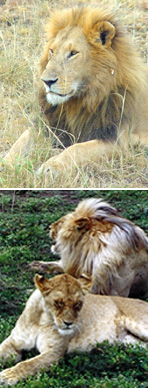
By the park’s principal water hole reside the park’s only lion pride. They don’t have much work during the dry season, because the animals in the area during the dry season will have to come to drink at some point. So the lions just hang out around the water hole.
At this time of the year there’s a bit more of a challenge, and we found the pride of 8 lion wandering some distance away into a dense forest, stalking impala. Shortly thereafter, we saw a magnificent male leopard strung (it seemed quite uncomfortably) atop the stick branches of a dead tree in the middle of that forest. Clearly, he had been chased up there by the lion.
The true Nxai pan is an amazing salt flat with raised islands of vegetation. Nxai’s most famous is “Baine’s Baobabs”, a little forest of 8 remarkably sculpted baobabs in an area that couldn’t be more than a half-acre large. It creates one of the most scenic landscapes in Africa that I’ve ever seen.
When boreholes for game reserves were first contemplated in the early part of the last century, there was some considerable debate about whether it was appropriate. The debate no longer exists.
I suppose as an East Africaphile I have an innate aversion to this, and many other similar management techniques employed in the south. Such as carrying capacity land management and culling.
But in the end, is it any different than the bird seed in my feeders at home, or the heated bird bath on my deck in the winter?
The great Serengeti Watch organization announced over the weekend that they had an advance copy of the Tanzanian government’s environmental impact study necessary for proceeding with the highway, but they didn’t analyze it for us. This is a serious mistake.
The 600-page report has not yet been officially released, but you can get to it through Serengeti Watch by clicking here.
I haven’t read it, and like many supporters of Serengeti Watch I’m upset that they led me to the document without some coaching as to what should be looked at in the 600 pages. The point of Serengeti Watch is to guide those of us who have placed our trust in them to take the lead. They’ve dropped an enormous opportunity, here.
Please, Serengeti Watch, give us a few more details and fast, before others not quite so sympathetic will do so.
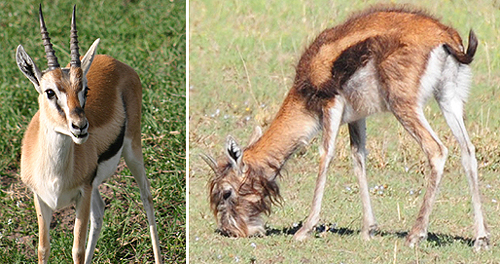
Healthy and diseased female thomson gazelle.
Mutant creatures and animal enigmas will soon be “driving packs of tourists” into Tanzania, according to wildlife officials there. Hmm. Slow news day?
This most recent claim of wild and wooly animal freaks was made by Paschal Shelutete, TANAPA communications officer.
Best diagnosis of the poor bloke Tommie is that she has Cushing’s Disease. The disease is caused by a variety of hormonal or pituary malfunctions and manifests itself differently in humans and animals. In humans the result is often loss of hair, but in animals, it can cause hirsutism, a condition of abnormal hair growth.
The professional level of TANAPA authorities reached new lows this year when they worked to end the current ban on international sales of elephant ivory, and fell in step with the politics driving the Serengeti highway. But this incredible claim by a TANAPA official, wrong on pathology and wrong on geography (his own!) leaves me speechless:
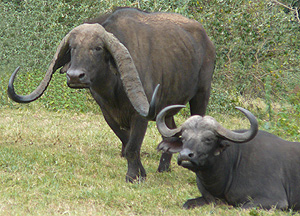
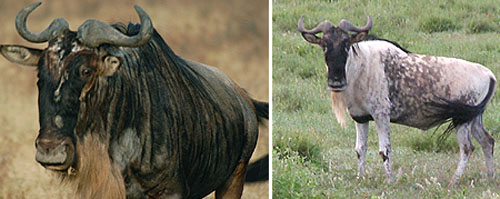
Animal mutations, especially with regards to coloring, are rare but widely known. All the photos you see in this blog I took myself, with tiny little cameras since I’m no photographer. In several cases it’s hardly more than a loss of pigment. In others, like the buffalo in the Aberdare, the weird horn configurations are probably a result of inbreeding.
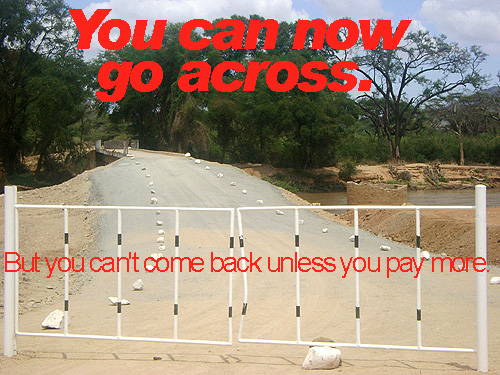
$50? $75? $100? $150? $200?One little bridge has been repaired in Kenya’s cockamamie system of big game parks. Is this Kenya’s Bridge to Nowhere?
To no fan fare whatever the bridge over the Ewaso Nyiro River was reopened on Saturday, theoretically reconnecting the two big game parks of Samburu and Buffalo Springs.
The key word here is “theoretically.”
This is the only bridge besides the main road’s at Archer’s Posts which links the two sides of the river. The bridge suffered its third washout in my life time last February during the heavy floods which ended the three-year mini-drought.
Theoretically, the bridge now allows tourists staying at lodges and camps on the south bank of the river (which is technically “Buffalo Springs Reserve”) to visit Samburu, and tourists staying on the north bank of the river in Samburu to cross over and visit Buffalo Springs.
Simple, eh? Well, no.
First, why would you want to cross over? Is the grass always greener on the other side? (There isn’t any grass in Samburu.)
The river was formed over thousands of years as a line in the sand at the point at which the Mathews Mountains watershed is meaningful.
North of the river (Samburu) is higher, hillier and catches more rainfall from the prevailing winds that butt against the Mathews Mountains. So there are usually more antelope, and therefore, more cats.
South of the river is remarkably much drier: gravel and flat, which usually attracts larger numbers of the rare northern desert game like Grevy’s zebra and the blue-legged Somali ostrich. Until Somak’s lodge opened on the south side last year, then flooded out, then reopened, there were fewer tourists on the south side, and the animals knew that.
So transient families of elephant, shier cats like leopard and mothers with babies like newborn giraffe were usually found on the south side.
So yes, you do want to see both sides, and seeing both sides would be the only way to attain the expectations of most brochures, pundits and Kenyan Government PR about “Samburu.”
Ergo the bridge.
Erstwhile Kenyan politics.
Click here to go to the Kenyan Wildlife Service website list of national parks and reserves. Can’t find Samburu? Can’t find Buffalo Springs? Is this a mistake?
Yes, it is a terrible mistake, but not for the reasons you might think. There’s no oversight here in the website. It is alphabetical, left to right by row. Still can’t find this reserve which is so important in every publicized safari to Kenya?
No one can. It isn’t a national park or reserve. It belongs to the county council.
(By the way. Can’t find the Mara? No, that isn’t a national park or reserve, either. It is three separate county council reserves like Samburu and Buffalo Springs are two separate county council reserves.)
This, of course, is lunacy. But that’s ordinary Kenyan politics, and regrettably, the new constitution which is doing so much good to bring sanity to places where there was lunacy before has not even touched on this subject of wildlife management.
Richard Leakey in his earlier days as head of the KWS tried diligently to bring all the important ecosystems under the authority of the federal government, the KWS. He lost his legs trying.
The Mara and Samburu bring in the greatest amount of tourist revenue of any of the great wilderness reserves in Kenya. But each are administered separately from the federal government. (The Mara is actually in an unbelievably worse situation.) Why?
So that the fat cats in the county council can pocket the proceeds.
See my earlier blogs on wildlife management for a continued harangue. Back to the bridge.
Now that the bridge is opened, the two county council’s which own the respective northern and southern parts of the great wilderness are fighting once again. Each side wants tourists to pay to cross the bridge and enter their land.
Well, I suppose there’s logic to that. But the logic ends when the tourist who is residing on one side, pays to go to the other side, than has to pay again to return to the place where his laundry is being done!
With fees rising this could mean $50 every time you cross over the bridge!
OK if it's an impala, but not OK if it's a goat?We appear successful in having brought the wild dog back from the brink of extinction without a moment’s reflection as to what that would mean to local people. A terrible mess is brewing.
I have seen wild dogs in East Africa 6 times in the last 15 years, 5 times in the last five years and 4 times this year alone. It’s obviously getting “better.” Time to pop the champagne!
Better not.
This week’s edition of the main Arusha (Tanzania) newspaper claimed that wild dogs were now so numerous that they are routinely killing livestock, injuring herdsboys, and packs in numbers of 20 to 40 dog were now attacking people.
“There is no programme to kill them,” Mr. Dawson Urio, the chairman of Uwiro sub village told the Arusha Times this week.
Remarkable.
Dog are nimble, skilled predators. Their numbers began a near cataclysmic decline in the late 1990s, and scientists knew almost immediately why.
Human populations were increasing, and human populations had lots of pet dogs. These pet dogs were largely immune to dying from distemper, but they often got sick and were rabid transmitters of the disease. And as pet dogs increased, so did rabies.
Distemper and rabies. They were wiping out the wild dog population.
The solution was simple. Go around to all the human populations around wild dog habitats and offer to inoculate the pets free against distemper and rabies.
Guess what. It worked.
But I have to admit not even I realized how this single-minded solution begged a much greater problem, and now, we’re confronting it full on.
Much faster than lion or leopards, much smarter than elephant, wild dogs are the coyote/wolf incarnate. And while coyotes and wolves do prey on some domestic stock here at home, they have nowhere near the opportunities that wild dog do in East Africa.
Literally every wild dog habitat is surrounded by herders with pets. And there is pressure from both sides of the dividing line: the reserves are experiencing rapid predator growth and the private lands just outside are experiencing rapidly increased populations.
Moreover, Maasai in particular, are rapidly learning to breed and sell stock, rather than just accumulate them as they did in former times. This means the pressure is building even more and the food chain is rattling even louder.
The dogs are being sighted everywhere: Arusha, Kilimanjaro, the Mara, Tarangire, Tsavo… even in Kenya’s woebegone Northern Frontier which was just decimated by the drought.
Tuesday, lion researcher Shivani Bhalla reported having seen 21 wild dog just outside Samburu National Park in the Westgate Reserve.
The Northern Frontier (Laikipia) is a vast area, with a biomass much smaller than that found on the great plains like the Serengeti and the Mara. Other predators like lions and leopards generally are in much reduced numbers and confined to narrow habitat bands within protected reserves that have fairly permanent sources of water.
Perhaps, the wild dogs prospered off the corpses of the more than 60% of the livestock that was lost in the drought. Even so, I think seeing this large a group of wild dog in Samburu is extraordinary.
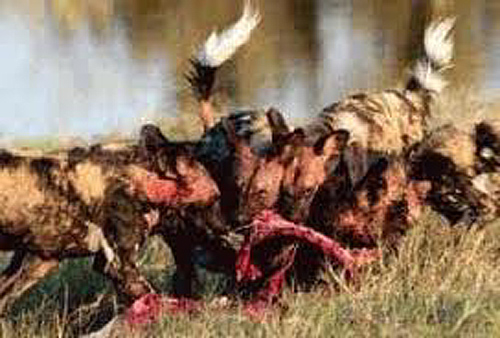
And few predators are as capable as the wild dog. Killing is its entire soul. Much more so than hyaena, they are cannibalistic:
Clearly we’ve got a problem. As at home where exaggerated stories of wolves and coyotes taking babies lacks any evidence, it’s going to be very easy to prove that a half dozen goats have been eaten by wild dogs.
The human/animal conflict is fast becoming the single greatest conservation issue in East Africa, today. Until now it was mostly with elephant.
No one ever expected an animal nearly written off to extinction would actually now be posing an even greater threat to man.
Elephants are on the rise, in numbers, in tusk size, in populations, and their growing battle with humans is straight on the top of the mind of Tanzanian voters going to the polls this week.
Lots has been mentioned about the side issue of the proposed Serengeti highway in this weekend’s elections, but an underlying component of that issue can be reduced to elephants.
It’s been more or less accepted in the campaign that if built completely the Serengeti Highway will diminish the vibrancy of the Serengeti/Mara ecosystem mainly by disrupting the wildebeest migration. But this amazing herd does not wander like elephants, and when politicians speak of foreigners’ interests lying “more with animals than people” what is understood is “more with elephants than farmers.”
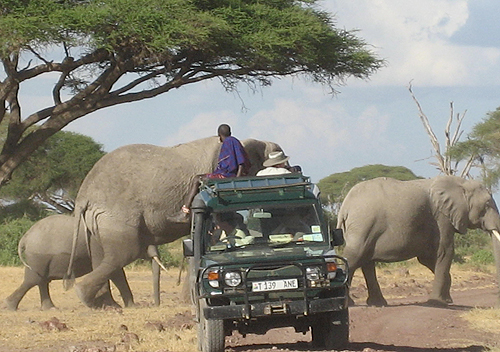
Our non scientific elephant viewing this year has been phenomenal. I have to stretch my memory back to the seventies to recall the numbers and sizes of elephants we saw this year. And if I as a casual observer had this experience, imagine what the farmer saw.
In fact, several times I saw what the farmer saw. Twice I watched farmers chasing elephants off crop land, obviously at great peril to themselves.
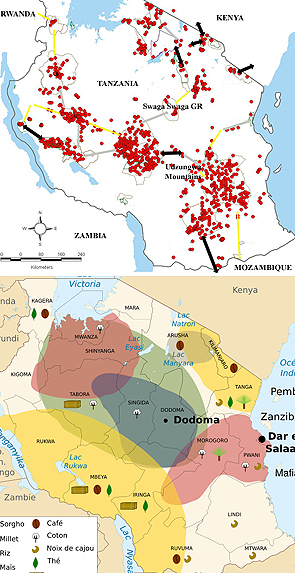
We are waiting anxiously for an important elephant report scheduled to be published before the end of the year by WCS that will show in much greater detail the state of elephants in Tanzania. But we got a glimpse of it this month when the coordinator, Trevor Jones, published one of the important maps that will undoubtedly be seen in the report.
WCS will undoubtedly define important elephant corridors throughout the country that link diverse protected areas. Allowing any animal populations great mobility increase the physical and genetic health of the species.
Jones is going to argue that very tiny corridors especially in the dead center of the country are essential to maintaining the health of the elephant populations.
Notice on the top left map Jones has placed arrows showing the most important corridors.
But these corridors fall directly over the country’s most productive agricultural regions. Note the map on the bottom left from the EU shows where Tanzania’s most productive agricultural lands are, right over Jones’ most important elephant corridors.
And while we may be waiting for Jones’ report, I doubt the voting farmers have to.
Earlier this year the Tanzanians were rebuffed by the world community when a plea to allow them to sell stockpiled ivory was narrowly defeated at the CITES convention in Doha. I robustly supported the Kenyan/U.S. initiative that managed the defeat.
My support for the Kenyan initiative was with the understanding allowing the sales would aggravate elephant poaching and because the case the Tanzanian officials made was terribly flawed, reeking of corruption. But the Tanzanian farmer is less worried about these issues than harvesting his pumpkins.
It was a shame that that important battle in Doha did not address the more serious human/elephant conflict which will now be addressed in the Tanzanian election.
Mutt struggling to survive over the Nguruman Mountains.Simon Ndege. Simon “Bird.” That’s what we called this little known man who has spent his life with Kenyan raptors.
In the earliest days of my safari guiding, hardly 30 years old, I irritated more than one client by insisting that we needed time to visit Simon Ndege. “To see a bird?!” was the universal exclaim. But once they did, their hearts never stopped racing.
Simon moved around a lot. He lived in old houses abandoned by missions in the middle of the Great Frontier, or he assumed a mud hut some affluent tribesman built. He was very shy and spoke so softly you wondered if there was a voice in there at all.
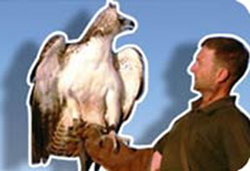
I’d crowd my clients about twenty yards from his hut, he’d disappear inside for what seemed like an incredibly long time, and then out he came with some magnificent raptor on his arm. His favorites were peregrines in the days the bird was very threatened, but mine was the gargantuan martial eagle. How he even kept it on his arm was beyond me.
And then, he’d fly the bird for us. Binoculars focused, the pigeon released, the raptor took off creating a wind storm around our heads. Once you synced onto the incredible soaring flight it was amazing! And then, when the dive to the kill came, it was absolutely unbelievable. Peregrines plunged down at 250 miles per hour!
I know that not a lot of my clients had the binoc skills to watch this, but then they would put the binocs down, squint and still get the rush watching the dot in the air fall like meteorite! Then, dinner over, Simon uttered one of his multitude of different whistles and the bird returned to his arm like a pterodactyl in a James Cameron movie.
Simon let us come because he was so poor. Finally a number of us, whom I’m sure he never knew, managed to direct a few yet respectable Saudi princes to him, and for a few years he earned some good money. A pair of Simon’s desert raptors sold for $25,000 in the early 1980s.
But Simon wasn’t interested in selling birds. He wanted to make them free. A number of organizations kept Simon alive and happy, as he moved shyly through life among his grand and awesome birds.
When asked for a bio that could top a blog a woman friend now writes for him, this was all he had to say:
“I was born and raised in Kenya and have looked after raptors ever since I was a small boy. I’ve been rehabilitating and conserving large African eagles including Martial eagles and Crowned eagles, as well as falcons and hawks, for the last 16 years for the Peregrine Fund and the National Museums of Kenya. I work wherever the birds take me.”
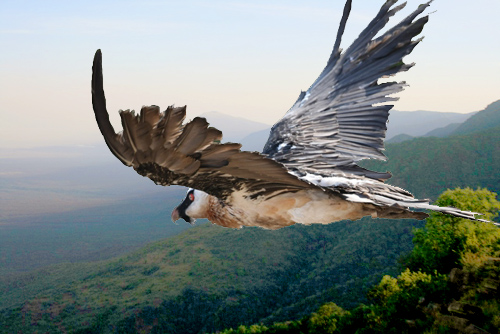
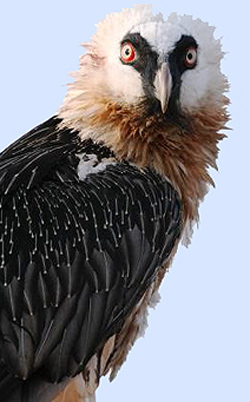
Simon’s latest project was “Mutt,” a Lammergeyer, one of the most beautiful and endangered raptors in Africa, also known as the Bearded Vulture. In a rare account of his work, the attachment perhaps obsession that this extraordinary man has for raptors spills all over the narrative. But in between the sad facts of the failure in reintroducing Mutt is revealed in much greater amplitude than I was ever privileged to know the story of a very special and dedicated lover of birds.
I have edited the original blog, which you can read here.
**********************
the Lammergeyer Release
account by Simon Thomsett
transcribed by Sheryl Bottner
I was asked by a friend about the outcome of the Hell’s Gate Bearded Vulture re-introduction project. There is no way I could answer what took up years of my time in a few brief sentences so I thought I could write this blog. In a nutshell, five Bearded Vultures (Lammergeyers) were rescued from Ethiopia in 2001-2002. The project had multi-NGO backing including support from the Peregrine Fund finance, Kenya Wildlife Service and the Ethiopian Wildlife and Conservation Organisation. The project was partly successful with two of five released birds surviving in the wild for years.
Our intention was to take 15 birds, some put aside for captive breeding, some for immediate release. We could easily have filled that quota with the abundance of Ethiopian nests, but logistically it provided tough to do. Although I had great support from volunteers and colleagues and for two years it was easy to see the famous “Lammergeyer’s of Hell’s Gate,” active persecution of the released birds and proliferation of industries within Hell’s Gate together with a burgeoning human population compromised the continuation of the plan. Two of the five birds were lost.
Mutt had to be recaptured.With one of the remaining three birds recaptured to save its life, we changed our aim to captive breeding, recruiting birds within Kenya using a no-impact sibling rescue method we pioneered in Ethiopia. Although accepted, we failed to get adequate official assistance or appropriate permits. As a result we lost 4-5 opportunities to take young. In addition I closed down the facility in Athi and had to seek new homes for all the raptors there, including the remaining Lammergeyer called “Mutt.”
The final destination for Mutt the Lammergeyer was not as we had planned. I hoped that she would be free and find a mate in the Nguruman mountains on the Kenya and Tanzania border.
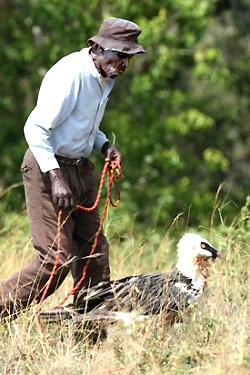
In February 2009 Laila Bahaa-el-din and I delivered Mutt to Mark Jenkins at Ol Donyo Laro, below the Nguruman Mountains on the Shompole plains near the Kenyan/Tanzanian border. Mark built a shed on a mountain ridge so that Mutt could establish herself and get “homed in” to the location. Despite the cage she was feather perfect but she was unfit for the wild, so I decided to rig up an outside flight arrangement that allowed her to fly some 90m. For this I needed Matusa my old assistant who came out of retirement to help. Matusa, I hoped, would be able to put Mutt out each day and return her in the evening to the shed, lest leopards eat her.
Finally we were ready to release Mutt and I drove back to the Jenkins’ ranch. This is some of the softest volcanic ash on earth. The wind-screen wipers struggled to keep dust out of our view. The air intake filter needed to be removed and cleaned every few kilometers. The drought was terrible at the time, exasperated by an invasion of livestock many times over that which the land could possibly sustain. Dead cattle and wildlife littered the road. Significantly not one was eaten by vultures or hyenas.
We met Mark Jenkins and after a grateful shower, fine meal and good night’s rest we continued the next day to drive the one hour up the mountain to Mutt’s domain. Matusa, well into his seventies, excitedly told me of the elephants that smashed trees outside of his banda the previous night. He recalled similar nights, many years ago near Machakos with a mournful shake of his head and click of his tongue. There haven’t been elephants there for the past 40 years.
The trouble with Lammergeyers (Bearded Vultures) is that they do not train up like other more conventional raptors. They find it difficult to land on a glove for example. They never get keen or hungry enough to consider flying to receive their food on a lure or glove like a hawk. While there is a negative side to training Mutt it would greatly have helped her overcome her physical weakness and allowed her to understand that she could habitually feed at a certain location. I just didn’t have the time to train her. The best we could do was to give her a long climbing rope to fly up and down from perch to perch. Since her earlier failed release I noted that she had spent much of her time leaping about and fracturing the tips of her flight feathers. She was obviously keen to go.
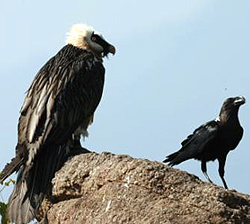
Mutt and two wild White-necked Ravens had become good buddies and I hoped they would help lead Mutt in search of food when she was free. I heard from the rangers that one raven got too cheeky and while stealing food was grabbed by Mutt. Some respect was now afforded to Mutt. Alarmingly the rangers and I had not seen more than three vultures from Mutt’s shed for the past nine months! Mark Jenkins had seen a few groups but he too recognized their serious decline. This was something inconceivable only a few years ago when dozens would be expected each day.
On October 7 we took Mutt’s jesses off. Matusa walked her to her favorite rock. Mutt sat there as though nothing had changed. I wanted no dramatic release. She should leave at her own chosen speed and not be hurried into it. The hours ticked by. The magnitude of the event was long past and we all turned our attention away. I lowered the camera. Then the wind stirred. She lifted off and sailed past the perch and over the valley.
We ran for binoculars and telescopes to see her traverse distant mountain ridges with the grace of a veteran. She vanished out of sight heading towards Tanzania. I turned on the radio receiver to hear its edifying silence. Later just before dusk the radio signal was faint, then strong. She had moved back into range. Somewhere within 30 kilometers she spent the night.
* * *
(From Jim: A successful release of a rehabilitated raptor begins with its first flight, but it never immediately flies away. Often for weeks it returns to the “hack” site where it first launched, where the falconer provides the normal meals the bird ate during captivity. As the bird regains its skills and develops its muscle tone, it will begin to hunt on its own, finally abandoning the hack site for good. Mutt never returned to the hack site, so Simon had to track her down.)
* * *
Mutt the Lammergeyer flew into a border zone where security is not so good. The next five days were some of the toughest I have had for many years. I scrambled, slid, abseiled and climbed in search of an elusive “blip” on a radio receiver. I was scared because if she was killed or disappeared out of radio contact I would have the death of a very rare animal on my conscience. The responsibility of it was sickening especially so as others would be sure to take a dim view of failure. In hands-on wildlife management critics are ever ready to oppose, no matter what the outcome. It was not good to worry about people’s opinions but as we searched with an ever increasing risk of finding her dead, I kept reinventing what I was going to have to report. In every respect this was the best chance Mutt would have, with the huge resources of Ol Donyo Laro supporting her. If she failed here she would have no hope anywhere else.
I exhausted three ranger patrols, which would have made me chuffed had I not been highly alarmed and in dread of finding her dead. Frustratingly Mutt proved yet again her total inability to return to the “hack” site for food. Instead she hid. Sometimes she must have flown out of one canyon into another, hugging the forested contours and never venturing out into visual range.
From a distance the Nguruman mountains look like rolling hills cloaked in forest with patches of cliffs and open grassland glades. From afar these look ideal and it is possible to find elephant paths that allow easy walking. You can walk the entire length of these mountains in glorious wooded avenues stamped asunder by millennia of elephants and buffalos. To picture the untrodden slopes in which Mutt was so unkind as to spend the night, think of taking a few dollops of mashed potatoes and arranging them in a neat line like Alpine mountains. Then with the back of the fork go berserk scraping the lower sides with furrows and ridges. Then pour thick gravy all over it so that you cannot see these wicked furrows and you have made the section of mountains in which Mutt decided to hide. It looks smooth and forested from the outside, but in fact it is deeply scared beneath with a myriad ridges. It is impossible to get a good fix on a radio signal because radio waves bounce or get cloaked depending upon the landscape.
Larle, a ranger who had helped me with the previous failed release, was inexhaustible and stayed with me for two days. Like me he was unarmed and did not carry a flak jacket, provisions, radio, heavy army boots etc., as did our original accompanying ranger force. We left them far behind as we moved mostly on all fours through terrible terrain.
The second night I woken with deep pain in the back and was unable to sleep until dawn. The day before, while negotiating a rocky slope in thickets I had slipped badly and hurt my stomach and back with the stiff backpack which had a thick kidney belt. The next morning I urinated some blood and decided to take it easy and stayed in camp. Thankfully things settled down. All I got that day from Mutt was a steady and reassuring signal coming from the same sort of area far across the valleys. The next day we went early with a fresh team who surged ahead and left me behind. They had no idea where they were going and soon came back. Cautious about my health I plodded along warning them that they had no idea what was in store for them. They needed to reserve their energy.
The next 10 hours saw us sliding and crashing up and down vertical banks, sometimes on ropes. The rangers would pause every hour to shake their heads in wonder. Surely none had seen these parts of the mountain. Mutt’s signal was wandering. She was flying. We went lower down the mountain descending hundreds of meters mostly on our backs and finally appeared at a large spring. The water was cold, very pure and much appreciated. The spring fed a small riverine line of tall trees and beyond it was the lowland hot acacia woodlands. The hill here was called Milima moto (meaning hot hill), and it lived up to it.
The rangers, feeling as though they had all survived an awesome experience all expressed a resolution that no matter what, we would continue on and find Mutt no matter how far she had gone. They were prepared to walk a week or more and have rations dropped on them from the sky. Still feeling beat from ailing kidneys, my comradery with my new fraternity faltered at this suggestion and I sincerely hoped that I could borrow a plane instead.
In line with her radio signal we saw a Crowned Eagle fly out over the hot lowlands and descend fast. I thought this odd because Crowned Eagles are restricted to the high forested slopes from which we had come. The radio suddenly went quiet, an ominous sign so we immediately pursued the signal now over this flat landscape. We trudged on towards a huge salt lake sweating profusely in the stifling heat. I tried the radio receiver and changed course to the left. It was so faint a signal and she sounded a very long distance away. Maybe she was covering ground fast. Then appearing before us were a few giraffe looking down, and there on the ground was Mutt. She had been beaten to the ground by the Crowned Eagle.
In the next few weeks I organized a new home for her at the Honorable Mutula Kilonzo’s residence near Machakos. Mutt has had more than enough opportunities for freedom and has demonstrated an inability to return to the place of release. She never ate and spent her freedom sulking, frightened and hidden. Even with the full support of Ol Donyo Laro and their formidable team of rangers we recognized that another release attempt would be fatal. I was disappointed in the lack of other wild Lammergeyers, as these hills were a previously known habitat for this species. The future of Mutt must now include captive breeding.
To be honest I dread the responsibility of re-opening the Bearded Vulture re-introduction project, as it will entail considerable physical effort and fiscal resources. Neither of which I have these days! The lessons I learnt nearly a decade ago were not so much the difficulty in achieving a re-introduction, but the insurmountable problems encountered in modern day conservation bureaucracy. Personally now, I have a few priorities to straighten out securing a place to work and live, before I can focus attention on Mutt, again.
Running to the right, unstoppable campaign!The human/elephant conflict is becoming a major campaign issue in both Kenya and Tanzania. Soon, efforts towards resolution will lose out to the calls for culling.
Western wildlife NGOs and local researchers have been working tirelessly on human/elephant conflicts over the past decade. They haven’t gotten very far. It’s hard to keep six tons from doing what it wants.
Tanzania elections are scheduled for the end of the year and new elections in Kenya for the new branches of its legislature will occur next year. One leading candidate in northern Tanzania, Abdilah Ali Warsama, campaigned this weekend on ending elephant harassment of local farms.
He’s not calling on the government to cull elephant… yet. Right now he’s just demanding compensation to the farmers and second, elephant fences.
I’ve never heard of elephant fences.
What Warsama may actually mean is the extremely expensive trenching or construction of deep moats which in several places in East Africa seems to have worked.
I saw a successful trench for myself at the southern end of Uganda’s Queen Elizabeth National Park in the Ishasha last month. It’s a temporary solution, because the earthen moat erodes with time. But this particular 2-meter deep and 2.5-meter wide trench was working and going into its second year.
The problem with trenches is that their goal is to stop wildlife from moving beyond the trench.
Wildlife purists don’t like that. In Warsama’s constituency (the Tanzanian town of Makuyuni, in between Lake Manyara and Tarangire national parks) the African Wildlife Foundation wants to create a corridor for elephants between Manyara and Tarangire.
No successful trench would allow that.
Nothing else has worked: not pepper spray, electric fences or lead-in corridors that try to direct animals away from human habitations.
Tarangire has long been known as a prime elephant park. One of its current attractions – developed only in the last couple years – are congregations of a dozen or more huge bulls hanging around together near park roads as if modeling for tourists.
Normally this many bulls would’t hang out together.
But they’re resting and enjoying the fruits of a night of hawkish delight. These jumbos move out of the park regularly at night to raid nearby farms. Then, lounging in the protection of tourist cameras, they convene just inside the boundaries during the day.
Wasarama is not happy with Tarangire’s new attraction. He pointed out that 250 acres of his constituency’s food crops have been destroyed in the last season, and that four farmers were killed trying to defend their crops.
I don’t doubt it. Last March as my migration safari was zooming along the Tarangire / Makuyuni road at about 80 kmh, we watched a farmer using a huge bola single-handedly as he tried to chase a family of five elephant out of his corn crop.
Wasarama’s campaign issue in Makuyuni is by no means isolated. Similar situations exist outside Bwindi in Uganda and the Aberdare in Kenya.
I see the day coming soon when the human/elephant conflict gets so serious that culling and contained reserves using trenches is the only solution. It’s hard to imagine an alternative.
Wednesday early morning police (it took three of them) shot (multiple times) and killed a mountain lion found in a residential area of Berkeley, California.
A 90-pound mountain lion (also known as a cougar) is roughly the same size as a cheetah, although stronger. The cheetah is built for speed whereas the cougar is built to bring down a deer, one of its staple foods.
The cougar population in California has been stable and healthy over the last decade, and there are growing calls to allow sports hunting, although Proposition 117 (passed in 1990) designated cougar as a “specially protected species.”
Not too successfully so Tuesday night.
The 911 call went out at 2:23a. Police called emergency California Fish & Wildlife officials, but they were hours away. The three police chased the cat through numerous backyards finally cornering it.
When asked why a wild cougar would find itself so far from a reserve, police admitted that the animal might have been a “pet.”
Alert. Alert. All 90-pound labs, rots, mastiffs, Shetlands, large boas and all Danes, stay inside your house! I’ve been working on my cat, Hillary, but she’s headed in that direction, too.
The public reaction has been mostly negative, based on the comments left on the San Francisco Chronicle story as well as several local blogs. Much of the criticism is exaggerated, although I personally think the police reaction was unnecessary.
The determination that the cat posed a “real and present danger” is hard to support. There are fewer than a dozen attacks by cougars every year, continent-wide. And the claim that professional wildlife officials were too far away to help… well, do the police know of that little institution known as the University of California – Berkeley? Not sure, but I think they do some zoology there.
Compare this to a much more dire situation in East Africa, where real lions, 4 to 5 times as big, are becoming an increasing concern to growing urban populations. Where up to ten people per year are now killed by them in East Africa.
Predator/human conflicts are not considered an American problem. Thank goodness, because this is certainly not the right solution.
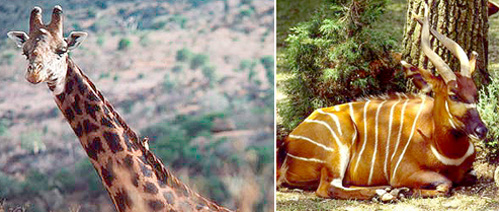
I actually snapped this Rothschild in 1986 along a farm road near Wamba, Kenya. My bongo pix are all on slides. This one is from the Louisville zoo.Two beautiful African animals face extinction because wildlife officials and scientists can’t agree on how to reintroduce zoo-bred individuals. And interestingly, it’s now become something of a contest (battle?) between the American zoo-world, and the American museum-world.
According to the IUCN, the mountain bongo and Rothschild giraffe face extinction in the wild if immediate efforts to reintroduce zoo-bred offspring aren’t successful.
I had just started my safari businesses in the 1970s when we routinely saw both animals on each and every safari. The bongo appeared nightly at The Ark and other tree hotels, and we often stopped on any rural road anywhere in Laikipia and could see a Rothschild.
This is as big news for Africa as the demise of the polar bear is to North America. The Aberdare National Park’s insignia continues to be the bongo. So in my life time, two large poster animals have almost disappeared.
There are plenty in zoos. Why can’t we just … put them back? Well, we tried. And failed. So far.
There is more hope for the Rothschild than the bongo. The Rothschild is living and breeding well in several places in Kenya, especially Lake Nakuru National Park. The problem is that these are not truly wild ecosystems: animal movement in or out of Nakuru was stopped when it was fenced more than 15 years ago.
There are 65 Rothschild in Lake Nakuru. There is a population twice as large in the unenclosed Ruma National Park (formerly “Lambwe Valley”) adjacent Lake Victoria in Kenya’s remote western province.
But small 50-square mile Ruma is considered critically threatened by encroaching farmland. It’s hard to get to so draws few tourists and so no revenue for wildlife management. And it’s surrounded either by the waters of Lake Victoria or densely populated areas: not a real fence, but a human fence.
There may be an additional 600 animals in various, remote and scattered places in the wild in Kenya, Uganda and the southern Sudan. But definitely no more. Uganda’s remote Kidepo National Park may hold the healthiest population.
American zoos have bred Rothschild giraffe extremely well but none are being exported back to East Africa, because of the embarrassing debacle of trying to do so with bongo. Eighteen bongo were sent to Kenya for reintroduction in 2004 but they have yet to be reintroduced into the wild.
Big consortium. Cost lots of money. And six years later the bongo is in worse condition than before. There are now only 103 bongos left in the wild. In 2004 when the zoos made their move, there were about 200.
Half the wild bongo population lives in the Aberdare National Park and I’m still lucky enough about every 3 or 4 visits to see one. The other half of the population is scattered in Kenya’s unprotected forests and on Mt. Kenya.
The penned-up for-reintroduction 18 bongos are something of a sore spot among us non scientific wildlife enthusiasts. But officials argue that simply releasing zoo animals into the wild is a near death sentence. They must be taught to fend for themselves – no easy task – and they must develop an acute vigilance against predation, also hardly a cinch.
But you’d think if six years weren’t enough schooling for zoo animals to learn the wild ways that they wouldn’t have been sent to Kenya in the first place. For Pete’s sakes, give them to Spielberg!
Bongo declined rapidly in the 1980s because of encroaching human populations around the giant Aberdare reserve that forced lions from the savannah into its altitudes. Lions don’t normally live in rainforests: No zebra or wildebeest up there, but the 300 kg bongo is just as tasty.
In less than a decade, the lions were eating the bongo to extinction, until the lion were forcibly removed from the Aberdare, and the Aberdare was then fenced.
So why not just drop them back into the Aberdare, now? The park is fenced and there are no lion!
Because those 18 bongos, (as well as another 500 bongos still kept in worldwide zoos), all came from a single wild population extracted from the Aberdare in the 1960s. It’s feared the inbreeding would be as devastating as lion.
Didn’t anyone know this before buying their airline tickets in 2004?
According to a press statement issued a few weeks ago by the Kenya Wildlife Service, The American Natural History Museum has now become involved, an interesting assertion that American zoos couldn’t muster enough good science to figure this out in the last six years.
ANHM will supposedly run critical DNA science on both the Kenyan-held, zoo-held and wild populations to help KWS decide where to go from here.
Oops. There goes the migration!A recent study in Kenya has sparked enormous confusion over the long-term future of its wildlife, particularly in the Mara. But a couple things do look certain. Don’t stay outside the reserves and don’t privatize national treasures.
I hate reporting a story like this, but it’s been growing in my conscience like mold on the wall. Time to disinfect.
“Scientific studies” in Kenya just don’t carry the weight of well-funded work elsewhere in Africa, particularly in the south.
Just a few months after rains returned to East Africa late last year, the Kenya Wildlife Service mounted an animal survey that began in Amboseli. KWS concluded that as much as 83% of Amboseli’s wildlife had been lost.
Click here to see the survey. Oops. Gone? It’s been removed. But aha! I saved the paper: click here.
All sorts of bigwig organizations participated in that paper, including some that are now criticizing it.
Evidence is growing that the survey was wrong. Not long after the survey suggested that most of Amboseli’s elephant and wildebeest had died, Cynthia Moss’ ATE
group reported that “most” of the elephant were returning, although with fewer juveniles. And only a few weeks ago, one of ATE’s researchers, J. Kioko, reported that “about 1000 wildebeest have arrived in the park.”
Now, this second damming report might be just as flawed.
The Mara Conservancy, one of the two authorities controlling the Maasai Mara, issued a stunning denial. The Conservancy called the report “false.”
The report put much of the blame on the explosion of Maasai homesteads in the “private” reserves that ring the Mara conservancies. Specifically, the report claimed there were only four homesteads in 1950 and that there are now 368. And in what I consider a gross indication of the report’s inaccuracy, it claimed there were 44 huts in 1950 and 2735 in 2003.
Homesteads, maybe, but huts are built and torn down weekly. The 1950 data wasn’t sourced, but had to come from colonial authorities, and native statistics in 1950 have been proved time and again to be grossly inaccurate.
Paula Kahumbu, Executive Director of Richard Leakey’s reputable Wildlife Direct organization, remarked as follows on one of the report’s huge claims of wildlife losses:
“For the life of me I cannot find the 95% decline in giraffe in any of the blocks – the greatest decline that I can find is in block 3 where numbers of giraffe decline from 37 to 12 individuals. That’s only a 67% decline.”
I’m not trained or blessed with enough time on my hands to wade through the competing reports to determine in any scientific fashion which are right and which are wrong.
But that’s not going to stop me from making a few conclusions that might help those of you interested in East Africa’s wildlife, or those who are considering traveling there.
First, why are things so confused? Isn’t science… science?
Yes to the second, but as the first, Kenya’s problem is unique; unique even to Tanzania, its nearest and most similar neighbor. The government of Kenya long ago divested itself of full control over a number of its wildlife reserves, including both Amboseli and the Maasai Mara, arguably the two most important ones.
These great tracks of national treasure were seconded to local authorities (Maasai county councils) who exacerbated the problem by privatizing their operations.
The federal Kenya Wildlife Service (KWS) still has some authority in both areas, but the bulk of the authority, including reporting facts on a day-to-day basis, is left in private hands. Even anti-poaching patrols in the Mara are run privately, not by KWS.
And to make a terrible situation intolerable, in the last decade the Mara was divided into two separately operated reserves. One by the Narok County Council, and the other by a sister Maasai community, the Trans Mara County Council.
One of Kenya’s legendary safari guides, Allan Earnshaw, wrote recently for the East African Wild Life Society, “The root of the problem is the fact that whilst the Maasai Mara is called a National Reserve, it is in fact treated and run as a local asset by the two different local authorities.”
(Problem upon problem: I cannot link you to this article, because remarkably EAWLS does not publish anything digitally.)
But Earnshaw is right on. And it gets truly ridiculous, as is the case as I write at this moment, if you wish to visit the entire Mara (which isn’t very big, you could do it in a day), you have to pay two fees: two times $60, to cross the Serena bridge going from one half to the other.
Anti-poaching patrols and scientific study groups are similarly constricted.
Collection of tourists fees, scientific study oversight and anti-poaching are operated by private organizations, separately for the two halves of the Mara, but the building of tourist lodges is a federal decision.
So since 2005, “no fewer than 55 new camps and lodges have been built in the Mara.” In 1997, there were a mere 20 camps and lodges. Today, according to Earnshaw, “there are over 100 and counting – with a bed capacity for 4000 tourists.”
The confusion over the numbers of animals, and the numbers of tourist lodges, is because there is no single authority managing the Mara. Studies and revenue receipts contradict each other. Private companies, competing for business jobs, exaggerate their potential. There is no neutral authority overseeing all this.
This is a Ph.D study of mismanagement at the least. Can’t do that, now. But let me try to glean from this mess three simple conclusions:
The effect on the area’s wildlife by the last drought was not as bad as local “scientific” studies suggested.
It was still bad, but probably not worse than in previous droughts. And with time we’ll know this for sure, but even in this short period of time since the rains returned late last year, things look pretty good to me.
Second, game viewing is increasingly depressed outside the parks. If you want to see a lot of game, avoid the private reserves and stay inside the park.
(Necessary semantic clarification: The Maasai Mara is not a private reserve, it is composed of two separate (County Council) government reserves, but it is privately managed. But ringing the Mara as is the case with almost all parks in East Africa, are adjacent or near adjacent private lands with tourist lodges.)
&Beyond’s Klein’s Camp and the Grumeti Reserve camps outside the Serengeti are examples. Saruni, Sasaab, Elephant Watch Camp are others outside Samburu. Treetops and Kikoti outside Tarangire. Literally all the Bush ‘n Beyond camps, and Laikipia camps like Lewa Downs and Loisaba are outside parks.
This doesn’t mean they aren’t fabulous additions to a vacation with their own unique attractions. It just means if you aren’t close enough to a park to at least enter it during a day-trip, your game viewing will be depressed compared to being inside the park.
Third, privatizing management of national treasures like a wildlife park or national Park (as being considered in the U.S.) is nothing less than stupid.
It transforms good, neutral scientific studies into the components of a cost-effective business plan. It prostitutes moral authority with profit. The decline of American zoos, for instance, I place squarely on the fact that the vast majority were privatized in the 1980s and 1990s.
America, take note. Kenya’s greatest national treasure, if it is in peril, is because it was off-lifted into private hands.
No pension and biodegradable.An important electricity line has just been laid in western Mozambique, crucial to the development of Mozambique’s big new Limpopo National Park.
Thanks to. Rats.
Yes that’s right. Installation had been stalled because of the huge numbers of land mines that remained in the area from the civil war. Land mines are a problem throughout much of troubled Africa, but nowhere as severely as in Mozambique.
An area of about 5000 sq. meters (100m x 50m, roughly the size of three American football fields placed end to end), was known to be full of mines, and there was no other way for the huge electricity grid to go.
The mines were known to be there, because of the skeletal remains found by the pylon diggers in the rectangular area they were to enter. The bones were from years of innocent people irregularly traveling through the remote area.
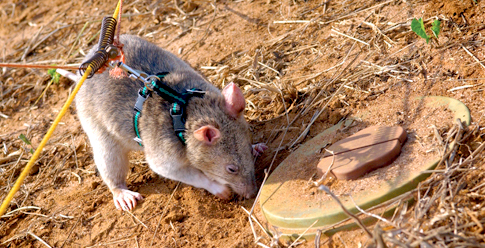
A pack of rats was let loose, identified the 32 mines in the area which were then dismantled, and the lights are on!
The giant African pouched rat is the work horse. It’s the genius work of a Belgium aid group, Apopo, with the cooperation of several organizations in Tanzania, including the army and Morogoro university where the rats undergo training.
The rat has an especially keen sense of smell. Like white rats, it’s affectionate and not aggressive, more like a bunny than vermin. Apparently it’s also quite intelligent, responding to Pavlovian training as if it were a dog. And, of course, it digs nicely.
What I find especially interesting about Apopo is that its founder and original collaborators were all engineers, those guys who look at a problem through its pieces. Traditional detection mechanisms went for the metal that the exploding powder turned into deadly shrapnel. But land mines are mostly composed of very aromatic powders (gun powder), and it was onto this principal ingredient that the geeks turned their attention.
Rats are cheap, friendly, responsive and biodegradable. AND when they step on a mine, it doesn’t go off!
Now consider this. The chief engineer, Bart Weetjens, is a practicing Zen Buddhist Monk in Belgium. It would take someone as out-of-the-box as this to create this genius scheme.
And guess what. Mines is just the first. The rats have just been trained to detect tuberculosis! Yes, and they will do so with greater success than the difficult X-Rays and chemical tests otherwise used.
Must we choose between elephants and less traffic congestion?The southern African countries are meeting today in Malawi to decide whether to withdraw from the CITES convention. They almost convinced me to support them, and then, they blew it.
The withdrawal from CITES (Convention on the Trade in Endangered Species) by part of the world where half the elephants live would throw the treaty into turmoil, even though that might not immediately threaten elephants.
I find myself slowly moving into the southern African camp after a life-time of supporting the East Africans. I have little doubt that relaxing the ban on ivory sales will increase poaching, and that will unequivocally negatively impact tourism in East Africa.
But I’ve seen more and more the destruction that elephants are doing, and the pitiful response of NGOs and governments alike to assist with the human sacrifice. More and more, CITES is looking like a Rich Man’s Treaty.
Yes, CITES protects Kenyan tourism. But what does that mean? Is it protecting revenue to develop the country and sustain its environment, or is it more just giving us rich westerners a better vacation?
The withdrawal from CITES was proposed by Botswana. The 15 nations in the trading and tourism organization Botswana is petitioning would be directed to urge their governments to take official action to withdraw, which will take a long time. But if that ultimately happened, CITES would be thrown into turmoil.
I doubt anything except hot air will come out of the convocation, but it makes us realize once again that just protecting elephant without protecting people begs fairness. Elephant protectors argue that the healthier environment and proper management of these jumbo forms of wildlife actually contributes to economic stability. Politicians, farmers and the poor feel significantly otherwise.
With as much coincidence and political adroitness as the Goldman Sachs hearing before a successful Democratic vote to move forward bank regulation in the U.S. Congress, Botswana and Zambian media last week were incessant in reporting about a family of elephant near Sesheke destroying crops and threatening farmers and villagers.
Sesheke is in the triangular border of Namibia, Botswana and Zambia just outside the famous Chobe National Park, which earns more tourism revenue for Botswana than any of its other protected wildernesses. Botswana argues that the human suffering in the area is simply not worth the tourism revenue, or that the tourism revenue won’t suffer that much if elephants are protected less, or both.
Botswana claims that it could earn up to $7 million annually by selling ivory that was simply harvested from naturally dead animals if it withdraws from CITES. Meanwhile, it spends $1 million annually just to manage the stockpile of collected ivory it can’t sell. These are significant amounts for a poor country.
But alas, the southern Africans aren’t doing their cause much justice this time around. The whole meeting grew farcical yesterday when it elected the Zimbabwean Ministry for Tourism its chairman. There hasn’t been any significant tourism in Zimbabwe for years, and nearly everything Zimbabwe does these days destroys tourism and its own development!
So the serious intellectual argument dissolves in farce. My wrenched little conscience starts laughing hysterically.
Ultimately, I just feel that the Africans have the preeminent position in determining not just the morality but the economy of this contentious debate, and I’m ready to give them the benefit of the doubt.
But if they make their spokesman and point man someone from a country with as destitute morality and economy as Zimbabwe, how on earth can I embrace their arguments?
Bluefin reception eats last tuna.The whole damned world is becoming politicized. It isn’t just us, and it’s not good for animals.
The quintessential world treaty, CITES, which has done so much good since its inception in the 1980s to protect endangered species became totally politicized at the March meeting in Doha.
Horse trading ruled the day. Sorry, elephant trading.
The convention resoundingly defeated any attempt to relax elephants’ listings as endangered. There will not even be any one-off sales of stockpiled ivory, as requested by Tanzania and Zambia and supported by most of the southern African countries.
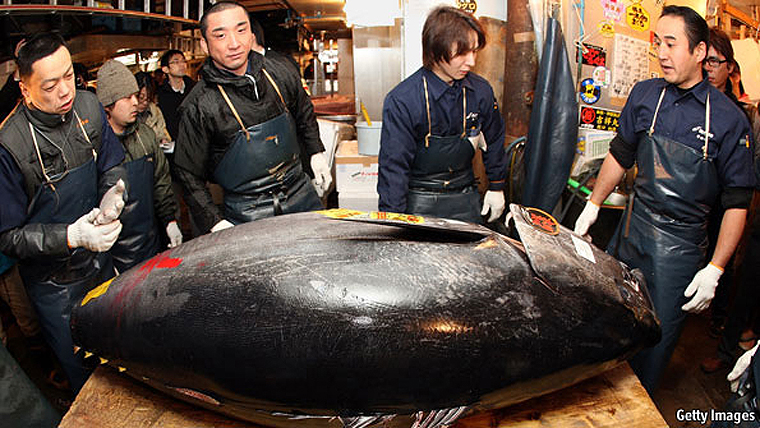
Elephants won, but at the expense of bluefin tuna; many corals; hammerhead, oceanic whitetip and spiny dogfish sharks; and polar bears. The scientific reports tabled at the convention overwhelmingly supported at least some restrictions on these rapidly dwindling species.
But while in the past science ruled mitigated by a harsh but important consideration for local economies, this convention was ruled by politics.
And it was crass.
After eles won, the big fight was over bluefin tuna. There is wide consensus that the population is in catastrophic decline but also wide recognition of its economic importance, not just in Japan, but also in Europe. There is even an organization created by world powers just to regulate this single species: the International Commission for the Conservation of Atlantic Tunas (ICCAT).
It’s a very practical commission: the mandate – unlike CITES – is not to protect the biodiversity of planet earth, but its economies. Economists recognized that without regulation the bluefin will disappear, so that regulation that prolongs the species’ existence is a good economic move.
But ICCAT was politicized last year when the European Union made an end-run on the commission’s authority by claiming that Europe as a whole – rather than just the European countries’ that consume bluefin – must be regulated.
By the formulaic process that economists – as opposed to environmentalists – work, that allowed France, Portugal, Spain and Britain to harvest a disproportionate amount of bluefin compared to the population of Japan, since their consumption was numerically diminished by nonconsuming eastern European nations.
So it left Japan out in the cold … sorry, out in the sea.
Japan responded at CITES by flying in the trade and fishery ministers of more than two dozen African countries where Japan is the champion of free-world non-military foreign aid. These senior government officials trumped the scientists which used to be the sole delegates and voters at the convention.
Then, to celebrate before victory, Japan hosted a huge reception where it served blue-fin tuna. Martha Stewart would call that Bad Form.
And the polar bear trading didn’t stop there. Why did Senegal, who supported the ban on elephants, vote against listing polar bears? Supposedly because there was an Inuit delegation that successfully argued it was their livelihood (even though CITES could clearly not regulate indigenous hunting of species). I think rather it was tit for tat. Sorry, eles for bears.
What does it all mean, that the natural history of earth is now being won or lost by the best politicians?
What does it mean that national health is being won or lost by the best politicians?
The complex answer is the same. It means that science and practical sense loses to forces more immediate: and that usually means the pocket-books of the rich and powerful. Sorry, rich is powerful. (And vv.)
I wrote earlier about the slow response America had to all of this. Well, to some extent, America came through at the last moment. The Kenyans take credit for probably instructing the Americans on what was happening, and in all the battles, the Americans came out on the side of a green earth.
But it took them a while, and they had no good response to the blue-fin tuna dinner. There’s so much on the table at the moment for America’s new administration, that I guess they just didn’t see the fish.
CITES bans ivory sales.Elephant are safe for the moment, but what about the people they’re trampling?
The CITES convention in Doha yesterday strongly rejected Tanzania and Zambia’s petition for a one-off sale of warehoused ivory. I think that’s the right decision, but will others step up to protect ordinary citizens?
(And note that the Obama administration became a pivotal force in denying the Zambia and Tanzanian petitions. This after months of silence on the issue.)
In Nairobi where I currently am staying between two safaris, the Kenyan media is jubilant. It was a page one story in Nairobi’s main newspaper, the Daily Nation. “Our elephants are safe, for now” was the story’s headline.
In Tanzania there are rumblings that the country “should take things into its own hands” and the tired refrain that the outside world is meddling in Tanzanian affairs.
“Should this meeting fail to consider this proposal, we run the risk of enhancing hostility against elephants by our local community especially where human-elephant conflicts are prevalent. More elephants will be killed,” Tanzania’s tourism minister, Shamsa Mwangunga said to the convention.
Bad argument, but Shamsa has a history of pretty bad arguments.
The argument that won the day was unequivocal: the results of CITES allowing two one-off sales in 1999 and 2008 are clearly documented as being followed by increased periods of poaching. And despite the substantial increase in elephant populations, elephant poaching this year throughout East Africa is the highest in years.
More stunning even was a report by TRAFFIC, the wildlife trade monitoring group, released just last week that claimed Tanzania has been involved – at the government level – with the increased illegal ivory trade. That was a body blow to Shamsa.
So congratulations all around to those who fought the battle, and enormous relief that the U.S. came out of its cloak of secrecy definitely on the Kenyan side. But don’t forget, the human-elephant conflict is increasing as elephant populations increase, and that’s a problem that also needs urgent attention.