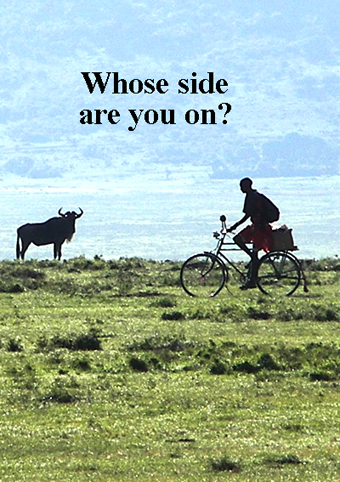
War in Ngorongoro?

War in Ngorongoro?

WhoseSideEducation is fine if you’ve got something to do with it. Is there going to be war in Ngorongoro?

The great experiment known as the “NCA” in what ABC’s Good Morning America christened one of the world’s Natural Wonders is coming apart.

Most tourists know it as “The Crater.” But Ngorongoro Crater National Park is just a tiny 100 sq. mile circular caldera sunk into a much larger wilderness area twenty times as big, officially known as the NCA (Ngorongoro Conservation Area).

The crater’s unique ecology collects more water than virtually any other part of the NCA, and its deep flat sedimentary and volcanic substrata – like the Serengeti – creates areas of grassland plains perfect for Africa’s great herbivores.

So the crater itself attracts a larger concentration of animals than the surrounding NCA. But there’s plenty out there in the NCA, too, on the gorgeous highland hills that ultimately descend onto the Serengeti’s prairies. And if wildlife couldn’t flow between the sunken crater, the NCA and the Serengeti, there wouldn’t be any wildlife in the crater.

Yesterday, the Parliamentary Committee in Dar assigned to the area began moves to forcibly evict Maasai from the NCA.

It spells trouble.

Committee member Dr Raphael Chegeni claimed there were now more than 60,000 Maasai living in the NCA with “unsustainable” numbers of cattle. This is well beyond the 25,000 Maasai Parliament authorized as sustainable.

You see it was presumed that as Tanzania developed, so would Maasai, and that they would choose to abandon traditional lifestyles for modern opportunities, and so while technically their population would grow, they would leave the wilderness.

And to its credit, the Tanzanian government, Italian NGOs and even the American Peace Corps have spent years building schools and dispensaries to get Maasai healthy and educated and ready to be a bank clerk.

But graduating from primary school in Ngorongoro didn’t turn out to be the magic wand intended. There aren’t any jobs for fresh school leavers. Modern Tanzanian bank managers don’t like Maasai kids.

Tanzania is an increasingly corrupt society, its superficial democracy immune from ethnic troubles but dominated by a small cadre of rich and educated.

Maasai in the main are neither rich or educated.

Recently, actually, things looked promising. Several years ago Tanzania’s Prime Minister was Maasai, and he was a fabulous Ben Nelson! But alas, he got implicated in several huge corruption scandals and lost his job and his clout. He’s headed for jail.

Before foreign hunters or tourists there were Maasai. Maasai and wild animals have always lived together just fine. And this is the heart of Maasailand. But over the years (starting in 1921) the Maasai have been squeezed into smaller and smaller areas, reserving larger and larger areas for foreign hunters and tourists which bring in much more revenue than hut taxes.

Besides, who in their right mind would want to spend their lives in a straw hut? Chief Blackhawk was last photographed in a suit talking to President Grant!

In 1972 Maasai were bumped entirely out of what is now the Serengeti, and theoretically, out of the 100 sq. mile crater.

It was a contentious act, and the “treaty” with the Maasai allowed them to continue to live in the NCA provided they didn’t alter their lifestyles from traditional herding into, for example, planting sweet potatoes (which is exactly what many do, today). Another caveat in the treaty allowed them to bring their livestock down into the crater during times of drought.

Those concessions were clearly humane, but they have led to uninterrupted tension between the Ngorongoro Maasai and park authorities ever since 1972.

To begin with, who was going to define a drought?
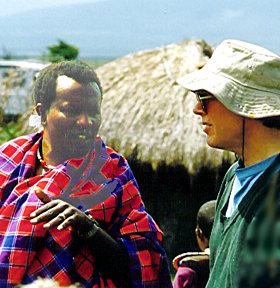
Jim with Edward, 1993.

I became quite good friends with a really sharp Ngorongoro Maasai in the 1980s who was the third most important son of the most important Maasai headman near Olmoti. When his two elder brothers died, he became the chief area spokesman.

There were several droughts during those years, and tension grew as the Maasai brought more cattle into the area. Rangers tried to evict them. Maasai are great spear throwers, but they turned out to be terrific rifle shooters, too.

Rangers and Maasai were killed in these gun battles. I remember camping with a group in Lemata on the crater rim when we were awakened by this gunfire in 1993.

My friend negotiated an end to the battles in the mid 1990s. Several Maasai, including him, were trained then hired as rangers. It was a brilliant move. Until he was killed in a war when he and other rangers were trying to evict Somali from the eastern Serengeti.

And since then, the area’s Maasai population has more than doubled.

Tanzania has some fabulous crusaders for human rights which have tried in the past to mediate between the government and the Maasai.

The Lawyers’ Environmental Action Team is among the best. But they tried and failed to mediate a dispute with Maasai in the northeast Serengeti last August, and they are now overwhelmed with work in the areas of Tanzania’s new gold mines and seem uninterested in the current dispute.

The conflict between animals and people is not the only conflict in the wilderness. The more important, and deadly, is the conflict between people and people.
Bipartisan with China, against Eles

Bipartisan with China, against Eles

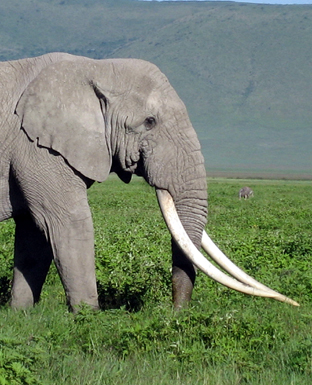
Destined for a chess board in Shanghai.
Two weeks from Sunday the Obama administration will finally let the world know what they think about elephant conservation. So far, they haven’t.

The silence is deafening. I’m afraid the whales and elephants are being negotiated away for sanctions against Iran.

This will be Obama’s first world forum on conservation. The last CITES convention held in Santiago under the Bush administration was a terrible embarrassment to all Americans. (See my blog.)

We were all hopeful that a very public and forceful presence by the new Obama administration this time would do much to recoup the deficit of trust in America that last conference produced.

But so far, nothing from Ken Salazar’s office. I called his press assistant, Tamara Ward, yesterday and she has not replied.

Many items are on the table, and the Obama administration has announced their position on some of the less controversial ones.

But the main act is a huge fight among African countries as to whether elephants should be downlisted from “endangered” to sort of “endangered” or “protected.” Any downlisting would then allow certain countries to sell stockpiles of ivory.

Zambia and Tanzania are leading the march this time to downlist the elephant, while Kenya and 26 other African countries are mounting the defense.

Zambia and Tanzania have huge stockpiles of ivory. This is collected from naturally dead elephants and confiscated from poachers.

Kenya, too, has stockpiles, but it knows that allowing any sales of ivory will stimulate the trade and motivate poachers. And Kenya has the foresight to know that a healthy elephant population will bring in much more revenue from tourism in the long term than one-off sales of tusks do in the short-term.

The scientific argument as to whether the elephant population is currently healthy enough to withstand increased poaching, or whether increased poaching could actually lead to extinction, is more arcane.

Like everything, today, the countries are actually inspired by money, not science.

It was hoped that the Obama administration would join the European Union in trying to bring some light to the scientific argument, which heavily suggests that increased poaching cannot be withstood.

The silence is deafening.

The conference opens March 13 in Doha, Qatar.

Led and founded by the United States and Kenya, among a few other concerned countries, CITES mirrors the U.S.’ own truly august Endangered Species Act (which preceded the international convention by more than a decade), and is a worldwide agreement on what forms of life can be passed through international borders.

By listing certain species from threatened to endangered into five different categories, the countries signing the convention agree to various regulations that are placed on their trade.

This could be as little as enhanced scrutiny, to as is currently the case with elephants, an outright ban on trade.

Scientists generally agree that prior to the corporate poaching of elephants which began in the late 1970s, that there were as many as 1.3 million. Today, there are 470,000.

But at the nadir of the long history of elephants, the population probably dipped to around 200,000 by the mid 1980s.

When the first CITES convention met to specifically deal with elephants and banned their trade, the black market price of a kilogram of ivory declined from $300 to $3 in one year. Poaching dried up.

By 1988, Kenya’s population of elephants had declined from 167,000 fifteen years earlier, to only 16,000. (Today it is around 30,000.)

As the situation improved throughout the continent, the irritated southern African countries (where poaching had always been better controlled) insisted they be allowed to sell legally harvested ivory.

The first sale after the treaty banned all sales in 1989 was allowed in 1999; 50 tons were exported to Japan. Poaching immediately started up, again. In June, 2002, the largest shipment of illegal ivory since the 1989 ban was seized by Singapore authorities. DNA analysis showed the ivory originated in Zambia. The cargo was destined for Japan and comprised 532 elephant tusks and more than 40,000 already cut pieces of ivory weighing more than 6.5 tons.

Nevertheless, the trend continued to allow more selling, in part because of the Bush administration’s tacit approval.

In November 2002 at a CITES convention, it was agreed that Botswana, Namibia and South Africa could export 60 tons of ivory.

Then, a second CITES-negotiated sale occurred in 2008. Zimbabwe sold108 tons to Japan and China. Predictions that this sale in particular would fuel an increasing appetite for ivory among the rapidly growing Chinese middle classes proved true.

In 2009 China opened 37 new government “ivory” stores.

Today, a kilo of ivory sells for $1500 in the Far East. In Kenya a poacher gets about $40, but even a small pair of 20-kilo tusks brings a poacher the equivalent of $800, just below the average amount a Kenyan worker earns per year.

It seems, though, that the Obama administration wants to be as namby-pamby with regards to conservation as it is to health care.

The U.S. delegation is supporting a handful of “listings” including a nearly extinct cockatoo in Indonesia and the very popular polar bear which impacts Eskimos and few others. Inuit are not party to trade agreements.

And, of course, “bipartisanism” with China is as important as with Republicans on health care.

We know where that got us.

Would you like a zebra or a petunia?

Would you like a zebra or a petunia?

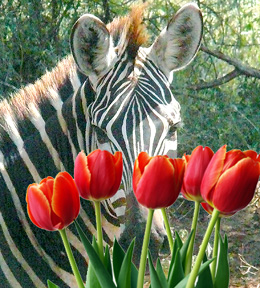
zeb flowersOr both? Animals are being frantically transported out of the Kenyan cut flower farms back into Amboseli National Park.. pretty much under the radar.
Wednesday, the Kenyan Wildlife Service (KWS) began a massive relocation of nearly 7,000 animals into Amboseli National Park. KWS has issued no press reports on the move and there are growing suspicions that it may be haphazard and poorly managed.

According to Simon N’Donga of Nairobi’s FM Capital Radio, the animals are being trucked from the Great Lakes area back to Amboseli. Thousands of herbivores had fled Amboseli during the last dry spell, and this would have been a decent place for them to have fled.

It’s where Kenya’s cut flowers are grown for export.

Last August I watched dozens of zebra, wildebeest and giraffe lining up on the edge of the dangerous Nairobi/Mombasa highway, frantically trying to leave the areas south of Nairobi where the drought was serious. Similar reports came from the Nairobi/Arusha highway.

All headed to the petunias.

The rains have returned big time and most of the country’s wilderness areas are very healthy, if too soaked. Likely the animals would return on their own, eventually.

But there are growing complaints in Kenyan society of the costs of wild animals in your corn patch and elephants in your church. There are also concerns that tourists will abandon the country for Tanzania if the country’s national parks don’t put on their Sunday Best for the upcoming season.

Capital FM Radio (I believe one of Kenya’s best investigative news sources) quoted a KWS senior scientist, Charles Musyoki, justifying the lightning fast operation “to make sure that Amboseli as an eco-system does not collapse.”

Seven thousand kicking zebra and blarting wildebeest is a huge number of animals to move. We’re talking about thousands of trucks. And probably not well insulated or padded. Certainly not your everyday wild animal-moving truck.

Capital FM said that a single helicopter was being used to herd the animals into 18-wheelers. The journey to Amboseli from Naivasha can take about 12 hours by truck. (Note that the Maasai Mara is only about 3 hours away from this area.)

When asked where the funds were coming from, Musyoki suggested it was directly from the Ministry of Finance, Kenya’s Treasury Department.

“We are actually doing this in the interests of Kenyans because Amboseli is one of the key protected areas in this country that generates a lot of income for the public,” Musyoki said.

The last reliable figures out of Kenya were in 2006 before the political turbulence of the 2007 election. Tourism was then Kenya’s largest foreign exchange earner, generating about $803 million, followed closely by cut flowers (then tea and coffee).

One out of every three flowers purchased in France, the Netherlands and Belgium comes from Kenya.

Almost all Kenya’s cut flowers come from the great lakes region, the area from which the zebra and wildebeest are now being taken.

If you hate deer in your rose garden….

KWS said the project will cost about $12-13 million. That’s not very much for 7000 animals. Earlier this year, KWS was relocating elephants from the coast into Tsavo at a cost of about $14,000 per elephant.

Forgive my natural cynicism which may have impeded my careful analysis of this, but it’s happening so quickly!

Kenya needs the cut flower industry. Kenya and all of us wishing to save the planet need Amboseli. So get those beasties out of my flower patch quick?!

Amboseli is Kenya’s third-most visited park (after the Mara and Nakuru), but one of its most fragile. It is a very unusual giant soda lake sitting under mighty Mt. Kilimanjaro, pumped to life by underground rivers off Kili that create a series of swamps and wetlands.

The herbivore population of zebra and wildebeest eat good old crab grass, not lotus flowers or swamp grass. They have always moved in and out of the park with erratic rains, and they have never constituted as important a part of the ecosystem as they do in the Mara, for example, a great grassland park.

That doesn’t mean they aren’t important; I just wonder how advisable it is to begin to control natural animal migrations with 18-wheelers that normally haul iron pipes and helicopters that have a shaky safety record in Kenya.

Just doesn’t seem like a sustainable long-term, carefully constructed plan.

Bonobos as Peace Makers

Bonobos as Peace Makers

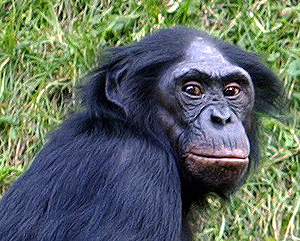
Can this creature bring peace to Africa?
In this so troubled time for East Africa there are some exciting glimmers of hope for societies and conservation.

Stand on any of East Africa’s high mountains and look east to some terrifying developments. Al-Qaeda militia are gathering on Kenya’s borders. The drought in Tsavo decimated the hippo population and spurned the bushmeat trade.

But look west and it’s a different universe. In the Congo, once one of the most turbulent spots on earth, there is a smell of peace, and long-time conservationists have smiles on their faces.

Recently an old friend, John Lukas, General Director of the White Oak Conservation Center, asked me if we might consider restarting tourism to the Congo.

John has maintained an oasis of conservation in that troubled region for nearly 30 years, the Epulu Research Station. His first interest was the rare okapi, found only in the Ituri, but since then his center has expanded and supported a wide array of other research.

Terese and John Hart, probably Africa’s most professional, dedicated long-term field scientists, worked even further away from Epulu’s oasis, among the Congolese pygmies and besieged communities decimated by decades of war.

The Harts raised a family while they researched in the “Heart of Darkness”. They were sometimes out of touch for weeks. In the worst of times, sane conservationists wondered what the hell they thought they could do in a part of Africa that Joseph Conrad had clearly labeled “out of reach”.

Well, they unearthed remarkable science about bonobos and newly discovered primates, and conducted the only good social science of the pygmies bushmeat trade, among so much more. And now, Terese has established promising beginnings to creating what would be Africa’s largest single conservation area, named for the time being as “TL2″.

This oblique, geographical reference to one of the most wondrous, colorful if not magical places on earth is typical of the Hart’s low-key but ever-steady science.

In an email to me over the weekend Terese remarked, “I believe that the situation has been improving for the last several years and with the right engagement tourism is definitely possible.”

Incredible. The last time I took tourists into the Congo was in 1979.

The southern Sudan, where impressed child soldiers created what was called with primitive burlesque, the Lords Resistance Army, there really now is peace after a generation, and a new and massive national park has been created.

I hope to write much more in the coming days about the Sudan’s Boma National Park, and about “TL2″. These incredible areas hold promise not just for the conservation of bongo and bonobo, as well as other extraordinarily rare animals and plants, but the promise of peace to their society.

Rwanda’s gorilla project has proved that the revenue tourists provide can exceed almost any other exploitation of natural wilderness, and if managed properly can lead to increased social development.

It’s not a stand-alone model, but it is remarkable that through the many troubles Rwanda suffered after the gorilla project was started, the health of Parcs de volcans continued to improve, including the size of the mountain gorilla population. Without tourism, this wouldn’t have been possible.

And the health of that single albeit most important conservation project in Rwanda is arguably one of the reasons Rwanda is now stable and prosperous.

Keep your fingers crossed! I’ll be writing more about these exciting areas in the weeks to come.

The Monkey & The Butterfly

The Monkey & The Butterfly

Monkey & ButterlyThe 2009 “Year of the Gorilla” ended very beautifully and very sad. The butterflies will just have to wait.
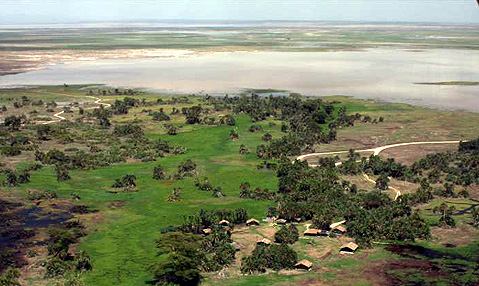
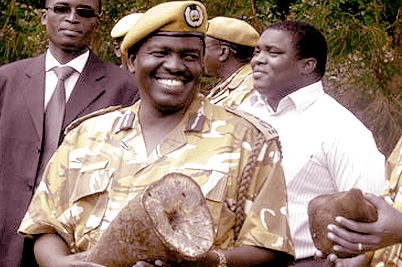
It was a sad coincidence from the start that the YOG planned so long in advance occurred as the world tailspinned into economic collapse. The whole point of these sponsored years is to focus attention and funds into what has been essentially world organized successes.

The success of the mountain gorilla project is legendary. Its foundation rests not on celebrities like the poorly trained and personally dysfunctional Dian Fossey. (Indeed, I strongly believe after her initial success in publicizing the plight of gorillas, she was more responsible for inhibiting development of the project than any other individual.)

Rather, the remarkable success was with the people – kids at the time – who really sacrificed part of their young professional lives to the cause: they were willing to work in the super-nova umbra of Fosey under enormous difficulties.

George Shaller did the science. Bill Weber and Amy Vedder followed him and created this hall-of-fame project that merged gorilla conservation with local development including tourism. And this triad of science and society had no precedent.

It was an amazing beginning, and you can buy their dramatic story from Amazon by clicking here.

The next tier was the grunt field workers cum- or to become scientists and legions of social workers and volunteers and probably primary among them was Craig Sholley. Click here to visit the conservation organization Craig now works for.

So as the heydays of the last decade whirled by with more good news than bad on the conservation front, it made sense to top off the century with the Year of the Gorilla.

Not their fault, Goldman Sachs. So while the various organizations involved have yet to tally the proceeds, the talk on the street is not good. Maybe less than half what was hoped to have been raised was actually realized.

But there are good stories, nonetheless. Researchers, students and volunteers supported by the YOG in Bwindi national park have blazed new trails and new science, and along the way, have even discovered a few new … butterflies.
mass of butterflies
This picture was taken by the volunteer named Douglas Sheil last week in the Bwindi forest. In this montage of several photos are two new species of butterflies.

“We don’t know a huge amount about Bwindi’s butterfly fauna though it appears to be richer than other forests in Uganda,” be blogged.

He then went on to list a few species still lacking confirmation and English names, and basically, took the pictures and left the science.

For others, when funds become available.

What are the Heavens doing?

What are the Heavens doing?

African Trust for Elephant's camp in Amboseli has been a dust-bowl for three years.
African Trust for Elephant's Camp in Amboseli.
For three years it has been only a dust-bowl.
Wildlife people are happy, social activists are alarmed, and the poor Turkana people believe it’s the end of the earth. El-Nino’s floods have blown up the drought.

From the Serengeti to Tarangire to Tsavo to Samburu to the Mara, the rains are tumbling down. And the last to report torrents – as was to be suspected sitting in the rain shadow of Mt. Kilimanjaro – was Amboseli in late December. And with that report by Harvey Croze of the African Trust for Elephants, we can say definitively that…

It’s raining too much!

“Three inches [of rain] may sound pitiful for those getting inundated with rain and snow in other parts of the world, but in Amboseli that represents almost 20% of the average annual rainfall. In one week!” Croze wrote on January 7.

One of East Africa’s best writers and little known is the wife of the legendary elephant researcher, Ian Douglas-Hamilton. Here’s what Oria Hamilton had to say in her recently circulated Christmas Letter of 2009:

I can finally tell you ‘the drought has ended’ and with it wonderful things have happened. The outlying hills and mountains are dark, as if newly painted against massive white and grey clouds looming above us streaked in sun-setting orange light, and all over the land, green grass, green bushes, green trees can be seen. It has been raining nearly every day since I arrived, the river is flowing, gently and continuously taking all the stress and hardship with it. Today we have food in abundance and water everywhere. The earth is a rich damp dark brown. Nature is extraordinary, ever changing, regenerating, on the move, reproducing – each day racing to catch up for all those desperate dry months. Thousands of little acacias are sprouting all along the river bank and the grass seems to be growing while I look at it. I barely dare to tread on it while I take my walk and this week the ‘lamb tails’, little white flowers, have blossomed and from afar it looks as if it has snowed.”

Normally in Samburu now the rains would have stopped, but they haven’t, and that means that an El-Nino phenomenon is definitely in play. That’s good for the veld, but it’s not so good for the folks whose home it is.

Today Kenya announced nearly $1 billion dollar in combined aid from the Kenyan Government and aid organizations like the Red Cross to serve almost one million newly displaced persons. Between Kenya and Tanzania the death from raging floods was confirmed above 100, today. Roads are being literally washed away, with nothing left after three years of erosive power caused by the drought.

Livestock losses in Kenya’s far north are approaching 90%. And one of the most exceptional stories of this episode comes from the Turkana village of North Horr. In normal years the village gets 2″ of rain annually. The people in the area depend rather on the water systems and aquifers generated by Lake Turkana.

Since the rains began in Turkana in October, the area average that has fallen has been 10″. That’s more than five years worth of rain in three months. It is a desert incapable of dealing with this inundation even at the best of times.

I remember the last real El Nino in 1992-93, so I’m not quite ready to claim that all the drama we’re currently experiencing is completely a global climate change phenomenon. And back then the rains were actually a bit heavier than we’ve so far experienced this year, but the human and animal ramifications were far less severe.

As societies and ecosystems as a whole grow (in size) and develop economically, sudden change of any kind is harder to deal with. And that’s certainly what we’re seeing now in East Africa, and I venture in many other places in the world as well.

So put “able to deal with sudden change” at the top of every responsible world citizen’s most necessary skills. And, this is so hard to say, please Ngei, turn off the taps … at least a little bit.

1% of Rhino Population Poached

1% of Rhino Population Poached

KWS officials at their news conference yesterday.  Photo courtesy of FM Capital Radio.
KWS officials at their news conference yesterday.
Photo courtesy of FM Capital Radio.

A major KWS nab of rhino poachers in Laikipia, yesterday, reveals new and terrible sophistication in rhino poaching.

Recently a friend chastised me for writing so negatively in my blogs, remarking specifically about the number of blogs about poaching. She’s right, of course. My blogs about poaching have increased substantially. Poaching always increases in an economic downturn, but this time Tanzanian and Ugandan wildlife management policies are even making it worse.

Tanzania and Uganda are substantially increasing their hunting and Tanzania has revoked its support to keep elephants on the CITES most endangered list.

Add to these wrong government moves, an increasingly bad approach being taken by international wildlife organizations, and we are creating the perfect storm for successful poaching.

I’m referring in particular to the incredibly stupid move just before Christmas by Fauna and Flora International (FFI) to import into Kenya’s Laikipia four of the remaining eight northern subspecies of black rhino in existence. (See my blog of December 26.)

Yesterday, a cell of poachers nabbed in Laikipia revealed a level of sophistication obviously much higher than the idiotic organization that dumped these precious rhino into the criminals’ lair.

A cell of twelve highly sophisticated “businessmen” – an organized corporate cell not just errant individuals – were arrested by the Kenya Wildlife Service (KWS) in possession of two recently poached rhino horns valued at $300,000.

Yes, you read correctly. The value of a rhino horn on Kenya’s black market is now around $150,000 per horn. It’s estimated that Fauna and Flora raised a quarter million dollars to transport the four rhino from Europe to the Ol Pejeta reserve in Kenya in December. Each of those rhino has two horns. The ROI for the bad guys, delivered right into their hands by supposedly good guys as their investment, is a neat 500%.

Try that on some Laikipia community based tourism project.

Baby born yesterday in the Ziwa Reserve, Uganda.  Photo by Angie Genade.
Born yesterday in Uganda's Ziwa Reserve. Photo by Angie Genade.

According to KWS Director Julius Kipng’etich, the suspects took down a 10-year-old female rhino at the Mugie rhino sanctuary. This is one of the best patrolled sanctuaries in Laikipia, owned by the author, Kuki Gallmann, and it lies oh about a two hour’s easy drive from Ol Pejeta, which is not as well patrolled a reserve, where four of the most precious life forms on existence now are up for target practice!

The “cell” included two poachers with a marvelously new Landrover and new weapons, six professionals running the feed-through front at the Luonyek trading center near Baringo, and four other accomplices.

According to terrific reporting by Catherine Karong’o of Nairobi’s Capital FM Radio, 18 rhinos were poached in Kenya last year, 13 of which were on private reserves like Mugie and Ol Pejeta.

This would be the first time since 1984 in the heyday of animal slaughter that 1% of Kenya’s existing rhino population was killed in one year.

“For us in Kenya,” Kipng’etich explained, “even the loss of just one [rhino] means a lot to us.” Kenya’s has the third largest population of rhino of any country in the world. South Africa has the most in well protected reserves, and the U.S. has the second… in zoos.

According to the KWS Director, the Kenya black rhino population now stands at 600, while the white rhinos are 240. Globally, it is estimated that there are 4,200 black rhinos left, and 17,500 white rhinos.

And 4 (that is FOUR) of the remaining precious subspecies of northern black rhino (the only rhino immune to tse-tse born diseases) has been plopped into the poacher’s den with specious conservation applause to the idiots who funded the project. Including a Vice President of Goldman Sachs. (Oh, sorry, didn’t they make some other mistakes, recently?)

I could go on and on, but let me stop with this: no charity, no NGO, no private donation can succeed as well as government-to-government action and the swift, scientific aplomb of well-run government agencies. Kenya is beset by a myriad of problems, but the KWS works well. And the KWS’ work is now made much harder by Fauna and Flora International. FFI is an old and respected private conservation foundation, which has done a lot of good work. This time, what it did in December was DEAD wrong.

Year-End Roundup & Predictions

Year-End Roundup & Predictions

2009 was a bad year for East Africa. 2010 will be a little bit better.

Socially, culturally and politically, I think it’s been a GOOD YEAR for Kenya and a BAD YEAR for its neighbors.

I’m positive on Kenya and critical of its neighbors even while supporting the western powers growing sanctions on Kenya for not moving quickly enough towards a new constitution.

This may seem like a contradiction, but in fact what it means is that the outside world’s attention to Kenya is working: it is absolutely encouraging all the right moves by Kenya’s still entrenched, corrupt leaders. Ultimately, of course, the people will have to oust these scoundrels, and right now that looks possible.

The Hague has begun the process of trying those who might have been responsible for the 2007 genocide. The U.S. and the U.K. in particular have banned the most corrupt individuals from traveling to their countries. A draft constitution is circulating among all factions of the society for comment, and Kenya’s invigorating journalistic transparency has grown even greater with such additions as FM Capital Radio. Kenya is still ranked worse than Uganda or Tanzania by Transparency International, but its improvement is significant. If there isn’t any major reversal in the way things are going, I think 2010 is going to be a very good year for Kenyan society.

Tanzania and Uganda, on the other hand, are turning gruesome in the shadows. Tanzania’s corruption is so much less known than Kenya’s, because its power centers keep it that way. But just through extrapolation of what we do know, I frankly believe that Tanzania must be infinitely more corrupt than Kenya.

One of Tanzania’s finest transparent media, This Day, was forced to reduce daily publication to weekly because it couldn’t obtain the interest or funding that the country’s strictly controlled media easily obtains.

Scandals in Tanzania’s electricity board, and worse, in its precious gold mining industry, threaten to reach absolutely astronomical proportions. It’s so bad that Zanzibar is without electricity more than half the time, and the Toronto based owner of one of the world’s richest gold mines in Tanzania is trying to sell it. And no one wants to buy it! They just can’t manage the corruption.

And Uganda is ready to dive off the end of the earth. Encouraged by disreputable American righties, the Parliament is set to pass a law that would give the death penalty to anyone convicted of being a practicing gay. And worse actually, lengthy imprisonment for anyone who knows someone actively gay and doesn’t tell! (Imagine what this will do to tourism!)

Uganda’s problems are mounting, and specifically as a result of the current president’s growing grasp on life-time power.

I think 2010 will be a GOOD YEAR for Kenya, but another BAD YEAR for Tanzania and Uganda.

It’s been a very BAD YEAR for tourism. Statistics are near impossible to come by and then impossible to confirm, but my best guess is that about a third of the tourism industry that existed in 2007 is now gone. It may be more. Kenya has taken the worst hit, and in certain sections of the industry the employee base is now less than 50% what it was in 2007. But equally deep hits were taken by Tanzania’s newer central country tourism (Zanzibar, the Selous) and Rwanda, which may be seeing a decline of more than 60% in tourist arrivals.

I don’t see this changing, soon. It may be a better year in 2010 than 2009, but it will still be a BAD YEAR for tourism throughout the region.

Most of 2009 was awful for the region’s weather. It was a BAD YEAR. But the arrival of normal if above average rains these last few months throughout the region broke the drought except in some isolated areas in Kenya’s north. All predictions are for normal if above average precipitation for 2010. So expect a GOOD YEAR for 2010’s weather.

It was a BAD YEAR for wilderness and wildlife, as the “drought” persisted through the third quarter. The lack of rains was the main cause, but by no means the main explanation. Poaching increased substantially as the age-old argument of whether a country’s wildlife should be viewed as an immediate resource for the local population (such as for food, or destroyed when threatening farms, or allowed for stock grazing). The drastic reduction in tourism only aggravated the situation: Reduced revenue for anti-poaching and other management needs contributed to a spiraling decline in the efficacy of the area’s wildernesses.

Virtually all species except the predators and scavengers (obviously) declined. Hippos took the biggest hit – they need the most grass which wasn’t growing. We aren’t sure about elephants yet, because they migrated, presumably to better places. But whether they’ll return and whether these better places helped them to survive remains to be seen.

Shore birds, especially flamingoes, suffered terribly. No one was killing or eating them, but human populations were desperate for their water sources.

As I reported earlier, we think the entire biomass probably declined by 5%. That’s not bad by the standards of past droughts, and it’s now stabilized. But I don’t see any extraordinary rebound in 2010 as was the case the year after past droughts. The natural biology that normally leads to population rebounds is this time offset by poorer wildlife management, increased poaching and less tourism preparation, caused by not just the past drought, but the current economic downturn.

So expect 2010 not to be worse for wilderness and wildlife, and basically that means it will GOOD.

Strictly economically, the entire region with Kenya in the lead is experiencing the same type of GDP jobless growth we are experiencing here in the U.S. Like here, this is a skewed statistic created mostly by government stimulus. The fact is that 2009 was a terribly BAD YEAR for the economies of all the region once you strip them of their government stimulus.

I’m afraid that 2010 will be worse. That’s one of the curses on developing countries. They are led into an economic abyss by the developed world, and then the developed world emerges out of the abyss first, often at the expense of the developing world.

How bad it will be will depend upon how much aid the developed world gives. But I can’t imagine any amount that will make 2010 anything but a BAD YEAR economically.


East Africa Report20092010
SOCIETY
Kenya
Tanzania, Uganda

Good
Bad

Good
Bad
WILDLIFEBadGood
WEATHERBadGood
TOURISMBadBad
ECONOMYBadBad

Rhinowash

Rhinowash

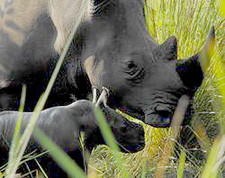
This week’s arrival in Kenya of one of the most endangered animals left on earth was not the cute Christmas present the world media reported.

In fact, the relocation of 4 of the remaining 8 northern white rhino in existence, into a country where poaching is becoming epidemic, may be one of the most stupid moves the conservation world has ever engineered.

The four northern white rhino (Ceratotherium simum cottoni) came from a zoo in the Czech Republic. The only other place that this subspecies of rhino survives is in the San Diego Wild Animal Park. There are none in the wild.

Eight life forms is statistically impossible to propagate. What is hoped is that some of the genes of this subspecies will get preserved if the four animals breed with other rhino subspecies. It is known, for example, that this highly endangered animal is immune to tse-tse fly transmitted diseases, whereas its less endangered cousins in Africa are not.

“It makes no sense to move them at this point .. It’s way too little, too late,” said Randy Rieches, curator of mammals for the San Diego Wild Animal Park, which has two northern whites.

Rieches and a host of other scientists have been fighting this move for months. Lately the argument has been a financial one, with proponents claiming that the quarter million dollar cost of the move is insignificant compared to the chance they might breed, and critics claiming the cost of the move is being grossly underestimated and is diverting resources from other much needed conservation efforts.

Funds were raised from just a handful of individuals, including the vice chairman of Goldman Sachs of Australia and Berry White, a controversial animal activist nicknamed the “rhino whisperer.” The effort was coordinated by Rob Brett, the director of Fauna and Flora International.

This is stupid.

There has been some reluctance to embrace Rieches’ many astute and scientific criticisms for fear this is not a scientific but a PR question, and that San Diego lost out to the Czech zoo. This is rhinowash.

The four animals transported to Kenya haven’t bred in 30 years. While they are being transported into a private reserve (Ol Pejeta) which has a good record of captive rhino maintenance, it is still in Kenya, and even better reserves near Ol Pejeta like Solio have had poaching incidents.

As I’ve often written poaching isn’t just a Darth Vader pastime. It increases in times of economic stress, and need we be reminded of the current times?

Rhino are one of the easiest animals on the African veld to poach. And the horn is worth more than its weight in gold.

So I consider the risk ridiculous. And as for preserving the gene pool of this subspecies, there are more conservative ways that are much less expensive, such as DNA deep-freeze. There is little research on cloning rhino, but the chances (the “statistical” chance) of one day cloning a rhino from its preserved DNA is astronomically greater than hoping these four animals will breed into existing populations.

In fact zoos are one of the best places to breed rhinos, not a private tourist game ranch.

And much more DNA research needs to be done on rhinos, to move towards a genome that will specifically show the differences between the 8 world subspecies which are now mostly presumed from taxonomical differences. I fear that money is directing research, here, as individuals who probably spent less time reading the monographs on the controversy wrote checks to get their names emblazoned round the world as animal rescuers.

We just don’t seem to have the attention to read very far down the page. If there is some real value to saving these rhinos’ gene pool, flying them to Kenya is absolutely not the way to do it.

More Poaching Evidence

More Poaching Evidence

Photo courtesy of INTERPOL.

European governments have joined Kenya to keep pressure on the Obama administration to end its silence on supporting continued protection of elephants during the upcoming CITES convention in March.

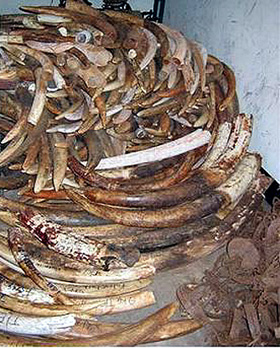
Today, officials from Kenya’s police and army, led by the Kenya Wildlife Service (KWS), released photographs and other details of a huge inter-country sting operation against illegal poaching, initiated by INTERPOL in July.

More than two tons of ivory was displayed as Kenyan officials described the operation, code-named ‘Costa’ in recognition of former Tanzanian wildlife director, the late Costa Mlay. The international sweep also resulted in the seizure of “huge caches” of firearms and ammunition, vehicles, cat skins and other contraband wildlife products.

It was the largest international action against wildlife crime ever, according to INTERPOL.

“We in KWS strongly believe that ivory trade fuels illegal killing of elephants,” said Kenya Wildlife Service Director Julius Kipng’etich who again appealed to the Obama administration to support a Kenyan initiative to keep elephants listed as an endangered species when the CITES convention convenes in March.

There has been growing frustration among conservation organizations at what seems to be the Obama Administration’s reluctance to stand with the Kenyans against Tanzania and other countries lobbying for a downlisting of elephants.

The operation began in July 2009 and was coordinated by INTERPOL’s Wildlife Crime Working Group based in Lyon, France.

With Kenya as the coordination center, sting operations in five other countries began simultaneously. Most of the individuals targeted by the operation, as well as associates who were trying to flee Africa, were successfully stopped at Nairobi airports.

KWS Deputy Director in-charge of Security, Peter Leitoro, said six foreign nationals were among more than 65 still being held in Kenyan jails.

“The success of Operation Costa is notable not only for the sheer volume of illegal ivory which has been recovered, which is among the biggest-ever hauls recorded, but because it also clearly shows the ability and will of law enforcement to effectively tackle wildlife crime,” said Peter Younger, manager of INTERPOL’s Operational Assistance, Services and Infrastructure Support (OASIS).

Ivory Crisis Continues

Ivory Crisis Continues

Yesterday Tanzanian wildlife officials announced they would join a Zambian initiative to allow sales of elephant ivory by downgrading the elephant’s status as an endangered species.

The move is part of the important politicking that is occurring before the March meeting of CITES, the international conference on the trade in endangered species.

Kenya denounced the move and also appealed for a third time to the Obama administration to take a stand on the issue.  For some reason the Obama administration is not acting on the Kenyan request.  It’s almost unthinkable to believe that the Obama administration wouldn’t support Kenya on this.  It was Kenya and the United States which wrote the first elephant ban in 1983.

That move at the time was supported by more than 180 countries.  It stopped the rampant poaching of elephant at the time.

“We are convinced Tanzania has contravened the spirit of the (moratorium) agreement and Kenya is totally opposed to their proposal to sell ivory,” said Mr Patrick Omondi, a KWS senior assistant director.

However, Tanzania’s director of Wildlife Erasmus Tarimo disagrees.

“We’re doing what is best for our elephant population,” he said in a phone interview to Africa 2000, adding that revenues from the sale would go towards elephant conservation.

Ironically, Tarimo was in the news just last week commenting on a Dar-es-Salaam police action against suspected poaching.  Four people were arrested in possession of over 30 elephant tusks.

According to sources within the wildlife industry, the ivory weighs more than 100 kilos and is believed to have come from at least 18 poached elephants killed within the vast Selous Game Reserve.

Other sources within the police force have described the latest seizure of poached elephant tusks in Dar es Salaam as further proof that the city is now a major transit point for ivory smuggling.

This latest development comes just days after THISDAY, one of Tanzania’s more aggressive newspapers, published a detailed expose on how the world-famous Selous has been turned into a veritable killing field where hundreds of jumbos are regularly slaughtered for their ivory.

The report actually suggested the poaching is once again going corporate.  “This looks like a chain network of poachers and ivory smugglers at work,” THISDAY reported.  The paper further claimed that some disgruntled game scouts are believed to be either turning a blind eye to illegal hunting activities or themselves taking part in killing the same animals they were hired to protect.

”An average of 50 elephants are being killed in the Selous each month…and that is a conservative estimate,” an official working in the Selous told THISDAY.

As I’ve explained in earlier blogs, poaching goes on the rise when the economy tanks.  Tanzania’s Ministry of Natural Resources and Tourism used to pay game scouts a working allowance of between $250 – $300 a month in addition to the salary to cover the expenses of fuel and food for extensive patrols in The Selous.  But due to budgetary constraints that allowance has been suspended.

Sources have described finding heaps of jumbo carcases minus tusks left lying on the mud roads within the Selous.

Tarimo has denied the increased poaching.

“A recent aerial count found 41 carcases of elephants,” he admitted.  “But 41 dead elephants is minimal compared to the total Selous elephant population of around 40,000,”  he said, adding that some elephants had died of natural causes.

Pangy Pain

Pangy Pain

The rain brings luck, and luck brings the pangolin, and the pangolin brings more fortune!
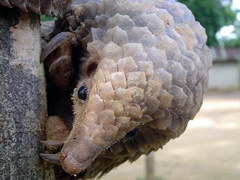
pangolin.karatu.2009
Yesterday a fight nearly broke out between residents of Mangola town, about 10 miles west of Karatu towards Lake Eyasi, when conservation officials removed a pangolin that had been found by villagers.

I’ve never seen a pangolin in the wild, and its cousin, the aardvark, only twice.  Both are common animals and their rarity comes from the fact they are so incredibly nocturnal.  Like vampires, they will actually wilt in the light, their eyes are so sensitive.

Both feed on termites.  Both have massive claws and ludicrously long tongues to nip white ants by the hundreds.

The rains which have come in spades lead to huge increases in the termite populations.  The rains also flood holes that pangolins and aardvark live in, flushing them out despite their better natures.

But unlike the aardvark the pangolin is an animal of great mystic stature.  It has little fear of man, is rather slow moving, and protects itself and any young clinging to its scales by rolling into a near perfect sphere and closing itself shut to the outside world.

And more to the point, villagers still believe its appearance presages great fortune.  The Malonga villagers tried desperately to figure out if this just meant more rain, better harvests, or new roads.  They put out a pile of corn next to a bowl of water next to a pile of asphalt, peeled the animal apart, and nudged it to move as a choice of one or the other offerings.

Peeling it apart is no easy task.  The scales are sharp and the pangolin has an anus gland not dissimilar to the skunk.

The pangolin chose the maize, or so it was determined, meaning that the future held outstanding corn yields.  The Chicago mercantile exchange didn’t move much, though.

And as they were trying to unpeel it for a determination of second place, Ngorongoro Conservation Authority rangers arrived just in time to rescue the poor animal from the medieval performance.  At one point, machetes were drawn against rifles.  (Probably neither worked.)

The head of NCAA Conservation Services Department Mr Amiyo T. Amiyo said “good Samaritans” had informed the rangers about the ceremonies.

“I have been a conservationist with the NCAA for almost twenty years now but throughout this period I have never encountered a pangolin. I think this is the first such animal to be seen in the neighborhood,” he said.

But all was cool in the end, and pangy was taken to the nearby forest and released.

“We couldn’t keep it, because we don’t have a cage,” Mr. Amiyo explained.

Monkeying Around Works!

Monkeying Around Works!

Duke researchers have once again made some amazing discoveries in East Africa, this time suggesting that interbreeding between quite different animals may provide survival advantages.
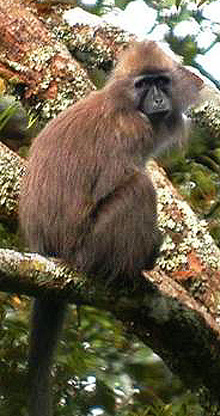
091111-kipunji-monkey-vmed-142p.widec
The setting is Tanzania’s Udzungwa National Park, absolutely one of the most beautiful wildernesses I have ever visited.  More than 120 endemic mammals and 13 primate species are found here that exist nowhere else on earth.  The discovery is about the most recently discovered primate, the kipunji (Rungwecebus kipunji)

There are just over 1100 kipunji left on earth, making them one of the most endangered animals creation has left us.  And they all live in just 7 square miles!   And very interesting, there are two separated populations: only about 100 in the Udzungwa park, and the remaining 1000 in a lower altitude area.

Yesterday a team of researchers led by Trina Roberts of the National Evolutionary Synthesis Center in Durham, N.C. (Duke) announced that while the two separated populations look identical, they have significantly different DNA.

The larger population has baboon DNA!

Note carefully.  The research isn’t saying that the two species once had the same ancestor (which may be true but isn’t the point), but that modern baboon interbred with modern kipunji recently… basically since any normal evolutionary changes (through natural selection) occurred.

In fact appearances suggest the two animals if they had a common ancestor diverged a very long time ago.  Baboon (Papio genus) looks more different from kipunji than chimps do from modern man.  The baboon has a long flat nose not found in kipunji, and male baboons weigh up to 65 pounds. Male kipunji weigh less than half that.  There are many other anatomical differences.

But at some point in the past, Papio and Rungwecebus had a tryst (that was certainly the scandal of the century up there in those xenophobic forests).  The DNA analysis even tells us that Mom was Papio, and that baby Papio/Rungwecebus became the matriarch of the stronger group of kipunji.  They don’t look a lot different, but DNA doesn’t lie.

“In the evolutionary history of this population there was at least one event where there was some cross-fertilization with a baboon,” said study researcher Tim Davenport of the Wildlife Conservation Society.

We know that normally when species hybridize, the offspring are almost always sterile: (mules is the common example).  In East Africa we have many bird species, especially among the starlings, which hybridize and live for a single generation.

But not always.  The best alter example is our own yellow-rumped warbler, which hybridizes and continues to breed so quickly field guides have a very difficult time keeping up with the new birds.

But in animals it’s extremely rare.  Giraffe are probably the best exception, as evidenced in zoos where interbreeding in earlier years caused serious embarrassment to zoo directors.  Look carefully in backwoods’ zoos and you might find a rather unusual looking giraffe.

But now the Duke researchers are suggesting there might be a reason for all of this.

The population which is strongest of the two kipunji is the one with baboon DNA.  Baboon are a very successful primate in the evolving modern world dominated by a single all-powerful primate known as man.  Many tree dwelling monkeys aren’t.  Is the larger kipunji population, larger, because it got something, or learned something from being hard wired to a more successful cousin?

This would introduce a new evolutionary mechanism that works a bit faster than waiting for gamma rays to move chromosomes around in some useful way.  It’s really quite exciting research.  And it probably correlates in some way to current research into whether modern man interbred with Neanderthals before sending them into extinction.

Kipunji was discovered in the Udzungwa in 2003, the twelfth new primate to be discovered in this forest during my life time, but the only completely new primate species discovered in the world since 1923!

Udzungwa National Park is only 785 sq. miles, but that’s because it sits in rugged forests that still remain unpopulated and not yet deforested that – well – don’t require protection…  Yet.  The overall huge area of pristine marvels is almost 4,000 sq. miles.

It’s not easy to visit.  My few visits have hardly touched the edges of this massive forest.  I tend to think that Tanzanian authorities are following the unofficial advice from WCS and the World Wildlife Fund not to develop the park.  There are more tourists that visit Mikumi National Park every week (a half hour away) than all the kipunji in existence!

Ban The Ivory Ban?

Ban The Ivory Ban?

The next meeting of CITES in March will be a crucial one. So far only 21 of the treaty’s 175 country signers have joined Kenya to support a ban on further sales of ivory.

Not even Tanzania has yet joined the Kenyan coalition. This is extremely bad news for elephant conservation.

Kenya, the United States and the International Union for Conservation of Nature (IUCN) were the original three creators of CITES, drafting the 1973 world treaty. But it took 16 years of subsequent diplomacy to get the constituent countries to agree to an ivory ban.

During that 16 years, according to the KWS, Kenya’s elephant population fell from 167,000 to less than 16,000: more than a 90% decline. And it was entirely from poaching.

In October, 1989, CITES officially placed elephant in “Appendix I” of the treaty, banning any sale of any elephant product, including of course ivory. That and the aggressive moves by such countries as Kenya saved the world’s dwindling elephant population.

The Kenya Wildlife Service (KWS) made American network news on Saturday, July 18, 1989, when it set to fire a pyre of $1 million worth of confiscated ivory, at the time more than 12 tons.

On July 14 of this year, 2009, KWS officials confiscated an equivalent $1 million worth of banned wildlife products that were connecting through Jomo Kenyatta Airport from Mozambique, addressed to the Xaysavang Trading Export Import Company Limited, Vientiane, Laos.

But this $1 million wasn’t 12 tons as in 1989, but only 600 pounds of ivory and 45 pounds of rhino horn. An expected but unfortunate result of the success of CITES has been to increase the value of such banned products.

“Since Mozambique has no rhinos and few elephants we suspect the trophies were illegally poached from neighboring countries and transported to Maputo by road,” said KWS Director Julius Kipng’etich.

“We will be doing a DNA to determine where the elephants were illegally poached from but it is highly possible it was in Tanzania, Namibia, Zimbabwe or South Africa,” Mr. Kipngetich continued.

None of these countries has yet joined Kenya in support of a continued CITES ban.

Still less than two-thirds the size of the continent-wide population in the 1950s (the Kenyan population stands at 32,000), elephant numbers have increase robustly since the CITES ban. Countries where poaching was little of a problem, like South Africa, want now to be able to sell their huge warehouses of harvested ivory, most of which has come from normal deaths or scientific culls.

In 1997 as poaching seemed to be on the wane, CITES downgraded elephant from “Appendix I” to “Appendix II”. This allows a “limited trade” in ivory. Kenya and other conservationist-oriented countries successfully stalled this implementation with endless proposals to define exactly what “limited trade” would be.

Kenya felt successful under the circumstances, and only five date certain sales subsequently occurred of warehoused ivory, mostly from southern African countries. All were auctions to Asian traders.

But following each of these auctions, conservationists insisted that poaching became resurgent, threatening populations where poaching is still a threat, such as in Kenya.

Then in 2002 came one of the greatest political blows to elephant conservation, and out of the blue, and from one of the original three creators of CITES: the United States.

At the 12th conference of CITES in Santiago, the Bush administration proposed an amendment to the treaty that would further erode its enforcement.

The conference was stunned. In fact even the U.S. delegation to the conference was stunned.

The day before, on November 4, the head of the U.S. delegation, Assistant Secretary of the Interior, Judge Craig Manson, supported the ban strongly in his opening remarks, saying that the United States “remains concerned regarding any resumption in this trade because of potential effects on elephant populations and ongoing monitoring efforts.”

Somebody in Washington was listening. Manson got a call late at night. The next morning he not only reversed his position, but he actually offered an amendment to the treaty which would forbid elephants from ever being placed on Appendix I again!

The outctry was palatable. The European Union was infuriated. Kenya felt snubbed. Manson received 12,000 emails in the course of an hour and left the conference early.

The amendment was not adopted, but without U.S. support to relist elephant into Appendix I (which Manson had personally originally supported), the conference kept elephant in Appendix II.

Controlled sales of warehoused ivory, although very limited, have continued.

The three-year drought that just ended in East Africa has exacerbated the problem even further. KWS documents a “quadrupling” of elephant poaching before the drought ended this month, over the course of 2009.

In part this is because elephant began to wander far and wide from the protected reserves searching for food and water. In part it’s because so many desperate Kenyans had little to eat or drink. (Read my blog, “ANIMALS OR PEOPLE” of October 4). And in no small part it’s because of a new and larger presence of Chinese in Kenya, as that country drills for newly discovered Kenyan oil and builds new roads with a multitude of new workers.

Kenyan authorities earlier this year impounded three tusks and deported three Chinese workers apprehended on the Isiolo/Marsabit road works. Kenya’s commitment to conservation couldn’t have been more forcefully demonstrated. Kenya needs the Chinese oil exploration; it will be a very needed boon to the country.

On hearing of the deportation of the workers, the Chinese government halted development activity in Kenya, including road works and oil drilling, for three months. It has since resumed.

But it is clear how China will vote at the March meeting of CITES in Doha, Qatar in March. And it is clear how Kenya will vote. The Obama administration has yet to announce its position.

DROUGHT TALLY

DROUGHT TALLY

Everyone wants a tally of the drought’s wildlife destruction now that it seems to be over. Here’s a start, temptingly premature.

Keep in mind that in a normal year we wouldn’t even be having rains yet over much of East Africa, and certainly not as heavy. And also keep in mind that the heavy initial rains of March, 2009, over northern Tanzania flipped off way too early.

Nairobi water works officials yesterday cautioned everyone not to start celebrating. The three dams that supply Nairobi’s public water were all below 35% capacity, and the heavy rains of the last 3 weeks have done little more than stop the continuing decline.

Water rationing in Nairobi continues.

We really won’t know until towards the end of November whether these “short rains” were sufficient to break the drought completely.

Nevertheless, yesterday the Kenyan Wildlife Service (KWS) issued a preliminary report; this simultaneously with National Geographic’s story about lost animals due to the drought.

According to the KWS about 2% of the wildlife north of the equator was lost, and 1% south of the equator.

The 1% figure is a bit misleading, though, because it’s bolstered by the wildebeest migration in the Mara, which originates in Tanzania where the drought was mild or nonexistent. Animals in Kenya’s Tsavo and Amboseli National Parks may have suffered up to a 5% decline. This isn’t because the drought was worse here than in the north, but because the north is a desert habitat to begin with, and the animals living there know how to deal with it better.

These are pretty significant numbers and might actually exceed the droughts of 1983 and 1998.

Most seriously, 40 of Kenya’s very rare 2,000 Grevy’s Zebra succumbed to the drought. “Losing these 40 is a significant loss,” said Mr Patrick Omondi, a KWS Senior Assistant Director.

500-600 hippos were lost. This is about 20% of that population. Their problem was that even in the Mara, which had rains throughout the entire drought, the hippos’ home in the Mara river (which arises in a drought area) fell below the minimum sustainable levels multiple times.

The hippos had to migrate, and there was nowhere to migrate to that was better. They had to fiercely compete for the 200 pounds of grass they needed nightly. Most died of starvation during failed attempts to migrate.

KWS says probably 300 elephants died, the majority of which were juveniles. Normally elephants abort their 22-month long pregnancy when a drought begins, but the explanation is two-fold. First, many of the juveniles were older than 3 years, but of those that weren’t, the three-year drought sort of snuck up on everyone this time. Rather than an all out whammy from the start (the normal pattern in the past), there were two years of declining rains before the door slammed shut this year.

The normal deaths by thirst and starvation were augmented by an increase in active poaching that always occurs during a drought. People need food.

Poaching for bush meat was so prevalent that butchers in large towns like Musoma (near the Serengeti) and Narok (near the Mara) openly hung the carcases of antelopes just as they would have cows.

And I think it was a wise political decision not to prosecute these merchants, as would have been the case had there not been a drought.

Elephant are not normally poached for food, but elephant poaching increased substantially. This is explained by a relaxation of CITIES rules that would probably have resulted in additional poaching even in good times, plus the drought which motivates individuals even further as their economic situation is more threatened.

KWS says that there were 189 confirmed elephant poaching incidents in the north in 2009, alone. NGOs in Amboseli and Tsavo have confirmed an additional 38 in the south.

“That’s the highest number of elephants poached since the international ban on ivory sales in 1999,” Mr Omondi said.

Predators don’t do badly in droughts, and only ten lions have been confirmed dead as a result of the drought. No predator isn’t a scavenger. And the likelihood is that their population actually increased.

If these numbers hold, it’s not so bad. Wild animals are resilient, and many scientists argue that natural culling is actually a necessary process. BUT… let’s just hope the numbers hold, and the drought is really over.