These Guys Are Worse Than Pirates

These Guys Are Worse Than Pirates

By Conor Godfrey
Last week, Greenpeace shadowed an unlicensed 120-foot Russian Trawler off the Senegalese coast.

Ships like these often pull in 250 tons of fish a day by dragging 700 meter nets behind them. Some of them use incredibly damaging bottom trawling and other techniques that increase hauls while destroying marine habitats.

To put the effect of these super trawlers in perspective, allow me to quote a few statistics from the Greenpeace report on illegal fishing published last week:

1. “It would take 56 traditional Mauritanian pirogue boats one year to catch the volume of fish a [super trawler] can capture and process in a single day.”

2. “The amount of fish discarded at sea, dead or dying, during one [super] trawler’s fishing trip at full capacity is the same as the average annual fish consumption of 34,000 people in Mauritania.”

Green Peace struggles to unmask illegal fishing ship off West African Coast
These ships rotate the same license among a number of ships, or more crudely, simply cover up the name of the vessel to prevent anyone from documenting their breach.

In short, bloated European fishing fleets have already overfished their own territorial waters, and are now taking advantage of poor African countries inability to enforce their maritime borders. (Japanese, Korean, Chinese, and Taiwanese companies are all guilty as well.)

The vast majority of these illegally caught fish are ‘fenced’ through Los Palmas in the Canary Islands, owned by Spain, and through a few other ports of convenience where illegally caught fish can enter lucrative European markets.

(The European commission estimates that at least 10% of seafood sold in the E.U. could be illegally caught; other groups put the estimate considerably higher.)

This gets me riled up.

My home away from home in West Africa – Guinea — has the most overfished territorial waters in the world.

The U.K.’s development agency estimated that in 2009 about 110 million USD worth of stock was illegally fished off the Guinean coast.

That might not sound like much to a country such as Portugal or Japan (culprits in the overfishing), but that is serious money to a country that cannot even provide reliable power to its capital city.

The 110 million USD estimate does not even take into account the near permanent damage done to the habitat and reproductive stocks.

So why can’t the next foreign super trawler without a license in Guinean territorial waters be given a warning, then boarded, then confiscated and the crew thrown in Guinean jail until their host country groveled for their release?

Of course – there is the rub.

Guinea (and most of its neighbors) does not even have patrol boats and crews capable of executing that type of interdiction.

(Also, the last thing you want to do is give unruly Guinean soldiers the authority to start shaking down fisherman arbitrarily.)

Of course, some harbor masters, judges, and other gatekeepers in the maritime industry are probably on the take or could be easily paid off at a number of points (giving out licenses, enforcing fines, etc.)

This can also happen legally.

Even though almost all West African fisheries are now in critical condition, many licenses are sold legally for hard-to-turn-down sums.

Some ideas:

1. The U.S., France, and other bi-lateral donors should kill a few of their grossly ineffective aid programs, and spend the money on professionalizing and equipping a local coast guard interdiction team. (Just one small ship would do it.)

If the E.U. is as concerned as they say, then this should be right up their alley.

Most West African countries (excluding Mali and Mauritania and Niger perhaps) could not care less about anti-terrorism, while illegal fishing on the other hand is a hot button domestic political issue.

The local authorities will be ready, willing, and receptive to assist in kicking the bums out of their territorial waters.

*Interesting model: Australia was concerned that other Pacific countries’ lax fisheries enforcement was hurting Australian interests. So the Australian government created a training program along these lines for a number of neighboring countries that has been very successful in curbing illegal maritime activity.

EJFoundation Photograph
2. Lock down Los Palmas in the Canaries.

This is the Sodom and Gomorrah of illegal fishing, and as long as it continues to offer a back door to E.U. markets, I refuse to believe that Spain is at all concerned with the plight of West African fisheries.

3. West African countries might enlist the help of international companies that are also concerned with maritime criminality.

The obvious partner would be the oil companies operating in their territorial waters.

The oil companies might allow host country customs officers to ride on their ships, or use their surveillance helicopters, etc.

This idea needs to be fleshed out, but it seems like a natural partnership.

I get tired of the numerous conspiracy theories that accuse Europe or the U.S. or China of commercially pillaging Africa; most of the less nuanced theories are simply critiques of capitalism.

This fishing business, however, is as clear as day: more developed countries (including some more developed African countries) are plundering poor countries’ fisheries simply because they can.

And they are doing it as fast as possible because someone else will if they don’t, and because they need to do it before these countries get their act together and start enforcing their own laws.

Highways or Hyrax

Highways or Hyrax

Nairobi National Park: 50 sq. miles adjacent city of 7 million
One of the greatest icons of big game parks is about to fall: Nairobi National Park. To a highway.

I’m not protesting; I’m not asking you to sign the petitions that successfully stopped the highway through the Serengeti, I’m just sick with nostalgia. This remarkable wilderness has survived with its ups and downs next to one of the most rapidly growing urban areas in Africa.

But with cloverleafs blooming all over Nairobi city, clovers have to go.

The very first wild animal I ever saw was in Nairobi National Park. My wife, Kathleen Morgan and I, flew into Nairobi directly over the park (still do) and I saw giraffe below the wing. We had hardly been in the city for a day in the early 1970s when I rented a car and drove to Nairobi National Park.

We paid our fees and drove onto the (then) dirt roads of Nairobi National Park and less than a minute later I had driven the Toyota onto a rock and we were totally stopped … about two feet from a rhino.

Rhinos were poached out of virtually all of wild East Africa in the next ten years (they’re coming back) and the city of Nairobi grew in leaps and bounds. The park did not grow. It remained as originally hardly 50 sq. miles, but also as always only three sides are fenced. The southeast side is open to the semi-wild country of the Athi Flats.

That used to be wild Maasai land all the way to Amboseli National Park. But soon a huge manufacturing area near Athi River town developed, along with some ground mining further south, and large ranches further west.

But small corridors remain open to the Amboseli/Tsavo/Kilimanjaro wilderness, although animals have to cross a major highway to get there. And even today you can find giraffe, zebra and wildebeest, and thanks to the special care of the Kenyan Wildlife Service, even a rhino and from time to time, lion.

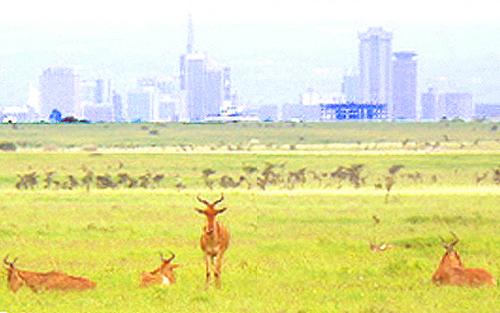
It’s absolutely striking to see these wild animals beneath a skyline that is quickly rivaling the looks of an Asian city in explosive mode.

Couldn’t last.

Nairobi is in desperate need of highways to relieve the unbelievable congestion of traffic. And while the plan presented presumes that the land lost will be made up in a sort of triangular acquisition of adjacent farmland, this will absolutely break up the existing long-distance corridors.

And local Kenyan opponents are particularly concerned about the lost of trees. The park has been a nursery of sorts for tree farms often created in compensation for other parts of the city’s forested areas lost to housing and development.

The loss is stinging, but it isn’t in reality the catastrophe that the possible Serengeti highway would have caused, for example, and truly, it’s hardly a surprise. And if we’re to believe the wincing KWS officials, there may still be enough manageable land to sustain some grazers, and the park as always will remain a tremendous place to rehabilitate rescued wild life.

It’s all about clover or cloverleafs.

Public Auction To Murder Rhino

Public Auction To Murder Rhino

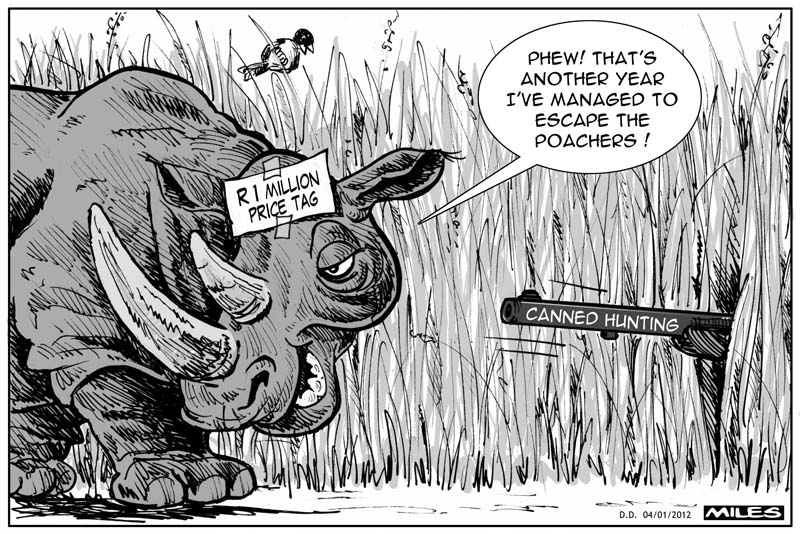
See this cartoonist's blog at http://cartoonsbymiles.blogspot.com/.
If you believe in culling, does that mean it’s OK to invite casual sportsmen into national parks to hunt big animals for a fee? I don’t think so, but South African officials do.

There are two related but very different stories here: the first is the growing number of scandals in the South African government; and the second is the issue of culling and hunting big game like elephants.

I’ve been trying to formulate an opinion on the first for some time, and I can’t. Jacob Zuma is the third president since the end of the apartheid era and one of the last of the old boys who were instrumental in the apartheid struggle with Nelson Mandela.

He’s also the most clumsy, the least intellectual and quite rash. His charisma is more chutzpah than boldness. But payback for being a revolutionary is winding down, and people seem more tolerant of his antics than I would expect presuming he’s on his way out.

And South African society in my opinion is doing remarkably well for having made such a gigantic transition. But scandals are one thing, and the new, growing attempt by the government to centralize power are quite another.

Zuma’s revenge for being made such fun of by the local press seems to be, among other similar acts, shutting it down in patent violation of the constitution. And the courts seem reluctant if reticent to battle him head on.

So in this climate of buffoonery morphing into odious politics, many lesser officials feel a bravado more typical of banana republic magnates than of major democracies.

So very lesser officials – nevertheless very publicly associated with Zuma and his ANC party – who oversee one of KwaZulu Natal’s big game sanctuaries, recently invited outside sportsmen to bid for the right to kill a white rhino in one of South Africa’s most famous reserves, Mkhuze.

Technically the rhino auctioned away to the highest traveling bidder was not within the exact confines of Mkhuze, but in the adjacent Makhasa private community reserve, and this provided the loophole for the overseers of this reserve to be so bone-headedly bold.

Readers may understand this better by a similar association in a more popular area, Kruger National Park, where the adjacent Sabi Sands private community reserve actually draws more American tourists.

Makhasa, like Sabi Sands, is governed to a large extent by the wildlife laws of the adjacent federal authority, between which there is no fencing. It is a single ecosystem. Kruger and Sabi Sands are in the interior far east of the country. Mkhuze and Makhasa are on the coast northeast of Durban.

Southern African wildlife management, particularly within South Africa proper, is likely the best in the world and is packed with professionals who are the stars in their fields. For a very long time they’ve believed in culling derived from intricate notions of “carrying capacity” that they believe they understand better than anyone.

Indeed, they may. The health and sustainability of southern African reserves is far greater, for example, than in East Africa. There are many more species albeit much less drama provided by the large numbers of animals seen in East Africa.

It is precisely the large numbers of animals that South African scientists see in East Africa that they insist will be East Africa’s ultimate downfall, the “tipping threshold” reached when too many unmanaged animals compete for dwindling resources. The crash that can result is often catastrophic and irreversible.

So southern African officials cull. For as long as the reserves have existed and been well managed (Kruger since 1926) culling has regularly occurred, and when the culling is of a springbok it makes much less noise than when it’s an elephant or rhino.

More scientifically, it is rare that a single elephant is culled. It is more likely (wince now) that an entire family is culled babies and all, since elephants are so social that to separate them from their family unit is generally untenable. But single rhinos are regularly culled.

Never, until now, has this excision been opened by auction to sportsmen tourists.

The winner of the auction, referred to anonymously as a “businessman” paid just over $110,000 for the right to shoot the white rhino, which by the way is an extremely docile beast, quite unlike its cousin, the black rhino. Conservation advocates screamed bloody murder, of course.

There are to be sure far too many white rhinos in southern Africa. They breed like cows and basically live like cows. You can virtually pet them. But they’re bigger than black rhinos and magnificent looking beasts. Killing them doesn’t take much skill.

There are so many of them, you can buy a white rhino for less than $10,000 although the transport and maintenance lifts that considerably. Many South African ranchers buy and breed white rhinos so they can then be hunted, and the going rate for legal hunting of such white rhinos is around $50,000, less than half what this anonymous businessman paid.

Add to this the fact that there is an epidemic of rhino poaching occurring right now in South Africa, and it’s been going on for more than a year. That bastion of extraordinary wildlife management, Kruger, has the unmitigated embarrassment of having had 11 rhinos poached this year.

So put all this together and you have to ask yourself who the hell would pay twice the going hunting rate to shoot a rhino in a protected reserve?

Answer: Someone who hasn’t a clue about most everything, e.g.: how much it usually costs, how much furore it would produce, and likely is paying quite a lot more under the table.

This is the kind of folly happening in South Africa right now in many areas of its society. It’s almost like a free-for-all. We can only hope the days of the old boys can be auctioned off as swiftly as was this white rhino.

Keep Hiding, Matilda!

Keep Hiding, Matilda!

A great scientific discovery in Tanzania made two years ago, announced yesterday, remains cloaked in secrecy because Americans are likely to kill it!

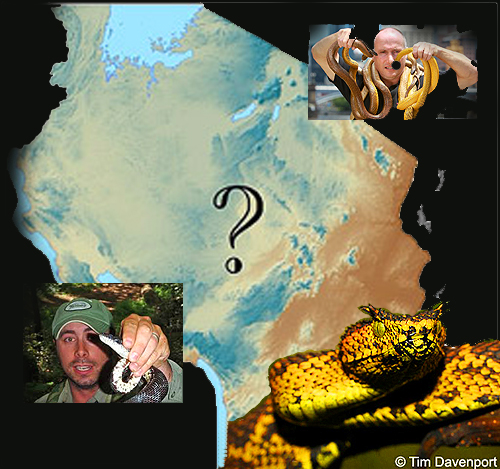
The Wildlife Conservation Society’s super field guy, Tim Davenport, has discovered an extremely beautiful, unusual and genetically important venomous bush viper, which he found somewhere in southern Tanzania and he won’t tell where.

Davenport, who was also the discover of the rare kupinji in 2005, has named the snake, the Matilda Horned Viper. (Note that there have been fewer new snakes discovered in the world in the last half century than primates.)

The discovery sheds important light on the evolution of snakes, and separately, on Tanzania’s own history of endemic forests and may ultimately contribute to the debate about why forests declined in Africa, and/or why early man contributed to this decline.

Wow. Lots of good stuff here. But Davenport says there are probably less than “dozens” of these snakes still alive, and so he won’t say where they live.

“It is often the case that the first few specimens of a newly discovered bush viper can be worth a high price and … a sudden rush to collect as many specimens as possible could actually extirpate the species in the wild,” WCS explains.

The genetic study WCS has carried out is sufficient evidence for the snake being considered an endangered species, and if finally ruled so, trade would become illegal. But getting the snake listed will take time, and in the meantime reptile collectors – mostly from America – would likely wipe it out of existence!

This is the really sad.

What exactly would happen?

Well, it starts with the scientific publication of where some new reptile has been found, and that’s why WCS “have agreed with the editor of the scientific journal … where the species description is published to keep the locality as vague as possible.”

Nevertheless, there are lots of clues, and unscrupulous reptile businessmen collectors will probably figure it out. WCS is worried. “Collection from the wild … has reached a level whereby it represents perhaps the biggest threat to Tanzania’s amphibians and reptiles.”

So Davenport is doing something extraordinary. He’s been breeding them, and that’s one of the reasons there’s been such a delay in the announcement. If he breeds enough, WCS may even put some into the commercial market to lower the price and the unscrupulous demand.

The problem is acute in America, because unlike other countries, there are few federal laws regulating owning exotic animals. These laws are largely left to the States, so some have good laws (like New York) and some have no laws whatever (like Oklahoma).

So it’s from Oklahoma that you can buy almost any snake in existence from companies like General Exotics which often goes out of business, then into business and back out of business, avoiding various state law agencies with jurisdiction over citizens who bought from them.

And the owners of General Exotics and dozens of other such unscrupulous companies hold wildly popular “fairs” constantly across the country. And of course when they come to Chicago they can’t bring exotics that are illegal under Illinois law, but they can still take your order!

These are not zoo people or even what I would call animal people. They are cutthroats who don’t care very much about what they’re selling.

But the problem, of course, isn’t them. It’s with the buyer.

The motivation for owning an exotic animal strikes me as wholly strange, but numerous analyses have suggested it falls in that macho category of indescribable subintellectual orgasms akin to anything which tempts fate like fast driving or polishing a gun.

I don’t know. I love to see them in the wild. And what they tell us about our prehistory, and how they contribute to our future lives is an immeasurable joy that you needn’t be a scientist to feel.

So keeping hiding, Matilda!

Top Ten 2011 Africa Stories

Top Ten 2011 Africa Stories

Twevolution, the Arab Spring [by Twitter] is universally considered the most important story of the year, much less just in Africa. But I believe the Kenyan invasion of Somalia will have as lasting an effect on Africa, so I’ve considered them both Number One.

1A: KENYA INVADES SOMALIA
On October 18 Kenya invaded Somalia, where 4-5,000 of its troops remain today. Provoked by several kidnapings and other fighting in and around the rapidly growing refugee camp of Dadaab, the impression given at the time was that Kenyans had “just had enough” of al-Shabaab, the al-Qaeda affiliated terrorism group in The Horn which at the time controlled approximately the southern third of Somalia. Later on, however, it became apparent that the invasion had been in the works for some time.

At the beginning of the invasion the Kenyan command announced its objective was the port city of Kismayo. To date that hasn’t happened. Aided by American drones and intelligence, and by French intelligence and naval warships, an assessment was made early on that the battle for Kismayo would be much harder than the Kenyans first assumed, and the strategy was reduced to laying siege.

That continues and remarkably, might be working. Call it what you will, but the Kenyan restraint managed to gain the support of a number of other African nations, and Kenya is now theoretically but a part of the larger African Union peacekeeping force which has been in Somali for 8 years. Moreover, the capital of Mogadishu has been pretty much secured, a task the previous peace keepers had been unable to do for 8 years.

The invasion costs Kenya dearly. The Kenyan shilling has lost about a third of its value, there are food shortages nationwide, about a half dozen terrorist attacks in retribution have occurred killing and wounding scores of people (2 in Nairobi city) and tourism – its principal source of foreign reserves – lingers around a third of what it would otherwise be had there be no invasion.

At first I considered this was just another failed “war against terrorism” albeit in this case the avowed terrorists controlled the country right next door. Moreover, I saw it as basically a proxy war by France and the U.S., which it may indeed be. But the Kenyan military restraint and the near unanimous support for the war at home, as well as the accumulation of individually marginal battle successes and outside support now coming to Kenya in assistance, all makes me wonder if once again Africans have shown us how to do it right.

That’s what makes this such an important story. The possibility that conventional military reaction to guerilla terrorism has learned a way to succeed, essentially displacing the great powers – the U.S. primarily – as the world’s best military strategists. There is as much hope in this statement as evidence, but both exist, and that alone raises this story to the top.

You may also wish to review Top al-Shabaab Leader Killed and Somali Professionals Flee as Refugees.

1B: TWEVOLUTION CHANGES EGYPT
The Egyptian uprising, unlike its Tunisian predecessor, ensured that no African government was immune to revolution, perhaps no government in the world. I called it Twevolution because especially in Egypt the moment-by-moment activities of the mass was definitely managed by Twitter.

And the particular connection to Kenya was fabulous, because the software that powered the Twitter, Facebook and other similar revolution managing tools came originally from Kenya.

Similar of course to Tunisia was the platform for any “software instructions” – the power of the people! And this in the face of the most unimaginable odds if you’re rating the brute physical force of the regime in power.

Egypt fell rather quickly and the aftermath was remarkably peaceful. Compared to the original demonstrations, later civil disobedience whether it was against the Coptics or the military, was actually quite small. So I found it particularly fascinating how world travelers reacted. Whereas tourist murders, kidnapings and muggings were common for the many years that Egypt experienced millions of visitors annually, tourists balked at coming now that such political acts against tourists no longer occurred, because the instigators were now a part of the political process! This despite incredible deals.

We wait with baited breath for the outcome in Syria, but less visible countries like Botswana and Malawi also experienced their own Twevolution. And I listed 11 dictators that I expected would ultimately fall because of the Egyptian revolution.

Like any major revolution, the path has been bumpy, the future not easily predicted. But I’m certain, for example, that the hard and often brutal tactics of the military who currently assumes the reins of state will ultimately be vindicated. And certainly this tumultuous African revolution if not the outright cause was an important factor in our own protests, like Occupy Wall Street.

3: NEW COUNTRY OF SOUTH SUDAN
The free election and emergence of South Sudan as Africa’s 54th country would have been the year’s top story if all that revolution hadn’t started further north! In the making for more than ten years, a remarkably successful diplomatic coup for the United States, this new western ally rich with natural resources was gingerly excised from of the west’s most notorious foes, The Sudan.

Even as Sudan’s president was being indicted for war crimes in Darfur, he ostensibly participated in the creation of this new entity. But because of the drama up north, the final act of the ultimate referendum in the South which set up the new republic produced no more news noise than a snap of the fingers.

Regrettably, with so much of the world’s attention focused elsewhere, the new country was hassled violently by its former parent to the north. We can only hope that this new country will forge a more humane path than its parent, and my greatest concern for Africa right now is that global attention to reigning in the brutal regime of the north will be directed elsewhere.

4: UGANDA FALTERS
Twevolution essentially effected every country in Africa in some way. Uganda’s strongman, Yoweri Museveni, looked in the early part of the last decade like he was in for life. Much was made about his attachment to American politicians on the right, and this right after he was Bill Clinton’s Africa doll child.

But even before Twevolution – or perhaps because of the same dynamics that first erupted in Tunisia and Egypt – Museveni’s opponents grew bold and his vicious suppression of their attempts to legitimately oust him from power ended with the most flawed election seen in East Africa since Independence.

But unlike in neighboring Kenya where a similar 2007 election caused nationwide turmoil and an ultimate power sharing agreement, Museveni simply jailed anyone who opposed him. At first this seemed to work but several months later the opposition resurfaced and it became apparent that the country was at a crossroads. Submit to the strongman or fight him.

Meanwhile, tourism sunk into near oblivion. And by mid-May I was predicting that Museveni was the new Mugabe and had successfully oppressed his country to his regime. But as it turned out it was a hiatus not a surrender and a month later demonstrations began, twice as strong as before. And it was sad, because they went on and on and on, and hundreds if not thousands of people were injured and jailed.

Finally towards the end of August a major demonstration seemed to alter the balance. And if it did so it was because Museveni simply wouldn’t believe what was happening.

I wish I could tell you the story continued to a happy ending, but it hasn’t, at least not yet. There is an uneasy calm in Ugandan society, one buoyed to some extent by a new voice in legislators that dares to criticize Museveni, that has begun a number of inquiries and with media that has even dared to suggest Museveni will be impeached. The U.S. deployment of 100 green berets in the country enroute the Central African Republic in October essentially seems to have actually raised Museveni’s popularity. So Uganda falters, and how it falls – either way – will dramatically alter the East African landscape for decades.

5: GLOBAL WARMING
This is a global phenomena, of course, but it is the developing world like so much of Africa which suffers the most and is least capable of dealing with it. The year began with incessant reporting by western media of droughts, then floods, in a confused misunderstanding of what global warming means.

It means both, just as in temperate climates it means colder and hotter. With statistics that questions the very name “Developed World,” America is reported to still have a third of its citizens disputing that global warming is even happening, and an even greater percentage who accept it is happening but believe man is not responsible either for it occurring or trying to change it. Even as clear and obvious events happen all around them.

Global warming is pretty simple to understand, so doubters’ only recourse is to make it much more confusing than it really is. And the most important reason that we must get everyone to understand and accept global warming, is we then must accept global responsibilities for doing something about it. I was incensed, for example, about how so much of the media described the droughts in Africa as fate when in fact they are a direct result of the developed world’s high carbon emissions.

And the news continued in a depressing way with the very bad (proponents call it “compromised”) outcome of the Durban climate talks. My take was that even the countries most effected, the developed world, were basically bought off from making a bigger stink.

Environmentalists will argue, understandably, that this is really the biggest story and will remain so until we all fry. The problem is that our lives are measured in the nano seconds of video games, and until we can embrace a long view of humanity and that our most fundamental role is to keep the world alive for those who come after us, it won’t even make the top ten for too much longer.

6: COLTAN WARS IMPEDED
This is a remarkable story that so little attention has been given. An obscure part of the Dodd-Frank Wall Street Reform Act essentially halved if not ultimately will end the wars in the eastern Congo which have been going on for decades.

These wars are very much like the fractional wars in Somalia before al-Shabaab began to consolidate its power, there. Numerous militias, certain ones predominant, but a series of fiefdoms up and down the eastern Congo. You can’t survive in this deepest jungle of interior Africa without money, and that money came from the sale of this area’s rich rare earth metals.

Tantalum, coltran more commonly said, is needed by virtually every cell phone, computer and communication device used today. And there are mines in the U.S. and Australia and elsewhere, but the deal came from the warlords in the eastern Congo. And Playbox masters, Sony, and computer wizards, Intel, bought illegally from these warlords because the price was right.

And that price funded guns, rape, pillaging and the destruction of the jungle. The Consumer Protection Agency, set up by the Dodd-Frank Act, now forbids these giants of technology from doing business in the U.S. unless they can prove they aren’t buying Coltran from the warlords. Done. War if not right now, soon over.

7: ELEPHANTS AND CITES
The semi-decade meeting of CITES occurred this March in Doha, Qatar, and the big fight of interest to me was over elephants. The two basic opposing positions on whether to downlist elephants from an endangered species hasn’t changed: those opposed to taking elephants off the list so that their body parts (ivory) could be traded believed that poaching was at bay, and that at least it was at bay in their country. South Africa has led this flank for years and has a compelling argument, since poaching of elephants is controlled in the south and the stockpiling of ivory, incapable of being sold, lessens the funds that might otherwise be available for wider conservation.

The east and most western countries like the U.S. and U.K. argue that while this may be true in the south, it isn’t at all true elsewhere on the continent, and that once a market is legal no matter from where, poaching will increase geometrically especially in the east where it is more difficult to control. I concur with this argument, although it is weakened by the fact that elephants are overpopulated in the east, now, and that there are no good strategic plans to do something about the increasing human/elephant conflicts, there.

But while the arguments didn’t change, the proponents themselves did. In a dramatic retreat from its East African colleagues, Tanzania sided with the south, and that put enormous strain on the negotiations. When evidence emerged that Tanzania was about the worst country in all of Africa to manage its poaching and that officials there were likely involved, the tide returned to normal and the convention voted to continue keeping elephants listed as an endangered species.

8: RHINO POACHING REACHES EXTREME LEVELS
For the first time in history, an animal product (ground rhino horn) became more expensive on illicit markets than gold.

Rhino, unlike elephant, is not doing well in the wild. It’s doing wonderfully in captivity and right next to the wild in many private reserves, but in the wild it’s too easy a take. This year’s elevation of the value of rhino horn resulted in unexpectedly high poaching, and some of it very high profile.

9: SERENGETI HIGHWAY STOPPED
This story isn’t all good, but mostly, because the Serengeti Highway project was shelved and that’s the important part. And to be sure, the success of stopping this untenable project was aided by a group called Serengeti Watch.

But after some extremely good and aggressive work, Serengeti Watch started to behave like Congress, more interested in keeping itself in place than doing the work it was intended to do. The first indication of this came when a Tanzanian government report in February, which on careful reading suggested the government was having second thoughts about the project, was identified but for some reason not carefully analyzed by Watch.

So while the highway is at least for the time being dead, Serengeti Watch which based on its original genesis should be as well, isn’t.

10: KENYAN TRANSFORMATION AND WORLD COURT
The ongoing and now seemingly endless transformation of Kenyan society and politics provoked by the widespread election violence of 2007, and which has led to a marvelous new constitution, is an ongoing top ten story for this year for sure. But more specifically, the acceptance of this new Kenyan society of the validity of the World Court has elevated the power of that controversial institution well beyond anyone’s expectations here in the west.

Following last year’s publication by the court of the principal accused of the crimes against humanity that fired the 2007 violence, it was widely expected that Kenya would simply ignore it. Not so. Politicians and current government officials of the highest profile, including the son of the founder of Kenya, dutifully traveled to The Hague to voluntarily participate in the global judicial process that ultimately has the power to incarcerate them.

The outcome, of course, remains to be seen and no telling what they’ll do if actually convicted. It’s very hard to imagine them all getting on an airplane in Nairobi to walk into a cell in Rotterdam.

But in a real switcheroo this travel to The Hague has even been spun by those accused as something positive and in fact might have boosted their political standing at home. And however it effects the specific accused, or Kenya society’s orientation to them, the main story is how it has validated a global institution’s political authority.


Bachmann or Else!

Bachmann or Else!

From India frustrated T-Partyers unable to maneuver the legislative process to eliminate civilization have just discovered a powerful new tactic. Release deadly snakes into IRS offices, guaranteeing at the very least a temporary pause in tax collections.

I have not taken the event more out of context than most T-Party dialogues. The perpetrator was actually protesting a new Indian regulation outlawing traditional snake charmers. And I have no doubt south Georgia T-Partyers will spin this to their warped intellects.

It was only last month that a 22-year old tried to illegally buy a black mamba in the woods of southern Georgia at 2:30 in the morning. Obviously frustrated that he couldn’t find one on Amazon.com he nevertheless found a ready seller. Must happen all the time, but we found out about this one, because the kid got bit.

We’ll never know for sure if he was always a redneck, but he absolutely was when medivaced to a Jacksonville hospital. His life was saved. The snake is loose.

A half dozen times annually some idiot in the U.S. breaks a battery of laws buying or selling an African mamba. For the life of me I can’t figure out why. What kind of imbecile wants to keep such a killer?

Mambas don’t make good pets. I know. I had to sweep them out of my house at the start of the first rains or risk being swept into the next world. I have a hard time understanding people who keep non-venomous snakes as pets, but good grief, why would you want a killer?

Has to be a macho thing. Unless you think you could create a seemingly serendipitous moment serving Assam tea cakes at an afternoon guild party to knock off a maiden aunt. Why else?

Mostly a macho thing. I’ve known several wonderful reptile scientists in my life, and by the time they become real worthy herpetologists, they were no longer macho-driven, but as kids, that’s usually what motivated them. Dares to do-s.

And then there’s the whole matter of it being illegal. You cannot own, sell or buy an African mamba, green or black, in the U.S. without a permit generally reserved for zoos and medical research facilities. So this dare gets even more thrilling, because it’s illegal.

Florida is running amok with killer snakes from Africa because of imbeciles playing God.

Get a life!

Buzzing Bee Ele Fence

Buzzing Bee Ele Fence

All we had to do is remember Dumbo jumping away in terror from Mickey Mouse. Instead we spent millions digging earthen moats, sprayed juiced pepper along firebreaks of hay, and I proudly discovered meter squares of steel reenforced spiked concrete. All we needed was a bee!

Five years of research has culminated with a global prize to a young British scientist who has proved how easy it is to keep elephants away from .. well, farmland, schools, roads, in fact anything you want!

Lucy King and Save the Elephants resurrected years old research about how terrified elephants are of bees. Then she intricately studied the sounds bees make, proved that was what sent the elephants fleeing, then combined a productive deterrent with a productive agricultural product and bingo, no eles and lots of honey!

Lucy King’s work has mastered “beehive fences“.

Long before King’s research it was common knowledge that eles flee bees. This upper brain memory in Africa is just like our Walt Disney knowledge of how scared they are of mice. Nice cartoon but .. so what? In fact, it was hard to believe and original science to study it seemed fanciful.

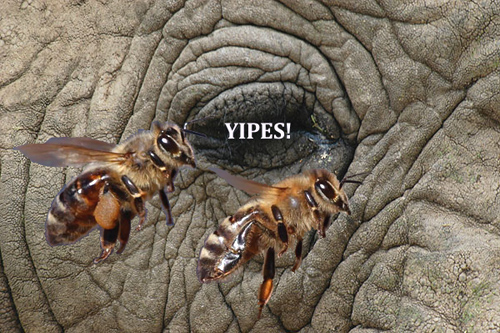
But good science doesn’t mind being embarrassed, and King’s and other’s earlier research showed that particularly in times of drought bees cluster around elephant’s eyes and up their trunks, because of the moisture there. People don’t realize that bees need as much water as pollen to make honey.

King’s research was the culmination of many individual research projects over the last five years, and was awarded the coveted “Thesis Prize” by the Convention on Migratory Species at the annual meeting in Norway.

“Her research underlines how working with, rather than against, nature can provide humanity with many of the solutions to the challenges countries and communities face,” said Achim Steiner, executive director of the UN Environment Programme (UNEP).

Dr King’s work spotlights an intelligent solution to an age-old challenge, while providing further confirmation of the importance of bees to people and a really clever way of conserving the world’s largest land animal for current and future generations.”

King was born in Africa and personally aware of the skyrocketing human/elephant conflict in part an unintended consequence of saving elephants from near extinction. Her work began at Oxford University and the bee studies were her Ph.D. thesis.

It ended in northern Kenya where once all the details of a “bee fence” were engineered, a control study of 34 Turkana villages in a new agricultural area on an elephant migratory route were carefully monitored for elephant incidents.

Seventeen villages were wrapped by newly designed bee hives, and seventeen weren’t. Over a two-year period, the data was striking. Farmland and village domiciles wrapped by beehives went essentially elephant incident free. Unwrapped villages suffered constant incidents.

Originally King and other scientists thought their job had ended a few years ago when they proved that 90% of elephants will flee certain types of bee sounds, mostly those created by the buzzing wings. This sound in turn provokes a very specific elephant alarm call that is not only the sound of a terrified beast running away, but specific enough to cause other elephants in the area to flee as well.

Clearly reproducing the sound was all that was needed. And while that’s technologically easy, it can be expensive and requires maintenance like all fire alarms. Particularly far out in the bush where electricity is erratic.

Boing. Why not do it from the beginning?

Villages now have the added benefit of lots of honey, and the specially engineered beehives designed to increase the longevity of the hive and production of honey are far less expensive and much more durable than electronic sound systems.

Despite all the excitement this isn’t the BEE-all or end-all of elephant deterrents. During periods of drought – which are chronic in elephant land – honey bee populations dive. It might be true that eles get stung more, then, but they also get much less warning since there are far fewer bees making the sounds that scare them away.

So during these frequent periods of low rain bee hive fences lose some of their mojo. King has explained in her research that bees are just one – if the most potent – weapon in a necessary arsenal of elephant deterrence.

Nevertheless, it is clearly the best one so far, and may in fact have a greater application in parts of the world like Asia where human/elephant conflicts are also growing and drought is much less a problem.

Like so much in life, simplicity rules!

No Odds on Bossie

No Odds on Bossie

Hardly had my business to show people big wild animals got off the ground when Peter Beard published his book, End of the Game. Now, I wonder, are there too many wild animals in Africa?

Yesterday we learned that the predictable “bamboo season” in Rwanda’s Parc de Volcan was bringing “as expected” many of the mountain gorillas out of their reserves into adjacent farmer fields. The battle between the cow and the gorilla, though, was not expected.

Researchers following the Urugamba silverback recorded him “charging a nearby cow” last week, although the expected bloody encounter was avoided when he unexpectedly stopped the chase. But cow-gorilla conflicts while troublesome are not what is principally bothering researchers.

Human-gorilla conflicts are escalating throughout the Virunga range, and give every indication that some biological threshold has been reached. The list is long but began horribly documented in 2007 when irate villagers stoned to death a gorilla that had entered their village.

An EWT client was one of the first ever tourists to visit habituated mountain gorillas back in 1979. Then, there were an estimated 280.

Today, the estimates range between 685 to more than 700, approaching a three-fold increase during my lifetime. Similar numbers apply to many animals throughout Africa, including other headliners like elephant and wildebeest.

Researchers are currently painting the human-gorilla conflict as not necessarily something the gorilla needs, but rather something it wants. This is the “bamboo season” as new shoots grow quickly with the onset of the seasonal rains. Gorillas “love” bamboo shoots.

In PdV many of the best and newest bamboo shoots appear first outside the park. The report of the incident between the gorilla and the cow was concluded by the researcher, “There are sure to be many incidents in the coming weeks surrounding the highly anticipated bamboo season. Stay tuned!”

Interestingly, this is exactly opposite to what the researchers in the PdV’s sister and adjoining park in the Democratic Republic of the Congo (DRC), Virunga National Park, claim. There, researchers wait anxiously for the “moment bamboo shoots are available” when their gorillas end raiding farmers’ crops and return inside the park boundaries.

So it sounds to me that there is no particular reason that new bamboo shots are outside rather than inside a park, and probably, in both parks they’re in both places. The human-gorilla conflict is more serious than where new bamboo shoots occur.

The human-gorilla conflict has been seriously documented ever since 2009 when an interagency working group HUGO was formed to deal with it. The name of the group was changed to human-wildlife conflict, in part because as researchers got into the problem they realized the area’s residents while concerned with gorilla conflicts were equally concerned with other burgeoning wildlife in the park, like buffalo.

A foot-high stone barrier is being erected around almost the entire PdV, and this seems to have helped stopped human-buffalo encounters. Near very productive farms alongside Sabyinyo volcano a trench has been cut, which seems to have impeded human-elephant encounters.

But a successful technique to discourage gorillas has not been found. Several years ago the International Gorilla Conservation Program (IGCP) encouraged using drums to scare away the gorillas, but one researcher in 2009 said, “I’m told they enjoy the sound and allegedly start dancing when the drums appear.”

And then this year the DRC gorillas became so familiar at tourist camps and area farms, that researchers began using drums again.

They still don’t dance. But it still doesn’t work.

One of the things that gnaws equally at my conscience and nostalgia is that the growing human-wildlife conflict in Africa is a reflection that years ago the precarious state so much big game found itself was, in fact, a natural if precarious balance with man.

But when man discovered he could make money showing animals to other men, which bought time to deliver a growing compassion as well as a separate understanding that biodiversity is essential to man’s long-term survival, big game became nurtured … developed.

And so, surprise, it prospered.

And so did man.

So the conflicts that existed so long ago that nearly made extinct such animals as the mountain gorilla are only more severe, today. The conflict resolutions are becoming more high tech, more intense and understandably, much more expensive.

And in some cases, such as with gorillas, there don’t seem to be any good conflict resolutions.

Ultimately this growing human-wildlife conflict in Africa will reach a breaking point, and if scientists are unable to stop the rate of growth of these animal populations by benign means before this happens, human policy that understandably favors humans will. And it may not be very pretty, then.

To Kill or Not To Ele

To Kill or Not To Ele

Have you ever heard about that little kitty that was taken far, far away and dropped in a forest but found its way back home? What about an elephant?

Last week the Kenya Wildlife Service completed the first of several phases of relocating 200 jumbos as much as 100 miles from where they were picked up. The controversial and very expensive project is one more attempt to “save” elephants by removing them from angry farmers, school children and people walking to church.

Well, we won’t know for a while. But … a couple don’t like their new diggs very well.

Two were killed in Kisii, a heavily populated city in exactly opposite direction from where they were relocated, and although they were “dispatched” by villagers before wildlife officials could identify them with certainty, there’s every indication they were from the relocated bunch.

Those ele would have walked about 50 miles through (human) enemy territory northwest having just been brought 50 miles southwest to the idyllic and peaceful human unpopulated Maasai Mara in the relocation effort. And frankly, whether they were from the relocated bunch or not, their journey from the nearest open reserve (the Mara) shows how capable they are of navigating human population centers.

And at the end of their journey you don’t hear cute little mews at your backdoor.

Pole pole I’m coming round to thinking ele must be culled. I’m not there yet, and I still viscerally resent the mostly southern African theory of “carrying capacity” and that anything that doesn’t meet the model should be eliminated.

(Not just ele, by the way, but Jacaranda trees, certain flies and spots on windows.)

But the situation in East Africa is growing intolerable, and intolerably expensive. KWS has moved the first 50 tuskers at an expense of about $3,000 per elephant.

That’s huge, especially by African standards.

All sorts of things are being desperately tried now to control this human/elephant conflict, from pepper spray, to scare crows, to moats and bullhorns.

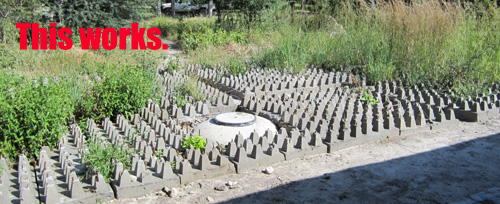
The most effective way is already being used in southern Africa (where they don’t need it as much, because they kill their excess!). The seel-reenforced concrete spike barriers employed in Botswana around its national parks tourist camps work well. The problem is they are extremely expensive, too. Each roughly 4′ x 4′ block costs around $10.

That’s the cost in South Africa. First there would have to be a factory built to produce them in East Africa, or the additional cost of importing them to East Africa.

To surround the northern top cap of the Maasai Mara (the southern border sits on the Serengeti) you’d need more than a half million blocks and that doesn’t even take care of the many river boundaries where they wouldn’t work, the labor to do it, they maintenance and the possible environmental fallout of also impeding other wildlife.

And then, of course as the southern Africans would point out, what happens when the density of elephant is compressed to a level that starts to destroy the Mara ecosystem?

You see. The reason the ele are leaving their splendid protected reserves, is because there are too many of them already.

So any successful barrier or relocation effort could end up being counter-productive.

I won’t continue to the conclusion.

The Dead Elephant in the Pyre

The Dead Elephant in the Pyre

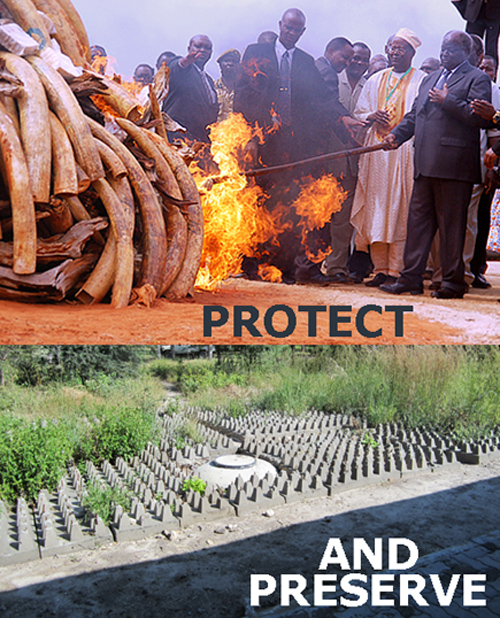
Protecting wildlife in Africa is a contentious issue, but Wednesday the Kenyan government publicly and forcibly illustrated its commitment to do so. There was no equivocation left in the pile of burned elephant tusks in Tsavo National Park.

It wasn’t just that 5 tonnes of confiscated ivory, worth close to $1 million on the black market, was being burned to ash. It was be being burned to ash by the President of Kenya, Mwai Kibaki.

And standing next to Kibaki were Kenya’s minister for Forestry and Wildlife and Minister for the Environment, as well as Uganda’s Minister for Tourism.

Kenya fought tooth and nail earlier this year at the CITES convention in DOHA to prevent elephant protection from being downlisted internationally. It fought hard against a formidable coalition of southern African countries, spearheaded this time by cousin, Tanzania. Kenya won.

The arguments Kenya had to successfully counter to defeat the initiative more or less all wrapped up into one: enormous revenue can be generated from the sale of ivory. In its most angelic form, this comes strictly from ivory sales by governments to governments of culled or naturally dead elephant, and in its slightly less acceptable form, from the sales of ivory confiscated from criminals.

But Kenya prevailed. Tanzania and its southern African countries are still grumbling.

Public support to loosen the restrictions on elephant protection, however, has numerous explanations. First and foremost is the scientific battle whether there are too many elephants right now. It’s similar to thousands of American communities that consider deer culling.

Many American communities that cull deer champion their subsequent efforts to give the meat to soup kitchens following one sniper’s moderate aim. But what do you do with 15,000 pounds of inedible meat after you;ve had to hire a military battalion to kill a single monster? And then, what do you do with the ivory, whose value is indisputably remarkable?

The next set of arguments is more compelling to the public that lives near elephant who almost universally believe one elephant is too many: Farmers lose tremendous amounts of crops annually to elephant raids, towns and villages suffer building attacks and road destruction, and federal outlays to protect elephants and their sanctuaries are becoming increasingly expensive.

But apparently not so expensive as to challenge the balance of tourist revenues. It’s the economy, stupid. We all applaud President Kibaki and his government for this dramatic show of public support, but … we all know why.

Pull the plug on tourist revenue is to pull the elephant gun trigger. Imagine if a fifth to a quarter of your local town’s property taxes came from foreign tourists paying to see deer or racoons. There’d be a whole different way of looking at planting roses.

I’m uncomfortable with this fact, just as I’m uncomfortable with current American politics driven by the almighty dollar. But … it’s the economy, stupid. Yet by pushing this moral and ethical if even scientific argument down the road, it pushes an ultimate understanding of it to the edge of the cliff.

Leakey may be exactly right that we are in the 6th great die-off, and that species decline is way behind our ability to control. But we know that species decline is fundamentally bad. And we know that no species declines all by itself, it drags much of its ecosystem and related species right down the drain with it. So governing this moral if academic argument by current economics is childish, way too short sighted.

And even more pressing is constructing the right now balance between the stresses of protecting the species and the negative human ramifications of doing so.

We need to right now figure out ways to protect farmers who live near game parks. Southern Africa does a better job of this than East Africa.

See the concrete and steel elephant grating of the “AND PRESERVE” picture above that I took earlier this year in a Botswana park. It’s so simple that it effectively keeps elephants away from the showers and toilets of a public camp site within the park.

But it’s terribly expensive, and East Africa claims not to be able to afford such measures. Instead, ruefully inadequate trenches and fences and electric wiring are still used. It’s a miserable control. It does little but further aggravate the farmers.

And if the farmers and school teachers are aggravated, today, what happens in the next decade when tourism revenues sink below agricultural production, or social services properly created by better education?

You guessed it. The elephant gun trigger gets pulled.

Widely Wild Wrongly Written Wildebeest Writings

Widely Wild Wrongly Written Wildebeest Writings

I'm no photographer.
But I took this, this year, with my Cannon SureShot.
Widely circulated reports about a crash in Kenya’s Maasai Mara wildlife are (1) premature, (2) likely false and (3) infuriating. PS (4) I’m fed up with western news sources about Africa. Unless it’s another apocalypse, it isn’t published.

Many of you truly concerned wildlife enthusiasts have sent me the link to the bad BBC story claiming that Kenya’s best game reserve is in a tailspin. Thank you, but take a powder and lie-down.

The purported “study” by Joseph Ogutu at the University of Hohenheim is the second study by Ogutu on the Mara. His first purported up to 95% of certain animals had disappeared and was uniformly dismissed by scientists worldwide.

I found it interesting this morning that the branch of the university that Ogutu is supposedly registered with, has an “internet problem.” Linking to the Bioinfomatics Unit of the University of Hohenheim cited in the BBC report generates this message [poorly translated from the German]: “Because of maintenance work the Intranet and some other homepages are not available.”

Hmm.

Mara wildlife has declined, and local wildlife censuses have confirmed this, but nowhere near as catastrophic as suggested in Ogutu’s report. Ogutu told the BBC that Mara wildlife had declined by “two-thirds.”

Nonsense.

Here’s the truth. No one knows in any good scientific way. The Kenya Wildlife Service conducts wildlife censuses that are excellent, but KWS has limited jurisdiction in the Mara which is technically controlled by local county counsels. In fact as I’ve decried loudly before, the Mara’s catastrophic problem is management not an apocalyptic reduction in game.

At one point three separate entities were controlling what we call “the Mara” and they didn’t like one another. So it’s literally impossible to conduct uniform studies over the area. And to make matters worse, historically the data is equally terrible.

Ogutu did the worst possible research as a result. He picked and chose segmented area studies over 15 years, none of which were comprehensive of the area as a whole. Moreover, I’m certain in the weeks ahead real scientists will challenge much of his root data.

Ogutu had decided the Mara was in a tailspin even before he did this study. Last year when the area was just recovering from a three-year drought, he claimed half the animals in the Mara were gone by incorrectly citing a continent-wide study
from the United Nations Environment Programme and London Zoological Society which addressed the whole continent, not just the Mara.

There are good studies, particularly from the Frankfurt Zoological Society, on the biomass of the Serengeti and larger Serengeti/Mara ecosystems. There are also good studies on individual species, like lion and elephant and so forth. And unfortunately, we can only surmise by broad intersections of these individual studies what the situation is, in the Mara.

It’s OK.

It’s very threatened, perhaps more so than at any time before. This is mostly because of (1) weather, also closely because of (2) Kenya’s rapidly developing economy leading to human/wild animal conflicts, and interminably (3) the untenable way the poor reserve is managed.

But don’t write it off, yet. Kenyans are remarkably creative these days.

Ogutu is correct that there has been a significant decline in Mara herbivores, particularly with regards to the wildebeest migration. But this is not directly due to cattle grazing encroachment as he claims. It is because of weather. Two dynamics are at play.

First, the Serengeti just below the Mara has been much wetter than normal (as has the Mara) but while areas just immediately to the north and east have been much drier. Global warming at its best on the equator creates these weird and frighteningly small and distinct weather regions.

So while there were floods in the Mara, in adjacent cattle grazing Koiyaki and Lemuk private reserves, it was bone dry. In times of drought cattle tended by cattle owners over compete with wild game.

Second, because the Serengeti has been wetter than normal, the wildebeest have not needed to move into the Mara (the furthest northern part of their migration) with the same regularity as in the past. Historically the Mara was the wettest part of the Serengeti/Mara ecosystem. That definitely is changing. There will be less and less of the migration traveling into the Mara, now, with global warming.

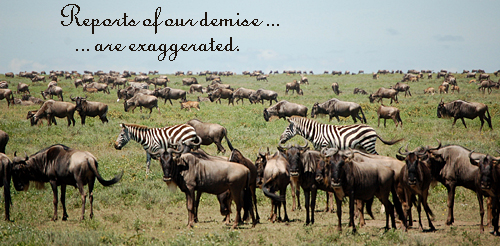
The wildebeest population has remained constant at around 1.5 million animals for more than ten years. Ditto for the third of a million zebra.

So without intending to minimize the real threats existing in the Mara, let’s not exaggerate them, either. I wish Vanity Fair or the New York Review of Books would do a story. There is no new crisis in the Mara. Visitors today will notice little difference from ten years ago, except maybe with regards to the migration.

Rather there is a continuing decade’s long crisis we definitely need to do something about, which cannot exclude global warming. And there is an ever deepening crisis in the way we learn things.

Cows-1 Wildebeest-0

Cows-1 Wildebeest-0

The idiot at the bottom of the hill below my house who poisons squirrels isn’t very sophisticated, but unfortunately, help is on the way for him. New genetic studies are unleveling the playing field and the wilderness — in Africa at least — is set to suffer.

Not everyone longs for a vacant plain on the Serengeti over which to spread their soul. There’s a lot of people who truly believe the human mind is the only center of value, and that it’s more or less self-contained, immune to its surroundings or at least protected from them, depending upon how smart it is.

So you don’t need towering mountains or raging rivers, or awesome polar bears or freakish spring hares to help you work out the meaning of life. All you need is Proust. That’s the epitome of the self-centered human.

And then there’s the Obama Mediator Ecologist (OME), trying futilely to bring diametrically opposing sides together by organizing weekend committees to pull out mustard grass from forest preserves. This is, of course, the ultimate exercise in wasted time, but it fools participants into thinking they don’t have to choose sides.

But the sides are impermeable to one another, no matter how many fools are temporarily dissuaded. It’s not possible to intervene in the wild “a little bit.” You either put a ten-foot, electrified brick wall around the forest preserve and inventory every microbe in the ground, or you let it run wild.

Since putting a ten-foot, electrified brick wall around the forest preserve and managing every microbe therein has been until now completely impractical, the wild has persisted. But scientists on the self-centered human mind team have a new strategy terrifying to the wilderness.

Genetic engineering.

I wasn’t so upset with genetic engineering until the announcement last week in the Proceedings of the National Academy of Science (PNAS) about the discovery of the gene in domestic African cattle which if activated will give it the same protection from the tse-tse fly that wild animals have naturally.

This will be a devastating blow to a number of wildernesses, including the Mara, the Serengeti, Ngorongoro Crater and the Serengeti. Let me explain.

Virtually all of Africa’s remaining great wildernesses are surrounded by farms and many of them by cattle farms. But domestic cattle (at least until now) can be killed by the tse-tse fly which carries bovine trypanosomiasis or “sleeping sickness.” Wild animals are immune.

So while visitors to the national parks will find funny shining blue or black pieces of plastic flapping off trees near their lodging killing tse-tse helter-skelter, wildlife officials actually nurture tse-tse in other areas of the park. Why nurture this gruesomely annoying little pest? Because it’s the best way to patrol the park to keep out domestic stock.

Domestic stock eat an enormously greater amount of vegetation than their wild counterparts, and if allowed run of the wild would essentially starve the naturally wild animals out of the parks.

Tse-tse are easily eradicated, and human sleeping sickness (which is different from bovine sleeping sickness) has been mostly eradicated throughout much of Africa. Despite its awesome proboscis, the tse-tse is one of the dumbest creatures on earth. Flap some brightly colored cloth in the air and it dives into it proboscis deployed.

Spray the brightly colored cloth with pesticide and it becomes the ultimate insect kamikaze. No need for mechanical spraying strategies or search-and-destroy techniques, just advertise, “Come kill yourself! Come kill yourself!” and the tse-tse dumbly complies.

But wildlife officials have carefully not eradicated all the tse-tse. And this, in part, has kept domestic stock outside wildlife parks.

But now, the PNAS scientists have identified the gene that wild animals use to become immune to tse-tse’s package of death. And they’ve identified it currently suppressed in the greater domestic cattle community throughout Africa and are engineering ways to manifest it throughout the industry as a whole.

I’m sure the intentions of the scientists were pure. They were motivated, the report says, by a $5 billion annual loss in cattle production to bovine sleeping sickness.

And as I always remind myself, why should farmers be given any less assistance than the wild? The great wildlife fence in Botswana, which decimated the wildebeest population in the 1980s, did its trick: it protected and helped increase beef farming so important to Botswana’s economy.

So I don’t really know what SHOULD be done. I only know what IS being done, and it seems a relentless effort to assist mankind necessarily at the expense of the great wild.

A Ton on the Menu

A Ton on the Menu


As Kenyan transforms itself with a new constitution into a modern society the question of what to do with elephants has popped up. Just over there, in the garden.

But the problem is manifestly two-fold: there’s the elephant in the garden, and then there’s the ivory in the airport.

And finally Kenyan lawmakers are having trouble ignoring the problem. (Admittedly they’ve got a lot on their plates in implementing the new constitution before next year’s election.) In the last two months alone more than 330 tusks weighing more than 3 tons representing more than 150 elephants have been seized at Nairobi’s Jomo Kenyatta airport.

All the ivory was headed for Asia, mostly China or Vietnam, and often via Nigeria using diplomatic pouches. Kenya is on to it, though, and not even diplomats are getting through as easily as before.

But the increased black market for ivory belies somewhat the other manifest problem: there are too many elephants.

Believe me if you’re a citrus farmer in Voi, Kenya, you’re likely to welcome a little bit of unmanaged hunting at the outskirts of your plantation.

The very proactive Kenya Wildlife Service (KWS) wants lawmakers to change this. They want new laws that would punish the now by standing farmer, and new authority for themselves to police this.

It’s not going to be easy.

Forcing the hand of until now Kenya’s silent farmers may not be a good idea. Following a successful collaring exercise near Kenya’s elephant, Tsavo National Park, to monitor human-elephant conflict this month, farmers became enraged.

Public officials from parts of Taita-Taveta County claimed that more than 500 elephants were terrorizing them. One elected official, William Ikutu, appeared on Kenyan TV allegedly nursing serious injuries following an elephant attack while working his farm in Mwakitau.

Village Chief Crispus Mnyika said the jumbos had imposed a virtual curfew in five villages, and KWS confirmed that more than 100 acres of farmland had been destroyed.

KWS responded with a major air and ground operation to drive the elephants back to their habitat had started involving aircraft, 4 special vehicles and 50 game rangers. KWS will not say how many millions of shillings the operation cost… for obvious reasons.

So Kenyan legislators are getting it from all sides: from wildlife officials wanting stronger laws and greater authority, to Kenyan citizens who want these pesky beasts out of their lives.

All sorts of things have been tried to separate wild elephants from human populations. Personally, I think outsiders – researchers, especially – have complicated the problem by throwing pennies at the problem, spending resources on nonsense.

Nonsense about chili powdered fences is all the rage, now, and patently doesn’t work. Ridiculous attempts at flimsy electric fences supported by hundreds of thousands of dollars from well meaning but poorly scienced NGOs may be even worse.

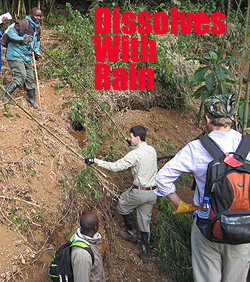
Large trenches that I’ve photographed myself in Uganda and Rwanda seem to work a little bit, but they require incredible maintenance and generally dissolve in the rainy season.

The only certain barrier I’ve ever seen is the one I recently photographed in Botswana’s Nxai Pan National Park: spiked concrete blocks that surround a public ablution unit at a public camp site. But this must be very costly. Imagine ringing a 500-acre farm with a minimum 15-foot periphery of these! (The stride of a big elephant is, yes, 15 feet!)

The daunting problem for Kenyan legislators, now, is to try to find enough resources to try to manage the crisis.

The Kenyan economy is exploding, and it’s not because of tourism. Energy development, IT including mobile phone companies, flower farming, even engineering and now new mining will likely eclipse tourism in just a few years.

The urgency for providing potable water and good sewage for its citizens, and a good business climate for its development, are issues of far greater importance to the average Kenyan and his legislator than protecting wildlife.

So all this begs the question: is there enough money left to protect elephants?

How Chewing on Fingernails Puts Rhinos on the Path to Extinction

How Chewing on Fingernails Puts Rhinos on the Path to Extinction

By Conor Godfrey on April 15, 2011

Rhino poaching makes me nauseous.

And it has already happened more than 80 times this year in South Africa alone.

It is also back in the news as the price per oz surpasses that of gold, and the infamous “Groenewald Gang “ comes back up for trial.

When people talk about the Guinean forest disappearing to make room for Cocoa farms—I’m upset, but I understand the calculus of the farmers doing the cutting.

When East African Farmers shoot elephants near their Watermelon farms, or Western U.S. ranchers shoot wolves near their cattle—I get it.

I am frustrated with the seeming inevitability of conflict between human development and species/habitat preservation, but I find it hard to really dislike the people killing animals they view as economically harmful pests.

Rhino poaching is an entirely different affair—this is organized crime.

Night-vision goggles, tranquilizers, helicopters, the whole nine yards.

The actual poachers are often unemployed South Africans and Mozambicans, but they are merely the tip of a multi-million dollar industry.

2010 was a brutal year.

333 Rhinos were killed in South Africa alone, including a number of critically endangered Black Rhinos.

In the first several months of 2011, 81 Rhinos and 9 poachers have already lost their lives.

In response to this dramatic uptick in poaching and violence, the South African government has brought in the heavies—as of April 1st South African military personnel have begun to take over security in South Africa’s famed Kruger National Park.

I tend to think protecting the supply will do little when a kilo of powered Rhino Horn goes for $35,850 on the black market.

More effort should be focused on curbing demand.

As recently as ten years ago the end-market for most illegal Rhino horn was Yemen, where artisans carved intricate jambiya dagger handles.

Studies suggest that Yemeni buyers can no longer compete with Chinese and Vietnamese traditional medicine markets where the vast majority of end users now purchase Rhino Horn and its derivatives.

However, we should all be more understanding; after all, Rhino Horn is the active ingredient in a number of highly effective treatments for cancer, high blood pressure, and impotency.

Wait—no it isn’t.

In fact, the purported medicinal properties of Rhino Horn have been tested over and over and the results are definitive—zip, zero, zilch.

Crushed up fingernails for what ails you
Rhino Horn is made of “agglutinated hair”—in other words—it is identical to finger nails. Here are links to a few studies for your perusal in case you find yourself reaching for the Rhino Horn powder before bed: Zoological Society of London, pharmacological study, Dr. Raj Amin.

The Chinese government does little to stop the misperceptions.

They even declared traditional Chinese Medicine as a strategic industry, and subsidized the industry to the tune of $130million.

Nauseating, I know.

South Sudanese Safari Anyone?

South Sudanese Safari Anyone?

by Conor Godfrey on March 10, 2011

In the last month, South Sudan has asked neighbors and the international community for teachers to staff universities, for money and logistical help for demobilization, disarmament, and rehabilitation of combatants, for ideas on a new national anthem, for help with their financial sector and several hundred other large and small matters that require more or less immediate attention.

All of these requests did not surprise anyone.

One request did surprise me though– South Sudan also asked for $140 million to begin rehabilitating their game parks as a top investment priority.

North Sudan

When you think of Sudan, what comes to mind: inhospitable desert, war crimes, tense referendums, oil, refugees, weapons, etc….

Let me offer a few new associations for the soon-to-be-independent South Sudan—jungle, wetlands, teeming with wildlife, and a migration comparable to the Serengeti.

South Sudan is home to one the largest wetlands anywhere—the Sudd—or barrier, in Arabic.

South Sudan

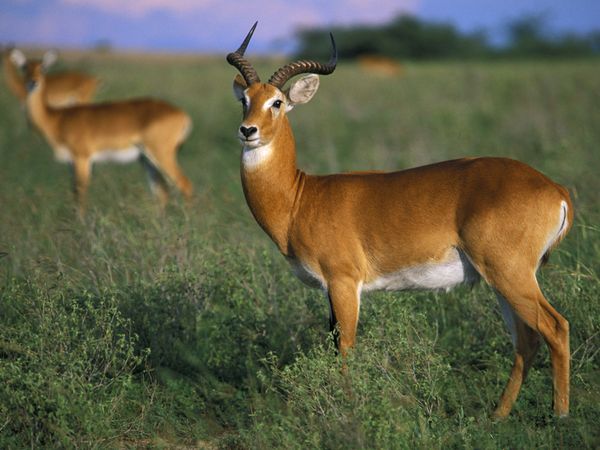
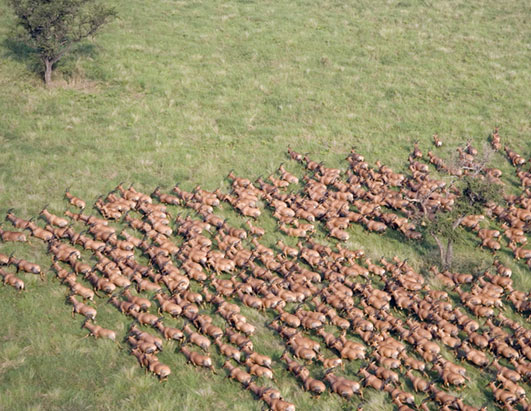
This massive wetland and the Sahelian swathes that border it have traditionally supported all manner of charismatic animals including elephants, lion, hippopotami, and crocodiles, as well as lesser known (at least to a laymen like me) fauna such as the Nile Lechwe (an endangered species of antelope), Tian, Reedbuck, over 400 species of migrating birds, and amazingly, a population of around 1.2 million White-Eared Kob.

The Boma Plateau, adjacent to the Ethiopian Highlands, also supports important populations of wildlife.

In 2007, the United States Agency for International Development and several other international donors worked with the Wildlife Conservation Society to conduct aerial surveys of Southern Sudan, essentially to confirm that the 30 years of intermittent fighting had indeed decimated animal populations.

Against all hope, they found many populations alive and well. Elephants, hippos, and other meaty animals had indeed suffered, but many had weathered the storm.

Elephants have dropped from somewhere in the neighborhood of 20,000 to around 6,000.

Zebra are all but gone, and Heartebeest numbers dropped about 95% in total. Many of the animals that survived did so by hiding out in the Sudd, where swampy conditions provided a measure of isolation.

South Sudan needs tourism revenue worse than most countries.

Currently, 98% of South Sudan’s revenue comes from oil. Production will peak in the very short term before beginning a 20-30 year decline after which the wells will simply dry up.

I would value expert opinions on the viability of a real tourism industry in S. Sudan; is there an adventure market that will relish the ‘untapped’ feel of a safari in South Sudan, will private companies invest long term in such an unstable environment, will oil extraction finish off the animals the war never managed to reach?

Most importantly, how can a country with so much human need spend the required sums on wildlife preservation?

In late 2010 National Geographic ran an interesting short piece on the relationship between the multitudes of identity groups in S. Sudan and the wildlife.

The author claims that history has forged a deep bond between people and wildlife in South Sudan.

For centuries, slavers and poachers, often the same people, came into modern day South Sudan to take away slaves and Ivory.

This linked the elephant and human populations groups together as victims in the minds of the tribes.

More recently, both people and animals took refuge in the deep bush or in the swampy Sudd wetlands to avoid the violence, once again creating a bond between human and animal, this time as fellow displaced persons.

This claim interests me quite a bit—that story resonates emotionally, and has certain logic to it, but my experience in Africa has been quite different.

In West Africa, people viewed wildlife as a nuisance, and from my brief experience in East Africa, it seemed like farmers and pastoralists felt the same way.

I came away with the impression that romanticizing wildlife was a privilege for those whose crops weren’t being eaten.

I digress.

To wrap up, whether or not South Sudan can preserve this habitat for tourists seems immaterial to me. It is one of the most important wildlife habitats on the continent.

Send them the $140 million.