Whiteness over Westgate

Whiteness over Westgate

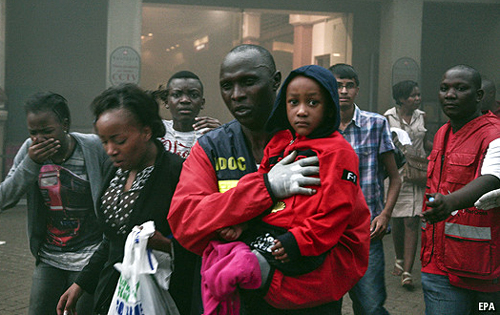
soldierWhiteWidowThis horrible week is ending. Finally, whiffs of smoke have stopped coming out of the Westgate Mall. But some facts must be tidied up before we surpass the media’s modicum of attention.

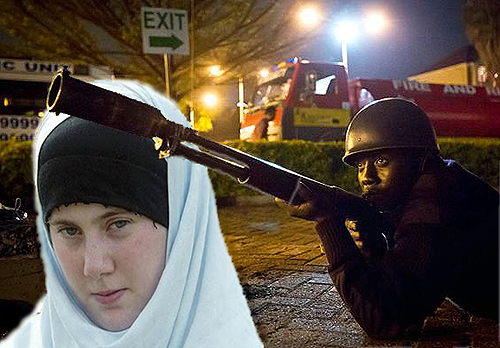
Technically, the White Widow is not yet implicated, but I believe she is. Britain’s arrest warrant for her yesterday is the clue. Conceivably she was not there as reported by several witnesses, as she is devious enough to have ordered one of her henchmen to masquerade her. But I for one believe she was the mastermind.

Given the secrecy of the investigation it will be a long time before we have hard evidence of who led the attack. But enough has already leaked out to seriously suggest westerners from the U.S. and Britain were involved, if not leading the effort.

Just as the attackers were likely from around the world, so were the victims. This morning 33 of the victims have been identified, including 3 Canadians, a famous Ghanian author, 2 Indians, a physician from Peru, a South Korean woman who had recently moved from Dubai, 3 Australians, a tourist from China, 2 tourists from France, a man from Trinidad & Tobago and 3 South Africans.

As happens with so many tragic events in Africa, this is a global story as much if not more than an African one. Its causes, strategies and ultimately its implications are pointedly universal in nature. Thinking of this as a Kenyan or African “problem” is intellectually juvenile.

Al-Shabaab is not resurgent. It drives me nuts the way American media and politicians believe this is some clarion call to urgency that rabid Muslims are again on the crusade. Rather, it looks to me like a dying gasp of an organization in great disarray that has received a spark from wayward westerners. But that’s far too complicated a story for a 4-minute segment on the evening news.

The subsequent attack in Wajir was not unusual, I’m terribly sad to say.

Fox News was not the only one to grossly exaggerate this event and irresponsibly tie it to Westgate. More than 70 people have already been killed this year in this troubled border region of Somalia where fighting has gone on more or less nonstop since 1993.

Life will return to normal in Nairobi and Kenya much faster than it did in New York and the U.S. after 9/11, and not because 9/11 was so much larger an event. Remember that Kenya suffered 3 to 4 times as many people killed and injured in the 1998 bombing of the American embassy as it did last weekend.

But last weekend truly had a greater impact on Kenya than 1998 and I think it equal to 9/11’s attack on America. The country is far more educated, interconnected, cosmopolitan and developed than in 1998. There is a greater shock because the attack interrupted a life routine that is so much more complex and modern than in 1998.

Life will return to normal more quickly, because that’s the African way. As I said in yesterday’s blog, that’s why ultimately terrorism as we know it today will be defeated by the African’s remarkable compassion and forgiveness.

“Forgiving is not forgetting; it’s actually remembering–remembering and not using your right to hit back,” Desmond Tutu said.

A long journey to break the endless cycle of violence.

Now That It’s Not Over

Now That It’s Not Over

mallexitingThe wound is still raw. Healing has hardly begun. But one of the most powerful and critical lessons ever for America to embrace is being taught right now: Mwalimu Kenya.

Al-Qaeda “won its war against America,” Kenya’s famous writer Obbo said today. But in Kenya in stark contrast al-Qaeda has released “the compassionate side of the nation” and by so doing, has already lost its battle.

How simply true. Please follow the link above and read Obbo’s column that appeared today in Kenya’s main newspaper.

Obbo meticulously details the aftermath of 9/11, carefully enumerating deaths and money spent on our retaliation in Iraq and Afghanistan, but also reminding us of equally vindictive actions that ultimately backfire:

“Thousands of students could no longer get into America. Many ended up in Canada, whose universities now have an edge over America’s in scientific research.”

He joins the large global body of scholars and analysts who refer to the years since 9/11 as “America’s imperial overstretch.”

The sadness/grief that I’ve been walking around with since the weekend has a pretty simple explanation and is, of course, nowhere near as great as Nairobi residents. We can’t find some people, and that’s the current breathless fear that they are among those lost.

But there is a unique character to this sadness that is uniquely African, something I’ve been trying to understand all my life. We in the west often call it fatalism and sometimes with even greater denigration, nihilism.

It’s neither. It’s what Obbo understands as compassion. It’s counterintuitive to us in the west to link compassion with sadness, but how simply true! If you are truly empathetic to suffering you can’t help but be saddened by it.

That’s the African way. And it’s the excruciatingly depressing reason that slavery flourished there, that colonialism raped its lands, that the Cold War treated states as puppets, that western pharmaceuticals considered it hardly more than a mad scientist’s lab.

And that now it is destined to take the brunt of the War on Terror. And take it, it will, and by so doing, it will defeat terror, just like Obbo says.

The west is already revving up its war cries. There’s nothing our hell-bent right would like better than another war.

And that, as Obbo so beautifully points out, is exactly what the terrorists want. If you invoke the Israeli mantra of an eye-for-an-eye, you lose, they win.

Obama should read Obbo. There are as many fatalities and injuries from the “collateral” damage of a few drones attacks as in the single attack on Westgate. This back-and-forth retribution will never end. America will never get weaker. The terrorists will never be eliminated. It is an endless cycle of violence.

So do you just turn the other cheek?

Yes, sort of. Security will improve in Kenya, now. The west who started the wars on terror will perforce be more involved and that will, in fact, likely better protect at least urban Kenyans.

But it’s going to be a long, hard slug for Kenya, a miserable journey that in fact started several years ago. Although the scale of the many smaller attacks throughout the country was not as dramatic as Westgate, there have been many of them. As in Nigeria, and Pakistan, and of course now Iraq and Afghanistan, a week hardly passes without some kind of terror attack.

Obbo’s right that in the end compassion prevails over terror. There is no other civilized alternative.

But it’s also time to get real, folks. This isn’t the 17th century. Nairobi is no further from Chicago using a cell phone than your neighbor down the street.

Kenya is far less capable of uplifting the world than America: of building not just bridges over rivers but between countries. It’s time that we tone it down, realize our global responsibilities and do so with the type of unqualified compassion that Africa has miraculously sustained through the entire modern era, a period of history where Africa is never more than a victim.

It’s time that change. It’s time that the entire world recognize that the enduring compassion of Africa is the final solution for attaining world peace.

The Real Disneyland

The Real Disneyland

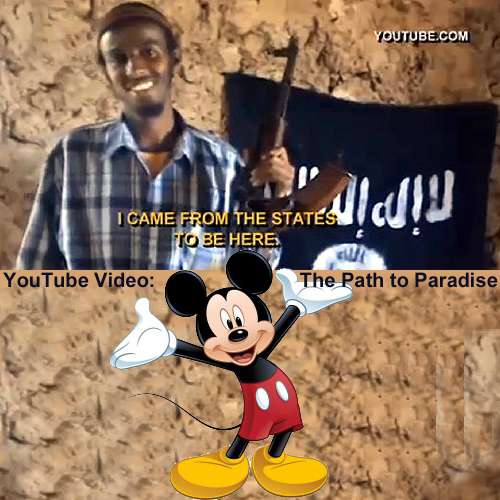
pathtoparadiseThe Westgate Mall attack was al-Shabaab’s dying gasp. There will be more attacks in East Africa, in London, in the U.S., but not from the old al-Shabaab. Not from what was left of the group that was wiped out in Westgate.

Many British analysts believe the attack was led by a fellow Brit, Samantha Lewthwaite. If this is true, it means the organization al-Shabaab has imploded.

The “White Widow” as she was called was essentially the last well-known al-Shabaab commandant. All the others had been killed over the last year.

Possibly less than a month or two ago, an Alabama citizen, al-Shabaab leader Omar Hammami, was killed in an internicine fire fight. He died along with a British compatriot, Osama al-Britani.

So three of the fragile top leadership of al-Shabaab who remained after Kenya routed the group from Somalia are dead. Two Brits, one a woman, and one American.

On PBS yesterday, Kenya’s foreign minister said there were an additional “two or three” Americans fighting as jihadists in the Westgate battle who were killed.

Think about this. Think about this carefully.

Few true journalists or analysts of anything will ever predict the near end to some movement, for fear they’ll be wrong and lose their position. I don’t have to worry about that. I hired myself.

And yes I could be wrong and by so saying I’m honestly diminishing my conviction, but my gut nevertheless tells me otherwise.

Reports that al-Shabaab still controls much of Somalia are incomplete. Al-Shabaab was rarely a coherent single organization, although it did coalesce for several years.

What I suspect is that the warlord society of Somalia, part of which loosely allied itself to al-Shabaab, may be doing so, again. If that’s true, al-Shabaab today is not a trans-national affiliate of al-Qaeda but rather a local political movement, retracting into what it was more than a decade ago.

The Council on Foreign Relations has prepared an excellent and brief primer on al-Shabaab that demonstrates this possibility well.

Does it matter that this one terrorist organization is expiring?

Yes, but it hardly ensures Kenya or the rest of the world that there will be no future attacks. What was left of al-Shabaab were foreigners, not Somalis and many weren’t even Arabs. They may have been Muslims but not even that is certain.

What they are, CBS reported yesterday evening, are wayward kids from developed countries like the U.S. and Britain.

The end of al-Shabaab does not bring an end to wayward kids from Minneapolis.

And that’s the second thought I want you to revisit. A terrorist act is pretty easy to pull off, today. It’s a rush for someone depressed. It’s a mission for someone ungrounded and otherwise uninspired.

“It’s the real Disneyland,” one al-Shabaab fighter told CBS.

Fighting clubs exist all around the world. The normal amoralism of a criminal is easily coopted by some ideology, whether that’s jihadism or some other cultism, and I seriously doubt that any of the actual fighters have studied Zen or Marx.

They’re looking for action and meaning, something they’re unable to get at home. And when they do something bad, we tax our poor to fund a megalothic war machine when we should be taxing the rich to fund schools that inspire young people.

When they pull off a mission at a poorly protected Westgate that a inner city gang from Chicago could have pulled off just as well, we respond by sending a dozen generals and Navy Seals when we should respond by sending social workers and community aid.

And when things go south for the jihadists, their amoralism becomes nihilism. They go out with a bang.

“It’s the real Disneyland,” one al-Shabaab fighter told CBS.

Backfires at the West Gate

Backfires at the West Gate

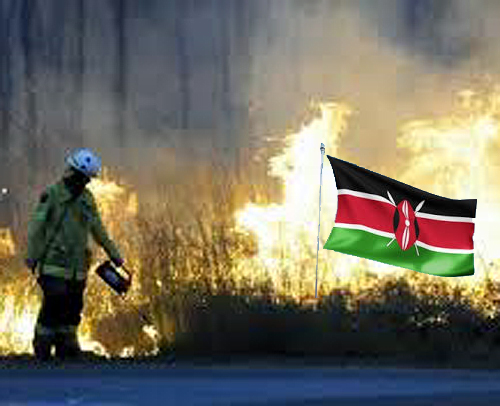
settingbackfiresKenya didn’t deserve this, but as America’s proxy in the war against terror in Africa, it was all but inevitable. This is Kenya’s 9/11.

It didn’t have to be this way. Until little more than a year ago, Kenya stayed out of the fray between terrorists and The West that was combating them worldwide. With the greatest terrorist state to its side, Somalia, it managed peaceful coexistence.

Not that it was easy. The massive Dadaab refugee camp on the border with Somalia was numbered in fractions of a million people and was putting enormous strains on the Kenyan economy and security forces.

Home grown sympathizers of the Somalia terrorists, particularly in the heavily Muslim coastal areas of Kenya, had carried out small grenade attacks and kidnapings, several of tourists.

But compared to the steady and growing breadth and scale of terrorism throughout the country all this year, culminating with Saturday’s attack on the Westgate Mall, it was almost par for the course in the age of world terrorism.

What changed a year ago?

It is widely called the Kenyan invasion of Somalia, and Kenyan troops remain in Somalia having successfully ousted al-Shabaab from power. But it is more accurately America and France’s war, using Kenya as our proxy.

And I don’t mean only ideologically or symbolically. If you’ve read my blogs since the October, 2011, invasion, you’ll have followed the growing presence of American troops and advisors, the large number of drones and the many French warships in the area.

This is all going to plan. And the plan, Obama’s and Hollande’s, was to make the west and their own countries in particular, safer. And they’ve done that.

At the expense of Kenya.

I am an American with my past and part of my soul in Kenya. Do I feel safer? As an American, yes.

But Kenyans have taken the hit, so that we Americans didn’t. And the garbage we heard this weekend from the hate-mongers in Congress and the T-Party people like Steve King of Iowa, make my blood boil. They are so intensely ignorant of the facts, and so wholly unsympathetic to misery, I’m not sure what those of us with reasonable minds can possibly do.

Kenya had been dealing with terrorism – as painful as it was – in a much more correct way until America and France got heavily involved in the last several years. Now, like America in the aftermath of 9/11, Kenya has no choice but to increase the fight they didn’t start.

And that will intensify the battle in Kenya even as worldwide terror diminishes painfully slowly.

It is so sad and such a replay of history. The age of slavery, the period of colonialism which followed and the subsequent Cold War dependencies foisted on new African states … all of these seemingly endless periods of African misery enormously benefitted the developed world with little regards for the African human being.

And so it happens, again.

Terrorism against America and France is much diminished for all sorts of reasons, but in very large part because we’ve found a way to keep it keep it far from our shores. Obama may be ending America’s great fires of war, but he’s done so in part by starting back fires.

If the Kenyan gate burns down, the fire comes home. So don’t worry, Kenya, we’ll be sure to help… you burn some more.

Poaching? Who’s Poaching?

Poaching? Who’s Poaching?

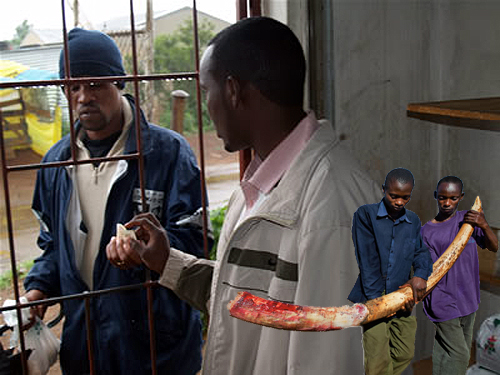
poachingwhosepoachingElephant poaching is increasing, unorganized, ad-hoc and much more likely organized by corrupt Ugandan and Congolese government soldiers than rebels or militia.

Although rebels like what’s left of the LRA also poach, they are not the principal poachers. In fact, they probably have an extremely minor role. And news reports suggesting otherwise make it increasingly difficult for us to solve the problem of increased elephant poaching.

So says Kristof Titeca after more than a year of field work in Garamba National Park in The Congo, a young post-doc from Belgium, in an article posted today.

It’s only work and analysis like this, which rarely percolates into the world media, that gives us a handle on how to deal with the current increase in elephant poaching. It’s equally important in suggesting that established news media has more interest in fanning dying embers of scandals than digging for the truth.

Titeca’s research and analysis is about ivory poaching. But he can’t help but wonder why not-for-profits out raising money, like the established world media find it so necessary to make these untrue links:

“One cannot help thinking that these reports are primarily concerned with trying to bring the LRA back into the limelight, in a context where its reduced violence makes it much harder to do so.”

And so Titeca veers slightly from his field work about elephants and ivory to find a couple references showing how diminished the LRA has become. His own work has concluded the same.

News delivery is so entrenched and institutionalized that reality is fixed like photograph. Often today in Africa, you have to turn to young kids outside the media system to get the real story.

There are a few precious sources in established media, and Titeca for example applauds Jeffrey Gettleman of the New York Times. But he doesn’t applaud any NGO or charity organization, and I expect because there aren’t any to applaud.

Titeca’s research is comprehensive. He details the trail from the initial killing to the traders and middleman to the airports that finally export it. Although established media focuses on Dar-es-Salaam and the Kenyan coast of Mombasa as major exit conduits, Titeca’s own research points squarely to Uganda.

As I’ve often written elephant poaching today is totally different from the plague that nearly exterminated the beast in the 1970s and 1980s, but those days gave rise to public awareness and the birth of numerous then good charity organizations.

Those organizations just can’t get it right, this time. In part because their very successful method of helping to end the extermination forty years ago won’t work, today, and they seem incapable of changing their focus.

Back then raising awareness and putting pressure on certain governments successfully led to the creation of CITES and the international ban on trading ivory.

That’s done. And it’s no longer working, because most governments are wholly convinced of the need to ban the ivory trade (even, I sometimes think, China) and because the world is widely aware of all kinds of animal poaching.

As Titeca and so many others point out, the trouble today is small ad-hoc groups of poachers and more organized middlemen, and many, many of them.

The mischievous attempt to put the rap on rogue organizations like the LRA is a terrible distraction and untrue: hard for the public to disconnect because the LRA is so horrible, and hard for CNN because it makes such a good story.

Ivory poaching today in East Africa is hardly different than robbing a 7-11 in the U.S. And it’s on a dangerous increase, yes, but the solutions are much more complicated than when Mama Ngina collaborated with the Emirates and used Sikorsky helicopters over the Serengeti.

The world’s complicated, folks. There’s no solution in your newspaper headline.

Remembrance of Things Past

Remembrance of Things Past

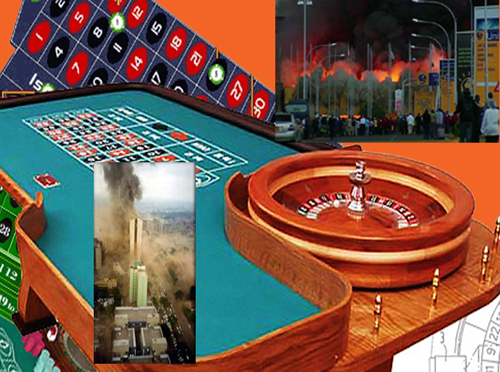
rouletteterrorismFifteen years to the day is a coincidence hard to accept. If yesterday’s massive fire in the Nairobi airport was not botched terrorism, it’s time to hit the roulette tables.

Fifteen years ago the nascent global al-Qaeda bombed the American embassy in Nairobi because it was an easy target. Kenya was one of the most open African countries at the time, moving towards an opportunity for real democracy.

“Unlike today, by the end of the 1990s human rights activism was the biggest thing and many African governments with dodgy records were finding themselves diplomatically isolated,” writes Kenyan analyst Charles Onyango-Obobo in today’s Daily Nation.

Obo – like many Africans – believes that changed abruptly and the War on Terror began not with 9/11 but with the American embassy bombings in Nairobi and Dar-es-Salaam on August 7, 1998.

In Nairobi 212 people killed and an estimated 4,000 wounded. In Dar es Salaam 11 people were killed and about 85 wounded.

I was leaving a late breakfast at the Norfolk Hotel. I had only a few chores left to prepare for a family safari I was guiding that was arriving the next evening from Europe.

Normally back then I was up before dawn swimming in the Norfolk’s pool, then hitting the buffet table as it opened at 630a. But preparations for the safari had gone unexpectedly well. There wasn’t a lot left to do but enjoy the lovely August day in Nairobi.

I had just gotten back into my room, one of the old (since removed) cottages at the edge of the Norfolk gardens when I heard a loud blast. It was 1030a. The sky had been completely clear as is the custom in August; the day fresh and breezes light.

Soon I found myself with many others who had also left their rooms as we gathered in the central garden of the hotel. There wasn’t any serious fear at that time. Likely a gas main exploded or something like that.

The Norfolk is about 2 miles from where the blast took down the American embassy. It was about ten minutes after the single blast, as we were all milling about in the garden speculating on some typical African lack of infrastructure, when the sky seemed to grow pregnant with debris.

A small, child’s size pair of broken glasses fell on my right shoe, then came the bits of torn clothing, and lastly, paper and other lightweight things like flowers or grass. Everyone stood motionless. It was hard immediately to put it all together. The falling debris ended almost as soon as it began.

A few minutes later my trusted Nairobi manager walked unusually fast up to me in the garden. Without any of the normal and very polite morning introductions about how you slept and did you enjoy your breakfast, etc., etc., Peter immediately insisted that a bank building had been blown up by the government that was trying to divert attention from a strike by bankers and teachers that was quickly going national.

It seemed plausible but everyone including us returned to our rooms to turn on CNN. It was hardly 11 a.m. CNN had live pictures from Nairobi, and was reporting that the Dar-es-Salaam embassy had just been blown up as well.

Peter left immediately without saying a word. We had another safari out in the bush. He didn’t need to explain what he had to do. I went to the phone and tried calling home, but the lines were jammed.

My personal driver showed up shortly thereafter. Our lives were now defined by sitting around the TV watching CNN. In those days I had a Grundig short wave, and not even the BBC was reporting as quickly and completely as television’s CNN. Local Nairobi radio stations were doing little more than reporting CNN.

As the extent of the blast was becoming understood, a palpable fear developed among foreigners. It struck me then as now how irrational that is. The event was over, and yet the effective terrorism is so surprising that what people are really reacting to is the immediacy of surprise, and the sense of having to flee to avoid another surprise is overwhelming.

In the lobby my driver, James, and I literally pushed ourselves through guests that were simultaneously trying to checkout, get cabs, contact home and airlines, and get the hell out of dodge.

I thought we were going to James’ rover, but he explained that was pointless since the city was being shut down, so we switched direction and headed down University Avenue directly towards the center city.

Remember that it was still a brilliant, crisp and cool August morning. This is the middle of the long dry season and everything sort of cracks under your feet. Suddenly, I realized that the normal buzz of Nairobi traffic was missing. There were sirens, not many, but the loud chocking diesel trucks and horns of the impatient were dead silent.

University Avenue goes right down the middle of Nairobi University, but most of the students were gone on holiday. Those who remained and many staff were outside milling about aimlessly, looking at James and me I thought suspiciously as we walked faster and faster towards the center city.

And that’s when I finally started to get control of my thoughts, again. What was I doing? Was this just ambulance chasing? Then, of course, I realized James wasn’t at all like that. Older, much wiser than me, he knew we had a responsibility to figure out for ourselves what was happening. We had two families with children scheduled to arrive tomorrow and another 12 people somewhere in Samburu.

But the university students eyed us as weirdos, though I noticed more fear than sarcasm in their staring at us. And then as we reached the end of University Avenue, the smells that had replaced the typical morning noise confirmed that something horrible had happened.

We crossed the normally very busy University Way Avenue as if it were a Sunday morning and continued right onto Muindi-Mbingu street. Normally I would do a little fearful dance from pothole to pothole to skip across this very busy street. Now, only a single tiny car sped just in front of us, then the street was empty.

I looked up and saw the black mushroom cloud. I looked down Muindi-Mbingu street where we were headed and it was empty. How did so many people and cars leave so quickly? We walked right past our office at the corner of University Way and Muindi-Mbingu then down towards the market. There were some people, like the students, lining the street as we passed, standing sort of aimlessly not even looking at the black mushroom cloud.

Outside the normally congested market there was much more activity, but it was also remarkably calm. I realized the people who hadn’t fled the city were now simply waiting for news.

We got as far as Kenyatta Avenue before we were stopped. Here along Nairobi’s main street and promenade were lots of people, certainly not the tens of thousands that would normally be in Nairobi working on a Friday morning, but enough to create several lines of spectators obediently standing quietly behind police lines.

I remember one big policeman facing us, looking incredibly dire but forceful, his eyes locking with mine long enough to make some judgment then moving on to the next person who interested him, his expression never changing.

Unable to move across Kenyatta Avenue, we started to walk down the police lines towards Kimathi Street. Kenyatta had been cleared for emergency vehicles, but of course there weren’t many, so the street was basically empty. It was as if people were waiting for a parade.

At Kimathi the entire street was blocked by official vehicles. We started to cross but a policeman stopped us, and grabbing James’ arm and pulling him out of the crowds around us towards me, I shouted to the policeman, “I’m staying at the Hilton! I need to get to my room!”

The Hilton was hardly five blocks from the embassy and in the dead center of the city. The poor policeman looked worried then let us go. In fact, many people at this juncture were managing “to go.” Non official people seemed to be moving in every which direction. We were inside the police lines and headed to the Hilton and suddenly the streets were crowded.

Hundreds of people flooded into the streets that would normally be congested with cars. As we wove among groups of people standing calmly and silently on the street towards the Hilton I saw how big the black fire cloud was. It looked like something out of a movie. It didn’t seem to move, to blow away or reconfigure. It just hung there.

And the smells were changing. It wasn’t diesel becoming charcoal becoming burnt wood. It was worse. It was petrochemicals like acrid plastic burning, and even worse than that, and I wiped my eyes.

We pushed our way down Kimathi Street, past the New Stanley and across Mama Ngina street purposefully towards the Hilton. We couldn’t get further. The streets were jammed with people, with officials trying to open corridors for emergency vehicles. Outside the front of the Hilton, where many of its own residents had emptied into the street, I heard my first real wailing.

I saw a woman weaving back and forth holding her profusely bleeding head. A bystander perhaps was trying to navigate her out of the crowds, and the crowd opened wide as she and her tender walked towards the hotel. I remember she was wearing a long red dress and had coiffed black hair and I remember particularly that nothing seemed burned or ripped on her.

James had stopped walking and was staring hopelessly at the ground at his feet. People were bumping us helter-skelter. I realized we couldn’t go on. We turned around and tried pushing our way through the hordes towards the Hilton’s front entrance.

With each second the smells got worse. It seemed that something sudden, like a new siren or a child’s scream or someone shouting would always be followed by an interval of silence filled by some awful smell. It was probably mostly rubber and plastic, but it was terrifying to realize it was something much worse, too.

“It is therefore … time to examine how the fight against ‘international terrorism’, which broke out in earnest after those August 7, 1998 bombings, has impacted our societies and politics,” Obo writes 15 years later to the day.

We couldn’t get into the Hilton. There were too many people, and the Headman was Crixus incarnate keeping anyone without a hotel key from getting past him. We slowly maneuvered back Kimathi Street, back up Kenyatta Avenue, back finally to our office where we pow-wowed with Peter.

There were four of us, and we were each entrusted with a certain important message … to the folks on safari, to the folks coming, to my home office in Chicago, and charged with finding some phone somewhere that would work. We all left hurriedly.

Two hours later having each completed our task, we were to meet back at the office, but we couldn’t. We were blocked by Israelis with dogs as they extended the perimeter around the now locked-down city.

But wise James knew an alley the Israelis didn’t, and he motioned me to quickly follow him. We had a brief few minutes inside the perimeter just as night was falling.

I had become more and more worried that the Kenyans would start to blame Americans; that Islamic terrorists, now claiming responsibility for the bombing, would have the support of the local population. I’d said as much to my staff.

But James took me only a few blocks and we peaked out of the alley onto Kigali Road. I stood, speechless, watching the city’s main mosque burn to the ground.

The response from the local population was just the opposite that I had feared: At least for those few hours of August 7, 1998, the prosecution and jury weren’t needed. Kenyans were burning the temple of the Islamists.

As night fell and I was now sequestered inside the Norfolk, which was just outside the perimeter of the city, a bunch of British soldiers marched down University Avenue in front of the hotel. Everyone raced to the bar to watch them in silence.

The sirens ebbed. Night covered the black cloud. The FBI arrived the next morning in stereotypical black suits and narrow black ties and for the life of me I was not going to give up my cottage to one of them: they were late. The Israelis, their dogs and British had it all under control. The men in black suits were tardy, again.

And that night of the day after the bombing I greeted my family safari arriving at the airport. We had of course contacted them in Europe and given them the option of not coming. But they were rational about the whole thing. Lightning rarely strikes in the same place twice.

Or something like that. That was when our phrases about terrorism began. When our tolerance of such massive evil was forced on us. And when we would begin to make many mistakes trying to figure out how to respond.

Obo is right. It wasn’t 9/11 in New York where the War on Terror began. It was August 7, 1998, in Nairobi.

Yesterday was no coincidence.
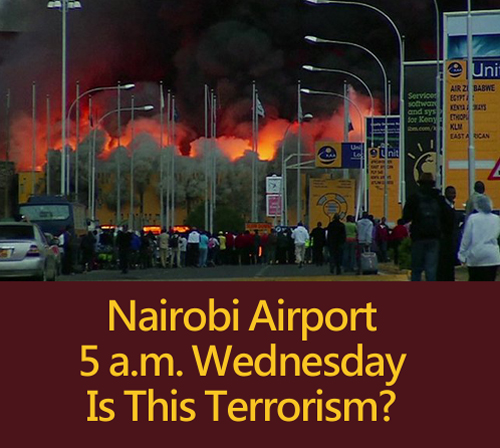
Nairobi Fire – Is It Terrorism?

Nairobi Fire – Is It Terrorism?

IsNBOfireterrorismIs this terrorism? What should stranded passengers do?

An incredibly massive and fast moving fire destroyed Nairobi’s Jomo Kenyatta’s international arrivals area early this morning.

Stranded passengers should contact their airline; there’s no alternative. If you’re on the ground in East Africa your ground operator will assist you.

Passengers planning to travel soon to East Africa via Nairobi might consider quickly rebooking to another airport. My best guess is that near normal international traffic into Nairobi will begin in about a week.

Then, from a week to two weeks out, it’s likely some flights will be canceled to reduce the load, it’s likely that some flights will be diverted as they were last night to (first) Mombasa, (second) Kilimanjaro and (third) Entebbe. Nevertheless, your ground operator will easily work around this alteration of arrival.

After 15 days or so, normal traffic will resume, although the airport arrival and departure procedures in Nairobi will likely be delayed. For this reason if you hold a short connecting time connection in Nairobi, consider rebooking now for at least the next several months.

TERRORISM?

There are frightening signs that this is terrorism. First, today is the 15th anniversary of the Nairobi embassy bombing. Second, had the suddenly erupting fire been 2 hours later, the terminals would have been full of arriving passengers.

Jomo Kenyatta Airport is one of the least secure airports in the world. Passengers often notice multiple secure checks, because the individual airlines don’t trust the government personnel, so they follow the normal airport security with their own.

Monday’s short airport closure, we were told, was because of a sudden loss of jet fuel. That’s incredibly suspicious. Major airports do not run out of gas.

If – and this is a very big IF – this is the reason the western world went into lockdown this last week, then we have another example of botched terrorism. That doesn’t mean it’s not scarey, just that if this is the best they can do, thank goodness.

Weather Grounds Drones

Weather Grounds Drones

Predictions about African security linked to global warming have proved frighteningly correct. Does weather trump drones?

As the stubborn, not-too bright bully on the block, America has shifted to accepting global warming as human caused, but it took a few Katrinas and Sandys to tip the balance. And experts still spend inordinate amounts of time explaining the obvious to the recent convert:

“Global warming” or “climate change” or whatever you want to call it is manifest most dangerously in extremes, not just increasing temperatures. So terrible winters on top of terrible summers means we’ve screwed up nature. It’s our fault and we’ve altered nature.

Winter and summer are naturally the opponents in a ping pong game. If one hits harder, it sets up the rebound to be harder as well.

And while it’s been predicted for some time that the short-term global effects of climate change could actually benefit America, because America reigns as the world’s principal power, there’s no way we’ll avoid the much more terrible negative effects:

“The U.S…. may benefit from increased crop yields, [but] its military may be stretched dealing with global “humanitarian emergencies,” Scientific American reported five years ago.

The rest of the world has more or less recognized this for a long time, so there are plenty of studies to refer back to. As America’s conversion into reality became policy when the Obama administration came into power, America began to participate in the global studies.

Africa has the largest percentage of unstable societies in the world, and what early climate change studies show is that these misfortunes were mostly predictable, founded mostly if not exclusively on climate change.

Because Africa is the only continent to stretch so far into both hemispheres, it is unfortunately placed to feel the greatest effects of climate change.

Jihad, civil war, violence after contested elections – even the reemergence of debates about social issues like female circumcision – all seem to ebb and flow with the weather. They are all symptoms of climate change.

John Vidal writing last month in London’s Guardian cited a variety of studies showing that the Arab spring had less to do with human rights than food insecurity:

While the self immolation of the Tunisian street vendor “was in protest at heavy-handed treatment and harassment in the province where he lived… a host of new studies suggest that a major factor in the subsequent uprisings … was food insecurity.”

When the rains returned to drought-stricken Somalia, was it only coincidence that the Kenyan army occupied then pacified the country? Or more likely was the Kenyan army decision triggered by an easier time supplying its troops with food?

And now that drought has turned to floods, pacified Somalia is growing restive, again, and this instability is even spilling into neighboring Kenya.

Even in Namibia, among the least densely populated countries on earth, growing instability from climate change motivated the president to declare a state of emergency on Friday.

Record floods in 2011 have now been replaced by record droughts.

The frequency of climate disaster in Africa is increasing so fast that even statistics are lagging. PreventionWeb is a UN agency that simply documents human disasters. From 1980 – 2008, the ten greatest disasters in Africa were all due to drought.

We expect, now, that the top ten disasters when compiled for 2008-2013 will be from flooding.

It seems pretty simple. Forget about proselytizing or promoting democracy and free trade, cut carbon emissions.

Outside Threats

Outside Threats

Yesterday’s deadly grenade attack in Arusha isn’t simply an indication of escalating religious tensions in Tanzania, but of the same escalating individual malevolence evident in the Boston massacre.

In neither incident do I believe there is any kind of organized group involvement, despite FOX News, Representative Stephen King or the other crazies on Meet the Press yesterday. Both cases seem to me to be engineered and implemented by wayward souls.

Wayward souls that have access in Boston to deadly technologies from Google searches. Wayward souls in Arusha who can trade a bushel of tomatoes for a grenade at practically any market in Africa.

It’s all the same. Neither is worse or more terrifying than the other. The higher tech move by the Boston duo was more deadly, just because American society is more sophisticated than Tanzanian.

Escalating religious and ideological tensions in America and Tanzania have been evident for years, and I agree with Arusha’s MP Godbless Lema that governments need to proactively address the schisms growing in their societies:

“”Religious fundamentalism is a reality in this country, but the government does nothing,” Lema said angrily outside the church, as police cordoned off the area.

Lema is one of the few honest, aggressive stars of Tanzanian politics. Like the minority of American politicians who want to address the Boston massacre with better schools and counseling and more jobs, rather than creating more fictitious global enemies, Lema knows the media speculation of the cause is absurd.

The ideologically bankrupt in a society will always point to the outside to explain a cancer within.

Since colonial times Tanzania has been one of the most Catholic countries of Africa, a product of King Leopold’s mid 19th Century conference that divided the colonial African world up by religion, so that missionaries didn’t duplicate their work.

One of the greatest historical ironies of Africa was that during the socialist policies of early independent Tanzanian in the 1970s to be a member of the Tanzanian communist party you also had to be a Catholic.

The amalgamation of Zanzibar with mainland Tanganyika in 1964 was like mixing holy water with myrrh. Since time immemorial Zanzibar was ruled by the radical Islamists of Oman, and even though it’s been given considerable autonomy, tensions have never fully eased with the mostly Christian mainland.

In October a respected Sheik in Arusha was hospitalized after an explosive device was set in his home. That was followed by church bombings in Zanzibar.

And so the cycle goes on and on, individual anger and want having found a convenient battle.

The Tanzanian government today arrested five Saudis, conveniently of a Muslim sect that is mostly disliked in Zanzibar, and charged them with terrorism.

Absurd, of course. This was the same Tanzanian government who employs the Arusha police commissioner who took 2½ hours to get to the church that was bombed Sunday morning, a half hour after the Vatican’s emissary attending the ceremony had been whisked out of the country.

The Honorable Lema is right. Governments do little today, in either America or Tanzania, to mend social schisms. Let’s just blame outsiders.

Unusual Risks in Africa

Unusual Risks in Africa

Investors in new shopping malls for Kenya and Nigeria are expecting a first-year return of 12% and a long-term return of 25%, led by savy South African banks.

Business plans for Africa have always astounded Americans. I’m mostly familiar with the tourism sector, and ROIs (return-on-investments) of less than a third are not considered worth the risk. And the risk is substantial.

And the risk hasn’t for a long time been either political or health, which is what most noninvestors think. Those types of risks have diminished regularly over the years, because of two radically different trends.

The first is simple: Africa is developing. It was never banished to the dustbin of underdevelopment, forever. Roads, schools, factories, hospitals, cinemas, community infrastructure – they have all developed at a faster clip over the last generation than was ever the case when the developing world was getting built.

The second is intriguing: businessmen like tourists have become increasingly immune and enured to politics, even violent politics. With the notable exception of global bad guys like al-Qaeda, turbulent societies somehow manage to court – not scare away – businessmen and tourists.

Egypt is the best example. That society is currently in literal upheaval, yet there were more than 8 million tourists there last year, and “tourist incidents” in Egypt have been fewer since the revolution than prior to the revolution.

It seems that both sides in a local fight have increasingly recognized the importance of foreign tourists and investment.

So what is the main risk, then?

That you’ll come up with something successful. Yes exactly: that your investment begins to pay off.

This totally counter-intuitive notion is what lays bare most poorly prepared investors in Africa. The African playing field is so small by comparison with the home turf from which most investors come, that the amount of investment is usually quite modest.

And that means if you hit on something great, there are lots of bigger guys watching from behind, and they’ll swoop down the moment those high returns actually come in.

And this is inevitably what’s happened over the last generation. A relatively small investor builds a lovely little lodge aside a national park, and the moment there’s positive cash flow, a South African tourism chain eats it up.

Now there’s nothing particularly wrong with this if the investor’s game is to make a little bit of money. And it works specially well for small investments, especially as I described above with small tourism ventures.

But the problem is that while the indicator for a tourism investment is positive cash flow, that doesn’t immediately translate into high return. The originator needs to have the fortitude if foresight to wait for that high return, but the temptation offered by the big guys is often considered just too much to pass up.

African investors’ greatest risk is that they don’t wait for that high return. And it’s often not “won’t wait” but more realistically “can’t wait.” Rarely does a single investor create something wholly unique.

There are lots of tourists lodges being built. Lots of shopping malls. Lots of gas stations. Lots of plumbing fixtures.

If you don’t take the offer the big guy gives you, he’ll buy up your competitors and smother you.

There’s nothing novel in this dilemma. What’s different in Africa is that the quantitative size difference between the Joe who took the first step and his buy-outer is massive. All the leverage is with the big guys.

It’s a simple equation derived of the modern truism that the rich have become richer as the poor have become poorer.

In 2009 Chinese investment in Africa exceeded the U.S.’ By the end of this year, Chinese investment in Africa will exceed the combined investment of Europe and the U.S.

And we’re more afraid of a terrorist attack?

DisMobius Engagement

DisMobius Engagement

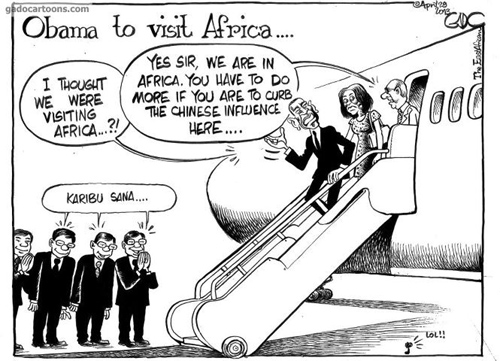
Last night a prominent African businessman chastised Obama for “disengaging” from Africa, even as American military involvement grows ominously large.

Obama as reflecting the “United States” is a curious shadow box of a troubled society. Are we (is Obama?) pulling inwards, constrained (perhaps by Congress?) to few good acts except our own security?

Yes to the first question, and the answer to the second question doesn’t matter.

“We are witnessing a gradual and continuous U.S. retreat from Africa,” Dr. Mo Ibrahim said last night in an acceptance speech for an award from an organization heavily funded by Obama’s Nobel Peace Prize winnings.

“I take the expansion of [AFRICOM] and the growing U.S. military presence sort of creeping down into sub-Saharan Africa as a further continuation” of American militarism, claimed Andrew Bacevich at the Carnegie Council last week.

Dr. Ibrahim is one of Africa’s richest men, commonly known as the “Father of Africa’s Mobile Phones.” Bacevich is a highly respected analyst, author of “The New American Militarism.”

“There is no question that Africa is moving forward,” Ibrahim continued, pointing out the extraordinary GDP growth of the continent, even through the global recession.

“ Everywhere in Africa you see Indian, Chinese, Brazilian businesses,” he said. But no American business except Coca Cola. Africans as a result are beginning to feel a bit uneasy about the United States.”

Read: “suspicious”

Note that Ibrahim didn’t include Europe in the panoply of foreign businesses racing into Africa, and Europe like America is in the forefront of the current global financial earthquake. I think it fair to include Europe in this analysis; it’s not just Obama, not just America, but the traditional developed world.

Which is turning inwards and becoming militaristic obsessed only with its own security.

That’s a very dangerous path to cut. It doesn’t work. It makes things worse: Look at Chris Hayes’ MSNBC show last night: click here.

In his book and his speech, Bacevich recognizes 9/11 as when America (“developed world” including Europe) pivoted from grand economic and social engagements with the rest of the world to become militaristic.

“The George W. Bush administration tacitly acknowledged as much in describing its global campaign against terror as ‘a conflict likely to last decades’ by promulgating the doctrine of preventive war,” Bacevich explains.

The doctrine of preventive war, as much a social upheaval and resource greedy policy as The Monroe Doctrine was nearly two centuries years ago, has consumed America. And it has consumed America just after American bankers and immoral financial trainers consumed society with the 2008 depression. We’re sort of on a mobius strip of unstoppable self-destruction.

Several weeks ago France conceded that its short several week involvement in Mali will likely extend to years. Remind you of something? Mission accomplished?

“… the violent pursuit of violent Islamists continues with no end in sight,” Bacevich laments.

I don’t think this policy of ‘the violent pursuit of violent Islamists’ would be quite as controversial if we didn’t have domestic flight delays, sinking education, wholly stalled government, and a basic social ennui that clearly now even extends to our private sector.

We define ourselves principally in “private sector”-speak. Capitalism cannot survive in today’s global economy, unless it’s global.

The world is moving on, and a lot of that movement is in Africa. There’s nothing very surprising about this. It was the fertile, untilled economic continent, and it’s now being tilled. By Brazil. By India. By China.

By the new economic bullies on the block.

But America sits idle. American businesses won’t invest, at home or abroad. America is consumed by its own terrorized concern that it is marked for doom.

It is. By itself.

Which Death is Worse?

Which Death is Worse?

Margaret Thatcher’s belief that there is no society, only individuals means that yesterday’s bombings in Boston is relatively insignificant news.

After all, there were more than four thousand times more (4000x) individuals killed last year by terrorism in the rest of the world compared to the United States.

But, of course, Margaret Thatcher’s statement isn’t true.

There is more than individuals. There is society.

And there are societies that, for lack of a better word, are considered more “civilized” than others, where “civilization” includes lack of violence, and most certainly, lack of violence against innocents.

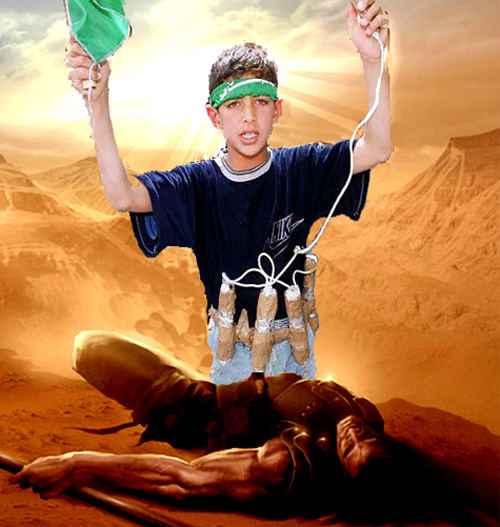
Terror is David’s ultimate weapon against Goliath.

Goliath is an impermeable military fortress. David is the suicide bomber disguised as an immigrant laborer that Goliath needs. Because there are so many immigrant laborers in Goliath’s world, David is relatively meaningless … until he blows himself up and takes down a few “innocent” Goliaths who happened to be wandering near.

That gets attention.

Numbers don’t. It doesn’t matter that it was 15 unnamed adults, children, clerics, wives and pregnant mothers in Garissa, Kenya, but only one 8-year old boy and two unnamed adults in Boston.

It shouldn’t have happened in Boston. It’s no surprise it happened in Kenya. Boston is more civilized than Kenya.

Moreover, as an American an attack on my country is more painful to me than an attack in Kenya. I come to work each morning in part affirming my beliefs and trusts in my society, convinced my society is working hard to be just.

This seems senseless. Weren’t there other ways the bombers could have expressed their dismay and dissolution with what they perceived as unjust?

They feel that way in Kenya, too.

And in Iraq and Pakistan and Argentina and nearly every other place in the world, even Australia.

Something is wrong with mankind and it isn’t with the bombers. There are too many bombers for too many vastly different reasons in too many vastly different places on earth.

Should weapons of any kind be illegal? Can we destroy every gun and bullet and bomb on earth?

What a silly notion. They’d still strangle us.

Should Big Brother be allowed to monitor us all? Do you know how many CCTV surveillance cameras are clicking away right now in London?

Kenya doesn’t have as many. Boston will, soon.

A good Pd.D. thesis for a student of political science would be to show a definite collaboration between the number of CCTV cameras and terrorist killings. More cameras, more police, less killings.

More cameras, more police to enforce a system terrorists feel is unjust motivates terrorists to become even more clever, more deadly. More individualistic.

Maybe Margaret Thatcher was right.

Should the Past Burn Away?

Should the Past Burn Away?

The Mali war has reignited an old debate: should precious artifacts always be returned to the motherland, or should they be kept in safety by the greater, more stable powers of the world?

Yesterday France returned to Nigeria in an elaborate ceremonial handover several confiscations of ancient Nok Arts, prized terra cotta sculptures of Nigerian empires of the 6th century. Over the last several years Yale University has begun a near complete repatriation of the Hiram Bigham artifacts the explorer took from Machu-Picchu in the early 20th century.

And while Paris remains replete with Egyptian artifacts like the obelisk acquired especially during Napoleon’s reign, France is slowly repatriating these, too.

And then comes Mali.

Without ancient artifacts from foreign lands such august institutions as the British Museum would be near meaningless. Chicago’s Field Museum would be emasculated. Taipei’s National Palace Museum would be crushed. And the Louvre – my goodness, Le Louvre, would be nothing more than a home for the Mona Lisa.

But is it right that such national treasures be housed away from the Motherland?

The treasures of Timbuktu rank right up there with the pyramids and Inca kings. In fact, many believe they are the most precious artifacts the world has.

This is because among its mosques and building relics are housed many of the world’s oldest written manuscripts. The oldest registered manuscript – at least before the current war – was dated from 1204. It included texts not just on world religion but astronomy, women’s rights, alchemy and medicine, mathematics and linguistics.

Timbuktu was a natural place for such ancient manuscripts. For several millennia before the modern age it was the crossroads of two major trade routes: the Saharan camel route with the Niger River.

But it was not until the 16th century when the area was arguably at its prime that a famous and wealthy scholar, Mohammed abu Bakr al-Wangari, established a “library” of ancient scrolls and documents. He spent the last 30 years of his life collecting these treasures, and when he died in 1594 they were inherited by his seven sons.

Collection and restoration continued for the centuries thereafter, but without a strong centralized government it was haphazard and often random. Timbuktu’s most prominent families became identified with their libraries of ancient texts.

By the turn of the 20th Century it was estimated that more than a quarter million books, notes, drawings and other relics of the past were being lovingly preserved by literally thousands of Timbuktu’s 100,000 residents.

UNESCO became deeply involved years ago, and in 2005 a huge portion of its cultural restoration budget was dedicated to Timbuktu alone.

But because the manuscripts – the most precious treasures of all – were still legally in the hands of individual families, UNESCO cleverly over the years poured its funds into the remains of ancient mosques and mausoleums. Slowly over time these attracted manuscripts.

Still the vast majority of texts were aggressively retained and often hidden by individual families. In 2005 South Africa convinced many of them to stop burying ancient parchment in the sand whenever trouble arose, and began a library.

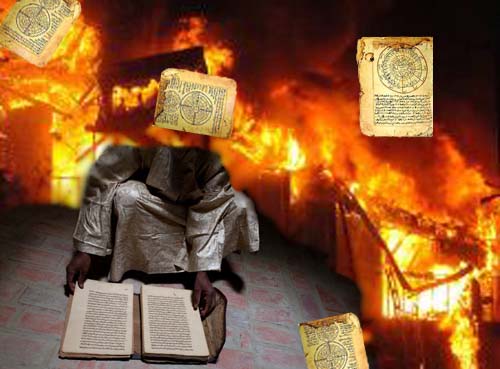
That extraordinary effort went up in flames as the Islamists left Timbuktu last week.

One of the most visible of the many libraries was Timbuktu’s Ahmed Baba Institute for Higher Studies and Islamic Research. When the Islamists first took over Timbuktu, the adroit director managed to convince one of the leaders of the importance of the texts to Islamic law.

Then, over the next months, he smuggled 28,000 of the most precious manuscripts out of the building. When the Islamists left, they burned what was left.

How much has been lost? Inventory is still going on, but the point is that most of these remarkable documents are still in private hands, libraries and collections of various Timbuktu families.

Is it time that such precious relics of humankind be removed to safer places? Or at the very least removed to Bamako and protected there?

Give Peace A Chance

Give Peace A Chance

Conflict in Africa is declining, not only relative to the rest of the world, but historically within the continent itself, and a brilliant University of Wisconsin professor has discovered why.

The truth is counterintuitive to many Americans whose understanding of Africa comes mostly from the nightly news and America’s very distorted and political travel advisories. But Scott Straus has documented the fact, and what’s more critical, explained it.

The University of Wisconsin at Madison is fast developing as one of America’s invaluable resources for everything African. Strauss is young, an associate professor brilliant enough to obtain an endowed chair, concentrating in political science and global issues.

But Madison is rife with many others Africa directed, including one of my favorite, John Hawks, whose exciting blog is one of the most important first sources of breakthrough anthropology and paleontology in Africa.

So it is not surprising that research news about Africa comes from UW-Madison. It is surprising, though, that a young associate professor will dare take on contemporary media alliances as normally disparate as Ted Koppel and Richard Engel.

Koppel suggested on Meet the Press last Sunday that Africa is going nuclear, not necessarily figuratively, and far outpacing the danger of conflicts of the past. Engel suggested on Tuesday’s Nightly News that Africa exceeds Syria or North Korea in terms of potential conflict.

And these represent the liberal media! As far as Fox News is concerned, the only indication at all that evolution might be true is that Africa hasn’t yet.

Media news in short sound bites is how most of America forms its understanding. As Straus explained in an article Monday it takes more than sound bites to reveal the truth.

Straus’ quest to disseminate the truth has been a two-year one. Using the most incontestable data since 1960, he has demonstrated in publications and conferences that conflict in Africa is on the decline. It’s a particularly difficult task right now, and he refers to the northern African conflicts as an “uptick” but when laid into any graph of any length – even just 3 or 4 years – his premise stands.

And as I’ve written recently, many of us do not see this current conflict in northern Africa as lasting very long. (So I hasten to add that doesn’t mean terrorism will be wiped out, or that Egypt won’t boil and bubble for years to come.) But it does mean that from a truly global perspective, it’s wholly rational that the world’s biggest businesses are investing hands over fists in Africa, because even they know: Africa is the place to be in the future.

But even more interesting is Straus’ more delicate conclusions as to why.

Why is there more conflict in Asia, for example, than Africa? Why are wars – when they do happen – more gruesome and often barbaric in the Balkans than Central Africa? Why is North Korea or Iran so much greater a threat than an extremist Islamic Arab Africa?

Three reasons:

1. The End of the Cold War
As I’ve often written Africa was the great pawn in the Cold War. It led to its current stubborn levels of corruption, since the patrons in the East and West lavished immature African societies with tons of money and weapons without requiring accountability. When the Cold War ended, this unfiltered pipeline did as well.

2. Democracy
This is Straus’ weakest point, but if I understand it correctly, he believes that before the advent of multi-party politics, dictators’ control of African countries’ growth, revenue streams and disbursements, were highly targeted ethnically or even just into the coffers of those dictators. The release of the economies of African societies requiring real public stewardship – coincidentally or otherwise with the advent of multi-party democracy – leads to a strong motivation to keep the social peace.

3. China
Like me Straus doesn’t hold China up as a model for how a big power should mentor small ones, but like me he realizes that China’s unique form of foreign policy is good for African peace. “China doesn’t take sides,” Straus says flatly. China takes oil. And it will do anything it can to get it. There’s no deceit, here. Everyone knows the rules of the game, and to be a winner, you have to have peace.

4. Regional Conflict Resolution
I disagree with Straus on this, but fortunately I think the previous three reasons are sufficient enough. Straus argues that regional powers and organizations have been working successfully to reduce conflict: South Africa in Zimbabwe, Kenya in The Sudan and Somalia, Egypt with the Palestinians, the African Union in many places. I don’t. I think these ostensible activities are totally emasculated without big power – mostly western – support and guidance. The signs are hopeful and this may herald the resolution centers of the future, but right now they are still the puppets in the shadow box.

But his last explanation could be stretched into an argument that is equally positive: that the Big Powers are doing better in shepherding conflict resolution in Africa. And with that I totally agree, and especially recently under Obama.

Truth is often so broad and so immutable that it fades like a watermark under the moments of things more exciting and threatening. That’s what much of Africa’s steady progress into the future is like. There was so little interest at all in Africa a generation ago by westerners, all we learned was the bad stuff.

That’s the history we store, miserably inadequate to produce sufficient contrast as a watermark on the abduction of child soldiers and Rwandan genocide. But the persistent and careful work by people like Straus will prevail, and I for one hope he continues to enthusiastically duke it out with the Koppels of the world.

Frighteningly Wonderful in Mali

Frighteningly Wonderful in Mali

France’s liberation of Timbuktu and defeat of Malian Islamic revolutionaries is right on schedule and demonstrates perfectly the American/French axis routing world terrorism.

Sunday’s Meet the Press roundtable was in contrast the perfect example of how fooled and even bamboozled old guard American media personalities still are. Andrea Mitchell excepted, the remaining two old men got almost everything wrong:

Ted Koppel who presided over the creation of the War of Terror in the media predicted “we’re entering one of the most dangerous eras this country has ever experienced.”

Wrong.

“I think it’s even bigger and more troubling than that,” pounced Bob Woodward, the man who broke Watergate and was apparently broken by it in return.

I’m making no bones about saying that France’s action will be short-lived, especially by the standards of American foreign involvements, and that it will be generally successful. As I said in earlier blogs, I think this is the end-game for the current era of terrorism. That doesn’t mean the end to terrorism, of course, just the end of the al-Qaeda chapter.

The end-game wasn’t supposed to be quite so publicly bloody, and this is largely because of American missteps in Mali. AFRICOM was the new American African command that set in pace a number of militaristic actions I’m ambivalent about, but which did chase al-Qaeda from Yemen to Somalia to central Africa and finally to North Africa where it was supposed to desiccate in the sand.

This three-year chase fragmented what had been a more structured and organized group of very bad guys. Separately, the Obama drone assassinations took out dozens of terrorist leaders, including of course the Top Gun. Like Sherman plowing through Georgia, death and destruction has been left in the wake, but…

…al-Qaeda is gone, Somalia has been pacified and terrorism has been chased on a long arc from Afghanistan down into east Africa and back up to North Africa … where now the French are pummeling it to death.

It got messy in Mali because Americans don’t speak French right. We trained the Malian army and held it up to public scrutiny as a model for modern African armies (allied, of course, to the west).

But those pesky French-speaking Africans got naughty and staged a coup against what we had also championed as one of Africa’s most stable democracies, and together with a few other events like generations of weapons released from Libya, the current war was precipitated.

Tuaregs have been fighting for independence since the dawn of the camel, and al-Qaeda remnants fleeing America’s silent sweep, pushed north into the southern flowing Libyan arms made uncomfortable but convenient bed fellows. For a while.

It couldn’t last. It didn’t. But it was strong enough long enough to give the French cause to attack. The French don’t dither like Americans. They never have, and their unique forms of morality are the same which continue to celebrate Napoleon’s tomb in the Champs de Mars.

So now what?

North Africa is a mess, but it isn’t the global threat that Afghanistan was. The trouble in Egypt is internal and will last for some time, but it will not spread. French foreign legion will be in Mali for some time, now, but fighting will diminish not spread into Niger or Nigeria as old men American commentators claim.

And the terrorism threat will diminish. The world will be more peaceful.

So why am I so unsettled and near sarcastic?

Because this was all planned. I see everything having happened to a a near perfect specific plan, a covert military mission organized by the Obama administration, cleaned up by the French. The French weren’t supposed to come out of the rafters, but they had to translate for the Americans. That was the only unplanned move. That this all worked and made the world peaceful is good.

That it is covert and so strikingly successful is terrifying.