The Coup d’Etat is Back

The Coup d’Etat is Back

Clattering Coups
By Conor Godfrey

Anyone who followed African news in the 1960s, 70s, or 80s, would be forgiven for thinking that a coup d’état once every five to ten years was written into West African constitutions. Yet, like small cars and women’s boots, shooting your way into the presidential palace is back in style.

Last Thursday in Niger the Supreme Council for the Restoration of Democracy followed in the footsteps of neighboring Guinea and Mauritania by seizing democratically elected President Mamadou Tandja at gunpoint.

So why are West African governments falling like dominoes? Oil and drugs.

I do not mean to ignore the host of possible global and local factors that may also bear some responsibility (global downturn, commodity prices, localized disputes), but I think we are seeing the first bubbles of instability rising from a torrent of illicit cash derived from the drug trade and the prospect of mind-blowing oil profits.

Drugs first: For some time predominantly South American drug cartels have been using weak West African states as transit points for Europe-bound product. Guinea-Bissau has the honor of being labeled Africa’s first “Narco-State,” but its southern neighbor, Guinea-Conakry, is in contention for that dubious distinction.

In 2009 the Guinean government exposed “drug labs” in Guinea used to facilitate this narcotics trade. That same year a smuggling ring involving former President Conte’s son was shut down in the southern city of Boke.

According to the Center for Strategic and International Studies, drug cargoes make the trip from coastal countries by convoy through Mauritania to Niger and beyond.

Notice that every country along that route has experienced a coup in the last two years. The revenue streaming in from cartels to corrupt officials dramatically alters the calculus of those in power and those who would see them ousted.

Let me put the problem in its appropriate financial context: when I worked in Guinea as a teacher I made $220 per month. This dwarfed the official salary of my Guinean principal and roughly equaled the official salary of his boss the superintendent. Imagine what a South American drug cartel could do with several thousand dollars, or several tens of thousands? It would be a tag sale of epic and disastrous proportions.

Oil: Experts predict that the Gulf of Guinea will soon account for 7% of the world’s total oil reserves. Exploration is underway in all but two West African countries (Burkina Faso and Cape Verde), and Ghana will become an oil producer as early as the last quarter of this year. Oil money, much like drug money, lends itself to secrecy and corruption.

Could the prospect of such easy-to-pocket money underlie the recent decisions by several West African leaders to stage ‘constitutional coups’ by amending their countries’ constitutions in order to serve additional terms? Nobody wants to leave office the year before money literally starts exploding out of the ground.

There is blood in the water, and the sharks will not be denied. The coup d’etat is back in vogue, and investors and policy makers should expect this fad to last through the season.

Related Reading
This instability map of Africa also shows the location of significant mineral extraction points. The correlation between mineral wealth and instability jumps out immediately. Imagine what might happen when oil-producing icons start to pop up all over West Africa? If you are more of a concrete thinker, just look at Nigeria.
France Apologizes, America’s Turn

France Apologizes, America’s Turn

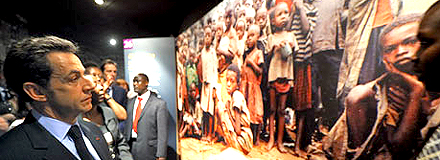
President Sarkozy at Rwanda's Genocide Memorial

Apologizing is hard and noble. It’s America’s turn.

Today, France apologized to Rwanda for its actions that contributed to the Rwandan genocide of 1994. Like the Belgian Parliament’s historic apology to the Congo for its ancient king, Leopold, (which included substantial reparations) these are difficult and noble acts.

“What happened here is unacceptable and …forces the international community… to reflect on the mistakes that prevented it from anticipating and stopping this terrible crime,” French President Nicolas Sarkozy told Reuters today.

It’s now America’s turn; Bill Clinton’s in particular.

The Rwandan genocide of 1994 could have been stopped. Numerous books and hundreds of pages of oath-sworn testimony, not to mention popular films, have documented the neglect of western countries, mostly the U.S. and France, from taking action earlier enough.

The UN general on the ground commanding a pitiful 500 troops saw it all coming. He pleaded with the General Assembly to do something.

The U.S. and France blocked his requests.

The genocide began.

France’s explanation was born of a long colonial involvement in the area. In a nutshell, there have always been little Hutus; they were the aboriginal hunter-gatherers of the area. In about the 6th or 7th centuries, the tall Watutsis (Tutsis) invaded the area.

The Tutsi herders represented about 15% of the population; the Hutus about 85%, but for more than a millennia the Tutsis over lorded the Hutus in a remarkably European feudal system.

During the colonial era France wanted to remedy this. That, too, was noble, but a half century of colonial rule is not enough to change the life ways of thousands of years.

The European colonial era ended not on any noble proposition. It ended because the colonial powers, Europe, were devastated by World War II and could no longer afford their colonies.

Belgium and France were the colonial powers in this region, and they raced to end their involvement with little recognition that all they had done during their occupation was make matters worse between the Hutus and Tutsis.

The first major massacre was 1972. Six more followed before the catastrophic genocide of 1994. Even today in Hutu/Tutsi conflicted Burundi, war rages. Not even Nelson Mandela’s decade long involvement in Burundi has stopped the fighting.

But in Rwanda it could have been stopped. But France ever championing the underdog, talked itself into believing that the event which started the genocide, the missile strike of the Hutu President’s plane returning to Kigali from a peace conference, was a deliberate act of the Tutsi.

Until today, in fact, France contended that the current President Paul Kagame of Rwanda was principally responsible for the missile strike.

He may have been. I don’t think we’ll ever know, several lower judges in France continue to bring charges against Kagame and others. Recently, a Rwanda government official was arrested when she entered Rwanda and charged with events leading to the genocide.

But French President Sarkozy is cutting to the chase. Whether it was Kagame’s gang or not who shot down the plane, France and the U.S. could have stopped the genocide, and they didn’t.

France contended for too many days after the fighting started that it was the Hutus fault, and it blindsided itself to the fact that in the beginning it was the Hutus who were the murderers.

Sarkozy has now admitted all of this. And apologized.

And America?

Well it was different with us. Bill Clinton was burned beyond belief by the defeat of Blackhawk Down in Somalia. We know much less about Africa than France. The one defeat-fits-all syndrome made Clinton believe we could be burned again in Rwanda.

We wouldn’t have been. The UN on the ground could have stopped the genocide. I think that some critics who claim Clinton was just being mean are ridiculous. I think he was just… dumb.

The world is grossly interconnected. We need our leaders to be aware as much of tiny places of trouble like Tblisi and Kigali, as they are fixated on Tehran.

After the genocide, France spent $900 million dollars in helping Rwanda recover. The U.S. spent $1.1 billion. Even from the crass business cost perspective, we both made very bad decisions.

Thank you, France.

And now, America? I wouldn’t hold your breath.

War in Ngorongoro?

War in Ngorongoro?

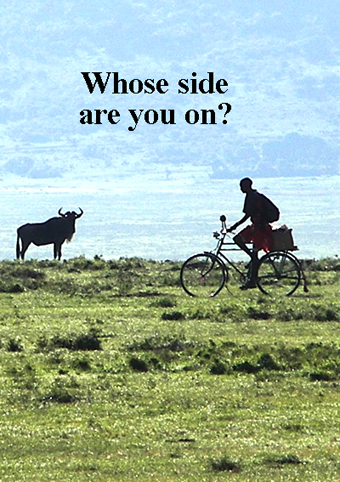
WhoseSideEducation is fine if you’ve got something to do with it. Is there going to be war in Ngorongoro?
The great experiment known as the “NCA” in what ABC’s Good Morning America christened one of the world’s Natural Wonders is coming apart.

Most tourists know it as “The Crater.” But Ngorongoro Crater National Park is just a tiny 100 sq. mile circular caldera sunk into a much larger wilderness area twenty times as big, officially known as the NCA (Ngorongoro Conservation Area).

The crater’s unique ecology collects more water than virtually any other part of the NCA, and its deep flat sedimentary and volcanic substrata – like the Serengeti – creates areas of grassland plains perfect for Africa’s great herbivores.

So the crater itself attracts a larger concentration of animals than the surrounding NCA. But there’s plenty out there in the NCA, too, on the gorgeous highland hills that ultimately descend onto the Serengeti’s prairies. And if wildlife couldn’t flow between the sunken crater, the NCA and the Serengeti, there wouldn’t be any wildlife in the crater.

Yesterday, the Parliamentary Committee in Dar assigned to the area began moves to forcibly evict Maasai from the NCA.

It spells trouble.

Committee member Dr Raphael Chegeni claimed there were now more than 60,000 Maasai living in the NCA with “unsustainable” numbers of cattle. This is well beyond the 25,000 Maasai Parliament authorized as sustainable.

You see it was presumed that as Tanzania developed, so would Maasai, and that they would choose to abandon traditional lifestyles for modern opportunities, and so while technically their population would grow, they would leave the wilderness.

And to its credit, the Tanzanian government, Italian NGOs and even the American Peace Corps have spent years building schools and dispensaries to get Maasai healthy and educated and ready to be a bank clerk.

But graduating from primary school in Ngorongoro didn’t turn out to be the magic wand intended. There aren’t any jobs for fresh school leavers. Modern Tanzanian bank managers don’t like Maasai kids.

Tanzania is an increasingly corrupt society, its superficial democracy immune from ethnic troubles but dominated by a small cadre of rich and educated.

Maasai in the main are neither rich or educated.

Recently, actually, things looked promising. Several years ago Tanzania’s Prime Minister was Maasai, and he was a fabulous Ben Nelson! But alas, he got implicated in several huge corruption scandals and lost his job and his clout. He’s headed for jail.

Before foreign hunters or tourists there were Maasai. Maasai and wild animals have always lived together just fine. And this is the heart of Maasailand. But over the years (starting in 1921) the Maasai have been squeezed into smaller and smaller areas, reserving larger and larger areas for foreign hunters and tourists which bring in much more revenue than hut taxes.

Besides, who in their right mind would want to spend their lives in a straw hut? Chief Blackhawk was last photographed in a suit talking to President Grant!

In 1972 Maasai were bumped entirely out of what is now the Serengeti, and theoretically, out of the 100 sq. mile crater.

It was a contentious act, and the “treaty” with the Maasai allowed them to continue to live in the NCA provided they didn’t alter their lifestyles from traditional herding into, for example, planting sweet potatoes (which is exactly what many do, today). Another caveat in the treaty allowed them to bring their livestock down into the crater during times of drought.

Those concessions were clearly humane, but they have led to uninterrupted tension between the Ngorongoro Maasai and park authorities ever since 1972.

To begin with, who was going to define a drought?

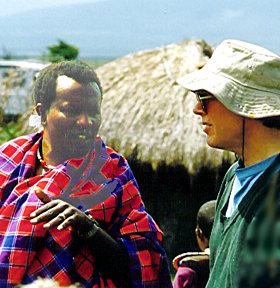
Jim with Edward, 1993.

I became quite good friends with a really sharp Ngorongoro Maasai in the 1980s who was the third most important son of the most important Maasai headman near Olmoti. When his two elder brothers died, he became the chief area spokesman.

There were several droughts during those years, and tension grew as the Maasai brought more cattle into the area. Rangers tried to evict them. Maasai are great spear throwers, but they turned out to be terrific rifle shooters, too.

Rangers and Maasai were killed in these gun battles. I remember camping with a group in Lemata on the crater rim when we were awakened by this gunfire in 1993.

My friend negotiated an end to the battles in the mid 1990s. Several Maasai, including him, were trained then hired as rangers. It was a brilliant move. Until he was killed in a war when he and other rangers were trying to evict Somali from the eastern Serengeti.

And since then, the area’s Maasai population has more than doubled.

Tanzania has some fabulous crusaders for human rights which have tried in the past to mediate between the government and the Maasai.

The Lawyers’ Environmental Action Team is among the best. But they tried and failed to mediate a dispute with Maasai in the northeast Serengeti last August, and they are now overwhelmed with work in the areas of Tanzania’s new gold mines and seem uninterested in the current dispute.

The conflict between animals and people is not the only conflict in the wilderness. The more important, and deadly, is the conflict between people and people.

Bipartisan with China, against Eles

Bipartisan with China, against Eles

Destined for a chess board in Shanghai.
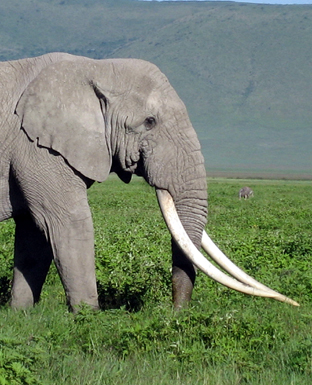
Two weeks from Sunday the Obama administration will finally let the world know what they think about elephant conservation. So far, they haven’t.

The silence is deafening. I’m afraid the whales and elephants are being negotiated away for sanctions against Iran.

This will be Obama’s first world forum on conservation. The last CITES convention held in Santiago under the Bush administration was a terrible embarrassment to all Americans. (See my blog.)

We were all hopeful that a very public and forceful presence by the new Obama administration this time would do much to recoup the deficit of trust in America that last conference produced.

But so far, nothing from Ken Salazar’s office. I called his press assistant, Tamara Ward, yesterday and she has not replied.

Many items are on the table, and the Obama administration has announced their position on some of the less controversial ones.

But the main act is a huge fight among African countries as to whether elephants should be downlisted from “endangered” to sort of “endangered” or “protected.” Any downlisting would then allow certain countries to sell stockpiles of ivory.

Zambia and Tanzania are leading the march this time to downlist the elephant, while Kenya and 26 other African countries are mounting the defense.

Zambia and Tanzania have huge stockpiles of ivory. This is collected from naturally dead elephants and confiscated from poachers.

Kenya, too, has stockpiles, but it knows that allowing any sales of ivory will stimulate the trade and motivate poachers. And Kenya has the foresight to know that a healthy elephant population will bring in much more revenue from tourism in the long term than one-off sales of tusks do in the short-term.

The scientific argument as to whether the elephant population is currently healthy enough to withstand increased poaching, or whether increased poaching could actually lead to extinction, is more arcane.

Like everything, today, the countries are actually inspired by money, not science.

It was hoped that the Obama administration would join the European Union in trying to bring some light to the scientific argument, which heavily suggests that increased poaching cannot be withstood.

The silence is deafening.

The conference opens March 13 in Doha, Qatar.

Led and founded by the United States and Kenya, among a few other concerned countries, CITES mirrors the U.S.’ own truly august Endangered Species Act (which preceded the international convention by more than a decade), and is a worldwide agreement on what forms of life can be passed through international borders.

By listing certain species from threatened to endangered into five different categories, the countries signing the convention agree to various regulations that are placed on their trade.

This could be as little as enhanced scrutiny, to as is currently the case with elephants, an outright ban on trade.

Scientists generally agree that prior to the corporate poaching of elephants which began in the late 1970s, that there were as many as 1.3 million. Today, there are 470,000.

But at the nadir of the long history of elephants, the population probably dipped to around 200,000 by the mid 1980s.

When the first CITES convention met to specifically deal with elephants and banned their trade, the black market price of a kilogram of ivory declined from $300 to $3 in one year. Poaching dried up.

By 1988, Kenya’s population of elephants had declined from 167,000 fifteen years earlier, to only 16,000. (Today it is around 30,000.)

As the situation improved throughout the continent, the irritated southern African countries (where poaching had always been better controlled) insisted they be allowed to sell legally harvested ivory.

The first sale after the treaty banned all sales in 1989 was allowed in 1999; 50 tons were exported to Japan. Poaching immediately started up, again. In June, 2002, the largest shipment of illegal ivory since the 1989 ban was seized by Singapore authorities. DNA analysis showed the ivory originated in Zambia. The cargo was destined for Japan and comprised 532 elephant tusks and more than 40,000 already cut pieces of ivory weighing more than 6.5 tons.

Nevertheless, the trend continued to allow more selling, in part because of the Bush administration’s tacit approval.

In November 2002 at a CITES convention, it was agreed that Botswana, Namibia and South Africa could export 60 tons of ivory.

Then, a second CITES-negotiated sale occurred in 2008. Zimbabwe sold108 tons to Japan and China. Predictions that this sale in particular would fuel an increasing appetite for ivory among the rapidly growing Chinese middle classes proved true.

In 2009 China opened 37 new government “ivory” stores.

Today, a kilo of ivory sells for $1500 in the Far East. In Kenya a poacher gets about $40, but even a small pair of 20-kilo tusks brings a poacher the equivalent of $800, just below the average amount a Kenyan worker earns per year.

It seems, though, that the Obama administration wants to be as namby-pamby with regards to conservation as it is to health care.

The U.S. delegation is supporting a handful of “listings” including a nearly extinct cockatoo in Indonesia and the very popular polar bear which impacts Eskimos and few others. Inuit are not party to trade agreements.

And, of course, “bipartisanism” with China is as important as with Republicans on health care.

We know where that got us.

Bringing Iraq to Africa

Bringing Iraq to Africa

Honored Nigerian Freedom Award Guests
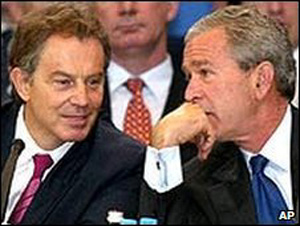
Are Bush, Blair and Condy sending the right message to Nigeria? No.

There is tension in Nigeria at the moment, as if there isn’t always tension in Nigeria, but Africa’s rich oil producer is technically without a president. The elected leader is either very sick or dead (no one’s sure), and the Nigeria’s Parliament has given his powers to an Acting President.

Nigeria’s long and labored post-colonial history is rife with horrible violence. Remember Biafra? Well there have been demonstrations and police repression lately reminiscent of the horrible days that led to that terrible conflict.

So presumably to delay what some believe is the inevitable, former leaders Tony Blair and George Bush jetted into town with former Secretary of State Condoleezza Rice, ostensibly to honor Nigeria’s freedom fighters at an award’s banquet.

Although I’m not sure this is anyone’s idea but theirs.

Problem was that the lead awardee of “freedom fighters”, former anti-corruption investigator Nuhu Ribadu, had fled the country for his life.

Ribadu had been ready to indict several top ruling-party politicians, including the one that George Bush was sitting next to, former dictator Muhammadu Buhari. Buhari was one of Nigeria’s most feared generals, detaining government critics without charge and afterwards pushing through laws that allowed him to hold the detainees indefinitely without trial.

Ribadu once estimated corruption cost Nigeria — a nation where most people live on less than $2 a day — over $380 billion since independence.

And another famous Nigerian human rights champion, Shehu Sani, who was to actually be seated near former President Bush, couldn’t, because he’d been jailed the day before.

I kind of now understand why nobody in the Obama or Brown administrations attended.

Sani, who was freed on bail but then denied entry to the event, told the BBC that “It was a peaceful protest. I was officially invited to the banquet – so I wasn’t going to throw any shoes.”

“But the police came and used force to shove me into their vehicles along with about 80 others.

“They said we needed a permit – but according to the constitution all we have to do is write to the police and tell them about the protest. We had done that.”

So Bush, Blair and Condy are the west’s representatives to an award ceremony for freedom and liberty in Nigeria except the awardees are either in exile or jail.

Peaceful Kenyan People Power

Peaceful Kenyan People Power

protesThe coalition government in Kenya was fraying at the seams last week, but a large public demonstration may have stitched it back together.
Wednesday several thousand protesters took to the streets of Nairobi in what many of us feared would be the end of the “Grand Coalition” which has held Kenya together in a fragile alliance since the terrible civil turbulence of early 2008.

How wrong we were.

The police actually protected demonstrators, they didn’t incite them as Nairobi police most often do. The protesters were a major mix of ethnic groups, not just Kikuyu or Luo. They marched through town and even shouted outside the President’s office.

And hardly disturbed the traffic in the city.

After tremendous media coverage, and politicians running to the microphones to lend their support, President Kibaki drew down his latest incendiary move. He agreed to the effective suspension of two ministers in the government which had been ordered by his rival and partner in government, Prime Minister Odinga.

I think this bodes very well for Kenya, but we’re still at an extremely fragile moment. I also think the events of the last several weeks have defined the good man and the bad man. The good man is Prime Minister Raila Odinga. The bad man is President Mwai Kibaki.

Kenyans have moved foward with deliberate and hopeful speed a new constitution which must be put in place before the election cycle for 2012 begins next year. As the details of the compromise began to leak last week, a rift opened up between these two power-sharing behemoths.

As the proposed constitution now stands, it is likely that the cause of the last dispute – the extremely close and fraudulent election between Odinga and Kibaki, could occur all over, again. Previously it was widely hoped that Kibaki would not stand for re-election, or effectively would not attract enough support in the way the electoral process would be implemented.

That changed, corruption in the government (which is endemic on both sides) exploded in the local media with regards to funds for schools and misappropriation of grain stockpiles. Neither is a new issue, but both gained new traction because the “bad guys” are all in the president’s camp.

And in the ever present background are the international trials set to begin momentarily in The Hague against yet to be named government officials accused of crimes against humanity in the violence of 2008.

It all came to a head last week when the Prime Minister suspended two of the ministers (both in the president’s party) pending resolution of corruption charges against them.

Over the weekend the President revoked the Prime Minister’s suspensions.

Monday, the Prime Minister appealed to Kofi Annan, who orchestrated the Grand Coalition in 2008, to return to the country to resolve the dispute.

Tuesday, the people took the streets.

And it was peaceful.

And it worked!

Wednesday, the President agreed that all responsibilities in the offices of the ministers who the Prime Minister suspended would be taken over by their permanent secretaries. An effective suspension.

Peace? Working in Kenya? Congratulations, Kenyan people power!

We’ll have to see where it goes from here. But so far, so good.

How dirty is Dar?

How dirty is Dar?

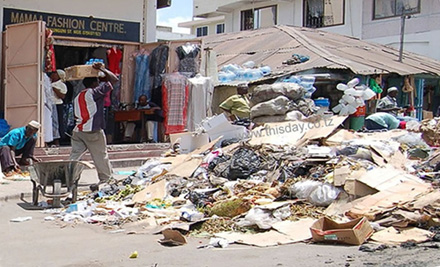
Uncollected garbage outside a "fashion center" in downtown Dar.
Uncollected garbage outside a fashion center in downtown Dar.
Photo by Tanzania's ThisDay.
Africa was agog today with reports that Dar-es-Salaam was the 8th dirtiest city in the world. But are these reports accurate?

No! No! Let me come to the needed rescue of Dar: It is NOT the world’s 8th dirtiest city; it is, in fact, the world’s 12th dirtiest city!

Mercer Health & Sanitation’s Index rated Dar at 40.4. Only three other cities in Africa were rated worse than Dar: Ndjemna (Chad) at #11, Brazzaville (Congo) at #10, and Addis Ababa (Ethiopia) at #6.

No other East African cities came in the top 25, although Nairobi fell into the top 35.

(Multiple African news reports cited a “NYC Consulting Firm” rating of #8 for Dar, but there doesn’t seem to exist an “NYC Consulting Firm.” That list of the world’s dirtiest cities is close to the real Mercer ratings, but not exact.)

Dar is not denying the criticism.

“It is true and I accept that the city of Dar es Salaam is dirty,” Dar es Salaam Regional Commissioner William Lukuvi told This Day an on-line Tanzanian news source. And that’s good, of course.

Dar is the fastest growing city in East Africa. No one is sure about its size, and it’s probably not as big as Nairobi, but closing the gap quickly. It also lacks Nairobi’s sprawling slums, which in an unusual way contributes to the lower Mercer rating.

Nairobi slums have been around for a long time and many NGOs have worked at them, as has the central government. Sewage, bad water, and the diseases that spread as a result, are the main reasons for Mercer’s list of the worst cities. And ironically, the decade and longer attention to the Nairobi slums has actually mitigated what would otherwise be an uncontrollable catastrophe.

Don’t get me wrong. The Nairobi slums are terrible, but the makeshift gullies cut by NGOs and the government does drain human sewage, the main cause of cholera. Last year there was more cholera in Dar than Nairobi.

Dar’s problem is that it is far behind Nairobi in sewage treatment and waste disposal. This is probably because Dar is on the ocean, and it has been common practice to just dump waste into the sea. The practice is now haunting the city, because unlike Nairobi, it has no well-organized sewage disposal.

Dar’s other problem is corruption. Dar’s three municipalities each contract private companies for garbage disposal, but don’t pay them. Instead, they allow the private companies to collect levies however they wish, a completely haphazard and terribly corrupt system.

To his credit, Lukuvi knows this.

“The present system is messed up. You can’t have a contracted company collect garbage and levies at the same time. The municipalities will henceforth be responsible for collecting the levies and paying the companies that are contracted to collect the garbage,” Lukuvi told This Day.

The annual Mercer ratings are important. They corroborate the United Nation’s warning that the greatest threat to the developed world is the lack of clean water.

Of Mercer’s 25 worst cities, 20 are because of a lack of clean water. Only 5 are because of air pollution.

Victorious fighters of al-Shabaab

Victorious fighters of al-Shabaab

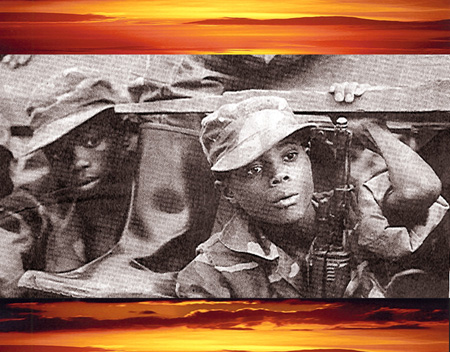
youngsoldiersLess than 24 hours after the UN Security Council approved continued funding of the Somali peace-keeping force, that force may have been routed from the capital by al-Qaeda.

After a night of intense fighting in Mogadishu, the blogosphere is replete with claims that al-Shabaab (al-Qaeda in Somalia) is near to taking over. Reuters was unable to make contact with any of the UN Peace Keepers.

“This fighting was the worst in months,” Mogadishu resident Ahmed Hashi told Reuters.

The world’s recent attention on Yemen as a cauldron for al-Qaeda growth came way too late. And now it seems not even the UN realizes how serious the situation in Somalia is.

This incessant game of catch-up, of pushing the “War Against Terror” from one country to another and always too late, now threatens the legacy of stability the west helped to create in East Africa.

The UN force had been trying to protect the pitifully weak “interim Somali government” which has not even controlled the entire capital city for the last year.

Al-Shabaab on the other hand has slowly established control over a huge portion of the country. In October these mostly foreign fighters took control of large towns near the Kenyan border.

Only the pirate-held area near Kismayu seems out of al-Shabaab’s grasp.

And where are all these weapons coming from? We’re not talking about machetes. There are tanks and missile launchers.

The fighting today reminds me of the 1980s Cold War days when America-backed Somali fought Russia- backed Ethiopia in the useless Ogaden desert that separates the two countries. Thousands of tanks. Thousands and thousands of mortars. Even jet fighters. For a completely useless piece of land.

That legacy left want and destruction then chaos, and at the time most of us didn’t even know that battles which rivaled those of WWII were going on the Horn.

We left want and destruction all over the Horn, proxy battles for the parlor room politics back in Washington and Moscow. The McCarthy hearings were shameful, the Vietnam War apocalyptic to world peace, but the number of Ethiopians and Somalis who were killed in the 1980s fighting for Communism vs. Capitalism and since killed as a result far out numbers the 58,196 names on Washington’s Vietnam Wall.

That was a generation ago. The children born then, now the fighters of al-Shabaab, now know no other life.

State of the World

State of the World

StateofUTonight it’s possible that more viewers outside the United States will watch President Obama’s State of the Union than from his own country.
Brian Williams’ and Katie Couric’s audience shrivels when compared to that of Owen Bennett-Jones, who today ends his BBC World Service specials on America just before airing the State of the Union live around the world.

“Is America really obsessed with God, gays and guns?” Bennett-Jones asks, today, as his final introduction to the world’s most powerful leader’s annual speech.

Yes.

Nairobi’s Capital FM Radio’s Eric Latiff reminded his fellow citizens on the eve of the address that corrupt Kenyan leaders “ will NOT step aside to allow investigations …unless foreigners (read donors) push them out of office.”

Like we do in Ecuador and Honduras, Afghanistan and Iraq, Thailand and Laos, and Rwanda and Uganda as well as Latiff’s Kenya.

We rule mostly by money, but also by arms (which seem to be less effective, today).

So today in Kenya, for instance, the U.S. announced it was withholding around $30 million promised for the country’s education system because of corruption. We also announced continued and increasing travel bans on certain Kenyan officials from entering the U.S. (where most of them store their money).

There is nothing illegal or immediately immoral in these powerful acts, and in Kenya most citizens actually support them. Because as in the U.S. right now, most citizens distrust the bums who have been elected to govern them.

So what we have in the world is distrusted bums governing distrusted bums.

Governing us.

Extend your universe, tonight. Pull up the BBC or Nairobi’s Capital FM. Note how powerful Barack Obama is perceived and whether true or not, how powerful the U.S. Ship of State is. The Ship of State floated by you.

Ivory Sink Hole

Ivory Sink Hole

Tanzania conservation authorities have plunged into quicksand and the sink hole could take all of East Africa with it.

This weekend Tanzania confirmed that it was aggressively trying to convince the 175 members of the Convention on International Trade in Endangered Species (CITES) to approve the sale of elephant ivory.

All the surrounding countries except Zambia strongly condemned the announcement by Director of Wildlife Erasmus Tarimo.

Kenya pointed out this was Tanzania’s worst year for elephant poaching in more than two decades. The announcement also followed a sad report Thursday that 12 rhinos had been poached in what had been considered the poaching-free park of Kruger in South Africa.

The United States has yet to take sides. This is a very troubling matter. The convention opens next month.

The irony is that one of the reasons Tanzania wants sales to be allowed is because it has confiscated so much illegal ivory just this year. Tarimo says the country is warehousing more than 90 tonnes of elephant tusks.

Based on the last such auctioned sale, that could be worth $20 million.

But the cycle of irony is self-perpetuating. If Tanzania gets to sell its ivory, there is likely to be more poaching as the market for ivory widens. Tanzania will confiscate more illegal ivory. Tanzania is discovering a mafia-like way to reap the rewards from what it claims is wrong.

”They (Cites) will track down our record in the past ten years to see history of elephants in the country,” Tarimo said, noting that the species have been increasing over the last ten years.

And you can be certain the Kenyans will highlight the horrible “history of elephant poaching in Tanzania” just this year alone.

All the countries in Africa with elephants hold large stockpiles of ivory, including Kenya. The southern African countries, which have historically managed anti-poaching infinitely better than the rest of the continent, have continually argued for controlled auctioned sales of ivory.

CITES has allowed three such sales, but never from the East African market.

It’s peaceful in Kenyan prisons

It’s peaceful in Kenyan prisons

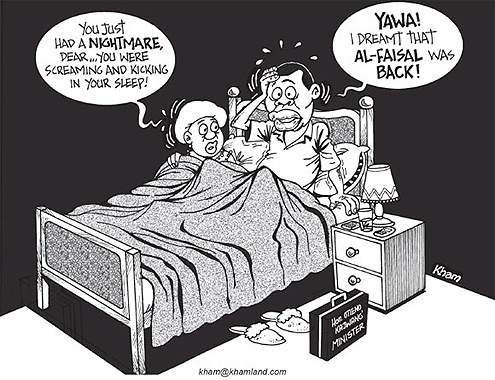
Friday's Daily Nation cartoon.  The black briefcase carries the name of Kenya's immigration minister.
Friday's Daily Nation cartoon.
The black briefcase carries the name of Kenya's immigration minister.
Today was supposed to be explosive in Kenya as Muslim activitists took to the street. They can’t. They’re mostly behind bars.

Over the last three days Kenyan authorities have arrested up to 2,000 Muslims across the country, most of them jailed for being “illegal immigrants.”

The crackdown followed last Friday’s riots in Nairobi, provoked (according to the government) by Muslim militants backed by al-Qaeda in Somalia (al-Shabaab). The demonstrators were demanding the release of cleric Abdullah al-Faisal, who the government has been trying to deport.

And further government embarrassment, yesterday: After weeks of trying to get commercial airlines to take Faisal out of the country, the government chartered its own Gulfstream jet wihch broke down on the runway before take-off.

As far as we know, Faisal is still in the country. And activist Muslims are still in jail.

By early afternoon today in Kenya all was calm.

Friday during prayers Muslim leaders around the country told their faithful to avoid further demonstrations. A statement read in thousands of mosques from the Supreme Council of Kenya Muslims condemned the police action but called on all Muslims — particularly infuriated youth — to stay at home, today.

Click here for the full statement as reprinted by Kenya’s FM Capital radio.

Officially the government claims that 1200 “illegal immigrants” have been detained. Unofficially, police put the number closer to 2000. Around 400 have already appeared in court.

Among those known detained are refugees from Somali, including two army generals and 11 Members of Parliament that had fled the growing military success of the al-Shabaab militia.

This is not good.

Many of the Somali refugees in Kenya are not radical; in fact, just the opposite. They’ve fled the fighting there because they are targets of the radicals. In all likelihood, they were moderating influences among Kenya’s Muslim community.

Thursday, a widely circulated internet site claiming to be al-Shabaab posted videos of militant jihadists shouting, “God willing we will arrive in Nairobi, we will enter Nairobi, God willing we will enter … when we arrive we will hit, hit until we kill, weapons we have, praise be to God, they are enough.”

But in a telephone interview with Reuters, today, al-Shabaab spokesman, Sheikh Ali Mohamud Rage denied the site was authentic and said the organization had nothing to do with last Friday’s riots in Kenya.

Now, what? And can anybody get that plane off the ground?

Right to Kenya

Right to Kenya

Two mysterious American lawyers are in The Netherlands trying to stop the international trial of Kenyans accused of genocide in the December, 2007 election.

This is an affront to justice and Kenyan society, and there are links to these men with the rightist neo-cons of the former administration. Which makes it even more of an affront to Kenyan’s earnest attempt to move on from that horrible time.

Prof. Max Hilaire and self-proclaimed lawer, William Cohn, appeared before the international court at The Hague expressly to forestall or terminate the Court’s procedures against ten Kenyans accused of crimes against humanity during the turbulence that followed the December, 2007, election.

Kenyans are shocked.

“Kenyans are seeking an end to impunity and to ensure accountability and justice for the over 1,000 Kenyans who lost their lives, the over 300,000 IDPs who lost their homes and the over 5,000 women who were sexually assaulted,” read a statement signed by prominent Nairobi lawyer, Naomi Wagereka.

Wagereka cited recent polls in Kenya indicating that a large majority of Kenyans want the perpetrators of the post election violence tried at the Court in the Hague.

The trial of the accused moved out of Kenya to The Hague when the Kenyan Government was unable to come to terms defining the trial, as was agreed in the political deal that ended the violence in February, 2008.

In that agreement, a time limit was set for the Kenyan Government to create something akin to South Africa’s Truth & Reconciliation Commission to deal with the perpetrators of that violence. The limit was extended several times before the government conceded that the trial should go to the Hague.

The vast majority of Kenyans, and now a consensus among government leaders, were therefore stunned by the news that two unknown Americans were trying to stop the procedings.

The chief prosecutor for the International Criminal Court (ICC) Luis Moreno-Ocampo dismissed the American’s actions as “unfounded”. He told Nairobi’s Standard newspaper that the Americans were simply delaying the procedings.

The two Americans’ brief argues that Kenya’s case does not meet the Court’s threshold of crimes against humanity, and that it is ‘overstretched’ and ‘exaggerated’.

Hilaire is associated with a number of right-wing organizations, particularly the Center for Strategic Studies at the National Defense University, which is often used by Fox News for commentary on defense issues.

He has authored several books, with recurrent themes that criticize the formation of the ICC and challenging the authority of a number of institutions, including the United Nations.

His sidekick, William Cohn, has been repeatedly reported by news sources as reputable as Agence France Presse as a “lawyer from California” but he is not listed with the California Bar Association. Little is known about him.

“One wonders whose interests are these American professors serving,” Kenyan lawyer Wagereka asked local journalists several days ago.

Nairobi Normal

Nairobi Normal

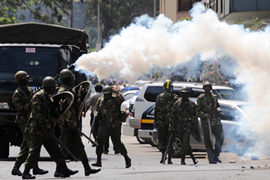
Nairobi is back to normal after a confusing afternoon of city rioting that proved less serious than first reported throughout the world.

Because the march by about 50 young Muslim youths following Friday prayers at Nairobi’s main mosque was a surprise, news reporters were not on the scene. Virtually all of the reporting came after the shots had been fired that killed between one and five people, possibly including one policeman.

Police were on the scene, and that’s the odd part of the story. Reporters usually follow police. But in this case neither local journalists or Nairobi’s most prominent foreign journalists (the BBC and Reuters) were there.

I was unable to find anyone I know who was there, so the best I can do is piece together what seems most reasonable from widely different reporting:

Wednesday following continued difficulties in getting the unwanted radical Muslim cleric Abdullah Al-Faisal deported from the country, the Muslim Human Rights Forum of Kenya announced that following Friday prayers at Nairobi’s main mosque there would be a parade of supporters across the middle of downtown Nairobi to the President’s Office to deliver a petition demanding the release of the controversial sheikh.

They asked for a permit to march from the police and were denied the permit. They did not – as has happened in the past with contentious groups – then announce the march would go on, anyway.

So a relatively small contingent of police positioned themselves in the parking lane off the main Kenyatta boulevard that cuts into the city from the big airport highway. I don’t know how small, but photographs by Capital FM’s radio station show only a single police van.

When the “small” group of marches left the mosque, which is one block south of the city market and one block east of where the police van was, the police tried to stop them. But there were too few police, so the police retreated and started firing teargas.

Demonstrators temporarily returned to the mosque, where the police followed and then surrounded with increasing numbers arriving from other parts of the city. And large numbers of anti-demonstrators began converging on the scene, especially from the City Market.

The second surge from the mosque was much larger, and this time included more prominently displayed placards and including one black flag reportedly representing Al-Shabaab, which is Al-Qaeda in Somalia and the organization with which Faisal is linked. Several marchers in the lead wore military fatigues and covered their heads with black masks, typical of jihadists.

Police retreated, again, and in the mayhem which ensued shots were fired. Police have not contended that the protestors had guns, so this would mean they shot one of their own.

Before the protestors got one block onto Kenyatta street, the now larger group of anti-demonstrators began attacking the demonstrators with knives and anything they could find lying around in the street. The battle between demonstrators and anti-demonstrators went on through the city for several hours as shops and businesses began to close up. Police had lost entire control of the battle.

One Nairobi newspaper claims that Muslim leaders from the mosque joined police in trying to quell the situation, but were unsuccessful. The Standard reported that several hours into the battle the police simply “became spectators” unable to stop the two factions from fighting.

The first march from the mosque was just after 1:30p. By 4 p.m. most of the fighting had subsided, the city center was a ghost town, and the police and shut off all access into and out of the city center. By 7 p.m. the streets were quiet but deserted, not entirely unusual for a Friday night. (Most of the entertainment areas are outside the city center.)

Kenya National Human Right Commission Vice-Chairman Hassan Omar said, “It was a simple demonstration which has turned ugly because police failed to control the crowd letting hooligans to take lead in the protest.”

Muslim groups claim that five people died and more than 20 were wounded. Police say that only two people died, and that one policeman was seriously wounded with a shot to the neck.

The Standard newspaper says that four people died; the Daily Nation says that one person died, Jeffrey Gettleman of the New York Times reported that three people had died, and the BBC reported that five people had died.

So far, the only person named dead is Ahmed Hassan Abdullahi, 25.

Nairobi Riots over Al-Faisal

Nairobi Riots over Al-Faisal

From Aljazeera -- some of the best reporting.

As night fell on Nairobi, Friday, the streets were quiet and five people were confirmed dead.

Below is an edited report from the BBC, but let me first complain bitterly about the NPR report. I love NPR but they continually get Africa wrong. Alone among such giants as the BBC, Reuters and Aljazeera, NPR failed to report that much of the riot was caused when Nairobi citizens started throwing stones against the Muslim demonstrators.

It seems that the police may have then sided with the much larger anti-demonstration crowd and over-reacted. But this would be typical in Nairobi. I remember during the August, 1998, bombing of the embassy. The first public action by Nairobi citizens was to burn the city mosque.

See my earlier blogs this week and last about Al-Faisal, terrorism, etc. Here are excerpts from the BBC:

At least five people have died after Kenyan police opened fire at supporters of a Jamaican-born Muslim cleric notorious for preaching racial hatred.

Faisal is in detention in Nairobi after Kenya failed to deport him.

Kenya wants to expel him citing his “terrorist history”. He was jailed for four years in the UK for soliciting the murder of Jews and Hindus.

Muslim youths began the protest match after Friday prayers at the Jamia Mosque in the centre of Kenya’s capital, Nairobi.

They wanted to present a petition to Immigration Minister Otieno Kajwang and Prime Minister Raila Odinga’s office.

But police had banned the march and intervened.

One banner read: “Release al-Faisal, he is innocent”, reports the AFP news agency.

Some reports suggest that the protesters were waving flags of Somali Islamist group al-Shabab.

Reuters news agency reports that some people joined the security forces in attacking the protesters.

Is Terrorism Nation-Building?

Is Terrorism Nation-Building?

One of Kenya’s prominent newspapers said today that Muslim suicide bombers could be a positive force in Africa.

I’ve printed much of the Daily Nation’s article below. It’s important for westerners who perceive themselves the targets if not actual victims of suicide bombing to learn of these contra opinions. The Nation is one of Kenya’s most conservative newspapers.

A little background is required.

A huge controversy has developed in Kenya over the jailed Muslim cleric, Sheikh Abdullah al-Faisal. See my blog of January 9.

No airline will board Faisal. Kenya can’t afford to charter him back to Jamaica. Surrounding countries, including Tanzania whence he came overland about a month ago, refuse to allow him entry. For the time being, Kenya is stuck with him.

He’s been held without charges either in the airport or in a nearby prison. Muslim groups have become more active in the last few days, assembling a team of lawyers that have begun filing motions in the incredibly convoluted Kenyan court system to try to get him released.

The author of the article below, Charles Onyango-Obbo, is a salaried employee of the newspaper. He is not considered a radical.

There is much in the article with which I agree, but ultimately Onyango’s reasoning must confront a serious moral impediment that means justify the ends, the means in this case being wanton murder, and with that I can’t agree. Nor can I agree with the impoverished morality that suicide carries any sort of virtue whatever, except possibly for the individual who kills himself.

Onyango did not use any of the common arguments often purported in the Muslim world to justify Al-Qaeda type movements and terrorism in particular. He did not, for example, try to justify terror as a way of getting the west to leave the Middle East or other areas where radical Muslims believe they have a more intrinsic right to power.

The reason I find this article so fascinating is that it argues that there is value to terror, even if there is no enemy to practice it on, no oppressor. Onyango states that suicide bombers, for example, create positive dialogue and promote local peace among disparate groups. This is an argument as convoluted as the Kenyan court system.

Perhaps, the newspaper agreed to publish this article, because somehow it thought it would dampen the growing tension in Kenya between Muslim groups lobbying for Faisal’s release and those who fear him.

The motive would be good, but the effect is not. Bad arguments don’t bring peace.

Below are excerpts from Charles Onyango-Obbo’s article in the January 14, 2010, issue of Nairobi’s Daily Nation. Click here for the full article.

[Sheikh Abdullah al-]Faisal’s problems…stem from the suspicion that he might be a religious extremist.

That, in turn, seemed to have been fuelled (sic) by the Christmas incident in which the young Nigerian, Umar Farouk Abdulmutallab, an alleged Al Qaeda operative, botched an attempt to destroy a plane carrying 290 people flying from Amsterdam to Detroit.

… It would seem, after that, suspicion heightened over every radical Islamic preacher.

The acts of people like Abdulmutallab often tar many innocent Muslims, and in some parts of the world, especially the West, Muslim has become synonymous with terrorist. Every other day, you read of stories of areas where Christians are protesting because a Muslim has moved into the neighbourhood.

But looking at suicide bombers acting in the name of radical religion from Africa, one sees more interesting things. It is heartening, in a strange way, to see an African willing to kill others for something other than his tribe, political affiliation, or personal profit.

Abdulmutallab’s action should resonate in Kenya, where following the disputed December 2007 elections, thousands of people were slaughtered and displaced because of their ethnic origin or the political party they supported. Or, better still, Rwanda where in 1994, nearly one million were killed mostly because they were Tutsi…

… Abdulmutallab was … willing to die … by being a suicide bomber. This idea of a most extreme personal sacrifice is not new in Africa, but it is not common either. …It is rare to see people in most African countries going to this extent. Apart from soldiers … we don’t usually put our necks on the line for our countries.

All this is good, for several reasons. First, religion is actually a big idea. If more of us begin to kill only for big ideas, and not small ones like tribe and who you voted for at elections, we shall see a sharp decline in violence in Africa… From Abdulmutallab’s act of terrorism might grow the first true seeds of modern patriotism in Africa.

Finally, before the Jihadists came along, there wasn’t much of a dialogue between Christians and Muslims in Africa, in part because in the countries where Muslims are a minority, they had endured a history of discrimination…

Following the September 11, 2001 terrorist attack on the World Trade Centre in New York … Islam made its biggest effort to explain that terrorism was not in the Qur’an. It found fearful Christians, eager for reassurance, were much more willing to listen than they had been in the past.

… Muslims were energised to defend the honour of their religion against attempts to besmirch all of them… One result in countries like Uganda and Kenya is that they used it to elect more Muslims to Parliament.

Many governments in Christian-dominated countries also sought to do something they had not been serious about — Muslim representation in public life. Muslims moderates, particularly, have flourished…

Entirely by accident, radical Islam-inspired terrorism might turn out to be the best thing to happen to both Islam and the politics of many countries in Africa: It has improved inter-faith dialogue, reduced marginalisation (sic) of Muslims, given them a little more voice, and by forcing countries to rally around something other than their tribes, could do African nationalism endless good.

[email protected]