Muslims & Terrorism in East Africa

Muslims & Terrorism in East Africa

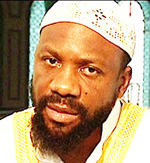
Sheikh Abdullah al-Faisal
The story of a young extremist Islamic cleric in Kenya gives us some insight into how Muslim extremism may be effecting East Africa.

Twenty-six year old Sheikh Abdullah al-Faisal has already spent 4 years in British jails, eight years studying Islam in Saudia Arabia, and tonight is in Kenyan detention since no airline will fly him anywhere.

My disclaimer is mandatory: Christian fanatics in my own country are as responsible – if not more so than Muslims – for the religious tension and the wars they’ve provoked. I take a dim view of organized religion.

Click here to go to Wikipedia’s site to document that more than 90% of the terrorist acts in the last generation were perpetrated by non-Muslims, and before 9/11 there were more Christian acts of violence than Muslim ones.

But at the moment it is the threat of Muslim extremism that is worrisome to East Africa. Somalia is right next door. Christian fanaticism actually is responsible for much of East Africa’s misery, but that seems to be coming to an end in Kenya and Tanzania.

Weirdo Christians running around in white dresses and hoods (that for all the world look like Klu Klux Klanners) of which Kenya’s past dictator Daniel arap Moi was a part, seem to be subsiding.

Once upon a time you had to be a communist AND a Catholic to be a part of Tanzania’s ruling party, the CCM. But that’s been over for some time.

Only Uganda remains in the death-grip of Christian extremism. President Museveni’s proposed death-for-gays bill was spurned by individuals associated with Washington’s “Family”, a weird fanatic Christian group including not but a few prominent politicians like Iowa Senator Chuck Grassley. Museveni is as much a modern-day Christian crusader as there will ever be.

FYI: (Increasing world denunciation of the death-for-gays bill might be working: the Ugandan Parliament seems to be modifying it to “life in prison” rather than death.)

But the power that Al-Shabaab now wields in Somalia, and the growing conflict in Yemen, are battles being won by very extreme Muslims. And today’s story about Faisal may help us understand how vulnerable East Africa is to fanatic Muslim politics.

According to Kenya’s Minister of Immigration, Otieno Kajwang, Faisal was arrested New Year’s Eve in Mombasa on accusations of links to terrorism, ten days after entering Kenya overland from Tanzania.

Kajwang said Faisal had slipped into Kenya through a small border post, explaining that had he used an airport or one of the major border posts where the immigration controls are linked by computer, his name would have shown up on the watch list and he would not have been allowed entry.

“We have fears that it is not in our public interest to allow him to either preach or live here,” Kajwang said.

The immigration minister said that even though the cleric hadn’t committed any crime, “the fact that he is on the international terror watch list said it all.”

“We are walking a tightrope here…we have been attacked by terrorists and it is only right if we seriously defend our borders,” Kajwang said.

Yes, But… The Tanzanians claim he was never in their country.

Sixtus Nyaki, the acting Arusha regional immigration officer, said Friday there was no truth in reports that the radical preacher had entered Kenya from Tanzania.

“I can confirm that the Jamaican preacher has not entered Tanzania,” Nyaki told Tanzania’s The Citizen newspaper.

Well it’s clear Tanzania doesn’t want him, either, but it’s not clear they didn’t have him.

One report in The Coast, a small Mombasa publication, claimed that Faisal’s passport showed that he definitely was in Tanzania and that he entered Tanzania overland from Malawi. There is no indication how he got into Malawi but the paper reported his passport also showed recent stamps from Nigeria, Angola, Mozambique and Swaziland.

Sheikh Abdullah al-Faisal was born to a British Christian Salvation Army couple in St James, Jamaica, where he was christened Trevor William Forrest.

Obviously not impressed with Salvation Armyism he left home at 16 before finishing secondary school, eight years later graduating with a degree in Islamic Studies from an institution in Riyadh, Saudia Arabia.

He then returned to the UK, where indictments from his trial claimed that this then under 20-year-old preacher was urging his audiences to kill Jews, Hindus and Westerners. He was tried and convicted in Britain in 2003 and jailed.

Released after serving his term four years later, he returned to Jamaica where the Islamic Council of Jamaica banned him from preaching. He then went to South Africa where he did preach extensively in mosques, there.

There are many more Muslims in Tanzania than Kenyan, but Tanzanian society is not as open as Kenya’s. All of Tanzania’s media has reported this incident, but none has quoted any Islamic cleric response.

It’s much different in Kenya.

“This is curtailing al Faisal’s freedoms of expression and association in a very discriminative manner that is totally unacceptable,” said Al-Amin Kimathi, the chairman of the Muslim Human Rights Forum (MHRF) in Kenya.

“It follows a pattern we saw throughout last year where Muslim scholars and aid workers were arbitrarily arrested and deported from the country on very flimsy grounds,” Kimathi added.

The Supreme Council of Kenya Muslims chairman, Prof Abdulghafur El-bussaidy, said he knew little about Mr al-Faisal’s visit, but directed journalists to another powerful Kenyan cleric, Sheikh Mohammed Dor, who has recently been nominated to the Kenyan Parliament.

“[Faisal] is an honest man who came into the country legally… he has not done anything wrong,” El-bussaidy told Kenya’s Nation. Dor also dismissed reports that Faisal had called for the killing of non-Muslims.

“I have CDs of his preaching … from what I have seen and heard, you will love him. He only talks about the rights of Muslims but has not in any way called for the killing of anyone. Those are rumours being propagated by the western world.”

“Why is it that it is only in Kenya that he has been arrested, based on malicious information from the West?” Dor asks.

Yes, that’s the question. Why Kenya? Why not Tanzania? And what does this mean?

Why did Kenya act on the likely enhanced terrorism communications that occurred after the Christmas Day incident, and why didn’t Tanzania? Why did clerics in the more Muslim country of Tanzania not react to this, and why did they in Kenya?

It’s an election year in Tanzania. Friday in Dar-es-Salaam, the President of Tanzania addressed all the local diplomats and warned them against making any public statements about the upcoming election. It was a chilling meeting.

In the last Tanzanian elections in 2005 there was widespread violence in Zanzibar. The divide was definitely a religious one: Muslim vs. non-Muslim. The violence in Kenya in 2007 was much more severe, in part because Nairobi is a hundred times bigger than Zanzibar, but the divide there was rich vs. poor. Later an ethnic component would emerge in the Kenya troubles, but it was never religious.

Tanzanian power is apparently as good at silencing its own population as its foreign diplomatic core.

I don’t believe that’s wise. It’s a lot hotter in Tanzania than Kenya. Tightening those bottles of fizzy water only shakes them up and increases their explosive power.
Rwandan Finale?

Rwandan Finale?

The serious rift between Rwanda and France was deeply aggravated by a Rwandan government report released yesterday reconfirming that the 1994 genocide was started by extremist Hutus.

This may not seem like news. The rest of the world has already accepted this. But this begins what I hope is the Last Act in this horrible history.

The April, 1994, genocide was of more than 800,000 Watutsis carried out by Hutus. No denial of this. But France has always contended that rebel Watutsis were responsible for the event which led to their own massacre.

This event was the shooting down of the (Hutu) presidential jet as it began to land in Kigali on April 6, 1994, by a sophisticated air-to-surface missile fired from quite near the airport. Everyone aboard was killed, including the Hutu president of the country.

The U.N., France and Belgium had soldiers in the country because of the growing tensions between the Hutu government and the Watutsis. French soldiers were the first to arrive at the scene of the crash. They walked away with the plane’s flight recorder and have never surrendered it to the Rwandan government or U.N. authorities.

In the day or so immediately after the plane’s being shot down — before the actual slaughter began — The French government sided with the official Hutu government outrage that claimed Watutsi rebels had shot down the plane.

Because of President Clinton’s political fatigue with ‘Blackhawk Down’ in Somali, and because of the French position on who was responsible for shooting down the presidential plane, France and the U.S. blocked efforts by other countries in the U.N. to send more peace-keeping troops to Rwanda.

And so the genocide began unabated.

Rwanda has never forgiven France for using this pretense to stop the U.N. from possibly having beefed up its military mission enough to have stopped the genocide.

France has never forgiven the current Watutsi government in Rwanda for what it considered a gruesome way to come to power: fire the first shot knowing this would provoke the Hutu genocide of your own tribe, and thereby provide justification for the massive retaliation that organized Watutsis rebels mounted from neighboring Uganda.

Most of the world does not believe France. But France has hardened its position over the years. The plane that was shot down on April 6, 1994, was carrying a Hutu president returning from a peace conference with Watutsi rebels. France contends that the deal he had struck with Watutsi politicians would have cut out the massive Watutsi rebel military, headed by Paul Kagume, the current Rwandan president.

France acknowledged the horrible genocide that occurred by Hutu against Watutsi, and France never tried justifying this, of course. But when the huge Watutsi rebel military poured into the country from Uganda where it had been training, and relatively quickly stopped the genocide, France was furious.

“Why had they waited?!” was the basic French contention that the Watutsi military had allowed the genocide of 800,000 of its own tribe, just to justify their military coming to power.

France began massive aid helping the Hutu refugees that began fleeing into neighboring Congo. In the years which followed, many of these Hutu refugee camps became military training centers for the dreaded “Interamwe” which began raids back against the new Rwandan government and continues today to cause havoc in eastern Congo.

The feud deepened recently when French undercover agents in Germany arrested Rose Kabuye, the current Rwandan President Kagume’s chief of protocol. A French magistrate charged her with “complicity in murder in relation to terrorism” over the downing of the plane.

France claims that Kabuye – who was a rebel Watutsi fighter at the time — was personally involved in the plot to shoot down the plane in 1994. The French government refused some international suggestions that the U.N. Rwandan Tribunal be allowed to try the case.

France has always believed the Tribunal was biased. French authorities said that only the French justice system was capable of ultimately resolving the facts.

* * *

I think we can trust the French justice system. The French lawyer for Kabuye believes he will be able to submit the Rwandan government report as evidence to support her case, and that ultimately the long French position will finally be proved wrong, as it has been assumed wrong by the rest of the world for more than 15 years.

I hope so. It isn’t just that the continuation of this ridiculous feud between France and Rwanda is impeding all sorts of local development in the area, it is the terrifying possibility that France is right.

For if France is right, no respectable country could continue to support the current Rwanda regime.

Year-End Roundup & Predictions

Year-End Roundup & Predictions

2009 was a bad year for East Africa. 2010 will be a little bit better.

Socially, culturally and politically, I think it’s been a GOOD YEAR for Kenya and a BAD YEAR for its neighbors.

I’m positive on Kenya and critical of its neighbors even while supporting the western powers growing sanctions on Kenya for not moving quickly enough towards a new constitution.

This may seem like a contradiction, but in fact what it means is that the outside world’s attention to Kenya is working: it is absolutely encouraging all the right moves by Kenya’s still entrenched, corrupt leaders. Ultimately, of course, the people will have to oust these scoundrels, and right now that looks possible.

The Hague has begun the process of trying those who might have been responsible for the 2007 genocide. The U.S. and the U.K. in particular have banned the most corrupt individuals from traveling to their countries. A draft constitution is circulating among all factions of the society for comment, and Kenya’s invigorating journalistic transparency has grown even greater with such additions as FM Capital Radio. Kenya is still ranked worse than Uganda or Tanzania by Transparency International, but its improvement is significant. If there isn’t any major reversal in the way things are going, I think 2010 is going to be a very good year for Kenyan society.

Tanzania and Uganda, on the other hand, are turning gruesome in the shadows. Tanzania’s corruption is so much less known than Kenya’s, because its power centers keep it that way. But just through extrapolation of what we do know, I frankly believe that Tanzania must be infinitely more corrupt than Kenya.

One of Tanzania’s finest transparent media, This Day, was forced to reduce daily publication to weekly because it couldn’t obtain the interest or funding that the country’s strictly controlled media easily obtains.

Scandals in Tanzania’s electricity board, and worse, in its precious gold mining industry, threaten to reach absolutely astronomical proportions. It’s so bad that Zanzibar is without electricity more than half the time, and the Toronto based owner of one of the world’s richest gold mines in Tanzania is trying to sell it. And no one wants to buy it! They just can’t manage the corruption.

And Uganda is ready to dive off the end of the earth. Encouraged by disreputable American righties, the Parliament is set to pass a law that would give the death penalty to anyone convicted of being a practicing gay. And worse actually, lengthy imprisonment for anyone who knows someone actively gay and doesn’t tell! (Imagine what this will do to tourism!)

Uganda’s problems are mounting, and specifically as a result of the current president’s growing grasp on life-time power.

I think 2010 will be a GOOD YEAR for Kenya, but another BAD YEAR for Tanzania and Uganda.

It’s been a very BAD YEAR for tourism. Statistics are near impossible to come by and then impossible to confirm, but my best guess is that about a third of the tourism industry that existed in 2007 is now gone. It may be more. Kenya has taken the worst hit, and in certain sections of the industry the employee base is now less than 50% what it was in 2007. But equally deep hits were taken by Tanzania’s newer central country tourism (Zanzibar, the Selous) and Rwanda, which may be seeing a decline of more than 60% in tourist arrivals.

I don’t see this changing, soon. It may be a better year in 2010 than 2009, but it will still be a BAD YEAR for tourism throughout the region.

Most of 2009 was awful for the region’s weather. It was a BAD YEAR. But the arrival of normal if above average rains these last few months throughout the region broke the drought except in some isolated areas in Kenya’s north. All predictions are for normal if above average precipitation for 2010. So expect a GOOD YEAR for 2010’s weather.

It was a BAD YEAR for wilderness and wildlife, as the “drought” persisted through the third quarter. The lack of rains was the main cause, but by no means the main explanation. Poaching increased substantially as the age-old argument of whether a country’s wildlife should be viewed as an immediate resource for the local population (such as for food, or destroyed when threatening farms, or allowed for stock grazing). The drastic reduction in tourism only aggravated the situation: Reduced revenue for anti-poaching and other management needs contributed to a spiraling decline in the efficacy of the area’s wildernesses.

Virtually all species except the predators and scavengers (obviously) declined. Hippos took the biggest hit – they need the most grass which wasn’t growing. We aren’t sure about elephants yet, because they migrated, presumably to better places. But whether they’ll return and whether these better places helped them to survive remains to be seen.

Shore birds, especially flamingoes, suffered terribly. No one was killing or eating them, but human populations were desperate for their water sources.

As I reported earlier, we think the entire biomass probably declined by 5%. That’s not bad by the standards of past droughts, and it’s now stabilized. But I don’t see any extraordinary rebound in 2010 as was the case the year after past droughts. The natural biology that normally leads to population rebounds is this time offset by poorer wildlife management, increased poaching and less tourism preparation, caused by not just the past drought, but the current economic downturn.

So expect 2010 not to be worse for wilderness and wildlife, and basically that means it will GOOD.

Strictly economically, the entire region with Kenya in the lead is experiencing the same type of GDP jobless growth we are experiencing here in the U.S. Like here, this is a skewed statistic created mostly by government stimulus. The fact is that 2009 was a terribly BAD YEAR for the economies of all the region once you strip them of their government stimulus.

I’m afraid that 2010 will be worse. That’s one of the curses on developing countries. They are led into an economic abyss by the developed world, and then the developed world emerges out of the abyss first, often at the expense of the developing world.

How bad it will be will depend upon how much aid the developed world gives. But I can’t imagine any amount that will make 2010 anything but a BAD YEAR economically.


East Africa Report20092010
SOCIETY
Kenya
Tanzania, Uganda

Good
Bad

Good
Bad
WILDLIFEBadGood
WEATHERBadGood
TOURISMBadBad
ECONOMYBadBad

INVICTUS

INVICTUS

If you’ve traveled anywhere in Africa, or love Africa for any reason, go see Invictus and renew your best beliefs about this amazing continent.

One of the deep-seated criticisms born of racism is that however unfair an oppressed people have been treated, they are incapable of acting responsibly. The ingrained presumption is that revenge governs their every motive and will simply flip oppression onto their former oppressors.

It’s why Lincoln hesitated emancipating the slaves and afterwards why freed slaves were denied the right to vote. It’s why we promoted affirmative action and womens’ rights but voted down the ERA. It’s why we praised Guess Who’s Coming to Dinner but while condemning Guess Who’s Coming to Live Next Door.

It’s why Tiger Woods is so much more a bastard than Governor Sanford.

And it may be why the film’s two main actors, playing two of South Africa’s most historic individuals, are American and not South African.

It’s why one of my most favorite critics, Bob Mondello, praised the movie but tried to justify Morgan Freeman and Matt Damon’s assumption of these august South African roles in part by claiming their South African accents were so good.

(How the hell would Mondello know that?! In fact, they weren’t very good accents.)

But racism is so ingrained that a necessary first step to liberation is to acknowledge how deeply it governs the very best of us. And this acknowledgment of the truth is infectious. That’s the story of Invictus.

Released from the international sanctions that had kept this sports nation from participating in the global arena for more than a decade, the white South African’s dearest sports team, the rugby Springboks, were finally allowed on the world stage as a competitor and host to the rugby world cup. The team was composed of a single black man in a country where blacks outnumbered whites at the time by more than 7 to 1. The team colors were the colors of the old flag of apartheid South Africa.

Completely defying the will of his own electorate, Nelson Mandela as the newly inaugurated head of state insisted that these symbols of his own oppression — of apartheid — be supported by all the other oppressed South Africans who brought him to power.

His oft stated “forgiveness” was infectious among his angry colleagues. His unexpected generosity defused the fear and anger among the whites. In the blink of an eye as compared to this country’s long and sad history of oppression, he replaced tons of vengeance with forgiveness and hopefulness.

Two of my favorite actors are Matt Damon and Morgan Freeman. I’m no film critic and often accused of being too enthusiastic where Africa is concerned, but I believe I will be supported by those more professional than I, that the South African actors far surpassed in quality of performance that of Damon and Freeman.

Patrick Lyster and Penny Downie who play Damon’s parents although having a very small role are incredibly good. And the entire body guard staff composed of South African actors could rival any Shakespearean company in the world.

Why, then, Matt Damon and Morgan Freeman, who did not perform as well as the South Africans?

I suppose because part of our ingrained racism would have inhibited this uplifting story from being taken on by Hollywood without Hollywood stars. Slumdog Millionaire is essentially apolitical and challenges few insensibilities; Invictus slams racism with a rugby scrub. So, I guess, thanks to Freeman for producing, Clint Eastwood for directing, and Damon for helping out a bit.

And thanks to South Africa and Nelson Mandella for showing us the way.

Garlic Mustard Terrorism

Garlic Mustard Terrorism

The new regulations announced in the last few days in response to the attempted bombing of Northwest #253 are pitifully stupid and counter-productive.

I see the developed world’s response to terrorism identical to the developed science response to invasive species.

Whether it is kudzu, the Asian beetle, or the arch devil garlic mustard, absolutely astounding amounts of private and public funds have been allocated for “eradication.” The U.S. government maintains over a dozen websites with instructions on invasive species control, and enormous amounts of resources have been expended over the years to curtail invasive species.

It is hard to find a single… that is one example of success.

And yet there are many examples of secondary destruction to the environment in the attempts to control the invasives.

This is an issue I’ve written and felt strongly about for decades, and my passion about it was generated in Africa. But the topic is endless and the data copious, yet I have yet to be presented with a single true example of success.

To be sure certain invasive species have been curtailed in limited geographical regions and have produced positive economic outcomes, such as the temporary curtailment of the zebra mussel in the Great Lakes or the stabilization of kudzu in the deep south. But even these partial examples of success are hard to document, are likely to be reversed, and the environmental impacts of their containment have had their own often worse environmental ramifications.

Many gardeners or authorities over small county-like natural reserves may claim success in curtailing species like garlic mustard or loose strife, and indeed in their small geographical areas they may achieve a level of success for a while. But it doesn’t last, and the efforts expended to effect the limited success often produce more damage than had nothing at all been done.

Essentially, I do not think we can control nature in any macro-successful way. What we have to do is understand it and anticipate it. It’s appropriate and effective to have rigorous agricultural barriers at international entry points, to impede the spread of species we determine may produce negative outcomes in our own society. But once it happens, it’s beyond our current capacity to control in any demonstrably beneficial way.

That’s exactly what terrorism is to culture: Identical to invasive species to the environment.

I wrote recently that any military success we might achieve in Afghanistan would only push the centers of terrorism elsewhere, and that this was currently being demonstrated in Yemen and Somalia.

We can cull deer in the Skokie lagoon, or remove all the garlic mustard from the Kasper Conservancy, but all this does is push the vermin to the periphery, exacerbating by concentrating the problem elsewhere.

It does not deal with the cause.

In the case of invasive species, we need to study why an invasive is so successful. Success in nature should be considered a near first principle, and at least a tautology. Garlic mustard might be spreading like wildlife, because its natural inhibitors are being eradicated. Maybe, a natural inhibitor is a birch tree. Maybe garlic mustard, in turn, is a natural inhibitor to wild parsnip and maybe wild parsnip is a natural inhibitor to poison ivy. And any idiot who thinks we will ever complete the list doesn’t understand nature.

But by concentrating on understanding the links, we will increase an overall awareness of nature’s tautologies. We will cease trying to reverse nature, and may, ultimately, be able to manage its future outcomes to our greater benefit.

Ditto for the Darth Vaders in the world.

There is a cultural reason for the persistence of Al-Qaeda. It will not be eradicated, any more so than garlic mustard will be eradicated. Al-Qaeda is part of the human fabric of culture, exactly as garlic mustard is of nature. It is as impossible that we will eradicate Al-Qaeda from the world as we will eradicate garlic mustard.

But if we cease to think of it as a growing threat capable of taking over the world’s sweat peas than we might spend some time trying to understand why it is so successful, and we might ultimately come to some terms with it. Maybe one solution is to let it grow and take over the distant prairie, and thereby orchestrate a cease fire that allows our sweat peas to flourish in our backyard garden.

There’s an old saying: live, and let live.

In the last few days, airlines have instituted some of the most absurd regulations described as enhanced security in response to the attempted bombing of Northwest #253.

Perhaps the most absurd regulation is that you can no longer leave your seat (or even stand up) during the last hour of the flight. The “rationale” for this is that the bomber had to leave his seat and retrieve his hand luggage to mix the incendiary device. OK, so our incendiary devices will now be mixed 65 minutes before landing instead of 60. In fact in the mayhem as dozens of kids and grownups race to the toilets and pull down the luggage hatches to arrange their last hour of imprisonment, any monitoring of unusual behavior becomes more difficult! How stupidly absurd is this new rule!

We are not going to stop future terrorism with rules like these. We are going to infuriate the public and make travel infinitely less desirable, which may even be an objective of the terrorists.

We are not going to eliminate Al-Qaeda by wiping them out of Afghanistan and Pakistan. They’ll just then go to Somali, then to Yemen, then to the Congo… it is a link so long that when the last chain is used, the first will be ready to be used, again.

If we want to stabilize terrorism, if we want to stabilize the spread of garlic mustard, we will cease trying to eradicate it. We will expend our resources to understand it fully, and then to negotiate our own subsequently more intelligent behavior in ways that make it ineffective as a future threat.

It is in preparation and manifestation of the future that we will succeed. Not in trying to reverse the situation of the present.

Live, and let live.

Horn of Alarm

Horn of Alarm

The massive U.S. efforts in Afghanistan and Iraq to oust Al-Qaeda from the area is like a failed deer culling operation in the Skokie lagoon. It’s just pushing the vermin elsewhere.

And that “elsewhere” is the Horn of Africa, mostly Somalia, but recent events including the attempted Northwest Airlines bombing two days ago, suggest Yemen may be growing unstable enough for Al-Qaeda infiltration, too.

Yemen is a terribly misunderstood society. After the bombing of the U.S.S. Cole in 2000 and the numerous publicized connections between terrorists and radical imams in Yemen, it’s been wrongly presumed that the country is an universal den of iniquity.

Nothing can be further from the truth. Last month’s military raid which included fighter bombers on a presumed Al-Qaeda outpost in the Yemeni wilderness was at the least a joint effort between the Yemen government and the U.S. Many think it was completely a CIA operation, given wide support by the Yemenis.

What Yemen is can best be summarized by the fact that even during the Cold War, a Marxist (if Maoist) revolutionary government in the south befriended and worked with a highly capitalistic and western-oriented government in the north, until the two were unified in 1990.

Since then, what the U.S. has proudly termed “fair elections” have democratically created a somewhat autocratic politic that overseas some of the Mideast’s most celebrated intellectuals, religious fanatics calling for each other’s extermination, and a society that is trying desperately to remain open.

And that’s the problem. If you think the U.S. is polarized between Republicans and Democrats, you can’t imagine the polarization among educated, activist Yemenis.

So far, more or less, so good. Somehow this ancient and educated society has managed to hold its remarkably disparate pieces together. And it’s more important than ever that the developed world – particularly the U.S. – find quick and effective ways to support democratic Yemeni society.

Because now, for the first time in maybe … 2000 years, Yemeni society may be fraying at the seams.

It began with the country’s open policy towards refugees. The Yemeni government claims there are currently 95,480 refugees cared for by a mixture of Yemeni and U.N. support. Human Rights Watch and others, however, claim it is closer to 150,000.

According to the latest UNHCR estimates, 74,000 refugees fled to Yemen from Eritrea, Ethiopia and Somalia just this year. That’s a 50% increase over 2008.

Reflecting its hugely varied cultures and politics, Yemen has the most welcoming policy to refugees of virtually any country in Africa or the Mideast.

Strategically positioned reception centers on the coast take in the boat refugees that survive the treacherous Red Sea crossing. In addition to providing temporary shelter and assistance, Yemeni authorities counsel refugees on how to obtain U.N. refugee status, provide job placements within the Yemeni society, run job searches throughout the Mideast for more qualified persons and even provide some job training.

But the remarkably humanitarian policy is coming under increasing strain just by the numbers now fleeing the Horn of Africa.

I reported last month how the Al-Qaeda Somali offshoot, Al-Shabaab, had consolidated its grip on most of southern Somalia. In response, ten days ago Ethiopian troops began reentering Somalia and engaging Al-Shabaab.

Hundreds of Ethiopian troops were photographed Saturday at the Kalaber intersection about 10 miles north of Beledweyne town in central Somalia, an area previously claimed by Al-Shabaab. This is a strategic point that some believe could define a demarcation of Somalia into two countries: the more developed north with Mogadishu as its capital, and the less developed pirate-infested south with Kismayu as its capital.

And last week Kenya sealed its nearly 1000-mile border with Somalia. The Kenyans are even refusing entry to wounded refugees.

The Minister for Internal Security and Provincial Administration, Prof. George Saitoti, claimed the move was necessary to keep terrorists disguised as refugees from entering Kenya, and to restrict Kenyan Somalis from joining the conflict.

“The government takes seriously threats by one of the fundamentalist factions … that some Kenyans of Somali origin were being recruited to prop up the fledgling Transitional Federal Government in Mogadishu and we will go out to ensure that partisans of the two factions fighting for control of the chaotic country do not cross the border disguised as refugees,” the Minister said at a press conference in Mombasa last week.

What is happening is that western Somalia is becoming more appealing to global terrorists than the increasingly stressful environment of Afghanistan. Like deer culling in America, though, we’re ridding certain suburban gardens only to have huge infestations pushed to less policed areas.

And Kenya and Ethiopia combined have not a fraction of the power of Pakistan to contain the spread of terrorism, despite their current valiant efforts. And Yemen is the intellectual bleeding heart liberal that increasingly can’t hold its own society, together. What a perfect safe haven the Horn is becoming for Al-Qaeda!

Military success in Afghanistan is pointless. Listen to the Horn of Alarm.

Democracy vs. Famine?

Democracy vs. Famine?

Yesterday, USAid’s Famine Early Warning Systems Network (FEWS) warned of a famine that could engulf about half of Kenya next May.

The sober report is not surprising given the three years of seriously reduced rainfall, the political turbulence of this period in Kenya, and Kenya’s growing population needs.

What remains surprising is how the local media uses every opportunity to blame the situation on the weather rather than government.

Right now is normally the period when half of Kenya’s food stocks are harvested, including beef and other hoofed stock. As a result of the “drought” just ended there is little to harvest and moreover, a fraction of what had grown is being lost in floods and mud slides.

The report forecasts a 2010 main maize harvest of 1.9 million metric tonnes, three-quarters the average. While that harvest is nearly double that of 2009, the lagging effects of the “drought” will worsen the food situation. The report forecasts a 32% increase in the number of people who will need emergency food aid next year.

Nearly two-thirds of these 3.8 million people the report says are in danger of starvation are not foiled farmers or herders living in drought-stricken areas, but residents of urban slums. They are considered “chronically food insecure” and would be so even if there had been no “drought.”

As I’ve often emphasized before the main problem here isn’t the weather. Despite the innuendos in local reporting of the report, the rains have been more or less normal, albeit it on the light side in Kenya’s north.

The situation could just as easily have been caused by internal political turbulence, a swine flu epidemic, or war with Somalia. Last year, in fact, part of the food emergency was caused when the Minister of Agriculture was caught swindling food aid being off-loaded foreign ships in Mombasa!

This time it was exacerbated by the weather, and climate change means such hits on Kenyan society are likely to occur more and more frequently. In fact the report suggests an additional 750,000 people are in danger of food insecurity because of “freak floods” occurring now in the coast and north east.

Kenya is surrounded by more stable societies in Uganda and Tanzania that suffer the same natural beatings that it does (although this “drought” I must concede hit Kenya particularly hard). But Uganda and Tanzania with all their corruption and social flaws seem to manage better than Kenya.

Why this is so is the stuff for a Ph.D thesis. I think it’s because Kenya is actually more transparent, less corrupt and more democratic than either Uganda and Tanzania.

Aha! I see the Chinaman winking in the corner. Are these noble western morals (democracy, transparency) the right prescriptions for moving developing societies forward in such troubled times?

I want to believe so. It’s up to Kenya to prove it.

Terror in Somalia/Fear in Kenya

Terror in Somalia/Fear in Kenya

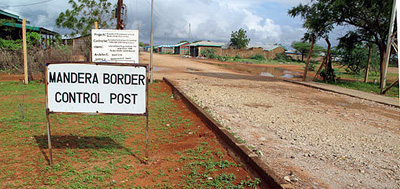
Kenyan police at the border post at Mandera with Somalia say villagers are fleeing the fighting leaving only a "ghost town."
Kenyan police say fighting in Somalia has turned the Kenyan border post at Mandera into a ghost town.
Fighting on the Kenyan border with Somalia does not mean Kenya’s stability is further threatened, but it does mean we better start paying more attention to Somalia.

The bold bombing in what had been a stable part of Mogadishu, today, and which killed several government ministers as well as a dozen graduating university students and several journalists, finally catapulted the Somali conflict into the world media, again. According to Google this morning, there were nearly 500 major media stories about the blast, second on the day only to news about Afghanistan.

This major escalation of the terribly complex and horribly bloody Somali conflict comes less than a week after a major battle between two Somali factions temporarily spilled over the Kenyan border at Mandera. This was the second such incident in a month. In October, fierce battles spilled over the border town of Dhobley, about one hundred miles south of Mandera.

Kenyan Internal Security permanent secretary, Francis Kimemia, confirmed Tuesday that Al-Shabaab rebels had captured the border towns opposite Mandera during a weekend of fierce fighting with the rival clan, Hizbul. Kimemia was then quick to say the conflict had been contained in Somalia.

Kenya has many troops and police in this near desert area in its far northeast where Kenya borders Ethiopia and Somalia. Many UK and U.S. soldiers have been seen here, and some openly in the large Kenyan island city of Lamu from which they stage operations.

The U.S. as well as many experts consider Al-Shabaab to be Al-Qaeda, and it is widely known that despite the U.S. support for the internationally created Somali government in Mogadishu, that the U.S. also supports Hizbul, which is trying to overthrow that central government.

The enemy of my enemy is my friend.

But while Al-Shabaab may be responsible for today’s suicide bombing in Mogadishu, the real battle between Al-Shabaab and Hizbul is for the important southern part of the country which borders Kenya, mainly to control the well developed Somali port of Kismayu. This is the center of Somali piracy, the single largest contributor to this tattered country’s GDP and could easily rival Mogadishu in many respects.

Abdullahi Jamaa of Nairobi’s Daily Nation wrote yesterday, “Somali gunmen often prowl along the borderline and their presence is testimony to the fragile security in much of Kenya’s lengthy border [with Somalia]. Over the years, the worsening situation of Somalia has rendered the security of Mandera all but non-existent. Residents live in fear.”

But most Kenyan officials are not worried that actual fighting will spill over from Somalia, and I agree, at least for the foreseeable future. Rather, there are two other immediate problems.

The first are refugees. The Dhobley battle in October sent as many as 2,000 Somalis fleeing into Kenya. Last weekend’s battle in Mandera sent very few, and that is likely because Al-Shabaab has now consolidated its victory over Hizbul for the whole length of the Kenyan border. But caring even for as few as 2,000 refugees is a great drain on Kenyan resources.

The second problem which Kenyan government officials consider even more daunting is the huge inflow of Somali piracy money into the Kenyan black market.

Internal Security Minister Professor George Saitoti says instability in Somalia had led to colossal sums of (pirate) money coming into Kenya illegally.

“And of course when they come here, it may appear initially that it is good for the economy but sooner or later that kind of money ends up distorting the monetary system and the economy as a whole,” the Minister said at a forum recently attended by U.S. Ambassador to Kenya, Michael Ranneberger.

* * *

I believe that Kenya is too stable to be a goal for Al-Qaeda the way Afghanistan and Somalia definitely are. Kenya is too developed, too modern, too secular. I remember all too well the embassy bombing in August, 1998. The first thing we noticed only hours after the bombing was how the city’s residents had set fire to the city’s main mosque.

In the ten years since then, Kenya’s development and integration into the western world has sped up exponentially. Despite the terrible election violence of December, 2007, the country is currently peaceful and in the context of a world recession, actually prosperous.

But what is happening to Somalia is extremely dangerous, and being aside Kenya it gives us an unique and hopefully more urgent perspective.

If we are successful in Iraq and Afghanistan, and if the Pakistanis are at all successful stabilizing their own country, where will Al-Qaeda go?

Somalia.

Ivory Crisis Continues

Ivory Crisis Continues

Yesterday Tanzanian wildlife officials announced they would join a Zambian initiative to allow sales of elephant ivory by downgrading the elephant’s status as an endangered species.

The move is part of the important politicking that is occurring before the March meeting of CITES, the international conference on the trade in endangered species.

Kenya denounced the move and also appealed for a third time to the Obama administration to take a stand on the issue.  For some reason the Obama administration is not acting on the Kenyan request.  It’s almost unthinkable to believe that the Obama administration wouldn’t support Kenya on this.  It was Kenya and the United States which wrote the first elephant ban in 1983.

That move at the time was supported by more than 180 countries.  It stopped the rampant poaching of elephant at the time.

“We are convinced Tanzania has contravened the spirit of the (moratorium) agreement and Kenya is totally opposed to their proposal to sell ivory,” said Mr Patrick Omondi, a KWS senior assistant director.

However, Tanzania’s director of Wildlife Erasmus Tarimo disagrees.

“We’re doing what is best for our elephant population,” he said in a phone interview to Africa 2000, adding that revenues from the sale would go towards elephant conservation.

Ironically, Tarimo was in the news just last week commenting on a Dar-es-Salaam police action against suspected poaching.  Four people were arrested in possession of over 30 elephant tusks.

According to sources within the wildlife industry, the ivory weighs more than 100 kilos and is believed to have come from at least 18 poached elephants killed within the vast Selous Game Reserve.

Other sources within the police force have described the latest seizure of poached elephant tusks in Dar es Salaam as further proof that the city is now a major transit point for ivory smuggling.

This latest development comes just days after THISDAY, one of Tanzania’s more aggressive newspapers, published a detailed expose on how the world-famous Selous has been turned into a veritable killing field where hundreds of jumbos are regularly slaughtered for their ivory.

The report actually suggested the poaching is once again going corporate.  “This looks like a chain network of poachers and ivory smugglers at work,” THISDAY reported.  The paper further claimed that some disgruntled game scouts are believed to be either turning a blind eye to illegal hunting activities or themselves taking part in killing the same animals they were hired to protect.

”An average of 50 elephants are being killed in the Selous each month…and that is a conservative estimate,” an official working in the Selous told THISDAY.

As I’ve explained in earlier blogs, poaching goes on the rise when the economy tanks.  Tanzania’s Ministry of Natural Resources and Tourism used to pay game scouts a working allowance of between $250 – $300 a month in addition to the salary to cover the expenses of fuel and food for extensive patrols in The Selous.  But due to budgetary constraints that allowance has been suspended.

Sources have described finding heaps of jumbo carcases minus tusks left lying on the mud roads within the Selous.

Tarimo has denied the increased poaching.

“A recent aerial count found 41 carcases of elephants,” he admitted.  “But 41 dead elephants is minimal compared to the total Selous elephant population of around 40,000,”  he said, adding that some elephants had died of natural causes.

Misery in the Mau

Misery in the Mau

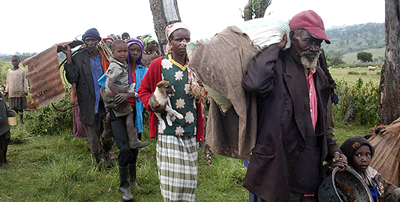
Photo by Joseph Kiheri of Nairobi's Daily Nation

Today a stream of now homeless farmers began leaving Kenya’s Mau Forest for fear they would be killed by security forces.

The Mau Forest story is one of the most heart-wrenching in Africa.  It has parallels to development stories throughout the world, including America’s Dust Bowl of 1930-39, and it is as somber and seemingly irreconcilable as any Grapes of Wrath saga.

But as with all modern phenomenon in Africa, everything is sped up in the time warp of development.  It took a decade or more to discourage then displace the American southern plains farmer in the thirties, and moving at that speed even the American government was able to gear up to provide work through the WPA and useful advice on how to better use the land.

In the end only about a quarter of the southern plains farmers couldn’t make it through.

But in Kenya the drama is all but three years total.  In the end there won’t be one remaining of the 40,000 families who last year were farming the Mau.

And not a cent of the promised government compensation of just under a million shillings per displaced family (about $120,000) has been seen.

And if they aren’t successfully evicted, it is likely that within a decade there won’t be a drop of water for Nairobi.

The Mau Forest is considerably west of the Aberdare and other highland mountain catchments that feed Nairobi’s three reservoirs, but it’s now understood that they are all intricately linked.  The Mau directly feeds the Great Rift lake system of the central province (Naivasha and Nakuru) as well as the Mara River.

These areas provide the irrigation for huge agricultural areas as well as the country’s extremely important flower export business.  Without the Mau’s water, the Rift agriculture would start to die quickly.

And as this became apparent, the agricultural interests would begin long-distance siphoning, or would actually move further east towards the Aberdare which is the water catchment area for more than 7 million people in and around Nairobi.

There isn’t enough water to do all this.

Too many things are happening too quickly in Kenya.  Progress fighting aids and other mortal diseases like malaria have buoyed population growth.  GDP growth averaging twice that of America is creating a middle class that wants better cars and longer showers.

But the land of Kenya is one of the most stressed on earth.  Only 14% of the country is arable; the rest near desert useful only in some sections for stock farming.  It is mineral poor.  And only the few highland areas, like the Mau and Aberdare, catch water for the 40 million people.

The drought of the last three years (breaking now at last) focused into stark relief to Kenyan leaders the looming disaster.  And despite the enormous media attention given to the drought, it was mild when compared with  droughts of the past.

Global warming actually makes the equatorial regions of the world wetter than they would otherwise be.  But the lust for water for development is just too great.

In 1996 after the last more serious drought the then dictator Daniel Moi began handing out choice parcels of the Mau forest, mostly to his fellow Kalenjin tribes people.

Bigwigs were actually given deeds.  Many others were given little “resident cards” and thousands others simply followed their kinsmen from the dry lands of the kalenjin onto this fertile ground.

No one knows for sure how many people ended up first clearing the forests to sell the timber, then farm this critical ecological zone.  The government says 40,000 families, and the average size of a farming family in Kenya is between 6 and 7.  So that could be about a quarter million people.

I’ve seen the beautiful little homesteads in the Mau.  The many log houses are tidy, with little vegetable and flower gardens, and often a cow or two in a tiny fenced area.  There are small fields of corn, millet, potatoes, beans and even wheat in some places.  Any random scene in a farming village in the Mau would likely depict a near idyllic scene for a developing African country.

Schools wre built and the government supplied teachers.  Dispensaries and some of the best small hospitals in Kenya were built here.  A sheep industry developed, and many residents wore heavy sweaters and woolen coats self-made as protection against the highland climate.

A typical Mau Forest farming family looks pretty well off.

It was not a surprise this would happen.  But last year into the 2nd year of the country wide drought, Nairobi water reserves began to be rationed.  Crops failed lower down the forests, even though the Mau and other highland areas were still getting reasonable rainfall.

Sixty Minutes from America produced a television story on the great wildebeest migration, and showed the declining level of the Mara River, and wondered if this were “the end of the migration.”

Actually, it was the start.

The government decided last year the Mau had to be cleared of farmers.  A security contingent swept in, burned homes, released livestock and randomly shot farmers who resisted.

The scandal erupted into huge Parliamentary fights and became – as so much in Kenya does – tribal.  The evictions were halted, but ultimately, they had to be restarted.  More carefully, with more notice, and with a better management of the idiot politicians trying to earn kudos with the controversy, the evictions have started for real.

And they will continue until not a man is left in the Mau.  And only a fence and heavily armed security forces surround the 16,000 sq. miles.

It seems like a pretty small area for a population approaching 40 million.  But that’s Africa, today.  Every little bit counts.

Heifer Charities

Heifer Charities

Heifer may be one of the better charity-direct not-for-profits for Africa, and then again, it might not be.

I am often asked for recommendations of charities serving Africa, and I am often asked specifically about Heifer.  There are actually two “Heifers”, and here are my thoughts and some background.

The Heifer Project International (“Heifer”) was founded in Little Rock, Arkansas, in 1944 by an Arkansan who had just returned from the Spanish Civil War.  Dan West was deeply religious and had been deeply impacted by the terrible and mostly pointless war in Spain.  He grasped upon a Christian biblical maxim that it is better to teach a man to fish, than simply to give him a fish to eat.

Today Heifer is one of the more prominent aid organizations in Africa.  It is on the Forbes Ten Best Charities list and recently received a generous contribution from the Gates Foundation, which is probably the lead NGO in Africa.

For relatively small contributions, the organization buys livestock (sometimes trees and other plants) and gives them to individuals mostly in Africa.  The bulk of the purchases are dairy cows.  The idea is that the individual receiving the gift will learn to tend the animal, harvest its milk, and hopefully breed it.

Because a cow today in Africa averages only $120, the charity has especially appealed to school groups where children are able to actively participate.

The Heifer idea has few direct critics, mostly animal rights groups.  From my point of view, its basic idea is a sound one.

So what’s the problem?  As usual, it’s in the administration of the idea, rather than the idea.

Towards the end of the 1980s Heifer found itself in serious difficulty.  It began requesting upwards of $250 for a cow that then cost about $80.  The problem was with the Arkansas administration and it was remedied, more or less, fairly quickly.

One of the ways the organization remedied the “cost drift” was to start a second organization, the Heifer International Foundation (the “Foundation”).  By separating the actual project funds from the growing needs at administration, Heifer was able to maintain good ratings.

Today, Heifer gets 3 out of 4 stars from the reputable Charity Navigator, similar to the American Red Cross.  More precisely, Navigator rates Heifer at 55.25, the American Red Cross at 54.6.  This is pretty good on the slightly mediocre side.

But the Foundation is another matter.  Navigator rates that as only two stars, a numerical rating of 46.7.  Almost a third of all the funds going into the foundation are used for administrative expenses including salaries.  By then taking on some of the otherwise administrative expenses that would be required to run Heifer, the Foundation takes the hit and lets Heifer get another star.

This is clever, and deceptive.  It should be a warning to those who give that the organization is unable on its own merits to attain what it feels is an acceptable level of accreditation.

Heifer is a very secretive organization, held very tightly.  That’s probably one of the reasons that Forbes and the Gates Foundation like it.

On May 21 of this year, the CEO of Heifer resigned amid a scandal that even until today has not been revealed.  The details are still with a sealed grand jury in Arkansas.  The rumors are that then CEO Janet K. Ginn was forced out of her position by the Heifer board for some sort of plagiarism. That’s all we know as reported in Little Rock newspapers, and it remains an unsubstantiated rumor.  But the Heifer Board has refused to deny it and Ginn’s attorneys are refusing to let her say anything.

It could be something really unrelated to the mission or work of Heifer, but that we won’t know until it goes to trial.  And if Ginn settles, we might never know.

Personally, I come down very hard on attempted charities for Africa.  I have worked and lived there for too long to have come to any conclusion except that things are getting worse in Africa.  So whatever the world has been doing has not been right, or mattered.

What is “right” is a much more complicated issue, but it begins not with a small donation and a checkbook, but with government to government actions.

Governments, ultimately, are accountable.  Heifer seems to be trying to avoid accountability.

HeiferRatings

Obama is losing Kenya

Obama is losing Kenya

The tide of Obamian Mistrust is cresting in Kenya like the El-Nino floods.

Just as at home in the U.S., the lust for change that swept Obama into office is coming to a head in Kenya.  But in Kenya the ramifications are much more immediate than in the U.S.

Last week the World Court at the Hague, in the person of UN Under Secretary Ocampo, announced that it would begin unilaterally to prosecute those responsible for the violence following the 2007 elections.

The Kenyan population was ecstatic. “What took them so damn long?!” shouted a letter writer in last Sunday’s Daily Nation newspaper in Nairobi.

What the letter writer meant was that the trials of those responsible were already to have begun – indeed, already ended!  This according to the agreement that Kenyan leaders signed in February, 2008.

What took them so long was the “diplomatic process.”  More than any other outside player, the U.S. has been actively trying to move Kenya’s leaders to implement the agreement which ended the trouble in December, 2007.

But it’s way too slow for Kenyans:  Just as at home in the U.S., where health care reform is morphing from the hopeful electricity in hundreds of thousands of American youth at rallies when Obama won, to the stuffy hyperbole of thick books about failed revolutions.

If the current political leaders in the U.S. and Kenya think that they can hide behind the umbra of “necessary time”, they are dead wrong and especially in Kenya.

Unlike the U.S. where the citizens are very polarized today — arguably the reason reform is being held up here — in Kenya citizens are united.  They hate their government, despise corruption and speak with unanimous condemnation.

There is not a single poll, single nongovernment group, old or young, which currently supports the government.  There are five Nairobi newspapers all shouting for instant reform.  Not even the old KTV television station — originally set up by the government — now supports the government.

But the U.S. and its institutionalized allies are moving Kenya at the same speed their governor is set at back home.  At home it means simply that reform won’t happen.  In Kenya it will cause massive destruction within the next few years.

Twenty months after an agreement was thrust on the despised Kenyan leadership by a reluctant U.S. and U.K. — which mandated a new constitution and prosecution of those responsible for the horrific violence — little has actually happened.

The U.S. has done everything within the realm of “established diplomacy” to move things along.  And that’s just the problem.  These are not times for established diplomacy.  Established diplomacy led to the Rwandan genocide and is the main reason there were 130,000 displaced persons in Kenya after the 2007 elections.

The U.S.’ most recent move, which I applauded in earlier blogs, was to bar 15 Kenyan leaders from visiting the U.S.  But Secretary Clinton refused to make the names public.

Here’s what Rob Jillo, of Nairobi’s popular Capital FM radio station said about that:

“To the US, I can only say to them that Kenyans feel that your travel bans are a mockery; they should make the name or names of banned individuals public so that Kenyans can hold them accountable and deal with them by naming and shaming them. They should also assist the country in repatriating monies held by these corrupt individuals and anti-reformists in overseas accounts.

“Mr Ranneberger [the U.S. ambassador to Kenya] and lately Mr Johnnie Carson’s [U.S. Under Secretary for Africa] source of irritation has always been the slow nature of reforms in the country. If we want to be in-charge of our destiny then speed up the reforms.”

This is not a time for politeness, in the U.S. or Kenya.  Playing by the old rules in the U.S. simply ensures the status quo and it will be at least a generation before genocide occurs on U.S. soil.  But in Kenya, the trigger is set: December, 2012.

If total and complete reforms are not in place by the next scheduled election, modern Kenya will end in a bloodbath.

Where Terror was Born

Where Terror was Born

As the situation in southern Sudan stabilizes, neighboring Congo-DRC grows more unstable than ever.
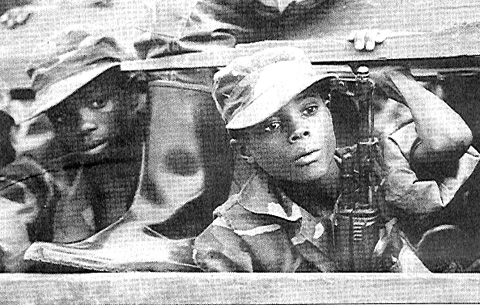
kidsoldier.zaire
There is a long and fragile road to travel before next year’s independent referendum in southern Sudan which is likely to create a new and more stable country, but for the time being it looks peaceful.

And so it seems that some of the troublemakers have moved west. Yesterday, the UN reported more than 7,000 refugees fleeing out of the DRC at its northwestern border into Congo-Brazzaville. There has rarely been trouble here, in this area much closer to the capital of Kinshasha than the troubled Kivu province far to the east.

The Congo-DRC, formerly Zaire, never achieved real stability after the CIA assassination of its first democratically elected president, Patrice Lumumba, in 1961. Literally every day since then for nearly a half century this second largest country in Africa has been without a unified government, unstable and at war.

If ever there has been a society whose grandfathers were soldiers for life with children who were soldiers for life with grandchildren who now seem to becoming soldiers for life, it’s the Congo-DRC.

The area of greatest turmoil has until now been the eastern Kivu Province which borders Zambia, Tanzania, Burundi, Rwanda, Uganda and The Sudan. This is because it is so incredibly mineral rich, from precious tungsten to uranium.

These precious metals have come into your cell phone straight from this darkest spot in Africa, and your payments for minutes have bought AK47s, missile launchers and jeeps.

The longest stretch of this northeastern and eastern border is with The Sudan, mineral rich with oil. There’s really been no border here. This black hole on the continent has been the greatest den of iniquity Africa has ever seen.

During infrequent moments of peace in the 1980s when I guided tours through Kivu, I bought charter air flights from mercenary sanction busters flying usually from Israel with light military equipment aboard. Most of the pilots as I remember were from Denver. Most of the military equipment had stamps on them from Seattle.

This was the area where the Lords Resistance Army arose, where children were kidnaped and drugged then turned into killers.

It’s pretty far from Darfur, but in that whole long area northwest to Darfur it has been lawless and terrifying for three going on four generations.

Now that a generation of diplomatic efforts might be paying off in The Sudan, the Congo-DRC becomes the last haven for the African rebel with his assorted SAM missiles, refurbished Humvees and millions of rounds of ammunition.

The Congo is becoming a set for Bruce Willis, which is apt since this all started during the early days of the Cold War when America was worried that a democratic process in the Congo was turning communistic. Belgium gave the U.S. an important assist in crowning the terrifying dictator, Mobuto Sesi Seko, after assassinating the election victor, Tshombe, in 1961.

Mobuto held the republic together with terror, but never completely. As he was dying of cancer he was dethroned, and the so-called democracy which replaced him in 1997 has never taken root. Around the developed areas of Kinshasha it is fair to say a more reasonable society has emerged, but in the boondocks of this massive country all hell reigns supreme.

The Belgium parliament apologized a number of years ago and awarded sizable reparations. The U.S. never has apologized.

The moment’s current crisis shows that as peace progresses in The Sudan, the born African rebel is moving next door. And while destruction spreads west through the country like the cancer that eviscerated Mobutu, Kivu remains bloody, with 18,000 ineffective UN peacekeepers.

UN peacekeeping chief Alain Le Roy said Sunday that the U.N. would immediately cease support of the Congolese army’s 213th Brigade in Kivu. Le Roy said the U.N. believed the unit had killed at least 62 civilians in the Lukweti area, some 50 miles northwest of the regional capital of Goma.

This is where I used to guide tours. It’s where there were mountain gorillas, millions if not billions of neon-colored butterflies flitting into beautiful jungles, pygmies and giant waterfalls. Today, a generation later, none of these exist.

Human Rights Watch describes an August attack in Kivu in which it said soldiers decapitated four men and cut off their arms. They then raped 16 women and girls, including a 12-year-old girl, later killing four of them. Researchers also found that many of the more than 500 victims were women, children and the elderly.

Africa was not like this before the white man showed up, despite racist attempts to paint early internecine tribal battles as “wars.” War came with machine guns, not machetes. Most of the world’s weapons in Africa today were manufactured in the U.S., sold through Russia and distributed by Israel.

This is where terror was born. And now we fight it in New York.

WEARY of OBAMA

WEARY of OBAMA

Africa is growing weary of “the change” promised by Obama yet to be realized. Here is one reason.

This is really more a story about America than Africa, but one of the reasons I think everyone should develop a passion of things foreign is to learn what the world thinks about us. These perspectives on the other side of the mirror usually reveal a lot about ourselves.

Obama’s election was greeted in Africa with as much euphoria as in the United States. There was a real hope that he would change America’s manhandling foreign policy, be more respectful of the smaller and weaker. Time is running out, and actions are now speaking louder than hopes.

Yesterday, the U.S. House of Representative overwhelmingly slapped the face of the rest of the world. It was nothing more than an insult, and ever the more stinging because it went so unnoticed in the U.S. But in Africa it was literally on the front page of nearly every major newspaper.

By a vote of 344-36, the House condemned the United Nation’s Goldstone Report and specifically asked Obama to vigorously oppose it.

To much of the rest of the world, and to Kenya in particular, this was an important report from a powerful UN body. The report was commissioned by the Security Council after the war last year between Israel and Hamas.

The commission was chaired by Judge Richard Goldstone of South Africa, one of the most respected jurists in Africa. Goldstone was instrumental in South Africa’s Truth and Reconciliation Commission and integral in the development of the UN Tribunal set up to investigate the war crimes in Rwanda.

The report condemned both Israel and Hamas for human rights violations during the war. It could not have been more neutral. It also seems to be completely true and factual.

The House vote came on the same day that Jose Antonio Ocampo, a UN Under-Secretary, announced in Nairobi flanked by Prime Minister Odinga and President Kibaki, that the World Court was going to take matters into its own hands and investigate Kenyans who were accused of crimes against humanity in the 2007 election violence.

According to Fred Abrahams of Human Rights Watch, ”The 344 [House] supporters have apparently not read the report. The 574-page document records violations of the laws of war by Israel, Hamas and other Palestinian armed groups, and concludes that all sides committed war crimes and possible crimes against humanity.”

This unnecessary and effectively pointless action by the House contributes to a feeling around the world – and especially in Africa – that Obama is too weak to change the behemoth of America.

The language of the resolution was offensive, terming the report as “irredeemably biased and unworthy of further consideration or legitimacy.”

The bill, introduced by Reps. Ileana Ros-Lehtinen (R-FL) and Howard Berman (D-CA), the ranking member and chairman, respectively, of the House Foreign Affairs Committee, calls on President Obama and Secretary of State Hillary Clinton “to oppose unequivocally any endorsement or further consideration of the report.”

Ros-Lehtinen and Berman were in Jerusalem a day earlier attending a conference on reinforcing U.S.-Israeli ties.

Of the 36 votes against Wednesday’s resolution, only three came from Republicans.

Speaking with rationality, Rep. Keith Ellison (D-MN), spoke out against the resolution. “This is a mistake. The stance of this Congress will erode U.S. credibility in the post-Obama world, and it will tarnish our commitment to the principle that all nations must be held to the same standards,” he said.

“We stand for the values of democracy, truth and justice. There is no reason for Congress, Israel or any other party to fear an honest judge,” he added. “Richard Goldstone is such a judge, and his report should be studied, not dismissed.”

Those who voted in favor of the resolution were:
Aderholt, Adler (NJ), Akin, Alexander, Altmire, Andrews, Arcuri, Austria, Baca, Bachus, Barrow, Bartlett, Barton (TX), Bean, Berkley, Berman, Berry, Biggert, Bilbray, Bilirakis, Bishop (GA), Bishop (NY), Bishop (UT), Blackburn, Blunt, Boccieri, Boehner, Bonner, Bono Mack, Boozman, Boren, Boswell, Boyd, Brady (TX), Braley (IA), Bright, Broun (GA), Brown (SC), Brown, Corrine, Brown-Waite, Ginny, Buchanan, Burgess, Burton (IN), Butterfield, Buyer, Calvert, Camp, Campbell, Cantor, Cao, Capito, Cardoza, Carnahan, Carney, Carter, Cassidy, Castle, Castor (FL), Chaffetz, Chandler, Childers, Chu, Cleaver, Clyburn, Coble, Coffman (CO), Cohen, Cole, Conaway, Connolly (VA), Costa, Costello, Courtney, Crenshaw, Crowley, Cuellar, Culberson, Cummings, Davis (CA), Davis (IL), DeGette, DeLauro, Dent, Diaz-Balart, L., Diaz-Balart, M., Dicks, Donnelly (IN), Doyle, Dreier, Driehaus, Edwards (TX), Ehlers, Ellsworth, Emerson, Engel, Etheridge, Fallin, Fattah, Flake, Fleming, Forbes, Fortenberry, Foster, Foxx, Frank (MA), Franks (AZ), Frelinghuysen, Fudge, Gallegly, Garrett (NJ), Gerlach, Giffords, Gingrey (GA), Gohmert, Gonzalez, Goodlatte, Granger, Graves, Grayson, Green, Al, Green, Gene, Griffith, Guthrie, Hall (TX), Halvorson, Hare, Harman, Harper, Hastings (FL), Hastings (WA), Heller, Hensarling, Herger, Herseth Sandlin, Higgins, Hill, Himes, Hinojosa, Hodes, Hoekstra, Holden, Hoyer, Hunter, Inglis, Inslee, Israel, Issa, Jackson (IL), Jackson-Lee (TX), Jenkins, Johnson (IL), Johnson, Sam, Jordan (OH), Kagen, Kanjorski, Kennedy, Kildee, Kilroy, Kind, King (IA), King (NY), Kingston, Kirk, Kirkpatrick (AZ), Kissell, Klein (FL), Kline (MN), Kosmas, Kratovil, Lamborn, Lance, Langevin, Larsen (WA), Larson (CT), Latham, LaTourette, Latta, Lee (NY), Levin, Lewis (CA), Lewis (GA), Linder, Lipinski, LoBiondo, Lowey, Lucas, Luetkemeyer, Lummis, Lungren, Daniel E., Mack, Maffei, Maloney, Manzullo, Marchant, Markey (CO), Markey (MA), Marshall, Massa, Matheson, Matsui, McCarthy (CA), McCarthy (NY), McCaul, McClintock, McCotter, McHenry, McIntyre, McKeon, McMahon, McMorris Rodgers, McNerney, Meek (FL), Melancon, Mica, Michaud, Miller (FL), Miller (MI), Miller (NC), Miller, Gary, Minnick, Mitchell, Mollohan, Moore (KS), Moore (WI), Moran (KS), Murphy (CT), Murphy (NY), Murphy, Tim, Murtha, Myrick, Nadler (NY), Napolitano, Neal (MA), Neugebauer, Nye, Oberstar, Olson, Ortiz, Paulsen, Pence, Perlmutter, Perriello, Peters, Peterson, Petri, Pitts, Platts, Poe (TX), Polis (CO), Pomeroy, Posey, Putnam, Quigley, Radanovich, Rangel, Rehberg, Reichert, Reyes, Richardson, Rodriguez, Roe (TN), Rogers (AL), Rogers (KY), Rogers (MI), Rohrabacher, Rooney, Ros-Lehtinen, Roskam, Ross, Rothman (NJ), Roybal-Allard, Royce, Ruppersberger, Rush, Ryan (OH), Ryan (WI), Salazar, Sanchez, Loretta, Sarbanes, Scalise, Schakowsky, Schauer, Schiff, Schmidt, Schock, Schrader, Schwartz, Scott (GA), Scott (VA), Sensenbrenner, Serrano, Sessions, Sestak, Shadegg, Shea-Porter, Sherman, Shimkus, Shuler, Shuster, Simpson, Skelton, Slaughter, Smith (NE), Smith (NJ), Smith (TX), Smith (WA), Space, Spratt, Stearns, Sullivan, Sutton, Tanner, Taylor, Teague, Terry, Thompson (CA), Thompson (MS), Thompson (PA), Thornberry, Tiahrt, Tiberi, Titus, Tonko, Tsongas, Turner, Upton, Van Hollen, Visclosky, Walden, Walz, Wasserman Schultz, Watson, Waxman, Weiner, Westmoreland, Wexler, Whitfield, Wilson (OH), Wilson (SC), Wittman, Wolf, Yarmuth, Young (AK), Young (FL),

Those who voted against the resolution were:
Baird, Baldwin, Blumenauer, Boustany, Capps, Carson (IN), Clarke, Clay, Davis (KY), Dingell, Doggett, Edwards (MD), Ellison, Filner, Grijalva, Hinchey, Johnson, E. B., Kilpatrick (MI), Kucinich, Lee (CA), Lynch, McCollum, McDermott, McGovern, Miller, George, Moran (VA), Olver, Pastor (AZ), Paul, Price (NC), Rahall, Snyder, Stark, Waters, Watt, Woolsey,

Those abstaining:
Abercrombie, Ackerman, Bachmann, Barrett (SC), Boucher, Brady (PA), Capuano, Conyers, Davis (AL), Davis (TN), Deal (GA), Gordon (TN), Gutierrez, Hall (NY), Holt, Meeks (NY), Murphy, Patrick, Nunes, Pallone, Pascrell, Payne, Pingree (ME), Price (GA), Sánchez, Linda T., Sires, Souder, Stupak, Towns, Velazquez, Wamp,

MUGSHOT REVEALED!

MUGSHOT REVEALED!


Kenya’s Attorney General is the first name publicly revealed from the secret U.S. list of the most responsible for Kenya’s violence and instability.

As I reported here last month, Secretary of State Hillary Clinton jetted into Kenya with two other high powered diplomats to warn Kenya that they were dragging their feet on promised reforms, including a new constitution that would facilitate the next election in 2012 and before that, bring to justice those responsible for the deaths and displacements of the 2007 election.

With the imminent arrival of the United Nations Under-Secretary, José Antonio Ocampo, naming the culprits has moved from a parlor game to high politics. Ocampo is widely expected to tell Kenyans that the UN is unilaterally assuming the prosecution of those responsible for the 2007 violence, very much as it did for the Rwandan genocide.

Clinton delivered a series of letters designating 15 unnamed persons in Kenya whose visas would be revoked to the United States, because of their obstruction of reform or presumed culpability in the 2007 catastrophe.

I suggested that Amos Wako was one of them, Kenya’s Attorney General for the last 18 years. Today Wako held a news conference to confirm that he had been so named and that he intended to sue Clinton in American courts.

Wako is obviously running scared, as he should be.

Travel to the United States is not simply for diplomatic purposes. Most of these big shots hold significant property in the United States, send their children and grand children to U.S. universities, and park most of their illicitly gained money with American banks.

Denying a mobster entry into the Deli and forbidding him his pastrami sandwich is about as close as you can get to putting him in jail. None of these idiots wants to remain in Kenya once their antics are disclosed. None of them probably wants to come to the U.S., either, but it will take a couple trips to the U.S. to get their affairs in order.

Now, Wako is barred.

Hopefully, this is going to shake things up a bit in Kenya.