Kenyan Church & Kenyan State

Kenyan Church & Kenyan State

The damn theologians are screwing it up, again. This time in Kenya.

Kenya’s only hope for a peaceful and prosperous future lies in passing the July referendum approving the new constitution. After months of wrangling and horse trading, Kenyan politicians whose differences are much greater than Pope Benedict’s and Joseph Smith’s, have finished the draft. It goes to the people for a YES or a NO in July.

Guess who says NO?
Here’s the list:

.

.
Failed Presidential Candidates;
Demagogues;
Terrorists;
Politicians who will soon be named by the criminal court in the Hague as fomenting the last round of violence in Kenya after the 2007 elections;
and..
.. Kenyan theologians. Why?

Church leaders oppose the fact the Constitution doesn’t outlaw abortion. (Knowing that hot-button issue is alone too flammable, they have also publically opposed the adoption of “kadhi” or local culturally defined magistrate courts that in certain locals have a religious tincture : i.e., Muslim. But their overwhelming gripe is that abortions aren’t outlawed.)

On my safaris I praise African church leaders as instrumental in bringing not only peace but sanity to the continent. I explain that while I’m not religious, without people like Desmond Tutu and much less well known theologians, Africa would be a sinking ship.

But like everywhere in the world, Kenyan theologians have become politicized. It’s truly amazing to me.

Today, there is little difference between Pope Benedict, Representative Stupak or Canon Peter Karanja in Kenya. They have lost their religious mission and are stinging their way into the political process with the vengeance of a scorpion.

What the hell has happened?

I don’t remember as a kid the extreme tension that exists in the world today between the “Church” and “The State.” As a kid, in fact, the only recollections I have were the arcane references to it by my 8th grade history teacher.

And that was in Annie Camp Junior High School in Jonesboro, Arkansas, about as deep into the Bible Belt Belly Hole as you could get.

But the separation of Church & State was simply a given: a fundamental divide that was only mildly inconsistent with our opposition to the other guys in the Cold War.

“Having participated in three meetings with the government, we note with sadness that the greatest hindrance to a resolution of the contentious issues is not legal technicalities but rather the lack of political will,” said a statement read by Karanja, on behalf of 17 Kenyan denominations, yesterday.

He said that the draft consitution “faces a blanket rejection by Christians at the referendum.” And he urged all theologians in the country to preach as much to their parishoners.

If that happens the Church may have saved the sinners contemplating abortion, but they will have doomed the nation and culture of Kenya for decades. Every life they think they will have saved will be paid for handsomely by the mayhem that will wreck the country.
Defense means Racism?

Defense means Racism?

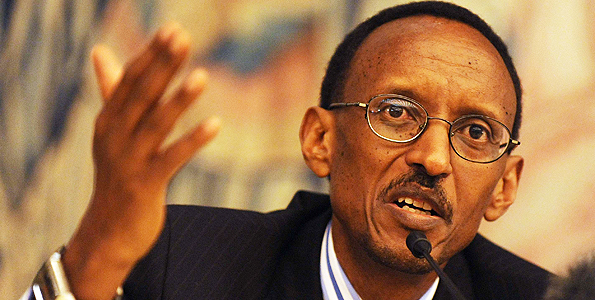
Paul Kagame, President, Hutu, Tutsi or Dictator?
It has been 15 years since the genocide in Rwanda, but tensions are building not lessening. The runup to the August elections doesn’t look good.

I was in next-door Zaire when the genocide began. I have friends whose lives were severely effected by the genocide. My daughter and I with a couple close friends were nearly kidnaped by powerful Hutus in Zaire (now The Congo) who took control of precious metal mines and established their own mini-states within the DRC.

But until this year all the possible bad news about Rwanda’s future was eclipsed by all the good news. That’s changed.

Wednesday the last of the promising Hutu political leaders in the country was arrested. There are no viable candidates left to challenge the current president in the August elections.

This followed Tuesday’s arrest of two prominent Tutsi generals, suggesting once again the machinations of this country’s diabolical ethnicity was gearing up for something bad.

It’s all in the runup to the August elections. The billions and billions of dollars that mostly France and the U.S. have injected into Rwandan society to build shopping malls and fine roads came with the price of “free and fair elections.”

Down payments were made. Hutus who had fled the country, like activist Victoire Inagbire were allowed to return (from The Netherlands), and disgruntled Tutsi who increasingly criticized the militarization of society, like Frank Habineza, were given a wide birth to criticize the government in the media.

But then things went south earlier this year, when the new educated class in Rwanda, much wealthier and more savvy than their parents, began to actually cross ethnic lines in support of social movements.

Anyone criticizing the government was suspect, and now most are in jail.

Both Amnesty International and Human Rights Watch have sounded alarms.

Habineza heads the Rwanda Green Party. True to its name, its agenda is mostly nonpolitical, but with time its membership grew with disgruntled Tutsi including many former military officers concerned with too many resources being used for guns rather than trees. Inagbire – fully educated in the west – started pointing out publicly that there were many Hutus who suffered in the genocide as well as Tutsi.

Her own brother was mistaken during the genocide for a Tutsi and killed.

And therein lies the quagmire of Rwanda. Tutsi and Hutu are linked by a common language and many, many intermarriages especially in Kigali. The old notion that the Tutsi is lean and tall and the Hutu short and stubby is especially not true, today, where the melting pot is bigger than the tradition.

Yet the animosity is intense, and since the 1994 genocide it has morphed into something political rather than ethnic.

The Hutus who fled and didn’t come back are now a powerful, onerous force in The Congo mostly known as The Interamwe. They are brutal, ruthless cowboys almost exclusively men controlling important Congolese mineral deposits by guns and terror. Read John Le Carre’s fabulous book, Mission Song.

The Interamwe has beat back Rwandan, Ugandan and even UN forces trying to suppress them. In the long time since the genocide this movement has attracted a number of eastern Congolese movements, some of them actually Tutsi. So this Hutu ethnic movement has become a renegade but powerful political source sitting on tons of titanium that buys arsenals of weapons.

And within Rwanda, Paul Kagame, President, has controlled Rwanda since he liberated it from the Hutu massacre in 1994. There has actually been a growing number of Hutus integrated into his government, and in the last several years, even into Rwanda’s Army, which is the real force in the country.

And so this “Tutsi” government has morphed, too, into an iron-handed government that many now call a dictatorship. Kagame says government policy is necessary as a defense against the huge Interamwe threat on his border.

Trouble is, as always happens, contemporary political motives erupt into old feuds. Our Arizona’s legislature’s honest interest in stemming illegal immigration seems to me fast transforming into a birther and racist movement.

And so will it in Rwanda if anything blows. Strong government against external threats will once again become Tutsi versus Hutu.

Eles for Bluefins

Eles for Bluefins

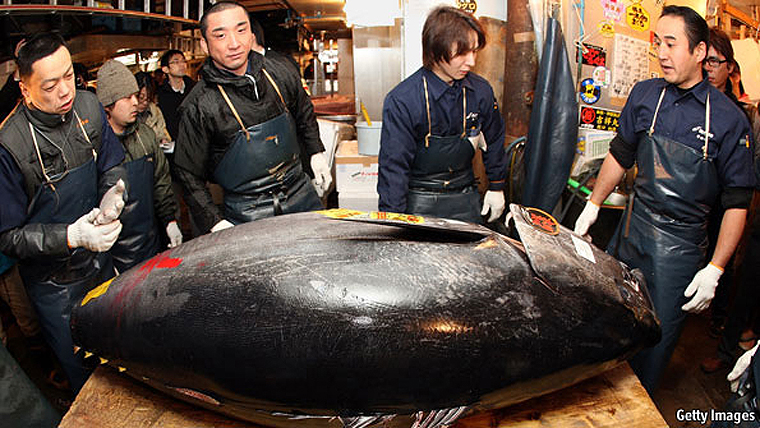
Bluefin reception eats last tuna.
The whole damned world is becoming politicized. It isn’t just us, and it’s not good for animals.

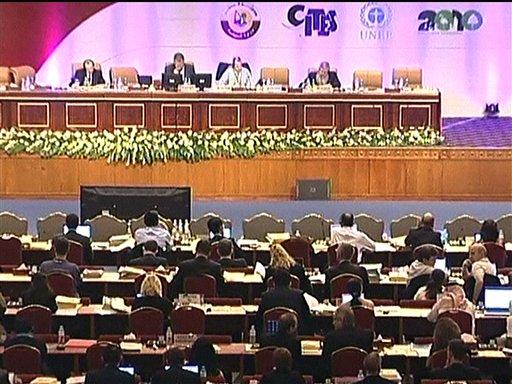
The quintessential world treaty, CITES, which has done so much good since its inception in the 1980s to protect endangered species became totally politicized at the March meeting in Doha.

Horse trading ruled the day. Sorry, elephant trading.

The convention resoundingly defeated any attempt to relax elephants’ listings as endangered. There will not even be any one-off sales of stockpiled ivory, as requested by Tanzania and Zambia and supported by most of the southern African countries.

Elephants won, but at the expense of bluefin tuna; many corals; hammerhead, oceanic whitetip and spiny dogfish sharks; and polar bears. The scientific reports tabled at the convention overwhelmingly supported at least some restrictions on these rapidly dwindling species.

But while in the past science ruled mitigated by a harsh but important consideration for local economies, this convention was ruled by politics.

And it was crass.

After eles won, the big fight was over bluefin tuna. There is wide consensus that the population is in catastrophic decline but also wide recognition of its economic importance, not just in Japan, but also in Europe. There is even an organization created by world powers just to regulate this single species: the International Commission for the Conservation of Atlantic Tunas (ICCAT).

It’s a very practical commission: the mandate – unlike CITES – is not to protect the biodiversity of planet earth, but its economies. Economists recognized that without regulation the bluefin will disappear, so that regulation that prolongs the species’ existence is a good economic move.

But ICCAT was politicized last year when the European Union made an end-run on the commission’s authority by claiming that Europe as a whole – rather than just the European countries’ that consume bluefin – must be regulated.

By the formulaic process that economists – as opposed to environmentalists – work, that allowed France, Portugal, Spain and Britain to harvest a disproportionate amount of bluefin compared to the population of Japan, since their consumption was numerically diminished by nonconsuming eastern European nations.

So it left Japan out in the cold … sorry, out in the sea.

Japan responded at CITES by flying in the trade and fishery ministers of more than two dozen African countries where Japan is the champion of free-world non-military foreign aid. These senior government officials trumped the scientists which used to be the sole delegates and voters at the convention.

Then, to celebrate before victory, Japan hosted a huge reception where it served blue-fin tuna. Martha Stewart would call that Bad Form.

And the polar bear trading didn’t stop there. Why did Senegal, who supported the ban on elephants, vote against listing polar bears? Supposedly because there was an Inuit delegation that successfully argued it was their livelihood (even though CITES could clearly not regulate indigenous hunting of species). I think rather it was tit for tat. Sorry, eles for bears.

What does it all mean, that the natural history of earth is now being won or lost by the best politicians?

What does it mean that national health is being won or lost by the best politicians?

The complex answer is the same. It means that science and practical sense loses to forces more immediate: and that usually means the pocket-books of the rich and powerful. Sorry, rich is powerful. (And vv.)

I wrote earlier about the slow response America had to all of this. Well, to some extent, America came through at the last moment. The Kenyans take credit for probably instructing the Americans on what was happening, and in all the battles, the Americans came out on the side of a green earth.

But it took them a while, and they had no good response to the blue-fin tuna dinner. There’s so much on the table at the moment for America’s new administration, that I guess they just didn’t see the fish.

Tanzanian Saints on the March!

Tanzanian Saints on the March!

While the political focus in East Africa has been on Kenya’s very public troubles, a much more sinister situation is actually emerging in Tanzania.

Wednesday morning Tanzanian special police arrested Christopher Mtikila, a conservative Christian theologian, very public human rights activist, and unfortunately, a real righty politician who until now had little viable support.

Reverand Politican arrested in Dar.
Last year the Tanzanian government legitimized his political movement, the Democratic Party of Tanzania (DPT), by registering it as an official opposition that could stand for national elections this fall.

I guess they had second thoughts… twice. “Special police” arrived at Mtikila’s house at 7am Wednesday, and knocked politely at the door. His wife wouldn’t let them in, so they left. A little bit more than an hour later they returned with vengeance.

For three hours they ransacked his apartment, finally leaving with his computer. The affair has transformed a fringe politician into a national hero.

Trapped in the same dynamic that indecisive and oppressive regimes from Nixon to Mao found themselves in, the Tanzanians in power have now elevated a fringe movement to substantial prominence that risks shaking the country to its core.

From a distance Tanzanian politics has looked honky-dory. It’s one of the few countries in Africa where the country’s presidents (following the first, Julius Nyerere) never served more than two publicly elected terms. The transitions have always been peaceful.

But beneath this veneer of peaceful democracy is strict one-party control. Nyerere established the Chama Cha Mapinduzi (CCM) as the single political entity in the country. After the political collapse of the Cold War, CCM relented somewhat allowing ineffective opposition parties that never garnered much public support, but CCM always was — and still is — in complete charge.

Public presidents are beholding to retired presidents sitting quietly in the “presidium.” Like in China, age is power.

I’ve often wondered if savvy Americans like Bill Clinton and Madeleine Albright really understood all this, and just didn’t let on. I’ve often wondered myself if this kind of top-down, near oppressive control is what emerging African democracies need. To a certain extent, it’s the (public) argument now going on in Kenya regarding their new constitution.

But it’s all coming apart now in Tanzania. The last thing Tanzania needs is a Newt Gingrich hero, but that’s what the indecisive Tanzanians-in-power have created with Rev. Christopher Mtikila.

Mtikila has been around for a very long time, sort of the Mike Huckabee of Tanzania. Born again apostolic, he’s campaigned tirelessly against the “unchristian” ways of the closely-held Tanzanian government. His views are not comfortable to most moderates. He’d like gays hanged and Sunday made a non-workday public holiday. He calls non-Christians “traitors.” Jailed more than two dozen times since the early 1970s.

Why on earth did the current Tanzanian regime suddenly legitimize him?

Times are changing. And for the better. I think the answer lies in Kenya, where real democracy is exploding through the streets. The internet, cell phones, blogs – you name it – young East Africans are on the march for greater transparency and democracy.

Kenya is handling it well. Tanzania has a lot to learn. And if it doesn’t soon, it may find that it’s oppressive politics flip from one heavy hand to another just as heavy, and maybe even less rational.

African Capitals Are Worlds Unto Themselves

African Capitals Are Worlds Unto Themselves

By Conor Godfrey

This weeks’ New Yorker featured a special on the last days of the Guinean Junta entitled The End of A West African Dictatorship.

I felt as if author John Lee Anderson used the dark surrealism of Heart of Darkness with the edgy absurdity of Clockwork Orange a l’ African to capture the disintegration of Captain Dadis Camara’s grip on power.

In Anderson’s account, Junta leaders conspiratorially vie for power inside the labyrinth of the Alpha Yaya military compound in Conakry, while brown-brown (½ cocaine ½ gun-powder) snorting soldiers patrol the streets in flat-beds fitted with 50. Caliber machine guns.

Implausible images of Junta leader Dadis Camara on horseback adorn this Orwellian landscape like a Guinean big brother modeled on a victorious Roman general.

Reading this nightmarish tale reminded me of the yawning disconnect between Conakry and Guinea, and more generally, between some African capitals and the countries they purport to represent.

How do you reconcile the tranquil Guinean interior with the horrors Anderson describes?

You cannot. They belong to totally different worlds.

Any villager arriving in Conakry, or Dakar, or Bamako, (the three West African capitals in which I’ve spent significant time) would notice certain differences between the capital and the interior immediately:

The prevalence of French, the partial electricity, the traffic, the multitudes of young people, the police and military presence, and the cell phone coverage would all make the capital a strange place for the average West African.

But the differences that create the deeper disconnect between rural and urban require a more discerning eye.

Capital Cities tend to contain large numbers of politicized young people.

These young people are often unemployed, more educated then their peers, and in constant contact with the outside world through the radio, television, and in contact with foreign NGO workers or tourists.

The presence of the State also becomes more noticeable and meddlesome.

Soldiers set up roadblocks, the haphazard enforcement of the rule of law burdens most while leaving the well-connected untouched, and state policies which are routinely ignored up country must be heeded for better or worse in the capital.

In The Berlin Conference Continues to Plague Africa 125 Years After the Fact, I talked about the artificiality of the African political map.

In the interior people, deal with this by ignoring rules issued from the capital, or the state government adapts to fit local realities.
(e.g. In my village, 90% of office holders came from families that held political power before the French colonial government nominally extended its writ to the sleepy village of Fataco.

Now those families have “official titles”, but nothing really changed.)

However in capital cities, the colonial powers grew deeper roots. Now their imposed system awkwardly competes for influence with more traditional levers of power like family, ethnic group, faith, etc…

I think these dynamics isolate capitals and those who live in them from the interior.

John Lee Anderson’s article describes a Guinea that most Guineans do not know or care exists; I wonder if the same is true for villagers in other parts of the continent.

Please feel free to comment!

The Frustrating Resilience of Early Marriage in Sub-Saharan Africa

The Frustrating Resilience of Early Marriage in Sub-Saharan Africa

By Conor Godfrey

This week the Swedish ambassador to Tanzania, Mr. Staffan Herrstrom, spoke to the Tanzanian daily The Citizen about early and/or forced marriage in Tanzanian society.

He spoke poignantly about his conversations with girls and young women across Tanzania, and outlined some of the social repercussions of forcing girls to wed at such a young age.

Mr. Herrstrom prescribes the following remedies:

· Prevent early marriages, not least by raising the marriage age for girls to the same as for boys: 18 years.

Prevent early pregnancies i.e. by providing counseling and qualified education on sexual and reproductive health and rights.

Make sure that all stakeholders, including the police, treat sexual abuse as the crime that it is – and the girl victims as the victims they are. Never ever doubling their burden by forcing them to marry the villains.

Make sure that every single girl get the right to high quality education – regardless of marriages and pregnancies.

In so far as the ambassador’s ideas support education, I support them.

However, most of these fixes attempt to change an outcome without addressing the context that supports that outcome.

If early-marriage were an issue in Western Europe, it would only take a few years to eliminate the problem.

The health teacher would make sure young women understood the biology of pregnancy, as well as how to use various contraceptives.

Ideally, parents would then reinforce these messages at home and offer guidance and support in topsy-turvey world of teen-dating.

These young ambitious women would also recognize how a sexually transmitted infection or unwanted pregnancy would make their goals harder if not impossible to reach, and hence take ownership of their own choices and sexuality.

This sounds so effortless because the Western European culture supports each step of the process.

In the sub-Saharan bush, even if birth control were available on every corner, even if the law were to make it illegal to marry younger than 18, and even if police were instructed to penalize abuse harshly– I do not think much would change.

The law means nothing unless it reflects valid cultural attitudes.

Perhaps in societies where the rule of law prevails, legal codes have more transformative power, but in the Tanzanian bush, I doubt the official law book means very much.

Here is how I would recommend changing the cultural scaffolding in order to make Ambassador Herrstrom’s first three remedies more potent.

Increase women’s access to credit

: Women’s financial dependence on men supports the status quo. Women are not only better stewards of money, but also more likely to spend that money on family priorities.

Increase women’s access to training for marketable skills

: Financial literacy, artisan skills, agriculture, foreign language, etc… Fathers and family members will be less likely to marry a young daughter into another family if she is a financial contributor.
Health and Sanitation

: Prosperity starts with reasonable health. Reasonably nourished, healthy young women will succeed more often than their mal-nourished peers. They will also work more efficiently, leaving more time for studying and/or income generating activities.

Education

: I could not agree more with the ambassador. A quality primary and secondary education does more to change the cultural context than anything else.

For some, these suggestions will appear to attack the problem of early marriage too obliquely, but I am convinced that is the most effective way.

My friends and family tend to look at early marriage as a strictly moral issue. This characterization, though not without substance, tends to generate blunt solutions.

Outlaw it. Punish Offenders. Declare it in violation of the Universal Declaration of Human Rights.

Ok—but realize that most of the parents who marry their daughters off too young are not evil.

For the most part– neither are the men they marry.

The cultural context that informs their life can absorb and adapt to new information, take stock of changing realities, and chart a new course forward.

That cultural fluidity makes diversity fascinating, and sub-Saharan Africa one of the most exciting places on the planet.

The end of early marriage cannot be willed, or declared into existence. It must work its way through that cultural matrix until one day it becomes painfully obvious that such a practice no longer corresponds to social needs and realities. Unfortunately, this may take generations.

Righting Old Wrongs Does Not Need to Destroy the Economy

Righting Old Wrongs Does Not Need to Destroy the Economy

By Conor Godfrey

All countries with a colonial history struggle with the psychological and economic impact of colonialism.

In many African countries, colonial masters empowered one people group over another and left a legacy of racial or tribal inequality that persists to this day.

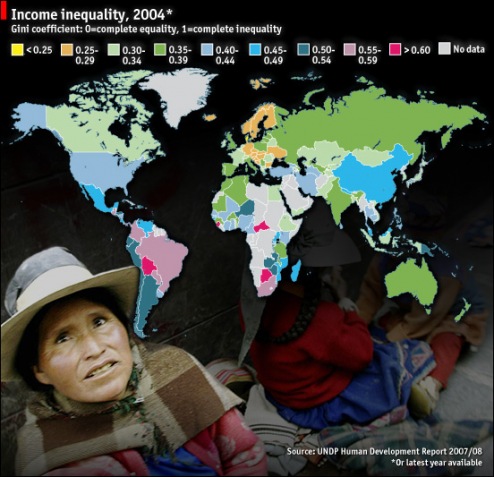
This legacy is particularly potent in South Africa, where the gap between haves and have-nots remains among the worst in the world.

Inequality Map 2004

Dealing with inequality is a complicated and emotional issue. As I see it, African governments can frame policies aimed at addressing inequality in two ways– righting old wrongs, or growing the economy.

Zimbabwe recently revived its 2007 Indigenous and Empowerment Act aimed at redistributing wealth and skills to indigenous Zimbabweans.

This is clearly of the ‘righting old wrongs’ variety, much like the government’s efforts at land reform over the last decade.

In 2000, the government participated in the seizure of 110,000 Sq Kilometers of farmland for redistribution.

Many of these farmers were neither re-settled nor reimbursed.

These ill-fated land reforms further eviscerated the production capacity of the former “bread Basket of South Africa”, and their memory casts a long shadow over the present indigenous empowerment legislation.

The current manifestation of the Indigenization and Empowerment Act would require foreign owned businesses valued over US$500,000 to sell or cede 51% of their business to indigenous Zimbabweans.

It would also require all companies to “procure 50 % of all [their] goods and services… from a business in which a controlling interest is held by indigenous Zimbabweans.” (Text of Indigenization and Empowerment Act)

Businesses and investors are fleeing for the hills.

The head of a large German investment group, Andreas Wenzel, was quoted as saying that, “Prompted by the recently introduced regulations… the German-Southern African Chamber of Industry and Commerce in Johannesburg are putting on hold their plans to bring German investors to Zimbabwe”.

Contrast this with South Africa’s Broad Based Black Economic Empowerment initiative (BBBEE).

The Department of Trade and Industry claims that Black empowerment and growth go hand in hand in South Africa—”This will only be possible if our economy builds on the full potential of all persons and communities across the length and breadth of this country.”

While the ANC has been guilty of populist pandering in the past, I do not believe that this policy deserves that criticism.

The BBBEE in South Africa rates companies on a BBBEE scorecard, awarding points for the percentage of Black senior managers, owners, and employees, as well as awarding companies points for doing business with other high scoring companies.

If you want to do business with the government (a huge purchaser of goods and services in the South African economy), then you must score well.

In this way, the South African government uses their buying power to encourage companies to find qualified black personnel and business partners.

From 2000 to 2008, BBBEE transactions accounted for 200 billion Rand.

Even though claims of reverse discrimination abound, the South African government rightly understands that developing the human capital of the entire rainbow nation is crucial to the country’s growth and success.

Righting old wrongs by throwing untrained and under financed indigenous people on previously profitable land, or forcing shotgun weddings between foreign firms and potentially unprepared indigenous partners, will only make everyone poorer.

Let South Africa Handle Mugabe

Let South Africa Handle Mugabe

Robert Mugabe
Morgan Tsvangirai

By Conor Godfrey

Just as American and European governments have asked friends and allies to follow their lead in years past on issues of concern to the West, South Africa is now asking for the West to follow its lead on an issue near and dear to their hearts—Zimbabwe.

I find it hard to get a bead on affairs in Zimbabwe because the pendulum swings from disaster, to optimism, to nagging pessimism, and back faster than you can minimize Al-Jazeera and open up the BBC.

Two years ago, the country had a raging cholera epidemic, 230 million percent inflation, and risked becoming a failed state.

The power sharing agreement signed in 2008 pleased no one but stopped the country’s descent into chaos and offered a refreshing break from the monotony of Robert Mugabe’s 30 year reign.

Then the news turned bad again. Snags in the rather loathsome shotgun wedding between Mugabe’s ZANU-PF and Morgan Tsvangirai’s MDC threatened to derail progress.

But last week the news was good. Jacob Zuma’s shuttle diplomacy appeared to have finally paid off.

Mugabe’s Zimbabwe African ZANU-PF and Morgan Tsvangirai’s Movement for Democratic Change (MDC) agreed to implement a series of measures to break through the current diplomatic impasse. (Outstanding issues include unresolved disputes over gubernatorial appointees, sanctions, and the swearing in of MDC Agricultural Minister Roy Bennett)

This week the news is bad.

A member of ZANU-PF told the press that his party would not take the agreed steps until Western governments remove sanctions (mostly travel restrictions and an asset freeze on Mugabe and his top officials).

In recent days, this official claimed that he only reiterated the party’s past position, but it certainly seems that ZANU-PF will continue to play the part of the obstructionist.

This is maddening. Robert Mugabe is largely responsible for Zimbabwe’s current state of affairs.

His thugs intimidate opposition members, his policies deter investment, and his mere presence makes potential foreign donors think twice about getting involved.

Lifting sanctions on Mugabe and his family would taste awful, but pragmatism often does.

I realize that the withdrawal of protest-sanctions lends quasi-legitimacy to an obstructionist regime, seems like playing politics with human rights, and undermines the Western claim to “always stand on the side of freedom and human dignity”. (President Obama’s 2010 State of the Union)

It’s a distasteful business.

However, Western governments lack adequate leverage to follow another course.

South Africa on the other hand has both vested interests and powerful leverage.

Zimbabwe is an important exporter to South Africa as well as the biggest buyer of South African exports in the Southern African Development Community.

Furthermore, conflict, epidemics, and refugees do not respect state borders. For these reasons, South Africa would like its Northern neighbor to return to stability and prosperity as soon as possible.

If Jacob Zuma says that sanctions should be lifted, we should lift them.

If the U.S. and U.k. governments need to hold their nose while doing so to appease their domestic audience, so be it.

But they should get out of South Africa’s way.

This suggestion is open to the criticism that South Africa has yet to deliver. But neither have Western sanctions.

As the region’s economic and political powerhouse, South Africa has far more at stake than we do. The U.K and the U.S. should encourage the growth of South Africa as a regional power broker by trusting its government to act responsibly in the interest of stability and growth in Southern Africa.

The Berlin Conference Continues to Plague Africa 125 Years After the Fact

The Berlin Conference Continues to Plague Africa 125 Years After the Fact

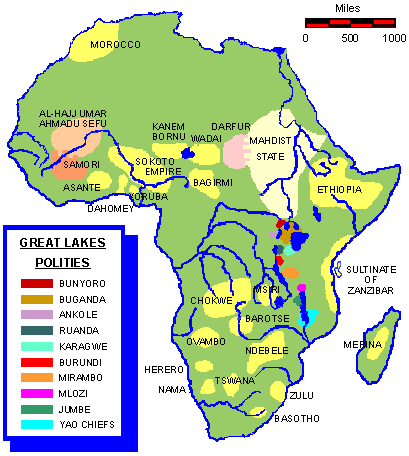
African Ethno-Political Divisions Before the Berlin Conference
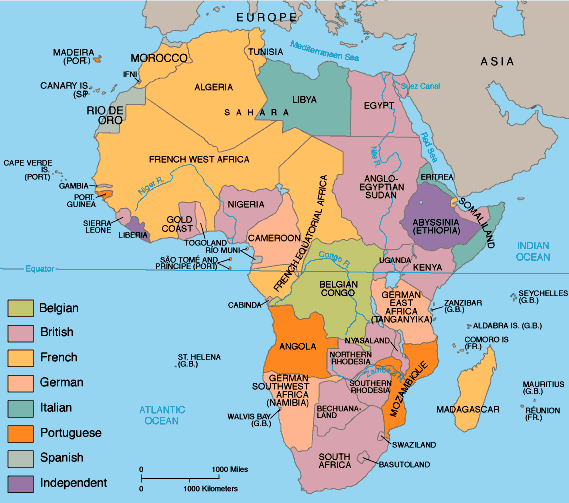
African Political Division After the Berlin Conference 1885

By Conor Godfrey

In 1884-85, European governments essentially drew a map of Africa on the back of a cocktail napkin in Berlin. This map carved Africa into a series of illogical states and spheres of influence that took little stock of realities on the ground and laid the framework for more than a century of civil strife.

Last week, the artificiality of the African political map was thrown into sharp relief by a series of tragedies.

Following the violence in central Nigeria, Muammar Gaddafi, well known for his misguided remarks and absurd costumes, suggested that Nigeria split into two states– one for the mainly Muslim North and one for the Christian and animist South.

On the other side of the continent, violence erupted in Sudan ahead of the planned referendum on an independent South Sudan.

Absurd borders are the rule not the exception in Africa. Europeans carved some of the great pre-colonial empires into unruly hodgepodges of people-groups who often lacked a shared history and had competing interests.

Look at the Gambia!

As the Europeans entrenched their rule, they imbued these imaginary lines with more and more meaning until state borders became faits accomplis. So what now?

The borders have created facts on the ground and there is no going back.

Mr. Gaddafi suggests Balkanizing the state(s) in question and equitably sharing resource wealth.

He uses the separation of India to substantiate his argument, but conveniently omits the ensuing civil strife and eventual civil war that took the lives of hundreds of thousands of people in that region.

He also appears to forget the previous attempt by the Igbo people to form their own state in South Eastern Nigeria. This event led eventually to the brutal Biafra-Nigerian war.

If Mr. Gaddafi wanted to partition every state in Africa that contains people groups deeply divided by tribe, ethnicity, or faith, he would quickly run out of fingers and toes.

This strategy would make more sense if religion and culture were truly at the core of these conflicts– but they are not.

Grazing rights, water rights, and land rights.

Access to political power, access to education, and access to jobs.

These are the flash points that drive conflicts in Africa.

Religion and culture will only fuel conflict when trampled on.

Even denying people a place to worship or undercutting some other important aspect of cultural identity rarely boils over into large-scale violent conflict unless people fear for the economic rights I listed above.

As conflicts persist, people tend to re-characterize resource based conflicts along ethnic or cultural lines, but I think that solving the resource and power-equity issues at the core of a dispute will eventually succeed in neutralizing the ethnic component.

The most effective way to deal with the fallout of the Berlin conference would be to strengthen regional bodies. ECOWAS, SADC, COMESA, even the Arab League, and especially the African Union.

This will build regional and continent-wide capacity to enforce treaties, mediate between parties, commit peace-keepers to patrol sensitive territory, and knock heads together when necessary.

Currently the various regional groupings in Africa play an important but limited role. I think this might be changing…

While ECOWAS’ response to the recent slew of coups in West Africa drew criticism from some quarters for its inconsistency, its mediation eventually proved crucial to diffusing tensions.

SADC’s attempt to mediate in Zimbabwe (spearheaded by South Africa) has not had the desired result thus far, but even the lack of progress demonstrates the need for a regional body in Southern African with more clout.

Regional stakeholders in ECOWAS urgently need to enter the scene more forcefully in Nigeria. Perhaps Burkina Faso’s Blaise Compaore could build on his successful mediation in Guinea and the Ivory Coast by wading into Nigerian politics.

The upcoming elections in Sudan will also offer the African Union a chance to prove its worth.

How the U.S. Could Transform the International Criminal Court

How the U.S. Could Transform the International Criminal Court

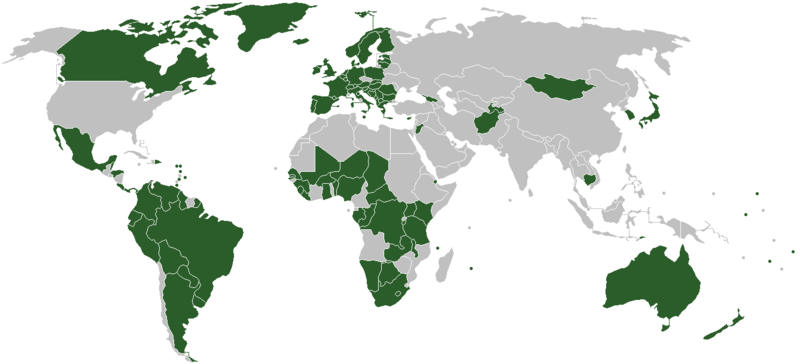
Members of ICC
Members of the ICC

By Conor Godfrey

This past week the International Criminal Court (ICC) added genocide to the charges currently pending against Sudanese President Omar al-Bashir.

This seemingly unenforceable addition has rekindled debate over the relevance of the ICC.

In March 2009, the ICC issued an arrest warrant for Mr. Bashir, to which the Sudanese president retorted, “Dissolve these documents in water and drink them.”

Even though the indictment severely curtailed Mr. Bashir’s travel schedule, few people believe that he will see his day in court

Al-Jazeera’s Riz Khan recently hosted chief ICC prosecutor Luis Moreno-Ocampo to discuss the relevance of the ICC and respond to criticisms that the ICC focuses its investigations on non-Western, specifically African, governments.

One listener from Kenya emailed Riz Khan with the following complaint worth reprinting in full:

“Why is the ICC’s name not changed to African Criminal Court (ACC)?

Apparently, the court only issues arrest warrants for African leaders who committed crimes, while the Western leaders are treated as if their gross human rights violations were not crimes.

Why is Ocampo not issuing an arrest warrant for Bush, Blair, or Israeli leaders?”

Mr. Ocampo’s response: “America is not part of the treaty.”

He could have rephrased that by saying—yes Mr. listener from Kenya, you are absolutely right.

And what about Israel’s three week war in the Gaza Strip?

Well, the ICC does not yet recognize the Palestinian territories as a state, and therefore legal obstacles must be cleared before taking action.

And of the 14 indictments so far, how many have been issued against African leaders? All 14.

Ignoring the complexity of the issue for the moment, you can see how easily opinion leaders in the non-Western world could frame the ICC as a Western weapon. The story practically tells itself.

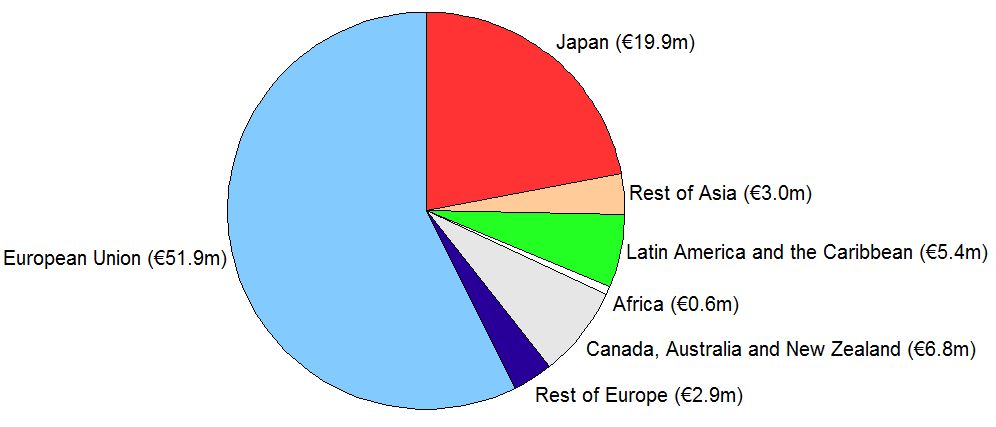
The funding for the ICC also raises questions about its biases.
ICC Funding pie chart

Given these gross inequalities, detractors say we should scrap the ICC. Wrong. America should sign up.

If the U.S. fears the ICC could launch politically motivated assaults on U.S. personnel, then they should invest heavily in the ICC process to ensure the court’s independence.

The American exceptionalism that dominated post-cold war thinking must evolve.

By subordinating national power to international norms, the Unites States plays a greater role in shaping those norms.

This will extend U.S. power and protect U.S. interests in the wake of unilateralism’s fall from grace.

The majority of reasons listed for the U.S. refusal to participate in the ICC as a member represents little more than a transparent attempt to remove the U.S. and U.S. personnel from the purview of international Justice.

Moreover, by more than 2 to 1, Americans favor participating in the ICC as a member. (Though admittedly 21% of American’s pleaded ignorance.)

The U.S. entry would revitalize the court and put its detractors on their heels. Many non-signatories would reevaluate their position, and the increased legitimacy of the court would make non-compliers less likely to support those indicted. As long as U.S. personnel, power, and resources remain on the sidelines the listener from Kenya will be right—we might as well call it the ACC.

Elephant Now Safe, Are People?

Elephant Now Safe, Are People?

CITES bans ivory sales.
Elephant are safe for the moment, but what about the people they’re trampling?

The CITES convention in Doha yesterday strongly rejected Tanzania and Zambia’s petition for a one-off sale of warehoused ivory. I think that’s the right decision, but will others step up to protect ordinary citizens?

(And note that the Obama administration became a pivotal force in denying the Zambia and Tanzanian petitions. This after months of silence on the issue.)

In Nairobi where I currently am staying between two safaris, the Kenyan media is jubilant. It was a page one story in Nairobi’s main newspaper, the Daily Nation. “Our elephants are safe, for now” was the story’s headline.

In Tanzania there are rumblings that the country “should take things into its own hands” and the tired refrain that the outside world is meddling in Tanzanian affairs.

“Should this meeting fail to consider this proposal, we run the risk of enhancing hostility against elephants by our local community especially where human-elephant conflicts are prevalent. More elephants will be killed,” Tanzania’s tourism minister, Shamsa Mwangunga said to the convention.

Bad argument, but Shamsa has a history of pretty bad arguments.

The argument that won the day was unequivocal: the results of CITES allowing two one-off sales in 1999 and 2008 are clearly documented as being followed by increased periods of poaching. And despite the substantial increase in elephant populations, elephant poaching this year throughout East Africa is the highest in years.

More stunning even was a report by TRAFFIC, the wildlife trade monitoring group, released just last week that claimed Tanzania has been involved – at the government level – with the increased illegal ivory trade. That was a body blow to Shamsa.

So congratulations all around to those who fought the battle, and enormous relief that the U.S. came out of its cloak of secrecy definitely on the Kenyan side. But don’t forget, the human-elephant conflict is increasing as elephant populations increase, and that’s a problem that also needs urgent attention.

Is Guinea Ready to Exploit “A World Class Monster” Iron Ore Deposit?

Is Guinea Ready to Exploit “A World Class Monster” Iron Ore Deposit?

simandouSimandou_environment_25_rdax_100x150

By Conor Godfrey

The feasibility studies are complete.

The ore deposit in Simandou, Southern Guinea, is 66% iron (high quality), and is likely the largest undeveloped iron ore deposit in the world (110 km).

One stockbroker interested in the project was quoted as saying– “It’s a world-class monster.”

Over the next several years, mining giant Rio Tinto, in conjunction with state backed Chinese mining conglomerate Chinalco, will spend an initial 6 billion dollars developing the necessary infrastructure to extract Simandou’s ore.

According to Rio Tinto executives, this infrastructure will include a trans-Guinean rail line from Simandou to the coast, a new deep water port South of the Capital Conakry, and of course, the infrastructure surrounding the mines themselves.

As Guinean officials were cleaning the drool off their desks, Rio Tinto announced that the Guinean government stood to reap 200 million dollars in tax revenue from the first few years of operation with a proportionally higher rake as mine output increases.

This is more money than all the other concessions in Guinea generate combined.

I hope and fear in equal measure.

A trans-Guinean railway would increase Guinean commercial capacity by leaps and bounds.

The announcement also refocuses attention on the transition authorities promise to hold democratic elections this June.

How serendipitous would it be for the newly elected government to have 200 million extra USD to jump start social programs and convince the population that a civilian government will indeed make their welfare a priority?

(See “The Coup d’Etat is Back” for the other possibilities.)

Watch this Rio-Tinto video for a grandfatherly manager’s take on the benefits of Rio Tinto’s giant mine.

While I acknowledge the vast potential for social improvement this deposit offers, my sense of déjà vu is disconcerting.

The presence of mining giants in Guinea dates back to the mid-1980s (1996 for Rio Tinto). How much has Guinea’s overall social welfare improved since then?

Negligible, if at all.

Ideally, the Guinean government would be a relatively clean, efficient organization capable of speaking with one voice, striking hard bargains with the mining companies, and implementing effective monitoring and legal safeguards to ensure that the money flows into government rather than personal coffers.

I expect the Ghanaian government to perform in this fashion when they start producing oil at the end of this year.

Alas Guinea is not Ghana. Instead, Guinea occupies the 168th slot out of 180 on Transparency International’s Corruption Perceptions Index, the government is riddled with internal divisions, and mining revenue historically has financed homes in France rather than roads and electric grids in Guinea.

Do not mistake my apprehension as opposition to private sector development or resource exploitation.

I believe in the private sectors’ power to transform developing economies. I also believe that mineral resources, in consultation with local authorities and relevant environmental groups, should be exploited in a mutually beneficial way.

Yet, the current dynamics inside Guinea make this almost impossible. Rio Tinto’s mission is to satisfy shareholders—not to transform the culture of corruption in Guinea.

Currently, Rio Tinto’s PR and social responsibility departments are making all the right noises.

I have no doubt they will build a few schools and health clinics, offer several thousand local jobs, and hopefully make good on their promised trans-Guinean rail line.

Yet, I fear that generations from now when Guinea gets up off her knees and stands ready to use her natural bounty for the benefit of all Guineans, the wells will be dry, the mines stripped, and the foreigners gone in search of more low hanging fruit.

To avoid this, civil society, NGO’s, commercial partners, and donor countries should begin a full court press on Conakry to make government finances more transparent and ministers more accountable before the revenue from Simandou begins pouring in.

I will even make the naïve suggestion that civil society should force the government to draw up transparent development priorities, and then in conjunction with Rio Tinto, hire a credible outside auditor to report on how mining revenue is being collected and spent.

This would make far more difference to Guinea than a handful of schools or rural health centers.

Related Reading:

Rio Tinto’s Website devoted to the Project.

What To Do With All These Ex-Combatants?

What To Do With All These Ex-Combatants?

What Next?
What Next?

By Conor Godfrey

A friend of mine currently serving in Liberia recently related the following story about his friend Abdoulaye.

Abdoulaye’s store was robbed for several hundred US dollars.

After hearing the night watchman’s account and looking into the evidence, Abdoulaye concluded that the burglar had military training and was more than likely an ex-rebel from Liberia’s long and brutal civil war.

If anyone could recognize this, he could—being himself an ex-commander under Charles Taylor.

This story was related to me on the same day that I read about ex-combatants in the Congo who had been integrated into the Congolese military and were now extracting more from Congolese mines as soldiers than they ever were as rebels.

This is a real problem.

28 African States have been involved in at least one major conflict since 1980 and the continent is awash with former combatants.

Their resumes include weapons training, brutality, and a large network of similarly credentialed co-workers, but usually lack the skills to transition into civilian life.

Despite these challenges, so-called success stories abound.

USAID and other websites tout programs emphasizing job training, basic literacy and numeracy, psychological counseling, and a bevy of other seemingly logical steps to re-integrating militia members.

Even in Liberia, polling data suggests that the majority of ex-combatants feel accepted in their families and communities.

I believe that many of these programs do indeed help break the cycle of violence, but they are not a panacea.

Ex-Soldiers from Liberia and Sierra Leone were at the core of the group that massacred and raped demonstrators in Guinea last September.

Former combatants from other conflict countries now run criminal syndicates and extortion rings like those in the Congolese mines.

Policies surrounding re-integration send mixed signals.

The ICC spends millions of dollars attempting to convict officers at the same time that various truth and reconciliation committees try to make communities forgive and move forward.

These proceedings are further complicated by how national governments, local communities, and the international community view the combatants in question.

How politicized were the combatants?

How legitimate were their grievances?

Were they a legitimate resistance force like Umkhonto we Sizwe in South Africa?

Were they convicted of widespread atrocities like the Lord’s Resistance army?

Were they mild Islamists like the FLN in Algeria, or extremist members of Al-Qaeda?

Or maybe they were more like criminal gangs than armed forces.

Creative solutions exist.

In Saudi Arabia, Islamic radicals and their families are forced to attend classes taught by moderate Imams.

Next, they are given a dowry so that they might marry and become a stakeholder in a more moderate society.

In Liberia, the national commission in charge of disarmament and reintegration provided educational and vocational training to those willing to take it.

In Mozambique, combatants were paid a small stipend each month for 18 months so that they would not be a drain on their families or need to resort to crime.

In Sierra Leone, some former rebels were given motorcycles and licensed as moto-taxis.

Most countries employ a mix of vocational training and community based education programs designed to pave the way for former soldiers to come back home.

As conflicts in Sudan, the DRC, Nigeria, and elsewhere end (inshallah), regional and local actors need to have a plan in place to turn these traumatized young people into a productive force

General Macarthur said that “old soldiers never die they just fade away”–

There are worse things.

Piracy on The High Seas

Piracy on The High Seas

Today's Face of Piracy -- Hijacking More Than a Ship
Today's Face of Piracy -- Hijacking More Than Just the Ship

By Conor Godfrey

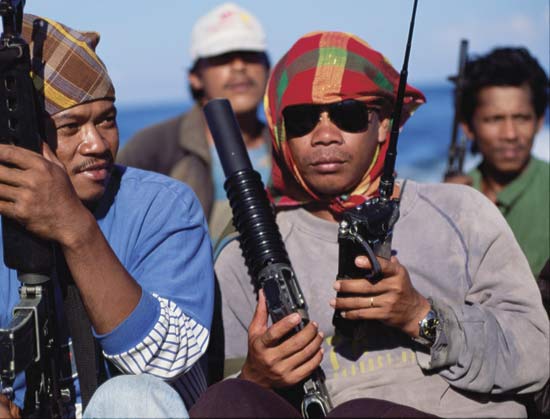
Over the past several days, news that French naval forces had captured ten pirate vessels coincided with reports of pirates seizing new ships and demanding hefty ransoms.

To Susie-Q public, piracy seems like a bad joke. Even the moderately well informed news consumer tends to picture a black Johnny Depp swilling rum on an African beach and blowing his hard earned ransom money on a few good nights in Margaritaville.

People ask how the world’s great powers let a few amateurs with motorboats push them around?

This image was cemented when American snipers killed three pirates in the Hollywood style rescue of Captain Richard Phillips. I could hear people around me thinking, “that’s right matey, look what happened when Uncle Sam got serious!”

However, the reality of modern piracy is complicated, expensive, and difficult to stamp out.

First some answers to the simple questions:

Why is it so hard to catch them?

Well, the twenty-odd warships on patrol cannot possibly cover the 1.1 million miles of ocean known as the Gulf of Aden. Pirates are also eschewing the heavily patrolled coastline and seizing ships up to 1,000 miles from the coast.

On the investigative side, the Somali economy runs almost entirely on cash, making it difficult to freeze pirate assets or follow the money back to the real movers and shakers.

Furthermore, the lack of an effective Somali government gives rise to a tragedy of the commons—who wants to foot the bill for stamping out piracy that effects everyone? (Sounds a bit like the Copenhagen Summit.)

How serious is the problem?

About 3.3 million barrels of oil pass through the Gulf of Aden every day. In any given year 20,000-30,000 ships use the Gulf to pass through the strait of Bab el-Mandab and onto the Suez Canal.

Where is the closest detour you ask? A mere 3,000 miles both ways around the Cape of Good hope.

The estimated 30 million dollars the pirates claimed in ransoms during 2008 accounts for only a tiny fraction of the overall cost to the global economy.

Rising insurance premiums, the cost of armed escorts, and fuel for detours constitute significant transaction costs for companies plying their trade in the Gulf of Aden.

The resurgence of piracy also says something important about the global system and Africa’s place in it.

Along with all the benefits of globalization came one significant drawback—the international system is now much easier to disrupt and those disruptions ripple further than ever before.

Buccaneers in Somalia with a few AK47s and the odd RPG can hurt the global economy to the tune of billions of dollars. (Estimates vary widely between 1 and 16 billion dollars annually.)

19 hijackers with box cutters can change the world.

Drug cartels based in South America can topple West African governments.

Bad dept in one sector of one country’s real estate market can trigger a cascade of financial failures all over the world. (Indulge the simplification to illustrate the point.)

Poverty and inequality unfortunately make Africa a likely breeding ground for such disruptors—be they pirates or pandemics.

While I have mixed feelings about globalization in general, I hope its benefits reach the underserved parts of Africa before those places protest their neglect by launching the next global menace.

Related Reading: Piracy Map

Homosexuality or Rabid Homophobia: Which is the Foreign Import?

Homosexuality or Rabid Homophobia: Which is the Foreign Import?

By Conor Godfrey
In less than two weeks the Ugandan parliament will vote on one of the most virulent anti-gay bills in history. Ugandan Anti-Gay Bill 2009 mandates the death penalty for some homosexual acts and significant prison terms for people who fail to report homosexual activity to the authorities.

Mass rallies preceding the introduction of this legislation informed audiences that “[Homosexuality] is not a human right. It is not in-born. It is a behavior that is learned and it can be unlearned”.

Speakers also discussed the aims of homosexuals in Uganda; namely, “to defeat the marriage-based society and replace it with a culture of sexual promiscuity.”

If this sounds familiar—you are right! It is our very own hate-mongering A-team.

On the podium in Kampala were Americans like Scott Lively, author of such scientifically renowned literature as 7 Steps to Recruit-Proof Your Child [from homosexuality], and also the source of my favorite piece of detestable drivel—claiming that legalizing homosexuality would be akin to legalizing “molestation of children or having sex with animals.”

Wow. Read this page of Mr. Lively’s blog. I could not make the case against him better than he does.

While Scott Lively, Caleb Lee Brundidge, and Don Schmierer are currently trying to distance themselves from the more heinous clauses of the Ugandan Anti-Gay Bill, the fingerprints of the most intolerant currents in American religious thought are all over the proposal.

It turns out that religious extremist groups in the U.S. funnel millions of dollars into Uganda, and Kampala is a regular stop for some extremist evangelical groups when taking their show on the road. (See related reading at the end of this entry for more information on American evangelism in Africa)

These agents of intolerance tap into a deep well of anti-colonial sentiment by portraying homosexuality as a “foreign import”, promulgated by agents of an international gay movement. They simultaneously play on perennial fears of cultural subversion by describing the gay plot to recruit African youth.

Statements by Ugandan Minister of Ethics and Integrity reflect these fears: he says the proposed legislation will “protect the traditional family by prohibiting any form of sexual relations between persons of the same sex”.

Other commentators have portrayed homosexuality as un-African, and by extension, the Anti-Gay Bill as congruent with African values. This strikes me as dangerous hogwash.

Yes it is true: most African communities do not support homosexuality. An open homosexual relationship would render the participants unable to meet some of the reciprocal familial and communal obligations that structure life in many African communities (e.g. marrying, producing children).

However, this rabid homophobia that makes people scribble “Die Sodomite” on the walls in Kampala is down right un-African. I have never heard an African voice anything more extreme than a mild discomfort with homosexuality.

Parents in my village would sometimes scold young children for ‘playing’ impolitely, but never displayed the level of fear and hatred necessary for a gay witch-hunt.

Hate-mongering by American extremists elevated African homosexuality from a non-issue, practiced by some individuals in a private way, to a hate-fueled cause célèbre requiring mass rallies and draconian legislation.

This is not a condemnation of Christianity in Africa. People in the know consistently describe religious charities like Catholic Relief Services as among the best NGOs working on the continent.

I knew several missionary families in Guinea who treated their communities with respect and earned the right to engage their neighbors in a meaningful exchange of ideas on universal questions.

There is a role for pious Westerners on the continent—but this is most certainly not it.

Related Reading: Brief history of modern evangelism in Africa

Four audio recordings of Ugandans with different points of view on homosexuality.