Elect Elephants or Pumpkins

Elect Elephants or Pumpkins

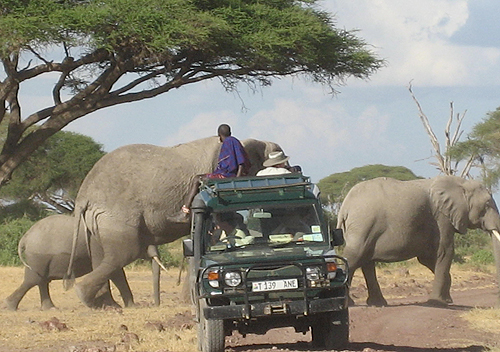
Elephants are on the rise, in numbers, in tusk size, in populations, and their growing battle with humans is straight on the top of the mind of Tanzanian voters going to the polls this week.

Lots has been mentioned about the side issue of the proposed Serengeti highway in this weekend’s elections, but an underlying component of that issue can be reduced to elephants.

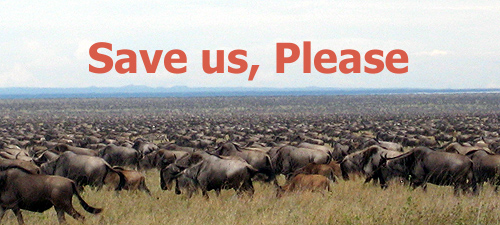
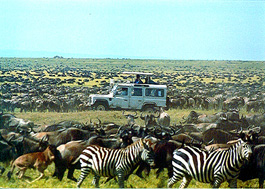
It’s been more or less accepted in the campaign that if built completely the Serengeti Highway will diminish the vibrancy of the Serengeti/Mara ecosystem mainly by disrupting the wildebeest migration. But this amazing herd does not wander like elephants, and when politicians speak of foreigners’ interests lying “more with animals than people” what is understood is “more with elephants than farmers.”

Our non scientific elephant viewing this year has been phenomenal. I have to stretch my memory back to the seventies to recall the numbers and sizes of elephants we saw this year. And if I as a casual observer had this experience, imagine what the farmer saw.

In fact, several times I saw what the farmer saw. Twice I watched farmers chasing elephants off crop land, obviously at great peril to themselves.

We are waiting anxiously for an important elephant report scheduled to be published before the end of the year by WCS that will show in much greater detail the state of elephants in Tanzania. But we got a glimpse of it this month when the coordinator, Trevor Jones, published one of the important maps that will undoubtedly be seen in the report.
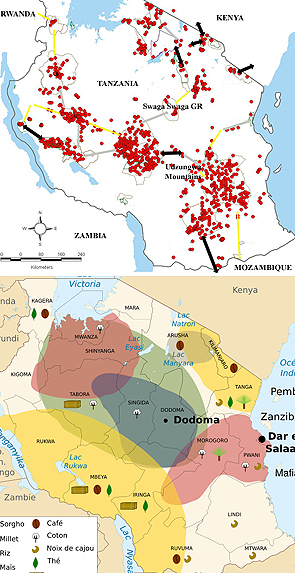
WCS will undoubtedly define important elephant corridors throughout the country that link diverse protected areas. Allowing any animal populations great mobility increase the physical and genetic health of the species.

Jones is going to argue that very tiny corridors especially in the dead center of the country are essential to maintaining the health of the elephant populations.

Notice on the top left map Jones has placed arrows showing the most important corridors.

But these corridors fall directly over the country’s most productive agricultural regions. Note the map on the bottom left from the EU shows where Tanzania’s most productive agricultural lands are, right over Jones’ most important elephant corridors.

And while we may be waiting for Jones’ report, I doubt the voting farmers have to.

Earlier this year the Tanzanians were rebuffed by the world community when a plea to allow them to sell stockpiled ivory was narrowly defeated at the CITES convention in Doha. I robustly supported the Kenyan/U.S. initiative that managed the defeat.

My support for the Kenyan initiative was with the understanding allowing the sales would aggravate elephant poaching and because the case the Tanzanian officials made was terribly flawed, reeking of corruption. But the Tanzanian farmer is less worried about these issues than harvesting his pumpkins.

It was a shame that that important battle in Doha did not address the more serious human/elephant conflict which will now be addressed in the Tanzanian election.
They Will Divorce

They Will Divorce

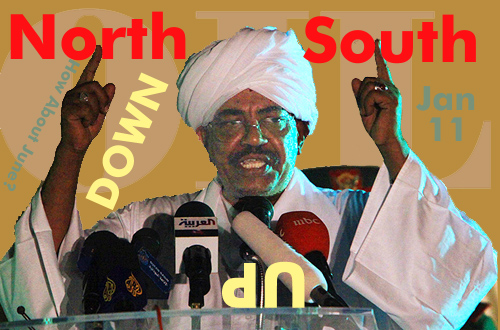
Guess what? After a generation of war the peace of a richly endowed part of Africa the size of Texas all comes down to … who gets .. That’s it! .. The what? OIL!

I’ve been writing for several years, now, that I believed – almost counterintuitively and certainly contrary to many observers — that southern Sudan would become a peaceful nation next year. Well, I might have been wrong. But not by much. It might be just slightly delayed as everyone works out who gets rich and who stays poor.

This week we watched some confused hand gesturing by Sudan’s current president, some rational talk by its senior foreign minister, some hand slapping by Hillary Clinton, and some sabre rattling by those expected to become the new South Sudan government. It wasn’t exactly getting ready for a ribbon cutting ceremony.

Other than the Balkans where the combined power of world force shellacked peace to death by imposing the breakup of existing states, or before that the implosion of the Soviet Union by capitalist viruses, there have been no breakups in existing countries in the world.

According to my calendar of state breakups, this was the next one. January, 2011.

The planned breakup of Africa’s largest country, The Sudan, into larger but poorer north and smaller and richer south, was the embodiment of a truly historic peace agreement in 2005.

Extreme, dictatorial and xenophobic Sudan agreed to a referendum. (That meant that individual southern herdsmen who were shot ten years ago if they looked a northern soldier in the eye were supposed to find a ballot box while keeping their eyes on the ground.)

The outcome was obvious from the beginning. The South would become a separate nation. Referendums on a separation are never scheduled because of uncertainty. When there’s uncertainty, unity rules.

The South and the soon to be “North” were never meant to be, anyway. The culture, religion, even geography is considerably different. Like so much that’s wrong with Africa, this was Britain’s fault for believing that contiguous deserts and swamps belonged together because there weren’t any cities in them (at the time).

Only needed one governor, then.

The point in scheduling a referendum is to give the divorcing parties time for counseling. You need to work out visitation rights, alimony, and the thorniest problem of all, oil.

Well, everything’s been worked out right on schedule except … oil.

I just don’t understand why this surprises everyone. Today’s headlines are running around the world proclaiming war.

War won’t happen. Peace is coming, but it might be delayed, so just breathe slowly. And who gets the oil will be decided in The Sudan long before Sunis, Shiites and Kurds decide who gets it in Iraq.

That is not to say that, like in Iraq, the uncertainty or poor agreement does not set the stage for civil war a decade hence. But my prediction stands. Sudan will become two within a few years at most without anymore fighting.

Kirubi vs. Obama

Kirubi vs. Obama

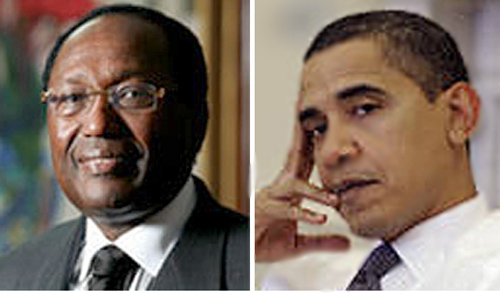
Kirubi vs. Obama. In change and hope, that is.
This sounds cheeky, but a blog by a Kenyan yesterday has inspired me more than Peter Baker’s interview of Obama. Anybody disagree?

Peter Baker’s in-depth interview of Obama published Tuesday in the New York Times really depressed me, and so what does a progressive American do when depressed? Obviously, read a Kenyan blog!

The Kenyans did only a little bit better than so-so in the recent Commonwealth Games, and Chris Kirubi’s blog pulled in readers with a “don’t worry it was great” congratulations before continuing on a lengthy discourse of what makes excellence.

I began to wonder if I were reading the text of one of my middle school teachers? It was pure American idealism. So different from what in my opinion is the state of America, today, as shown in Baker’s interview. It seems that in America, hard work and vision just doesn’t mean a lot any more.

Whereas in Kenya, hard work is really paying off with a surging economy and exploding modern culture. And Kenya’s Vision 2030 is one of the most ambitious and yet likely to be achieved goals any nation has ever set.

Here’s some of Kirubi’s blog:

“When I look at the lives of these athletes one thing I admire is their attitude and determination to excel. This got me thinking. What if we were to embrace the same spirit and adopt this attitude, determination in every aspect of our lives and businesses? Wouldn’t we be far off than we are now?

As a society we’ve accepted the incredibly durable myth that some people are born with special talents and gifts, and that the potential to truly excel in any given pursuit is largely determined by our genetic inheritance.

This is not so.

Excellence for me is derived from working and building what you have. It is not an inherited trait which determines how good you become at something, but rather how hard you’re willing to work.

Bear in mind that excellence comes at a price and you must be willing to pay that price.

If you want to be really good at something, it is going to involve relentlessly pushing past your comfort zone, along with the frustrations, struggles, setbacks and failures that you encounter. In the end, becoming really good at something you’ve earned through your own hard work can be immensely satisfying.

Remember that you have the remarkable capacity to influence your own outcome and that each time you fail is a chance to begin again this time more intelligently.

As my friend and renowned motivational speaker, Azim Jamal once said, “obstacles are part of the journey of life. When we keep our eye on the goal, obstacles are not threats. In fact, they become opportunities to create breakthroughs.”

If only Obama read my blog.

Tanzania Violence No Catastrophe

Tanzania Violence No Catastrophe

A lot of hot air, and very little to fight about.
Sporadic election violence breaking out throughout Tanzanian cities is not a harbinger of any October 31 disaster. It’s not like Kenya in 2007.

Last week the most pronounced violence ever to hit Arusha town occurred when proponents of two opposing political camps tried planting their flags in the city market area. Police moved in to break up the heated exchange and proponents began pelting the police with stones.

The police responded with tear gas that at first actually attracted more brawlers into the fight, which did last several hours. The incident was over before nightfall and remains the most severe violence so far.

In Dodoma, Tanzania’s technical capital city, police began arrests yesterday afternoon of suspects they claimed were planning more election violence. The strict laws in Tanzania give police the right to hold such persons without charges for an indefinite period of time.

Unlike in Kenya three years ago, these are not issue-driven incidents. They are basically thugs and bullies whose local differences vary greatly from region to region. The difference between the various national parties in Tanzania is actually quite small with regards to substantive issues.

That was not the case in Kenya, where stark differences separated the people’s socialist candidate, from the ruling elite’s business candidate.

Another important difference is that Tanzania’s election on October 31 will not be close. It may be closer than 2005, when current president Jamaya Kikwete won by more than 80 percent of the vote. In fact a poll released yesterday stunned the nation when it suggested Kikwete’s margin this time may be less than 15%. But by most analyses, it will be considered a landslide.

The trigger for the massive Kenyan violence was an election so close that like Bush/Gore, the victor arose from the power extant. It was simply too difficult to untangle the closeness to obtain a rational, undisputed outcome.

And the final, possibly most important difference, is that there is no single hotbed of dissent in Tanzania, as in the massive Kenyan slums of Nairobi. It was there in Kibera and other slums surrounding Nairobi that the violence burst. There are no massive concentrations in Tanzania of populations who feel disenfranchised from the status quo.

So don’t worry as you read growing accounts of Tanzanian election violence. I don’t yet see any possibility of widespread reaction to the election two weeks from Sunday.

Electing a Serengeti Highway Auction

Electing a Serengeti Highway Auction

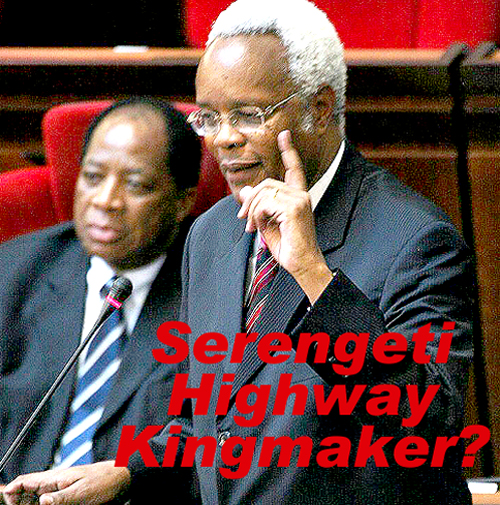
Will this man if elected determine the highway route?
The imminent election of a formerly disgraced Tanzanian politician may determine the route of the controversial Serengeti Highway.

Tanzania’s disgraced former Prime Minister launched his political comeback yesterday by vowing to push through the Serengeti highway despite environmental objections.

But in typical Tanzania PoliSpeak, Lowassa left open which route he supports. I think the man is on track to become the final power broker for how the highway is built and that he’s essentially going to put the route up for international auction.

As with everything in Tanzanian politics, a lot of reading between the lines is necessary. There is a possibility that Edward Lowassa is just a loose canon trying to avenge his disgrace, being carefully rehabilitated by power elites, or just blowing populist hot air.

Lowassa’s flamboyant political rally in Mto-wa-Mbu, specifically where the highway is scheduled to begin, came only one month before the national election on October 31. He is running on a small, opposition party ticket (Chama cha Demokrasia na Maendeleo, “Chadema”) which currently has only 6 of the 295-seats in Parliament and no national officials.

(Chadema may be the biggest threat to the ruling autocracy in Tanzania, although it’s hard to see enough victories in Parliament to impact the balance of power.)

Lowassa cannot run on the ruling party ticket, because he was thrown out in 2008. At the time he was the second most powerful man in Tanzania, its prime minister, but he got mired in one too many scandals.

He resigned as Prime Minister on February 7, 2008, after being implicated in a corrupt deal with the Houston energy firm, Richmond Development, where it was widely speculated he received enormous kickbacks for electrical services that were never delivered.

His resignation and that of other implicated ministers which immediately followed saved him from any formal investigation into the extent of criminality.

Making the Serengeti Highway a primary campaign position allies him with his former friend and now President, Jakaya Kikwete, who is also the man who forced his resignation in 2008.

But unlike Kikwete, he hasn’t specified which route — north through the Serengeti or south outside animal reserves — he favors. And listening to him yesterday at his rally, you’d think the issue wasn’t whether to lay the tarmac north or south, but whether to build a highway for the common man or preserve lions for tourists to see.

“Environmental activism should change. [Activists] should not be more concerned by the welfare of the animals than that of our people who need development,” Lowassa shouted to the cheering crowd.

Lowassa began his career as the area’s police boss, and he remains very popular locally so is likely to win. His opponent is an evangelical minister whose main campaign issue is that the election, scheduled for October 31, should not be held on the Sabbath.

Lowassa is playing both ends of the field. He can win the election and still embrace either the northern or southern route.

And then, he will become the most prominent politician whose constituency is closest to the actual highway area. He will become crucial in any negotiations down the line.

I think this is what Lowassa is doing, sneaking his way into an issue that not even the ruling elite can control, one that is certain to ensure his political rehabilitation on the national level.

He’ll give Kikwete an acceptable path towards changing his own position, which is that the northern route is the best one, while ingratiating himself into the political elite once again.

Lowassa will be up for the highest bid. That’s the nature of the guy. So NGOs, start the fund-raising, because Lowassa’s victory will be a sure sign that the highway’s route is up for auction.

Let Africa Kill the Gays

Let Africa Kill the Gays

The puppet, David Bahati, and the puppeteer, Sen. Jim DeMint.
Can we not stop this insanity?
Polarization, craziness, lies near insanity does not a physical mark make. Until vigilantes bash heads in Cleveland and my safari clients are tortured in Ugandan prisons.

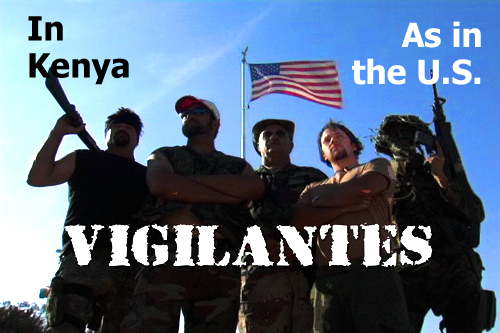
It hasn’t yet happened, but I have reason to worry. Yesterday, I blogged that we should take note of the violence occurring by Kenyan vigilantes as a trend developing here at home, and today we hear that the Ugandan MP promoting a bill to execute gays and imprison any who know of gays (including tourists) rigged his recent re-election.

David Bahati is the crazy, and the confident of President Yoweri Museveni of Uganda, and “Christian brother” of Sen. Jim DeMint (R-SC). Like so much vicious anger in the world, today, he’s the puppet of the American Christian Right.

His story, and his puppetry, is not news. Click here for a video condensing all the news in which he’s been involved for the last several years.

Basically, since our legion of crazy rightists has conceded they probably won’t be able to execute gays at home, they’ve decided to pour resources into Africa so it can be done, there.

If Bahati’s bill becomes law, and I have safari clients trekking gorillas in Bwindi National Forest (like I did last week), and those clients innocently remark about something gay-related, they could be arrested! And god (is there one?) forbid, if one of them mentions that he/she is gay, he/she could be arrested and executed!

And all of this, the polarization, craziness, lies near insanity, AND Cleveland vigilantes AND Ugandan homophobes all comes from the United States’ Christian Right, and pointedly, the “Family” who resides in “C Street” in D.C.

Bahati’s reelection was challenged by someone who was sane, Charles Musekura, who had strong support for a number of reasons not least of which is that most sane Ugandans don’t think you should execute gays!

But Bahati had the money. We can guess from where. And he had the tricks, too:

Michael Mubangizi, a respected reporter for the Ugandan Observer, reports that the recently concluded reelection campaigns including Bahati’s were rigged. They were rigged in quite simple ways. People were selling ballots that were then counted with names that didn’t exist. Up to 5,000 ballots illegitimate ballots may have helped to reelected Bahati.

Led by Sen. DeMint (R-SC), this “movement” that claims the moral high ground is one of the most evil social phenomenon ever seen in the world. I just can’t understand for the life of me why they are so prominent and hold so much power.

Just as I cannot understand why there are vigilantes in Cleveland.

But these machinations of hate are something that we must all try very hard to understand, whether in Cleveland or Uganda. They aren’t just wrong, they’re crazy. Their perpetrators aren’t going to be convinced by logical argument.

And as evidenced by Bahati in his recent reelection, nothing legal or sane alone is going to stop them.

Here is a list of the most prominent C Street players. Unless we stop them, this insanity will continue:

Chuck Colson, Watergate felon
Rep. Bart Stupak (D-MI)
Rep. Chuck Pickering (formerly R-MS)
Rep. Frank Wolf (R-VA)
Rep. Heath Shuler (D-NC)
Rep. Joe Pitts (R-PA)
Rep. Mike Doyle (D-PA)
Rep. Mike McIntyre (D-NC)
Rep. Zach Wamp (R-TN)
Sen. Bill Nelson (D-FL)
Sen. Chuck Grassley (R-IA)
Sen. Jim Inhofe (R-OK)
Sen. Jim DeMint (R-SC)
Sen. John Ensign (R-NV)
Sen. Mark Pryor (D-AK)
Sen. Mike Enzi (R-WY)
Sen. Sam Brownback (R-KS)
Sen. Tom Coburn (R-OK)

Whose Law? Yours or Mine?

Whose Law? Yours or Mine?

Everywhere in the world crazies are sprouting from the misery of the economic downturn. And we should take note particularly with what’s happening in Kenya.

Kenya may be the most dynamic emerging society in the world. It ended a mini-revolution with an imaginative coalition between radically different sides, then passed a new, modern constitution that in my opinion is an universal model for morality, human rights and dignity.

These clarion democratic ideals have empowered even the weakest sections of its society, as they should. And the weakest sections of a Kenyan society are far weaker than here, for example!

We may have an embarrassing one out of six Americans in poverty but Kenya’s is much worse off. It’s likely closer to one out of two!

But poverty in Kenya is a strata quite different from in the U.S. A huge portion of that half of its population still lives relatively calmly in subsistence, not in dependence of society as American poor, do.

But a growing portion of Kenyan poor are amassing in bulging slums surroundings its cities. And in these cesspits of humanity, political awareness and higher education combine in volatile ways.

That was why there was such violence after the contested election of 2007, an election which pitted two very different men against one another. It is very fair to call that an election one of the poor against the rich.

(It is also why the resolution of that conflict was so astounding. Of all the opposites in society, none is as irreconcilable as rich vs. poor.)

Rich versus poor is a pretty simple concept. In Kenya, as this fire burned, it morphed into Luo versus Kikuyu, tribe against tribe. An economic controversy has all sorts of academic qualifiers. Ethnic ones don’t.

What was a panoply of issues with lots of gray between, became black and white. A rich man could argue that the poor will get richer faster if they let him get richer, first! And the poor could argue that their drain on society impedes the rapid growth enjoyed mostly by the rich. So each side is blurred. Each side attracts advocates from the other.

But you can’t change the way you’ve been born. A Luo can’t convince his neighbor the Kikuyu that they share physical genes. That battle was demarcated by god.

That hate is more than visceral, it’s innate.

And it has lead in Kenya to vigilante groups springing up throughout the country. This is now Kenya’s greatest social problem.

And when one vigilante group grows very powerful and successful, a remarkable transformation albeit transitory occurs: Society as a whole begins first to tolerate, then later, embrace the thugs. It’s so simple, so nice. No complicated qualifiers, just a mafia leader to tell us what to do.

Mungiki is Kenya’s mob. Born in the slums, its leaders now live in grand houses and control huge businesses. From time to time the government indicts them, or even brings them to trial, and most of the time juries find them guilty of nothing. It started as a Kikuyu-based vigilante group. But today it reins across different cities the way mobsters did in the first half of America’s 20th Century.

There are places in Kenya where it’s impossible to become an elected official without the support of the Mungiki. And you know what that means.

And there are more and more wannabees around the country. Two days ago in a remote area of western Kenya, far from Nairobi and the Mungiki and modern life, 50 youths calling themselves “Sungusungu” stormed a village and hacked to death four people, then trashed their homes.

Sungusungu claims it was avenging the recent murder of a Kenya Assemblies of God church pastor, Mr Michael Onchong’a Nyakundi.

Yes, religion is an easy infusion into these vigilante movements. Ever watch the movie where the mob leader regularly goes to mass?

Kenya has an advantage in this stage of its development that America didn’t have during the years of prohibition. It has more facts, more history, more outcomes that proved how counterproductive the mob was over the long run. Kenya knows from America’s history that vigilante society is self-destructive and ultimately puts itself out.

And while these may be somewhat illusive concepts, they’re real enough I believe to help Kenya get through this period faster than we did in America.

Oh. Did we get through them?

Our Arthritic Fingers are Still Crossed

Our Arthritic Fingers are Still Crossed

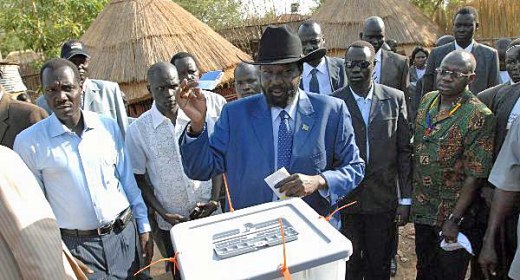
Salva Kiir practicing for an election he has waited for for 27 years.
The years and years of violence, genocide, child soldiers and poverty in the midst of the world’s greatest riches may be coming to an end in The Sudan, even as new obstacles presented themselves this week.

Against all odds and every expert’s prediction, the beleaguered and troubled Sudan, Africa’s largest country and guardian of its greatest length of Nile, agreed nearly five years ago to begin a peace process that should end in a few months.

That final of hundreds of steps and missteps is a national referendum that will allow the non-Arab south of the country to secede. And with it goes 80% of Sudan’s enormous and mostly untapped oil reserves.

Who on earth would have thought that the recalcitrant government of Khartoum, the one which is headed by the only sitting world leader indicted by The Hague for war crimes against humanity, the man who cannot travel anywhere without being arrested, has agreed to excise four-fifths of his nation’s wealth?

The answer is not simple, but the simplest way to convey its myriad of complications is that believe it or not, Gen. Omar al-Bashir finally concluded (as half of his life passed before him) that not to do so would cost him greater than trying to keep it.

Patient world diplomacy, patient sanctions changed this dictator’s mind.

At least until last week.

As we race towards a finish line on this generational marathon, Bashir’s government is stalling. That doesn’t strike me as very odd. Imagine having agreed to settle a class action suit against your drug company by giving 80% of it away. It’s a rather tough decision to come to, and once made, there’s going to be a number of second thoughts.

No one’s taking any chances, though. Next week at the UN one of the few meetings that President Obama will hold, with the UN Secretary General, Ban Ki-moon, are two high ranking Sudanese officials. (They can’t meet with Bashir, because if he stepped foot in the U.S. he would be arrested with an international court warrant.)

Headlines around the world are calling this “Obama’s rescue” and in a sense, I can understand the headline but I think it’s mostly opprobrium.

Patience is the key, patience even as the marathon comes to an end. And when it does, is there a possibility we could apply this masterful patience to places like, oh say, Afghanistan?

Serengeti Highway Update

Serengeti Highway Update

Keep on trekkin, guys! Relief just over the next ridge!
Unfortunately the American zoo convention ending today in Houston will make no statement about the Serengeti highway, but other news is promising.

You can think of the zoos inaction in either of two ways: (1) this seemingly impressive group of American conservationists is just too amorphous and internally divisive to reach consensus on anything; or (2) like so much of America right now, doing nothing is the greatest achievement possible.

This is particularly true in light of the recent Nature article in which virtually every important researcher in the Serengeti signed on. This included the Americans George Schaller of the Bronx Zoo, Anna and father Richard Estes, Andrew Dobson of Princeton and the adopted American, Charles Folley. They were among 27 prestigious scientists who contributed to an article entitled, “Road will ruin Serengeti.”

And there’s more at home:

Tanzanian media, which while not government controlled is certainly government suppressed, has been growing increasingly bold in opposing the proposed construction.

Dar-es-Salaam’s largest newspaper, The Citizen, today reposted an old story about UNESCO considering withdrawing the Serengeti’s World Heritage status if the road is laid. What’s so interesting about this is that the paper got the permanent secretary, the career civil servant who heads Tanzania’s Ministry of Natural Resources and Tourism, to lie … sort of.

While it takes reading between the lines, I’m absolutely certain this is what the article intended. Dr Ladislaus Komba told The Citizen that UNESCO had “suspended its warning” after being assured that new environmental studies would first be conducted.

That’s probably not true. At least UNESCO will not confirm its true. The last policy report focusing on the Serengeti issued by WHC can be read by clicking here and that was in 2003. At the recent meeting in Brasilia, there was resolution statement that is, indeed, a warning that policy could change if the road is built.

But The Citizen has unmasked Komba for inverting events. The Tanzanian government offer to make new environmental studies came well before the WHC conference in Brasilia last month, where all the news and hearsay, and “warning” was reported.

There has been no official suspension by WHC of that warning. In fact the warning warns they better make good on past promises, which include a better environmental study than currently on the table. So no official suspension of anything, therefore. And page one news in Tanzania, now.

There’s been a lot of dosie-dose going around the ridiculous presumption that forceful opposition will make the Tanzanian leadership close ranks on this issue. First of all, that just isn’t true. There has been much forceful opposition (double-down on that Nature article) from the getgo. And now the Kenyan Government itself has become involved.

The wimps have claimed the Kenyans have been silent, because they too didn’t want to upset the Tanzanians any further. Balderdash. The Kenyans have had other things filling their agenda… like a new constitutional referendum, a World Court investigation of their politicians and war on the border with Somalia.

So I have to admit I was pleasantly surprised when Komba’s counterpart in Kenya, Mohammed Wa-Mwachai, issued a statement last week that said in part, “We have instructed our Tanzanian High Commission to set the stage for negotiations [about the Serengeti highway] and we hope to come up with an amicable solution.”

The Kenyans, actually, have the most to lose. Their one great remaining game park with large herbivore herds roaming the plains is the Maasai Mara, the top of the Serengeti ecosystem. The reduction of the current 1+ million wildebeest to less than 300,000 as estimated by the Nature article would cripple Kenyan safari tourism.

So we’re sorry that the American zoos were composed mostly of invertebrates, but keep the pressure up. In sum, the news has been good!

How Much for Censorship?

How Much for Censorship?

Will the proposed censorship law destroy South Africa?
Crippled and cowering, the South African government is shifting its attention onto the country’s media after essentially provoking then losing the devastating public service strikes.

South Africa’s problem at the moment is that it’s exhausted. Can hardly blame it. The current political framework is less than 16 years old, it keeps chugging along with an economy about 20 times bigger than all the rest of the countries of Africa combined, the divisions between its rich and poor get larger, and a private capitalist economy keeps fighting with socialist leaders.

Everyone on all sides had hoped that a successful performance of the World Cup would somehow have made roses bloom and smog go away. To be sure, an unsuccessful performance would have been dire, and kudus to the government for taking the dare.

But attention to the World Cup was a distraction. Apartheid was the ace capitalist tool. By sequestering rights and setting boundaries among populations, markets were more easily defined then exploited. Wealth was much more easily created, albeit by excluding the majority.

So this is to be sure an incredibly daunting situation, now that the majority is in power, even while the majority knows it can’t just divide the existing wealth without so diluting the economy that it immediately evaporates into the African thin air.

So it’s understandable that this society wants to retire to bed with a plaster.

But a much more serious distraction than the World Cup is now besetting this enervated society.

Press Freedom.

Frankly, I think press freedom is overrated, today. Even in societies with thousands of years of censorship, like China, the news gets out. You simply can’t stop every cell phone, iPad and their partner electrons from zapping around.

Don’t get me wrong. When the battle lines are drawn, I fall squarely with the blobbers. (Sorry, is that blogger or blabber?) I’m just trying to point out that… it’s a distraction.

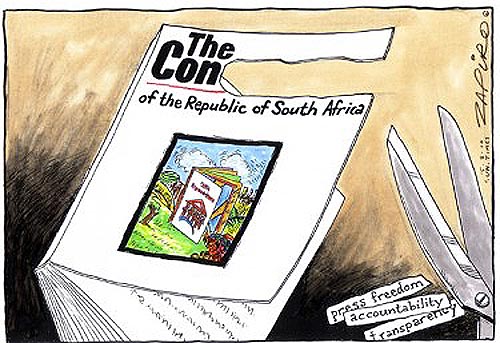
The proposed “Protection of Information Bill” has not yet passed South Africa’s parliament. It is a bill – with similarities to Kenya’s press control bill passed last year – that in its purest form would punish lying or revealing government secrets.

Of course, that’s the problem. One person’s lie is another’s truth. One person’s secret is another person’s redemption. This is not to say a lie is a truth, or that governments don’t have rights to secrets, or vice versa, just that there are a lot of malicious and ignorant people out there who believe lies and would misuse secrets.

And protection of their right to be stupid seems inseparable from pure freedom. And so it is.

South African leaders have been so quirky and so beleaguered by scandals that it’s quite clear that the law is as much intended to stop the whistle-blowing as it is to keep a fragile society from being rocked apart by lies or taken down by being stripped buck naked.

And so the fight begins anew with this session of Parliament. The original legislation has been softened, a “tribunal” of mediation proposed to define the parameters when previously it was the government itself, but Cry Freedom has lost its resonance.

It would be a mistake to pass this bill. And it may pass because the real problems besetting this ailing country seem insoluble, whereas controlling the press seems so much easier. Passing it is neither going to end press freedom in South Africa or stop journalists from finding out who Jacob Zuma’s next wife is.

South Africa didn’t fare very well in the actual World Cup matches. But it pulled off the event just fine.

Democracy or Bust!

Democracy or Bust!

Yusuf Makamba: No Democracy in Tanzania.
The Tanzanian election is less than two months away and is really heating up. Yesterday, debates were banned!

Opposition candidates are furious, of course, and blogs and articles in the U.S. especially are denouncing Tanzania’s authoritarianism as wrong and archaic. I agree, but I also wonder if the squeaky clean critics understand how they’ve contributed to the mess.

Yesterday’s announcement by the CCM secretary general, Mr Yusuf Makamba, that forbid all party candidates from debates (on television, but there weren’t any scheduled anywhere else) is certainly because the election is unexpectedly moving away from the party central command.

But another reason is more philosophical: the power of opposition in a modern world, the power to … lie.

There is no better example than here in the US of A. Death Panels. A President Born in Kenya. No Global Warming. Weapons of Mass Destruction. And to wit: The Millennium Trade between Burning the Quran and Moving The Mosque.

Lies foul up democracy. Everyone agrees lies are bad, but it’s the bad guys who profit from them. And in this viral internet age, lies can be assumed truths for critically long times. Sometimes, forever.. as those who embrace them lager themselves against being called out.

Democractic Lies gain special traction in bad times when people are so angry. Like now.

Maybe, just maybe America can weather this extreme moment of national lying. But a young and uneducated country like Tanzania maybe can’t.

It’s been a long while since Tanzania has had a real opposition; in fact, almost never. Following the surprise resignation of the country’s first president, Julius Nyerere, after more than twenty years in office in 1985 there was a spark of opposition. It faded quickly.

Today Yusuf’s CCM controls 206 of the 232 seats in Tanzania’s parliament. That’s almost 90%, and the renegades in opposition rarely make it through a single term.

But this time it’s different. Mostly because of what was left of an angered media the government partially shut down, a number of scandals have become public.

Every Tanzanian newspaper is read mostly online, so these scandals went viral:

There were lingering issues with the former attorney general’s million dollar kick back for arranging a missile defense system around Dar.
The Tourism Minister’s side business selling illegal ivory. The World Bank withdrew development funds and the specified reasons of corruption – usually kept under wraps – were leaked.

And local issues, including the proposed Serengeti highway in the north, became contentious issues between the party and opposition candidates.

It was only just before the last election that the Tanzanian government allowed opposition parties. Its legacy is a single-party state.

Yusuf holds as much power as any elected leader. A small cadre of mostly past elected leaders constitutes what we used to call the “central committee.” Yusuf and this group call virtually all the shots in Tanzania.

But democracy is pushing through this old style politics. I feel the internet age makes it inevitable.

It would just be helpful to emerging societies like Tanzania if the veterans of this age-old ideal of democracy had citizens who acted on The Truth, not The Lie.

Trampling the Election

Trampling the Election

Running to the right, unstoppable campaign!
The human/elephant conflict is becoming a major campaign issue in both Kenya and Tanzania. Soon, efforts towards resolution will lose out to the calls for culling.

Western wildlife NGOs and local researchers have been working tirelessly on human/elephant conflicts over the past decade. They haven’t gotten very far. It’s hard to keep six tons from doing what it wants.

Tanzania elections are scheduled for the end of the year and new elections in Kenya for the new branches of its legislature will occur next year. One leading candidate in northern Tanzania, Abdilah Ali Warsama, campaigned this weekend on ending elephant harassment of local farms.

He’s not calling on the government to cull elephant… yet. Right now he’s just demanding compensation to the farmers and second, elephant fences.

I’ve never heard of elephant fences.

What Warsama may actually mean is the extremely expensive trenching or construction of deep moats which in several places in East Africa seems to have worked.

I saw a successful trench for myself at the southern end of Uganda’s Queen Elizabeth National Park in the Ishasha last month. It’s a temporary solution, because the earthen moat erodes with time. But this particular 2-meter deep and 2.5-meter wide trench was working and going into its second year.

The problem with trenches is that their goal is to stop wildlife from moving beyond the trench.

Wildlife purists don’t like that. In Warsama’s constituency (the Tanzanian town of Makuyuni, in between Lake Manyara and Tarangire national parks) the African Wildlife Foundation wants to create a corridor for elephants between Manyara and Tarangire.

No successful trench would allow that.

Nothing else has worked: not pepper spray, electric fences or lead-in corridors that try to direct animals away from human habitations.

Tarangire has long been known as a prime elephant park. One of its current attractions – developed only in the last couple years – are congregations of a dozen or more huge bulls hanging around together near park roads as if modeling for tourists.

Normally this many bulls would’t hang out together.

But they’re resting and enjoying the fruits of a night of hawkish delight. These jumbos move out of the park regularly at night to raid nearby farms. Then, lounging in the protection of tourist cameras, they convene just inside the boundaries during the day.

Wasarama is not happy with Tarangire’s new attraction. He pointed out that 250 acres of his constituency’s food crops have been destroyed in the last season, and that four farmers were killed trying to defend their crops.

I don’t doubt it. Last March as my migration safari was zooming along the Tarangire / Makuyuni road at about 80 kmh, we watched a farmer using a huge bola single-handedly as he tried to chase a family of five elephant out of his corn crop.

Wasarama’s campaign issue in Makuyuni is by no means isolated. Similar situations exist outside Bwindi in Uganda and the Aberdare in Kenya.

I see the day coming soon when the human/elephant conflict gets so serious that culling and contained reserves using trenches is the only solution. It’s hard to imagine an alternative.

Translating the Party in Kenyan

Translating the Party in Kenyan

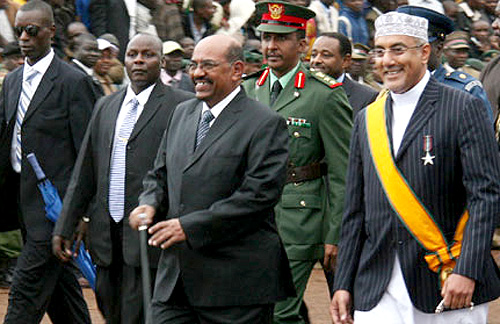
Sudan's President, Omar al-Bashir, (center) at the Kenyan ceremonies.
Several of you asked for a translation of the beautiful music, Daima Kenya, posted Friday. Others, including NPR, might profit from a translation of a little bit more.

Kenya’s weekend parties were glorious, beyond glorious. And I’ve provided a translation of its unofficial national anthem, Daima Kenya, below.

Swahili translations are very difficult. It’s much easier to translate NPR’s irresponsible reporting.

Some day I won’t start these tirades with the qualifier that “I love NPR,” but I do. I think they’ve just stretched themselves too thin trying to report from Africa. The files are glaring for what they don’t say.

Friday and Saturday I listened with pleasure when NPR headlines reported the Kenya celebrations. So Sunday when headlines reported that Sudan’s President had snuck into the dignitaries box to watch the “promulgation”, my interest peaked.

But in fewer seconds than it takes to close this browser, they managed only to say how displeased President Obama and Kofi Annan were. No further explanation.

There’s an old African expression that goes something like, if you’re prostrate on the ground a tiny little thing right in front of you will obscure the tree that’s crashing down on top of you.

Bashir should have been arrested when he entered Kenya. In fact, the decision to allow him to attend must have been very last-minute, because he didn’t fly into the ordinary international airport, where presumably police and immigration officials have him on a most-wanted list.

Instead, he suffered the indignities of a tourist on a longer flight and smaller cabin by flying into the tiny Wilson Airport which doesn’t handle jets.

Bashir has been indicted by the criminal court in the Hague, no less a world legal authority than Kofi Annan’s United Nations. There is a warrant for his arrest in most countries including Kenya. Virtually all sane minded people – and that definitely includes the Kenyans – agree that he’s a criminal who should be tried for crimes against humanity, specifically in Darfur.

Although The Sudan shares a border with Uganda, Bashir didn’t attend this month’s Organization of African Unity conference, because the Ugandans said they would arrest him.

No one even thought to ask if he were invited this weekend. Since he hadn’t been allowed next door into kissin cousin’s Uganda for the OAU, it was unthinkable!

At least for far, far away radio networks.

I very much respect the International Court and I wish that America would sign on to it, rather than sequester itself with those other moral pillars like China. Bashir should be tried and convicted.

But in January there is going to be a very important election in the southern Sudan, in which we all hope (especially the southern Sudanese) that they will cede from greater Sudan and become a separate nation.

This would end two generations of civil war, stop the unbelievable horror of militias like the Lord’s Resistance Army which have plagued the southern Sudan and Uganda for 30 years, and bring a modicum of peace to this tortured area.

So far, because of Kenya, Bashir has gone along with the process. This in itself is absolutely astounding. And it would not have happened without Kenya’s constant political involvement. And it will not happen if Bashir, as the leader of Africa’s largest land country filled with much of its oil, does not agree right up to the moment that new borders are demarcated and different flags raised simultaneously.

Get the picture? NPR is just radio.

Now to the next translation.

Swahili is an incredibly melodic language, essentially because there are five classes of noun which more or less begin with the same letter, and most every adverb and adjective that refers to that noun must also start with that letter. So you usually have this beautiful sentence with every word sounding a little bit like every other word in the sentence.

That’s music or a poem, and to translate that into a language without that uniformity of sound is really very difficult. Yet that’s really most of the beauty of Daima Kenya: it’s poetic melody.

Really, you can enjoy – you can feel — the message just by listening to the sounds.

So here’s a straight translation:

VERSE 1
Umoja ni fahari yetu
Undugu ndio nguvu
Chuki na ukabila
Hatutaki hata kamwe
Lazima tuungane, tuijenge nchi yetu
Pasiwe hata mmoja
Anaetenganisha

Unity is our pride.
Unity is indeed our strength.
Hatred and racism
We can’t afford.
Everyone is needed
To rebuild this country
Every single person.

CHORUS
Naishi, Natumaini,
Najitolea daima Kenya,
Hakika ya bendera
Ni uthabiti wangu
Nyeusi ya wananchi
Na nyekundu ni ya damu
Kijani ni ya ardhi
Nyeupe ya amani
Daima mimi mkenya
Mwananchi mzalendo

I live, I hope,
I’ll always work for Kenya.
Our flag is my beacon:
Black for the people,
And red for the blood.
Green for the land,
And white for peace.
I’ll always be a Kenyan:
Citizens us all.

Verse 2
Kwa uchungu na mateso
Kwa vilio na uzuni
Tulinyakuliwa Uhuru na mashujaa wa zamani
Hawakushtushwa na risasi au kufungwa gerezani
Nia yao ukombizi kuvunja pingu za ukoloni

For the pain and suffering,
For all the sadness
We won our liberty.
Those heroes of old
Who were shot and imprisoned:
Their purpose was
To break the yolk of colonialism.

Verse 3
Wajibu wetu
Ni Kuishi kwa upendo
Kutoka ziwa Mpaka pwani
Kaskazini na kusini

Our purpose now is
To live with love:
From the lake to the coast,
North and south.

They Call it Promulgation Day

They Call it Promulgation Day

Kenya is starting over.
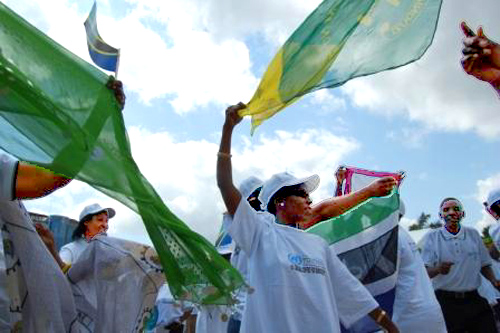
I call it the biggest, loudest, most spectacular party ever held in Africa!

All of yesterday and all of today people didn’t go to work in Kenya: they played. There were soccer matches and bingo games all over the country, Nairobi’s discos wound round the clock, and impromptu marches in the street by mad bands looking like they came from Mars.

There were feasts like you can’t believe: in the countryside fried goats stewed with paw-paw and a touch of Tusker beer! In the cities there were black-ties (that came off pretty quickly) with prime rib and Indian-spiced posho!

It was the most peaceful, exuberant loudly musical, proactive joy Africa has ever experienced!

I wish I could have been there.

Listen to the video above, the unofficial new anthem of the New Kenya: Daima Kenya.

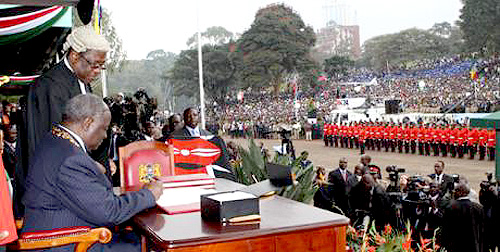
This was the day that the country officially “promulgated” its new constitution. That might seem arcane, and the whole affair has been buried in the world’s other griefs. Kenya’s a tiny place when measured as we seem to do every moment of the day, now, in dollars.

But it has nearly 40 million people, and that raises its position on the list of nations. And the human potential of each and every one of them has been elevated even more by today.

In retrospect I realize that the election violence which followed in December/January 2007/2008 was predictable: the obvious end-result of imposing a western-style democracy on a primitive society in the 1960s that couldn’t handle it.

But there was a silver lining. That jolt to national beingness forced a rate of maturation never seen in the history of mankind. It strained two generations and came to a boiling point in December, 2007.

1300 people were killed and 150,000 were displaced in horrible post-election violence. The terrible events were nonetheless mediocre by the standards of the world’s catastrophes, and so didn’t get the attention deserved. And it was for the wrong reasons that America and the UK took interest: because Kenya lies astride terror-stricken al-Qaeda almost-controlled Somali. A Cold War game plan that didn’t work then, and won’t work, now.

But thank God for Kofi Annan, who took the reigns for the right reason. He knew Kenya was a strategically important place. Not for its geopolitical situation, but for its human potential. Our world needs a lot of human potential.

So Annan manipulated the money from American and the UK, and restrained western impatience, and in typical African fashion, he pulled off a new day a lot later than America and the UK wanted, but for a future much longer than westerners normally consider.

The greatest irony of all is that this new Kenyan constitution “promulgates” a society which is more democratic, more transparent, more accountable to the people than in the U.S..

No judge will be brought to power because of cronyism or without adequate legal training.

Women will never be paid less than men. The disabled, mentally challenged, chronically impoverished cannot be ignored by social services; every single Kenyan that walks this earth now has health care.

Pregnant women whose lives are threatened can get an abortion.

Smaller political regions (like states and counties) can’t trump basic social tenants upholding human rights, or adjust national educational goals for parochial interests. IE: Evolution will be taught in schools!

There’s no chance that the chief executive, the president, or some inner circle of power brokers can go to war without the scrutiny and authority of the legislature.

And a lot more less dynamic but remarkably imaginative stuff like multiple types of civil courts for multiple cultures; full citizenship for all naturally born Kenyans living abroad no matter how long they’ve been gone; full land ownership with extremely limited rights of eminent domain.

These are all modern democratic principles the likes of which have disappeared in much of contemporary America. So I salute Kenya as a beacon to be emulated.

These lofty principles are much more distant from the realities of implementation for a poor country like Kenya than they would be for us. That’s the incredible challenge. Some may say it’s folly to dream so high.

But of all the wonderful words in Daima Kenya, posted here twice: above in the refined version performed today, and below in its original version first produced after the horrible violence of 2007, I’m sure you’ll hear, “Tu-ma-ini” or “Hope” multiple times. “Daima”, too, which means “forever.”

Forever Kenya. Forever Hopeful.

South African Cartoons

South African Cartoons

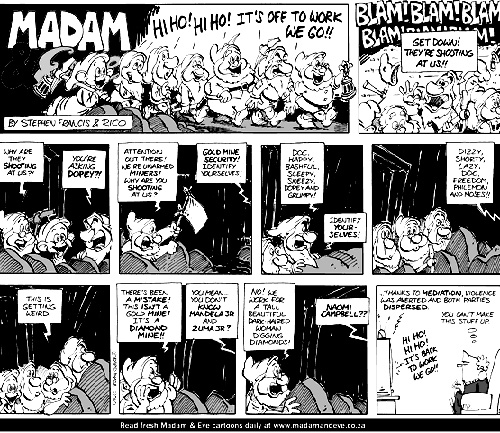
Yesterday’s popular cartoon, “Madame & Eve”, in Johannesburg’s Daily Mail: Naomi Campbell is a SA supermodel who gave blood diamonds to the head of a SA children’s charity, who hid them in his home safe for 13 years before admitting it.
After a stellar performance during the World Cup, the turning fortunes of Jacob Zuma make many of us wonder if the South African presidency will be forever filled by wackos.

South Africa pulled off the World Cup like any grown up country; in fact, better. Infrastructure nightmares, mass strikes, insidious crime waves – didn’t happen.

Now it looks like it’s happening, and what we thought was Zuma’s deft handling of his country may just have been his ability to stick a very large finger into the hole in the dam.

Today is the tenth day of a national strike which threatens to bring the country to a standstill. Schools, hospitals, social agencies and even part of the President’s office are on strike. Late yesterday even the military threatened to join the walkouts!

Workers’ grievances have coalesced into a single demand: an 8.6% basic wage increase and a $130 monthly housing allowance. Zuma dug in his heals at 7% and $100.

So the difference isn’t that big; nowhere near as big as Zuma’s ego.

Zuma is best known as the president with twelve wives. That social embarrassment, though, was eclipsed recently by the revelations that Zuma’s family has profited from questionable government mining leases.

Now with twelve wives Zuma’s family extends over large parts of South Africa, but it’s a principal son who is principally involved this time.

This scandal follows Zuma’s pet legislative agenda this season: nothing to do with wages, housing or social justice. He is promulgating a draconian law that will suppress South Africa’s mighty and free press.

Zuma is the third president of the new republic. Nelson Mandela performed better than any of us could have hoped. The second president, Thabo Mbeki, fell into history as the leader who insisted that AIDS wasn’t a virus.

The interesting thing about both these guys is that under their weird personas appears to be some real talent. They both come from the ANC’s inner circle, were dedicated ideologues and have clearly formed a massive bureaucracy underneath them that is working marvelously.

Their approach to foreign policy, particularly with troubled Zimbabwe at their sleeves and massive illegal immigration, has actually received educated nods from around the world.

So what’s with this clowning around?

In Zuma’s case, his flirtations with the law are getting serious and begin to look like so many African leaders that take privilege beyond legislation. His close brush with conviction for rape (complexly linked to his polygamy) could be his ninth life, and as investigations proceed into the mining deals, he may be on the verge of the beginning of his end.

Freedom fighters are a strange lot of people. Nelson Mandela was the exception, and that’s probably why he was their leader. After a generation of fighting by rules that only a few make together, it must be hard to live in a democracy.

I expect until time sweeps away these old guys we’re going to get plenty of cartoons.