At last Politics Bites!

At last Politics Bites!

For the first time in 40 years, an outbreak of yellow fever has been reported in East Africa, far from any tourist area. Until now tourists’ yellow fever inoculations were political!

That’s right. One of the great irritants of traveling to East Africa in the last 40 years has been the necessity of getting a yellow fever inoculation, when no yellow fever disease was known to exist in East Africa.

The shot is pretty benign for most people and lasts ten years, but it’s expensive. And that’s because, well, there aren’t many areas in the world where yellow fever is a real risk. So the vaccine is rather rare.

The yellow fever hullabaloo in East Africa began in the late 1960s when an outbreak was reported near Kilimanjaro shortly after Tanganyika and Zanzibar federated into the new Tanzania. Unlike malaria, which is a much more complicated mosquito-born disease, yellow fever is a pretty simple virus carried in the blood of day-flying (rather than malaria night-flying) mosquitoes.

Still itching from their loss of autonomy, Zanzibaris began requiring proof of a yellow fever vaccination for all persons arriving in the country, even from mainland Tanzania of which they were now supposedly a part.

It didn’t matter that the bit of the 1960s outbreak was far, far from Zanzibar. If you didn’t have an inoculation, you had two choices: leave, or let a local official jab you. In those days, neither local officials or jabs were very antiseptic.

Zanzibar has some beautiful beaches, and as the island opened to tourism in the 1980s, a number of safari travelers would end or begin their trip in Zanzibar. Irritated by Zanzibari insistence on having a yellow fever vaccination (decades after the little outbreak was suppressed) mainland Tanzania began requiring the shot. I guess the theory was, if you can’t beat ‘em, join ‘em.

That irritated Kenya. So Kenya, too, started requiring the shot.

From time to time saner minds prevailed, and Kenya and Tanzania dropped the requirement. But they seemed to be dancing separate tunes, and whenever one required it, there was a bit of delay, then the other one did.

Soon fearful that there really was yellow fever, all sorts of countries in southern Africa began requiring the shot if you came from East Africa. Even South Africa! Where the first heart transplant was performed!

(In fairness to South Africa, they figured correctly that if East Africans required the shot, they must have the disease.)

And this little game continues right up to today.

Yes, dear traveler, you need that yellow fever inoculation, because even if right now no one requires it for entry, they might when you actually travel.

And it doesn’t matter a hoot that your chances of contracting yellow fever are less as a tourist in sub-Saharan Africa today than getting meningitis or (amazingly) Rift Valley Fever if you live in the Midwest.

Go figure.

The Culprits Named!

The Culprits Named!


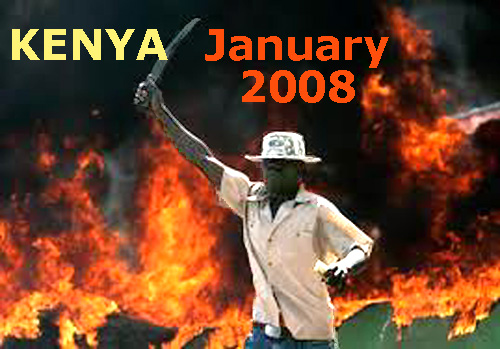
A very tense calm reigns over Kenya, today, following The Hague’s naming of the six most responsible for the violence in 2008.

The vast, vast majority of Kenyans today, rich and poor, want this chapter turned over. I don’t predict any wide scale violence, but the streets of Nairobi, today, are extremely tense.

Phones, email and internet and even satellite connections were flooded from the outside world, and much of East Africa was in a communications logjam by the end of its day.

Five prominent politicians and one media personality were charged by the same global authority that tried Slobodan Miloševic’ and the Rwandan instigators of genocide as the principals who caused Kenya’s 2008 violence.

The six represent several different tribes whose alleged unsavory alliance doesn’t seem to make a lot of sense at first. It includes a very powerful Rift Valley politician and former important minister, William Ruto – a Kalenjin – and from a rival tribe, the Kikuyu, Uhuru Kenyatta, the son of the “Father of the Country.”

But that was the point of The Hague’s investigations, not to name everyone who was violent, but to single out those who actively prepared then stoked it.

Three of the six were already widely suspected: Ruto, former (since resigned) national police chief Mohammed Hussein Ali, and Henry Kosgey.

There had been rumors that Uhuru Kenyatta, son of the first president Jomo Kenyatta, was implicated, but many had considered him too westernized to have become so mired in the darker side of Kenyan politics. Kenyatta spent a good portion of his younger life outside the country being educated and was widely considered at one point a modern future leader.

In fact both Ruto and Kenyatta had announced interest in running for president.

Two were surprises: Radio personality Joshua Sang, and Kenya’s secretary to the cabinet, Francis Muthaura.

Three of the six are currently serving ministers in the coalition government, and Muthaura is something akin to the President’s Chief of Staff. President Mwai Kibaki was quick to follow the announcement by insisting they not yet resign public duties. Kibaki also suggested the government might now reopen the question of whether to hold the trials in Kenya, effectively emasculating the power of The Hague.

The Hague issued what amounts to two indictments. The first – against Ruto, Kenyatta, Ali and Kosgey – is for “alleged murder, deportation and persecutions.” The Hague considers the four to have prepared in advance for the violence, knowing full well that the results of the 2008 election would be contentious.

In a horrible additional twist, Kenyatta is alleged to have orchestrated his violence through the underworld using Kenya’s mafia, the Mungiki.

The less severe (if such a comparison is possible) indictment against Sang and Muthaura is for pouring fuel on the fire once the violence began.

It’s widely known that many more people were involved. The number of people actually killed was somewhere between 1300 and 1500, and those displaced as high as 350,000. It took Kofi Annan and the full press power of the U.S. and the U.K. to stop the January, 2008, violence. This resulted in a now wonderfully working coalition government that just successfully passed through national referendum an excellent new constitution.

The net result of this announcement is to weaken substantially the political side led by Kikuyu President Mwai Kibaki and improve the standing of Luo Prime Minister Raila Odinga. One complication in this simplification is that the Kalenjin, and Ruto in particular, are close allies of Odinga.

Reduced even further, the Hague’s charges if presumed correct corroborate the widely held analysis that Odinga’s election to president in 2007 was stolen by the fortress of Kikuyu power.

But the violence that began was absolutely not ethnic, although that’s how it quickly morphed. But it began because Odinga was a champion of the poor, a true socialist; while Kibaki was the godfather of the establishment, a capitalist to the core.

The violence began in the slums where the poorest in the country had worked so hard to elect Odinga. The ethnic division in Nairobi’s slums is much less clear.

Does Clooney Help or Hurt?

Does Clooney Help or Hurt?

The Obama Administration has been balancing American interests in The Sudan deftly and with amazing success. “Winds of War”, George Clooney and Ann Curry might have jeopardized these efforts.

“Winds of War”’s principal success is the message that genocide is likely following next month’s referendum for the south to secede from the north. But the horrible conclusion taken from this is the simplistic and incorrect notion that violence can be prevented.

Entertainment comes in many forms but at the core of most entertainment is the reduction of ideas or situations to attract an audience. Well-prepared bait creates happiness or sadness, fear or comfort, other deep emotions like feeling enlightened, so that you’ll come back to the entertainer and buy more, later.

This is not how the history of The Sudan should be spread among the world. It’s just much more complicated than a 1-hour television special.

At the best, in pure reductio infinitum, we can say “at least it’s increased interest.” Clooney seems like a wonderful person. At least Ann Curry thinks so, as much of the special was about Clooney, not The Sudan.

Both Curry and Clooney expend a lot of effort explaining why so much of this story is about Clooney, rather than The Sudan. He is “using his celebrity” to help. I’m not sure he hasn’t. But I’m worried.

The danger of mobilizing the world to an issue like the upcoming Sudanese election by entertainers is that the results will be misunderstood. If trouble occurs, we’ll believe we understand exactly why. In this case: because it was preventable and we didn’t prevent it. That was the single message Clooney and Curry conveyed, again and again.

Preventing violence following the January 11 referendum for the south to secede from the north is virtually impossible in my opinion. But this does not mean that a new country, South Sudan, won’t be established, or that a better peace and situation that now exists won’t occur.

Violence after the referendum can’t be stopped, for the same reasons that terrorism can’t be stopped. In The Sudan as in the subways of London and airports of Seattle, mass destruction waits only for the actions of a single possibly random idiot or ideologue, take your pick.

Throughout “Winds of War” constant comparisons were made to the Rwandan genocide. This is simply straight out wrong. Effective foreign military force was already in Rwanda and could have been quickly and easily augmented, and specific policies in the U.S., France and the UN decided against doing so. It was a single wrong decision.

Sudan 2011 is not Rwanda 1994. The Sudan has genocide going on right now in Darfur. The world has come for better or worse to accept this genocide so long as it stays below a certain threshold.

The UN has (as of October) 9451 military personnel from India, Pakistan, Bangladesh and a variety of African countries, spread out over a country that is 100 times bigger than Rwanda, which is basically validating the level of existing genocide.

(Important FootNote: No UN presence is near the town of Abyei where the violence after the January 11 referendum will likely begin. That – I believe – is intentional. Take it from there. If that dried out prairie brush fire can be contained, perhaps the suburbs around San Diego can be saved from the inferno.)

The Rwandan UN Force was heavily European, commanded by a Canadian general over a country that until the genocide began was at peace. He tried – unsuccessfully – to convince a world black-eyed from BlackHawk Down that genocide was imminent and could be prevented. He was right, and the “world” was wrong.

That metric cannot be applied today to The Sudan.

Instead, what I believe the Obama Administration and EU is working towards in southern Sudan is an acceptable threshold of genocide as exists right now in Darfur.

Not an entincing trailer to a film, is it?

Of course it isn’t! It’s a hard pill to swallow. And what’s worse, except through WikiLeaks we can’t admit it. But it may be the only way to incrementally ratchet down Sudan’s century of genocide. Rwanda’s ethnic hatred can be pretty simply explained: two different competing tribes whose animosities were accentuated by a racist colonial era. All we had – and have to do there is keep the genie in the bottle until sanity matures.

Sudan’s 30 or 40 tribes have been massacring one another for two millennia. Fueled by incompetent colonial powers, by enormous resources of oil, and by the visceral global ideological powerhouses of Christianity and Islam. We can’t even get the world to agree there shouldn’t be genocide! Every nation from China to the U.S. wants the oil, wants the religious allegiances and should we begin talking about the continent’s water source known as the Nile?

The Sudan is so important, so fundamental to the peace and stability of all of Africa, that a one-page synopsis or one-hour TV special has the enormous potential of screwing up everything.

The proposed border areas between the north and the new South Sudan will have violence, I just don’t see any other prospect. It will begin in Abyei. This is where so much oil is found. But we’d like to keep the violence in this oil-rich area at levels contained, just as the violence currently in the oil-rich Niger Delta of Nigeria seems contained. If this can be managed, then a society in South Sudan can emerge as it’s emerging in Nigeria.

“Winds of War” stokes the fire. If Clooney’s message achieves ultimate success, when the gunfire begins later next month in Abyei, America will send troops to stop it, and will become as deeply mired in conflict there as we are in Afghanistan.

It’s not working in Afghanistan. It won’t work in The Sudan.

More:

Click here for Frank Lagiftt’s excellent NPR report.

Below for as usual an unbiased report from Al Jazeera.

Wiki Tells It Like It is!

Wiki Tells It Like It is!

The several thousand WikiLeaks about East Africa so far tell us very little that we didn’t already know or deeply suspect. I actually find it rather refreshing.

Basically, East Africans are publicly affronted by the frankness with which Wiki frames the obvious failings of East African leaders and their positive actions as American motivated. And basically American diplomats are shown as being a bit more juvenile than adult when it comes to getting (or not) their way.

Wiki basically shows that the Big Boy got his way with the little toughs. Good. I’m glad we did. And I think most East Africans are, too. From time to time, the Big Boy ain’t so bad.

American policy in East Africa from the end of the Bush years through the present has been right on as far as I’m concerned (except for one significant item: the soon new Southern Sudan.) In the main, an A- overall.

But Wiki takes the charm out of the politics. When all the polite language is peeled from the events, when “convinced” becomes “bribed” and “suggested” becomes “threatened” there’s no question any more that American power bludgeoned its way in East Africa over the last few years:

We bribed Kenyan leaders to be democratic and we bribed them to fashion a more moral constitution. We threatened sanctions if they didn’t bring the proposed new constitution to a vote. We targeted Kenyan youth with a campaign not dissimilar to Obama’s get-out-the-2008-vote, because they were the most energized and least likely to actually vote. And so we got them to vote ..the way we wanted (which was the right way).

We raised a normally behind-the-scenes ambassador to a very public level. We did everything short of leaking ourselves the names of top Kenyan politicians we believed were principally responsible for instigating the violence following the 2007 elections, to the point that these guys became so universally known that real criminal prosecutions against them in The Hague may begin shortly.

Once outed, our ambassador was given other public tasks we hailed as “transparent.” When food that we were delivering to a famine area of Kenya was delayed at the Kenyan port of Mombasa because the bribes paid to off-load it weren’t enough, our dear ambassador took a camera team onto the gangways and started off-loading the grain himself.

We lamented that so much time had to be spent with Kenya’s growing up into a full democracy that we have let Uganda and Tanzania slide. But that doesn’t seem to matter, because they are neither as powerfully geopolitically or as economically powerful as Kenya.

OK. Take a deep breath. Wiki just ratted on the Teacher to that troublesome but promising Pupil. The rest of the class (Tanzania & Uganda) always knew Kenya was the favorite and that it was a tense relationship.

But it’s working, if you concede that current American interests are almost as vital to East Africans as Kenyan interests. I do.

So… This has all been good. Good for East Africa and good for America.

So, WikiLeaks, what was bad?

What Kenyans are currently all upset with is the derogatory name calling carried by U.S. diplomatic cables. Both the president and prime minister of Kenya are called beneficiaries of a network of old boy corruption “feathering” their fortunes “with impunity.”

Yeah. So?

That’s not news. It’s been said in public by many former officials world-wide, much less Kenyan journalists themselves. Frankly, I think this, too, is changing although it was much less evident earlier this year than now. So, anything else, Wiki?

We and Britain publically decided to embarrass Kenya in October, 2008, when a ship carrying 33 Ukrainian T-72 tanks was hijacked by Somali pirates, then freed (after ransom) off the coast of Kenya. Kenya claimed at the time that the tanks were for Kenya, despite journalists claiming otherwise that the Kenyans were creating a corridor for arming southern Sudan.

As then, I still have this intuitive feeling that we’re involved in this, but Wikileaked cables suggest we were affronted by the revelations. The cables paint Kenya as the culprit and us as the surprised school-mom and either way, this is enraging Kenyan leaders who are working so hard to making the January, 2011, elections in southern Sudan work.

I don’t like war, anywhere, but without some military hardware southern Sudan will not survive any attempt at Independence.

Wiki also underscores something I’ve been saying for a long time: China is beating America at the Africa game, the East African parlor in particular.

There’s a lot of name calling, again. One top diplomat, Johnnie Carson, referred to China in Africa as a “pernicious economic competitor with no morals.” (Agence France Presse). “China is in Africa for China,” Carson said as well to a group of Nigerians, insisting there was nothing moral or altruistic in their very large recent economic involvement in Africa.

Yeah. So?

Why is the U.S. involved in Africa? To bring righteousness and moral rectitude to the Dark Continent? Why did Stanley broker for the malicious King of Belgium? Why has any foreign government ever been involved in Africa… or anywhere else foreign for that matter?

In diplomatic niceties we say “self-interest.” When the niceties are dropped, Carson goes on and on castigating China for trying to buy UN votes and other allegiances, something that America is the ace at, especially during the Cold War.

I think this is revealing. I think this is something we as Americans should study. What these leaks reveal in the unrelenting American diatribe against China in Africa is that we’re jealous. We don’t have the cash, anymore, and China does. For years – especially during the Cold War from our government, and right until the economic downturn from our megamonolithic corporations, America spent more in bribes than anybody else.

Now, Wiki explains, China does.

We’re jealous. But the great revelation is the following:

China is spending OUR money. The money from the purchase of toys, car parts, solar panels, and kitchen utensils.

It’s ironic and terribly revealing. We’re still bribing, but not necessarily in our own interests. Rather, in China’s.

Hmm..
Mired in Infamy by a Fossil Fuel

Mired in Infamy by a Fossil Fuel

Choose your culprit: Right or Left.
Yesterday The House censured Rep. Charles Rangel for among other things, bribes. And today Nigerian officials confirmed a warrant has been issued for the arrest of Dick Cheney… for bribes.

While the magnitude of the bribes is significantly greater in the Cheney than Rangel case, both involve oil, and both involve men at the highest pinnacles of U.S. power.

On the surface the two men couldn’t be more different: conservative and progressive, white and black, aristocrat and slum-boy. Yes, but the difference even stretched into their souls.

The one I’ve always liked is like your bumbling old uncle who nonetheless brings you the best Christmas presents. Rangel was a progressive, Harlem’s Godfather, articulate and loaded for bear in the public arena fighting for what he thought was right.

Cheney is the Joker incarnate. He appears public only when the vicious veils of his den of inequity are ruffled, and even then rarely says anything. He’s insensitive to public suffering, loved by no one.

But at the bottom of their souls all differences disappear. They’re both corrupt.

I’ve spent a good amount of my adult life explaining to critics of Africa that the popular notion that Africa is corrupt is upside down. Africa is a poor place, or at least has been for most of my life. Corruption usually takes the form of money. That has to come from rich places.

Like Haliburton and the U.S. Congress.

Rangel maneuvered into a tax bill a loophole worth hundreds of millions of dollars to an oil-drilling company that pledged $1 million to build a New York city college named in his honor.

Cheney orchestrated up to a quarter billion dollars in bribes to Nigerian officials, there.

In my book Cheney was the bad guy and Rangel the good guy. Cheney was the elite if effete aristocrat masterfully deploying evil. Rangel was the underdog, wounded vet, loyal progressive slipping into the aristocratic comfort zone with little skill.

Cheney did things to get rich. I suppose Rangel did, too, but mostly to get honor. Cheney seems unmotivated by anything moral. Rangel was dangerously playful with The “Ends-Justify-The-Means” to enrich his down treaded community and obtain personal accolades.

Frankly, I actually think Rangel was also just tired of detail, arrogantly careless, ultimately criminally incompetent or incompetently criminal. That certainly does not describe Cheney. Cheney’s Nigerian crimes are ruthlessly calculated, focused from the get-go.

But they both broke hundreds of laws. The big stash was oil.

(Nothing has been proved in court. In both cases only unlitigated allegations exist, and likely will never move further. But let the truth prevail. Justice is often not revealing, just reflective: as opaque as the power that opposes it.)

Cover them both in oil, and you can’t tell them apart.

There couldn’t be two different characters. Mired in infamy by a fossil fuel.

Kenya’s Bridge to NoWhere NoHow

Kenya’s Bridge to NoWhere NoHow

$50? $75? $100? $150? $200?
One little bridge has been repaired in Kenya’s cockamamie system of big game parks. Is this Kenya’s Bridge to Nowhere?

To no fan fare whatever the bridge over the Ewaso Nyiro River was reopened on Saturday, theoretically reconnecting the two big game parks of Samburu and Buffalo Springs.

The key word here is “theoretically.”

This is the only bridge besides the main road’s at Archer’s Posts which links the two sides of the river. The bridge suffered its third washout in my life time last February during the heavy floods which ended the three-year mini-drought.

Theoretically, the bridge now allows tourists staying at lodges and camps on the south bank of the river (which is technically “Buffalo Springs Reserve”) to visit Samburu, and tourists staying on the north bank of the river in Samburu to cross over and visit Buffalo Springs.

Simple, eh? Well, no.

First, why would you want to cross over? Is the grass always greener on the other side? (There isn’t any grass in Samburu.)

The river was formed over thousands of years as a line in the sand at the point at which the Mathews Mountains watershed is meaningful.

North of the river (Samburu) is higher, hillier and catches more rainfall from the prevailing winds that butt against the Mathews Mountains. So there are usually more antelope, and therefore, more cats.

South of the river is remarkably much drier: gravel and flat, which usually attracts larger numbers of the rare northern desert game like Grevy’s zebra and the blue-legged Somali ostrich. Until Somak’s lodge opened on the south side last year, then flooded out, then reopened, there were fewer tourists on the south side, and the animals knew that.

So transient families of elephant, shier cats like leopard and mothers with babies like newborn giraffe were usually found on the south side.

So yes, you do want to see both sides, and seeing both sides would be the only way to attain the expectations of most brochures, pundits and Kenyan Government PR about “Samburu.”

Ergo the bridge.

Erstwhile Kenyan politics.

Click here to go to the Kenyan Wildlife Service website list of national parks and reserves. Can’t find Samburu? Can’t find Buffalo Springs? Is this a mistake?

Yes, it is a terrible mistake, but not for the reasons you might think. There’s no oversight here in the website. It is alphabetical, left to right by row. Still can’t find this reserve which is so important in every publicized safari to Kenya?

No one can. It isn’t a national park or reserve. It belongs to the county council.

(By the way. Can’t find the Mara? No, that isn’t a national park or reserve, either. It is three separate county council reserves like Samburu and Buffalo Springs are two separate county council reserves.)

This, of course, is lunacy. But that’s ordinary Kenyan politics, and regrettably, the new constitution which is doing so much good to bring sanity to places where there was lunacy before has not even touched on this subject of wildlife management.

Richard Leakey in his earlier days as head of the KWS tried diligently to bring all the important ecosystems under the authority of the federal government, the KWS. He lost his legs trying.

The Mara and Samburu bring in the greatest amount of tourist revenue of any of the great wilderness reserves in Kenya. But each are administered separately from the federal government. (The Mara is actually in an unbelievably worse situation.) Why?

So that the fat cats in the county council can pocket the proceeds.

See my earlier blogs on wildlife management for a continued harangue. Back to the bridge.

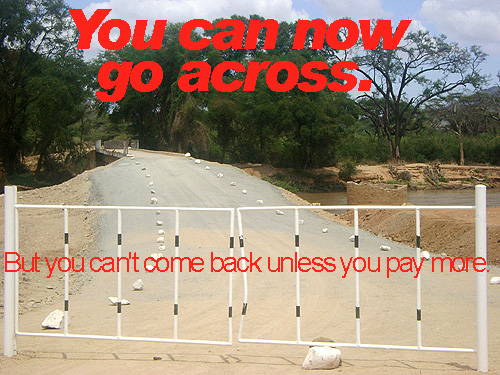
Now that the bridge is opened, the two county council’s which own the respective northern and southern parts of the great wilderness are fighting once again. Each side wants tourists to pay to cross the bridge and enter their land.

Well, I suppose there’s logic to that. But the logic ends when the tourist who is residing on one side, pays to go to the other side, than has to pay again to return to the place where his laundry is being done!

With fees rising this could mean $50 every time you cross over the bridge!

What we need is a bridge to reality.

Wiki Air Freshner

Wiki Air Freshner

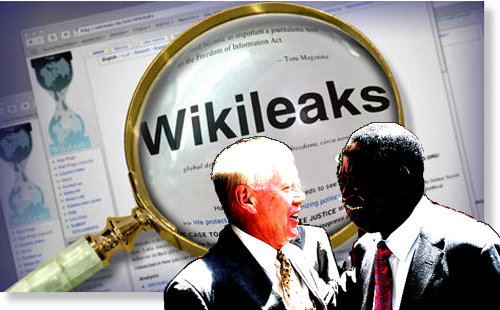
I think because of WikiLeaks the U.S. has finally named the culprits:
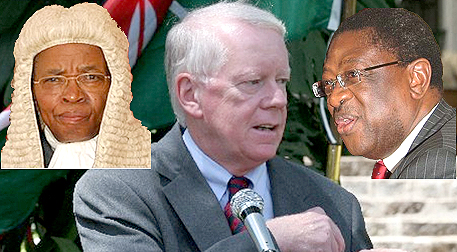
Evan Gicheru (left) and Amos Wako (right)
I believe the U.S. ambassador to Kenya’s call today to prosecute Kenyan Attorney General Amos Wako is a result of WikiLeaks, and bravo!

The minor of the quarter million secret and confidential memos that began publishing this weekend will take analysts a long time to digest. And naturally the allegations that the U.S. was in a nuclear stand-off with Pakistan, or that the Saudia king called for the U.S. to obliterate Iran will be the headlines for a long time.

But in the world of U.S./Kenyan diplomacy, Wiki is as integral as anywhere.

US ambassador Michael Ranneberger called today on the Kenya government to prosecute Attorney General Amos Wako and replace Chief Justice Evan Gicheru. This was a bombshell that was not news.

These miserable little politicians who have caused such harm to Kenya have been called everything by the U.S. … except by their names. Until today. And I think, thanks to Wiki Leaks.

It must be what Wikileaks is doing everywhere. Analysts refer to “embarrassment” but nothing revealing. Diplomacy are the frilly clothes put on ugly bodies to make everything look respectable.

In Kenya everyone has known for some time that Wako and Gicheru are among the most corrupt of the corrupt. But both command local (and highly ethnic) constituencies that bristle with the notion their leader is a crook and hit-man.

So until now, foreigners involved in Kenya have been polite. Ranneberger has exhausted every inuendo possible to let the Kenyan press know that the Obama administration wants these two men out before better aid and relations can begin.

And not just the U.S. Most western donors, and The Hague which has begun (with the Kenya Government approval) prosecution of those alleged as the principal culprits in the 2007 election violence.

Wako was one of the first public witnesses to travel to The Hague to testify (in secret).

Ranneberger was just getting out in front of WikiLeaks, today. All the big wigs were at the development forum this morning, including Prime Minister Raila Odinga and Deputy Prime Minister and Minister for Finance Uhuru Kenyatta.

They all listened stoically as Ranneberger finally said the names.

Said first, I presume, by WikiLeaks.

Judges Just as Foreign As Now!

Judges Just as Foreign As Now!

A Better Way?
Brilliant idea! Foreign judges on a Supreme Court!

The idea is not so out-of-the-blue. The newly adopted Kenyan constitution stipulates that foreigners may be appointed as judges to high courts.

Here’s the logic. Kenyan society is so divided ethnically that no mathematical wizard’s computations can come out with a formula for a Supreme Court fair to all sides. The obvious solution: have judges that don’t belong to any of the ethnic groups!

The fact Kenya is having this discussion I believe means they are moving forward very fast towards a truly multi-ethnic society. Certainly the young people are not as fettered to their ethnicity as the older generations, but it is the older generations who remain in power.

The idea was suggested yesterday by Martha Karua, an MP from a Kikuyu district. What’s significant is that she was once the country’s Justice Minister. This idea is no joke.

The Supreme Court as created by Kenya’s newly adopted constitution will function very similarly to our own.

Quoted in Kenya’s Daily Nation today, Ms. Karua said the presence of “three foreign judges would instil a sense of neutrality even if the major political parties engage in horse-trading in the appointment of judges to the Supreme Court.”

She pointed out that two commissions that were created after the 2007 election violence to determine its causes and suggest remedies were composed of foreigners. The Commission of Inquiry on Post Election Violence (CIPEV) included a former police commissioner from New Zealand and a lawyer from the Democratic Republic of the Congo.

Several years ago I attended a lecture by the brilliant biologist, E.O. Wilson, who was at the time unveiling his new compendium of Darwin’s works. In response to a question from the audience, Wilson suggested the reason there was so much opposition to the teaching of evolution in secondary schools was because Americans were so tribal.

Think about it.

We may not be divided by ethnicity, but our ideological divisions today are as great as those between any Kikuyu or Luo, or Jew or Christian.

What Wilson was saying is that when divisions become tribal, rational compromise and dialogue between the tribes is futile.

What Karua is saying is the same.

Recognizing the problem is the first step to solving it. And imaginative Kenyans have once again come up with something truly brilliant.

My nominations to the U.S. Supreme Court would include Martha Karua herself, the venerable South African judge Richard Goldstone, and Abdullah Gül, the current president of Turkey. Yours?

Two Roads, not One

Two Roads, not One

A new proposal for the contentious Serengeti highway may have emerged from last week’s elections in Tanzania. It looks promising to me. In perfectly wonderful political language, the Arusha rumor mill calls it “The Compromise.”

Two highways would be built instead of one. The first and biggest would follow the alternate southern route. The second would follow the original route from Arusha but end just outside the east side of the park.

The fact that the second road would still encroach important wildlife areas in the Ngorongoro Conservation Area only enhances its chances of success. Environmentalists have played their cards almost exclusively on the wildebeest migration issue, and if the road stops before entering the Serengeti, this issue becomes moot.

Two roads would cost a lot more, of course, than one. But “The Compromise” might garner western donor assistance, which seems impossible if the road cuts through the Serengeti.

It would also satisfy a major argument used by proponents of the current road, that Maasai communities to the east of the Serengeti are in dire need of development impossible without a good road into their area.

The buzz began circulating in Arusha Wednesday morning after two days and nights of celebrations for Godbless Lema, Arusha’s new 32-year old Member of Parliament. Lema was the successful candidate of the new major opposition party, Chadema.

He had campaigned against building the road. His opponent, incumbent ruling party (CCM) Batilda Burian was the Minister of State in the Vice-President’s Office responsible for environmental affairs.

Lema just didn’t oust a ruling party incumbent. He thumped one of the country’s important environmental ministers, winning 58% to 39%!

Arusha has always been solidly against the road. During the heated campaign Dr. Burian tried unsuccessfully to distance herself from her party’s insistence that the road be built without actually denouncing it, a balancing act that tumbled.

She denied Lema’s charge that she was the “architect” of the highway plan, insisting (remarkably) that she had nothing to do with it.

But Lema countered, ”Ms Batilda Buriani … is the state minister in charge of environment and should have advised the government against the road project…”

Now that the battle is over, tempers are cooling. Lema is unlikely to get anywhere as an opposition MP without compromise with the ruling party that still holds sway over more than two-thirds of parliament.

The road is supposed to begin in Arusha with Arusha contractors. There’s a lot of fluff and not much power in being a single MP in Tanzania, but what power exists usually resides in dispensing the pork. Many of Arusha’s young businessmen – Lema’s peers – are in the tourist industry. But many are in construction. It would be just as hard for him to fall in line with the ruling party as to completely oppose the ruling party’s position.

Alas “The Compromise.”

The current proposed northern route would connect the urban centers of Arusha and Mwanza with a looped road that would transect the northern portion of the Serengeti National Park about 40 km south of the Kenyan border.

An amazing array of scientific, professional and business organizations has lined up squarely against the plan, arguing that it would seriously impact the great wildebeest migration.

Disrupting the migration is THE issue outside of Tanzania, but in Arusha the main concern is that business would seriously suffer from the subsequent impact on tourism. Most of Tanzania’s tourism industry is located in Arusha.

But from the getgo the current and newly re-elected President Jakaya Kikwete has steadfastly insisted the road would be built. Even as foreign donors began to suggest they would have nothing to do with the road, Kikwete claimed that Tanzanians will fund the road themselves without foreign assistance.

Most of us know that’s absurd. We think what Kikwete really means is that the Chinese would do it for him.

But the Chinese have been stung recently by a series of environmental embarrassments, most notably Chinese workers arrested and deported for poaching ivory. They may not be in such an enthusiastic mood to find reasons for bringing their anti-animal reputation up anew.

Alas, “The Compromise.”

Hard to say if the rumor will gain traction, but it seems to make imminent sense to me. Instead of a half billion dollars, it might cost $650 million, and particularly if the Chinese are involved maybe even less. The campaigns against the road must have reached the desks of western aid dispensers. This seems like a compromise made in heaven.

And, after all, that’s what the Serengeti is.

Don’t Visit Zimbabwe

Don’t Visit Zimbabwe

Contrary to very strange suggestions I’m reading in the travel press, it’s still too dangerous to safari in Zimbabwe. Tourists are being murdered. And not by political thugs, either.

Zimbabwe’s economy is recovering from a hole some of us feared would spew forth the lava from the center of the earth. And the opposition democrat and power-sharing Morgan Tsvangirai is getting more attention as he jaunts around the world. And for these two reasons Zimbabwe watchers say things are getting better, in particular, safer and more welcoming for tourists.

They are DEAD wrong.

Zimbabwe’s modern story is one of the most remarkable in the world. In a few short months the dictator Robert Mugabe will tie Africa’s previously second-longest serving African dictator, Mobuto Sese Seko, who was in power for 32 years.

(As far as I know there will be no colorful fetes.)

Number One is Omar Bongo, president of Gabon, who held control for 42 years, a record few believe aging Mugabe can reach alive.

In all three cases, the leader ruined the country while amassing unimaginable personal wealth.

Zimbabwe, though, is remarkable because the other two were installed by foreign powers’ secret maneuvering. I think it’s quite fair to say that France is directly responsible for the bad situation in Gabon, and that the U.S. and Belgium are directly responsible for the bad situation in The Congo.

In Zimbabwe, Zimbabweans are directly responsible for the bad situation in Zimbabwe.

And that’s probably why nothing is going to happen to make things better, even after Mugabe dies.

On the political front, Tsvangirai is a huge disappointment. It seems clear to me that this masochistic egotist had little more than a Mercedes Benz in mind when he let himself be beaten to a pulp numerous times before being invited to join the government.

Like a piece of tough meat, the Mugabe regime has tenderized him. He’s useless. Useless, that is, to the people of Zimbabwe. He’s become prime rib for the regime, who hauls him out on a plate each time they’re criticized from abroad.

So the country has continued to go down the tube.

Yes, there may be less street violence, a result of Tsvangirai’s unending marination. The economy like virtually every economy in the developing world is on the up, but nowhere near at the pace of its neighbors or near a teeny weeny fraction of its potential.

So fuel for vehicles needed to transfer tourists from place to place is still scarce, and new white faces are more often presumed the feared leaving than visitors arriving.

But here’s the worst indicator:

A lot of animals are killing a lot of tourists.

A week ago Saturday five lions brutally killed a tourist near the country’s main national park, Mana Pools. Last month a man was trampled to death by an elephant in Matusadona national park. A veteran conservationist on anti-poaching control in the same place was gored to death by a buffalo a few days earlier.

And even outside the national parks, a resident biking near Kariba was tusked by an elephant.

Animal attacks aren’t unknown, of course, in Africa, but these recent incidents are not normal.

“We appeal to everyone to exercise extreme caution. Animals have become extremely unpredictable,” said Zimbabwe Conservation Task Force head Johnny Rodrigues. Rodrigues explains that uncontrolled hunting – even in the national parks and often by Mugabe regime sportsmen – has “traumatized” the animals.

Every safari traveler needs to exercise caution inside a national park, but unlike Geoff Blythe who was tusked near his home in Kariba, certainly this is not a regular need outside a wilderness.

And the “extreme” caution that Rodrigues advises is simply below the threshold of a vacation’s safety.

So forget about any plans to visit Zimbabwe.

No & Hell No Worldwide

No & Hell No Worldwide

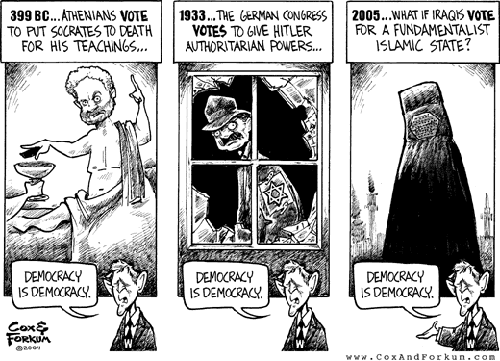
Worldwide people have used elections to express dissatisfaction. That’s the limit of a democratic vote. You can’t say what to do, just that what’s being done isn’t OK.

At home and in Tanzania, ruling coalitions suffered very seriously without losing complete control. The level of political slaughter is relatively the same, for example, in Tanzania as here, and that really suggests that worldwide democracy is manifesting in about the same way.

Here Democrats got slaughtered in sheer numbers of votes cast and office holders shown the door, yet managed to keep control of the Senate while pretty firmly rejecting any new “Tea Party” force in national life other than as a political spoiler.

In Tanzania the balance of power was much more off center to begin with, but the ruling Chama Cha Mapinduzi (CCM) Party lost more than 20 seats in a Parliament where they had held 185 out of 239 seats. Their presidential candidate, incumbent Jakaya Kikwete, was returned with probably around 65% of the vote, but this was compared to more than 80% the last time.

And Tanzania’s opposition consolidated, and fringe parties as with the “Tea Party” in the U.S. made loud noises but few gains.

The “economy-its-stupid” doesn’t work in the developing world, where growth is better than ever, unemployment is shrinking and business expanding. So why such similar outcomes?

Worldwide, people are dissatisfied.

Even when things, as in Tanzania, are doing pretty well. So why?

It’s a fascinating answer, if you’re willing to believe me. I think the wave of dissatisfaction emanates from The States and that it’s really more impatience than disapproval.

News, blogs, entertainment and money are dominated by the U.S., Europe and China in that order, worldwide. China remains essentially a closed society. Europe is the heady intellectual with a thousand different personalities.

Only the U.S. remains a cohesive culture – at least in the eyes of the rest of the world. And so in that old sparkling car adage, “So goes the U.S., so goes the world.”

Tanzanians used the same tool they share with Americans, a vote, to act the same way Americans acted. They voted, No.

We never learn what the No vote means in democracy. The vast number of voters don’t vote against their incumbent because he voted for Health Care and then scribble on the ballot, “Need torte reform, interstate markets and an increase in the eligibility age.” They simply choose the one alternative given them. And unfortunately, few voters care, really, what that opponent will do once elected.

They just want to say, I’m dissatisfied.

And that’s what they did in Tanzania as in Wisconsin.

It’s a terrible curse of the theory of democracy. You’d like to think we had multiple choices, multiple ways to express ourselves. But we don’t. And when the world’s most powerful culture wants to say “No”, so does the rest of the whole wide world.

Election Day

Election Day

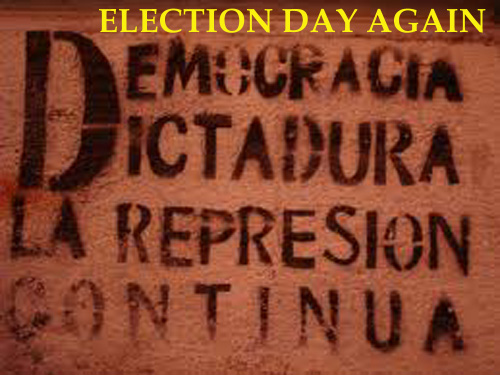
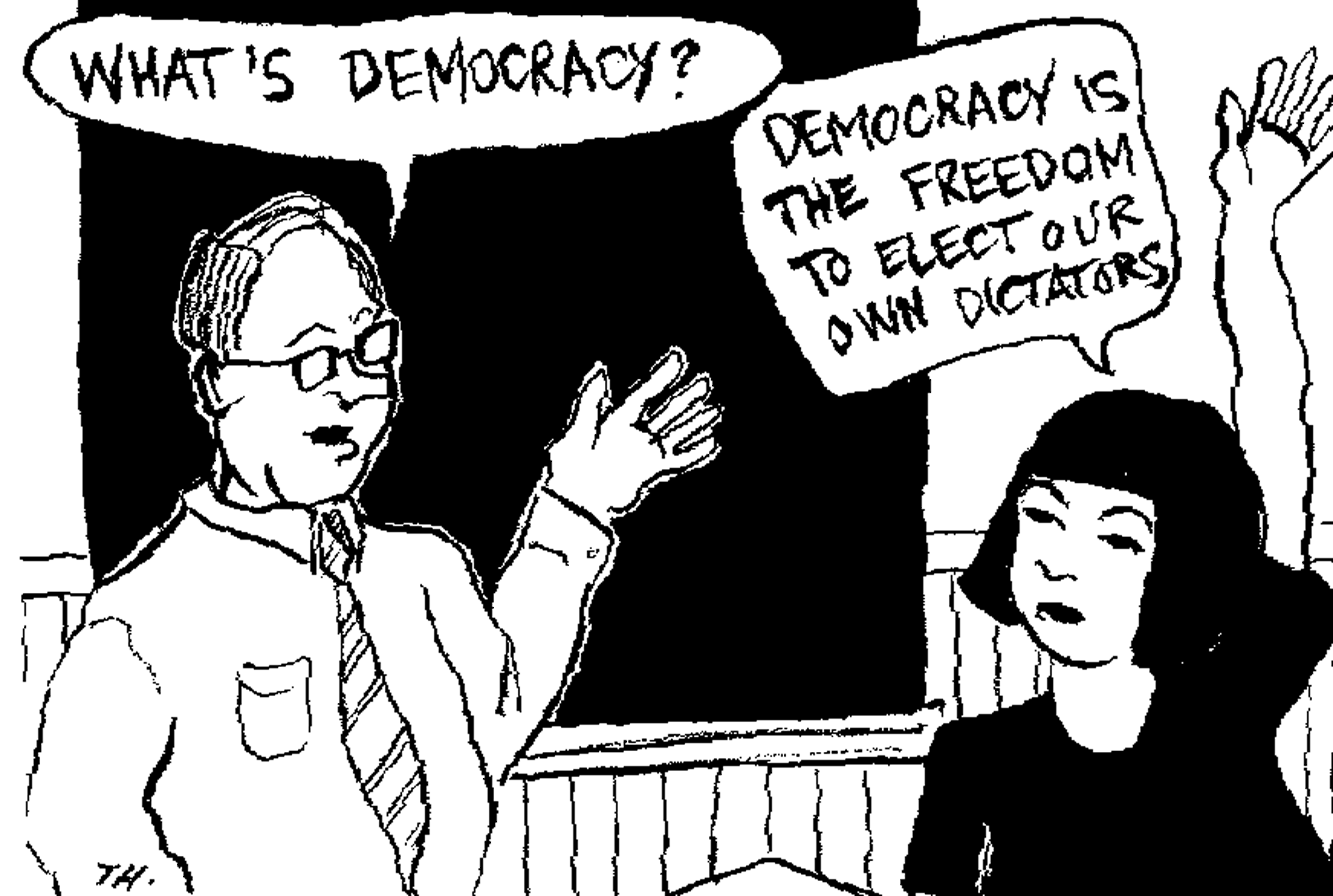
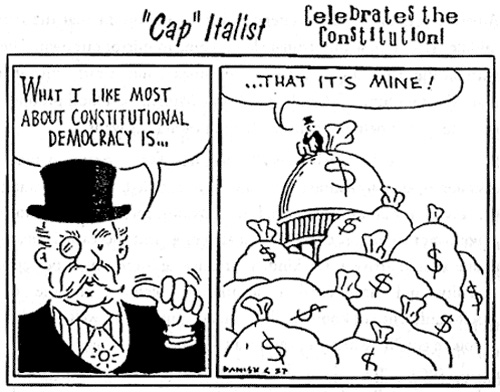
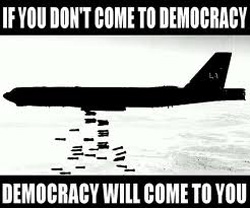
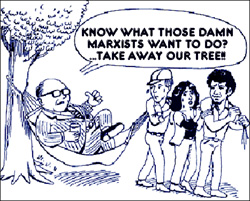
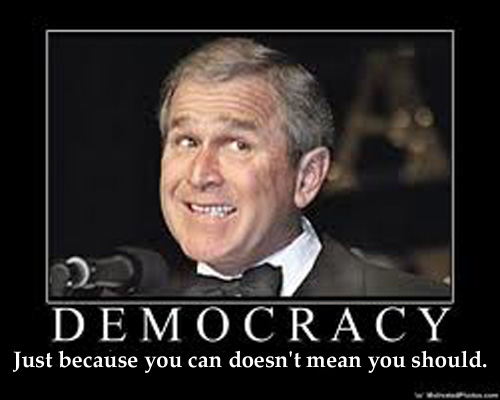
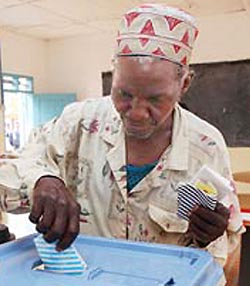
Democracy may not be cracked up to be what we think. Neither here or … in Tanzania.

As I look at what has happened in East African elections over the last several years – all considered democratic – and place that in the background of our own elections, today, I wonder if implementing the “will of the people” (WoP) can ever occur.

In Tanzania there is every indication that the ruling elite will continue to rule, as they have for … well, forever. Ditto for Rwanda earlier this year, and what we also expect in Uganda. Only in Kenya, where the electorate is more educated and empowered, have elections been close enough to cause real trouble.

The Tanzanian election was Sunday, and the political party whose heritage comes from the one-party state that took Tanzania from independence in 1962 to its first multi-party election in 1992 is expected to win handily. Results are seeping out and should be known in full by the end of the week.

That first “democratic” election in 1992 was forced on Tanzanian society, mainly by an unrelenting Reagan policy that stopped any kind of donor aid from virtually any US or world aid organization if the country didn’t go “democratic.”

Reagan created the diplomat known as the “Democracy Officer” and put one in virtually every embassy and consulate in the world. Sort of like a politburo official, this puny little usually poorly trained non career diplomat had effectively more power in some embassies – particularly in East Africa – than the ambassador him/herself.

Tanzania – like many developing countries around the world – was clever. They created a veneer of multi-party democracy that even to today is hardly more. Political parties are denied registration. Opposition candidates get no press. And like many of our own T-party candidates this year at home, central party candidates refused to debate or talk to the press.

Is this “democratic”?

In Rwanda presidential opponents are dead or in jail. Uganda holds an election, soon. The opponents have quietly withdrawn or are in what is locally called the “process of disappearing.”

Yet our State Department, the EU and other lordly world bodies, have called these all “democratic elections.”

I suppose they are. And perhaps, that’s the point. To the extent that people can vote, if that’s all democracy means, they are voting with their daily lives of complacency as much as at the ballot box, that they will do as they are being told to do.

Is that “democracy”?

And here at home, it could be that a majority of Americans today vote against their own best interests. Because they’ve been fed simple lies they believe. Like Obama is a Muslim. Or that death panels will decide their death moment.

Or that the Health Care Law is so many bad things it isn’t and none of the good things it is. Or that Obama is responsible for the debt. Or that the wars …

The wars? Anyone talking about the wars? Are there wars? Anybody hear a bomb recently? Are Afghans and Iraqis and American kids being blown to smithereens?

Anyone care? Maybe it’s just in xBox.

What we’re learning here and in Africa is that democracy does not reflect WoP. It reflects a physical act of choosing between candidates, but the little brain that directs those hands marking a ballot and effecting a choice is … well, brainwashed.

Democracy seems to be doing what you can be convinced to do. Even if it’s not true, or not what you really want to do.

That’s not what democracy should mean.

To me democracy means affecting a choice whose outcome you understand pretty clearly and correctly. There really is a reality out there, Joe. If the pipes are clogged, there really is a place – probably in the U-tube – where sludge is building. And we probably can really plunge it out.

But if you’re told over and over that it’s OK your sink overflows, that the pipes are still working, then Joe the Plumber & Great Deceiver controls your life, not you.

Only in Kenya has democracy approached some realistic manifestation of WoP. And that provoked the worst election violence we’ve seen in Africa in my life time. Is that good? Certainly not for the 1300 murdered and 150,000 displaced.

So, WoP, are you everything you’re cracked up to be?

Have we restored Sanity?

Have we restored Sanity?

Jim Heck (left) with Chicago lawyer Bill Sullivan
in the White House press room after the rally.
As 1 in 200,000+ attendees at John Stewart’s Rally to Restore Sanity, Saturday, I was wildly enthusiastic about the whole program until the end.

I might only be .000005 th of the voice of the mass, but I think I reflected most of humanity which had encased me. Stewart’s ending soliloquy on too much negativism and polarization ran hugely hollow.

Almost everyone there, like me, was a progressive. The cast of characters that marched onto the stage, from Cat Stevens (now Jusef) to Father Gaducci were liberal cut-outs of a very long and historic left-wing movement in this country.

The great skits depicting the wrongness of generalizing about religious fanaticism, of exaggerating the coming of the apocalypse and the reactionary views of most of the “mainstream” media, were all great and enlightening.

And the police helicopters circling endlessly above and the Batman-like snipers on the building tops made us all realize this wasn’t all fun and games.

So Stewart’s attempt to accentuate neutrality, compromise and thereby bring back a feel-good America drew about as much applause as Father Gaducci when he called for God to give us a sign that Methodism was the true religion.

There was more polite laughter.

But that was hardly ten minutes of five hours. The rest was great. We progressives came in thousands and thousands and we weren’t shrill or ridiculous (like the Beck crowd), and there was a lot of humor, something I believe progressives have always maintained. And a real indication that our beliefs are constructed not divined from the supernatural.

One of my favorite signs was, “Give me ambivalence, or give me something else.”

I think we were a great sea of wait-and-see. Our enthusiasm was really for sanity, something currently missing from American life. Anyone who wants to tap into us has to start speaking in grammatically correct sentences that can easily be fact-checked!

And how will we vote?

Democratic.

But will we all vote?

Not sure. It just might be better to let the crazies duke it out first.

Tanzania Elects After America Votes

Tanzania Elects After America Votes

We will know the official outcome of our elections Tuesday, before we know the official outcome of Tanzania’s Sunday elections.

Despite the rapid development in places like Tanzania, there are still many very remote polling stations, and uniformity in how returns are reported publicly rules Tanzanian law. So of course they know right now who won in the urban areas like Dar, but it won’t be reported until little remote villages like Endulen report in as well.

The expected results are much more expected in Tanzania than here at home.

Jakaya Kikwete, the current president, will likely be reelected for his second and final term, although by a much narrower margin than the 80% of his first election.

Kikwete has lost some of his pizzaz. A few weeks after his first election, he dressed up like a commoner and walked into various government agencies, like social security, and experienced the distress of trying to get something done.

He’d walk out and the next day fire most of the staff.

He was hailed for such bravado. But those days are far gone. His main rival, Willibrod Slaa, is riding a wave of anti-corruption sentiment. Foreign donors have halved their donations since Kikwete’s first election, ostensibly because of growing corruption.

This half billion dollars lost annually, in a national budget which is only just over $6 billion, is a sizeable hit. Kikwete has tried some fancy footwork to close the gaps, including increasing the tax on foreign mining companies and issuing bonds, but it still falls massively short.

So the country has moved into deficit spending big time, even while the economy is doing nicely and would not normally mandate such red ink if the donors were being normally kind.

Like here at home, it’s the economy stupid, and in a developing country even when the economy is doing pretty well, for many it seems exactly otherwise. It will be a generation before the developing world can provide to the extent the developed world now does.

And as communication increases and democracy spreads, discontent rules.

Change, whether you can believe in it or not, motivates everyone’s vote.

By Hook or By Crook

By Hook or By Crook

Will President Kikwete (far left) not be reelected Sunday?
Before Angle vs. Reid on Tuesday, we’re going to have Kikwete vs. Slaa on Sunday. And a remarkable surprise may be in the making.

Several opinion polls are now predicting that the sitting president of Tanzania, Jakaya Kikwete, may not be reelected.

This is really incredible. I have to admit my own surprise by admitting how I never would have considered it possible.

In my blog of October 12, I said most analysts were predicting a landslide for the sitting president, Jakaya Kikwete. Well, no more. Most are predicting a victory, but not by much, and there are even some daring to suggest he will lose to his most formidable rival, Willbrod Slaa.

Tanzanian voters have only had a choice of presidential candidates since 1992; before that, a single-party state controlled the presidency. This will be the 5th election since then, and it would be the first that a sitting president was ousted.

Today the main issue in the campaign is corruption and government competence. This has appeared suddenly and surprisingly. Corruption and government competence has always been questioned by Tanzania’s elite and educated, but the message has apparently gained traction with the masses.

Much of the broad political fight has been focused onto Kikwete’s support for his former prime minister, Edward Lowassa, who is attempting to return to Parliament after resigning several years ago as a result of a scandal that implicated him in millions of kickbacked dollars.

Although Lowassa is popular in his home region, he is vastly unpopular elsewhere. He’s a de facto admitted crook. But the president is supporting him, and the president’s opponents are calling him out for doing so.

And focusing the entire charge of corruption on this one very visible event.

We’ll see. All eyes on Tanzania Sunday. I’m still predicting Kikwete will win,.

By hook or by crook.