Tale of Two Countries

Tale of Two Countries

Tanzania Foreign Affairs Minister Bernard Membe explains well.
Anyone want to guess why a bunch of African countries aren’t recognizing the Libyan rebels?

Kenya recognizes the new government in Libya. Tanzania won’t. The split, which cleaves the continent like the Great Rift Valley, divides the strong democracies from the weak ones. Guess which side Tanzania’s on?

Tanzania and 40 of the other 52 countries in the African Union (it would be 53 with Libya) have sheltered under the weak AU position that the Libyan Transitional Council has no democratic legitimacy.

Well … that’s not exactly news.

Nor is it news that quite a few of those 41 countries while pretending democracy at home fall just a wee bit short of true representative government. Twevolution isn’t finished, and I think this split helps show us who’s next.

One of the 41 countries leading this position is a true democracy, South Africa. But President Jacob Zuma fashioned the policy, called the AU meeting over the weekend, and pushed through this donkey position.

Zuma’s motivation are quite different from the hedge lings anxious to follow him. Zuma had been in Libya several times trying to broker a cease-fire and a Kenya type coalition government with his friend, Gaddafi.

Gaddafi is a friend of Zuma’s, because Gaddafi was super rich with few places to dump his money, so he lavished it heavily on many projects in South Africa and elsewhere in the continent. He paid for the building, for example, in which the AU now meets.

But some reports of the sort Zuma constantly refers to are exaggerated. Most of the money went for questionable goals but Zuma is beholden to the fallen dictator for many of the same reasons he seems to be supporting Robert Mugabe all the time: stability.

It’s a terrible policy position that has infected such great nations as … well, us. Zuma knows that most of his neighbors are cutthroats and he fears twevolution spreading all over the place. South Africa literally runs much of Africa. Its giant economy, more than ten times the size of all the rest of the economies on the excluding Arab North Africa (Morocco east through Egypt), has become the main conduit for Chinese investment.

If this wretched disease of freedom starts spreading, well it could be awful for him.

[Little side story: remember all those reports of a southern African plane flying over Tripoli? London’s Daily Mail this weekend claimed it was Robert Mugabe’s private jet offering a free taxi service south. Reports were “vehemently” denied by the Zim government.]

So taking umbrage in Zuma’s duplicity are countries like Tanzania, struggling politically and definitely ready for a twevolution.

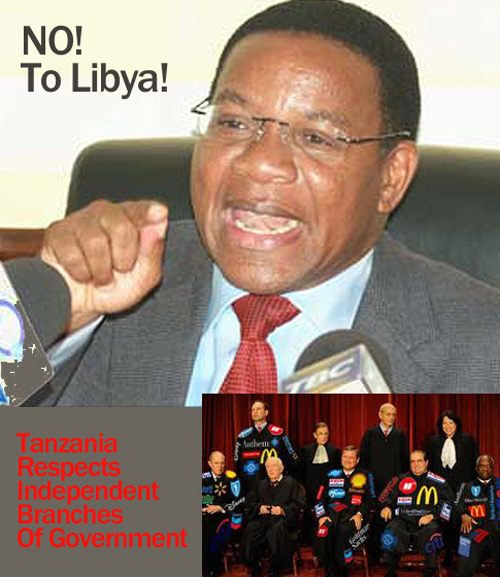
Tanzania’s foreign minister explained : Tanzania will not recognize any government that doesn’t “respect the division of power between the executive, legislature and the judiciary.”

Hmm. That is a problem with some Africans, this lack of self-esteem.

Dictators Weekend Out

Dictators Weekend Out

Joburg’s main newspaper is spot on: the downfall of Libya will “put a new spring” into twevolution. And old hags dealing with aging revolutionaries no longer passes muster: Uganda, Eritrea and Al-Shabaab are in a vaudeville skit as the age of pictures begins!

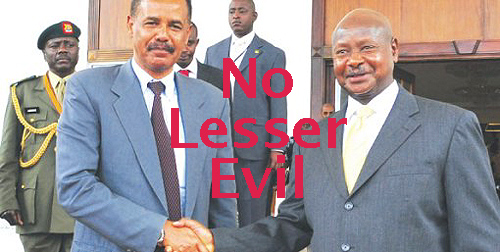
Two of Africa’s dwindling dictators spent a nice weekend together in Kampala. Yoweri Museveni, Uganda’s dictator, and Eritrean President Isaias Afeworki, are two of the most disliked people in Africa.

Museveni is cracking down on his people like never before. Afeworki is already under UN sanctions, and a resolution currently before the Security Council could effectively strangle him (although China is not yet on board).

Museveni’s crimes are methods of keeping himself in power. Afeworki’s crimes are too, but have drawn more world attention because of his funding of al-Shabaab, al-Qaeda in the Horn of Africa, which until recently controlled nearly two-thirds of Somalia.

Museveni and Afeworki are old school guys: “The enemy of my enemy is my friend”-school. Ethiopia, from whom Eritrea wrenched independence in 1993 and who remains its most bitter enemy, is an ardent supporter of the transitional government in Somalia battling al-Shabaab for control.

But wait, wait! Uganda is on the same side as Ethiopia, isn’t it? Here’s the truly unbelievable irony: Although the African Union has armed troops supporting the transitional government in Somalia, only Ugandan and Burundi soldiers remain from the original force which was much larger and included Kenya.

Uganda is by far the dominant force. So Uganda is supporting the enemy of al-Shabaab ostensibly more than any other African government.

And Uganda paid dearly for it last November, when al-Shabaab blew up two sports bars in Kampala packed with people watching the world cup. Nearly 80 people were killed.

So what’s going on, here? Where’s this enemy-is-my-enemy thing? Why is the president of a country ripped to shreds by a suicide bomber from a movement supported by Eritrea, welcoming the president of Eritrea?

The headlines say they are mending fences.

I don’t think so. Museveni has probably killed as many or more of his citizens than the November bar bomb did. And Afeworki has only a few more civil disturbances to go before he’s indicted by the World Court.

These are two aging dictators who nobody else likes. They don’t have any other friends, and as Libya crumbles, the prospect of their own tenure needs some mutual self-esteem reenforcement. These are not nice guys “working out differences.”

They are bad leaders lagering against twevolution.

Will Kibaki Lead Obama?

Will Kibaki Lead Obama?

President Obama can learn something from President Kibaki. Kibaki has a plan, a bold and risky one to be sure, but one what that might solve an urgent Kenyan problem. Did you hear that, Obama? Bold. If risky, bold?! To solve a problem?

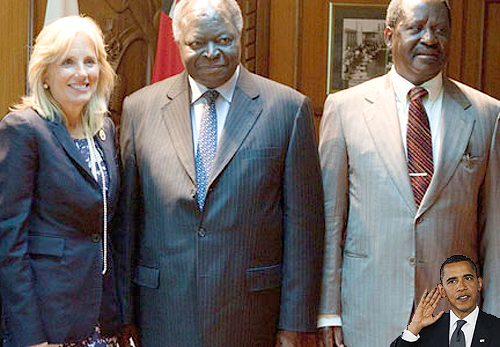
Yesterday Kenya’s two leaders, President Mwai Kibaki and Prime Minister Raila Odinga, together warmly welcomed the U.S. Vice-President’s wife, Jill Biden. Dr. Biden was in Kenya to assess the growing famine and refugee problem in Kenya’s north and Somalia.

That problem is spiraling into a serious catastrophe, even as rain falls. As I’ve written many times in this blog, the famine is not mainly a result of drought, but of the increasing war in Somalia.

Today, one of the most reliable news sources for Somalia (actually based in the U.K.), Shebele News, reported that “calm returned to the Mogadishu city as almost of its districts are in the hands of Somali forces after Al shabaab fled the capital.”

While gauging the fight in Mogadishu is very difficult, I think because al-Shabaab also claimed the opposite, that we can believe the former. Al-Shabaab rarely makes any statements, and this rout of the Somali capital would be the latest in a number of setbacks for them.

Presuming this situation to be true, it definitely gives President Kibaki an opportunity to do something bold, and he has done so.

Yesterday he told Dr. Biden that Kenya would enter sovereign Somali territory to “set up feeding camps” there.

Not quite an invasion, but close. And offering to do something this radical would help to move the problem a little further away from sovereign Kenya. It would also give cover to the international aid agencies and donor countries who dare not appear to invade any new place right now.

The risk is that all of our assessments of the weakened state of al-Shabaab are incorrect. It was al-Shabaab that bombed two bars in Kampala last fall, killing nearly 80 people, in retaliation for Uganda’s support of the African forces in Mogadishu.

So this is risky. And what’s more, normally such a national policy would require Parliament to sign off on at least the funding. But Kibaki, like Obama, is not exactly on the friendliest terms with his legislature.

But Kibaki, unlike Obama, is grabbing the reins and whipping the horses into action. Nonaction is not an option. He is leading, and leading is risking, will always be challenged by those who don’t want to follow, and must often pierce sovereign territory.

Kibaki should be wildly applauded.

Perhaps, Dr. Biden can find a moment in her busy schedule when she gets back to chat with Obama.

USA to Follow KEN?

USA to Follow KEN?

Politicians the world over are a lot smarter than we give them credit for. Take Kenya, for instance. Wednesday a new political party was announced, a reaction to the public’s intense dislike of current politicians. Should we follow Kenya’s lead?

The new party in Kenya is the United Democratic Front (UDF). Wow, that blew me away. At last, a truly representative group of savvy (all) men who are united in their respect for voter’s wishes. Now that’s a change. And they’re going to be in the front, too!

Sensitivity to the complexity of issues doesn’t mean you don’t need good marketing. I think these three-letter wraps are perfect. In the airline industry we’ve used three-letter codes for years to designate airports.

ORD is Chicago. LOL is Derby, Nevada. ACK is Nantucket. This helps us remember where we’re going to, if of course, we were sure we were going and that there would be an FAA (Fair trAffic Actors) to assist us.

Although the announcement yesterday was greeted by throngs of people nearly overflowing the covered bus stop at Uhuru and Kenyatta avenues, it was hard to figure out exactly what the new party stood for. Fortunately, Google helped with a simple UDF search.

The UDF clearly stated “it’s commitments to the people of Kerala to rise to their aspirations for Growth and overall development along with a peaceful living for the entire section of society.”

Now there’s a mission statement.

An obvious error in today’s main newspaper in Nairobi reported, “The UDF… is linked to some politicians associated with the G7 grouping.“. I and most of Kenya are unable to explain this, but we are waiting for them to add another digit or letter.

Perhaps, though, with my long experience following politics in Kenya, I can make an inference as to really why this new party was formed.

The two principle leaders of the UDF, crossing their waving hands in the photo above, are (left to right, or vice versa depending upon which photoshop or political analyst you use) is Prime Minister Uhuru Kenyatta and suspended Higher Education minister William Ruto.

I for one would be concerned that their travel schedules might disrupt their local policy planning. They are traveling back and forth to The Hague quite a lot, since they are both indicted by the World Court for crimes against humanity, and the vast majority of the Kenyan people refused to allow them to wiggle out of that one.

And then there’s the possibility that Ruto will go to jail (in Kenya). The question with Ruto is whether he will go to jail in Kenya first, or the Netherlands first. That’s why the PRE (“president”) suspended him from his cabinet position.

Both men have crossed existing party lines and old ethnic barriers to form this new party. This carries on the tradition they began during the turbulence following the 2007 election when (allegedly) they both recruited thugs often not in their own tribe to shoot police, club clergy to death and set fire to buildings.

Now the question comes home. Should we follow Kenya’s lead? Perhaps Senator David Vitter could start a new WTF party. He might go to jail, soon, too.

And then there’s that other senator, Joe Lieberman self suspended from the DEM but unwilling to join the GOP for GOK (God Only Knows).

That’s a team, now! Vitter and Lieberman, or Lieberman and Vitter, just like Ruto and Kenyatta (or Kenyatta and Ruto).

Amazing, isn’t it?

Stuck in the Blah Days in Tanzania

Stuck in the Blah Days in Tanzania

Northern Tanzania seems the epitome of everything that’s wrong with East Africa right now: economic recession, bad weather, a disgruntled population, and all in the context of a government that refuses to reform itself. Ho-hum.

There really is good news in East Africa, now, but at a little distance it just seems like silver linings rather than good news: to wit, the canceling of the Serengeti highway, and last week’s announcement that no new lodges will be built on the rim of Ngorongoro Crater.

Last month the Tanzanian government accepted international demands (especially from UNESCO) that the Serengeti highway not be built, while at the same time assuring Maasai just outside the park that they would get a new road at least up to the park boundary.

Brilliant move. We were ecstatic. Although I had expected by now that the donor funds to build this road and an alternative southern route would have been announced, I still think that’s what will happen.

And last week, after many more years of wrangling than the Serengeti highway issue, the government officially nixed plans by at least three companies for new lodges at Ngorongoro.

Again, brilliant move by a weak government drowning in the blahs. The point is that tourism is down, perhaps way down. Existing lodges are functioning at dangerously low capacities. It would be foolhardy to add any supply, now.

But of course the tourism minister, Ezekiel Maige, said “the area needed to remain natural and free from human pressures.” Right. And good of course, but that’s a sarcastic “right” coming from a government with little real interest in anything but oil rigs and mine shafts.

The lodge controversy at Ngorongoro began in 2005 and 2006, the hay days of safari travel. That’s when the super luxurious and ultra modern Kempinski Bilila Lodge attracted a principal investor named Jakaya Kikwete, Tanzania’s president. Reports indicate that the lodge is now putsing along at a less than 20% capacity.

When things are a bit bad, but not at crisis or catastrophic levels, news tries to push them through that threshhold to a point of gathering wider interest. What a wrong approach! We don’t want to get that point!

Unlike Kenya, Tanzania’s efforts at government reform have stalled. (btw Uganda’s are all but dead to the world.) A newly elected legislature last November, infused with new young blood and maverick politicians, was the greatest hope. They started the gears rolling for a new constitution, a necessary step.

But that’s over. Obese blahs cover the land, and nowhere within Tanzania more so than its important touristic north. It’s a do-nothing time.

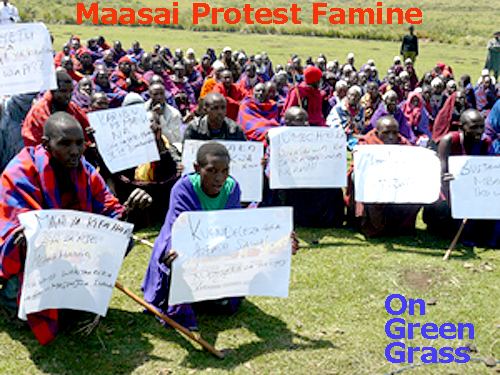
The weather is bad but not terrible (March-May rains were well below normal, but rains for the year look OK). Scandals persist as always, with the token official here and there scheduled to be sacked. Climate change gets worse and worse and Ngorongoro Maasai are demonstrating that famine and drought is destroying their lives (while sitting on freshly grown green grass).

What does this mean?

Nothing. That’s the point. We ought not presume that reforms will not take off when things improve, nor be less vigilant that a sneaky government won’t reallocate rim land to developers. Keep your eye on the weather; if it persists through another poor rainy season, then it’s time to worry for sure.

At home, we call these the Dog Days of summer, when it’s just too hot to do anything. In Northern Tanzania I call it the Blah Days, not too hot, not too cold, just not too anything.

SERENGETI WATCH OUT OF SYNC

SERENGETI WATCH OUT OF SYNC

Contrary to Serengeti Watch’s weekend retraction that the Serengeti Highway had been scrapped, it has been scrapped. SW now needs to be as clear as it’s demanding the Tanzanian government be.

Friday I joined the world, including SW in announcing the Serengeti highway had been scrapped. It has been, but a retraction by SW with an unusually scrupulous reading of the official Tanzanian government announcement does confuse the issue, and this is intentional by the government. Let’s try to work through this.

First, what happened Friday was a Tanzanian government letter sent to UNESCO dated Wednesday got into the media. After the first reading SW sent out an alert to their thousands of members that the highway had been scrapped.

I’m not sure of the actual sequence of reporting, if SW was the first to report this or how exactly SW got a copy of the letter, but within seconds of the SW announcement the world press was reporting it, including the BBC. Before Friday ended in Africa, in fact, foreign correspondents as reputable as the London Telegraph’s Mike Planz were reporting “Wildebeest migration safe after Serengeti road plans scrapped.

Agence France Presse reported Friday from Paris, where UNESCO is located and to whom the letter was addressed, that UNESCO had confirmed the “Tanzania has stated it will reconsider its North Road project.”

And Sunday, media throughout Africa and the world picked up an Agence France report that as a result of the “reconsideration” UNESCO’s World Heritage Site board of trustees had decided not to list the Serengeti as an endangered World Heritage Site.

Click below for the best resolution I can give you of the Tanzanian government letter to UNESCO.
NoSerHiway_letter_6-22

SW considers the second paragraph of the letter dissimulating. The third paragraph, however, is pretty definitive:

Ezekiel Maige, Tanzanian’s Minister for Natural Resources & Tourism wrote, “…the proposed road will not dissect the Serengeti National Park…”

So, then, what is the “proposed road.”

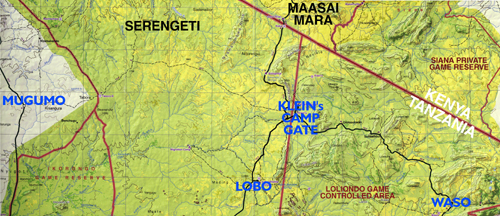
Maige explains this in the second paragraph as a two-part road divided by the Serengeti itself. The eastern portion will be a new paved road to Loliondo, plus a 58k stretch from Loliondo to the Serengeti’s Klein’s Camp Gate, although that long 58k that will not be paved.

He then continues to remark that a 53k section traversing the Serengeti “will remain gravel road” and continue to be managed by park authorities and presumably, funds “as it currently is.” Where that road ends, at the western Tabora Gate of the park, there would then be a new (or renewed) 12k gravel road to the town of Mugumo, where a new paved road would continue to Lake Victoria.

Excerpted from Harvey Maps, London.

Now the confusion comes because SW doesn’t seem to think that this 53k gravel road through the park exists. After a day’s elation, SW sent out an alert to its supporters claiming “No gravel road exists across this 53 km stretch.”

I’ve driven it many times. See the map above. It’s a horrible road in places, disappears in others, but it has been a designated Serengeti track road for at least the last 50 years.

“WASO” is the actual town to which the new paved road will be built from Mto-wa-Mbu. Maige and others commonly refer to the “Loliondo Road” but Loliondo is the entire district. There is a small political and government headquarters named Loliondo 6.2k east of Waso, but Waso in the main urban center.

The 57.6k gravel road that will be newly built or newly reconstructed but which will remain gravel will be from Waso to the Serengeti’s eastern park gate at Klein’s Camp. 58k on gravel is at the best of times a two-hour trip. This is no thoroughfare.

Maige’s reference to the “existing road” from the eastern to the western side of the park, and which had been generally (not specifically) the blueprint for the originally announced “highway” is the arched track shown above as a broken line that begins a few kilometers south of the Klein’s Camp gate on the main road to Lobo, then moves northwest, then southwest through the neck of the Serengeti to the western gate at Tabora.

Maige then said the existing track from the park gate to the town of Mugumo will be improved, and at Mugumo the paved road will continue to Lake Victoria.

The arched track through the Serengeti is what SW claimed does not exist. Of course it does, and it appears on a number of the last issues of the Frankfurt Zoological Society’s maps of the park. The oldest one I have was published in June, 1970. A 2008 one is republished by Harvey Maps of London and is available for sale to the public.

To improve this existing track will require significant effort. There is nothing in Maige’s announcement to suggest there will be any further upgrading or building of bridges, or anything of the sort, on the 53k track that links Klein’s Camp Gate (east) with Tabora Gate (west). Frankly, I doubt they’ll do a thing.

The existing track just gives up the ghost in huge sections, and a number of new bridges (over the Balanganjwe and Mbalimbali to name two) would have to be built. No small or inexpensive task. It does not seem to jive with Maige’s claim of an “existing road” nor one that would be managed “as it is currently.”

As it is currently, a better Landcruiser than mine would be needed to make the entire journey. I suppose that park rangers on poaching patrol might manage along it, but that’s about it.

So this is the crux of the dissimulation, and I suppose it’s understandable that SW might suspect the government of trying to fool its way into retaining UNESCO World Heritage status while still planning to dissect the Serengeti. But frankly, I don’t even think Tanzanian politicians are that foolish.

Maige said definitively “the proposed road will not dissect the Serengeti” and that’s what the world community and UNESCO is taking at face value.

In fact, were Tanzania to do so, I can imagine nothing but incredible ramifications to the country as a whole, and not just from UNESCO, but the World Bank and the U.S. which has just orchestrated new aid for the country.

Yes, you can argue Maige’s letter is clever dissimulation but in fact it would be considered outright lying to the NGOs and foreign donors on which the country depends for its very existence. There are just too many sentences in that letter that stand as evidence that “the proposed road will not dissect the Serengeti.”

I think the letter is intended as much for local consumption as UNESCO. Like any good Tanzanian politician, Maige will never admit the government has changed its mind. And Tanzanian politicians’ track record of fooling Tanzanians more than outsiders is legend. It’s totally realistic to suppose what the government is doing, here, is leading unsuspecting local supporters of a faster link from Arusha to Lake Victoria down a nonexistent track.

If Tanzania really intended to build a new road, why write this letter in the first place? Do you really think Maige believed he could fool UNESCO, the World Bank and the United States with something like this?

That’s just too unbelievable.

Nothing is ever final in government or politics, whether it be Tanzania or here, and we have every reason to demand a greater clarification from Tanzania. But my money’s still on no new road through the park for the foreseeable future.

China Builds & West Saves Africa

China Builds & West Saves Africa

NPR’s fabulous story this morning about Kenya and China begs repeating what I’ve been saying for so long: watch China carefully and learn without embarrassment. The world may do better, then.

Frank Langfitt’s reporting on Morning Edition was superb. (And so much better than NPR’s former African correspondent, Ofeibea Quist-Arcton, who has been reduced to the new “West African Correspondent” where she continues to do a bad job, there.)

Langfitt did a yeoman’s job telling a decade’s story in less than 15 minutes. But there were a few things of importance that were neglected.

In May last year I wrote about the “Flame Tree Road“, which was then 8 lanes growing to 11 and is now, as Langfitt reports, 16 at some spots. Last September I wrote about China’s port plans in Kenya, and just a few months ago, Conor Codfrey reported the somewhat jaded views of western businesses about all of this. Two years ago I reported China was suddenly in Kenya looking for oil. Langfitt recapped it all, very well.

China is entirely and pitifully practical. And that is the crux of the difference between her and the west.

The west pontificates at best, fools at worst, and has been doing so for centuries.

The three C’s that governed Livingstone’s life and fund-raising, “Civilization, Commerce and Christianity” more or less governed until just this decade virtually everything the west ever did in Africa. China is also a “C” but like any efficient businessman, they’ve reduced the three C’s to a more productive two: “China & Commerce.”

China’s premise appears in stark relief for those of us who know Africa. Damn Kenya’s dwindling forests, we need the wood to build things. Forget about Kenya’s wetlands, they have no oil. And as for its wildlife, the only good rhino is one without a horn.

Poaching of both elephants and rhinos has increased substantially with the Chinese presence in East Africa, and there have been regular reports of Chinese apprehended in East Africa with poached ivory or rhino horn.

More worldly: Damn the millions under the Yangtze dam, discard the two centuries of Tibetan Buddhism, consider an enemy the enemies of your neighbors and do anything for a quart of oil.

Did I say we can learn from this?

Yes, absolutely. Because this policy reeks of the desperation of perfected capitalism, and that is the world’s economic system. Knowing it doesn’t mean you love it.

Ever since Livingstone’s three C’s, the west has spent enormous resources in trying to justify and work through the inherent contradiction between capitalism and goodness, trying in effect to claim there wasn’t an inherent contradiction. Realpolitik was the west’s first foray into diplomatic reality and succeeded to some extent because its American minister had a thick foreign accent. But Realpolitik has faded recently as Christianity and other ideologies like “hard work” and “marriage” have ascended.

The Chinese just love Glen Beck.

Africans are getting worried now that this pure intention of China is without a soul. Langfitt’s reporting this morning encapsulates in a few minutes volumes of recent articles and endless conversations on Kenyan radio talk shows.

After all, the west gave Kenya its religions. China is giving it its roads. There’s a very interesting future out there.

Religious Horror

Religious Horror

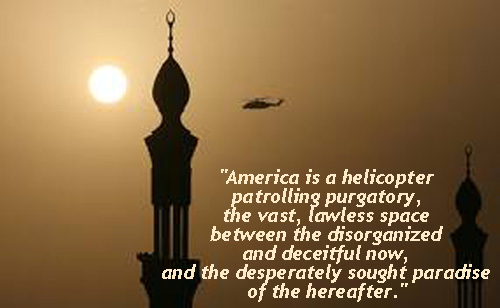
To a young apolitical Iranian woman, America is an army of helicopters ruling purgatory, patrolling the vast, lawless space between the disorganized and deceitful now and the desperately sought paradise. This wondrous insight comes to us thanks to the Zanzibar Film Festival which opens this weekend.

(For a broader summary of the festival, please read my Tuesday blog.)

“Invitation” is a film by Payam Zeinalabedini, an Iranian with a very limited budget. It’s not going to win any technical awards, and as you are carried along by the lilting, beautiful girl’s voice over the film’s haunting music, it becomes hard to “translate” the very poor English subtitles. But please stick with it, and forget the subtitles if you must. It is absolutely a film that every American should watch.

Watch it now, by clicking here, or come back to it, later. It is 30 minutes long and gives us Americans a widely held view of ourselves from the outside.

In a larger sense I think this is why so many Americans love Africa. There is something that we immediately identify with every moment of new experience, whether it be vast Midwest-like plains or thousands of animals. (American’s empathy for animals is legendary.)

And I’d like to think a few clever Iranians understand this, too. Payam’s film has shown in a few other festivals, but its technical merits are wanting. If shown, for example, in Milwaukee or Austin, it would probably fall flat as poorly made propaganda. But the characterization it makes of America will not offend an audience in Africa. And obviously it’s not intended as propaganda, there.

Africa has manipulated America well, for both America and itself, for several generations. Africa knows the good we have, and the bad we seem unable to shake. And because the film really does lack the technical merits of so many of the other entrants in the festival, I have to believe, too, that the Africans running the festival are doing exactly what the Iranians are:

Trying to send us an important message. A post card, if you will, of an essentially apolitical Iranian girl of her journey into Iraq. In a way that won’t evoke our defensiveness before we absorb it. ‘Someone,’ I can imagine them saying to themselves, ‘has to let America know what’s happening.’

Filmed in 2008 it is a story of this young lady making the trek to the holy Shiite shrine in Karbala, Iraq. We never know her name, or the name of her grandmother who she invokes constantly as her mentor and inspiration and the assumed recipient of her remarks.

In fact, throughout the film’s crowded voyage through humanity, no one offers names. At the Iraqi/Iran border where American soldiers finger print and eye scan all pilgrims, names are clearly forged or just made up. Except for imams and holy historical figures, names aren’t used, not even when trying to check into an inn for the night.

The film becomes a documentary of crowds of nameless pilgrims wandering towards the shrine, in a sort of hapless pursuit that things holy must be better.

The Iranian woman narrator has paid an Iraqi tour company for the trip, as have hundreds if not thousands of other Iranians in lines of buses coming out of Tehran. But when the convoy reaches the Iraqi border, the comfortable vacation turns into a horrible expedition.

It’s raining and cold. Compared to Iran’s paved roads, Iraqi’s dirt tracks are terrible. And dangerous. The girl explains that Iraqi security personnel must join the bus groups to guard the continuing journey, because it’s considered so dangerous.

Waning daylight infuses the “second-hand Iraqi” buses bereft of working windows or adequate heaters as the convoy pushes deeper into Iraq. They pass Tikrit, and the narrator turns her camera at Saddam’s palace, but it passes quickly out of view as something no longer meaningful.

It’s dark, cold and still raining, and the colored often neon lights that poke out from villages along the way seem like circuses or game parlors. The narrator remembers the tracer lights of Iraqi aircraft over Tehran during the great wars. She was very little, and she remembers her grandmother telling her to run to the shelter.

Then the tour bus gets stuck in the mud, in the dark, cold and rain. The Iraqi security officer orders them to stay in the bus “And don’t sleep! It’s dangerous!” By the broken English subtitle, she says mournfully, “Grandma, I now know what anxiety for the future means.”

The next day she sees lines and lines of Iraqis walking on the muddy sides of the road to the shrine and feels embarrassed with her fortune. “I am not vengeful,” she begins, invoking the long wars between the two countries, “and I wonder if I should get out and walk with my brothers.”

Americans – which are never shown – are omnipresent, but as if in another dimension, outside real peoples’ realities. At one point, the security officer accompanying her in her bus warns her not to take pictures or use her cell phone, because Americans “have X-rays and we’ll all then get arrested.”
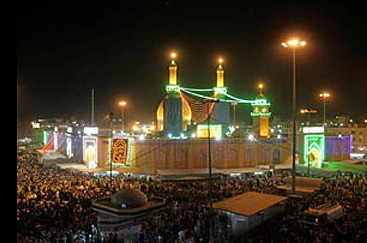
As they approach Karbala in the darkness and drizzle, the sounds of excited pilgrims increase. There is self-flagellation and ominous and aggressive dancing common to this sect of Shiites, unhappy crowds, mixed and uncoordinated singing and shouting. They walk pass dilapidated or bombed out structures as the throngs of people move towards the only lighted structure in the area, a yet distant giant Christmas-lighted mosque and shrine.

They decide to check-in to their inn before going to the mosque. The electricity is erratic and there is no light in the cold, rainy street. Yellow light peeps out from shuttered windows. When they finally locate their presumed overnight lodging, they discover there’s no room for them at the inn. And there’s no representative around from the travel agency that took their money to complain to.

“This is Karbala,” the innmaker intones, “go to Paris, go to the Emirates if you want a room!” The girl remarks they can’t even find an internet café, because there’s no electricity and no computers. She remarks with the first bit of political overtones that this is the country that was supposed to have a nuclear bomb, and they don’t even have working computers!

What she had hoped would be a joyous excursion has become a nightmare. She finds an Iraqi who has the authority to allow her to film inside the shrine, but his laptop doesn’t work so he can’t give her the necessary permit. She finds a laptop from a fellow Iranian traveler, and the official creates a permit using Word.

Suicide bombers have attacked nearby mosques. There are sirens and flashing lights, and suddenly American soldiers who are never shown, though. No one seems to care. “This country is conquered by Americans,” she says as if only realizing it herself, now.

Finally she gets inside the mosque. The light is bright, almost blinding. Most faces turn away from her camera. Those that don’t reveal fear, anger, perhaps terror.

She gets in a line of congested movement towards the shrine, the object of the trek. The orderly movement forward is interrupted by security officials frisking entrants. Inside, she says, “Grandma, perhaps it was your prayers that got me here, but now I’m entrapped among the security Army of Blasphermers.”

“I feel I am supposed to see and hear” inspiration or something religious, and then her voice is drowned out by the sounds of helicopters going around and around, closer and closer, louder and louder.

This is the view of Iraq by a young Iranian. I don’t consider this propaganda, although I think it quite fair to presume the film maker had an agenda in mind. But strip away the commentary and subtitles, and just take the scenes shown for what they are:

A country in endless mourning, restless and lawless, pitifully unfulfilled.

Ready to either implode completely or explode entirely.

An American watching this film must wonder what the hell we’re doing there. We’re not bringing peace, and we’re certainly not bringing prosperity or any measure of happiness. If our national security goal is to impede harm against us, we’re certainly not doing it by making friends. You could not live in Karbala without hating America.

Nevertheless, if this has “kept a lid on terrorism” one wonders if the oppression this thrusts on the peoples of Karbala is fair strategy. In a tit-for-tat body bag game, we’re winning. But one wonders if the game weren’t played at all, if the numbers of dead, injured and unhappy would be infinitely less.

We have turned a once joyful religious trek undertaken for centuries into a modern horror film.
African Doors to the World

African Doors to the World

Who will spearhead the social unrest in China? Are women being mentally beaten to death in Iran? These and similar cutting edge issues find their window to the world Thursday, at the Zanzibar Film Festival.

The world’s great film festivals have become institutionalized, perfected as I suppose they should be in celebrating independent and often unrestrained art. After all, that’s why they arose: the mainline industry had abandoned art for commerce. But in maturing so idealistically to technique, the great film festivals have abandoned many cutting edge social issues.

And movies are one of the best ways to broadcast your issue. Africa has a number of film festivals where this is still the case, and none better than this year’s Zanzibar festival.

I list below films from China and Iran that I believe tell a story no one’s listening to, and which presage very important world events. By so doing I don’t mean to minimize the great African films – particularly Swahili language films – which will also be shown.

A Good Catholic Girl, for example, is a remarkable short film from Uganda with two wonderful lead roles about falling in love across religious and ethnic lines. This is now a multi-generational issue, and when explored deeper says much about the ethnic and gender turmoil in Uganda, today.

The Rugged Priest isn’t a very good technical movie from Kenya, but it is a story rarely told yet enacted over and again especially when I first worked in Kenya in the 1970s. It’s also an interesting benchmark for the growing Kenyan film industry, as the movie was a hit in Kenya.

But what the Zanzibar Film Festival provides is a quiet outlet for film makers in places like Iran and China, whose work would likely be suppressed at home, and is either not submitted to the bigger festivals for fear of drawing attention, or just as likely, because they just aren’t technically good enough.

But I doubt any of you won’t feel the same goose bumps I did watching the trailers, and clearly, these raw yet to fully mature young artists are telling us something very important about the near future in their countries.

Just an Hour Ago, and A Beautiful Snowy Day reveal the oppression of women in Iran is so intense that I believe – and I believe the films are suggesting – that the next great unrest will come from women, there.

The Rice Paddy is a Chinese/French entry which is among the most professional productions, and remarkable for its intense portrayal of the migrant worker in China’s rice fields, a group of people today as important in China as the slaves were to cotton farmers in the 1800s in America.

While The Rice Paddy is not subversive as such, clearly in the light of today’s news about Chinese inflation and migrant worker unrest, it presages cracks in China’s social construction that likely will figure prominently in that country’s imminent transformation.

But the enormously powerful Iranian film, The Invitation I feel so important that I’ll be writing a separate blog about it, Thursday, to commemorate the film festival’s opening. Please come back, then!

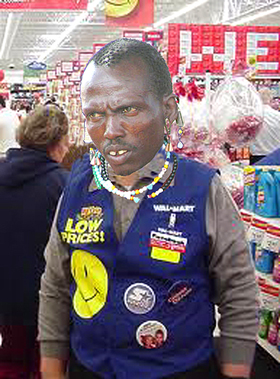
Africans First Walmart Second

Africans First Walmart Second

Does Africa need lower prices? You bet! In just a few years there will be Walmarts in virtually every major African city. I think Africa can handle it. So I say, “Bring‘um On!”

Africa’s third largest retailer, Massmart, will be consumed by a $4.6 billion offer from Walmart following initial South African government approval Tuesday. Massmart currently operates in 13 of Africa’s 53 countries, and growing.

Predictably, business interests hailed the merger. Worker interests decried it. The South African government commission which approved the merger is imposing a few restrictions, including maintaining the existing labor/union mechanisms which many had feared wouldn’t survive the merger.

Everyone knows what this means. There is no dispute that Walmart will lower prices, probably boost quality in an African market known for shoddy alternates and outright fakes, as well as lowering wages and reducing other existing worker benefits.

“Can you imagine what [will] happen in Africa, with its extremely vulnerable workforce and inadequate and unenforced labor laws?” Mfonobong Nsehe writes on a Forbes blog consortium.

Everybody knows.

But two-thirds of South Africans support the merger. The reason is simple, and it’s Walmart’s signature: Lower Prices.

And the counter argument is that lower prices mean lower wages mean either depressed economies and/or an increasing gulf between rich and poor. Click here for a great interview of Patrick Craven, a South African union spokesman.

America exports Walmarts, because America is the world’s largest and most fundamental capitalist system, and Walmart is the epitome of what capitalism means. Walmart, in turn, exports human rights abuses when it sources vendors from foreign sweat shops. America champions human rights. Therein the paradox.

If we’re going to live with capitalism then we want its players to be as aggressive as possible so that the system remains dynamic. Healthy capitalism is a bloody thing. And I can’t see impeding Walmart if we’re encouraging Goldman Sachs, or for that matter, Exon/Mobile.

Walmart is not the problem. Walmart has to live under the laws of each country in which it operates, and what that means from the getgo is that advanced industrial societies must take charge of their capitalist development. REGULATION.

Minimum wages and minimum worker benefits must be increased. Affirmative action, particularly with regards to gender, must be dusted off the shelves and reembraced whole-heartedly. Legions of public agencies, from tiny villages to sovereign governments, must not extend tax benefits without ensuring that tax loss doesn’t depress its citizens’ standards of living or increase the gulf between the haves and have-nots.

The consumer and worker must always get the better shake. Business should be seen as serving, not feeding on, consumers and workers.

This is not Walmart’s responsibility. Walmart’s responsibility is to be as mean as possible. That’s how capitalism succeeds.

It’s now up to the African governments. They’re newer and not as beholding to giant capitalist entities as the American government has become, and there is a real possibility they will be able to regulate this behemoth with the same idealism they profess as overall goals of governance.

People First. Walmart Second.

Africa has a chance to get it right. But they dare not model America. We haven’t done so well.

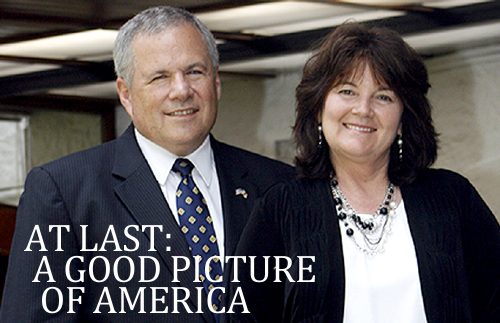
America’s Faces are now Fabulous

America’s Faces are now Fabulous

America’s new ambassador to Kenya is a brilliant appointment that ensures U.S. goals and interests while really helping Kenya move into the new era created by its new constitution. A win-win situation the likes of which were unknown before Obama/Clinton took over world diplomacy.

Like many of Obama’s better civil servants, Maj.-General Jonathan Gration is a disenfranchised Republican. (Best example, Defense Secretary Robert Gates.) Steeped in solid conservative traditions, he quietly moved away from the receding cliff that so many Republicans fell off.

The decline of the solid Republican Party gave Obama a real windfall of good folks. Gration was drafted into the Obama campaign early on as an African policy advisor and became our envoy to the South Sudan, where he did yeoman’s work that seems to be paying off.

Gration just replaced another fabulous ambassador in Kenya, Obama-appointed Michael Rannenberger, who like many diplomats worldwide was forced out because of embarrassing classified remarks exposed by Wikileaks.

And as should be the case of all diplomats, Gration really knows his assignment. He was born in the Congo to missionary parents. His first language was Swahili. He rose in the military as a security/terrorism expert. There can simply be no better replacement for Rannenberger.

During the Bush years diplomats were appointed usually as party favors, literally. TV personalities, big time donors and other celebrities drove the art of diplomacy into the realm of country clubs.

I remember Sam Fox’s appointment to Belgium, a man incapable of tying his shoes much less working in the country that was the center of the EU. And he had almost single-handedly funded the terrible “Swift Boat Veterans for Truth” ad against Sen. Kerry.

That was typical of all of the Bush era appointments. The Republican slide that he oversaw believed international relations were mixed marriages to be avoided.

How wonderful things have changed.

Gration knows that no major policy changes are occurring with his appointment, and I think that both Kenya and those of us at home familiar with Africa are glad with that. Rannenberger was a stellar diplomat who really moved forward anti-corruption efforts as well as the implementation of the new Kenyan constitution.

I’m not familiar enough with the rest of the world, but if this is any indication of Obama/Clinton diplomacy elsewhere, we’re doing extremely well worldwide.

Uganda is Dying

Uganda is Dying


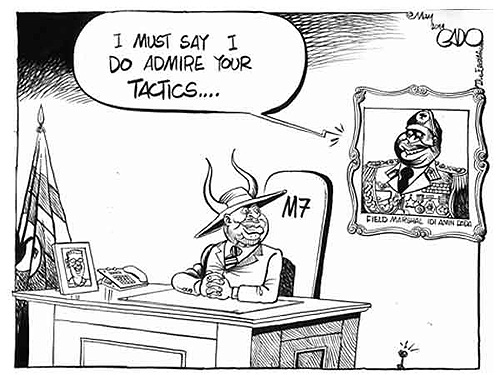
Nairobi's GADO says it best: Museveni is like Idi Amin.

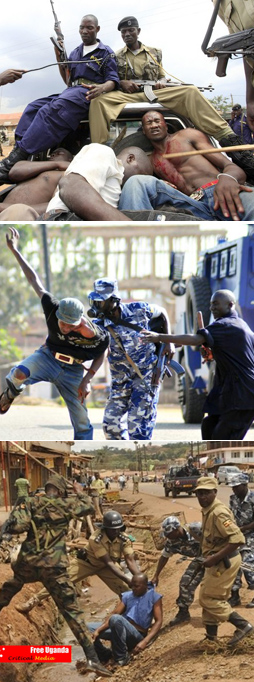
Yesterday the Ugandan Wildlife Authority drastically reduced the fee for visiting mountain gorillas. Yesterday 6th term president Yoweri Museveni lambasted the police for being too soft on demonstrators. Get the connection?

I don’t think people realize how bad it’s getting in Uganda. This is in large part because of the clever dictator’s successfully distracting the world’s media by the admittedly draconian “Kill the Gays Bill”. But this has drawn all the attention away from the much greater and more serious human rights violations affected on all Ugandans, increasingly brutal every day.

For travelers heading there now, don’t be too alarmed. Proceed with caution. Keep your eyes on the “Kill the Gay’s Bill” that like flotsam on a dying reservoir won’t go away. See if Museveni actually imprisons all of his opponents, and keep your attention on that rebel rouser, Kizza Besigye.

And especially, keep reading one of the best blogs in Uganda, Mark Jordahl’s Wild Thoughts from Uganda. And hope that Mark isn’t imprisoned like a lot of other journalists.

Today, Jordahl notes:
“Why does a sitting president, who is no longer a member of the active military, wear fatigues to a swearing in ceremony for Members of Parliament? … Does he want to remind people that he can come down on them, at any time, with the full force of the military?”

For tour companies like EWT, and if as an individual you’re now beginning to plan a safari for the future, scratch Uganda off the list.

The Hide is a great camp in what was one of the best wildlife parks on earth, Zimbabwe’s Hwange National Park. EWT still carries a credit from that camp from our last safari into Zimbabwe in 1999. I’m afraid 2011 has seen our last safari in Uganda.

I can’t remember exactly the straw that broke Zimbabwe’s back for EWT, but I do recall a series of events including growing police brutality that displaced Africa’s beautiful sunsets with red flags: First there was the harassment of journalists. And then the emasculation of other branches of government, starting with Zimbabwe’s until then flamboyant parliament and ultimately killing the judiciary.

And that’s exactly what’s happening, today, in Uganda. It’s a methodically slow and miserable decline.

And the decade which followed EWT’s decision to stop safaris in Zimbabwe didn’t result in any real danger or injury to tourists who still went. But it became increasingly uncomfortable.

At this stage – NOW in Uganda – expect bloody demonstrations, road blocks, crazed police.

And then as the population is subdued the country’s suffering infuses society like lupus: the growing bellies of malnutrition to the long lines of cars at gas stations. For tourists it’s the possibility that gas for your transfer to the airport won’t be available and brunch will be canceled.

Ultimately tourist attractions do suffer. The boreholes so essential to Hwange and other national parks were neglected. Soldiers shot the animals.

We know well how tourists are immune to internal troubles, whether that be Tibet, Nepal or Madagascar. No sides in an internal conflict want to discourage tourists. In fact, tourists become an indication that “everything’s OK.”

And I’ve always believed that travelers should go wherever they want to, wherever their own clever devices can get them. Whether that be Cuba for an American in the 1990s or South Africa under apartheid.

But go with your eyes wide open. Travelers in the future won’t be going to Uganda to see mountain gorillas. They’ll be going to explore a once great society cut to its knees by a maniac dictator.

As Mark warns today to all of us who still love that place: “Uganda needs to be watched closely.”

And the MU’s Have It! … All!

And the MU’s Have It! … All!

Time is running out on Uganda. Slowly drifting into dictatorial oblivion, its soul is being bled to death by its vampire ruler. Uganda is becoming the next Zimbabwe.

Zimbabwe is so exhausted it will not respond to the African Awakening. And Uganda is on the very threshold of being unable to as well. These two once beautiful places have been laid to waste by power-crazed dictators: MUgabe and MUseveni.

Understandably, the world news about Uganda is almost exclusively about the unimaginable “anti-gay” bill floating like invisible toxin in Uganda’s Parliament. For us in the tourist industry it’s a death knell. If passed, simple knowledge unreported of a gay person becomes a crime.

Casual chatter in a safari vehicle about gay friends or gay society, or god forbid, a gay customer must be reported by the driver to the police, or the driver can be imprisoned. It’s unclear what would happen to the foreign visitor.

And that’s hardly the most draconian aspect to the bill which in one form proscribes the death penalty for certain gay acts.

But I think this horrid legislation is being used as a distraction by Yoweri Museveni from the final cementing of his dictatorship, his swearing in for a 6th term as Uganda’s president.

His elaborate ceremony yesterday was replete with tumbling fighter jets that nearly crashed into the presidential stadium, out-of-tune competing bands, tens of thousands of supporters, and a remarkable list of other Heads of African States gingerly trying to avoid being photographed by the few journalists left in the country.

Museveni is now the longest ruling dictator after Robert Mugabe of Zimbabwe, who has ruled that enervated society for 31 years. Now I’m not one to believe in term limits, but give me a break.

Mugabe – who last year was allowed to travel only into the Vatican and Malaysia – arrived the swearing-in ceremony to raucous and well orchestrated jubilation before taking THE privileged seat next to Uganda’s powerless Chief Justice Odoki (who swore Museveni in), who sat next to the First Lady, who sat next to The Emperor.

Like in Zimbabwe, Museveni came to power legitimately. In fact his recent 6th election was probably fair enough that democracy technicians are required to anoint him (although by nowhere near the two-thirds he claims).

But the election campaign was not fair or democratic. The government controlled the media, imprisoned or killed opponents, dispersed demonstrations in hellish ways, and broke, tortured then temporarily exiled his main opponent, Kizza Besigye, by refusing to allow Kenya Airways flights into the country.

And while all the world bites their lip about what’s happening with the anti-gay bill in the Ugandan Parliament, the fact is that the Ugandan Parliament is becoming a pitiful and powerless entity. No journalist could figure out, today, what procedures are in play with regards to the bill. No one could even say if Parliament were over, or not.

This is because it’s Museveni pulling the strings, and he’s dangling this putrid piece of legislation to distract the world’s interest from the iron crown he just forced the Ugandan population to place on his head.

What happened in Zimbabwe is happening in Uganda. An educated, respectful population torn by recent ethnic conflicts is being manipulated into submission by a heathen dictator. It’s too late for Zimbabwe. It might be too late for Uganda.

Brainwashing U.S. & Nigerian Kids

Brainwashing U.S. & Nigerian Kids


The first job I got fired from was after I reported to my Yugoslavian boss (during the Cold War) that UNESCO’s proposal for funding Sesame Street for Cuban National Television could be used for political, not only educational purposes. Guess what? USAid is now funding it for Nigerian State television.

And guess what else? Besides the Washington Post which originated the story, the only other major city media that carried it was the Kansas City Star. And Kansas is one of a handful (but growing number) of States that impede the teaching of evolution and promote creationism.

So would you please click here to sign the petition promoted by 17-year old high school student, Zack Kopplin of Baton Rouge, who is trying desperately to stop his state legislature from doing what Kansas has done. After which, I’ll put all these paragraphs into a meaningful idea.

Done?

Nearly 40 years ago when working for UNESCO in Paris, I realized that despite my liberal leaning that there were powerful tools that governments could use to attain acquiescence to almost anything. We dared not call it “brainwashing” but that was exactly what they were.

USAid is funding Sesame “Square” on Nigerian state television. There are 13 independent television stations and networks in Nigeria, but none can compete with NTA, the massive state-controlled network which unlike PBS or the BBC is a real mouthpiece for the government.

Mouthpiece. Nigeria has a lot of explaining to do, both currently and historically. And one of its most effective devices is NTA.

And now, it can develop in its children – with U.S. help – a tool for imbibing its messages.

America’s problems are manifold but I think easily reduced into this statement: we have empowered the ignorant.

The ignorant of America are wealthy, know how to spell well enough, and have developed social and political tools to lord over us infidels while flagrantly promoting contradictory ideas, and worst of all, embracing nonsense like creationism.

We can’t – we shouldn’t – outlaw ignorance. It’s our own fault. We didn’t pay the teachers in Oklahoma or Kansas, or for that matter anywhere, enough to do a good job. We created a generation of ardent believers … in nonsense.

The only skill you need to believe deeply in nonsense is how to read. Especially in today’s unreal, surreal and political contrary world.

Learning tools like literacy are not the same as acquiring analytical skills. That’s what’s lacking in America, and now possibly in the next generation of Nigerians. Masses of skilled kids will be made just literate enough to believe the nonsense of their autocratic rulers.

USAid could have funded Sesame Street in Nigeria in other ways – on competing networks clamoring for a voice in the country. But they didn’t. They propped up a corrupt and secular regime with a powerful additive: brainwashing.

Pathetic Fear of the Wounded

Pathetic Fear of the Wounded

East Africa: beware! You are reacting to the fall of bin Laden like a Republican U.S. politician, and you should know by now that’s absurd.

Until now I’ve felt that East Africa had handled terrorism threats – particularly from Al-Qaeda and its franchises – better than the U.S. But that may be changing now that bin Laden is dead and East Africa is emerging as a powerful young society.

East Africa has probably suffered as much if not more from the machinations of Al-Qaeda than the U.S. Don’t forget: it was the embassies in Kenya and Tanzania that were blown up in 1998 by Al-Qaeda that presaged 9/11.

Fringe Muslims had been blowing up things in Kenya since the early 1960s when the then Block Norfolk Hotel was bombed because it was owned by Jews. Somali shares a 500k border with Kenya, and Al-Shabab (Al-Qaeda in Somalia) controls much of it. During the World Cup last year almost 100 people were killed when two sports bars in Kampala were blown to smithereens because Ugandan troops aid a UN peacekeeping effort in Somalia.

And there’s much, much more. I won’t be foolish enough to count up the bodies, East Africa vs. the U.S. from Al-Qaeda, but the comparison is serious.

And until Obama, American politicians used terrorism incidents to beef up the military industrial complex and prop up their own careers. Sounds harsh? Yes, it is terribly harsh, but it is not spurious, it’s true.

The incredible difference in the way the Obama administration has handled the end of Osama, compared to previous (mostly Republican) administrations that used torture, disseminated grizzly pictures and turned our national security into a contest for new MnM colors, tells me that we’re finally getting it right.

Ideas, Joe, not guns and their human debris. Plans, not fear.

But now I’m worried that East Africa is following the same wrong course that America followed in the past.

“As the world celebrated the killing of Al Qaeda leader Osama bin Laden in Pakistan Sunday by US Special Forces, East Africa stared at a possible new political nightmare,” warned popular East African columnist Charles Onyango-Obbo in an OpEd this weekend.

Onyango went on to terrify his readers with the same balderdash dumb politicians have used for centuries: fear of the wounded devil. Wounded but not killed, his vengeance becomes greater than ever.

“Most analysts agree that the Al Qaeda threat has not been buried with him,” Onyango writes of the obvious, even though it isn’t. Many analysts believe this and many other successes against terrorism recently herald the beginning of the end of Al-Qaeda.

Terrorism expert Peter Bergen claimed on CNN the bin Ladens’ death marked “the end of the war on terror” and a number of experts as critical as Foreign Policy’s Daveed Gartenstein-Ross cautiously agree.

I don’t think it’s necessarily that definitive, but my point is that there is not universal certainty among those who should know, that bin Laden’s death increases the threat level of terrorism anywhere .. including in East Africa.

The most repressive government in East Africa, was the most enthusiastic about the “new threats.” Details hadn’t even been released about Osama’s demise when on May 2 the Ugandan government “stressed the need to beef up security following the killing of al-Qaeda leader Osama bin Laden. Matia Kasaija, the internal affairs state ministersaid Uganda should not be caught unaware.”

It’s an old tactic, for morally bereft governments and uncreative journalists: scare the hell out of the audience to get their loyalty and attention.

It’s what we did in America for nearly a generation, and we now realize what a terrible mistake that was.

East Africa, beware. Don’t jeopardize reality just to score some extra points.