Justice Over Politics

Justice Over Politics

Not just free trade, but free justice! Africa once again leads the world into a new age. Today, major Kenyan politicians seem to have submitted to the World Court to face charges of crimes against humanity.

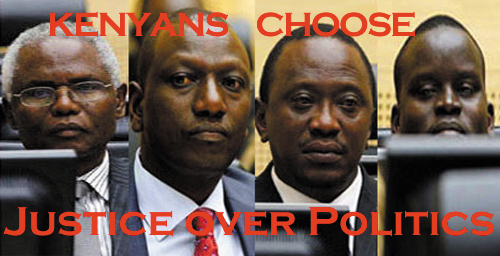
They include Kenya’s Deputy Prime Minister, Uhuru Kenyatta, and son of the founder of the country. Also included is a former kingmaker and government minister. The president’s Chief of Staff during the troubles of 2007 is also charged, and finally, a nonpolitican altogether, a radio personality who perhaps unwittingly caused rampant violence.

At 130p local Kenyan time, the World Court at The Hague confirmed the charges and announced the trial will begin.

The Hague is 6000 miles from Nairobi. Nevertheless, over the last two years, those accused have traveled back and forth with their teams of lawyers, have submitted to questioning and accepted the jurisdiction of the court to adjudicate their futures.

Can you imagine Carl Rove standing trial in The Hague for fixing the Florida count, or Rumsfield and Cheney for trumping up WMD? Or for that matter, Deng Xiaoping for the massacres in Tiananmen? More exactly, the slavic genocide of Radovan Karadzic was prosecuted by the World Court, but only after years of undercover missions that caught him as he ran from justice.

Can you imagine any of the world’s notorious criminals willingly submitting to The World Court? The U.S. and China even refuse to recognize it!

This historic day is the first time that powerful men in a distant foreign land willingly go to trial to defend themselves against a prosecution by an entity that claims to represent … The World.

For anyone who doesn’t follow Kenyan politics, this seems nothing short of absurd.

The decision by the World Court is about the violence which followed the disputed 2007 presidential elections in which 1300 people were killed, but perhaps a quarter million injured or displaced, and which included some horrific acts of ethnic violence.

The charges claim that these individuals orchestrated the ethnic violence with money, with direct orders and with violence themselves.

For over a year Kenyans debated whether or not to try the accused in Kenya. Parliament was twice deadlocked. There were demonstrations, pro and con. Ultimately, the Kenyan populace deferred the issue to The World Court.

Why on earth would still popular politicians willingly submit themselves to a foreign justice that could incarcerate them for the rest of their lives? Because Kenyans want it that way.

Alright, why on earth do Kenyans want it that way?!

Because Kenyans know – and I dare say even some of the supporters of these accused truly believe that their flawed system of politics is self-destructive, and that only by excising some of its components might … freedom reign.

And there is an absolute analogy with the political situation in many parts of the world, including my America: Try as we might to reform campaign laws, try as we might to impose term limits, try as we might all to restrict lobbying … try as we do to wrest control from an elite of politicians and businessmen and politically appointed justices, time and again we lose.

The only way to move out of this self-perpetuating status quo is to … move out! Is to eliminate the barriers to justice in the same way we so proudly eliminate the barriers to free trade. No preconditions but a simple due diligence that to whomever we submit there will be fairness.

This is nothing short of a pipe dream, I know. To think it might occur in America in my life time is thrilling but probably idiotic. Nevertheless, the new age of the twevolution of Africa and the Mideast is not a flitting moment in history.

It will continue, and years from now if there is peace in the world, this day and the Kenyans who created it will be forever cited as moments of political brilliance.

The #1 … Place To Get Hurt

The #1 … Place To Get Hurt

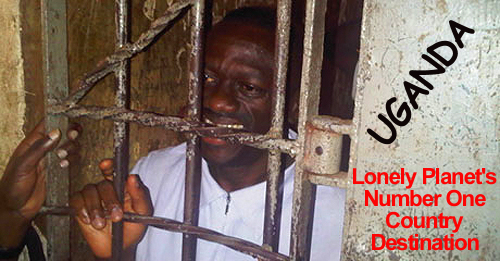
Opposition Leader, Kizza Besigye, after another brutal police action yesterday.
We all know print media is on the decline, but no better example than the once stellar Lonely Planet naming one of the worst countries in the world #1 in its Top Ten Destination List.

Lonely Planet named Uganda #1 explaining, “It’s taken nasty dictatorships and a brutal civil war to keep Uganda off the tourist radar, but stability is returning and it won’t be long before visitors come flocking back.”

That was in November. Stability has not returned; it’s getting manifestly worse. And tourism has sunk to levels not seen since Idi Amin, and rightly so.

Yesterday Uganda’s main opposition leader, and in fact all opposition politicians in Parliament, were arrested without charge, following another (how many now, 24?) brutal battle on the streets of a Kampala suburb. (Most politicians, including the leader Kizza Besigye, were released late today.)

This is not a place you want to visit. Demonstrations have continued since the current dictator’s rigged last election more than a year ago. Tourism has plummeted. The road from the international airport at Entebbe to the capital of Kampala – the only road from the airport – and thence to the rest of the country is lined with police and military.

And even as some of the country’s other lower corrupt politicians try to join the twevolution of Besigye, Yoweri Museveni’s grip is tightening. This week he simply ignored Parliament’s initial moves to impeach him, and there is every indication he will jail anyone associated with moving such legislation forward.

He has jailed, fired and reappointed cronies to Uganda’s judiciary. Patent corruption of the highest kind, giant under-the-table payments from oil companies and huge swindles of private land, are widely known. But today Uganda’s newly reconstituted courts threw out all attempts to allow Parliament to investigate further.

The pattern is identical to the early days of Zimbabwe, and I must admit having traveled in Zimbabwe during the same period, there. Travel right now – if you miss a demonstration and take extra time for military check posts – can actually be an incredible value, since tourist costs have dropped so much.

From a safety point of view, if you miss the demonstrations tourists are more or less being left to their own devices.

But like Zimbabwe, the demonstrations will increase before the country settles into a state of awkward misery, where fuel and sometimes even food becomes scarce. Where officials like park rangers go on the take just to stay alive. It’s hard to predict exactly when such a time occurs.

Lonely Planet’s list was eclectic at the least. Myanmar and Switzerland also made the Top Ten.

About the only truth to Lonely Planet’s naming Uganda is that Uganda is even more lonely than before.

Field of Nightmares

Field of Nightmares

Young Uganda school boys amazingly won the all-African baseball championship and thereby an invitation to the U.S. for the Little League World Series in Williamsport this past summer. But they didn’t come. The American consulate in Kampala denied them visas.

So the day before yesterday, the Canadian little league winners who were scheduled to play the Ugandans in the first round last August, played the Ugandan kids in Kampala. And lost.

In times past, which means before 9-11, the Ugandan schoolboys would have gotten visas. But the sloppiness of their application process, and the fact that they didn’t have the money to hire someone locally who could have helped them, doomed them from the start. If I can’t say it was wrong of the U.S., I must just lament how the world has changed.

Personally aghast at what had happened, Phillies super star shortstop Jimmy Rollins bankrolled the Canadian Little League winners who flew into Uganda last week with Rollins. Rollins wasn’t the only American to help the Ugandan kids. The team had long been coached and funded by American, Richard Stanley, who owns several AA minor league teams in the U.S.

The heart-breaking story is a simple one. The goodwill and extraordinary charity, including not only from stellar individuals like Stanley and Rollins but also from several branches of the U.S. government that funds much of school sports in Uganda, all were trumped by …

… national security.

And who is to say it should have been otherwise? We know how children particularly in Uganda’s part of the world have been coopted, or more truthfully brainwashed, by hideous forces like the Lord’s Resistance Army. We know that as unlikely as any of them might have been active terrorists, that the enormous love that would have been showered on them as individuals from unsuspecting Americans could have been so easily manipulated into odious ways.

None of this might have posed an imminent threat, but the level of resources that would suddenly have had to have been dedicated to monitoring the affair and its endless aftermath was simply “beyond budget.”

Do I really believe all that malarkey? Of course not. They were children, easily contained, easily watched. All you had to do was photograph and fingerprint. It’s an absurd and heart-wrenching story.

What exactly was the State Department worried about?

It seems that the principal concern was that birth dates and names didn’t register with the personal interviews of the applicants by the U.S. consulate in Kampala.

African kids change their names all the time, and few know when they were born. That discrepancy is an honest one that would never occur if a double-agent or dedicated terrorist tried to get into the U.S.

Even Stanley said he accepted the State Department’s decision. And a filmmaker instrumental in publicizing the Ugandan kids’ great baseball story, Jay Shapiro, agreed, too, with the Americans’ decision. They’ve both caved.

A kid with a mitt won’t take down the Twin Towers.

Is this a reflection on the Obama administration, on the budget, on the paranoia of America?

All the above.

African View of Iowa Caucus

African View of Iowa Caucus

Many Africans view the Iowa caucus as not very democratic, governed less by voters expressing preferences than by the media, polls and money.

Me, too.

Nairobi’s heavily listened to radio station, Capital FM, called today’s elections in Iowa “peculiar.” Finding it amusing that “voters .. gather late on Tuesday in church basements, school auditoriums and even in some private homes” the radio station said it was one of the “quirkiest but most important electoral events” for the United States.

I think that most of the educated world has developed a notion of democracy that is much more realistic than we have in the U.S. Pure democracy, which might today be akin to California’s referendums or even simple issue questions that participants endorse or condemn by a simple internet vote, is itself confused by how that “simple issue question” is formulated to begin with.

Democracy is a messy process, however you look at it. Voting fraud, which is not an issue in America, is a grave issue throughout much of Africa. But undemocratic influencing of voting has reached its apex in America, today.

Much of Africa receives its news about America from world sources, since local resources don’t allow foreign correspondents. BBC-Africa Service, News24 (from France) and Radio Netherlands all have services directed at Africa and often produced in Africa by Africans.

The BBC-Africa service has provided the most coverage of the American election. In a video interview with a university professor in Iowa, BBC-Africa claimed that issues were hardly important in today’s election in Iowa, but rather how much attention the winner would get, how it would then effect him/her in the polls and most of all, how much money will then flow into his campaign coffers.

Money for campaigns overwhelms most Africans. Consider that the amount of money this election will likely receive from PACS and superPACS ($2 billion) exceeds the entire national budgets of many African countries. And that could be doubled by individual small contributions.

You can’t help but agree that money is one of America’s most important democratic tools. I don’t think Africans think this necessarily wrong, particularly if it’s fairly managed (which it may not be, now, after recent Supreme Court cases), but what sticks out like a sore thumb is how brazen Americans are that their system is more democratic than others.

“I don’t think Europe is working in Europe. I don’t want Europe here,” Mitt Romney was quoted in fin24, a conservative South African business journal which was nevertheless mocking the idea that Europe isn’t working.

Of course Europe is working for Europeans, and frankly I believe the parliamentary system delivers democratic choices cleaner and quicker than ours.

America is descending from supreme everything, and that’s not all bad. But hopefully we can learn from those in the world ascending, like many in Africa. Becoming jingoistic as suggested by the Romney quote doesn’t aid our transition.

Top Ten 2011 Africa Stories

Top Ten 2011 Africa Stories

Twevolution, the Arab Spring [by Twitter] is universally considered the most important story of the year, much less just in Africa. But I believe the Kenyan invasion of Somalia will have as lasting an effect on Africa, so I’ve considered them both Number One.

1A: KENYA INVADES SOMALIA
On October 18 Kenya invaded Somalia, where 4-5,000 of its troops remain today. Provoked by several kidnapings and other fighting in and around the rapidly growing refugee camp of Dadaab, the impression given at the time was that Kenyans had “just had enough” of al-Shabaab, the al-Qaeda affiliated terrorism group in The Horn which at the time controlled approximately the southern third of Somalia. Later on, however, it became apparent that the invasion had been in the works for some time.

At the beginning of the invasion the Kenyan command announced its objective was the port city of Kismayo. To date that hasn’t happened. Aided by American drones and intelligence, and by French intelligence and naval warships, an assessment was made early on that the battle for Kismayo would be much harder than the Kenyans first assumed, and the strategy was reduced to laying siege.

That continues and remarkably, might be working. Call it what you will, but the Kenyan restraint managed to gain the support of a number of other African nations, and Kenya is now theoretically but a part of the larger African Union peacekeeping force which has been in Somali for 8 years. Moreover, the capital of Mogadishu has been pretty much secured, a task the previous peace keepers had been unable to do for 8 years.

The invasion costs Kenya dearly. The Kenyan shilling has lost about a third of its value, there are food shortages nationwide, about a half dozen terrorist attacks in retribution have occurred killing and wounding scores of people (2 in Nairobi city) and tourism – its principal source of foreign reserves – lingers around a third of what it would otherwise be had there be no invasion.

At first I considered this was just another failed “war against terrorism” albeit in this case the avowed terrorists controlled the country right next door. Moreover, I saw it as basically a proxy war by France and the U.S., which it may indeed be. But the Kenyan military restraint and the near unanimous support for the war at home, as well as the accumulation of individually marginal battle successes and outside support now coming to Kenya in assistance, all makes me wonder if once again Africans have shown us how to do it right.

That’s what makes this such an important story. The possibility that conventional military reaction to guerilla terrorism has learned a way to succeed, essentially displacing the great powers – the U.S. primarily – as the world’s best military strategists. There is as much hope in this statement as evidence, but both exist, and that alone raises this story to the top.

You may also wish to review Top al-Shabaab Leader Killed and Somali Professionals Flee as Refugees.

1B: TWEVOLUTION CHANGES EGYPT
The Egyptian uprising, unlike its Tunisian predecessor, ensured that no African government was immune to revolution, perhaps no government in the world. I called it Twevolution because especially in Egypt the moment-by-moment activities of the mass was definitely managed by Twitter.

And the particular connection to Kenya was fabulous, because the software that powered the Twitter, Facebook and other similar revolution managing tools came originally from Kenya.

Similar of course to Tunisia was the platform for any “software instructions” – the power of the people! And this in the face of the most unimaginable odds if you’re rating the brute physical force of the regime in power.

Egypt fell rather quickly and the aftermath was remarkably peaceful. Compared to the original demonstrations, later civil disobedience whether it was against the Coptics or the military, was actually quite small. So I found it particularly fascinating how world travelers reacted. Whereas tourist murders, kidnapings and muggings were common for the many years that Egypt experienced millions of visitors annually, tourists balked at coming now that such political acts against tourists no longer occurred, because the instigators were now a part of the political process! This despite incredible deals.

We wait with baited breath for the outcome in Syria, but less visible countries like Botswana and Malawi also experienced their own Twevolution. And I listed 11 dictators that I expected would ultimately fall because of the Egyptian revolution.

Like any major revolution, the path has been bumpy, the future not easily predicted. But I’m certain, for example, that the hard and often brutal tactics of the military who currently assumes the reins of state will ultimately be vindicated. And certainly this tumultuous African revolution if not the outright cause was an important factor in our own protests, like Occupy Wall Street.

3: NEW COUNTRY OF SOUTH SUDAN
The free election and emergence of South Sudan as Africa’s 54th country would have been the year’s top story if all that revolution hadn’t started further north! In the making for more than ten years, a remarkably successful diplomatic coup for the United States, this new western ally rich with natural resources was gingerly excised from of the west’s most notorious foes, The Sudan.

Even as Sudan’s president was being indicted for war crimes in Darfur, he ostensibly participated in the creation of this new entity. But because of the drama up north, the final act of the ultimate referendum in the South which set up the new republic produced no more news noise than a snap of the fingers.

Regrettably, with so much of the world’s attention focused elsewhere, the new country was hassled violently by its former parent to the north. We can only hope that this new country will forge a more humane path than its parent, and my greatest concern for Africa right now is that global attention to reigning in the brutal regime of the north will be directed elsewhere.

4: UGANDA FALTERS
Twevolution essentially effected every country in Africa in some way. Uganda’s strongman, Yoweri Museveni, looked in the early part of the last decade like he was in for life. Much was made about his attachment to American politicians on the right, and this right after he was Bill Clinton’s Africa doll child.

But even before Twevolution – or perhaps because of the same dynamics that first erupted in Tunisia and Egypt – Museveni’s opponents grew bold and his vicious suppression of their attempts to legitimately oust him from power ended with the most flawed election seen in East Africa since Independence.

But unlike in neighboring Kenya where a similar 2007 election caused nationwide turmoil and an ultimate power sharing agreement, Museveni simply jailed anyone who opposed him. At first this seemed to work but several months later the opposition resurfaced and it became apparent that the country was at a crossroads. Submit to the strongman or fight him.

Meanwhile, tourism sunk into near oblivion. And by mid-May I was predicting that Museveni was the new Mugabe and had successfully oppressed his country to his regime. But as it turned out it was a hiatus not a surrender and a month later demonstrations began, twice as strong as before. And it was sad, because they went on and on and on, and hundreds if not thousands of people were injured and jailed.

Finally towards the end of August a major demonstration seemed to alter the balance. And if it did so it was because Museveni simply wouldn’t believe what was happening.

I wish I could tell you the story continued to a happy ending, but it hasn’t, at least not yet. There is an uneasy calm in Ugandan society, one buoyed to some extent by a new voice in legislators that dares to criticize Museveni, that has begun a number of inquiries and with media that has even dared to suggest Museveni will be impeached. The U.S. deployment of 100 green berets in the country enroute the Central African Republic in October essentially seems to have actually raised Museveni’s popularity. So Uganda falters, and how it falls – either way – will dramatically alter the East African landscape for decades.

5: GLOBAL WARMING
This is a global phenomena, of course, but it is the developing world like so much of Africa which suffers the most and is least capable of dealing with it. The year began with incessant reporting by western media of droughts, then floods, in a confused misunderstanding of what global warming means.

It means both, just as in temperate climates it means colder and hotter. With statistics that questions the very name “Developed World,” America is reported to still have a third of its citizens disputing that global warming is even happening, and an even greater percentage who accept it is happening but believe man is not responsible either for it occurring or trying to change it. Even as clear and obvious events happen all around them.

Global warming is pretty simple to understand, so doubters’ only recourse is to make it much more confusing than it really is. And the most important reason that we must get everyone to understand and accept global warming, is we then must accept global responsibilities for doing something about it. I was incensed, for example, about how so much of the media described the droughts in Africa as fate when in fact they are a direct result of the developed world’s high carbon emissions.

And the news continued in a depressing way with the very bad (proponents call it “compromised”) outcome of the Durban climate talks. My take was that even the countries most effected, the developed world, were basically bought off from making a bigger stink.

Environmentalists will argue, understandably, that this is really the biggest story and will remain so until we all fry. The problem is that our lives are measured in the nano seconds of video games, and until we can embrace a long view of humanity and that our most fundamental role is to keep the world alive for those who come after us, it won’t even make the top ten for too much longer.

6: COLTAN WARS IMPEDED
This is a remarkable story that so little attention has been given. An obscure part of the Dodd-Frank Wall Street Reform Act essentially halved if not ultimately will end the wars in the eastern Congo which have been going on for decades.

These wars are very much like the fractional wars in Somalia before al-Shabaab began to consolidate its power, there. Numerous militias, certain ones predominant, but a series of fiefdoms up and down the eastern Congo. You can’t survive in this deepest jungle of interior Africa without money, and that money came from the sale of this area’s rich rare earth metals.

Tantalum, coltran more commonly said, is needed by virtually every cell phone, computer and communication device used today. And there are mines in the U.S. and Australia and elsewhere, but the deal came from the warlords in the eastern Congo. And Playbox masters, Sony, and computer wizards, Intel, bought illegally from these warlords because the price was right.

And that price funded guns, rape, pillaging and the destruction of the jungle. The Consumer Protection Agency, set up by the Dodd-Frank Act, now forbids these giants of technology from doing business in the U.S. unless they can prove they aren’t buying Coltran from the warlords. Done. War if not right now, soon over.

7: ELEPHANTS AND CITES
The semi-decade meeting of CITES occurred this March in Doha, Qatar, and the big fight of interest to me was over elephants. The two basic opposing positions on whether to downlist elephants from an endangered species hasn’t changed: those opposed to taking elephants off the list so that their body parts (ivory) could be traded believed that poaching was at bay, and that at least it was at bay in their country. South Africa has led this flank for years and has a compelling argument, since poaching of elephants is controlled in the south and the stockpiling of ivory, incapable of being sold, lessens the funds that might otherwise be available for wider conservation.

The east and most western countries like the U.S. and U.K. argue that while this may be true in the south, it isn’t at all true elsewhere on the continent, and that once a market is legal no matter from where, poaching will increase geometrically especially in the east where it is more difficult to control. I concur with this argument, although it is weakened by the fact that elephants are overpopulated in the east, now, and that there are no good strategic plans to do something about the increasing human/elephant conflicts, there.

But while the arguments didn’t change, the proponents themselves did. In a dramatic retreat from its East African colleagues, Tanzania sided with the south, and that put enormous strain on the negotiations. When evidence emerged that Tanzania was about the worst country in all of Africa to manage its poaching and that officials there were likely involved, the tide returned to normal and the convention voted to continue keeping elephants listed as an endangered species.

8: RHINO POACHING REACHES EXTREME LEVELS
For the first time in history, an animal product (ground rhino horn) became more expensive on illicit markets than gold.

Rhino, unlike elephant, is not doing well in the wild. It’s doing wonderfully in captivity and right next to the wild in many private reserves, but in the wild it’s too easy a take. This year’s elevation of the value of rhino horn resulted in unexpectedly high poaching, and some of it very high profile.

9: SERENGETI HIGHWAY STOPPED
This story isn’t all good, but mostly, because the Serengeti Highway project was shelved and that’s the important part. And to be sure, the success of stopping this untenable project was aided by a group called Serengeti Watch.

But after some extremely good and aggressive work, Serengeti Watch started to behave like Congress, more interested in keeping itself in place than doing the work it was intended to do. The first indication of this came when a Tanzanian government report in February, which on careful reading suggested the government was having second thoughts about the project, was identified but for some reason not carefully analyzed by Watch.

So while the highway is at least for the time being dead, Serengeti Watch which based on its original genesis should be as well, isn’t.

10: KENYAN TRANSFORMATION AND WORLD COURT
The ongoing and now seemingly endless transformation of Kenyan society and politics provoked by the widespread election violence of 2007, and which has led to a marvelous new constitution, is an ongoing top ten story for this year for sure. But more specifically, the acceptance of this new Kenyan society of the validity of the World Court has elevated the power of that controversial institution well beyond anyone’s expectations here in the west.

Following last year’s publication by the court of the principal accused of the crimes against humanity that fired the 2007 violence, it was widely expected that Kenya would simply ignore it. Not so. Politicians and current government officials of the highest profile, including the son of the founder of Kenya, dutifully traveled to The Hague to voluntarily participate in the global judicial process that ultimately has the power to incarcerate them.

The outcome, of course, remains to be seen and no telling what they’ll do if actually convicted. It’s very hard to imagine them all getting on an airplane in Nairobi to walk into a cell in Rotterdam.

But in a real switcheroo this travel to The Hague has even been spun by those accused as something positive and in fact might have boosted their political standing at home. And however it effects the specific accused, or Kenya society’s orientation to them, the main story is how it has validated a global institution’s political authority.
Maple Leaf is Oxidizing

Maple Leaf is Oxidizing

If you thought everything Canada is green and good, think again. Canadian mining is destroying Africa. And maybe destroying Canada.

The Canadian “extractive industry” as our Canadian cuzzes obliquely call it, is exploding. Literally, as GDP for Canada and as dynamite and gunfire in Africa. Numerous human rights violations across the continent have been documented against Canadian companies.

One of the worst incidents occurred in Tanzania in May. I’ve written about the North Mara gold mine before, operated by Canada’s Barrick Corporation. I think it how lovely now that the company’s own website lists some of the gravest allegations against itself.

In May Barrick admitted police aided by its private security forces shot to death 7 “intruders” and wounded others. Reports suggested as many as 1,000 people were involved. And clearly there is complicity by Tanzanian officials, which is now being investigated in parliament.

But it is the brashness of Canadian companies which stokes African ire. The CEO of one of Canada’s most aggressive African mining companies, IAMGOLD, recently told journalists in response to a strike called at one of his mines in Burkina Faso that he would crush the “illegal strike and as they will find out, will not tolerate anything that has a negative impact on our stakeholders.”

Well, that’s not particularly soothing PR for an industry blemishing the earth, and Canadians over the years were beginning to feel remorse. A year ago Parliament was about to pass Bill C-300, but the mining lobby and conservative Harper government managed to kill it. The bill would have imposed the same human rights regulations on Canadian companies operations in Africa as it imposes on those same company’s operations in Canada.

One unexpected result has been that groups as disparate as Burkina Faso mothers and Nigerian teachers are now suing Canadian companies broadside in Canada. The suits are so successful that there are plenty of lawyers to take them on.

So having lost that PR battle, and having lost all sorts of civil suits, the Canadian government has achieved a novel alternative.

The government has “developed a partnership” between many of these insidious mining companies and otherwise respectable NGOs. Here’s the three top:

World University Service of Canada (WUSC) has partnered Rio Tinto Alcan. Plan Canada has teamed up with IAMGOLD. And World Vision Canada has joined forces with Barrick Gold, the Tanzania devil.

A few seconds before this was announced it would have been thought an idea for the Onion or Daly Show. But it’s real. In effect the Canadian government has bought off otherwise good charities to polish up the image of its tarnished silverware. These organizations get up to a million dollars each to, in the words of WUSC CEO, “nudge along good practices.” Holy Smokes. Literally.

Each partnership is odious. Plan Canada’s mission as a principal advocate for child development has some explaining to do ever since IAMGOLD closed down operations at its Essakane mine in Burkina Faso due to strikes in part alleging illegal use of child labor.

Hm.

World Vision, one of the most aggressive religious NGOs that I’ve often claimed is one of the few excellent ones in Africa, is partnered with the gold trolls, Barrick. I just don’t think they’re going to get even an ounce for the wise men.

It’s all such a monstrous if laughable window dressing. I heard recently that not-for-profits were hurting this year. How? For money? Or mission statements?

AirZim AirGone

AirZim AirGone

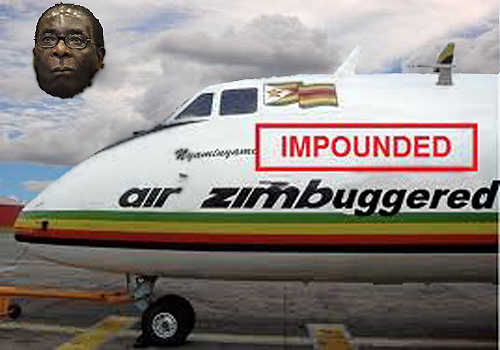
How I wish the end of Air Zimbabwe would be Mugabe’s nail in the coffin. But this vampire gives no impression of leaving before he’s melted by sunlight.

Yesterday Zimbabwe’s diaspora media broke the story: Air Zimbabwe’s one and only 767 had been impounded by the maintenance company owed $1.2 million dollars.

Then, with typical zany Zimbabwean zest, Zim moneybags apparently raised the ransom to pay off the debtor, but the plane still isn’t leaving and we’re not sure why. Well, for the facts, read the Zimbabwe government newspaper, The Herald, and then presume just the opposite:

(1) They didn’t raise the money.
(2) The staff including pilots of the airplane are too scared to return home. After all, someone will have to be punished for such an unwarranted delay.

Either way, a relatively unused although older 767 sits today on the tarmac at Gatwick airport. And you might say that about almost everything of the modern age in Zimbabwe, including the opposition leader and powerless prime minister, Morgan Tsvangira, who once led bloody protest marches but now spends his time explaining why he won’t let a woman into his house who claims to have had his child.

Everything in Zimbabwe has been coopted and drained to the core by its self-appointed evil master, Robert Mugabe. It is one of the most tragic tails in Africa: how this once prosperous, richly resourced, highly educated country can achieve nothing now but misery and comic notoriety.

The 767 is the perfect mascot. This plane often didn’t fly; usually because it had no passengers, but more often because of unpaid bills here and there. That is Robert Mugabe’s standard operating procedure: do. So when he did, but had no money to pay for it, he just waited until someone else paid for him. Usually that was South Africa, and in the case of the 767, China.

The 767’s weekly routine begins Friday night with a scheduled departure from Harare to Peking via Kuala Lumpur. There are several reasons for this bold route. First, Mugabe probably knows that one day he’s going to have to run. And to China might be the only alternative.

Mugabe is reported in some quarters to be 120 years old. In any case, he’s suffered innumerable diseases, including throat cancer, most of which have been treated in a Malaysian hospital which only takes cash. He’s managed to take Rand from South Africa and Yuan from China to pay doctors in Kuala Lumpur.

And the 767 plane is often filled with lots of cronies who have lots of other diseases, so this southern African medivac is welcomed by KL’s underpaid doctors.

Two. China never turns away a foreigner in need. So they buy our treasury bills, and they refuel the 767 and they force lower diplomats to use the airline on their way to Africa. This way China will eventually rule the world.

Three. No one notices when the plane doesn’t fly two out of three weeks or so.

The plane turns around in China and comes back to Harare arriving Sunday morning at 615a, and then Sunday morning at 8 a.m. it’s scheduled to fly to Gatwick arriving Sunday night, but that ridiculous schedule never happens.

All day Monday it’s supposed to get maintained in Gatwick – you know, oil changes and such. Then Monday night it returns to Harare arriving Tuesday morning. Then, until Friday, it’s now at the disposal of the President.

Now there’s a business plan for you! (It until recently flew midweek to Kinshasa, but that was suspended.)

Zimbabwe is an unreal, a scatological nation held together by outside forces: China as a part of its world strategy to dominate the earth; South Africa in order to keep out refugees who would overwhelm it should any real revolution begin.

So now, Mugabe’s escape is reduced to the range of a 737. AirZim might have one of those left working.

War: Month 2

War: Month 2

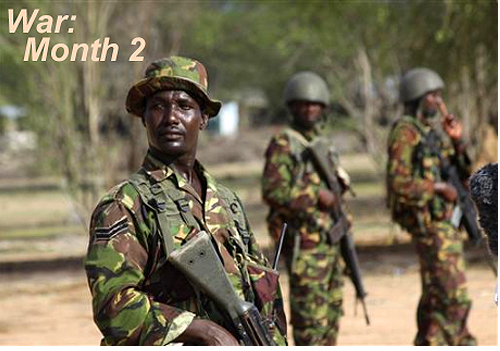
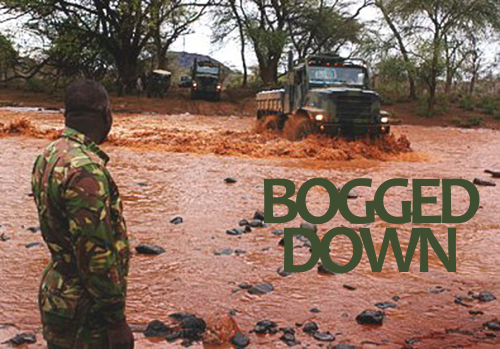
It’s clear that Kenya’s invasion of Somalia will be lengthy. The army is not moving quickly, there is hardly any action at all, and Kenya seems content to occupy the bit of land they’ve conquered while letting the initially stated objective of Kismayo disappear.

In the end the strategy could work. Al-Shabaab while ruling much of Somalia is not really a very good governing entity: they are fighters not administrators. Kenya and France seem to have laid a siege over the port of Kismayo. Starving al-Shabaab might be the prudent “way out.”

The respected African analysis, Robert Rotberg, said last week he thought the Kenyan slowdown was because of heavy rains. But the emeritus prof has got that a bit wrong; rains in eastern and southern Somalia have abated considerably in the last several weeks. The Kenyans haven’t been stopped by water.

But the rest of Rotberg’s analysis had some compelling aspects to it. “Al-Shabaab’s days as a sustainable and robust fighting force are rapidly coming to an end,” and I agree. He also posits a UN trusteeship for what will “come after” the Kenyan/Ethiopian victory, very much as Southwest Africa was established under South Africa following World War II.

Kenya roared into Somali nearly two months ago, then screeched to a dead stop when it became clear that al-Shabaab was fortifying a city northwest of Kismayo, which could conceivably clench the Kenyan military in a pincer action if they continued to the sea.

As the war begins its second month, Kenya’s 3-4,000 troops have lost 4 in action, 6 in accidents and ten more wounded. Not bad.

So… Kenya stopped, and there it’s been for some time. In place of fighting a remarkable diplomatic effort by Kenya has laid the ground for their lengthy involvement. First, they reversed the initial displeasure of the puppet government in Mogadishu. Then, they exposed Eritrea as supplying al-Shabaab’s military. And finally, they’ve kept both America with its drones and France with its naval gunships involved.

At home the terrorist threat of al-Shabaab has diminished. The first couple weeks saw grenade attacks in Kenyan churches, bombs in Nairobi bars and a restless Somali population. That’s settled. Personally, I still don’t think it wise to restart tourism in Kenya, but I’m very glad that the threats to the Kenyan population seem to have diminished.

But the war is a terrible drain on Kenyan resources. The country is preparing for its first election after the new constitution. Its shilling is in the tank with no indication it will recover. Economically this war is the last thing Kenya needs.

Kenya believes this effort will, literally, keep al-Shabaab at bay, the bay at Kismayo. And if the siege ultimately works, perhaps Kenya can walk to the seaside without firing a gun. It sounds crazy and beautiful. We’ll just have to wait it out … with the Kenyans.

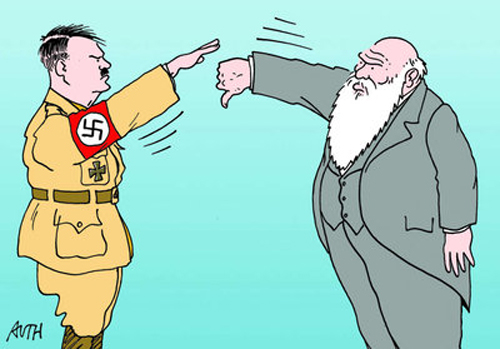
The Evolution of Republicans

The Evolution of Republicans

By the Philadelphia Inquirer's Tony Auth.
Sometimes I wish American politics would just hang clear of my Africa, but how naive I guess. Evolution is founded in, based in, spectacular in Africa, and it’s increasingly a hot-button issue in current Republican politics. I’m embarrassed to write about this, but the amount of ignorance among potentially very powerful people is flabbergasting and increasingly terrifying.

Herbert Cain hasn’t said, and that’s the point. He’s going to have to, soon. He can’t maintain his lead without addressing these issues which are part and parcel to the beliefs of those who will choose the candidate.

And by the way, Cain has a few other problems at the moment.

Jon Huntsman is the only major Republican candidate to embrace evolution. “To be clear. I believe in evolution and trust scientists on global warming.” Jon Huntsman is also the only major Republic candidate without a chance of winning.

Mitt Romney accepts evolution as science. But his mission to stay afloat in the hurricane season in the Bermuda triangle forces him into multitudes of qualification. “God created the universe” and evolution “created the human body.”

Detailing exactly what he believes would probably wreck his campaign.

Only Newt Gingrich can out hedge Romney. When asked specifically about evolution, he angled his response, “I believe that creation as an act of faith is true, and I believe that science as a mechanical process is true,” Gingrich told reporters in May. “Both can be true.”

And have absolutely nothing to do with one another or evolution.

Rick Perry concedes that “evolution is a theory” but “with gaps in it.” No, there aren’t his kind of gaps in it, but more important, he pulls no punches in terms of what he’ll do if he can: “I am a firm believer [that] intelligent design … should be presented in schools. “

He’s been successful in Texas, where intelligent design has been incorporated into middle school text books and evolution qualified. It’s a huge and horrible story in itself.

Michele Bachmann “supports intelligent design,” and supports it by lying, “There are hundreds and hundreds of scientists, many of them holding Nobel Prizes, who believe in intelligent design.”

Well, of course that’s not true, as is the case with much that Bachmann says day after day as though it’s gospel. (Maybe that’s the problem with her followers: they make up gospel.)

Unequivocally as his best credential Ron Paul states, “There is a theory… of evolution, and I don’t accept it,” Paul said.

Then there’s the bottom of the evolutionary chain, the last link so to speak. Rick Santorum makes the ridiculously untrue, not-even-a-metaphor pandering parallel that belief in evolution means you “are a descendant of a monkey,” and goes on to insist this nonsense is just one of “the many other liberal beliefs [of] Democrats.”

As a Senator from Pennsylvania he proposed the “Santorum Amendment” to the 2001 No Child Left Behind Act that would have forced public schools to offer the creationist perspective in science classes, and to call into question the scientific evidence supporting evolution. That amendment was rejected.

That’s what we got to work with. One reasonable man without a hope who isn’t really a Republican, one man hiding on the run, two ducking and three wackos.

The candidates are driven by the right-wing Christian media, particularly talk radio. And the last few weeks have taken the ridiculous into the abstract sublime. You just won’t believe what right-wing talk radio is discussing these last few weeks with regards to evolution.

The current evolution topic is whether Darwin’s theories of natural selection contributed to Hitler’s Nazi holocaust.

Say what?

And so, therefore, Hitler was not a Christian.

Of course.

I know it’s unbelievable. I actually felt it was better to just not to wade into this, because the threads of logic were so knotted up.

“Nazism was not science-based,” Univ. of Minnesota biologist PZ Myers wrote last week, “Hitler was a true Christian.”

Somehow, whether Hitler was a Christian depends upon whether Christians believe in evolution, but evolution is science and if they don’t, then they aren’t Nazis, either? This is the new litmus test for Republican candidates. Can you phrase it better than me?

This ridiculous dispute became so prominent lately that University of Chicago professor Robert Richards issued a White Paper, “Was Hitler a Darwinian?“ with 45 pages of careful history, heavily annotated, in order to conclude “The only reasonable answer to the question that gives this essay its title is a very loud and unequivocal No!”

And Monday, the respected Philadelphia science journalist, Faye Flam, wrote that serious historians today “agree that any whiff of Darwinism in Hitler’s speech or writing was merely window-dressing.”

But we all know in today’s world that facts and logic don’t mean very much, so why try? We try, because it keeps us sane.

I just hope the election will fall however marginally with the sane.

Sharpen the knives for that Turkey!

Sharpen the knives for that Turkey!

In a topsy-turvy world where rain is not good and war is fought in daylight as you sleep, the sum total of the world’s misery explodes, and you prepare for Thanksgiving.

Kenya’s invasion of Somalia will be long and self-destructive unless the west decides to increase its military involvement, or unless Kenya figures out a way to spin failure and go home. For the sake of Kenya, I hope the latter.

The BBC reported today that the Kenyan military chief has conceded that the operation is taking longer than expected. As we well know from our own adventures, this is soldier-talk that the original drawing board was pure fantasy. I said a week ago that we would know today whether the operation was going to achieve some success in a reasonable time or not.

Not.

All we can hope for now is that Kenya will study carefully the history of Ethiopia’s invasion of Somalia five years ago and go home, and hopefully much more quickly than Ethiopia did.

But I doubt that, too. It isn’t just a matter of Kenyan national pride, now, but enough hard evidence emerged last week that we are now certain both France and the U.S. are pushing Kenya hard to do exactly what it’s doing, softening the enemy.

Whether either of those super powers, which are sending occasional missiles from off-shore and drones from secret bases in the area, has a threshold for greater involvement is hard to say. France is never shy about military involvement, but Obama’s reelection could be seriously jeopardized by more overt action.

Today, Kenya’s prime minister told a meeting of African leaders “not to blame foreigners, but ourselves” for the military involvement in Somalia. Hopefully, local Kenyans took that to mean “giving room to the West to intervene.”

The week started miserably when Kenya’s poorly trained air force bombed a refugee camp killing dozens of civilians. “Most of the victims were women and children,” the New York Times Josh Kron reports citing Doctors without Borders.

“Military action risks worsening the effects of famine on the Somali people, and pushing more people ‘beyond the reach of aid agencies’,” the international aid group, Oxfam said Friday.

And there are more and more refugees.

And while the BBC reported today that good if not better than expected rains “have eased the drought“ that news isn’t welcomed. There are so many displaced persons, no crops that have been planted and no plants to hold the water, that the effect of the rain is erosion and disease.

And within Kenya a “Patriot Act,” similar to our own despicable human rights atrocity, is gaining momentum as Kenyans fear retribution is certain.

It is a very grim story to tell, today. I can’t help feeling that it’s our fault, and by “our” I don’t mean the Democrats and President Obama, I mean western society for a hundred a years of selfishness and greed. There is just so much wealth in the world, we can extract natural resources at just a certain rate. There is limited comfort as a result, and we have reached the point that to maintain a modicum of what we historically achieved, much of the world must squander in abject misery and war.

Yes, to use a favorite nonpartisan political phrase, we are blessed… to be here, rather than there.

Africa’s Process of Elimination

Africa’s Process of Elimination

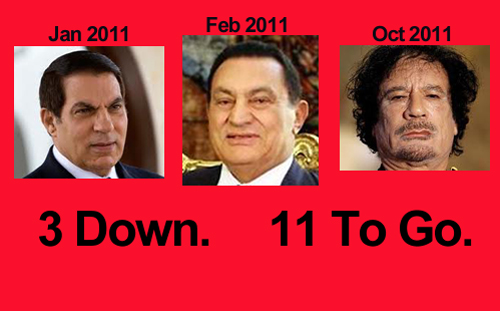
Three African despots down. Eleven to go. Here’s my list and predictions of when the last of the African dictators will fall.

Is it possible to think of a world without dictators? Can you imagine no Kim Jong Il, the “Stans” with free wifi elections, Hugo sent back to his banana farm or Ahmadinejad retired as a Fox News anchor?

I can’t speak about the rest of the world, but yes, I can imagine an Africa without ruthless despots, and Twevolution is knocking them down the continent from top to bottom. Only a few years ago I would have thought this impossible.

What’s happened in Africa started with this near obsessive demand for education, and over the years I was so critical of all sorts of different African forms of education for all sorts of different reasons. But that all seems so trivial, now. Whatever flawed system might have delivered it, delivered it it did. From Tanzania’s mandated free education in the early years of independence, to more sophisticated forms in Egypt, it worked.

I think I was too focused on what was being taught, the curriculum, rather than just the teaching itself. Teaching young kids – even when forced down their throats or teaching “incorrect” things – obviously instills curiosity.

In my life time, Africa has made the longest journey in education of any part of the world. When I began my career there in the early 1970s, there were vast portions of the continent that didn’t even know there was more to the universe than themselves.

My wife and I brought the first refrigerator into a remote part of western Kenya. Powered by natural gas, it nearly installed me as a local despot myself, or a shaman. When ice cubes were placed on the hands of children, they thought I was burning them to death.

How remarkably different that place in western Kenya is, today, with nascent global call centers and plans for a solar panel industry. What must grandma think?

The second critical component to today’s dramatic political change is the internet.

That’s twevolution. A young Kenyan woman started the whole social networking organization of civil disobedience when Kenya imploded after its last election. Ory Okolloh spearheaded the founding of Ushahidi and is now Google’s Policy Manager for Africa.

But while the internet may be the new “weapon” of revolutionary change, it had a much much greater impact much earlier. I remember before cheap cell phones and easy access to computers in Kenya the dozens and dozens of internet cafes in Nairobi.

And the kids were packed into them like sardines! What were they doing? Playing games? Looking for a job? Or, maybe, learning about the better things in the life… Or, maybe, about the gross injustices that divide the world’s privileged from those who serve the privileged?

There are still pretty bad guys in control of 11 of Africa’s 54 countries. I can imagine every one of them gone in the next decade.

They fall broadly into two categories: 7 zealots and 4 victims. The victims will fall last and perhaps not with more than a thud. But the zealots will tumble into al-Jazeera videos screaming.

The zealots are composed of widely different men whose path to tyranny was varied. But they now share a narcissistic certainty, a near divine belief, that they should rule no matter what. Their countries of Zimbabwe, Sudan, Gambia, Burkina Faso, Cameroon, Equatorial Guinea and Uganda are in various stages of abject servitude.

They are making themselves, their friends and families wealthy often with impunity at the expense of their citizens. They believe so much in their self-conceived right to rule that they often fail to hide their crimes, deluded that they can do no wrong, or perhaps that there are none remotely capable of challenging them.

How wrong Gadhafi was.

These guys go first.

The second batch I even find sympathy for, but they’re on the way out nonetheless. I call them victims because essentially they started as true liberators with extremely lofty ideals and plans, but they got ensnared in societies with the deepest ethnic divisions in the continent, and with a concomitant division of education.

Rwanda, Chad, Eritrea and Ethiopia are today headed by ruthless men who are nonetheless loved by a large segment of their population, the segment from which they were born.

They believe, quite possibly truthfully, that loosening the reigns of dictatorship will bring catastrophe on their entire country as it reverts to the chaos from which they long ago thought they liberated it. These victims at least ostensibly put “country” before “self.” The zealots don’t even have this as a pretense.

That’s Africa. Where education delivered the dreams and the internet facilitated revolutionary change. Will the rest of the world follow suit?

No War Games on Safari

No War Games on Safari

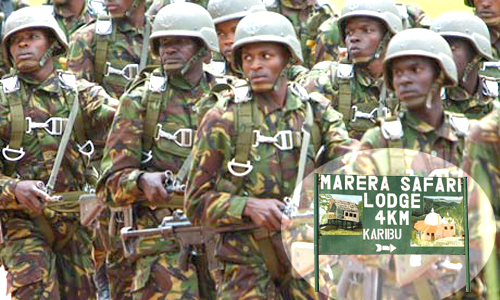
Today Kenya invaded Somalia. The speed and size of the mission surprised me and I’m sure greatly pleased Leon Panetta. It’s hard to predict the outcome, but one thing strikes me as certain: this is not a time to take a Kenyan safari.

Most news sources reported the Kenyan military operation as a response to a spat of recent kidnapings, and I don’t doubt this has something to do with it. But it could also be a partial excuse for a more globally organized effort against what appears at the moment to be a successful rout of al-Shabaab from Somalia.

The size of the Kenyan excursion is secret, but there were enough eye witness reports on the ground to confirm a major operation. The BBC and AlJazeera (who has a reporter embedded with the Kenyan forces) reported “lines of Kenyan tanks and trucks” and multiple air strikes against an al-Shabaab base about 75 miles inside Somali territory.

The local Nairobi newspaper The Nation reported at least 32 trucks and tanks and London’s Guardian newspaper reported multiple aircraft bombing al-Shabaab positions to the east.

Africa Union forces led by Ugandan soldiers in the last several weeks have routed al-Shabaab from the Somali capital of Mogadishu. The BBC reporter Will Ross said these forces were now working in tandem with the Kenyans, moving south from the capital towards the conflict area where the Kenyans are, headed to what could be a pincer action to rid a large portion of Somali of al-Shabaab.

Last week the Obama administration sent 100 Green Berets into Uganda for deployment further west into central Africa. The statement of deployment claimed a mission totally separate from this conflict, but last night on CBS Panetta said the operation was integrated with fighting terror in Africa.

With Obama’s long list of al-Qaeda captures and kills recently, we know that the al-Qaeda/al-Shabaab power has been significantly diminished. Is this their last hurrah? Might the Ugandans, Kenyans and Americans actually be getting rid of these terrorist organizations?

I wish I felt the answer was a definitive yes, but frankly I think rather it’s a hopeful maybe. I’m no expert historian, but I just don’t see ridding any part of the world of anything, unless the people actually living there do it themselves.

And the Somalis haven’t. The parallels with Afghanistan and even Iraq are substantial. I don’t even believe that Iraq will be stable in ten years. And if I’m wrong and it is, then the question becomes was it worth the 20 years of war and investment we made to make it so?

That’s the greater, global question. But for those of us much closer to the situation, our lives and our businesses are immediately effected. Tourism must go on hold in Kenya, now, until we see what happens.

It’s been widely reported that al-Shabaab has now threatened Kenya. Last year al-Shabaab killed more than 70 people in two simultaneous bomb blasts in Kampala sports bars where patrons were watching the World Cup. They specifically threatened such before it happened because of Uganda’s lead role in the African Union forces in Mogadishu, and immediately then took responsibility. The parallel with Kenya can’t be starker.

I don’t think it will happen in Kenya. I think al-Shabaab is too much of a spent force and now too engaged outside Kenya. And Kenyan security is better than Uganda’s. So my visceral concern for my own Kenyan employees and friends is minimal.

But you don’t take a vacation where you have to keep looking over your shoulder. That’s not what a good safari is supposed to be. So while I’m not expecting trouble, the chance is more real than before, and equal if not better alternatives are available elsewhere, particularly in Tanzania.

Until the battles end and the dust settles, Kenya has become too troubled a place for tourists.

War Games in Africa

War Games in Africa

The Green Beret deployment last week in Uganda reflects an increasingly militaristic Obama policy that like all war endeavors ends up compromising other very important policies, like democracy. Is it working, and why now?

The Obama Administration went out of its way to emphasize that U.S. troops will not operate in Uganda but are simply using it as a staging area to catch the renegade militia leader, Joseph Kony.

Kony is probably in the Central African Republic (CAR).

Apparently there’s not the right airports or staging areas in the new South Sudan, and certainly not in The Congo or CAR to handle even a few (100) soldiers and their equipment. Possibly no easy political entry, either.

Nevertheless, many will think otherwise. Uganda, as I’ve written, is not the most stable place right now. And the bad guys are those in power who will obviously get a boost locally from the arrival of American troops, no matter where they’re supposed to go.

But Obama’s on a roll nailing al-Qaeda and its allies, and last week Uganda led the forces in Somalia which routed al-Shabaab from the capital, Mogadishu.

Kenya, this weekend, moved its troops across the border into Somalia, something I’m sure that America has been encouraging it to do for some time.

So as the saying goes, it’s payback time.

Al-Qaeda is of equal if not more interest to the U.S. than to many countries in East and Central Africa. Those countries’ biggest concern has always been the militias in the eastern Congo and South Sudan, including the old Interhamwe and the newer Lord’s Resistance Army (LRA).

Like al-Qaeda, both those and other lesser militias are on the run. I see this as tit for tat. You (East Africa) help us wipe out al-Qaeda, and we’ll help you wipe out the LRA.

This isn’t just my analysis. The Enough Project and The Long War Journal, among a number of other NGOs heavily involved in the area, postulate the same.

War has an ugly history that way.

The LRA (Lord’s Resistance Army) is a spent but still active guerilla force most famous for its abduction and enslavement of child soldiers. It wrecked havoc in northern Uganda/southern Sudan for nearly 15 years until it was forced out of the area almost ten years ago.

Oh, and by the way, there’s two interesting side stories to note as well.

The first I’m sure the Obama administration is sensitive to, but it’s remarkable so little has reached the world press:

The Obama Administration’s avowed explanation for entering deepest, dark Africa is to hunt down the LRA captain, Joseph Kony, just like they’ve been hunting down al-Qaeda leaders. Interestingly, Kony’s second-in-command was just ordered freed by a Uganda court after being apprehended and put on trial.

Thomas Kowyelo was apprehended by Ugandan military about a year ago. Two weeks ago, a Ugandan Appeals Court ordered his release upholding the agreements that offered amnesty signed in 2006 and 2007. (Kowyelo remains jailed pending a prosecution appeal to Uganda’s Supreme Court.)

Seven years ago a peace agreement was signed between what was left of the LRA and the Ugandan government. This agreement among many good things had a flawed section which awarded undefined “amnesty” to any LRA soldier.

Both Kony and Kowyelo have been indicted by the International Criminal Court (ICC) for crimes against humanity. This technically mandates any country that recognizes the ICC (most of Africa including Uganda) to arrest them and send them to The Hague for trial.

But so far Uganda’s courts have given priority to the peace agreement signed with the LRA over international treaties. Perhaps Obama is worried Uganda will actually catch Kony before he does.

The other side story is a bit more amusing.

I wrote Friday about Michele Bachman’s faith advisor having been deeply involved in clandestine organizing of African militias to kill Kony. He was even jailed in Uganda for illicit arms dealing and other mercenary charges.

The only Republican candidate to criticize the deployment was, you guessed it, Michele Bachmann.

This Mojo Got Real Spirit!

This Mojo Got Real Spirit!

A paid staffer for Michelle Bachmann was imprisoned in Uganda for terrorism and illicit arms deals with Congo rebels linked to the current serious turmoil in Uganda. Did you know about this?!

Last week Peter Waldron convened evangelical Iowa ministers in Des Moines to discuss political strategy to help Bachmann.

Five years ago, according to The Atlantic which broke the story on August 17, he was sent to Uganda’s Luriza Prison convicted of terrorism and illicit arms dealing. My Google pretags and all the media I read about Africa didn’t bring it to my attention.

I do read The Atlantic from time to time, but it took a casual look at a Ugandan’s blog, yesterday, for me to finally learn about it. Obviously I have serious interest in this, but shouldn’t the whole world have serious interest in this!?

There’s a lot more to this story. Fast forward to today: Waldron has tried to turn this normally terminating revelation to his profit. He’s making a movie about himself, and will portray his time in Ugandan prisons as a hero’s suffering for righteous causes.

Holy Smothering Smokes! This is absolutely incredible! I know it’s what the right does all the time, twists bad into good. But this is unbelievable:

Bachmann’s press secretary, Alice Stewart, replied in an email to The Atlantic: ‘We are fortunate to have him [Waldron] on our team and look forward to having him expanding his efforts in several states.’

He’s a mercenary! He’s an arms dealer! He’s a crook and about as bad a guy as you can get!

More. Here’s what the respected Ugandan blogger, Mark Jordahl, said about Waldron two days after the story appeared:

“I happen to know some people who … went to his apartment one evening. The table was covered with pornography, and there were a number of attractive young ladies hanging around. I’m sure he was just talking to them about the evils of pornography.”

And, oh by the way, he’s the Michele Bachmann campaign’s faith advisor. Paid. Still. Today.

Oh-oh, and by the way, after The Atlantic published the story, the website for his movie was shut down. Fortunately, The Atlantic had transcribed the trailer that was on YouTube (which was also taken down):

“Lebanon. Iraq. Syria. Afghanistan. Pakistan. Uganda. India. For over thirty years, his family never knew where he went — never knew what he did. Based on a true story, Dr. Peter Waldron was on a mission. Was he a businessman, a preacher, a spy? Tortured and facing a firing squad, he never broke his oath of silence. What secret was worth the ultimate price?”

A month after being imprisoned for up to life, Waldron was deported from Uganda. According to Waldron, he was freed “thanks to the Bush Administration.”

Now there’s an awful lot to this story we don’t know, and I think it would make a fascinating investigation for some serious journalist. Who were those others arrested, charged and imprisoned with him? All we know so far is that they were Africans involved in the civil war in The Congo. When Waldron was deported, so were they.

Why was he in Uganda in the first place?

One of Waldron’s friends, Dave Racer, told the Uganda Monitor that Waldron “was a friend” of Uganda President Yoweri Museveni.

A friend of the rising dictator, Yoweri Museveni, is just the kind of person who would be whisked out of the country before the opposition got their hands on him and revelations would pour to earth.

But what revelations?

The Atlantic reported local allegations that he was working with Congolese rebel militia members to capture a warlord, Joseph Kony, in order to claim a $1.7 million bounty offered by the International Criminal Court in The Hague.

Here’s my fundamental lesson from all of this. There is a fact or two no one can dispute. Peter Waldron was imprisoned in Uganda for alleged terrorism. Police confiscated lots of money and serious weapons from his home. He was arrested with a group of known foreign (Congolese) rebels. Then, suddenly and in violation of Ugandan law, he was deported.

He tried to champion this and other episodes of his life in a movie the forward publicity of which was then removed from public view when this story broke.

He works for the Michele Bachmann campaign as a faith advisor.

The rest is here say, although I put a lot of personal credibility in my friend and blogger, Mark Jordahl, who reports through another level of here say that Waldron didn’t appear to evening visitors at his home to be that upstanding a guy.

Forget about the here say. Let him tie up all the loose ends of his mysterious tale, or let the woman who professes such high and mighty morality dump him from her campaign.

And presuming neither will happen, the lesson ultimately we learn is that at least in Republican politics nothing matters anymore but pure fantasy.

Good. Lesson learned. But why did this take such effort? Why did The Atlantic story not gain traction in the greater media? Why is Waldron still a Bachmann staffer?

Because Uganda doesn’t mean diddly squat to Americans? Because arms dealing and bounty hunting is good experience for “faith advisers”?

Whoa, that mojo got spirit!

This Just In!

This Just In!

Here’s something really, really important, and I know you’ll think I’m being sarcastic but I’m not. Kenyan judges can’t wear wigs, anymore.

I think this is one of the most wonderful stories of the year.

Kenya has been undergoing a legal transformation the likes of which I really don’t think another country in the world in my life time has accomplished. After approving a new constitution a year ago, Parliament has been madly passing law after law to make the constitution real.

They’ve done away with numerous unnecessary civil servants in the old regime, consolidated the political boundaries of the country, enfranchised gays and other fringe cultures, mandated a third representation in Parliament by women … the list goes on and on.

I’m not saying that everything newly accomplished in this country born of corruption, tribalism and nepotism is beyond reproach, and this isn’t intended to survey the whole process. But I’m truly impressed by the creation of the new judiciary.

Kenya’s old judges were miserably corrupt. The recently appointed and approved judges to the new Supreme Court are mostly fabulous individuals, pretty free of political baggage and ideology. Oh were that day possible here at home!

As hard to believe as it might be, Kenya even considered chief justices that were not Kenyan! Good lord, can you imagine the U.S. considering some extraordinary foreign justice for a position of meter attendant?

And their approval by Parliament was not without a lot of grumbling and backdoors’ maneuvering mostly by one tribe claiming another tribe was not fairly represented. The appointees sat in the wings, like our own Presidential appointments waiting to be confirmed, just like our dozens of judicial appointees waiting for confirmation.

But unlike here at home, they have all been approved!

I’m not sure this is because the existing Members of Parliament have seen the light, or come round to “country first” or are just exhausted. But the bickering stopped, and these stellar and extraordinarily well qualified individuals have all taken their seats on the bench.

And the oft shouted warning by those who opposed them, that they would be massively disruptive to the current culture, legislating from the bench a cultural autocracy … well, these are among Chief Justice’s Willy Mutunga’s first decrees:

– No judge is to be addressed “My Lord” or “My Lady.”
From now on, it’s “Your Honor” or the Swahili version, “Mheshimiwa.”

– No wigs.
Finally trumping its colonial power, Britain, as more hip, “No head gear of any type will be worn except by the kadhis.” The kadhis is a brilliantly conceived lower court to deal with family Muslim issues and the traditional Muslim headgear will obviously be appropriate.

– Robes to be decided later.
The judges’ colloquium gathered after all appointments had been confirmed just couldn’t reach a consensus on this one, yet. Many said that robes instill a feeling of respect. But Deputy Chief Justice Nancy Baraza said many Kenyans say robes instill fear, not respect.

I’ll let you know how this works out.

But how wonderful that social turbulence, tribal infighting, ideological bickering and political gamesmanship seem to be matters of the past.

And they had no problem increasing their debt ceiling, either.