Africa 2050

Africa 2050

By Conor Godfrey
On Friday, I tried to provide a bird’s eye view of the U.S.–Africa relationship, with an eye for the civilizational points of contact like religious organizations, the number of Americans traveling to Africa or Africans traveling to the U.S., and state to state interaction over trade, security, etc…

I tried to make clear that, in my opinion, the relationship suffers from malign neglect, and a distortion brought on by an over emphasis on development assistance.

Before I offer some big picture ideas on how the U.S. could increase the intensity of this civilizational interaction, I suppose the first question is why this would be a good thing in the first place?

Why should American’s care about Africa, or Africans about America, more than, say, central Asia, or eastern Europe?

My basic argument is this – Africa will be a prime source of both creation and destruction over the next fifty to one hundred years.
The continent holds approximately one quarter of the world’s states, the youngest and fastest growing population in the world, seven of the world’s top ten fastest growing economies, and likely, as discussed in an earlier post, 50% of the mineral resources that the world needs to continue its upward trajectory.

The next thirty years will see African societies and individuals innovate to overcome mindboggling development obstacles.

Where states and societies fail to do so, their failure will spin off destructive forces that will extend far beyond the continent’s shores.

African innovation also tends toward the truly disruptive as opposed to incremental improvement.

In many developed markets, legacy technology encourages baby step refinements.

Think of how long it has taken mobile money to take off in the United States.

We are just now seeing the first generation of mobile payment processors, while in Africa, mobile payments were achieving wide market penetration in 2007 and 2008 (mainly M-Pesa at that time).

Why? Because there was not an entrenched cash register culture that was ‘good enough.’

Now apply these dynamics to energy and green tech, waste processing, internet and communications technology, whatever; in developed markets, entrenched technology and powerful interest groups stand to lose from truly disruptive innovation, and therefore need to co-opt or squash it.

Africa can leapfrog these legacy systems and launch entirely new industries.

As Europe, Japan, and other traditional allies turn inward to deal with their impending demographic implosions, the U.S. needs to maintain links with the most dynamic, growing societies abroad.

This includes getting their best and brightest to study in the U.S., and linking our firms with the innovation pipeline coming from emerging markets like Africa.

So lets say you believe that the U.S. needs Africa over the next century.

How do the two societies move their anemic relationship currently based on aid, security, and resources to something more robust? People to people and firm to firm.

Number one. Rebrand America in Africa.

For years America has tried to out humanitarian other countries; the foreign policy and media organs have tried to position American companies and the American people as the nicest, most considerate, and development oriented of all potential donors.

There are simply too many hypocritical counterpoints to really make this narrative stick.

Instead, America should focus on quality and creative cache.

The U.S. MUST protect its brand’s image as the best made, highest quality goods on the market.

Perhaps even more importantly, American companies, gear, and people should present themselves as the coolest, most cutting edge, and most interesting of potential partners for Africa.

The iPhone, Facebook, Twitter, GE, Akon and Lady Gaga, the New York Knicks, Pixar, Black Entertainment Television, MIT, and (oddly enough) Chuck Norris are more effective ambassadors for brand America than 80% of our development programs or security partnerships.

The creative and cultural cache represented by this indicative group of people has another advantage—it can reach over, under, and around state governments to connect directly with average citizens.

I suppose you could call this soft power; I would rather call it putting America’s best foot forward.

More practically, our immigration system needs drastic reform.

I could fill Ngorongoro Crater with the stories I’ve heard of entrepreneurial, honest and otherwise fantastic Africans getting denied visas to the U.S.
I understand the need to control the borders, and to be discerning, but if the U.S. wants the best and brightest to build ties in and contribute to the Unites States, then those people need to get here first.

If they come here on student visas, and study something practical and valuable, then let them work here if they want!

As I am running out of space and audience attention, I would end by encouraging the passage of the Increasing American Jobs Through Greater Exports to Africa Act of 2012, and urging the administration to take action on the upcoming expiration of the African Growth and Opportunities Act (hopefully by adding tax incentives for U.S. companies who invest in key sectors in Africa).

Everyone, from readers of this blog, to policy makers, to the U.S. diplomatic corps, needs to start thinking about how to deepen this relationship. If it withers in the shade of current great power politics all parties will lose.

The Ties that Bind Us

The Ties that Bind Us

By Conor Godfrey
Just a few days ago bipartisan sponsors introduced a bill simultaneously into the house and senate that would, if passed, better coordinate all the various organs of U.S. policy on Africa.

by Black Agenda Report

This got me thinking- well, what is U.S. policy on Africa? In fact, more broadly, what does the U.S.–Africa relationship look like now?

Let’s start with official policy, and move into the more nuanced aspects of the relationship.

On a macro level, the only thing resembling a coherent platform for U.S – Africa relations is a trade program known as the African Growth and Opportunities Act, or AGOA for short.

AGOA allows a wide variety of African exports into the U.S. duty free, and in most cases, quota free as well.

Unfortunately, the only real AGOA success lies in textiles and apparel, and this success has been tempered in recent years by the expiration of a law that previously limited textile power houses like Bangladesh and Cambodia from flooding the U.S. market.

The United States also undertakes several major security operations and partnerships in Africa.

These include anti-piracy patrols in the Gulf of Aden, anti-terrorism partnerships in West and East/Central Africa; and, with their check book at least, the U.S. supports peacekeeping and security service training in a number of places.

Most of these programs are run via the U.S.-Africa Command, or Africom, (paradoxically based in Germany), or the 50 U.S. embassies spread all over the continent.

Uncle Sam also makes a (somewhat half-hearted) effort to promote commercial ties via 8 full time U.S. Commercial Service offices on the continent. (fun fact: There are now 54 countries in Africa.)

That leaves, in terms of official policy anyway, development assistance.

The United States Agency for International Development (USAID) maintains programs in 23 African countries, and in 2010, spent ~ 1.6 billion USD on humanitarian and development assistance.

If you have read any of my other posts, you probably know that I am a development aid skeptic.

I meet formally and informally with African business people every day, and I can say that a huge (I am choosing the word “huge” deliberately) percentage of educated African movers and shakers believe that development assistance is the salient characteristic of U.S.–Africa policy, and bash that assistance as paternalistic and unhelpful.

Exceptions abound: most people cannot say enough good things about U.S. led HIV/AIDS interventions and research, and in places where the U.S. can operate freely, its disaster relief and humanitarian assistance is more efficient and impactful then many other donors.

But are security partnerships and development assistance and international trade the basis of a 21st century partnership?

Maybe. Probably. Well, at least a part of it.

But what about people to people connections?

There are approximately 171,000 Americans living in Africa excluding military, (Source.) compared with 1,612,000 in Europe, and about a million in Asia depending on what one counts as Asia.

Conversely, African citizens now number around 1.5 million in the U.S., and migrants of African origin constitute 3.5 percent of all migrants to the U.S.

That number leaves out the 40 million African Americans that form the traditional or historical diaspora in the United States.

The real Africaanswerman makes his living helping Americans experience Africa. But only 3% of the 28,507,000 annual U.S. based international travelers visited Africa in 2010 (Likely inflated by the World Cup in South Africa!)

There are other ties of course; American religious organizations of all stripes have ties in Africa, and we are just starting to see educational institutions partner with African universities.

However, I have been looking into the best international policy graduate schools the U.S. has to offer, and the African offerings are slim.

Options to take major African languages (French, Arabic, and Portuguese aside) are even slimmer. (There are very, very cool Title 6 centers that teach African languages in some undergraduate institutions.)

The picture I am trying to paint is that of a relationship that screams for attention and coherence.

In my next blog on Monday, I will highlight how I think policy makers and thought leaders in American society could build on natural U.S. ties to the continent, and why I think U.S. society would be better off if we did so.

How Rich? This Rich

How Rich? This Rich

By Conor Godfrey
Yesterday Tullow Oil struck black gold off the Kenyan Shore; Canadian and Australian miners seem to announce new gold gold discoveries in Africa all the time.

In fact, it seems like once a month I hear of another “world class” mineral or hydro-carbon discovery in Africa.

I thought it might be fun to dig into just how mineral rich Africa is. Before I get started, let me say a huge thank you to Dr. ABBAS. M. SHARAKY at Cairo University, his research on African geology was immeasurably helpful in terms of understanding why Africa is so mineral rich.

Fun fact– modern day Swaziland hosts the oldest known mining site in the world – scientists believe this mine was operational about 45,000 years ago!

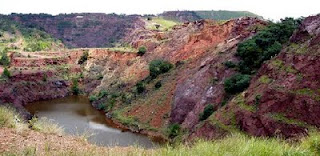
See the picture of Lion’s Cave on the left. Mineral resources have also shaped African history and culture, especially the rise and fall of the great empires in modern day Mali, Ghana, and Egypt. Gold, iron, and other metals have had cultural, commercial, and even cosmetic uses for much of human history on the continent.
Today the African sub-soil is unbelievably, but not inexplicably, rich.

Before writing this, I have sifted through more geological research then I really have the vocabulary to understand, and pulled out some gems that helped me imagine the scope of both known and unknown mineral resources in Africa.

Africa is still undergoing what the field calls “Primary Exploration.”

E.g. preliminary surveys and shallow drilling.

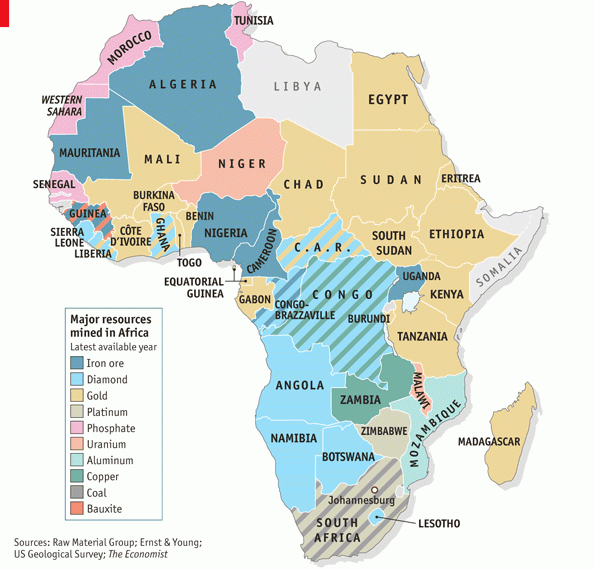
With the very limited knowledge we have of Africa’s subsoil, the continent already holds 30% of the world’s known mineral reserves.

This includes 80% of all platinum, chromium, and tantalum, and almost 50% of the world’s gold, diamond, cobalt, manganese and phosphates, and the plurality of many others, including bauxite and uranium.

Geologists estimate that Africa likely holds more than 50% of the world mineral reserves.
Wow. 20.4% of the world’s land (actual land, not water), with upwards of 50% of the world’s mineral resources.

I guess what I’m trying to say is that catalytic converters, computer chips, cell phones, engagement rings, fertilizer, tin foil, and nuclear submarines would all be a heck of a lot more expensive without African resources.

Why? (spoiler alert, pure creationists will not be happy with this section.) Well, according to Dr. Abbas, Africa has some of the oldest rocks in the world—otherwise known as Precambrian rocks.

These rocks come from the period that covers the formation of the Earth through bacterial life….a mere 4.5 billion years.

Precambrian rocks account for 80% of the world’s industrial metals.

The Kalahari craton geologic formation covers much of Southern Africa, and contains a number of the world’s oldest (therefore Precambrian) rocks.

This formation is what makes South Africa the most mineral rich country in the world; with an estimated 2.5 trillion USD worth of resources under its soil.

To put this in perspective, remember that while Saudi Arabia has just shy of 20% of the world’s proven oil reserves, South Africa has approximately 85% of the world’s platinum, 80% of its manganese, 75% of its chrome, and over 50% of a half dozen more key resources.

Other parts of Africa have mind boggling concentrations of strategic minerals; the best examples are diamonds in Botswana, copper and cobalt in Zambia and the DRC, tantalum in the DRC, uranium in Namibia and Niger, bauxite in Guinea, and phosphates in Morocco.

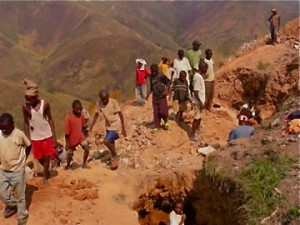
Tantalum Mine DRC

Africa is loaded with hydrocarbons.

Nineteen African countries produce significant quantities of oil, and ‘proven’ reserves have been skyrocketing as exploration really gets underway.

Chew on the following statistic: throughout the 80’s and early 90’s, the mining community spent about 10% of their budgets on exploration, but only 1% in Africa.

While this has improved drastically in the 90s and post 2000, African exploration is still grossly underfunded; it currently accounts for 13% of the mining community’s exploration budget but accounts for 30% of the world’s proven reserves.

Currently, Africa has proven reserves of about 210,000 billion barrels – this number is being revised upward on a quarterly basis.

These reserves constitute about 13% of global reserves- the proportion will obviously rise as commercially viable oil continues to be discovered from Mozambique to Ghana to Uganda to Liberia, and relative peace and calm allows the major producers to double down on investment and R&D.
(Source)

Botswana Diamond Mind
Get ready for some 20,000 ft. assumptions.

The developing world’s standard of living is rising- sometimes in fits and starts, and sometimes in long 30-year runs (China).

To be rather blunt, these people, and their governments, want the tin foil, nuclear submarines, green tech, phones, and other IT products that we spoke about earlier.

New discoveries will slow in the rest of the world while they accelerate in Africa over the next 50 years; I for one am very curious to see how this ramifies through world politics.

Surprise in the Sahel

Surprise in the Sahel

By Conor Godfrey
On the morning of March 22nd Malians woke up to discover that 20 years of stability and progress had been, temporarily at least, hijacked by a group of mutineers turned putschists led by a Captain Amadou Sanogo.

This was a punch in the stomach with no warning.

When I was evacuated from Guinea after a similar Coup in 2009, we traveled north through Upper-Guinea to Bamako, Mali.

On the Guinean side of the border, one gets shaken down every 50 kilometers by aggressive soldiers manning checkpoints on a sorry excuse for a main road.

As soon as you cross to the Malian side of the border, the road quality improves 200%, and the soldiers manning periodic checkpoints are friendly and helpful.

It was like a different planet.

This small anecdote conveys the crux of the sahelian surprise – this landlocked country with minimal assets was successfully bootstrapping itself out of desert poverty.

It was also a poster-child for the fruits of reasonably good governance.

This coup was not the result of long simmering ethnic tension, or gross mismanagement; it was a pseudo-spontaneous overflow of frustration by a group of junior officers and enlisted soldiers in Bamako.

More of an isolated mutiny that got out of control.

The explanations for the coup are all over the news: here and here you can find good articles on the acute causes.

See my previous post on Tuaregs.

Essentially, there has been a full-fledged rebellion in the north of Mali since January, led by a Tuareg outfit known as the Movement for the Liberation of the Azawad (one of many Tuareg campaigns over the last few centuries….they are only called rebellions once there is an actual State to rebel against — I suppose.)

These rebels have inherited military equipment and wherewithal from the Tuaregs that fought alongside Gadhafi, and are essentially outgunning and outmaneuvering the uniformed Malian army.

The junior officers doing much of the fighting (and dying) in the North feel the Malian government has mishandled the rebellion, accusing them of sending poorly armed and equipped soldiers to face hardened and well armed rebels.

This issue is also magnified by the growing resentment of the Southern Malian population (where the overwhelming majority of Malians live) toward the rebellious Tuaregs in the North.

Most Malians are looking for a strong response.

(Whether this constitutes “support” for the coup is difficult to tell: here is a very intriguing set of posts by “Bamako Bruce” claiming widespread disenchantment with the previous government.)

Regardless, if soldiers continue to loot stores and government buildings, nebulous support from some Malian youth will likely evaporate.

I am going to go out on a limb regarding the outcome of this crisis, and I expect you all to write in angry comments if I am wrong…

My prediction is that this is going to blow over.

The coup leaders did not secure the backing of the necessary socio-political elements of Malian society (religious leaders, senior military figures, opposition groups), and now find themselves increasingly isolated.

Malians were enjoying the fruits of democracy (albeit slowly), and have no appetite for violence or prolonged instability.

They are simply pissed off that their government cannot get a handle on the conflict with the Northern rebels.

On that front, the Tuareg rebellion has done so well that there are now signs the rebel leaders want to negotiate from a position of strength and secure more autonomy and other perks before their success triggers the use of overwhelming force by Mali (perhaps financed and armed by international friends).

All of this spells a negotiated solution.

The coup leaders will try to secure a golden parachute by leveraging their ability to prolong the instability, and some of them may get one.

The rightful president of Mali, Mr. Amadou Toure (now either in hiding or under arrest), was due to leave office in weeks anyway, and will likely agree to leave power as scheduled and collect his prize from the Mo Ibrahim Foundation.

He will inevitably promise all sorts of populist goodies on his way out knowing that his successor will have to deliver on them.

This will pave the way for elections that will elect a candidate promising better equipment and training for the army, thus defusing the tension that brought the coup in the first place.

Of course, things could go south quickly as well.

Read this short piece of analysis by a risk consulting group.

While I think that the Executive Analysis scenario is unlikely, there are several points where my more positive projection could break down.

These mainly concern rebel and government choices regarding winding down or scaling up the conflict in the North.

The Malian government may need (strategically or because of popular pressure) to bloody the rebels before negotiating.

After all, the Tuareg rebels have claimed so much land in this campaign that they might be tempted to do so again the next time they are feeling aggrieved or restless.

This scenario could give the military government more time to maneuver, as it will be difficult to respond effectively to the rebellion if everyone is focused on elections.

My views are not necessarily the majority position. A darker prognosis can also be found here at African Arguments.

Mali is headed in the right direction. This, I think, I hope, is just a painful bump.

P.S. The Coup leader received military and intelligence training in the U.S.

On Safari: The All Good Cape

On Safari: The All Good Cape

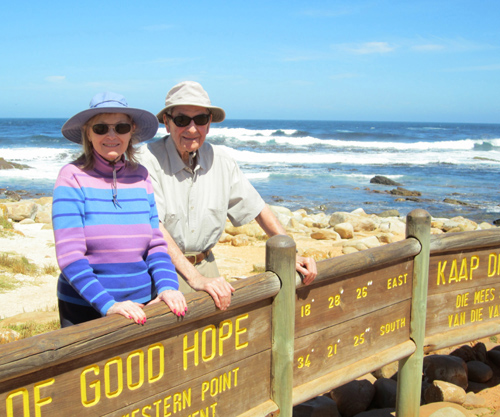
Dr. Lester Fisher, Dir. Emeritus of the Lincoln Park Zoo, with Barbara Shaffer
at the Cape of Good Hope as we began our safari in southern Africa.
I like to begin all southern African safaris in Cape Town, despite it being rather distant from game viewing areas and in spite of its constantly rising costs. As one of the most beautiful cities in the world it portrays so much of what young, modern Africa is becoming.

We spent four nights and five days in The Cape before heading to Botswana for game viewing. It was warm for March, several days in the lower 90s. But fortunately one night of heavy rain turned everything on, like a light switch, and the last of The Cape’s summer flowers and fragrances filled the peninsula.

One day was for the city itself. As with any world class city, I had to pare down the attractions to fit our time. I begin with a walk through the Company Gardens which is laden with history, sated with beauty and ringed with museums.

Nothing exciting was happening in any of the museums except the Slave Lodge, which had a special exhibit about Mandela. The Slave Lodge is one of the more sobering museums in the city, but without some understanding of how slavery affected and was a part of South Africa for so long, you really will never understand the present.

From there we visited what I think has become my favorite Cape Town museum, District Six, but this time I learned how important a guide is, and how fascinating and surprising the experience can be there.

District Six is a “living museum” whose guides are actual persons who were among those evicted from this historic quarter of Cape Town during the most pernicious period of apartheid, the 1960s. Residents who were fourth generation Capetonians were given sometimes less than a week to leave before the home their great-grandparents had built was bulldozed to make into an all-white section of the city.

Prior to the bulldozing, the area was classified as “coloured” meaning it was of mixed races. This could be white and black or Indonesian and Indian, or Malay and white. But it was a close knit, historic, politically dynamic and highly educated community, thrust suddenly into the dustbin of history.

The guides are what make the museum so incredible as they describe not just their lengthy history before the eviction but their lives afterwards and then after the end of apartheid. The story is usually a three-part drama that ends in pretty hopeful and inspiring ways.

But this time the guide we got, a politically active ANC undergrounder at the time he and his family were uprooted from nearly a 100 year history in the community, spent most of his time complaining to we visitors of the current affirmative action policy of the South African government.

Very interesting.

Obviously, the several centuries of apartheid that plagued the Old South Africa is going to take time to remedy, and I doubt there are many who feel that affirmative action is a wrong course of action. But the guide, a District Sixer and therefore a coloured, felt that affirmative action was displacing the opportunities of his family at the expense of blacks. “I’m not anti-black,” he insisted; “I’m just anti black behavior.”

That cliche has rung the world round and been exposed as hyperbole of the greatest sort, and it was a bitter sweet experience for me personally, who has been to the museum so many times, to see this crack in the hopefulness of the New South Africa.

Another day was spent at the Cape of Good Hope, and I can’t remember once before when there was no wind at the top of the Flying Dutchman that overlooks the sea that Dias and de Gama rounded centuries ago. But that was our fortune to be sure! Hardly a breeze, in fact, no clouds and one of the most spectacular views in the world. That day is the day we see the jackass penguins (recently politely renamed “African penguins”) at Boulders, and they’re absolutely some of the funniest things in existence. I like to sneak into the parking lot several blocks from the national park, the “swimming beach” and watch the kids swimming with them!

Another day was spent at Kirstenbosch, with free time to ride up Table Mountain and view the city from Signal Hill. What an amazing place Kirstenbosch is, and how indescribably beautiful. I say that because it isn’t just the gardens themselves which are spectacular, but that incomparable setting below Table Mountain. We nearly cried as our guide was walking us through pastures of bloom and stopped to say hello to an old man who had carried the ashes of wife to a certain point in the gardens that she so loved.

And finally we spent a day in the wine country. You’d be surprised that there really isn’t time to visit more than say two wineries. For one thing, the drive is so spectacular that you don’t want to get off the highway, with the jutting Cederberg mountains framing one beautiful vineyard after another.

I chose vineyards that don’t take tour buses. (We were driving ourselves around in rental cars.) That way you can get incredible attention and detail from the vinter as the wines are described, and real interaction when there are only a small number of people sampling the treasures. I particularly like Rustenberg Winery with its 19th century Victorian garden that is so spectacular as well!

True animal people as we are, part of the day for the wine country was spent at the Eagle Rehabilitation Center associated with the Spier Winery. Nearly half of the Cape Vultures, an endemic species, have been lost to poisoning, and that’s one (but by no means all) of the center’s missions. We got there in time for the 4 pm raptor demonstration and watched a number of beautiful birds flying around, landing on our arms and heads!

The Cape is so wonderful that I just could never see stepping into a game park in southern Africa without first stepping into this wonderland!

Mama Africa

Mama Africa

By Conor Godfrey

Over the past week I’ve made it out to Silver Spring, MD, for a few great African films.

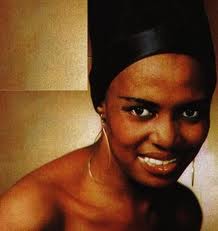
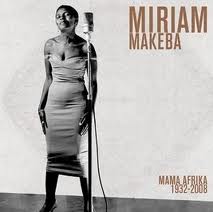
Opening night of the festival featured “Mama Africa” – a cinematic eulogy to the late great South African mega star Miriam Makeba. Find the English language trailer here.

If you don’t dance in your seat I would probably just give up the ghost.

As noted in this Reuters’ review, the worst thing one can say about the film is that it would have been even better had she been alive to comment on her own life.

Miriam was involved with the making of the film up until her death in 2008.

The rest is put together with help from archival footage and interviews with a dozen former band-members, friends and relatives.

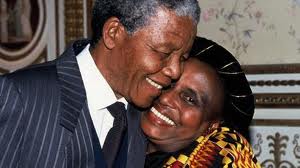
Makeba with Nelson Mandela

In Miriam’s case, this includes many of modern Africa’s founding fathers like Sekou Toure and Julius Nyerere, famous Black panthers like Stokely Carmichael, and world-class musicians from all over the world.

Renown South African Trumpeter Hugh Masekala (Also Miriam’s first husband and lifelong friend) fills in a lot of her early history. (Find an upbeat anti-apartheid track from Hugh here.)

She was born into crushing apartheid township poverty in the 30s, and even spent six months of her first year in jail with her mother who had been sentenced for selling homemade beer.

Her rise was meteoric once discovered.

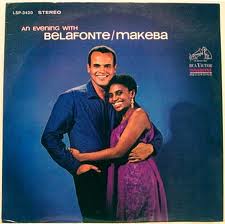
After being caught in the film “Come Back, Africa”, filmed secretly and smuggled out of South Africa by Lionel Rogosin, she was discovered by Mr. Harry Belafonte.

Belafonte went on to introduce her to the greats of the American music scene. She would eventually sing at JFKs birthday, and record with stars like Nina Simone, Desi Gillespie, Paul Simon, and tons of international stars.

She held seven passports and 10 citizenships at the time of her death.

Before the film, I really only knew her mega hits, like “Pata Pata.”

(Or find the song live in concert here.)

During the film, she actually says she wishes that some other song, with more meaning, had become her defining hit.

I suppose there is some irony in the vocal anti-apartheid singer who’s smash hit was, in her words, “a nonsense dance song.”

But there were plenty of more substantive hits as well.

Director Mika Kaurismäki featured songs like the Khosa wedding song “Qongqothwane”, known as the “The Click Song” by English speaking South Africans.

She introduced the song in the movie by saying that “the colonizers have to call it “The Click Song” because they have trouble pronouncing “Qongqothwane” with the right clicks.

One of my favorite pieces of concert footage was “Oxgam.” This particular piece shows her potent smile to good effect.

After all, she essentially had her pick (more like pickS) of husbands wherever she went.

Find the more emotional, slower Makeba in “Khawuleza.”

I also had the pleasure of seeing my old haunts in the Fouta Jallon region of Guinea when the film explored Makeba and her husband Stokley Carmichael‘s exile in Guinea.

After the two wed, all of Makeba’s U.S. dates and deals were cancelled in protest of Stokley’s activism.

At that point, a number of African countries, including Guinea, vied for Africa’s peripatetic daughter to come live with them as she still could not go home to South Africa.

In general, the film was a beautiful tribute to a pan-African hero, a tireless activist for justice in South Africa, and one hell of a voice.

Good luck finding it though – stay tuned here.

What Political Evolution looks Like –
Invasions Not Included

What Political Evolution looks Like –
Invasions Not Included

By Conor Godfrey
[The daily song: I am going to talk about Senegal, so today the musical shout out goes to Senegal’s virtuoso ( and almost presidential candidate)….Mr. Youssu N’Dour. Here are some free streaming songs/videos from his fan site.]

I believe that political evolution takes generations.

The media cycles in the United States magnify off-hand, irrelevant political utterances and give the impression of a political roller coaster when the real ride is, in fact, considerably smoother and longer.

The increasingly powerful office of the U.S presidency, the role of the U.S. judiciary, party platforms—these things change at the margins relatively frequently, but those small alterations accumulate into major developments over the course of a generation, not one election cycle.

The Arab Spring might seem like a spontaneous combustion—near instant change—but the political culture that provided fertile ground for the sparks of the Arab spring was in the works for decades.

It was the generational divide in Arab countries, the slow but accelerating growth of political Islam, increasing social inequality and other longer term trends that drove the evolution of political culture across the Arab world.

One street protest or one election is just a blip unless political culture has opened up space for the event to reverberate. (There are interesting points to be made here about the role of technology in accelerating political evolution.)

Senegal offers a powerful case study in the slow, steady evolution of political culture. I am more interested by the meta-story and will not get lost in the weeds of the current situation here, but read these excellent articles if you are interested in details of the current exciting election:
Towards a Second Round in Senegal

Senegal’s famous founding politician poet– Leopold Senghor—governed for twenty years before leaving office voluntarily.

Then there was what I will call an “electoral phase;” Senghor’s successor (Abdou Diouf) won mildly rigged elections every five or six years for two decades.

The entire patronage network that kept leaders in power was in Mr. Diouf’s hands. He did not have to resort to massive bribing or brutality to win elections.

Decision makers understood that he controlled access to the trough. However, at that time, a number of other things were changing in Senegal’s political culture.

The people that made their names during the independence period were slowly fading from the scene. Along those same lines, Senegal was getting much younger.

These younger people adopted new technologies and ideas faster than their parents and grandparents.

When 2000 rolled around, technology advances had made vote counting more fair and efficient, and young people were looking for someone to reflect the changes they saw in society.

The patronage networks behind the incumbent (Abdou Diouf) had also seen this writing on the wall and had begun to hedge their bets.

Enter the current president- Abdoulaye Wade- who won in the second round of that 2000 election.

Abdoulaye Wade is now the victim of these same long term trends.

One of his key legal maneuvers to rig the election in his favor (lowering the threshold to win outright in the first round) was blocked by civil society in the form of pressure on politicians from young Senegalese that probably got their first taste of electoral power when they voted in Wade in 2000!

Now the youth on the street are cheering “Degage!” – or “clear out!”

The electoral system has seeped into Senegal’s political culture over the past forty years.

That same culture has, in fits and starts, tolerated a loyal opposition, and adopted the technologies and legal methods necessary to enforce an electoral framework.

This is obviously simplifying generations of political developments in a complex country, but my point is this…

Senegal represents a realistic pace of political evolution.

No matter how the current election turns out, it is obvious that the country’s long term trajectory is headed toward more inclusion and more transparency.

If this election goes poorly, or the military over-reacts and makes mistakes in Casamance, those are likely just blips.

In the same way that one election in Libya or Afghanistan does not mean much at all, even if CNN and Al-Jazeera trip over themselves to see how many synonyms for important and game-changing and critical they can use in one broadcast.

The Desert Speaks –
Tuaregs in the News

The Desert Speaks –
Tuaregs in the News

By Conor Godfrey
(Hello to all Jim’s readers! The actual Answerman is off finding answers in Southern Africa, so I have been asked to amuse and entertain for the better part of March—I will do my upmost.
Jim and I share some interests and opinions, and diverge quite a bit in others, so I hope you enjoy a brief change, and please feel free to leave comments or email me at [email protected] if there is an issue you would like to see covered.)

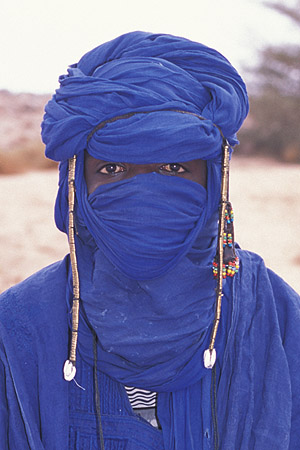
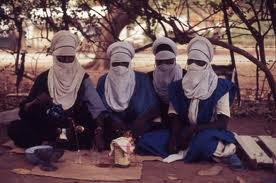
The Blue People, the People of the Veil, the Tuareg: to the people-groups that live south of the great desert, these veiled nomads are known as warriors, slavers, merchants and cattle raiders, and have been doing all of the above ever since the camel was introduced to N. Africa around 0 B.C.

For the last millennia, the Tuaregs have controlled the five most lucrative trade and smuggling routes across the Sahara – after all, the 1.2 million Tuaregs that roam the Sahara are more intimate with the desert than we are with our kitchens and bedrooms.

E.g. We call the sandy expanse from Algeria to the Red Sea the Sahara Desert; the Tuaregs see this as dozens of different deserts, each with its own name depending on its aridity, elevation, vegetation, etc…

This interlocking web of deserts goes by the name “Tinariwen”, in Tamasheq, the main dialect of the Tuareg people.

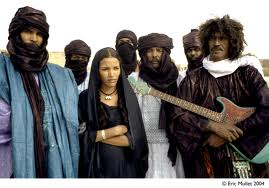
Tinariwen is also the name of a Tuareg band that won the Best World Music Grammy last week.

The band Tinariwen is what I imagine the Sahara Desert would sound like if you gave it an acoustic guitar and a drum.

“Tenere” – the Tamasheq word for the true, deep desert, is the band’s ancestral and spiritual home. Have a listen here.

They were even on the Colbert Report when they were promoting the music Festival au Desert in Timboctu. NPR calls them the best acoustic rock group of the 21st century.

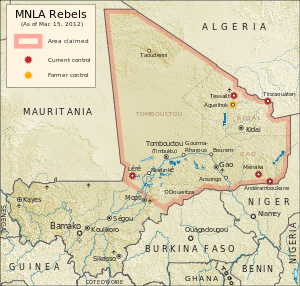
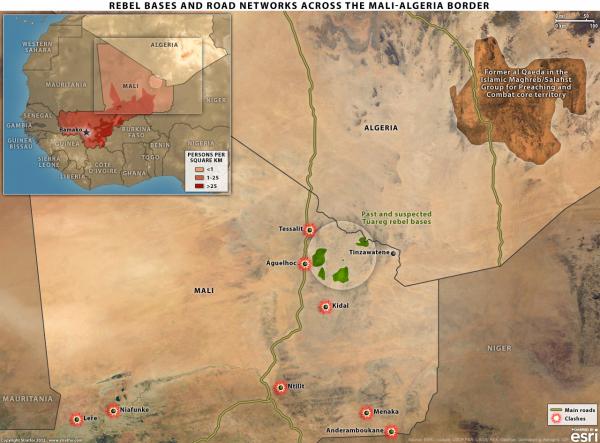
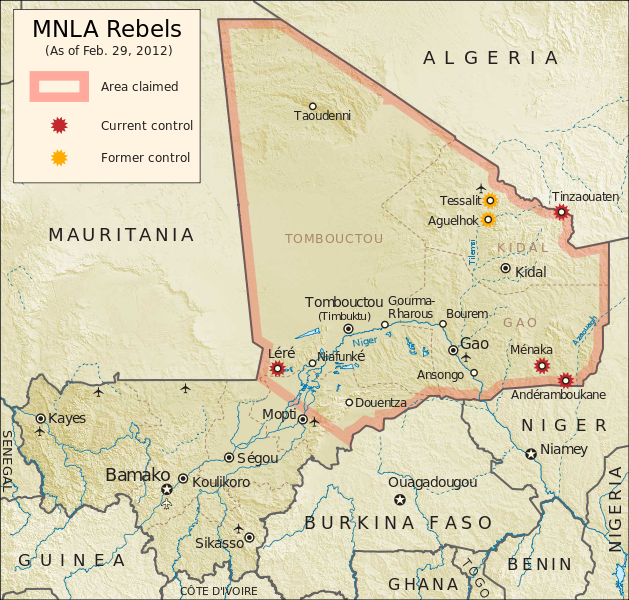
There was, however, another reason the Tuaregs were in the news last week. While Tinariwen was sporting their best Boubous to collect their prize, other Tuaregs were rolling over strategic towns in Northern Mali and skirmishing with the Malian army (See map of conflict on the right.)

The ‘rightness’ and ‘wrongness’ of this conflict (and the other Tuareg rebellions over the last century) is very difficult to parse, and probably immaterial.

When African states in the Sahel gained their independence in the 1960s from, in this case, France, they attempted to assert control

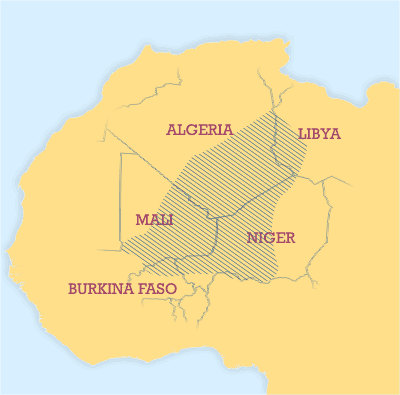
Tuareg Area
over their desert interiors, putting them in conflict with the Tuaregs who refused to acknowledge imaginary lines drawn in the sand (literally)

At the same time, the trans-African trade was increasingly moved by sea, making the two thousand year old caravan routes less and less profitable.

The Tuaregs turned their dessert expertise toward less savory commerce– hostages, drugs, and guns for hire—which put at least some Tuaregs in contact with al-Qaeda and other nefarious groups.

The Tuaregs are NOT Islamic extremists – their brand of nomadic Islam is heavily blended with millennia old animist traditions, and would probably give a hard line Islamist a heart attack.

Tuaregs that do come in contact with al-Qaeda do so for pragmatic, financial reasons.

Also, the various governments abutting the Sahara have every incentive to play up the al-Qaeda – Tuareg link because the U.S. then shells out cash and personnel for military and anti-insurgency training.

(It did not help the Tuareg case that 800 Tuareg warriors fought alongside Moammar Gadhafi’s troops in the recent civil war.)

The Indigo people are a relic of the pre-nation state era; a trans-national people so intimately tied to their land that modern borders are not only unenforceable but totally irrelevant.

Ironically, Tuareg champions are now adopting the modern world’s nationalist rhetoric to express their people’s aspirations.

Malian Tuaregs and some non-Tuaregs have formed the National Movement for the Liberation of Azawad… Azawad being the local name for the Tamasheq speaking regions of Mali, Niger, and Algeria.

The Associated armed group has been renewing the armed struggle for a Tuareg homeland since late January, 2012.

In many ways the Tuaregs have a more coherent cultural and geographic claim to nationhood than many of the modern world’s balkanized republics. Said another way, they are arguably as distinct from their Southern neighbors as the South Sudanese were from their Arab neighbors to the North.

It is difficult to watch some of the last trans-national nomads locked in a losing struggle with the modern world.

As many of the world’s nation states splinter along civilizational lines (Iraq and Syria, Sudan(s), Nigeria, etc… ), and identity politics grows stronger in developed and developing world alike, I wonder the Tuaregs were not simply ahead of their time in thinking that national boundaries were just imaginary lines in the sand.

Somalia & Peace?

Somalia & Peace?

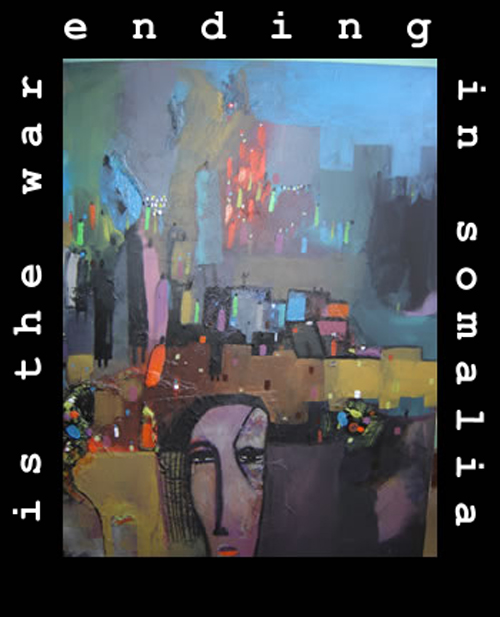
Painting by Abushariaa.
My text.
Peace may be coming to Somalia. If so, kindly note carefully that the country of Kenya is the first country in a half century to unilaterally establish peace with war.

I seem to remember another country that tried: in Vietnam, in Iraq, in Afghanistan, and oh, in Nicaragua. And her adversaries tried in Czechoslovakia, Poland, Hungary; and other adversaries in Tibet.

None of those worked very well. What’s critically important this time, is that the big failures don’t derail the little success. Listen, please, to Kenya.

Thursday’s peace conference in London is being reported by the western media almost like composers gathering to write a funeral dirge. At first I just couldn’t understand this.

Then it hit me: peace is coming to Somali, not through the bigwigs and their F16s and drones and special operations and decades of failed warring, but because of a slow and methodical and most importantly, little military operation by Kenya that began last October.

Some argue that incessant droughts, western European poaching of its rich fisheries, and the west’s systematic routing of al-Qaeda are the main reasons, but I disagree. They are all important, of course, but the main reason is that a neighbor on its own volition stepped in less as the Terminator and more as the School Mom with a big stick.

None were more skeptical than me. The notion of getting “bogged down” grew literal with early, heavy rains. And it was only reasonable to suppose that no major putsch was possible with such a little force.

But what appears to be the new working military formula, is that putsch is old school. Perhaps necessity structured the Kenyan campaign, so be it. Civilian losses, mostly in terrorist revenge attacks near the border, are subsiding and “pacification” by Kenyan troops as the inch themselves towards the sea seems to be working.

Somalia was too far from Europe to be a cultural center like Alexandria. There were no Lawrence Durrell’s writing about its ancient spirits. But Somalia in the old days was very much of a Mediterranean-like African country: pretty if lazy, modern if low-key, and increasingly self-sufficient.

Above all they were seamen, accomplished fishermen and navigators. As world wars loomed at the end of the 19th century, Britain used the pretext of suppressing a popular local ruler, Abdullah Hassan, to gain control of critical ports accessing the Red Sea.

Similar to earlier jihadists like Sudan’s Mahdi Muhammad Ahmad, Hassan could easily organize the enormous local antipathy to modern western ideas like school for women. The “modern world” was thrust on much of Arabic Africa far too quickly.

After the world wars it was only natural that the former colony would choose the other side of the Cold War, and Somali became a Soviet ally. Even so it prospered nearly as much as neighbors like Kenya who had chosen the West, and education, especially exploded throughout the population.

The end of the Cold War left Somali without a patron. And ideologues like Reagan thought no further than ending the reign of an adversary. A huge vacuum was left in the societies which for a generation had depended upon the Soviets and Chinese.

It was like a calendar flipping backwards in time.

Mogadishu imploded in 1991. Black Hawk Down ended in catastrophe in 1993, and Somali was apportioned by warlords who had been the benefactors of a quarter century of arms buildup by proxy adversaries a half a planet apart.

One can read the history of 1990s Somalia very similarly to General Gordon’s battles in Khartoum in 1884. A century apart, the killing and fighting is placed conveniently far away from the main protagonist, a distant super power trying to impose an alien culture on a local people.

But such analogies probably have little significance, today. Historical imperatives might just have evaporated in the last quarter century. The world is too closely connected, now. Hiphop is just as popular in Mogadishu and Nairobi as in London.

And I am surprised by the Kenyan success. Fighting which brings peace. I hope I am not surprised once again that I was surprised.

Presidents’ Day Holiday

Presidents’ Day Holiday

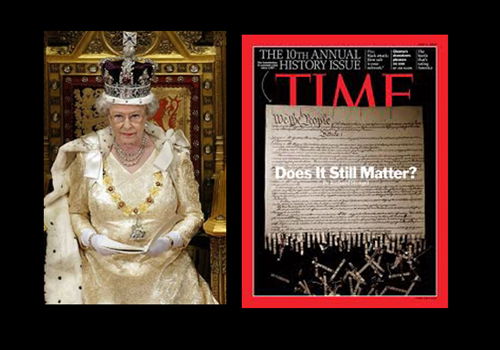
The Presidents’ Day Holiday in America, today, is perhaps the least celebrated of the year, and it shows how America like much of Africa is moving away from a powerful executive.

The exceptions validate the rule, so the dozen or so African dictators still in power in places like Uganda, Zimbabwe, Cameroon and Chad, among the most egregious, delineate the old days. As modern African societies emerge and new constitutions are formulated, the chief at the top gets less and less power.

And so it’s distressing particularly when a country like Senegal that had embarked on the modern trajectory does a U-Turn. Senegal’s tortured constitution limited a president to two terms, but Senegal’s even more threatened tortured court system abrogated that section and the current 2-term president, Abdoulaye Wade, is now running for a third term as his society implodes.

But he’s the exception to the rule, and what we see in Africa more often now is gentlemen politicians conforming to the rule of law that limits their powers. The most outstanding example is Kenya, where despite mounds of complicated legislation enacting a new constitution, the old men that used to run the country will probably not be running it for much longer.

And Tanzania, and South Africa, and Liberia and many, many others. All places where modern African societies realized that single personalities – the Grandpa authority – were no longer appropriate as social chief executives.

Ultimately, I believe even America will have to come round to this view. Our president is one of the most powerful social chief executives in the world; probably the most powerful among democratic countries. I think this may have worked well in year’s past when essential U.S. policy was pretty unidirectional.

But today, with radically opposed polarities, the prospect of a strong liberal president being succeeded by a strong conservative, etc., does little to move society in any direction but crazy figure eights.

The new societies – the emerging African societies – are designing and experimenting with better forms of democratic, capitalist government. America will have to follow.

Many government offices are closed, today. Banks are closed. The post office is closed. Some schools are closed and most businesses, like EWT’s, are “technically closed” with the phones not answered. But many workers, like me, are sitting here at their desks like most any other work day.

Perhaps an affirmation that a strong chief executive shouldn’t be quite so empowered, anymore.

Can’t Do It Here? Try Uganda.

Can’t Do It Here? Try Uganda.

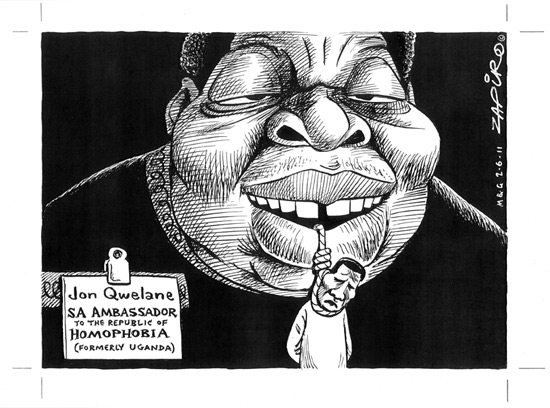
By South African cartoonist Zapiro.
The reemergence of the draconian Ugandan anti-gay legislation isn’t just a tedious clarion alarm. It shows that as the world’s economy improves, vital human rights concerns subside from the limelight.

It also shows how lasting wrong-minded movements once elevated to celebrity status in Africa can survive, as compared, say, to America.

Despite many of your complaints about my sarcasm and cynicism, I truly believe in America and get my sustenance from the ultimate outing of truth, here. But that’s not the case in many places in the developing world like Africa. Once launched into the heavens, it’s much more difficult to bring an errant issue down to a safe earth landing in East Africa than here.

David Bahati is the poster child for Church Street (sorry, I mean “K” street). He’s the puppet Ugandan legislator that does the gofer work for American conservatives who found an entry into Uganda after Bill Clinton’s many overtures to the country more than a decade ago.

His travel to and from America, hosting in America, and coaching as a politician came right from America’s extreme right. He introduced a bill in the Ugandan parliament in 2009 that was ultimately withdrawn because of its draconian provisions including execution for some prosecuted gays.

It is simply the American right using Uganda as a place to do what they can’t do, here.

The bill was withdrawn because of a huge public outcry worldwide. But last week Bahati reintroduced the bill, and immediately thereafter as if scripted from source, the Ugandan government supported the bill by reducing the greatest possible punishment from execution to life imprisonment.

That is the margin that the American coaches think will win the day. And they might be right.

The world’s state of happiness is improving, exception the Greece affair. The nearly two million signatures on on-line petitions against the 2009 bill set a precedent that already we know won’t be achieved this time around.

A coalition of East African clerics hopes to achieve a petition with a measly “5,000 signatures.”

Even as Uganda itself has achieved little additional political stability, its economy is no longer dive bombing. What I’d really like to see are Bahati’s emails and phone records, as I’m absolutely sure his moves are being orchestrated from here.

The right in America is on a roller-coaster right now, and each time Santorum’s head appears above the rising waters, they gloat, and I’ll bet, pick up the phone and tell Bahati, just as they would tell Santorum, it’s now or never.

They’ve got a better bet going with Bahati.

And unfortunately, Ugandan activitists are being clobbered not just by American righties but South African righties as well. Same dynamic: can’t do it at home, do it where you can when you can.

Jon Qwelane was appointed South Africa’s ambassador to Uganda last year. He was subsequently convicted of hate speech (anti-gay) in South Africa, but his ambassadorship continues. South Africa has a long tradition of gay rights, and it’s embodied in its constitution. I wouldn’t doubt an “evil axis” of K-street and aberrant South African diplomats.

So this time the Ugandan putsch is without finesse. Last time it went through Parliament several times like a ballerina pas-de-deuxing through a china shop, as quietly as possible then finally petered out after a huge international outcry.

This time several days ago, only a week after Bahati reintroduced the bill, the Ugandan Minister for Ethics and Integrity initiated a massive public campaign to arrest gays.

In fact he personally marched into a convention of presumed LGBT and took over the podium, announcing arrests as activists ran to the corridors.

Since 2009 the Ugandan parliament has been riveted with controversy, descent and wide movements of subservience to a growing executive followed by courageous acts of trying to assert their increasingly diminishing power. But the net result, today, isn’t good.

I think this time the anti-gay bill will pass. Fortunately, it won’t mandate execution for being LGBT, just life imprisonment.

Santorum won’t win. Bahati will.

Wudst Time Just Move On

Wudst Time Just Move On

Yesterday I listened painfully to a brilliant African jurist try so hard not to be condescending to a rabid American academic who characterized himself as a “strict constitutionalist.” Some Americans are so stuck in the past. We just can’t see the world whipping past us leaving us in history’s dusts.

So what does one do when in an unusual situation you’re unexpectedly driving across the country on a workday? Listen to NPR’s Talk of the Nation, and the program yesterday afternoon was fabulous: “Should the U.S. Constitution Be An International Model?”

According to the host, Neil Cohen, the program evolved from the tremendous criticism from the right of Supreme Court Justice Ginsburg’s Cairo interview recently where she dared to suggest Egyptians might want to consider other alternatives to the U.S. Constitution when writing their own new one. (After the first two minutes in Arabic, the interview changes to English, stick with it.)

As Slate.Com’s David Weigel posted, the interview “disturbed the balance of the universe.” (The onslaught of rightest invective was so intense there are concerns Congress may try to impeach Ginsburg.)

Headling yesterday’s NPR program was Cape Town professor, Christina Murray. Murray was instrumental in designing the South African and Kenyan constitutions. She was among an exclusive group of global “experts” hired by both countries to assist each in creating a modern form of government.

I would have loved to have listened to Murray and those of similar learned dispositions (like Yale prof Akhil Reed Amar who was also on) talk forever about what I’ve come to realize are two of the world’s newest and now best constitutions. Then perhaps a week later we could start discussing the process of how experts like them were chosen, what motivated the revolutionaries in each country, etc.

But that’s not America, today. Media like NPR feel (under the heavy boot of Congressional funding) a national responsibility to impede intellectual development by giving equal air time to the ignorant. The result is always … nothing but further honing of irreconcilable first principles. Tiring and trite.

The vast majority of intellects studying government systems, today, understand that different cultures emerging in a new world where the ability to protect unique heritages and folkways is at last secure, will have different needs. Like Kenya and South Africa.

The vast majority of intellects studying politics, today, recognize that just as we moved from the diode to the transistor to the computer chip in a mere quarter century, there’s absolutely nothing wrong with altering a bit rules of governance first thought up in 1797.

Yet NPR’s foil to reality on the show, Roger Pilon of the ultra rightest CATO Institute, hogged air time to say the same thing again and again: Raw American 18th century democracy is primae facie the best form of self-governance because the only necessary social objective is to have as little government as possible.

What does a professor say in response to such immature, tautological hogwash? It causes pauses, and that wastes more time. And it transformed Prof Amar into someone who sounded like he was explaining to a four-year old why it was OK that the robin gobbled up the worm.

We’ve got to move on, folks. Murray and Amar and virtually all but one of the callers knew this. The 30+ rights enshrined in the Kenyan constitution offended Pilon who explained he was pretty offended by several of our own Bill of Rights, because “we really don’t need them” arguing that “freedom” means we have “infinite rights” anyway.

I need a plaster. But please, click on the link above and listen to the show. You can turn down the volume when old man Pilon talks.

So kudus to NPR for bringing on Murray, who I hope some day will be nominated for a Nobel Prize. She’s still young and vibrant, and her body of work is exceptional. The constitutions of Kenya and South Africa will be the models for future governments well through this century.

And if we can just get beyond the sludge of our own intransigent ignorance, perhaps even for us.

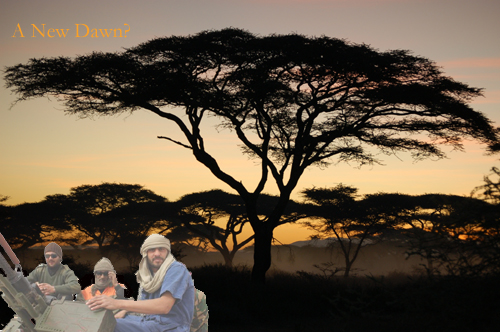
Is It A New Dawn?

Is It A New Dawn?

The fighting in much of Africa is settling down into a complicated and unnerving politics. Some see this as a lull before a real storm. I see glimmers of peace.

My rosy outlook depends on Europe. This is because everything in the world is economically linked, and the weakest chain right now is Europe. If six months from now Europe is stable, with or without Greece, I’ll breathe a sigh of relief.

Nigeria, the Ivory Coast, Kenya and the giants of Libya and Egypt all have indigenous organization that will right their bobbing ships if Europe resolves quickly. Even chronic trouble spots like Somali could cool down : My view.

There are other views. Most of the prominent thinkers in Africa would be considered extreme progressives by most Americans. They see their continent as settling down just like I do, but while the developed world heats up. This switch in developmental political polarity is seen as an opportunity for Africa to step out of old world orders like those governed by capitalism.

This view presumes Europe won’t resolve. It presumes that America’s self-destruction isn’t ending just with the Republican Party. It even presumes that China is poised to enter its own period of intense civil disobedience.

“We are in a revolutionary moment and revolutionaries cannot be pessimistic,” writes Horace Campbell in the African journal Pambazuka.

Campbell sees the world situation very similar to the era just before World War II, which followed the emergence of radical if revolutionary ideas in places like Europe and the United States after the poor end of World War I.

Western politics are driven by rich “capitalists … who want the pretext for war against Iran so that a wider conflict could cascade from Iran and the Middle East to Pakistan and wider afield” to beef up the old economic machine.

But unlike the twenties and thirties, western war machines are “degraded by the humiliations in Iraq” and the U.S. military – the world’s “greatest superpower” – is spent. Combined with Europe’s obsession with austerity, all this “old thinking” will be unable to “salvage the outmoded forms of governance.”

The result in Campbell’s view is the “revolutionary moment.” And what I see as a settling down towards possible peace in Africa he sees as the lull before the storm.

Less revolutionary but equally pessimistic in terms of a bright dawn of peace, Alex de Waal believes that the West is too impatient with Africa and time and again quashes its own good attempts at peace and development.

“The dominant interventionist approach to peace and security in Africa by-passes the hard work of creating domestic political consensus and instead imposes models of government favoured by western powers,” Alex de Waal writes in OpenDemocracy.

Because, he argues, the West (and China) are so desperate for Africa’s natural resources. This is a common theme in much criticism of the west by Africa, but it belies the fact that Africa is the seller and the West (and China) are not.

De Waal lists a number of situations from Darfur to Libya where he contends that African created and led efforts that could have ended conflict were stymied by western powers. He implicitly thanks China and Russia for stopping the west’s knee-jerk reactions towards Syria, even while supporting Syrian revolutionaries.

Because he believes that an incomplete end to these conflicts are short-term only, and that the lasting result of this outside suppression of internal healing will be increased conflict.

Conventional global powers “tended to see Libya as a problematic version of Tunisia” whereas “Africa … feared that Libya would turn out more like Chad–mercenarised tribalism spilling across frontiers” creating armed rebel groups throwing “havoc” all over the region.

Although that remains to be seen, recent reports in neighboring Niger may now confirm de Waal’s fear.

Nevertheless, I think de Waal is too pessimistic and Campbell too revolutionary. I’m no milk-toast liberal, and I agree with much of what these two political philosophers believe. De Waal is right-on regarding the impatience of the west and the intrinsic failings of its (often militaristic) band-Aid approaches to African conflict.

And Campbell’s historic analysis tempered by economic realities I think will lead pretty quickly to a revised world economic order and I’m glad it will.

But unlike both I don’t see a fiery horizon presaging a new dawn. I think most of the conflict is over.

I don’t think we’re going to go to war in Iran, regardless of what impish Israel might do. I think the healthy worker movements in Ohio and Wisconsin as much as in Zukan and London transit and Greek hospitals will strengthen and become strategic forces for change.

And I think the movements in Kenya, Nigeria, Libya and Egypt will turn out pretty good.

I believe all this, because I sense majorities of power growing in Africa as well as here and Europe that consolidate facts, stick with simple truths and release human compassion.

It’s namby pamby, or it’s real. I think Europe will resolve. I think it’s real.

An Incredible Production!

An Incredible Production!

We’ve got another hit musical in the making: nuclear war over Tehran, American righties swinging from Egyptian guillotines, evil ladies wresting control of revolutions. Time to buy your season ticket.

The pointers in north Africa are swinging towards war: Egypt’s predictable predicament with the West cocks Israel’s war machine. This isn’t good.

Egypt’s prosecution of a number of Western NGOs allegedly for funding “destabilization” is the trigger. What? A revolution isn’t exactly stable. The notion that outside groups promote revolution at the peril of revolution is nonsensical.

Americans especially don’t understand revolution, not even their own distant one. Framing all regime changes in the history of our own relatively simple revolution more than two centuries is a mistake. We tend to think there are very few outcomes of a revolution: the good or the bad.

Only recently did American schoolbooks talk about the loyalists that supported the King. The idea that neighbors and friends and even relatives might have opposed the outcome at some earlier point doesn’t register. Too complicated.

But just reschedule your entertainment to include a few popular musicals like Les Miserables or Evita. A revolution unleashes all sorts of competing forces and until a lasting and dominant one prevails, all sorts of messes occur. Anything can happen.

In Egypt few were talking to the Muslim Brotherhood as it systematically garnered more and more control of the situation. Last year it was only al-Jazeera that early on regularly interviewed and reported on the Brotherhood. Barring any major disruption, the Brotherhood will soon become Egypt’s ruling force.

The 19 NGOs under prosecution are mostly American but also include one important German organization, and they’ve all been in Egypt for years. Some of the higher profile Americans, including the son of one of Obama’s cabinet secretaries, has taken sanctuary inside the American embassy. If their trial proceeds too far I can imagine SEALs attempting a rescue of those currently taking sanctuary in the American embassy in Cairo. Flashbacks to the Iranian revolution.

“The prosecution could hardly have been better designed to provoke an American backlash,” the New York Times writes this morning.

Situations like this are rarely logical, but they are predictable. I’m not suggesting that we should not have aggressively supported the Egyptian revolution, but perhaps this gives you a greater insight into why Russia and China want to try to screw a Syrian genie back into the bottle.

Societies like theirs are poorly prepared for the unprepared. In that competition, America wins the gold. And our unprepared for mistakes rattle the whole planet: CDS, anyone? Gambles sometimes lose.

In brilliantly reporting this morning NPR discovered that the person behind the Egyptian prosecutions is a woman holdover from the Mubarak regime, who apparently always distrusted Americans.

A revolution allows these types of sleeper ideologues to emerge and flourish. Imagine what chaos might ensue if Egypt’s military tries to interfere.

Yet Democratic Senator Patrick Leahy seems poised to stop Egyptian aid if the trials proceed.

Add to this fluid situation a pinch of Iranian nuclear power, an obsessively conservative Israeli regime and an American election and you have all the ingredients for a major war. A century from now, perhaps it will be the most popular musical on Broadway.

Democracy Without Votes

Democracy Without Votes

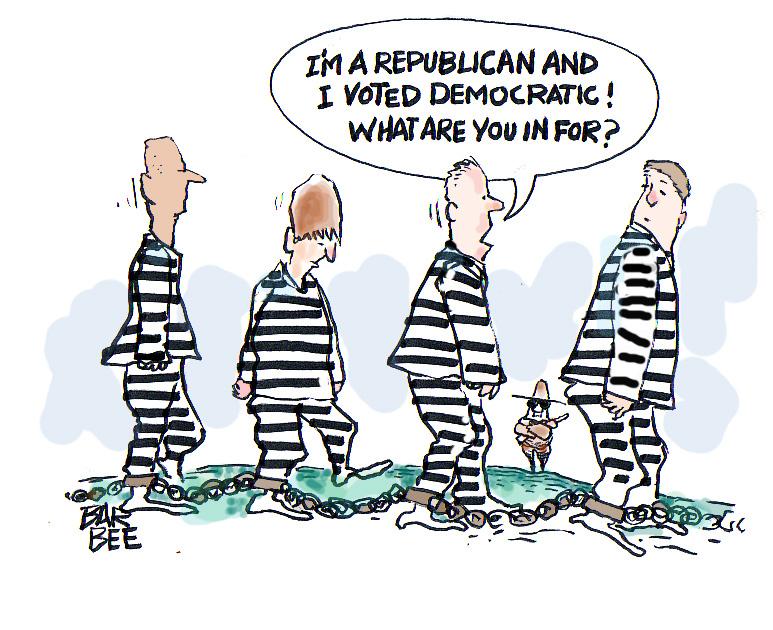
Carton by artists Barbee Fish.
So who’s more primitive? Yesterday Kenya announced modern, near-instant voter registration processes even while 14 American States are implementing new laws making voter registration now the hardest in the world.

With a nearly $10 million infusion by world bodies like World Bank, Kenya’s election monitoring board proudly adopted such instant high-tech registration techniques as retina scans, because according to its chairman, Mr Isaack Hassan, “it was prudent we aren’t left behind.”

Behind who? The U.S.? Hardly. Not a single U.S. state uses biometric devices to register voters.

Hassan said “most African countries, for example, Ghana, Sierra Leone, Tanzania, Burkina Faso and Nigeria, had embrace [biometric registration] and as such it is prudent for Kenya not to be left behind.”

So I guess Mississippi, Tennessee and even glorious Wisconsin and 11 other U.S. states are behind Ghana, Sierra Leone, Tanzania, Burkina Faso and Nigeria in running democracies!

“This is a national disgrace,” writes Cokie & Steven Roberts in a blogpost yesterday. Their fabulous blog cites a report released recently by the Brennan Center for Justice at New York University that argues as many as 5 million mostly Democratic voters in the U.S. have been disenfranchised from the next election by Republican state governments.

Kenya and all the other African countries cited above except Ghana have experienced recent and violent elections. And all of them are taking radical measures to fix this, and the first and most important fix is to facilitate an easy, quick way for everyone to vote.

The mantra of voter fraud is one of the most primitive, fraudulent claims ever assumed by existing American legislators, and it reflects not some concern about freedom, but concern about losing power.

Fortunately, the Obama administration is forcefully challenging many of these laws in court. But god help us if they fail.

What the hell are we doing? Why are we digging ourselves back into a prehistoric political hole? If you believe in democracy, and I do and most of Africa does, resultant laws will craft it differently and fashion a kaleidoscope of power as different as the Iowa caucuses counts are from New Hampshire electronic tallies.

But don’t tread on me. Let me vote! Facilitate my involvement, don’t impede it.

My grandfather was proud of being one of the few true Republicans in Chicago in the 1930s and 1940s, and he loved telling us his grandchildren why he stopped voting before the war. The last time he tried the election judge looked him right in the eye and said, “Mr. Andersen, sir, you’re dead.”

That was eighty years ago. I thought things had changed.

They have, in Africa.