Firing The Light

Firing The Light

FiringTheLightA California company is building plants and producing huge amounts of solar power for South Africa. Why not here?

In collaboration with a Saudi financing company (and Google!), SolarReserve will produce almost 350mW of electricity from four solar plants in South Africa’s sunny Karoo (from Kimberly west into the northern Cape).

In fact SolarReserve does have a single operation in Nevada, but the new operation just announced in South Africa will be its fourth just in that country.

Both our countries use fossil fuels at about the same percentages: 70% of American electricity is fossil fuel generated, 67% for South Africa.

Traditional fossil fuel plants produce more electricity once operating than comparable solar operations. American nuclear power plants, for example, proudly insist that they generate around 500 mW and a typical coal-fired electric plant generates around 550mW. This is up to three times what a typical solar plant creates.

More importantly, coal-fired and nuclear plants sustain their rated output far better than alternative energy plants like solar, which of course don’t produce at night.

Is South Africa simply “greener” than America?

No, unfortunately. The flip side of output is the cost of building a plant. Solar plants are much less expensive than traditional fossil fuel plants and can be up and running in 16 months, half as long as a coal-fired plant. Nuke facilities can take a decade to build.

That’s the key for South Africa, and it’s the reason such a fertile market exists there right now for solar energy providers. Last year the country experienced its first rolling outages and more are expected this year.

Africa’s rapid growth demands alternative energy sources in a way America does not. It costs less to build and can be operating in a fraction of the time. Politicians, I’m afraid, and not environmentalists are driving the process in South Africa.

Inevitably, though, Americans will benefit. As expected when South Africa’s first solar plants came on line they produced far less than projected. Any new technology is going to experience such growing pains.

Working through these engineering issues gave rise – at least in SolarReserve’s case – to a whole new alternative to PV (photovoltaic) solar electricity production.

PV is what we all understand: a cell hit by the sun produces electricity. It’s what’s on the top of your home and it’s what we use to create a bit of power in our camps in the African bush.

SolarReserve is now a leader of a new almost scifi technology referred to as CSP (concentrated solar thermal power): Ten thousand tracking mirrors, rather than cells, circled onto a 1,500 acre field direct laser-like sun onto the top of a 550′ tower at the center, melting salt at temperatures as high as 1,000F.

The salt is then used to heat steam to power generators. The reason the Saudi company has joined these ventures is because an easy by-product of this process is fresh from salt water.

By the way, the Australians just announced a breakthrough in the old PV technology. Traditional PV cells are rated as low as 18% efficiency. The new Australian methodology increases efficiency to 33-40%.

The answer to the question I poised at the top is urgency and capital. There is more of the first and less of the latter in South Africa than the U.S.

Those of us who look long-term, though, see the present urgency and poverty in South Africa vis-a-vis the U.S. as an opportunity to help us all.

Does this mean “green” is “poorer” and more “reactive” than non-green?

For the time being. That’s the point: only for the time being. As crass it is, we non-greeners are using green South Africa to work through the glitches before we handily adopt the new technology.

It’s the way of the (capitalist) world.
Waterworld

Waterworld

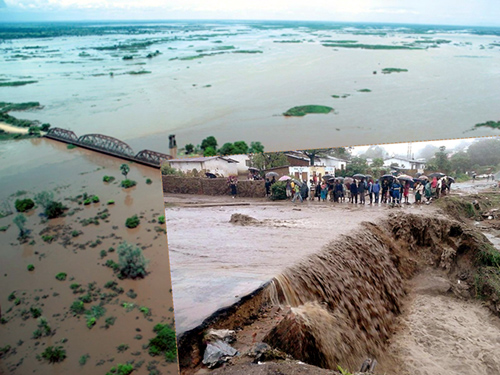
thiswasfarmlandThe devastation of the torrential rains now falling on southern Africa is an unprecedented catastrophe of global warming.

“The worst flooding in the history of Malawi,” according to Bloomberg News,
has forced the president to declare more than half the country a disaster zone.

Southern Tanzania, northern Mozambique and large parts of Zimbabwe and Zambia are also seriously effected.

The number of people displaced may soon exceed one million. Already a quarter million have lost their homes.

Professional climatologists in South Africa today said there’s not enough time left to adjust society, and that all that’s left to do now is to educate the population so they can better understand the weather warnings as they come:

Global warming has no less effect on the United States than southern Africa: we all know this well by now. The difference is that our infrastructure might be capable of absorbing the catastrophes. We might be able to build sea walls the way the Republicans want us to build border fences. We might keep the rising sea at bay.

The developing world has nowhere near the resources for that kind of response.

The mega deal between China and the U.S. will take decades to have an impact. It seems to me problematic that it will positively impact even our own future, but there’s no question the developed world will not benefit from it.

Just look at Africa right now.

By the time reduced emissions by the developed world produce any noticeable benefit, the number of seasons of catastrophic flooding and drought in Africa will have devastated the continent.

It doesn’t take a rocket scientist to know what this means.

Material destruction leads to human misery. Diseases spread quickly, infrastructure like health facilities is destroyed, crop production is massively interrupted, so there is an exponential rate at which misery develops.

The dissatisfaction which then breaks down the societies will leave weak ones obliterated and stronger ones, like South Africa, with serious public uprisings.

Developed countries like our own will be unable to provide enough assistance to seriously turn things around. Just as we’re learning that wars in the Levant don’t work, we’ll learn that disaster response in the developing world won’t work.

As we accept that cruel truth, we’ll draw back into our own levies to watch the world outside our high tech shores dissolve away.

That’s the real possibility for man’s legacy. If the developed world survives, it will not have a pretty face.

It’s Just a Joke, Right?

It’s Just a Joke, Right?

xenophobiaXenophobia triggered by the slaughter at Charlie Hebdo has devolved in Africa from Christian/Muslim into primitive and very dangerous tribal racism.

The demonstrations, lawlessness and violence we saw last week in places like Algiers and Niger was a direct response by Muslims to French secular dogma featuring Charlie Hebdo’s mocking Muslim cartoons.

That grew in Europe to vigilantes against any foreigners. Particularly in Dresden and Birmingham xenophobia was ignited.

Back in Africa ethnic tensions are rising dramatically throughout sub-Saharan Africa. Today’s presidential election in Zambia, for instance, has been inflamed by ethnic tensions that had long since been curtailed.

And yesterday in Soweto, youth gangs looted foreign-owned stores, killing two and injuring more, mostly Somali and Pakistanis.

I suspect this is happening all around the world. We know it’s happening here in America.

In Algiers, Niger, Soweto, Birmingham, Dresden or Texas, xenophobia today in particular is the manifestation of people feeling they’re getting shafted, unfairly denied what their televisions are telling them is a “recovery.”

Economic statistics are improving and truly fewer people are on the skids. It’s as true in Soweto as it is Dallas.

But the “improvement” is horribly lopsided towards those who were better off to begin with. It’s also likely lopsided to those who have a greater experience with adversary, like immigrants.

In Soweto the shops that were looted were owned mostly by Somali and those killed were Somali. Few people in the world have had to endure the life of a Somali. Even fewer still have found the wherewithal to migrate an entire continent to try to etch out a more productive life for themselves.

Those are the kinds of people who will likely bounce back first, since they’ve already achieved the skills of survival in adverse situations.

And those below them who linger, like the supposed out-of-work truck driver in Texas, thrash out at a Muslim in a suit-and-tie because it’s a difference that’s clear enough for him to understand, a sort of Limbaugh economics.

There will always be xenophobia and ethnic racism, because there will always be differences that seem unfair to those who have less.

But today that unfairness is particularly sharp. The rich are unfairly rich, whether that be in South Africa or the United States. But unlike in the past, the rich are also in seeming total control.

Whether it is the Koch and Murdoch in the U.S. or the Zuma-ists in South Africa, the rich and powerful control much of the media with skills which include deceiving the poor and less informed that the problem is with “foreigners.”

The beauty of America is foreigners, the “melting pot” of the free world. Clearly this is where most of our creativity and ingenuity has come from. To a great extent, it’s a dynamic happening in South Africa, too.

Charlie Hebdo had no idea. Humor is sometimes so provocative it actually accomplishes something.

The Price of Democracy

The Price of Democracy

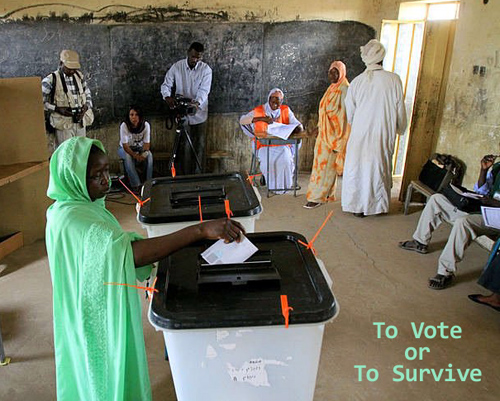
tovoteortosuriveChad and Cameroon are defeating Boko Haram while Nigeria is losing. What’s going on?

Cameroon shares a 500 km border with Nigeria on the east and Chad shares a much smaller border above the Cameroon/Nigerian border from Lake Chad north.

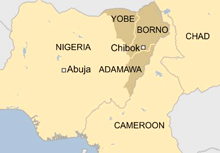
Boko Haram controls virtually all the Borno State of Nigeria, which is its far northeastern province. Parts of two other Nigerian states, Yobe to the north of Borno and Adamawa to the south, are also contolled by Boko Haram.
chadnigcammap
Both Chad and Cameroon are holding Boko Haram at bay and, in fact, freeing hostages and securing border posts that Nigeria has abandoned. The few times that Boko Haram has tried to enter either country, it’s been pushed back into Nigeria.

Both countries are less powerful than Nigeria on paper, i.e. in terms of available military hardware and defense budgets. The U.S. which has strategic military arrangements with all three countries has a far greater one with Nigeria than the other two.

Why, then, is Nigeria incapable of defeating Boko Haram?

While the Chadian army is less powerful than Nigeria’s on paper, it’s a much better fighting force. It led the charge, so to speak, in the successful fight against Mali Tuareg Islamists last year, taking a role there second only to France.

Despite its much longer border with Nigeria, many fewer refugees are fleeing into Cameroon than into Chad. This is because the thrust of Boko Haram’s military advances has been to the northeast, driving directly towards Lake Chad.

So the refugee problem, which is a trigger for all sorts of conflicts worldwide, provides Chad with all the rational it needs to ratchet up the fight, and Cameroon – and possibly even Nigeria – don’t mind a bit.

Chad is the most militaristic society of all three countries and that’s essentially the short reason that it’s succeeding in fighting Boko Haram as it would – and has – any insurgency.

Last year when trouble in its neighboring Central African Republic erupted, battles spilled over into Chad for a very short time. Chad’s military response was so severe that while the CAR remains very unstable and its capital in constant turmoil, the fighting has been contained at the border by the Chad military.

Nigeria was once a country like Chad. It became independent from Britain in 1963, but within three years it was a military dictatorship. Military dominance continued in Nigeria right through its bloody Biafran Civil War and after, with several weak and unsuccessful attempts from time to time to move towards civilian democratic rule.

The 1980s were pivotal for Africa because of America’s president, Ronald Reagan. He insisted that all embassies throughout Africa have a chief “Democracy Officer” and that any aid be contingent on moves by that country towards democracy.

Nigeria was dependent almost completely upon British and American investment. New discoveries of oil were being made daily, and a rich future looked possible but only if the west would invest.

The military agreed to Reagan’s initiatives and elections in Nigeria were held in 1993, but as often happens the man who won was quite radical. The general who had agreed to the elections annulled them, and the U.S. and Britain promptly suspended aid.

Not until 1999 was a truly democratic government in place.

Ever since then Nigerian politicians have had a tricky balance: the educated mostly urban populations thrive on democracy. They depend upon goods and investment from the west which insists on democracy.

The rural populations – particularly in places like Borno State – are marginalized, ethnically divided and with local governments mastered by little dictators. They are supported by insurgents and increasingly, radical Islamists.

Most importantly, though, the Nigerian military has been systematically eviscerated by the Lagos civilian government so that it cannot return to power. Defense budgets have been cut and military commands intentionally fractured.

Nigeria is in the midst of still another national election. The last thing that the current president running for reelection wants is to empower the military. In essence, that means ceding at least for now large swaths of his country to Boko Haram.

Democracy is not everything that it’s made out to be: definitely not a one-size fits all. If democratic Nigeria is to survive, it will probably mean so will Boko Haram.

Charity Begins At Home 2014

Charity Begins At Home 2014

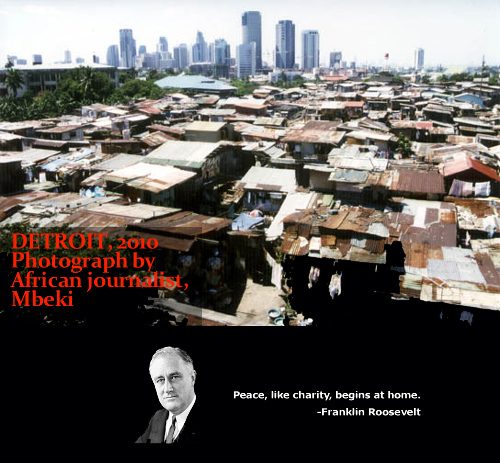
charitybeginsathomeCharity begins at home: In my estimation that means creating good government.

At this time of the year I get numerous requests from my generous and truly sensitive clients regarding charities I recommend in Africa. They are often surprised.

There are two reasons I discourage charity, whether to Africa or anywhere.

First, especially in Africa, charity is often a massive con game. There are many excellent not-for-profits doing heart warming work in Africa, but unfortunately there are many, many more that cause more problems than they solve.

Second, charity by its very nature coopts the responsibility that any reasonably moral society should take on its own. So by your act of charity, you are perpetuating the immoralities of your society.

The second reason is a contentious one, I concede. So for those who disagree with me on moral terms, my basic message changes to “stick close to home.” Charity is meaningless if wasted. All it does it make you feel good while possibly doing serious damage.

You must be able to do due diligence before giving, and you must be able to follow up to assess performance. Accountability is much easier the closer to home you get, and of course by “closer to home” I don’t mean simply proximity. You must be familiar with the situation, and you’re much likelier to be familiar with something near to you, geographically, socially and culturally.

Besides, we are rapidly approaching the time when poverty caused disadvantages like illiteracy are greater in parts of America than in the developed world.

I do due diligence in Africa. Good African charities are extremely few in number. They include Catholic Relief, World Vision and Médecins Sans Frontières.

Donations to many other large Africa involved organizations like National Geographic or the World Wildlife Fund are nearly useless. Their projects have become so massive they rely on their endowments to survive, diluting any individual giving to the point of meaninglessness.

Donations to smaller often locally created charities in specific countries, or to smaller church-based foundations, are usually destructive and anti-developmental. They are so mission focused that while they may indeed be helping a small group of people, more often than not they conflict with the greater social and governmental policies of the area.

One of America’s largest youth-based volunteer organizations, DoSomething.org, reports 11 facts about current America that are likely more egregious than in many parts of the developing world.

Consider this. Morning Edition reported today that in clustered communities of 10,000 children in Philadelphia there were only 33 books.

Literacy is difficult to specify, because different parts of the world define it so differently. UNICEF is the best mediator of literacy statistics worldwide, but the problem is that UNICEF does not generate literacy metrics for the United States. But clearly, literacy in that Philadelphia community is not good.

According to UNICEF, Kenya’s literary rate is just above 72%.

Why, then, would you send books to Kenya and not to distressed Philadelphia?

The conundrum of wanting to do good but being unable to do so will only be remedied when we create a society with a government that is trusted and moral.

That should be your greatest goal of the new year, not getting a tax credit.

Africans Praise Cuban Initiative

Africans Praise Cuban Initiative

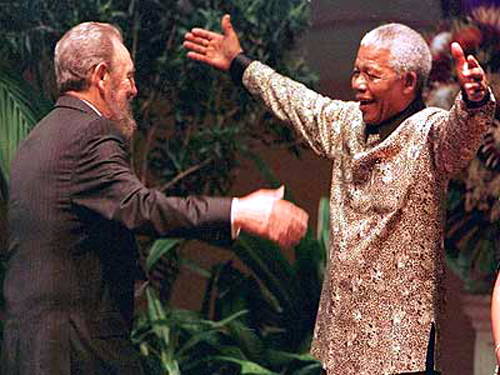
cubafidelmandelaSouth Africans echoed most of the continent yesterday in praising Obama for normalizing relations with Cuba.

In my lifetime Cuba has been active in Africa and seems to have chosen the right sides to support. The current Tanzanian regime, the current South African and Angola regimes, were all receiving aid and support from Cuba when they were considered outcasts by much of the rest of the world.

It was no surprise, then, that the current South African government issued a very positive statement of support for the Obama initiative.

Cuba sent cash, arranged and sometimes housed African revolutionaries and after most independent movements were over, hugely supported public health initiatives.

It seems odd now to hear our own press and officials speak of how small and poor Cuba is. I don’t doubt it. It’s just that few “small and poor” governments figure prominently in aiding and assisting other (possibly even smaller) poor governments.

Cuba’s medical reputation is considered stellar by most African governments. It was among the first to offer AIDS assistance and recently help in fighting the ebola epidemic.

Personally I remember walking shoulder-to-shoulder with Cubans in the 1980s in … you’d never guess, Cape Verde.

In the 1980s South Africa was a strict apartheid regime and Cuba was still fiery and revolutionary. Because the two diametrically opposed regimes were at the very fringes of their ideology, most of the world kept them both at arm’s length.

Cuba was sending money and military equipment to revolutionary movements in places like Angola and The Congo. South Africa was trying desperately to break the United Nations sanctions that were crippling it because of its apartheid policy.

So the two crossed paths, every night about 1 a.m., in the Cape Verde Islands, just off the coast of west Africa.

South African Airways was banned from landing in any other African country, and in those days long-range aircraft couldn’t make the U.S. without refueling. Cape Verde was and is one of the smallest and least developed countries in Africa. South Africa bought them, built them an airport and used it every night to refuel on its way to the U.S.

One airline per day could hardly support the South African investment, so with tacit approval from the communist hating, fascist regime in South Africa, Cape Verde also allowed the airline from Cuba to land to refuel its missions of revolution and contraband into the continent!

And to economize, it only made sense to work as little as possible. So both airlines converged at right around the same time.

And all us passengers got out and stretched our weary legs on these very long flights by walking together in circles in a gym that seconded as the Cape Verde terminal!

I wouldn’t be surprised if I was rubbing shoulders with African revolutionaries, and more to the fantastic point, if some of South Africa’s horrible apartheid officials were doing the same!

So go the ironies of the world and the vagaries of excessive ideologies.

Now, finally, some of this nonsense is coming to an end.

Free Kenyan Collapse?

Free Kenyan Collapse?

Kenya democracy is on the brink of collapse, because … of democracy.

Facing imprisonment if the bill in Parliament he is criticizing is passed, popular Kenyan journalist, Kwame Owino, wrote today that Kenyan society “is bound for a democratic recession, with the possibility that its constitutional journey will come to an abrupt and painful stop.”

At immediate issue is a Security Bill that is so draconian if passed that if will effectively stop debate in the Parliament that passes it.

This afternoon Parliament grew so disruptive that fist-fights broke out, media cameras were smashed and the police ordered to surround the building.

“The changes are retrogressive and their cumulative effect could return Kenya to the police state of the 1980s and 90s and reverse gains made in protecting human rights,” Amnesty International Regional Director told local media.

Human Rights Watch said the Security Bill would “limit the rights of arrested and accused people, and restrict freedoms of expression and assembly.”

The bill’s details include holding “terrorism suspects … without charge for 360 days, compel landlords to provide information about their tenants and punish media organisations for printing material that is “likely to cause fear or alarm”.”

This is not a new development. There are already a series of horrible new laws, particularly against free speech, that this Parliament has already passed.

Bloggers around the country are being brought in by police for “impolite” or “disrespectful” remarks.

One of Kenya’s most political and followed tweeters, Robert Alai, was yesterday released on $2,000 bail and will be tried for having tweeted that Kenyan President Uhuru Kenyatta is an “adolescent president”.

Here’s the thing:

The reason that Kenyatta had the new Security Law introduced (or more correctly, many draconian amendments to the proposed law) is because of terrorism, mostly in Kenya’s far northeastern provinces which are adjacent Somalia.

Kenya with the aid and abetting probably of America invaded Somalia in October, 2011, and remains as an occupier. Somalia has achieved some peace and stability for the first time in more than a generation as a result, but Kenya has suffered terrorist retribution.

Kenyatta’s slow but methodical increase in security measures has seemed to work in stemming what had been a growing increase in terrorism.

Terror attacks in Nairobi, for example, happening last year at nearly one per month, are now rare.

But the cost of this has truly been the democratic rights protected by its fabulous young constitution.

It’s fair to surmise that every new tourist who comes to Kenya because of its new security sends an additional Robert Alai to jail… if the new laws work.

I don’t think they will. They didn’t in America. The Patriot Act did little to protect us. Under the Patriot Act a bevy of new terrorist attempts came to the surface, including the shoe-boot and underwear-pants bombers, the cargo planes and much more.

Not until we backed off draconian measures like the Patriot Act, began ending the wars of retribution in Afghanistan and Iraq, did our own security truly improve. That is if you exclude Sandy-Hook, the Black Knight bombing and maverick terrorists like the Boston Marathon bombers.

My point exactly. What is security? Three thousand people and the exponent of their families were seriously hurt by 9/11. How many in the exponential pool of marathon runners, parents of grade schoolers and movie goers have been hurt by domestic terrorism?

There is real equivalence, here, and the Patriot Act probably did more to increase this aggregate terrorism than it did to reduce it.

Once a power center like a government gets it into their noggin that they should fight terrorism, they begin to think they should fight until they win.

That is the recipe for certain defeat. Terrorism cannot be defeated. It has existed forever and it will forever exist.

European nations are the best examples of how to live with and manage terrorism.

America after 9/11 … and now Kenya, are about the worst examples out there.

Shape up, Kenya. There’s still time.

Ivory Ends

Ivory Ends

Only ivory can be so minutely and intricately carved yet remain so tough and durable.
There may still be too many elephants in East Africa, but Tanzania is acting so irresponsibly with regards to increased poaching that the scales may soon tip.

This week a group of environmental organizations led by the EIA petitioned the U.S. government to withhold aid from Tanzania until elephant poaching abates.

It’s unlikely that the appeal directed to Secretary of State John Kerry will be seriously considered. Tanzania is on the front-line of the Obama administration’s war on terror, and the “elephant problem” is considered incapable of trumping “homeland security.”

The flaw in this reasoning is simplistic and ultimately fails because our homeland security policy with regards to terrorism is failing.

The explanations for Tanzania’s “elephant problem” also reveal why the country is so incredibly corrupt, why it has grossly mismanaged its treasure of natural resources including oil and gold, and why its powerful oligarchy can with abandon relocate thousands of Maasai to appease a few Dubai hunters.

Recently Dick Cheney agreed that enhanced interrogation techniques were a means to an end and were justified.

Facilitating if not outright supporting Tanzania’s corruption is also a means to an end that the Obama administration apparently feels is distant enough from public understanding to be acceptable.

I’ve often written that the elephant poaching problem is serious but exaggerated. Increasingly this year, though, the situation has grown more troubling. I hesitate to cite specific numbers, because they’re all over the place.

The EIA report looks sound to me, but I’m subsequently infuriated that they introduce it on their website with an ITN video that grossly misstates acceptable numbers. I just wish for once that these good environmental organizations working to save elephants would be more scientific and less evangelical.

London’s Guardian newspaper is probably the best resource in the world for accurate news on current elephant poaching. The Guardian contends that “Chinese demand for ivory is devastating Tanzania’s elephant.”

I agree, but what is missing from the hysteria is the fact that the growing development of Africa has enormously constrained elephant habitat in just the last ten years: not just national parks, but more importantly the vast areas peripheral to the national parks as well as the quasi protected corridors that connect distantly separately massive wildernesses to allow for elephant migrations.

These “corridors” and “donut edges” are often private land or land in trust, and demands for their development have grown exponentially. Farming, mining as well as simple village growth now impinge on what was only a short time ago elephant bush.

The tension between the needs of a growing and developing human population with the enormous amounts of land required for wild elephants is at the highest ever.

Until that tension is squarely addressed, corrupt officials will play god. Local communities engaged in ivory poaching will be given a pass, since the government is inept or incapable of giving them work, instead.

This is the real problem. Distant foreigners’ hearts may break when pictures of poached elephants appear on their TV screen. The world should continue to encourage China’s incremental movements to change a thousand-year culture that covets ivory as no other collectable.

And as the Guardian brilliantly pointed out, the disconnect between westerners’ campaign to stop endangered animal poaching and their allowance that these same animals may be legally hunted and harvested, has to be closed.

So the problem is not as simple as hysteria presents, but the problem is getting worse. It may not be the extinction of elephants that looms any more likely than the end of enough larger wild areas to support families of such a large wild animal in East Africa.

For the first time in my opinion, that is a plausible claim. Whatever the remedies, they certainly do not include ends-justify-means tests of what’s right to do.

Corrupted Index

Corrupted Index

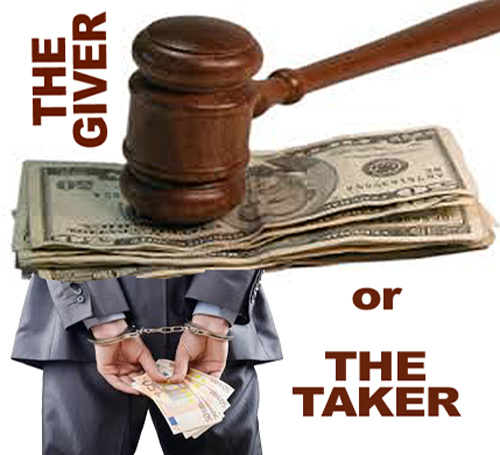
giverortakerTransparency International’s corruption index for East Africa is depressing, not wholly accurate and therefore more depressing, and becoming increasingly irrelevant.


The index
was released this week and the analysis of sub-Saharan Africa differs little from last year in the aggregate: Africa is still the most corrupt place in the world, and East Africa is among the worst in Africa.

Notable is that Kenya has dropped even further to the bottom (now below Nigeria) and that Tanzania ranks much higher than I think it should. Also notable and unchanged is the positive rating given Rwanda.

The index is a summary of up to 8 other organization’s assessment of a country’s corruption. Several of these are massive and well known institutions like the World Bank and African Development Fund.

Others, like the Bertelsmann Foundation and Political Risk Services International Country Risk Guide are less well known and I think lack some serious credibility. They are often regionally specialized or carry certain political and ideological biases (mostly towards capitalism and oligarchical democracy).

Nevertheless, I think the index as a general tool works. This year, however, it doesn’t work so well for East Africa.

Before I sound like an apologist for evil, there is no question that Kenya is still seriously corrupt. The most recent, egregious scandal to go public emerged last month when a British court revealed huge bribes paid to Kenyan officials for printing documents like … ballots.

This specific story points perfectly to my criticism of TI’s index.

Britain, listed by the index as lily white at 14th of the 176 countries analyzed, is essentially the facilitator of Kenya’s corruption, listed by the index as the dismally 145th.

In other words, if British printing companies didn’t pay corrupt Kenyan officials, then at least in this case there would be no corruption.

Add to this that in many countries, including Britain and in certain cases in the U.S., paying bribes isn’t illegal.

In still another misleading way, Rwanda is shown as the outstanding 5th best of Africa’s 50 analyzed countries, and that may indeed reflect less bribery for ballots. But Rwanda’s insidious support of militias in The Congo is doing far more to destabilize Africa and the world than Kenya.

The irritation I feel leads ultimately to the definition of corruption. It took an Act of the U.S. Congress (the Dodd-Frank Act), numerous judicial appeals and even global litigation to stop Apple from funding Congo warlords through black market schemes perpetuated by Rwanda.

It took a simple UK court to reveal the three Kenyan idiots who took bribes for a single act of corrupt printing. And then, it stopped.

Which is the more egregious? Well, the first sustained a generation of war and millions of deaths and millions more starved and tortured. The second?

I’m not condoning the second, I’m suggesting that TI’s index can lack relevancy.

I am also mystified at how Tanzania improved so much this year, even though the European governments for the first time ever suspended their aid because of growing evidence of corruption, there.

It would take time, but I think a good Ph.D thesis in economics would reveal that TI’s index is linked to economic performance, which does not reflect clean governance.

So overall I accept TI’s assessment that not much has changed in Africa vis-a-vis the world as a whole as regards corruption and good governance.

But enter the details and we might be discovering a very corrupted analysis.

Not Enough Eyes

Not Enough Eyes

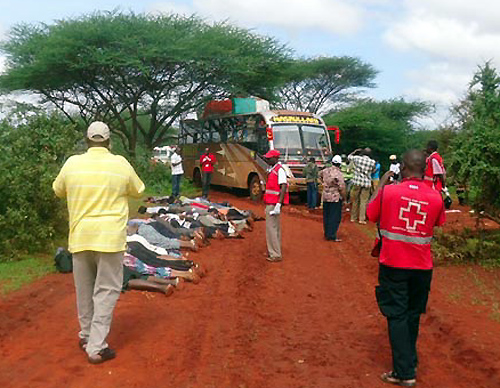
ManderaKenya’s an eye-for-an-eye policy against terrorists is doomed from the start and will only make matters worse.

This weekend poor Kenya suffered still another horrific terrorist attack in its far northeast near the Somalia border.

A commercial bus carrying about 60 people from the town of Mandera to Nairobi was hardly 30 miles from the Somalia border when terrorists apprehended it then murdered almost half those inside who were unable to demonstrate that they were Muslim.

Al-Shabaab claimed responsibility.

This makes 135 similar incidents (although most were far fewer fatalities) so far this year. Almost all of these have been in the very remote northeast corner of the country, although there have been a couple attacks in Nairobi’s Somali suburbs as well.

In my opinion security in the country is definitely improving, although it’s hard to demonstrate this after such an attack as this.

But particularly in Nairobi people are actually relaxing and feeling considerably safer.

“Al-Shabaab can no longer attack in cities like Nairobi because of enhanced security measures,” wrote a former high military official in Kenya’s main newspaper this weekend.

But that same expert went on to demand a change in current government policy and security strategy, arguing for a much tougher stand including very quick and immediate retribution.

And that seems to be exactly what happened Sunday.

In response to the 28 persons killed and single bus destroyed by al-Shabaab, Kenyan officials claimed a raid across the border into Somalia killed more than 100 terrorists, destroyed four vehicles and an armed camp.

Kenya invaded Somali in October, 2011, completing the liberation of most of the country’s main urban areas about a year ago. That has led to the first globally recognized Somali government since 1994, although the government remains very fragile. The capital city of Mogadishu, however, is definitely returning to a semblance of normalcy for the first time in a generation.

Thanks to American drones, many of the al-Shabaab leaders have been killed as well, although new ones appear immediately.

The Kenyan response of tit-for-tat isn’t going to work. It hasn’t worked since the Jewish rebels of Masada were massacred by the Romans in 1 B.C. It isn’t working for Israelis, today.

Tit-for-tat escalates violence; it absolutely has never subdued it. Advocates point to short moments in history, as many contemporary Israeli leaders have done, but five or ten years of tense peace is hardly a demonstration of efficacy.

Ethnic and religious conflict must be seen for what it really is: an easy reflection of more meaningful differences, like those of wealth and opportunity, education and health. Whether it is northern Ireland or the Basque country lazy thinkers want to explain the difficulties by ethnicity or religion.

That’s completely wrong, utterly superficial.

If it weren’t wrong, then it means these conflicts must continue until one side is obliterated altogether. And that’s what drives many of their fighters, this belief that it’s do-or-die and nothing in between.

The real remedy is far more complicated and lengthy to implement. Of course, meanwhile, anxious citizens on the periphery of the actual conflict want quicker resolution.

Unfortunately, there is no quicker resolution, and believing there is only makes matters worse.

Poached By The Rich

Poached By The Rich

rhinoboatThe escalating poaching of elephants and rhinos will not stop until the increasing gap between rich and poor is stopped.

There is mixed information right now about whether or not the poaching of elephants has slightly slowed, but even so it remains at relatively high levels.

But the poaching of rhino is escalating and is of most serious concern because there are far fewer rhino than elephant.

Indian rhino are a particularly endangered species, and rich Indian consumers are among the Asians who purchase rhino products as medicines.

Kaziranga National Park in India’s Assam is the center of the rhino war in India.

The irony is that until just the last few years the trouble in Assam was not with rhino poaching, but Muslim extremists. I regularly visited Kaziranga in the 1980s before it was often closed to tourists because of this political extremism.

While much of the world is suffering from religious extremism, and while it continues in Assam, rhino poaching is now a bigger issue, there.

Over the last few years efforts to curb both elephant and rhino poaching have been massive, and much of this has been successful. Why, then, does the problem continue?

“Rhino horn is worth more than gold,” explains Jeremy Hance writing for the ecological journal, Mongabay.

An average-sized rhino horn is now worth around $60,000.

The price of rhino horn has never gone down, but the fluctuations in the gold price have meant that there were times – about a decade ago when gold was at historic lows – that rhino horn was more expensive.

But in today’s world, with gold above $1600/ounce, it’s astounding that a natural-product medicine – which is what rhino horn is used for – would command a greater price.

Modern Asian’s use of animal product medicines is just like American’s use of natural products bought at health food stores. Of course there are fanatics, but most of us use them as supplements, not as principal treatments.

The analogy continues to the demographics in the market. Natural product health foods in American generally are used by an increasingly wealthy upper class.

The increasing spread between the rich and the poor gives the rich much more disposable income, and that will increasingly be spent on luxury goods and ancillary and tertiary products … like rhino horn and ivory.

A rich man’s fancies are a market man’s treasure, because the cost of a hobby or a fancy escalates far faster and higher than normal consumables in the market.

The dynamic is double-edged. As the rich get richer, they play more with their fancies and hobbies. At the same time the poor get poorer and more desperate and are willing to attempt risky business like poaching just to survive.

Of course the lack of today’s societies to distribute wealth fairly has much graver outcomes than the extinction of animals, but conservationists understanding of the route cause of their battle may at last force their politics to the fore.

Climate change, health care, a minimum wage and fair earnings – these are all issues that suffer when wealth is unfairly distributed to the powerful rich people of the world.

Add to that, now, the biodiversity of earth.

Can You Be Too Right?

Can You Be Too Right?

Wildebeest survive, but Maasai must move on.
As worldwide petitioners against a Loliondo Maasai eviction approached two million, an important meeting with government officials ended today without resolution.

Last May I blogged about this sad story in partial error, resulting in my concession that the blog had enough misleading information to be adjusted. The incomplete discussion of the problem remains a serious part of this story.

The controversy remains: the Tanzania government wants to evict 40,000 Maasai from traditional lands to increase a hunting concession for Dubai businessmen and princes.

The error so many of us participated in last May was reporting the controversy as an immediate crisis.

And that escalation of reportage has worsened. Respectable media reported today that the evictions have already begun. They haven’t.

We were led to our mistakes last May by the organizers of a very successful petition campaign on behalf of the Maasai, which has exceeded its wildest expectations by the way.

In May the organizers of the petition broadcast an urgent appeal for signatures based on an exaggerated claim that the government was imminently prepared to forcibly oust the Maasai.

Several of my readers pointed out to me this wasn’t true. The problem was real – and continues – but the immediacy was overstated and the government had set no deadline for forced eviction.

The situation is the same today.

Numerous legal maneuvers have been going on in Tanzania for some time, long before the petition campaign began. These continue today.

This past weekend, a report in London’s Guardian attributed to another report from Survival International elicited comments from the organizer of the petition which were exaggerated and went viral.

The story even emerged as a headliner in America’s normally very careful electronic media, Salon.

This is a complicated and serious story, and the media (including at first, me) just doesn’t seem to know how to handle it correctly.

Survival International, in fact, has a good time line of the real story. Click here.

The government’s policy came to the fore five years ago. There have been ups and downs, and based on today’s useless meeting in Dodoma, I’d say the government is losing the battle of waiting it out, and that’s good.

And it’s so good that many of my readers and others worldwide have signed the petition. But like a previously exaggerated social meeting campaign, Save the Serengeti, the movement starts to become more important than the issue.

Save the Serengeti absolutely contributed to stopping the building of the Serengeti highway (when it was in its first iteration, Stop the Serengeti Highway) but in no way alone despite its self-promoted appearances. Moreover, when building the highway was stopped, the campaign didn’t.

The real development of this Maasai story is simpler. Under increasing pressure to abandon once and for all the government’s policy to evict the Maasai from Loliondo, the government has offered a cash payment in compensation to 40,000 Maasai.

The offer is for approximately two-thirds of a million dollars or about $15 per person evicted, in addition to previous offers of new land that theoretically equals or exceeds the land that would be confiscated.

Today’s meeting in Dodoma was to discuss this new offer, and as expected, Maasai leaders rejected it.

Undoubtedly this new emergence of the controversy benefits the Maasai, and that’s good, too. It’s just not … well, exactly right to think of it as immediate to this prolonged problem.

Meetings occur all the time between government officials and Loliondo Maasai. Ridiculous moves like $15 per Maasai evicted should hardly be considered starting new or more serious confrontations.

Yet even in Arusha some thought so. Last night an arsonist started a terrible fire in Arusha that caused some to wonder if it was in protest of the Dodoma meeting about the Maasai eviction.

I received several requests to write this blog. I’m extremely thankful for my readers’ sensitivities to this problem. I’m glad that we’re all “on the side” of those benefiting from the exaggeration of the problem.

But ultimately it’s the facts that matter. It’s the facts we need to be vigilant about, not the hysteria.

ZimZam OldNew BlackWhite

ZimZam OldNew BlackWhite

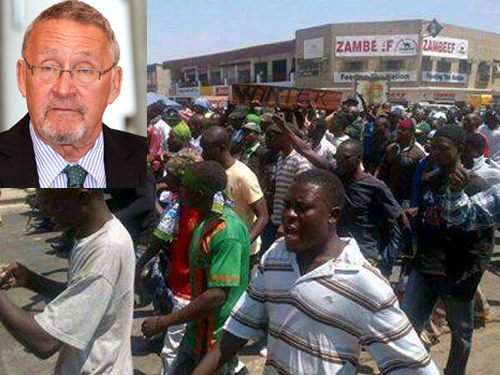
ZambiaTurbulenceThis morning two countries just above South Africa are suddenly and surprisingly tense. There is potential for serious violence in Zambia and Zimbabwe.

Other than that both countries begin with the letter “Z” there’s little else at first glance that seems similar about them beyond sharing the Zambezi river as a common border. But I think the sudden climate in each reflects a connection between them we didn’t realize before.

In a nutshell the problem in Zambia is the sudden death of its unusually popular president and the ensuing power struggle that includes the completely unexpected if remote possibility that a white man will come out on top.

In Zimbabwe nothing can be explained without Robert Mugabe, and the old and clearly sick dictator is being besieged from all sides: his party, an ever resurgent opposition and … even his wife.

Both situations have resulted in near lock-downs of their capitols. Clearly, violence is developing.

“Violence will never be the answer,” was the lead editorial in Zim’s ruling party newspaper Friday. Which, of course, means it will be.

In fact, the ruling party stoked the flames a few paragraphs later by stating, “…violence in crisis areas is not pushed by ideological pundits, but criminals hiding under a political or religious umbrella.”

Convoluted as usual by a lack of proper diction and reason in equal measure, it’s still quite clear that Zim’s ruling elite is getting a call to arms.

“Lusaka is in lockdown mode as most roads are closed today and tomorrow” ostensibly for the funeral of the recently dead president.

‘Who Cares?’ the first comment following that report today in one of Zambia’s main newspaper goes on to ask, pointing out that what really matters is “what is happening at the parliament gates,” i.e., the succession fight.

The sudden death of a popular and powerful leader in Zambia, and the apparent final demise of a decrepit and very sick old dictator right next door, are happening in tandem. Is this just all coincidence?

Well, probably, but I’ll tell you my imagination might not be completely to blame here. The current Acting President of Zambia is Guy Scott, a white man. Click here to read my first blog about his coming to power.

Like similar situations in democracies throughout the modern era, Scott as Vice President was a know-nothing, powerless figurehead who accompanied international missions mostly for needed amusement. George Bush refused to believe he was an official when a Zambian delegation visited the White House.

As Acting President he normally has no more power than an Acting Anything, which as we all well know in politics or business is a stand-in for the real thing expected sometime soon.

And so it seemed with Scott. Until last week. Here’s how that changed:

“… suddenly there was an announcement on national television that, Acting President, Guy Scott had dismissed PF Secretary General, Edgar Lungu from his position…[and]… replaced Lungu with Chipili Member of Parliament, Davies Mwila.

“The announcement was greeted with spontaneous riots and protests … and a thick nationwide atmosphere of disaffection.

“Diplomats quickly revised Zambia’s security rating from ‘peaceful transition to crisis.’”

The chess game that is always African politics is seen as some simply as Scott’s attempt to keep his opponents out of contention, the most important of which is the late president’s son.

But I think he’s setting himself up as a compromise candidate. He’s stoking the flames to become the hero who puts out the fire.

How does this parallel with Zimbabwe?

A once little known fact that has received wide attention recently is that Scott is actually a friend and vital supporter of the Zimbabwean dictator, Robert Mugabe, who among all of his most vicious detractors was hated most by the white farmer he displaced.

Mugabe is clearly on the descent, certainly physically but I think at last politically. When your wife challenges you in public, beware.

But if Scott prevails, then so might Mugabe’s dreams for succession?

Would you ever have thought the survival of the black demon Mugabe depended upon a once little known white man next door?

Tanzania Tittering

Tanzania Tittering

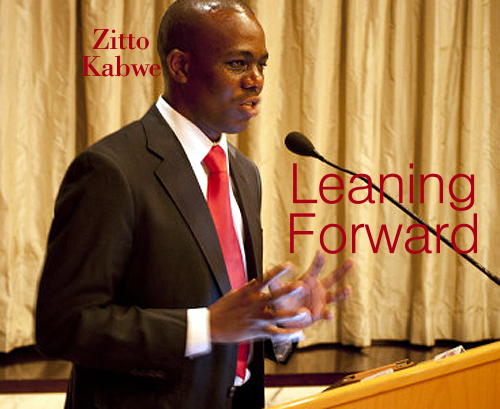
ZittoKabweTanzania’s power cabal is pressing the lid tightly on a pot of boiling discontent, but young revolutionaries are up to bat. Game on.

Three issues are exploding: fraudulent mining contracts, authorities complicit with smuggled ivory, and the ramming through of a bad new constitution.

Tuesday, Dar police surprised the world much less Tanzanians by actually arresting the country’s two top gas and oil officials for failing to comply with a subpoena issued by young bloods in the Parliamentary opposition.

There had been a delay between the actual issuing of the subpoena and the ultimate arrests, and in Tanzania’s Shakespearean politics it’s hardly more than speculation as to why. Here’s my best take:

Serious pressure on Tanzania started in mid-October when the consortium of European Union donors suspended more than a half billion annual dollars of development aid.

This was no surprise. A year ago I suggested it would happen.

I believe foreign aid from the EU and the U.S. is often given for political reasons much more than for the development reasons championed, and huge amounts of cash for which there is no accounting is the reason there is so much corruption in Africa.

(That’s changing. It’s embarrassing that the U.S. has not yet joined the EU in the suspension of aid.)

We aren’t sure when the subpoena was issued, but the crusader who pushed it through Parliament is a powerful, young business educated progressive from the main city on Lake Tanganyika, Kigoma.

Zitto Kabwe set up a website in his name devoted to the fraudulent mining issue in July. The subpoena was probably issued sometime shortly thereafter.

That particular controversy – one of a dozen such fraudulent stories coming out of Tanzania’s incredible new-found wealth in gas and oil – was of a secret government agreement to cede more than two-thirds of all oil and gas revenue to the foreign investors.

That’s at least twice the norm and when compared, for example, with several contracts that neighboring Kenya has issued with foreign mining companies, almost three times the regional average.

Kabwe said his crusade opened up when a local blogger, Ben Taylor, discovered the fraudulent deals which had been held secret by the government.

Taylor’s account was immediately published in an excellent Africa wide media publication, African Arguments that got continent-wide attention.

Then, new reports of increased ivory smuggling facilitated by the same officials who engineered and profited from the fraudulent mining contracts hit the news this week.

The lid on the boiling pot of discontent might still be pressed tightly down, but it’s getting hotter. The gas and mining officials were hauled in this week. The kingpins will likely be out on bail by tomorrow.

“This scandal is too big. We are not ready to see all this money end up in the pockets of a few officials,” opposition politician David Kafulila told Deutsche Welle.

Add to all of this a growing controversy over Tanzania’s so-called new constitution. Widely opposed by the public because it really isn’t new, doing little more than enshrining the ruling party’s near autocratic power, the government has vowed to move ahead with the national referendum in April.

That controversy has spilled over into the streets and Sunday one of the principal architects was almost stoned and beaten in a forum held in Dar-es-Salaam to promote the government’s position.

The government doesn’t appear to be backing down. Today, the unpopular prime minister condemned the protesters, maverick legislators but mostly the EU for withholding aid, arguing it would hurt “the common man.”

We’ll see who it hurts sooner than you think.

Letter From America

Letter From America

DividedGovernmentLETTER TO MY AFRICAN FRIENDS

Here’s what happened Tuesday in America:

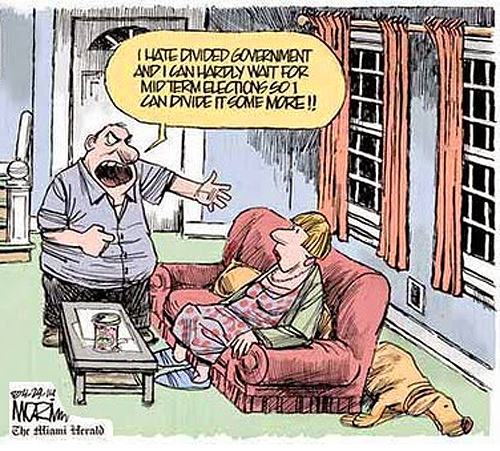
An antiquated governing system flipped between two irreconcilable ideologies, because those ideologies are so far apart that compromise isn’t possible.

Many of you – I’m thinking particularly in Kenya – want to replicate America’s governing system. Don’t. It was great for the 19th and 20th century, but it doesn’t work in our high-tech, globalized 21st century.

Yesterday’s politicians and media analysts are absolutely right that “America is yearning for compromise” but they’re absolutely wrong that “now there’s hope the two sides will work together.” Our political structure has evolved to prevent compromise, so while we all want it, we’re not going to get it.

Since about a generation ago, “left” and “right” have moved too far apart from one another to be able to compromise within our system of government. This isn’t a failure of democracy, it’s a failure of the governing system to reflect democracy.

So gridlock will continue. Obama will stick to his positions and no substantive laws will be passed, or he will concede Republican positions. The two sides won’t each “give a little.” Neither side can: the positions are simply too far apart. So all legislative outcomes will simply be reflections of one side or the others ideology.

My ideologies and Ted Cruz’ are irreconcilable, but we are both gaining support. There is nothing left of the middle in America. I’m not sure this is in itself bad. The “middle” is often nothing more than a “muddle.” In many places in Europe widely divergent clearly opposing parties manage functional government through a parliamentary system. America is unable to.

Obama’s presidency is failing, because he still believes in legislative compromise. He still believes that he is the leader of everyone in America, and that idea means that he’s the leader of no one.

Whether it be on human rights, national security and wealth distribution, compromise isn’t possible: The difference in opinion is too great.

Today’s American elections are structured to achieve a knockout punch. Last night was a big Republican win. The Democrats will have their turn, again, and then the Republicans again, while America sinks further and further behind China and India and much of you in Africa.

“Sinks” in terms of economy, yes, but also in terms of culture, education and human rights.

The demons are three: an executive presidency, the rules of candidate campaigns and a little understood process called gerrymandering.

By the way, the American public as a whole is much more unified than our elections make it seem. In Tuesday’s election, “ballot initiatives” and “referendum” – policy questions put to the electorate as a whole – received massive support : redistributing wealth (“minimum wage”), protecting human rights (“anti-discrimination”), decriminalizing the poor (“legalizing marijuana”) among many others.

But under America’s system, today, these are rarely allowed to come before the voters and often then only as recommendations to their legislators rather than methods of creating law.

And under our broken system of government, the public’s will can’t be manifest well. So while the public passed those few referendum, at the very same time they elected powerful legislators who promised to oppose those exact same referendum.

So … nothing gets done. Gridlock or schizophrenia, doesn’t matter.

You in Africa have a unique opportunity to see how wonderful democracy has been for a long time in America. Use your fresh ideas to figure out a way to sustain it. We’re failing, here.