Basic Burundi

Basic Burundi

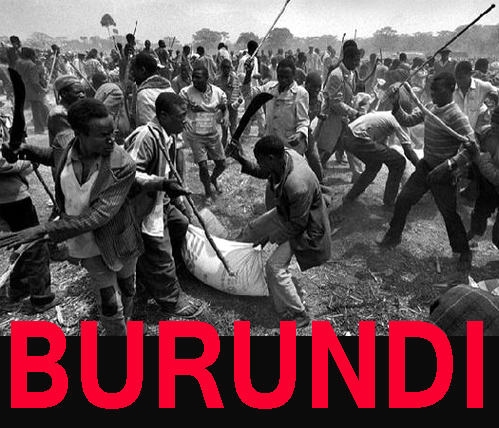
BurundiThe conflict in Burundi, as previously in Rwanda, is ethnic, aggravated by horrific colonial rule and current western disinterest.

Unfortunately my position is more aligned with global right wingers than the left-leaning media, which argues forcefully that this is not an ethnic but a political conflict.

On the surface that’s obvious. The current president, Pierre Nkurunziza, was out of the country when a coup was staged by a demoted military officer, Godefroid Niyombare, and both are Hutus. Like Rwanda, 85% of the population is Hutu, 15% Tutsi.

Niyombare staged the coup after growing unrest in the capital that followed Nkurunziza’s announcement that he would seek a third term as president in upcoming elections.

The constitution restricts individuals to two terms as president. Nkurunziza contends his first term was not really a term, since he came to power on an agreement that ended a 13-year old violent conflict between Hutus and Tutsis. He argues that since only his second term was from an election, he should be given another election chance.

Niyombare was head of the intelligence service when Nkurunziza announced this, and he publicly opposed it. The president then sacked him.

So, yes, on the surface it seems like it’s Hutu against Hutu.

Dig deeper.

The UN announced several days ago that more than 50,000 refugees were fleeing Burundi: 25,004 to Rwanda, 17,696 to Tanzania and “almost 8,000″ to the South Kivu province in the Democratic Republic of the Congo.

Rwanda and Tanzania are considered friendly to Tutsi, and the DRC friendly to Hutu. Check the numbers. The easiest way to flee the country of Burundi is to cross over to the DRC. There are virtually no formalities on the northern route to Uvira, and more than half of the country’s western side is Lake Tanganyika, an easy crossing west to the DRC.

Why, then, so few refugees into the DRC? And so many into Rwanda and Tanzania?

The answer is obvious. Regardless of the political specifications at the surface of the current conflict, the population fears a genocide against Tutsis.

Burundi and Rwanda were originally a single colony of Germany before World War I. Like all the European colonial powers, Germany considered its mandate one of civilizing a primitive population of inferior people.

Africa colonization was aggressively driven by the private German, French, Belgian, and British businesses that were anxious to exploit the continent’s massive natural resources. European governments, however, were very reluctant to do so, but business required an ordered society and business prevailed over their weary governments.

Soon these four great European powers were competing with one another for more control and influence over the African continent, justifying the enormous cost to European electorates as a humanitarian one, creating civilization from barbarians. All the while European businesses were conducting some of the most unimaginable exploitation of people and resources.

This model for development required the colonizers to determine levels of “civilization.” European powers made public pronouncements of which ethnic groups showed more potential or initiative, and/or greater subservience to colonial oppression. In virtually all cases the local ethnic power was accepted in whatever state the European governments found it at the time colonization began.

In the Burundi/Rwanda area, the Tutsi while only 15% of the population were the most educated and most powerful. Tutsi ruled.

Following Germany’s defeat in World War I, the League of Nations divided its massive East African colony between Belgium and Britain.

Britain got what is now Tanzania, and Belgium got what is now Burundi and Rwanda. Belgium governed its area as a single colonial country, Ruandi-Urundi, and soon became the most notorious offender of human rights of the entire colonial period. Read Leopold’s Ghost.

For more than a millennium Hutus and Tutsis shared a single language and most life ways and traditions, and they intermarried frequently. But the Tutsis were always the overlords, and the Hutus were the workers and sometimes, slaves.

For centuries, some suggest two millennia, the minority Tutsi ruled the majority Hutus. More workers were needed than overlords, and whether by design or default as the centuries passed, the population of Hutus grew much faster than Tutsis.

By the time Belgium took over the area after World War I, there were between 5 and 6 times as many Hutu and Tutsi, even though the Tutsi ruled. Some claimed that over the centuries as Tutis numbers declined relative to Hutu, that the Tutsi felt they had to become more and more authoritarian.

World War II ended the colonial era.

Europe had to rebuild itself. There were no resources to continue colonization, despite the continued pressure by businesses to do so. Every colony was put on a fast track for independence.

The easiest way to do this was to further institutionalize the ethnic stratifications that had begun nearly a century before. Belgium decided the best thing to do was to create two countries and encourage the Tutsi to go to one (Burundi) and the Hutu to another (Rwanda).

Burundi was given to a Tutsi clan as a monarchy. In Rwanda, however, Belgium insisted on an election, and guess, what, the Hutus won. (The 1993 genocide changed that and Rwanda has been governed by a single Tutsi dictator ever since.)

But the division was unfair to begin with. Both countries are about the same size, yet the Tutsis were outnumbered by Hutus 5 – 6 to 1. Quite apart from the politics and attempted segregation, it’s not easy to get families and small businesses to leave homelands they’ve occupied for generations.

So essentially ever since independence the area has been in constant turmoil as the Hutu/Tutsi conflict only grows worse, not better. It was historical. It was reenforced and aggravated by colonial policies.

And Bill Clinton’s refusal to intervene and stop the 1993 Rwandan genocide before it was too late recreated the worst of this ethnic divide in the modern era.

I see no end to this ethnic divide. But if Barack Obama recommits the error of Bill Clinton should the situation in Burundi escalate, then once again we will reenforce racism, emasculating the politics that might otherwise be able to mitigate the intense hate.
What if we end Malaria?

What if we end Malaria?

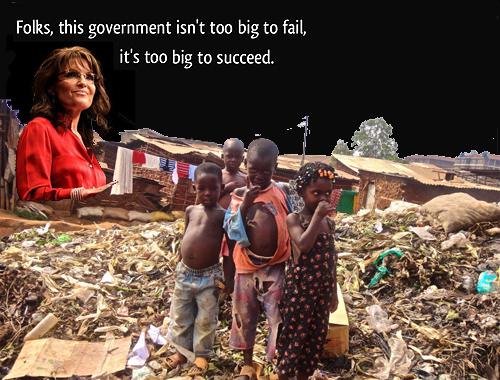
toobigtosucceedThe fight against malaria is going well, but American attitudes will have to change to achieve ultimate success.

Malaria threatens much of the world because there’s no vaccine and its threat increases proportionately with poverty.

But a successful vaccine or other efforts like bednets could actually increase poverty and disease overall.

Malaria was eradicated in most of the western world when sanitation and potable water became government responsibilities. Sanitation and the delivery of potable water reflect less poverty.

Less trash and better managed water reduces mosquitos, which transmit malaria.

The circular relationships of water and trash to malaria means that malaria will be automatically reduced – even eradicated – when better water and trash collection arrive poor communities.

A critical part of the Obama administration’s initiative to reduce malaria understands this, but it is somewhat buried in its presentation to Congress in order to avoid the expected criticism that there is too much government in such initiatives:

“The President’s Malaria Initiative (PMI) works to reduce the burden of malaria while at the same time strengthening host country health systems and workforces,” in my estimation is the key ingredient, but you have to read quite deeply into the report to get to this section. The front of the report is all about nets, spraying and diagnosing, things that Congresspersons can grasp.

“You can’t fight malaria without health care workers,” the somewhat buried part of the President’s plan understands well, because these workers don’t simply instruct people on how to fight malaria, they work on social services like potable water and trash collection.

The American Congress – indeed, the American people – don’t accept the huge efforts required by government to build social institutions like public sanitation. Whenever such efforts are suggested, naysayers point to corruption and lack of private enterprise involvement.

That’s why efforts like the President’s Malaria Initiative have to fool Congress into thinking that American money is not being spent on such grand goals, but on things like nets and spray.

In America all criticism of large scale government involvement finally devolves to the insane belief that government is the problem, not the solution, and this mantra has been insidiously instilled in the American psyche ever since President Reagan said it nearly 35 years ago.

The largest private organization fighting malaria is the Bill & Melinda Gates Foundation. While their efforts are noble, they haven’t achieved a fraction of what government-to-government aid, like the President’s Initiative, has:

Two researchers at Duke University recently concluded that “impressive progress in the fight against malaria” occurs exactly because of a “substantial increase in [government-to-government] funding,” specifically the President’s Initiative.

Private NGOs focus on possible cures like vaccines and inexpensive solutions like bednets because it’s a lot cheaper than developing public health systems.

Yet as they approach success a horrible catastrophe looms: What if the Bill Gates Foundation finds a malaria vaccine? What if enough bednets are distributed to basically reduce malaria substantially?

Many more children will live. And so without improved public health systems many more children will also die. A host of other diseases are on an alarming increase in Africa, like a huge range of gastro-intestinal diarrheas and tuberculosis.

Without delivery of potable water, none of these “children saved from malaria” will be healthy. So while malaria might be reduced substantially, overall public health will decline.

It’s simply a matter of money. Government-to-government aid for reducing malaria last year was $3 billion. Private NGO totals, including the Gates Foundation, was less than half that.

The Duke researchers suggest that $6 billion annually is necessary.

Six billion isn’t very much in western world budgets, but unless it’s used to buy bednets or underwrite specific vaccine developments, legislatures like the American Congress refuse to act, ignoring grander goals like developing public health systems.

Yet that was exactly how malaria was eradicated from the U.S.!

Until the attitude promulgated in America that government is less effective than private initiative changes, the world will not.

Stability at What Price?

Stability at What Price?

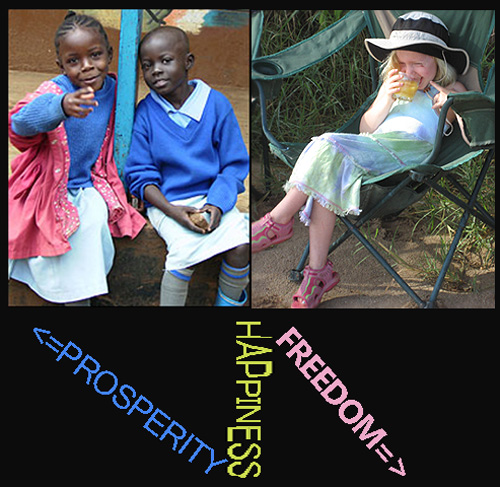
freedomprosperityAre freedom and prosperity at least somewhat mutually exclusive? Why is Africa so stable, today?

There is serious turmoil in Burundi, but in the major hothouses of death and destruction, Nigeria, Somalia and South Sudan, right now there is a remarkable level of peace.

Tuesday, Secretary of State Kerry became the first high American official to visit Somalia since Blackhawk Down in 1993. Kerry justified his visit because Somalia “is turning around.”

There are many wonderful indications to suggest this is true.

There is worrisome fragility in the current Mali government, and troublesome weakness in a number of West African governments probably due to the prolonged ebola outbreak, but governments in North Africa and sub-Saharan Africa (other than Burundi) look strong and stable.
Why?

The answer is becoming clearer and clearer. Very strong military assistance mostly from the U.S. and France has propped up existing governments and laid to waste many areas of terrorism.

The starkest of the stark is Nigeria.

Literally for the last 5 years Nigeria was decimated by Boko Haram, at its worst situation (hardly a few months ago) ceding nearly 20% of its territory to terrorists.

Today Boko Haram is absolutely on the run. The explanation from one of Nigeria’s best media outlets:

“Unlike a year ago, when Nigerian troops would run away from Boko haram militants after running out of ammunition or for possessing inferior weapons, the Nigerian soldiers are now better armed, better equipped and better motivated.”

‘Better equipped’ is the understatement of the decade. The list of new equipment in the hands of Nigerian soldiers is astonishing, particularly when compared to the situation less than a half year ago.

It was not for wont of giving. The western powers were ready, as clearly demonstrated by the current situation, to arm the Nigerian military sufficiently. But a mixture of local politics and western hesitation because of the equivocal politics kept the ammunition in warehouses until now.

Legitimate concerns with protecting human rights were front-and-center in the paradigm that kept the previous Nigerian government of Goodluck Jonathan weak. These have been cast to the crows by the current president Buhari, a former general nearly imprisoned by his own society for human rights’ violations.

Ditto in South Sudan, the more “peaceful” Somali and ever more stable Kenya.

In addition to arming Africa to the teeth, Obama’s militarism these last six years has decimated terrorist cells and American drones have wiped out more than two dozen terrorist leaders.

Media freedom is a great barometer of authoritarian governments, since there has never been a government in the history of mankind that wasn’t vain.

Press freedom is under serious attack in … Nigeria, South Sudan and ever more stable Kenya.

So that’s the reason it’s safer than ever for you to travel to Africa: growingly authoritarian governments infused with western military might.

Regular readers of this blog will know that I’m troubled by this. I’m delighted that Africa is a calmer, safer, more stable place, but troubling if at the expense of freedom and the sanctity of human rights.

It seems that this age-old paradigm is near inviolable. Freedom and prosperity are at least somewhat mutually exclusive.

But wait.

Didn’t we try this, once? Weren’t there horrible South American generals and racist American governments and horribly cruel potentates that ruled the world for a long time not too long ago.

Did things get better? For whom?

Compromises Galore

Compromises Galore

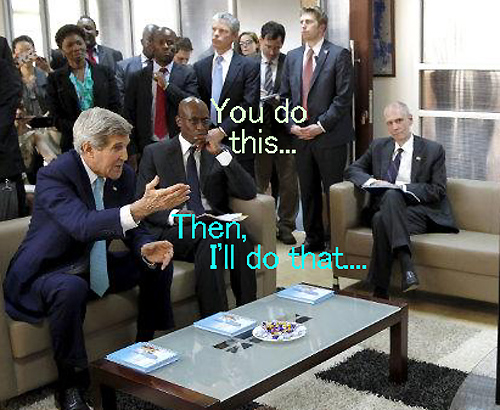
KerryInKenyaBill Clinton, John Kerry, then Barack Obama, a sort of reverse greeting line that heralds the end of frosty relations with Kenya. Let’s call it compromises galore.

Politics is so damn slimy. I know how important Kenya is in Africa. I know how exceptional its youth, in particular, is and how imaginative its culture has become.

I know that in a future world, Kenya will be much more important than it is, today.

If I know it, then Bill Clinton, John Kerry and Barack Obama know it, too. The difference between them and me is that I don’t have to ignore the travesties of human rights that Kenya’s current leaders employed in their rise to power.

Uhuru Kenyatta should not be the head of anything except a mafia, and certainly his vice president, William Ruto shouldn’t be, either.

The two orchestrated horrible violence following the 2008 elections, ironically in part against one another’s followers. When the evidence for this was gathered then meticulously catalogued, and when the individuals supplying the evidence were sequestered under witness protection in Europe, not a man in the world – except them – denied it.

Then one by one the witnesses recounted or disappeared. The evidence dissolved. The two who had been arch enemies from different tribes that historically killed one another struck an alliance and were elected to lead Kenya.

The outcome, today, is that Kenya is prospering when many African countries aren’t. One could argue that the millennial enmity between the Kalenjin (William Ruto, the vice president) and Kikuyu (Uhuru Kenyatta, the President) tribes has been laid to rest.

The War Against Terror has been successful from the point of view of the United States, because the U.S. is much safer, because Kenya became the sacrificial lamb, invading Somali with American might and dollars and taking care of more than a half million refugees.

But Kenya doesn’t mind being the sacrificial lamb because the investment – much of it military – has raised it from the 13th to the 9th largest African economy in only five years.

I think Kissinger called this Realpolitik.

They’re happy. We’re happy. So why am I not happy?

I guess because in today’s world ends do justify the means. The timeline for this dynamic, though, is historically short. The longer a view you take, the less it’s true.

The machinations, manipulations, abject brutality and horror of Kenyatta’s and Ruto’s actions to achieve power have resulted in a more stable, prosperous Kenya and one that may even be tackling the most horrid affliction of emerging cultures, corruption.

Yet in accomplishing these lofty goals some very nefarious means were employed, among which is included sacrificing their own country’s peace and stability for America’s. The sale price was pretty good, though.

So as each level compromises to achieve something good by sacrificing a bit of morality, the ladder down to iniquity is built. It becomes institutionalized.

This logic is where I strike brotherhood with the Far Right… or the Far Left. It’s where compromise is bad.

Ultimately, I guess, it’s a matter of degree – how much you compromise for what ends – a very subjective exercise and who among us can judge whose subjectivity is correct? Me? Kerry? Uhuru? Bush?

Hillary? omg

The Gift Horse’s Mouth

The Gift Horse’s Mouth

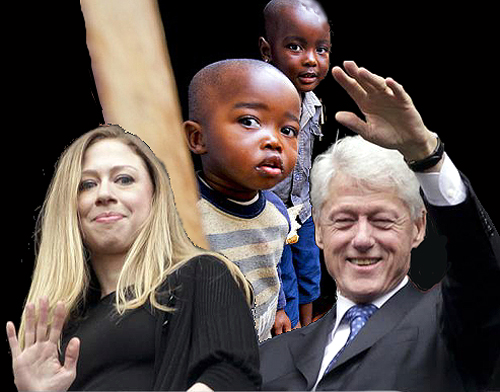
clintontripAfricans are bristling but resigned to the current Clinton safari the same way I’m resigned to a President Hillary. What a dreary day.

The Clinton clan minus Hillary is currently on a 9-day African tour to Kenya, Tanzania, Liberia and Morocco, and they are not getting the reception they had expected.

Like the Bill Gates Foundation, the Clinton Foundation is highly vested in Africa, and so you would think it natural that from time to time the principals would come here.

“O, fellow benighted Africans! Gaze down at the bleeps emanating from your electronic device – a device powered by the marvelous coltan mined on your land. Can you not see the newsflash? Dignitaries, Big Names indeed, have come to our continent in order to help us help them help us,” famous African filmmaker and writer, Richard Poplak, wrote yesterday.

Poplak is white, South African born bred and nurtured, and like most of the intellectuals of all colors on the continent, not particularly happy with the Clintons.

Poplak continues:

“…the Grand Priests of the Clinton Foundation, the givers who give almost as good as they get, [have come] to sniff the cow dung burning in rustic villages, to pat the heads of the doe-eyed children they have kept safe from brand name infectious diseases.

“O, African, behold Chelsea Clinton, future presidential candidate of the Democratic Party… Lynn Forester de Rothschild, the billionaire boss of E.L. Rothschild… [billionaires] Jay and Mindy Jacobs are here!

“O, but Africans, there is more. No one less than Hadeel Ibrahim is here! The daughter of Sudanese-British billionaire mobile phone philanthropist Mo, Hadeel Ibrahim is a great friend of Chelsea’s, and they apparently spent a wonderful thanksgiving together at the Clinton pile in Chappaqua. All has been forgiven since Bill Clinton Cruise Missiled the Al-Shifa pharmaceutical factory in 1998.”

Like the Bill Gates Foundation, the Clinton Foundation is even more heavily invested in Africa. I believe this is Bill’s penance for having “made a mistake” (his own words) when he ordered his United Nations ambassador to vote against increasing the Canadian UN force that could have stopped the 1994 Rwandan genocide.

The problem is, Clinton has piled one mistake on another in Africa. He hugely empowered Ugandan president Museveni when all of us knew that was a mistake. Museveni is now one of Africa’s great dictators, the author of the “kill the gays” bill.

Poplak continues:

“Along for the ride are many other Clinton Foundation donors… professional philanthropists, Silicon Valley whizz-kids and generally outstanding humans. The safari …will culminate in a dazzling conference in Marrakesh, presided over by that famous empowerer of women and long-time Foundation supporter, the King of Morocco.

“And it is equally churlish to think of the Clinton Foundation as a giant corrupt money suck akin to the worst African banana republics: … [The fact that] Bill Clinton seems to have helped a Canadian mining magnate hand over 20% of America’s uranium resources to the Russians while Hillary was leading the state department, does not ipso facto make the outfit rotten.”

But she would be the first woman president!

“And what does it matter to you, O African, that tens of millions of dollars have flowed into Clinton pockets from women’s empowerment centres like the UAE and Saudi Arabia, either for speaking fees or for donations?

“… it may be tempting …to imagine that the Clintons and their Foundationites are using the continent as a theatre set, and we Africans as drooling extras… It is tempting to say that this is all about big money and real politick, because Bill and Hillary Clinton, along with their Chelsea clone, serve power for power’s sake.

“You might wish to say that this all seems so garish and ghastly, millions of dollars blown by a 0.1% cabal on swanning about the continent, billions of the world’s wealth zipping over the African savannah in a legions of Lear Jets.

“But you would just be sour to think that way. Ungrateful. When the beautiful waxed SUVs zip into your village and you smell the $1,500 anti-aging cream on the frozen faces of these Kings, these Gods, remember to thank them with the appropriate deference. Remember to bow and scrape.

“If we don’t look the part, then they don’t get the money.”

Buddying Up

Buddying Up

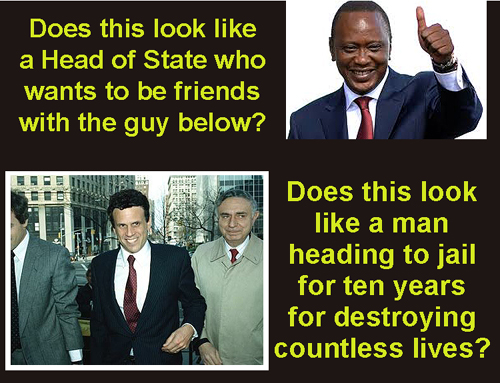
kenyatta and milkenPresident Kenyatta’s legacy like his plane last night is heading in the wrong direction.

The President of Kenya was headed last night to Los Angeles to learn the “American Way.” His teacher? The Joker with a makeover.

But his plane had to turn back because of fighting in Yemen. As of this writing it’s not known if he’ll resume the journey to the United States, and if so, what parts of it will be eliminated.

I have a suggestion.

Only two African Heads of State are scheduled to address the closed-door “Milken Institute Summit” next week in Los Angeles: Kenyatta and Rwanda’s Paul Kagame.

The Summit is an annual event avoided by most public figures because the Milken Institute is funded by Michael and Lowell Milken, “junk bond kings.”

The Milken legacy is one humongous fraud on the American people, two playboys who got filthy rich from the suffering of tens of thousands of retirees and other responsible middle class savers.

In 1990 Michael was sentenced to ten years in prison for manipulating financial markets that in part caused the collapse of the ‘Savings & Loan’ industry and likely contributed to the later world financial collapse.

Today the two brothers are billionaires and Michael is listed by Forbes as one of the richest men in the world.

Most of the world has already written off Rwanda’s Kagame as a ruthless dictator and most of the world has begrudgingly accepted him for keeping the peace of his troubled country.

But Kenyatta’s story is still being written. There’s a lot of good and a lot of bad to it.

As Kenya’s current Head of State he has a lot to be proud of: Things are going petty well in Kenya right now.

Security has improved immensely as the Somali conflict winds down albeit excruciatingly slowly. The economy is up despite the most enormous challenges in the world. The new constitution is being implemented step by step and with a few exceptions is going well.

But Kenyatta’s legacy will forever be saddled with the fact that the World Court considered him responsible, and charged him, with fomenting the horrible violence of 2007 that ultimately brought him to power.

So Kenyatta has a lot to prove in the remainder of his term as Kenya’s president, much less in the remainder of his life.

Traveling to the U.S. to address a controversial business forum that any sane politician wouldn’t touch with a hundred foot pole will hardly become a feather in his cap. It’s another tick in the bad column.

He says he’s doing it to increase investment in Kenya.

That was the line that Milken used for America in defending his junk bond trading.

I hope Kenyatta reads his fate correctly. The first leg of his journey yesterday, a flight from Nairobi to Dubai, had to turn back because of fighting in Yemen.

Apparently his advisers didn’t know about the fighting in Yemen? Do they know about Michael Milken?

As of this writing it’s not known which parts of his planned American trip will be cut short if he continues.

It looks pretty clear to me.

Cape of Good Hope Not Enough

Cape of Good Hope Not Enough

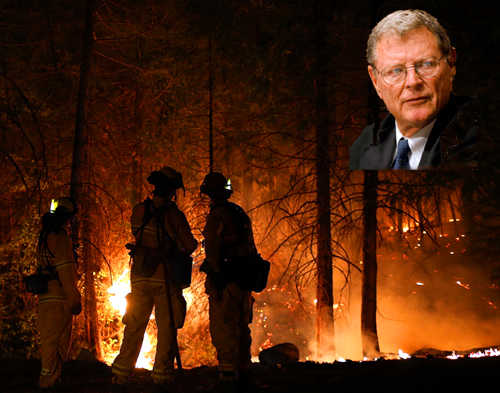
FiresInTheCapeGlobal warming disrupts my landmark Cape/Botswana safari, but compared to what may happen a decade from now, I don’t think anyone will complain.

A 12,000-acre wildfire has closed one of the Cape’s most spectacular coastal highways and today threatens Table Mountain National Park.

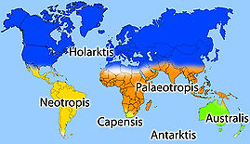
These areas are not simply major tourist attractions, but arguably the most precious of the world’s six floristic kingdoms.
FloristicRegions
The Cape is about 35 degrees south longitude. So is much of Australia and South America. California is about the same, but north. All these coastal areas in their summers are experiencing record-breaking hot temperatures, high dry winds and … unprecedented fire.

“Unless there are rapid …reductions of greenhouse gas emissions …Australia will experience more heat waves and bush fires,” a climatology professor at the University of Melbourne has warned. 2014 and 2015 were the worst years for wildfires in Australia’s history.

The 2014 Chilean wildfires nearly destroyed the port city of Valparaiso.

The Brazilian government has warned of a 160% increase in wild fires as endless lines of flames destroy huge portions of the Amazon.

We all know what’s happening in California.

Light rain yesterday slowed the fire’s advance in The Cape and there’s hope that “heroic” (many volunteer) fire fighters will get control, today.

But the spectacular Chapman’s Peak drive into The Cape Peninsula from the city is closed, and it’s likely to remain closed long after the fires subside.

The destruction of the foliage on the steep cliffs that rise from Chapman’s is now compromised, and rock slides are more likely.

Chapman’s Peak is one of the main tourist attractions and in a very personal way it displays how global warming is lasting and destructive. Everyone remembers catastrophes in personal ways: Saturday 35,000 bicyclists convene at The Cape for the world’s largest timed marathon race. The route has been slashed to less than half its original 70 miles.

We pay attention to the catastrophe of an event, but then we move onto the heroes who ended it never paying enough attention to the long term trends and destruction.

I remember the 1996 Yosemite Ackerson Fire which burned 60,000 acres and may actually now stand as one of the markers of global warming. But at the time it was rationalized as a necessary ecological event, just today as many in The Cape are viewing today’s fire.
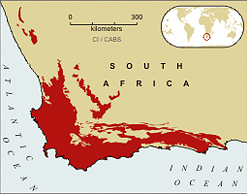
capefloristickingdom
The Cape is arguably the most precious of the six floristic kingdoms on earth for little more reason than how small it is. The Ackerson fire was 60,000 acres large. This Cape fire is currently 12,000 acres, a fifth the size of the Yosemite catastrophe.

But Yosemite sits in the world’s largest floristic kingdom, the boreal. The fire was infinitesimal over that immense area.

The Cape’s precious floristic kingdom is less than 800,000 acres large and this fire could destroy almost two percent of that kingdom, an area with a remarkable 8,700 species of plants of which two-thirds are endemic. This rivals the Amazon’s biodiversity and dwarfs the boreal biomes in which Yosemite is found.

A good friend here told me yesterday that “we’re just going to have to learn to live with this” as she repeated the mantra of the importance of fire in rejuvenating plant species.

It’s true that the fynbos biome requires fires more often to remain healthy than the great pines of Yosemite. Most scientists think the optimum for any fynbos plant is 7 years.

But I disagree substantially with my friend’s shrugging off this occurrence. When understood globally we begin to see how sinister global warming has become.

This Cape fire is not a singular event. It’s part of the longitudinal band we can now clearly call the planet’s “Ring of Fire.”

Caused by global warming, increasing fires reduce the plants that produce our oxygen while the actual combustion contributes to increased greenhouse gases. This is precisely the exponential advance that scientist have been warning us about for years.

Yes, heroes should be applauded and firefighters are among the most laudable. But it’s time, folks, to start focusing on the villains.

And among the most notorious of today’s villains are the climate change deniers like our own Senator Inhofe who now chairs the American Senate’s most important environmental committee.

Can you believe that? But I doubt Senator Inhofe even knows what a floristic kingdom is. His cronies in Kansas and Texas have been doing everything in their power to eradicate such nonsense from the public school textbooks.

Bon Voyage!

Bon Voyage!

LenatTSAThose of us daring to leave the country after today through unpaid security staff might heed the following advice.

Go early. I can’t blame anyone who works for the TSA for slackening up. Many went through this in the 2013 government shutdown, and the experience wasn’t pleasant or fair to any of the workers.

To begin with senior personnel who aren’t on the front lines of security will actually be furloughed, just as they were in 2013. The bosses.

Everyone eventually got paid, including these senior managers. So for the bosses it was, in effect, a paid vacation. That doesn’t sit well with the employees who have to come in under the terms of their contract … even without pay.

“When it comes down to it, there’s people who’s going to decide not to come to work,” Bob Bartz, the TSA Local 1048 president told ThinkProgress Monday.

Congress thinks that it has “fixed” the disaster that confronted travelers when the 2013 shutdown began, by funding traffic controllers and a few other essential personnel. But not paying people who are doing legitimate work is not exactly a fix that sticks.

I’m reminded of a section of my new novel, Chasm Gorge. Len Willy, the safari guide, has just returned to Nairobi and must pass through immigration and customs, manned by officials rarely paid:

The line moved quickly, and the fatigued official stamped his passport without even looking at him. He quickly walked down the never having worked and never will work escalators into baggage reclaim where the overworked carrousel tried, stopped, and tried again to revolve baggage back into the lives of passengers.
      Len’s line of sight cut over the frozen stares of the passengers to the customs tables, where indecently clothed and overstuffed officials waited for their bribes, appropriately directly beneath a newly painted sign that announced that no bribes should be paid.
  His two bags arrived, and with his fingers already searching for money in his front pocket, he quickly walked towards the customs table.
      Kenya was a land of chai, the Swahili/Hindi euphemism for a bribe. In the old days Len remembered resisting angrily, staring at young hooligans’ hands with the disgust of a master visitor, capable of withdrawing his support and the thousands of American tourists he commanded. But the fat Wazee who manned the scratched and scarred customs tables were no hooligans. Their clothes were frayed, their eyes held in sockets by flaps of skin made thick by nights of no sleep. Big bellies were likely extended not from too much food, but from too much cheap changaa – cheaper, sweeter, faster than a bottle of beer.
      Len could muster no anger when he imagined the throngs of family waiting to be fed, clothed, and sent to school by a single man fortunate enough to be closely enough related to some high official that he got this coveted government position – only not to be paid from the national treasury for months.
      Len was stopped. Most weren’t. But he was as much a ripe target for chai as tourists were for cab and elephant hair bracelet scams. Resistance welled in his veins even as his pocketed hand grabbed the hundred shilling note.
      The customs official didn’t even try to seem legitimate. Instead, he just threw his fingers at random parts of Len’s bags.
      Len pulled the shilling note out of his pocket, and before he even opened his hand, the official snapped it up with little regard to keeping it secret and then casually took out his wallet and carefully folded in the note, abandoning all notice of Len as he returned his attention to the back of the arrivals hall, deeper into the carousel’s twists and turns than luggage would ever go.
      “Three kilos of flour, or a half kilo of tea, or all the makings to launch a SAM,” Len recounted dreamily to himself the worth of his hundred shillings.

Nairobi has greatly improved since that segment was inspired.

O’Hare, on the other hand ….

The Cold Out of The Spy

The Cold Out of The Spy

letsnotpaythemToday’s spy scandal in South Africa, CitizenFour and my own novel, Chasm Gorge, all show that the old spy isn’t all that he’s cracked up to be.

And that, my friends, is why not funding Homeland Security could be the greatest security threat the United States has faced since 911.

This morning South Africa is raked by still another controversy, but this one is more sexy because it’s about spying.

Calling South Africa the “El Dorado of Espionage,” the Guardian newspaper and Al-Jazeera jointly announced they had collected hundreds of secret documents from South Africa which revealed the identities of 78 spies working in the country, plus an additional 65 foreign intelligence agents.

(A subtle difference: a “foreign intelligence agent” is a credentialed foreign officer usually associated with an embassy or consulate who ostensibly works in a non-security area. A “spy” is your Johnny-down-the street.)

Both the Guardian and al-Jazeera are in the forefront of today’s investigative media, and both have agreed to not release the actual identities of those discovered.

Which is a shame because I rather think that most of these 143 people are pretty inept when considered in the context of our classic Cold War spy heroes. What’s been unearthed by these so-called spies seems either highly technical and something that a normal third grader facile with the internet could do, or kind of comic.

“South Africa … relied on a spy … to find out details of its own government’s involvement in a … joint satellite surveillance programme with Russia,” was how the [South African] Mail & Guardian described what it felt was the most significant story of the investigation.

Did you get that? South Africa used a spy to figure out what it was itself doing.

The two outstanding and aggressive news agencies characterize their investigation:

“The continent has increasingly become the focus of international spying as the battle for its resources has intensified, China’s economic role has grown dramatically, and the US and other western states have rapidly expanded their military presence … in a new international struggle for Africa.”

I agree. I just don’t share the belief that spies or foreign intelligence agents are the movers and shakers of this information.

As CitizenFour demonstrates all it takes is a geek. The world is so transparent, today — relative to the Cold War — that the skills required to uncover information have long since changed.

In my novel, Chasm Gorge, I portray African spies as old, pudgy and easily manipulated by nonspies: the politicians who are today’s real movers and shakers.

Which is why if we don’t fund Homeland Security, and since I’m scheduled to leave America on an airplane this weekend, and since there’s now a good chance the people manning security aren’t going to be paid … well, have you noticed some of those TSA folks?

Many don’t strike me as material for the Boston Tea Party militia. I didn’t feel in the beginning that their services would be very useful, but now that their services are institutionalized, they can very easily become compromised, too.

We have achieved a sort of stasis in preventing terrorism within America. By throwing everything and the kitchen sink at anything that wiggles, the marauding cats have been sequestered at the dumpsters.

If TSA doesn’t get paid, if all the tens of thousands of others throwing kitchen sinks don’t get paid, what’s going to happen?

Maybe exactly what Congressman Steve King wants: “It’s the only leverage that we have,” King told NewsMax yesterday.

I.E. The leverage to blow ourselves up.

Seems to me that’s exactly what a suicide bomber believes.

The Age of Presidents

The Age of Presidents

Today is the American Presidents’ Day holiday, and as in Africa perhaps we should think of as commemorating ‘The Age of Presidents.’
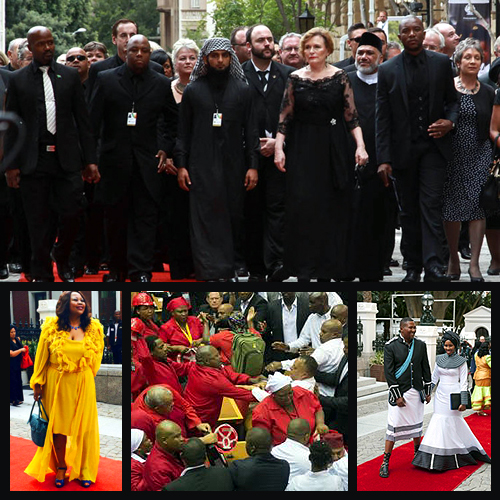
Officially marked to celebrate the birthday of our first president, George Washington, it was expanded by most of the states to also celebrate Abraham Lincoln’s birthday, which also occurs in February, hence the name.

Some southern states, though, officially celebrate Washington and the third president, Thomas Jefferson, a ridiculous and clearly racist slap at the president who ended slavery.

It occurred to me, today, that this is an unique year for presidents in Africa as well. Today the authoritarian president in Egypt, Abdel Fattah el-Sisi, bombed ISIS targets in Libya after Egyptian Copts were beheaded there.

Like the King of Jordan, Abdullah II, and like Obama for that matter, these men acted unilaterally, evoking whatever powers they perceive exist but certainly not any that emanate from any democratic processes.

Today America has 10,000 troops back in the Levant. (Read the last chapter of my novel, Chasm Gorge, where I predicted this.)

It seems to me we live in a time where democracy is not working, and that often any peace or stability or prosperity that occurs does so because an authoritarian person is benevolent.

Consider Kenya’s increasingly dictatorial president overseeing an increasingly peaceful and prosperous society.

Or the best example in all of Africa, the iron fisted completely ruthless Paul Kagame of Rwanda. Few countries in Africa today are as peaceful or prosperous as Rwanda.

The six years of an Obama presidency has seen American society recover masterfully from a terrible recession, try to end foreign conflicts and reduce the tension of illegal immigrants. Yet most of this was not done in a democratic way.

Perhaps in this modern age democracy is not the will of the people, but a tool to manipulate the will of the people. Happy President’s Day!

State of Whatever

State of Whatever

State of WhateverSouth Africa’s State of the Union last night was not “unprecedented chaos,” just theater at its best. Isn’t that what government is all about?

One longs for days past when information didn’t fire so quickly all over the place, when natural barriers – like time and party lines – filtered the nonsensical from what was important.

We all want thrills. There’s no thrill in a chief executive reciting all his accomplishments. Rather, we want to see a Congressman shouting at the President, or a void left by a Supreme Court Judge.

Last night in South Africa their State of the Union erupted into ultimate theater.

It was abjectly comical.

The main drama was when members of the country’s most revolutionary party, the Economic Freedom Fighter Party (EFF), interrupted proceedings demanding President Jacob Zuma repay the country for the millions used to refurbish one of his homes.

It’s a legitimate, major scandal.

Zuma’s own government investigators have determined wrongdoing, although no consequences have followed other than Zuma vaguely promising that he will repay. (Zuma’s life as president has been one scandal after another.)

The Speaker of Parliament then instructed the EFF – properly dressed in reddish orange jumpsuits – to shut up. The EFF refused, the decibels were raised, and then the Speaker ordered Parliamentary security to forcibly remove the EFF.

Later EFF leaders claimed seven of its members were injured by security officials.

A much more respectable party, the Democratic Alliance (DA), came to the party all dressed in glamorous black as a symbol of the death of democracy, then walked out en masse after the eviction of the EFF.

Parliament was left with the ANC and a handful of stringer-on parties, like the communists, and President Zuma dutifully continued his very boring address.

Media has pretty universally now termed last night as “chaos.” It wasn’t. It was theater.

Clearly the EFF had planned on the disruption. Clearly the DA had planned on making a point of the expected disruption. And clearly, the ANC had plans for clearing them both out.

Important security officials in the government were walking in and out of Parliament as if on cue before, during and after the eviction. Journalists’ phone and video signals were jammed inside the hallowed halls just before eviction. The white shirted bouncers strong enough to shove the EFF out of the hall were not regular Parliament employees.

This was all planned, on all sides, and it was quite a show. In fact South Africa’s State of the Union is a media spectacular not dissimilar to our Oscar’s.

Celebrities arrive wearing outlandish and lavish fashions, dip before the cameras before walking on the red carpet into the hallowed chambers. There was the grandson of Nelson Mandela in a newly created Parisian tailored suit inspired by his grandfather’s tribal garments.

There was the country’s head of the police walking awkwardly to keep in balance her newly polished chest of medals.

And there were the various parties, uniformed in chosen colors in perfectly starched arrays of dissemblance.

“It was a landmark setback for Zuma,“ one of South Africa’s major newspapers claims.

I don’t think so.

It’s just what we always expect from South Africa: just a show.

Ain’t So Edelweiss

Ain’t So Edelweiss

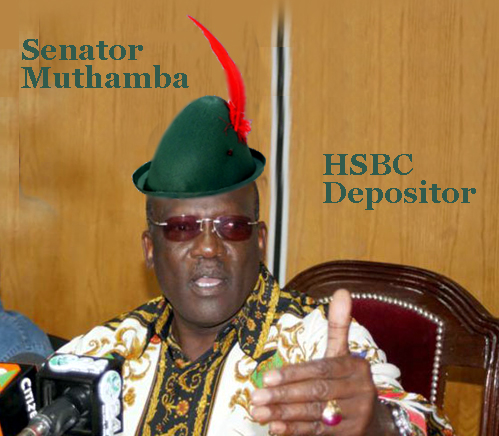
senatormuthambaEast Africans figure prominently among the leaked billionaires holding accounts with the Swiss HSBC bank, but there’s a lot more to the story.

The International Consortium of Investigative Journalists’ report of the hidden, possible illegal depositors of HSBC’s Swiss bank was released last week. As thousands of journalists mine the information it was reported yesterday that a prominent Kenyan Senator is among them.

There’s nothing in the ICIJ report to link any individual to illicit activities, although the report does explain how bank officials routinely advised investors ways to avoid paying taxes, among other methods of hiding wealth.

The report leaked information from 742 clients, but almost all of these are unnamed accounts as is the custom with high rollers banking in Switzerland. The “numbered” account is usually all that is known.

But true to form, Senator Johnston Muthama of Machakos opened at least one account in his name and eight others with other family member names. His total deposits of around $35 million seem unbalanced to his business interests in his area, but that’s impossible to prove.

His explanation to a newspaper in Kenya today was that the accounts were opened as business ventures with international capitalists and were related to his legitimate business interests in mining.

The remainder of the Kenyan accounts were unnamed and equaled $559.8 million. There were 286 Tanzanian accounts in excess of $100 million.

In today’s world there are a lot of rich people and I suppose not all of them got that way illegally. In any case. it’s not possible from the ICIJ report to prove any illegality by anyone, although the inferences are strong.

HSBC has agreed for some time to repatriate foreign funds to governments that can prove the deposits are illegal. This is a clever move by a big bank recognizing that “foreign governments” are usually controlled by the people who are its depositors!

The East African component of HSBC depositors is fractional when compared to those from the developed world, and Senator Muthama’s $35 million bank account shouldn’t give any of us pause. In the big pond of the wealthy, he’s a very small fish.

What is significant is that countries like Kenya and Tanzania are incapable of emerging from poverty in today’s world without mastering capitalism, whether they should have to or not.

Muthama’s stash is only one of hundreds — maybe thousands — from East Africa, which means that precious capital needed by East Africa is leaving it.

Several years ago professors at the University of Nairobi documented this horrible capital flight out of East Africa.

“Residents of the East Africa Community have more money stashed away in Swiss banks than those from any other region in Africa,” the report found.

The report said that more than $1.3 billion of capital generated by East Africa was at the time residing in Swiss banks.

A major reason East Africans as compared, for example, to the much bigger and more prosperous southern Africans may have more Swiss deposits is because southerners can grow their money at home often as well as abroad. In far less developed East Africa that’s more difficult: there’s less for very wealthy people to invest in.

As with this week’s expose, there was nothing in that 2012 report to prove illegality, and the 2012 report was not even trying to suggest it. Rather, it was pointing out that development requires capital and capital generated in East Africa ought to stay and be used in East Africa, not flee to Switzerland.

The ICIJ report is a national embarrassment to Kenya and possible political epitaph to Johnston Muthamba but it’s important to repeatedly acknowledge illegality is only inferred.

(Sort of the same way we wonder how a new Congressman can decorate his office like Downton Abbey.)

Secret capital in Swiss banks, on the other end, is clearly evil.

Muddled America

Muddled America

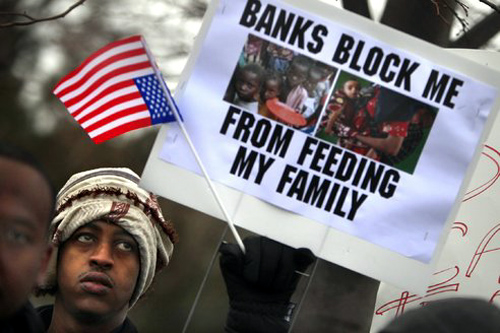
banksblockmeAnother bank stops money transfers to Somalia as American business continues to foment terrorism in The Horn of Africa.

As of this morning Merchant’s Bank of California will no longer process customer wire transfers to Somali .

This leaves fewer than a dozen mostly small banks left in the U.S. that still process wire transfers to Somalia.

I don’t know if it’s uncontrollable fear, explosive ego or just abject stupidity, but it’s so clear that this action will increase terrorism and any threats to America as a result.

According to Oxfam
, $215 million annually is sent by Somalis in the U.S. to relatives in Somalia, equaling or exceeding the total annual U.S. foreign aid to the country.

“… millions of Somalis … are dependent on this for their daily lives,” Degan Ali, the founder of a Somali support group in Kenya told Reuters today. “We’re talking about food, shelter, medical needs, education …” she explained.

I remember my own grandfather each Saturday wiring much more than my grandmother thought appropriate to his relatives in Croatia.

Large banks like Wells Fargo and Citibank stopped the service a decade ago, citing U.S. government regulation as the reason.

In a message last week to its intermediary agents, Merchants said it had received a “Consent Order” from the Department of the Treasury requiring new procedures to ensure that the wires did not end up in terrorist’s hands, and that the procedures were either impossible to comply with or to expensive to pursue.

So which is it? Is it the U.S. government incapable of managing a regulation that determines the numbers of zeros after “$5” used either to buy a month’s worth of cornmeal or a SAM missile, or is it the banks who just don’t want to be bothered by a few more checklists?

Last April two Congressman from Minneapolis where America’s largest Somali community resides, one Democrat (Keith Ellison) and one Republican (Erik Paulsen), introduced legislation in The House to clarify and simplify these regulations.

Guess what? Boehner and company dumped it as increasing government involvement in the banking industry.

In December Oxfam published a timeline of American regulatory agency involvement in this, documenting so clearly how confused and contradictory it is.

So whether it is messed up self-destructive ideology, or messed up poorly created regulation, or both, once again America is shooting itself in the foot.

There’s no question that too much money is getting into the hands of terrorists. But the significant conduits are Saudia Arabia and other of our allies! Not expatriates in Minneapolis or Los Angeles sending chip change to struggling relatives!

That presumption is the success of terrorism. There are so few American expatriate Arabs and Muslims who feel anything less than outrage against terrorism that I feel embarrassed every time I write this sentence! Americans don’t – or don’t want to – believe this.

So the system on all sides gets muddled, we make the situation worse and worse with cockamamy wars and stops on bank transfers.

We act against our own best self-interest. Isn’t that terrorism’s first objective?

Terrorists will never defeat America. America will defeat America.

More Than Goodluck

More Than Goodluck

goodluckvsbuhariAfrican democracies are not doing well in the face of growing terrorism, and next weekend one of the biggest tests occurs when Nigerians go to the polls.

Secretary of State John Kerry made an unannounced visit to Lagos a day ago on his way to Kiev. His message was unequivocal: pursue, protect and keep clean the upcoming elections. None of the three are likely.

The presidential election is too close to call. President Goodluck Jonathan is seeking a second term. His unexpected best challenger, Muhammadu Buhari, is seeking a return to power.

Jonathan is an avowed Christian. Buhari is an avowed Muslim.

Jonathan at least talks democracy and claims he champions it. Buhari was one of Nigeria’s most ruthless military dictators currently being investigated by the International Criminal Court for crimes against humanity.

Neither candidate talks much about the ineffective war against Boko Haram, which controls about an eighth of the country.

Both candidates publicly disavow the possibility of a military coup. Both candidates’ advisers say otherwise.

There had hardly been a more popular man in Nigeria before Goodluck Jonathan came to power in 2011. His first few years were a love fest with the nation, and Nigeria was doing very well.

As with other popularly elected Nigerian leaders, Jonathan’s most important task was to keep the military at bay. The military has ruled Nigeria for more years than civilians since Independence in 1960. Occasionally those periods have been reasonably fair and peaceful; Buhari’s was not.

Almost all the military rulers, beneficent or tyrannical, looted the country. Nigeria is only now emerging from a state of constant corruption.

Jonathan carefully emasculated his own army so that when Boko Haram emerged, a dilemma of unexpected proportions did as well.

Foot soldiers were rarely paid because the military budget was systematically reduced or reallocated. Military leaders remain firmly in control, though, so what money was left was hoarded at the top. Foot soldiers get fed and clothed and are provided with enough aura to build egos instead of pensions.

But it’s the reason Nigeria’s military mostly fled Boko Haram, rarely fighting. All the successful military operations against Boko Haram in northeastern Nigeria have come from the Chadian Army.

Which both Jonathan and Buhari say is just fine.

Despite Secretary Kerry’s noble visit, democracy is not working in Nigeria. Certainly for the moment it is not working for Nigeria’s Muslim community who is adamantly opposed to Boko Haram but getting no help from the central government.

A Buhari victory could come at the ballot box or the barracks. Either path is paved by Nigerians of all dispositions increasingly afraid of Boko Haram.

Next weekend’s elections will be unable to justly determine a winner. Jonathan’s democratic presidency achieved that goal the last time because he last won by such massive margins.

That won’t happen this time. It’s too close.

Each side has enormous resources for “getting out the vote” which means “getting out the vote as many times as you can.”

A contested election is certain and it’s hard to imagine anything peaceful. Bush vs Gore, or more appropriately, Kenyatta vs Odinga, are not models for this massively powerful and divided country besieged by terrorism.

So rumors now flourish in Lagos that Jonathan is courting military leaders to fracture any support that may exist for Buhari.

No irony ever before would match Jonathan installed in power by a military coup after losing a democratic election. That reality may be fanciful, though, as I expect the election will be inconclusive.

Let the strongest man win.

Shush! You’re in Tanzania!

Shush! You’re in Tanzania!

tanbansspeechThe Tanzania government is inviting violence as it cracks down on all dissent prior to two upcoming elections.

Tanzania has never been a model of transparency. European governments suspended aid more than a year ago because of shady, under-the-table mining deals, and despite some demanding young mavericks in Parliament, the government continues to stonewall all requests for basic information.

But now it’s getting very serious. For the first time the government has banned a major newspaper.

In times past the government has banned smaller papers and blogs, but the East African newspaper is a large regional publication that has been popular in Tanzania for twenty years.

The paper is one of the most aggressive in East Africa. Its investigative journalists recently published details of the government’s fraudulent passing of a new proposed constitution to ready it for a national referendum in April. This is likely what provoked the ban.

The outcry was immediate and from all points in sub-Saharan Africa.

Yesterday evening in an unusually harsh statement, the European Union condemned the move.

The Media Institute for Southern Africa further reported that the East African’s principal bureau chief in Dar-es-Salaam was detained and questioned by police.

The government is running scared. National elections are scheduled for October, and a referendum on the disputed new constitution is scheduled for April 30.

Neither are expected to go well. The proposed constitution was approved by a Parliament that was boycotted by virtually ever member of the opposition. Critics are especially angered by mechanisms intended to keep the party which has ruled Tanzania since independence firmly in control.

Among the mechanisms that would do this is the subjugation of Zanzibar, which was one of the reasons a new constitution was to be considered in the first place. It was presumed that a federal system would give Zanzibar considerably more autonomy and that would help calm the civil disobedience afflicting the island.

The East African aggressively reported these criticisms by the vocal and youthful opposition.

Last October the fractured opposition to the government announced a coalition to oppose the government candidates in the upcoming national elections. Today that appears to be evaporating, and in this moment of weakness I think the government wants to regain control.

It won’t work, of course.

As one of the comments to the story in Nairobi’s Daily Nation pointed out, most everyone reads the East African today online. The government has no way of banning that.

So the act of trying to do so is likely to do little except further inflame the situation.

At the same time if the opposition is unable to reconstitute its coalition I think it deserves to lose. There could be no better opportunity than right now to dislodge the ruling party. If this moment is missed, expect Tanzania to grow more and more repressive.