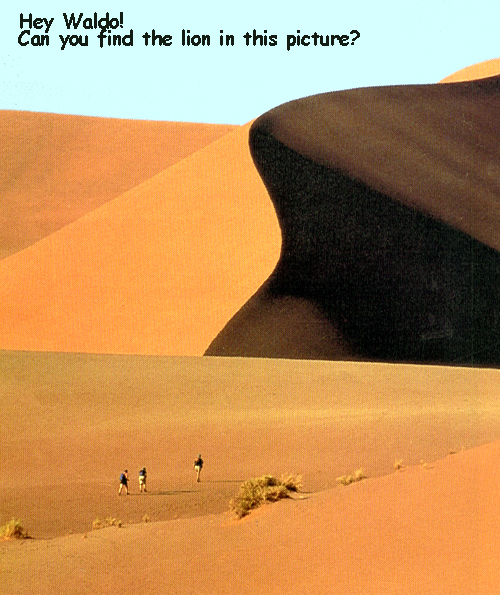
Lion in the Dune?

Lion in the Dune?

No! Because there aren't any!
NPR’s Namibia stories this week distort the overall complexities of human-animal conflicts in Africa as whole. The reporting by Christopher Joyce was an admirable portrayal of one very unusual country’s struggle with wildlife, but when he generalized he was quite wrong.

I hope you listened to the two reports, one on Monday and the other on Tuesday. Read this, then listen to them, again.

Many issues regarding wildlife, hunting and social responsibilities of any country are universal. How to make use in a profitable and sustainable way of these natural resources is an ongoing struggle that I feel is being successfully addressed throughout most of Africa.

But not necessarily the ways Namibia is trying. How Namibia approaches this diminutive national resource is very much different from the rest of “Big Game” Africa. Namibia is a very, very unusual place.

The thrust of Christopher Joyce’s reporting for NPR was that the only way that wildlife can be preserved is by privatizing it. Maybe for Namibia, but dead wrong for Africa and the vast majority of the rest of the world.

A little bit bigger than Alaska, the country is mostly uninhabitable. Nearly half (the western regions that border the Atlantic Ocean) is so dry that some fishermen grow up never seeing rain. Much of this area is the Namib Desert, which is pure sand, and some of the most spectacular dunes on earth are found here.

There is very, very, very little wildlife compared to the rest of sub-Saharan Africa. In fact, compared to practically any other random part of the world. I can’t emphasize this enough, because Namibia is where many outstanding wildlife research projects have occurred recently. Some have even led to major discoveries (about elephant verbalization, for instance). But this may be the case, indeed because the wildlife here is so scarce.

The NPR report itself confirmed there might be 125 lion in the entire country. That is about the same number of lion for this massive 325000 sq. miles as found in tiny 100 sq. mile Ngorongoro Crater in Tanzania. For a similar area in East Africa the size of Namibia there is likely upwards of 50 times as many lion.

And that metric applies pretty well for any other wildlife comparison between Namibia and the main wildlife viewing countries of Africa. The exception could be oryx and springbok, two antelope species which do exceedingly well in very dry environments. But except for these two antelope, Namibia is not a place to go to see wildlife.

The most famous wildlife park in Namibia is Etosha Pan, which is about 7% of the entire country’s land mass (22,000 sq. miles). It’s hard to find an animal census for the park, probably because it’s not very good. The Namibian government claims there are 2500 elephant (dubious) and makes the grandiose claim that, “It is well known that Etosha has the single-largest population of black rhinos in the world, but the actual count is kept secret so that this fact – and the population of rhinos it defines – is never threatened.”

Such unsubstantiated remarks need to be taken with a lot of grains of salt, of which Etosha has a vast supply. Moreover I’m absolutely sure there are many more black rhinos in places like Lewa Downs in Kenya as well as in a number of South African private reserves.

Namibia’s richest wildlife area is the eastern Caprivi Strip, the area squeezed between Botswana and Angola which is hardly 300 sq. miles large. This is where many of the private wildlife reserves Christopher Joyce discussed in his radio reports are located. Interestingly, though, it was not where Christopher Joyce of NPR spent most of his time.

The reserves Joyce reported from may have the least amount of wildlife of any of the collection of private reserves in Namibia, which does make it a compelling story as to how they are trying to exploit the little they have. But I am concerned that at no time did he explain this serious difference between Namibia and the more popular areas for wildlife viewing in Africa: i.e., there is hardly any wildlife in Namibia.

(Joyce spent most of his time on the few reserves on arid, near desert terrains where the provocative topic of hunting was raised. I thought he did a decent job with this topic although he might have considered interviewing the equally if not larger segment of the population in Namibia that opposes hunting. Nevertheless, this is a topic universal to privatization of wildlife reserves throughout the continent.)

The Caprivi is a beautiful, wooded and riverine area with a varied biomass, and what to do with it is a critical issue but keep in mind how small an area this is. It may contain up to three-quarters of all Namibia’s non-desert wildlife, but it is one one-hundredth of the country in size, only one quarter the size of Yosemite National Park.

I hope you see where I’m going with this. To call Namibia an African wildlife destination is really rather stretching it. It has some extraordinarily unusual wildlife, because of its extraordinary desert ecologies, well worth a zoologist’s interest. But to consider it a viable tourist destination for wildlife is a ruse.

Namibia’s attractions are grand, but they do not include wildlife.

And it’s probably precisely this reason that the government wants to develop the little that remains as best they can. Fair enough. And it may, indeed, be true as Joyce suggests that privatization of such a minimal resource is the only way to sustain it…in Namibia.

But this strategy is absolutely not an evidently good one for more normal environments elsewhere in Africa, where the wildlife is more naturally abundant. In fact, it’s a major and often contentious issue in areas that have naturally abundant game. Personally I’m in the camp of folks who do not believe that privatization of important national resources like wildlife is good.

And when Joyce ended his final episode by claiming the people “from all over the world and Africa” were coming to Namibia to learn from their privatization projects, I started to laugh then became rather irritated.

It’s like suggesting farmers are traveling to New York see how to grow corn. There is some corn grown on Long Island, and probably in very creative and interesting ways, but it’s sure no general model.

Private wildlife reserves are flourishing all over Africa, hundreds more than in Namibia, because they have much more wildlife to show off. Now it could be that the particular model for Namibia’s privatization is better, say, than Tanzania’s WMA (Wildlife Management Areas) or South Africa’s private wildlife zoning ordinances, with regards to fairness to the local population or to the wildlife or whatever. But Joyce didn’t explore this.

Namibia’s future is not with wildlife. Its tourism development must — and has, actually, at least until now — feature many other wonderful things before wildlife. Wildlife could be the icing on the cake of a fabulous Skeleton Coast safari, but the cake is substantively without animals.

Moreover, Namibia’s broader economic and social development is not with wildlife. It is squarely with how to divide the special wealth from its rich deposits of uranium, diamonds and a few other minerals; and with the growing conflicts with its rapidly developing indigenous populations like the Ovahimba.

That doesn’t mean we shouldn’t all be fascinated by the story Joyce told. Just put it in perspective, which he should have done but didn’t.
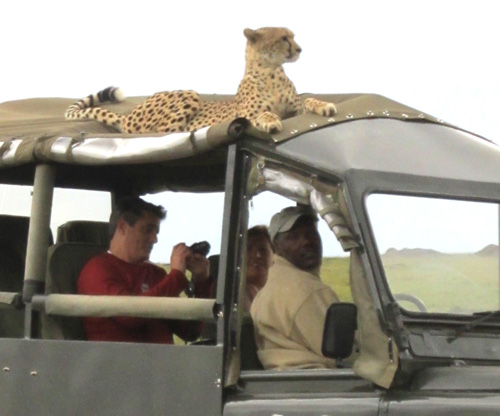
Marvel of the Mara

Marvel of the Mara

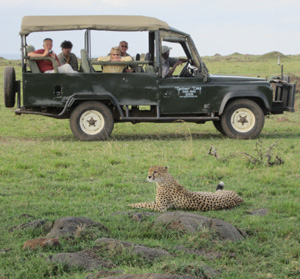
I took this picture yesterday in the Mara. Nine other vehicles were watching with us.
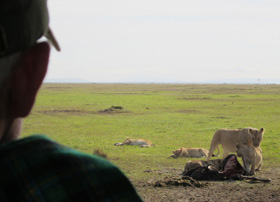
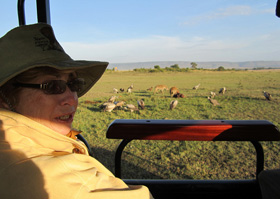
Twenty-seven lion, five cheetah, a rhino, 4 kills (not take-downs), a serval, two leopard (one with a recent kill) and a hyaena kill of a wildebeest. In three days in the Mara. And lots of vehicles. Is this a zoo?

No, of course it isn’t. It is Kenya’s best game park, the Maasai Mara. So we ended our safari with incredible game viewing, and it was expected. But am I showing my clients the wilds of Africa?

The Mara proper is hardly a tenth the size of the Serengeti, sits right on top of it, and is the northernmost venue for the great migration. It has almost 4 times as much accommodation as the Serengeti, despite its much smaller size. So, yes, it can seem busy if crowded compared to the Serengeti.

Ellen Sirlin watching hyaena kill.
But it is busy precisely because the game viewing is always so exceptionally good. The quantitative exponent of game viewing in the Mara is rarely duplicated elsewhere. The dozen or so hyaena around the lion we saw, the 100 vultures plus assorted jackals and storks, was typical of my experiences in the Mara every time I go, and 3 to 4 times the number of animals and birds that would normally be seen on a Serengeti kill. Why?

For two intertwining reasons.

First, the Mara is the wettest part of the Serengeti/Ngrongoro/Mara ecosystem. And wet means more food at every level, and that means more predators and ultimate cleanupers.

Roger Sirlin watching lion eat.

Second, more animals means more visitors and the Mara is probably the most congested game park in East Africa. Lion brush aside your vehicle, vultures clip your canvas rooftop when landing, hippos block the road into your camp and crocodile lay eggs a few feet under your tent.

And rarely are you the only one snapping photos. I try very hard and do often succeed, but if you want to see the rhino, or the cheetah take-down, you’ll be sharing the experience often with 10-20 other vehicles.

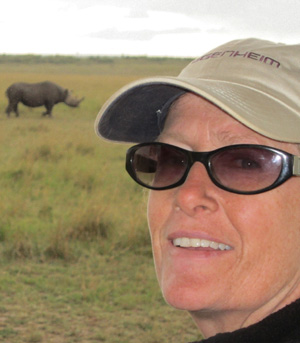
Sue MacDonald watching a rhino.
All this visitor activity means that the animals are much more tolerant of people and vehicles than anywhere else I’ve ever been in Africa. Animal tolerance of vehicles surprises all visitors almost everywhere, but the indifference of Mara animals to visitors is almost beyond belief.

But here’s the rub. Remove the visitors, the vehicles, the people, and I think it fair to argue very little of anything else would change.

So are we really experiencing truly wild and natural behaviors?

Yes. For the Mara. It’s as natural as garlic mustard taking over Yosemite or chronic wasting diseases menacing recreational hunting in Wisconsin. What I’m saying is that in the Mara it is a real balance of life as it exists there, today.

It is certainly not the way it was a generation or more ago. And it is certainly not the way it is in most other reserves in East Africa.

Even in the Serengeti, which shares a border with the Mara and several rivers, animals grow more suspicious of human visitors and their vehicles. But even so, these “wilder” behaviors in other East African reserves are far tamer than they were in Africa 50 years ago.

Then, African wildernesses weren’t as protected. People competed with animals for the same turf, and people are more clever. Animals were afraid of people, people would just as likely kill as preserve anything wild, and so wild things were harder to observe, less obvious.

David & Lynn Heiman, Roger & Ellen Sirlin.
In other words, if you want to make wild animals accessible to the casual visitor, a dynamic will begin that will make the animals less suspicious of visitors, and that will bring in more visitors, and that will make the animals even tamer and tamer. I can’t see any way to stop this.

So the complaint I have about this marvel in the Mara is the growing number of other visitors. And as a visitor, you have to decide if you want to see it all, rather easily and quickly, or prefer as I think I do the less congested wilderness.

This dynamic – the marvel of the Mara – has happened only in my life time. It’s something that I feel has been achieved at the loss of “wildness” which is still easily experienced in places like The Selous or the Serengeti.

But nostalgia may have gotten the better of me. Visitors may not seek wildness any more than they seek the remarkable beauty of a lioness cleaning her cubs, or tiny baby warthog racing after mom. And for all those wonderful experiences and so much more, the Mara is the place!

Saving A Penny with Davey Jones

Saving A Penny with Davey Jones

For some clients, today, traveling for leisure is being squeezed by the economy. And as a result, they’re making some very dangerous decisions. Tight economic times are absolutely not the time to dismiss expert advice.

I can think of no better example than the horrible tragedy last Friday in Tanzania. One of the ferries that plies between Zanzibar and Dar capsized. At least 200 people are dead or missing.

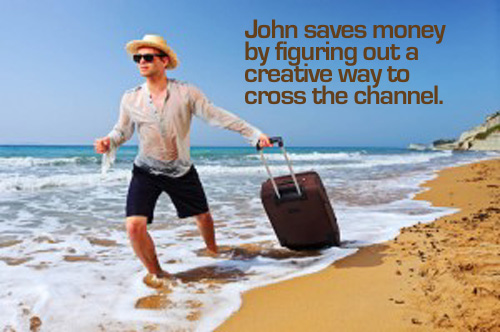
The usual way for a tourist to get between mainland Tanzania and Zanzibar is to fly. From Dar, the quick 15-minute flight costs around $60. Recently, I had a client booked this way who discovered on her own that one of the 5 daily ferries between Dar and Zanzibar would cost her only $8.

Now my first task was to determine if this was really a budget issue or something else. Since her overall safari was well over $5000 it seemed silly she would be interested in saving $50 particularly when it wasn’t very comfortable and took 6-8 times as long.

But it seems so romantic, she said.

A ferry that is licensed to carry 400 people and that often carries 600 is not particularly romantic.

I have nothing else going that day, she retorted.

At this point, one begins to wonder if this is becoming one of those epic battles between the expert (me) and the client (her) over my alleged disrespect for her budgetary and travel research capabilities.

I’d like to get to know the local people, she added.

At which point I laid down the gauntlet and said the ferry schedule was totally unreliable, they only depart when they fill up, they have a terrible safety record and my straight-out advice is don’t do it.

She did.

Fortunately, she wasn’t on the ferry last Friday. Her ferry went off more or less on schedule, it was a fine sailing day, and I’m sure she’s telling everyone she meets that it was one of the best parts of her safari.

And that she really had to fight with her travel expert to do it.

This isn’t just an “I-told-you-so” anecdote. As a traveler, you can do it on your own, or you can do it with an expert. A lot of people can do it on their own quite well, and I’m the first to champion the feelings of personal accomplishment and excitement that comes with plotting your own distant explorations.

But don’t mix and match.

Personally arranged travel to exotic places carries significant risk that is a part of the whole adventure experience. I know that better than anyone. The challenge of personally overcoming intrinsic difficulties are the same as felt by the climber of McKinley or the swimmer of the English Channel.

But here’s the point. Had she arranged her own safari on her own completely, she would have learned that the ferries are unreliable and dangerous. She might then – as I have, especially in my youth – played the odds and gone, anyway. And in her case, she would be vindicated.

But she had no clue. Because she relinquished the responsibility initially to me to get her to Zanzibar from the mainland, I (a) did not believe that she wanted a daring experience and (b) knew that the 1% savings of her trip was not worth the added risk.

She was not in a position to make such a determination.

So what was her beef? Well, in all honesty, I think the squeeze of the economy is getting to people. Like so many others, this was a trip of a lifetime for her. A retired teacher, she had saved and saved, and no doubt those savings were less than she expected.

And probably she felt the villains who reduced her 401K weren’t so dissimilar to the villain (me) who was trying to extort her.

Beware, dear travelers, of projecting your angers and stress onto your advisers. Most of us aren’t going to ask you to pay for something you don’t have to do, and we certainly aren’t going to jeopardize the possibility of giving you a “trip of a lifetime” so you can save a penny with Davey Jones.

Student Do-Gooders Beware

Student Do-Gooders Beware

The right way: Cottonwood Institute's many student programs.
Summer is coming and throngs of young people are getting ready to screw up the world. That’s the effect of most volunteer tourism. Here’s why, along with a few stellar exceptions.

During the last fifty years of America’s descent into conservative misery, America’s philanthropy has increased substantially. There’s a good reason for this, and a bad reason for this, and they impact tourism as we never expected they would.

The good reason was because community compassion developed as funding for good social programs was withdrawn. What else could we do? Institutions like museums and zoos, which should be a part of the public domain, became privatized for budgetary reasons. Today we even see public funds withdrawn from any type of arts (and often recreation) programs in public schools!

Fiscal concerns in America trump virtually every other concern except to wage war (in the guise of security). After we bought our ten billionth gun, there just wasn’t any money left for public aid.

We are now ailing as result.

Education is a mess.

In virtually every category America has declined. The most talked about one is health but health and everything else in life declines first and foremost because education declines first. America is now 33rd in the world. The education accomplishments of countries like Russia, Mexico and Brasil outperform us.

The need to do something in the face of government suppression of public services became overwhelming. And public response in terms of charity was good. What was bad was that charity was often not charity, just a ruse and self-disguise. And one of the principal tools for accomplishing that self-deception was tourism.

Frankly, I have serious doubts about philanthropy in general and have written about this before. The current controversy with Three Cups of Tea stands as a perfect example.

The bad effects of so-called voluntourism are acute when it involves children. I love guiding kids on safari, because I love watching their minds open to the vast mysterious of places far away and lifestyles never imagined. But I cringe terribly when they try to plan this in advance.

The number of requests I personally get by misguided parents who want to spend “a day or maybe three depending” on charitable activities when they go on safari drives me insane. It’s counterproductive. It’s a blatant indication of how badly their children are being raised.

One of the world’s finest social psychologists says it much better than me:

IN a research paper specifically addressing youth tourism programs for specially young AIDS orphanages in Africa Prof Linda Richter writes, “Programmes which encourage or allow short-term tourists to take on primary care-giving roles … are misguided for a number of reasons.”

1. They end up costing the orphanage more than the benefits received.
2. The volunteers generally perform badly.
3. Low-skilled volunteers squeeze out local and indigenous workers who not only need the work but could create a long-term benefit to the community since they don’t disappear after a few days.

But the zinger is indelible, long-lasting:

“The formation and dissolution of attachment bonds with successive volunteers is likely to be especially damaging to young children. Unstable attachments and losses experienced by young children with changing caregivers leaves them very vulnerable, and puts them at greatly increased risk for psychosocial problems…”

This is no old tour guide’s biased balderdash.

Professor Linda Richter (PhD) is a Distinguished Research Fellow at the Human Sciences Research Council in South Africa. She’s an Honorary Professor in Psychology and an elected Fellow of the University of KwaZulu-Natal; an Honorary Professor in the Department of Pediatrics and Child Health at the University of the Witwatersrand; a Research Associate in the Department of Psychiatry at the University of Oxford (UK) and has been a Visiting Scholar at Harvard University USA) and Visiting Researcher at the University of Melbourne. That’s only the beginning of her resume.

Prof Richter concludes:

– “Children out of parental care have a right to protection… In particular, they have a right to be protected against repeated broken attachments … exacerbated by care provided by short term volunteers.
-“Welfare authorities must act against voluntourism companies … that exploit misguided international sympathies to make profits at the extent of children’s well-being.
-“Lastly, well-meaning young people should be made aware of the potential consequences of their own involvement in these care settings, be discouraged from taking part in such tourist expeditions…”

It is impossible to provide meaningful assistance FOR ANYTHING in a day “or maybe even three”. You can learn. You can become aware that it is unmeaningful, but you can’t MAKE A DIFFERENCE.

Yet again and again I have parents calling me about the spring break or summer safari, and they want to make sure their kids volunteer for a “day or maybe three.”

This is an unexpected further decline in America’s descent into greed and lack of real community compassion. It’s a way of “feeling good” without really doing anything meaningful. It’s believing you can do something meaningful when it’s impossible to do so.

You go on vacation for R&R and to expand your world view. You help the world afterwards, with that expanded world view. You help the world by getting deeply involved at home, not abroad. You personally have to suffer or benefit from the accomplishments or mistakes that you, yourself, make. That becomes increasingly difficult the further your charity is placed from home.

There are excellent student groups – (important: all not-for-profit and in never linked to commercial tour companies) – that do great work. Note that it is mostly local, and I believe that’s how it should be.

The Cottonwood Institute and Students Today Leaders Forever especially impress me. I bet there are dozens, but the point is there is no way to approach even a modicum of these organizations’ accomplishments on a commercial vacation.

And for adults Earthwatch rules the planet. It’s so good, in fact, that there really aren’t any viable competitors.

In all three cases, and I’m sure many more, volunteerism is not the point. It may be used, and when used creates real benefits as much for the individual (without jeopardizing the situation because of that individuals’ lack of skills) as for the situation itself.

That ultimately, is the only test. And if that standard can’t be met, then the self-styled “volunteer” does more harm to the situation than any benefits that might accrue. Voluntourism does more harm than good. And significantly to the voluntourist him/herself.

Do-Gooders, don’t get on the plane.

America & Magic Help The Congo!

America & Magic Help The Congo!

While beating ourselves up over whether Wall Street was too big to fail, the unceremonious application of the Dodd-Frank Act has slowly stopped hundreds of thousands of gruesome murders in Africa, aborted tens of thousands of acts of rape and child kidnapping. The Act has absolutely helped to end one of Africa’s most gruesome multi-generational wars. We really do have something to be proud of.

Technically implementation as regards Section 1502 has not yet even occurred. It is likely to be implemented after August. But the very process of publicizing The Act, requesting comments and holding hearings has so radically altered the economy of Kivu Province, that it appears the war is truly winding down!

Giant world corporations that funded Africa’s longest and most gruesome war have changed their policies. Sony, Intel, Motorola, HP have all publicly adopted new policies that either conform to what they expect the new rules will be, or moved in that direction.

I won’t retell the story or history. But for the full background see my earlier blogs:
Evaporize Goma!
and
We Won!

Essentially your cell phone and your kids’ PlayStations can’t work without minerals previously bought from warlords in Kivu who then used that money to murder, pillage, rape and kidnap Africa’s children to an extent never before seen in history.

The Congo Wars began in the 1980s and have lasted as long as I’ve worked in Africa. They have nearly totally destroyed one of Africa’s most beautiful, magical places. But maybe, maybe there’s just enough magic left to reemerge.

Last month 118 tourists visited Virunga National Park in Kivu Province in the eastern Congo. One of the first and earliest intrepid tourists wrote on the Lonely Planet forum almost a year ago:

“There is a lot of information floating around on different websites saying the Congo is a dangerous place to visit…. At no stage during my time … did I feel unsafe or threatened in any way or form… The villagers we met along the way were the most delightful and happy people you could wish to meet.”

The presumption of peace encouraged many NGOs to increase their assistance. German groups especially began funding the rebuilding of the national parks, in particular, Virunga.

It’s hard for me to imagine that Virunga will ever greet me again with the splendor of my memories there in the late 1970s. The jungle was unbelievably beautiful, and unlike the heat and humidity of the Amazon and Asian “jungles” I’ve visited, this is a highland jungle: cool and spectacular.

Billions of same colored butterflies, friendly and helpful pygmies, unnamed monkeys, okapi, and truly myriads of undiscovered bugs, plants, frogs… I have visited many of the world’s wildest places. This was the most beautiful.

“Last week our team of skillful roof engineers have started on the roof of the main building of the Lodge,” wrote the chief warden on Sunday of the lodge he is building in his new Virunga National Park. He set an ambitious goal of 200 tourists for next month!

And there was massive attendance at a community forum to help with all aspects of the Virunga wildlife region just on Tuesday.

A real sense of normalcy is returning to Kivu. But I’m not quite ready to schedule EWT’s first trip in 35 years to Virunga. The same park warden lauding his new lodge also wrote of ongoing attacks. He calls them “organized land invasions.”

The warlords who took Sony’s money were born during war. They know no other life. And they’ve morphed from international crooks into petty thieves, and as raw bandits they’re very successful.

But I’m watching the situation very carefully. A string of positive remarks from young, intrepid travelers last year seemed to end right around the time of the flawed Rwandan election, which makes sense. Rwanda politics is probably the single greatest factor in the stability of Kivu.

And the disintegration of everything that’s good in neighboring Uganda is more bad news. This week’s bit of trouble in the new South Sudan I don’t consider serious, but it distracts NGOs and other humanitarian organizations from their focus on helping the DRC.

And finally, the DRC has called for Kivu’s first elections this November. Amazing, incredibly gratifying if it’s pulled off well, and the single most hopeful sign I’ll be watching for. We can’t expect 40 years of brutal, sadistic war to end quickly.

But yes, it is ending. And probably the single-most important reason was section 1502 of the Dodd-Frank Act. America, you can truly be proud!

The Sun Rises on Egypt

The Sun Rises on Egypt


If you’re interested in a good deal in Egypt, time is running out. Good times in Egypt are on the march. But good deals are coming to an end.

Following a press release from Europe’s largest tour company, KUONI, on Friday it rescinded several of its deals in Egypt over the weekend.

KUONI stopped offering multiple night incentives and cash discounts on many of its upmarket properties and cruises in Egypt. Many of these are still available for mid- and down-market products, but top ranked hotels and cruise ships are now back to rack rates.

This and many other indications suggest that unless there’s some serious reversal in the political situation in Egypt, good deals there may be ending.

Tourism is a great barometer – a leading indicator – of a society’s perceived tranquility. I say “perceived” because as tourism skyrocketed in China, it would be hard to argue that areas of Tibet were “tranquil” or that progressive movements were being liberated.

And it’s perception, rather than reality, which drives tourism.

Take the current civil violence between Muslims and Christians in Egypt which broke out, again, this weekend. And last weekend was worse: 12 Copts were killed following a peculiar rumor that they were trying to force a Muslim woman to convert. (There were an estimated 65,000 tourists in Egypt last week.)

But on Christmas Eve before the revolution, 22 Copts were killed in the same type of religious violence. This was the highest of high tourist seasons in Egypt. An estimated one million tourists were in Egypt at the time, and that news story didn’t effect travel there one iota.

Coptic/Muslim violence has been ongoing in Egypt literally for millennia, but the story has rarely percolated into the world press. But Egypt is in the news, now – as it should be. Coptic oppression, like the oppression of women and Muslim activists, will make world headlines, now. And perhaps this new spotlight on problems the country has suffered for a long time will hasten resolution.

I think tourists know this. And the growing numbers of tourism to Egypt suggest it.

Egypt is just a bit smaller than South Africa. Last year’s hosting of the World Cup in South Africa help to boost its annual tourist figures to nearly 9 million. Before the revolution, Egypt welcomed around 12 million visitors annually.

This year South Africa will likely reach 9 million again, and Egypt will fall back to around 6-7 million.

That’s a lot of tourists! A lot LOT more than was expected only a few months, ago. And it’s likely a harbinger of good times to come.

On April 28 the U.S. State Department dropped its travel warning to Egypt, replacing it with a milder travel alert.

The U.S. move followed by about a month similar moves by most European countries.

Is tourism to Egypt as safe, now, as it was last year before the revolution? I think so, particularly if we speak of the main tourist areas like the Nile between Luxor and Aswan. But it’s extremely important to understand the caveat that I’m speaking of reality, not of perception. No, Egypt is not yet perceived as safe a destination by tourists as before the reveolution, even though it may, in fact, be.

But given the numbers trend, it may not be too long before that par, too, is reached.

Ice Cap Covers Botswana

Ice Cap Covers Botswana

April 26, 2011, southwest Okavango Delta. These are supposed to be dry roads.
The ice cap is moving onto Botswana and the Kalahari Desert. No, this is not a Fox News report.

I just returned after nearly two months (on separate trips) into Botswana, and I’ve watched with trepidation albeit excitement a natural event which has not been recorded before. The Okavango Delta, one of Botswana’s most important tourist attractions and one of the most unique ecosystems on earth, is going bananas.

It isn’t a surprise. This is the third year running that the Delta has reached dangerous levels but the latest predictions made in mid-April suggest this year will be the worst ever and that it will continue to get worse and worse in the years to come.

This is extremely dangerous mostly to the fragile human populations eking an existence on the trail of water leading back to the Angolan Highlands, where it all originates.

But dangerous as well to the serious investments many have made in Botswana’s tourism industry.

And dangerous or at the least very disrupting to tourists. My account on this is first-person.

First, some necessary background:

The Okavango Delta is essentially the Kalahari Desert flooded. Excuse the non sequiturs, but it’s not my fault, it’s the vernacular that called central Botswana a desert. The Kalahari isn’t really a desert. It gets more rain per year than much of America’s southwest. It’s a Mojave plains, or high sierra butte that doesn’t get a lot of rain, but lots more than a desert.

But unlike the Mohave or high sierra, its ground base is grey-white powdery sand, the result of millennia of flatness and repeated rapid evaporation in a severe climate where summer temperatures can exceed 110F and winter temperatures can sink below freezing.

This has led to an extraordinary unique ecosystem, with plants fantastically adapted to grabbing and conserving the rain that does fall.

And every year unbelievable amounts of water spill into its upper regions. And as global warming melts the ice caps, there’s more and more water. Where the water spills onto the Kalahari is the Okavango Delta.

The Delta doesn’t dry up when the surge of water coming out of the Angolan Highlands ebbs as it does every year with the end of the Angolan Rains. The effect of millennia has been cumulative. At all times of the year there is a marshy, swampy, river run Delta. It has grown or receded over the centuries but it always bloats the first half of the year and shrinks back a little the second half of the year.

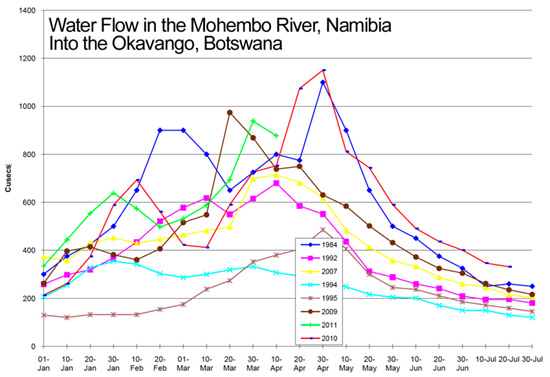
The UN Office for the Coordination of Human Affairs (OCHA) issued the latest comprehensive scientific report several months ago, and the more recent and detailed graph below is now in circulation.

This year will exceed the highest ever flow of water into the Delta.
All indications point to worse years in the future.

The bottom line is that many of the camps, campsites and tourist lodges in the Delta may be in peril this year.

In early March I visited the northeast Delta. The airstrip at Kwara camp was flooded. The managers made the mistake of trying to keep the camp open by transporting passengers 2½ hours from the next nearest workable airstrip.

But the tracks from that airstrip to the camp were also flooded. The vehicles flooded out. In one incident, water was above the floorboard as we stared a small crocodile in the eye.

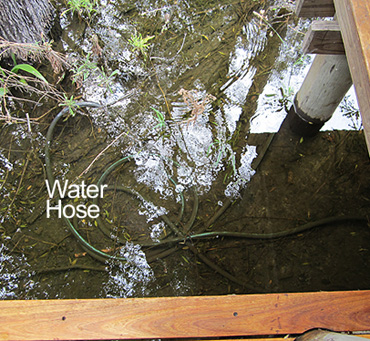
The edge of my cabin in the Delta. Note the gardening hose normally used to water the grass is under water.

A month later I visit Jao Camp in the southwest Delta. Twenty-four hour pumps and a three-foot high ring of sand bags around its airstrip barely kept it functional. I watched a Cessna 208 slip as it landed. The water lapped at my cabin deck and game drives were as if in partially submersible military vehicles.

Both these camps are operated by very good companies, and their experience is shared by virtually every camp in the Delta. It’s critically important these two camps not be singled out from the other 53 in the Delta that all face the same problem.

True “water camps” as Delta camps are locally known, are understandably positioned to experience the unique delta floods. It’s just that no one expected the ice cap to melt this quickly.

This is quite serious. Two of the three “pushes” or surges of flood waters that occur each year are over, but the third is yet to come. So even as the rainy season ends in southern Africa (usually right about now), the flooding of the Delta will continue. Last year waters did not begin receding until August.

I have great sympathy for Delta camp owners and investors. Kwara, in fact, has rebuilt both the airstrip and camp to higher ground.

But will it be high enough?

Ecotourism is Dead

Ecotourism is Dead

Ecotourism is dead. From the President of Tanzania, to the much more critical tourism market itself, feather beds and five gallons to flush a toilet have subsumed efficiency and sustainability. Requiescat in pace.

“Community Based Tourism Projects,” “Fair Trade,” “Shared Value Pricing,” and a ton of other phrases to champion a capitalist market in control of its morals, today those lovely little properties and projects are disappearing downwards faster than loose jeans on teen hips.

It all began when the king tried to pretend he really really cared about the slave weeding his rose garden. And it was challenged when the consumer got fed up with allocating her hard won vacation to another cause. And it was finished when the world global crisis left only the rich in the leisure travel market.

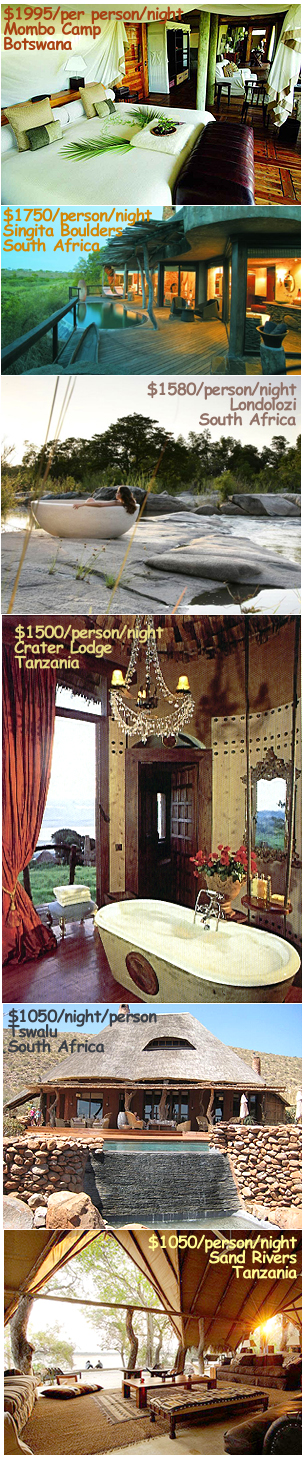
Mombo Camp, Singita Lodge, and Bilila Kempinski, are just a few examples of what works, today, in African tourism, and they are anything but ecofriendly.

I can’t think of a single successful ecotourism property that has been built anywhere in Africa in the last five years, and most that were built prior to that are on the skids. Newly built properties, and the ones that are roaringly successful today are all spas and castles. And there are several reasons why this makes good business.

The foremost is that the mid- and down- travel leisure markets are rapidly shrinking, and by necessity, becoming more and more efficient in delivering their core product: vacations. Any type of exotic or what we used to call “adventure” travel is under heightened pressure just because of how hard it is to get to them and then use them, and these (especially in Africa) were the pillars of ecotourism.

The lower market tiers shrank as all travel shrank in the massive economic downturn, but they never recovered, as the upmarket did. There’s a lot of speculation as to why this is true and if it will ever return, but right now, it’s fact. The midmarket is AWOL.

And there’s another very important reason specific to Africa.

African wilderness is under siege. By development forces like mining and urban development.

Take forests, for example. In Kenya the loss of forests has so drastically impacted in real time the potable water of urban Kenyans that recently a sizable majority of voting Kenyans supported a pretty draconian move by the government to forcibly relocate nearly 40,000 people.

Take elephants. Concerted action by world conservationists to save the elephants began in the mid 1980s. It is a success story without a rival. Not only was a catastrophic slaughter stopped, but wildlife management efforts helped accelerate the recovery.

But to what avail, from the point of view of a young African trying to make a success in the world? To the avail that his farm is being mauled, that his county roads are being destroyed and that his children on a weekend country holiday are in danger?

Take the Serengeti highway, which is just one of many industrial projects currently being plowed through previous grand reserves in order to facilitate rapidly developing industry.

And take the relaxation of environmental standards, which kept the wildernesses healthy. This week Tanzania President Kikwete ridiculed the environmental community for trying to delay mining a 300 million ton soda ash deposit which lies adjacent the Serengeti and will likely at the very least destroy the flamingo populations living on Lake Natron.

“We cannot continue to mourn about our country being poor while our minerals are lying untapped and [while] … our neighbours, Kenya, are doing the same on the other side of the lake,” he said.

Which is true, and is the reason that the Kenyan side has no birds or animals.

“At times I wonder whether those who are opposing this move are really patriotic, because it seems as if they are agents of some people we don’t know,” Kikwete said. Bulls eye.

So with a shrinking wilderness and a shrinking market for it, what to do?

Build Up. As high and expensive as you can get. Be damned the resources consumed to build Versailles! Onwards and upwards! Four Posters! Plunge Pools! Solar Cosmetics!

The upmarket has by definition been primarily interested in comfort and style rather than context. It matters, but less with the upmarket, if the Serengeti road will disrupt the great wildebeest migration. So long as there is still a feather bed at the end of track that has a wildebeest or two, it will be just fine.

Bilila Lodge in the Serengeti is not so dissimilar to an Aman Resort Indonesia or a Canyon Ranch in Arizona. Bilila is a Kempinski property, one of the oldest, most successful European grand hotel chains that exists.

I just stayed at Bilila Kempinski and was truly astounded. The lodge is very remote and made even more so by a single access road that is 35 kilometers long. That’s one impressive driveway.

The public areas resemble any wonderful western spa or upmarket golf lodge, for example, with stylish architecture, spiraling staircases, giant lounge chairs, and lots of glass. The infinity pool is spectacular. Individual rooms are magnificent and huge with tasteful accouterments and the highest quality furniture.

But here’s what really got me: wifi worked better than in any upmarket hotel or lodge I’ve stayed at anywhere, in Nairobi or Dar. The wide-screen TVs had a whole arm’s length of channels, not the 7 or 8 limited ones found in Intercontinentals and Fairmonts in Africa.

Hot water was hot and always so. The air-conditioner not only worked, but well and softly, even when it shouldn’t have (when it was cool out). The telephone by the bed could ring my wife a half world away quicker than reverse when I was in any office in Africa.

The a la carte menus seemed right out of lower Manhattan, and the food was just as good. The boutique didn’t mess around with wood server spoons, but rather trendy canvas art whose price tags usually started at five figures.

Ecotourism is dead, because … it didn’t work. It relied on the generous spirit of middle class travelers willing to donote a little bit of their vacation to a better world order.

What an absolutely laughable idea, today.

On Safari: Always Begin with Nairobi

On Safari: Always Begin with Nairobi

No matter what I’ll be doing, I start my African journey in Nairobi, because to me that seems to be the heartbeat of Africa. It’s where you really find out what’s really going on.

It’s also a good idea to arrive at night, although I was unable to this time. Morning traffic in Nairobi is absolutely unbelievable. At night, the ride from the airport to the center city takes all of 20 minutes. It took me, today, 2 hours.

That may not seem unbelievable to someone working in Manhattan and commuting from a distance Connecticut suburb, but this was 12 miles in 2 hours. Most of the time you sit in a car with an engine turned off, waiting for the spurts of movement caused by police opening up certain routes into the city’s roundabouts.

I remember years ago in Bangkok that it was the same, so I also remind myself of this, because in those days Thailand was at the stage of underdevelopment that much of Africa is, today. And frankly, I think Africa’s going to reach Thailand’s level much more quickly.

After getting settled into my hotel, the rest of the day was spent reuniting with old friends, buying a new phone, and completing a consulting job critiquing a new Nairobi hotel transparent politics and very positive about the future based on the great performance of the present. Like many developing economies, Kenya’s GDP growth may approach 8% this year, phenomenal by developed world standards.

So more people have jobs and more jobs are better paid. It’s still a long, long way from what we consider tolerable. Parents still play an active role in getting their adult children .

The folks in Kenya are doing better than ever, energized by new and more jobs, and in probably more than half the households, young children are raised by grandparents, not parents.

This isn’t because the parents have abandoned their children, quite to the contrary! It’s because so many jobs are far from home and require the parents to live apart from their families, sometimes for weeks at a time. This is quite common. Nearly a sixth of Kenya’s population lives in or around Nairobi, but jobs are spread throughout the country.

As the Kenya economy improves, many Kenyans are beginning to feel that the adult children who had moved to places like the U.S. or the U.K. should return. It’s a particularly appealing feeling, since perhaps as many as half of the Kenyans living abroad are doing so as illegal immigrants.

Finally, today, I critiqued the new Sankara Hotel in Westlands. This is an upmarket area of Nairobi experiencing very rapid development, including a number of new NGO offices and residences. It’s near the National Museum.

Sankara is a sleek and beautiful hotel with a minimalist style that will remind guests of America’s Omni or W hotels. The rooms are spacious, beautifully furnished, lavished with lots of teak and glass. The hotel is an indoor/outdoor with the three outer edges of the pyramid where the rooms are, and the center a massive atrium.

It includes Nairobi’s swankiest pastry shop which looked to me like an art gallery more than a place to buy sweets! The pastries are works of art, and most, far too big for me!

The wine cellar, displayed entirely in glass on glass shelves in climate controlled glass pantries, houses some of the most famous wines in the world.

This is a hotel for the young, the romantic and the jet-setter, and it was no surprise that while I was there so was a convention of Citibank Africa and a South African movie video company.

Tomorrow: on to Botswana.

Get a Life, you Dupe!

Get a Life, you Dupe!

You can no longer buy a ticket on American Airlines through Expedia or Orbitz. Said another way: the big guys are fighting for your money and it doesn’t matter a hoot.

American Airlines is the U.S.’ second largest airline and the world’s third. After the completed merger of United and Continental later this year, it will drop another notch. Don’t lose any sleep over this.

Expedia and Orbitz currently account for about a quarter of all airline bookings made by U.S. travelers. After American’s move this week, that could drop at least temporarily by about half.

And what will happen to your air fares?

They’ll go up.

And what would have happened to your air fares if all of this hadn’t happened?

They’ll go up.

And what will happen if they resolve this, as they certainly will?

Fares will go up.

And how much more or less will fares have gone up depending upon when its resolved or not?

0.

So what’s happening? What’s happening is that Expedia is trying to screw you more than American already has.

The high and mighty morality with which both sides in this Big Guy Fight have evoked is disgusting. Both sides, of course, claim that consumers are the losers and because of the other side. That they are championing competition. This is such balderdash.

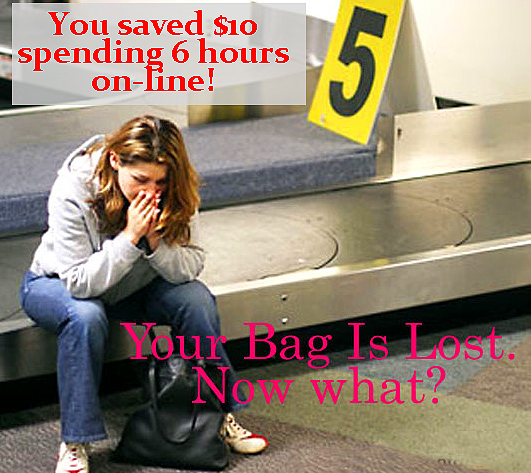
Americans (not the airline, but the organic ones) are basically idiots when it comes to buying their airline tickets. They are suckers of the highest standard. Duped by hidden fees and outright fraudulent advertising, they will spend hours on their computer to glean $10 off a $150 fare.

That is not competition in action, it is obsessive-compulsive behavior.

And the winners in this insanity are the airlines and brokers like Expedia who realized that paranoid-driven consumers could be duped by internet games. American spokesman Ryan Mikolasik told the New York Daily News that the impoverished multinational is losing “several hundred million dollars a year” in fees paid online services like Expedia.

In 2010 the total profit earned by U.S. airlines will exceed $7.7 billion.

That is several hundred million dollars that isn’t being used for fuel, maintaining aircraft, salaries, amortizing loans or advertising, research and development, and it certainly isn’t being used for coffee or tea.

That is SEVERAL HUNDRED MILLION DOLLARS more than flying is worth. But don’t think that if American is successful, that you’re going to get a refund!

American Airlines alone is projected to earn over $400 million. That’s AFTER on-line fees.

Before this tiff Expedia controlled nearly a quarter of the ticket purchase market in the United States. That does not foster competition. Whenever any entity controls that large a segment of such a vital commercial market, competition is stymied not enhanced.

Capitalist principles in the purchase of airline seats were doomed when Jimmy Carter started the process of airline deregulation in the 1980s. That was the mistake that American society made, removing government oversight from a vital service so essential for every day life.

So it’s now chaos, with the Big Guys fighting over who is going to be able to screw us the most. And by the way, it can also flip over and screw the airlines and their employees royally, too. As happened with all the airline bankruptcies.

And I hesitate to point out that more and more mechanical problems are happening, because government oversight in that critical area is also wanting.

So don’t choose sides on this one, dear consumer. It won’t matter a hoot. And for god’s sake, don’t waste your time finding a ten percent deal from New York to Chicago by flying via Houston. You’re killing yourself, shortening your vacation, wasting your resources and foolishly increasing the number of miles flown.

It boils my blood, which I wish they were capable of doing with coffee on short-haul flights, which as you know, they don’t even do that, anymore.

Top Ten 2010 Stories

Top Ten 2010 Stories

East Africa is booming, so many of the stories of 2010 were terrifically good news. But there were the tragedies as well like the Kampala bombings. Below I try to put the year in perspective with my top ten stories for East Africa for 2010.

1. Populace democracy grows.
2. Terrorism grows, as does the battle against it.
3. Huge stop in the mercenary purchases of Coltan.
4. Momentum for peace in the runup to establishing a new South Sudan.
5. Tourism clashes with development, especially with the proposed Serengeti Highway.
6. New discoveries of fossil fuels produces new wealth and a new relationship with China.
7. Gay Rights grow public but loses ground.
8. Rhino poaching becomes corporate.
9. Hot air ballooning’s safety newly questioned in game parks.
10. Newest early man discoveries reconfirm sub-Saharan Africa as the birthplace of man.

#1: POPULACE DEMOCRACY GROWS
Theoretically, all the East African countries have operated as “democracies” except for the torrential years of Idi Amin in Uganda. But the quality of this democracy was never very good.

Tanzania was a one-party state for its first 20 years, and that same party continues to rule although more democratically today. Kenya, Uganda, Rwanda and Burundi experienced one dictator after another, even while democratic elections at regional levels challenged the executive.

But the end of the Cold War destroyed the alliances these developing countries had with super powers. Purse strings were cut, and political cow-towing ended. All of them moved towards a truly more democratic culture.

And in 2010 huge leaps were made in all the countries towards more truly representative government. The most important example by far was the overwhelming passing of the new constitution in Kenya in a national referendum where more than 75% of registered voters participated.

And like the U.S. election which followed shortly thereafter, and like support for national health care in the U.S. and so many other issues (like no tax cuts for the rich), Kenyan politicians dragged their feet right up to the critical moment. They tried and tried, and ultimately failed, to dissuade Kenyans from their fundamental desire to eliminate tribalism in government and more fairly distribute the huge wealth being newly created.

I see this as People vs. Politicians, and in this wonderful case, the People won!

And there was some progress as well in Tanzania’s December election, with the opposition growing and its influence today moving that country towards a more democratic constitution.

(It was not so good in Rwanda or Uganda, where stiff-arm techniques and government manipulation of the electoral process undermined any attempt at real democracy.) But the huge leap forward in Kenya, and the little hop in Tanzania, made this the absolute top story of the year.

#2: TERRORISM GROWS
Four smaller bombings in Nairobi’s central business district over the year were eclipsed by two horrible simultaneous bombings in Kampala bars on July 11 while patrons were watching the world cup.

Police display an unexploded suicide vest.

Al-Shabaab, Al-Qaeda in Somali, claimed responsibility. And throughout the year Shabaab grew increasingly visible along the Kenyan border as its power in Somali increased.

I’ve written for a long time about how the west has had its collective head in the sand as regards terrorism and Al-Qaeda in particular. Long ago I pointed out that the locus of Al-Qaeda terrorism had moved to the horn from Afghanistan, and this year proved it in spades.

The country with the most to lose and most to gain in this war on terror is Kenya, because of its long shared border with Somalia. And the year also marked a striking increase in the Kenyan government’s war on terror, and with considerable success.

With much more deftness and delicacy than us Kenya has stepped up the battle against Al-Shabaab while pursuing policies aimed at pacifying any overt threats to its security, by such brilliant moves as allowing Omar Bashir into the country and not arresting him (on an international U.N. warrant). As I said in a blog, Kenya Gets It, and the story is therefore a hopeful one.

#3: CONGO WAR & COLTAN
This is also a U.S. story.

The Dodd-Frank Act is our victory!
The Congo Wars continue but are abating, and in large part because of a little known provision in the Dodd-Frank Wall Street Reform Act which now makes it almost impossible for major corporations in the U.S. to buy the precious metal Coltan on the black market.

A black market which has funded perhaps Africa’s most horrible war for more than a generation. Hundreds of thousands – perhaps millions – have been killed and raped, and more than 20,000 children conscripted into brutal wars, funded by purchases of Coltan and other precious metals by Intel, Sony and Apple.

It certainly wasn’t just this little legislative move. The U.N. peace-keeping force, fabulous diplomatic initiatives by Uganda and a real diplomatic vigilance by the U.S. all were instrumental. But the year ended with the least violence in the region in more than two decades.

#4: SOUTH SUDAN
I may be jumping the gun on this one, because the referendum to create a new country, the South Sudan, is not scheduled to occur before next month. But the runup to the referendum, including the registration process, while labored looks like it’s working.

Allied loosely with the Congo Wars, the civil war between the North and South Sudan had gone on for generations until a brokered peace deal five years ago included the ultimate end to the story: succession of the South into a new country.

The concept is rife with problems, most notably that the division line straddles important oil-producing areas. But in spite of all of this, and many other ups and downs along the way, it looks to me like there will be a South Sudan, and soon. And this year’s new U.N. presence in Juba, donor-construction of roads and airports, all points to the main global players in the controversy also thinking the same.

The creation of a new state out of a near failed one is not the be-all or end-all of the many problems of this massive and powerfully oil-rich area. But it is a giant leap forward.

#5: THE SERENGETI HIGHWAY & TOURISM
Last night NBC news aired a segment on the Serengeti Highway controversy, elevating an East African story into American prime time. Good.

But like so many reports of this controversy, the simplification ran amok. NBC’s reporter Engels claimed the motivation for the road was to facilitate rare earth metals like Coltan (see above) getting into Chinese hands more quickly.

While there may be something to this, it’s definitely not the main reason, which is much more general and harder therefore to fight. As I’ve often written, the highway as planned will be a real boon to the Maasai currently living to the east of the Serengeti, as much if not more than to the Chinese.

And as far as I know, Maasai don’t use Coltan.

Roads bring commerce and may be the single quickest way to develop a region. This region is sorely in need of development and recent Tanzania politics has aligned to the need for this regional development.

The highway is just one of many such issues which came to the fore throughout 2010 in Kenya and Tanzania. Concern that the west is just interested in East Africa as a vacation destination with no regards for the struggle for development, has governed quite a few local elections this year.

The whole concept of tourism may be changing as the debate progresses. I believe very deeply that the Serengeti highway as proposed would hinder rather than help development. But as I’ve pointed out, alternatives are in the works.

And the real story of which the highway story is only a part, is how dramatically different East Africans have begun to view tourists in 2010.

#6: NEW RESOURCE DISCOVERIES ALTER GEOPOLITICS
For years I and other African experts have referred to East Africa as “resource-poor.” Kenya, in particular, had nothing but potash. Boy, did that change this year!

Although only one proven reserve has been announced in Kenya, several have begun production in Uganda and we know many more are to come.

China has announced plans for a pipeline and oil port in northern Kenya at a cost of nearly $16 billion dollars, that’s more than twice the entire annual budget for the Kenya government! Deep earth techniques have matured, and China knows how to use them.

More gold has been found in Tanzania, new coal deposits in Uganda, more precious metals in Rwanda… East Africa is turning into the world’s rare earth commodities market.

A lot of these new discoveries are a result of technology improving: going deeper into the earth. But 2010 freed East Africa from the shackle of being “resource-poor” and that’s a very big deal.

#7: GAY RIGHTS ON THE HOOK
African societies have never embraced gay rights but as they rapidly develop, until now there was none of the gay bashing of the sort the rightest backlash produces in the U.S.

U.S. Righties manipulating East Africa.

That changed this year, and in large part because of the meddling of U.S. rightest groups.

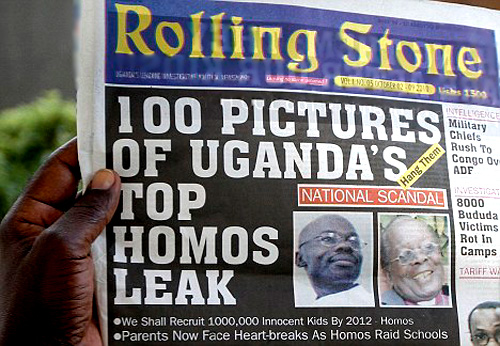
In what appears to now have been a concerted many year effort, support from U.S. righties is leading to a vote in Uganda’s parliament that would make homosexuality a capital offense, and would jail for long terms those who failed to out known gays.

This extreme is not African, it is American. Mostly an insidious attempt by those unable to evince such insanity in their own society to go to some more manipulative place. The story isn’t over as the vote has yet to occur, but it emerged and reached a crescendo this year.

#8: RHINO POACHING EXPLODES
Poaching is a constant problem in wildlife reserves worldwide and Africa in particular. Rhino are particularly vulnerable, and efforts to ensure safe, wild habitats have been decades in the making.

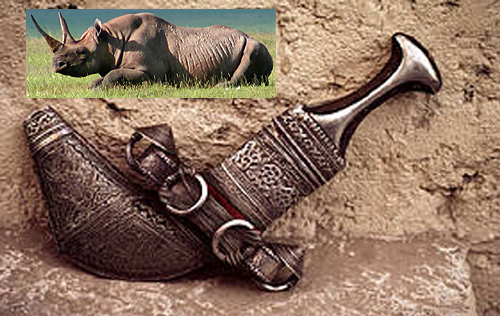
Dagger from rhino horn.

This year, they seemed to come apart. It’s not clear if the economic downturn has something to do with this, but the poaching seems to have morphed this year from individual crimes to corporate business plans.

This leap in criminal sophistication must be explained by wealth opportunities that haven’t existed previously. And whether that was the depressing of financial goals caused by the economic downturn, increased wealth in the Horn of Africa where so much of the rhino horn is destined, or reduced law enforcement, we don’t yet know. But 2010 was the sad year that this poaching exploded.

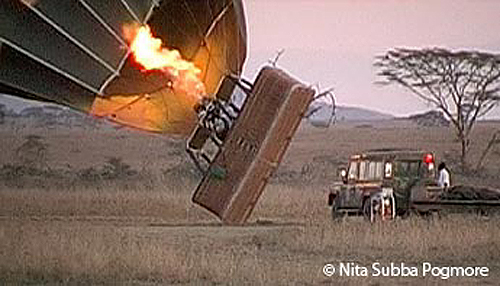
#9: IS HOT AIR BALLOONING SAFE?
Hot air ballooning in Africa’s two great wildernesses of the Maasai Mara (Kenya) and the Serengeti (Tanzania) has been a staple of exciting options to visiting tourists for nearly 30 years. That might be changing.

Is it Safe?

A terrible accident in the Serengeti in early October that killed two passengers and injured others opened a hornet’s nest of new questions.

After working on this story for some time I’ve personally concluded 2010 was the year I learned I should not step into a hot air balloon in East Africa, at least for the time being!

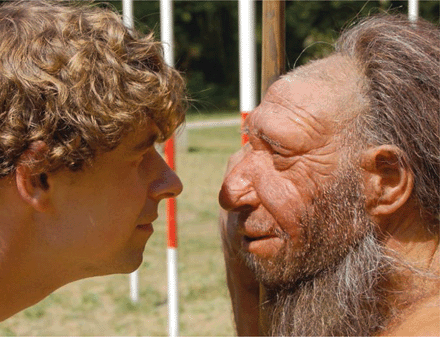
#10: EARLY MAN WONDERS
There were not quite as many spectacular discoveries or announcements about early man this year as in years previously, but one really did stand out as outstanding and you might wonder what it has to do with East Africa!

Representation by Tomislan Maricic.

DNA testing of Neanderthal proved that early man from Africa didn’t wipe them out after all, but absorbed them into the ever-evolving homin species.

And that absorption, and not massacre, happened outside Africa to be sure. But it finally helps smooth out the story that began in Africa: It’s likely that Neanderthal were earlier migrants from Africa, and absorption was therefore easier, physiologically and biologically.

It’s a wonderful story, and fresh and exciting, unlike the only other major African early man announcement about Ardi which was really a much older story, anyway.

****************
HAPPY NEW YEAR to all my loyal readers, with a giant thank you from me for your attention but especially your wonderful comments throughout the year. See you next year!

TripDestructor not TripAdvisor!

TripDestructor not TripAdvisor!


What do I have in common with Arthur Frommer and Google? We don’t think you should use TripAdvisor!

You shouldn’t believe everything you read. Verification and consistent fact-checking is the mantra of good investigative analysis and journalism. Experts take time to become experts. Monday Morning Quarterbacks are good for nothing but Budweiser.

You shouldn’t believe a car mechanic who tells you that your breaks aren’t working because your foot is suffering from Fibromyalgia. You shouldn’t believe a cotton farmer who tells you that nylon is bad for your skin. You shouldn’t roll over your IRA into the hot lead penny stock. You shouldn’t believe a Republican who tells you he favors cutting the deficit.

And you shouldn’t believe a traveler you don’t know about the quality of his recent experience.

That’s been my gripe: the wholly and exclusively subjective analysis of TripAdvisor reviews bereft of any expertise whatever.

And Google, now, seems to agree.

Last week the on-line search engine marketing firm HitSearchLimited reported that “Google seems to have removed [TripAdvisor] reviews from sources that do not have a verifiable method of ensuring that each review is written by a verified source…”

Yes! (Not that I’m a great fan of Google or anything that gets this big, but when the bigwigs start to fight among one another, I’ll route for those carrying my view to be sure.)

Time and again I’ve listened to astute clients claim that they are fully capable of reading between the lines, judging which reviews seem more credible.

It’s possible, if you’ve had a similar experience to what the review is about, but still unlikely. At the very least, you need to know the reviewer, as you would know and trust your friends about a travel experience. The known idiosyncracies and prejudices of your friend you’ll understand temper his/her evaluation, and you’ll probably then be in a better position to use the review.

Arthur Frommer has carried on his own campaign against TripAdvisor for as long as I have, and in last month’s blog critical of TripAdvisor he reiterated, “I will not choose the London or Paris hotel recommendation of an amateur who has stayed in exactly one London and one Paris hotel in the course of their entire life.”

The UK based KwikChex, a vetting agency for travel companies, announced in September that it was representing more than 120 travel companies (mostly hotels) in a possible class action suit against TripAdvisor.

This gets much more onerous than just my or Frommer’s general cautions about using TripAdvisor. These 120 travel concerns, one of which I know personally, have been defamed by malicious reviews on TripAdvisor using outright lies.

Kwikchex can be hired to sort things out. With enough documentation, TripAdvisor can be convinced to remove a review and has done so, specifically at Kwikchex’s behest. But the time and expense can sometimes be deadly for a small travel company or hotel.

The ego of many who believe they have “discovered” something is hard to suppress. The reason you don’t buy that tonic to grow hair is because … well, it doesn’t grow hair! Despite the old hairy man on the television who says it does!

As a travel consumer, you need to evince that same kind of discipline. Some of you may, indeed, think you can ferret out the more likely true from the less likely true in a string of TripAdvisor reviews.

I don’t think so.

Prices Trending Lower for 2011

Prices Trending Lower for 2011

The weather’s been unusually rainy, but I can see through the mist to a 2011 landscape with fewer tourists on safari.

As we approach the most important annual conference for African tour companies in London next month, the news is leaking. Competition is fierce.

Budget travel has been all but wiped out. Midlevel travel is in fierce competition with a major decline in prices, and upmarket travel is contracting capacity and not increasing prices.

For the prospective traveler it looks good on two counts: (1) there will be fewer tourists, and (2) prices are stable or dropping.

For the local African tourism company, there’s going to be a lot of rolling up the sleeves and hard work. I predict more closures, merges and partnerships and a workforce that is likely to contract by another 5% before it bottoms out late next year.

The surge of travel that followed the technical end of an economic downturn is over, and vendors see this from slim forward bookings. By June of this year vendors had noticed a pullback in December holiday bookings, and pretty grim pickings for the start of the year.

This is an economic cycle at its perfection. When travelers realized the earth wasn’t coming to an end last year, those who had waited up to two years to travel all came at the same time. That’s now over, and the market is readjusting to levels that will be here for years to come.

Germany is an important source of foreign tourists to East Africa, and the German economy is doing well. So companies specializing in tourists from this area of north central Europe might even expand next year.

The other source of a smile is the coast. Sun ‘n sand holiday makers from Europe have replenished the Indian Ocean beaches. Charters were pretty full this past season and will likely stay that way next. Africa’s coast is now a nearly completely matured market that can rival coastal holidays almost anywhere else in the world, and so the value particularly for Europeans is pronounced. It’s a wonderful success story. Now, all we have to make sure is that security that Kenya and Tanzanian can provide will do the trick.

But as far as I can tell, Germany’s momentary economy strength and the East African coast are the only two positive signs in a year which otherwise looks very weak and pretty miserable.

Southern Africa’s ridiculously high exchange rates – a result of the world’s reliance on basic resources like gold in an economic downturn – are keeping prices for everything, including tourism products, ridiculously high and this will continue to depress that market.

Often budget travel does well in an economic downturn, but the problem this time is that the younger traveler no longer exists, the Asian traveler which flooded the market last year has stabilized and is decreasing, and all that’s left are pensioners with an increasing concern about their financial future.

To the extent that the midmarket doesn’t depress pricing enough, it will move down to the budget level. We see that happening right now with chain companies like Serena and Sopa providing Somak’s new customers. To the extent that the first two S-companies lack further pricing moves, they will drop customers to the bottom S.

And that’s where the stiffest competition will be next year: The midmarket. It’s where potential travelers will find the best values and where investors will have the most headaches.

The upmarket was the hardest hit when the economic downturn began in 2008, it rebounded the most in 2009, increased a wee bit again this year, and will take the hardest hit next year because its rebound was so high relative to the overall market. Although where it ends up as 2011 will be remarkably close to where it was in 2009.

The volatility of the upmarket is a result of its small size and ability to price quickly depending upon market trends. So with alarming speed &Beyond published incredible deals in early 2009, ended them with the same alacrity in 2010, and is now presenting them again for 2011.

&Beyond is the only transnational company throughout sub-Saharan and southern Africa, and so it has its feet solidly in two different mud pools. One might be sinking while the other is firm. It’s always a good company to look at for comparisons. Right now &Beyond’s pricing is getting much more aggressive in east than southern Africa, I think because of presumptions that Zimbabwe might be coming back on line and a recognition that the East African market for upmarket travel is cooling.

I’ll revisit all these general predictions with hard numbers after the November convention.

Safety Concerns hit Serengeti Balloons

Safety Concerns hit Serengeti Balloons

Disgruntled Employee or real Whistle Blower, that is the question.

The tragic crash of a Serengeti hot air balloon last week raises some very old questions and puts into doubt the safety of hot air ballooning in Tanzania.

Two passengers were killed (an American and a Dane) and eight seriously injured after the smaller of two balloons lifted off at dawn a week ago Wednesday and then crashed in turbulent winds. The flight of the larger balloon was aborted by the pilot who felt the winds were too strong.

Although no official investigations have been completed, a simple review of the situation suggests neither balloon should have been allowed to fly.

Serengeti Balloon Safaris (SBS) has acknowledged that the winds were 30 mph as the smaller gondola attempted an emergency landing that went very wrong.

Two balloons are scheduled to lift off daily in the Serengeti, and this season ballooning just began in Tanzania’s Tarangire National Park as well. But Tanzania’s total capacity pales in comparison to Kenya’s, where as many as 14 balloons fly daily in a single reserve, the Maasai Mara.

I’ve spoken to principles of balloon companies in both countries, and my gut feeling is that they do it much better in Kenya than Tanzania. This might be simply because the Kenyan industry is so much larger and has had a much longer experience. And extraordinary caution is required when asking someone in Kenyan tourism about Tanzanian tourism, and vice versa, as the rivalry is profound.

But off-the-record Kenyans generally express sympathy with a vengeful website launched by what is certainly a disgruntled former SBS employee, Nigel Pogmore. Kenyans insist that many of Pogmore’s accusations of SBS’s unsafe procedures would never be seen in Kenya.

Pogmore’s long list of what SBS does wrong is mostly ridiculous, as I an untrained pilot, dare to determine. But a few do standout:

Pogmore claims he was fired because he was a “whistle blower” after being appointed SBS’ Safety Officer and then in the course of that job uncovered all sorts of safety irregularities. SBS claims Pogmore was a disgruntled employee with a very short fuse and that his past employment history bears this out.

So I asked SBS Managing Director, Tony Pascoe, why he hired Pogmore in the first place. Pascoe has not answered despite several emails to him.

Pogmore claims SBS balloons fly virtually until they run out of fuel, and therefore violate an industry standard that there be 50% fuel reserves left at the end of a flight.

While this may, indeed, be the industry standard, this is one that many Kenyan companies don’t manage, either. (Although no Kenyan company claimed they would fly until they were out of fuel.) The balloon flights in East Africa are generally short by industry standards and over pretty uncluttered (no power lines) geography. Provided the winds aren’t unusual, they can usually expect to land anywhere along the expected flight path.

Pogmore severely criticized the procedure by which SBS fired up their balloons in the morning, claiming the method they used to raise the pressure in the gas tanks was unsafe and that passengers were boarded in unsafe ways.

He also specified faulty equipment on 5 of the 6 balloons owned by SBS. This included poor or faulty Emergency Rapid Deflation (ERD) capability, fuel gauges and incorrectly maintained fire extinguishers.

Most scathingly, Pogmore claims SBS essentially ignored required safety inspections, insisting that a normal inspection took 2-3 trained staff 4-5 hours, but that his experience proved there were some inspections completed in less than ten minutes.

SBS, of course, is defending itself against all these accusation at their new “answer” site, balloonsafety.info. The problem was that site is very similar to the problem with Pogmore’s site: there’s too much emotion and not enough facts.

I had a courteous phone call with a close relative of SBS Managing Director, Tony Pascoe, and a subsequent courteous email exchange with Tony.

Tony thanked me yesterday when I advised him I had reduced our conversations into a few simple questions I would appreciate him answering.

But when I sent those questions in writing, as agreed, they’ve gone unanswered. Pascoe has suddenly gone silent. A subsequent reminder email also went unanswered.

Please see below in comments. The CEO of SBS finally did answer some of these questions after this blog was posted.

This leads me to believe they have something to hide, or at least aren’t well enough prepared yet to answer some very serious accusations.

Should you take a hot air balloon ride on your safari?

My answer for the time being is, No, not if it’s in Tanzania.

JIM’s Solution to Terrorism

JIM’s Solution to Terrorism

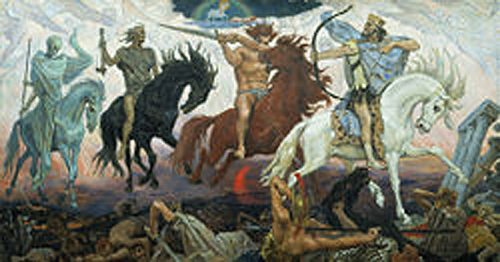
To end terror we've got to deep-six these four guys.
For travelers like us terrorism is nothing new. And it’s well past the time that we should lead our fellow Americans into a fuller understanding of what it means and how to minimize it.

If you can’t stand reading through the rest of my poorly constructed nonsense, just jump to the bottom of this for MY SOLUTION.

The penultimate word in the first paragraph is the key: Minimize. Terrorism will never, ever go away. It never has. Pagan potentates enslaved tasters to eat their food, first. Famine and pestilence were certain outcomes for any misbehaving early Christian. Spies stole children from critics of the gulag. Salman Rushdie, and many of his family and friends, have remained in hiding since the 1989 fatwa ordering his murder.

And leaping into the present, Ugandan citizens are so terrified of the proposed laws against homosexuality, that as many gays may be fleeing the country today as Asians who were ordered exiled by Idi Amin in the 1980s!

By the way, know a Mexican in Phoenix?

1. TERRORISM IS NOT NEW
The first and most important point. And it should not be as powerful news as it is, today that there’s terrorism.

Every time the nightly news headlines a terrorism warning, it’s presented as something remarkably unexpected. Every single night the news is filled with mayhem, war and killing, but a terrorism “threat” elicits greater shock.

Because the mayhem, war and killing was not about you. And because the threat is simply that, something that hasn’t yet occurred and so isn’t yet fully defined, so it might involve you. Suddenly, you’re in the news.

And when it doesn’t happen, or does and doesn’t happen to you, then you recycle your psyche to be just as shocked at the next news broadcast of potential terror featuring you. Americans are all hams and gluttons for punishment.

I hate to tell you, but terrorism is just as ordinary an occurrence as hurricanes, lightning strikes and your regular ole every-year airplane crash over Rochester. It’s a part and parcel of our lives.

2. TERRORISM IS NOT MORE POWERFUL TODAY
Don’t give me that baldersash that yes, there’s always been terrorism, but not with the power of airplanes or nuclear weapons.

How many died in the halocaust? How many ships were sunk by kamikazes? How many specific terrorism deaths in the Balkans, or during the many years of conflict in Northern Ireland? How many are still being raped and decapitated in Kivu, The Congo, or Somalia? How many airplanes or nukes would it take to reach this sum?

That is not to say that the methods of terrorism haven’t changed. As the world is more interconnected, all the good and evil within it move further and more quickly. Terrorism in our generation has adopted a travel component that it didn’t use to have it, and that’s the reason we as travelers are more attuned to it.

1985: the Achille Lauro cruise ship hijacking
1985: hijacking of TWA in Cairo
1988: Pan Am disaster over Lockerbie
1996: Atlanta Olympic bombings
1998: American embassies bombed in Kenya and Tanzania
9 -11
2005: 7-7 city bombings in London subway
2008: Slaughter in Mumbai

All the above specifically and successfully targeted travelers on airplanes or tourist hotels, or used travelers to get to their target. There were scores of other unsuccessful attacks like the shoe- and underpants-bombers. That’s a generation and counting of terrorism redefined to some extent by travel.

3. MOST MUSLIM TERRORISTS ARE NOT IDEOLOGUES, JUST WELL PAID
This nonsense that Mideast suicide bombers are half wits who believe they are tending roses in heaven is more baldersash. It just drives me crazy. THEY GET REALLY WELL PAID!

They are completely unlike the long history of soldiers who went into battle for ideological and religious reasons expecting to die fighting.

The most recent ideological suicide soldier was the kamikaze. And the phenomenon did not begin until the loss of Iwa Jima, after which rational people, including well trained Japanese soldiers, knew there was no hope. Read this for a thoughtful explanation of soldier ideologues.

There have been thousands of reports like the ones above corroborating that today’s suicide bombers in the Mideast do it mostly for money, not mostly for their soul or honor, and yet leave it to Americans to twist this around. This fundamental mistake is something the rest of the world doesn’t make.

This account of suicide bombers as relates kamikazes is accurate, but totally inaccurate regarding current Muslim terrorists. It’s typical of the American Right’s, mostly religious, repositioning of facts. This casts a simple proposition, that Muslim suicide bombing can be valued in dollars, into the heavenly worlds of moral conflict making it much more difficult to deal with.

This is because the current conflicts in the Mideast are all economic ones, not ideological ones. Virtually all the major conflicts on earth have been economic and this is no different. The people with more power need oil currently lived on by people with less power.

This is a tough situation and I don’t mean to belittle it in any way. I don’t think it’s clear that we as the people with more power shouldn’t have equal or more rights to the oil than the people who live on top of it. But that’s a different problem, one with a different analysis.

By redefining an economic problem into an ideological or religious one, the arguments are driven less by facts and much more by emotion. And ultimately the only way to win an emotional argument is to be more fanatic.

Please watch this.
It’s heart wrenching. Sunday’s “This Week with Christiane Amanpour” stripped our current conflict to its reframed religiosity. And it’s so clear there’s no resolution in sight. So long as religion dominates the perspective, this war will never end.

4. THE CERTAIN WAY TO LOSE THIS WAR IS TO INCREASE THE FIGHTING
“War Against Terrorism” is as inappropriate a phrase as the “War Against Drugs” or the “War Against the Lunacy of 13-year-old Boys.” The real war today is a “War Against People Who Live Over Oil They Won’t Give Us at a Fair Market Price.”

It has been the longest war in the history of the modern world. It began when Edwin Drake extracted the first black liquid from Pennsylvania in 1859. The war really heated up when most of the world’s known oil shifted out of Texas and Oklahoma to godknowswhere deserts in the Mideast only about 50 years ago.

It was sometimes a military fight, but mostly a cultural and diplomatic one. We violated all sorts of our own values in this campaign to annex land for ourselves and our European partners so we could have its oil. We bribed, applied our laws to theirs, fixed markets, we tried everything possible until finally, we had to shoot.

And during this lengthy fifty years or two generations, the poor souls living over there noticed how fancy the cars were that were using oil. Before iPhones that was a bit more difficult, but now you can send a picture of a Dodge Ram all over the world in seconds.

We got richer. They got poorer. We got richer because of their oil.

Doesn’t compute, does it?

What would you do, a young, yet vibrant desert youth whose abs haven’t been yet emaciated for lack of proper nutrition? You watched your grandfather and your father die loathsome deaths mostly from smoking Philips cigarettes. And then with your iPhone, you saw what’s under your home made Jenny the prettiest, richest homecoming queen in the world. How come you can’t wear a carnation?

Today’s terrorism is fire. It’s the fire in the soul of two generations of Mideasterners mostly being denied their rightful development.

Terrorism’s fire is fueled by desperation, wont, poverty. What else can you call a suicide bomber? Don’t fool yourself that they all think they’re going to paradise. This is a very attractive job.

Terrorism must be watered down, not fired up. Terrorism will decline only as the desperation in the world declines, and not a second before. Until then, it will increase, and for those of us fortunate enough to not be so desperate, it will be something effecting our lives …always.

JIM’s SOLUTION TO ENDING THE CONFLICT WITH RADICAL MUSLIMS
It’s kind of hard to do this, because the numbers just won’t stay still:

Anyway, let’s give it a try. During my final edit this morning, the number was One Trillion, eight-nine billion, seven hundred and twenty-four million, one hundred and sixty-five thousand, eight hundred and thirteen dollars.

It’s been three thousand, two hundred and eighty-five days since we invaded Aghanistan on October 7, 2001.

That means, roughly give or take a few cents, we’ve been spending
$331,727,295.50 per day.

Now the area of Iraq and Afghanistan is 426,034 sq. miles. So if we divided how much we’ve been spending per day, that means we’re spending $778.64 each day on every square mile of those two countries.

Now if you don’t mind, I’m going to reduce the $778.64 by about one four-thousandths of a penny, one four-hundred-thousandths of a dollar so that my wife’s favorite local state historical site, the Apple River Fort, can be kept open, which has faced possible closure for budgetary reasons.

That leaves $778.64 available each day for every square mile, which I would bundle up in cheerfully wrapped packages using Halliburton‘s Christmas Wrapping Division, and then drop from a helicopter. Over the course of a year, that’s roughly the salaries of ten suicide bombers in each square mile, or in total, way more than whatever total has ever been paid to all the suicide bombers in the history of mankind.

What do you think?