On Safari: East versus South

On Safari: East versus South

Six weeks in sub-Saharan Africa has confirmed my long-held views on where the best game viewing is and why, how seriously threatened the wilderness is by remarkably fast and unregulated economic growth, and how youthful optimism about Africa’s future mostly discounts its precious wilderness.
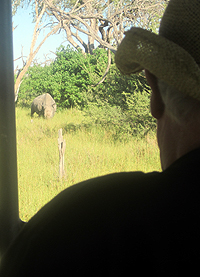
Wild rhino in the Okavango Delta.
My first stint of the year began in Cape Town, included Johannesburg, multiple places in Botswana including the Okavango Delta, Victoria Falls and Zambia, Nairobi, and ended as I guided my first “great migration safari” in northern Tanzania.

The ability to contrast East and southern Africa so immediately corroborates my long-held view that East Africa provides better game viewing for the typical safari traveler.

This might seem strange when I also tell you that in a single day on Chief’s Island in Botswana we saw the Big Five (lion, leopard, rhino, elephant and buffalo) and that seeing the Big Five in East Africa is no longer guaranteed no matter how many days you have on safari.

That’s because rhino is so rare, today, in East Africa. (Caution: captive or contained rhino, as found in fenced places like Nakuru National Park, Solio and elsewhere in
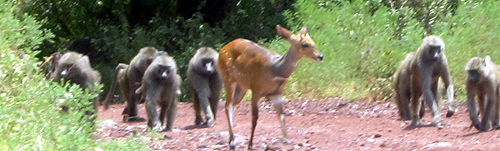
We saw this bushbuck unnaturally traveling with a baboon family in Lake Manyara. Its possible adoption by the baboons is an example of East Africa's stressed wilderness.
Laikipia including Lewa Downs, doesn’t count. Those are fun to visit, but they aren’t true wildernesses, anymore.)

But therein lies the important distinction between East and southern African game viewing. The south’s wilderness has been managed much better over the last century. Kruger National Park in South Africa is likely the best managed wilderness on earth.
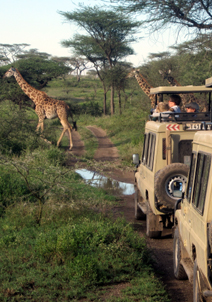
Groups of up to 20 giraffe in East Africa are common. Much smaller numbers in southern Africa.
For more than a century, Kruger and similar southern African wilderenesses have sustained rich and varied biomasses. Although currently suspended throughout much of southern Africa including Kruger, culling had been and in many places still is an instrument of aggressive pruning that aimed to insure the most diverse biomass possible.

Culling has never occurred in East Africa, and likely because of its cost rather than any moral inhibition. Similarly, the south routinely reintroduces or just moves around various species from one wilderness to another in an attempt to achieve balance.

Anti-poaching is far better funded and managed in the south. All decisions about park management, its borders and its sustenance (including the still controversial actions of creating unnatural watering holes from aquifers) has come from officials that are far better trained and paid in the south than in the East.

So in a relatively short time in Botswana visiting two different areas in the Okavango Delta and Moremi we saw a balanced variety of several dozen types of larger mammals including a dozen elephant families and large numbers of buffalo and several prides of lion.

In Botswana’s Chobe balance has gone to the wind. Chobe is almost all elephants: too many, and at the exclusion of much of the rest of its historical biomass. It’s heart-breaking for me to return to areas along the Chobe River that were oncebeautiful forests and are, today, grasslands. The elephant population has destroyed much of Chobe’s former wilderness. It is, in fact, more like East Africa than southern Africa.
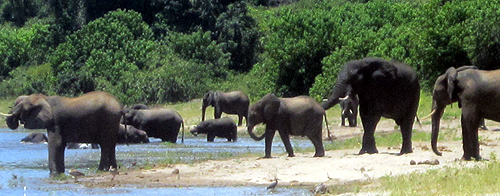
Which is why so many people love Chobe. There are so many elephants in so many endearing behaviors and from time to time dangerously so, that Chobe like so much of East Africa provides the thrills often missing from a more balanced and rich biomass.
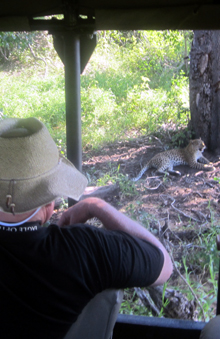
We see about the same number of leopard in east and southern Africa.
One implication in the above is that East Africa (and Chobe) are worse wildernesses, because the biomass is less rich, because they have either been poorly or not managed.

This remains to be seen. I think the scientific consensus points in this direction, but it’s been pointing in that direction for an awfully long time and we have yet to experience “the crash” scientists have been predicting for such out-of-balance wilderness.

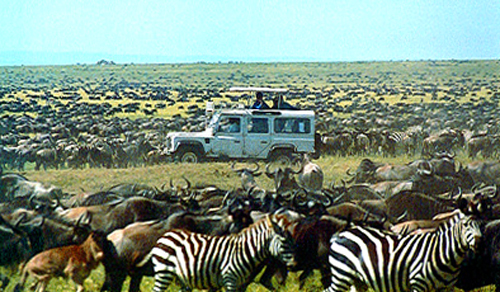
Scientists might pale at the biocount of these wildernesses, but tourists are thrilled: On my great migration safari of 11 days in northern Tanzania, we saw 61 lions, 2 leopards, 5 rhino, and I don’t know maybe 500 elephant and a quarter million wildebeest? And perhaps several hundred thousand zebra, a hundred giraffe, and – very important by the way – fewer tourists than in Botswana.

This last observation, that my safari clients in East Africa encountered fewer other tourists did my safari clients in Botswana, is not the norm. Most East African tourists on the lodge circuit will definitely encounter more tourists than a similarly budgeted trip in southern Africa.
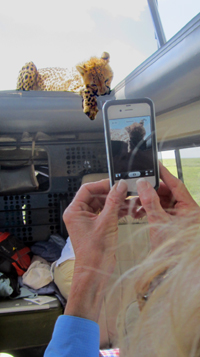
Who's looking at whom?
But I don’t like the lodge circuit, and the safaris I guide are expensive. This lets me remove my game viewing from heavily used tourist areas into the East African wildernesses that are truly less used than virtually any wilderness in the south.

The unmanaged, some say chaotic, out-of-balance wildernesses of Chobe and much of East Africa result in greater numbers of larger animals at the expensive of many smaller ones that have gone extinct.

Theoretically, this situation is not sustainable. And this tension of nature trying to preserve itself is likely the reason for the much greater drama usually experienced on an East African safari.

It’s certainly a bitter sweet reminder that urgent action to preserve these great East African wildernesses has been grossly neglected. But as crass as it may seem, it also provides at least for the moment (and perhaps at the cost of the future), the “greatest wildlife spectacles on earth.”
On Safari : The Spectacular Cape

On Safari : The Spectacular Cape

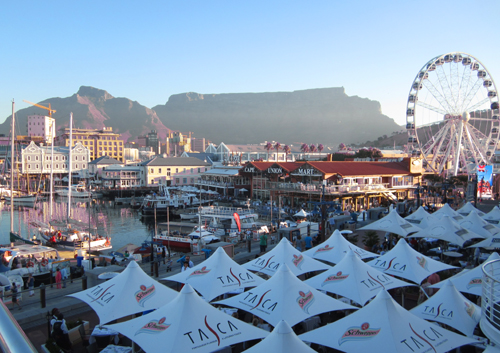
Sunset at the Waterfront. Table Mountain in the background.
Table Mountain is cheeky. It’s one of the main reasons tourists come to Cape Town, but it only lets itself be seen about half the time.

The mountain was truly spectacular for me this morning. I’ve been to Cape Town about a dozen times, but I had yet to take the funicular up the mountain. Mostly this was because I’d always tightly scheduled my time, here, and I knew scheduling in the mountain was iffy.

The main website for the cableway starts on the right top first page with the announcement about whether the mountain is “open” or “closed.” And even that is somewhat misleading, because the tram runs even when the mountain is wrapped in cloud, which is about half the time.

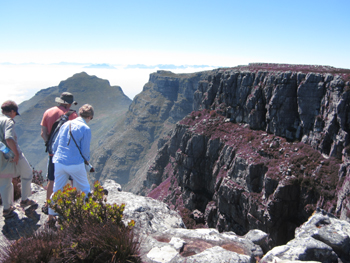
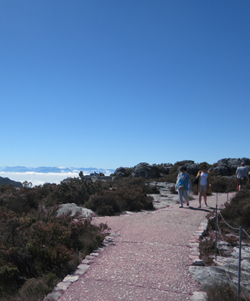
Easy trails once on top.

The mountain closes when the winds get too steep. In fact there’s a very, very loud “hooter” at the top that screams out when the winds are coming in, giving everyone a very short time to get back to the tram or face either staying up top for a long time or taking the 4-hour walk down.

But these last couple days have been so spectacularly clear and wonderful warm in Cape Town, and every morning I’d sit eating my breakfast staring at a perfectly clear mountain top, that I knew it was time.

I got a parking place only about a half kilometer from the tram entrance. That’s not bad, because whenever the mountain is out and especially in the morning every tour guide and tour bus in Cape Town heads for the mountain. It doesn’t matter you were headed to see the penguins or buy trinkets at Market Square or learn about history on a stroll through the Company’s Garden – all that in due course, ma’am. If the mountain’s out, go for it!

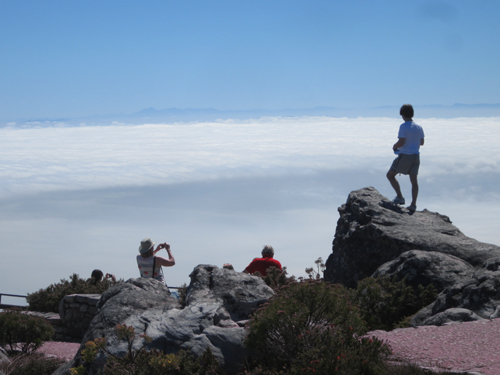
Getting ready to lie down on "Belly Rock." Slightly angled up so you can look over the edge 3000' down!

So it’s crowded, and I was in the beginning of the crowds which shortly after I arrive around 945a had stretched to a waiting line of about 45 minutes. Two cable cars each carrying 65 people go up and down constantly, a journey of just a couple minutes.

Once a top it’s amazing. And not just the views, but the unusual ecosystem found here includes some remarkable fynbos, reeds, orchids and of course, proteas. The best time for the flowering bouquets is August and September. But I was here in the worst time, February, and it was still beautiful.

The mountain’s geology is equally fascinating dating back 600-800 million years. It’s a unique type of unusually dense sandstone. There are wonderful park trails with good signage and you can spend the day up there or an hour. In an hour you can get the entire panoramic view of both the east into False Bay and towards the Indian Ocean, and west into Table Bay and the Atlantic. On truly clear days you can see Cape Point.

Managing the crowds is becoming difficult. My guide actually caught one Korean chipping off a piece of rock, which of course isn’t allowed. The guide explained that Koreans who worship the “Five Great Massifs” of which Table Mountain is one come with concealed rock hammers to chip away a piece and take it home.

And there little old British ladies, I was also told, who nip away the protea buds! Or steal the orchid seeds!

And there are macho Australians who illegally jump off with unlicensed paragliders!

I felt like Polijimmy.

Our trip’s first stay is on the Waterfront. I really don’t think there’s a better place to stay these days in Cape Town, unless you’d like a good BnB or have more time for a condo or villa along the coast. But for a traditional hotel stay, it’s really the Waterfront. The aged Mt. Nelson is too far away from the action.

Everything is at the Waterfront and don’t be discouraged by its touristy aspect, after all that’s why you’re here, right?! All the adventure touring from whale watching to shark diving to sunset cruising starts from here, the famous aquarium is here, although many of the good sightseeing attractions are a few minutes away in the city.

But 80% of Cape Town’s finest restaurants are here, entertainment is here, and of course all the good shops are here. The management encourages minstrels, new bands and juggling troops, pantomimers and all sorts of performance artists to just set up shop willy nilly.
So along with the amazing aroma of freshly fried calamari you’ll hear creative music at every turn.

My choice of hotel is the Victoria & Alfred, simply because of its location smack dab at the beginning of everything at the Waterfront. Table Bay is too staid for my taste and basically reminds me of an old folks home.

But if my pocket’s full and budget doesn’t matter, I go to the Cape Grace, absolutely one of the most stellar hotels in the world, and only five minutes further away from the action than the V&A. And if my pocket’s tight and hotel ambience is really secondary to anything else, then it’s the Portswood, a truly fine value only minutes away by a well marked walkway.

What a wonderful way to begin an African trip!

Good News From Africa

Good News From Africa

Four of my most important stories for 2012 were basically great, good news! Exciting discoveries in science in Africa, growing strategies for peace in Africa’s troubled regions, and my having guided an old friend and client, the Don of American zoo directors, Les Fisher!

These are my 6th to 10th Top Ten Stories. To see a list of all The Top Ten, click here.

#7 : China Partners with U.S. for Peace in Sudan
The world’s two most diametrically opposed societies have struggled uncomfortably ever since shaking hands during the Nixon administration in the 1970s. Whether it be over world wars and conflicts, climate change, human rights – you name it, we’ve been at odds.

But this year the two adversaries teamed up to make peace in The Sudan. This is terribly exciting.

Two years ago South Sudan became its own nation after years of civil war with The North. That in itself was amazing, and in no large part because of enormous initiatives by the Obama administration.

But the border between the two has never been completely demarcated. And it goes right through the most productive oil fields in the area, and so border disputes spilled over into outright warfare.

China and the U.S. got together and stopped it. Period.

It is an amazing geopolitical development, because the U.S. is heavily invested in The South, and China, in The North. But rather than parry their positions, they negotiated them for peace.

Unfortunately, trouble persists in both countries not due to this grander conflict. Darfur remains troubling for The North and The South’s northwest states are close to open rebellion.

But the grand deal signed earlier this year between the two hostile siblings of the once singular Sudan state remains laudable.

#8 : Breakthrough Discovery for Malaria Eradication
The devil is in the details to be sure, and despite a generation of unprecedented research and global aid, malaria finds ways to evade suppression. But this year a new genetic discovery might finally herald a definitive way to eradicate this disease that is so devastating in Africa.

Malaria is such a tough candidate for making a vaccine against because it’s really seven different types of life forms. True, it’s only one of the stages that infects us, but that one has proved terribly difficult to fight against.

If we could simply interrupt the change of life forms from one to the other, we’d do the trick. And now, a new genetic discovery gives us a guide towards finding out how to do that. It’s complicated, but perhaps the most promising new science regarding malaria in my life time!

#9 : African Arms Dealer Finally Prosecuted in U.S.
It’s no secret that you can’t fight a war without a gun. But the west – and especially the U.S. – and Russia have suppressed this evident fact because their war machine economies are so important to their overall economies.

And what’s even more embarrassing is that several of the most prominent arms dealers have lived as foreign visitors on extended friendly visas for some time in the U.S. The presumption has to be that the U.S. felt some advantage for letting them stay here.

So it was striking that finally the Obama administration actually began to prosecute arms dealers in a way past administrations, including back through Clinton and Reagan, declined to do.

Viktor Bout, a Russian, was convicted after a full court press by the Obama administration, suggesting more such prosecutions are on the way. This is an African story, because that was the turf on which Bout played, heavily involved in the most recent wars in Liberia and Sierra Leone.

#10 : Les Fisher Goes on Safari at 91 years old
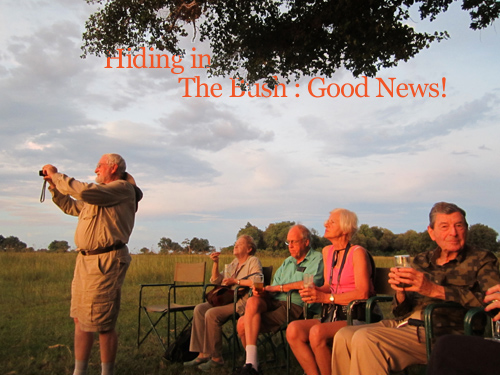
The Don of African Zoo Directors who helped pioneer some of the first American adventure travel in Africa took a group of small friends on a not-so-easy safari into Botswana in the hot season.

I’ve guided Dr. Les Fisher on at least a dozen safaris over the years, and we’ve been in some of the most remote parts of Africa, together.

As I recall this was his 5th “Last Safari Ever!” At 91 that’s hard to argue, but it was hard to argue at 90, too!

Stay tuned.

Beach Bums

Beach Bums

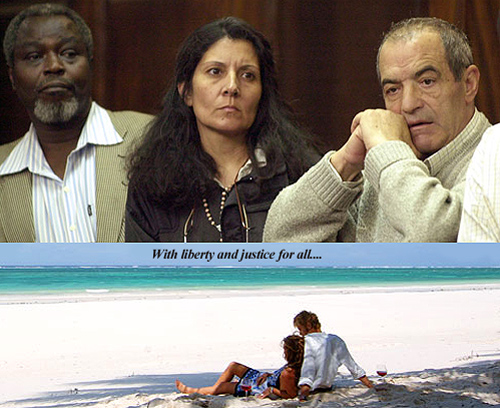
Angelo Ricci, a member of Kenya's Italian community, listens as a Kenyan judge acquits him of any crime for having 2,500 pounds of cocaine in his beach resort cabin. (AP)
Don’t feel sorry for the harassed billionaires of the world; they’ve found a place to hide from those nasty journalists linking them to blood money, laundering and drugs: the incomparably beautiful beaches of Malindi, Kenya.

This summer Brian Dabbs writing for The Atlantic unmasked the Italian cartel in Malindi, Kenya, that uses “Eden” as a likely place to headquarter a global mafia increasingly on the run from Europe.

Ten days ago Silvio Berlusconi joined billionaire friend and equally maligned Flavio Briatore in Malindi, Kenya, where they remain today cloaked in a secret “billionaires retreat” with much younger women, and many believe this is a don convention to divvy up the Joker’s World.

They are “holidaying” at the Lion in the Sun Resort, owned by Briatore, and which TripAdvisor ranks as #6 of 17 resorts in Malindi. E-Travel calls it a HotSpot hotel. (No mention in either TripAdvisor or E-Travel about money laundering or the drug trade.)

Berlusconi is the deposed and disgraced former Italian prime minister and now convicted felon. Briatore has a longer list of accomplishments including conviction for fixing Formula 1 racing.

When Italian billionaires convene like this in Malindi (this is hardly the first time), the Kenyan Post newspaper puts out this clarion call: “Nairobi ladies, there is a cash cow in Malindi, better hurry up!”

Two things really bother me about this.

Most troubling is that while Italian mafia, drugs and global crime is not news for Malindi, it is growing worse just as Kenya is about to turn a new page next March with its first election under a new and fabulous constitution.

While I see an increasing transparency and honesty with Kenyan politicians as a whole, the crew in Malindi has been totally corrupted by the Italian criminals.

Dabbs interviewed several Kenyans, including the local police boss, who essentially confirmed that they turn a blind eye to all the criminal goings-on among the Italian billionaires. Even local judges have acquitted the cartel of cocaine trafficking that excellent Kenyan investigators had all but proved.

Add to this the growing political instability of the coast, where a new political force called the “MRC” (Mombasa Republican Counsel” is increasingly linked to terrorism and many warriors fleeing Somalia, and you have all the ingredients for mob reign.

And secondly, travel tools used by so many people are doing nothing but white washing this horrible situation. It’s an incredible travesty, from my point of view a crime of its own:

Online travel portals like TripAdvisor, E-Travel, Luxist and get this, Conde Nast’s OnLine Tatler awarded it the Best Life Changing Spa – Tatler Spa Award Winner 2010. You can say that, again. And you won’t find that link leading you to Conde Nast or Tatler, because they’ve since discharged their noble duty of killing that award without explaining why.

But I guess the occasional legitimate guest Lion in the Sun gets irritates Briatore, anyway. He’s building a new exclusive “billionaire’s condominium” in Malindi, claims that half the units are already sold and that “For this project, I will choose who will come here.”

I guess that won’t be any clients I have.

Kenya Great But Don’t Go

Kenya Great But Don’t Go

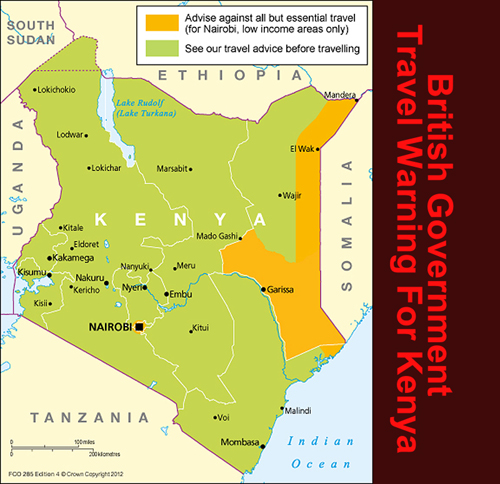
Good news in Kenya is causing extreme turbulence and many countries are cautioning their citizens about traveling there, now.

It’s heart-wrenching, because Kenya depends so much on tourism. It’s complicated, because the potential for disrupting foreign vacations comes specifically from a series of successes in Kenya’s military operation in Somalia and its growing role in the global war against terror.

Britain, France, Australia and Canada among several dozen other countries all issued new advisories to their citizens this week, indicating that travel to Kenya has become increasingly problematic. (The U.S. did not, and that oversight continues a long history of poor and misleading travel advice coming out of Washington.)

All countries said the same thing: don’t go to any part of the northern coast of Kenya including Kismayu and Lamu, and if you travel to Nairobi city, avoid a number of the poorer areas, specifically named.

The reasons for this stem from two major events this week:

A radical cleric in Mombasa was assassinated in a drive-by shooting. As I wrote at the time Sheik Aboud Rogo was a well-known supporter of al-Shabaab, al-Qaeda in Somali, and one the remaining likely fugitives of a number of high-profile terrorist events.

As I said I believe the shooting was done by the very people Sheik Rogo supports as an attempt to incite violence and disrupt Kenya. It worked. Kenya’s second largest town and only port exploded in violence earlier this week.

Secondly, after nearly a year, the Kenyan military is about to invade Kismayo, the final stronghold of al-Shabaab. It’s Somalia’s modern port, largest organized city and the capital of pirates and terrorists the world over. The economy of Kismayo alone is estimated at ten times that of the rest of Somalia.

This week the Kenyan navy continued an unending bombardment of the port, taking out its airport and confirming the death of at least two major al-Shabaab leaders. The Kenyan air force has been dropping leaflets on the town explaining to citizens where and how to flee once the ground fight begins.

After Kismayo falls, al-Shabaab has nothing left but disparate mostly now ungoverned guerilla fighters, and clearly what they will do is attempt strategic acts of terrorism. The Kenyan coast – where 50% of all its tourist revenues are generated – is within day’s walk of Somalia.

And the poor neighborhoods of sprawling, gigantic Nairobi are perfect hideouts for fugitives. This year a number of grenade attacks have already occurred there that were linked to al-Shabaab.

But if you’re a Kenyan, and despite a lot of civil and political turbulence right now (including several major public sector strikes), you’re incredibly hopeful and aggressively behind the government. The march to the historic spring elections under a new and brilliant constitution will become a model for much of Africa.

But fate has dealt Kenya, with its geography and its rapid development, a terrible roll in the world’s struggle to end terror. It’s stepped up to it, and I think it will prevail.

But as much as I support Kenya and hope for its ultimate success and glory, I cannot do anything other than advise potential travelers not to go there, now.

Three Times Nostalgia

Three Times Nostalgia

Not too many years ago, the Mt. Kenya Safari Club was the magic that made a safari. Today it’s just another resort off the Thika Superhighway.

Bidding has opened for 95 of the quarter million dollar residences on the Mt. Kenya Holiday Homes resort, located hardly spitting distance of the Safari Club. Each of the ultra modern 3- or 4-bedroom homes in two or three stories has a fireplace, and is powered and heated by solar panels.

The 123-acre complex is being marketed to city dwellers who long for a second country home, in a perfect location for weekend hiking, bird watching, trout fishing, horseback riding and that occasional golf.

There will be a perfectly manicured 9-hole golf course, and the entire complex is secure by a big game proof electric fence and mini-moat to keep out those wandering buffalo. But if you yearn for wild animals like zebra, lion, elephant and so forth, don’t worry. The resort is just south of the Sweetwaters Ole Pejeta private reserve, famous for its abundant big game.

When Kenyan safaris first became popular to Americans in the 1970s, trepidation was introduced into hard-earned holidays, and the “adventure vacation” was born. And to be sure back then, we knew lots less about malaria and how to prevent it, many of the roads were hardly tracks, and most of the night time lodging was in very basic tented camps with shared toilet and shower tents.

More than once I took my safaris far enough into the bush that we would encounter locals who had not often seen visitors. It was never certain how these meetings would develop: friend or foe. And about the same time police were being appointed to far out places, and it was always certain we’d be delayed for a bribe.

And quite different from what you might expect, the game was hard to find. There was actually more of it, of course, but it was very skittish of people. It wasn’t really until the 1980s that Kenya’s highland game was approachable enough to take good pictures.

So what game we did encounter evinced the old “fight or flee” syndrome. On my very first safari at the age of 21 on my very fast game drive I was charged and hit by a rhino. In my first decade as a safari guide I had tusks through floorboards, was rolled in my tent by an elephant, escape charging lions, had a woman faint to a bellowing buffalo and watched two lovely ladies scream while being charged by a hippo.

And every day was very dusty and very dirty and the evening’s ice cold water for showers was manna from heaven. And even the finest Chicago debutante appeared at the evening camp fire looking like Miss America.

In those days you didn’t race over to Kenya and back for a 12-day jaunt. Most safaris were 22-26 days long. And by the third week, I would definitely notice “adventure fatigue.”

That was when we’d arrive at the Mt. Kenya Safari Club.

Frankly, in the 1980s, the Mt. Kenya Safari Club was hardly more than a nice Holiday Inn on well landscaped grounds built around a central Victorian mansion. The fact was that there were similar homes in the Kenyan highlands, but kept well under the radar, because they were owned by old white colonials still lying low. So to a visitor the Mt. Kenya Safari Club was the most unexpected and amazing jewel in the crown of an adventure safari.

It cost about three times what other night’s lodging cost. The plumbing always worked. Usually, there was hot water. The food, all local, was fabulous, and the old colonial woodworking, Victoria furniture and servants clicking heels became a sort of Colonial Theme Park.

There was a Members’ Dining Room ostentatiously separated from the guest dining room, and membership (open to all) cost about $500/year. The President of Kenya was one of the few black members at the time. (He was one of the few who could afford it.)

So your richest and most resplendent clients were advised before departing home that William Holden, the principal investor of the Club, would welcome their “membership.” And by so doing on those few nights under Mt. Kenya, you would remove yourself from the grand guest dining room and be escorted by the Maitre D’ into the exclusive members’ lounge.

Back then $500 was about a third what a 25-day safari cost! Using the same metric, today, you can actually make the entire down payment on a 4-bedroom, 4-bath luxury home with a fireplace!

The grand if palatial public areas of the original Safari Club were all deep wood plastered with big game trophies. The Club was originally designed as a hunter’s retreat by William Holden and friends. As photography safaris grew much more popular, the board had no trouble pivoting into the modern age.

Today the Safari Club is a Fairmont Hotel. Its revenue stream is now less than 50% from tourists, attracting Kenyans from the city for a weekend holiday.

And no longer unique, there is nothing here different from other nearby resorts like the new Mt. Kenya Holiday Homes except some very precious nostalgia.

Travel to Uganda Now Deadly

Travel to Uganda Now Deadly

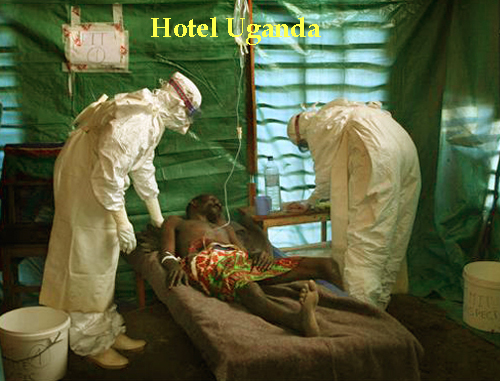
There is a reason that ebola has reached Kampala, and it’s the same reason I’ve recommended against visiting Uganda for a while: the dictatorial Ugandan government.

The first (and last) time that ebola (or what we thought might have been ebola) reached a metropolitan area was in Nairobi in 1980, which became the subject of the documentary book “Hot Zone.” But in 1980 the size of Africa’s city populations were much smaller. Transport around the area and even just within the cities themselves was nowhere near as easy as it is, today.

As the most infectious disease we know on earth, the Kampala outbreak may unfortunately be a story only just beginning.

All the neighboring countries have moved into full-scale alert. Kenya has put all its national hospitals on special alert and has dispatched health officers to all border crossings with protective Hazmat gear.

“All the necessary kit and medical supplies needed have been assembled and dispatched to health facilities in the bordering districts,” Rwanda’s New Times newspaper reported this morning.

The South Sudan government said it will “not take any chances“ with the disease and has mobilized its national health network.

This is the fourth outbreak of ebola in Uganda since 2000. This is the first time that an announced original outbreak was not contained. Whatever the reasons for not being able to contain it this time, the reason it reached Kampala so quickly from the far end of the country is because the government of Uganda lied about the outbreak.

Three days before 14 people hemorrhaged to death in Kampala’s Mulago hospital, the government denied there was an outbreak. Friday, the Associated Press quoted a Ugandan government official who dismissed the possibility of a widely reported ebola outbreak in Kibaale province “as merely a rumor.”

Two days before the outbreak appeared in Kampala, a local news source quoting government authorities reported that “The team deployed in Kibaale has indicated that the outbreak is now fully contained and no further spread is expected to take place.”

This misinformation is typical of Ugandan authorities.

London’s Daily Telegraph tells the story best. After an outbreak in a nonrural area of northwest Uganda 2-3 weeks ago, the government tried to keep a lid on the story. When they were unable to, they claimed the outbreak had been contained. The confusion contributed to panic in the hospitals in the region, which led to people fleeing the area.

The Ugandan government’s policies of lies and misinformation are now beginning to undermine the little health care infrastructure that exists in its rural areas. Several weeks ago Transparency International issued a damning indictment of the government’s failing health care policies in rural Uganda.

Ebola’s incubation period is 7-10 days. One of the ironic components of this most infective of all diseases is that it’s so deadly if contained it kills itself pretty quickly. So if health officials can actually contain the disease this story will be dead and over in 3 weeks.

Unless, of course, Ugandan officials try to hide it, again.

I’ve said for a while now that the increasingly oppressive regime in Uganda with its unstable politic and jittery society makes it an undesirable destination for tourists.

And now there’s lot more reasons not to visit.

Hot Migration Topic

Hot Migration Topic

Is it really such a burning issue: why are the wildebeest so late?

I’ve often experienced them crossing from Tanzania to Kenya even later, sometimes not until August. Normally, though, the herds cross the two river border that separates Tanzania from Kenya by mid- to late June, so we’re a month behind.

This year it’s stinging Kenya more than before.

Kenya’s tourism is reeling from terrorism and a rapidly inflating currency. So the few tourists coming to the Mara who are expressing disappointment is just another blow the Kenyans don’t need.

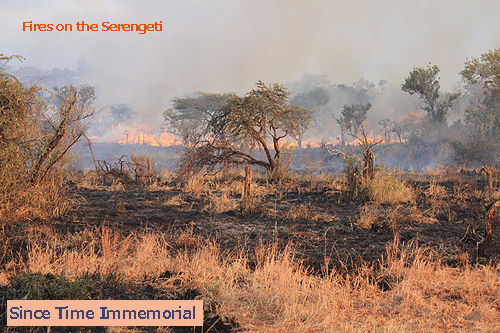
Looking anywhere for a reason their vacation has been diminished, there are a number of American tourists now blogging incorrectly that the reason the migration is late is because the Tanzanians are setting fires in the Serengeti which is disrupting the wildebeest from moving north.

And of course the general collection of end-of-the-world nuts have picked up this version of what’s happening.

They’re all wrong, but first let me explain where the less apocalyptic are coming from.

The wildebeest eat grass and nothing but grass. Their traditional migration patterns are based on where the grass grows when. It’s that simple. Historically the rain pattern traces a parabolic circle the north of which is Kenya’s Maasai Mara and the south of which is Tanzania’s Serengeti.

For more detail, click here.

The rainiest place in East Africa is Kenya’s Maasai Mara. When it’s dry everywhere else, it rains in the Mara, so the wildebeest go there. The Mara is higher and more rocky and has more acidic soil than in the Serengeti, and so the grass isn’t as nutritious. But at least it grows when it doesn’t grow in the Serengeti.

Separate from this rain dynamic that guides the migration is the age-old agricultural and wildlife management question about whether or not to burn grasses on a prairie.

A proponent of burning that I trust explains the necessity as the only way from keeping the prairie from turning into a forest. Most scientists agree with this explanation, but they also disagree that’s good. Most science suggests burning isn’t overall a good strategy for either agriculture (slash-and-burn) or wildlife management. In other words, it might be better to have a few more forests and a few less prairies.

The argument has been going on since Caesar.

Here’s a blogger that’s got it right.

Whichever side you choose, the fact all agree on is that the increased prairies in East Africa over the last half century is part of the reason that the wildebeest population has tripled. Another argument is over whether the current huge size of the wildebeest population is good or not, but certainly from a tourist point of view it is.

Both Kenya and Tanzania park rangers burn their grasslands. Come September and October when the rains return to parts of the Serengeti and the herds begin to leave Kenya, Kenyan rangers start furiously burning to delay their departure from there.

So both sides do it, and both sides argue they do it for scientific reasons, albeit there is a short-term benefit that does for a very short while delay the herds. Burning, as you may startle yourself from remembering 3rd grade science, produces water (moisture) which drops on the burned prairie and immediately sprouts new short grass even without rain.

Alas, a very tempting reason to stay and have another bite.

It was very unfortunate that an excellent Kenyan newspaper, Nairobi’s biggest, propagated the inaccurate story. It’s beneath the standard of the Daily Nation but even worse, suggesting the fires are being uniquely set as a blockage rather than just the normal half-century old grass burning strategy is totally irresponsible.

The greatest reason the herds are late is because the rains – like everywhere in the world – have been very unusual. I’m sitting in a place of a horrible drought. East Africa – northern Tanzania in particular – has had unusually heavy rains, and this has resulted in much more new late grass.

The migration isn’t so hard-wired that animals will leave a food source. Migrations worldwide are driven by food sources. We had an unusual warbler migration this year in the Midwest, because bugs – their food – appeared earlier than normal.

Burning is incidental to this, perhaps a short-term fix delay (a week, maybe two) but nothing more significant. Tourists who believe they can fine tune their “migration vacation” in periods of two-weeks are nuts.

Tanzanians blame Kenyans for everything wrong in Kenya, and Kenyans blame Tanzanians for everything wrong in Kenya. In this case there’s nothing wrong to begin with.

Except bad reporting and tourists who didn’t do their homework.

Live For Your Trip

Live For Your Trip

Here’s a sure fire way to kill yourself: plan your own trip to East Africa.

This is going to sound like the most self-serving blog ever, but I find little solace reporting about the 73 people killed last week when – once again – the ferry between Dar-es-Salaam and Zanzibar capsized.

The ferry is featured in Lonely Planet, in dozens of plan-yourself travel forums, and even in WikiTravel.

It’s pointless to write about the ferry, today, because I would simply be repeating what I wrote about a year ago when the same thing happened.

Do-it-yourself, plan-it-yourself travel to Africa has not quite developed to a safe enough point yet in most of East Africa, and the ferry is the best example. Forums like Lonely Planet are getting better to be sure, but they are also among those that sail right past the news of the day.

On July 8 jpinab entered the Thorn Tree Forum of Lonely Planet and asked for advice about traveling from Zanzibar to Arusha.

After several replies and backpostings, including two which I suspect were actually small local tour company stealthers from Dar, jpinab fortunately decided not to take the Zanzibar ferry.

But was there any discussion about how dangerous they are? About how unreliable they are? How of five ferries scheduled daily rarely 3 actually operate?

No, the discussion was governed by cost. And that’s the same that happens time and again if you move through these travel forums. The preponderance of activity is how to get a good price, and the presumption is that everything is possible at a good price.

That’s crazy. It’s also deadly.

South Africa and Europe are superb places to explore on your own, with forums of helpful individuals that I’ve only rarely found to be completely wrong.

If you’re savvy about forums, if you realize that most of the information from travelers who have been only once or twice to a destination is very limited and usually not true in any general way, then you’ll be careful enough to survey large numbers of remarks panning through a variety of seasons and types of people.

If you take the time to do all that, then I wager you have a pretty good chance of determining something good and safe by yourself.

But not yet in East Africa and the ferry is a good example.

The information I see from independent travelers in East Africa on these forums is saturated with inaccuracies. The most inaccurate of all is the discussion of the “great migration.” It amazes me how travelers who visit a place once in their lives suddenly are experts.

But the inaccuracies about the Zanzibar ferry defy my patience and understanding. I hope the four foreigners killed on the Zanzibar ferry last week didn’t use a travel forum to get there.

Traveling to the Mara in January to see the “migration” is a mistake that you’ll be able well to live with. That’s the point: Live.

Broken like Most Everything at VicFalls

Broken like Most Everything at VicFalls

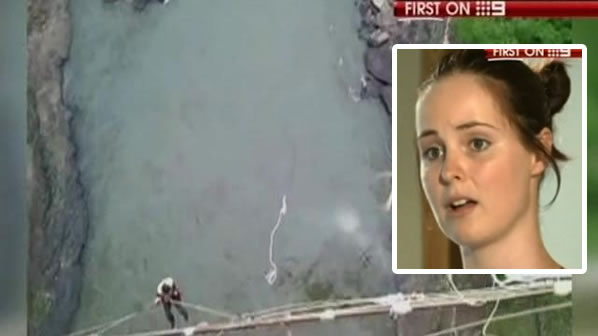
A young Australian tourist who miraculously survived her bungi chord snapping over Victoria Falls New Year’s Eve is back in a hospital in South Africa.

Her traveling companion took a video of the failed jump and it’s going viral on YouTube.

Her survival is miraculous. Remember, your feet are bound when taking the plunge, and she recounted at one point that this binding got caught on something at the bottom of the raging river, so that she had to swim under water to untangle herself.

The video ends showing many of her cuts and bruises. She was a day in a local hospital and then resumed her travels but has since been reported in a South African hospital with a possible collapsed lung.

I’m restraining myself from making too many assumptions about this, because it easily fits into a growing dysfunctionality in Zimbabwe and with all tourist interests that are associated with Zimbabwe. The company providing these services actually functions also as a wholly Zambian company, but its roots are distinctly Zimbabwean.

Unlike here, or where bungi jumping began “Down Under” there is no government regulation or oversight of significance at Victoria Falls. No certification of the operators, no examination of the equipment, no good review of rescue plans.

Discard the yellow journalistic claims that she plunged into a crocodile infested river, by the way. There are lots of crocs in the Zambezi. My 42k canoeing trip in 3 days passes upwards of a thousand, but not where she fell. Crocs don’t like raging rivers, and she fell into the river just after it tumbles off the falls.

We are further hampered by no good bungi jumping accident statistics. They’re likely pretty good. The operator’s contention that an accident is more likely “driving to the bridge” where the activity occurs than on the activity itself may be true.

But if my interest were principally bungi jumping, I wouldn’t do it at Victoria Falls, just as I wouldn’t rent a car there or book my canoe trip right now. And if my principal interest was seeing VicFalls and this came as a secondary interest, I’d suppress it. It’s a lot safer to look at than to look back.

Zambia’s not so bad at the moment, but Zimbabwe is a mess. VicFalls is shared by them both, and anything to do with the river in particular is a joint administration, and given the terror of today’s Zimbabwe, essentially no administration, no safety gauges and no safety assurances.

Right now? OK to look at. Terrifying to look back.

Tourism, Come Clean!

Tourism, Come Clean!

Yesterday was World Responsible Tourism Day, until yesterday in my view one of the greatest tourist scams in my lifetime. But finally yesterday, Cape Town authorities saved the concept from the dustbin. Nevertheless, tourists beware!

WTD began nearly 20 years ago with a mania by tourist companies to be labeled “ecotourism” companies. This was the buzz word. The concept was simple and appealing especially to those of us working in Africa and other wildernesses of the world: tourist service providers promised in no way to compromise the environment, and in better cases, to actually contribute to renewing it.

But with time and increased use of the world’s wildernesses, too many visitors disrupted cheetah hunts, too much trash significantly altered species survival, too many boots unhinged Inca ruins.

From the start it was nothing mroe than a self-serving goal and nowhere as evidently as in Africa. What was particularly offensive about the concept from the getgo was that we had no choice. If we wanted the industry to thrive, we had to preserve its attractions.

The purpose of “ecotourism” was to fool the consumer into thinking it was a strategy of choice not necessity. And it favored the little guys, and that was always a warm and cozy feeling. It was a lot easier for a single standing property to change its sewer system into something greener, than a large chain of established companies. And true to form, the smaller company would then tout its accomplishment mostly by pointing out the deficiencies in its competitors.

But there was no way for the consumer to undertake due diligence. Several organizations tried to become certification organizations, but it never materialized and was evident from the beginning that they were just self-serving organizations looking for a cause.

A number of reputable media companies – mostly international magazines – gave awards, but despite some highly credentialed judges nominees were either received from biased consumers or from the companies themselves.

There has never been and never will be a good way to check the veracity of what an “ecotourism” company claims it is.

Moreover, the cleaver that supposedly severs ecotourism companies from nonconformers just isn’t as neat as you might think. Just as smaller companies can reform their sewer systems faster, larger companies can produce more revenue and jobs faster: theoretically what successful ecotourism is supposed to achieve. This conundrum forces ideas into very specific and opposing sides; there isn’t a good compromise. If you’re for cleaner sewer systems, you’re against more jobs; if you’re for more jobs, you’re against cleaner sewer systems.

Greenies will argue otherwise, and their arguments may be cogent in a longer time view. But business is not wont to project too far into the future; in Africa we work on three-year rates of return. These arguments will be valid only when governments take specific action, essentially regulating and leveling the playing field. That hasn’t happened. There is no Tourism Protection Authority.

Recently the Peruvian government significantly increased tourist fees to its attractions like Machu-Picchu. The stated motive was to reduce tourism numbers to protect the sites of antiquity. But it’s not at all clear this is the true motive. Tourist numbers have been plummeting, train tracks have been covered in avalanches, and it could be that the world economy and global warming is the real advocate here.

And so, alas, ecotourism was on the wane well before the world recession. As early as 2004, hardly a decade after it became fashionable, science was documenting that much ecotourism was simple foolery, and in some cases outright counterproductive. Statistics began to show that ecotourism no longer had a marketing advantage. And that was good.

So by 2010 in a Yale University publication professor Geoffrey Wall simply and neatly explained that ecotourism was too hard to analyze, to soft to measure and basically that the concept was too deficient to be either realistic or useful.

I believe it was as ecotourism was losing stature that the next lofty concept was concocted: Community Based Tourism (CBT). The idea was that local communities that either legally owned or by proximity controlled areas of wilderness tourism should be manifestly involved, and that in their subsequent profit, they would become the best natural trustees of the environmental assets they controlled.

There is something terribly dishonest about this since behind the concept is the manifest need to vacate the ownership or legitimate control of any resource if the owners don’t act environmentally responsible. I think this is an interesting idea and well worth debate. But it was not presented as such, nor debated. It was a single-sided coin that always fell heads-up.

CBT in its best form was intended to convince owners to use their resource in a greener way. Thus Maasai herders would be influenced to build a lodge rather than a wheat farm. The great flaw in this best form was that tourism was never able to achieve the asset wealth that its alternative could. There are a couple exceptions, but in the vast vast majority, this was the case.

Ecotourism and CBT are empty, self-applying, self-rewarding concepts. In the real world, they can’t be evaluated, so they effectively can’t exist except in the minds of the scammers.

This doesn’t mean that to be green in anything – tourism included – isn’t noble and right. Or that to increasingly involve the locally community in projects that take place in their community isn’t a great idea for all parties involved.

What it means is that generally good ideas were hijacked and misshapen into supposed attributes that made one company theoretically better than another. And it worked at first. But with time, common sense prevailed.

There is one concept I feel is worthwhile that has emerged from this mess. “Fair Trading” is an United Nations concept that insists that a higher proportion of the revenues generated by a tourism service are retained by the local community and owners, as opposed to alien middlemen and distributors. This is refinement of CBT, a real metric applied to it.

Unfortunately, it has gained neither the traction nor recognition that ecotourism or CBT did in the beginning. That’s probably because it sounds too much like them.

But it’s definitely something you tourists should consider and ask about.

And that was the one good thing about “World Responsible Tourism Day.” It used the right words. And the Cape Town authorities were asked to usher it onto the world stage in London yesterday, where thank god at last, “ecotourism” and “community based tourism” were replaced by the simple, more general, more honest, good-feeling term, “Responsible.” Right on, Cape Town.

War : Week 3

War : Week 3

It’s clear that a major battle is brewing, but it isn’t at all clear who is going to win. America is worried. Kenyans are growing increasingly anxious. More deaths, including tourists.

The Thursday afternoon killing of a safari vehicle driver in the Shaba Reserve, and the wounding of a Swiss tourist inside, has no clear motive. There is no clear evidence that it is linked to any retribution from those Kenya is fighting in neighboring Somalia.

The safari vehicle was on a routine game drive and was returning to the lodge when several gunmen opened fire. The driver accelerated the vehicle but there was a second batch of gunmen waiting and they pummeled the vehicle with additional gunfire.

The driver was killed, the vehicle rolled over, one tourist was hit by a bullet and one was uninjured. Kenyan Wildlife Service agents at Archer’s Post were first on the scene.

Nevertheless this is exactly the area that I warned was unsafe only a a month ago. Whether these were bandits or ideologue militias doesn’t really matter. Kenya’s rule of law is falling apart as all its resources are funneled to the conflict in Somalia.

Go back and read the hostile comments I suppose understandably left by Kenyans who read that article. But wouldn’t it have now been much better if all had taken heed, and the tourist was now not dead?

Definite links have been established, however, with additional kidnappings around the border area of foreign aid workers, and of a grenade attack on a church in Garissa, a major town not far from the Somali border.

Meanwhile, the Kenyan offensive seems stalled. This is my view, not the view expressed by the Kenyan military, which claims to be on track in its liberation of Kismayo.

The army, though, has not yet even taken Afmadow, a northern town distraction that Kenyans learned was being fortified by al-Shabaab militias, and which they announced they would first have to pacify before continuing the progress towards Kismayo.

In the course of last week, French fired from naval vessels into Kismayo and America launched drone attacks from a base in Ethiopia. Kenya claimed a number of small skirmish victories, but its army does not seem to be moving.

This could be because of new reports of how heavily fortified Kismayo has become. During an African leaders conference last week, Prime Minister Raila Odinga literally pleaded with the west for more assistance.

Meanwhile Kenyan society is growing increasingly anxious with the war.

“The worst case scenario,” writes blogger Abdi Sheikh, is that Kenya gets deeply embroiled in the “conflict for years and disenfranchise both Kenyan Somalis and Somali refugees living in Kenya.”

“Any major mistake will bring the conflict into Kenya,” he goes on, and “may also stir xenophobia against Somalis living in Kenya.”

That may already have happened. Additional police are seen regularly in the densely populated Somali suburb of Eastleigh in Nairobi. New government policies demanding Kenyan Somalis disarm themselves are likely only going to inflame the situation.

Several newspapers reprinted old publications of WikiLeaks documents of American embassy dispatches detailing al-Shabaab recruiting within Kenya.

One thing everyone seems to agree on, which I don’t think is quite as evident as presumed is that “Kenya has taken an action that is irreversible” (Abdi Sheikh). “It has sparked a war with a shadowy group that has no clear frontline. This means those responsible for military action must think carefully not to create new enemies or inflame the conflict further.”

And yet if it isn’t reversible, it may be doomed. Sheikh reminds us, “There has been no foreign military invasion that has ever been successful in Somalia.”

A Sacrifice So Far Far Away

A Sacrifice So Far Far Away

From far, far away, Kenya is being sacrificed to quell the war on terror. A young and dynamic, growing country with a tremendous future has been thrown to the wolves.

The war in Somalia is not going well for Kenya. The army advance is bogged down, more aid workers and civilians have been kidnaped or killed and many more injured near the front and by two grenade attacks in Nairobi city. The shilling is tanking and local prices are skyrocketing.

But it may be going well for America. Depending on your point of view, of course.

“Several of the missiles fired at jihadist fighters … on the Somali side of the border seem to have been fired from American drones or submarines,” the respected magazine, the Economist reports.

I want to stop al-Qaeda’s terrorism, who doesn’t? But fighting these endless proxy wars is inhumane. Go ahead, fire the drones, but don’t make Kenya the sacrificial lamb.

From the Kenyan border to the stated objective, the coastal city of Kismayo, the path using existing roads and tracks is about 150 miles. After 40 miles, the Kenyan military got bogged down in mud following heavy rains.

Fighting to that point was minimal. Skirmishes by al-Shabaab supporters and guerillas resulted in random and rapid firing by Kenyan troops. At the crossroads of Bilis Qoqani, 45 rebels ambushed the convoy and in the ensuing battle, the first real encounter between Kenya and al-Shabaab, the militants were routed, 9 killed and several Kenyans wounded.

At that point it was learned that an unexpectedly well organized al-Shabaab force was digging in at the city of Afmadow. This is actually north of the planned assault and now means the Kenyans have to confront the militants there or risk being attacked from their flank if they proceed directly to Kismayo.

So while today they are only about 85 miles from their objective, it looks like they must head north for the great battle at Afmadow, first.

And back at home, things couldn’t be worse for the everyday Kenyan. The city’s main newspaper calls it a “Nightmare.”

The world is surprisingly learning that a significant portion of the prewar Kenyan economy was linked to the port at Kismayo that the Kenyan military is now trying to take over.

“Supplies such as sugar, rice, cooking fat and powdered milk” and “even electronic goods and vehicles” come from Kismayo, even though it is controlled by al-Shabaab. Sugar in Kenya’s northeast today costs four times more than two weeks ago.

In the center of the country in Nairobi, the concern is not so much with sugar as shillings. A year ago the shilling traded at about 65-70 for one U.S. dollar. Today it returned to just under 100 after peaking yesterday at 106.

The median interest on a business loan shot up to 20% today, after the government’s request for a $65 million loan from the IMF was answered with only $25 million.

Tourism is being decimated. If everything ends well and Kenya is the super hero, tourism will rebound rather quickly. But that doesn’t look likely to me. I think we’re in a very long period of declining tourism.

More and more Kenyans are beginning to question the war, as I believe they should. “Let Us Rethink Our Somali Intervention” was the lead editorial in today’s Nairobi Star newspaper.

We all want al-Qaeda’s ruthlessness to stop, most of all Kenyans who have lived with it day in and day out for much of their lives. But violent eradication of an entrenched fighting force is not something Kenya can accomplish. If we as Americans have accomplished it in Iraq (which is very uncertain) look at the effort it took. Kenya cannot undertake that.

Obama knows that. Hillary knows that. But their allegiance is to their home. The sacrificial lamb comes from far, far away.

Chant of the Impatient & Vanquished

Chant of the Impatient & Vanquished

Within a week we’ll know whether the Kenyan invasion of Somalia is the true beginning of the end of al-Qaeda or the start of increased instability and terrorism in Kenya. I’m pretty pessimistic and damn mad. But the outcome of the battle of Kismayo will tell all.

Kismayo is a city. A functioning, wealth-producing large coastal city with a proud university and clean streets. It’s the defacto capital of al-Qaeda in The Horn, the center for terrorist planning, administration and growth.

It’s the only true geopolitical epicenter of terrorists in the world. In Kismayo terrorism leaders don’t hide in caves. They go to work in offices. They collect taxes. They use big computers to concoct strategy, to build internet sites, to train young militants in actual schools, to organize and implement arms deals. This isn’t Wajiristan.

And until this moment, Kismayo was untouchable. Since Sunday, planes have bombed the city. Sea-launched missiles hit the city center. The Kenya military is marching towards Kismayo.

Kenya’s major newspaper called the expected encounter “The Mother of All Battles.” Western terrorist experts see it as a “high stakes game for Kenya.”

There is remarkable calm in Kenya. In fact, it’s absolutely ridiculous! The rest of the region and much of the world is overwhelmed by news from the front, including the first two Nairobi city bombings as al-Shabaab begins its guerilla war inside Kenya. But one reading the Kenyan newspapers today has a hard time finding any war reports at all!

The country is in denial. The diaspora is in denial. Even if the battle is successful, the effort is likely to bankrupt the country. Tourism is doomed for the forseeable future. Even political stability, so creatively accomplished for the last four years, shows the first stages of unraveling.

I hate making this prediction, and I really want to be proved wrong. But Operation “Linda Nchi” will fail. It will likely fail the same way Ethiopia failed five years ago when western powers propped up its invasion of Mogadishu the same way they are currently propping up Kenya’s of Kismayo.

Ethiopia – with a far more sophisticated army than Kenya’s – marched into Mogadishu and installed a very weak government then rapidly returned home leaving behind a mess that was supposed to be cleaned up by 8-9000 non-Ethiopian African Union soldiers in a few months. It’s been three years. It’s still a mess.

Even though Kenya’s military is far less sophisticated than Ethiopia’s, I think this is the likely outcome, because terrorists survive by running away, never by making a stand. Their success comes in suicide and car bombs, subway attacks and shoe bombers. They don’t do tanks well.

The west seems to think that we’ve got al-Qaeda on the run. It’s true that an arm’s length list of al-Qaeda leaders have been wiped out by American drones and stealth attacks by the Obama administration. The question is, is it enough that Operation “Linda Nchi” is the nail in the coffin, or just the positioning of another sacrificial lamb.

If the latter, Kenya will become rocked by terrorism for years and years. Unless it becomes the horribly ruthless, dictatorial regime of Ethiopia where you need permission to sneeze on the streets of Addis Ababa.

Kenya doesn’t understand — which America maybe finally does – that a ground war against terrorism won’t work.

Defense against terrorism is critical and can be successful. Diplomacy and sanctions against terrorists works. Stealth raids and maybe even drones to kill terrorists might even work, but war doesn’t work. Kenya was managing all of these things masterfully! Until last week.

My friends in tourism in Nairobi are near panic. Bookings are canceling in the droves. And no one in their right mind would suggest a foreign vacationer visit the country, now.

This is so damn sad. For so long Kenya tread the perfect balance with regards to its chaotic terrorist neighbor, Somalia. It refused to join African peacekeepers in Somalia. It tolerated but repelled incessant incursions into its Somalia border towns. And it quietly assisted the big guys by rounding up terrorists on its own soil.

But then the Somalia famine quadrupled the size of the refugee camp in Kenya at Dadaab to a third of a million people, in less than three months; the world economic collapse bludgeoned the shilling, and finally the spat of kidnapings was just too much for this until now adroit and up-and-coming new world to take.

“We had to do something.”

The chant of the impatient and vanquished.

No War Games on Safari

No War Games on Safari

Today Kenya invaded Somalia. The speed and size of the mission surprised me and I’m sure greatly pleased Leon Panetta. It’s hard to predict the outcome, but one thing strikes me as certain: this is not a time to take a Kenyan safari.

Most news sources reported the Kenyan military operation as a response to a spat of recent kidnapings, and I don’t doubt this has something to do with it. But it could also be a partial excuse for a more globally organized effort against what appears at the moment to be a successful rout of al-Shabaab from Somalia.

The size of the Kenyan excursion is secret, but there were enough eye witness reports on the ground to confirm a major operation. The BBC and AlJazeera (who has a reporter embedded with the Kenyan forces) reported “lines of Kenyan tanks and trucks” and multiple air strikes against an al-Shabaab base about 75 miles inside Somali territory.

The local Nairobi newspaper The Nation reported at least 32 trucks and tanks and London’s Guardian newspaper reported multiple aircraft bombing al-Shabaab positions to the east.

Africa Union forces led by Ugandan soldiers in the last several weeks have routed al-Shabaab from the Somali capital of Mogadishu. The BBC reporter Will Ross said these forces were now working in tandem with the Kenyans, moving south from the capital towards the conflict area where the Kenyans are, headed to what could be a pincer action to rid a large portion of Somali of al-Shabaab.

Last week the Obama administration sent 100 Green Berets into Uganda for deployment further west into central Africa. The statement of deployment claimed a mission totally separate from this conflict, but last night on CBS Panetta said the operation was integrated with fighting terror in Africa.

With Obama’s long list of al-Qaeda captures and kills recently, we know that the al-Qaeda/al-Shabaab power has been significantly diminished. Is this their last hurrah? Might the Ugandans, Kenyans and Americans actually be getting rid of these terrorist organizations?

I wish I felt the answer was a definitive yes, but frankly I think rather it’s a hopeful maybe. I’m no expert historian, but I just don’t see ridding any part of the world of anything, unless the people actually living there do it themselves.

And the Somalis haven’t. The parallels with Afghanistan and even Iraq are substantial. I don’t even believe that Iraq will be stable in ten years. And if I’m wrong and it is, then the question becomes was it worth the 20 years of war and investment we made to make it so?

That’s the greater, global question. But for those of us much closer to the situation, our lives and our businesses are immediately effected. Tourism must go on hold in Kenya, now, until we see what happens.

It’s been widely reported that al-Shabaab has now threatened Kenya. Last year al-Shabaab killed more than 70 people in two simultaneous bomb blasts in Kampala sports bars where patrons were watching the World Cup. They specifically threatened such before it happened because of Uganda’s lead role in the African Union forces in Mogadishu, and immediately then took responsibility. The parallel with Kenya can’t be starker.

I don’t think it will happen in Kenya. I think al-Shabaab is too much of a spent force and now too engaged outside Kenya. And Kenyan security is better than Uganda’s. So my visceral concern for my own Kenyan employees and friends is minimal.

But you don’t take a vacation where you have to keep looking over your shoulder. That’s not what a good safari is supposed to be. So while I’m not expecting trouble, the chance is more real than before, and equal if not better alternatives are available elsewhere, particularly in Tanzania.

Until the battles end and the dust settles, Kenya has become too troubled a place for tourists.