Your Box or Your Trip?

Your Box or Your Trip?

The weekend terrorist alerts issued for Europe are the most extensive and serious in history. What should we do? Personally, nothing.

The best intelligence suggests a coordinated terrorist attack is currently playing itself out, right now. The media is reporting that the plans include something akin to the 2008 Mumbai slaughter where pretty good suicide gunmen fanned out across a city center shooting madly, throwing incendiary bombs.

It’s a race between implementation and prevention. But it’s not easy anywhere in Europe, any more, to pack a weapon and go into a populated area. It’s not even easy to get a weapon, or ammunition… as it is in the U.S.

Alerting travelers and residents alike, there will be more eyes and ears to report unsavory activity. It will increase the chances that nothing will happen.

But shouldn’t I advise you to “just wait a while?” Let things cool down? Sure I could, and so could the terrorists wait a while. (Or following a dreaded success, they could claim another is imminent.)

Don’t exaggerate our own government’s announcement. It’s an alert, not a warning. Were it a warning, I might argue differently.

The risk of being hurt by terrorists in Europe, now, is worth the risk of any travel you have arranged. It’s time for the frequent reminder of the threats you and your children face crossing busy city streets, driving on an interstate, or injuring yourself while playing sports.

All of these are greater than you being hurt soon by terrorists in Europe. God forbid, even if it happens, as car wrecks happen every minute. There’s not the slightest indication, for example, that the target relates to travel or airports, any more than it does to pubs or hotels or hospitals or malls. All that we might surmise is that it is planned for areas with lots of people.

The counter I often hear is that crossing the street, driving, working out, are all essential to your daily lives, but that vacation travel isn’t.

We can just stay home, the argument goes. We don’t have to travel.

For those of us fortunate to have the means to travel, we probably also have nice homes and comfortable life styles that to many may now seem a safer alternative. Five hundred cable channels and sixty types of potatoes chips with three nearby pizza delivery services. And as soon as we nuke all the deer in our city parks, we won’t have to worry about tick fever, either.

It’s precisely because Americans have so insulated themselves from the outside world that we started the wars in my life time that I believe have led to the current level of terrorism. We’ve painted ourselves into a corner, and it’s a very tiny, self-contained corner.

About a third of all American travel is to Europe. Nearly a third of that is by Americans who will never travel anywhere else except on a cruise.

Please, enjoy Europe, now. A life in a box isn’t worth living.
Safaris are getting expensive!

Safaris are getting expensive!

Will increasing safari costs scare away new visitors?
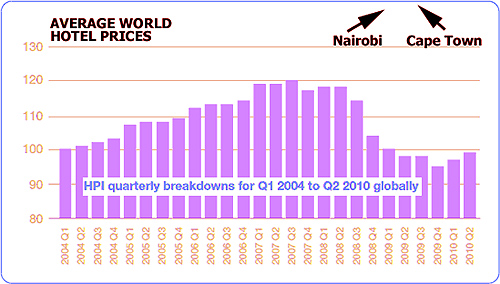
As if you didn’t already know, it’s official! This year Africa (Cape Town and Nairobi in particular) saw the highest hotel price increases in the world!

Last week the HPI Index was released by the UK company, Hotels.com. Their biannual report is one of the most accurate and heavily used in the industry.

Of the 15,750 locations surveyed, the Number One city with greatest increase in cost from last year to this was Cape Town (54%), the second was Shanghai, and the third was Nairobi (31%)!

What is even more telling is that both Cape Town and Nairobi are inching their way up into the top ten most expensive hotels in the world. Right now, Geneva holds that rank ($232), but Nairobi is $216 and Cape Town $180.

Overall, world prices have recovered only to where they were in 2004. They peaked in the third quarter of 2007, at that time 20% higher than 2004. World-wide, therefore, prices remain depressed by about 18% from before the economic downturn.

But not African cities! Why?

Cape Town’s answer is simple: the World Cup. Nairobi’s answer is more complicated but is basically two-fold: China and political stability.

China is investing so incredibly heavily in Kenya that it’s pushing up all prices related to visiting one of Kenya’s principal cities (Nairobi or Mombasa). You can’t build a road or drill an oil well without thousands often tens of thousands of builders and consultants that need a place to stay.

And a close second is the marvelous turnaround Kenya has pulled off in the political arena: a new constitution is in place. The city has attracted some of the world’s most prestigious world conferences as result, with tens of thousands of delegates.

This incredible spike in prices in these two African cities has elevated safari prices in the bush, but that seems counterproductive to me. Because occupancies in the bush are falling, after a short surge in 2009. Nevertheless, most properties in the bush have their offices if not sister properties in the city, and the effect was unstoppable.

My prediction isn’t rocket science. I think Cape Town will slip (there isn’t another World Cup coming into town) and Nairobi will stabilize but continue its slow growth upwards.

As for safari prices, I think they will start to disentangle themselves from the anomalies in their cities. 2011 will be a good year for safari vendors, but not as good as 2010, so I think we’ll start to see an end to increases if not actual drops in prices by the end of 2010.

For those of you thinking of going on safari, though, I’m not sure you’ll notice anything. In fact, American resellers increased their costs three or four times greater than the hotels in 2009. This is because they had so heavily discounted them during the economic downturn.

So for the end-consumer, I predict prices will remain the same. What we may see, though, is a return to the great last-minute deals that characterized 2008 and 2009. These were often restricted to same company safaris or very specific lengths of stay, but if you could tolerate the lack of flexibility, it often meant savings of up to a third.

These were heavily booked especially by veteran safari travelers, visitors who had already been introduced to the safari world and knew what they liked and didn’t. So if you’re one of those, and capable of going within a month or two of an announced deal, keep that computer internet engine fired up!

Friends Traveling with Friends

Friends Traveling with Friends

An unusual short Saturday blog, just a bit off topic. But yesterday I began to wonder if friends traveling with friends is everything it’s cut out to be.

For African tourism it seems absolutely essential to our survival! In fact, the idea of a “family trip” – now propagated throughout the industry – began in the 1970s with “family safaris.”

But yesterday as I was invited to a presentation at a local service organization of an African safari that one of the members took, I happened to have the most dissimulating thoughts.

Don’t we enjoy vacations in part because we can “get away?” And doesn’t “get away” mean from everything normal, all our normal responsibilities and social chores? Surely “getting away” doesn’t mean eating every single meal at the same table with someone important to your board or next fund raiser.

Or bringing along the kids that you had to kick out of bed for school and reprimand after their first drunk!

Or, for that matter, making sure that Mom or Dad eats a good enough breakfast.

This sounds heartless! It is! Personally, being a bonafide tour guide, there’s no vacation I can think of where I wouldn’t want my friends and family.

But not everyone is like that. Yesterday, I stood next to one of the nicest persons I’ve ever met, who with me was watching this wonderful presentation of a safari, in a packed room where we were just onlookers like everyone else.

And I remembered how “responsible” she had been during the trip to the group of friends she had organized. And I began to ask myself, Was that fair? Did she have any time at all to relax and absorb the wonder?

Saturday morning thoughts. Good with a strong cup of Kenyan tea.

Steel for Anemones

Steel for Anemones

No more Lamu.
Yesterday the Kenyan government invited you to replace the heavenly treasure of Lamu Island with Africa’s largest port.

Lamu, an ancient Arab kingdom and now a quaint beach retreat on the north Kenyan coast will become Africa’s second largest port in less than ten years, and shortly after that, its largest.

The half dozen paradise islands, the nearly two thousand years of quiet peace, the cars-prohibited stone streets, the sweet halva whose recipes have been passed down for generations, the white sands and azure seas will be replaced by supertankers and deep-water berths.

Oil.

Where oh where is cold fusion?

In order to get your piece of the $16 billion Chinese building fund, you have until October 15 to submit bids for:
– dredging 60 miles of coral reefs;
– plowing away several hundred miles of gorgeous sand dunes; and
– staking out the 1,000-acre port facility.

You can then submit bids for:
– surveying 800 miles of high speed rail from Manda Bay on the mainland opposite Lamu Island to Addis Ababa, Ethiopia, to Juba in the southern Sudan;

or, if you’d rather:
– help with Africa’s largest and longest steel pipeline from the oil fields of The Sudan to Lamu.

Any way you look at it, there’s probably a job in it for your nephew.

Those of us who have watched with wonder the highways being pasted down on our sleepy Africa over only the last few years have little doubt this will happen.

We also watch from afar – not far away in distance, but in memory already drowning in nostalgia.

We can’t stop this and shouldn’t. The government white paper Mr Cyrus Njiru, transport permanent secretary, presented last spring is no longer being scoffed at. There are real and live economists in the world who believe the development transforming Kenya will create Africa’s largest middle class in less than two decades.

Right now there is only one deep water port in all of the east side of this huge continent at Durban, South Africa. The three berths scheduled to come on line by 2020 in Lamu will place it second to Durban’s eight. But ten years later (2030), Lamu will grow from 3 berths to 16!

This is not just the mission statement of a not-for-profit that wants to end polio among bonobo. This is the life story of the Chinese, the society quickly becoming the biggest and richest on earth, but a society with little oil of its own.

It’s a race between Chinese consumption and laying pipe, concrete and rail through the deserts and war zones of Africa. And that’s a story in itself, because it might be the first time anyone’s done something that might really bring peace to this war ragged area.

Can you imagine ExxonMobile or preboom BP planning a project of such historic dimensions in Iraq or Afghanistan? Of course, not! In fact, they refused.

This area is probably much worse than Afghanistan or Iraq. The pipeline and edges of the highway will skirt into territory currently held by Al-Shabaab (Al Qaeda in Somalia). The pipeline will transect the oil fields that have contributed to more than a million deaths, many of them child soldiers, in The Sudan.

But the Chinese can’t say, I’m not sure this is safe enough. This is where they’ve found oil and where they control the rights.

I know this will happen. And I hope it brings peace. The Chinese – unlike the moralists in the west – can care less if women are stoned to death for burning the toast or ancient monuments are used to fill potholes. I’m not saying this offers a rosy picture of our next world society; it’s just the facts, ma’am. Chinese are the world’s ace capitalists.

They need oil. Fast.

Kenya’s figured that out and knows how to deliver.

For a price, of course. The price of prosperity. Less infant mortality for a few miles of paradisiacal coastline. Modern agricultural machinery to grow hybrid corn. Fiber optic cable to create Africa’s Bangalore.

Steel for anemones.

There will still be many wondrous places on the Kenyan coast. Just not Lamu, anymore.

Kenya’s Biggest Party Ever!

Kenya’s Biggest Party Ever!

The joy, exuberance and incredible hope spawned by last week’s election victories in Kenya is absolutely amazing! Get ready for the biggest party ever in Kenya!

The last few years have brought social and political transformations around the world but you would be hard pressed to find a more radical one than in Kenya.

Those who visited Kenya only five years ago would not recognize it, today.

There are 12-lane highways, potable water in some cities, the world’s largest tea-export industry and … peace and prosperity.

Something’s wrong, right?

No. Friday the nation of Kenya holds its biggest party in history: A party to celebrate the overwhelming victory of the election for a new constitution.

Kenya’s long struggle with the exogenous microbes of post-colonialism is, by this self styled official clarion announcement, OVER.

I’m taking some risk here, but I’ve earned the right. I lived on the Kenyan border during Idi Amin’s terrors, I had to tell Purdue Alumni that we couldn’t go as planned into Tanzania when the short war with Tanzania erupted in 1977, I had clients locked down in the Stanley when the 11-hour coup of 1982 was zapping bullets around the nearby Hilton, I heard the embassy bombing in 1998, I snuck in and out to get all clients out of Kenya after the horrible post-election violence of 2007…

And scores of smaller things like being in Kenyan jails and bribing officials to get into or out of the country.

Is this really, really over?

Well, yes, actually I think it might be. Global terrorism won’t go away: it’s closer to Kenya than anywhere: al-Qaeda lives next door in Somalia. But this is a part of every person’s life, no matter where you are in the world except maybe Antarctica.

And I think that we, as Americans, can enjoy a tiny part of the credit. It wasn’t so much a sea-change in American foreign policy, but it was a definite change under President Obama that gave a lot of money (which led to this burst of prosperity) and lot of transparent counsel to the crippled nation of Kenya trying to rebuild itself after the last failed election.

Click here for the VOA take on the election’s meanings.

In a “Gazette Notice” released today, the Kenyan Government published the final results of the August 4 election: 6,092,593 Kenyans voted YES and 2,795,059 people vote NO. The YES’ had it nearly 70/30.

And on Saturday, one of Kenya’s largest polling organizations, Infotrack Harris, said that 91 percent of Kenyans are satisfied with the results.

The poll shows the level of satisfaction very high across the entire country, including in the Rift Valley Province where a majority voted against the proposed law.

Infotrack Chief Executive Officer Angela Ambitho said, “88 percent of those in Rift Valley are actually satisfied with the outcome of the referendum. You actually see less satisfaction in Coast and Central and that may just be due to the fact that they anticipated that the speed with which implementation would take place would be faster.”

Wow. Peace and prosperity can never come fast enough.

There were losers; there are always losers, and frankly, I’m really glad these are the identified losers:

(1) William Ruto & Thugs
This is the current Minister for Education who led the “NO” campaign and who everyone knows is soon to be indicted by The Hague for inciting the election violence of 2007.

(2) Churches
Kenya is an incredibly religious country as African countries go, and until now, I’ve felt that was more a good thing than a bad thing. But this time around the churches were near united in their opposition to two (of hundreds) of constitutional articles.

One “might” allow for legal abortions and the other creates some civil courts for very restricted litigation based on Islamic law.

I’ve written about this before, so won’t repeat the necessarily complex details, but suffice it to be said that I take the August 4 outcome as a near unbelievable boundary between what modern Kenyans feel is the division between church and state.

It does not mean that Kenyans aren’t as religious as they always have been. It just means that they’re modern citizens who have a lot more tolerance for one another than we do in our own country. If only we could master that here in the USA.

(3) The American Right
Did you read that, Right right? Yes, you did. The American Right poured in hundreds of thousands of dollars to defeat the referendum. Righties in Congress even threatened the Obama Administration with legislation to inhibit our assistance with the election.

I’ve written about this, too, so won’t rehash here, but this is one of the most exciting outcomes for me personally as a liberal American who loves Kenya.

Any chance this presages our own November elections?

I really think this is fundamentally new page not only in Kenyan history, but possibly in all of Africa’s arduous history in the last half century.

No, I don’t like Nairobi’s traffic and the pollution is increasing. Its treasured wilderness is threatened like never before. But guess what? Rational people are in control.

Global Warming Hits Safaris

Global Warming Hits Safaris

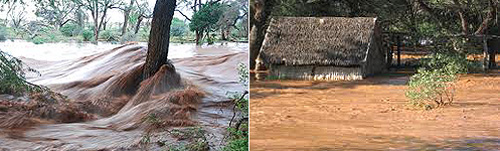
The Samburu River washed away every single camp in March.
A year ago we were waiting anxiously for the droughts across Africa to subside. Today the place is flooded.

Extreme climate is nothing new to Africa. But I’m ready to call it a reflection of global warming. And I think it should govern all plans for future safari travel.

I’m writing this as Pakistan is floating away. Siberia almost burned away. Half the farm stock in northern Kenya was killed by a drought two years ago that was followed by another decimation from floods this year.

I just came back from a safari in Uganda and Rwanda. The Ishasha River, which demarcates some of the border between Uganda and The Congo, ripped away part of our camp.

Lake Albert, where we found the prized Shoebill Stork, is being clogged by hyacinths and other aggressive water plants. This is a factor of increasing temperatures.

I reported that the great migration entered Kenya from Tanzania on June 18. It’s gone back! To and fro migration movements are not uncommon, but the unanimity of the herd movement this year definitely is. Unnatural rains in northern Tanzania have been so heavy that the better grasses are now found there, rather than the Mara.

The equatorial regions of Africa encompass some of the most complex weather systems in the world. There are jet streams racing southeast, while others race north, and huge monsoons that shift several times a year.

Stick up a few obstacles like Kilimanjaro, and a few wet places like Lake Victoria, and you have climate chaos. The result is a high altitude wind maelstrom over the equator.

So what to do when planning your safari?

Well, first, recognize that climate data built from years of statistics is no longer as good a prediction for your safari as it was a decade ago. Then:

(1) Avoid river camps.
(2) Consider more comprehensive insurance. There is now insurance that will cover you for “any reason” that you cancel. It’s expensive, but not as expensive as finding out your camp no longer exists!
(3) Do more, rather than less. Yes, that’s right and it sounds strange, but the trend to date has been to slow down the pace of your safari to more comprehensively enjoy a certain area. Well, what if that area is parched to dust?
(4) Go during the margins of seasons, when the seasons are changing. In East Africa, that’s the end of March, the first of June and mid-December. Weather always seems to calm down when a seasonal change begins.

I’ve been reading lately a number of blogs and reports about how global warming might actually be a boon to safari travel:

All in all it’s wetter rather than drier. Even during the horrible mini-drought in East Africa that ended last year, there were great safari places like the Mara that were near normal.

More water means more grass. More grass means more animals.

Hotter temperatures means more bird nesting. In fact, we’ve begun to notice some migrant species which are now remaining in East Africa year round.

Don’t take the above to mean that I don’t think we should aggressively tackle global warming and try to stop it. I do! Every day in Africa I see the devastation and uncertainty in people’s lives and in the fickle mischief that effects the wild.

But your planning of safaris is likely to come sooner than the world’s tackling of global warming!

Impenetrable Rides

Impenetrable Rides

Sarah Taylor at the Bakorwe Community Group.
Particularly in Uganda where charter flying remains in its infancy, a comprehensive safari has to include long drives. Today we traveled from Ishasha to Bwindi.

Forget about asking me how many kilometers we had to travel; that’s useless. Consider that Alex calculated that for much of our safari from today on we were averaging 18k per hour.

So we left Ishasha in two different groups: Steve led four people who wanted still another game drive, and boy what a wonderful decision that was. They saw 8 lion, and together with the three we saw the day before, this has to be a record for Ishasha.

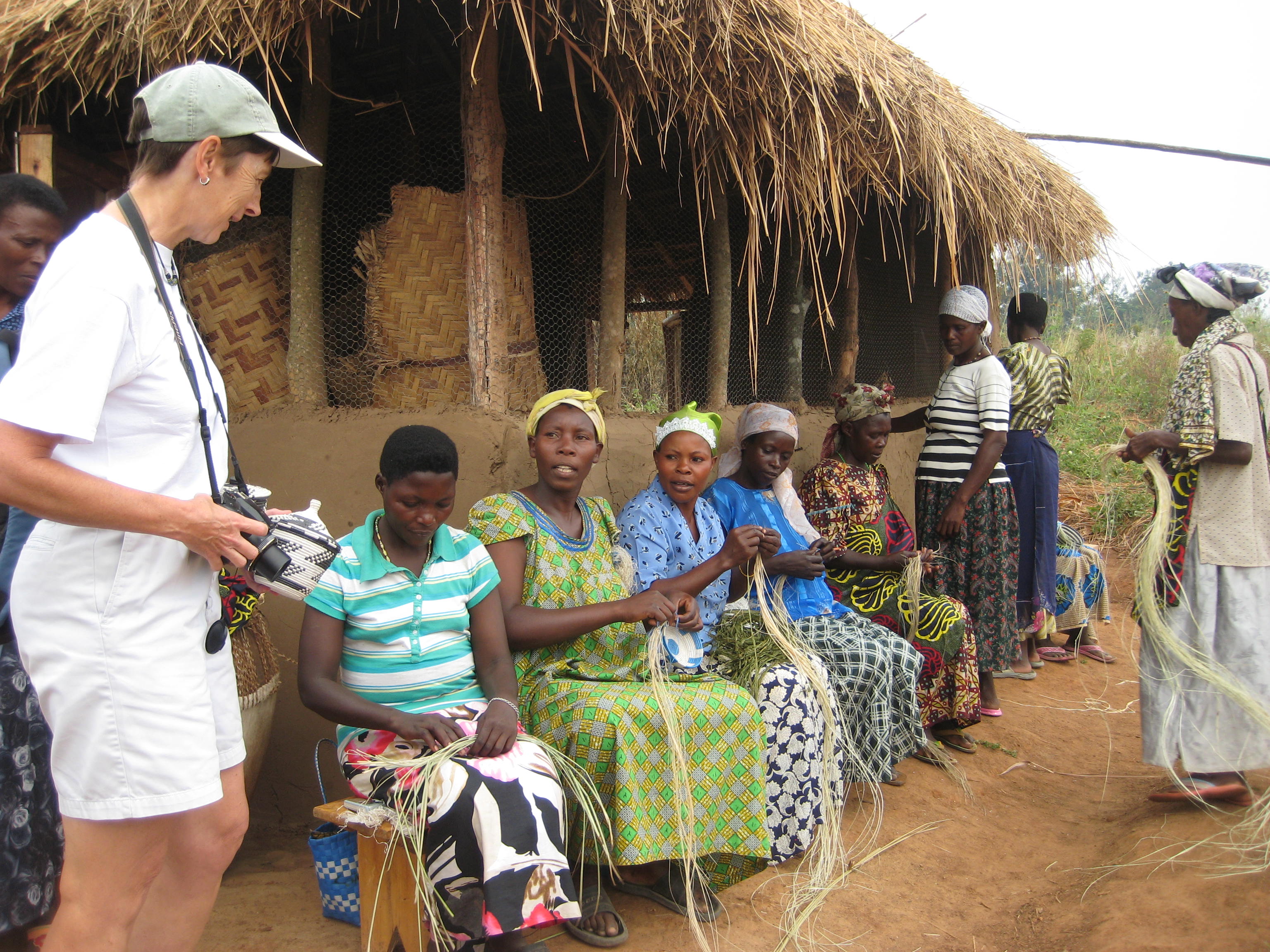
The rest of us left before Steve and crew returned from the game drive. Sarah had discovered a community cooperative that would give a tour of the contemporary village. It took us about an hour to weave through the last of the park to the village.

Bakorwe is located right on the border with Queen Elizabeth National Park (QENP). In fact, a part of the tour is the inspection of the “elephant trench.” This 10k trench, dug 2 meters deep and 3 meters wide, was intended to keep elephant and other wild beasts out of the village.

In the past I’ve written about a number of other attempts in East Africa to protect farms and villages from the growing elephant population, but I actually think based on Bakorwe’s record, this might be the best.

Of course it takes enormous man power, but it seems that once dug, it was remain in tact through terrible rainy seasons for at least three years without too much maintenance.

Our guide, Barnard, was a self-taught man who enjoyed the title of Community Liaison Officer and earned every bit of it. His English was impeccable. He grew up in the village, had to leave school when both his mother and father died so that he could care for his siblings, and was now the spokesman for the village.

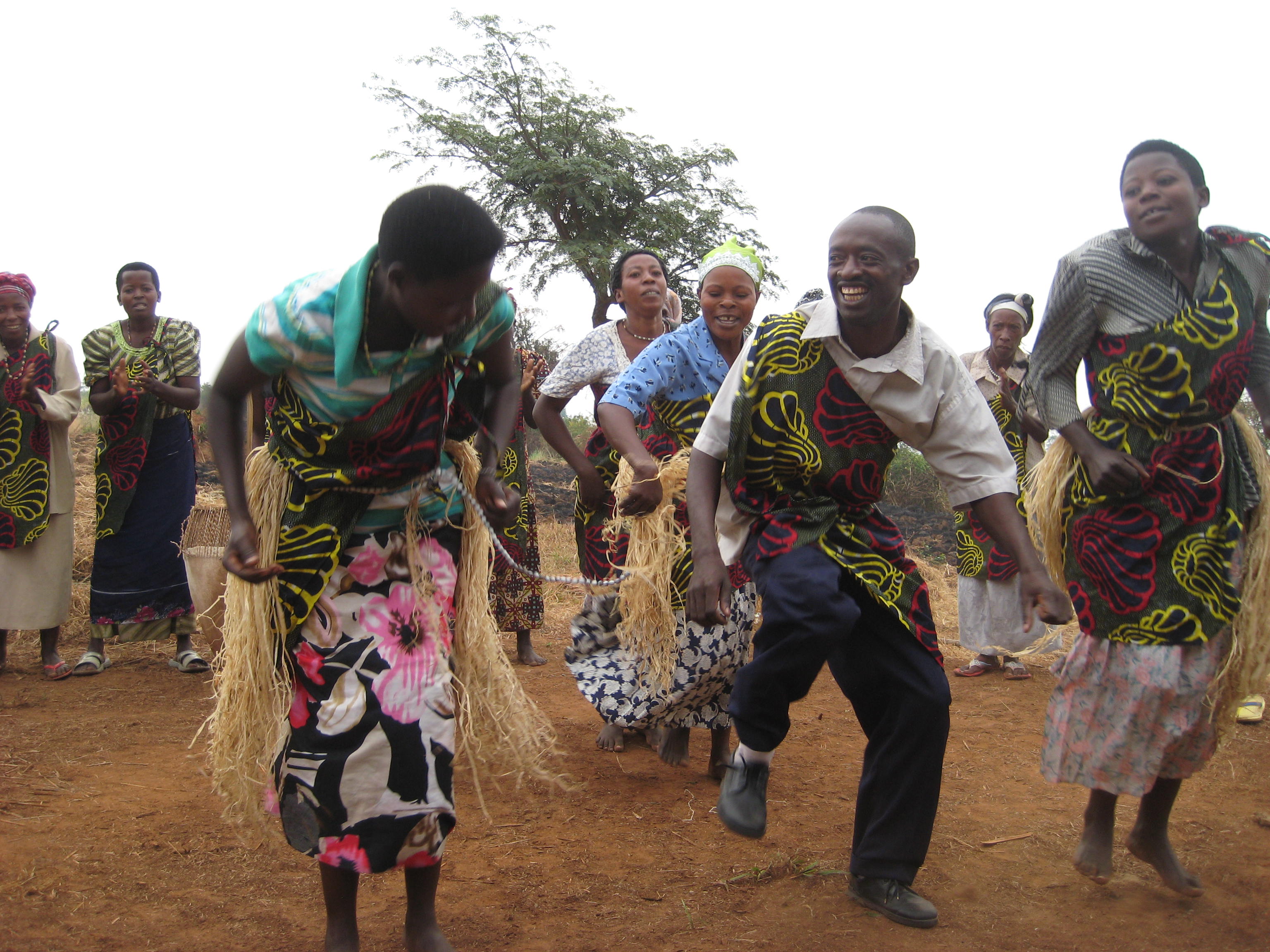
In addition to the elephant trench, we visited a craft center and watched traditional dancing. But the highlight for me was visiting a local healer, who was also a beekeeper. It was absolutely fascinating to see how he created bee-hives from large baskets.

We left the village around 11 a.m. and proceeded towards the Bwindi Impenetrable Forest, making a stop at the Kayonza Tea Factory to buy local Bwindi tea (more about that in subsequent blogs).

And we pulled into our Gorilla Resort Lodge around 1 p.m. after a pretty harrowing but spectacular drive in, around, back and forth through the “Impenetrable Forest.”

In the afternoon, people enjoyed the cute little town of Bwindi, with its internet cafes, coffee shops and local hospital.

Tomorrow, it’s off into the forest!

We watched traditional dancing from the Bakorwe Community.

‘NO’ for Violence in Kenya

‘NO’ for Violence in Kenya

Criminal politicians and an old dictator support NO rallies in Kenya.
There’s going to be trouble in Kenya on August 4 and for a few days afterwards, but not as serious as in 2007. Continue on safari, but be vigilant.

A week from Wednesday Kenyans go to the polls for the first time since the violent election of December, 2007. This time they aren’t electing anyone. They’re deciding either YES or NO to a proposed new constitution.

But this time, unlike last time, modern Kenyans and their astute politicians are taking extraordinary preparations to keep peace.

A special commission has been set up by the government to monitor the country’s temperature in the run-up to the referendum.

The National Cohesion and Integration Commission has been active, independent and very useful. They’re also a little bit worried.

Commission member Alice Nderitu yesterday said that the “threat of violence is real.” But she hastened to add, “It’s tense but manageable.”

And this time the Kenyan government is buoyed by a Coalition of the World that includes the U.S., the UN and a beautifully created internal Kenyan coalition called “Uwaino.”

The phrase in Swahili used mostly in cooking roughly means blending together, or combining diverse components into something sweet and good.

But the main function of the new organization is to allow Kenyans from around the country to anonymously text any indications of election violence brewing.

Based on nearly 5,000 messages received this weekend, the coalition identified certain areas of the country where tempers are rising.

Those areas are in the west and north, pretty far away from Nairobi and not near any popular tourist areas.

Western and northwestern Kenya are analogous to America’s deep south. Divided ethnically from the rest of Kenya in a similar way that southerners felt disenfranchised from American power centers in the last century, western Kenyans are fearful that their rural, less worldly lifeways will be oppressed by the heavy hand of modern Kenya.

Less educated and less likely to enjoy the benefits of a modern Kenya, people living in places like Kisumu, Kericho up to Eldoret are being ginned up by old leaders like the former President Daniel arap Moi.

Moi, who barely escaped a national tribunal that was going to charge him with a multitude of crimes during his 21-year dictatorship, has been holding NO rallies and focusing on really very small parts of the new constitution that are hot button issues to a less educated electorate.

Abortion and roads, in particular. The new constitution explicitly allows abortion in cases where the mother’s health is in jeopardy (it goes no further; that will be up to subsequent legislatures). And the devolution of power reducing the new President’s powers means that a guy like Moi can’t come in and direct that all new road building be around his home town.

Like at home in America where the real issue (growing health care costs) get subverted by sound-bite absurdities (death panels), Moi is telling his constituents they won’t get any new roads and there will be none to travel to heaven, either.

Ah, democracy by sound-bite.

Uwiano has also identified causes as well. A number of text messages received last weekend identified a little known hate radio broadcast linked to two Members of Parliament, Kiema Kilonzo and Waweru Mburu, both of whom are likely to lose their jobs in a restructured electoral map under the new constitution.

Meanwhile, the government has hired an additional 15,000 national police (who aren’t always themselves the best peacemakers, by the way) and deployed them into areas expecting trouble.

And the U.S. has spent some serious diplomatic capital in this referendum. Vice President Joe Biden was in town last week promoting a “peaceful vote” and the very active U.S. Ambassador Michael Ranneberger has if not crossed the line of neutrality come really close in supporting the YES campaign.

All polling shows the YES will take the day pretty easily. Even the powerful Christian church alliance, which had campaigned for a NO vote, this weekend started to break apart with some very respected clerics coming out full swing for YES.

And notably, the only political leaders supporting the NO vote are those who we now think were responsible for the last round of violence, and who are likely to be prosecuted by the World Court for those crimes. (Education Minister, William Ruto, leads the pack.)

These are powerful men back in their rural constituencies. The fact that Moi is even free is an indication of the power he still wields.

So I doubt this is going to go over as quietly as an election for a Chicago mayor. But I don’t think it will be very disruptive, either.

More Trouble for Uganda?

More Trouble for Uganda?

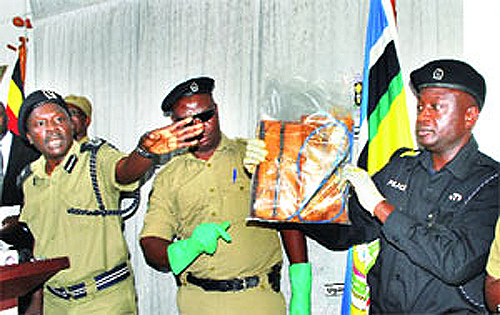
Police display the unexploded suicide vest found in Kampala.
Ugandan police gave indications, yesterday, that Al-Shabaab plans further bombings in Kampala next week during the OAU conference.

I imagine that several Heads of State who had planned to attend will not, now, or will greatly reduce their stay. In this regard, the Sunday bombings would have achieved their objectives, so further disruption wouldn’t be necessary. But:

Next week is not a time to visit Uganda. Wait until the conference is over July 28.

The OAU is the main body controlling the Somali peacekeeping forces in Mogadishu, and Uganda is the largest single contributor to that force. The OAU mission supports a weak Somali government being contested militarily by Al-Shabaab.

Ugandan police announced the arrest of Wasswa Nsubuga just outside the city yesterday and claim that he was carrying documents describing how to create 19 different types of bombs. He is an Ugandan who two years ago returned from Iraq where he had been working as a security guard. He currently works as a security guard in Kampala for a supermarket.

In his defense, and with credit to the police, Nsubuga explained to the press in a prepared statement that the documents he carried had been given him by his Iraq employer as a way of educating himself of the threats of terrorists.

But there were other Ugandan government actions that also suggested heightened concern as delegates to the OAU begin arriving, Saturday.

Police and military are visible everywhere from Entebbe to Kampala, brandishing large machine guns. Virtually every city hotel now has intense security, with under-body car checks made outside parking areas, and metal detectors being rushed to hotel entries.

Most of the larger shopping centers have also employed new, visible security measures.

But the most visible change has been at the airport at Entebbe. Check-in now takes about 4 hours, with multiple checks by Ugandan government officials followed by private security checks from the individual airlines.

My fingers are crossed for the Ugandans next week. On the one hand, the event now having occurred, it seems unlikely more could happen. But the clear and stated target was the African forces from the OAU now in Somalia, and their annual conference begins Saturday.

Bombings in Kampala

Bombings in Kampala

More than 60 people were killed yesterday in two separate bomb attacks in Kampala, a signature Al-Qaeda attack. Curiously, the terrorist organization has not claimed responsibility.

I’ve increasingly written about Al-Shabaab, Al-Qaeda in Somalia, and their increasing power and influence in East Africa. With last week’s peaceful elections in the southern third of Somali known as Somaliland, the Al-Shabaab is consolidating its control of the north-western third outside Mogadishu. Ironically, violence in Somalia is slightly down.

But if the fighting for turf is subsidizing, the fighting for hearts and minds is only growing. The blasts in Kampala, at an Ethiopian bar and the Rugby Sports Club (both packed with guests watching the World Cup), carry all the characteristics of a terrorist organization trying to make a point.

Their point: get out of Somalia.

Uganda and Burundi are the only East African countries that have military forces in Somalia fighting Al-Shabaab. They are a part of a joint UN/African Union force that is doing poorly and has suffered numerous casualties for peace-keepers. The Uganda media is becoming increasingly hostile with the government’s war effort, there.

So all the pointers suggest a premeditated, coordinated attack by Al-Shabaab to get East African forces out of Mogadishu.

Why, then, have they not taken full responsibility?

(1) The nature of terrorism is such that Al-Shabaab may have planted agents in Uganda but without fully knowing their plans. They may simply be waiting for their own confirmation.

(2) The President of Uganda, Yoweri Museveni, is standing for re-election later this year. He has become increasingly authoritarian and has been imprisoning a number of opponents. The biggest attack was at the Rugby Club, frequented almost exclusively by educated and many dissident Ugandans. Regardless of who actually did it, will most certainly quiet to some extent Museveni’s public critics.

(3) Shortly the southern Sudan will be voting for independence from the Republic of Sudan, and the situation just north of Uganda is growing tense. Uganda has been an advocate for southern Sudanese independence. (Uganda President) Museveni has told the Republic of Sudan that if its president comes to Kampala next month for the Organization of African Unity (OAU) meeting, he’ll be arrested. (There is an international warrant on Omar al Bashir for war crimes in Darfur.) Sudan harbors Al-Shabaab.

The horror of what has happened suggests some absurdity in focusing on the perpetrators, but we have been fairly fortunate in the last several years in East Africa to not have suffered these incidents. With some clarity in the days ahead, we may have a clearer understanding if anything new is developing.

Right now, I don’t think so. The evidence is pointing to Al-Shabaab, specifically against Uganda for its soldiers in Somalia, a mission that because of its low international interest has attracted less international security. Thus, more easily accomplished.

On Safari: Homeward Bound

On Safari: Homeward Bound

There’s no easy way to get home. You just have to grunt and bear it!

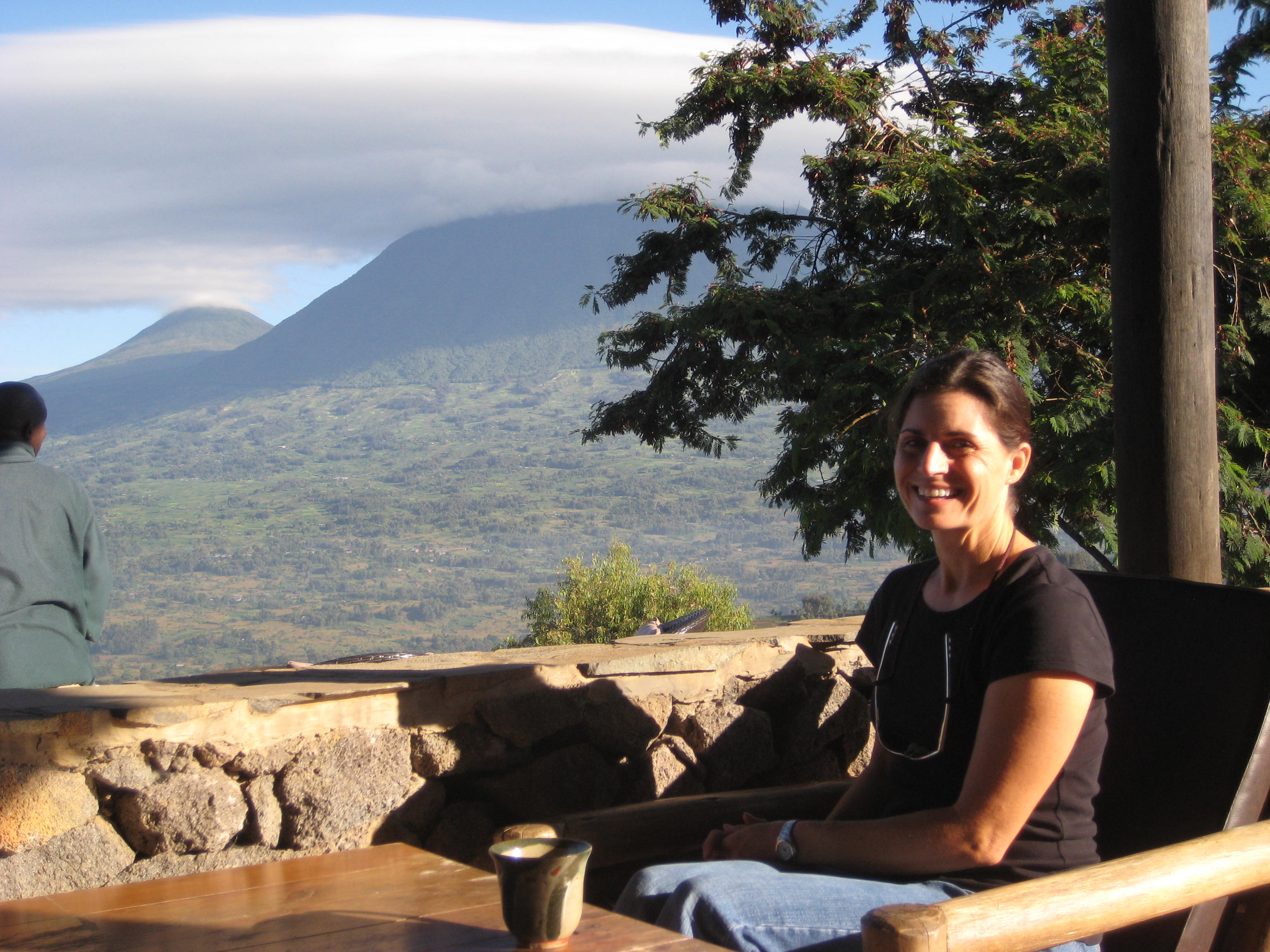
But before leaving Debbie enjoyed a final view out our dining area deck over Muhabura to the volcano Gahinga that she and the others had conquered the day before!

The electricity of having completed the trek and been so close to these magnificent animals slowly recedes as the journey home begins. But actually, I think this is a way of fixing the memory in good ways. You start to think about what you’ve done, about the poverty all about you, about your contribution in fees to hoped for local development.

You drive through cities that look fine, but with people who don’t. You remember all you’ve read about the long history of mountain gorillas, saved from the brink of extinction and yet teetering in an ecosystem hardly politically stable.

It might just take 36 hours of flying and reflection to start to know exactly what you think about it all.

Catching your Insight in Nairobi

Catching your Insight in Nairobi

What if the tongue missed the pellet?!!!
I have often recommended that people take some time to enjoy Nairobi’s attractions. Today, the Cronan family did just that.

After a final dawn game drive in the northern end of the reserve and a fine breakfast at Olonana, we fly back to Nairobi and the family headed to Karen.

Karen is the suburb outside Nairobi named for Karen Blixen (Isak Dinesen) who wrote Out of Africa. It is today where the rich and powerful live, and where several great attractions are located including the Karen Blixen National Museum.

This is the home that Dinesen used during her failed attempt to grow coffee in Kenya. It is the perfect example of early colonial living. Remarkable for its simplicity and few rooms, it is beautifully furnished with valuable heirlooms that the early colonialists brought from Europe.

They sometimes waited for nearly a year for these trunks to arrive, but in those days there was never a concern that they wouldn’t! “Lost Baggage” hadn’t yet been concocted, I guess.

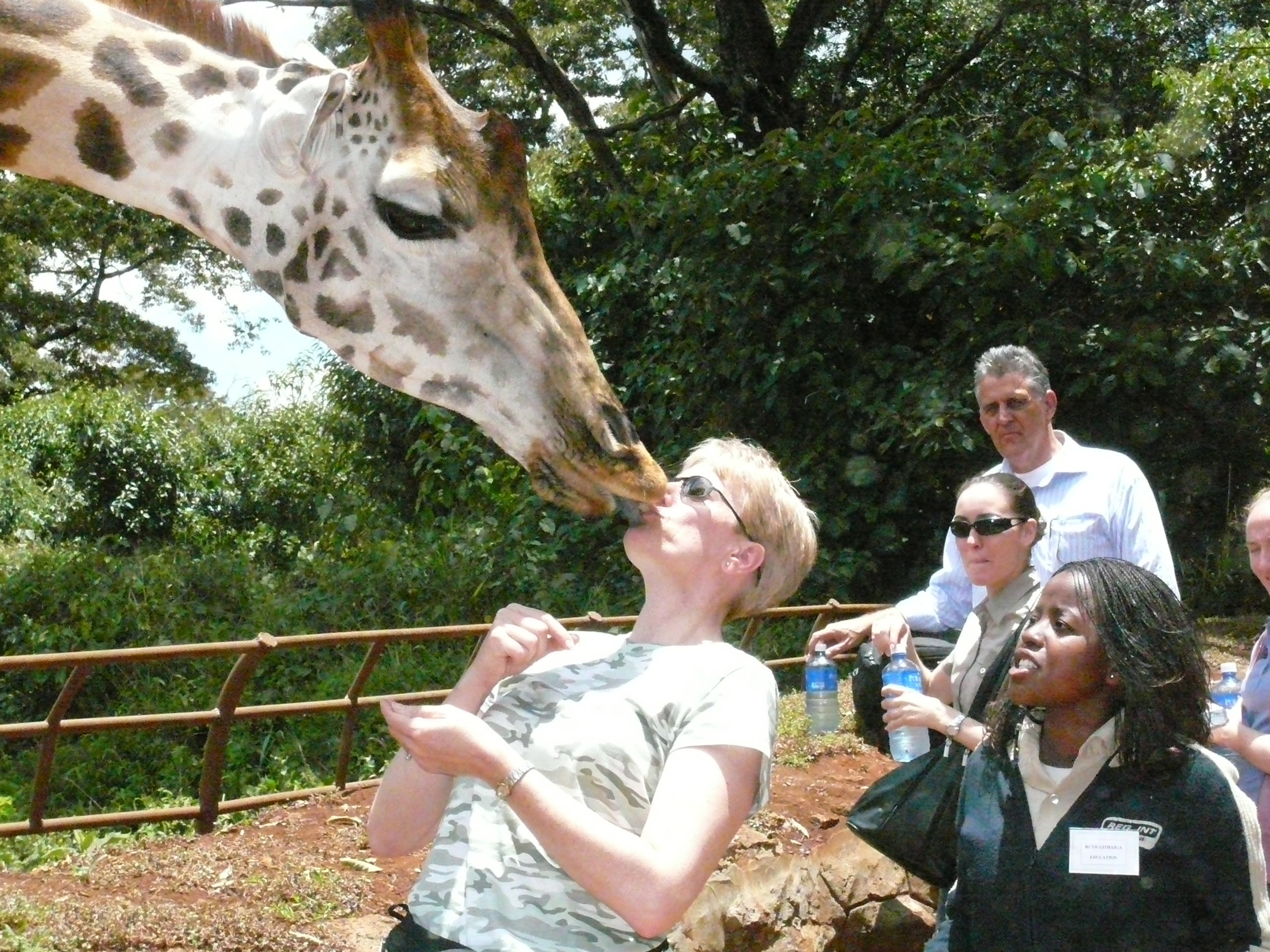
The Cronans especially enjoyed the Giraffe Centre. This is where the endangered Rothschild giraffe is protected, on display for all guests forking out the hefty entrance fee (that supposedly goes for the conservation of the giraffe). Today the giraffe is only found in Nakuru National Park, Kenya’s entirely fenced-in big game park. It is extinct in its original range (Laikipia).

Emily announced with particular pride that a giraffe picked a pellet with its tongue out of her mouth! This trick has become quite popular, but I’ve often wondered what would happen if that giraffe tongue – approximately 18″ long – missed the mark and continued into your esophagus….

The final attraction was Kazuri Beads. This brilliant “Harambee” (‘self-help’ in Swahili) has really taken off in the last few years, supporting dozens of working women who create outstanding jewelry and cutlery. Kathleen and I have so much Kazuri we’re ready to become an outlet. I particularly like the dinner settings in guinea fowl mode.

The Cronans had to return for an overnight to Nairobi before continuing to Kigali for our gorilla trek. That was an extremely convenient way of starting with the city tour, then going on safari, and returning for these attractions in Karen.

Safaris that don’t need an interlude in Nairobi really should have at least one full day (which normally means two nights) to enjoy these fun and informative attractions. Those who just rush in to see the animals and then rush not only miss the much greater overview of Kenyan society, but will be left in the dark when the increasingly important human/animal conflicts appear in the news.

You can’t have a game park without the support of country and its peoples. And these types of visits in Nairobi seem to me to be the bare essentials for beginning to understand this complex and increasingly tense relationship.

Overland to the Mathews

Overland to the Mathews

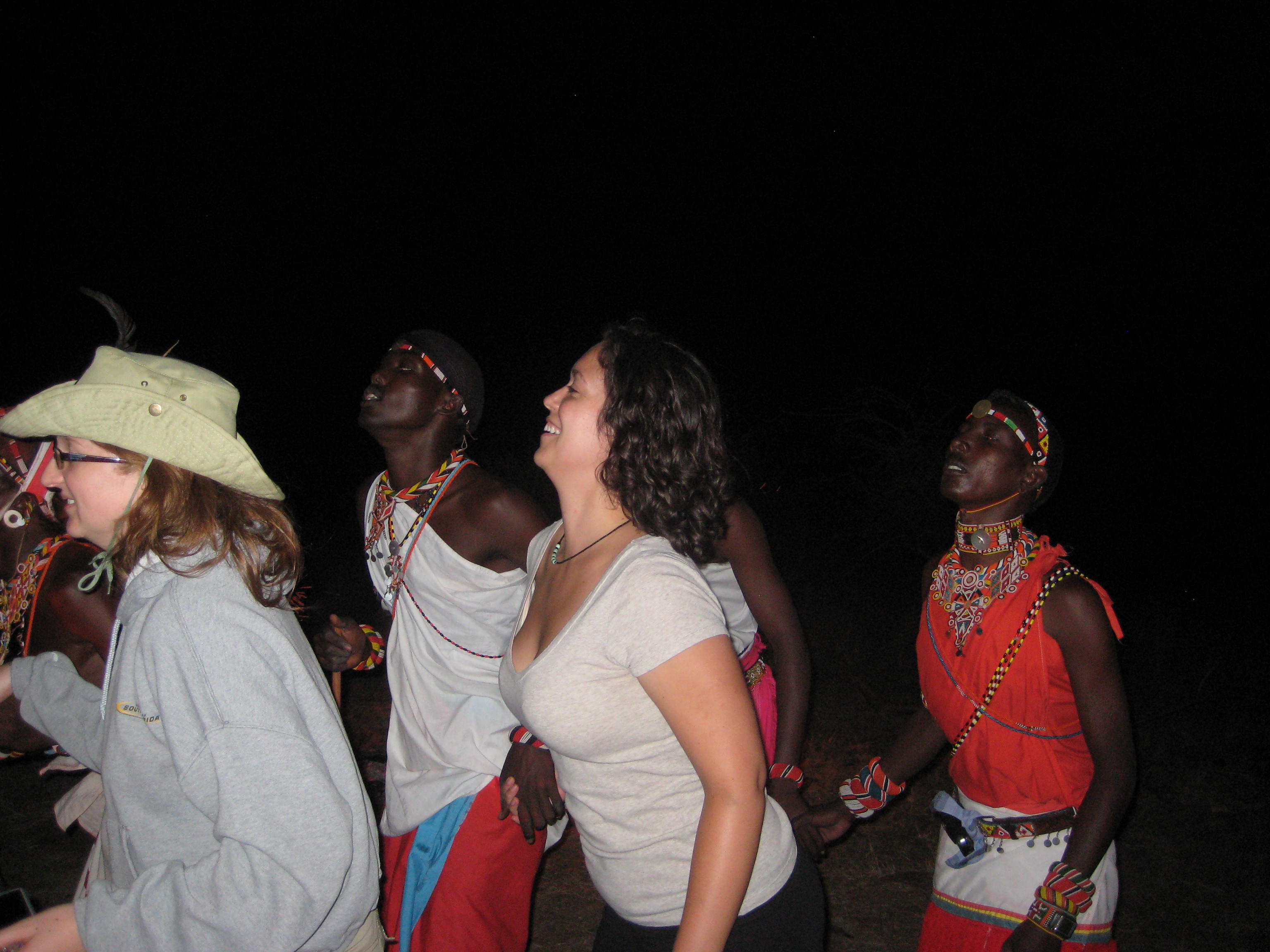
Before we left Saruni, Emily danced with the Samburu.
It’s a shame that so many safaris just fly from place to place. They miss all the wonderful things we saw, today.

Admittedly the drive was longer than I or either of the camp staffs expected. We left Saruni around 8:30a and expected to be in our camp, Kitich, in the Mathews Mountains by lunchtime. In fact, we didn’t get there until 2 p.m.

We returned to the reserve and then traveled west past Intrepid’s and out the West Gate. This has never been an area with much game nor very attractive. And I was particularly disappointed that West Gate was in such disrepair.

Once outside the reserve it was typical rural Africa, with a number of local Samburu villages. Later we emerged onto the unpopulated basin not far from Wamba, and that was where we saw Grevy’s zebra.

This was a real bonus. We know from the March KWS survey that the Grevy’s like most northern antelope were decimated by the drought. We saw two groups for a total of a dozen animals.

The drive from the Wamba road into Kitich is really the pretty part of the safari, but the road is terrible. We went through two small villages, one of which was having its market day. There were a large number of Samburu warriors, many newly painted and dressed to the nines. It was an incredibly colorful experience.

The Mathews in many respects resembles the lower altitudes of the Aberdare. It was an incredibly stark contrast to the semi-arid scrub of Samburu, but note that in terms of driving time, the Aberdare is actually closer.

Much less is known about the biomass of the Mathews than the Aberdare, because it is so remote. We passed a car from the Northern Rangeland Trust that was beginning a survey of the ecosystem, long overdue and anxiously awaited by many. For years it’s been presumed that deBrazza’s monkey is found here, but many wonder if it really still exists.

What I immediately noticed was actually a greater diversity of birdlife than the Aberdare. Both plains birds, like the sooty boubou, and forest birds, like the tropical boubou, were calling as we entered Kitich camp. Later we’d see other examples, such as the chinspot and white-eyed batis.

We took an afternoon walk of about an hour, down an elephant path! And there was evidence there to be sure. The camp manager, an old hand, Patrick Reynolds, led the walk with his loaded rifle.

The rains have been very heavy here and the grass was very high, but that also meant the forest was in full bloom. It was truly outstanding, with tiny flowers from all colors of the rainbow. Can’t wait until our longer walk, tomorrow!

Beautiful Saruni

Beautiful Saruni

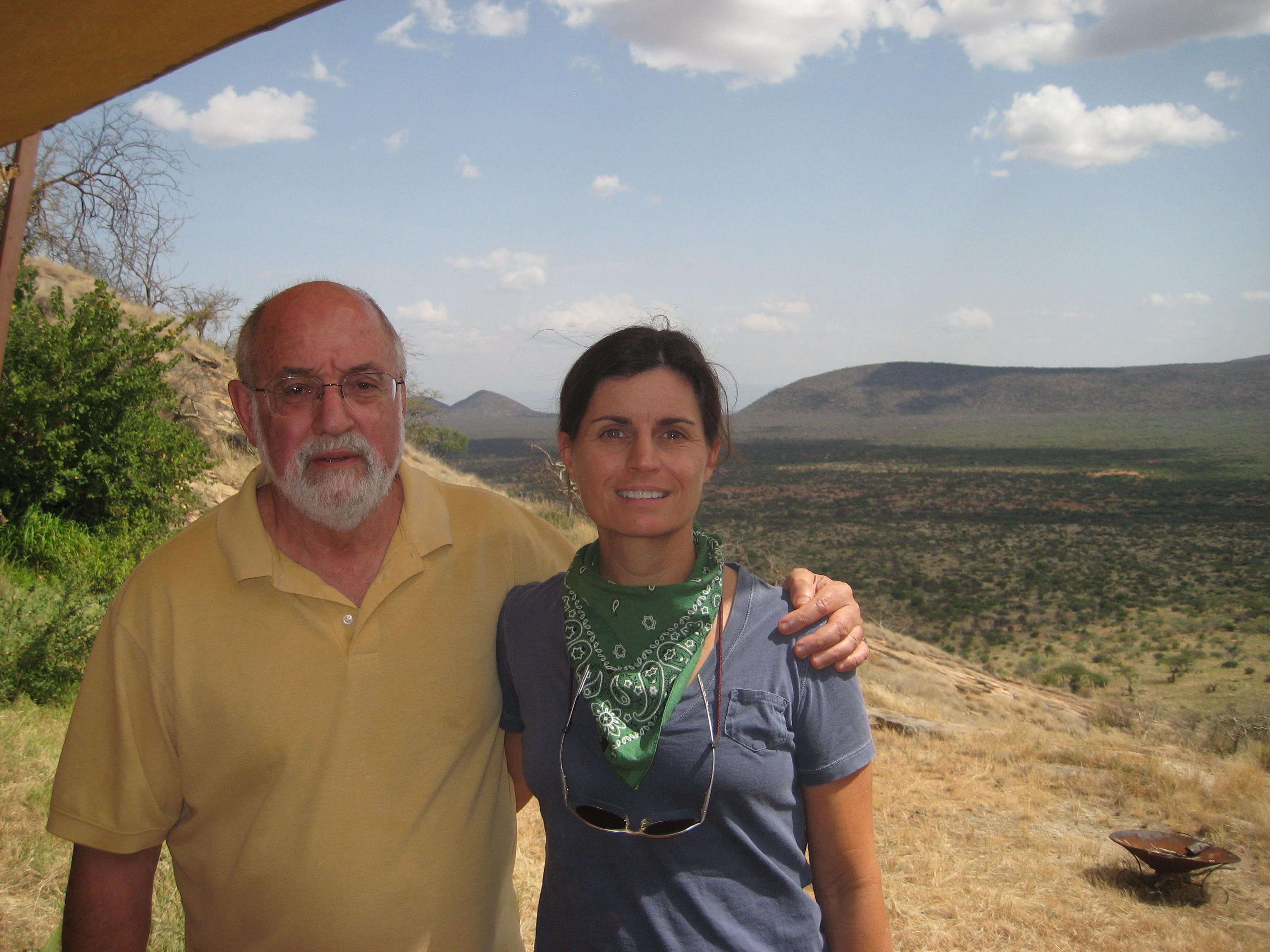
John Cronan and daughter, Debbie DeSilva, at Saruni.
The new Chinese road has made travel from the Aberdare to Samburu easy, just like in the old days. More for less, again!

On the third day of our Cronan safari we left The Ark after a wonderful night which included sightings of all the regulars (lots, and lots, and lots of elephant; buffalo, hyaena, bushbuck) with the added bonuses of giant forest hog and porcupine!

Our African porcupine is considerably bigger than the one at home, and shaped more like a dinosaur than a round ball of spines. His large head and stumpy almost fish-like snout is particularly intimidating. But at the same time it’s one of the shyest creatures on the veld. It showed itself twice for only minutes, and the moment there was any significant noise from the lodge, it went scurrying back into the forest.

We left The Ark pretty much on time and got to the Equator before most of the other tour buses and cars, so were first in line for the “Coriolis demonstration.” When I had briefed my three scientists (Dad and two sons) on this upcoming attraction, there was great laughter and enormous skepticism.

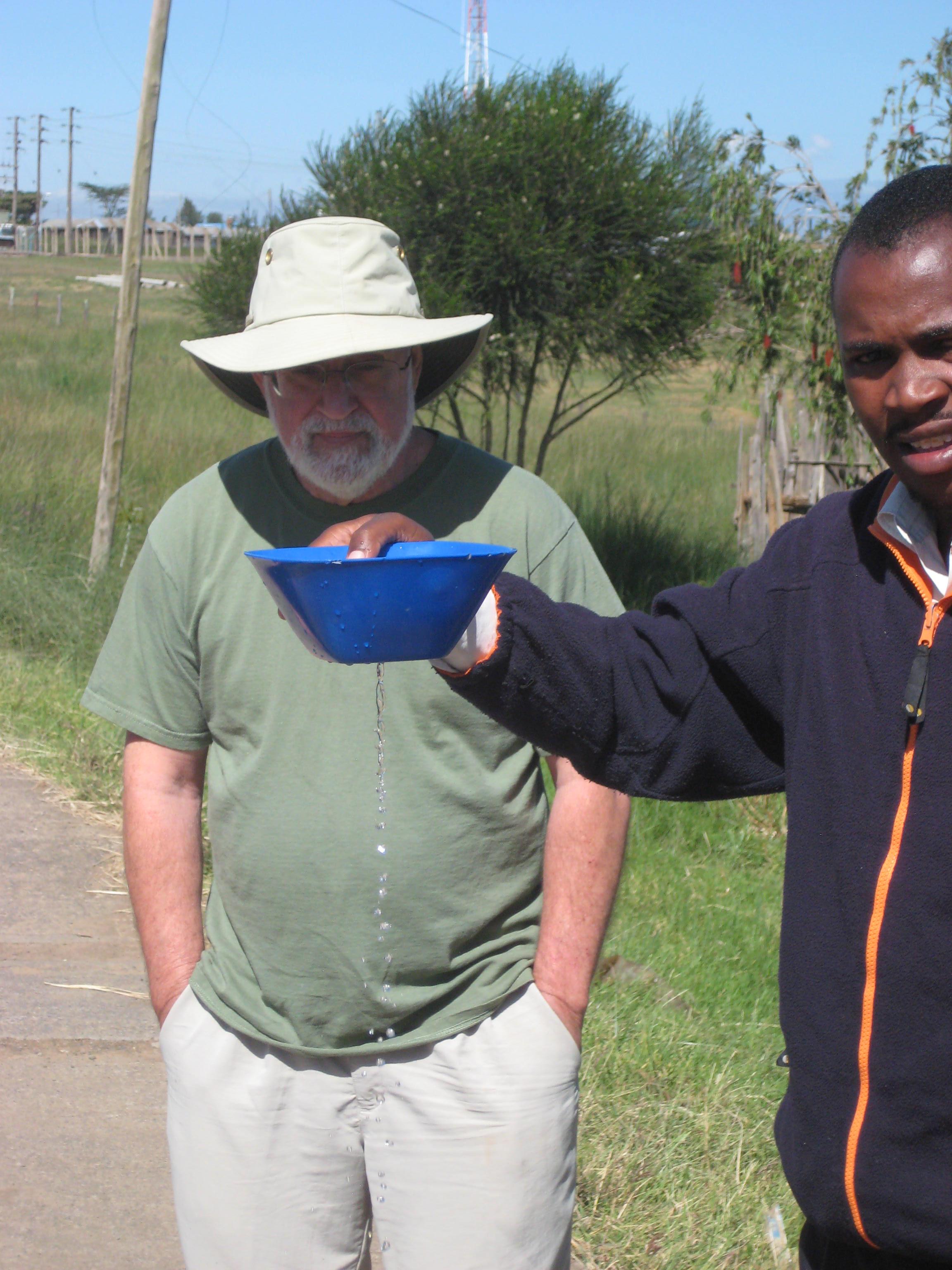
The chief honcho at the equator gives the demonstration. You walk 20 meters north, and the twig he places in his plastic pitcher that has a small hole at the bottom, twists around clockwise. And the stream of water coming out of the pitcher twists clockwise.

Then, you walk 20 meters south, and the effect is counter-clockwise. And then, on the Equator, there is no twisting, just an unmoving twig and a single untwisted stream of water out of the hole.

20m N of Equator Curios, it twists clockwise!
After watching the demonstration, the scientists were … well, dumbfounded. Now, I still don’t know if it’s for real!

We got to Samburu around lunchtime and picnicked at the gate. We spent the afternoon being introduced to most all of Samburu’s unique species and ended the day at Saruni, a luxury ecolodge in the Kalama conservancy just north of Samburu.

The property is beautiful, but it’s truly unique attraction is the view. It sits atop one of the hills at the start of the Mathews Mountains and the view extends all the way past Isiolo up the slope to Mt. Kenya. It is absolutely one of those expanses that just sucks up your soul and makes you breathless.

As we had sundowners on the highest hill in the area, the view was 360 degrees of some of the most beautiful landscape in Africa!

A Lovely May Safari

A Lovely May Safari

An absolutely beautiful crisp Sunday in Nairobi!
My Cronan Family Safari began on a brilliantly beautiful Sunday in Nairobi.

Father John (Cronan) had called my wife, Kathleen, while I was on the Great Migration Safari in March, and the vagaries of my own schedules, his as a very active scientist, and his children and sigoths meant that we had to “Do It!” right now.

I’m really looking forward to a spectacular trip! For one thing we’ll once again debunk one of the Great Myths of Safari Travel that the best time to go is the dry season. East Africa has just come through a torrential rainy season, and every third of fourth day it’s still raining.

That’s good! I’ve spent 30 years of my career trying to explain this, fighting with institutionalized myths about when to go created not from facts, but to assuage client potential. That’s a fancy way of saying that “high season” and “best season” almost everywhere in the world (except for the Arctic and Antarctic) correspond not with the optimum travel opportunities at that time, but strictly when it’s convenient for people to travel. So inevitably the highest season for travel everywhere in the world is the December holiday season.

That’s true even in places like Botswana, where it’s an awful time to go! (Middle of its terribly hot, humid torrential rains.) December is absolutely NOT the time to visit Botswana.

John had been a part of a Great Migration Safari group I guided in 2007. Then we began in Kenya’s south, so this time we’ll tackle Kenya’s north, and as a perfect increment to his safari travel (which has also included Botswana), we’ll end the trip with a gorilla trek in Rwanda!

But today right after their arrival it was lovely in Nairobi! Bright, crisp, cool, and frangipani, bougainvillea and flame trees were brilliant! As we drove out of the airport beside the lush Nairobi National Park we saw giraffe in the distance! Amazing, it isn’t? Wild animals just outside an airport for a metropolis of 6 million people!

We walked through the city center learning something of the history of the area, had tea at the Thorntree Café and then went to the National Museum.

This was a real treat for me. As always, my passion for paleontology draws me like an iron filing to the incredible early man exhibit of the museum. But today was extra special, because John and both his sons are geneticists. We all marveled as I always do inside the special room where the originals of Zinj, Turkana Boy, the Black Skull and several other hominins are displayed.

The originals! What other museum in the world would put its priceless national treasures on display like that?

Early to bed for early to rise. Tomorrow, on to the Aberdare!