Kenya ‘Gets it’ too

Kenya ‘Gets it’ too

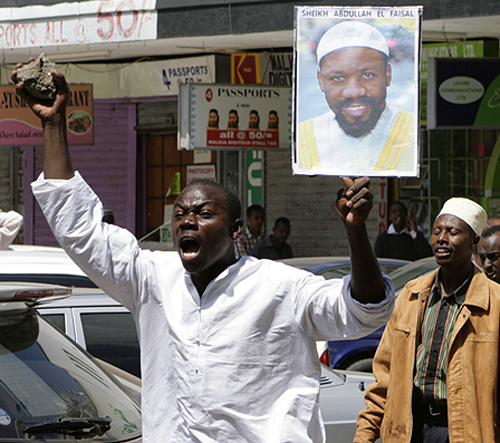
Nairobi demonstrators aroused by al-Faisal.
The Times Square Bomber says his radical Muslim cleric “gets it.” So does Kenya.

NPR reported this morning that Faisal Shahzad, the Times Square bomber, attributed his radicalization to Abdullah Al-Faisal, a convicted felon in the UK who Kenya recently deported to Jamaica.

I wrote earlier about the Al-Faisal controversy in Kenya and how Kenya stood alone among dozens of African countries by arresting then deporting Al-Faisal, who had fled into Africa to preach radical jihad.

Apparently, Al-Faisal made the gross mistake of trying to sneak into Kenya (the only easy way to get to Somalia, his obvious destination). A score of other African countries through which Al-Faisal passed did nothing, despite warrants for the man’s arrest and requests by Interpol to question him.

In fact he had become something of a celebrity in South Africa, where he was received widespread public attention and even some support from the South African government.

But the moment al-Faisal stepped into Kenya, he was arrested.

Today the leaked investigative report that NPR aired shows not just the power of internet clerics, but the obvious side of the so-called War on Terror embraced by Kenya.

The Flame Tree Road

The Flame Tree Road

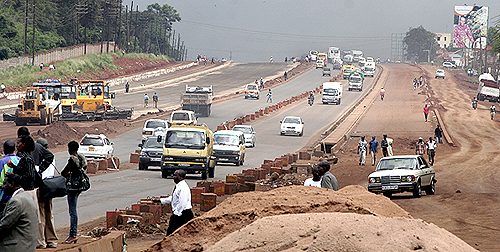
All (12-lane) roads lead to Nairobi.
Three years ago China started building roads all over Kenya, including an 8-line highway between Thika and Nairobi. It’s now 30 miles of 12 lanes!

(Stop! Yes, the Kenyan wilderness away from Nairobi is still beautiful and healthy. You still will find lions in the Kenyan wilderness. Not to worry, there.)

In the few short years since the Chinese road building boom started throughout Kenya, the growth of the satellite suburbs has exploded. People saw roads finally being built (rather than the money for cement bloating the pockets of politicians) and began to realize they really could live cheaply outside the city and still work there.

It’s the same dynamic China has been grappling with for nearly two decades of incredible growth. I, for one, can’t understand how on earth it’s going to work, but I’ve heard that China is doing pretty well.

Once all these cars get to the city, what will they do?

Kenya’s main newspaper, The Daily Nation, reports 1000 new cars are being purchased to be used in the city EVERY MONTH.

I’ve written elsewhere how you have to avoid arriving Nairobi’s international airport on any weekday morning, because the traffic is so congested that it takes up to two hours to move a mere 11 miles from the airport to the city center.

That’s not going to change. The great roads that China is building simply feed into the city. There are plans for a ring road to circle away those cars not intending to come into the city, but most of them are trying to get into the city, not around it.

The city center isn’t big enough!

This seems like a massive failure of urban planning. I’ve questioned the Chinese motives, because they are combing Kenya for oil and other business opportunities. But then, again, did anyone see Shanghai recently?

Nairobi… Shanghai?

Holy smokes.

iTravel Where?

iTravel Where?

iNeck Brace for Long iFlites
Last week Apple Computers filed a patent for a travel app called iTravel.

Where?

That’s something I’ve always wanted to know. I seem to be traveling so much these days if someone could just give me a device or an app for my other devices so that the first device knows where I misplaced the second device, and when it needs an update, then clearly I wouldn’t suffer jetlag so much.

Though I do see a problem with Apple’s strategy.

The app could book airlines, hotels and cars, and would be an extension of iTunes “Concert Ticket +” and would as well provide ticketless check-in using NFC (Near Field Communications) such as retina scanning or fingerprinting.

The main problem is its name. There are already several iTravels: there’s an iTravel Rental Car company in Georgia, there’s an iTravel Alarm Clock and iTravel Neck Art, and a multitude of sites already out there such as iTravel2u and iTravelsmart among many others, and then there’s iTravel Travel, a Project of Travel.

iPod already has an iTravelBag. And inside the iTravelBag for the iPod you can place the iStickUm Notem to remind yourself where you lastum putum your iPoddom.

i41 welcome them iAll. In fact given the trends in the industry I expect we will soon see iAll+.

I was fascinated once listening to a woman from China explain how she uses a computer in Mandarin. There are 5000 basic characters in mandarin and obviously not 5000 keyboard keys. But by typing the English equivalent of the phonetic counterpart of the character, the character then appears. Meaning is achieved when enough characters emerge strung together.

So there is this labor (finger bashing) intensive midstep process of creating meaning through creation of the character phonetically. When I asked her if this isn’t a bit stressful, she raised her left index finger, touched the top of her ear with her right little finger, stuck her elbow out at me and looked slightly up.

i41 wood gate up mixed.

But anything that improves the direction of my travel is much appreciated.

+

Tears of Rain as Camping Ends

Tears of Rain as Camping Ends

The ending of the recession and its accompanying surge in bookings are redefining the American safari travel market. One important change: luxury camping is OUT!

Yesterday I discussed how the market will evaluate permanent lodging, but it’s with some sadness that I conclude the era of camping might be over in East Africa.

And it might not be, altogether. What I know is falling in interest as fast as a baboon plummeting out of his tree at sunrise is so-called “luxury camping.”

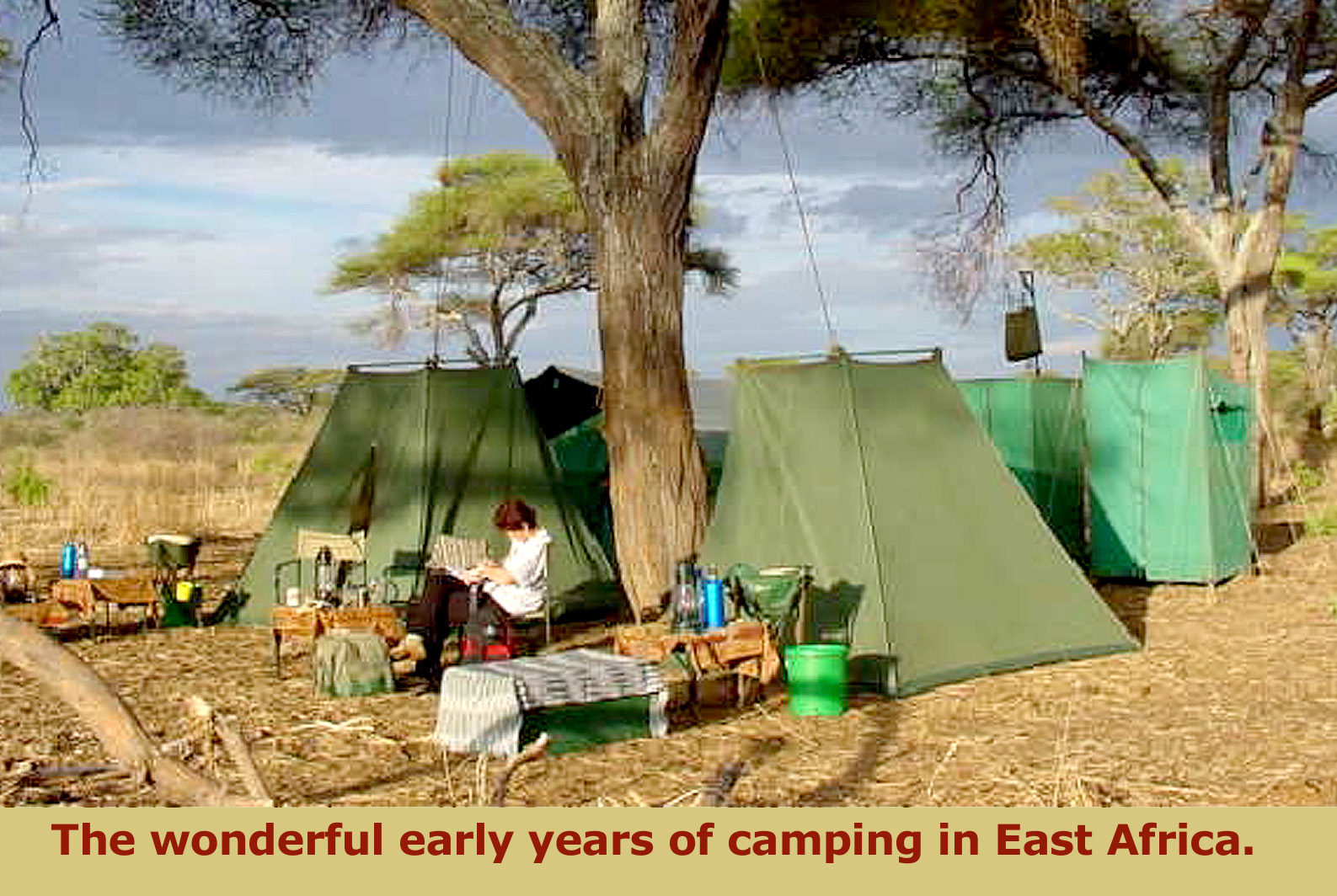
In the old days when we first started comfortable mobile tented camping, we took the whole camp and staff with us along the itinerary. It took the guys at least a day to break camp, move and reset it, and on that moving day we’d go to a lodge.

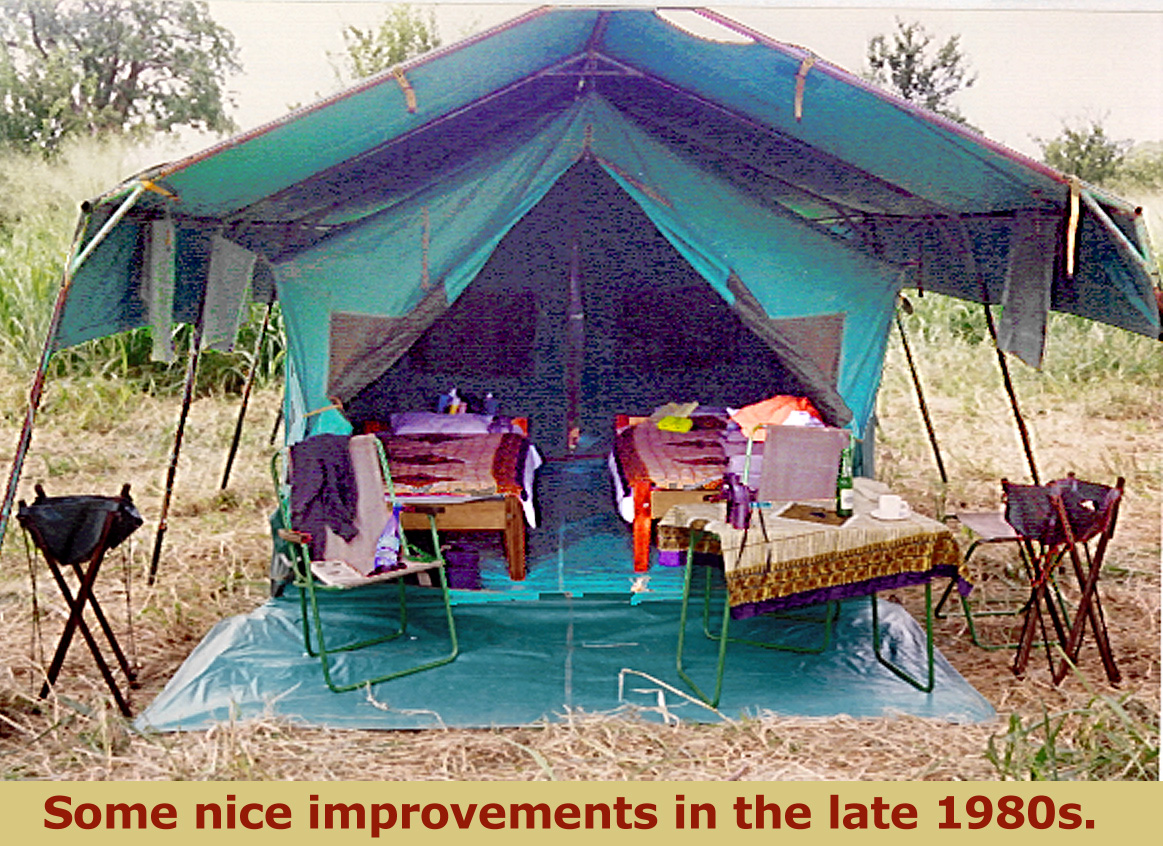
That was the camping I really enjoyed. These were large tents, spring beds with comfortable 2- or 3″ foam mattresses with a bit of linen to make them look good, detached long-drop (toilet) tents and detached (hot-bucket) shower tents. There was then a mess tent, and it usually took a staff of at least 8-10 to work a small camp, and the staff/client ratio was about 1:1.
The reason for these camps in the first place was because there wasn’t an alternative! One of my favorite places to camp was Naabi Hill in the Serengeti with its sweeping views of the migration plains. The nearest lodge was at Ndutu, 30k away.

We loved it so much, we ultimately destroyed it. We oversold camping. We referred to the “real Africa” and experiencing the veld “like the first explorers.”

Right. Brochures are instruments of exaggeration, and in this case, inversely so. It’s TODAY that the camps are like the early explorers. Today, “camps” have clawfoot iron bathtubs and cellar wines served in Waterford crystal.

Here’s what happened and why the new American market now rejects camping.

The cost of camping was on a par with staying at a lodge in the early 1980s, right after the second major recession since I started my career redefined American market interests in East Africa. So price in the beginning wasn’t an issue. You had a choice: be a wimp and stay at a lodge, or be adventuresome like you expected you’d have to be when you first started thinking about going on safari!

And it was, truly, adventuresome. Gerbils would scurry under the plastic floor all night long like little tumblers rolling through the ground; scorpions had to be dumped out of your shoes in the morning; elephant would knock trees’ seeds onto your tent in the middle of the night, and hippo would be crunching grass right outside your matted window.

I remember a wonderful guy, Richard Lattis, then the curator of herpetology at the Bronx Zoo (later the director) waking me up rudely in the middle of the night as he lunged out of his spring bed onto mine (and me!) to watch the hippo on my side eating the grass just outside the tent.

I remember my son, Brad, insisting he was old enough to leave the mess tent at dinner in the dark (at about 7 years old) to go back alone to his tent to visit the long-drop. He came back remarkably quickly with a white face, stoically silent, and a disposition unable to use the long-drop for several days subsequently.

I found leopard tracks around his long-drop!

Or my great friend, Gregg Painter, expert birder, wandering to the edge of camp while the rest of us slept off the morning heat in our cots after our game drive, rescued in the nick of time by my driver, Winston, as he pulled his Landrover in between Gregg and the lioness with her cubs!

Those were the days.
And it was particularly nice that the same staff, same tents, same outstanding food, traveled with you from place to place.

And it became more and more popular, because it should have been! So guess what, the price went up… on two fronts. First, the normal supply/demand curve pointed every price upwards, and second, the government began charging special fees for camping.

Then, as the price mounted parity was always in jeopardy. Those of us outfitting the camps started to scratch our noggins wondering, “What the hell are clients paying so much for, when down the street there’s a real bathroom?!” We were always worried that the price threshold wouldn’t hold.

And then in the mid 1990s, the competition got fierce. The main company in Nairobi that made canvas tents went bonkers. Canvas – most of it pulled up from South Africa – doubled in price from 1995 to 1999. That led to even higher pricing.

And by the early 2000s government fees for camping within a game park reached $100 per person per night.

And there were now more lodges and more permanent tented camps, but the market demand was still substantial. All inclinations to hold prices down disappeared.

By 2000 the net cost for a person camping including fees was just under $300 per night. That would translate into a retail market price of $500-700 per night. The mean retail price of a safari using a permanent lodge was around $350 and a permanent camp, around $400.

The disparity was now enormous. How’d that happen?

Market demand, I think. We were too good at promoting the “real Africa.” The fantasy of an African safari was most closely reflected in a camping program. We learned that many travelers were in search of this fantasy and like Space Mountain or Bourbon Street, we gave it to them!

The successful formula attracted lots of new investors. Suddenly the national parks were creating new “special campsites” all over the place. Sometimes, they were in sight of a lodge!

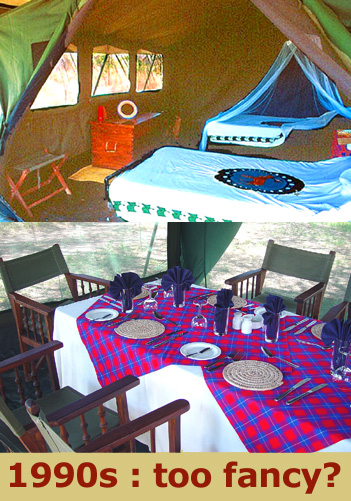
So to earn your customer’s business, “improvements” began. Like… flush toilets and solar lighting?

Whoa! Sir and Lady Burton never used flush toilets!

Flush toilets and solar lighting takes a while to set up. The idea of a moveable camp was gone. So was the idea that camp was set up just for your safari. The only way any of this made sense was to set up “camp” for 5-6 months in one place, so you could bury electrical cable, create either a complicated septic system or make arrangements to dispose of all waste regularly, hire staff for extended periods, and figure out a long-term supply strategy.
By the early 2000s, “camp” … wasn’t.

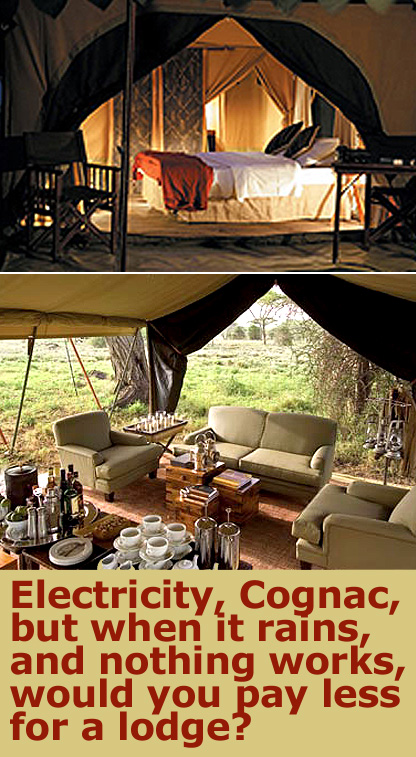
It was semi-permanent and unmovable. The giant tent interiors included four-poster beds with beautiful covers, arm chairs and armoires, separate attached chambers with flush toilets and big showers and a separate bathroom sink area. When you settled into your queen-sized bed at night under the draped mosquito netting, book lights could be switch on until you drifted off to sleep.

Pathways were demarcated with colored rocks and kerosene lanterns, flutes were played by appropriately dressed Maasai askaris and pork loin was served with Pinot Noir.

Animals wouldn’t dare come anywhere near the place, anymore, but that was OK.

Now, all of that isn’t so bad until…

It rained.

No matter how “semi-permanent” it all was, it wasn’t a lodge or permanent camp, and nature ruled. It was one thing in the old days when it rained and got muddy in front of your tent. You just took off your shoes and let down the flaps. Didn’t matter if a few drops of water or mud followed you inside.

But good grief, imagine what mud does to a white fluff comforter!

In the old days, if we saw the path’s water rising, we’d quickly move the tent! Not possible with these new monstrosities. You just watched slowly as the water seeped onto your floor drenching the sheep mats. And my, what water can do to an electrical system!

And then …

When the toilet often didn’t flush right… or when the bed lights didn’t turn on .. Or when the shower spigot fell onto you… or when you found carpenter ants in your Sealy Posturpedic… the contrast between “camping” and “lodging” grew stark.

And you’re paying more for all of this than if you were in a nice, cozy lodge!

The days of camping – at least East Africa’s style of “luxury camping” – are ending with this current recession.

Substance over Fantasy. Luxury camping ruined the fantasy.

It remains to be seen if the old days of camping will make a come-back at a reasonable cost. It will be harder, because there are fewer places that don’t have permanent camps or lodges which justify a mobile camp.

And I wonder if the animals will ever again join humans trying to be as wild as them.

But whether the old days of camping return, the ridiculous days of “luxury camping” are over.
Ndutu Lodge IN; Crater Lodge OUT

Ndutu Lodge IN; Crater Lodge OUT

Which to choose for the same price: a week in the left bed or 1 night in the right bed?!!
Reliability and Substance over Fluff ‘n Fantasy. That’s the read from the surge in new travelers to East Africa.

‘Reliability over Fluff’ – This is one of the important redefinitions of the post-recession market in East Africa. It’s the reason that places like Ndutu Lodge will do well, and why places like Crater Lodge will now see a decline.

(Tomorrow, I’ll discuss the emergence of’ Substance over Fantasy.’ Why so-called luxury, mobile camping in East Africa is on its way out.)

The end of a recession is an exciting time for any industry, but particularly so for travel. The surge in bookings is the side-liners coming to the fore, the people who had planned to go but pulled back when the recession hit. We’re feeling that surge right now.

This burst of new travel was building continually throughout the recession. The fear that the recession wasn’t ending was the dam on the logjam. It kept building with people ready to go but who pulled back, afraid that the recession might continue. They waited until there was certainty things were getting better.

That’s happened, worldwide, and the net result is a bubble of healthy travelers bursting out at us. This group has a lot in common besides their financial endurance.

They are now redefining the next business cycle’s important parameters of price brackets and style.

It was the end of the 1973-75 recession that opened the gates of travel to East Africa. There wasn’t much to redefine, because there hadn’t been much before, but in the last half of the 1970’s decade travel to East Africa quadrupled from America.

Hardly ten years later, the end of the 1981-82 recession resulted in a massive redefinition of the American market to East Africa. That was when the first boutique safari camps appeared. The preceding decade had been one mainly of mass tourism, large groups staying in large lodges. The end of this recession marked the beginning of “style” (read: ‘luxury’) as an important component of American safaris.

It’s interesting to note that the single largest group of travelers to East Africa, the French, never really bought into this. French still remain the single largest nationality traveling on safari, but they never abandoned the big mass tourism lodges for the luxury lodges the way the Americans did.

That 1980s recession also redefined how people traveled, including the French. Suddenly there was a surge in couples and small groups, what the industry calls “FIT”s (Foreign Independent Travel). That was nearly unheard of only a few years preceding. That led to all sorts of revolutionary changes, like a whole bunch of new local airlines flying daily services to all the game parks.

While we had a recession in the 1990s, it was mild (GDP fell less than 2%) and didn’t cause any significant redefinition of that second big recession of 1980s. That may explain why there is going to be such a big realignment, now. This 2007 recession is only the third one since travel really took off to East Africa in the 1970s large enough (GDP falling more than 3%) to redefine the markets.

So for nearly twenty years we’ve had a linear growth in market parameters: mostly in style getting more and more lavish.

This time it looks pretty clear to me: out are the expensive and outlandish Fluff ‘n Fancy of places like Crater Lodge and so-called “luxury camping,” and in are reliable locations and services of places like Ndutu Lodge and Sanctuary camps.

This isn’t just a reflection of price. It’s also a reflection of the “New Efficiency” of the American traveler.

I think the American is becoming more European. I chuckle to myself now when I recall the many tourism conventions I’ve attended when around the bar we Americans would chastise our European counterparts for not “splurging” on the new styles available.

The irony, of course, is that at home the European lives a much more lavish lifestyle than the American. Our huge unused living spaces, poorly decorated reading rooms and bathrooms without bidets cast us with an unrelenting cowboy legacy.

American luxury and splurging is now going to be reserved — like with the European — for the backyard pond, the second home or refurbished kitchen. Home is going to be the focal point for luxury, not travel. A vacation – a safari – will have preeminent goals unique to its destination.

Like finding animals.

And it matters less and less that after finding the animals you fall into a feather bed. A nicely made up spring mattress will be just fine.

The depth, surprise and lasting impact of this latest recession will not fade from memory, soon. If you want to think of this “New Efficiency” dynamic as more related to the fear of another recession than just a maturation of where luxury is meaningful, be my guest. The net result is the same.

And here’s the beautiful ironic twist. Future safari travelers might even spend more than before, but it will be to lengthen their vacation rather than upgrade their accommodation. There will be new scrutiny of services. It won’t matter a hoot that you have sherry by a personal fireplace if there aren’t enough porters to get your bag into your room at the same time you arrive.

My personal experience in this last safari season traveling with this burst of new travelers really bears this out.

All properties have cut back. Chains and independents alike have reduced staff and overall services. But it was at Crater Lodge that we noticed it most. Crater Lodge had been the most talked about property in East Africa, an &Beyond extravaganza that guests fondly called funky. It’s lavish, and lavishly priced, currently $1500 per person per night in its highest season.

When you’re forking out that amount of money, even the tiniest decline in services stings. Of the four nights I spent there in the last six weeks, two nights experienced long periods of no electricity. Wake-up calls were routinely a half hour late. Dinner portions were smaller and smaller. Askari or “guards” were often found asleep rather than ready to escort guests.

I’m sure that the surge of new travelers will refresh Crater Lodge’s revenue stream enough to remedy these failings. But their effects are more long-lasting.

We realized that if there weren’t 12-foot high ceilings with an 8-foot dropping rheostatic chandelier over the clawfoot bathtub set in a nearly 200 sq. foot room that maybe not so much electricity would have to be used in the first place! That if we just used our own alarm clocks, we wouldn’t have to be waken up by an underpaid, under slept porter.

What the travelers realized is that they had paid for Fluff. And what they really wanted was not to miss the dawn game drive.

In contrast, little Ndutu Lodge, retailing in its highest season at $170 per person per night ran as it always did like an efficient time piece. Since the generator has always gone off at 11:30p, no one missed it in the middle of the night. The food was as ordinary and generous as ever, and wake-up calls came right on the dot.

Both Crater Lodge and Ndutu Lodge share an important component of success: their location. Crater Lodge is perfectly placed on the rim of Ngorongoro Crater. Ndutu Lodge is in the southwest Serengeti, seasonally perfect for the great migration. On that, neither of them can err.

But since you can stay for more than a week at Ndutu Lodge for the cost of a single night at Crater Lodge, the contrast has just grown too stark. There are three other lodges on the crater rim, and Crater Lodge can no longer compete with them economically.

And the staff at Ndutu Lodge was much better than at Crater Lodge. Ndutu employees are loyal, courteous and know what they’re doing. That could be because Ndutu retains its workforce much better than Crater Lodge does. The rooms were really nice, the beds wonderfully comfortable, the bathrooms fully functional.

A night’s rest at Ndutu Lodge is less stressful and now more enduring than at Crater Lodge.

There was a time just a short while ago when the rose petals lining your bathroom floor to your hot clawfoot bath garnered your every dime. Just won’t any more. Reliability over Fluff.

World Cup Travails

World Cup Travails

SA strikes grow violent

In a live sequel to Invictus South Africa’s dreams and aspirations were to be featured as it hosts the greatest sporting event in the non-American world, the World Cup. It’s not going well.

The South African Municipal Workers Union (Samwu) has been striking since July, and the protests are growing and the violence is escalating.

Rubber bullets were used Wednesday following massive national street marches, Monday. In many parts of the country basic services like sweeping, garbage collection and public bus services have stopped. All is reminiscent of last year’s massive violent strikes that clogged city streets with burning trash and tires.

The decision to award the World Cup to South Africa was a long and tortured one, with opponents of the world body running the event claiming the country wouldn’t be able to refurbish or build new stadiums in time, and wouldn’t be able to provide good enough security.

That’s been compounded by poorer ticket sales than expected, poorer media contracts, and criticisms from virtually every sector of the paranoid western world that there aren’t enough hospitals or grocery stores!

London’s notorious Daily Star has even claimed that a devastating earthquake will occur during the games!

Building has been slow but now seems like it will be completed in time. Thousands of additional police and undercover security personnel have been trained by a government with a serious budget shortfall.

But no one expected the new stadium workers or trained police might just not show up for work.

“Workers want to see matters resolved speedily,” Samwu Secretary General Mthandeki Nhlapo said yesterday of the open-ended strike. “But there will be no compromise from our side.”

It’s not really a South African problem, as I see it. Imagine if the venue chosen had been Athens instead of Joburg. The problem is the world economic crisis.

Imagine if Obama had allocated a few extra billions to host the event in New Orleans.

To hire the thousands more police and build the great new stadiums, while trying to accomplish its many promises in the post-apartheid world in a depressed economy, South Africa is in the same pinch every country in the world finds itself.

The protests represent a very open, democratic society. Are we going to subscribe to every athletic event being hosted by Beijing?

Don’t change your plans to go to the World Cup. I’ll be very surprised if things don’t settle down weeks before the June 1 exhibition match in Johannesburg between Denmark and Australia.

Stunning: But Not All Africa Has to Offer

Stunning: But Not All Africa Has to Offer

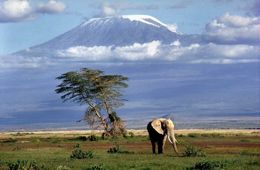
Kilimanjoro - Africa's Crowning Glory

By Conor Godfrey

Last week, the New York Times travel section featured a two page special on Dogan-country in Mali.

Is West Africa finally on the tourism radar?

Inside an artisan cooperative frequented by foreign NGO workers in Conakry, Guinea, I once saw postcards for sale with Massai Morani on the front.

Stamps sold nearby featured elephants with Kilimanjaro in the background.

Don’t second guess yourself—Kilimanjaro is indeed further from the store in question than New York is from London.

I suppose “les blancs” (mostly white NGO employees) swinging through Conakry looking for “African” souvenirs bought out this bewildered woman’s supply of savannah and elephant paraphernalia so consistently that she was forced to ignore geographic realities and restock.

Why has East Africa monopolized the Western vision of the most biologically and culturally diverse continent on Earth?

Please do not misunderstand me.

The cradle of mankind in East Africa will nourish your soul and should certainly make your short list. That being said—so will West Africa.

Even in-transit, you will encounter West Africa’s fascinating search for its soul.

A rich and varied past informs a present riddled with uncertainty, and more importantly, with possibility.

Unlike coastal China, or in major cities in East Africa, the forces of modernity have not succeeded in casting traditional peoples and beliefs as anachronistic and backward.

You do not need to travel to mock villages or tourist markets where people in imitation traditional dress sell you tourist curios that would never grace the inside of their own homes.

Markets and village communities are vibrant and functional, and outside large cities, foreigners remain a curiosity as opposed to walking dollar signs.

Lets assume you believe West Africa is an interesting place; what would you do when you got there?

A few ideas…

Fly into Bamako, Mali and spend a few days hearing the best of the best play the Balafon and Kora in dives around the city.

By day check out the gigantic Bamako market famous for its Bogolan (Mud Cloth).

Take a three day cruise up the Niger river where you can sleep on the deck at night (or in a cabin if you prefer) and stare at a star-filled sky undimmed by ubiquitous electricity.

Tuareg_dunes

Step off the boat near Timbuktu where you can hire Tuareg guides to take you into the dessert and spend the night on the dunes.

Fly into Burkina Faso for the bi-annual African Film Festival and hob-knob with the African intellectual elite.

Travel through Guinea-Bissau where West African vitality meets Portuguese street life and café culture.

Hire a boat to maroon you on the wild and beautiful Bijagos Islands off the coast.

IMG_0030

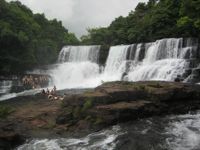
Go to Guinea in June or early July when the so-called “Water Tower” of West Africa will provide endless opportunities to explore deserted waterfalls and some of the best hiking anywhere.

Spend a weekend in Sierra Leone at River Number 2.

These ideas and the hundreds of others I will resist listing are a mere sideshow to West Africans themselves.

All cultures claim to be hospitable, but other parts of the world are competing for second place.

West African hospitality will exhaust you.

Anytime you pass by strangers eating they will yell out “invitation!” and be unsurprised if you sit down to join them.

Many travelers trek through West Africa without ever knowing where they will stay. Introducing yourself to village authorities will almost always lead to more food than you can possible put in your stomach, a place to stay, and an army of children to do your bidding.

I have deliberately left out the awful transportation infrastructure, heat, and dirty urban spaces.

So I suppose West Africa is not for the infirm or those prone to carsickness, but the adventurous traveler will not be disappointed.

You got it Coming, but you can’t Go!

You got it Coming, but you can’t Go!

BA strike imminent

If you’re planning to travel in the next few months, the chances are you’ll be effected by an airline strike. It’s your fault.

There have never been so many major airlines in strike mode, and it reflects the recovery in only the way the travel industry can.

Yesterday, the Lufthansa strike temporarily ended. Today, air traffic controllers in Paris are striking. British Airways is set to strike within a few weeks. Within the next month or so, American Airlines could be on strike.

The disputes are varied but basically represent the end of the World’s Worst Recession (WWR) as people begin however slowly to travel, again.

Airline’s unique accounting registers profit with forward sales. Airlines and most of the travel industry are one of the few things that you pay for before you get. So that right now things aren’t exactly beautiful clear skies, but down the line, it looks that way.

So while today British Airways can claim it is still losing nearly one million dollars a day, that’s pittance by airline standards and it obviously suggests what the unions already know: a year from now they’ll be waddling in cash.

Airlines are doing well, both in terms of announced earnings and stock prices. Their employees are not doing as well.

I began to write this blog hoping I could quote a lot of figures, but frankly, the airline game is a complicated one. What the United Airlines’ annual report says is much different than CNN or Business Week about the airline’s true operating profit and important to me, workforce numbers. And those are the two issues butting head-to-head in these upcoming strikes.

But I believe I have a grasp of the general state of things.

Nine-Eleven came on the heals of a little recession. It tanked the airlines. It set United Airlines ultimately into bankruptcy. Nine-Eleven marked the end of minimum decent service on the airlines and began to threaten air safety.

But I trace the problem to a much earlier date: 1984, the end of the “CAB” – Civil Aeronautics Board, the government agency which until then heavily regulated the airlines as a strategic national industry.

Prices, sellers, even seat widths at one time, were all government regulated. Thanks mostly to Jimmy Carter, but started by Gerald Ford, the death of the CAB marked the beginning of America’s infatuation with smaller government. We are now discovering the true “benefits.”

The airlines were thrust into a competitive environment the likes of which had never been seen. Here are some interesting numbers:

EWT’s first safari with the Sacramento Zoo was in July, 1983. Under regulation, groups could achieve a slight discount on regulated, government-mandated air fares, and so the zoo’s air fare of roundtrip San Francisco/Nairobi of $1323 represented about a 12% discount over published fares.

Today, that is February 22, 2010, 26 and one half years later, during which I’ve had three cats and one dog die, three homes, two children born, educated and out on their own… the best roundtrip air fare from San Francisco is … $1357.10!

Give or take $20 or $25 depending upon the combination of airlines, and that’s the problem. The American consumer will spend the better part of a weekend lowering his fare by $10. So the pressure on the poor airlines has been almighty to keep fares low.

So weakened by throwing the industry to the ravages of price pressure Nine-Eleven was the nail in the coffin. In and out of bankruptcy, reduce pay and benefits, reduce seat size, charge for bags.. Do anything at all but increase the price!

The last to suffer, of course, are the stock holders and upper management who designed this whole cockamamy system. Believe me, they have not retained the same salaries they had in 1983!

Fares are WAY too low. Imagine buying a new fully loaded Ford Taurus for $18,000!

Or a new home at $75,800 that today costs $215,900!

Coming up: plane crashes. We’ve already begun to see them, and discover they are caused by poorly trained and poorly paid … pilots. See the details on Continental #3407 on February 9, 2009.

The system, like a lot of things lately (read: Congress) is broken. And we notice the cracks in our broken things when we have fewer things and each one of them that remains becomes more important.

Air service to places like Cleveland and Memphis has been drastically reduced; to cities like Dubuque it’s almost gone. We are strangling the infrastructure for growth.

So plan ahead. Beware. And be PATIENT. You’re probably not going to get to where you want to go exactly as you had hoped.

And most importantly, it’s your fault. Realize that. You who reduced the size of government and put hundreds of thousands out of work and jeopardized the safety of air travel and the future of nice cities… all to save $10 on that air fare to New York.

A Very Lonely Planet

A Very Lonely Planet

lonelyplanetArusha is NOT one of the 8 worst cities in the world. It is the 8th most HATED city, so there!
In October Lonely Planet published a list of the world’s most hated cities, and Arusha was 8th. As for lists, this was about the 8000th mistake Lonely Planet has made about East Africa.

First, a reality check. Arusha is one of my favorite African cities. It’s a modern, fast growing city doing just fine, in fact superbly by African standards. You’d never know it was so large, because it’s so pretty. It has some serious crime which you can avoid by not walking the streets at night, and a lot of conmen which you can avoid by not being conned.

Sound familiar? Sound like, well maybe, Chicago?

I love Chicago.

One of the authors of the original list, Vivek Wagle, tried to create a conundrum but instead just revealed poor journalism.

A Lonely Planet connundrum it is not. It’s a mistake, no complex idea.

By the way, here are the other cities that were more “hated” than Arusha at 8th:

Detroit, Accra, Seoul, Los Angeles, Wolverhampton (England), San Salvador, and Chennai (India).

That list is, of course, a conundrum because those cities have little in common with one another except that they are cities (well, not sure about Wolverhamwhat?), but reduced to the little we know about the big ones (Detroit, Accra, Seoul and LA) it’s really not a bad group to find yourself in.

Lonely Planet is becoming very lonely. More and more astute travelers know to politely acknowledge it but never take it to the café.

In the beginning, the LP idea was a pretty good one. It was detail on the cheap. Find some inveterate, young (and necessarily poor) traveler who was spending a lot of time in some foreign place, and pay him/her outrageously poor wages to write a chapter.

It worked when Americans just began their love of traveling the world. There were many really good young explorers with a bit of their own capital who loved the exposure that publication provided.

But there was never any fact-checking. It was basically all opinion. Fortunately for the idea, the opinion was usually positive, because these were kids awestruck by a new place, energized by a feeling of discovery, and elated by the idea they were now an author.

Lonely Planet pays about $500 for a chapter about a country. In the old days, some of that was extremely good stuff. I particularly liked the condensation of history, for example. But it’s still pitiful wages.

But as time went on, and book sales zoomed, and the owners got profitable and there were lots more people traveling everywhere, journalism crept into the credo.

Are you sure that that tented camp didn’t have a bathroom attached?

Fact check. Holy smokes, who’s going to find that one out?

So more and more scrutiny developed and in the 90s LP submitters had to spend at least one cycle of regularity in each place they reviewed.

That was expensive. Paying for that might eke into the outlandish profits of the publisher! Two nights in a tented camp in East Africa costs an entire chapter’s pay!

Unless…

The camp comps you. That means takes you free, because the camp knew it would then appear in Lonely Planet.

Get my drift?

All of us began to know this. I remember during my close association with Hoopoe Safaris of Tanzania that the marketing manager’s main call to arms was sounded each time a Lonely Planet editor came to down.

We wined and dined and put him/her up free at every place we owned or might soon.

And guess what else? We bought adds in some Lonely Planet publications. It was called “synergy in marketing.”

And we got rave, rave reviews, and it paid handsomely. I never thought the marketing manager was very good, but he claimed in one meeting that a quarter of our bookings came from Lonely Planet.

In today’s internet world TripAdvisor has replaced Lonely Planet.

Lonely Planet still has great background. As a Cliff Notes guide to a place you’ll be traveling, it’s still worth the buy. But as far as its recommendations and opinions about the cities or places you might stay, forget it. It’s all staged.

But then, you know that. Lonely Planet is lonelier than ever.

How dirty is Dar?

How dirty is Dar?

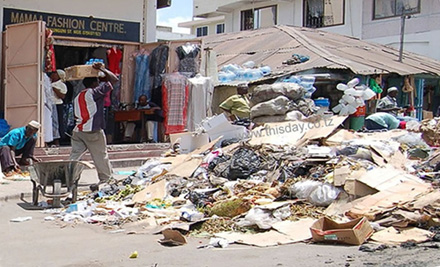
Uncollected garbage outside a "fashion center" in downtown Dar.
Uncollected garbage outside a fashion center in downtown Dar.
Photo by Tanzania's ThisDay.
Africa was agog today with reports that Dar-es-Salaam was the 8th dirtiest city in the world. But are these reports accurate?

No! No! Let me come to the needed rescue of Dar: It is NOT the world’s 8th dirtiest city; it is, in fact, the world’s 12th dirtiest city!

Mercer Health & Sanitation’s Index rated Dar at 40.4. Only three other cities in Africa were rated worse than Dar: Ndjemna (Chad) at #11, Brazzaville (Congo) at #10, and Addis Ababa (Ethiopia) at #6.

No other East African cities came in the top 25, although Nairobi fell into the top 35.

(Multiple African news reports cited a “NYC Consulting Firm” rating of #8 for Dar, but there doesn’t seem to exist an “NYC Consulting Firm.” That list of the world’s dirtiest cities is close to the real Mercer ratings, but not exact.)

Dar is not denying the criticism.

“It is true and I accept that the city of Dar es Salaam is dirty,” Dar es Salaam Regional Commissioner William Lukuvi told This Day an on-line Tanzanian news source. And that’s good, of course.

Dar is the fastest growing city in East Africa. No one is sure about its size, and it’s probably not as big as Nairobi, but closing the gap quickly. It also lacks Nairobi’s sprawling slums, which in an unusual way contributes to the lower Mercer rating.

Nairobi slums have been around for a long time and many NGOs have worked at them, as has the central government. Sewage, bad water, and the diseases that spread as a result, are the main reasons for Mercer’s list of the worst cities. And ironically, the decade and longer attention to the Nairobi slums has actually mitigated what would otherwise be an uncontrollable catastrophe.

Don’t get me wrong. The Nairobi slums are terrible, but the makeshift gullies cut by NGOs and the government does drain human sewage, the main cause of cholera. Last year there was more cholera in Dar than Nairobi.

Dar’s problem is that it is far behind Nairobi in sewage treatment and waste disposal. This is probably because Dar is on the ocean, and it has been common practice to just dump waste into the sea. The practice is now haunting the city, because unlike Nairobi, it has no well-organized sewage disposal.

Dar’s other problem is corruption. Dar’s three municipalities each contract private companies for garbage disposal, but don’t pay them. Instead, they allow the private companies to collect levies however they wish, a completely haphazard and terribly corrupt system.

To his credit, Lukuvi knows this.

“The present system is messed up. You can’t have a contracted company collect garbage and levies at the same time. The municipalities will henceforth be responsible for collecting the levies and paying the companies that are contracted to collect the garbage,” Lukuvi told This Day.

The annual Mercer ratings are important. They corroborate the United Nation’s warning that the greatest threat to the developed world is the lack of clean water.

Of Mercer’s 25 worst cities, 20 are because of a lack of clean water. Only 5 are because of air pollution.

Is Kenya Safe?

Is Kenya Safe?

Safer to be in than Tanzania or Uganda, according to the UN.

The U.N.’s announcement this week that Kenya is now safer for its employees than Tanzania or Uganda sheds new light on how travelers should view government travel warnings.

Not much has changed in the last year in world governments’ advice to their citizens heading on safari. The U.S. and Britain retain a travel warning against Kenya, Canada doesn’t, and Canada and Britain retain a travel warning on Uganda, and the U.S. does not.

The U.S.’ lack of warning on Uganda is political. Ever since Bill Clinton invested so much time and money in Uganda, and more recently when so many U.S. politicians got mired in Uganda’s sticky politics, the U.S. has misrepresented that country’s safety for travelers.

I think Uganda is safe to visit, if you know what you’re doing. As I do for Kenya and Tanzania. But traveling to East Africa for a safari is not as safe as traveling to Branson, Missouri, for a music festival, or to the Loire Valley for wine tasting, and it’s perfectly right of governments to try to explain these distinctions.

After years of trying to figure out these admonitions from a variety of western governments, after years of parsing which are political and which are truly advisory, I think at last there may be a better guide for potential travelers than any government’s specific recommendations.

The United Nations has tens of thousands of employees stationed all over the world. The level of pay – like our own military and foreign service – is determined to a certain extent by how dangerous the UN believes these postings are.

But the UN goes beyond analyzing simple threats to personal safety. It analyzes how easy communication is, what diseases are locally threatening, how likely power interruptions occur, how smoothly complaints and infractions of local law are handled by local authorities, how complete public services are… it even analyzes how enjoyable are local cinemas and theaters, how well stocked is the local grocery store, and how the climate might effect foreigners not used to it. And much more.

It goes on and on, because what the UN realizes is that the “safety” of a foreigner in a foreign place is a “well-being” issue that extends far beyond whether or not al-Qaeda is trying to get you.

And so the UN puts all the countries in the world into 5 categories: A, B, C, D or E.

Get a posting to a country with an “E” rating and you’re going to be paid a lot to maybe get killed. Get a posting to a country with an “A” rating and you’re going to be paid a lot less but will live to spend it all.

Better yet, the UN may divide a country’s rating depending upon what city you’re visiting.

Last week the UN moved Nairobi and Mombasa (Kenya) up from C to B. It kept Arusha and Dar-es-Salaam (Tanzania) and Kampala (Uganda) at C.

That’s exactly how I feel.

C is OK, if you know what you’re doing and how to do it. B takes a little bit less care.

Of the 141 countries in the world that the UN has a permanent presence:
49 are A,
37 are B,
27 are C,
21 are D,
and 7 are E.

Of those 46 are in sub-Sahara Africa:
6 are A,
9 are B,
14 are C,
13 are D,
and 4 are E.

As I’ve said time and again, nobody going on vacation wants to research the safety of where they’re headed. But also as I’ve repeatedly explained, a safari isn’t a “vacation.”

There’s little R&R on safari. A safari traveler is a student, and that’s a wonderful thing. She’s an explorer, lusting for the new and unknown. He doesn’t want a quiet beach in the Carolinas.

So there’s a risk in this, however slight. It takes some guts to want to become smarter, to educate yourself about parts of the world that are foreign to you.

But that doesn’t mean you put yourself in danger. So how best to determine this threshold?

Go first to the UN list. Don’t go if it’s a D or E. If it’s C, then read the detailed travel advisories from your country and others to help you determine if you consider it safe. If Britain, Canada and the U.S. all agree, I think you can take that as a pretty unbiased analysis.

But if they don’t agree, as they don’t in East Africa, it gets a bit tougher. You have to figure out why they don’t agree, and decide who is better to trust.

(Important qualifier: my simple list above is for only the capitals of those countries. Kenya, for instance, gets an “E” for the town of Garissa, which is near the Somali border. So you also need to research your travel by city, beyond the simple capital references given above.)

And finally, I’ll leave you with this travel admonition recently given to travelers from abroad who are considering visiting the United States:

“There is a general threat from terrorism in the United States. Attacks could be indiscriminate, including in places frequented by expatriates and foreign travelers. The US Department of Homeland Security (DHS) has designated the terror alert status of “orange”, or high, for all international and domestic flights in the USA.”

The above admonition comes from Her Majesty’s government of Great Britain.

When Not To Come To Nairobi

When Not To Come To Nairobi

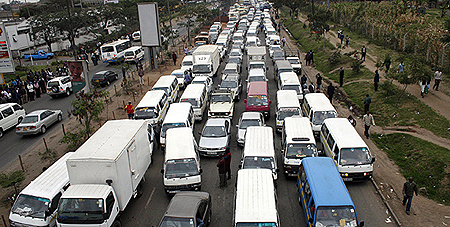
About 8:15a, Wednesday 10Jan6, airport road into city.

Try not to arrive Nairobi in the morning of any weekday. If you do, you’ll end up a part of this.

The congestion in Nairobi’s morning weekday (and sometimes, Saturday) traffic has become apoplectic. Traffic it is no longer. From about 630a until 930a it is a frozen sea of smelly metal.

Travelers leaving Jomo Kenyatta Airport for the city or any destination north should expect as much as a 150-minute drive on what in the evening or on Sunday morning would be a 20-minute drive.

Blogging in today’s Daily Nation commuter Samantha Spooner writes:

Another blog that involves cars… but this is the reason this blog is being written – it is where we are spending a huge proportion of our time these days. A blog on ‘stuck in traffic’ is nothing new but the situation has become so absurd that something needs to be written, if for nothing but my sanity.

Previous to Samantha’s post, I had believed that idle remarks on Facebook were how people were curing insanity.

Elephant Attack

Elephant Attack

Yesterday an American woman and her infant were killed by an elephant as they walked out of the Castle Forest Lodge near Mt. Kenya.

The name of the woman has not yet been released, but Kenyan authorities said she was the 39-year old wife of a teacher at Nairobi’s International School. The age of the infant was not given.

Reports by Agence France Presse said they were in a small group “casually walking” into the forest, and that the group included her husband who escaped unhurt.

None of the reports has been confirmed by U.S. authorities, but they are likely true.

The Castle Forest Lodge is a downmarket log motel not too far from Serena’s Mountain Lodge, one of Kenya’s five tree hotels. It’s located on the south end of the Mt. Kenya National Park, an area known to have many elephants. Expat workers typical of a U.S. high school teacher frequent the facility. One night with all meals costs $63.

One night with all meals at the nearby Serena Mountain Lodge retails at $260.

I am intentionally implying that the more you pay, the less likely you are to get trampled by an elephant.

The largest group effected by elephant deaths in Africa are not tourists, but Africans in their homes and farms who also do not have the insular experience of a well-run tourist facility. I am not implying that Africans or expats who pay less should be any less protected from elephants than my own Park Avenue clients.

There are some very nasty edges to the make-up of a tourist.

What a Deal!

What a Deal!

At last East African tour companies are doing the right thing to try to get back on their feet, and there are incredible deals for new bookings.

The New Year arrived with a plethora of tour deals, and they’re real. They include ridiculously cheap airline tickets, internationally and domestic, 3rd and 4th nights free, and just the good old drop in prices. These are real deals that will be pulled once the market recalibrates.

One of my great criticisms of East African tourism over the years has been the typical but counterproductive reaction to a downturn in business of raising prices.

I know that’s counter-intuitive, but as I’ve explained before, supply/demand really only works well in a functioning free market. The developing world is moving that way, but they aren’t quite there. Even in the most scrooge-like companies in the developed world, laying off workers is expensive. There are either severances to negotiate, or high unemployment taxes to be paid.

Not so in the developing world. Just tell Johnny at 4 pm not to come to work, anymore, and then close a third of your lodge. Raise the prices on the bookings which are left and maintain a semblance of profit. The profit will be a lot smaller than it was, but it won’t be a loss… except, of course, for Johnny.

The problem with this strategy is that the market is not waiting in the sidelines to jump back into East Africa. If prices go down in India, it’s likely quite a few potential East African visitors will end up there, instead. A huge percentage of East African travelers come as referrals, so every booking lost represents multiple bookings for the future.

The raise-your-prices, lower-your-costs strategy is terribly short sighted for East Africa. East Africa must mature into the real supply/demand dynamic that governs world tourism.

This time, East African companies seem to be getting it right. Prices are definitely dropping. I reported earlier that 2010 contract rates issued last November showed a 5-10% decline over 2009. This is the first time since EWT has been keeping records that there was ever an announced decline in contracts.

And over the New Year’s weekend, a whole bunch of new offers began appearing.

A number of tour companies, including EWT, are now able to offer free Zanzibar or Mombasa beach stays after 10 or more day-long safaris.

Air fares have sunk through the basement. The leader is the airline, Swiss, which is offering roundtrips from New York at $1143.10 with taxes, and from London at $646.50 with taxes. But there are many others close to this. Many are offering free stopovers at interesting places, such as Turkish Airlines, where you can now stopover from the U.S. at Istanbul, then continue your East African trip for around $1200.

Business might be doing the right thing, but the Kenyan Tourist Board is stuck in the past.

Last week it announced a “vigorous recovery” of the tourism industry which was a flat-out lie. Announcing an expected 680,000 arrivals for 2009, the KTB proudly said this was a huge recovery representing a 17% increase over 2008.

Uh, did anybody remind that statistician that 2008 had tourist arrivals of 50% of 2007, because of the political turmoil in the country, and that there was no economic downturn in 2008?

What a joke. Kenya was approaching 1.2 million visitors in 2006. Let’s be real, honest and forthright. Neither the consumer or travel reseller is going to be anything but perturbed by these ridiculous statements.

Anyway, this morning’s overall reality is great! It’s taken so damn long for East African businessmen to realize what is necessary in the global market. I don’t think anyone should start planning a recovery party, soon, because this downturn has been deep. Whether tourism or tea, the recovery will be a long one.

But those who take true supply/demand initiatives, and who are honest with their consumers and resellers will still be standing when the sun finally rises.

And tourists, don’t wait for that sunrise! The deal is now!

Law of the Jungle!

Law of the Jungle!

Tourist fees in the Serengeti and NCA (Ngorongoro Conservation Area) have doubled, and in some instances, tripled, and it’s not clear whether this is law or graft.

The law is printed on the official TANAPA fee schedule. Click here to download that schedule. The fees are basically $50 and in bold red letters at the bottom of the brochure it states, “NB: Fees valid for 24 hours only.”

There is nothing that says it is for a single entry. But many tourists are now being charged $100, and some, $150, based on the notion that the gate is a toll-booth, not a park gate, and that every time you pass you have to pay!

The vast southern grassland plains of the Serengeti are technically composed of two separate parks management authorities: the Serengeti National Park (north) and the Ngorongoro Conservation Area [NCA] (south).

Ngorongoro Crater, Olduvai Gorge, Lake Natron, Olmoti and other old volcanoes and most of the lakes region of Ndutu is technically in the NCA. Naabi, Seronera, Moru, Gol, the western and northern corridors are technically in the Serengeti National Park.

The multiple charging occurs to tourists who are lodging in one area but traveling during the day into the adjacent area. The first example I can document of this in August… to me!

(I paid $50 for the day of August 31 at Ndutu Lodge in the NCA. Then unexpectedly I had to drive into the Serengeti to pick up guests who had been delayed. The rangers charged me $50 for simply driving to the airstrip to collect the guests. But then as we returned into the NCA, the rangers charged me a third $50 for “reentering” the NCA.)

At the time I chalked this as just one more incident of African graft. There’s nothing on the permit which could otherwise explain it, and I didn’t want to duke it out with the rangers while welcoming my newly arrived guests into the Serengeti.

Increasingly, though, it is happening to many of our safaris.

The northern border of the NCA abuts the southern border of the Serengeti and traditionally game drives have moved back and forth over this vast area, more commonly known as the southern grassland plains of the Serengeti.

Often the great herds are partially in one area and partially in the other, and moving back and forth between the two areas is the only reasonable way to undertake a game drive in the area. Now, it seems, every time the invisible line is crossed, tourists will be charged $50!

Every country has the right to charge whatever they deem fit for foreigners to use and visit their natural resources. But what if this is not what the Tanzanian government believes is being charged? Who, really, is pocketing this money?

And if it is legal, then the permit and literature like the fees schedule should say so.