On Safari: Dead Elephant Walking

On Safari: Dead Elephant Walking

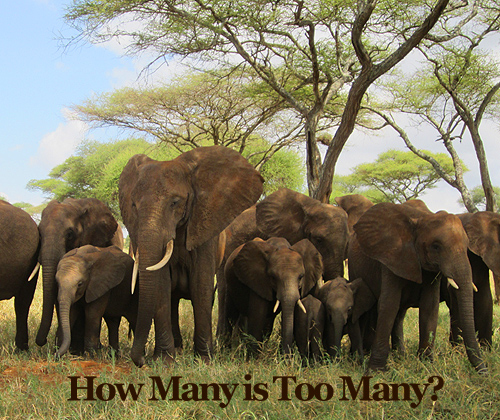
Chobe’s elephants are legendary, but what I saw this time is disconcerting. They are tame, inbred, their many broken tusks are like toothpicks, their family behaviors have broken down and they are destroying the Chobe forests. Is it time to cull?

There is a growing consensus in the affirmative. Even the conservation organization Elephants Without Borders, which can hardly be blamed for skirting the issues of culling, has come round to accepting it at least when human tragedies are caused.

These ‘problem elephants’ should be culled, according to a September, 2007, white paper written by EWB researcher, Dr. Michael Chase. Chase’s argument at that time was that a culled elephant would discourage other elephants from repeating the offense.

But that has proved untrue. And elephants causing injuring a person or destroying a small farm is hardly the major problem; it’s simply the one that gets the most attention. It’s the easiest to understand.

But there are far more serious consequences of too many elephant. It starts with the elephant itself. And the problem isn’t and wasn’t the elephant; it’s us.

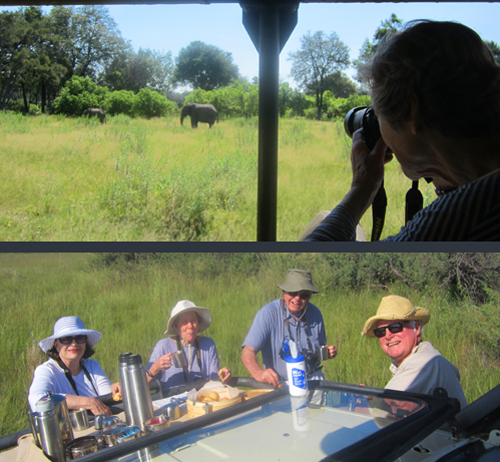
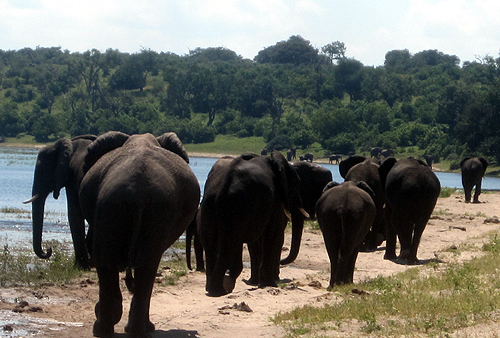
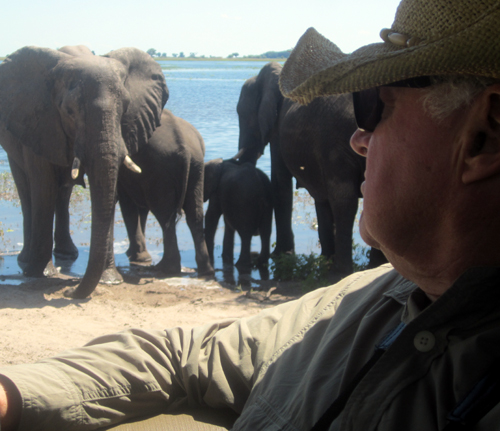
Today we watched spectacular displays of multitudes of elephants in Chobe, playing in the water (actually swimming!), young adolescents sparring harmlessly, and at least three newborns just discovering the world. How can we not but simply sit back and enjoy this?
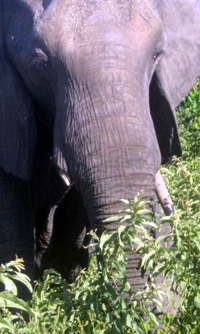
Chobe's toothpick elephants.
Because when looking a little closer, the scene ain’t so cute. It’s absolutely remarkable how many of Chobe’s elephants have broken tusks, an obvious reflection that if not eating themselves out of house-and-home, they’re at least so far eating themselves out of calcium.

And the tusks which remain are pitiful. We know that smaller tusked elephants throughout the continent are a result of the years of cataclysmic poaching in the 1970s and 1980s, when “small tusks” become a survival mechanism. Only big-tusked elephants were wanted by the poachers.

But large, healthy tusks are essential to a sustainable elephant population, which uses them for all sorts of things, like digging for salt and in dry times, water. So throughout the rest of Africa we’ve seen the slow improvement in the size of tusks.

But not in Chobe. Quite the reverse, and whatever makes for strong, healthy tusks is now jeopardized.

And then there’s the elephant’s important family behavior. Males that reach puberty are kicked out of the family unit. Females remain with the unit forever with their children, and a grand matriarch leads the family. In Chobe, that seems to have disappeared almost altogether, simply because there are so many elephant they can’t separate themselves into any type of grouping.

I hesitate to quote numbers, because elephant population studies are notoriously wrong, skewed by the bias of the organization making them, and official government conservation numbers can be even worse.

Moreover, elephant are difficult to count, because they travel such enormous distances so quickly and do not necessarily repeat travel routes. But suffice it to say there are lots of elephant in northern Botswana and similar habitats in surrounding Zambia, Angola and Namibia.

I have been visiting Chobe since 1978. Hardly is my analysis scientific, but my photos speak volumes. Most of Chobe was a forest in 1978. Today, every excursion from Kasane into the park that was once a dense forest will encounter meadows and eroded cavities with fibrous grasses.

Chobe is a resilient ecosystem, sitting along the rich river systems that eventually form the Zambezi, and in an area with relatively high rainfall. But while it may be true that ecosystem recovery is more possible here than in other places in Africa, it is clear the degradation of the ecosystem in the last 30 years has been severe.

What we can see is only the tip of the iceberg. The loss of biodiversity in grasses, trees and other plants leads to a loss of biodiversity in avifauna and much more.

Why will no organization undertake a definitive biomass study?

Because everyone knows the outcome, and no one wants to author it.

Even the official government site for Chobe National Park concedes, “Damage caused by the high numbers of elephants is rife in some areas of the Chobe National Park. In fact, concentration is so high throughout Chobe that culls have been considered, but are too controversial and have thus far been rejected.”

I think we’ll have to leave it to the younger and less prejudicial scientists yet unencumbered by worries about funding and tenure from a public obsessed with the “little bunny” syndrome. But for better or worse, young scientists taking the issue head on are concluding that culling is now not a viable option.

Benjamin Golas of the 2013 class of graduates of the University of Pennsylvania veterinarian school is one of them. He writes about Chobe:

“Too many elephants…”

“I would hardly be a good conservationist if I did not bring up [the fact that] the region, which can happily and sustainably hold a few thousand pachyderms, is home to upwards of an estimated 140,000… and it shows.

“Trees become scarce… Baobab that remain… look sick and scarred.”

Golas sees the most terrible situation looming. He believes that we have avoided culling for so long that now “the sheer numbers of elephants have made responsible culling impracticable” and there is no viable alternative.

No viable alternative? So then, what?

Perhaps the natural crashing of the population, a Biology 101 phenomenon that every college student learns: Left to nature’s devices, too many of one species will ultimately result in its cataclysmic decline, suddenly and often without warning.

It could be a virus that spreads like wildfire. It could be a syncing of estrus cycles caused by unusual weather. It could be a a new political shift in local human populations that just get fed up with the problem. But something will ultimately cull the elephant, now that we haven’t.

For years I espoused this position: let nature take its own course: Hand’s off. But now I see the danger of so doing, that as the elephant takes itself down, it may take much of the biomass with it.

Is it time to cull?

It’s too late.
On Safari: A Precious Fragile Delta

On Safari: A Precious Fragile Delta

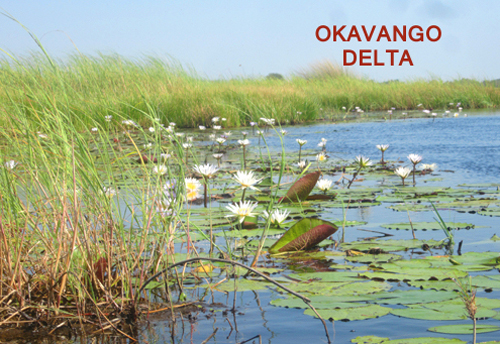
The one-of-the-kind Okavango Delta in far off Botswana, like every other part of the world, is threatened by the unusually rapid global warming caused by Chinese factories and soccer mom’s SUVs in Minneapolis. It makes our trip now even more treasured.

Numerous studies as early as 2007 from a variety of high-tech government organizations around the world have established that the Okavango is in for a mighty wallop. I experienced it myself last year when the flow from Angola was so severe we were flooded out of our first camp.

Numerous tourist businesses in Botswana suffered from that flood. This year it’s better. The flow seems to be ordinary, but that’s not the end of the story. The rains, which generally have had minimal impact on the water levels of the Delta, have been so intense in the region that rivers, roads, lagoons and lakes are overflowing.

The ice cap has to go somewhere.

Few places in the wild world are studied as intense as The Delta. This is because it’s so unique. No one is happy with what’s happening or is expected to come, soon. Too much water in The Delta will change it significantly.

But what does this mean for animals and plants, for the system as a whole? I’ve often written that the ecology of Africa is marvelously adaptable. The problem is what will that adaptation be? Retreat from man? A part of the downwards spiral of increased carbon emissions?

I worry about that for the Delta. The storms have been so intense, all sorts of lighting fires have been started this year. Add to that increased human pressures, particularly from honey harvested in wilderness regions, and fires are spreading through the Delta as if it were San Bernadino in August.

And then there’s elephants. So many. Too many? Elephants contribute to the loss of forests, and forests recycle carbon gases.

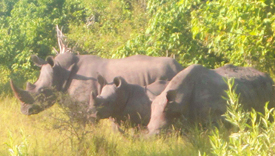
For my clients this time it was magnificent. In one game drive alone we saw the Big Five, mainly because rhino reintroduction throughout Botswana by a number of organizations has been so remarkably successful. I’ve often seen the Big Five Minus Rhino on a game drive, but I can’t remember the last time I’ve seen them all on a single several-hour game drive.

So for the time being and thanks to such wonderful projects as rhino reintroduction, the Delta remains spectacular.

But, for how long?

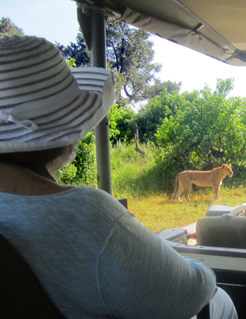
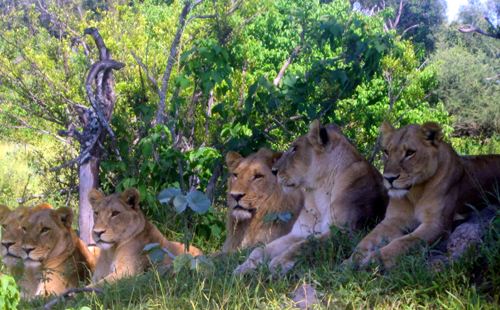
Six of the 10 lion in one pride that we saw yesterday.

On Safari: Moremi Game Reserve

On Safari: Moremi Game Reserve

On the drive from Chief’s Camp airstrip we saw elephant, kudu, hyaena, impala and giraffe. That took about 30 minutes. The Okavango Delta at this time of year is truly magnificent!

The veld is beautiful right now. Everything is lush and green. It’s a bit late for the blooming trees and flowers, although I did see one acacia still flowering and a beautiful wild iris of the most delicate pink color seen from time to time throughout our drives.

The juvenile carmine bee-eaters are just getting their full color, and the migrants – like the yellow-billed stork – are still here in large numbers, so to a certain extent we’ve got the best of both seasons as far as birding goes.

It’s the end of the Delta’s summer, temperatures today began in the mid 70s and would rise throughout the day to nothing more than the upper 80s. A huge cold front has moved into the southern part of the continent, so we were lucky. But even without this front, it would hardly be ten degrees higher.

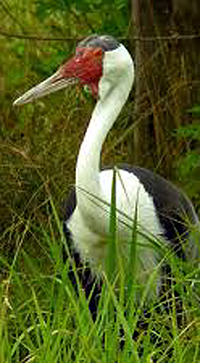
The highlight for me on the morning drive was seeing a pair of wattled cranes. These magnificent birds were almost extinct less than a decade ago, and according to the Wattled Crane Rescue Foundation there are now 235 in South Africa. (There are no good number estimates for Botswana, but I imagine it’s higher.)

The crane was challenged by what challenges most of Africa’s wildlife, today, growing human settlements, and in particular, power lines. Baby wattled cranes fly up to six weeks before they can walk, so if knocked out of the sky on their juvenile flights, they’re often doomed.

Like whooping cranes and California condors saving the crane fell to a consortium of private groups which raised the funds and enthusiasm for a sustained recovery effort that began with collecting eggs and raising chicks in safe facilities for later reintroduction.

Fortunately, normal behavior of the crane is to lay two eggs but to raise only one chick, so pilfering the nest of a single egg had little impact on the status quo.

Always a highlight is the incredible numbers of elephant, everywhere. Today we encountered 20-30 on the drive of all ages, and several groups of large males. During lunch at Chief’s Camp everyone was treated to 24 elephant in two families and a male following at some distance.

They moved into the swamp behind camp and found a channel where they watered and played, and then a secondary mud hole where the young especially spent a long time rolling and playing. It was an extraordinary course to an otherwise exceptional meal!

We’re here at Chief’s for three nights. Stay tuned!

What a Valentine’s Bouquet!

What a Valentine’s Bouquet!

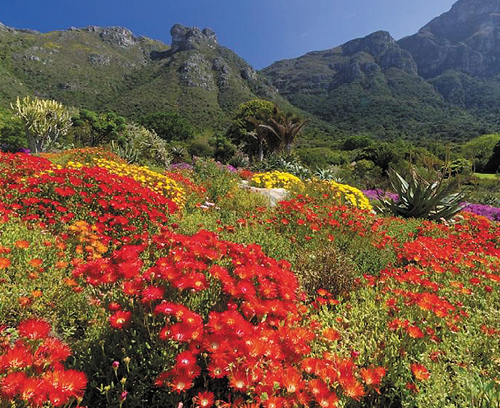
The floral biodiversity of The Cape is greater than the Amazon; in fact it is the most diverse floral system in the world, even though it’s the smallest.

Today and tomorrow we experience this amazing Valentine’s Day bouquet, first by visiting the famous Kirstenbosch botanical gardens as it celebrates its 100th birthday, and tomorrow, by visiting the tip of Africa, The Cape of Good Hope.

In the special care of one of Kirstenbosch’s most famous guides, Andrew Jacobs, we piled into an elongated golf cart and began a comprehensive tour of one of the seven richest and most beautiful gardens in the world.

The day was gorgeous, Table Mountain loomed above us, the Cape Francolin barely moved out of our way and despite the fact this is not a heavy blooming season, we saw an amazing display of our planet’s evolutionary ingenuity.

The Cape is one of the world’s six floral kingdoms. (The other are the Northern Hemisphere, South America, Antarctica, Australia and Africa other than The Cape.)

There are about 8800 unique plant species in an area about the size of the State of Maine, and 69% of the endemic! Both facts are amazing. The density of species diversity is 3 times greater than the next highest kingdom, the Amazon portion of South America.

The reason for this remarkable and concentrated biodiversity has to do with where The Cape is: at the confluence of the world’s coldest and warmest oceans, where jetstreams and ocean currents collide ferociously.

The result is a climate that is mostly dry, but when it rain it rains hard. The result is a plant kingdom that thrives because of considerable moisture but had to learn how to conserve water over very long periods of dryness.

It is mostly a leafless kingdom, with photosynthesis occurring in the stems. What looks like leaves are stemmy reeds, waxy or hairy and almost always pointed and sticky. Butterflies are still needed for pollination, but because there are no leaves for the caterpillars to eat, these butterflies’ caterpillars are carnivorous, eating ants!

Protea and red bush tea are the two stars of the kingdom, both fynbos which is the single largest plant grouping in the kingdom.

One of the best places to see the greatest variety of this kingdom is atop Table Mountain.

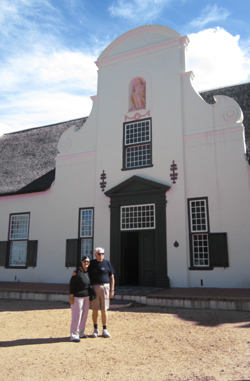
Whitney & Ada Addington in front of the manor house at Groot Constantia.

After our great tour we went to nearby Groot Constantia, South Africa’s first vineyard, and tasted the Sauvignon that has been cultivated here since 1679! The restored houses and stable and excellent orientation center depict the life of Simon van der Stel, one of the first governors of the Cape and generally considered the father of the Boer culture.

It rained this morning! It’s not supposed to rain, now. (How often have you heard your tour guide say this?) But the climate is changing, and fortunately for us, the afternoon was bright and beautiful!

On Safari : The Spectacular Cape

On Safari : The Spectacular Cape

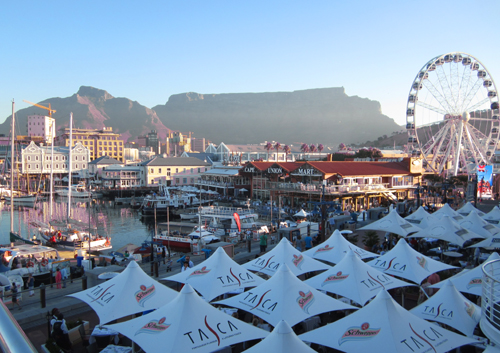
Sunset at the Waterfront. Table Mountain in the background.
Table Mountain is cheeky. It’s one of the main reasons tourists come to Cape Town, but it only lets itself be seen about half the time.

The mountain was truly spectacular for me this morning. I’ve been to Cape Town about a dozen times, but I had yet to take the funicular up the mountain. Mostly this was because I’d always tightly scheduled my time, here, and I knew scheduling in the mountain was iffy.

The main website for the cableway starts on the right top first page with the announcement about whether the mountain is “open” or “closed.” And even that is somewhat misleading, because the tram runs even when the mountain is wrapped in cloud, which is about half the time.

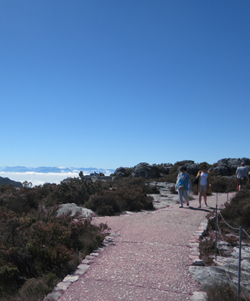
Easy trails once on top.

The mountain closes when the winds get too steep. In fact there’s a very, very loud “hooter” at the top that screams out when the winds are coming in, giving everyone a very short time to get back to the tram or face either staying up top for a long time or taking the 4-hour walk down.

But these last couple days have been so spectacularly clear and wonderful warm in Cape Town, and every morning I’d sit eating my breakfast staring at a perfectly clear mountain top, that I knew it was time.

I got a parking place only about a half kilometer from the tram entrance. That’s not bad, because whenever the mountain is out and especially in the morning every tour guide and tour bus in Cape Town heads for the mountain. It doesn’t matter you were headed to see the penguins or buy trinkets at Market Square or learn about history on a stroll through the Company’s Garden – all that in due course, ma’am. If the mountain’s out, go for it!

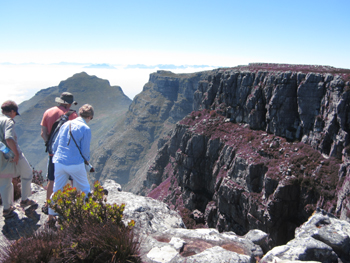
Getting ready to lie down on "Belly Rock." Slightly angled up so you can look over the edge 3000' down!

So it’s crowded, and I was in the beginning of the crowds which shortly after I arrive around 945a had stretched to a waiting line of about 45 minutes. Two cable cars each carrying 65 people go up and down constantly, a journey of just a couple minutes.

Once a top it’s amazing. And not just the views, but the unusual ecosystem found here includes some remarkable fynbos, reeds, orchids and of course, proteas. The best time for the flowering bouquets is August and September. But I was here in the worst time, February, and it was still beautiful.

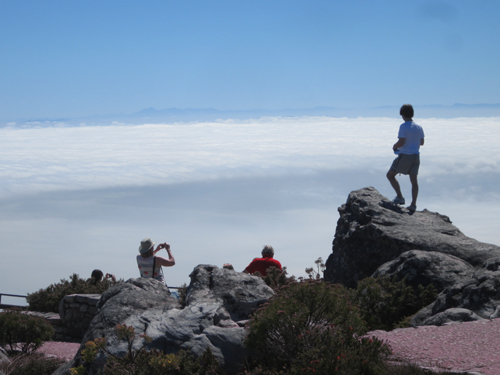
The mountain’s geology is equally fascinating dating back 600-800 million years. It’s a unique type of unusually dense sandstone. There are wonderful park trails with good signage and you can spend the day up there or an hour. In an hour you can get the entire panoramic view of both the east into False Bay and towards the Indian Ocean, and west into Table Bay and the Atlantic. On truly clear days you can see Cape Point.

Managing the crowds is becoming difficult. My guide actually caught one Korean chipping off a piece of rock, which of course isn’t allowed. The guide explained that Koreans who worship the “Five Great Massifs” of which Table Mountain is one come with concealed rock hammers to chip away a piece and take it home.

And there little old British ladies, I was also told, who nip away the protea buds! Or steal the orchid seeds!

And there are macho Australians who illegally jump off with unlicensed paragliders!

I felt like Polijimmy.

Our trip’s first stay is on the Waterfront. I really don’t think there’s a better place to stay these days in Cape Town, unless you’d like a good BnB or have more time for a condo or villa along the coast. But for a traditional hotel stay, it’s really the Waterfront. The aged Mt. Nelson is too far away from the action.

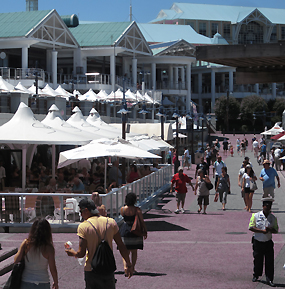
Everything is at the Waterfront and don’t be discouraged by its touristy aspect, after all that’s why you’re here, right?! All the adventure touring from whale watching to shark diving to sunset cruising starts from here, the famous aquarium is here, although many of the good sightseeing attractions are a few minutes away in the city.

But 80% of Cape Town’s finest restaurants are here, entertainment is here, and of course all the good shops are here. The management encourages minstrels, new bands and juggling troops, pantomimers and all sorts of performance artists to just set up shop willy nilly.
So along with the amazing aroma of freshly fried calamari you’ll hear creative music at every turn.

My choice of hotel is the Victoria & Alfred, simply because of its location smack dab at the beginning of everything at the Waterfront. Table Bay is too staid for my taste and basically reminds me of an old folks home.

But if my pocket’s full and budget doesn’t matter, I go to the Cape Grace, absolutely one of the most stellar hotels in the world, and only five minutes further away from the action than the V&A. And if my pocket’s tight and hotel ambience is really secondary to anything else, then it’s the Portswood, a truly fine value only minutes away by a well marked walkway.

What a wonderful way to begin an African trip!

On Safari!

On Safari!

I’m off to Africa! The next 6 weeks I’ll be posting from Cape Town, Johannesburg, the Okavango Delta and the Serengeti, among many other wonderful places in the east and southern parts of the continent.

The next four Mondays will be honored by blogs from the African expert and Wilson scholar, Connor Godfrey. But the remaining three days of postings each week will be from me on safari.

It’s remarkable how fast communications have changed, and how the opportunity for me actually posting material to you from the most remote parts of the Serengeti is now possible. (Fingers crossed!) But the advent of wireless communication literally hopscotched the slothful progress of land line communication throughout the continent.

Today there are more cell phones per capita in Kenya than in the United States. And in Kenya and much of Africa cell phones are used for much more than just talking: data transfer, wire payments and even malaria tracking!

So my ability to keep posting to my blog has been revolutionized in just a few years.

I’ll be guiding several safaris, researching a few new venues and consulting. I’ll be posting first from Cape Town next week, absolutely one of my favorite cities in the world.

It’s been a wonderful stint home during a winter of great amounts of snow and intense cold, and my African friends find it odd that I enjoy that kind of climate. Perhaps it’s the extreme, because in just a few weeks in Botswana the heat and humidity are likely to be pretty intense.
And there’s no question that the extremes distinguishing winter in Chicago are no greater than the extremes of thunderstorming and temperatures in the Okavango. And while I think such experiences are fun and valuable for the moment, they are mounting misery upon those who live there year-round.

How global warming is effecting the veld is something I’ll certainly be reporting on.

Stay tuned! The next blog will be from Cape Town!

On Safari: The Call of The Wild

On Safari: The Call of The Wild

A feral ginger cat on my lap trying to bite off my hand for having left her unstroked during my seven weeks in Africa. Why do I already miss Africa?

Our game viewing was fantastic: wild dogs, lions mating, 7-day old lion cubs and 4-day old cheetah cubs, lion hunts and elephant charges, 8-foot vulture wing feathers grazing our heads, wilde raising dust to the heavens, crocs stalking impala, a 9-foot snake like a flash in the dust, and the blood curdling screams in the night – like a vampire’s door closing on a haunted castle – of the harmless little hyrax.

Why do 90-year old veterans return when their doctors say they shouldn’t? Why do residents of America’s own magnificent wildernesses still pay thousands and suffer 30 hours in multiple aircraft designed to compost human beings into cornflakes to set foot on Africa?

No matter how much we learn about Africa, starting of course with the fact that it’s hardly a single place but the world’s second largest continent replete with virtually every habitat on the planet, it remains the wildest place on earth.

And wild is good. Even though it taxes the visitor, physically and mentally, and there’s nothing subtle about it.

Africa’s challenges are virtually all emergencies, environmental or political or whatever. It seems to me, today, that most westerners recoil from challenges, finding ways to ignore crises: kicking the proverbial can down the street. Africans don’t have that option and western visitors to Africa don’t, either.

So I think of all the varied motivations for the travelers who accompany me on safari, the predominant driver is to experience not so much the specific thrill of a bull elephant’s charge, as of the moment of a true crisis that cannot be ignored.

“The End of the Game”
“The Last Chance To See…”
“A Traditional Boma”
“Urban Chaos”
“Worst Corruption”

All the above are untrue characterizations of Africa, but preeminent perceptions by western travelers nonetheless. It’s the best a foreigner who’s never been can conjure as to why they pay so much, travel so far, suffer so many inconveniences and yet come away thinking in an appropriately hyperbolic way that it’s their “trip of a lifetime.”

Sounds crazy, doesn’t it?

Maybe, but it’s not. Because the feelings that drive the inaccuracies and hyperbole are validated by actual experiences, although in much truer and more brilliant ways.

The end of the game is not nigh, but the intense battle between farmers growing watermelon and Tarangire’s elephants has reached high noon. It’s isn’t the last chance to see huge wild open spaces, but until the Serengeti Highway was nixed by public outcry last year, it could have been.

There are no traditional bomas, anymore, but there are scores of Maasai wallowing in the slums and firing up populist movements igniting Arab Springs all over Africa. There is urban chaos, for sure, but without the pollution of China and guided by a remarkably confident and political youth.

And corruption is no worse than at home, and Africa’s actually doing something about it!

These are extremely exciting revelations to the newbie traveler. You can’t experience them anywhere else on earth.

What a fabulous two safaris I just guided! What fabulous, daring travelers accompanied me! That is Africa at its best: excitement, beauty and insight. What a combination!

On Safari : Too Many Elephant

On Safari : Too Many Elephant

20Mar2012: Taken with my little Canon sureshot, 2x.
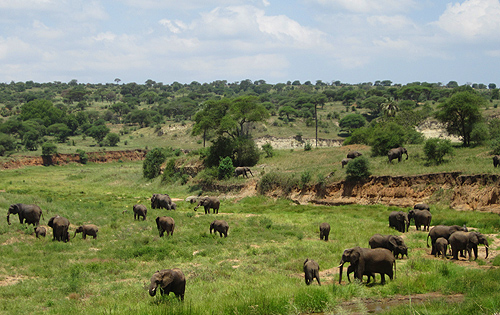
There are too many elephant in Africa and it’s going to cause serious trouble, soon. Our first big game park was Tarangire, and as Kathy Kowalski from Sabula, Iowa, remarked, “It’s like driving by cattle in Iowa.”

When I think back the many years I’ve been doing this, and read the statistics of the early days, it’s an unbelievable story. Elephant fill the veld of the northern half of Tarangire National Park like Thomson’s Gazelle on the southern Serengeti plains.

They’re everywhere. Admittedly this is a bit of a dry year so far. (Perhaps not dry, just late rains.) And that is an added incentive for the ele to come down to the river to dig in the sand. But I’ve seen them almost as dense after the rains were well underway.

And as everyone oohs and ahs over the true majesty of the scenes, here, I can’t help but wonder about the farmers on the perimeter, the school children walking to school, and the oxcart suppliers at the village markets. The future of this part of Tanzania and elephants is colliding like the particles in a nuclear reactor.

Of course we saw a lot more in Tarangire than just ele, especially since we were staying in the southern half of the developed park area at Swala Camp. It’s the only camp in the park in the south, and so there are far fewer people. On many of our game drives there were no vehicles but ours.

Ele researcher Charles Foley has determined that the ele in the north are resident, more habituated and easier to approach. The ele near where we stayed are mostly migrants, more skittish and dangerous, and that seemed very true.

We had breakfast overlooking the exquisite Silale swamp, as I always do, but remarkably this time, no animals. Until we started driving along the swamp road and encountered one of the most beautiful leopard sights I’ve ever seen. She was magnificent: lying on a horizontal baobab tree that was already losing its leaves, in front of a morning grey-blue hazy sky. Couldn’t have asked for better.

I pointed out to my group how massive her biceps and shoulders were and how to compare them to the size of her neck. She compares favorably to a number of lineman in the NFL. By the way, before we left Tarangire, we’d seen 6 leopard. Please don’t spread this around. I have many safaris where no leopards at all are seen.

And we saw lion, on a fascinating and recent kill of a giraffe that had fallen into the pond where the lion had obviously ambushed it. The lion were done eating when we arrived, though still guarding the carcass from afar, and I couldn’t help but laugh trying to imagine these water haters eating their treasure.

The lioness had just brought very young cubs down. They couldn’t have been more than 7-10 days old, and of course, they were unable to get through the water to the carcass. But they seemed to have enjoyed their first introduction in the real world.

We went back to the kill the next two days, and very little changed. The lions were asleep in the grass, the vultures were patiently roosting nearby, a jackal or two was running helter-skelter around, but no food feast going on. These lions will likely not kill again in the normal three days, just come back to this mega-sized prey and feed again until they get tired of old meat.

It let me explain to everyone another of the great myths of the African wild: that whatever is killed is gone, finger snap, bingo, just like that. It’s never like that. Unless it’s 8 lion killing one warthog. Even a regular old zebra is going to take a week or more to disappear. So this giraffe could be around for a month.

(There are exceptions which probably created the myth. The density of predators and carrion eaters in Ngorongoro Crater is so high, that a zebra might disappear in a day or two. But for the vast, vast majority of the African veld, this just isn’t the case.)

So we came from Tarangire to one is rapidly becoming my favorite lodge in East Africa, Gibb’s Farm, and here we are for three marvelous days, exploring Manyara and Ngorongoro, before heading into the greatest wildlife experience on earth, the Serengeti.

Stay tuned.

23Mar2012: East bank, Tarangire River, just down from Matete.
On Safari: The Real Maasai

On Safari: The Real Maasai

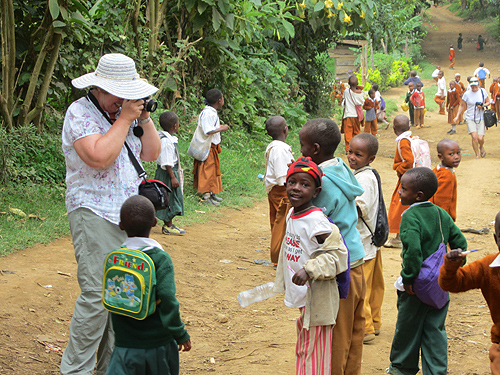
Caroline Barrett meets Maasai school kids.
We’ve had some terrific game viewing, but yesterday was to broaden our experience of Africa: there is so much more than animals.

A vacation, time-off, a holiday – they all evoke images of a breezy, sunny beach, lazing on a hammock swinging softly near a smartly uniformed attendant serving margaritas. That’s not a safari. While there are outfitters who promise exclusivity, rests in the woods with little of a schedule, that’s not what the vast majority of people who come here expect.

They expect above all, wild animals, and there’s no doubt the vast majority of travelers here are animals lovers. And they don’t expect a lazy hammock swinging softly in the breeze. They expect to be roused earlier than normal, herded on schedules into vehicles, and long, long drives over bumpy, dusty roads.

No pain, no gain. In the end the view of the pride of lions with the furry youngsters monkeying around validates the effort. But the effort is considerable, and travelers know that.

So I’ve tried throughout my career to maximize my travelers’ fortitude. And today I think represents a great success. We didn’t start until 9 a.m. Our bumpy ride was but a few kilometers. But the view we got at the end of the day I consider as important as a pride of lion playing.

We spent the day with the “middle class” if you will, of modern Africa.

More than 2/3 of all Maasai in the three countries in which they live are hard working, modern people who live in tight-knit communities that probably remind most of my older visitors of America’s deep south as World War II was ending.

Houses are modest but functional with plumbing and electricity, many in some disrepair for wont of better and expensive maintenance, roads that are horrendous, but communities that take pride in their history, their businesses and above all, their schools.

They are teachers, store owners, taxi drivers, business people and of course, tourism service providers. The Maasai community that we visited on the slopes of Mt. Meru has not lived a nomadic existence herding cows and goats for nearly 200 years.

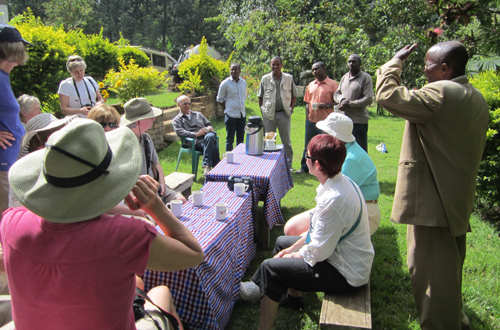
After being briefed by the village chairman whose wife served us coffee and tea in her garden, we were escorted by a young man studying economics in a local college and who spoke excellent English. He explained that there were around 4500 people in the village. “Village” is a political term in modern Tanzania, similar to a town in America.

Phil Lopes studies Mary Critchlow's new necklace.

We saw people working in their farms, women carrying large bundles of wood on their heads, successful men proudly stacking the cement blocks of their better houses and were also escorted to the edge of the village where “traditional houses” existed in a sort of village remembrance of their heritage.

And much of the tour was spent at the primary school. The headmaster brought us into an older class and gave them the opportunity of asking us questions. Among those asked were, “Are you married?”, “How did you get here?”, “Where are you from?”, and “What do you do?”

After each of us explained what we did, the Headmaster asked how many of the classroom of about 50 students would also like to become a such-and-such, an invariably most of the hands were raised enthusiastically.

Until Phil Lopes said he was a politician. There was a pause from the Headmaster until Phil prompted him to ask, “Why don’t you ask how many want to be politicians?”

Enthusiastic laughter and hands-up response.

From Ngeresi village we went into town and had lunch at a local diner, the kind most of the working, modern Maasai in Arusha use for lunch during the work week. The choice of fish, beef, chicken or beans and rice; served with rice, ugali or chapati was unanimously considered a good, solid meal. The cost? $2.10 each.

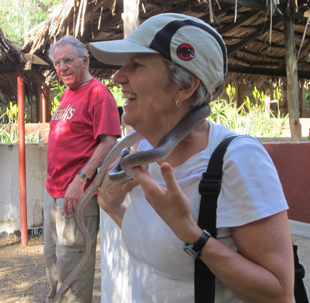
We ended the day at a couple other Arusha area attractions including the Meserani Snake Park, where the Maasai Charles guided us in front of the several dozen snake cages describing how quickly death came from each bite… Well, a lot more actually, like the type of toxic, how bites are treated and why people get bitten.

The Maasai we met and who befriended us today actually call themselves “wa-Meru” rather than Maasai, to distinguish themselves from the traditional (archaic: “primitive”) ways of their ancestors. But their language and their not so distant ancestry is the same, and I have hired Maasai driver/guides here — some of the best I’ve ever had — who herded goats on the distant Serengeti as a young boy calling themselves “Maasai,” and then developed a careers in Arusha town calling themselves “wa-Meru.”

The Vice President of Kenya was a Maasai. The CEO of Kenya Airways is a Maasai. Prominent Maasai fill Africa’s boardrooms. But it isn’t just the most modern and the most primitive. The men driving my clients around Tanzania, explaining the intricacies of acacia dependence on giraffe or the complexity of Tanzania’s new constitution, or discussing the problems of a their children during the teen years of texting – they, too, are Maasai.

It was a long, productive, nonanimal day and I’m now doubly encouraged to give these wonderful clients the finest game viewing in the world. I hope they felt the day worthwhile, a day that might have changed their notion about what a Maasai is.

The Ngeresi Village Chairman briefs my group at his home on Maasai development.
On Safari in Zanzibar

On Safari in Zanzibar

It’s still too early to return to Kenya, so my migration safari began not in Nairobi but in Zanzibar. We had three wonderful, very hot and fascinating days!

It rather breaks my heart to substitute anything for Kenya, which as a society is so incredibly hopeful and promising. But the tourist incidents recently in the north, the kidnaping of NGOs near the Somali border, and the bombs in Nairobi city — however ineptly undertaken – all prove that the Kenyan invasion last October of Somalia has spawned revenge attacks that in my opinion make a safari in Kenya ill-advised.

And Zanzibar is one of the most fascinating places in Africa, for it was here that literally “it all began” in East Africa. Colonized in the early 16th century by Portugal, then conquered by the Omani Arabs almost two hundred years later, East Africa’s culture, language and much of its difficult politics was fashioned here in the ‘Spice Island.’

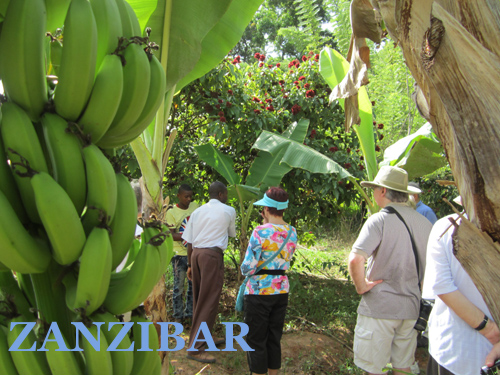
Our first excursion was to see a spice plantation cooperative outside Stone Town. Every spice imaginable is grown here, and it was so remarkable to learn how mace is harvested from the outside of nutmeg, how chilies grow wild, and how almost interminable stripping of the cinnamon tree for its bark does nothing more than promote more bark to grow and more cinnamon to be harvested!

The crown crop is cloves. First planted by the early Omani sultans who realized a business game changer if spices could be harvested less than half the distance from Europe to Indonesia, cloves production continues to be among Zanzibar’s chief sources of foreign reserves.

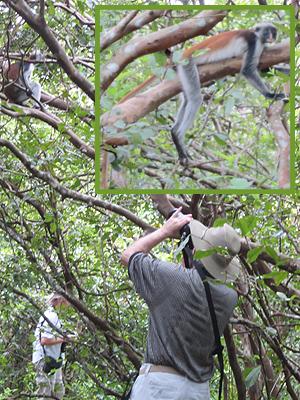
Rich Knapp photographing red colobus.

We then visited the Jozani Forest, Zanzibar’s 20 sq. mile protected wilderness that contains almost 100 species of trees and thousands of unusual plants, flowers, and the main attraction for animal lovers, the Zanzibar red colobus monkey.

The monkey is the last large wild mammal on the island, and its protection is secured principally by the revenue earned by tourists like us coming to see them. And over the years they’ve become remarkably habituated. Multiple times they ran around our feet, swung by our faces, and sat for long minutes giving poses for perfect pictures!

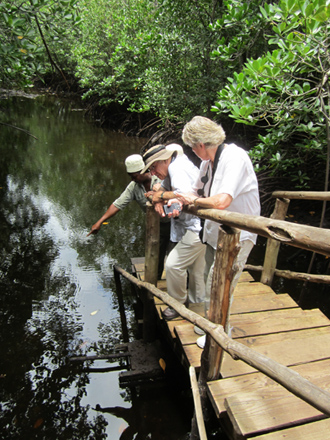
Jozani is also where visitors can learn how important the mangrove forests are to protecting the island. They create a natural barrier to rising tides, tsunamis and typhoons. We were fortunate to go at low tide, when many crabs and fishes could be seen as well, and my compliments to the Zanzibari authorities who constructed the walkway out into the sea through the forest.

Phil & Pam Lopes in mangroves.

The last guided tour we took was a historic walk through Stone Town, its bustling food and fish markets, several of its narrow stone streets and ultimately to the former slave market which became the site of the first Anglican church and is now a museum.

And we ended with a cruise in a dhow at sunset! The “live music” aboard wasn’t exactly Zanzibari or African (Beatles is particularly popular, here), but other than that the opportunity to experience traveling as the early explorers and traders did was a real treat!

On to the great northern circuit! Stay tuned!

On Safari: The All Good Cape

On Safari: The All Good Cape

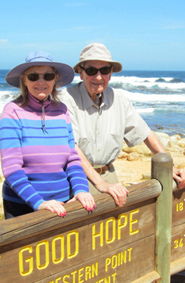
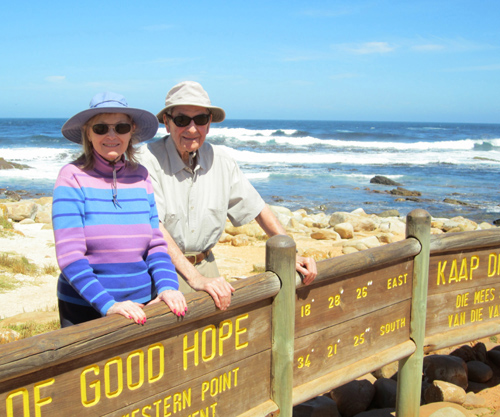
Dr. Lester Fisher, Dir. Emeritus of the Lincoln Park Zoo, with Barbara Shaffer
at the Cape of Good Hope as we began our safari in southern Africa.
I like to begin all southern African safaris in Cape Town, despite it being rather distant from game viewing areas and in spite of its constantly rising costs. As one of the most beautiful cities in the world it portrays so much of what young, modern Africa is becoming.

We spent four nights and five days in The Cape before heading to Botswana for game viewing. It was warm for March, several days in the lower 90s. But fortunately one night of heavy rain turned everything on, like a light switch, and the last of The Cape’s summer flowers and fragrances filled the peninsula.

One day was for the city itself. As with any world class city, I had to pare down the attractions to fit our time. I begin with a walk through the Company Gardens which is laden with history, sated with beauty and ringed with museums.

Nothing exciting was happening in any of the museums except the Slave Lodge, which had a special exhibit about Mandela. The Slave Lodge is one of the more sobering museums in the city, but without some understanding of how slavery affected and was a part of South Africa for so long, you really will never understand the present.

From there we visited what I think has become my favorite Cape Town museum, District Six, but this time I learned how important a guide is, and how fascinating and surprising the experience can be there.

District Six is a “living museum” whose guides are actual persons who were among those evicted from this historic quarter of Cape Town during the most pernicious period of apartheid, the 1960s. Residents who were fourth generation Capetonians were given sometimes less than a week to leave before the home their great-grandparents had built was bulldozed to make into an all-white section of the city.

Prior to the bulldozing, the area was classified as “coloured” meaning it was of mixed races. This could be white and black or Indonesian and Indian, or Malay and white. But it was a close knit, historic, politically dynamic and highly educated community, thrust suddenly into the dustbin of history.

The guides are what make the museum so incredible as they describe not just their lengthy history before the eviction but their lives afterwards and then after the end of apartheid. The story is usually a three-part drama that ends in pretty hopeful and inspiring ways.

But this time the guide we got, a politically active ANC undergrounder at the time he and his family were uprooted from nearly a 100 year history in the community, spent most of his time complaining to we visitors of the current affirmative action policy of the South African government.

Very interesting.

Obviously, the several centuries of apartheid that plagued the Old South Africa is going to take time to remedy, and I doubt there are many who feel that affirmative action is a wrong course of action. But the guide, a District Sixer and therefore a coloured, felt that affirmative action was displacing the opportunities of his family at the expense of blacks. “I’m not anti-black,” he insisted; “I’m just anti black behavior.”

That cliche has rung the world round and been exposed as hyperbole of the greatest sort, and it was a bitter sweet experience for me personally, who has been to the museum so many times, to see this crack in the hopefulness of the New South Africa.

Another day was spent at the Cape of Good Hope, and I can’t remember once before when there was no wind at the top of the Flying Dutchman that overlooks the sea that Dias and de Gama rounded centuries ago. But that was our fortune to be sure! Hardly a breeze, in fact, no clouds and one of the most spectacular views in the world. That day is the day we see the jackass penguins (recently politely renamed “African penguins”) at Boulders, and they’re absolutely some of the funniest things in existence. I like to sneak into the parking lot several blocks from the national park, the “swimming beach” and watch the kids swimming with them!

Another day was spent at Kirstenbosch, with free time to ride up Table Mountain and view the city from Signal Hill. What an amazing place Kirstenbosch is, and how indescribably beautiful. I say that because it isn’t just the gardens themselves which are spectacular, but that incomparable setting below Table Mountain. We nearly cried as our guide was walking us through pastures of bloom and stopped to say hello to an old man who had carried the ashes of wife to a certain point in the gardens that she so loved.

And finally we spent a day in the wine country. You’d be surprised that there really isn’t time to visit more than say two wineries. For one thing, the drive is so spectacular that you don’t want to get off the highway, with the jutting Cederberg mountains framing one beautiful vineyard after another.

I chose vineyards that don’t take tour buses. (We were driving ourselves around in rental cars.) That way you can get incredible attention and detail from the vinter as the wines are described, and real interaction when there are only a small number of people sampling the treasures. I particularly like Rustenberg Winery with its 19th century Victorian garden that is so spectacular as well!

True animal people as we are, part of the day for the wine country was spent at the Eagle Rehabilitation Center associated with the Spier Winery. Nearly half of the Cape Vultures, an endemic species, have been lost to poisoning, and that’s one (but by no means all) of the center’s missions. We got there in time for the 4 pm raptor demonstration and watched a number of beautiful birds flying around, landing on our arms and heads!

The Cape is so wonderful that I just could never see stepping into a game park in southern Africa without first stepping into this wonderland!

On Safari in The Cape

On Safari in The Cape

A Rooibos Tea Farmer in The Cape
Cape Town is my second favorite city on earth, and in no small part because it’s so damn beautiful. The vegetation is lush, but also unique. Giant plants, myriads of bizarre flowers and vines, give an impression of a city in a jungle. Do you drink red bush tea?

I arrived yesterday after several days in the wine country, and it was sixth consecutive day of perfectly clear, hot summer weather. I was ecstatic, because it meant that the guests I would be welcoming today could truly get to the top of Table Mountain, one of the city’s most famous attractions, but one that is rarely enjoyed.

Table Mountain stands over Cape Town like a behemoth angel frozen since the beauty of the world was unveiled. But its head disrupts the complex winds that come from the east, off the world’s warmest sea, the Indian Ocean; and from the west, off the world’s coldest ocean, the Atlantic. When there is the least bit of meteorological turbulence, the grand mountain spins itself into a cocoon of thick cloud even while every other part of the horizon is clear blue.

So we say the mountain is shy. And we learn never to promise a visit to its top, even if you’ve given yourself the week necessary to fully enjoy this place.

So, today, after my guests had arrived, the mountain was back to normal, hiding in its tablecloth.

Never mind, there are hundreds of things to do here, and top of my list is “city bowl” with its overwhelmingly powerful District 6 museum, a stroll with commentary through the Company Gardens, and another stroll through Bokaap including some Malay finger food. And that’s just a start.

And besides, anywhere you go, it’s simply beautiful. Summer, winter, spring fall, something is blooming and exploding color and fragrance. And the best place of all to see a representation is the world famous Kirstenbosch Gardens, one of seven national botanical gardens and among the best in the world.

But I was prompted to write about Cape Town’s horticultural side, today, because of a news report in yesterday’s Cape Times that casts doubt on the longevity of rooibos – you probably know it as red bush tea.

In contrast to everything I’ve said so far, rooibos is not very attractive. It looks like spiney grass. As it ripens just before harvest, it turns brown and ugly, like giant pine needles covered with mildew. And up close it rather smells like bad sap.

Nonetheless, it is one of the world’s most unique teas. South Africans for centuries have lived by it. Early British tourists couldn’t understand why when they ordered tea this despicable infusion arrived instead. And even today, beware. If you say “tea” without qualifiers, it will be rooibos in your cup.

It is admittedly an acquired taste. Like vegemite, haggis, sweetbreads and other basically repulsive sources of energy, when served at a young enough age an immediate affinity is achieved that if missed requires massive concentration to ultimately tolerate.

So my kids, introduced to rooibos at a young age, swore by it. Or rather swore at me if I came home from a safari without it. It took me about 36 or 37 years to finally acquire the taste, but once achieved, it is truly magnificent. Whereas I once described rooibos as tasting something like an infusion of a recently ripped off outer shell of an aged Michelin steel radial, I now think of it as sort of chocolately.

Rooibos farmers don’t actually farm, since it’s a naturally growing weed in one of the super unique micro-climates of the Cape in an area near the Cedarberg mountains. But the farmer’s skills are essential to maximizing the crop: knowing in particular how to, or not to, prepare the soils after each harvest, which traditionally is right about now.

The rooibos farmers here produce 12000 tons of tea annually, and South Africans keep half of that for themselves, or about 2.4 billion cups. Most of the other 2.4 billion cups are drunk by my kids. I drink several cups a day.

There is no question that it has special nutritional values, and this is what has led to the monster battle between Nestle corporation that is trying to obtain a world patent on the active ingredient of Rooibos, and South Africa, which thinks of rooibos as part of its heart and soul.

So today, after nearly a week of unusually hot temperatures in the Cape (mid to upper 80s), climate change experts quoted in yesterday’s Cape Times say the fragile weed could be doomed.

Horticulturally cultivation has failed. People have tried to grow rooibos in Australia, the United States and South America, to no avail. Cultivated rooibos rarely succeeds. It’s got a mind of its own, this thing, and rising global temperatures might doom it forever.

So if you haven’t yet acquired the taste of rooibos, you better start right away. According to these same experts we have less than a hundred years, and it could well take you half of that to learn to enjoy it.

No Coffee Blacks

No Coffee Blacks

My several days in Stellenbosch gave me new insights into the extraordinary difficulties South Africa is trying to confront. My optimism for the future of South Africa has diminished slightly.

Nowhere in the world are the effects of ethnic segregation as easy to see and historically easy to study as in South Africa. And unlike what most Americans think, this isn’t a single generation’s problem: apartheid might be a recent word, but it has been entrenched in South Africa since its prehistory.

Stellenbosch vies with Pretoria as the most conservative major metropolis in South Africa. Just under 100,000 people (a quarter of which are students) it was the first major settlement after the Cape in the late 1600s, the birthplace of Afrikaans and nationalist ideas, and the very center if epitome of Dutch Reformed church theology.

Today it is a producer of some of South Africa’s best wines, a seat of higher learning, and a major tourist destination. I’m here at the end of its summer, its principal tourist season, and there are tourists everywhere from every part of the world.

Yesterday midday I waited as all tourists do, hovering over one of the café tables at Java, an excellent restaurant and coffee house on Ryneveld Street, pouncing the moment someone left. Once seated, no concerns that it will take a server some time to finally get around to you!

Every beautiful café in the 4×6 block city center was the same, but it was also clear there were as many South Africans as foreigners. Many were South African tourists, as the South African who can afford to travel does so far and wide. But there were also many locals, enjoying a beautiful Sunday only about an hour after the great central church had disgorged its supplicants.

During my two days and two nights and four meals and coffee breaks during my weekend stay here, allocating a lot of time to maneuvering for a place to sit… I saw only three nonwhites.

When I went to the local “mall” and only main supermarket, it was all reversed. The mall is only a two-block walk from all the beautiful cafes and restaurants, across from the gargantuan city hall. There it was completely reversed. Hordes of weekend shoppers, only scattered whites.

“You see,” my affable waiter at one excellent dinner restaurant with only whites eating said, “this is not a white place.”

That’s hardly an explanation, so I probed.

Essentially, it’s not that he believed nonwhites felt ostracized anymore; indeed, they control not only the government but a growing proportion of South Africa’s huge economy. “It’s too expensive.”

The racial divisions that have plagued South Africa since inception, institutionalized by Britain in the independence act of 1911 and refined and strengthened until apartheid was torn down by Nelson Mandela, stratified economy by race.

And that’s a hard nut to crack.

The October 2011 census statistics are still being processed, but the 2001 numbers are expected to be better. That’s because in the last decade as many as 4-5 million African refugees have either legally or illegally come into the country.

But as of 2001, 1 in 11 South Africans is white, just a slightly higher percentage than “coloureds” — a uniquely South African racial division representing mixed race with a high percentage of whiteness. That means that roughly 4 out of every 5 South Africans is something else, mostly black.

At independence in 1911, 22% of the population was white. By 1980 that had decreased to 18%. The dramatic emigration of the subsequent several decades, which bled the country not only of skills and talent but also capital, was the result of the writing on the wall of history. South Africa was going to change, and so it did in the early 1990s.

But though its constitution is a model for any truly moral society, and though its top industries are becoming more and more under non-white control, and though its government is wholly controlled by nonwhites, whites still reign.

Because, as my nonwhite waiter explained, “it’s too expensive for us.”

Income inequality plagues the world. The United States ranks among the highest of developed world income inequalities with a “Gini Score” of 41. (“0″ is no inequality; “100″ is total inequality.) Most developed countries are in the 20-30 range. But South Africa? 64

This is almost, but not quite, a which came first conundrum, the chicken or the egg. If you got it, you’re not going to let it go easily, and you’re going to do everything possible to keep it for your kids, your cousins and your community. It’s almost … natural.

But what economists recognize today is that in a rapidly growing and interacting global platform, inequalities are unsustainable. Yesterday in Joburg’s Sunday Times business leader Michael Spicer pleaded with his colleagues to do something about this, calling the current situation in the country a “disaster.”

It isn’t that good South Africans of all colors aren’t trying. The University of Stellenbosch, founded by Afrikaners who wanted to restrict virtually all economic gain only to those of Dutch heritage, excluding even the English, today has one of the most progressive enrollment policy of any major South African university.

Together with nearby University of Cape Town admission policies make our own affirmative action policies seem tepid at best. These major institutions are trying to achieve a 40% non-white enrollment by 2016, and they’re well on their way to doing so.

And not without serious controversy. Admission standards for nonwhites have had to be reduced nearly in half to achieve this measured growth. And you know where that leads academics intent on performance.

So it seems that everyone, everywhere in South Africa is trying to reverse what nearly 400 years of unjust history has created. And how they are trying to do it must be a shining example for every part of the world where income inequality breeds disarray.

The question is simply, will it be fast enough.

Les Fisher on Safari

Les Fisher on Safari

Today I’m on my way to Africa for seven weeks of exciting safaris and consulting, and this time it’s so very special because of a certain great person joining me.

I’ll be guiding the Director Emeritus of Lincoln Park Zoo and some of his friends, in Cape Town and Botswana. Dr. Lester Fisher is 91 years-old and if I recall correctly, this is his 6th “Last Safari Ever!”

My first safari with Dr. Fisher was in the 1980s. Since then we’ve been to Africa almost two dozen times together, and often on some extraordinary and very unique voyages: into Kivu province in The Congo, countless gorilla trips (since he’s the world expert on captive gorillas), multiple times to East Africa including with his own family, Ethiopia, Namibia, Zambia – you name it!

His popular book, “Life on the Ark” describes many of our adventures.

I remember on his 2nd or 3rd “Last Safari Ever!” I had as I’m wont to do kept the group out far too long on a game drive the last day on safari. And it was during a drought in the Serengeti to boot.

It was extremely hot and dusty. We should already have been around the campfire with a Tusker in hand, but we were only at Naabi Hill, still another hard hour’s drive away from camp.

Les was already up there in years, and I saw him get out of the car to walk to the restroom. I raced after him and waited for him to return as I surveyed the dour faces of the others returning slowly into the vehicles.

I was terribly worried that this over zealous last game drive wasn’t exactly “icing on the cake.”

Les came out and I stepped next to him as we ambled to the car, waiting for any remark whatever from this man who was above all known throughout his career as extraordinarily diplomatic. But I was fully expecting the worse. He said:

“What do you think about bringing my family back in June?” And we did!

Les’ evening chats around the campfire are legend. With time the volume of knowledge he acquired of the zoo world, the animal world (and by the way, the people world) became truly astounding. He is a veritable encyclopedia of people’s interaction with wild animals.

General Patton put him in charge of his dog. The City of Chicago put him in charge of their zoo for years and years. And the experts of the zoo world put him in charge of their gorilla strategies.

And he put me in charge of his safaris. I have no greater honor or pride.

Safari RoundUp

Safari RoundUp

David Heiman, Roger & Ellen Sirlin and Lynn Heiman.
Our 14-day dry season safari in Kenya and Tanzania ended with a beautiful morning in the Mara, hardly a breeze and high wisps of cloud suggesting afternoon rain. The quantity of big animals we’d seen threatened my past records, and like every guide on earth, my greatest wish was that all my clients had a great time.

People who choose to go on a safari do so with a lot more thought and consideration than just a quick hop over to Europe or golf holiday in Arizona. And it isn’t just the money. They know it isn’t a typical vacation of R&R, but a journey that involves a lot of personal energy.

So having already made this decision, no matter what goes wrong – no matter how dusty it might be, or hot, or cold(!), or how long the wait for the charter aircraft, or lodge check-in or delivery of the much needed cold beer, there is a tolerance from virtually every safari traveler probably not to be expected from travelers on a more ordinary trip.

And so it’s sometimes hard for us as guides to really gauge how people feel. They’ll insist they had a great time, but did they really?

Our trip was pretty typical of my designed safaris. It starts off with some pretty good game viewing, and with the least comfortable of the accommodations, and then grows into greater comfort and a slightly slower pace, and then regains superb game viewing towards the end.

But even this formula demands some serious personal effort. To even partially grasp the magnificence of the wild and the fragile political and social systems in which it’s found, there’s a lot of information you’ve got to grasp.

Sue MacDonald, Dave Heiman,
Margy & Roger Gelfenbien, and Alfred.
I always spend time in Nairobi, discussing history and culture, and this time I think the folks were really blown away by the dynamism if over busy-ness of Nairobi. But I’m so optimistic about Kenya at the moment, that I think I conveyed this positive feeling well.

Anyone can bop over to the Mara for a few days and almost always get the Big 5, yes including rhino, now that the rhino rehabilitation projects have proved so successful. And the Mara is one of the most beautiful places on earth.

But to grasp the East African wilds, and how dangerously close they are to self-annihilation, other goals are necessary: like finding the migration or some arcane animal like a serval or ratel. To sense the importance of preserving the wild, you have to stick with some event – like an elephant family on their way through a forest to who knows where, or a lion with a bloody face, or a limping antelope – to recognize the intricacy of everything with one another.

And this takes time. And driving, and believe me, the park roads aren’t like ours at home! There’s a lot of bumping, and swaying and probably heavy handed grasps of the nearest window rail!

But when properly prepared and fully cognizant of what you’re getting into, It think it ends up being one of the most satisfying and memorable of life’s experiences.

I won’t list the animal or bird count on this safari, because so much is dependent upon atypical conditions, but we did very, very well. Personally, my greatest memory will be finding the migration in the northern most reaches of the Serengeti, a month or longer before it was due there.

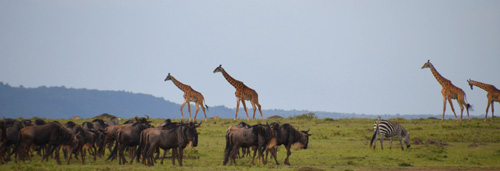
We were able to see the world changing, climate change at work. We can see how great animals are adapting, and the hazards they are encountering doing so.

I know that others were mesmerized by the seven kills we found. Many people can’t take these for very long, and I understand that. But certainly one of the most amazing encounters we had this time was seeing a lone hyaena that had just killed a yearling wildebeest.

It was exactly 42 minutes from the time that lone hyaena began to eat, that the entire wilde was essentially gone. Ten other hyaena arrived, jackal nibbled away, vultures cleaned off the last pieces. It was amazing.

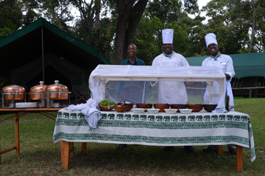
Our camp kitchen staff!
For its speed and efficiency.

Seeing the wild southern elephants of Tarangire was another great memory. Few people go down that far into Tarangire, content with the incredible encounters with the more resident and friendly eles to the north. We were surrounded – literally – by eles that don’t see a lot of people. They were wild, vicious perhaps, and most of all, incredibly powerful.

I had a fabulous time. My clients said so, too, and I hope as they reflect as I am now on the innumerable special moments, their appreciation for the wild and connection with East Africa will be established for the rest of their lives.