Marvel of the Mara

Marvel of the Mara

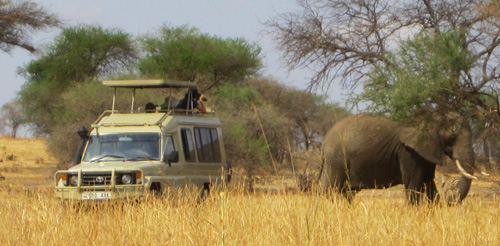
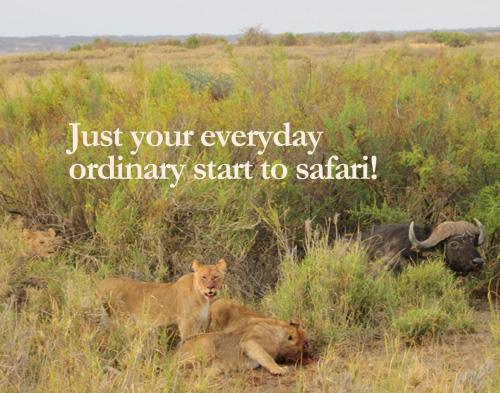
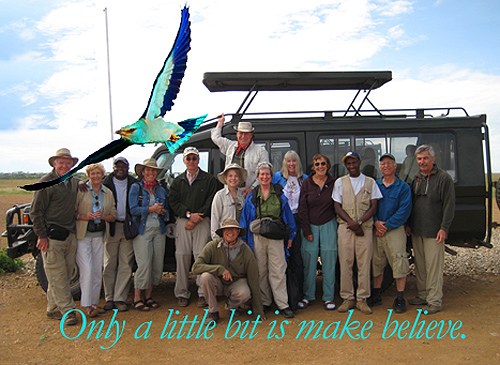
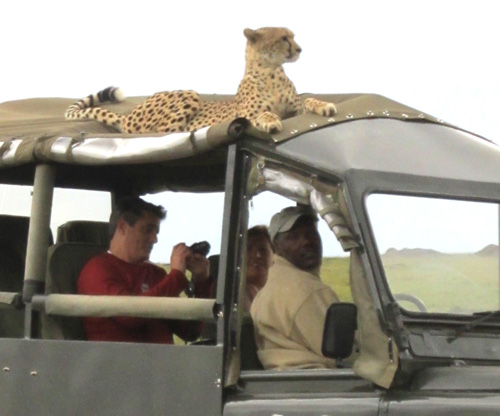
I took this picture yesterday in the Mara. Nine other vehicles were watching with us.
Twenty-seven lion, five cheetah, a rhino, 4 kills (not take-downs), a serval, two leopard (one with a recent kill) and a hyaena kill of a wildebeest. In three days in the Mara. And lots of vehicles. Is this a zoo?

No, of course it isn’t. It is Kenya’s best game park, the Maasai Mara. So we ended our safari with incredible game viewing, and it was expected. But am I showing my clients the wilds of Africa?

The Mara proper is hardly a tenth the size of the Serengeti, sits right on top of it, and is the northernmost venue for the great migration. It has almost 4 times as much accommodation as the Serengeti, despite its much smaller size. So, yes, it can seem busy if crowded compared to the Serengeti.
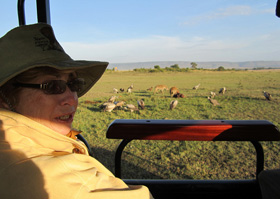
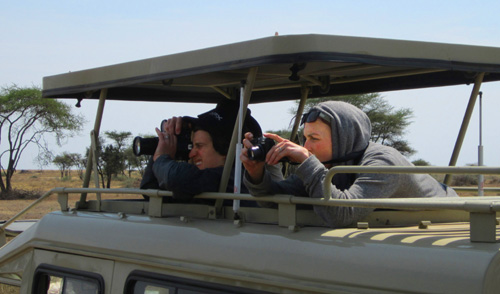
Ellen Sirlin watching hyaena kill.
But it is busy precisely because the game viewing is always so exceptionally good. The quantitative exponent of game viewing in the Mara is rarely duplicated elsewhere. The dozen or so hyaena around the lion we saw, the 100 vultures plus assorted jackals and storks, was typical of my experiences in the Mara every time I go, and 3 to 4 times the number of animals and birds that would normally be seen on a Serengeti kill. Why?

For two intertwining reasons.

First, the Mara is the wettest part of the Serengeti/Ngrongoro/Mara ecosystem. And wet means more food at every level, and that means more predators and ultimate cleanupers.
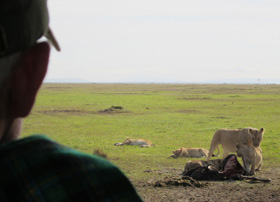
Roger Sirlin watching lion eat.

Second, more animals means more visitors and the Mara is probably the most congested game park in East Africa. Lion brush aside your vehicle, vultures clip your canvas rooftop when landing, hippos block the road into your camp and crocodile lay eggs a few feet under your tent.

And rarely are you the only one snapping photos. I try very hard and do often succeed, but if you want to see the rhino, or the cheetah take-down, you’ll be sharing the experience often with 10-20 other vehicles.
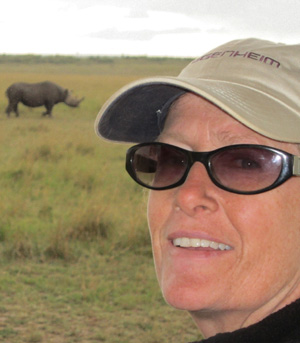
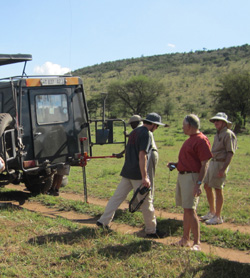
Sue MacDonald watching a rhino.
All this visitor activity means that the animals are much more tolerant of people and vehicles than anywhere else I’ve ever been in Africa. Animal tolerance of vehicles surprises all visitors almost everywhere, but the indifference of Mara animals to visitors is almost beyond belief.

But here’s the rub. Remove the visitors, the vehicles, the people, and I think it fair to argue very little of anything else would change.

So are we really experiencing truly wild and natural behaviors?

Yes. For the Mara. It’s as natural as garlic mustard taking over Yosemite or chronic wasting diseases menacing recreational hunting in Wisconsin. What I’m saying is that in the Mara it is a real balance of life as it exists there, today.

It is certainly not the way it was a generation or more ago. And it is certainly not the way it is in most other reserves in East Africa.

Even in the Serengeti, which shares a border with the Mara and several rivers, animals grow more suspicious of human visitors and their vehicles. But even so, these “wilder” behaviors in other East African reserves are far tamer than they were in Africa 50 years ago.

Then, African wildernesses weren’t as protected. People competed with animals for the same turf, and people are more clever. Animals were afraid of people, people would just as likely kill as preserve anything wild, and so wild things were harder to observe, less obvious.
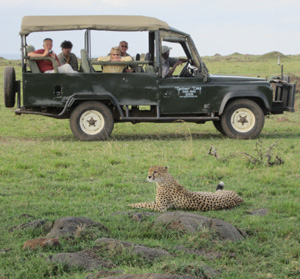
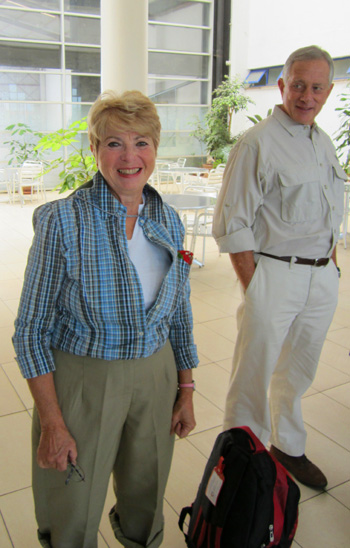
David & Lynn Heiman, Roger & Ellen Sirlin.
In other words, if you want to make wild animals accessible to the casual visitor, a dynamic will begin that will make the animals less suspicious of visitors, and that will bring in more visitors, and that will make the animals even tamer and tamer. I can’t see any way to stop this.

So the complaint I have about this marvel in the Mara is the growing number of other visitors. And as a visitor, you have to decide if you want to see it all, rather easily and quickly, or prefer as I think I do the less congested wilderness.

This dynamic – the marvel of the Mara – has happened only in my life time. It’s something that I feel has been achieved at the loss of “wildness” which is still easily experienced in places like The Selous or the Serengeti.

But nostalgia may have gotten the better of me. Visitors may not seek wildness any more than they seek the remarkable beauty of a lioness cleaning her cubs, or tiny baby warthog racing after mom. And for all those wonderful experiences and so much more, the Mara is the place!
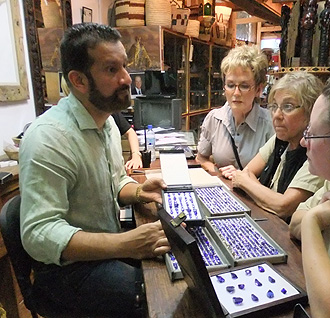
Arusha’s Getty

Arusha’s Getty

Even Arusha has its J. Paul Getty. As we ended the Tanzanian portion of our safari, we visited Cultural Heritage, a tourist landmark that may have done more for northern Tanzanian tourism than the paved road to Manyara.

Initially a curio shop, Cultural Heritage has finally fully embraced its name. Yes, you can buy most everything you see, but it has legitimately become an exceptional museum.

The enormous complex is the brainchild of Saifuddin Khanbhai, mostly known just as Saif. He doesn’t appear as much as he used to, but you’ll never get out of his site. He personally designed this behemoth building, personally welcomed Bill Clinton and a score of other dignitaries, and if he’s around, he still personally negotiates your Tanzanite purchase.

Saif didn’t have the wild life of J. Paul. He’s a devoted Ismaili, in fact a principal liaison with the sect’s religious leaders in Asia. His family traces its Tanzanian roots back to 1836, and the Cultural Heritage complex to 1976.

Then hardly more than curio duka, Saif’s vision for Cultural Heritage was a long time in the making. The first large reopening was in the early 1990s, when the little store became a very big store on the outskirts of the city. It was linked with the growing popularity of Tanzanite, and Saif’s family had interests in at least one of the only 14 mines near Mt. Kilimanjaro.

I can remember countless client purchases that Saif personally negotiated, but the one that sticks out most amazingly was a young Chicago lawyer who after choosing his gems questioned the value of Saif’s offer.

Saif took out a FedEx envelope, bundled up the jewels and put them inside. He handed the package to my client and told him to take it home and have it appraised, and then to either put the check in the envelope or return the gems.

The envelope came back with a check.

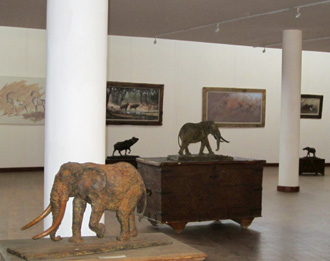
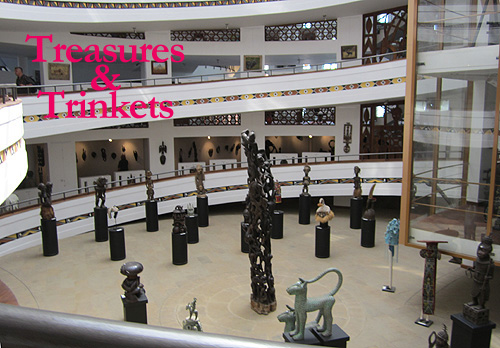
Today adjacent a huge store with precious antiques and modern curios, clothing, books and maps and virtually anything at all related to visiting and enjoying Tanzania, there’s also a restaurant and now a mammoth four-story “museum.”

I see Saif as Arusha’s J. Paul Getty. There’s no question he’s out to make a buck, and like Getty he was the brunt of much local gossip when he first began this effort. And like Getty his first and foremost motivation is to make a buck, and an honest one, and in the course of doing so he either wants to or perforce is raising Arusha’s cultural standing.

Much of the collection strikes me as priceless. Some of the deep African masks, chairs, parts of buildings, dhows and doors, musical instruments and ancient beaded work is extraordinarily precious and has been collected from far and wide. I’m a bit turned off, though, by much of the local stuff. Some of the amateur paintings that are displayed are pretty bad, though I do understand his desire to promote local artists.

But get past the local stuff into the heart of Africa and you’ll be absolutely amazed. And there is so much, so unbelievably much for this little city of Arusha, that you can’t help but be overwhelmed.

I’ve seen museum buyers often in the store, and I imagine it takes them hours to sort treasures from trinkets, but I have no doubt the sort is worth the time!

Congratulations, Saif! Arusha owes you big time!

Umbrellas in the Dry Season

Umbrellas in the Dry Season

At home whether it’s raining or not doesn’t mean much. On safari it means a lot to me as the guide. What we do, when we do it, planned months ahead, is predicated on where and when it’s going to rain. That’s now near impossible with global warming.

We were all having drinks tonight before dinner at Swala Camp in Tarangire when the thunderstorms began. Chris Benchetler left the room to try to get photos, and in fact the heaviest rain seemed over. Everyone was scrambling for umbrellas which the manager was fetching from some far away storehouse.

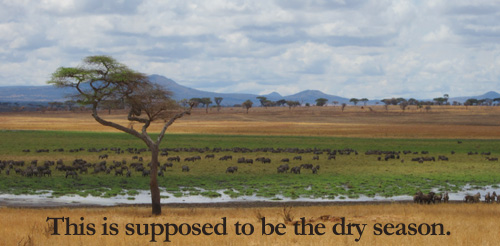
This is supposed to be the driest time of the year. We flew into the Serengeti through a terrible thunderstorm. Where we landed was so dry that your lips cracked even before getting out of the plane. Yet we could see some of the heaviest rain imaginable less than 5 miles away.

And today in Tarangire, in what’s supposed to be the driest time of the year, we got nearly 3 inches of rain in less than two hours. We ate dinner in Swala’s beautiful open-air dining hall with the moisture of heavy rain filling the veld.

I watched black paradise flycatchers doing their mating dance as if it were March! What’s going on? Global warming, and while it may make my job more difficult, I dare not imagine how it’s screwed up Tanzanian farmers.

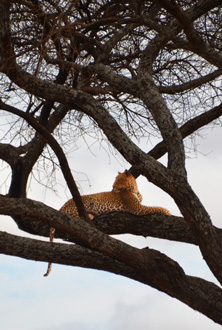
The leopard to left was photographed by Sue MacDonald, today, in Tarangire near the Silale swamp. Before the morning was over, we had seen five leopards, including two 2-month old cubs. Now that was a bonus. Leopard don’t usually like their cubs seen by a dragonfly much less a tourist, although admittedly we were several hundred yards away.

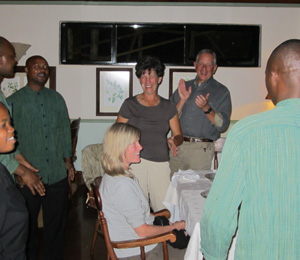
Sue by the way celebrated her 24th birthday with us on our safari (or was it 25?) We had a riproaring evening at Gibb’s Farm with the staff singing Happy Birthday to her. Lynn and David Heiman are joining the chorus!

Gibb’s as always is one of the most favorite stops on safari. The rooms are spectacular by East African standards, more like a fisherman’s cottage in Nantucket than a safari room. The setting in the Ngorongoro highlands reminds many of Tuscany, and the organic food on the farm is stupendous.

Tarangire is known for its ele, and we were certainly not disappointed. I have a long history with ele as you readers of my blog know, and I’m not exaggerating to say that the numbers we saw in Tarangire this time surprised even me.

In the Silale swamp alone we probably saw a thousand. Now by Charles Foley’s latest count, that would mean a quarter of all the ele in Tarangire, and I suppose that’s possible. But it was absolutely magnificent. I wish I could show you a picture, but really no one in our group — including some rather accomplished photographers like Roger Gelfenbein — were capable of giving me a photo that worked.

So you’ll have to let your imaginations soar with this little snapshot I took of Sue, Roger and Ellen Sirlin watching just one jumbo yesterday.

Safari Snaps!

Safari Snaps!

Ski pro Chris Benchetler and new wife, snowboard pro Kimmy Fasani, were dressing like they were on the slopes not the Serengeti! But guess what, it can be cold!

No matter how hard I try, no matter how much our literature tells people to DRESS FOR COLD, most every traveler just presumes that Africa will be hot and uncomfortable. Sometimes, it is. But often, it isn’t! Chris and Kimmy were decked out in all their sponsors’ attire (which, by the way, is quite good). But quite a few of my other travelers were cold!

Now on the other hand, get this. True to form and all our warnings, one out of twelve of my travelers arrived without luggage! Ellen Sirlin had also been foiled by the unusual 9/11 baggage restrictions in Heathrow, so she didn’t even have a survival bag.

So Ellen and I went out on the streets of Nairobi and spent around $65 on a safari wardrobe for her! Well, I should say the beginnings of a safari wardrobe. Take a look at the left at Ellen’s “safari attire.” With only a few hours, she mustered a sewing kit, scissors and an iron and turned some raw stuff we found on the street into a rather stunning look.

David Heiman is admiring her … in clothes that came with his luggage.

We’ve had way too many flats already this safari, 4. I normally get one or two. Tumaini says it’s because he decided to try a new brand, and well, obviously it didn’t work.

Traditionally safari tires were tubed. That’s because they’re easy to fix that way. But lately we’ve all been buying the new tubeless, and they really ride a lot better. But of course, each puncture in them is a lot more difficult to fix than on a tubed tire.

Another thing: travelers understandably always want to know how long it’s going to take to get from point A to point B. Well, you can see from this photo, the right answer is “it depends.”

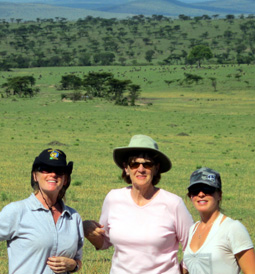
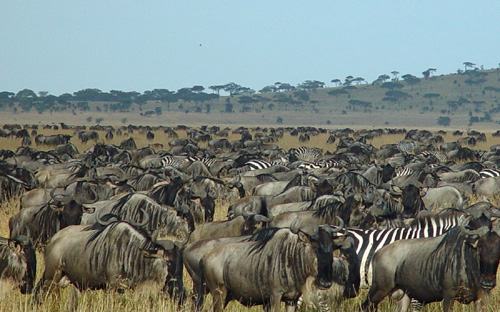
Sue MacDonald, Margy Gelfenbein and Kimmy Fasani posed for me in front of the migration in northern Tanzania. I’m not a very good photographer and just have a tiny snapshot camera, so I have to explain that the micro dots in the distance are the migration!

But note how green the veld is, and how beautiful the travelers are!

Mustering the Migration

Mustering the Migration

It’s very hard to know how much to push yourself on safari, and it’s difficult for the guide to know how much you really want to. Today we found the migration in northern Tanzania – it was an absolutely Number Ten experience. But it was psychically expensive.

We left camp at 815a and we returned at 645p. The object of the day was to find the migration. The safari plan is to experience the migration at the end of the trip, in Kenya’s Maasai Mara, but a couple people were leaving the trip early and the simple drama of the notion we could see the migration earlier in Tanzania compelled everyone to try.

The rains have been unusual. (Hardly news, eh?) If they weren’t the vast bulk of the migration would have been out of Tanzania by the end of July at the latest. And it wouldn’t normally begin to return until a little bit later than now.

But as I’ve often written, global warming has a net increase in wetness to the equatorial regions. It’s sometimes hard to understand when all that’s in the newspapers is the “worst drought in 60 years” but consider our own situation in America. Texas has the “worst drought in 60 years” but the majority of the country has been unusually wet. Ditto for East Africa the last few years running.

The terrain in northern Tanzania is identical to Kenya’s Maasai Mara. Same altitude, same rolling hills, same rivers and creeks, and when wet, same beautiful grasslands. So for the last few years, the migration has often lingered longer in northern Tanzania or returned earlier from Kenya.

In fact, what I think is actually happening is neither. I think the range of the northern migration is spanning out south to north. That means less of a concentration anywhere, but a larger area of thick wildlife.

Whichever it is, quite a few Tanzanian companies have bet it’s going to continue. Once up north we passed six new semi-permanent camps erected at great expense far from a southern supply source, to cater to travelers wanting to “see the migration” in Tanzania.

Where we believed from on-the-ground info the migration could be seen was 150k from our camp on Mukoma Hill in the central Serengeti. The roads up to the area weren’t bad, so it mean we’d have a day of about 6 hours just traveling (3 there and 3 back), albeit through game areas.

But if we were to keep focused it meant we had to race right bye other great things!

We were out of camp hardly more than 20 minutes when we came upon a pod of hippo in the Seronera River. People began to click away, and my driver, Tumaini, knew that he had to keep them moving if we were to reach the northern Serengeti early enough to enjoy it. So he hurried people along.

Right around Seronera the veld was remarkably green. In fact, I presumed it would continue green and damp all the way north and so I began to worry what effect this unusual weather might play on the traditional March/April migration safari. But hardly before I was done worrying, we had entered a prolonged period of dryness, typical for this time of the year.

That dry swath continued all the way from the western road junction past Lobo almost to Balaganjwe. But then near just south of the Balaganjwe west of the Megogwa Hills the veld turned beautiful lemony yellow. Grass was everywhere, and so were wilde! This was about 10k south of the Sand River gate into Kenya (Maasai Mara).

We then used the Tanzanian park services’ new roads and tracks to follow the Sand River northwest to where it merged with the Mara right on the border. Kenyan travelers will know this as the “Mara Bridge” area. There were wilde everywhere, on both sides of the river. We watched a river crossing over the Sand River which was quite exciting.

Except for the green veld this far south, everything else looked pretty normal. The Sand River was dry at times, and the Mara though flowing nicely was not unusually high. We didn’t see many crocs; I had the impression they’d already eaten, but there were many nooks and crannies of the rivers that caught hunks of dead wilde with lots of birds.

In addition to the migration, my travelers saw for the first time both eland and topi. We’ll likely get them both in the crater later on, but it was an unexpected bonus for many.

We were diverted from lunch, once again on this safari!, by lion. A beautiful tree we had picked out at a distance on a hill that gave us great views had already been taken by four beautiful, fat and sassy young lion. Some great pictures!

So after lunch we went a little bit further but then had to turn back in order to get home in time. So all told, we had about three hours of great migration viewing.

But it was a very, very long day. And given that most of the veld is normal, that meant very dusty and very bumpy. Parks services fix roads right after the rainy season, but now with intermittent and often heavy rains at unusual times, the roads grow bad more often than before. And there’s either not enough money or willpower, or both, for the parks to maintain the roads more often.

I know that at least half my travelers this time wouldn’t have done it otherwise. Roger, Chris and Kimmy, and Sue were pretty ecstatic about the day. And it’s a hard call to make for the guide to even bring up the subject, because inevitably there are going to be travelers who join the pack when they really don’t want to.

But all told I was pretty satisfied. It was a truly beautiful sight. Nowhere near as crowded with other tourists and vehicles as in the migration areas in Kenya. But do we presume this will happen all the time, now?

As a betting man, I’d say yes. But wait for our report on the migration in Kenya, which ends this safari! Getting to this area of northern Tanzania is costly, time consuming and for some, stressful. In the end is it worth it? Stay tuned.

Ho-Hum Just a Routine Day on Safari!

Ho-Hum Just a Routine Day on Safari!

Bumpy road, alkaline dust, wind in your face. And a honey badger, some impala, hartebeest, elephant, a serval in a tree killed by a leopard and a family of 11 lion taking down a bull buffalo.

Anyone who only reads first paragraphs might be misled.

It was hardly an ordinary start. We lucked out big time. Sue MacDonald kept saying “I don’t believe; can you believe it?” And as is often the case with great game drives, it was basically luck and not strategy that took us to this extraordinary beginning.

Following the first couple days in Nairobi for our normal political and cultural touring and to shake as much jetlag as possible into the congested throngs of people we walked through on the street, we flew into the southwest Serengeti, to Ndutu Lodge. Yesterday there were two others besides our group, and today we’re alone. This is because of the common knowledge that the migration which is centered here in March and April is long gone.

But what so many television special driven tourists don’t reflect on is that animals and wilderness does not follow a TV schedule. It goes on year-round. Sure there will be times that will basically provide more animals than others, but there are very special things that happen at all the different times of the year.

I’ve written before about the discovery of the buffalo virus that was leading to more lion kills and lion deaths, but even so lion killing a buffalo is no easy task. I don’t think a lion even considers taking down a buf unless more customary food like zebra and wildebeest aren’t available. It would be like going to Whole Foods for a last-minute Friday snack and buying a complete Angus.

And that’s the case at Ndutu in the middle of the dry season. (By the way, we arrived in a rain storm, and it’s rainy today as well, but that’s really unusual. And the area essentially remains very dry.) So for the lion of Ndutu, dinner is always a challenge.

We’d heard in the middle of the night the anxious lion roars and hyanea yelps. We’d hardly been out for a few minutes past daylight when Dixon spotted a lone female walking fast on the top of a ridge about 500 yards away.

We drove up to her and I immediately noticed that she was limping, and that her belly was terribly contracted, a sign she hadn’t eaten for days. Clearly last night she was involved in a failed hunt of something that injured her right shoulder.

She took no notice of us and kept on her mission driven limped walk. She hesitated only momentarily to call and then listened as another lion called back from the far distance. She started to walk again.

Then all of a sudden out of some low bushes runs a subadult male covered in blood. The female we had been following laid her ears close to her head, turned tale and began running with the bloody faced male in close pursuit.

She was obviously not a part of the pride that currently owned this territory, but rather than following her we wanted to figure out the bloody face of the pursuer.

Soon we found other lion, three mature females and five cubs of various ages, all bloodied but clustered together as if something was attacking them.

Then we saw literally ten feet from our car in the bush a giant male buffalo.

He was obviously dying. The giant, awesome beast lifted his head back towards me and I saw that distinctive glaze in the eyes of a dying animal. Animals have expressions just like us, just not in the face.

Every time a lion got near him he’d stand up and begin to swing his deadly horns.

The older lion knew to stay well away, but the younger kids couldn’t suppress their hunger. They would move towards him, even jump on him, and he’d growl and swing his head. The youngest cub, about 4½ months old, got a seething cash on his little neck.

So we watched this for some time as the buffalo seemed to be on his last breath, and then when he seemed to stop breathing, a lion would close in, and he would stumble to his feet swinging his head, braying.

Finally, still alive, he lost all strength and the family knew it. They were on him at once: the kids on the back, the larger lion digging into the soft flesh areas. We left before he was dead.

A few hours later, on our way back to the lodge, we stopped to review the situation, and the buf was dead. In just that short several hours the lion had carved an enormous amount from the available meat and most were too full to eat another bite. But the male was close on the kill, as they always are, reluctant to give way so long as a single morsel of meat is left.

Even though he was too full to eat it.

Then came our second wonder. Two elephant were strolling down the lake shore which was about 50 yards away. But the wind was directly on them, off the kill, and immediately the mother ele started scenting the air.

Before long she was charging the lion, chasing them away and trumpeting loudly. The lion dutifully stood clear, the male the last to do so, and she kept up the harassment until for some reason she felt appropriately vindicated, and went off.

No. It was not an ordinary start to a safari. But on the other hand it wasn’t totally unusual. This is the most stressful time for Ndutu. Except for the aberrant rains that came with us, the veld is parched, a powdery salt blown almost like smog into the mostly still veld by the dawn and dusk breezes. Unlike March when I’m here, there is only a fraction of the normal bird song, a thin sliver of the number of animals always here then.

But predators don’t migrate. If they’re to survive, this is when they have to show their stuff. And for the lucky visitor, like us, a once-in-a-lifetime scene unfolds into our own alien world.

Heading into the Bush!

Heading into the Bush!

Starting tomorrow I will be on safari in East Africa and blogging four times weekly from the field … I hope. Cell phone and internet reception has improved so much I think it really will be possible. We have an exciting safari ahead of us!

It is also a remarkable collection of people, and I’ll try to give you little snapshots of each of them as the days go bye. But I am already specially indebted to newly weds Kim Fasani and Chris Benchetler, who are taking part of their honeymoon with the rest of us.

What did I say? A honeymoon couple joining a bunch of us who are into planning our Golden Wedding Anniversaries? (As happens from time to time, I do slip into a minor exaggeration.)

More specifically, age rarely matters in my groups. Last year, for instance, I actually guided a 7-year old. (He was traveling with his mother.) More to the point, EWT operates a lot of honeymoon safaris, but not really very many where the honeymoon couple joins a group.

But Kimmy seems so incredibly enthusiastic and eager to get virtually everything out of the trip she possibly can, that when I mentioned my safari was more or less overlapping hers, she (presumably pulling her spouse along) jumped aboard!

Don’t get overly empathetic. The two of them do have enough sense to peel away from the group trip at the end to enjoy a most romantic getaway on a remote beach in Zanzibar. (My heart pines remembering those days!)

And, by the way, they won’t be the first. But they do join a very special group of people I’ve had distinct pleasure over the years guiding and getting to know. Their honeymoon is obviously more than just a place to wipe off rice granules from rented garments. They’ve come to be thrilled and to learn something new.

And actually, honeymooners seem to stay in touch a bit more than others. I’ve now followed the first honeymoon couple I can remember guiding through two Labrador Retrievers, then two kids, several houses and jobs, and now … the kids are in college!

My group this time also includes a couple from New York, from Florida, and several from Ohio, so together with Kimmy and Chris who are from a remote locale in Montana, we have a rather wide segment of America on board. The 12 of us are expecting some extraordinary experiences!

The focus as always is on seeing the wild working its miracles and exercising its inexorable power. Although there has been unusual rains this season in areas where it normally doesn’t rain after June, the dynamic of the dry season still appears firmly in control.

That means the veld is getting stressed out, and that means the predators are in their heyday. Of course it remains to be seen, but I expect we’ll see 75 or more lion, at least one leopard and up to a dozen cheetah.

The climax of the trip is in an area where we expect to find part of the great wildebeest migration, at its northern most point, before the herds begin to slowly reassemble themselves in the southern Serengeti. This is always a dramatic time for the migration, with exciting river crossings.

I’ve already heard from friends that the crocs are pretty full and so the river crossings are proceeding without much ado. When they first wake up begin earlier in the season, they are famished, and carnage reigns. We probably won’t see that, now. The big crocs eat only once or twice a year, when the migration comes and goes. They gorge, then basically go to sleep for months.

I’m especially anxious to see the state of the elephant herds in Tarangire. There are too many elephants and have been for the last 5-10 years. We need signs that the population is stabilizing and not continuing to grow, and Tarangire, where we should see (yes) a thousand or more will have the best indicators.

So stay tuned, folks! It’s possible the blogs might not come quite as regularly, but I promise whenever in range to top up each day’s experiences with as much truth as I can possibly muster!

On Safari: Is The Delta Floating Away?

On Safari: Is The Delta Floating Away?

Climate change is effecting Africa seriously, and perhaps nowhere is it as evident as in the Okavango Delta.

The delta is Botswana’s landmark attraction. It’s where the Kalahari ecosystem floods. That’s right, a “desert” in flood.

The unusual continental divide in Africa is very close to its western coast. And the torrential rains of Angola flow regularly east creating some of Africa’s great rivers like the Zambezi, and some of its most famous natural wonders, like Victoria Falls.

And the Okavango Delta, for here the water spills onto a flat scrubland, creating ever-changing islands and massive marshes and wetlands. And the rich nutrients deposited create a fertile ecosystem with as diverse a biomass as found anywhere in Africa.

But the Delta is being stressed by global warming. More water than ever imagined is flowing into it. And this year it’s a double whammy as unusually heavy rains pour relentlessly onto the delta as well.

Our camp’s airstrip was flooded out. The circuitous tracks we had to take from the nearest surviving airstrip challenged our Landcruisers as they submerged well above their floorboards and bubbled through flooded areas like tugboats!

High water time in the Delta is May and June. Yet already in March the water was higher than it had ever been before.

What does this mean? For one, there have been many resident animals like elephant, giraffe, buffalo and sassaby that may be pushed out. For another, reeded wetlands supporting many bird rookeries may be pushed far away towards the radical climates of the pans.

And for populated areas like the important central city of Maun, humans are being relocated away from the rising tide.

The wilderness is resilient. I have little doubt that for many years of stress during our global climate change, plants, animals and birds will adapt. But man’s permanent settlements, including existing camps and lodges much less cities and villages, will be much more traumatically challenged.

On Safari: Wells to Protect Game?

On Safari: Wells to Protect Game?

For a very long time throughout southern Africa wilderness areas have been supported by manmade wells to provide year-round sources of water for the game. It’s absolutely necessary.

And so different from East Africa, for example, where this level of intervention in the wild hasn’t yet occurred.

I visited Nxai Pan national park in Botswana, which is very similar to the nearby and probably better known Makgadikgadi Pan to its south. Together they represent the largest salt pans in the world, ancient lakes that if connected would have been among the largest fresh water lakes in the world.

Although technically salt pans are incapable of any vegetative growth, there are vast grassland and scrubland areas on the periphery which bloom in this rainy season.

And today, thanks largely to the manmade water wells drilled in these peripheral areas, considerable game can reside year-round. True, the vast majority appear during the rainy season (November – March) but the “borehole” ecology is creating a year-round big game ecosystem.

I was there as the rains ended in March, together with hundreds of zebras which only a few short weeks before were thousands of zebra. There were also lots of wildebeest, elephant, and the springbok and oryx are resident year-round.

By the park’s principal water hole reside the park’s only lion pride. They don’t have much work during the dry season, because the animals in the area during the dry season will have to come to drink at some point. So the lions just hang out around the water hole.

At this time of the year there’s a bit more of a challenge, and we found the pride of 8 lion wandering some distance away into a dense forest, stalking impala. Shortly thereafter, we saw a magnificent male leopard strung (it seemed quite uncomfortably) atop the stick branches of a dead tree in the middle of that forest. Clearly, he had been chased up there by the lion.

The true Nxai pan is an amazing salt flat with raised islands of vegetation. Nxai’s most famous is “Baine’s Baobabs”, a little forest of 8 remarkably sculpted baobabs in an area that couldn’t be more than a half-acre large. It creates one of the most scenic landscapes in Africa that I’ve ever seen.

When boreholes for game reserves were first contemplated in the early part of the last century, there was some considerable debate about whether it was appropriate. The debate no longer exists.

I suppose as an East Africaphile I have an innate aversion to this, and many other similar management techniques employed in the south. Such as carrying capacity land management and culling.

But in the end, is it any different than the bird seed in my feeders at home, or the heated bird bath on my deck in the winter?

On Safari in the Kalahari

On Safari in the Kalahari

Tourism has come to the Kalahari Desert, but not everyone wants it to, not least some of the Bushmen who live there.

I spent two days in the Central Kalahari Reserve at a beautiful 8-bed lodge called Tau Pan Camp, experiencing this huge natural wonder as a dream come true. I was not disappointed.

The Kalahari Desert is vastly misunderstood, for it is hardly an expanse of sand, nothing like the Sahara or the desolate sands of the Namib just to its west. The reserve itself is just over 20,000 sq. miles, although this is probably only two-thirds of the entire ecological area.

This huge area – about twice the size of Massachusetts – is a magical scrubveld, similar to much of Arizona and New Mexico. Beautiful succulents, innumerable wild flowers, characteristic water-saving tubers and even acacia and baobab trees pepper a certainly very flat landscape.

It is particularly beautiful now, as the intense summer rains begin to end. And the many varieties of grasses draw large amounts of game like oryx, springbok, sassaby and red hartebeest.

And these beautiful, colorful creatures tend to linger at the Kalahari’s many pans, like Tau by which I stayed. These are sometimes massive, sometimes small depression remnants of ancient lakes, which today fill only briefly and then with very shallow pools of water. Some through eons of evaporation become actual salt pans. Others, like Tau, become immense fields of nutrient grasses with the rains that begin in November and last through March.

And not just animals, but remarkable birds are found here. The rains allow the birds to bloom as much as the grasses! I was mesmerized by the many strikingly colorful black khorans displaying, their bright red faces calling love tunes to any nearby lady, quite oblivious to our interest!

But the Kalahari’s marvelous ecology is an on-off one regarding water. Come the end of April, there is often nothing but dust until the new rains in November. But this magical places stores much of the rainy season underground, and occasionally (and more so with help from boreholes) the water is available year-round to the resident Kalahari lions and other predators.

And therein lies the controversy. The Botswana government is waging battle against some of the San (Bushman, click-speaking) people to force them from their traditional lifestyles into community based tourism projects. Part of this battle is the drilling of boreholes to establish permanent colonies of wild animals.

One early morning I was taken by one San, who in English vernacular chose the name “Custom”, into the bush not far from the lodge. There he demonstrated some truly remarkable skills of the desert nomad, including how to snare small game like steenbok, how to extract medicines and poisons from the vegetable bounty that surrounded us, how to start a fire and how to extract pure water from the large turnip-like tuber base of a flimsy little succulent.

Custom, being a part of the tourism industry already, had no qualms about the government’s moves. But as for his relatives? He was equivocal.

There are only two places currently in this massive area for tourists. I stayed at the stunningly beautiful Tan Pan Camp. My life has been in tourism, and I feel when done properly, it contributes as much to the well-being of current peoples as to the preservation of traditional cultures.

What none of us want to see is a degeneration of traditional cultures into the refrigerated housing of current American Indians. Let’s hope the Botswana government and San peoples will find the right way.

On Safari: A Glimpse of Sad Zimbabwe

On Safari: A Glimpse of Sad Zimbabwe

The sad state of affairs in Zimbabwe was not something I expected to be a part of on this trip. The surprise was shocking.

My flight Wednesday from Nairobi to Gaberone, Botswana, traveled via the pariah city of Harare, and it’s one of the few air services that exist into and out of this capital of oppressed Zimbabwe.

So it was not unexpected that most of the passengers were headed to Zim. These were Zimbabweans, not NGOs or aid givers or missionaries. They were people who were returning to their country after business abroad.

At least half of that was with very small children who required medical attention that no longer exists in Zim. It was quite uplifting to see these now healthy kids jumping around. But the flipside were the passengers boarding in Harare for Nairobi. These children were being carried onto the plane looking dazed and very ill, totally silent, by very concerned parents.

And sitting near me in business class were three Zim government officials. Two sat far away from a third, and whispered constantly. The third took his seat and started demanding champagne, then speaking louder and louder to those of us around him, about inconsequential and unintelligible stuff.

When the flight attendant asked him to be quiet during the video on flight safety as we taxied out, he raised his quite large bulk out of the seat and started shouting at her, reminding her of his special importance.

It was a sad reminder of the state Zim finds itself in today. Children with no modern medicines, parents with no alternatives abroad, and the big bosses taking advantage of them both.

On Safari: Always Begin with Nairobi

On Safari: Always Begin with Nairobi

No matter what I’ll be doing, I start my African journey in Nairobi, because to me that seems to be the heartbeat of Africa. It’s where you really find out what’s really going on.

It’s also a good idea to arrive at night, although I was unable to this time. Morning traffic in Nairobi is absolutely unbelievable. At night, the ride from the airport to the center city takes all of 20 minutes. It took me, today, 2 hours.

That may not seem unbelievable to someone working in Manhattan and commuting from a distance Connecticut suburb, but this was 12 miles in 2 hours. Most of the time you sit in a car with an engine turned off, waiting for the spurts of movement caused by police opening up certain routes into the city’s roundabouts.

I remember years ago in Bangkok that it was the same, so I also remind myself of this, because in those days Thailand was at the stage of underdevelopment that much of Africa is, today. And frankly, I think Africa’s going to reach Thailand’s level much more quickly.

After getting settled into my hotel, the rest of the day was spent reuniting with old friends, buying a new phone, and completing a consulting job critiquing a new Nairobi hotel transparent politics and very positive about the future based on the great performance of the present. Like many developing economies, Kenya’s GDP growth may approach 8% this year, phenomenal by developed world standards.

So more people have jobs and more jobs are better paid. It’s still a long, long way from what we consider tolerable. Parents still play an active role in getting their adult children .

The folks in Kenya are doing better than ever, energized by new and more jobs, and in probably more than half the households, young children are raised by grandparents, not parents.

This isn’t because the parents have abandoned their children, quite to the contrary! It’s because so many jobs are far from home and require the parents to live apart from their families, sometimes for weeks at a time. This is quite common. Nearly a sixth of Kenya’s population lives in or around Nairobi, but jobs are spread throughout the country.

As the Kenya economy improves, many Kenyans are beginning to feel that the adult children who had moved to places like the U.S. or the U.K. should return. It’s a particularly appealing feeling, since perhaps as many as half of the Kenyans living abroad are doing so as illegal immigrants.

Finally, today, I critiqued the new Sankara Hotel in Westlands. This is an upmarket area of Nairobi experiencing very rapid development, including a number of new NGO offices and residences. It’s near the National Museum.

Sankara is a sleek and beautiful hotel with a minimalist style that will remind guests of America’s Omni or W hotels. The rooms are spacious, beautifully furnished, lavished with lots of teak and glass. The hotel is an indoor/outdoor with the three outer edges of the pyramid where the rooms are, and the center a massive atrium.

It includes Nairobi’s swankiest pastry shop which looked to me like an art gallery more than a place to buy sweets! The pastries are works of art, and most, far too big for me!

The wine cellar, displayed entirely in glass on glass shelves in climate controlled glass pantries, houses some of the most famous wines in the world.

This is a hotel for the young, the romantic and the jet-setter, and it was no surprise that while I was there so was a convention of Citibank Africa and a South African movie video company.

Tomorrow: on to Botswana.

Have we restored Sanity?

Have we restored Sanity?

Jim Heck (left) with Chicago lawyer Bill Sullivan
in the White House press room after the rally.
As 1 in 200,000+ attendees at John Stewart’s Rally to Restore Sanity, Saturday, I was wildly enthusiastic about the whole program until the end.

I might only be .000005 th of the voice of the mass, but I think I reflected most of humanity which had encased me. Stewart’s ending soliloquy on too much negativism and polarization ran hugely hollow.

Almost everyone there, like me, was a progressive. The cast of characters that marched onto the stage, from Cat Stevens (now Jusef) to Father Gaducci were liberal cut-outs of a very long and historic left-wing movement in this country.

The great skits depicting the wrongness of generalizing about religious fanaticism, of exaggerating the coming of the apocalypse and the reactionary views of most of the “mainstream” media, were all great and enlightening.

And the police helicopters circling endlessly above and the Batman-like snipers on the building tops made us all realize this wasn’t all fun and games.

So Stewart’s attempt to accentuate neutrality, compromise and thereby bring back a feel-good America drew about as much applause as Father Gaducci when he called for God to give us a sign that Methodism was the true religion.

There was more polite laughter.

But that was hardly ten minutes of five hours. The rest was great. We progressives came in thousands and thousands and we weren’t shrill or ridiculous (like the Beck crowd), and there was a lot of humor, something I believe progressives have always maintained. And a real indication that our beliefs are constructed not divined from the supernatural.

One of my favorite signs was, “Give me ambivalence, or give me something else.”

I think we were a great sea of wait-and-see. Our enthusiasm was really for sanity, something currently missing from American life. Anyone who wants to tap into us has to start speaking in grammatically correct sentences that can easily be fact-checked!

And how will we vote?

Democratic.

But will we all vote?

Not sure. It just might be better to let the crazies duke it out first.

Another Safari Ends

Another Safari Ends

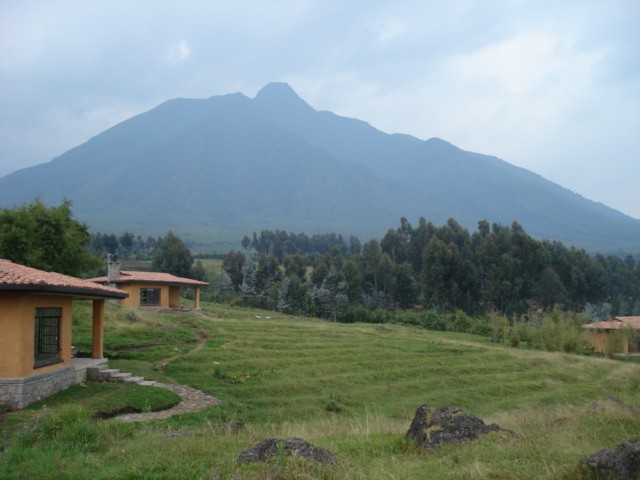
Sabyino volcano behind Sabyinyo Silverback Lodge.
After a gala farewell dinner preceded by raucous limericks about the trip, the group began the journey home.

Sarah Taylor summarized the trip during dinner, and I was impressed! From the surprise backstage visit to the Entebbe Zoo, through chimps and lions and gorillas, we covered much of Uganda and a bit of Rwanda.

Of our 13 travelers, only one had not been to Africa before. This is not usually a first-timer’s trip, unless the first-timer is specifically interested in primates or birds. The big game normally associated with an African safari is actually quite limited.

And the primates did not disappoint. Everyone enjoyed two treks for chimps and two treks for mountain gorillas. And the list continued. We saw two species of black-and-white colobus, a subspecies of sykes, red-tailed, grey-cheeked mangabey, red colobus and of course, vervet and baboon.

The exotic bird list is too large to enumerate, but I’ll summarize it this way: the Great Blue Turaco is one of the most sought-after sightings by birders worldwide. It’s as large as a wild turkey, as funky as Groucho Marx, and looks like it just dipped itself in neon-colored paint.

We saw them in several places, but my great joy was when I stepped out of my tent in Ishasha to open the backside flaps and flushed five of them from the tree above me.

We had the chance to compare – as so many potential travelers wish they could – the differences between mountain gorilla trekking in Rwanda and Uganda. I’ll be blogging more about this in the future, but suffice it to say, now, that I think most on this safari would choose Rwanda over Uganda, if both countries in a single trip as we did were not practical.

And everywhere we were impressed with the local guides: from the enthusiasts at Semliki to the guide on the boat on the Kazinga Channel, to the chimp and mountain gorilla guides. Striking a bond with foreigners on short trips is very difficult, but when a deep interest – like conservation – is so dearly shared, the bond forms quickly.

Although we did start with a charter flight, flying from place to place in Uganda and Rwanda is quite difficult and usually impractical. So we drove. And we drove. And we drove. There are certainly rewards to overland travel: you see things locally that fliers miss completely.

But for the most part these roads are pretty bad compared to what today is available in Kenya and Tanzania. So everyone earned boot camp stripes they had never intended to get!

We left outstanding Sabyinyo Silverback Lodge just after 8 a.m. on Saturday morning. By Saturday night everyone was on their way home: to Cleveland, to New York, to Chicago and to Philadelphia.

Farewell Africa; I’ll be back, soon!

So Who’s Smarter?

So Who’s Smarter?

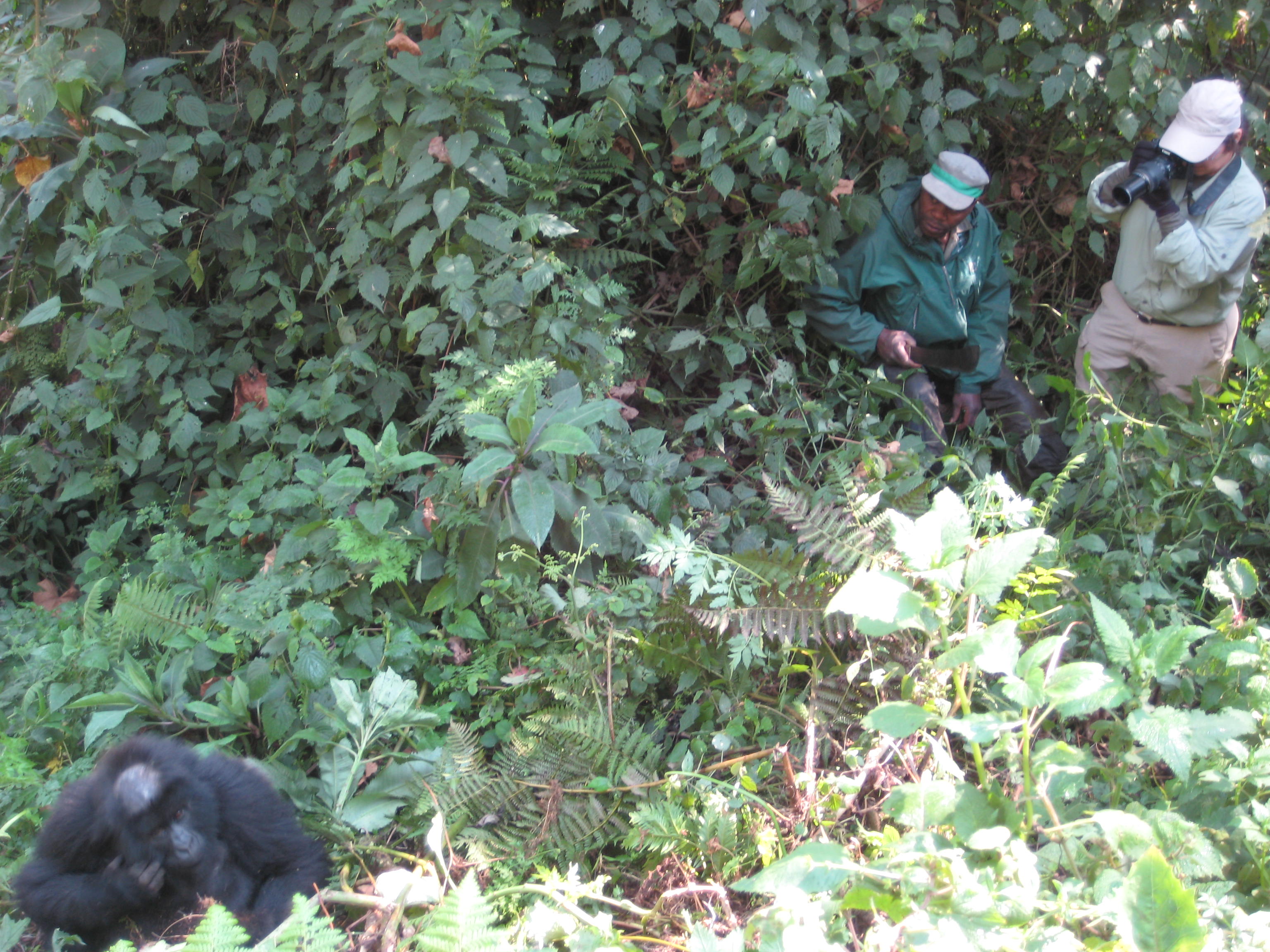
Doreen Yashen photographing Baldy in Parcs de volcans.
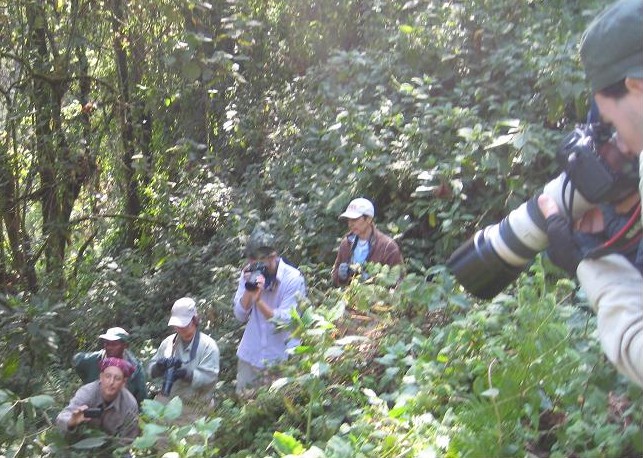
Sixty-four people with broken legs and open wounds gather at Kinigi headquarters everyday to see 8 mountain gorilla families. We were no different.

I love Parcs de volcans. I love the guides, the organization, the scenery, and most of all I love the artifice we guides bring to the daily planning session with the chief guide to decide which clients will visit which families.

Some families are almost always hard, like Sousa. Some families are almost always easy, like Hilwa.

“Hard” means a trek of an hour or more, and more than once my treks have exceeded four hours. It’s not uncommon to return at dark from a day that begins just after 8:30a.

“Easy” means you’re back at your lodge before lunch.

Right.

Left to right: Bill, Doreen, Alex, Sarah & Stephen

So today I – like every other guide – pleaded in guide pow-wow that I had five people with broken limbs and failing organs. Other guides had brought one-eyed clients, the deaf, and the recently released insane. One guide even claimed his client was 90 years old but knew how to wear cosmetics well.

That over, the implacable chief guide politely began to filter the pool.

Stage one: all those who had trekked yesterday over to the side. These included two women who had been vomiting most of their lives and an old man who couldn’t remember his name.

Stage two was a general separation by age. The 90-year old was excised and presumed 60, and the under fifties with insured ailments were lumped together.

In beautiful African undertones, artifice gave way to smiles and streaks of honesty. My five were assigned to one of the easiest groups, Hilwa, in return for taking moderately hard group, Sabyinyo, for the rest of us eight.

And off we went.

We eight to Sabyinyo saw the largest silverback, Gahonda, and a week-old baby, along with what seemed to be a drunken 5-year old and others in the family of 11. The day was spectacular, the experience as always thrilling, the trek took about 16 minutes, and we were back at the lodge at 11:30a.

The five to Hilwa saw one of the most impressive silverbacks, a year-old kid, and were not the requisite 7 meters from several family members, but more like 7 millimeters. The day was spectacular, their experience particularly thrilling as they scaled 80% inclines, hung from rocks by their fingernails, and tiptoed across a 1″ ledge of the Great Rift Valley.

And the five assigned to the easy group got home at 4 p.m. Haggard is not sufficient to explain their condition. Daniel Pomerantz, a refugee into the group of five from the youth corps, arrived with most of the left leg of his pants trailing his feet.

The low road was the high road and the antics in trying to predetermine which would be which now seemed patently absurd. Cathy Colt and Hope Koncal were turned into champions, their positive and unrelenting attitudes taking them to heights they could never imagine scaling.

It’s really amazing as you sit for that short hour among these monoliths of pre-humanity. You know that they know a lot more than you think. Are they entertaining us? Are they earning their security this way, cognitively? Or, are they just having fun brushing by us and rolling out of trees?

Seeing distant reflections of our humanness in these gentle creatures makes war and aggressive capitalism and obsessions with success seem utterly trivial. They are so simple, so supremely self-confident and so survival savvy that they’ve manipulated us to preserve them.

So all the questions about what they’re doing out there turn back around onto us. It isn’t why are they so fascinating, but why have we dedicated so much of our resources to preserve them?

Is it, maybe, that we want to find the justification for preserving ourselves?

Existentialism aside, you big brutes bested us, today! And I suspect you always will.

Left to right:
Silverback Gahonda, ZooDirector Steve