Earth’s Greatest Travelers

Earth’s Greatest Travelers

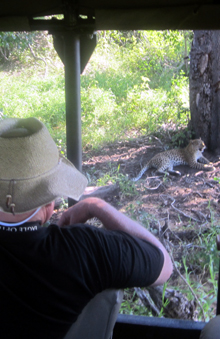
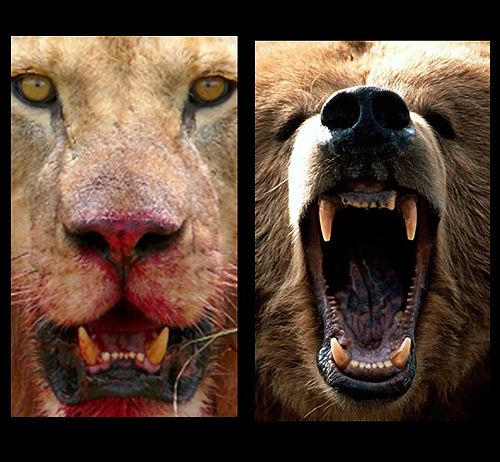
"Lion" by Dena Fairbanks. "Bear" by John Hamill.
I’m off to Alaska. Alaska? The AfricaAnswerman is going the wrong way, no? No. The similarities between Alaska and Africa are manifold. They’re where the last great wildernesses on earth struggle to survive.

There’s nothing extraordinary in the realization that the ends of the earth are wilderness. In many ways it’s why they’re the ends of the earth. In the case of Alaska, it’s radical climate, daylight hours, threatening geology frame the borders of our planet with what’s livable.

A wealth of biomass from the world’s great whales to many of its birds flock here as natural selection would want, to exploit the extreme nutrition that condenses itself in short periods each year. Think of it this way: the amount of sunshine is identical anyplace on earth. It’s just at the poles a lot more of it comes in their summer and none in their winter.

This means life adapts in strange ways, essentially living the life of Riley for about 3 months of the year and sleeping for the rest. Plants, inuit, and I dare say immigrant humans all adapt to that strange lifestyle.

But earth’s travelers aren’t anchored to any spot. So the world’s behemoth, the blue whale, and its most angelic if hyper bird, the hummingbird, make journey after journey here for the privilege of working 24 hours a day for three months.

It’s a work routine lots of young people aspire to!

When I first went to Alaska it was much different than today. The growth of earth has transformed Anchorage from a weirdo’s way station to a magnificent city. The wealth of neglected natural resources made the hillbilly a billionaire. Fairbanks was a cold place for airmen. Today its university leads research in astronomy and natural resources.

And there’s a lot more tourists.

Just like Africa. So our job is to recover, perhaps preserve, the thrills of the past.

Humans need thrills. Adrenalin is not just for avoiding the boss. We need to jolt our physiognomy every once and a while to keep it tuned up.

The scenery of Alaska and Africa is simply incomparable. There are many places in the world as expansive and awesome as Denali, and there are many places in the world as overwhelmingly beautiful as the plains of the Serengeti. But then, there’s also Prince William Sound and the Wrangells, Ngorongoro Crater and Manyara’s cliffs.

The compactness of beautiful, thrilling scenery in Alaska and Africa has no rival.

We get rather boring every now and again. But a lion and a bear are never boring. The natural world is dominated by sheer force buffeted by the brilliance of natural selection. It’s nice everywhere once in a while to be relieved of having to be clever, or make the right decision, or figure out your taxes.

It’s nice to be in a beautiful place where the order of everything is predetermined. It’s something of an intellectual copout – and certainly not what humans were built to do.

But humans are different from everything else, and in these great wildernesses we come to understand exactly how and why.

“Awe replaces anxiety,” Patricia Schultz writes in the New York Times.

Stay tuned! I’ll try to post pictures of our trip, but here’s a remarkable secret: I get less connectivity in Alaska than Africa!
Serengeti Playground

Serengeti Playground

Thanks to Sheila Britz of New York for this!
What do the President of Botswana and I have in common? We have both sustained cheetah injuries this year! His to his face. Mine to my car.

The Botswana government confirmed today that President Ian Khama had been scratched by a cheetah and had received several stitches in his face. Not a wild cheetah, but a caged cheetah that the president was obviously observing, and nothing serious enough to announce it until the press asked about it, today.

And it probably wasn’t even intentional. Cheetah differ from other cats in that their claws can’t retract.

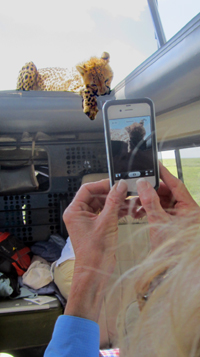
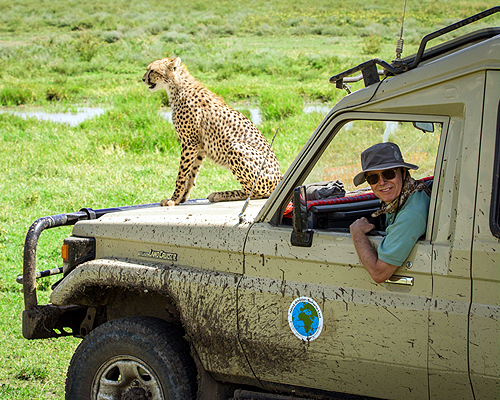
Cheetah are interacting with tourists (and presidents) more and more. In each of the last two years I’ve had cheetah jump on our car to the terror and delight of my clients.

Earlier this year as we were approaching the edge of the migration in the Serengeti, we encountered a family of four cheetah: big mama looking somewhat weary at her three terrible teens: three 6½-month old not-quite-cubs-any-longer.

Because cheetah are the most harassed of all the cats in the wild, they love anything that doesn’t try to eat them … like tourists. I suspect, though, that if there were another animal in the wild except man that didn’t bother and pester them, they’d come purring over like a lap cat with affection.

Cheetah eat faster than any other cat, because if they don’t, they’ll have the food taken away … by bigger cats like lion and leopard, by hyaena, even by jackal and big birds. It’s a stressful life.

So when something just comes along to look at them, they’re most accommodating if not presumably relaxed by the notion that a man – the greatest hunter and threat to all living things – wants to be its friend!

After all, the enemy of my enemy is my friend, right?

Not to mention that a car is pretty high off the flat veld. Jump up on it and you’ll achieve a view far superior to that stumpy little termite mound.

All cats display innate curiosities, particularly as cubs, so when our vehicle stopped at the edge of the migration to watch the antics of the family of four cheetah last March, they were distracted to watch us.

With a head cocked unnaturally to the side of a slithering body that moved sideways around the front of my car, Number One opened his mouth in his pitiful little hiss, stopped, sat down on his haunches and then jumped up on the hood.

Numbers Two and Three meanwhile jumped on the two tires mounted on the backside. And yes, the roof was up and open!

Cheetah began this behavior years ago in all the national parks and reserves where they were protected. As tourism increased driver/guides naturally would try to encourage cheetah onto their car, for the obvious thrill it provides the client.

Rangers and scientists then complained that the growing number of cars around cheetah were disrupting their hunts, and guests should stay well away from them.

This was – at the time, and now – balderdash. I have no doubt that there were hunts disrupted, and we should be extremely mindful of not approaching cheetah on the hunt, but my experience has always been that in the vast majority of situations driver/guides do not disrupt hunts. It’s much more rewarding for a client to see a cheetah hunt than a cheetah tail.

Rather, it was just rangers and scientists pining for the good ole days when everything was pristine and wild. I think that was in the Pleistocene.

In our case, we were the only cars we’d seen the entire morning, and we were in a very, very remote area of the Serengeti. We had four cars, and as soon as the cheetah jumped on mine, the others stayed back.

Number One began admiring himself in my rear view mirror. I could easily have touched him, but everyone – cheetahs and tourists – were having such a grand time I didn’t want to disturb them.

Like cat cubs anywhere, the three of them were suddenly all over the roof, the hood, the tires, tumbling and not quite as sure footed as the mother who had run away and was calling them to no avail.

As Number Two decided to tightrope from the backside under the opened roof to the front, and tottered a bit, there were audible gasps from my clients.

All well and good, until Number Three decided to chew apart the rubber lining we put between the roof and the top edge of the car, to seal the roof when it’s pulled closed. And this was the rainy season and I fully expected the afternoon shower later in the day.

So that did it. I hissed back, and he hissed at me while Number One started to eat our radio antennae. At that point I started shouting and waving my hat and everything else I could find, and finally, reluctantly, the three kids jumped off the car.

On Safari: Among the Great Herds

On Safari: Among the Great Herds

Friday Lunch
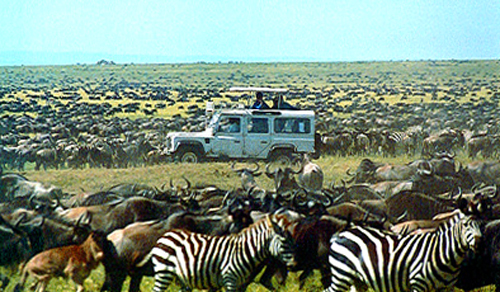
It was Bingo in Barafu today as we drove into the locus of the great migration, probably seeing a couple hundred thousand animals before the day was over.

This is always the easiest time of the year to find the largest single migratory group of wildebeest. It’s never the most dramatic time (which is the river crossings later on), but I prefer now because you see so many more animals.

And because there are so many babies. In fact, the herd has suddenly grown a quarter larger as nearly every mature female calves.

And set on a veld that is so spectacularly lush and colored by multitudes of wild flowers, it’s hard not to understand why this is my favorite time.

Nevertheless, finding “the migration” (which means a significantly large portion in one group) is not as easy as it seems.

The animals move with the most nutrient grasses, which grow where it rains. So finding the migration is as easy as exactly predicting the weather!

But we had intelligence that placed the migration in the Gol Kopjes, north of Naabi Hill. That in itself was a bit unusual, tad too far north and east for this time of the year. But clearly they were not around Ndutu, where “normally” they would have been, and yesterday our encounters with them after Olduvai to Lemuta suggested our intelligence was correct.

Mind you, there were wildebeest almost everywhere we looked or traveled in the southern quarter of the Serengeti/Ngorongoro. But the smaller scattered herds of maybe 200-400 were not a big enough or uniform enough group to be called “the migration.”

We headed to Naabi Hill, slipping and sliding as to be expected after yesterday’s incredible late afternoon downpour. On the way, we saw a family of three cheetah, a mother with two older cubs.

They were fat and sassy and not likely to hunt now, except that a juvenile Grant’s gazelle separated from its family group was trying to get back to it, and the cheetah were in the way!

I couldn’t believe how daring that young gazelle was, and it provoked one of the cheetah who gave it half chase. And that’s all it took for the gazelle to disappear into the sunset, apparently giving up whatever family ties prompted its initial reaction.

We saw another cheetah with full belly when we finally reached the Gol and then a lioness atop a kopjes, when we hit an empty but green plain filled with flies. That and confirmation of the droppings that lots of wilde had been there recently made us realize we were on the right track.

It was a lot further than I expected, given the intelligence we had, but the herds had obviously moved. Our intelligence was 3 days old and the herd was actually another 10k north and east of where I expected them to be.

But there it was, a “hot dog” shape of wildebeest perhaps 20-25 kilometers long and 3-4 kilometers wide. It lay north to south on the far eastern side of the Serengeti nearly touching Loliondo.

The northern-most portion was in the Barafu Kopjes, ridiculously far north for this time of the year. And the southern-most portion was … well, where we had stopped for lunch yesterday, at Lemuta.

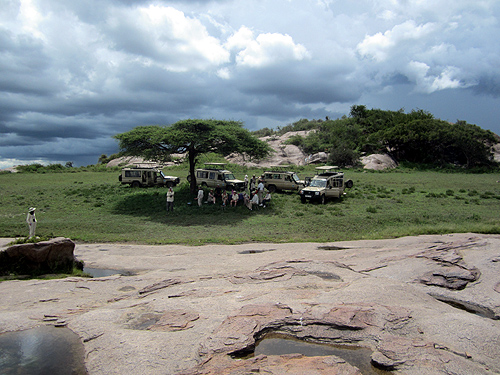
We stopped for lunch on a high kopjes overlooking the veld. It was an incredible accomplishment finding this amazing spectacle, the greatest in the world, and everyone realized the long drive necessary to reach this point was worth it several times over.

The rest of the afternoon we spent cruising through the herds and making our way home. And towards the end of the day, we came upon the same four brother lions we had seen yesterday, and two of them were lying beside partially eaten ostrich!

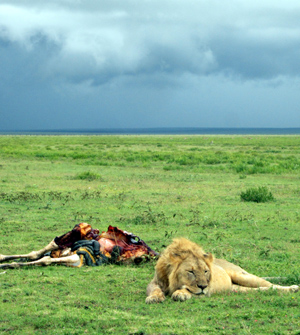
I still have to think about this one. Lion don’t eat ostrich. Lion don’t defeather birds, and the ostrich feathers were in a pile. Lion don’t eat ostrich heads or bills, and those together with most of the necks of both ostrich were nowhere to be seen.

Seemed to me it had to be hyaena and our four brothers just got irritated with the fact the kill had come so close to them. Their bellies were still full from their kill several days ago. I’m sure they ate some of the bird, but most of it lay “unused.”

It was a fantastic, successful day!

On Safari: Into the Wilds

On Safari: Into the Wilds

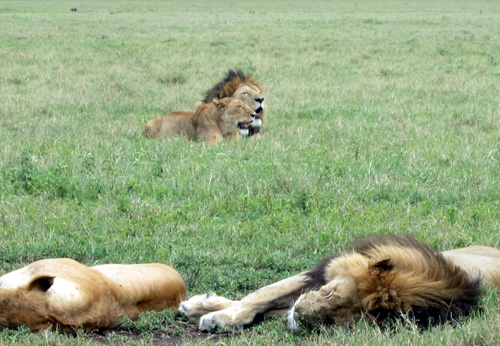
2 Lions
This is one of my favorite days on safari, as we spend most of our time off-roading in the far southeastern corner of the Serengeti positioning ourselves to find the great herds in the next few days.

We left the crater just after breakfast, and there was heavy mist on the rim as we drove around the northwest side past the down road which has been closed for reconstruction. The road then swings around to the west for about 4 kilometers of beautiful driving on the north side of the giant alter-crater.

Like so much of the veld today, it was lush and green, but I saw only a smattering of zebra and wildebeest. The road then rises briefly over the lip of the alter-crater before dropping onto the north side of the crater towards the Serengeti.

Whistling thorn acacia reappear, so therefore do giraffe! Lots of zebra suddenly, and as we descended, more and more giraffe. As we approached the road to Olduvai Gorge, large numbers of wilde and zebra mixed in with Thomson’s Gazelle covered the veld.

I hesitated thinking this was part of a large hunk of the migration, but sure was tempting to think so. Fortunately I said nothing and it ended before we actually drove into Olduvai Gorge.

After our fascinating tour of the visitors center and museum and special visit to the site where Mary Leakey found Australopithecus bosei, we continued off-road onto the grassland plains towards Shifting Sands.

We passed several Maasai herders, and I noticed they were now ranching sheep as well as goats. Saw lots more wild animals and right around shifting sands the wilde population seemed pretty dense.

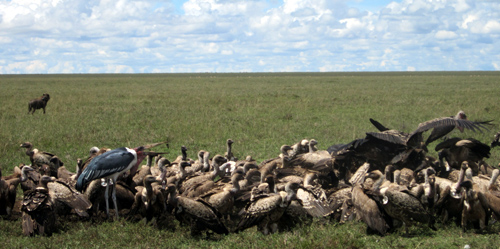
We continued overland towards Loliondo, stopping at a kopjes near Lemuta for lunch. On that hour or so drive from Shifting Sand, we stopped several times to photograph kills covered with birds, golden jackal, and several baby wilde that couldn’t have been more than a couple days old judging from the length of their umbilical chord.

Lunch on a Lemuta Kopjes is always a highlight of the trip. The views are astounding, and the entire veld was peppered with animals. This was an important clue, by the way, that would help us tomorrow in locating the largest hunk of the migration.

But it was getting on, and we had a ways to go to Ndutu Lodge, one of my favorite. So we changed direction and began heading southwest to the lakes area of the Serengeti. Passed numerous eland that ran before we were within a mile of them!

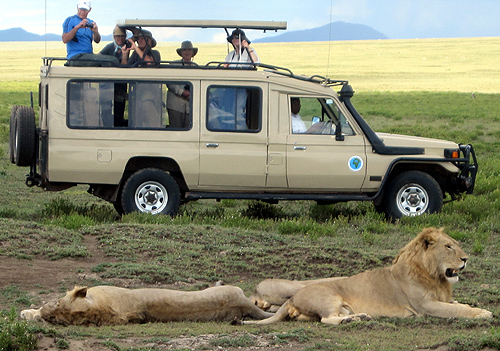
Photographed lots of hyaena just waiting on the outskirts of water holes for some thirsty beast to drink. And we ran into four brother lion who had killed a day before perhaps, with giant bellies so large they could hardly walk.

We reached the main road and took a breather so people could photograph themselves under the “Welcome to the Serengeti” sign, and the drivers who had been working so tirelessly since early this morning could rest a little.

Then we started the last 25k to our lodge following Olduvai Gorge to Lake Ndutu. Halfway there it started to rain, and then thunder and lightning, then hail and then the rain became so heavy and the wind so dangerous we had to stop for a short time.

We literally couldn’t see because the sheaves of water falling from the sky were so severe.

I’ve lived through countless East African rainy seasons. I remember one of my camps blown away, of lodges and tented camps flooded. And perhaps it’s just the emotions of the moment, but it sure seems like the rain is harder, more and longer than in previous years.

We reached the Ndutu Forest just as the rain abated and got to our lodge around 7 p.m. It had been an 11-hour day, filled with tons of animals, extraordinary scenery and (lots of) rain. Until we had reached the main road to the Serengeti, about 40 minutes from our lodge, we hadn’t seen a single other vehicle other than our own four.

This is the Africa I love the best, and today reached all my expectations.

So Many Birds

On Safari: Animal Paradise

On Safari: Animal Paradise

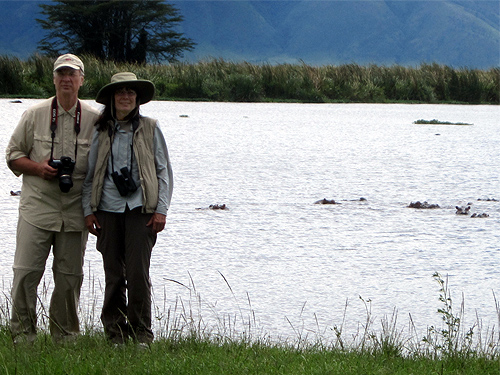
Mark Zmijewski & Jennifer Jones in front of a hippo pool where we had our lunch in Ngorongoro Crater.
Our game drives in Ngorongoro Crater were exceptional, but in the course of my career they always seem to be. It’s an absolute wildlife paradise.

We actually visited the park twice, because our game drive to Lake Manyara was prevented by terrible floods. But the crater although beautifully green had wonderful roads and tracks and we had no difficulty on two consecutive days.

I get very upset when I hear people say they shouldn’t come to East Africa during the rains. That’s when they should come! The first half of the year is the wet season in northern Tanzania, and this is when the migration is most easily seen, when all the baby animals are being born, and when the veld is most beautiful.

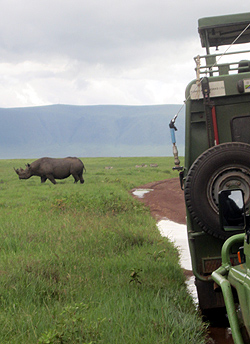
And we lucked out in spades this time. On our first day we saw 7 free-ranging black rhino, and on the second day we saw two, but on the second day we saw them up close and personal!

We saw dozens of lion. The crater has among the highest density of lion of any wilderness in Africa, probably around 100 for the 102 sq. mile wilderness.

We saw the giant eland, probably thousands of zebra and wildebeest, and likely more than a thousand buffalo.

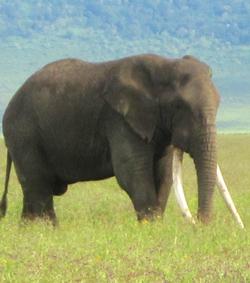
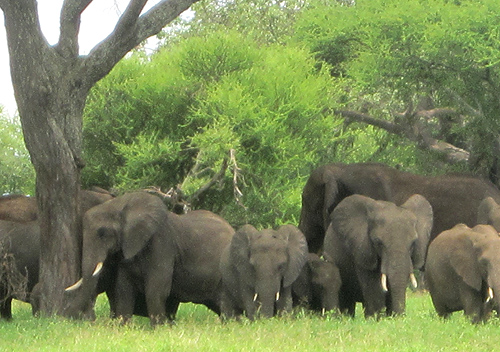
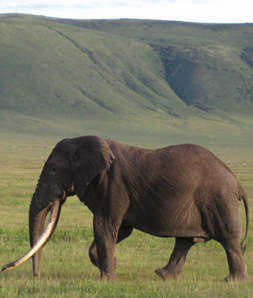
But I was specially pleased with how close we got to some of the last big tuskers that exist on earth.

During the horrible years of elephant poaching in the 1970s and early 1980s, a group of young males with very large tusks entered the crater for protection. The geology of the crater made the corporate poaching of those years virtually impossible.

The crater isn’t a good habitat for elephant. Elephant are browsers that prefer leaves and branches and bushes, but the crater has little of that – it’s almost all grass.

But they adapted and adjusted to eating grass. And so they were saved while their cousins and siblings were decimated by poachers.

During those poaching years small tusks, or no-tusk elephants were passed over as the professionals sought the elephants with the largest tusks. Soon the global population of elephant was reduced to small tusked animals.

But the guys in the crater survived. They’re dying off, now, since they’re well into the 60s. And unfortunately, even after poaching ended, they didn’t leave the crater to mix with global herds, and the few females that now enter the crater don’t seem to interest them!

So it looks like these magnificent tusks will die when they do.

On Safari: Fatal Blow to Manyara

On Safari: Fatal Blow to Manyara

Global warming is devastating earth, and it ruined a day on safari and possibly ruined one of Tanzania’s best game parks for a long, long time.

Worldwide weather is become more and more extreme. In East Africa we have more droughts that are drier and more floods that are heavier, and the frequency at which both occur is mind-boggling.

The developed world is of course no less susceptible, but we have more resources to deal with it. When Super Sandy crushed America, we were able ultimately to deal with it by rebuilding.

But the developed world just doesn’t have those resources.

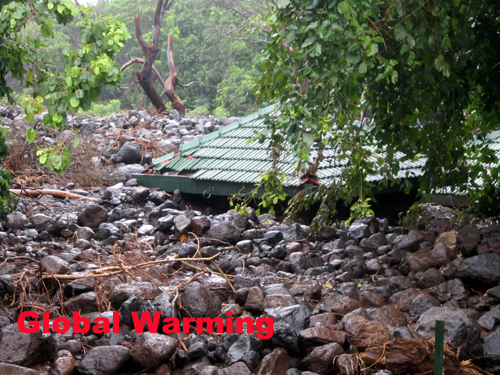
Four days before we were to visit Lake Manyara National Park, unbelievable rain causing flash floods that no one could have anticipated swept off the Great Rift Valley over the park and poured into the entry gate.

A beautiful visitor’s center with its wonderful little museum, gift shop and toilets were submerged in mud and when the water receded, covered and surrounded by boulders that had fallen from the Rift.

Four days before we were trapped by the same heavy rains in Tarangire National Park, as the only bridge to the outside world had been submerged by a raging river.

I quickly chartered airplanes to fly us the short distance from Tarangire to our next destination, Gibb’s Farm, but my four vehicles and drivers had to wait by the river until the waters subsided.

We knew the waters had subsided somewhat when we were ready to visit Manyara, so we decided to head out to the park early in the morning. It was dry enough, although the scene was so sad.

All the public buildings were buried in rocks and mud. But the road into the park was now dry, and so I thought we’d be able to visit this gem. But the ranger said no. They were too concerned that another flash flood was in the brewing.

So instead we went into Ngorongoro, enjoying an unexpected second game drive in this wonderful park (see tomorrow’s blog for information about those game drives).

We couldn’t have chosen a better place to stay for this trauma than Gibb’s Farm. It’s one of my favorite places on all safaris, and I use it as a base for visiting both Manyara and Ngorongoro Crater.

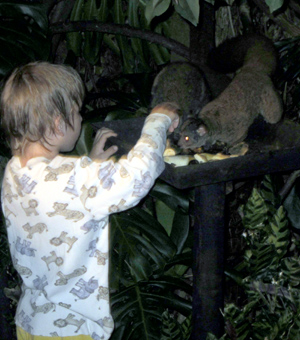
So we were there for three days. And one of the most wonderful moments came not with anyone in my group, but with many of them watching a 7-year old guest, Eli, as he closely encountered bush babies.

Gibb’s puts out fruit every night at 7 p.m. to attract the local bushbabies (greater galago). They’re a wonderfully curious primate with a very loud voice!

But no one but Eli ever tried to pet them. And guess what? They seemed to like it!

On Safari: Tarangire at its Best

On Safari: Tarangire at its Best

Tarangire proved as exciting as I expected, and we dodged the heavy rain, and as a result we achieved the optimum experience of the year for this wilderness.

You can go on safari virtually at any time of the year to East Africa and with good planning have the most memorable trip of your life. But if you’re willing to gamble a bit – which my clients don’t realize I’m always doing with their trip – then you can bingo out marvelously, and that’s what happened to us in Tarangire.

I like traveling during the rains, and I try to do so just before the heavy and debilitating rains start, and that’s the gamble. And in fact this year heavy rains have started .. early, and so stay tuned to see how the rest of the trip might unfold.

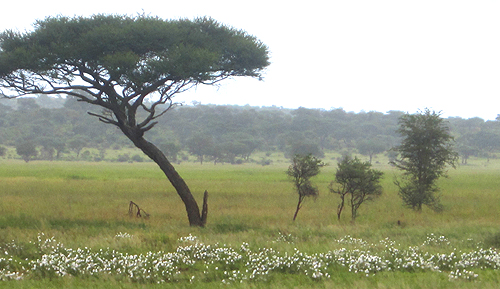
But what it means for Tarangire is that the most beautiful landscapes in Africa have been created. The great sand rivers flow, the white tissue paper flowers explode in the beautiful grasses next to the yellow hibiscus and purple mini-dahlias and the landscapes in the sky are overwhelming: sculpted by a storm forming over there and giant cumulus over there.

And, most importantly, the animals are at their supreme. Everybody’s fat and sassy. So we saw the four grand lion brothers with big bellies and magnificently washed black manes. We watched a male leopard stretch out his own belly in the morning sun. And of course for Tarangire, we watched and watched and watched elephants playing and fighting and vying for position.

We’ve been here hardly a full day and our elephant count is approaching a thousand. At this time of the year when fewer tourists come and the veld is fulsome with food, there are many playful babies and many great bulls fighting to mate.

And Tarangire is anomalous, magnificently wonderful for its sheer numbers of ele but they become so dense particularly now that their normal behaviors begin to break down.

Families mix readily. Teenagers form gangs and often wander far from the family, and I often wonder how they matriculate properly. With normal behaviors young males are kicked out of the family between 10 – 12 years old, and they must immediately associate with an older male that teaches them how to behave.

This was discovered sadly several decades ago when authorities in the Pilanesberg reserve in South Africa imported a score of young male ele who hadn’t been matriculated by older males. They killed quite a few of the other animals before they were corralled in and scientists began to study what had happened.

And that was when it was learned how important the mentoring of a younger male by an older male is. But in Tarangire the groups are so dense and the age groups often segregate together that I just wonder if there’s been any science about mentoring in conditions like these.

The roughly 3700 ele in the “northern sector” of the park are mostly resident. And we saw nearly fifty hardly fifty yards from the park entrance as they were mingling about staff quarters. These are wholly habituated animals that rarely leave the park, much less this small area.

But as we moved south to our camp, we saw the truly wild and magnificent wilderness elephant. On two occasions (since we were using the same tracks) a tailless female stopped us and really threatened us.

My clients behaved wonderfully. Not a whisper was said, and when she asked us to back up, we did slowly. But we persisted within her area of irritation, and eventually each time she let us pass.

But altogether we’ve seen nearly a thousand, playing in relatively deep pools at the side of Silale swamp, wallowing in mud, mounting in courtship, trumpeting playfully and in the expected aggression that is generated by so many animals living so closely together.

As you’ve read in other blogs, I think there are too many elephant in East Africa. And the sad part of the story were all the dead forests growing further and further from the main transit passes in the south. Trees killed by elephants: forests turning into savannah.

And of course the growing human/elephant conflict, perhaps the single greatest issue in the natural history world of East Africa today.

But like any gamble, the gamble nature is presently taking sustaining so many elephants is exciting to behold. We only hope the outcome is not a loss, but a win. And frankly, I don’t know either how to call how it will be, or how it could come to be.

But we experienced it, because we gambled with the weather and so far won.

On Safari: Never Discount Junior

On Safari: Never Discount Junior

There are few true big game reserves so close to large metropolitan cities as Arusha National Park, and it’s holding its own against an onslaught of peripheral farms and shops.

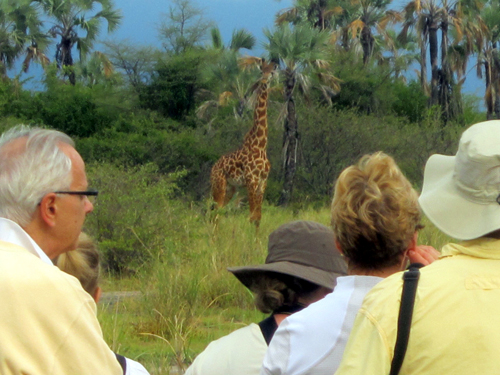
The park was exceptionally green and beautiful and lived up to its reputation for us as “Giraffic Park.” We probably saw 100 giraffe in the course of the afternoon game drive.

There are no cats, and elephants use it strictly as a corridor. We saw evidence of elephant but no animals. What we did see was the usual and beautiful groups of zebra, waterbuck and warthog, with the frequent peppering of lovely bushbuck in the sides of the forested hills.

But we also had a stroke of incredible luck and saw quite a few smaller forest creatures, including the spectacular colobus monkey with its gigantic white flowing tail. We saw a family of 20 grouped in a single tall tree in the distance – in the middle of a low bushland that I’m sure was of little interest to these strictly arboreal monkeys.

But perhaps they were enjoying afternoon tourist sightseeing!

And the grand find of the day was the red-flanked duiker. I personally haven’t seen one of these in Arusha for over ten years, and it’s just the type of species that is threatened both by elephants destroying the forest and human development on the outskirts.

We caught only a glimpse of it, but everyone in my car did see it, and it was really a joyous event recognizing that the forest is still holding its own. We also saw quite a few suni, another smaller but less endangered rodent/antelope and of course, the ubiquitous dik-dik.

But the farms are encroaching, and we literally drove on the edge of a corn farm on one side of the road and a meadow with giraffe and waterbuck on the other. There were regularly spaced new blue tents throughout the field, with machete armed lookouts to protect the crops.

That’s the challenge of Africa’s wilderness, today, to become relevant, meaningful and productive to African populations. Arusha’s holding its own, and it was a lovely first game drive in Africa for my clients.

And what’s more: never discount the little bits of wilderness that remain, either because the pressure to develop them is so large or because their size jeopardizes their being able to sustain real biodiversity.

The pressures on Arusha are enormous. And with extreme weather, like last year’s drought, I become certain that it won’t survive. Then the rains return and the wilderness flexes its muscle and shows us animals (the duiker) we haven’t seen for years.

Nature is resilient. That shouldn’t make us less vigilant, but we should respect and admire its own healing itself.

Arusha National Park is the perfect example of this.

On Safari: Bridge into the Past

On Safari: Bridge into the Past

We began the safari at one of the most beautiful and historic places near Arusha, Tanzania, the old Ngare Sero estate. People woke this morning to the wonderful clatter of cloud forest sounds of monkeys and giant birds.

Ngare Sero was built long ago as a home for hunters. It’s situated beautifully on the foothills of Mt. Meru about a mile high and benefits from rain much of the year and the beautiful clear streams that come off Africa’s 5th highest mountain.

Rebuilt for the discriminating tourist about a decade ago, clients enjoy the original manor house’s large verandah which overlooks the beautiful lake. In the thick forests which surround the lake are families of colobus monkey, the gorgeous black-and-white monkey with a white tail that looks like it comes from a horse!

These primates are among East Africa’s best “leapers” rivaling the great eland of the vast Serengeti plains. They can leap 40 feet from the top of a giant podacopurus onto wild mango and giant figs. We happen to be here now at the most wonderful time to watch colobus, since all the trees are in top fruit.

The forests also include lots of sykes monkey, which are larger and more subtly colored. Giant silvery-cheeked hornbill whose size and massive beak and horn are truly trumped by their very loud and raucous call.

So together with the deep grunts of the colobus and the frantic cawing of the hornbill, the beautiful whistles of the red-winged starling and chatter of the white-eared barbet, this is truly a bit of African paradise, the way so much of East Africa used to be.

But walk over the old bridge between the manor’s estate and the outside world, and you’ve emerged onto modern Africa: dense farms, convenience stores, and last night almost until midnight we listened to the screaming ranting of a local evangelist celebrating Easter Monday. During the day we’re close enough to the main Moshi/Arusha road to hear the trucks, and the cheers and boos of a local soccer match.

So civilization has definitely arrived. But this beautiful little alcove of ancient Africa is a wonderful way to begin anyone’s imagined adventure, and in this case, a real glimpse into Africa’s past!

Tomorrow we travel to the great national park of Tarangire. Stay tuned!

On Safari: East versus South

On Safari: East versus South

Six weeks in sub-Saharan Africa has confirmed my long-held views on where the best game viewing is and why, how seriously threatened the wilderness is by remarkably fast and unregulated economic growth, and how youthful optimism about Africa’s future mostly discounts its precious wilderness.

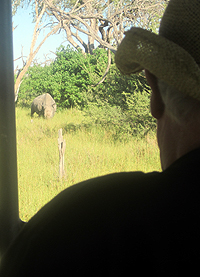
Wild rhino in the Okavango Delta.
My first stint of the year began in Cape Town, included Johannesburg, multiple places in Botswana including the Okavango Delta, Victoria Falls and Zambia, Nairobi, and ended as I guided my first “great migration safari” in northern Tanzania.

The ability to contrast East and southern Africa so immediately corroborates my long-held view that East Africa provides better game viewing for the typical safari traveler.

This might seem strange when I also tell you that in a single day on Chief’s Island in Botswana we saw the Big Five (lion, leopard, rhino, elephant and buffalo) and that seeing the Big Five in East Africa is no longer guaranteed no matter how many days you have on safari.

That’s because rhino is so rare, today, in East Africa. (Caution: captive or contained rhino, as found in fenced places like Nakuru National Park, Solio and elsewhere in

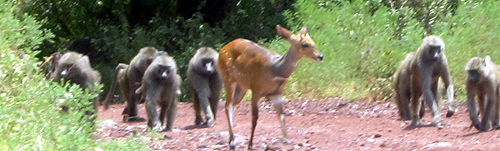
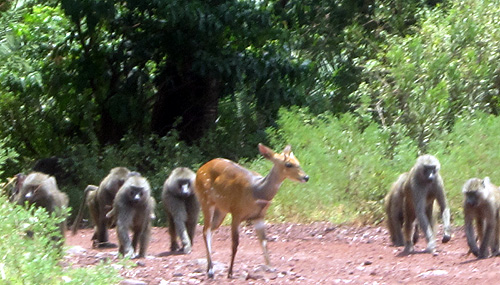
We saw this bushbuck unnaturally traveling with a baboon family in Lake Manyara. Its possible adoption by the baboons is an example of East Africa's stressed wilderness.
Laikipia including Lewa Downs, doesn’t count. Those are fun to visit, but they aren’t true wildernesses, anymore.)

But therein lies the important distinction between East and southern African game viewing. The south’s wilderness has been managed much better over the last century. Kruger National Park in South Africa is likely the best managed wilderness on earth.

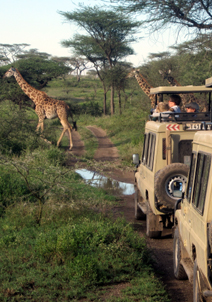
Groups of up to 20 giraffe in East Africa are common. Much smaller numbers in southern Africa.
For more than a century, Kruger and similar southern African wilderenesses have sustained rich and varied biomasses. Although currently suspended throughout much of southern Africa including Kruger, culling had been and in many places still is an instrument of aggressive pruning that aimed to insure the most diverse biomass possible.

Culling has never occurred in East Africa, and likely because of its cost rather than any moral inhibition. Similarly, the south routinely reintroduces or just moves around various species from one wilderness to another in an attempt to achieve balance.

Anti-poaching is far better funded and managed in the south. All decisions about park management, its borders and its sustenance (including the still controversial actions of creating unnatural watering holes from aquifers) has come from officials that are far better trained and paid in the south than in the East.

So in a relatively short time in Botswana visiting two different areas in the Okavango Delta and Moremi we saw a balanced variety of several dozen types of larger mammals including a dozen elephant families and large numbers of buffalo and several prides of lion.

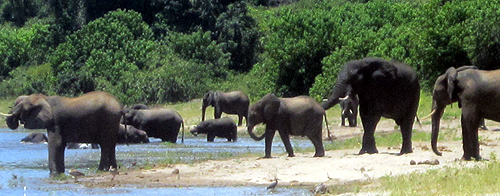
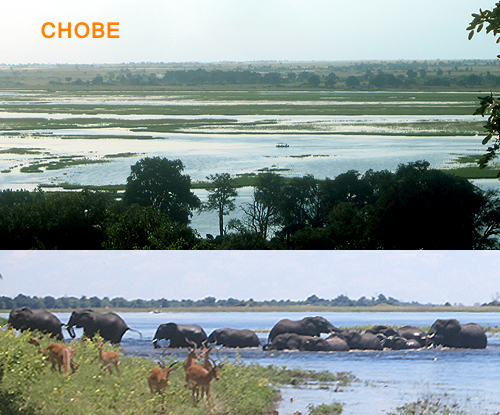
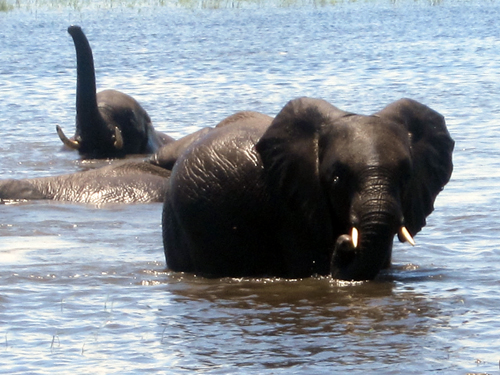
In Botswana’s Chobe balance has gone to the wind. Chobe is almost all elephants: too many, and at the exclusion of much of the rest of its historical biomass. It’s heart-breaking for me to return to areas along the Chobe River that were oncebeautiful forests and are, today, grasslands. The elephant population has destroyed much of Chobe’s former wilderness. It is, in fact, more like East Africa than southern Africa.

Which is why so many people love Chobe. There are so many elephants in so many endearing behaviors and from time to time dangerously so, that Chobe like so much of East Africa provides the thrills often missing from a more balanced and rich biomass.

We see about the same number of leopard in east and southern Africa.
One implication in the above is that East Africa (and Chobe) are worse wildernesses, because the biomass is less rich, because they have either been poorly or not managed.

This remains to be seen. I think the scientific consensus points in this direction, but it’s been pointing in that direction for an awfully long time and we have yet to experience “the crash” scientists have been predicting for such out-of-balance wilderness.

Scientists might pale at the biocount of these wildernesses, but tourists are thrilled: On my great migration safari of 11 days in northern Tanzania, we saw 61 lions, 2 leopards, 5 rhino, and I don’t know maybe 500 elephant and a quarter million wildebeest? And perhaps several hundred thousand zebra, a hundred giraffe, and – very important by the way – fewer tourists than in Botswana.

This last observation, that my safari clients in East Africa encountered fewer other tourists did my safari clients in Botswana, is not the norm. Most East African tourists on the lodge circuit will definitely encounter more tourists than a similarly budgeted trip in southern Africa.

Who's looking at whom?
But I don’t like the lodge circuit, and the safaris I guide are expensive. This lets me remove my game viewing from heavily used tourist areas into the East African wildernesses that are truly less used than virtually any wilderness in the south.

The unmanaged, some say chaotic, out-of-balance wildernesses of Chobe and much of East Africa result in greater numbers of larger animals at the expensive of many smaller ones that have gone extinct.

Theoretically, this situation is not sustainable. And this tension of nature trying to preserve itself is likely the reason for the much greater drama usually experienced on an East African safari.

It’s certainly a bitter sweet reminder that urgent action to preserve these great East African wildernesses has been grossly neglected. But as crass as it may seem, it also provides at least for the moment (and perhaps at the cost of the future), the “greatest wildlife spectacles on earth.”

On Safari: Crater Delight

On Safari: Crater Delight

Our full day game viewing Monday was extraordinarily productive: 5 rhinos, 34 lion (one pride finishing a kill), and lots more.

The crater was greening up following several days of heavy rain and so was particularly beautiful.

As Nancy Weinstein said, “Seeing the rain on one side and the sun on the other with all the magnificent light” produces the ethereal reality of the crater, as if you’re in some controlled smaller space where so many different things are happening so fast.

The Up Road is closed for repairs, so everyone has to leave the crater on the Sopa Road.

This makes game viewing for some of the opposite side lodges, like Serena and Crater Lodge, particularly long.

We were staying at Gibb’s Farm so were prepared for the lengthy time getting in and out.

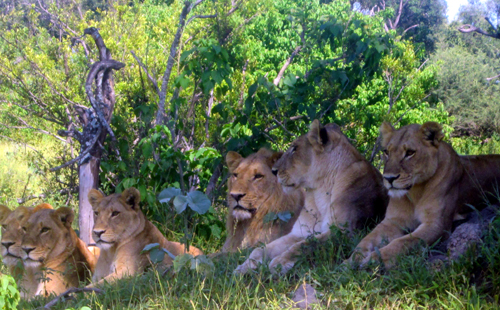
We also went in using the Sopa Road and weren’t a few minutes out of the Lehai Forest when we saw our first pride of lion.

I was pretty sure it was the Mti Mkubwa pride (“Big Tree”) and they were incredibly fat and sassy.

We figured there were five of them, but they were pretty far in the distance and totally sacked out. Patience is the key to exceptional game viewing and we waited for a while and sure enough, they began to get up one by one and walk towards us.

With more to view as they approached, it was clear they had hunted last night. Their bellies were bulging. And I noticed not far from where our cars were on the road that there was a gully, and with all the rain we’ve had, undoubtedly plenty to drink.

And that’s exactly what happened! After lions feast on their kill, they have to drink copious amounts of water or the 15% increase in body weight resting mostly unchewed in their tummies would clog their entire GI system.

Undoubtedly they had drunk once at least, but they were now returning to drink again. And after they did, they continued towards us onto the road! So there was more to their moving than just thirst.

I figured they were either returning to the kill or perhaps returning to where there were cubs waiting.

Lionesses “den” their cubs somewhere during the hunt, and the cubs obey. Sometimes an adult female will be left behind to baby sit, but not always, and it’s always amazed me how those little critters know not to follow mom.

That was just the beginning! We then proceeded to find rhino, huge families of buffalo, of course lots of zebra and wildebeest and even hartebeest and eland. Just before lunch, we went to the hippo pool near the central lake.

Lunch was great fun in front of the Loitokitok lake, which had more hippo in it than I remember in times past. The great treat was watching a grey heron standing on the back of a slightly submerged hippo, moving through the water as if slow water skiing!

(Our picnic lunch from Gibb’s Farm was specially outstanding, but of all the goodies included I’ll never forget the brownie! Amazing.)

We saw more rhinos on our way back, and more prides of lion, and golden jackals, serval cat and a number of great birds. The large numbers of Abdim and White storks are getting ready to migrate back to Europe, so there was a lot of colorful soaring.

And it was on the way out that we once again encountered the Mti Mkubwa pride, and this time a female was dragging around the skin of a young buffalo. So it had been the kill they were returning to.

And our last glimpse of activity in the crater as we raced to get out of the park in time was one of the giant tuskers that are dying off fast.

About 30 giant tuskers went into the crater when poaching became severe in the 1970s. The crater affords a natural protection to wildlife that makes poaching very difficult. But the crater isn’t a good habitat for elephant: there aren’t enough bushes and trees; it’s almost all grass.

But the Big Tuskers learned to eat grass and have stayed ever since. But they’re now well into their 60s and dying quickly. I expect they’ll all be gone in 2 or 3 years.

** And just a little aside about our game drive Sunday in Lake Manyara National Park. See the picture below. Manyara is known for lots of baboon, true.

But we watched a young bushbuck walk with them in near lock step, stopping when they did, moving when they did and where they did. For all the world it looked like it had been adopted by the troop!

And now into the Serengeti!

On Safari: Tarangire Cats

On Safari: Tarangire Cats

Four lion brothers together for life is not unheard of, but quite unusual and we watched them in Tarangire today after they had mastered a huge kill.

The childrens books’ rendition of lion or the incomplete TV documentaries make people believe that every lion belongs to a pride headed by a grand master who only occasionally does temporary work for MGM.

But that’s not really the case. Lion prides are composed of almost any permutation of males and females of almost any number up to and sometimes exceeding twenty. Females once together generally stay together their entire lives, unless something like a harassing male forces one away perhaps while attempting to eat the lioness’ cubs.

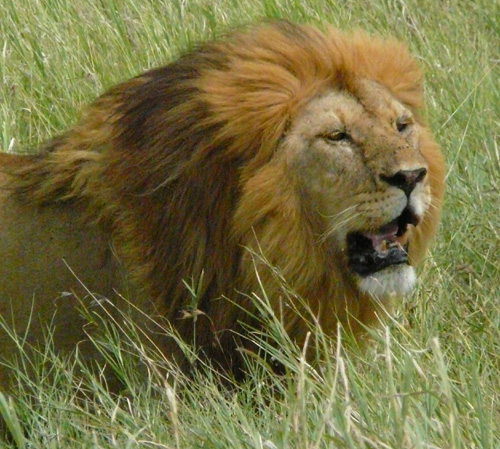
But take any number of lions, any combination of male and female, and you constitute a pride. And today in Tarangire we saw four brothers, fat and sassy from the night’s kill, drinking in the Silale swamp.

Their bellies were bulging, their manes grand and disheveled, and several faces bloodied by the battle of the kill. One limped. One was tailless, perhaps the result of losing a colossal fight to one of his brothers for the right to go into a pride and mate.

We had not too much earlier seen two male cheetah – all of this along the Silale swamp. The cheetah struck me as unusually anxious, and that seemed odd as they are among the friendliest of the cats. But discovering the lions right down the road explained that.

Hartebeest, dozens of birds, and the inimical landscapes of Tarangire at dawn and sunset and even during the day. It’s been raining hard and the white morning glories are covering the veld, altering the somber view of a misty morning with absolute radiance.

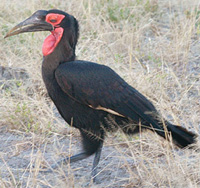
One of my favorite moments early this morning was not just coming upon a family of ground hornbill, but arriving while they were still piping their organs! The sound of the ground hornbill carries for miles, so I’ve often heard it, but not up close. It’s usually only in the very early morning.

But here they were piping away hardly 20 meters from us, the deep organ note sound resonating so loudly there was nearly a fizz after each note. The commotion we learned was prompted by an aging juvenile who wanted the giant bullfrog his mother was carrying, and mom had decided he was old enough to get one himself.

So we watched as he complained and complained then finally with the speed of a cheetah darted at his mom practically turning her over and tearing the frog out of her mouth!

The organ pipe stopped.

On Safari : Still Too Many Ele

On Safari : Still Too Many Ele

Tarangire National Park is the perfect place to demonstrate there are too many elephants in the wild right now, and it didn’t fail to confirm the theory this time! We had exceptional game viewing based from a new, luxury lodge called ChemChem.

Our day and a half of game viewing in Tarangire probably encountered 500 or more elephant, but it’s so difficult to estimate. In one panorama I challenged everyone in the group to count the elephants we saw, and the numbers ranged from 120 to 180.

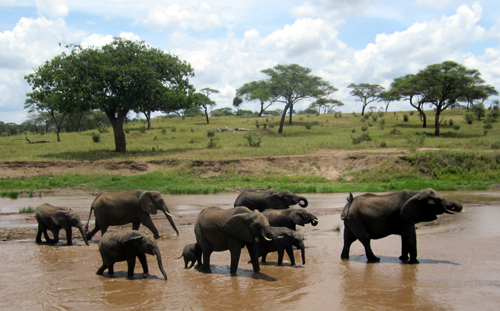
Traditional elephant behavior breaks down in Tarangire because there are so many elephants. Families don’t separate themselves from one another but often travel, forage and frolic in the river together.

We saw week-old babies and octogenarians. We saw good tusks and many bad tusks or little tusks. We saw many babies and watching the rest of the family protect these little guys is absolutely wonderful.

And protecting them is so hard to do! Especially when they get down to the river and insist on rolling well beyond when mother thinks it’s time to leave.

We stayed at a new lodge outside the park for our first several days in Tarangire, before moving into the park and staying at a great place inside. The lodge is called ChemChem and it’s the dream of several French investors and old African hands.

Placed between Tarangire and Manyara, the ChemChem property extends all the way to the shores of Lake Manyara, and the activities my group enjoyed were really fantastic.

They included a walk where we got remarkably close to impala, giraffe and zebra. I don’t allow walking if there are predators or elephants around, and ChemChem assured me there weren’t.

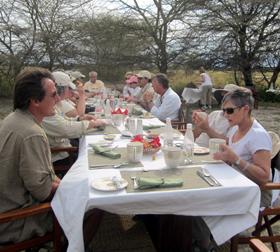
A fabulous bush breakfast, Maasai sundowner chorus and sundowner along the lake are all a standard part of the ChemChem fare.

We’ve had some very heavy rains. According to the folks here, it’s just the rebeginning of the rainy season which starts in November/December and continues straight through May, with a noticeable letup in February. Well, the letup is over.

It was wonderfully exciting to go to sleep in ChemChem’s marvelous tents to the performance of lightning, thunder and tumultuous rain. I’m of course glad for this, because it means the migration in Serengeti (if the rain continues that far) will start to concentrate.

On our first game drive towards our second camp in Tarangire, Swala, we encountered again numerous elephant, lion mating, leopard, hartebeest and I’m sure I’m forgetting lots more. It’s been a wonderful two days so far, with another to go, in Tanzania’s elephant park, Tarangire.

On Safari: Kenya’s Election

On Safari: Kenya’s Election

There were 44 observers from the Carter Center watching the Kenyan election last night but all they observed was joy and glory! As I write this in East Africa the winners are not yet known, although Uhuru Kenyatta has a significant lead for president. But so far only 5 million on an estimated 10 or more million votes have been counted.

I was in Kenya when the polls closed, for just a few hours on my way to guiding my first Great Migration Safari.

The whole world watched as Kenya masterfully pulled off the first national election under its new and fabulous constitution. Final results will be some time in coming, because the constitution mandated that the winners achieve minimum support from all of Kenya’s 47 counties, denying any victory based exclusively on ethnicity.

This means despite Kenyatta’s lead another election between the leaders could well occur within 30 days in order to finalize the results. But based on last night I’m already creating a “Celebrate Kenya Safari” return trip!

Kenya knew that it had to prove to the world that the debacle that followed the last election in 2007 would never happen, again, and that it has truly emerged into the modern world. Moreover, it displayed a transparent democracy I don’t even think America could rival.

It wasn’t perfect, but no election is. In fact, it began ominously with an early morning attack on police poll watchers in the troubled second city of Mombasa, and 4 policemen and 2 poll workers were gunned to death.

The authority governing the election had assured that anyone in line before 5 p.m. would be allowed to vote, no matter how long the line was, and in some places it stretched for nearly a mile. But in Kilifi, north of Mombasa, election authorities ended the process at 5 p.m. even with a long line waiting, because of reports of imminent attack.

The coast remains a troubled area for a number of reasons, most importantly that it’s mostly Muslim and seriously impacted by Kenya’s occupation of neighboring Somalia.

There were long lines in many places, and some polls didn’t close until 10 p.m. In a number of areas poll officials with legislated authority simply kept the polls open even for late comers.

Kenya has more cell phones per capita than the U.S. and a free app was available that voters would use to report irregularities. And needless to say, with 10+ million voters there were many. It will take many weeks to sort them all out, but ???

I’m sure that many tour operators like EWT were waiting with baited breath. We could not restart Kenyan safaris without a positive result, and it was beyond our best hopes.

There were 14.4 million registered voters. In addition to the executive president, the election chooses governors and one senator from each of the new 47 counties, 290 national assemblypersons, 1450 county representatives and 47 “women’s representatives” who have a remarkably unique role in the new constitution.

There were 53 political parties, of which there are 8 major contenders, that fielded 12,752 candidates. The country managed 33, 400 polling places with 6-10 poll workers each, secured by 99,721 security personnel including police and … even rangers from the Kenya Wildlife Service!

Voter ID – a contentious issue in the U.S. – was mandatory, and there were two steps checking it. Approximately 20,000 fraudulent voters were stopped from voting, and although that’s insignificant statistically, it underscored how important Kenya felt legitimate democracy must be.

Elderly, disabled and pregnant women could immediately go to the front of the line. Anyone at all who wished assistance could vote with an assistant who pledged “secrecy” regarding the person’s vote. This is a brilliant addition to a country still not yet at 100% literacy.

Voting machines were high-tech, but there were parallel methods of hand counting when the machines failed, which inevitably some did.

So we won’t know for a while the final outcome, but the start is nothing less than stupendous! In a way, the fact that the process worked is what achieves the real victory.

On Safari: Chobe Today

On Safari: Chobe Today

Chobe National Park in Botswana provides the most spectacular elephant experience on the planet. Is it a realistic experience of elephant in the wild, or a tourist fantasy?

We concluded three wonderful days here with a deep morning excursion into parts of the park few tourists visit, down the main road to Savuti. It reminded me of the old days in Botswana, when there weren’t fancy lodges and … well, paved roads.

For fear of sounding like a nostalgic old man, those were the days! This was wild Africa, when animals ran from the sound of your car, and when Landrovers traveling on Botswana’s deep sand roads felt more like sailing in a fast-running estuary than driving.

Not today. Things have changed. Finding 50 elephants ten minutes after leaving your air-conditioned lodge is normal. For elephants, and for tourists, that’s probably a good thing. Yesterday I wrote about the serious challenges too many elephants in Chobe presents, but their accessibility and sheer numbers is breath-taking to virtually all of us visitors.

The panorama of the Chobe River as it divides Botswana from Namibia and begins the awesome confluence of the great Zambezi is itself worth the ticket price. The entire ecology of Botswana is so weird and spectacular that in itself seems unreal. We were here for only three days. In that short time the river rose three feet as the great flood from Angola begins in earnest.

And this is no small river. Although broken by islands and sand bars that streak through its middle and edges providing habitat for ridiculously colored malachite kingfishers and stupendously beautiful carmine bee-eaters, the river is about 4 miles wide. So for this to raise 3 feet in three days is kind of overwhelming.

It’s a bit above average, but not too much, and nowhere near as dramatic as it was last year. This is nature flexing its rather striking biceps, and it’s humbling.

In three days how many elephants did we see? A thousand? Fifteen hundred? We stopped counting. They walked around our vehicles either as if we weren’t there or with little interest. When one did stop to flap its ears, we knew he was a newcomer, perhaps transiting from Namibia, but not one of the hundreds if thousands who spend a good portion of their lives playing in the water.

When inevitably one of these magnificent creatures dies, the shore of the river grows the ancient mole-like bumps of silent crocs, turned perpendicular to the shore, waiting for everyone to leave but them. We saw hundreds of crocs. We saw crocs tearing apart a dead baby hippo. We saw crocs stalking black heron. We saw impala worried about taking a drink from this unmeasurable amount of water.

The elephants have cleared the forests and impala and baboon have filled in the gaps. We also saw puku and lion, giraffe and kudu. It was the Lion King stage and the script was endless. I’ve rarely seen smiles glued on my clients for such a long time.

Yet I think back to the old days when part of the experience was fear. There was concern that a 6-ton beast might suddenly appear and tip your rover. There aren’t any 6-ton beasts anymore. The elephants are smaller, weaker than before, but still the world’s largest land creature and nothing to sneeze at.

I think back to the sounds of the late summer winds, the sounds of the river rising and gushing through the marshes. Today there are sounds of airplanes and cars, and boats and houseboats.

Life goes on, and my goodness, whether real or unreal or natural or somehow naturally contrived, Chobe is nothing less than magnificent. Yes, there are some real problems here for elephants and the wild in toto, but the moment is symphonic.

And whether it’s better or worse than before, it is what it is. And it’s nothing less than magnificent!