#1 & #2: Whites Fight on Black Soil

#1 & #2: Whites Fight on Black Soil

2012 goes down in history as the first time a modern African military defeated then occupied a terrorist state. Somalia fell to Kenyan soldiers. Except that there’s a lot more to it than that.

My #1 top story for 2012 in Africa is the “pacification” of Somalia by the Kenyan armed forces, and #2 is the less obvious reason why. To see a list of all The Top Ten, click here.

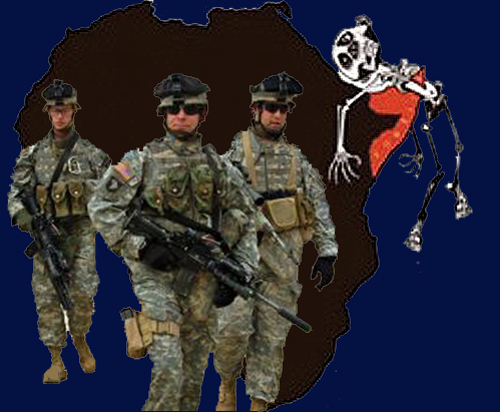
The #2 story, the “less obvious reason why” the Kenyans conquered Somalia is the enormous covert military operations by the west, particularly the U.S. and France.

That assistance actually does include boots on the ground, but the Green Berets and French Foreign Legion are stealthy. They’re only rarely seen.

And while their presence has been most notable in the Somali war, they’ve been seen elsewhere, especially in central Africa in The Congo. About a 100 U.S. forces arrived publicly in Uganda for that effort. The French have a lot more in northern Africa.

These two top significant events on the continent last year have enormous implications globally but of course even greater ramifications locally. But I’d suggest that in a worldwide context they are among the top events of the year.

Somalia has been an anarchic geopolitical unit for 20 years. The implosion began when Bill Cinton abandoned a United Nations effort to hold the country together in 1993, what is commonly known in America as “Blackhawk Down.”

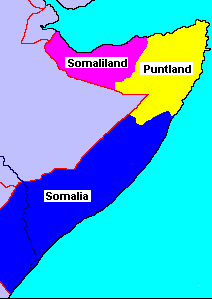
The country quickly broke apart into ethnic and clan-based tiny warlord states originally fueled by the weaponry left by Blackhawk Down. That later was sustained by piracy and other black-marketteering. Although two northern parts, Puntland and Somaliland, managed to organize themselves into something more stable and less onerous than the old Taliban Afghanistan, the majority of the country remained ruled by local warlords.
The Russians left Afghanistan in 1989 and shortly thereafter the country was ruled by the Taliban which welcomed the gang of Thugs led by bin Laden. This was a turning point in global power, a specific outcome of the end of the Cold War.

Perhaps the world was so tired of conflict that the west in particular grew inward desperate for periods of no war. Be that as it may, no president in the history of the U.S. has so dropped the ball on world peace like Clinton did, then.

His early nineties retreat from Africa caused all sorts of mayhem, from the Rwandan war to the Nairobi and Dar embassy bombings. He has since apologized, and some of his advisers at the time say he had been distracted from the growing turbulence in Africa by the Monica Lewinsky affair and subsequent impeachment.

I believe that radicals like bin Laden were emboldened by the subsequent mayhem. The Rwandan holocaust preceded by the implosion of Somalia was a calling card to bin Laden. A few years later, he blew up the American embassies in East Africa.

A few years later, he blew up the Twin Towers.

Terrorism reigned.

And so it has ever since. And America’s extraordinary response, the military involvement in Afghanistan and Iran hasn’t worked. Obama knows this. Like suburbs hiring trained snipers to kill deer eating their city park roses, Bush tried to eradicate terrorism with firepower.

All it did was blast it to the sides: Africa. Deer aren’t as dumb as you think. They sense the sniper’s limits and move out. For a while the city park’s roses bloom magnificently, but roses on the periphery don’t do so well.

For example, Somalia. Bush shotgunned Afghanistan, then Iraq, and many of bin Laden’s thugs were routed elsewhere. Not too many years later they ended up in Somalia after a short stint in Yemen. The al-Qaeda became al-Shabaab and conquered the warlord states of southern Somalia. What had been Afghanistan under the Taliban was now Somalia under al-Shabaab.

One and the same.

So Kenya especially began to suffer the same way all the countries bordering Afghanistan suffered. It starts with refugees. That is a problem of enormous magnitude, aggravated in Kenya’s case because the camps were located in its far and remote northeastern frontier.

And quite apart from the strain of such a responsibility economically and socially, the camps become conduits for terrorists to enter Kenya. Shortly Kenyan bus stops and churches were being blown up by suicide bombers.

So a little more than a year ago Kenya announced it would mount a military operation into Somalia. George Bush failed getting Pakistan to do the same in Afghanistan. Obama succeeded with Kenya. At first we all laughed out loud. But we were wrong.

At first the Number One News that Kenya has pacified Somalia seems so good. Part of it is. A multiple generational war is ending. Good, right? Yes, of course when any conflict ends.

Mop up continues, but when the Kenyan army captured the town of Afmadow we knew it would only be days before Kismayo fell to the courageous Kenyans. As it turned out it was months but it did finally fall and today Kenya occupies most of what only a year ago was troubled Somalia.

Today, Somalia has an effective government and the capital of Mogadishu – while not exactly a tourist haven yet – is peaceful. Kenya, on the other hand, is increasingly troubled.

I believe Kenya is too advanced and mature a society to succomb the same way Afghanistan/Pakistan, Yemen and Somalia did. Yes, folks, Kenya is more socially atune and politically savvy than Pakistan. I’m hopeful that the current bombings and other violence will slowly end as the new constitution is cemented with elections in March.

But this is deja-vu squared, no matter how you cut it. We routed world terrorists out of Afghanistan and they feld to Yemen. We routed world terrorists out of Yemen and they went to, and settled in for a quite a while, Somalia. Now that they’re routed out of Somalia?

The unpleasant conclusion is that for the time being, they’re in Kenya, and so Kenya is not a good place right now to visit.

Obama and Hollande seem to think the terrorist can just be chased into oblivion, and oblivion to them is currently beyond Kenya somewhere else in Africa. Are you following what’s happening in Central Africa, today? Or Mali? Or Nigeria?

I’ve been very skeptical about this policy. I’m not sure the west has enough resources to chase every terrorist into oblivion. I wonder if it’s time to let up.

But I’m uncertain. As uncertain as Clinton and Mitterand in 1994 must have been before a million people were slaughtered in Rwanda.
No More Grains of Rice

No More Grains of Rice

Susan Rice’s performance on the Sunday Talk Shows incorrectly explaining the Benghazi attacks is a perfect example of how she has historically allowed political considerations to trump more important foreign policy or human rights considerations in Africa.

She’s been acting like this for years. She seems incapable of intricate analysis and quiet diplomacy. She’s no engineer of foreign policy. She’s a cheerleader. Africans don’t like it. I don’t like it. Americans should not make her the Secretary of State.

Her list of failures in Africa is impressive: Blackhawk Down followed by the Rwandan genocide followed by the East African embassy bombings followed by the escalating instability of Darfur followed by the poorly created South Sudan and most recently, the mishandling of the growing violence in Kivu and Goma.

There are more, but these are the main ones.

Contrary to the Huffington Post that I usually love, there were plenty of warnings that the Kenyan embassy was going to be attacked in 1998.

An Egyptian agent, or double agent initially set up by the FBI gave warnings of the attack on East African embassies about nine months before it happened. The details were published long ago by the New York Times.

After years of further investigations, Frontline organized all the evidence in a way that was resounding proof that plenty of warning had been given, warning that had been ignored. At the time, Susan Rice was advising President Clinton on African affairs and had to have been involved in the decision (or lack of decision) to do something about the intelligence.

Today in Nairobi the “August 7 Memorial Park” stands as America’s remembrance of the bombing and in particular remembrance of the 238 Kenyans who were killed. I’ve visited the memorial often and it includes a short movie that also describes a workman who came into the embassy hours before the bombing and tried to warn everyone to leave, but who was ignored.

The memorial has had a website for years: memorialparkkenya.org. The URL is confirmed by Google. But the website no longer works… for some reason.

I was in Nairobi and heard the bomb go off. It is a day I will never forget, and I will never forget what I’ve learned about it, even if websites die.

But worse than the 1998 bombing was the 1994 genocide in Rwanda. The U.S. and France are specifically responsible for having allowed the genocide to happen by their actions blocking the Security Council from sending in more peace-keeping troops as desperately requested by the Canadian General at the time.

France refused to increase peace-keeping because of a complex historical feud with Belgium and France’s blind support of the Hutu who at the time were plotting the genocide but had been seriously repressed by the existing Rwandan regime.

Clinton backed France because of his being burned by BlackHawk Down. It was a cowardly response, and one for which he has since apologized.

There is a wealth of literature on this. The two best are the movie “Hotel Rwanda“ and the book, “We Wish to Inform You That Tomorrow We Will be Killed With Our Families.”

According to a former President of GenocideWatch, Dr. Gregory Stanton of Woodrow Wilson Center for International Scholars:

“The U.S. government was forewarned of the impending genocide. Communications were sent by cable, e-mail, and secure telephone… [But] Policy makers in Washington, D.C., especially Anthony Lake, Dick Clarke and Susan Rice at the National Security Council… did not want the U.S. to get involved in another African “civil war.”

The decision to “not get involved” hooked America into a mind-boggling expensive refugee and human rights initiative, followed by billions for Rwanda aid that continues today. But beyond the expense, we’re talking of at least a million lives lost.

The guilt of supporting Rwanda is something Susan Rice knows deeply and is deeply entrenched in. As the DRC Congo/Goma crisis deepened this fall, she specifically in her capacity as UN ambassador engineered multiple softenings of European led initiatives to impose sanctions on Rwanda to restrain its wanton support of the turbulence there.

A few weeks ago, America began reversing this overly cautious policy. It was terribly wrong in the beginning and has certainly led to more violence than was necessary.

Perhaps the best example of Rice’s inability to perform more than a political role was her performance in The Sudan, including Darfur and the creation of South Sudan.

The secession of South Sudan from the greater Sudan is overall a diplomatic victory for the world and most certainly a good move for the citizens there. It took more than 20 years and involved a serious civil war that the U.S. was deeply involved in.

But the creation of the new state was poorly done. Two years after independence, South Sudan is still mired in military difficulties with the north in a modern way, and with several ethnic groups in ways reminiscent of William of Orange. The untold oil wealth is not being mined because of this instability and a refugee problem within the country has grown severe.

Rice must shoulder much of the blame. She consistently created PR moments, sound bites and veneers of western institutions neglecting the much more difficult and intricate process of creating social institutions.

At a critical juncture in the negotiations that were leading to the two-country solution in The Sudan, Rice actually organized a rally of blurry-eye Juba citizens hurriedly rounded up for something more akin to an American political rally.

As reported by Matthew Russell Lee of InterCity Press who was traveling with Rice at the time:

“‘Are you ready to protect your country?’ [Rice shouted to the small crowd.]
Yes!
‘Are you ready for independence?’
Yes! … Another diplomat … would later call it a “political rally” and deem Susan Rice’s organization of the Juba leg as inappropriate.”

Rice has never displayed the insight or vision of a Hillary Clinton. She is schooled in American bureaucracy where she has percolated through the ranks and become one of its best soldiers.

One of Obama’s most serious failings is his inability to freshen up government. Rice like Geithner and others in his close circle, are old boys/girls who have rarely lived on the outside. While you might say the same of Hillary Clinton, it could be that rising to the top as fast as she did insulated Hillary from the strictures of soldiering Rice has not liberated herself from.

I’ve come to believe that Obama chooses people like Rice and Geithner not completely from a lack of his own personal courage, but because he very deeply believes in the American government status quo. He eloquently describes government’s ups and downs, but he sees overall America as on the right path.

I’m more radical. I’d like a visionary who shakes up government and doesn’t rely exclusively on old people with old ideas to join him at the helm. Africa has changed so quickly and so radically in my lifetime, I don’t think someone schooled and processed through American bureaucracy for her entire life is how we as Americans should be represented to Africa.

“Susan Rice’s chances of succeeding Clinton as secretary of state look slim,” writes a respected South African analyst.

And he, and I, think that’s just the way it should be.

Statistics are Just Cosmetic

Statistics are Just Cosmetic

The American demographic is changing, the earth is heating up, and lipstick is the only way to understand how well Africa is doing and how far behind America is falling.

A U.S. presidential election provides an incredible snapshot of America, because so much data and polling and social introspection goes on. Much of it confirms my long-stated beliefs that America is yet impeded by racism and sorely crippled by under education.

And that means much of America just doesn’t accept reality. Like global warming. Or like how Africa is becoming so modern, innovative and holds the potential to outdistance America on a number of fronts.

I’ve written about energy, for instance, and the aggressive use of solar and biofuels; I’ve written about the many inventions like the competitors to iPhones; I’ve written about software development and imaginative financing.

And now I’m writing about a topic I know so much about: cosmetics.

A new Kenyan beauty products company is achieving some unique success and might well enter the American market. We often criticize foreign-made products (particularly from China) because they often have a great price advantage. An advantage sometimes associated with inhumane labor practices or outright government subsidizing.

Not the case with SuzieBeauty. Her products might cost less than Lancome but it’s not because of slave labor. It’s because the division of wealth on earth is so skewed that the “richest” in places like Kenya are still less rich than in America. But that not by as much as you probably think!

SuzieBeauty is a perfect example of how American accomplishments are being exploited and enhanced faster by non-Americans than they are by Americans.

Suzie Wokabi is the founder of SuzieBeauty, and she’s Kenyan, of course. But she spent some time in the U.S. where she graduated from college and then joined the fashion industry. She became certified for media make-up and then worked for five years in New York before returning to Africa in 2007.

There and then in Africa, educated and experienced by everything wondrous in America, she really blossomed.

SuzieBeauty’s main standard-size bright colored lipstick costs about $10. A similar lipstick from MAC in the U.S. costs $15. This 50% difference is true through almost all of the beauty products offered by each company. One Kenyan and one American.

There are several interesting things about this.

The U.S. government says that the average wage of a working person in American in 2011 is $42,979.61. According to the Kenyan government the average wage of a working person there in 2011 was under $1000. (According to the CIA it was $1700.)

The big difference between the Kenyan government’s own determination and the CIA’s has to do with many factors, most notably the exchange rate which organizations like the CIA weight over longer periods of time. But regardless, either figure when compared to the American one suggests a society in Kenya of abject paupers. And it’s these numbers that teachers often use in high school much less college.

Africa and most of the third world have been growing so rapidly over the last several decades (as high as 10% per year, compared to developed countries 3-4%) that their societies have become radically divided economically.

The difference between Kenya’s richest and Kenya’s poorest is nowhere near as great as between America’s richest and poorest, but that’s because America’s richest are off the charts. But the difference say, between the top fifth-or-sixth of Kenyans and the bottom fifth-or-sixth is a chasm compared to that metric in America.

And that stat applies to most developing countries. And to be sure that’s an enormous problem. In Africa that metric is most pronounced in South Africa, where the country is fairly rich but huge portions of its population are abjectly poor. The labor unrest and social disturbances plaguing the country right now reflect this division.

Redistribution of wealth is a hot topic in the U.S., and one that few politicians are ready to embrace. But it is taken for granted in the developing world, because it’s understood without it their societies will explode.

But the point of this blog is not to lobby for redistribution. It’s to demonstrate that America’s top 10% and Kenya’s top fifth-or-sixth are not chasms apart. They’re about 50% apart, the difference of the cost of Suzie’s lipstick and Mac’s.

And that’s a remarkable fact, because only ten years ago it was probably 100%, and twenty years ago it was probably 1000%.

The developing world benefits from the youth of its societies which are unbridled by hundreds of years of law to be sure, but which are also unfettered by custom. But most of all the developing world is willing to experiment and explore new if radical social constructs which old places like America are so afraid to do.

You’ll never hear Kenyans talk of “founding fathers” or restricting their social responsibilities to what men in wigs 200 years ago thought was right.

SuzieBeauty’s mission goes well beyond value for stock holders. It includes “…innovative research …training and education, social responsibility and environmental awareness.”

Not your normal lipstick manufacturer. I can hear Kenya smacking its lips right now!

Beach Bums

Beach Bums

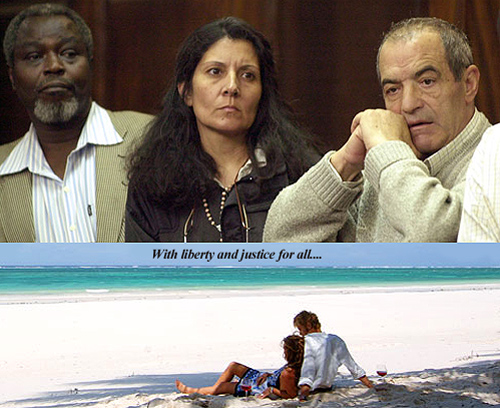
Angelo Ricci, a member of Kenya's Italian community, listens as a Kenyan judge acquits him of any crime for having 2,500 pounds of cocaine in his beach resort cabin. (AP)
Don’t feel sorry for the harassed billionaires of the world; they’ve found a place to hide from those nasty journalists linking them to blood money, laundering and drugs: the incomparably beautiful beaches of Malindi, Kenya.

This summer Brian Dabbs writing for The Atlantic unmasked the Italian cartel in Malindi, Kenya, that uses “Eden” as a likely place to headquarter a global mafia increasingly on the run from Europe.

Ten days ago Silvio Berlusconi joined billionaire friend and equally maligned Flavio Briatore in Malindi, Kenya, where they remain today cloaked in a secret “billionaires retreat” with much younger women, and many believe this is a don convention to divvy up the Joker’s World.

They are “holidaying” at the Lion in the Sun Resort, owned by Briatore, and which TripAdvisor ranks as #6 of 17 resorts in Malindi. E-Travel calls it a HotSpot hotel. (No mention in either TripAdvisor or E-Travel about money laundering or the drug trade.)

Berlusconi is the deposed and disgraced former Italian prime minister and now convicted felon. Briatore has a longer list of accomplishments including conviction for fixing Formula 1 racing.

When Italian billionaires convene like this in Malindi (this is hardly the first time), the Kenyan Post newspaper puts out this clarion call: “Nairobi ladies, there is a cash cow in Malindi, better hurry up!”

Two things really bother me about this.

Most troubling is that while Italian mafia, drugs and global crime is not news for Malindi, it is growing worse just as Kenya is about to turn a new page next March with its first election under a new and fabulous constitution.

While I see an increasing transparency and honesty with Kenyan politicians as a whole, the crew in Malindi has been totally corrupted by the Italian criminals.

Dabbs interviewed several Kenyans, including the local police boss, who essentially confirmed that they turn a blind eye to all the criminal goings-on among the Italian billionaires. Even local judges have acquitted the cartel of cocaine trafficking that excellent Kenyan investigators had all but proved.

Add to this the growing political instability of the coast, where a new political force called the “MRC” (Mombasa Republican Counsel” is increasingly linked to terrorism and many warriors fleeing Somalia, and you have all the ingredients for mob reign.

And secondly, travel tools used by so many people are doing nothing but white washing this horrible situation. It’s an incredible travesty, from my point of view a crime of its own:

Online travel portals like TripAdvisor, E-Travel, Luxist and get this, Conde Nast’s OnLine Tatler awarded it the Best Life Changing Spa – Tatler Spa Award Winner 2010. You can say that, again. And you won’t find that link leading you to Conde Nast or Tatler, because they’ve since discharged their noble duty of killing that award without explaining why.

But I guess the occasional legitimate guest Lion in the Sun gets irritates Briatore, anyway. He’s building a new exclusive “billionaire’s condominium” in Malindi, claims that half the units are already sold and that “For this project, I will choose who will come here.”

I guess that won’t be any clients I have.

Look Out! Peace & Prosperity!

Look Out! Peace & Prosperity!

Watch out! A period of political stability is looming, and with it economic stability. From South Africa to Kenya to Egypt and across the pond to the U.S. tranquility looms large for a while, perhaps the rest of the decade.

I guess it’s the end of the Great Recession. Like a patient recovering from a near life-threatening disease, the initial feeling of weakness is actually relaxation more than a loss of a power. The juices are strong, again, and confidence is returning..

The Arab Spring has settled into what extreme progressives like myself fear is ennui and may be, but whatever it is, nothing much more is going to change from what we see this morning. And coasting along for a while isn’t such a bad notion, really.

With all the potential turbulence in the Mideast, it struck me that Egypt’s Hamas, the Muslim Brotherhood, the current regime, was one of the first to congratulate President Obama on his reelection with unnecessary gusto:

The politically allied Ahram Online said that President Mursi “hailed” Obama for his reelection. In polispeak that’s pretty strong stuff. I think it means more than just don’t twist the $2 billion life line.

And there’s no question that if Obama’s policies in Iran don’t lead to positive movement, the errant child of Israel, the perfectly bilingual Netanhayu, could pull the trigger. But even he seemed remarkably humbled by recent events. Or maybe more correctly, the tiger’s been caged.

Whichever it is, the tension meter in the Israel/Iran war zone plummeted last week.

I think the area cooled in large part because of clever Mursi of Egypt. Mursi has all his life worked in the background and we criticized him on his democratic assumption of national political office for continuing to do so. But his messages are pretty consistent: no more war. Perhaps even heavy handed: no more protests.

Mursi is not want to restrict his ideology to The Nile. He wants peace in the whole area and he has begun to coalesce his Shia partners in a way that compliments western sanctions against Iran’s crazy Shiites. His efforts are truly masterful and little known because he prefers the shadows.

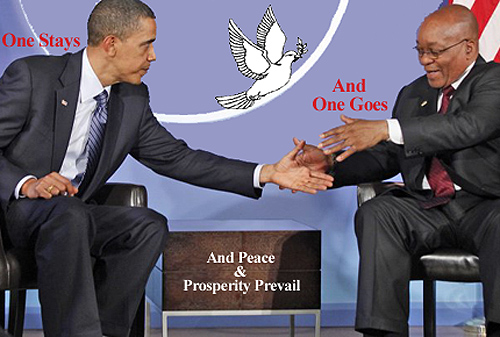
In South Africa I think the circus which has been its politics for the last decade or so is coming to an end. President Zuma’s long theater of the absurd comes under public review when the ANC convenes next month to decide if he should continue as leader.

It’s one thing to be a dancing bear, and quite another to chase the audience out of the tent. Zuma’s multiple wives (I think for PR purposes alone), his absurd pronouncements about AIDs, his annoying suits against critics and most recently, his gross mishandling of the country’s growing labor unrest has cooked his goose.

South Africa’s doing well, more so when compared to the west and less so when compared to nearer South America but sure enough that Zuma’s incredible even public graft is likely over. Watch the December conference carefully, but I think it will herald in a new, better and more stable political regime in South Africa.

And all pivots March 4 on Kenya, and I will be in Nairobi if briefly, and I expect to hear the olive thrushes not bazookas going off. It’s been a laborious often agonizing process as this remarkable country rereates itself from the devastation of its 2007 violence.

But recreated they have, and while Kenyan politics is forever unknown until the day it happens, the man in waiting to be the next President ever since his unimaginable concession five years ago of his legitimate election as President back then, will likely be Kenya’s next leader. And its first leader of the “New Era.”

New Era, indeed. In America we won’t slip off the fiscal cliff, or if we do it will be short-lived and not significant. This doesn’t mean not without drama. I heard this morning that Dancing With Stars is critically losing viewers, and my 7-1 Chicago Bears forgot last night how to play in the cold and sleet. We need drama in America, and I’m sure the fiscal cliff will step to the fore.

But some of the most radical thinkers in America before the election are remarkably sanguine if subdued right now. That means for the time being the fire’s gone. And maybe, that’s not so bad.

But when it’s all said and done, which will be in a very short time, we’ll all recognize that we were the patients who almost died but didn’t, and whose juices are now flowing stronger than ever.

Wild Animals Aren’t Nice Anymore

Wild Animals Aren’t Nice Anymore

Pepper spray, moats, blow horns, flashing lights … nothing seems to work. People around the world are getting fed up with wildlife.

And it’s becoming frighteningly unclear if the benefits of tourism are greater than the disadvantages that local communities now believe they must bear to support that tourism. And which is more important: agriculture or tourism? Resource development or tourism? A relaxing Sunday walk in the park, or tourism?

And as a result the greater question of biological diversity gets subsumed in this more immediate question.

Last week officials from the Kenyan Wildlife Service held town meetings in southern Kenya to admonish citizens not to try to move ton plus buffalos themselves, while in the west of the country exploding populations of wild dogs have begun to attack farmers’ sheep.

With nearly 15% Kenya’s land wilderness reserves that protect wild animals, it’s hard to find any human area short of the megalopolis of Nairobi that isn’t effected.

But it isn’t just Africa, of course. It’s worldwide. From India to Indiana. From elephants to wolves to beavers. And what’s worse is that the conflict is becoming tinier and tinier!

Two years ago Amanda H. Gilleland of the University of South Florida (USF) completed a meticulous study documenting a growing intolerance for wildlife by the citizens of southern Florida. But not just to cougars and alligators, but to armadillos, possums, racoons, squirrels and … even frogs!

More poisoning, more illegal shooting, more often cruel and unnecessary “eradication.”

Man against Beast.

What’s going on?

Two simple things: (1) increasing wildlife populations which have been unexpectedly even more increased by (2) global warming.

Obviously global warming threatens a few species like the polar bear, but for the vast majority of the planet’s mammalian biomass it’s actually a boon to survival. Wild animals adapt to changing weather much better than people do and warm is better than cold.

When elks move north from Isle Royale because it’s getting too hot for their food source, wolves are then left without a meal. So with the first warm breeze, wolves move towards their next easiest dinner: the nearby sheep farms of northern Wisconsin.

When excessive drought and flooding caused by global warming in the equatorial regions threatens the grass dinners of the African buffalo, the massive herds simply move into people’s backyards and irrigated farms.

And all of this is happening after decades of successful work to conserve wolves and buffalos, boosting their populations even without the help from Chinese factories.

It isn’t as if scientist haven’t been trying to do something. But conference after conference from my point of view seems to slam into the brick wall of the simple fact “there is too much.” There are more people. There are more animals. There are too many.

The host for the black bear/human conflict conference held this year in Missoula characterized his responsibility to sum up the gathering’s scientific findings as “the guy with the broom at the end of the parade, sweeping up the horse apples.”

“Bear managers in North America are victims of their own success,” he concluded.

It’s incredibly ironic that successful big game management, which the Kenya Wildlife Service inscribes as Kenya’s “posterity,” is a main source of the problem. Wild dog is the best example.

Nearly extirpated throughout Kenya ten years ago, a large scale project to vaccinate pet dogs that lived on the outskirts of wilderness areas essentially controlled distemper that had been migrating from those pets into the wild population. Now pets and wild dogs are distemper free, but sheep farmers have become quite ill tempered.

Of course a huge part of the problem would be easily solved if we solved global warming. (Oh, and by the way, that solution would create a few other benefits to humankind as well.)

But even if a sudden, miraculous consensus was found in the world to deal with global warming, it would take a lot longer to accomplish than some sheep farmers in Kiambu or Wausau are willing to tolerate.

Besides, it’s only half the problem. The other half of the problem is that animal populations are growing. In some cases like elephants it’s fair to say they’re exploding, and in almost all cases so are the human populations sitting next to them. “There is just so much flour you can put into a loaf of bread,” my grandmother used to say.

But not resolving the issue to at least some extent will create the defacto solution implicit in the USF study:

Wild animals won’t be considered nice, anymore.

Africa may have presented us with the solution, although it’s expensive.

First accomplished in Namibia with Etosha National Park in 1973, the 500-mile 9-foot reenforced double electrified fence with moat, successfully divided big game from ranchers, and over the last 40 years both ranching and tourism have prospered.

And more recently in Kenya, the Aberdare National Park is now fenced in. The 250-mile long fence included 100,000 posts hand driven into the ground. But it cost what amounts to the average annual wage of one million Kenyans.

There’s no alternative, folks. Some places like Tanzania’s Serengeti and Botswana’s Okavango Delta may remain mostly unfenced for another generation or two, but the day is coming. If we don’t stop the war of Man Against Beast, we know who will win.

Kenyan Thoughts on Obama

Kenyan Thoughts on Obama

Should Obama lose so he can save the world? A prominent Nairobi commentator argued that if Obama loses the election he can then join past leaders like Clinton to better influence the world.

Charles Obbo writing in today’s Daily Nation explained that if Obama wins, the growing conflicts in Iran, Syria and Mali will turn nasty and “the US president will have to enter the fray on the side of Israel – and alienate two-thirds of the world.”

This and economic conflicts with China and America’s penchant for shooting before talking could all destroy Obama’s current trajectory to become “the only person of colour” to join the “non-state do-good” club of Clinton, Carter and (Bill) Gates.

(Interestingly, Obbo dismisses Kofi Annan as “still developing his voice” and explains that Nelson Mandela and Desmond Tutu are too enfeebled.)

I was struck by the analysis that Obbo thinks someone can influence world affairs more as an individual than as President of the United States. I don’t mean to pat my own American chest here, but both Clinton and Carter left imprints on the world during their very short times as president that they’ll never be able to duplicate as private citizens.

I think it likely there was an ulterior motive creeping into Obbo’s commentary. Many Africans – and particularly Kenyans – are disappointed that Obama didn’t pay them more attention during his first term.

The reader Yvonne in replying to Obbo pried it out clearly: “He is a leader of the free world not just Africa. Kenyans forget that he had .. an economy on the brink of collapse and two wars that he had just inherited.”

Normally an oped in Kenya’s main newspaper, the Daily Nation, draws a handful of comments from the readers. This morning when I looked there were more than 50. The majority took issue with Obbo on a number of counts.

Several gave Obbo the Bronx Cheer, pridefully arguing that neither Obama or the “non-state do-good” club were needed.

Leo Tamutu says, “We don’t need foreigners to do charity in Africa. We have thousands of Kenyan Billionaires to do us pride in charity… To wish Obama loses to Romney so that he can divert his attention to helping Africa is pathetic.”

A number of readers ticked off the now well-known litany of reasons Romney would be a disaster. Alex Njinu sums it up for many: “No way, Romney is helpless, hopeless and pathetic.”

Symore Themoose says, “Romney … spells trouble, war all across the world. Republicans own and run weapon factories, and markets for their goods come first.”

Michael chided Obbo, “Yes, let Obama think about his reputation. Not the global catastrophe at stake.. I’m sure Romney, who thinks Syria is how Iran gets to the sea, understands foreign policy completely.”

Kiwanuka Nsereko believes Obama is the only candidate good for women throughout the world:

“Whether Obama will be a state actor and give the brown-black people a voice does not matter,” she begins. “What is pivotal is for him to … sustain the voice of women, which is in danger of being eroded by the right wing wackos. Saving the women voice, in the USA, will have the domino effect of providing hope for women around the world.”

But I found one comment which was incredibly insightful and really reflects my own deeply held view about this election:

Gabbe O’k speaking especially to the many Kenyans who believe Obama lost interest in them explains, “Obama had to distance himself from Africa to even have a chance for the second term… Republicans were waiting to brand him an outsider caring for African affairs… Right now his biggest disadvantage is being half black because most jungus cannot stand another 4 years of a black president… If he were white this could have been a landslide.”

Yet it’s interesting that Obbo – a man who I greatly respect and who sees the world generally with the same vision I have – believes that a U.S. president loses much of the power of individual good just by being President. I haven’t come to believe that … yet.

Folks, these are all remarks from Kenya, not from Columbus or Miami. But they represent as much if not more insight into America than Americans have themselves.

Take umbrage, guys.

A Real Kenyan Oscar

A Real Kenyan Oscar

The Kenyan entry for this year’s “Best Foreign Film” continues an incredible story about East Africa’s blindingly fast social changes and overwhelming tragedy in the struggle to become a modern society.

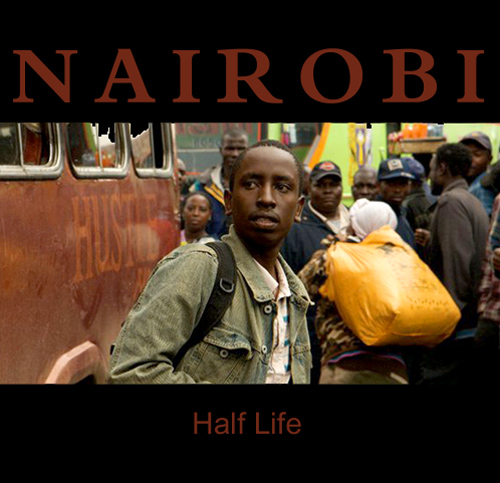
It isn’t just that “Nairobi Half Life” tells a powerfully realistic story of urban Kenya, but that the story is finally “being told” by Kenyans.

Rather like the Olympics, Oscars often cite a film as coming from a certain country even though the film is actually made by outsiders. Case in point is Slumdog Millionaire, which raised India out of the Bollywood marsh into the real global film world, even though the film was financed, directed, screen played, tecked and in many cases (excluding the lead) acted by British.

The main problem is financing. Even what the Iowa State Film board would consider a low-budget Indie film is a fortune in Kenya. So financing is likely to always come from film capitals like LA or London.

But this year the Kenyan entry for “Best Foreign Film” is almost exclusively Kenyan except for its financing. The techies, actors, supporting personnel and most importantly, the director, are all Kenyan. This will be David Tosh Gitonga’s second foray into big screen directing.

His first — as assistant director of the tear-jerking, soul uplifting, smile plastering masterpiece “1st Grader” – is absolutely one of the best films I’ve ever seen.

Both films portray a real and rapidly changing Kenya. “The First Grader” is set in rural Kenya right after the government declared education a universal and free right. The star is a wonderful old Kenyan who in his 80s is impoverished but proud particularly of his history as a freedom fighter. Unable to read a letter he receives from the government, he shows up the first day of the new term at a primary school in order to learn how to read.

Much more sinister but just as true and realistic, “Nairobi Half Life” follows a young rural Kenyan who migrates to Nairobi to become an actor. But like so many rural immigrants into the city, he is subsumed by the underbelly of a giant modern African metropolis, made hostage to the crime and drugs of its slums.

The film has been shown only at festivals and through a limited release in Germany but film goers are ecstatic. And its promise comes from the very respectable Durban Film Festival where lead actor Joseph Wairimu received the Best Actor Award.

It was not too long ago when Kenya produced nothing but wildlife films. And no criticism intended, they were extremely good.

But what is happening in Africa, and especially in Kenya, is truly mind bending for those of us who have lived and worked there through much of the last half century. But we can’t begin to imagine how it must be effecting Kenyans themselves.

Every single Kenyan is impacted in the tornado of change: The old, like the character in “The First Grader” and the young, like the lead in “Nairobi Half Life.” And unlike what we westerners consider the classic literature explanations of East Africa, Out of Africa is neither real and hardly any more relevant to what happens every day in Kenya now.

Good luck Kenya!

Old Man or Best Loser?

Old Man or Best Loser?

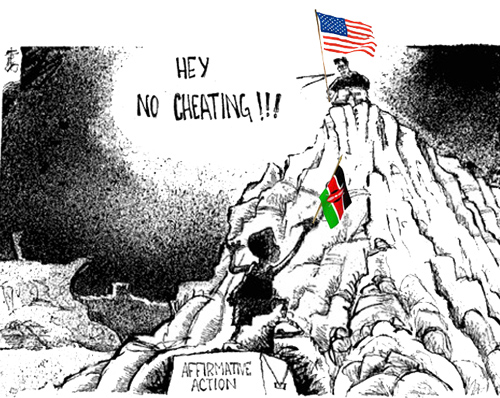
Our Supreme Court considers reigning in contentious affirmative action policies just as Kenya implements the policy in an extreme way.

Last week CNN reported that “race-conscious admissions” as a policy for determining university admission “appeared to be in trouble.” The report filed by Bill Mears suggested that Anthony Kennedy’s swing vote on the conservative court could preserve the general policy while striking down the specific plan from the University of Texas under particular review.

However broad or narrow this particular decision might be, there is no question that affirmative action in the U.S. is in decline, even as there is near unanimity among academics as well as commercial managers that policies which create diversity are over time very beneficial to everyone.

America stepped into affirmative action gingerly and took a long time to fully embrace it. That has lasted about a decade or slightly longer, and it now seems as though we’re gingerly stepping away from it.

Kenya on the other hand is going from a society almost exclusively managed by men to a forced society where at least one-third of the country’s power elite must be women in the course of a single election.

Although the debate and legislation has been confined to the make-up of Kenya’s government, there is little doubt that a one-third female Kenyan government will if not actually legislate rules for the private sector will certainly powerfully effect it.

Unlike the possibly too careful approach by America, I’m worried that Kenya’s might be too uncareful. The new constitution now being implemented is the driving force. The problem is that this very difficult section, which mandates the one-third rule, has only now begun to be addressed, less than five months before the next election.

Most legislators and public commentators promote the obvious way, which has become known as the “best loser rule.” When, for example, less than a third of the new legislature elected is female, then some of the duly elected male winners will be somehow automatically replaced by women closest to having won.

But how this metric will be calculated remains to be determined. Which district will be the sacrificial lamb and which female candidates will then be elevated? Will it be determined by actual votes or percentages or pro-rata?

The complexity of the issue is so great some argue it is too great to solve before March, when the next election occurs. Seventy, or one-fifth of the new National Assembly, will be appointed. This unappointed one-fifth was intended to be reserved for noncompetitive leaders like wise diplomats or career unionists who are appointed by the executive and National Assembly.

One argument suggests all seventy should be reserved for women, but then what if the gender level is still not achieved?

That’s probably a bad idea, since the unappointed legislators is itself contentious, a holdover from Kenya’s former constitution intended above all to achieve stability after a close election by allowing the narrowly won to beef up their control. Plus if applied in its purest, the appointments of legislators would themselves have to follow the affirmative action rule which was must be applied on its flipside, too: there can’t be more than a two-thirds gender dominance.

The issues in the Supreme Court University of Texas affirmation action case are no less or more complex than Kenya’s gender rule. But the scope of each is hugely different. And it represents the level of risk each society is now willing or not willing to take.

In the global arena today, America moves like an old man afraid of falling. Kenya jumps with abandon like a kid on a trampoline. The risks of failing govern America. The passion for more Olympians governs Kenya.

The Democratic Challenge

The Democratic Challenge

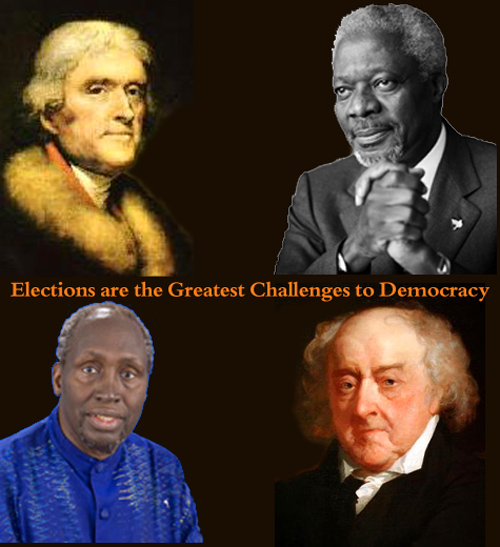
Two of Africa’s wisest old men have echoed the same cautions that America’s founders gave a young democracy about its elections. Beware: Bad elections are the greatest threats to democracy.

Yesterday Kofi Annan and Ngugi wa’Thiongo focused on the upcoming Kenyan elections as a marker for world democracy and reflected on America’s distortion of elections as something to be avoided by younger countries.

Annan is a well-known world figure, one of the most prominent Secretary Generals the United Nations has ever had. Like Jimmy Carter who remained remarkably active after leaving office, Annan’s role in global negotiations has never ceased. In fact, it was Annan who led the Kenyans out of the mire of the violence following their last election in 2007.

Ngugi has adopted America as his home after a career as a professor at Yale and New York universities. He is currently the Distinguished Professor of English and Comparative Literature at the Univ. of California in Irvine. Until 2004 he lived intermittently between Kenya and the U.S., and in Kenya is heralded as a famous revolutionary and writer.

What Americans obsessed with their own election need to know is that huge new parts of the world, especially in Africa, are adopting democracy and America’s form of democracy to govern their young societies.

This is a major change from hardly a generation ago when just as many new countries were adopting forms of Chinese communism or heavily top-down managed socialism. It’s a testament of course to the end of the Cold War, but also of the preeminence of capitalism in the global economy.

Old countries like China might be able to fiddle with capitalism and not disrupt their mechanisms for governing, but new countries can’t. The power of the economy is so critical with emerging countries that it often trumps other moral and social issues.

A case in point was Ngugi’s violent condemnation yesterday of Kenya’s decision to use English as the predominant language for governance. Ngugi is Kikuyu, the main tribe in Kenya and was imprisoned as a freedom fighter under the British. He is himself a master of the English language but he has written scholarly novels in Kikuyu, and he believes preserving multiple languages is critical to an advanced society.

It is something of the inverse argument in America as to whether Latinos should be validated by a greater use of Spanish in government.

Arguing that the current Kenyan leaders are “child abusers” for denying “mother tongues” Ngugi says, “To have a mother tongue … and add other languages … is empowerment. But to know all the other languages and not one’s own is enslavement.

“The post-colonial government and the entire [Kenyan] elite have chosen enslavement over empowerment,” he concludes.

The problem, of course, is that the violence that followed the 2007 elections turned ethnic. It is completely understandable that current politicians wishing to avoid anything much beyond a dull election want to steer clear of languages that are specifically ethnic.

In America as in Kenya when one person speaks a language that another person doesn’t understand, enormous suspicions arise, conjecture becomes almost as credible as fact-checking, and literally all hell can break lose. Unlike in Canada or Belgium where multilingual democracy flourishes, in most of the world multiple languages breed distrust.

(N.B. What puzzles many in the Kenyan situation, though, is why English was chosen rather than Swahili. Swahili belongs to no specific tribe and so is clearly universal among East Africans. The problem is that Swahili is a lingua franca and suffers thereby from a sore lack of precision. Tanzania tried to use Swahili as the formal language for many years, slowly giving way to English. It’s near impossible in Swahili to say succinctly, “Federal zoning regulations with regards to clean and safe landfills will preempt county council laws with regards to individual ownership.”)

(N.B. continued: Swahili in my view, by the way, is one of man’s most wondrous cultural achievements of the last several centuries, creating poetry of nearly every statement while maintaining a universal morality far superior to many popular western notions about right and wrong. But that’s another blog, and in this case I think Ngugi is wrong.)

Annan didn’t mention language, but in virtually everything else the two scholars said yesterday there was agreement.

Annan who is Ghanian was in Kenya yesterday. He referred to his fears that money is buying power in Kenya, as in the world over. “The infusion of money in politics … threatens to hollow out democracy,” Annan told CNN in September.

Annan understands the importance of capitalism in the world, today, but he also sees it as a threat to democracy. Many of us wait expectantly for his treatise on how the twain should ever meet, but for the time being I suppose we should presume he simply wants aggressive regulation.

In Kenya today he sees a brazen challenge to its young democracy by its rich leaders. Four of Kenya’s richest men and political leaders, including the son of the first president Jomo Kenyatta, are on trial in The Hague for inciting the violence of 2007.

Yet two of them, Uhuru Kenyatta and William Ruto, are running for president. (Not yet officially, but in Kenya “officially” comes quite close to the actual election.)

Annan sees this occurring not because the Kenyan people want it to, but because these individuals are so powerful, and because they are so rich.

Ngugi concurs: “Unregulated money in politics undermines …confidence in democracy… The explosive growth in campaign expenditures … strengthens fears that wealth buys political influence.”

American politicans’ penchant for personal stories about their early impoverishment is mostly malarkey or at best irrelevant to their current control of wealth. The vast majority of successful American politicians are rich. The cost of entering politics defies many startups. Over $1 billion will be spent by candidates and their surrogates in the current U.S. election.

Both men see the poor, the less privileged, the disabled and geographically disenfranchised as likely a majority of African voters that can be deftly ignored in a modern election:

Ngugi: “Too often, women, young people, minorities and other marginalized groups are not given a full opportunity to exercise their democratic rights.”

Democracy is today widely popular throughout new African countries and embraced as the best way to protect and govern themselves. But the messages that Ngugi and Annan delivered yesterday to a promising young African country resonant here at home just as much.

Democracy is never achieved; it’s simply strived for. America has used democracy for nearly two and a half centuries, yet the corrupting power of money, the difficulties of implementing democracy to a multi-lingual population, and the ease with which the underprivileged can be disenfranchised are threats as great today as they were in the 18th century.

Nor any greater a threat in Kenya than here.

Clash of the Faithful

Clash of the Faithful

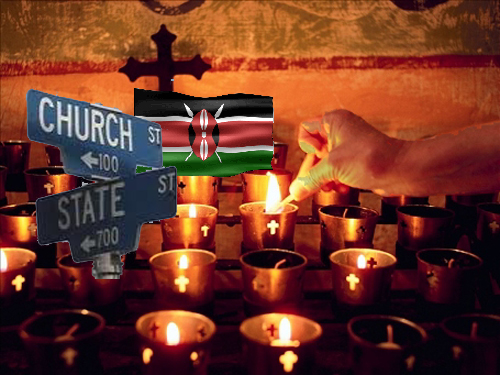
A colonial benchmark is struck in Kenya as Parliament considers banning religious organizations in publically funded schools. The Catholic Church has initiated a massive campaign to counter Parliament’s likely move which I doubt will be successful.

The Education Bill is one of the most striking features of Kenya’s rapid move to implement its new and modern constitution. If successful the bill will effectively wrest the last bit of control religious institutions have on Kenya’s public primary and secondary schools.

Currently up to a quarter of Kenya’s rural primary and secondary schools maintain a religious character as a legacy from colonial times. The state normally places and pays for the teachers and in most cases (but not all) the administration, and the church maintains the infrastructure and controls much of the school day including extra-curricular activities. It is specifically these religious activities that clash with Kenya’s new constitution that Parliament is directed to implement.

Most of these schools are on property owned by the church, and one of the more contentious debates expected is whether the new Kenya will use its modern power of eminent domain to effect ultimate jurisdiction over the existing land and school structures.

Education has been the top priority of every African government since modern governments existed, and regardless of their political and social persuasions, virtually every African country’s education was built on religious foundations.

The British explorer David Livingstone created the sound bite for colonial development in the 1830s: Civilization, Commerce & Christianity. The Three C’s were implemented by a mixture of privately funded missionary work and rapid education funded by the colonial powers.

The two were inseparably intertwined in the 19th Century, whether that was German Lutheranism, British anti-Catholicism or French, Belgium and Portugese Catholicism. Education is expensive, and the colonies had neither a legacy of any type of education or the wherewithal to fund secular educational services.

Besides in the colonial days it was only America that had struck a secular course for its society and America had no African colonies.

When my wife and I first went to Kenya it was to teach. We were hired and paid by the Kenyan government, but assigned to a large 800-student boys boarding school in a remote location in western Kenya that the then Kenyatta government had little interest in supporting. The Catholic Church stepped in, providing almost all of the funds for St. Paul’s Amukura Secondary School and a Headmaster and Assistant Headmaster that were both priests.

The priests essentially ran every component of the school, from sports to curriculum, although a national examination that determined matriculation often governed what the curriculum should be.

The Church, not the government, solicited aid from abroad to fund the schools science laboratories, build and maintain the infrastructure that allowed hundreds of rural boys to board at the school, provide a small dispensary and in many cases scholarships for the most needy.

That has changed significantly over the years, with the government now mandating virtually everything but after-school hours’ programs. Kenya’s rapid development has meant that many boarding schools and the high costs associated with them changed into day schools, but where boarding is still necessary the Church remains the paymaster.

Extracurricular activities, boarding where it continues, and the land on which the schools still sit are the contentious issues before Parliament.

It is the Catholic Church that has the most to lose, and it is pulling no punches in its drive to dissuade Kenyan legislators from further diluting its influence.

If Parliament continues on the track predicted, “…our schools will start producing Godless creatures and the society will be ruined,” Kisii Catholic Bishop Joseph Mairura told reporters this weekend.

The issue is especially sensitive right now as Kenyan Christian churches suffer violent terrorist attacks presumed to be in retaliation for the government’s invasion of parts of Somalia controlled by Islamists.

Public sentiment is charged. The comments left after Sunday’s weekend stories that the leadership of the church is going to fight Parliament’s moves were divisive and angry.

Is a certain Church/State separation the right move for Kenya now at a time of stressed government resources?

It depends on how much faith you have.

While We Moo

While We Moo

Nine countries in Africa have more cell phones per capita than the U.S. and their youthful programmers are creating more creative apps than here at home.

South Africa, Libya, Botswana, the Seychelles, Gabon, Tunisia, Algeria, Morocco and the Congo have a higher per capita cell phone rate than the U.S. In part this is because land lines were never very good in many African countries, but it’s also because the technology of cell towers developed as fast in Africa as in the U.S.

Most European countries also have a higher cell phone per capita than the U.S., but what it means for Africa is that apps that are African specific are appearing in the dozens – sometimes hundreds – every day.

The most widely used cash transfer app in the world, M-Pesa, was first created and launched in Kenya in 2007. Today the app supports 23,000 jobs and has 17 million registered users in just Kenya alone.

But that isn’t even half the story. It was hardly two years that operational control for M-Pesa was ceded by its creators to IBM, which subsequently hired all of that development company’s employees. It was a clever – perhaps necessary way for IBM to avoid difficult worldwide patent contracts, since it is now free to develop the app worldwide.

M-Pesa is simple and complete, and that’s probably why it hit a brick wall in the U.S. Interstate commerce laws, local taxing authorities and most of all, the “cost for the media” (i.e., the price that the app owner wants to command for each use) has bogged down use here and in the rest of the developed world.

GoogleWallet is the closest to M-Pesa, and it’s still cumbersome compared to the beauty of the Kenyan app.

There are many apps as creative and simply beautiful as M-Pesa that Africans have developed, but one very unique app that caught my attention is iCow, and it’s not because I farm.

And that’s the point. Although iCow is most useful to the full-time dairy farmer, there are many Kenyans who are not farmers nevertheless own cows. In the fast paced changing Kenyan culture, professionals working normal 9-to-5 jobs often still own land in rural areas with aspects of farming still undertaken by much of their family.

iCow is a “cow calendar,” remarkable resource for locating vet services and medicines, and a news app that regularly updates the user on the newest science in dairy farming. Most importantly, it tells you when to milk your own unique cow, depending upon its age, feed intake and breed.

A professional in Nairobi recently told the city newspaper that she manages her small dairy farm 150 miles away “through regular [iCow] SMS updates.”

iCow was so successful that it spawned a whole range of other farm apps created and used in Kenya.

Nearly a generation ago we were warned that the “Information Revolution” and “Information Age” would be a pivotal moment in human history.

It’s happening, now.

Truth Matters

Truth Matters

Slips of the tongue in Kenya – like the U.S. – trump any attempt by today’s wimpy journalists to champion truth. Unfortunately contemporary journalism deems what it inaccurately characterizes as “fairness” more important than truth, and the public has had just about enough.

Several days ago a minister in the Kenyan government called for the eviction of “Maasai” from his constituency during an attempt on the street to quell a demonstration that was becoming violent.

Several days ago a candidate for President of the United States derided half the population as moochers incapable of patriotic decisions while he was speaking to financial backers.

Both remarks revealed the true beliefs of their speakers. Both were incendiary, capable of spawning new and troubling events. And to be sure, there were journalists in both countries that so reported and ended their filings there.

But also in both countries there were as many if not more journalists who equivocated the event with the protagonist’s supporters rationalizations. Fortunately, at least this time, the public is having none of it in either country.

Ferdinand Waititu, a minister in the Kenyan government, raced to his constituency just outside the Nairobi airport two days ago to help quell a mounting demonstration protesting the murder of a young man. He was caught on a phone video telling the crowd to evict Maasai and basically laying the blame for the killing on the ethnic Maasai.

Like Romney, the speech was not intentionally secretly taped, it was just taped without prior notification. Its value was not preordained. Its value grew as the truth of the moment evolved in real time.

“Prior notification” was a great trick of gentleman journalists pretending to be fair. In fact, today, we’re probably all being taped all the time by one means or another, either by London MI5 as we sit snoring on a bus or by our children at a family dinner.

And that’s good. The technological revolution can’t equivocate. At least not yet. What it sees is what is, not what’s later spun or previously prepared.

Waititu in Kenya is now under arrest for hate speech. Kenya is approaching a pivotal moment next March as it holds the first national election since the ethnic violence of 2007, and admittedly the government is at least temporarily reigning in some human rights at least until the constitution and new president are in place.

There was nothing criminal in what Romney said, and probably not even hateful. His remarks were dismissive and – by the way – inaccurate, and as a mix portray a pessimistic and egotistical man that most certainly shouldn’t be president of the United States.

But both incidents display how bad currently journalism has become. It takes no rocket scientist to come to the conclusions above about each man’s remarks. But in today’s sick age of preposterous “objectivity” journalism in both countries taxed our time trying to minimize the despicable nature of the “truth.”

It begins with both men apologizing for what they said. Apologies aren’t what they used to be. They used to be shameful admissions and left real scars on those who offered them. And they were mostly considered a pivotal moment for the individual who signaled a change from one way of thinking or doing business to another. And appealing to our better natures, we the public would hopefully then forgive them, give them another chance.

Today apologies are as frequent as press conferences. They seem to have assumed the nature of little more than deflecting interest in the truth. Politicians like Waititu and Romney apologize for a mistaken remark as something insignificant.

Well, thank goodness for the modern age. The Kenyan social media, like the American social media, driven not by equivocating journalists seeking the highest viewership but by the highest morality, will have none of it, anymore.

Truth matters.

Black Gold

Black Gold

As the U.S. and Europe teeter with their economies their investors are turning to Africa where energy companies are growing rich overnight.

Fed up with the failures of austerity in Europe and the even greater failures of politics in the U.S., giant multinationals are directing investment out of their home turfs to Africa. Facilitated especially by new Chinese technologies for deep drilling, huge new reserves of oil and especially natural gas are being discovered almost daily in Africa.

Literally overnight western companies like Tulow, Royal Dutch Shell, Cove Energy, ENI, Galp Energia, the BG Group and Eskom have seen share prices skyrocket with their new African discoveries.

Global analysts think this presages a major shift in geopolitics in the not-so-distant future. Steve Levine of the trendy new quartz.com online business journal thinks that by 2020:

“.. oil prices could average $80 a barrel, Gulf monarchs … could face unrest, Mozambique—yes, Mozambique—could become one of the most important petro-states on the planet, China could more congenially assume a top rung among global powers. And the US could untether itself from some tyrants.”

What I think Levine and others fail to underscore is that we already have a Third World African energy giant, and we have had it for more than a generation, and it’s not doing so well.

Nigeria is a mess, and the $64 trillion dollar question is will that also be the outcome for Tanzania, Kenya, Mozambique, Uganda, Angola and the others.

Nigeria’s oil, gas and other natural reserves rival many states in the Mideast. Civil war, rampant corruption, now Islamic extremism and a failure to develop basic infrastructure have stymied any meaningful development over the last 30 years.

Nigeria’s manifold problems have not just inhibited Nigerian development, but scared off many global energy companies grossly reducing investment and extraction.

Uganda’s new oil finds are suspended while the county battles multinationals in the courts over royalties.

And Tanzania’s new-found energy wealth is tied up in a series of new energy laws that simply can’t get through Parliament. And Kenya – struggling beautifully but ardently to implement a new constitution, hardly has time for such trivialities as trillion dollar oil reserves.

But that, actually, is a reason things might go OK for East Africa. Unlike the now drunken uncle Nigeria, these countries aren’t just waving in outsiders with no requirement except that they lace the doorman’s hand.

The reason for the stall in Tanzania’s multinational contracts is because of the immense new pressure being exerted on its Parliament by … we-the-people. Centered on new energy finds, the power of young legislators and activists around the country to create a fair energy law is unprecedented in this sheepish country whose population until now has jerked its knees whenever its leaders whistled.

And Kenya has become one of the most sophisticated democracies in Africa. Its only delay, truly, is because such heavy lifting as implementing a new and brilliant constitution must come first.

Each country is different, of course, but my take is that African democracies are maturing so fast that they are now fully capable of creating welcoming capitalist environments for these giant multinationals that will ultimately benefit them mightily. Thirty years ago, Nigeria just wasn’t mature enough.

To be sure this is a serious generalization that needs careful parsing. And don’t give it to the multinationals to do; don’t presume that they always know what’s best. Ask BP Shell and the other multinationals that struggle in Nigeria. Many wish they’d never started.

But once invested giant multinational energy companies get caught up in their own ideological web that won’t let the little spider move on even as the web gets torn to shreds. While a few multinationals have left Nigeria and Belarus, most wouldn’t walk away from their huge capital investment, even when the returns weren’t worth it.

This led to all sorts of horrible things. Horrible returns to investors, yes, but corruption and graft on huge scales that to this day continues to stymy Nigeria.

I don’t think that will happen, again. Thanks not to the greed of the multinationals, but to the sophistication of Africa’s young emerging democracies, today.

And I for one think that Kenya and Mozambique will be the leaders and shakers. Tanzania could turn out well, too. Right there are reserves of oil and natural gas that are almost a fifth of the existing reserves in the Mideast.

And if Angola and Uganda throw off their despicable governments – which could indeed happen – then the oil well overflowith.

China vs. America

China vs. America

China and America are fighting on the streets of Kenya’s third largest town.

Kenya is preparing for its first election since the debacle and violence of 2007. Scheduled for March 4 most Kenyans hope for a peaceful and simple event that will be the crowning achievement in the creation of a new constitution.

But ghosts of the past haunt every Kenyan. The older generation – from which most of the candidates come – is still fiercely tribal. The hope for a peaceful and successful election rests squarely with the youth.

The younger educated generation is truly non-tribal. Most higher secondary education and above is composed of schools with a complete hodgepodge of Kenya’s tribes. The younger business class, the new entertainers and certainly the country’s vibrant media is without any tribal identity. Since more than half the population in Kenya is under 21, even statistics point to a hopeful future.

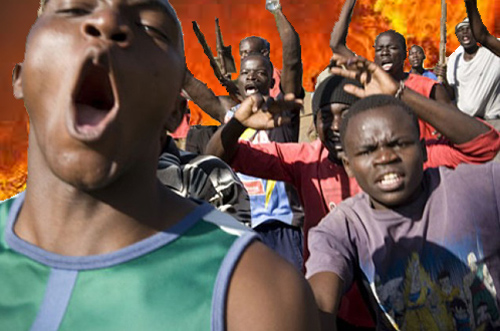
But in the Lake Victoria town of Kisumu, it is the youth turning tribal and violent. Kisumu is Kenya’s third largest city and its situation is at the intersection of two historically warring tribes, the Luo and Luhya.

Gang violence – not so dissimilar to the same type of gang violence found in America’s larger cities – is not new, but it’s becoming more powerful. In Kisumu the two principal rival gangs call themselves “America” and “China.”

It doesn’t matter which is which, the point is that young and angry Kenyans looking for a fight – perhaps because they are few jobs and little of a future – revert to tribal identities. And in their limited global lexicon they see the two greatest world enemies as China and America.

There is nothing ideological about either group that allies them with either China or America. The commonality is paramount power. Nothing is better or more powerful, richer or stronger, than America and China.

But what strikes me as saddest is that to be adopted by these warring youth gangs the labels have to carry an ultimate component of irreconcilability.

The darker skinned Luo boy may indeed see as much physical difference between the yellow Chinese and the pale-faced American as between himself and the browner Luhya. The languages are much different. The customs are different.

Read the comments that follow this news story about last weekend’s violence. The vitriolic references to “cuts” and “cutting” are referring to the ancient tradition that one tribe circumcised and one tribe didn’t. This is ultimate, primitive animus.

It all seems irreconcilable.

The fact is that the irreconcilability is truly much greater among these young tribal gangs in Kenya than between America and China. I hate to deflate their mutually assumed perfect labels, but America and China may be adversaries but they will never become enemies.

Despite what one of our presidential candidates might some day declare, the world’s two greatest economies are too interdependent upon one another to start a battle. Each is too involved in the other’s lives.

Perhaps these wayward Kenyans can learn from this. Perhaps they can understand arch rivals need not be arch enemies.