Weather Grounds Drones

Weather Grounds Drones

Predictions about African security linked to global warming have proved frighteningly correct. Does weather trump drones?

As the stubborn, not-too bright bully on the block, America has shifted to accepting global warming as human caused, but it took a few Katrinas and Sandys to tip the balance. And experts still spend inordinate amounts of time explaining the obvious to the recent convert:

“Global warming” or “climate change” or whatever you want to call it is manifest most dangerously in extremes, not just increasing temperatures. So terrible winters on top of terrible summers means we’ve screwed up nature. It’s our fault and we’ve altered nature.

Winter and summer are naturally the opponents in a ping pong game. If one hits harder, it sets up the rebound to be harder as well.

And while it’s been predicted for some time that the short-term global effects of climate change could actually benefit America, because America reigns as the world’s principal power, there’s no way we’ll avoid the much more terrible negative effects:

“The U.S…. may benefit from increased crop yields, [but] its military may be stretched dealing with global “humanitarian emergencies,” Scientific American reported five years ago.

The rest of the world has more or less recognized this for a long time, so there are plenty of studies to refer back to. As America’s conversion into reality became policy when the Obama administration came into power, America began to participate in the global studies.

Africa has the largest percentage of unstable societies in the world, and what early climate change studies show is that these misfortunes were mostly predictable, founded mostly if not exclusively on climate change.

Because Africa is the only continent to stretch so far into both hemispheres, it is unfortunately placed to feel the greatest effects of climate change.

Jihad, civil war, violence after contested elections – even the reemergence of debates about social issues like female circumcision – all seem to ebb and flow with the weather. They are all symptoms of climate change.

John Vidal writing last month in London’s Guardian cited a variety of studies showing that the Arab spring had less to do with human rights than food insecurity:

While the self immolation of the Tunisian street vendor “was in protest at heavy-handed treatment and harassment in the province where he lived… a host of new studies suggest that a major factor in the subsequent uprisings … was food insecurity.”

When the rains returned to drought-stricken Somalia, was it only coincidence that the Kenyan army occupied then pacified the country? Or more likely was the Kenyan army decision triggered by an easier time supplying its troops with food?

And now that drought has turned to floods, pacified Somalia is growing restive, again, and this instability is even spilling into neighboring Kenya.

Even in Namibia, among the least densely populated countries on earth, growing instability from climate change motivated the president to declare a state of emergency on Friday.

Record floods in 2011 have now been replaced by record droughts.

The frequency of climate disaster in Africa is increasing so fast that even statistics are lagging. PreventionWeb is a UN agency that simply documents human disasters. From 1980 – 2008, the ten greatest disasters in Africa were all due to drought.

We expect, now, that the top ten disasters when compiled for 2008-2013 will be from flooding.

It seems pretty simple. Forget about proselytizing or promoting democracy and free trade, cut carbon emissions.
The Right Can Do No Wrong

The Right Can Do No Wrong

The tenacity of Rightists that so inhibits U.S. progress is becoming true worldwide, and no better example than the imminent diplomatic earthquake over Kenyan leaders’ indictment by the World Court.

The phrase is not mine, but Richard Dowden’s, one of the world’s most respected African analysts, Director of Britain’s Royal African Society.

Dowden’s brilliant summary and analysis of the Kenyan Mess published today is required reading for anyone who’s trying to understand this incredible “mess.”

And his conclusion is “Right”-on: the minority (in the world as in Kenya) who are “elite … simply do not recognize that they are subject to the law. Politically powerful, exceedingly wealthy and above the law,” people like Kenyatta, Cameron or Limbaugh just ignore legal and social realities, carving a world in their selfish images.

(Read Dowden. I do not intend to quote him out of context, and the quote above he wrote strictly with regards to the Kenyan leaders on trial, but I think it a fair if liberal extraction of his meaning.)

Dowden’s analysis is no more brilliant than his summary, which is a tough nut to crack. Before I further try to summarize Dowden you must have an understanding of the ICC (International Criminal Court) which has indicted the President and Vice-President of Kenya for crimes against humanity.

The U.S. does not recognize the ICC. Nor does China, India and 38 other countries. But the majority of the world does: 122 countries including Canada, Australia, all of South America and almost all of Europe.

Another 28 countries, including Russia, have “signed on” to the ICC Treaty while not yet ratifying it. In so doing they agree to the abide by the treaty (including arresting indicted criminals on behalf of the Treaty who are not their own citizens) without yet allowing prosecution of their own citizens.

The Court was only formed in 2002. There is a much older cousin, the International Court of Justice (ICJ) formed in 1945 and designed strictly to adjudicate disputes between countries. All countries that belong to the UN automatically accept the ICJ.

Both courts are located in The Hague and share some facilities.

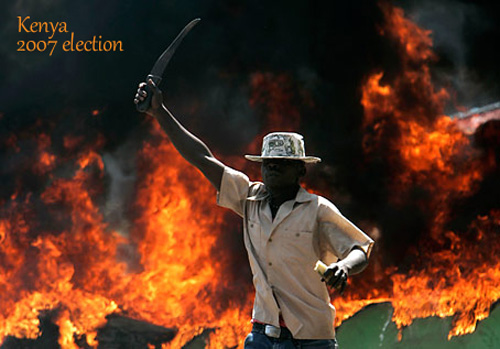
In 2007 Kenya blew up after a contentious end-of-year election. About 1300 people were killed and a quarter million displaced (of which more than a 100,000 remain so). The violence threatened Kenya’s relative stability and the west’s toehold in the continent:

Kenya was and probably remains the closest African ally to both Britain and the U.S. Strategically critical to the War on Terror (especially in Somali) and to both countries’ defense posture in the Red Sea (bases and warships in Mombasa), Kenya was the platform on which democracy and western capitalism were and are being promoted by the west onto the continent as a whole.

Britain, the U.S. and recently retired UN Secretary General Kofi Annan formulated a brilliant peace agreement that after a troubling six weeks brought Kenyan society back to peace, resulted in five years of growth and stability and the creation of one of the world’s best, new constitutions.

Part of that lengthy and complicated agreement was that those responsible for the killings and massacres should be brought to trial. The agreement gave Kenya the option of running the trials itself, or if it didn’t want to, allowed the ICC to run them.

Kenya through its parliament decided to wave its right to hold the trial and agreed to cooperate with the ICC.

Lo and behold, guess what the ICC found?

That two of its rising political stars, who recently became the country’s President and Vice President, were principally responsible for the killings and massacre.

Oops.

You know it’s interesting. In the old days what tangled up the west in its own ideology was its support of South American and Mideast dictators who held none of the west’s lofty morals. And these guys often used the west’s weaponry freely given them back on the west!

But now what you have is the west denying its own lofty morals!

David Cameron, Prime Minister of Britain, and Jacob Zuma, President of South Africa, both lead countries who have signed on to the ICC. President Zuma traveled to Nairobi to be an honored guest at Kenyatta’s inauguration.

This week Cameron welcomed indicted Kenyan president Uhuru Kenyatta to a conference about Somali in London.

There was local “outrage” but it didn’t seem to matter.

Today Kenyatta announced in a wildly aggressive press conference that the UN Security Council better vacate his indictment with the ICC.

Also today, Fox Newser Stephen Hayes, given a platform in U.S. News and World Report, says that the ICC should drop the charges against Kenyatta.

I think that says it all. The Right Worldwide is unified, but why? You can argue that Cameron is hamstrung by Kenya’s importance in the Somali situation, and you can argue that Zuma is crazy.

But why would Stephen Hayes take a position?

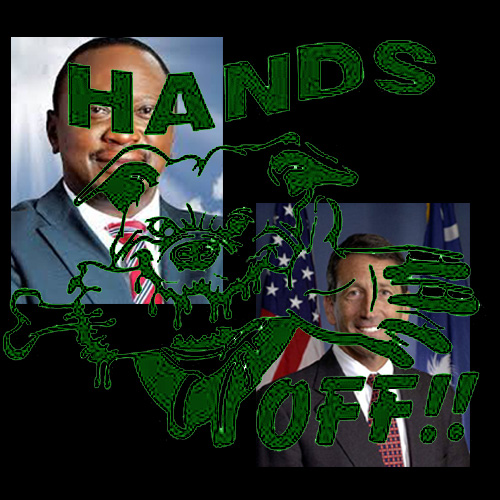
Because The Right (Kenyatta + Cameron + Zuma + Hayes, let me also add Sanford) are all miserable failures who through “elitism” and (likely unscrupulous) wealth have manipulated elections to become powerful men. And The Right does not unlock its jaw once clamped.

They are all also in minorities, but there seems to be no organized majority to defeat them.

Back to unedited Dowden:

“The fact is that the Kenyan elite … simply do not recognize that they are subject to the law. Politically powerful, exceedingly wealthy and above the law, no state official would dare touch them.”

Equally applied to miscreant U.S. bankers and right-wing U.S. politicians. How many bankers have gone to jail? Or even lost their job? Which man was yesterday elected a Congressman who is indicted for having misused public funds for his affair in South America?

Good grief. They just can’t be gotten rid of. And so what happens when Vice-President Ruto decides not to go to The Hague for his trial on May 28, or when President Kenyatta decides to take a pass on his date of July 9?

Dowden: “a major diplomatic earthquake.”

Justice Becalmed, Justice Bedeviled

Justice Becalmed, Justice Bedeviled

Today’s final detailed explanation by Kenya’s Supreme Court of its decision to affirm the March presidential election makes me doubly angry with Bush vs. Gore.

The clear consensus by much more scholarly analysts who have rushed out their initial impressions is pretty negative, that the detailed decision is “disappointing.”

But quite to the contrary, it helps me understand how insidiously deceptive a political system is where the final say presumably rests with a collection of appointed sage elders with so little obligation to anyone or anything that they can neutrally discern the facts and subsequently convey justice.

Or in other words: Finalismo.

By the way, there was nothing very revealing in the 113 pages, and a little bit for everyone including the critics of democratic methodology and the critics of corruption. I’m no legal scholar, but let me paraphrase the decision this way: don’t rock the boat.

The “rule of law” sounds good, but over America’s much longer history than Kenya we can often find definitive failed justice from the top. And that’s not wholly unexpected since it’s usually the most contentious and/or complicated issues that rise to the top, and it’s just statistically unlikely that the right decision will always be made.

And an incorrect Dred Scott decision foments war. The incorrect decision of our own Supreme Court in Bush vs. Gore arguably paved the way for two prolonged, unbelievably expensive and totally unjust wars.

America has a long enough history that it just seems statistically inevitable that some pretty horrible top court decisions would be made. But this, in effect, was Kenya’s first major decision.

And like America in Bush vs. Gore, the justices’ action put the man who likely lost the election in the winner’s seat: In Kenya by not altering the decision by the election authority (despite massive illegalities) and in America by stopping a recount of votes.

In Kenya it was passive justice; in America it was active justice; but in both it put the wrong man in power, invalidating democracy.

As in Bush vs. Gore, there were plenty of tidbits the justices couldn’t ignore: like the wanton corruption acquiring voting technology and the inability of the corroborating registration system to affirm exactly who had voted.

They even encouraged the Kenyan prosecutors to indict the “tender team” that designed and acquired the voting technologies that massively failed.

Just as the justices in Bush vs. Gore acknowledge that hanging chads if reconciled could alter the outcome.

So I don’t think we can rack this one up to the “statistical” likelihood that all profound decisions will not always be correct. There’s more to it.

In Kenya it means one of two things:

1. The justices were biased towards the flawed outcome, however wrong it was; or

2. The justices felt their meaning for existence was not sufficient enough to alter the status quo.

In America it was clearly Number 1, because they did alter the status quo by stopping the recount. In Kenya it’s hard to say.

But both situations demonstrate how weak the “rule of law” is in Kenya and America towards assuring a just outcome. Because the “rule of law” in both cases wasn’t. Law didn’t rule. Something else did.

And don’t be fooled by rationalists who argue that green is black, that intonation is meaning, that interpretation rather than implementation governed the situations. Legal opinions coming out of the whazoo drown in semantics. Get yourself into that clear air of what’s right and what’s wrong.

I believe that the “rule of law” achieves justice.

There was not “rule of law” in either Kenya or America. In both cases the justice system failed. And not just “statistically” so; intentionally so. Something else prevailed over justice. It’s called…

Power. And unlike the very essence of justice, it has no limits.

The Impoverished Kenyans

The Impoverished Kenyans

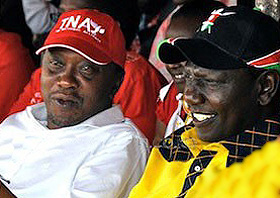
Left: President Uhuru Kenyatta, scheduled to go on trial for crimes against humanity in July. Next in line: Vice-President William Ruto, scheduled to go on trial in May.
Poor Kenya. The world waits to see if the new president and vice-president will travel next month to The Hague to stand trial for crimes against humanity. Kenyans elected these men free and fairly. They chose alleged murders to lead them.

As a businessman in tourism I wait for more signs. As a devoted student of Kenya, I’m depressed and frightened. Like everyone in the world who knows Kenya, we wait with baited breath for the start of the scheduled May and July trials of the Vice-President and President.

Kenyans are polite and on edge. They are proud that they didn’t devolve into violence as during the last election, proud of the new judicial system that validated the election, but on pins and needles waiting like everyone in the world for the next chapter in this country’s history.

That comes next month when Vice-President William Ruto is scheduled to begin his trial for having arranged and financed killer squads following the 2007 elecetion. President Kenyatta’s trial is set to begin in July.

“If the International Criminal Court is right,” writes Daily Nation columnist Makau Mutua, “the two funded death squads to kill, maim, and loot each other’s folks. Mr Ruto only subordinated himself to Mr Kenyatta because he couldn’t win [the national election] on his own.”

Mutua goes on – as many others have – that this unlikely team of arch enemies is together for only one reason: they are both alleged organizers of mass murder.

There’s nothing particularly sensational in this thriller, the Joker elected mayor. It struck me as a storyline that would likely be rejected by Hollywood for being sorely uncreative. The difference, of course, is that this is real.

And the sad part is not the fates of these two men. The sad part is that Kenyans elected them, freely and fairly.

Incredibly, Kenyans couldn’t come up with anyone else. And although it’s true I supported Kenyatta’s principal rival, Raila Odinga, nearly anyone of the other 6 challengers who contested the election would have been infinitely better.

Anyone who watched even a snippet of either of the two election debates would see what great people Kenya has as potential leaders. But none but Uhuru and Raila had the financing (and ethnic support) to be viable candidates.

That was the main reason I (and many, many others) supported Raila: none of the other challengers had a chance, and the outcome proved it. The remaining six challengers got less than 8% of the vote.

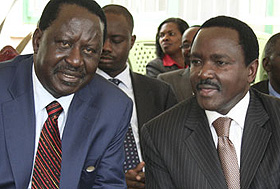
Kenya is peaceful. In fact as Somalia improves, Kenya becomes more and more peaceful. Raila has met with Kenyatta. They are photographed laughing together, working to “keep Kenya peaceful.”

I received an email from an owner of a lodge near Mt. Kenya, Sunday, which implores me to write good things about Kenya, to beef up its tourism:

“Would it not be a good idea to now send out a positive email concerning Kenya? It seems to me that people prefer to spread bad news all the time.

“Kenya is an amazing country with lovely people and I am sure if you compared the crime rate with the UK and considered the poverty people combat every day here in Kenya, the UK would not come out looking too rosy itself!”

UK leaders are not accused of crimes against humanity. The Kenyan president and vice-president are.

By All Means Peace

By All Means Peace

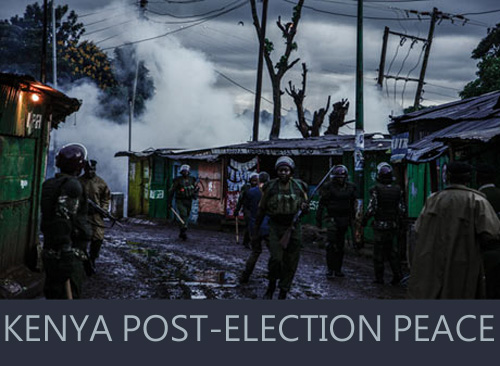
Only a couple violent incidents following Saturday’s court decision upholding Kenya’s election. Peace is predicted, specifically because the architects and instigators of the deadly violence following the 2007/2008 elections are now the country’s president and vice-president.

Uhuru Kenyatta is the country’s new president. William Ruto is vice president. The two are indicted for crimes against humanity. Whether it be the poor judgment of Kenyan voters or its manipulation by evil leaders, doesn’t really matter anymore. It’s done.

Five years ago when 1300 people were killed and nearly a half million displaced (a quarter of which remain so) Kenyatta and Ruto according to the World Court indictment used their vast fortunes and complex communication network to organize thugs and criminals to kill and terrorize.

They no longer command thugs and criminals. Today, they command the Kenyan army.

A generation or more of Kenya’s social progress has been lost.

It’s the ultimate prerogative of democracy to install in power those who should not be: To make liars, cheaters, crooks and even murderers Heads of State. And in this case in Kenya, I honestly believe as did its exemplary Supreme Court, that if not the majority at least the plurality of Kenyan voters truly wanted this outcome.

And the insult to righteousness is that not even a tiny minority of Kenyans ought to have voted for Uhuru Kenyatta. Kenyatta is the richest man in East Africa, now the 4th president of Kenya and son of the first, and one of six unique Kenya individuals indicted by the World Court for crimes against humanity.

On April 9 he becomes the second sitting African Head of State (after Omar al-Bashir of The Sudan) to be on trial for the gravest sins against his fellow men.

How could Kenyans have elected him?

There are two widely accepted reasons. The first is Kenya’s horrid tribalism, which perhaps I wrongly thought its youth had all but discarded. Kikuyu Kenyatta’s chief rival in this election was Raila Odinga, a Luo from western Kenya.

The Kikuyu and Luo are the arch enemies that define Kenya tribalism. It was Raila’s father, Oginga Odinga, and Kenyatta’s father, Jomo Kenyatta, who fought one another in the bush then in Parliament to be the first to rule an independent Kenya. Jomo prevailed then jailed Oginga.

That was a half century ago. Most of us simply could not believe that the last half century of human development in Kenya, which outperformed all historical standards, would not produce a new generation of Kenyans who would emerge from these hateful trapping of tribalism.

Now nothing seems to have changed. Each tribe so fears the other that they will do anything to achieve power over the other. There are more than 40 tribes in Kenya, and Uhuru’s deft manipulation of democracy in this exercise was to choose his vice president from a third tribe that ensured a solid plurality against the Luo.

It mattered little that his choice was one of the most evil and corrupt men in Kenya, William Ruto, a fellow indicted by The Hague as well. The Kikuyu Kenyatta/Kalenjin Ruto team, bedeviled as historical enemies nevertheless controlled the numbers, and the numbers make democracy.

The second reason seems less likely to me, but Kenyan analysts seem sure of it:

There may have been a popular backlash against the World Court’s indictments and of western nations’ not so subtle messages to Kenya that they better not elect a criminal.

The U.S. was particularly blunt: Obama said he hoped Kenyatta wouldn’t win. The U.K. – Kenya’s national mother and principal benefactor – said it would not allow Kenyatta or Ruto to visit Britain. (Both have now congratulated the new leaders.)

So Kenyatta crafted an election strategy, replete with his billions of carefully placed media shillings, charging “foreign interference,” a phrase guaranteed to garner votes.

I may be just as naive about this as I was about the presumption that tribalism was water over the dam, but frankly the Kenyans I know are heartsick with the outcome. These are Kenyans that are young, well educated and truly a rainbow of tribes.

But like the courageous kids who started the revolution in Egypt, or the intellectuals who thought they crafted the New South Africa, or any of the bloodied stakeholders dedicated to good change in places like Tunisia much less Russia or Broward County, democracy has a wicked way of exploiting change by crushing it.

Revolution is no certain remedy. And democracy is often little more than a facilitator for the evil that provokes revolution in the first place.

Peace, maybe.

Kenya’s new constitution, its youthful society and progressive economy, is 100% 21st century. This election is the failure of that new generation to manifest itself, take control. It is a government of a society of the 1960s.

Kenyatta’s government will be in power for at least the five years given it by the new constitution. But some think it’s in for the generations that were just lost.

All Hail The Chief

All Hail The Chief

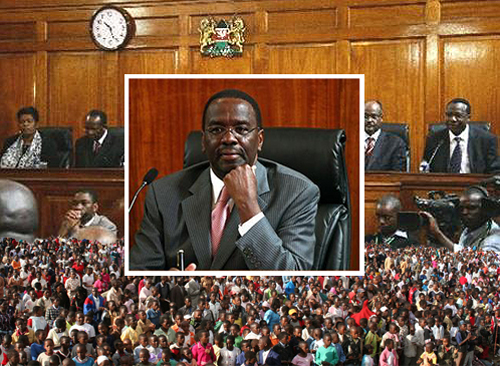
Kenya’s future is in the hands of a man little known outside Kenya: Willy Mutunga. The 65-year old Chief Justice will render his High Court’s decision on the recent election Saturday morning.

The country’s tension is building, its currency is falling, and protests are being prepared not just to follow the court’s decision, but right now to protest strict measures the government has imposed to ban public demonstrations.

But despite all this tension, Willy Mutunga can legitimately claim to have the trust of most Kenyans.

The Chief Justice has a long history of democratic activism, including a long stint in jail under the former dictator, Daniel arap Moi. His choice by Parliament was one of the easiest and least contentious of all appointments mandated by the new constitution.

His demeanor throughout the proceedings contesting the March 4 election has been exemplary. He’s been transparent, ordering live broadcasts of the deliberations.

And he’s given himself and the other five justices of the high court five days of full deliberations to make a decision.

Many would argue that is hardly enough to wade through the hundreds of petitions, reaves of evidence and uncountable allegations flinging between the two camps of president-elect Uhuru Kenyatta and aggrieved challenger, Raila Odinga.

And while that may be true, Mutunga knows all too well that this episode in Kenya must be brought to a conclusion.

Every day that passes without a court decision affirming Kenyatta’s election, confusion and complexity builds. Who is running the government? It’s not clearly known, as the former president Kibaki is dead silent.

Office holders under the last regime, which supposedly has ended, are becoming more and more vocal and partisan. Today, the attorney general petitioned Mutunga to consider that the “government” believes Kenyatta is the president.

If too much time passes whatever is left of the Kenyan government will be replaced by anarchy. Mutunga knows this, so he specifically advised the nation when the decision will be made: Saturday morning.

“I have given most of my life to a better Kenya and if taking it is what will be required to consolidate and secure our democratic gains … that is a price I am not afraid to pay,” Mutunga said recently, revealing the many death threats he’s received.

It may be this widely disseminated statement that has elicited the public trust. Death rates are rampant. Social media is beyond the pale. It is hard to underestimate the vitriol and anger in Kenya, today.

And frankly, I don’t think Mutunga and his court will render a decision on the evidence. The evidence is too voluminous, too contentious, too imperfect. It would take months to determine the ballots that were mismarked or miscounted. This will have be a ruling from the hip.

The ruling will be on whether the election authority which pronounced Kenyatta the victor with less than 10,000 votes of 12.2 million cast should be honored, or whether it should be denied and a new election process started.

The easiest thing to do is simply affirm the outcome. After all, all the parties in the election had expressed unqualified support for the election body which made the call. The Constitution gives this body wide latitudes of decision-making.

But not affirming the outcome seems more rational. Ballot counting was an unqualified mess; all sides agree on this. The .07% margin of victory is therefore a ridiculous conclusion.

But not affirming the outcome requires the court to suggest a remedy, a new election or run-off, all within its power but which then essentially emasculates all the months and years of institutional preparation Kenyans had invested in the election.

I predict the court will rule the election invalid. But I’ve been sorely wrong predicting events associated with this election, and no matter what the court does, Kenya’s greatest challenges are yet to come.

Storm Clouds over Kenya

Storm Clouds over Kenya

Storm clouds are forming over Kenya. The thunder and lightning and destruction has not yet started, and all of us who love Kenya hope it will not, but the anger is palpable and as a safari broker I must advise all considering Kenya for the moment to stay clear.

My blog yesterday about the election went viral and the hate, death threats, invective and dirty speech publically thrown back at me as comments on the blog and Facebook are chilling.

For the first time ever I changed something that I had written – or rather, photoshopped. I worried that the photoshopped picture was being misconstrued, that I was suggesting that the current election had experienced violence.

It didn’t. There was an incident in Mombasa on election morning that left six dead, but that was it. The rest of the day, and up to this very moment as I write, has been peaceful, and as I wrote on the day after the election, joyously so.

So I have changed yesterday’s blog picture to eliminate the possible connotation otherwise. In Facebook I post twice: once for the full picture and once for the link to the blog. Facebook entries cannot be edited, only removed, so I simply removed the full-size picture. But the other has to remain, so if you wish to see what the picture was that worried me, go to AfricaAnswerman on Facebook.

I do not want to contribute to the growing anger. But as Mwirigi posting the first comment to the respected columnist Macharia Gaitho in today’s Daily Nation says, “I am against any attempt to muzzle free speech. This is how it starts, we have come from a time where it was a crime to imagine the death of the president. Many people have fought long and hard for us to have the ability to express ourselves freely.”

I read Gaitho religiously. He’s an outstanding columnist. Today he says, “The level of malevolent hate, ethnic bigotry, incendiary words and totally criminal incitement [on social media] would put to shame the infamous hate media outlets of the Rwanda Genocide, the newspaper, Kangura, and Radio Télévision Libre Mille-Collines.”

So I am hardly alone. In fact, my few thousands of hits and comments are minuscule compared to the extraordinary traffic on Kenyan sites.

The second comment on Gaitho’s column by Njamba says, “We should differentiate between freedom of speech and abusive and hate speech.” But she continues to incorrectly conclude this means we as individuals can’t come to conclusions or predictions about the future.

And therein Njamba and thousands other Kenyans hit the slippery slope, giving only lip service to free speech by inhibiting it from reasoning to points of view. Unless, of course, it’s their point of view.

“Right now I feel let down,” Gaitho continues today, “and very ashamed to be a Kenyan, for the level of post-election violence assaulting my eyes and ears every day is worse now than it was before and during the elections.”

Words cut ideas. Machetes cut throats. How close are we today to the latter?

My opinion: too close to plan a trip there. As a safari broker professional, I cannot let anyone go to Kenya, now. If the Kenyan Supreme Court invalidates Kenyatta/Ruto winning the election, as I think it will, and calls for a run-off election, all hell could break lose.

Gaitho: “Any time there is bloodshed in Kenya, you will never see Raila Odinga, Uhuru Kenyatta and William Ruto or their families in the line of fire… They will be swilling champagne and cutting business deals in … members’ clubs.

“Their children and grandchildren will not be wielding weapons in the battlegrounds, but will be safely squirreled away in some posh boarding schools in England, Switzerland or South Africa; or if of age, gambling and drinking away a fraction of daddy’s fortune.

“A cursory look at the social media war will indicate that the “principals” are not typing out a single word in anger. They leave that to their rabid followers and hired guns who… will throw all caution to the wind and put their bodies on the line.”

I so hope this doesn’t happen. But how can I feel otherwise, now, than it might?

Africans have an art of patience that far exceeds ours. As travelers and brokers of travel, we now have to be patient. We have to wait before returning to Kenya. We have to wait for a certain peace.

Kenyan Nightmare Continues

Kenyan Nightmare Continues

Kenya is peaceful but disturbed. A famous national analyst Saturday said the country is “on the brink of implosion.” The loser in the presidential election is challenging the results in court, but if he loses the president and vice-president of Kenya will be international criminals indicted for crimes against humanity. This is not acceptable.

“An uncomfortable silence pervades the public sphere,” Godwin Murunga wrote this weekend in Kenya’s largest newspaper, the Daily Nation. “We are afraid of our feelings.”

So the country waits on pins and needles and does so by being quiet. A once robust media discusses fashion and school tests while the Joker and his prime assistant prepare a government of iniquity. A fabulous new constitution sits like an butterfly in a cocoon waiting for a dictator to roast it before it hatches.

And the world holds its breath, so happy there’s not another war or revolution, hoping perhaps beyond hope that the New Kenya will right itself.

But how?

The mistake came long ago when in the many wonderful and difficult things the country was doing to recreate itself, it allowed indicted international criminals to become candidates. What else could it do? Does not democracy revere the right of the accused to be considered innocent until proven guilty?

And, in fact, multiple accused by the World Court in The Hague have been ultimately released or original charges dropped before trial.

But I think the more important fact is that the World Court’s standards for irrefutable evidence is so great – so much more substantial than country courts around the world including the U.S. – that just to be indicted is at the very least reason to prohibit the indicted from assuming national office or responsibility.

Even as a contradiction to democracy and the purity of law that governs it. The interlude between indictment and conviction was the loophole that put Kenya in the mess it finds itself, today.

And that’s the point. So even while people like myself are convinced that Uhuru Kenyatta and William Ruto will be convicted by The World Court, their simple indictment should have prevented Kenya from allowing them to become candidates.

Uhuru Kenyatta and William Ruto, the current president-elect and vice-president-elect, are not nice guys. They are greedy, conniving politicians whose families have looted the poor Kenyan for generations.

Their success was brilliantly created. Singly they couldn’t survive, because they come from tribes that are historical arch enemies. Together they combined their enmity to defeat all that was good in Kenya.

Raila Odinga, the challenger who lost, is not purity incarnate, but he is considerably less corrupt, untainted by scandals, and was not the least bit implicated in engineering the violence of 2007 as the ICC has charged Kenyatta and his running mate, William Ruto, were.

Odinga’s challenge of the outcome of the election in the Kenyan courts is substantial. Kenyatta was declared the winner by less than 8,000 votes of more than 12 million cast. The election was bungled. One of Kenya’s finest analysts called the election “shambolic.”

The list of counting grievances includes districts whose vote tally exceeded the number of people registered there. It includes up to a half million votes that were declared spoiled by incorrect marking, even while the intention of the voter was clear.

It includes thousands of discrepancies between parallel methods of counting that were intended to confirm one another.

It is, in a nutshell, a mess. And it is that mess that even if too complicated to untangle stands as a powerful reason to claim that .07% of the votes cast might not be legitimate.

Yet at the same time peace has been sustained and security prevails, today. “Many Kenyans… have spent the last 5 years trying to avoid a repetition” of the violence of 2007, writes Magnus Taylor, a South African who reported daily from Nairobi on the election. But he adds:

“Kenya is far from being over the nightmare.”

On Safari: Kenya’s Election

On Safari: Kenya’s Election

There were 44 observers from the Carter Center watching the Kenyan election last night but all they observed was joy and glory! As I write this in East Africa the winners are not yet known, although Uhuru Kenyatta has a significant lead for president. But so far only 5 million on an estimated 10 or more million votes have been counted.

I was in Kenya when the polls closed, for just a few hours on my way to guiding my first Great Migration Safari.

The whole world watched as Kenya masterfully pulled off the first national election under its new and fabulous constitution. Final results will be some time in coming, because the constitution mandated that the winners achieve minimum support from all of Kenya’s 47 counties, denying any victory based exclusively on ethnicity.

This means despite Kenyatta’s lead another election between the leaders could well occur within 30 days in order to finalize the results. But based on last night I’m already creating a “Celebrate Kenya Safari” return trip!

Kenya knew that it had to prove to the world that the debacle that followed the last election in 2007 would never happen, again, and that it has truly emerged into the modern world. Moreover, it displayed a transparent democracy I don’t even think America could rival.

It wasn’t perfect, but no election is. In fact, it began ominously with an early morning attack on police poll watchers in the troubled second city of Mombasa, and 4 policemen and 2 poll workers were gunned to death.

The authority governing the election had assured that anyone in line before 5 p.m. would be allowed to vote, no matter how long the line was, and in some places it stretched for nearly a mile. But in Kilifi, north of Mombasa, election authorities ended the process at 5 p.m. even with a long line waiting, because of reports of imminent attack.

The coast remains a troubled area for a number of reasons, most importantly that it’s mostly Muslim and seriously impacted by Kenya’s occupation of neighboring Somalia.

There were long lines in many places, and some polls didn’t close until 10 p.m. In a number of areas poll officials with legislated authority simply kept the polls open even for late comers.

Kenya has more cell phones per capita than the U.S. and a free app was available that voters would use to report irregularities. And needless to say, with 10+ million voters there were many. It will take many weeks to sort them all out, but ???

I’m sure that many tour operators like EWT were waiting with baited breath. We could not restart Kenyan safaris without a positive result, and it was beyond our best hopes.

There were 14.4 million registered voters. In addition to the executive president, the election chooses governors and one senator from each of the new 47 counties, 290 national assemblypersons, 1450 county representatives and 47 “women’s representatives” who have a remarkably unique role in the new constitution.

There were 53 political parties, of which there are 8 major contenders, that fielded 12,752 candidates. The country managed 33, 400 polling places with 6-10 poll workers each, secured by 99,721 security personnel including police and … even rangers from the Kenya Wildlife Service!

Voter ID – a contentious issue in the U.S. – was mandatory, and there were two steps checking it. Approximately 20,000 fraudulent voters were stopped from voting, and although that’s insignificant statistically, it underscored how important Kenya felt legitimate democracy must be.

Elderly, disabled and pregnant women could immediately go to the front of the line. Anyone at all who wished assistance could vote with an assistant who pledged “secrecy” regarding the person’s vote. This is a brilliant addition to a country still not yet at 100% literacy.

Voting machines were high-tech, but there were parallel methods of hand counting when the machines failed, which inevitably some did.

So we won’t know for a while the final outcome, but the start is nothing less than stupendous! In a way, the fact that the process worked is what achieves the real victory.

The Great Debate in Africa

The Great Debate in Africa

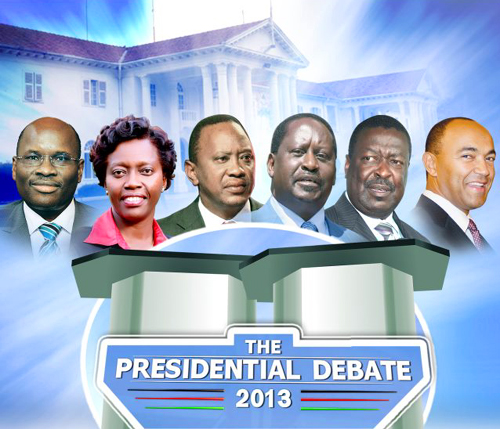
From left to right, Prof. Ole Kiyiapi, Martha Karua, Uhuru Kenyatta, Raila Odinga, Musailia Mudavadi and Peter Kenneth. Not shown are two candidates who won a court appeal from having been disqualified: Mohamed Dida and Paul Muite.
It took them longer to get the babies and kissing spouses onto the stage, but the first ever, quite spectacular Kenyan presidential debate ended very much like most of America’s primary debates:

The crazies looked crazier, the ones who quoted scripture couldn’t quote GDP numbers, every pot called every kettle black, the smart drowned in their own moderation, none seemed to know all the words to the national anthem, the self-appointed media hosts deservedly lost control, and the winners are still winning and the losers are still lost.

Unlike America, though, polling this close to the March 4 election is now banned in Kenya, so it took outsider polls of little repute and no published evidence to proclaim the winners and the losers.

So I will.

The debate lasted 3 hours (see below for my cheat sheet onto YouTube) and I watched it from start to finish after just arriving Cape Town following two days of constant traveling while eating delectable fresh calamari and hake and Cape greens quickly and cheaply bought at the Waterfront’s Pick ‘n Pay, liberally lubricated with a local vineyard cab.

I know. How could anyone sane not watch sunset over Table Mountain because Uhuru Kenyatta was explaining how he would be president while being tried at The Hague for crimes against humanity?

Me. And literally thousands of South Africans, by the way, as local TV (SA2) carried much of the debate and this morning’s talk shows were filled with discussion about it.

The outcome of the Kenyan election is going to effect the entire continent. I really believe that the winners of last night’s debate, Prof. James Kiyiapi and youngster Peter Kenneth, have no chance of winning the election.

Forty million Kenyans watched the eight candidates debate live. It’s unlikely 10% of the voters were moved away from their predetermined vote, which is based on their tribe. But that’s the marvel of Kenya, being able to undo its misery precisely because it’s so pervasive: neither of the two major tribes are large enough to produce a majority.

So the 10% could matter. Although not as you might think.

If none of the 8 candidates gets a majority, which is becoming increasingly likely, then there must be a runoff election. And the losers in the first round will likely make alliances with the winners of the first round. “Endorsements” by those dropping out of the race actually then have a much greater impact than in the American election.

Raila Odinga, a Luo and the current prime minister, remains the favorite of the eight candidates. He is followed closely by Uhuru Kenyatta, a Kikuyu who is under indictment for allegedly having incited the violence that followed the last election in 2007.

The candidates I saw as winners, and I’m sure who were also deemed that by Kenya’s rapidly growing very youthful educated middle class, come from relatively small ethnic groups.

Kiyiapi is a Maasai. Kenneth is a mullato. Kiyiapi is one of the smartest Kenyans I’ve ever listened to, a college professor. Kenneth is quick and witty, and one of Kenya’s most successful and prominent businessmen.

The two were the most articulate. Both knew the facts (few of the remaining did) and both are left-of-center populists who would further tax the rich and redistribute wealth in ways to alleviate poverty.

There was actually not a lot of disagreement among any of the candidates regarding policies, whether that be taxation or redistribution, education or security.

And that’s because the aggrieved poor in a developing country can simply not be ignored. They can’t be ignored out of simple humanity, but also because their numbers are large enough to start a revolution if progress on their behalf does not occur fast enough.

But everyone knows that regardless of what’s said, there are the lefties like Odinga, Kipiyia and Kenneth; and there are the righties like Kenyatta.

And so if I’m right, and if Kenneth and Kipiyia were the winners last night, then in a second round the people watching like me who felt the same are likely to support Odinga over Uhuru.

All I hope is that Kenyatta does not win. He is responsible for the last election violence; he’s a slick and evil man. He will set Kenya back into the times of his father, the first president of the country, when there were only two tenants of governance: nepotism and corruption.

The next and final debate is February 25.

Click here for yesterday’s full debate.

10m35s : The candidates get two minutes each to introduce themselves.

16m00s : The candidates discuss tribalism which quickly devolved into the issue of Kenyatta’s candidacy and position in the current government as deputy prime minister, even while being tried in The Hague for having incited such violence in the last election.

It’s important to note that Kenya could have tried Kenyatta and the five others itself in Kenya with its own justice system, but that Parliament voted not to, defaulting to a treaty provision that then allowed the World Court to hold the trial.

19m48s: Kenyatta’s defense of his candidacy

34m35s: the media host challenges Kenyatta to explain tribal remarks he has made in the current campaign.

At 53m35s Kenyatta contends, “The people have the confidence that I can discharge my duties while clearing my name.”

At 57m30s Odinga quips that it would be hard for Kenyatta to “run a country by Skype from The Hague” which presumes he will be convicted and jailed there.

At the 1hr30m00s mark the moderator gives the floor to Kenyans in the hall for their own questions about security, education and health care.

Familiar?

Yes, but the good stuff was then over. There was little disagreement on the policies the government should take on any of the public questions.

Vested Interest

Vested Interest

With one month to go, President Obama admonished Kenyans to hold a peaceful election. Obama wasn’t just preaching the word. Critical U.S. policy is predicated on a successful Kenyan election outcome.

There was nothing surprising in Obama’s one-month-to-go pep talk. But as I listened to it, I realized it was powered by the deep behind-the-scenes U.S. African foreign policy that has driven so much of African history in the last few years.

The routing of al-Qaeda, the pacification of Somalia, the fugitive chase of the LRA, the massaging of Rwanda hegemony, the less successful use-and-throw-away Uganda geopolitics, the deep skies of drone assassinations – it’s all a remarkable mosaic of clever and intricate U.S. policy.

And Kenya is the linchpin.

Unfortunately, the policy is driven overwhelmingly by Obama’s hunt of terrorists. That’s a fine thing to do, don’t misunderstand me, but developmental imperatives seem to get attention only when the greater objective of wiping out the terrorist prevails.

So that the “war on poverty” is far subservient to the “war on terror.” This is short-term strategy.

Kenya is fundamental to this policy. America rebuilt Kenya’s military and notably the product looks mighty good. Compared, for example, to Mali or Nigeria or Afghanistan, the Kenyan military forged enough independence and local celebrity identity that it functions better than anyone could have imagined only five years ago.

And there seems to be no dichotomy between the military and civilian authorities, as in Pakistan, for example, or Egypt. America has created a fighting arm in Kenya that is totally beholding to its brain.

That’s good, yes. And from Obama’s point of view, more importantly, it’s been effective.

Now comes the election, the ultimate validation of a non-revolutionary society, of a stable politic based on “strong institutions” and “just government.”

No country in the world today can achieve what America did in 2000: institutions so strong they prevailed even while being irrational. That’s what happened when the Supreme Court effectively – with no precedent or authority whatever – wound down the mechanisms of challenge and handed victory almost willy nilly to the man who had lost.

And the defeated graciously walked away to become a billionaire.

That standard is unattainable by any but America. But Kenya can come near enough to validate the policy that sustains that potential. If it doesn’t, Obama policy in Africa will in a blink no longer be validated. If Kenya unhinges itself by Bronx Cheering the very institution on which Obama policy is founded, then everything the U.S. has done in Africa is lost.

Somali could tear apart, again. Militias in the jungles of The Congo would rearm and reform. The Arab Spring could become Arab Hell. Terrorism would be reborn.

It sounds like an exaggeration.

Jump Start

Jump Start

Less Titling, (c) Washington Post
In a much saner way than America, Kenya’s presidential campaign got underway yesterday. Saner, because it will be done and over six weeks after beginning!

This is, of course, the big one folks. Not only will it choose the first truly democratically elected leader of Kenya, under its new and fabulous constitution, as the country’s growth explodes and it winds down its war in Somalia, but it will determine once and for all if Kenya is a safe place.

Safe to invest in. Safe to live in. Safe to visit as a tourist.

It’s that simple, and that breathtakingly important.

Most national elections determine fiscal and economic policy, security issues and legislative agendas. And this one will, too, but the most important question in this election is actually not who wins, but what happens after they do.

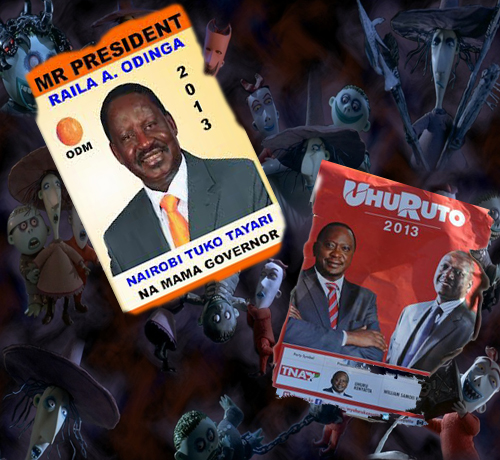
The polls are pretty uniform in suggesting that the winner will be Raila Odinga, the current prime minister, as I very much hope will be the case. But few people are concerned with whether the election outcome will be that Odinga wins, more than they are with whether the outcome will be as with the last election in 2007, the country explodes in violence.

Last time round the country exploded in violence because there were sore losers. Two of those sore losers are running again, one for President (Uhuru Kenyatta) and the other as his running mate (William Ruto).

Uhuru Kenyatta & William Ruto
The two have been indicted by The World Court in the Hague for having incited the violence of 2007, paid to have it continue, and actually organized some of its worst atrocities. Remarkably, they have both traveled to The Hague to answer the charges and – at least until this point – agreed to be tried.

The last election was the first true attempt at national democracy. I remember watching the returns on the internet very much in real time. The problem was that the returns were giving the election to Raila Odinga, who was opposing the sitting president, Mwai Kibaki.

It was blasted deja vu to Gore/Bush. Internet returns suddenly stopped and the media began reporting all sorts of irregularities in the transporting of election ballots to the counting authorities.

The sitting president declared himself the winner. It was ridiculously premature. The rest of the world shook nasty forefingers at Kenya … except for America. President George Bush called up Mwai Kibaki to congratulate him on his victory. It was around 11 p.m. Kenyan time. Kenya media exploded with the announcement.

No other world leader did the same. And the next morning fires started.

Raila Odinga & Kalonzo Musyoka
When the violence began it was basically the poor of Kenya – found mostly in its slums and who had supported Raila Odinga – against the rich. Which included the police and politicians.

But it quickly degenerated into an ethnic war. Mwai Kibaki is Kikuyu. Raila Odinga is Luo. They are the two largest tribes in Kenya, and while as in Northern Ireland the Catholics are generally the poor when compared to the Protestants, so are the Luo when compared to the Kikuyu. So the battle was forged on grounds long prepared.

Uhuru Kenyatta, who was set to become a major official in the Kibaki government, is also Kikuyu. William Ruto is a Kalenjin, historically an arch enemy of the Kikuyu, but in this case the enemy of my enemy is my friend, and so the Kalenjin allied themselves with the Kikuyu.

Ethnic violence began to tear the country apart.

According to voluminous documents now in The Hague as the trial of Kenyatta and Ruto progresses, those two so-called national leaders planned and fomented the violence.

It took a number of months, Kofi Annan, heavy hands and wallets from the U.S. and Britain to quell the violence and create a power-sharing agreement between Kibaki and Odinga which held until today.

It has been a remarkable recovery. Odinga and Kibaki have actually worked well together, mostly because Odinga despite the details of the power-sharing agreement, always took a backseat to Kibaki.

But under their leadership, the country created a fantastic new constitution and steered towards a path of unexpected economic growth. Kibaki never intended to stand for election this time, and needless to say, that helped enormously.

Kenyans remain very ethnically racist. The younger are much more tolerant than the older, but even the young struggle with ethnic identity. And because there are more than 40 ethnic tribes in Kenya and really more than half dozen greater ethnic coalitions, there is no single ethnic group that can determine a national election.

Odinga probably won last time (as Gore did) and is projected to win this time, because his policies – not his ethnicity – align best with most Kenyans. It is fair to say if he doesn’t win, it has less to do with policy than ethnicity.

Will Kenyans reach into their minds rather than their hearts for how to vote? That, of course, is a separate question from what they will then do if their decision is not validated by the outcome.

David? Debby?

David? Debby?

Yesterday’s prickly article in Science that there aren’t as many species going extinct as you thought might be because we’re using drones to nuke rhino poachers.

The journal Science is no teenage blog. The rigors of getting published in magazines of this caliber are legend, and the author, Dr. Nigel Stork, comes well credentialed. He’s the Deputy Director of the Griffith School of the Environment, not just one of Australia’s top schools but a global leader.

So what did Dr. Stork say? Something that alarms alarmists, that right now there’s no reason for alarm.

Stork’s comprehensive data study concluded that species are not going extinct as quickly as commonly thought. There is not, as Richard Leakey convinced me years ago, a Sixth Great Die-off happening, now.

Five times before Leakey’s pronouncement in the 1980s, Planet Earth has suffered a massive die-off of species. We know the reason for several of these, including the giant rock that pummeled Yucatan and accelerated the end of the dinosaur era. Another of the reasons millions of years before was when bubbles of deadly methane trapped deep within the earth were released by earthquakes.

While I can’t put my finger on any study suggesting otherwise, it really has been a widely accepted notion that if not an actual “Die-off” that we were losing species right left and center. Organizations such as Global Issues live not die by pronouncing organic holocaust.

Stork says stand back and take a deep breath. He’s not saying everything is as good as it should be, just that it isn’t as bad as popularly believed.

And to his credit he portends Armageddon if global warming isn’t curbed.

The article made me think about East Africa, of course. I thought of the several species of antelope that have gone extinct in my lifetime, the decline in lions, the ups and downs and right now downs of elephants, and the real loss of a number of smaller forest creatures.

Yet I then had to remind myself of how many new species have been discovered within that period. Now this isn’t like new births replacing deaths, of course. But it may indicate that a balance of sort exists that we were just ignoring.

It’s hard to accept that belief. When we get broadsided by Konza Cities and Mega Malls and highways through forests. But scientifically, it may just be true.

Conservation of known species is today a tremendous art and the technologies that have been employed to nurture our biodiversity are sometimes, well, extraordinary.

Take drones, for instance.

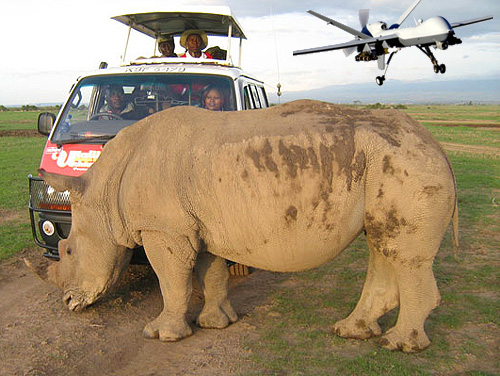
Now that the Somali war is winding down, what do you do (if you were Uncle Sam) with all those robotic airplanes flying all over the place? You start an internet campaign to raise money and buy one of them to fight rhino poaching!

And what a steal it was! The drone cost less than $40,000, but keep in mind how fast drone depreciate and this one had none of the bells and whistles of the better models, like missile launchers and laser sprays.

They weren’t particular about the color, either.

Kenya’s most successful rhino conservancy, Ol Pejeta, explained that the drone was purchased “used” from the U.S. company UASUSA Tempest, and that another U.S. company, Unmanned Innovation, will launch it and provide the ground-based monitoring equipment. No comments from these guys since they’re classified.

I’ve always felt that one of the best ways to justify wars is to give away a few bombs. Discreetly, of course.

Now though the campaign to raise enough money is done, Ol Pejeta will let you donate more and you might win the contest to NAME THE DRONE!

Konza of Kajiado

Konza of Kajiado

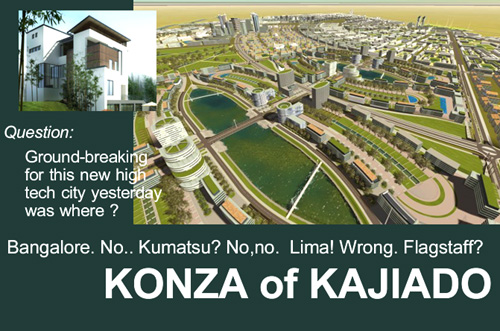
Ground breaking my eye, what happened 35 miles from Nairobi yesterday was nothing less than the Big Bang.

“Kenya’s Silicon Valley” they call it: 37,000 luxury homes and apartments, 70 acres of high-tech complexes, highways and public tennis and golf courts, several universities, high speed rail to Nairobi, 4-lane superhighways, buried electricity and fibre optics.

I know I sound like a very old man, but I can’t believe it. “Konza City” was born yesterday, and if it stays on track, by 2020 it will rival the most advanced tech cities in India and create more than 200,000 new high-skilled tech jobs.

Not only will it have call centers that we all know and hate so well serving us as likely as Proschnik in St. Petersburg, but it will have dynamic research facilities building on Kenya’s promising lead in expensive cell phone technologies, as well as medical and agricultural research facilities.

Its developers champion “green technology” and so there will be considerable solar polar.

The Kenyan’s call it a technopolis. The World Bank has funded the $330 million high speed railway that will connect the area to Nairobi, and planning is already well underway. The first rails will be laid in 2014.

But private investors are contributing up to $1 billion to a variety of areas, from private home construction to tech factories to malls. Already smaller Nairobi investors are vying for placement for car shops and grocery stores. $1 billion dollars in Kenya is easily equivalent to $100 billion in America.

More than 250 global companies have already pledged involvement, including Huawei, Samsung, RIM, and Danish Technologie.

The estimated private plus public investment that will have been spent by 2020 is expected to exceed $10 billion, which is an equivalent $1 trillion in the U.S.

I am astounded, and I admit somewhat skeptical. But I was equally skeptical only ten years ago regarding what Kenyan planned to do by today. Today its highways are reducing country-wide congestion, its education system has leaped forward, and a variety of new technologies are performing very well.

But Kenya has to get its political act together to truly manifest this dream. It has to at least achieve the level of transparency and accountability that exists today in India, or in a completely different fashion, the stability and control of a China.

Right now neither of those directions are certain. I’m encouraged that multinationals like Samsung are willing to invest heavily, but this dream will take multiple Samsungs.

The troubles confronting Kenya this minute are formidable, starting with the yet completed pacification of its neighbor, Somalia, to the still top-heavy and corrupt political leadership.

But it is getting better, and the election on March 4 will tell us a lot about whether dreams like Konza are real dreams or pipe dreams.

Waiting for March 4

Waiting for March 4

The starting bell will ring and ring and ring madly throughout Kenya Thursday for the start of the awesome 2013 elections. And then deathly silence follows for 6 terrifying weeks.

The economy has already stopped. Donors and outside investors alike have literally stopped all financial transactions. Schools will close so their buildings can be used for voting. Parliament disappears. The current president goes on vacation. The world waits.

I think it’s instructive that in this high tourist season, when wintry westerners flock to Kenya’s unmatched coral coast, some coastal hotels have shut down. Occupancy is so low, companies won’t reveal what it is.

Everyone waits for March 4, the election. Will March 5 be another beautiful African day, or something else?

I began this blog specifically to disseminate the news of Kenya’s last election in 2007, when the peaceful if paradisaical safari destination erupted in terrible violence. More than 1300 people were killed in a few weeks and nearly a quarter million displaced.

It was a near apocalyptic bump on the road to a modern democracy. The quick resolution of the contested election was unexpected and brilliant, a power sharing agreement which has held for five years between the radical opponents.

But now that tentative extra-constitutional arrangement is over. The country must rally round a timely and sustainable definition of itself for the foreseeable future. New forms of self-government, new civil rights, new judiciaries – all radically transformed from 2007.

The election is the culmination of one of the most historic transformations of a society in five years I think ever in the history of mankind. That sounds grandiose, I know, but it’s true.

The country’s financial and educational development in five years is preposterously positive, the GDP nearly reaching 5% growth per year. The visible transformation of Nairobi is unbelievable. If you went on safari in 2006 you won’t recognize the city now.

Its skyscrapers, 8-lane superhighways, Benz’ and BMWs will make you think you’re in L.A. Well, at least that’s the first impression. The layers of difficulties under this pretty veneer are daunting.

And the social transformation is more formative. The new constitution is incredibly just and creative. Educational advancement has skyrocketed. Per capita income is on a steep rise. A national Gallup Poll conducted only several months ago shows enormous confidence and security by Kenyans:

Across the country, Gallup concludes, individuals feel that their “Life Situation” will improve by a monster 50% in just the next few years.

The outcome of the primaries at the national and major regional level is a foregone conclusion for the six major political parties. Despite the parliamentary appearance of Kenya, the new constitution places huge power in an executive president, so like in the U.S., the presidential election is by far the most important.

(This, by the way, was a great disappointment to me. Executive presidencies are 20th century stuff in my book. As democracies mature, aggressive collections of diverse political parties each holding realistic power will guide societies better.)

The front runner is the current prime minister, Raila Odinga. The polls are definitive but the margin of error is big and not too far behind is Uhuru Kenyatta, trailed well behind by the third contender, William Ruto.

There is no questions that of the three, Raila Odinga is the man, the right man. He was denied his place in 2007, but he ended his fight gracefully to share what he had rightfully won to stop the violence, and he’s spearheaded Kenya’s transformation.

His two nearest opponents – Uhuru and Ruto – are thugs, both indicted by the International Criminal Court for instigating then organizing and paying for the violence of 2007.

It couldn’t be a clearer choice from the outside. From the inside it is woven into the deep power of ethnicity, the ancient clansmanship of Africa. Loyalty to family is something we all suffer, but in Africa it is seared into the soul.

March 4 is a day for Kenyans to choose between ideas and family: Ideas that I’ve written about for the last several years which put Kenya in the global forefront of human rights and justice. And family which knows nothing but to fight.

How would you vote?