The Cheetah Within

The Cheetah Within

TheCheetahWithinObama turned down a game drive with his family while in Tanzania, Africa’s most famous safari country, because if he went on one his security would have to be beefed up “to carry sniper rifles with high-caliber rounds that could neutralize cheetahs, lions or other animals.”

This little tidbit provided by the Washington Post – if it’s really true – is another indication of how disengaged Obama is from the realities of Africa. If not the whole wide world.

Lions attack people about as often as neutered male Portuguese Water Dogs do. Those few visitors I know of in my 40 years of guiding that have been hurt by lions have generally walked into their opened mouths uninvited.

Most cheetah are actually smaller than neutered male Portuguese Water Dogs and have a hard time injuring anything larger than a small deer. Here’s how you neutralize a cheetah:

I have personally done it multiple times. You shoo them off your Landrover by swiping them with your hat. And I don’t use hard Tilly hats. I prefer the lighter, less hot thin nylon like Columbia.

We guides are not allowed to carry guns when viewing lions and cheetahs “and other animals” because … well, because we don’t want to kill them. The only reason you need a gun in an African big game reserve is if you’re the predator. Defense and safety against the extraordinarily rare big game aggression against visitors is a matter of the same common sense you would use jogging in Washington Park on an “off-leash” day.

Something that apparently Obama is lacking as far as Africa is concerned.

I have often criticized Obama for his humongous militarization of Africa: for his drone policy, for the troops he’s sent into Uganda and Mali and probably elsewhere, and for the enormous weaponry that he has laid over the continent.

Well, now I know another reason why: He’s worried that cheetahs and lions will disrupt his Africom command.

My God, friends, I’m the most progressive person you probably know and I had such high hopes for Obama. I’m enormously grateful to him for shepherding the country through the Great Recession but I’m having a hard time finding other things he’s approached as a modern adult.

And I came to the conclusion some time ago it’s because he’s a wimp. Unable to stomach a real fight, delirious with the religious idiocy that he can bring people together at a time when they’re committed to slashing each other’s throats, he’s retreated into a child’s world of managing imaginary fears.

Experts like Reich and Krugman who know how banking nearly destroyed the world as well as I know how African big game safaris photograph lions, must be seething just as I am, now. Historians like Goodwin and Beschloss who predict a President’s legacy the way I predict the damage a cheetah on my car will do is limited to chewing off my rubber pop-top roof sealing must spend regular moments inside closed rooms screaming.

We progressives and liberals all are about to explode with bent-up frustrations and false hopes for a man who has obviously been subsumed by the paranoias and institutions of an old and dying world inside the beltway:

A man who has lost his simple common senses and lofty ideals which could have cracked out of a culture that relies on veteran councilors and advisors who relied on earlier veteran councilors and advisors who have led this country further and further away from the modern world, miring it in the past.

I’m incensed at the incest of old practices prevailing over new ideas. Of antiquated myths trumping contemporary realities and simple modern truths.

It’s lunacy: Obama’s a young man ruled by old fogies who’ve spent their lives looking over their shoulders. It’s the Cheney clique on Bush all over again. How sad that the result is the same, even though one man was so dumb and the other so smart.

Look friends, I’m not worried that you’ll now be too afraid for me to show you some lions and cheetahs “and other animals.” I’m worried that you’ll be too afraid to go through airport security in order to get here.

Might Obama now arm TSA with “sniper rifles with high-caliber rounds”? Dozens of my own past clients, much less the far more nefarious ordinary travelers in the millions, are much more dangerous than lions and cheetahs “and other animals.”

(I guess that’s it for gun control, eh?)
Obama Reconsidered

Obama Reconsidered

africa25n-1webIn Arusha today rumors abound that President Obama will cancel his visit to Tanzania next week, because of Nelson Mandela’s failing health and the Snowden Affair.

Africa thrives on rumors like nowhere else, but my experience is this is so because they’re often true. Put another way, the NSA wouldn’t want to put a station here.

On the other hand, Arusha is the center of Tanzanian political dissent and Obama was never scheduled to muddy the waters by making his host, Tanzanian president Kikwete, venture into an area that hugely dislikes him.

But nevertheless last week’s rumors were that Obama was going to make a quick surprise visit to the north, where Arusha is located, just like President Bush did on the last American presidential visit here.

After all, this is where the big game animal parks like the Serengeti are, where much of Tanzania’s development in agricultural export is growing, and certainly the most educated and globally engaged part of the country.

My sources are the best there are: taxi cab drivers. I was with three different ones this morning in Arusha, and with little prompting they all said the same thing. They were also uncharacteristically hesitant to talk politics, almost as if doing so would contribute to the possibility Obama won’t come.

Africa’s love affair with Obama when he was elected has changed. There’s a lot of resentment that America has seemed far less engaged with Africa than under the last two presidents. Many respected experts are calling the trip “long overdue.”

I expect there are many protagonists who feel slighted by the world recession and the priority world leaders had to give that. And whether or not Obama has more severely slighted Africa than immigration groups or returning vets, he has hardly “disengaged” from Africa:

Total bilateral non-military assistance for Africa has risen from roughly $7 billion in Bush’s last year as president to $7.6 billion today. That’s a modest increase, but when set in the context of the world recession and the fact that much American aid was decreased, it’s actually a positive number.

But the headline is how dramatically military aid has increased – or at least we think so, because those figures are near impossible to parse. But the level of Obama military involvement from Somalia to Kenya to the CAR to Malawi is widely known and very considerable. Many of us have written that it is too involved.

But Obama has kept all this under the radar; I understand why there was little stomach to publicize our considerable military involvement, but I don’t understand why we didn’t tout our non-military increases in aid, explaining the relatively smallness in terms of the global recession.

“Kamma Obama,” one driver explained: ‘That’s Obama.’ He’s widely viewed throughout the continent as too soft-spoken and too much of a conciliator. Africa politics and culture is not accustomed to such politeness.

Tanzania is the place where the president’s most important speech is scheduled, and that because the Obama Administration hopes that East Africa will move more quickly to implement its East African trade agreements. It seems that all American administrations place increased trade as a top priority in dealing with Africa, and it becomes easier when African neighboring countries break down the barriers that exist between them, first.

But elevating Tanzania to this importance may be short-sighted. It’s understandable that it wouldn’t be Kenya, with the country’s president and vice-president under indictment from the World Court for crimes against humanity, but few consider Tanzania more important than South Africa or Senegal, the other countries scheduled to be visited.

An important part of any American presidential trip is to promote democracy, and Tanzania is hardly the shining example. A week ago Saturday an opposition rally in Arusha was bombed and three died, and many in Arusha believe the government if not directly responsible probably knew it was planned but did nothing to prevent it.

From my point of view, this is the real “disengagement” of Obama. He seems to have a good wide-angle lense on the situation here, but has no time for details. This lack of focus suggests distraction, but regardless it may be something his administration is coming round to realize.

And so an excuse like Mandela’s ill health or Snowden’s night flight to Havana might be all that is needed to scratch the journey at the last minute. And until the right, better focus is achieved, that might not be all such a bad thing.

Ancient Waterboarding

Ancient Waterboarding

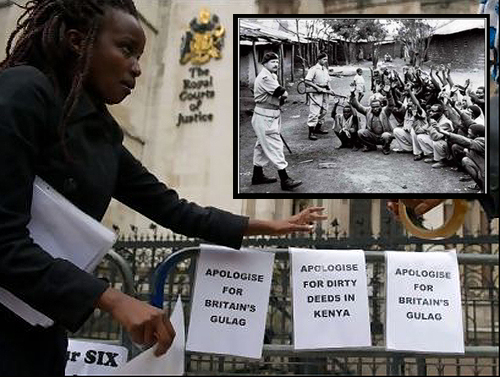
Britain’s invitation this week to Kenya that it seek financial compensation from the U.K. for acts of torture more than a half century ago opens a topic that could be stinging to the United States.

Britain’s highest ranking diplomatic officer delivered to President Uhuru Kenyatta Tuesday a huge report documenting British torture during the Kenyan battle for independence in the 1950s, and invited Kenya to request financial compensation.

The report followed a British High Court ruling last October that allowed Mau Mau (Independence) war veterans to sue the British government for their torture in the 1950s and early 1960s, and the British government’s subsequent negotiations with hundreds of alleged victims.

In fact the release of previously sealed and top secret documents from the U.K. Foreign Office suggested there could be still living as many as 10,000 Kenyans due compensation.

The tedious process of negotiating individual claims began last year, and attempting to get out in front of what could have been an endless line of petitioners, the British government commissioned the report that was handed to Kenyatta Tuesday.

Quite apart from the tens of millions of pounds likely to be paid to the victims of Kenya’s insurection, the released secret documents, court case and Tuesday’s government commission report opens the gates to similar allegations from other foreign colonies.

The British report acknowledge Red Cross archives that documented widespread use of torture techniques including waterboarding and worse, waterboarding with kerosene.

Kenya reacted yesterday by demanding an official apology from the British government:

Britain should “offer a public and unconditional apology to the people of Kenya for all injustices and gross violations of human rights committed by the colonial administration between 1895 and 1963,” the Kenyan response says.

Note that Britain and Kenya right now are not the best of friends. In fact, Kenya has few friends in the world as the world awaits to see if its president and vice-president will stand trials as accused for crimes against humanity scheduled to begin in just a few weeks.

The British report and offer of compensation, however, seems completely unlinked to the UK’s current cold shoulder attitude towards its former colony.

And there is every concern in America that the British action sets a precedent that could severely impact the U.S.

If U.S. violations, including torture and unwarranted war, become issues for compensation, there could be literally millions of claims.

No formal reaction has been forthcoming from the U.S., although Voice of America broadcast this week a story admitting that the “The Mau Mau settlement would set legal precedent.”

The report did not elaborate as to whether it was legal precedent restricted to Britain or one that would be more global in nature.

And of course a number of other warring or former colonial powers would be just as vulnerable to legal attack as the U.S., mostly notably France.

Current American occupations of Iraq and Afghanistan are really little different from the European colonial actions in the past century.

The West has a distinct problem imposing its will. Perhaps a financial slap will bring western morality to its senses.

Weather Grounds Drones

Weather Grounds Drones

Predictions about African security linked to global warming have proved frighteningly correct. Does weather trump drones?

As the stubborn, not-too bright bully on the block, America has shifted to accepting global warming as human caused, but it took a few Katrinas and Sandys to tip the balance. And experts still spend inordinate amounts of time explaining the obvious to the recent convert:

“Global warming” or “climate change” or whatever you want to call it is manifest most dangerously in extremes, not just increasing temperatures. So terrible winters on top of terrible summers means we’ve screwed up nature. It’s our fault and we’ve altered nature.

Winter and summer are naturally the opponents in a ping pong game. If one hits harder, it sets up the rebound to be harder as well.

And while it’s been predicted for some time that the short-term global effects of climate change could actually benefit America, because America reigns as the world’s principal power, there’s no way we’ll avoid the much more terrible negative effects:

“The U.S…. may benefit from increased crop yields, [but] its military may be stretched dealing with global “humanitarian emergencies,” Scientific American reported five years ago.

The rest of the world has more or less recognized this for a long time, so there are plenty of studies to refer back to. As America’s conversion into reality became policy when the Obama administration came into power, America began to participate in the global studies.

Africa has the largest percentage of unstable societies in the world, and what early climate change studies show is that these misfortunes were mostly predictable, founded mostly if not exclusively on climate change.

Because Africa is the only continent to stretch so far into both hemispheres, it is unfortunately placed to feel the greatest effects of climate change.

Jihad, civil war, violence after contested elections – even the reemergence of debates about social issues like female circumcision – all seem to ebb and flow with the weather. They are all symptoms of climate change.

John Vidal writing last month in London’s Guardian cited a variety of studies showing that the Arab spring had less to do with human rights than food insecurity:

While the self immolation of the Tunisian street vendor “was in protest at heavy-handed treatment and harassment in the province where he lived… a host of new studies suggest that a major factor in the subsequent uprisings … was food insecurity.”

When the rains returned to drought-stricken Somalia, was it only coincidence that the Kenyan army occupied then pacified the country? Or more likely was the Kenyan army decision triggered by an easier time supplying its troops with food?

And now that drought has turned to floods, pacified Somalia is growing restive, again, and this instability is even spilling into neighboring Kenya.

Even in Namibia, among the least densely populated countries on earth, growing instability from climate change motivated the president to declare a state of emergency on Friday.

Record floods in 2011 have now been replaced by record droughts.

The frequency of climate disaster in Africa is increasing so fast that even statistics are lagging. PreventionWeb is a UN agency that simply documents human disasters. From 1980 – 2008, the ten greatest disasters in Africa were all due to drought.

We expect, now, that the top ten disasters when compiled for 2008-2013 will be from flooding.

It seems pretty simple. Forget about proselytizing or promoting democracy and free trade, cut carbon emissions.

The Right Can Do No Wrong

The Right Can Do No Wrong

The tenacity of Rightists that so inhibits U.S. progress is becoming true worldwide, and no better example than the imminent diplomatic earthquake over Kenyan leaders’ indictment by the World Court.

The phrase is not mine, but Richard Dowden’s, one of the world’s most respected African analysts, Director of Britain’s Royal African Society.

Dowden’s brilliant summary and analysis of the Kenyan Mess published today is required reading for anyone who’s trying to understand this incredible “mess.”

And his conclusion is “Right”-on: the minority (in the world as in Kenya) who are “elite … simply do not recognize that they are subject to the law. Politically powerful, exceedingly wealthy and above the law,” people like Kenyatta, Cameron or Limbaugh just ignore legal and social realities, carving a world in their selfish images.

(Read Dowden. I do not intend to quote him out of context, and the quote above he wrote strictly with regards to the Kenyan leaders on trial, but I think it a fair if liberal extraction of his meaning.)

Dowden’s analysis is no more brilliant than his summary, which is a tough nut to crack. Before I further try to summarize Dowden you must have an understanding of the ICC (International Criminal Court) which has indicted the President and Vice-President of Kenya for crimes against humanity.

The U.S. does not recognize the ICC. Nor does China, India and 38 other countries. But the majority of the world does: 122 countries including Canada, Australia, all of South America and almost all of Europe.

Another 28 countries, including Russia, have “signed on” to the ICC Treaty while not yet ratifying it. In so doing they agree to the abide by the treaty (including arresting indicted criminals on behalf of the Treaty who are not their own citizens) without yet allowing prosecution of their own citizens.

The Court was only formed in 2002. There is a much older cousin, the International Court of Justice (ICJ) formed in 1945 and designed strictly to adjudicate disputes between countries. All countries that belong to the UN automatically accept the ICJ.

Both courts are located in The Hague and share some facilities.

In 2007 Kenya blew up after a contentious end-of-year election. About 1300 people were killed and a quarter million displaced (of which more than a 100,000 remain so). The violence threatened Kenya’s relative stability and the west’s toehold in the continent:

Kenya was and probably remains the closest African ally to both Britain and the U.S. Strategically critical to the War on Terror (especially in Somali) and to both countries’ defense posture in the Red Sea (bases and warships in Mombasa), Kenya was the platform on which democracy and western capitalism were and are being promoted by the west onto the continent as a whole.

Britain, the U.S. and recently retired UN Secretary General Kofi Annan formulated a brilliant peace agreement that after a troubling six weeks brought Kenyan society back to peace, resulted in five years of growth and stability and the creation of one of the world’s best, new constitutions.

Part of that lengthy and complicated agreement was that those responsible for the killings and massacres should be brought to trial. The agreement gave Kenya the option of running the trials itself, or if it didn’t want to, allowed the ICC to run them.

Kenya through its parliament decided to wave its right to hold the trial and agreed to cooperate with the ICC.

Lo and behold, guess what the ICC found?

That two of its rising political stars, who recently became the country’s President and Vice President, were principally responsible for the killings and massacre.

Oops.

You know it’s interesting. In the old days what tangled up the west in its own ideology was its support of South American and Mideast dictators who held none of the west’s lofty morals. And these guys often used the west’s weaponry freely given them back on the west!

But now what you have is the west denying its own lofty morals!

David Cameron, Prime Minister of Britain, and Jacob Zuma, President of South Africa, both lead countries who have signed on to the ICC. President Zuma traveled to Nairobi to be an honored guest at Kenyatta’s inauguration.

This week Cameron welcomed indicted Kenyan president Uhuru Kenyatta to a conference about Somali in London.

There was local “outrage” but it didn’t seem to matter.

Today Kenyatta announced in a wildly aggressive press conference that the UN Security Council better vacate his indictment with the ICC.

Also today, Fox Newser Stephen Hayes, given a platform in U.S. News and World Report, says that the ICC should drop the charges against Kenyatta.

I think that says it all. The Right Worldwide is unified, but why? You can argue that Cameron is hamstrung by Kenya’s importance in the Somali situation, and you can argue that Zuma is crazy.

But why would Stephen Hayes take a position?

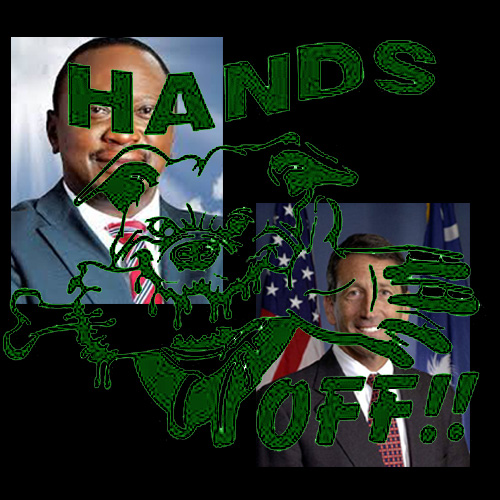
Because The Right (Kenyatta + Cameron + Zuma + Hayes, let me also add Sanford) are all miserable failures who through “elitism” and (likely unscrupulous) wealth have manipulated elections to become powerful men. And The Right does not unlock its jaw once clamped.

They are all also in minorities, but there seems to be no organized majority to defeat them.

Back to unedited Dowden:

“The fact is that the Kenyan elite … simply do not recognize that they are subject to the law. Politically powerful, exceedingly wealthy and above the law, no state official would dare touch them.”

Equally applied to miscreant U.S. bankers and right-wing U.S. politicians. How many bankers have gone to jail? Or even lost their job? Which man was yesterday elected a Congressman who is indicted for having misused public funds for his affair in South America?

Good grief. They just can’t be gotten rid of. And so what happens when Vice-President Ruto decides not to go to The Hague for his trial on May 28, or when President Kenyatta decides to take a pass on his date of July 9?

Dowden: “a major diplomatic earthquake.”

DisMobius Engagement

DisMobius Engagement

Last night a prominent African businessman chastised Obama for “disengaging” from Africa, even as American military involvement grows ominously large.

Obama as reflecting the “United States” is a curious shadow box of a troubled society. Are we (is Obama?) pulling inwards, constrained (perhaps by Congress?) to few good acts except our own security?

Yes to the first question, and the answer to the second question doesn’t matter.

“We are witnessing a gradual and continuous U.S. retreat from Africa,” Dr. Mo Ibrahim said last night in an acceptance speech for an award from an organization heavily funded by Obama’s Nobel Peace Prize winnings.

“I take the expansion of [AFRICOM] and the growing U.S. military presence sort of creeping down into sub-Saharan Africa as a further continuation” of American militarism, claimed Andrew Bacevich at the Carnegie Council last week.

Dr. Ibrahim is one of Africa’s richest men, commonly known as the “Father of Africa’s Mobile Phones.” Bacevich is a highly respected analyst, author of “The New American Militarism.”

“There is no question that Africa is moving forward,” Ibrahim continued, pointing out the extraordinary GDP growth of the continent, even through the global recession.

“ Everywhere in Africa you see Indian, Chinese, Brazilian businesses,” he said. But no American business except Coca Cola. Africans as a result are beginning to feel a bit uneasy about the United States.”

Read: “suspicious”

Note that Ibrahim didn’t include Europe in the panoply of foreign businesses racing into Africa, and Europe like America is in the forefront of the current global financial earthquake. I think it fair to include Europe in this analysis; it’s not just Obama, not just America, but the traditional developed world.

Which is turning inwards and becoming militaristic obsessed only with its own security.

That’s a very dangerous path to cut. It doesn’t work. It makes things worse: Look at Chris Hayes’ MSNBC show last night: click here.

In his book and his speech, Bacevich recognizes 9/11 as when America (“developed world” including Europe) pivoted from grand economic and social engagements with the rest of the world to become militaristic.

“The George W. Bush administration tacitly acknowledged as much in describing its global campaign against terror as ‘a conflict likely to last decades’ by promulgating the doctrine of preventive war,” Bacevich explains.

The doctrine of preventive war, as much a social upheaval and resource greedy policy as The Monroe Doctrine was nearly two centuries years ago, has consumed America. And it has consumed America just after American bankers and immoral financial trainers consumed society with the 2008 depression. We’re sort of on a mobius strip of unstoppable self-destruction.

Several weeks ago France conceded that its short several week involvement in Mali will likely extend to years. Remind you of something? Mission accomplished?

“… the violent pursuit of violent Islamists continues with no end in sight,” Bacevich laments.

I don’t think this policy of ‘the violent pursuit of violent Islamists’ would be quite as controversial if we didn’t have domestic flight delays, sinking education, wholly stalled government, and a basic social ennui that clearly now even extends to our private sector.

We define ourselves principally in “private sector”-speak. Capitalism cannot survive in today’s global economy, unless it’s global.

The world is moving on, and a lot of that movement is in Africa. There’s nothing very surprising about this. It was the fertile, untilled economic continent, and it’s now being tilled. By Brazil. By India. By China.

By the new economic bullies on the block.

But America sits idle. American businesses won’t invest, at home or abroad. America is consumed by its own terrorized concern that it is marked for doom.

It is. By itself.

Give Peace A Chance

Give Peace A Chance

Conflict in Africa is declining, not only relative to the rest of the world, but historically within the continent itself, and a brilliant University of Wisconsin professor has discovered why.

The truth is counterintuitive to many Americans whose understanding of Africa comes mostly from the nightly news and America’s very distorted and political travel advisories. But Scott Straus has documented the fact, and what’s more critical, explained it.

The University of Wisconsin at Madison is fast developing as one of America’s invaluable resources for everything African. Strauss is young, an associate professor brilliant enough to obtain an endowed chair, concentrating in political science and global issues.

But Madison is rife with many others Africa directed, including one of my favorite, John Hawks, whose exciting blog is one of the most important first sources of breakthrough anthropology and paleontology in Africa.

So it is not surprising that research news about Africa comes from UW-Madison. It is surprising, though, that a young associate professor will dare take on contemporary media alliances as normally disparate as Ted Koppel and Richard Engel.

Koppel suggested on Meet the Press last Sunday that Africa is going nuclear, not necessarily figuratively, and far outpacing the danger of conflicts of the past. Engel suggested on Tuesday’s Nightly News that Africa exceeds Syria or North Korea in terms of potential conflict.

And these represent the liberal media! As far as Fox News is concerned, the only indication at all that evolution might be true is that Africa hasn’t yet.

Media news in short sound bites is how most of America forms its understanding. As Straus explained in an article Monday it takes more than sound bites to reveal the truth.

Straus’ quest to disseminate the truth has been a two-year one. Using the most incontestable data since 1960, he has demonstrated in publications and conferences that conflict in Africa is on the decline. It’s a particularly difficult task right now, and he refers to the northern African conflicts as an “uptick” but when laid into any graph of any length – even just 3 or 4 years – his premise stands.

And as I’ve written recently, many of us do not see this current conflict in northern Africa as lasting very long. (So I hasten to add that doesn’t mean terrorism will be wiped out, or that Egypt won’t boil and bubble for years to come.) But it does mean that from a truly global perspective, it’s wholly rational that the world’s biggest businesses are investing hands over fists in Africa, because even they know: Africa is the place to be in the future.

But even more interesting is Straus’ more delicate conclusions as to why.

Why is there more conflict in Asia, for example, than Africa? Why are wars – when they do happen – more gruesome and often barbaric in the Balkans than Central Africa? Why is North Korea or Iran so much greater a threat than an extremist Islamic Arab Africa?

Three reasons:

1. The End of the Cold War
As I’ve often written Africa was the great pawn in the Cold War. It led to its current stubborn levels of corruption, since the patrons in the East and West lavished immature African societies with tons of money and weapons without requiring accountability. When the Cold War ended, this unfiltered pipeline did as well.

2. Democracy
This is Straus’ weakest point, but if I understand it correctly, he believes that before the advent of multi-party politics, dictators’ control of African countries’ growth, revenue streams and disbursements, were highly targeted ethnically or even just into the coffers of those dictators. The release of the economies of African societies requiring real public stewardship – coincidentally or otherwise with the advent of multi-party democracy – leads to a strong motivation to keep the social peace.

3. China
Like me Straus doesn’t hold China up as a model for how a big power should mentor small ones, but like me he realizes that China’s unique form of foreign policy is good for African peace. “China doesn’t take sides,” Straus says flatly. China takes oil. And it will do anything it can to get it. There’s no deceit, here. Everyone knows the rules of the game, and to be a winner, you have to have peace.

4. Regional Conflict Resolution
I disagree with Straus on this, but fortunately I think the previous three reasons are sufficient enough. Straus argues that regional powers and organizations have been working successfully to reduce conflict: South Africa in Zimbabwe, Kenya in The Sudan and Somalia, Egypt with the Palestinians, the African Union in many places. I don’t. I think these ostensible activities are totally emasculated without big power – mostly western – support and guidance. The signs are hopeful and this may herald the resolution centers of the future, but right now they are still the puppets in the shadow box.

But his last explanation could be stretched into an argument that is equally positive: that the Big Powers are doing better in shepherding conflict resolution in Africa. And with that I totally agree, and especially recently under Obama.

Truth is often so broad and so immutable that it fades like a watermark under the moments of things more exciting and threatening. That’s what much of Africa’s steady progress into the future is like. There was so little interest at all in Africa a generation ago by westerners, all we learned was the bad stuff.

That’s the history we store, miserably inadequate to produce sufficient contrast as a watermark on the abduction of child soldiers and Rwandan genocide. But the persistent and careful work by people like Straus will prevail, and I for one hope he continues to enthusiastically duke it out with the Koppels of the world.

Surge Then Peace?

Surge Then Peace?

When’s the last time the U.S. fought a war in a foreign land that ended with a better society and government for those people and greater peace for all the world?

Yesterday.

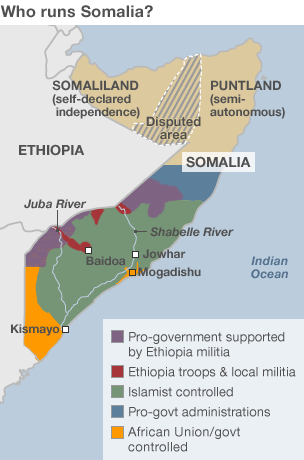
But before that, you have to go back to World War II. But yesterday the U.S. officially recognized the existing Somalia government after 21 years of on-and-off direct conflict.

Although far from tranquil or totally stable there is today a globally recognized Somali government for the first time since 1991, piracy is ending, farmers are planting, schools are open and the economy is growing. None of this since 1991. All this precisely because Obama “surged” our militarism there for the last two years.

He surged a war and won.

Applause?

Them’s the facts, Ma’am. The catastrophe began with Bill Clinton’s cowardly response to Blackhawk Down and then a few years later, the Rwandan Genocide. Clinton escaped a couple close calls with oblivion as President, and I for one think he’s culpable for the last several decades of terrorism in the world. (With a good measure of French obstructionism as well.)

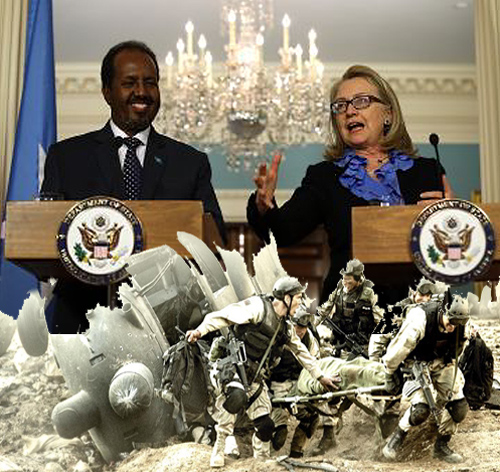
A sweet irony that his wife yesterday was the person in the spotlight recognizing Somali peace.

But Clinton and French responsibility for igniting global jihad had a significant catalyst with the end of the Cold War.

So many African countries were nothing but pawns in the Cold War. They were treated like ivory pieces on a chessboard, spit-polished when they advanced one sides game and ignored to the point of being sacrificed when they didn’t. The frontline battle was in Somalia and neighboring Ethiopia for 20 years before Blackhawk Down.

The U.S. and westerners pulled the puppet strings on Somalia, and Russia with occasional Chinese lace pulled the strings in Ethiopia.

Tens of thousands – maybe hundreds of thousands of people died in regular old tank wars on deserts with no more value than the sand that defines an egg timer. So for 40 years “Somali society” if it still exists was pulled and shoved and bombed and tortured as some unexplained pendulum flinging between good and bad.

The epoch Americans remember most is the one just ended: the epoch of terror when Obama’s surge in Afghanistan forced al-Qaeda principals to flee to Africa. After a short stint in Yemen they went to Somali where their much greater skills and far superior dedication to ideology gave them the tools to conquer the rat pack of warlords that had controlled what had been Somalia with the residue of weaponry left by the end of the Cold War.

The prize in that stealthy battle was the port city of Kismayo, the throne of the pirates, and the loot this provided al-Qaeda rebirthed them with new weapons, new roads, new infrastructure and alas was born, al-Shabaab.

Obama gives no quarter to his enemies. But he doesn’t like public wars. So with more equipment and better technology and not a few real American boots on the ground, America began battling al-Shabaab.

It was just the continuation of the Texas Ranger pulling up his red bandana to disguise his face and sticking his badge in his pocket so he can hunt down the Dallas bank robber who fled into Arkansas. But when it became clear that this clandestine operation wasn’t enough, well, he hired Kenya.

The Kenyan Army invaded Somalia in October, 2011.

Well, that did the trick!

So now the al-Qaeda principals – what’s left of them – have fled into the interior and north of Africa. But don’t worry. The French talk better than we do in that part of the continent, so they’re taking control, now.

I’m of two minds about all this. The world – the whole wide world, including shipping and fishing lanes and air space – it’s all much, much more safe and peaceful today because of Obama’s surge against terror.

But my second mind is whiplashed by the memories of the Cold War, and how we used African societies as pawns in a game that was cruel and devastating to them.

It all remains to be seen. And perhaps my sarcasm is little more than spite of days gone bye.

Perhaps today is better.

Time to Go Home Now

Time to Go Home Now

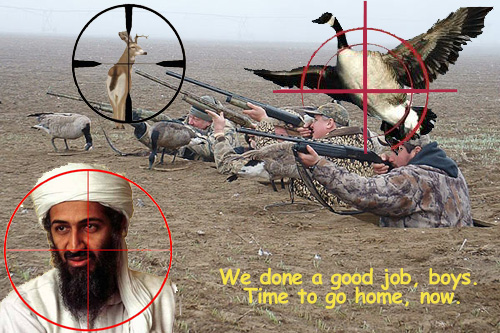
Hey chums, time to end the war on terror! We successfully pushed it into Africa! And they’ll do much better once we get the boots out.

The modern war on terror is like suburbanites trying to eradicate deer and geese. Few homeowners are ever hurt by deer and certainly not by geese, but their gardens are eaten and zoysia lawns defaced.

And “everyone knows” of the dog that was bitten by a stag, or the young oak trees eaten to the ground in the precious county forest, or the toddler nipped nearly to death by the hen’s beak, and – horror of horrors – something so truly horrible it must be given an anagram: CWD.

It is precisely the juggernaut of thought about CWD that tips the balance in the county finance committee to hire that sniper to go into the lagoon and start shooting. After all, CWD does exactly what the suburban homeowner wants it to do: kills the deer.

But fashioning goodness from simple reactive evil, the homeowner begins to feel sorry for the poor wasting away antelope. Euthanasia is wrong, but execution is right.

This is so similar to terrorism.

Nine-Eleven did ultimate harm to 3000+ people, but at the time there were more than 300 million living in the U.S., another billion or so in the countries represented in that awful carnage. So the vast, vast majority of human beings were not effected … except by terror.

By the fear it would, somehow someday, happen to them or those close to them.

The war on terror, though, has much realer consequences for all of us. It’s costly, it allows invasions of our privacies not otherwise possible, and it allows a small handful of people – mostly the president – to assassinate foreigners at will.

The last removed power that the war on terror conveys actually effects us directly. Our own behavior changes when our leader can murder at will.

When you think about, it’s worse than horrible. We have grown complacent about murder.

Numerous analysts last week suggested it’s time for America to end the war on terror. It makes a wondrous peace headline just before the holidays but it carries powerful implications for American policy.

Journalists like Rachel Maddow and Fareed Zakaria have been joined by experts close to the government.

The reason for this is pretty simple: the assault on terrorism carried out especially by Obama has succeeded. Like with deer chomping roses, we have exported the problem to our periphery.

Culling deer or blasting away geese has never successfully reduced either an existing regional population or any population trends. But it does move the problem away – to the edges of your existence.

Culling deer in the Chicago suburb of Skokie moves the problem further out from the city into more rural areas, complicating life there a little bit more as a result.

Obama has successfully routed al-Qaeda and with the weekend’s drone assassination of Abu Zaid al-Kuwaiti in Pakistan, the last of Osama’s Old Boys Network is gone.

With the effective fall of the town of Jowhar in Somali last week, al-Shabaab is nearly gone, too. Somalia, which became the dustbin of terrorists worldwide as Obama’s wars in the Afghan region intensified, is essentially now no longer under terrorist control.

It is under the fragile control of countries like Kenya and Ethiopia, that are now carrying the burden of the war on terror.

Even much smaller and more regional groups like the Lords Resistance Army are on the run, presumably from U.S. Special Forces in the deepest central African jungles.

America’s War on Terror – at least as regards America’s land itself – is over.

The strongest argument against ending the war on terror, is that it isn’t eradicated worldwide, and worse, where it still flourishes (in Africa) the powers there are much weaker than us. I.E.: They Don’t Have Drones.

True TDHD but they will be much more successful wiping up the residue than we were. The so-called terrorists are much closer to them ethnically and historically. There is a much greater need to pacify militants and integrate them into society.

Right now you might think that doesn’t look real good: Terrorists hold half of Mali, most of the CAR and are detonating bombs in Nairobi at the rate of about one per month.

But it’s nowhere near the confusion and destruction that Afghanistan was less than ten years ago, or even that parts of Pakistan are today. Nairobi today is probably nicer than Belfast 20 years ago: Africa will take care of itself, much better and quicker if we withdraw.

That leaves … Afghanistan and Pakistan.

It’s been more than a year since we announced we will be out of Afghanistan in little more than another year. Theoretically we never invaded Pakistan. I’m no expert on the region, but I wonder if eliminating drone assassinations would not actually have a positive effect on our security. When we take our boots out, drones will be all that’s left.

So happy holidays, all. Peace is near at hand?

Better Than Democracy

Better Than Democracy

What if they don’t want “freedom”? What if they want a benevolent dictator operating in a framework of Sharia law? Is such liberty to be denied?

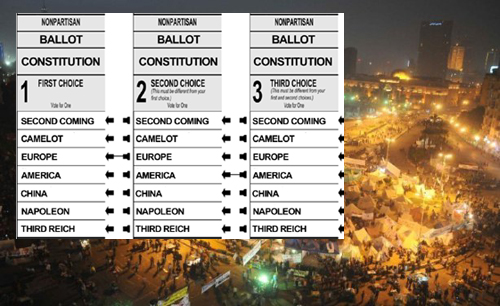
The Egyptian diaspora begins voting on a proposed constitution Saturday. A week later, those in Egypt will vote and within two weeks Egypt will likely have a new constitution.

The proposed constitution looks a lot like the old one under Mubarak with one notable difference: the elected president is limited to two 4-year terms.

The powerful role of the military, the judicial process, the suppression of women (tantamount by notably saying nothing about them and referring to citizen rights as the “right of men” and founding law on Sharia), the legislative process and internal geopolitical map are all carbon copies of the Mubarak years.

In addition to the limited terms of an elected president, the effective control that current president Mursi has on the military actually seems greater than Mubarak’s.

Amnesty International who I support strongly is livid. In their article published last week they described with vengeance case by case of Tahrir Square protestors injured by tear gas canisters dated March 2012 and sold to Egyptian police by Americans.

The article ends, “One thing is certain: the protesters will not accept a return to rule by decree, or accept a constitution written by a committee that doesn’t speak for them.“

Is the filibuster more important than one-man, one-vote? What if the protesters are not the majority?

I don’t want to get too philosophical, but we are at least breaching philological meanings of democracy and it strikes me as remarkably parallel to Harry Reid’s current conversations about Senate rules.

Amnesty, Human Rights Watch and other champions of human rights are unanimous that democracy is not as important as their own missions to protect basic human rights.

So that means that protecting basic human rights is more important than freedom, democracy or liberty, right? Do you ascribe to that?

I do: democracy is not always the best mechanism for achieving the most important goals of protecting human rights. And right now in Egypt, we have the greatest example I could ever have concocted to prove this.

Democracy brought both Hitler and Mussolini to power. It enshrined racism in America’s south for nearly a century. Democracy protected torture under Bush; it freed the thug Nixon; it allows even today Peronists to destroy Argentina.

And right now in front of our eyes democracy is crushing the marginal advances in human rights protections that Egypt has made the last generation.

Because that’s what the majority of Egyptians want. That’s the manifestation of democracy.

Are the majority of Egyptians bad? Let’s phrase that more acceptably: is what the majority of Egyptians feel they want as government bad?

Yes. Because, we say with arrogant displeasure, they are either too dumb and uneducated, too coopted by an oppressed civilization, or too immoral to protect human rights.

No! say the protestors in Tahrir Square and herein lies a great test of democracy. The liberals who wish to protect human rights in Egypt as in the U.S. may be in the majority, but they have never coalesced into succeeding well in a democratic system.

Some argue, now, that the incredibly fractured Mursi opposition will coalesce, because if they don’t, they’ll be crushed.

In America a similar argument has proceeded throughout my life regarding the many different directions and movements that have continually had difficulty coalescing into the Democratic Party. Maybe America’s democracy is mature enough that it works for us, today, from time to time.

But in Egypt? I don’t think so. The same self-destructive motive that governs any older American to vote Republican and diminish his rights under Medicare and Social Security, or for any woman to vote to promulgate law to govern her pregnancy, is identical to the majority of Egyptians today who are equally self-destructive, willing to sacrifice their basic free will for something else.

What else?

Probably security. Probably promises of economic advancement. Maybe just more cash.

It happens here, too.

Democracy is sloppy and as society moves into the instantaneous informational age that makes sneaky theory less long-lived, it may be out of date.

Human rights is more important than one-man, one-vote. Egypt does not seem to believe this. And so…

… are human rights so important that they should be protected from without? How far do we go and remain morally correct? Are we a global community first? Or do we dare to accept our brother’s immorality because there is something even more precious than human rights?

Self-determination. Because we are uncertain of the inviolability of our own morality? Because … we might be wrong?

No More Grains of Rice

No More Grains of Rice

Susan Rice’s performance on the Sunday Talk Shows incorrectly explaining the Benghazi attacks is a perfect example of how she has historically allowed political considerations to trump more important foreign policy or human rights considerations in Africa.

She’s been acting like this for years. She seems incapable of intricate analysis and quiet diplomacy. She’s no engineer of foreign policy. She’s a cheerleader. Africans don’t like it. I don’t like it. Americans should not make her the Secretary of State.

Her list of failures in Africa is impressive: Blackhawk Down followed by the Rwandan genocide followed by the East African embassy bombings followed by the escalating instability of Darfur followed by the poorly created South Sudan and most recently, the mishandling of the growing violence in Kivu and Goma.

There are more, but these are the main ones.

Contrary to the Huffington Post that I usually love, there were plenty of warnings that the Kenyan embassy was going to be attacked in 1998.

An Egyptian agent, or double agent initially set up by the FBI gave warnings of the attack on East African embassies about nine months before it happened. The details were published long ago by the New York Times.

After years of further investigations, Frontline organized all the evidence in a way that was resounding proof that plenty of warning had been given, warning that had been ignored. At the time, Susan Rice was advising President Clinton on African affairs and had to have been involved in the decision (or lack of decision) to do something about the intelligence.

Today in Nairobi the “August 7 Memorial Park” stands as America’s remembrance of the bombing and in particular remembrance of the 238 Kenyans who were killed. I’ve visited the memorial often and it includes a short movie that also describes a workman who came into the embassy hours before the bombing and tried to warn everyone to leave, but who was ignored.

The memorial has had a website for years: memorialparkkenya.org. The URL is confirmed by Google. But the website no longer works… for some reason.

I was in Nairobi and heard the bomb go off. It is a day I will never forget, and I will never forget what I’ve learned about it, even if websites die.

But worse than the 1998 bombing was the 1994 genocide in Rwanda. The U.S. and France are specifically responsible for having allowed the genocide to happen by their actions blocking the Security Council from sending in more peace-keeping troops as desperately requested by the Canadian General at the time.

France refused to increase peace-keeping because of a complex historical feud with Belgium and France’s blind support of the Hutu who at the time were plotting the genocide but had been seriously repressed by the existing Rwandan regime.

Clinton backed France because of his being burned by BlackHawk Down. It was a cowardly response, and one for which he has since apologized.

There is a wealth of literature on this. The two best are the movie “Hotel Rwanda“ and the book, “We Wish to Inform You That Tomorrow We Will be Killed With Our Families.”

According to a former President of GenocideWatch, Dr. Gregory Stanton of Woodrow Wilson Center for International Scholars:

“The U.S. government was forewarned of the impending genocide. Communications were sent by cable, e-mail, and secure telephone… [But] Policy makers in Washington, D.C., especially Anthony Lake, Dick Clarke and Susan Rice at the National Security Council… did not want the U.S. to get involved in another African “civil war.”

The decision to “not get involved” hooked America into a mind-boggling expensive refugee and human rights initiative, followed by billions for Rwanda aid that continues today. But beyond the expense, we’re talking of at least a million lives lost.

The guilt of supporting Rwanda is something Susan Rice knows deeply and is deeply entrenched in. As the DRC Congo/Goma crisis deepened this fall, she specifically in her capacity as UN ambassador engineered multiple softenings of European led initiatives to impose sanctions on Rwanda to restrain its wanton support of the turbulence there.

A few weeks ago, America began reversing this overly cautious policy. It was terribly wrong in the beginning and has certainly led to more violence than was necessary.

Perhaps the best example of Rice’s inability to perform more than a political role was her performance in The Sudan, including Darfur and the creation of South Sudan.

The secession of South Sudan from the greater Sudan is overall a diplomatic victory for the world and most certainly a good move for the citizens there. It took more than 20 years and involved a serious civil war that the U.S. was deeply involved in.

But the creation of the new state was poorly done. Two years after independence, South Sudan is still mired in military difficulties with the north in a modern way, and with several ethnic groups in ways reminiscent of William of Orange. The untold oil wealth is not being mined because of this instability and a refugee problem within the country has grown severe.

Rice must shoulder much of the blame. She consistently created PR moments, sound bites and veneers of western institutions neglecting the much more difficult and intricate process of creating social institutions.

At a critical juncture in the negotiations that were leading to the two-country solution in The Sudan, Rice actually organized a rally of blurry-eye Juba citizens hurriedly rounded up for something more akin to an American political rally.

As reported by Matthew Russell Lee of InterCity Press who was traveling with Rice at the time:

“‘Are you ready to protect your country?’ [Rice shouted to the small crowd.]
Yes!
‘Are you ready for independence?’
Yes! … Another diplomat … would later call it a “political rally” and deem Susan Rice’s organization of the Juba leg as inappropriate.”

Rice has never displayed the insight or vision of a Hillary Clinton. She is schooled in American bureaucracy where she has percolated through the ranks and become one of its best soldiers.

One of Obama’s most serious failings is his inability to freshen up government. Rice like Geithner and others in his close circle, are old boys/girls who have rarely lived on the outside. While you might say the same of Hillary Clinton, it could be that rising to the top as fast as she did insulated Hillary from the strictures of soldiering Rice has not liberated herself from.

I’ve come to believe that Obama chooses people like Rice and Geithner not completely from a lack of his own personal courage, but because he very deeply believes in the American government status quo. He eloquently describes government’s ups and downs, but he sees overall America as on the right path.

I’m more radical. I’d like a visionary who shakes up government and doesn’t rely exclusively on old people with old ideas to join him at the helm. Africa has changed so quickly and so radically in my lifetime, I don’t think someone schooled and processed through American bureaucracy for her entire life is how we as Americans should be represented to Africa.

“Susan Rice’s chances of succeeding Clinton as secretary of state look slim,” writes a respected South African analyst.

And he, and I, think that’s just the way it should be.

Kenyan Thoughts on Obama

Kenyan Thoughts on Obama

Should Obama lose so he can save the world? A prominent Nairobi commentator argued that if Obama loses the election he can then join past leaders like Clinton to better influence the world.

Charles Obbo writing in today’s Daily Nation explained that if Obama wins, the growing conflicts in Iran, Syria and Mali will turn nasty and “the US president will have to enter the fray on the side of Israel – and alienate two-thirds of the world.”

This and economic conflicts with China and America’s penchant for shooting before talking could all destroy Obama’s current trajectory to become “the only person of colour” to join the “non-state do-good” club of Clinton, Carter and (Bill) Gates.

(Interestingly, Obbo dismisses Kofi Annan as “still developing his voice” and explains that Nelson Mandela and Desmond Tutu are too enfeebled.)

I was struck by the analysis that Obbo thinks someone can influence world affairs more as an individual than as President of the United States. I don’t mean to pat my own American chest here, but both Clinton and Carter left imprints on the world during their very short times as president that they’ll never be able to duplicate as private citizens.

I think it likely there was an ulterior motive creeping into Obbo’s commentary. Many Africans – and particularly Kenyans – are disappointed that Obama didn’t pay them more attention during his first term.

The reader Yvonne in replying to Obbo pried it out clearly: “He is a leader of the free world not just Africa. Kenyans forget that he had .. an economy on the brink of collapse and two wars that he had just inherited.”

Normally an oped in Kenya’s main newspaper, the Daily Nation, draws a handful of comments from the readers. This morning when I looked there were more than 50. The majority took issue with Obbo on a number of counts.

Several gave Obbo the Bronx Cheer, pridefully arguing that neither Obama or the “non-state do-good” club were needed.

Leo Tamutu says, “We don’t need foreigners to do charity in Africa. We have thousands of Kenyan Billionaires to do us pride in charity… To wish Obama loses to Romney so that he can divert his attention to helping Africa is pathetic.”

A number of readers ticked off the now well-known litany of reasons Romney would be a disaster. Alex Njinu sums it up for many: “No way, Romney is helpless, hopeless and pathetic.”

Symore Themoose says, “Romney … spells trouble, war all across the world. Republicans own and run weapon factories, and markets for their goods come first.”

Michael chided Obbo, “Yes, let Obama think about his reputation. Not the global catastrophe at stake.. I’m sure Romney, who thinks Syria is how Iran gets to the sea, understands foreign policy completely.”

Kiwanuka Nsereko believes Obama is the only candidate good for women throughout the world:

“Whether Obama will be a state actor and give the brown-black people a voice does not matter,” she begins. “What is pivotal is for him to … sustain the voice of women, which is in danger of being eroded by the right wing wackos. Saving the women voice, in the USA, will have the domino effect of providing hope for women around the world.”

But I found one comment which was incredibly insightful and really reflects my own deeply held view about this election:

Gabbe O’k speaking especially to the many Kenyans who believe Obama lost interest in them explains, “Obama had to distance himself from Africa to even have a chance for the second term… Republicans were waiting to brand him an outsider caring for African affairs… Right now his biggest disadvantage is being half black because most jungus cannot stand another 4 years of a black president… If he were white this could have been a landslide.”

Yet it’s interesting that Obbo – a man who I greatly respect and who sees the world generally with the same vision I have – believes that a U.S. president loses much of the power of individual good just by being President. I haven’t come to believe that … yet.

Folks, these are all remarks from Kenya, not from Columbus or Miami. But they represent as much if not more insight into America than Americans have themselves.

Take umbrage, guys.

The Clothes Stink

The Clothes Stink

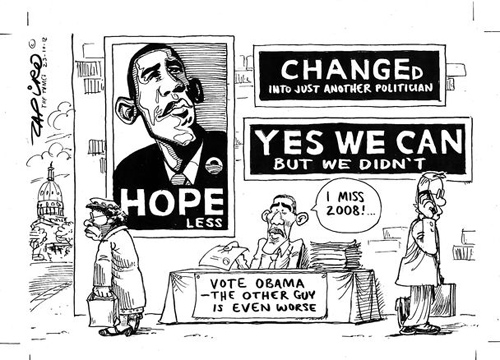
By Zapiro, South Africa's most famous cartoonist
The U.S. election dominates much of the media of Africa. Should it matter to American voters what a South African diplomat thinks? Does it really matter to a Kenyan businessman if Obama wins or not?

Yes and yes, but unfortunately that’s almost beside the point. I for one have become so weary about the election that my greatest wish is that it be over. I’m not sure if I or any of my many fellow Americans regardless of their politics cares much about what the world thinks, anymore.

We just want one less week in October.

No place on earth has an election cycle as long and drawn out as America’s. No other democracy spends a fraction of what the U.S. spends on elections. So towards the end nothing really matters but getting it out of sight and out of mind.

That’s not a very healthy attitude.

“The selection of a leader for the US might be in some respects more important for other societies than for America,” writes the respected diplomat, Richard Falk, in South Africa.

Writing today in South Africa, a Jamaican-born Tanzanian activist now teaching in the U.S. writes, “The US … massive debt, devalued dollar and unchecked political and economic power of the banks threaten the entire humanity.”

Quoting Newt Gingrich he concludes, “This will be the most important election in the United States since 1860.”

Perhaps, or perhaps not for us in America. But it’s certainly true for the rest of the world.

My nonscientific survey of Africa suggests that Africans believe they will have a much more difficult and threatened existence if Romney wins. The most attention being paid to the American election is in Kenya.

That’s understandable because Kenya is in the thralls of its own contentious election, and one that is much more significant to their country than ours is today in America. It will be Kenya’s first election under a radical new constitution, and the tension is extraordinarily high; the potential for violence is real.

Writing in Nairobi’s digital newspaper, Njoroge Kinuthia recently said “this democracy thing baffles and befuddles.”

Her analysis of some Kenyan politicians is exactly mine of Romney: “They fight and change” positions “like clothes.

“When they stink– [the clothes are] discarded like dirty rags for convenience… That’s why politicians keep hopping like grasshoppers. That’s our brand of democracy, folks.”

Kenya is deeply behind Obama, but for reasons that would disinterest most Americans. Principally it was because of how the Obama administration — and mostly Hillary Clinton –helped the country dig out of the mire of violence and political chaos of 2008. And then there’s the “distant relationship thing.” You’d be surprised how many Obama relatives have popped up in Kenya.

Kenya built its new constitution heavily with American-like government institutions. It will be tried and seriously tested for the first time in national elections on March 4. Perhaps that’s why Kinuthia seems to have as much ennui as myself. Perhaps it’s the institutions, not the players, which is to blame.

North Africa is solidly Obama, but “begrudgingly so” as explained so clearly by the Reuters correspondent in Beirut. North Africans are very disappointed that Obama fell so far behind in his promises to reduce the Israeli/Palestinian conflict.

But be that as it may, Romney is “too keen to project U.S. military might.” In the part of the world where most of today’s wars are being fought, this is the preeminent concern. And there is very wide consensus across the continent that wars will increase worldwide if Romney gets elected.

The cartoon that appears above is from South Africa’s most famous political cartoonist, a man who like myself is extremely progressive. His cartoon is exactly how I feel.

And of course it ignores the fact that Obama’s inability to achieve his goals is in huge part the fault of the intransigent Congress.

But we focus our democracies so heavily on the executive that we won’t countenance their failure as a leader except as their own personal failure. It’s what the candidates themselves project! They speak as if they alone can determine governmental outcomes.

(Or even more laughably, that they alone can “bring together” the intransigent polarized divisions that have to make the laws they sign.)

Published in the South African blog RAIN, the UN Special Rapporteur on Palestinian human rights, Richard Falk wrote two days ago, “When Obama actually won the presidency, it was one of the most exciting political moments in my lifetime.”

But it was downhill from that point, Falk writes. He believes that heavily racist America is to blame. He believes that redneck Americans were so polarized by Obama’s victory that it “gave rise to an Islamophobic surge that revived the mood of fear and paranoia that followed … the 9/11 attacks.”

(See Gary Wills in this issue of the New York Review of Books for a similar analysis.)

And now, Falk argues, Obama supporters like himself frustrated with the President’s inability to manifest his agenda risk losing to a “dangerous alternative,” because their support for Obama is no longer enthusiastic.

Baffles and befuddles. Right on.

Falk’s conclusion is sadly mine as well:

“The stakes in the presidential election have been reversed – the upcoming election is more about fear than hope.”

So trembling I will drop my vote into the ballet box as an inverse image of a mushroom cloud explodes over Iran.

General Ndugu Obama

General Ndugu Obama

Drawing by PSMandrake.
Many will be surprised that America has grown increasingly militant in Africa. Because Africa is where most world terrorists now locate, American policy on the continent is defined overwhelmingly by the American War on Terror.

Obama’s massive military involvement in Africa is mostly covert, so not readily understood. But the policy is public if difficult to ferret out, and Ralph Nader said yesterday on Iowa Public Radio that Obama is far more militant than George Bush, who got us mired in two major wars.

Nader’s right. But Nader neglects to explain that Obama’s militancy is predominantly covert. Using drones, very secret special forces that come and go quickly, and massive support of African proxy armies, Obama has exceeded American military involvement in Africa under George Bush almost exponentially. But not in soldiers. So Americans don’t feel it, and mostly they don’t know about it.

Africom, the Pentagon command for Africa, now has more personnel and overall resources than all of USAid for Africa. The command manipulates deployed drones that have assassinated a dozen African militants and been critical to successful African military operations in Somalia, Uganda, the DRC and the Central African Republic.

That is not, of course, the be-all and end-all of American foreign policy in Africa. There has been continued assistance throughout the continent on a wide range of issues from clean water to malaria eradication; the Obama administration has been particularly supportive of African initiatives in the UN and World Court; and on highly political issues (several regarding Rwanda) the Obama Administration has come down swiftly and correctly on the sides that we progressives champion.

But the bottom line is that Obama looks much more like a general than a philanthropist to Africans, today. It is unlikely he would be nominated today for the Nobel Peace Prize.

I remain certain terrorism cannot be eliminated strictly militarily. That results in two options: (a) don’t try to eliminate global terror, just do the best possible and learn to live with what remains; or (b) simultaneously work towards eliminating the cause of terrorism.

That [b] has gained the euphemism of “nation building” starting as early as the Vietnam War, and it remains hard to define, very open-ended nonmilitary support that is often squandered or misplaced. But there is no question Obama believes in the policy for Africa, despite the emphasis on militarism.

So as the veteran African diplomat John Norris pointed out in Foreign Policy earlier this year, “this president’s approach to Africa look a great deal like business as usual.”

It’s hard to fault a leader who had to dedicate most of his time to staving the collapse of the entire global economic order for being uncreative with new African development policies. But it’s not hard to critique his aggressive militant approach to Africa’s terrorists. That’s not “business as usual.” It is a considerable ratcheting up of war in Africa.

But fatefully or coincidentally “nation building” in Africa is proceeding at a rapid pace as well, albeit with little direct American support. The implementation of a new constitution in Kenya, a recharged South African political debate about basic social and commercial policies, glimmers of constitutional change in Tanzania and Malawi, might all be that is necessary to balance Obama’s militarism.

And it puts us progressives and peaceniks in a compromised position. Terrorism might indeed be on the wane in Africa because of Obama’s increased militarism, but the policies are not the ones we would have advocated in the beginning and the question of their shelf life remains dubious.

Is Obama an African war monger? Yes. But global peace maker, too? That is the crux of today’s African foreign policy debate.

Black Gold

Black Gold

As the U.S. and Europe teeter with their economies their investors are turning to Africa where energy companies are growing rich overnight.

Fed up with the failures of austerity in Europe and the even greater failures of politics in the U.S., giant multinationals are directing investment out of their home turfs to Africa. Facilitated especially by new Chinese technologies for deep drilling, huge new reserves of oil and especially natural gas are being discovered almost daily in Africa.

Literally overnight western companies like Tulow, Royal Dutch Shell, Cove Energy, ENI, Galp Energia, the BG Group and Eskom have seen share prices skyrocket with their new African discoveries.

Global analysts think this presages a major shift in geopolitics in the not-so-distant future. Steve Levine of the trendy new quartz.com online business journal thinks that by 2020:

“.. oil prices could average $80 a barrel, Gulf monarchs … could face unrest, Mozambique—yes, Mozambique—could become one of the most important petro-states on the planet, China could more congenially assume a top rung among global powers. And the US could untether itself from some tyrants.”

What I think Levine and others fail to underscore is that we already have a Third World African energy giant, and we have had it for more than a generation, and it’s not doing so well.

Nigeria is a mess, and the $64 trillion dollar question is will that also be the outcome for Tanzania, Kenya, Mozambique, Uganda, Angola and the others.

Nigeria’s oil, gas and other natural reserves rival many states in the Mideast. Civil war, rampant corruption, now Islamic extremism and a failure to develop basic infrastructure have stymied any meaningful development over the last 30 years.

Nigeria’s manifold problems have not just inhibited Nigerian development, but scared off many global energy companies grossly reducing investment and extraction.

Uganda’s new oil finds are suspended while the county battles multinationals in the courts over royalties.

And Tanzania’s new-found energy wealth is tied up in a series of new energy laws that simply can’t get through Parliament. And Kenya – struggling beautifully but ardently to implement a new constitution, hardly has time for such trivialities as trillion dollar oil reserves.

But that, actually, is a reason things might go OK for East Africa. Unlike the now drunken uncle Nigeria, these countries aren’t just waving in outsiders with no requirement except that they lace the doorman’s hand.

The reason for the stall in Tanzania’s multinational contracts is because of the immense new pressure being exerted on its Parliament by … we-the-people. Centered on new energy finds, the power of young legislators and activists around the country to create a fair energy law is unprecedented in this sheepish country whose population until now has jerked its knees whenever its leaders whistled.

And Kenya has become one of the most sophisticated democracies in Africa. Its only delay, truly, is because such heavy lifting as implementing a new and brilliant constitution must come first.

Each country is different, of course, but my take is that African democracies are maturing so fast that they are now fully capable of creating welcoming capitalist environments for these giant multinationals that will ultimately benefit them mightily. Thirty years ago, Nigeria just wasn’t mature enough.

To be sure this is a serious generalization that needs careful parsing. And don’t give it to the multinationals to do; don’t presume that they always know what’s best. Ask BP Shell and the other multinationals that struggle in Nigeria. Many wish they’d never started.

But once invested giant multinational energy companies get caught up in their own ideological web that won’t let the little spider move on even as the web gets torn to shreds. While a few multinationals have left Nigeria and Belarus, most wouldn’t walk away from their huge capital investment, even when the returns weren’t worth it.

This led to all sorts of horrible things. Horrible returns to investors, yes, but corruption and graft on huge scales that to this day continues to stymy Nigeria.

I don’t think that will happen, again. Thanks not to the greed of the multinationals, but to the sophistication of Africa’s young emerging democracies, today.

And I for one think that Kenya and Mozambique will be the leaders and shakers. Tanzania could turn out well, too. Right there are reserves of oil and natural gas that are almost a fifth of the existing reserves in the Mideast.

And if Angola and Uganda throw off their despicable governments – which could indeed happen – then the oil well overflowith.