High Road and Low Road

High Road and Low Road

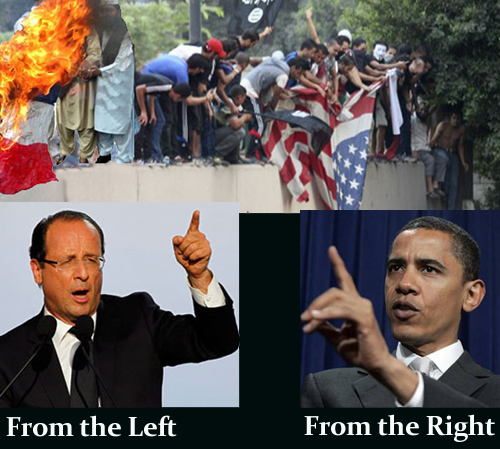
The French president’s push for foreign military intervention in Mali is a true leftist at work and frames Obama as the centrist he is.

French President Francois Hollande’s foreign policy in Africa is nearly identical to Obama, but their methods couldn’t be different.

The new socialist president of France is outspoken and quick to act. In Africa he is pushing for military intervention in many of the hot zones, including against extreme Islamists in Mali. He does not mince his words, either, labeling the Islamists in Mali with “unfathomable stupidity.”

Hollande is referring to Tuareg rebels that now control the historic city of Timbuktu, where reports are filtering out that many of the treasured monuments are being destroyed.

Timbuktu is one of the oldest cities in the interior of north Africa. Its world-famous “library” of ancient texts is an UNESCO World Heritage Site and has been reportedly destroyed. Just before Timbuktu fell from the control of the Mali government, several French were kidnapped and remain so.

So it’s understandable that Hollande will say forceful things, but the man’s wrath at what he considers common sense stupidities is not limited to places where French are held hostage.

He was one of the first to condemn the U.S. consulate attack in Benghazi. He’s one of the staunchest supporters of France’s very controversial rule prohibiting school children from veiling their heads even if they are Muslim. And he is leading the effort to assist the Syrian rebels.

What I find so revealing is how timid and centrist he makes Obama appear in contrast. And as I search for the links of evidence and delve more deeply into Hollande’s simple ideology, I realize it’s not that Obama “appears” to be centrist, Obama is centrist.

Centrist, today, whether in U.S. or worldwide politics is what hardly a decade ago we’d call right. The power of Ronald Reagan and his success in eliminating a huge part of the “socialist” world has manifest itself in extraordinarily powerful and lasting ways.

“Ends Justify Means” was an opprobrium 1960s communist haters placed on world socialists, but typical of far-right and far-left ideologies, they circle about and become each other. Both the communist world and the “free world” embrace ends-justify-means.

What I love about the new African politics producing great constitutions in Kenya and South Africa, for instance, is the utter ignoring of these archaic ideologies. New thinkers, especially in Africa, recognize the old adversaries socialism and free-market democracy are mostly meaningless in today’s interconnected and highly technical world.

And like Hollande, Africans embrace common sense. Ends-justify-means is not common sense, quite the opposite. Its Machiavellian nature means it often trips itself up. Starting a war on a false pretense in Iraq is the ultimate ends-justify-means.

I’m not suggesting Obama will start another war. But here’s the stark difference with someone like Hollande, and you be the judge as to which is better, or more effective:

As radical Islamists flee areas they flourished in only a decade ago – Afghanistan, the Horn of Africa, Yemen and Somalia – they are fleeing to the north of the continent, areas with weak governments and remote locales.

But they’re hugely weakened. The result is a lot of fracturing. Boko Haram, al-Shabaab, al-Ansari are versions of al-Qaeda, but they aren’t al-Qaeda and as best shown in Mali, they often fight one another.

In Mali, today, Tuareg rebels who have through some lone spokesman identified themselves as “Maoists” are actually the ones in control. They have swayed quite a distance from a religious ideology.

In pursuing the fugitives, Obama is relying on drones and secret missions. Hollande is simply straight-forward. He wants to expend no time or energy on deception. He calls for military intervention, he calls the Tuareg stupid and he condemns actions immediately that he sees as immoral.

That’s the difference between a centrist and a socialist, today. Their missions might be the same, but their methods are quite different.
Kenya Great But Don’t Go

Kenya Great But Don’t Go

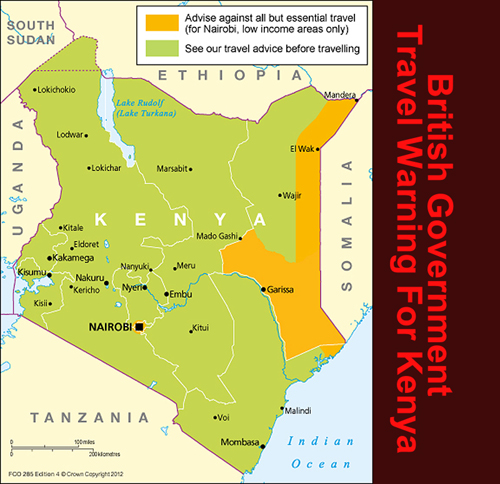
Good news in Kenya is causing extreme turbulence and many countries are cautioning their citizens about traveling there, now.

It’s heart-wrenching, because Kenya depends so much on tourism. It’s complicated, because the potential for disrupting foreign vacations comes specifically from a series of successes in Kenya’s military operation in Somalia and its growing role in the global war against terror.

Britain, France, Australia and Canada among several dozen other countries all issued new advisories to their citizens this week, indicating that travel to Kenya has become increasingly problematic. (The U.S. did not, and that oversight continues a long history of poor and misleading travel advice coming out of Washington.)

All countries said the same thing: don’t go to any part of the northern coast of Kenya including Kismayu and Lamu, and if you travel to Nairobi city, avoid a number of the poorer areas, specifically named.

The reasons for this stem from two major events this week:

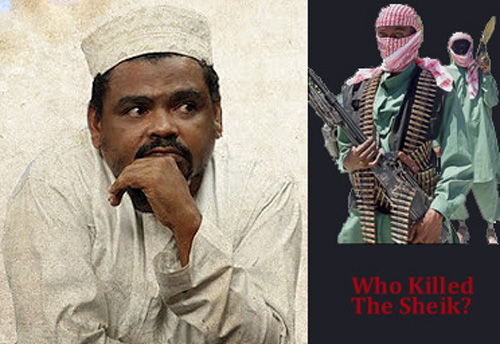
A radical cleric in Mombasa was assassinated in a drive-by shooting. As I wrote at the time Sheik Aboud Rogo was a well-known supporter of al-Shabaab, al-Qaeda in Somali, and one the remaining likely fugitives of a number of high-profile terrorist events.

As I said I believe the shooting was done by the very people Sheik Rogo supports as an attempt to incite violence and disrupt Kenya. It worked. Kenya’s second largest town and only port exploded in violence earlier this week.

Secondly, after nearly a year, the Kenyan military is about to invade Kismayo, the final stronghold of al-Shabaab. It’s Somalia’s modern port, largest organized city and the capital of pirates and terrorists the world over. The economy of Kismayo alone is estimated at ten times that of the rest of Somalia.

This week the Kenyan navy continued an unending bombardment of the port, taking out its airport and confirming the death of at least two major al-Shabaab leaders. The Kenyan air force has been dropping leaflets on the town explaining to citizens where and how to flee once the ground fight begins.

After Kismayo falls, al-Shabaab has nothing left but disparate mostly now ungoverned guerilla fighters, and clearly what they will do is attempt strategic acts of terrorism. The Kenyan coast – where 50% of all its tourist revenues are generated – is within day’s walk of Somalia.

And the poor neighborhoods of sprawling, gigantic Nairobi are perfect hideouts for fugitives. This year a number of grenade attacks have already occurred there that were linked to al-Shabaab.

But if you’re a Kenyan, and despite a lot of civil and political turbulence right now (including several major public sector strikes), you’re incredibly hopeful and aggressively behind the government. The march to the historic spring elections under a new and brilliant constitution will become a model for much of Africa.

But fate has dealt Kenya, with its geography and its rapid development, a terrible roll in the world’s struggle to end terror. It’s stepped up to it, and I think it will prevail.

But as much as I support Kenya and hope for its ultimate success and glory, I cannot do anything other than advise potential travelers not to go there, now.

Sheik Aside

Sheik Aside

Tuesday’s drive-by killing of the jihadist cleric Aboud Rogo in Kenya marks a small if hopeful turning point in the troubled East African coast.

Real evidence will never emerge so we are left to speculation, but blogs, rumors and common sense seem to converge this time: the murder was specifically intended to stoke religious and ethnic violence.

It did at first, but only at first, and the city did not even fire up like Watts in 1965 or Tottenham only a year ago.

This doesn’t mean that the embers remaining aren’t nuclear. But to me it seems a clear indication that Kenya’s invasion of Somalia, the global “War Against Terror,” and Christian/Islamic confrontation has peaked. In a weak and uncertain way, logic tells me things are going better.

Sheik Rogo was a fiery and provocative cleric, openly recruiting young Muslims in his Mombasa madrassa for al-Shabaab. For years he’s been associated with a number of jihadist attacks in East Africa, including the bombing of the American embassy and several high profile attacks on the coast, including the terrible bombing of an Israeli resort.

He was killed Tuesday in a carefully planned and masterful drive-by attack. The attack car which has not been found, the lack of any leads by police, the particular place the shooting actually began, and the high caliber bullets found at the site and not easily available in Kenya, all point to a very carefully organized murder.

The sheik has been confined to the Mombasa area virtually since 2002 when he surrendered his passport to Kenyan authorities. He remained charged with numerous counts of terrorism, and his legal battles in Kenya are legendary.

But he has never actually been brought to trial, and Kenya has resisted extraditing him to the U.S. for instance, for fear such action would provoke Mombasa’s radicals. So instead Kenya did what a western country can’t discipline itself to do: nothing.

African patience was winning out. The sheik’s prominence peaked. His support was waning. In the most virulent political battle on the coast going on right now, a move by a new but powerful Islamic political party to secede from Kenya, the sheik had no involvement. In fact, it appeared he’d been excluded.

Western detractors tried to pin the assassination on America or the Kenyan police, claiming each was no longer tolerant of the protracted legal battles against the sheik. I seriously doubt this. Obama’s War on Terror is going just fine, in part because people like Rogo have been marginalized. Better to have him contained in Mombasa than Guantanamo.

It’s much more likely that the dying powers in Somalia saw the sheik as a sacrificial lamb. Recruits from his madrassa to al-Shabaab are less important, now that al-Shabaab is being routed.

I think the sheik was killed by a sheik. Disquieting, yes, but when the fighting turns inwards the battlefield grows smaller.

Renewing [or not] The Strongman

Renewing [or not] The Strongman

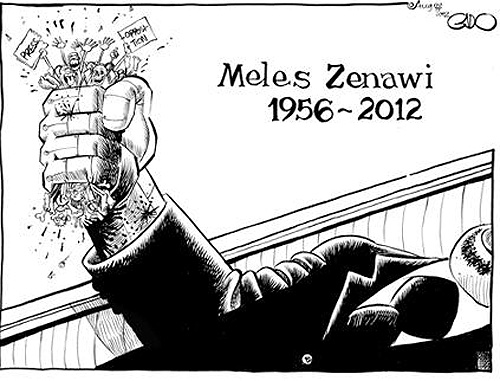
Last week’s death (unusually of natural causes) of Ethiopia’s strongman Meles Zenawi is an unique opportunity for America to reflect on its impact in East Africa, if not the whole of the developing world.

Meles was one of the most ruthless dictators in the world. He was also heavily supported (argue, “propped up”) by the Obama administration. This contradiction was justified because Meles was also instrumental in the War on Terror.

America’s Wars on Communism and Terror and Drugs have governed our policies in Africa for more than a century. The question, now, is whether we are mature enough of a society to throw off these archaic shackles usually described as “self-interest.”

    Cycle One: The War on Communism

In 1960-1962 during the presidency of John Kennedy democratic movements throughout the Congo were quashed and its leaders assassinated paving the way for the continent’s most famous and longest serving tyrant, Mobutu Sese Seko.

    Cycle Two: End of The Cold War

In 1993-95 during the presidency of Bill Clinton democratic movements in the Congo and Rwanda were abandoned to chaos paving the way for seemingly interminable war and ethnic conflict.

At the time the rationale for abandoning Africa to dictators and mayhem was that there was nothing consequential to America in Africa at the time worth fighting for. The Cold War was over

    Cycle Three: The War on Terror

Today, 2010-2012, under the presidency of Barak Obama strongman regimes in Rwanda, Uganda and Ethiopia have received huge amounts of military and development aid paving the way for ruthless dictatorial regimes violating all sorts of human rights.

Today’s rationale is that the War on Terror is going pretty well, and especially well in The Horn of Africa.

Lesser acknowledged but well known is the American Right’s involvement in all three of these cycles. Until the current cycle it was principally from church missions and was admittedly less significant. But during this latest cycle, the involvement of DC’s Church Street and other evangelical groups most prominently in Uganda has been well reported.

The contradictions are explosive:

The most incredible one is that while President Obama has inched his own country away from homophobia quite successfully, his administration piles enormous support on the Ugandan regime which is still trying to pass legislation that will execute gays for being gay and imprison nongays for not revealing that someone is gay.

And there are many more: no military involvement in Libya or Syria, but already a brigade of green berets in Uganda and the CAR; and tax to death or forbid U.S. corporations from extracting coltan and other precious metals from the troubled DRC, but laden Rwanda with extra development aid to build local industries that do just that.

This is not a Right or Left affair, although it seems to always be initiated by Democrats and then massively supported by Republicans that follow. And it is not a Left versus Right affair, either. The fact that Democrats in power are essentially promoting the same thing as evangelic Christians funding movements in African backrooms is clear this is not a Left verus Right affair. It’s a power thing.

It’s ends justify the means. It’s Kissinger’s self-interest dogma. It’s we do what works best for us, irrespective of morals, ethics or human rights. It’s been the way of the world for centuries.

And so we endure Cycle Three: Museveni in Uganda, Kagame in Rwanda and whoever will be Meles’ successor in Ethiopia are all ruthless dictators. Together with American drones, the War on Terror proceeds just hunky-dory.

All hail the African Strongman.

Derecho Doom

Derecho Doom

The heat, fire, floods and storms are not normal; we did not evolve to live in this. Finally it’s hitting us the way Africans have been clobbered for years.

Wake up! The Washington Post today had the courage to say it: This Is Global Warming.

The meekness with which we morphed “global warming” into “climate change” amazes me. Call a spade a spade! Kudus to the Post and everyone with the courage to speak the truth.

Our increased technology has shielded us from the suffering that undeveloped peoples have felt for decades. Natural disasters impact us less than undeveloped regions, for the obvious reasons that our shelters and rebuilding apparatus is so much better.

But maybe now the tens of thousands of disbelievers without a/c unable to watch the quarter finals at Wimbledon might now understand what the less fortunate in the world have been dealing with for decades.

Global Warming Causes Natural Disasters. Unlike increased levels of CO2 and the inevitable suffocation it might cause us in oh 200 years, earthquakes and landslides and derechos (what is a derecho?) are here and now.

Today in Sendai City, Japan, world leaders meet to figure out what to do about the increased level of natural disasters since 2000. It’s a fitting location because yesterday Japan restarted a nuclear reactor.

According to the UNDP, natural disasters since 2000 have killed more than a million people and affected over a quarter of the global population. And they’ve cost upwards of US$1 trillion.

Most of this suffering has been in Africa. And the UNDP is necessarily polite and unprovocative. The conference could not have been arranged if fingers pointed to those guilty, but there are those who are guilty:

(1) Carbon Emitters. Global warming is easily blamed for flooding: (ice melts). But melting leads to boiling, cracking and all sorts of other wanton destruction.

(2) Baby Makers. Mankind is growing faster than he’s learning to take care of himself. And yet we rile over China’s one-baby policy.

Africa has joined many prominent nations in trying hard to find remedies. Remarkably, the continent has cut its birth rate even while the developed world bellows it’s not enough. But when Africa points out how wasteful and dirty are the world’s principle carbon emitters, there is a deafening silence.

Africa and the developing world has suffered for a generation mostly because of nothing they’ve done or could have done. Global warming comes from development, from factories and cars and airplanes. It doesn’t come from subsistence farming.

Have you heard the TV guy say, “not in a generation”, “hottest on record”, “never before” more and more? It’s not a fluke, Joe. Hurricanes and sharks in Cape Cod. Snow storms in Mobile. It’s hotter than we can stand for very long. We’re using Spanish words to describe storms that alone can take down Twitter.

Maybe the blind eye is ready to open up.

Africa Bails Out Europe

Africa Bails Out Europe

How do you feel during the Holiday Season when you see a homeless person drop a coin in the Salvation Army’s tin?

A deepening world economic downturn, caused mostly by Europe, is having violent effects in Africa even as poor Africa helps to bail out Europe.

It was hardly two years ago that the American stimulus and Ireland’s spectacular comeback from the cliff had markets and spirits alike rising. And Africa seemed to be on a steady path of growth and prosperity. The Arab Spring, modestly violent in Egypt and Tunisia, was good news.

Africa’s situation couldn’t be more different, today.

Mali is essentially two countries, with a violent stalemate between extreme Islamists and a corrupt traditional government in Bamako. The Congo is blowing up, again. Nigeria is near catastrophic civil war in the north. Angola’s strengthening dictatorship provoked widespread demonstrations, yesterday. Uganda’s miserable leader yesterday took advantage of an eviscerated opposition by banning 38 organizations that had refused to denounce homosexuality. That’s the short list.

There’s some good news: Somalia, Kenya. But then there is bad news again: Egypt.

What’s going on, of course, is that the global economy is turning south.

That’s not an oversimplification, nor a rationalization. Even something as complex as Egypt can be explained as the generals’ growing confidence that their naughty ways won’t be interdicted because the big guys have more pressing business to attend to at home: their economies.

When the economy is improving, especially after the depression the world just experienced, no one wants to rattle the boat. The status quo reigns supreme. And that was the situation in much of the world and Africa in 2008-2010.

But when the economy goes sour, the prosperous hibernate, the middle classes begin to panic and the extremists forge strong alliances with the poor. The only salient political power that emerges is extremism. And that’s the situation, now.

So the culpable are those who did nothing, or did something wrong, in trying to remedy the world economic downturn. We’re well beyond what caused it; the new blame shifts now to those who did nothing to remedy it.

Europe.

You can’t tighten your belt while you’re losing weight and hope to put on some pounds. An undernourished kid has to reach critical mass before starting to exercise and build muscle. It’s called stimulus. (Athletes call it steroids.) The U.S. did it. China did it. South Americans did it and Africa did it big time, and they all struggled out of the hole.

But Europe didn’t, and now the world suffers. So what does poor Africa do? At the Los Cabos conference, South Africa pledged an additional $2 billion for the IMF fund designed principally as an European bailout. It did not go over well back in South Africa. But South Africa, the continent’s giant, knows that if Europe falls everything in Africa falls, too.

South Africa is unique among African countries to be considered a “developed country” instead of a “developing country” by world institutions. The classification was made shortly after World War I when the League of Nations appointed South Africa as the custodian of then Southwest Africa (now Namibia) taken from the defeated Germans.

It was a marginal call. In those days societies were seen as defined by their elites and upper class. South Africa’s huge and neglected black populations were seen more as a problem similar to America’s native Americans than as intrinsic to the society as a whole.

Nevertheless South Africa is significantly richer than most African nations and most visitors to its main cities and attractions find it little different from developed world cities and attractions everywhere. But since the end of Apartheid South Africa could have lobbied world institutions to reconsider its classification.

That wouldn’t have been easy, either. It’s not just a matter of pride, but of foreign investment, interest rates and much more. In the end South Africa’s new black rulers decided to retain the global classification.

And now they are fulfilling their responsibilities. And bailing out Europe who couldn’t figure out how to do it themselves.

Whose Creation of the World?

Whose Creation of the World?

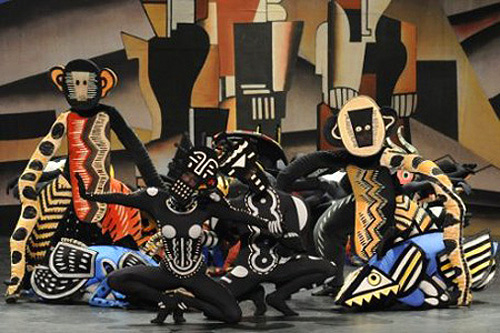
A Congolese ballet currently moving through Europe’s summer festivals strikes a remarkable difference between American and European compassion to Africa. Maybe compassion per se.

Congolese choreographer Faustin Linyekula is currently restaging a near century’s old ballet called “The Creation of the World” that was first produced in France between the world wars. At that time it was widely called “The First Negro Ballet” since its depiction of emerging humankind was black, and as such, included pioneering black performers at a time when blacks worldwide were pretty much confined to trumpets and drums.

It became impossible then, and remains impossible now, to view this ballet as anything more than white people’s fantasies about black people’s existence. Racism in its most theoretical forms.

The ballet’s storyline is basically biblical, but the world that emerges is not flowering with white lovers under a perfectly formed apple tree. Instead, mankind births into something rather depressingly horrible: skin without bodies, torsos without hearts, and babies in abject suffering. Essentially, mankind without a soul.

And in the Bible’s remarkable way of accepting suffering as simple destiny, it prevents the viewer from leaping to any remedy. There is no hope things will get better in the ballet. The story ends in misery.

Linyekula’s thundering question is “How could they not see the suffering?” The English translation was made by Radio Netherlands after Wednesday’s performance in Amsterdam, and it’s right on.

More exactly Linyekula means why did they not react to the misery during the colonial age, and now, why are non-Africans not assisting Africa more than they are?

The question begs the question about compassion. And it’s logical that those who are responding most compassionately (Europeans) will also be challenged more often (than Americans who are doing less) that they are still not doing enough. That’s what Linyekula is trying to do: tug on the European’s guilt, egg them on to even greater compassion.

“The Creation of the World” wouldn’t succeed in America, today. Like anything troubling, there is a threshold of assumed responsibility, and I believe Europeans have a greater tolerance for heavy lifting in Africa than Americans. A greater compassion.

It would take me a book to dissect the cultural facts of current European antipathy to immigration vis-a-vis its greater compassion to mankind as a whole than American’s. But I do believe that:

Americans are fast losing their compassion, compassion for almost anything but themselves. Whether Europeans in contrast are growing more compassionate and tolerant is hard to measure on its own, but in contrast to America they most certainly are, despite the wave of anti-immigration sentiment polluting Europe, today.

The ready measures of this regarding Africa specifically are foreign aid and private investment, government engagement (military or otherwise) and free trade agreements. In all these areas, Europe is racing past America despite Obama’s attempts to stay even.

Europe is in a much worse economic situation than America. Why, then, is Europe reaching out to Africa more than America? The first reason is because of America’s current obstructionist Congress. But there are deeper reasons as well.

Europe is closer to Africa than America, so trade and investment is easier. It has more immigrants from Africa and it has a more pressing problem of refugees from Africa than America. But there’s an even more important reason in my view: there’s more guilt.

Few societies in the world used and profited from slavery as much as America, and we all know where they came from. But that’s perhaps too long ago for any residual guilt to move us in any contemporary fashion to greater compassion. The colonial period in Africa which emerged as slavery was being ended was dominated by European powers and lasted for a very long time. It’s not “so old.”

That was a mostly wretched period in world history. Parliaments in Portugal, Belgium and France have all apologized and paid reparations for their society’s unjust colonial involvements. The Catholic notion of repairing past wrongs by dropping a penny in the church’s collection box is a very European notion.

(And, by the way, it often works and has a much greater impact than lovely speeches about morality and compassion.)

To be fair, though, the production is not being swallowed whole in Europe. Linyekula actually extended the ending of the original production exaggerating the “misery.”

A respected French arts critic, Marie-Valentine Chaudon, asks “Does Linyekula go too far” implying European disinterest with the African suffering she accepts was in large part caused by the colonial period.

Perhaps. But what saddens me is that “maybe too far” in the European mind is outright “extra-terrestrial” in America’s, today. And while I’m no dance critic, I think the art Linyekula clearly has turned for political and social purpose is extremely valuable.

And I sorely wish we in America could achieve the same level of self-inspection with regards to racism, with regards to our lack of compassion.

Africa 2050

Africa 2050

By Conor Godfrey
On Friday, I tried to provide a bird’s eye view of the U.S.–Africa relationship, with an eye for the civilizational points of contact like religious organizations, the number of Americans traveling to Africa or Africans traveling to the U.S., and state to state interaction over trade, security, etc…

I tried to make clear that, in my opinion, the relationship suffers from malign neglect, and a distortion brought on by an over emphasis on development assistance.

Before I offer some big picture ideas on how the U.S. could increase the intensity of this civilizational interaction, I suppose the first question is why this would be a good thing in the first place?

Why should American’s care about Africa, or Africans about America, more than, say, central Asia, or eastern Europe?

My basic argument is this – Africa will be a prime source of both creation and destruction over the next fifty to one hundred years.

The continent holds approximately one quarter of the world’s states, the youngest and fastest growing population in the world, seven of the world’s top ten fastest growing economies, and likely, as discussed in an earlier post, 50% of the mineral resources that the world needs to continue its upward trajectory.

The next thirty years will see African societies and individuals innovate to overcome mindboggling development obstacles.

Where states and societies fail to do so, their failure will spin off destructive forces that will extend far beyond the continent’s shores.

African innovation also tends toward the truly disruptive as opposed to incremental improvement.

In many developed markets, legacy technology encourages baby step refinements.

Think of how long it has taken mobile money to take off in the United States.

We are just now seeing the first generation of mobile payment processors, while in Africa, mobile payments were achieving wide market penetration in 2007 and 2008 (mainly M-Pesa at that time).

Why? Because there was not an entrenched cash register culture that was ‘good enough.’

Now apply these dynamics to energy and green tech, waste processing, internet and communications technology, whatever; in developed markets, entrenched technology and powerful interest groups stand to lose from truly disruptive innovation, and therefore need to co-opt or squash it.

Africa can leapfrog these legacy systems and launch entirely new industries.

As Europe, Japan, and other traditional allies turn inward to deal with their impending demographic implosions, the U.S. needs to maintain links with the most dynamic, growing societies abroad.

This includes getting their best and brightest to study in the U.S., and linking our firms with the innovation pipeline coming from emerging markets like Africa.

So lets say you believe that the U.S. needs Africa over the next century.

How do the two societies move their anemic relationship currently based on aid, security, and resources to something more robust? People to people and firm to firm.

Number one. Rebrand America in Africa.

For years America has tried to out humanitarian other countries; the foreign policy and media organs have tried to position American companies and the American people as the nicest, most considerate, and development oriented of all potential donors.

There are simply too many hypocritical counterpoints to really make this narrative stick.

Instead, America should focus on quality and creative cache.

The U.S. MUST protect its brand’s image as the best made, highest quality goods on the market.

Perhaps even more importantly, American companies, gear, and people should present themselves as the coolest, most cutting edge, and most interesting of potential partners for Africa.

The iPhone, Facebook, Twitter, GE, Akon and Lady Gaga, the New York Knicks, Pixar, Black Entertainment Television, MIT, and (oddly enough) Chuck Norris are more effective ambassadors for brand America than 80% of our development programs or security partnerships.

The creative and cultural cache represented by this indicative group of people has another advantage—it can reach over, under, and around state governments to connect directly with average citizens.

I suppose you could call this soft power; I would rather call it putting America’s best foot forward.

More practically, our immigration system needs drastic reform.

I could fill Ngorongoro Crater with the stories I’ve heard of entrepreneurial, honest and otherwise fantastic Africans getting denied visas to the U.S.

I understand the need to control the borders, and to be discerning, but if the U.S. wants the best and brightest to build ties in and contribute to the Unites States, then those people need to get here first.

If they come here on student visas, and study something practical and valuable, then let them work here if they want!

As I am running out of space and audience attention, I would end by encouraging the passage of the Increasing American Jobs Through Greater Exports to Africa Act of 2012, and urging the administration to take action on the upcoming expiration of the African Growth and Opportunities Act (hopefully by adding tax incentives for U.S. companies who invest in key sectors in Africa).

Everyone, from readers of this blog, to policy makers, to the U.S. diplomatic corps, needs to start thinking about how to deepen this relationship. If it withers in the shade of current great power politics all parties will lose.