Libyan Democracy in Action

Libyan Democracy in Action

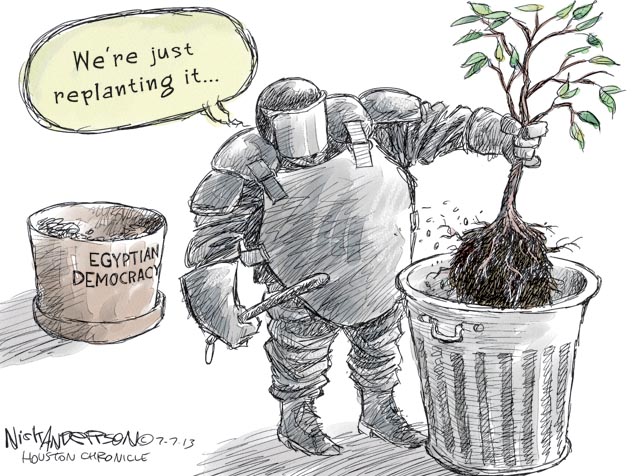
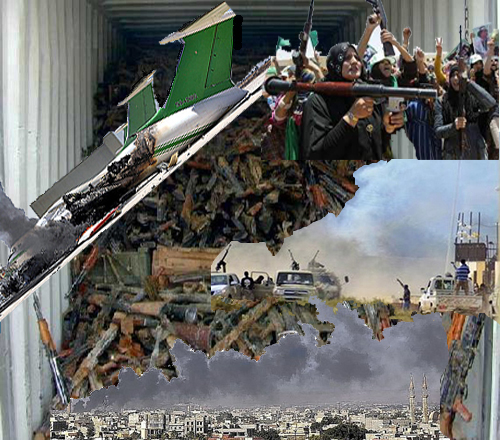
stockpileweaponsThe cocks have come to roost in Libya: yet another example of why instant democracy is a bad idea.

With all the rest of the troubles going on in the world Libya is being neglected if not ignored, and yet the fighting this week in Tripoli rivals almost anything that’s happening right now in Gaza, the Ukraine or Iraq.

The Tripoli airport is in shambles. The tower is down. About 20 commercial jetliners sit idle at wrecked gates or scattered among the tarmac.

“Foreign diplomats, workers flee Libyan chaos by thousands,” the Los Angeles Times reported this morning.

The Philippines is among the dozens of countries evacuating its nationals. This will mean that Libya’s hospitals will collapse.

Thousands of Libyans themselves are also fleeing. Tunisian soldiers killed two trying to stop the crowds surging across the border.

The Washington Post tried to sort out the combatants yesterday and decided that militants, previously from the city of Misrata, are coming out on top. They’ve almost taken over the Tripoli airport.

And it’s not the national Libyan army that’s stopping them. The army has disbanded and many of its highly skilled soldiers – trained by the U.S. and allies – have fled to their respective militias… with their modern weapons. Also supplied by the U.S. and its allies.

The Misratas haven’t taken over the Tripoli airport because several other militant groups led by the Zintanis are in the passenger terminal shooting back.

At the height of the Libyan revolution, Zintanis and Misrata militias fought side-by-side.

And in Benghazi, where the Libyan revolution began three years ago, guess who’s now in control? A former Gaddafi general.

“Towns fight towns; Islamists oppose nationalists; federalists rise up against central government; ex-Gaddafi units clash with former revolutionaries – and everyone has guns, artillery, tanks and missiles, taken from the vast arsenals the deposed dictator had stashed across the country,” Reuters reported yesterday.

After the fall of Gaddafi, western powers led by the U.K., France and Britain stepped in to quickly create democratic institutions. A democratically elected government, fully in place two years ago, was deemed freely and fairly constructed by outside western observers.

The problem is that each individual faction thinks that democracy will immediately get them what they want. The Zintanis, coming from remote Berber mountain villages, felt Gaddafi stole their oil and gave them nothing in return.

The Misratas, more developed and mercantile, fear any kind of religious law and believe their taxes are too high.

Neither grievance has been addressed by the weak existing government, in large part because it has never been able to enforce anything. Too many people have too many weapons.

“Hampered by hypocritical ‘no boots on the grounds’ orders, Western military advisers could do little as Gaddafi’s vast arms stocks were pillaged by all comers,” explains London’s Telegraph’s Mideast correspondent.

Stepping beyond journalism, Richard Spencer then reminded British readers that “I … tried to alert the authorities… to the presence of 100,000 landmines, boxes of Semtex, anti-tank and anti-aircraft missiles lying unguarded in a field and adjacent warehouses in south Tripoli. Nothing was done, and within days they had been pilfered.”

As a columnist for Gulf News Spencer was more explicit:

“The same powers [that topped Gaddafi] seem to have turned a blind eye to a nation whose current sorry state is partly a result of their own faulty policies.”

Which faulty policies? Any of a million that contribute to the toppling of an authoritarian regime replaced by democracy.

I admire the New York Times this morning for warning western countries against abandoning Libya, but the Times analysis is simplistic. This isn’t just a battle between Islamists and non-Islamists: it’s much more complicated than that.

You can’t turn democracy on like a light bulb above the sink. It takes years, often generations to evolve. It’s both the reason that Russia is sliding back into authoritarianism and China is inching towards real democracy. Both of these dramas will likely continue long after I’m gone.

It was the height of absurdity to think that the arsenal of destruction Gaddafi had amassed could be managed by a fledgling democracy. That was the first mistake.

Democracy often works badly. Take our own current state of affairs, although we’ve dealt with ups and downs for so many years I’m hopeful we’ll finally creep out of the irresponsible governing abyss we now found ourselves.

But we demonstrate a certain immaturity if we think that the “help” we gave the Arab Spring revolutionaries would result in anything other than the bloodshed currently playing out. That was the second mistake.

You can’t liberate the oppressed with democracy. It never fills a void. It must be built carefully and that takes a lot more time than American and British election cycles.

On Safari: America from Afear

On Safari: America from Afear

whichismoreexplosiveI and Kenyans woke this morning to the news of a bloody terrorist attack near Lamu. But what worries us even even more is that the U.S. might restart the Iraqi war.

CNN’s “State of the Union” is the most widely watched American show in Kenya. It comes on live at Sunday dinner time.

So Kenyans who woke the next morning to actual terrorism watched with even greater horror as Sen. Lindsay Graham called for a virtual reverse jihad.

The U.S. Right spent Sunday warning of a “califate” that would be a super threat to the U.S., an ISIS that would rebomb the World Trade Center.

This is utter nonsense. Don’t take the bait, America. What is going on in Iraq is a civil war, not global jihad.

Nairobi’s leading newspaper in its leading editorial this morning claimed the resurgence of war in Iraq “serves as graphic testimony that Western military adventurism in the region not only failed to extinguish the flames of extremism, but might have added fuel to the fire.”

“Stepping into the bloodbath of Iraq would be madness,” was the headline in one of London’s leading Sunday newspapers.

Why are we more afraid of terrorism than driving over a bridge ready to collapse or dying of cancer?

As I wind up my three-day visit to Nairobi I realize how horribly warped American paranoia of terrorism is and yet how impossible it seems to remedy.

Terrorism is increasing. The Rand Corporation’s most recent report shows a 58% increase in significant jihadist groups, a doubling of fighters and a tripling of attacks.

Obama’s own government report, The Country Reports on Terrorism submitted to Congress on April 30 claims terrorist attacks increased by nearly 50% from 6,700 to 9,700 from 2012 to 2013, resulting in 18,000 murders and 33,000 serious injuries.

There’s no reason to doubt these numbers. And here are some more:

The number of homicides in the U.S. averages between 13 and 15,000/year, or roughly 80% the number of worldwide terrorist killings. The number of highway fatalities in the U.S. annually is nearly twice the fatalities caused by worldwide terrorism. The numbers of U.S. homicides or highway fatalities in relation to U.S. fatalities caused by terrorism doesn’t exist, because since the Boston Marathon bomber, there haven’t been any.

What are we afraid of? Or more specifically, why do we fear terrorism more than the highway or the gunman in the classroom?

Kenya has had an unfair share of terrorism fatalities, injuries and damaged economies, because it has been targeted by terrorist groups for its proxy war against al-Shabaab in Somalia, a war that it would not have chosen to do, nor been capable of doing, without serious pressure and military assistance from the west, primarily the U.S. and France.

So as Kenya’s rate of terrorist harm has increased dramatically in just the last few years, France’s and the U.S.’ has declined.

Yet there is a palpabale fear in the U.S. that this is not the case. That fear is the success of terrorism, making its victims’ communities feel threatened out of proportion to the facts.

Imagine if the trillion plus dollars spent on the wars of retribution and against terrorism in Iraq and Afghanistan had been directed instead to America’s leading cause of death, cancer and heart disease, both which average 25 times greater than the worldwide deaths from terrorism.

With that amount of money might we have already achieved a robot car whose driver, even if drunk, would be unable to cause an accident thereby reducing American fatalities, currently 2-3 times worldwide fatalities caused by terrorism?

Clearly it’s not the deaths that bother us. So it’s not the threat of fatalities that must bother us, it’s the challenge to our power. A relatively few deaths caused by terrorism create a proportionately greater fear and insecurity.

DUIs, suicides, cancer, school shootings … we’ve learned to live with and do not seem to threaten our way of life. We must learn to live with terrorism in the same way. As an actual threat, it’s actually much, much less.

Kenyans know this. The country is booming (except for tourism). Everything from Google to IBM to Caterpillar to GM is investing heavily here. The energy of its youth, the rapidly increasing level of education and the imaginative ways difficult problems are being solved is becoming a model for the world.

But the beautiful white sand beaches, among the finest in the world, and in the incomparable wilderness and big game are being abandoned by world travelers.

There has not been a tourist assault death here in more than two years, nor an injury; nor have any foreign investors been bumped off or maimed.

Those are pretty good numbers for any business person. But as explained above, numbers mean little when it comes to scaring people. Terrorism, the wanton killing for ideological reasons, scares people more than potholes on I-80.

So as irrational as it may be that you will choose to visit New York instead of Nairobi, where any way you run the numbers your chances of being killed or hurt are much greater, you’ll feel better doing it.

And that’s why terrorism is so successful. And that’s why it’s more important than ever that we start to educate ourselves to the priorities of need we truly have.

Before terrorism wins against us all.

New Ways for Africa

New Ways for Africa

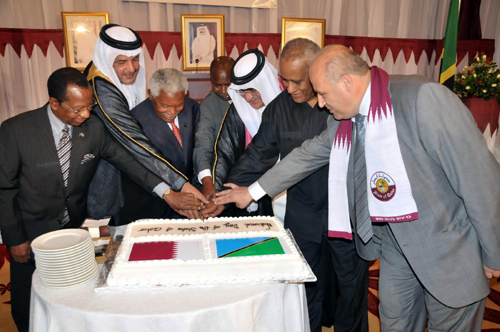
qatarIf you’re planning a trip to Africa, you might be surprised to discover the way you’ll get there is not through London or Amsterdam, but Doha.

China and Europe are retreating from a long period of heavy investment in Africa, and it seems that Middle Eastern countries are racing to fill the gap.

The global economic climate does not bode well right now for Africa. Even though America seems to be doing alright, almost every other part of the world is teetering on the brink of another recession.

Europe’s growth is stagnating and a crisis of the sort occurring in the Ukraine could send it further downhill.

China’s economy is slowing Chinese investment is retreating from the African continent.

Since China has been Africa’s principal investor for more than a decade, this means Africa will suffer terribly, especially South Africa. At the same time it means that opportunities in a wide variety of industries become available for new players, and that right now seems to be the oil-rich MidEast countries.

In my own industry the most obvious indication is air travel. Although airlines are thought principally as people movers, much of their revenue comes from cargo. The two are inextricably linked in any good business plan.

Recently, the longest supporter of East Africa transport to Europe, KLM, announced a serious cutback in its service to Kilimanjaro airport in northern Tanzania.

While this may indeed reflect a decline in passenger traffic, it also reflects a decline in the cut flower market in Holland as the KLM jumbos transport enormous amounts of cut flowers to Europe.

British Airways has also announced cutbacks into Africa.

Taking up the slack has been Turkish and Qatar Airlines. Both airlines are doing well and expanding rapidly and much of the expansion is into Africa.

With the airline comes business and the MidEast is not suffering a recession. Africa has its whole modern history relied on foreign investment and its cultures have often moved with those who invest most heavily.

Are we poised to see a whole new and large Africa/MidEast alliance?

Jim filed this post from Arusha, Tanzania.

Dancing with The Devil

Dancing with The Devil

Little Kadogo by Cheri SambaThe U.S.’ complete disengagement from Uganda would seriously jeopardize its already faltering economy, ostensibly but not completely truthfully because we disapprove of the country’s new anti-gay laws.

Together with a variety of European countries that have already suspended aid, the expected U.S. cutoff would reduce the country’s GDP by more than the 2.7% languishing growth it’s currently struggling to achieve.

That will topple the country into recession.

Like Zimbabwe years ago Uganda would become dependent upon its neighbors. Zimbabwe has floated above complete annihilation for nearly two decades because of South African assistance.

Uganda’s neighbor Rwanda is the area’s economic powerhouse. Allied almost exclusively because of tribal reasons, I see Uganda becoming Rwanda’s client state.

Disengaging from Uganda now serves a lot more interests to the United States than just the aggressively stated ones by Secretary of State Kerry regarding human rights.

The U.S. had become somewhat mired in Uganda, starting with Bill Clinton’s forced love affair with the country in the 1990s as a manifestation of his mea culpa with regards to not acting to stop the Rwandan genocide of 1994.

Disproportionately large amounts of aid flowed into Uganda from Clinton’s U.S. Particularly in a country as poorly prepared for business as Uganda, that aid developed a dependency that has been hard to end.

Bush and company nefariously increased U.S. involvement by helping Uganda enact the very law that Museveni signed this week! Bush officials and many more subterranean lobbyists actually lived in Uganda for quite a while ostensibly teaching it “to become democratic.”

The main Ugandan leader of the bill in the legislature was trained by right-wing legislators in the U.S.

All of these cross favors anted up the aid.

Obama could have pulled back, but didn’t. Instead, he used Uganda as the portal to continue the interior chase of terrorists scattered from Somalia’s cleansing. Ugandans cheered the 90 special forces that landed near the capital and marched across the country on Uganda TV, chasing the terrorist Joseph Kony.

That cost a lot.

I ally myself with Norway. The unequivocal ending of its $8 million dollar in aid is a drop in the bucket compared to the U.S., but its morality goes unchallenged:

“Norway deeply regrets that Uganda’s president today signed a new and stricter law against homosexuality,” Norway’s foreign minister, Børge Brende, said Monday. “It will worsen the situation of an already vulnerable group, and criminalize individuals and organizations working for the rights of sexual minorities.”

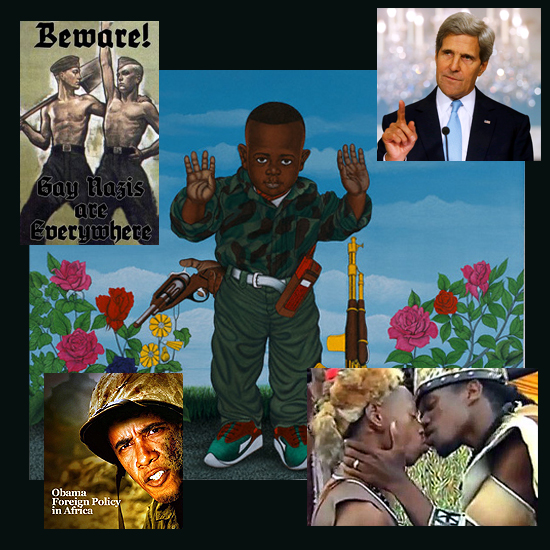
In contrast, Kerry’s statement comparing Uganda to Nazi Germany has so much anger in it that you know there’s more to it.

And that’s a simple deduction: we want to pull back from mistakes of the past. Clinton’s mistake in Rwanda was compounded by throwing unaccountable aid to Uganda in restitution: that was wrong.

Bush’s involvement in helping Uganda to achieve this anti-gay rights legislation is the wrongest of the wrong.

And Obama’s militarism of Africa is the third wrong. Now that all these missions are accomplished, in typical American fashion, we now disown them.

When we do we’ll be on a more correct path. But it was a moral compromise at many of the junctures that got us to this point, and if you subscribe to Kerry characterizing Uganda as Nazi Germany, then you better characterize America up until now as a House of Chamberlain.

Last Hope for Africans : Israel

Last Hope for Africans : Israel

refugees fleeing to israelThe cancerous conservatism and nationalism pumping through the developed world is slamming African refugees hard. Israel may be their last hope.

The Swiss example this weekend is only the latest example. Despite heroic European political leaders trying to open the welcome gates to the new flood of refugees, the electorates are shouting back: get rid of the colored!

The best microcosm of this global phenomenon is in Israel. Few countries implement the necessary safeguards and support for refugees as are enshrined in the Israeli constitution.

Giant caveat: Palestinians aren’t considered refugees – however they end up in Israel – and that remarkable hypocrisy if not hyperbole shows how schizophrenic the Jewish state is.

But excise that bit of nonsense and Israel’s constitution and constant judicial reaffirmation of it guarantee that a refugee who arrives and is not a Palestinian will be cared for. At least until now.

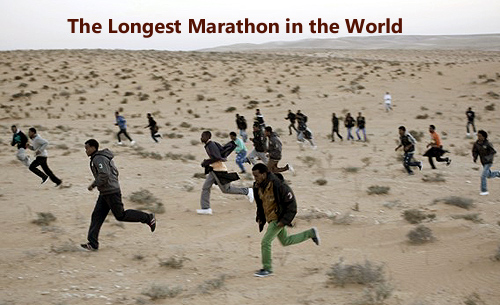
Between 50-60,000 African refugees currently reside in Israel as “illegals” but with considerable state support. Treated much better, for example, than they would be in refugee camps operated by the United Nations, they are given housing, living allowances and schooling.

The majority of these non-Palestinian Africans are smuggled in from Egypt where the potential fugitive from home pays as much if not more than Latinos coming into Arizona and Texas from Mexico.

According to the New York Times, 90 percent of these come from Eritrea or The Sudan.

Except for Syria, whose refugees can much more easily go to Turkey or another closer European country, The Sudan has produced more refugees annually than any other country in the world and for a long time.

Israel’s very active if under-the-table involvement in The Sudan for the last 30 years has likely caused many of the nationals to flee. Many of the weapons in Sudan’s multiple and bloody civil wars have been supplied by Israel.

As one analyst put it, “the chickens are coming home to roost.”

Be that as it may, for the first decade of this century African immigrants coming from The Sudan and Eritrea, Libya and even Egypt have been not only cared for but actually welcomed by most Israelis. The growing conflict with the Palestinians shrunk Israel’s manual labor work force. As in America, these persons of color were needed for menial jobs.

But the wave of anti-immigration flowing across Europe has moved south into Israel. Twice in the last year alone, the Israeli Supreme Court has had to strike down the Knesset’s moves to restrict refugee assistance.

The latest move by Israel is to erect refugee camps modeled after those commonly operated by the UN throughut the rest of the world.

Located in the Negev desert – atypically removed from the populace of the country which is technically the host – refugees are contained in fenced encampments.

This is very different from Israel’s past policy of open house and social integration.

Struck down once by the Israeli Supreme Court, the country has moved to lower the height of the fences and add a few services, and is trying to build the camp, again.

Other methods being used include paying refugees handsomely to return home, but that’s finding an obstacle in the market dynamics. You have to pay a Sudanese an awful lot to return to Darfur.

“The Israelis do not want to forcibly deport the “infiltrators,” as they are called here,” the Washington Post wrote recently, but “Nor do they want them to stay.”

Deportation which would be used by most other countries in this situation of growing citizen complaints is usually not an option for Israel. The countries to which deportation applies – the home country – won’t take anything from Israel, least of all citizens it refers to as spies and traitors.

In this nether-nether world between wanting to get rid of a growing number of “infiltrators” before right-wing Israelis start vigilante action, and upholding their idealistic constitution, and possibly wearing the guilt on their sleeves that they are responsible for the situation in the first place … Israelis are in one of the most difficult quandaries of their existence.

This has given a period of freedom to the refugees who are starting very public and near disruptive protest rallies in Tel Aviv and Jerusalem.

It shouldn’t seem the least bit counter-intuitive that the world’s growing backlash against refugees is played out most succinctly in Israel. Israel is, in a very real sense, a nation of refugees.

So if Israel turns away from its own fundamental principles, the African refugee in particular is pretty much doomed.

Gates Gets Gross

Gates Gets Gross

gatesinafricaBill Gates is a very nice man captured in the last century, and his remarkable generosity grossly misses the mark.

The Melinda & Bill Gates Foundation just released Bill Gates’ “annual letter.” The Foundation continues to seek solutions to two of Africa’s crises, malaria and poverty.

The two, of course, are interconnected. Throughout the world the level of malaria infection is inversely proportional to personal income. I don’t think, though, that this fact drove the Gates Foundation’s mission development.

Gates and most of the world charities tackle problems as crises to the exclusion of remedying the fundamentals.

Don’t get me wrong. It isn’t as if these generous folks make crises out of situations in order to be good philanthropists. Malaria on an individual level is a distinct crisis. Hunger caused by extreme poverty has an immediate simple remedy when dealt with as a crisis: dinner.

But the problem with Gates and most of the world’s charities is that despite how rich they may be, they aren’t rich enough to tackle the fundamentals, and so they default to actions that deal with incidental crises.

Malaria is the perfect example.

Malaria was eradicated from most of the developing world without drugs or bednets. My own Chicago’s Fullerton marsh was a cesspool of malaria right until the great fire of the 1860s.

After the fire and a growing awareness that government had to step up, malaria was systematically eradicated from Chicago by an exponential increase in public expenditures that started with increased urban hygiene (better sewers and drainage) and radical use of crude oil to suffocate marshes.

Even at that time suffocating marshes was an ecological controversy, but the power of the public domain was much greater then than now. The majority ruled.

By the early 20th century, there was no malaria in Chicago. An early NIH study of the eradication found a number of additional socially progressive policies kept malaria from returning to large urban areas like Chicago, such as banning child labor.

By the 1930s malaria in the U.S. was confined to 13 poor, southeastern states that did not have the tax base to successfully eradicate the disease. So government came to the rescue.

The 1947 National Malaria Eradication campaign moved money from the rich industrialized northeast to eradicate malaria in the south, and was successful in doing so in less than a decade.

I suspect similar stories exist throughout the developed world. And the solutions employed then would work today in Kenya or Indonesia. But destruction of the environment (oiling marshes and later, using DDT) is no longer considered a tit-for-tat that might balance in the long run, and modernizing Nairobi’s sewage system is too expensive for even the Gates Foundation.

That example is a bit oversimplified, since in fact the Gates Foundation probably does have both the capital and wherewithal to modernize (at least once) the Nairobi sewage system. What I really mean, of course, is to effect a modernization and cleanliness that like in late 19th century Chicago was achieved by modernization of a public service.

Today Nairobi is exponentially bigger than Chicago was in 1860, and Nairobi is affected physiologically by what happens in Mombasa, Addis, Kampala and Dar, so fixing Nairobi without simultaneously fixing those other great metropolises would be problematic with regards to eradicating malaria.

BUT (and this is a very big but) so is the world’s wealth exponentially bigger today than in 1860, and that’s the point.

Were the public interest as dominant today as it was in Chicago in 1860, Nairobi, Mombasa, Addis, Kampala and Dar would be free of malaria, because the rich world would have fixed their sewer systems… (and of course, a lot more).

What has changed in the last 150 years is a disproportional amount of wealth has become concentrated among a few afraid it will be taken from them. There are not enough people in that pool of the paranoid very wealthy for any truly democratic or benevolent change to take place.

That isn’t to say that a majority of rich people, among which I’m sure Bill Gates is one, are not generous and intelligent enough to ante up. In this year’s letter, Gates castigates Americans for their paltry $30 annually that the U.S. provides in world aid.

But the power brokers within that pool are not the Gates of the world. They’re the Koch’s of the world. And the Koch’s rule. So long as there are Koch’s there will not be more than $30 annually per American spent on world aid.

So what’s left?

Gates. Deal with a problem as a crisis and not a fundamental, and that’s precisely what’s happened with malaria.

In October the huge multinational pharmaceutical Glaxonsmithkline (GSK) announced it would market the world’s first malaria vaccine.

The vaccine is about 60% efficacious. Not bad but incapable of eradicating malaria. It took about 30 years and billions of dollars to develop this. The beneficiaries are not exclusively people saved from malaria. It will probably in equal measure make the rich, richer.

(Note this cynical observation: If there were a vaccine that could eradicate malaria, that could be a big downer for the investors who paid to develop the vaccine.)

When the world won’t step up, when your own government or township won’t tax enough to fix fundamental problems, we have no choice: Gates and GSK become our only hope and it’s a very momentary, transitory solution that’s provided: a stop-gap.

And the powerful in the pool of the wealthy then distort those efforts to suggest they are successful in terms that claim governments can’t be.

And the cycle of mythology is perpetuated. Gates recognizes this. His annual letter is built on a series of “myths.”

I prefer a Warren Buffet to a Bill Gates. Frankly, I don’t prefer either of them in theory. There should not be super rich.

But Buffet often focuses on the fundamentals. Gates is an engineer. Or as a brilliant Dutch satirist pointed out this week, Gates treats aid like he treats Microsoft: self-perpetuating and growing and never completely tackling the problem holistically.

See Ikenna’s video below:

Right On, Alabama!

Right On, Alabama!

Tom HanksSomali piracy is at its lowest level in years and Tom Hanks helps show us why.

The Oscar-nominated “Captain Phillips” starring Tom Hanks depicts in terrific detail the hijacking of a giant container ship as it traveled through Somali waters in 2009. The film which has already won a screen writers award is up for six Oscar nominations.

Anyone watching the film right from the beginning is going to scream out, “Why doesn’t the crew have guns!?”

Well, most crews do now have guns. The Alabama was hijacked in 2009 when few merchant vessels from any country in the world were allowed to be armed.

That stemmed from a centuries long policy of governments worried that large vessels were capable of coups. Later in history rogue merchant vessels tried avoiding naval inspections as Britain and the U.S. started to police the high seas for contraband.

More recently the government of Egypt banned any type of armed vessel in the Suez canal, where most of the ships in Somali waters originate.

But after large naval task forces organized by the U.S. and European union were unable to stem increasing piracy by 2010 many countries including the U.S. began allowing on-board security. The U.S. remains the most restrictive, but many U.S. flag carriers can now carry weapons or commercial security.

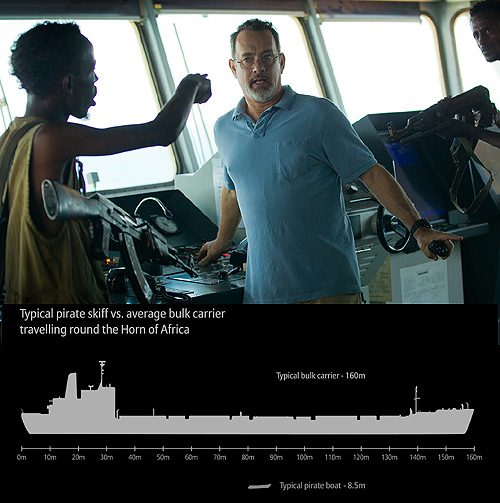
In 2009 giant ships like the Alabama were completely unarmed. The movie details how the captain and crew had to behave without weapons. It shows how tiny little speedboats with a handful of men carrying old Uzis or AK47s could take over a ship 3 times the length of a football field, bigger than five 747s.

As a composite of the 500 ship hijackings that year, I believe the movie does a fabulous job. It may not have been so honest with regards to Capt. Phillips and the Maersk Alabama.

In fact quite to the contrary, the crew of the Alabama is suing the real Captain Phillips and his employer, Maersk, for more than $50 million for malfeasance.

“It is galling for them to see Captain Phillips set up as a hero,” the plaintiffs’ lawyer told the Guardian last October. “It is just horrendous, and they’re angry.”

The crew contends that Capt. Phillips should have done exactly what the film depicts Capt. Phillips doing! If the crew is telling the truth, it’s almost as if Columbia pictures read the litigants’ charges and wrote the screenplay from the depositions!

Water hose defense, engine room retreat, wave action, intentional power failures … all procedures the suit against Maersk contends Capt. Phillips refused to do or bungled.

The film does give one clue to Capt. Phillips’ culpability. U.S. recommendations which Maersk had adopted included keeping ships at least 300 miles and preferably 600 miles from the Somali coast. In the film the ship is about 200 miles from the coast when hijacked.

Because the litigation is current, neither Maersk or Captain Phillips will comment. At least until the Oscars are awarded, neither will Sony or Hanks.

The screenplay also dug into the reality of why there is piracy in the first place. I wish it had been developed more elaborately, but kudus to the writers for bringing up the subject of how the Somalis had been raped of their fisheries by multinational fishing companies.

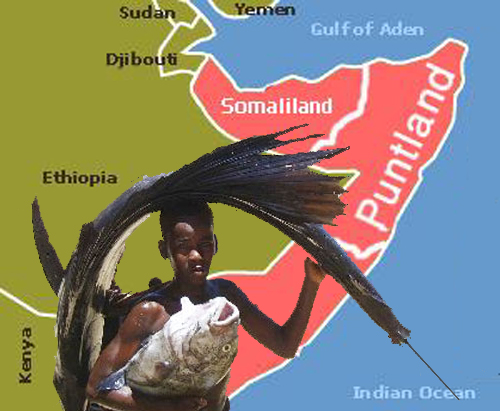
Most pirates were once fishermen, or more correctly, would be fishermen if their industry hadn’t been plundered by multinationals taking advantage of the implosion of the Somali state.

In the movie there is a poignant scene where Capt. Phillips (Tom Hanks) challenges the chief pirate:

“You’re no fisherman!” Hanks charges and then asks the pirate why with his language skills and obvious other capabilities he doesn’t do something more legitimate.

“Maybe in America,” the pirate answers. “Not in Somalia.”

In 2009 when the Alabama was hijacked, there were nearly 500 hijackings annually. Last year it was about half that.

Piracy is down because of actions as depicted in the film by heroic crew, because of massive operations by European and American navies (including as masterfully shown in the film an exciting operation by Navy Seals), and probably most of all because of the pacification of Somalia itself.

Go see the flick! Hollywood finally gets it right.

Dropping The Tuna

Dropping The Tuna

somalifishingI don’t like it but it’s good news. Should a private foundation in Somalia be doing what really should be the responsibility of the U.S. government?

Developing Somalia’s fishing industry is critical to sustaining peace in the region. Piracy was expertly developed as al-Shabaab’s principal source of revenue by enlisting former fishermen who had been systematically raped of their livelihoods mostly by western fishing companies.

Fishing had been Somalia’s main industry prior to the state failing in the 1990s. Numerous studies documented major western fishing companies, the majority from Italy and France, taking advantage of Somalia’s implosion to rape the seas of the Gulf of Aden.

With all the money and effort western powers have spent trying to oust the terrorists from Somalia, I can’t understand why they won’t rebuild its fishing infrastructure. Somehow, I guess, it’s just not militaristic enough.

So the job is being left to the private sector, which could be all well and good of course, but I fear without government to government involvement, here, a free-for-all is going to develop in these nutrient rich waters.

For several years now as the Somali war wound down, there have been reports of private companies violating fishing treaties and dumping toxic waste, in essence taking advantage of the lack of government (including multiple government, regional and UN) regulations.

The Oceans Beyond Piracy project brought together active western partners in Somalia at a Thursday conference in London which was striking for its positive outlook.

Led by a Danish NGO, Somali Fair Fishing, the conference wants to rebuild not only the infrastructure but the human capital of the Berbera port.

Berbera is Somaliland’s main port on the Gulf of Aden just before the Red Sea. Somaliland and Puntland are autonomous regions of Somalia that have been relatively peaceful for more than a decade.

Functioning as independent states, the two northern regions have seen realistic development over the last decade but been given little outside attention. World aid organizations, for example, are reluctant to promote what would become the fracturing of a former Somalia Republic.

New elections in Somaliland and new policy initiatives in Puntland announced this week, however, suggest that the two autonomous regions of Somaliland and Puntland are newly interested in reintegration.

It makes imminent sense for western powers and world aid organizations to go in full force to develop Somaliland’s Berbera. It’s wonderful what Oceans Beyond Piracy and other small NGOs are trying to do, but it’s just not enough.

There’s no point in developing a fishing industry if there’s no fish. Without reenforcement of existing world treaties about the Somali fishing harvests, and without worldwide enforcement to stop ships treating the Gulf of Aden as the world’s biggest public toilet, there won’t be any fish.

The foundation supporting the Oceans Beyond Piracy initiative is the One Earth Foundation of Colorado. The CEO, Marcel Arsenault, made his fortune anticipating the housing bust of 2008. As a new kid on the block of a growing number of private philanthropy organizations it doesn’t have a long enough track record for any critical appraisal.

But its mission looks good and I wish them success.

As always, though, I worry when private interests trump the responsibility of government institutions.

The Thursday conference attracted a number of giant players, like BP and Maersk. But these mega multinationals are not going to invest fully until western governments decide to invest as much in cranes and drones.

It’s an unending story of failed peace making. Nixon tried lamely to explain to a fatigued America that Vietnam could only be won by building factories, but it was an out of sync suggestion at the time it was made, way too late.

War is expensive. Fishing is much less expensive and far more productive.

Before we lose Somalia again, world powers should see what groups like One Earth and Fair Fishing are trying to do, and learn from them. USAid in Somalia should now be given as much support as AFRICOM.

Between Life & Death

Between Life & Death

bodyorgansforsaleTanzania has embraced a Wall Street Journal suggestion last week that a free market should be created to buy and sell human organs.

“It is none of our business,” Tanzania’s Minister for Health and Society Welfare said yesterday affirming the Tanzanian government’s position that it would not oppose such a market. He then confirmed that it’s perfectly legal for Tanzanians to sell their organs to the highest bidder.

The Journal’s Saturday essay argued that kidney transplants add more than 20 years of life to those in need, and that two kidneys aren’t necessary for a healthy life.

“How can paying for organs to increase their supply be more immoral than the injustice of the present system?” the journal asked.

The authors estimated that an open market for selling kidneys would result in an expected cost of $15,000 per kidney.

That’s approximately triple Tanzania’s average annual income.

In acknowledging the Journal article more quickly than the Tanzanian government normally acknowledges a health epidemic on its own soil, the Minister pointed out that there are already robust donor markets in Iran and India.

Two kidneys might not be necessary for a healthy life, but removal of any organ, even the redundant second kidney, is not without risks. Even if those risks are small the notion of literally selling part of yourself for cash belies desperation.

And in a “free market,” one that is truly global, there’s little doubt that the most desperate in the world would quickly become the suppliers. Suicide bombers and all sorts of other criminals are often little more than lives for sale. Reducing humanity to a commodity is the basest form of oppression.

The Journal article touched on alternatives that such countries as Denmark are employing, called “implied consent.” This presumes that everyone who dies naturally allows whatever viable organs remain to be taken and reused.

But such a policy if adopted worldwide would decimate the capitalist alternative suggested by the Journal. As shocking as it may sound, there are likely far fewer natural deaths that would result in viable organ donating worldwide, than there are living persons in the developing world willing to sell their organs.

Imagine if the going rate for a kidney in the U.S. was $150,000? That’s the equivalency with Tanzania’s economy. Imagine advertising this in Appalachia or Flint, Michigan. Imagine white buses with ambulance attendants and Brinks Trucks behind them.

There’s something terribly wrong with this scenario, whether it is in Flint, Michigan or Arusha, Tanzania.

Yet the Journal article is not ground-breaking. HBO Producer of the “Tales from the Organ Trade” and three-time Emmy winner, Simcha Jacobovici, is an aggressive advocate for allowing anyone to sell their organs for the highest price:

“For my part,” Jacobovici writes in the Times of Israel, “I am no longer a dispassionate reporter on the issue… Some suffering we cannot alleviate, but this suffering has a simple solution. While tens of thousands need kidneys, tens of thousands want to sell them. We each have two kidneys. We only need one.”

The fact of the matter is that voluntary organ selling has been occurring throughout Africa for a long time, widely reported from Kenya to Nigeria. But there has been little comment about it until now and virtually no criticism.

The Journal article has forced the topic out, giving advocates of live donor selling in the developing world significant credence to the position that there is nothing immoral to the practice.

It is an incredible dilemma. My first reaction is that there is nothing baser than turning humanity into a commodity. My second reaction is that authority over one’s own physical body is inalienable: how can we the rich tell them the poor not to sell themselves?

Religious doctrine is pretty consistent:

“The answer is a definitive ‘No.’ The selling of an organ violates the dignity of the human being,” according to the Catholic Church, and virtually all major religions argue similarly.

But religious doctrine in my opinion is largely responsible for the multitude of dilemmas Tanzanians currently find themselves in, today:

From the historical condoning of slavery in the pre-colonial era, to the submission to greater force in the colonial era, to the oppression of vicious dictators in the post-colonial era, religion has not been a very good guide for the development of Tanzania.

For many millions in the developing world selling an organ is the difference between life and death. Twice.

South Sudan like them all Crumbles

South Sudan like them all Crumbles

military-democracy1Add South Sudan, Central Africa and Libya to Iraq and Afghanistan and you have the most costly failure in human history to make undeveloped parts of the world in the image of its superpower.

“Most costly” is an understatement. None of us can begin to imagine the 20 years of military hardware costs, personnel deployment costs, global policy orientation costs … except perhaps Eisenhower’s impugned “military-industrial” complex.

And even if that impugned component could be economically conceived as contributing to America’s growth, how do you economically measure the human tragedies? It’s arrogant to simply refer to American military casualties, since the human toll is a hundred, perhaps a thousand times, perhaps ten thousand times American injuries and deaths.

Yesterday, Assistant Secretary of State Linda Thomas-Greenfield told a Senate Foreign Relations Committee that South Sudan was “in danger of shattering.”

None of America’s experiments in democracy abroad was as promising as the South Sudan. Unlike elsewhere in Africa and the Middle East, America’s contribution to its generational civil war was mostly limited to diplomatic involvement.

Which was true of the other side as well. We supported the rebels. Russia and China supported the mother country, Sudan. And when Russia dared to send more than a Mig or two, Clinton bombed a Khartoum factory and Russia agreed to toe the unspoken diplomatic line to not arm the factions in the war.

So the war went on and on and on, very much like Darfur continues in the western Sudan, today. Rather than planes from Russia and tanks from the U.S., guns and hand-held missiles came from arms dealers in Jamaica that had mastered the insecure arsenal of the downfall of the Soviet Union. That wasn’t good, but it kept the war at a lower grade.

The emergence of the new South Sudan nation was a joy to the world, and especially to America. Politicians and celebrities all took credit. Although landlocked, the country’s potential was uniquely good, because it sat on so much oil, because so much of its land was unpopulated and fertile, and because its long civil war had leaders ready to go.

What happened?

Two things. First, democracy. Second, tanks.

DEMOCRACY
It’s one thing to nuke Afghanistan because its leaders bombed the World Trade Center. It’s quite another to suppose you can remake that part of the world in your own image.

We are learning again and again that America’s form of government — indeed lifeways, altogether – doesn’t work in the undeveloped world.

There are dozens of fundamental reasons why. But consider just this: America itself has had constant and serious problems with implementing its own democracy literally from the getgo.

We’ve mastered democracy, perhaps. But from Congressional gridlock to politicians’ lies to the uncertainty in counting votes to the complexities of voting at all … these are complicated, intricate problems created, analyzed and remedied by very modern and often high tech solutions.

I can blithely mention the “unimagined cost” of our mistakes, but even the carefully imagined costs of mistakes in the South Sudan result in that country’s own immediate deaths and destructions.

In America our mistakes are often manifest far from our shores. Not in places like the South Sudan. There is a simple line from a politician’s corrupt actions to the deaths of thousands of his fellow countrymen.

Writing today in African Arguments, Andreas Hirblinger dissects what’s left of South Sudan’s constitution and government and shows that little is left but the authority of the current “democratically elected” president.

Democracy doesn’t work in undeveloped places. This is a lesson the entire era of the “Arab Spring” is finally teaching us.

TANKS
Give two thugs AK47s and you turn a brawl into a war.

So pleased with their creation of the new democratic state in Africa, the western world began pouring in funds without strings.

What did that money buy? Communication systems from IBM? How about urban development consulting from J.D. Powers? No? Almost all the money went to Halliburton and it wasn’t just for catering services on oil rigs.

Not long after George Clooney and Hillary Clinton attended the unveiling democracy in Juba, the U.S. and its allies wittingly or not began arming South Sudan to the teeth.

Surprise! Huge new fighting began with The North. The war was supposed to have been over.

We need worldwide gun control. And that, because it’s so dearly linked to manufacturing and concomitant economic growth, is the harder problem.

Imagine suggesting to a country dominated by such an entity as the NRA that the UN should enforce a ban on all weapon transfers. Yet that is exactly what’s needed.

Fights are organic parts of any social development. Words don’t kill. Fistfights rarely kill. Give a newly emerged nation whose population is still mostly illiterate and has lived for generations by subsistence agricultural an arsenal of modern weapons …. well, I think anyone can understand this argument.

But will we do anything about it?

Maybe. I think Gates’ memoir, statements by Thomas-Greenfield and actions by Kerry have many lines to read between. I think America may be learning this critical lesson about democracy.

No chance we’ll stop the military-industrial complex. Eisenhower was spot on.

#5 : Climate Change

#5 : Climate Change

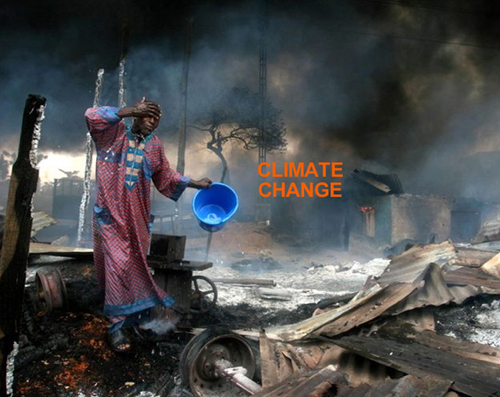
climatechange.13TOP5There are American politicians wallowing in our current deep freeze as evidence there’s no global warming, and there are African farmers planting three times annually who think everything’s just fine.

It isn’t.

Climate change in Africa is my #5 story for 2013 in Africa.

The incremental warming of earth neither stops great variations in weather or singularly increases what was bad before. Still, African farmers seem a lot less stupid than some American Senators.

One effect of incremental global warming is to make the equatorial regions wetter. The equatorial part of Africa is one of its principle food baskets. But it’s only been in this generation that agriculture has grown in any significant way from just a subsistence industry.

So there are fewer good farming techniques and poorer seeds, less mechanization and irrigation, significantly no crop insurance, and basically a farmer’s harvest is beholding to Mother Nature.

I spoke with several African farmers over the last several years in Kenya and Tanzania who know that planting maize or millet three times a year is ruining their soil, but with the added moisture now available, “subsistence” is trumping “sustainability.”

There’s another reason they do it unabashedly. The common effect of global warming around the earth is to make the extreme moments of weather even more extreme.

So when a drought comes to equatorial Africa, as it normally has done forever, it’s worse. In the past small harvests were common in common droughts. Today everything is lost completely.

One could say that global warming is winning the race against modernizing agricultural in equatorial Africa.

Cyclones and typhoons (“tropical depressions” and “hurricanes” in western hemisphere jargon) have always been very rare in equatorial Africa because the spread between very hot and very humid and very cool and dry required to create these phenomena just doesn’t exist.

Not only have they been on the increase, they’ve crawled right up the Red Sea! That’s almost like Hurricane Sandy winding her way down the St. Lawrence into the Great Lakes!

Last year these kinds of unusual winds and storms in Rwanda, Tanzania, Somali and Ethiopia produced enormous devastation.

Farms are destroyed, towns are washed away, whole communities are dissolved … literally. In Kenya and Tanzania, where tourism is still a very important part of the economy, rains so heavy that they were off the charts quite nearly destroyed Lake Manyara National Park.

Farmers are anxious for solutions, and some may be coming. The most talked about one is called “re-greening” which represents numerous small-scale initiatives for dealing with climate change.

But it’s uncertain any techniques can deal with the speed of things changing. There’s just not much you can do when the entrance to a national park is covered by a mud slide.

Victoria Falls is one of the greatest tourist attractions not just on the continent of Africa, but in the world. It has always cycled from low water to high water, but about the only effect was to create a season that was safe for white water rafting.

Now the low water cycles of the falls are so low that many travel professionals are advising against a trip to the falls from September through December, the normal low water period. And conversely as well, the high water which normally comes in March – May is sometimes to great that the mist is so intense you can’t see anything.

That essentially reduces tourism to the falls by a half year!

And this cycles right back from tourism to agriculture. With such a ridiculous variance in flow from the Zambezi River that produces the falls, there is now a serious battle between the countries in the area that want to dam it to better regulate their own needs.

African politicians rightly see global warming as the real war on earth, far more important than the War on Terror.

First, Africans didn’t cause this but they’re being made not to contribute to it, and this stifles traditional development.

The developed world will not invest in African countries to mine coal, for instance. But coal is abundant throughout Africa. But there’s plenty of investment for extracting oil, which can contribute just as much to global warming as coal, because the developed world still lusts for oil.

Second, extremes in weather increase social conflict. There’s a good case to be made that the whole problem in Somalia might never have happened if the area’s agriculture hadn’t been decimated by global warming (and if the country’s fisheries hadn’t been exploited by western powers).

Even on a much more local level, the stress caused by frequent droughts followed by frequent floods leads to considerable tensions. Increased Kenyan police action in the area of the country where the desert meets fertile ground has grown exponentially. This year the military was sent in to keep warring factions apart.

I wonder if a science fiction writer in the 18th or 19th centuries looking forward into today would paint what is simply typical news to us as apocalypse.

The world can no longer deny climate change, but Africa is the poor cousin that fears being sacrificed to save the lovely pumpkin farm in the Hamptons.

Them! Is Here Already!

Them! Is Here Already!

Them! is here already!What does an African country do when Bill Gates says eat it or starve?

Most Americans think that the growing concern over what foods are safe is something that only their privileged, developed world has to suffer, that it is somewhat esoteric and – provided, of course that you aren’t culinarily involved – restricted to … nuts. (Peanuts, that is.)

Well, it’s not. In fact the debate over GMO is reaching a crescendo in Africa where scientists, multinationals, governments and NGOs like the Gates Foundation are in a diabolical battle over GM corn.

It is, literally, a matter of life and death.

Mom might wipe her brow when planning a contemporary Thanksgiving dinner at home, today. She might have to source out a natural turkey farmer and find a grocery store that sells gluten-free pie crust. This is all a lot more work than Aunt Evelyn did when the centerpiece of our holiday dinner was a jello salad.

But in Africa the sweat is over whether some people will starve or not, and my take is that GM foods are not the answer. Bill Gates disagrees.

You’ll have to be patient if using the links I’ve incorporated, because everyone is being quite deceptive. No one wants you to hear them shouting. But the uproar is rising and it’s focusing on a single of many ongoing battles:

Monsanto is one of a couple multinationals that is profiting from the development and patenting of GM crop seed, particularly corn (“maize” as it’s called elsewhere). That story is in itself distressing, as farmers who use GM seed can no longer use their own crop seed. They must buy it year after year from Monsanto.

There are literally tens of thousands, perhaps now hundreds of thousands of GM plants and organisms, and Monsanto owns a hunk of them.

One version of maize for which Monsanto had its highest hopes, MON810, whose appropriate brand name of “YieldGard” is all but ignored in the current debate, is the center of the controversy.

MON810 yields a corn that is remarkably drought resistant. It’s widely used in the U.S. and understandably was imagined as drought-plagued Africa’s savior seed.

About a third of Europe’s countries ban MON810. The most recent science from Norway declared MON810 harmful to humans, pigs, mice and butterflies.

An important European Commission (EFSA) that approves or disapproves GM products was given the task of deciding for all of Europe if Norway’s science was valid. On what many argue was a technical fault, the commission approved MON810.

The EFSA decision allowed multinational agribusiness to sue countries like Norway, France, Germany and Poland to reverse these bans, and Monsanto is succeeding in doing so… sort of.

Europe’s political interface is not yet complete, and so recently France “rebanned” MON810 after “reallowing” it. Other nations are likely to follow suit.

I can’t possibly pass judgment on the science. I can’t even figure out how to decide which science is worth reading; it’s all over the place.

The main crusader against GM foods is Prof. Gilles-Eric Séralini whose arguments verge on the hysterical. But his science is widely used by opponents of MON810.

There are many very respected groups whose approach is more measured but forceful, like the “Occupy Monsanto” crowd.

The problem – and it becomes critical in Africa – is who to believe: crusading scientists, respectable citizen groups or government commissions. No one questions that MON810 produces a much higher yield. Africa really needs a lot of corn, fast.

But I take my lead from South Africa, the most rational and developed of African countries.

Shortly after MON810 came to market about 15 years ago, the South Africans banned it. But that didn’t last long, and many anti-GMO activists in South Africa claim their government’s reversal was as a result of U.S. trade pressure.

During its use in the last decade, South African farmers recognized a need for increased pesticides and fertilizers to keep the crop going. Yes, it needed less water and from a business standpoint with the yields it was producing, it was still a good business decision.

Activists argued that the reason MON810 requires more pesticide and fertilizer is because it produces super insects and bacteria.

Late this summer, MON810 created corn was withdrawn from the South African market. It was a combination of public outcry and government regulation.

Moreover, pressured by the South African government, Monsanto agreed to compensate farmers for their unusual pesticide and fertilizer costs needed to bring MON810 corn to harvest.

It’s not clear whether this ban will be sustained nor if alternative Monsanto GM seeds will not just be used, instead. But what is clear is that the leading African country has decided MON810 is bad.

So what now?

Immediately the battle shifted north to less developed countries like Tanzania and Kenya where the seed is still allowed. But it was anything but certain Monsanto would prevail there, either.

In steps charitable giving.

Monsanto, in its ever creative marketing plans, decides to give the Bill Gates foundation free use of MON810.

And it’s an NGO coup for a foundation deeply involved in helping Africa. The cost of MON810 could be absorbed by South Africans, not by Kenyans. Now, Kenyans get it for … free.

And true to form, Kenya is now in the midst of another Shakespearean government scandal in which a quasi government agency banned MON810 before the Gates Foundation announcement, then summarily reversed itself after the announcement and, of course … nobody can say why.

Of course Monsanto dare not publicize its generosity too directly, so it’s being done through a partnership program created by an African foundation that gets most of its money from Gates.

That’s sufficient enough distance to keep Gates out of the maelstrom.

At least for now. Until we think we see a Dreamliner above the Mara cornfields, when it’s actually a monster locust coming in for the kill.

Desert Dreams

Desert Dreams

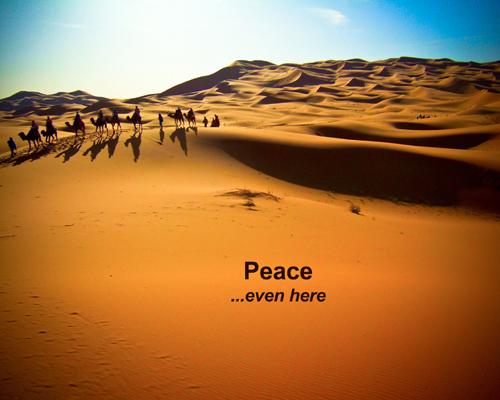
WestSaharaPeaceIn a war weary world, Iran is not the only place that conflict may be subsiding. In the sand blown desert country of the Western Sahara, Obama initiatives may be reducing decades of tension.

It’s hard to give all the credit to Hillary, Obama and Kerry, because I really believe the world is just getting tired of war. But chalk it up to being in the right place at the right time, the Obama administration’s foreign policy is winning a lot of peace.

The Western Sahara is a “non-self governing country” in Africa, a strange but apt name for a disputed and occupied territory whose last peace was brokered by the UN. It is mostly occupied by Morocco and claimed by Algeria, and from time to time, Mauritania as well. These are the three countries which border it.

There are fewer than a half million people who live in this mostly godforsaken land that is essentially little but Sahara Desert.

But in colonial times any piece of Africa that bordered the sea was important, and Western Sahara’s 700 miles of coast where Africa bulges out into the Atlantic were critical for safe passage of the early sea vessels.

Spain finally wrested control of the place from Portugal and administered it until 1977. It wanted to grant independence to this Colorado-size country earlier, but not even indigenous people were interested. Instead, Algeria and Morocco fought skirmishes over taking control.

I can’t understand why either Algeria or Morocco wanted control, but in the half century since their initial claims to Spain, the idea of incorporating the territory into their sovereign nations has become a kingpin of national pride.

Algeria and Morocco have been at each other’s throats for nearly that entire time. Algeria continues to struggle with popular, progressive if revolutionary movements that swing back and forth from military approval. Like Egypt, the military is all powerful in Algeria, and like Egypt, the tension between religious groups is intense.

Morocco, on the other hand, has been a placid monarchy for centuries. Conservative and very western leaning, there couldn’t be a different place from neighboring Algeria.

Spain was tired of administering the place, and forced a settlement in 1977 that resulted in an immediate fight between Morocco and Mauritania, that Morocco won two years later. Since then, Morocco has administered most of the territory, and Mauritania ceded all interest.

But over the decades since Morocco instituted control, a local population has become energized. The numerous little fights between countries and tribes have resulted in major refugee camps, all in Algeria, which are very left-leaning and pro-Algerian.

Basically this is a dustbin of Africa gripes and racism, swept into the desert where conflict has always had an upper limit of destruction.. There’s little there to destroy. But the world moves on, the internet reaches every sand dune, and the local population of now three generations of stateless persons is getting antsy.

The Polasario movement is the only legitimate political movement as a result, based from the refugee camps in Algeria and very anti-Moroccan. While they have had little success in any military action against Morocco, they have successfully rallied much of the world against Morocco’s dictatorial rule.

So it was extraordinary to say the least when the Moroccan King visited President Obama this week and sought assistance for his plan to transform the Western Sahara with massive development.

Whether it caught the other parties off guard or not, one by one the contentious parties started to fall in line. Basically, if America and its allies supply the dough, peace might break out.

The Obama Administration promptly said yes.

The Polasario seemed willing, too.

And together, the Moroccan King promised for the first time to consider autonomous government if only implied in the joint statement with the White House.

And by its deafening silence, Algeria will not object.

This may seem trivial. It is, in the greater context of world conflict. Some analysts suggest the Obama administration’s real interest isn’t so much with Western Sahara, but with getting the until now hostile neighbors of Algeria and Morocco to be civil to one another.

Simply opening the border between them could facilitate enormous international investment, for example.

That might be true. But I think equally true is an indication that a war weary world penetrates even the smallest political quarters on earth, and that for the first time in generations, peace seems to be the default, not war.

Getting to the Bottom of It

Getting to the Bottom of It

getting to the bottom of itWhile the battle against corruption in Africa is mostly going well, it’s hit a brick wall in Tanzania. Yesterday, most of the aid-giving free world (less the U.S.) chided Tanzania for dragging its feet.

The donor group, calling itself the “General Budget Support” (GBS) Group, gives Tanzania approximately a half billion dollars annually as direct cash into its general budget fund, about 10% of the country’s projected national budget.

The U.S. in comparison plans to give Tanzania this year approximately $1.15 billion.

The difference with USAid is that it doesn’t flow without conditions into the country’s general fund as is the case with the GBS, but towards specific projects and programs, many of which are outside the Tanzanian government’s budget programs.

Specificity in aid is a hallmark of U.S. assistance, and a controversial one. It’s not only a hallmark of USAid, but of Tanzania’s other principal donor, China.

By specifying what the money is supposed to be used for, the vendors receiving the funds are often U.S. and Chinese companies.

And the U.S. usually does a pretty good job; China often doesn’t.

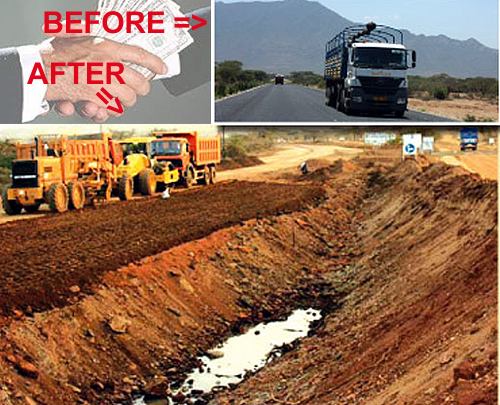
It’s been less than a year since China finished the Namanga/Arusha/Dodoma road, and it’s collapsing already.

I’ve traveled that road multiple times annually since 1973. It’s rare to be in very good shape, but the best period was from about 2000 to 2008, a legacy of Japanese aid and workmanship.

But no road lasts forever, and even less so when a country is developing and its trucks and commerce are growing.

So we were all extremely excited last year, despite the delays of construction, that this “new road” would bring new speed to the country’s prosperity.

Junk aid is the controversy that surrounds specificity of aid, which is the practice of the Chinese and Americans. Many European countries that have developed real expertise in aid to the developing world, like the Netherlands and Norway, prefer to work through world bodies like the World Bank, or directly with country authorities as is the case with the GBS.

So while it may seem counter-intuitive that giving unspecified aid battles corruption, that’s exactly what this does, as evidenced yesterday by the sweeping indignation of the GBS and its threats to hold back some of what is being pledged.

It’s the same policy that the European Union applied to Greece, Italy, Spain and Portugal. There was no specificity to the cash, other than you better get your house in order.

That’s what the GBS is doing in Tanzania, and from my point of view, it has a lot more effect than America and China’s grandiose claims that their aid avoids causing corruption.

An enormous percentage of USAid, for example goes to a handful of corporations, like Halliburton. (The exact percentages take institutions to figure out, and clearly are being intentionally made difficult to determine.)

Just as in Tanzania the Chinese road corporation, China Geo Engineering, received the funds to rebuild the Namanga/Arusha/Dodoma road.

These mega corporations then pay themselves and their country cronies for such things as equipment, and often for expertise and management as well. The Chinese actually are far more guilty of this than the Americans. It is hard to find a Chinese project with any locals above basic laborer.

That isn’t to say it doesn’t help the local economy, but advocates of the GBS form of aid argue it leads to much greater corruption.

And the corruption begins at home. Halliburton, like China Geo Engineering, is rife with nepotism, cronyism and just simple outright graft. Removed from many of the accounting restraints that would attend them for projects within their home country, they are essentially set free to work as they wish.

Bribing is par for the course.

And whether a Chinese or American capitalist monster, the bottom line is what counts. And that doesn’t seem to be effected by where the bottom of the road goes.

Secure that Terrorist

Secure that Terrorist

terrorwarNigerians are fiercely divided on whether America’s decision Wednesday to label Boko Haram a terrorist organization is good or bad, but one thing is clear: they don’t like America turning Africa into the principle field in the War Against Terror.

The arcane political moment when the U.S. State Department labels this or that organization a “terrorist organization” doesn’t attract much notice in the U.S., but it should.

The “Foreign Terrorist Organization” (FTO) amendment to the country’s standing immigration law gives the President and State Department wide powers of interdicting U.S. citizens from virtually any type of engagement with an organization so labeled.

Ohio University African political professor, Brandon Kendhammer, sent a letter to Hillary Clinton in May, 2012, signed by twenty other prominent academicians in the U.S. as well as the Council on Foreign Relations, urging Clinton not to designate Boko Haram an FTO:

The professors explained that the law is so sweeping that it would even keep them from contacting certain organizations and individuals in Nigeria essential to their research.

“Now it’s going to be very hard to contact … or even to just work with communities where members [of these designated FTO organizations] might be present,” the letter complained.

What is normally reported on CNN is the top of the law, that financial holdings in the U.S. linked to an FTO organization are frozen and that specific individuals named as leaders are banned from travel in the U.S.

But like so many of America’s terrorist and spy laws, today, FTO goes much further and gets increasingly sinister. Prof. Kendhammer can no longer even send an email to fellow Nigerian academicians, for example, who might be listed in a deep appendix at the State Department as having “connections” with Boko Haram.

The analysts who make these designations are not academicians, themselves, and might designate an individual doing a Ph.D thesis, for example, “connected with” Boko Haram.

It’s unbridled powers like these which are so chilling. They are powers, like those currently being debated around the NSA controversies, which technically cannot be applied within the U.S. or sometimes as well, U.S. citizens abroad.

Nigerian officialdom mostly welcomed the U.S. move, Wednesday. But the Nigerian public is more conflicted. African governments usually approve, because it usually means getting a lot more guns.

But yesterday a group of Nigerian journalists filing a combined opinion in the Leadership newspaper reminded us that only last year, Nigeria’s ambassador to the U.S. urged the state department not to issue the designation.

There is the obvious disincentive to future foreign investment on the national level, but on the individual level the additional scrutiny that will now befall Nigerians traveling in the United States is a terribly daunting prospect to them.

That would seem petty in the scheme of a War Against Terror if the War Against Terror were not so duplicitous and extra-American. By that I mean almost all the great rules and morals that make America great which are supposed to be preserved by a War Against Terror are blown to smithereens by the way America has been conducting this war in Africa and by the powerful use of the FTO law.

Last month Navy Seals or some such Batmanned into Benghazi and jumped out with Abu Anas al-Liby. He has now been charged in New York with masterminding the attack on the U.S. embassy in Nairobi in 1998.

The crack kidnapping would be illegal in the U.S., as by the way it is in Libya. The week-long interrogation which followed by a U.S. ship at sea violates many worldwide war conventions. But, hey, he’s a bad guy.

Or is he? This was not the first time al-Liby was arrested.

One time was in 1999 by British intelligence. But then with American prompting he was released and likely put on the pay of the CIA to assassinate Gaddafi.

This and other similar intrigues, including of course the training of Osama bin Laden by the CIA to fight the Russians, were listed yesterday by Syracuse professor Horace Campbell and other experts to demonstrate that “means justify the ends” in America’s war on terror.

And right now, the means is all in Africa. And it “means” that African don’t know what it means, because it could change.

It’s nice to think that Obama’s steadfast and incredibly militaristic assault on known terrorists that are now being, literally, rounded up in Africa might be making us safer here at home. And that’s Africa’s problem. It’s making us safer by making them less safe.

Terrorism can’t be blown out. It can be contained, and that’s precisely what Obama is doing, and whether by design or happenstance the containment has become Africa. And you can imagine what that means to Africans.

Containment in the War Against Terror has no limits. Bush and Cheney thought torture was OK, so we tortured. Obama thinks snatching al-Liby is OK, so we snatch al-Liby: all the human rights laws and freedom safeguards of great America mean nothing.

Play bin Laden or al-Liby for however you can, but to your advantage. Leftover armaments can be thrown into a Nairobi mall. Start a little war over in Somalia with your Kenyan proxy, ignore the Ugandan dictator’s threat to execute gays so that your Navy Seals can chase a mean guy into the CAR.

Do whatever you want. There are no rules. Means justify the ends.

That’s the essence of the FTO.

Terrorism can’t be blown out. It can be contained and it can minimized by addressing the desperation of the peoples it appeals to so that it loses support. Those are the only two remedies, and only one of them is right.