Oiling The Works

Oiling The Works

MondayinLusakaZambia, copper giant and Zambezi River namesake, is fraying at the seams, torn by a global recession manipulated by Sandia Arabia and an educated society intoxicated by democracy.

What’s happening in Zambia today is a preview of the trouble hanging over much of developing Africa, and Zambia is in the focus just unluckily because of the unexpected death of its leader.

At 77, popular Michael Sata was right around the age of many African leaders and his health was OK. His death in October came as a surprise.

If Sata had died a year earlier before copper prices had tumbled and oil began to decline and the Eurozone started to fray, again, I doubt anything unusual would have happened. The country was doing well.

But Sata didn’t die a year earlier, he died in the early preview to a new global recession caused by the forced decline in oil prices, which has triggered a decline in commodity prices of all sorts including copper, Zambia’s one and only and very important resource.

I wrote earlier about the peculiar transition of power to a transitional government Sata’s death abroad caused: A white man, Guy Scott, became acting president but was barred from becoming president even as he oversaw the process for new elections.

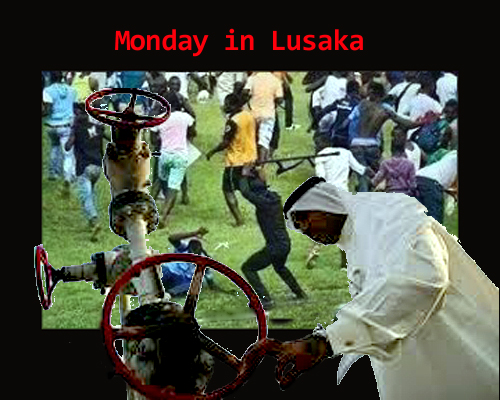
Immediately fissures began in all political alliances, and yesterday violence peaked with car bombings and sporadic gun fire in the capital. Read the comments to the brief article to see how high tensions are.

This would not have happened a year ago. Yesterday alone copper prices tumbled and are now almost 10% below a year ago. The Canadian stock market sank miserably, because of copper.

“Copper [has] an uncanny ability to predict turning points in the global economy,” a Dubai asset manager wrote recently.

It isn’t that the people exploding cars or throwing rocks or issuing threats in Zambia understand the economics of global commodities, just as the new disaffection with Nairobi university students doesn’t mean every single one of them understands the mechanisms that provoked Chinese companies to stop drilling for oil in Kenya.

But everything is so intricately linked, that disaffection spreads like a virus. In Africa’s small if previously vibrant economies, a wrinkle in future outlook is a tsunami of potential misery.

President Zata died unexpectedly as the storm clouds that were gathering began to rumble. The event alone was socially disruptive to be sure, but in normal times it would not have led to the violence in the streets of Lusaka currently seen.

Zambia is one of sub-Saharan Africa’s better educated countries, and though it’s struggled with an above average amount of corruption, it should have been able to make the current power transition pretty easily.

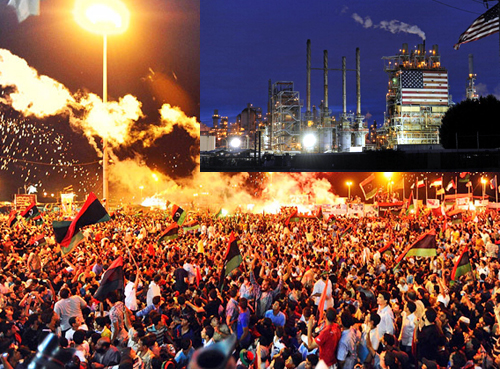
But Sandia Arabia opened the spigots. We’re told the reason is to force America out of the top spot in world oil production. The ramifications are startling and severe.

Combined with an untimely power transition in developing Africa, it creates a maelstrom of discontent and unease.

The Zambian election process begins in earnest in a week. As copper is a barometer of the global economy, what happens in Zambia next week will foreshadow much of Africa for next year.
Africans Praise Cuban Initiative

Africans Praise Cuban Initiative

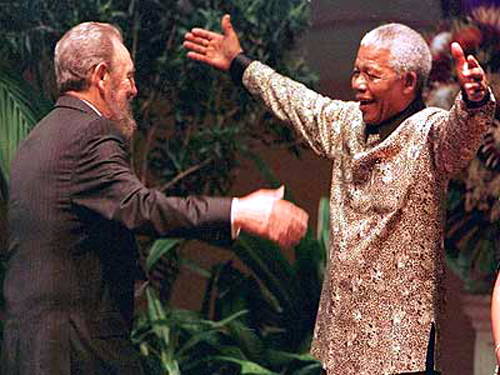
cubafidelmandelaSouth Africans echoed most of the continent yesterday in praising Obama for normalizing relations with Cuba.

In my lifetime Cuba has been active in Africa and seems to have chosen the right sides to support. The current Tanzanian regime, the current South African and Angola regimes, were all receiving aid and support from Cuba when they were considered outcasts by much of the rest of the world.

It was no surprise, then, that the current South African government issued a very positive statement of support for the Obama initiative.

Cuba sent cash, arranged and sometimes housed African revolutionaries and after most independent movements were over, hugely supported public health initiatives.

It seems odd now to hear our own press and officials speak of how small and poor Cuba is. I don’t doubt it. It’s just that few “small and poor” governments figure prominently in aiding and assisting other (possibly even smaller) poor governments.

Cuba’s medical reputation is considered stellar by most African governments. It was among the first to offer AIDS assistance and recently help in fighting the ebola epidemic.

Personally I remember walking shoulder-to-shoulder with Cubans in the 1980s in … you’d never guess, Cape Verde.

In the 1980s South Africa was a strict apartheid regime and Cuba was still fiery and revolutionary. Because the two diametrically opposed regimes were at the very fringes of their ideology, most of the world kept them both at arm’s length.

Cuba was sending money and military equipment to revolutionary movements in places like Angola and The Congo. South Africa was trying desperately to break the United Nations sanctions that were crippling it because of its apartheid policy.

So the two crossed paths, every night about 1 a.m., in the Cape Verde Islands, just off the coast of west Africa.

South African Airways was banned from landing in any other African country, and in those days long-range aircraft couldn’t make the U.S. without refueling. Cape Verde was and is one of the smallest and least developed countries in Africa. South Africa bought them, built them an airport and used it every night to refuel on its way to the U.S.

One airline per day could hardly support the South African investment, so with tacit approval from the communist hating, fascist regime in South Africa, Cape Verde also allowed the airline from Cuba to land to refuel its missions of revolution and contraband into the continent!

And to economize, it only made sense to work as little as possible. So both airlines converged at right around the same time.

And all us passengers got out and stretched our weary legs on these very long flights by walking together in circles in a gym that seconded as the Cape Verde terminal!

I wouldn’t be surprised if I was rubbing shoulders with African revolutionaries, and more to the fantastic point, if some of South Africa’s horrible apartheid officials were doing the same!

So go the ironies of the world and the vagaries of excessive ideologies.

Now, finally, some of this nonsense is coming to an end.

Boom or Bust?

Boom or Bust?

oilboomportendsrevoliutionAn extremely dangerous economic situation portends tremendous global unrest, especially in Africa.

Obama’s energy policy has put American front and center, and while Americans are reaping enormous relief from falling energy prices the developing world is poised to suffer considerably.

That may seem counter intuitive, because energy is needed by everyone. It isn’t only Americans that are benefitting from lower energy prices, is it?

Yes.

Europe, India and China have unique problems restricting them from benefiting from increased global oil and gas production.

Developing countries in Africa have an even more unique situation making it even worse for them:

African governments have long subsidized their citizens’ energy prices, especially gas and oil, because without natural resources and without refineries, a gallon of gas would just be out of the reach of even the most successful truck driver/owner.

So a gallon of petrol in developing Africa has cost $5 to $6/gallon for the last 20 years, regardless of the actual cost to the governments holding that price for their consumers.

But, you may ask, the governments win or lose depending upon the price, right?

Of course, but over the last decade an unexpected factor entered the equation. New technologies allowed a boom in oil and gas exploration in Africa. Reserves previously too difficult to get were unleashed.

Previously considered resource poor, countries like Kenya, Uganda and Tanzania now consider themselves resource rich.

Oil is being pumped from the deserts of Kenya like never before. The government has benefitted much more from the taxes on these natural resource extractions than it has expended to keep the consumer price of oil and gas at stable levels. A net positive increase.

America is unwittingly changing that.

Kenya was ecstatic when 600 million barrels of oil reserves were established in its northern deserts, and this year it celebrated a remarkable 3 million barrels of extraction.

But …

… Texas is right now extracting 3 million barrels of oil every day. This year Texas produced the entire estimated Kenyan reserves in 9 months.

America’s energy boom has crushed world oil prices. Kenya’s tax revenues are plummeting. That’s not even the worst part of the story.

Kenya’s main oil exploration company, Tullow Oil Plc of Britain, announced this week that it was massively reducing its exploration in Kenya. This was a polite way of saying, Goodbye Folks.

The net result of the loss of new revenue over the last ten years against the benefit of reduced energy prices worldwide is a net loss for Kenya and virtually every developing African nation that had recently discovered new oil and gas reserves.

This is a perfect illustration of the gap we talk about so often between the rich and poor. If the rich and poor are equated, and by that I mean subject to identical economic laws and their results, then they benefit or suffer by the same percentages.

If a big society like America grows by 6% annually and a small country like Kenya grows by 6% annually, the difference between them gets bigger and bigger.

When that dynamic is accelerated because the bigger society, America, benefits from a global price reduction in energy (because the net result of cheaper asset value is offset by even greater increases in production), while the smaller society, Kenya, suffers enormously … the gulf widens even more.

No one had predicted the size of the energy boom in America. It’s absolutely unbelievable, and it has widened the gap between America and the rest of the world in near exponential ways.

This is a terrible conundrum that seems out of control. The answer can’t possibly be to restrict production? Isn’t there something inherently correct to presume that if things cost less we’ll all be better off?

If by “we” you mean Americans, absolutely! If the “we” includes Africans, absolutely not. Africans will get poorer more quickly than they ever expected, and I think that will set off another and much greater Arab Spring.

There is a solution to this. It’s a nasty term called redistribution of wealth. It’s even more nasty than Republicans in Congress believe, because I’m not just talking about recalibrating America’s tax code.

This one is about the whole wide world.

Ivory Ends

Ivory Ends

Only ivory can be so minutely and intricately carved yet remain so tough and durable.
There may still be too many elephants in East Africa, but Tanzania is acting so irresponsibly with regards to increased poaching that the scales may soon tip.

This week a group of environmental organizations led by the EIA petitioned the U.S. government to withhold aid from Tanzania until elephant poaching abates.

It’s unlikely that the appeal directed to Secretary of State John Kerry will be seriously considered. Tanzania is on the front-line of the Obama administration’s war on terror, and the “elephant problem” is considered incapable of trumping “homeland security.”

The flaw in this reasoning is simplistic and ultimately fails because our homeland security policy with regards to terrorism is failing.

The explanations for Tanzania’s “elephant problem” also reveal why the country is so incredibly corrupt, why it has grossly mismanaged its treasure of natural resources including oil and gold, and why its powerful oligarchy can with abandon relocate thousands of Maasai to appease a few Dubai hunters.

Recently Dick Cheney agreed that enhanced interrogation techniques were a means to an end and were justified.

Facilitating if not outright supporting Tanzania’s corruption is also a means to an end that the Obama administration apparently feels is distant enough from public understanding to be acceptable.

I’ve often written that the elephant poaching problem is serious but exaggerated. Increasingly this year, though, the situation has grown more troubling. I hesitate to cite specific numbers, because they’re all over the place.

The EIA report looks sound to me, but I’m subsequently infuriated that they introduce it on their website with an ITN video that grossly misstates acceptable numbers. I just wish for once that these good environmental organizations working to save elephants would be more scientific and less evangelical.

London’s Guardian newspaper is probably the best resource in the world for accurate news on current elephant poaching. The Guardian contends that “Chinese demand for ivory is devastating Tanzania’s elephant.”

I agree, but what is missing from the hysteria is the fact that the growing development of Africa has enormously constrained elephant habitat in just the last ten years: not just national parks, but more importantly the vast areas peripheral to the national parks as well as the quasi protected corridors that connect distantly separately massive wildernesses to allow for elephant migrations.

These “corridors” and “donut edges” are often private land or land in trust, and demands for their development have grown exponentially. Farming, mining as well as simple village growth now impinge on what was only a short time ago elephant bush.

The tension between the needs of a growing and developing human population with the enormous amounts of land required for wild elephants is at the highest ever.

Until that tension is squarely addressed, corrupt officials will play god. Local communities engaged in ivory poaching will be given a pass, since the government is inept or incapable of giving them work, instead.

This is the real problem. Distant foreigners’ hearts may break when pictures of poached elephants appear on their TV screen. The world should continue to encourage China’s incremental movements to change a thousand-year culture that covets ivory as no other collectable.

And as the Guardian brilliantly pointed out, the disconnect between westerners’ campaign to stop endangered animal poaching and their allowance that these same animals may be legally hunted and harvested, has to be closed.

So the problem is not as simple as hysteria presents, but the problem is getting worse. It may not be the extinction of elephants that looms any more likely than the end of enough larger wild areas to support families of such a large wild animal in East Africa.

For the first time in my opinion, that is a plausible claim. Whatever the remedies, they certainly do not include ends-justify-means tests of what’s right to do.

Fighting Terror with Terror

Fighting Terror with Terror

futilityofantiterrorLike father, like son: Kenya has now joined its military father, the U.S., using illegal force in failed attempts to fight terrorism.

The Senate committee report released Tuesday is a shame on America that will follow our empire to its ultimate grave, but the extra-judicial killings of 500 detainees by Kenyan security forces is simply mindless.

My novel, Chasm Gorge, explains how a terrorist in Kenya succeeds by provoking America to react with excessive force. That’s exactly what’s happening in Kenya today.

And it’s fair to conclude that because America did it, Kenya does now. America planned, financed and helped managed the Kenyan invasion of Somalia.

The Kenyans are simply doing what their teachers did: Actions speak louder than words.

Yet there are words, too:

The Kenyan operatives told London’s Guardian that “they have received training and intelligence from Britain.” So add Britain to this terrible mix.

Why is this happening? Why did America torture? The evidence is strong that torture doesn’t produce useful intelligence, and even if it did it would be immoral.

Hypothetical cases suggesting that torture could reveal and thereby prevent an ultimate apocalyptic attack are ludicrous. Nothing yet in the human arsenal is more apocalyptic than the immorality of torture.

In today’s world and any future hi-tech world I can imagine, torture does nothing but escalate a conflict. So why pursue such inane policies?

The answer is the same as to why the Kenyans murder their detainees.

Revenge. It’s that simple. Revenge is short-term relief. It’s old testament equalizing. There is, in fact, some logic to revenge if a conflict is considered irresolvable, when compromise at any point is impossible. In this case only one side wins, and revenge is a move on the chess board that allows no draws.

If we truly believe certain conflicts are irresolvable, then as righties for years have argued, pull out all the stops! Let the nukes fall!

Fortunately, we’ve retain enough sanity to avoid doing this yet, which reveals the deeper truth that we are prepared to compromise, but that flies in the logic of revenge.

That’s the devilish duality of the American psyche: whatever our education and intellect tells us battles with our machismo. Our ego is deadly.

Many Americans are beginning to realize this. Terrorism wins when the terrorized over-react in fear, essentially defeating themselves.

When the U.S. spends trillions of dollars in retaliation to 9/11, it loses the battle of 9/11. When in reply to the several thousand soldiers killed in Iraq and Afghanistan battles the U.S. kills and displaces fractions of millions of people, it loses the wars in Iraq and Afghanistan.

We, and now Kenya, are doing exactly what the terrorists want us to do.

And so, we’re both losing. For gods’ sakes, Kenya, learn from your failed teacher.

Letter From America

Letter From America

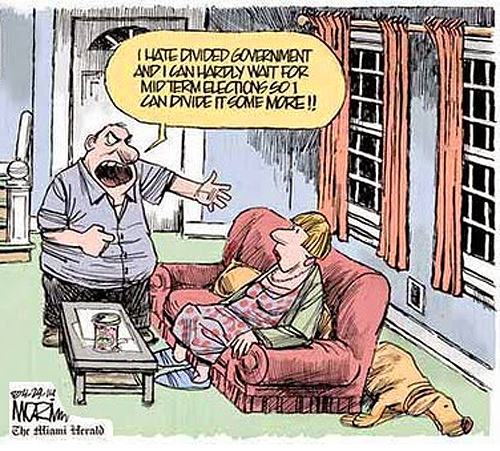
DividedGovernmentLETTER TO MY AFRICAN FRIENDS

Here’s what happened Tuesday in America:

An antiquated governing system flipped between two irreconcilable ideologies, because those ideologies are so far apart that compromise isn’t possible.

Many of you – I’m thinking particularly in Kenya – want to replicate America’s governing system. Don’t. It was great for the 19th and 20th century, but it doesn’t work in our high-tech, globalized 21st century.

Yesterday’s politicians and media analysts are absolutely right that “America is yearning for compromise” but they’re absolutely wrong that “now there’s hope the two sides will work together.” Our political structure has evolved to prevent compromise, so while we all want it, we’re not going to get it.

Since about a generation ago, “left” and “right” have moved too far apart from one another to be able to compromise within our system of government. This isn’t a failure of democracy, it’s a failure of the governing system to reflect democracy.

So gridlock will continue. Obama will stick to his positions and no substantive laws will be passed, or he will concede Republican positions. The two sides won’t each “give a little.” Neither side can: the positions are simply too far apart. So all legislative outcomes will simply be reflections of one side or the others ideology.

My ideologies and Ted Cruz’ are irreconcilable, but we are both gaining support. There is nothing left of the middle in America. I’m not sure this is in itself bad. The “middle” is often nothing more than a “muddle.” In many places in Europe widely divergent clearly opposing parties manage functional government through a parliamentary system. America is unable to.

Obama’s presidency is failing, because he still believes in legislative compromise. He still believes that he is the leader of everyone in America, and that idea means that he’s the leader of no one.

Whether it be on human rights, national security and wealth distribution, compromise isn’t possible: The difference in opinion is too great.

Today’s American elections are structured to achieve a knockout punch. Last night was a big Republican win. The Democrats will have their turn, again, and then the Republicans again, while America sinks further and further behind China and India and much of you in Africa.

“Sinks” in terms of economy, yes, but also in terms of culture, education and human rights.

The demons are three: an executive presidency, the rules of candidate campaigns and a little understood process called gerrymandering.

By the way, the American public as a whole is much more unified than our elections make it seem. In Tuesday’s election, “ballot initiatives” and “referendum” – policy questions put to the electorate as a whole – received massive support : redistributing wealth (“minimum wage”), protecting human rights (“anti-discrimination”), decriminalizing the poor (“legalizing marijuana”) among many others.

But under America’s system, today, these are rarely allowed to come before the voters and often then only as recommendations to their legislators rather than methods of creating law.

And under our broken system of government, the public’s will can’t be manifest well. So while the public passed those few referendum, at the very same time they elected powerful legislators who promised to oppose those exact same referendum.

So … nothing gets done. Gridlock or schizophrenia, doesn’t matter.

You in Africa have a unique opportunity to see how wonderful democracy has been for a long time in America. Use your fresh ideas to figure out a way to sustain it. We’re failing, here.

Don’t Vote

Don’t Vote

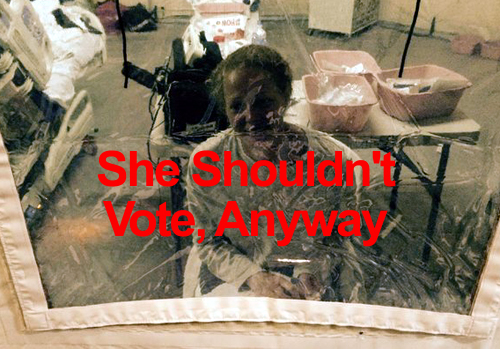
sheshouldntvoteThe depths to which some Americans have descended in an hysterical attempt to protect themselves against ebola has become immoral.

The airport quarantines of health workers arriving from West Africa is dead wrong. It will impede the health services and trade, which West Africa must have to recover, and many more people will die.

In a worse case scenario, the situation which had become better will slide into worse, and the threat to Americans will increase substantially. The policy is self-destructive.

Then why is this happening?

Politics. American politics has become so corrupt our democracy is now impotent. The electorate has lost the ability to analyze issues and is controlled by false claims and fearful media.

Governors Quinn, Cuomo, Scott and Christie are hardly bar chums.

Yet they walked in lockstep to solicit their electorate’s hysteria, because they are all about to lose power, and they are getting votes however they can.

Of course their actions reveal an electorate – if they’re correct – that’s slum ignorant. Are you truly so ignorant? Or like me, do you feel helplessly manipulated?

My own governor, Illinois Pat Quinn, is no angel but I did plan on voting for him as “the lesser evil.” His challenger, Bruce Rauner, is no alternative for a progressive like myself.

So I now have no choice but not to vote for either. This is hardly democracy at work.

But it is at least myself acting on the truth that I know:

The four governors that enacted this barbarian policy are killing people in West Africa and not increasing the protection or health of their own citizens.

In fact, the policy endangers their own citizens’ health and well-being.

This political act against self-interest is what has been happening to America for a generation. Whether it is the senior voting to end Medicaid or the food server voting to end a minimum wage, Americans have been brainwashed with a thousand false ideas to act against what they know is best for themselves.

And now this toxic social personality threatens the lives of thousands.

Facts be damned. Scream don’t think. The man will do anything to stay in power.

I can’t keep him out. But I won’t vote him in.

Perry’s Practicalities

Perry’s Practicalities

killwestafricansWhen tiny incidents like a few ebola cases in Dallas are properly scrutinized by the obsessed media, their exaggeration grows unbelievably large.

The media is obsessed, because the public is obsessed.

Every unnecessary harm should enrage us: including the 10,332 American deaths caused by drunk driving in 2012 (that’s 28+ per day, more than 1 per hour); or the 23,362 homicides that’s 64+ per day, almost 3 per hour).

But DUIs and homicides, much less war fatalities, poverty, infant mortality, industrial accidents and so forth, are not contagious. Is that the difference?

The obsessed public believes itself essentially so good and righteous that they would never be involved in unnecessary harm … unless they caught it?

Or: the obsessed public is so anti-social that nothing matters except individual responsibility? In other words, forget about John Doe or Jane Odhiambo, I shouldn’t get infected with something I didn’t stupidly expose myself to? And to hell with those who have?

I don’t know, but it’s a sad, sad commentary on our American society in general when the focus is so incredibly tiny.

There’s also the possibility that Americans just can’t telescope out. They’ve been so brain washed by the often useless concepts of individual responsibility and self-survival that they can’t think in macro terms.

Right now, folks, if you drive, you’re 10,000 times more likely to be killed by a drunk driver than by contracting ebola. And if you drive and aren’t a health care worker, the stat is mind-boggling: you’re millions of times more likely to be killed by a drunk driver than by contracting ebola.

Did you get a flu shot? If not, the chances you’re going to die of flu this year are in the hundreds of thousands more than that you’re going to get ebola. Even if you live in Dallas.

But people won’t get flu shots, and their Congresspersons (mostly Republican) are getting besieged by phone calls demanding that we stop all air traffic into the areas where ebola is an epidemic.

So they’ll take the same amount of time, maybe more, to ultimately kill more West Africans that would otherwise not die for an infinitesimally virtually nil insurance against they’re own getting ebola.

And then, they’ll be one of the 30,000 American deaths from flu this year. Like seniors voting to end social security, Americans just love to act against their own self-interest if only the media can tell them why.

When life-and-death becomes political, it gets dirty. Wars are dirty. Crime and punishment is dirty. And now the poor and needy have become dirty.

How utterly despicable.

Water Wars

Water Wars

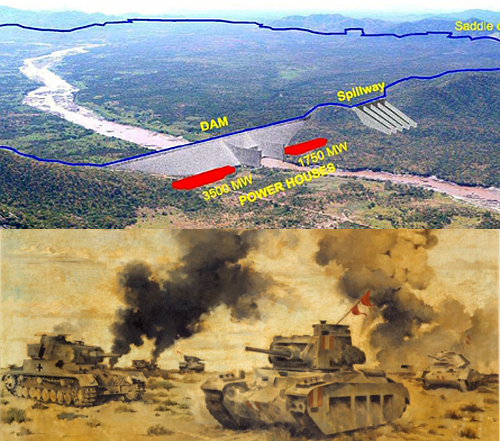
waterwarsIt was inevitable. Africa is coming to blows over water. It’s no joke that it could mean war.

Nine African countries depend upon The Nile. All of them are water deprived and all of them except Egypt are subject to devastating droughts. Only Egypt – which rarely experiences rain at any time – has matured without climate catastrophes.

But Egypt is the greatest user of the Nile waters, and the last of the nine countries on the chain from Lake Victoria and the headwaters of the Blue Nile. During colonial times Egypt was much more developed than the other nine countries, and Britain was the colonial master of them all.

So Britain produced a mid 1950s treaty that gave Egypt veto power over any of the other nine countries when deciding collectively how to use the Nile water.

Times have changed.

Fresh water is as precious a commodity among these countries as oil. In 1999 the nine countries agreed that parceling out the waters of the Nile was the most important issue among them. They formed the Nile Basin Initiative, and since the formation, nothing at all has happened except bitter name calling.

Meanwhile, parts of the shoreline of Lake Victoria have receded more than 150 feet, and the depth of the lake has dropped by nearly 30 feet.

To manage their increasingly vital resource, more than 25 dams are currently planned for different parts of the Nile. The largest dam in the world is currently being built in Ethiopia, and Egypt is furious with Ethiopia for building it.

Egypt depends upon a strong flow of water along the Nile to irrigate its enormous agricultural industry. There is every indication the Grand Renaissance Dam alone will deplete this flow.

“Egypt sees its Nile water share as a matter of national security,” strategic analyst Ahmed Abdel Halim explained. “To Ethiopia, the new dam is a source of national pride, and essential to its economic future.”

A year ago Egypt’s president Morsi said “all options are on the table” including “military responses to Ethiopia.”

Yesterday Kenya’s Natural Resource Cabinet Secretary ended another failed Nile Basin Initiative meeting. It failed principally because Egypt would not officially attend, although its ambassador to Kenya did show his face.

Nine of the countries less Egypt have agreed on an initiative agreement, but Egypt is balking. According to the 1999 accord, only 6 of the 9 countries need ratify the agreement for it to take effect. But Egypt is considered critical.

“That is the only way we can do this peacefully. Otherwise… we are going to be at war because of water,” Prof Judi Wakhungu, the Environment, Water and Natural Resources Cabinet Secretary told Kenya’s main newspaper yesterday after the meeting broke up.

Egypt without enough Nile water would be brought to its knees. It seems to me that much more powerful than the 1950s colonial shelf treaty is the fact that Egypt’s very existence for more than 7,000 years has depended upon The Nile. That’s quite a few grandfathers to be claused in.

I doubt there will actually be war, but not because Egypt doesn’t have the resolve if the waters stop flowing. Rather, I think Ethiopia is sensible enough to realize that turning off the spigot will cause war, so it won’t.

But there are many who disagree. Ethiopia is something of a maverick state, always has been. As the Grand Renaissance Dam starts to rise, the country’s leaders may also start basking in their increasing level of power.

The Curse of Apathy

The Curse of Apathy

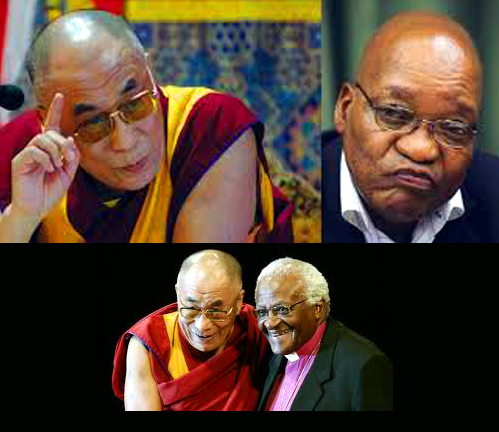
dalai&saIn an incredibly sycophantic move, South Africa’s president Jacob Zuma has denied the Dalai Lama a visa to attend a convention of living Nobel peace prize laureates in Cape Town.

The convention was supposed to begin a week from today, but Late last week the laureates announced they were suspending the October 13 get-together and relocating to a yet unnamed country.

Cape Town Mayor Patricia de Lille said her government “has embarrassed the country.”

The laureates decision not to go to Cape Town followed the South African government’s refusal to elaborate on why the Dalai Lama was not given a visa. Fourteen of the 21 laureates sent a letter to President Jacob Zuma asking him to reverse his decision.

The initial decision to hold the convention in Cape Town, which would have been the first time in Africa, was a coup for the wildly popular Desmond Tutu, himself a Nobel laureate, who was instrumental in ending apartheid.

The ending of apartheid was the reason that Nelson Mandela, and at that time the president of South Africa, Willem de Klerk, shared the 1995 prize.

“I am ashamed to call this lickspittle bunch my government,” Tutu said in a statement.

This is actually the third time that the Dalai Lama has been denied a visa. The last time was for Tutu’s 80th birthday celebration.

China and South Africa have a very close relationship, and interestingly, it is less because of aid and investment than trade. South Africa is China’s leading trade partner in Africa.

China has publicly promised to lobby for more power in the UN Security Council for Africa. Given the political turmoil in Africa’s other powerhouse countries, Egypt and Nigeria, any such aggrandizement would likely benefit South Africa.

China has often snubbed the world prize, as a number of prominent and usually dissident Chinese have been made laureates.

Most Chinese believe it is a political tool, and as such, South Africa’s president’s refusal to embrace it should be seen as strictly political, say the Chinese.

One might also bring up sour grapes. Jacob Zuma is one of the most corrupt and least loved of South Africa’s big man politicians. Many in the country wonder how he has managed to stay in power.

He’s received none of the multitude of accolades and awards that many of his comrades-in-arms against apartheid, like Mandela and Tutu, have.

What perplexes me is how younger South Africans don’t seem to care to the extent I thought they would. Their lives are getting better, however incrementally, but key economic indicators like the spread between the rich and the poor is growing.

I suppose like at home, war fatigue has spilled over into political fatigue. Your average Joe has become exhausted by being fed up.

And so long as things on a day-by-day basis don’t seem to get worse, major if immoral power policies leading to oligarchical control just don’t raise enough ire.

It’s called the curse of apathy.

Shelter in Place

Shelter in Place

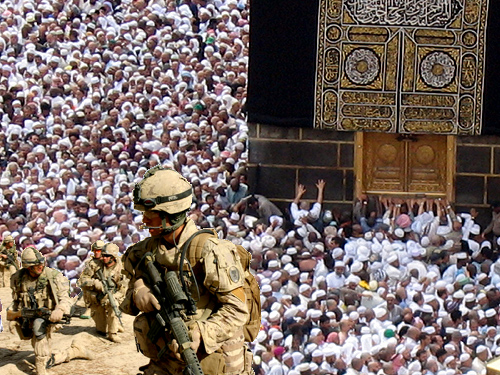
index“The War on Terror,” Version 163 announced by Obama last week, is taking a significant toll on American tourism and business in East Africa.

This weekend the U.S. embassy in Kampala issued the most serious warning in their lexicon of warnings, “shelter in place,” one step before evacuation:

“All U.S. citizens are advised to stay at home or proceed to a safe location. Shelter-in-place and await further guidance. Follow U.S. Embassy Kampala on Twitter and Facebook for the latest updates.”

The warning was issued Saturday and rescinded Sunday, after Ugandan authorities claimed to have foiled a terrorist attack Saturday night.

Then all day Sunday Ugandan military and police went through Kampala ransacking houses and shooting people. This, by the way, is how the Ugandan military works: shoot first, ask later.

It is the same philosophy that gave rise to terrorism in the first place.

It doesn’t work.

Uganda is neither a place to visit or live, right now, and it hasn’t been for some time. That isn’t because of an increased threat of terrorism, but because of the government’s increased militarism.

That seems to be in fashion with U.S. authorities right now.

Kenya is doing a much better job. Security outside the border region is improving, although security along the coast and Somali border is not.

Beheading, by the way, has been a modis homocide among terrorist groups for the last several decades. Recently another Kenyan border village experienced one.

What’s new, of course, is the beheading of westerners. The roughly thousand beheadings of Africans and Arabs didn’t draw any serious attention. But my goodness, we’ve now had three innocent westerners brutally beheaded! Time for action.

Until now terrorists felt that the potential ransom for a westerner was more valuable than the potential public reaction.

They’ve realized now that the PR value of a few beheadings is worth zillions more than a couple hundred million dollars.

We’re now playing into their game exactly as they wish us to.

That’s why they’re winning.

Dumb Historians

Dumb Historians

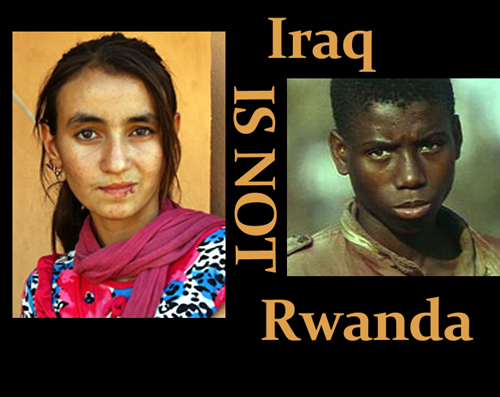
IraqIsNotRwandaErbil is not Rwanda.

Supporters of the U.S. air attacks in northern Iraq spent the weekend invoking the mistake the U.S. made in 1994 in Rwanda as a reason why we should restart the military campaign in Iraq.

They obviously don’t know the history.

Prior to the Rwandan genocide, the United Nations Security Council empowered a peace-keeping force with boots on the ground from more than a dozen countries including a number of Rwanda’s African neighbors.

This had occurred after the French had unilaterally sent a small military force to Rwanda. France was the lead nation in the intervention force.

But the general overseeing the UN troops was Canadian. And the troops that saw most of the active engagement were Dutch. And literally dozens of other countries were involved in air lifts and logistical support.

And the entire world, as represented in the Security Council, was behind the effort.

Right now, there is absolutely no international effort to support Kurdistan (Erbil) or to help the stranded refugees in the Sinjar mountains. Right now it is only the United States.

In Rwanda the genocide followed when the French enlisted the United States in blocking increased UN military involvement by the Security Council even as the situation worsened. That was the mistake in Rwanda: choosing sides and letting one side start massacring the other.

In Iraq today a genocide may already have happened, and the stranded refugees in the Sinjar mountains could be the next genocide.

That’s the tough question, but it has an answer however horrible. If I believe a genocide is possible, am I saying the U.S. should not go it alone to stop it?

In this specific case, yes.

Based on the recent history of the area, the effort by us alone to change history, to abate even temporarily a genocide is likely to cost thousands more lives and infinitely more misery in the future.

The question to me is quite simple. Do we react to the horror of the present by damning the future to an even more horrific destiny? Can we not refer to history?

Can we not stop rewriting history, as with the analogies to Rwanda?

This is not isolationism. If what is happening in the Sinjar mountains were happening in Puerto Vallarta then my orientation would change. If other countries in the Mideast and nearby Europe asked us for support, my support is available.

But to go it alone? No. Definitively and completely. Not only must Americans grow their sense of community, they must extend their human vision into the future and realize as nature’s greatest achievement we have the capability to fashion our future, not just react to our present like unintelligent animals.

A final subtle argument floating around the weekend talk shows was that yes, we were wrong to go into Iraq, but we did so, so we are now responsible for the mess we created.

Yes, we are completely responsible for the mess we created. So do we create a greater mess? The only responsible thing to do is stand back and let the area’s own social and historical equilibriums reappear however awful that may be.

We can’t fix it. We were unable to fix it in the beginning, and now we are unable to fix the mess we created. All we are capable of doing is making bad situations even more terrible.

Virtually every conflict that America has gone alone in my life time has been a disaster, starting with Vietnam. The world today would be so much better and happier if America had not blustered solo into those wars.

We shouldn’t feel unmasculine recognizing this fact. Power is never insurmountable, not even moral power. From my point of view, the only global power that will prevai is GLOBAL power, the combined efforts of multiple countries. We supply the warplanes. Sweden or Chile supplies the justification.

The conflicts in which we were only a part – like the Balkans War – had very good outcomes.

We are strong and should remain so. But we are dumb and should listen to the rest of the world before throwing our punches.

All Hail The Buck

All Hail The Buck

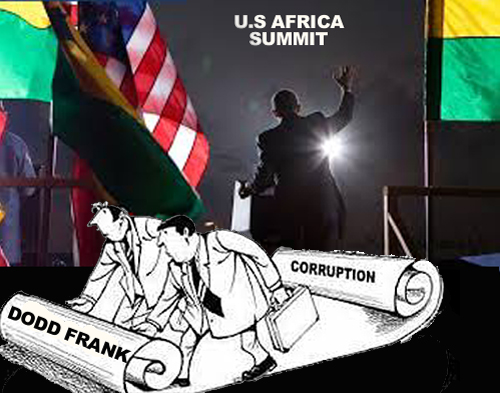
summitdoddfrankThe glitz and fanfare closing the historic U.S./Africa summit today glazed over very serious issues like corruption with lavish promises of aid and economic cooperation.

The political and strategic gains for both the United States and African Heads of State were starkly and almost exclusively economic, and clearly human rights’ activists in particular are leaving the conference terribly disappointed.

The amount of cash pledged by the U.S. and the World Bank was more than double what was expected: over $33 billion. Massive projects for electrification and natural resource development went well beyond the Heads’ expectations.

Of course $33 billion is a drop in the bucket for the U.S. and its western agencies, but it’s a large sum of money in Africa, representing about half Kenya’s annual GDP. It would be like a rich alien power promising Earth $33 trillion in aid.

So the jives are good among the rich and powerful, and the buzz in Washington is all about how Obama successfully challenged China head-on, considered at least until now to have been the dominant new force in Africa.

But there are also a host of not-for-profits and NGOs welcomed by the White House to the summit, often specifically invited, that received little attention. Their concerns are manifold, from the environment to good governance, but unless their topic was trade or foreign investment, they’re leaving empty-handed.

One concern that seemed to pop up again and again in a many different meetings and discussions was Obama’s failure to fully enact Dodd-Frank.

The Dodd–Frank Wall Street Reform and Consumer Protection Act was a signature piece of Obama legislation signed on July 21, 2010. Four years later hardly half of the law has been implemented.

Africans are specifically interested in section 1504, which has not been implemented. This portion of the law requires all mining companies listed on U.S. stock exchanges to publish all their payments to U.S. and foreign governments in the countries where they operate.

Sounds simple enough, right? Well, the very fact that it might be implemented is probably one of the main reasons that the generational war in The Congo is almost over. It would end the decades-long practice of many international companies that obtained their rare earth minerals from Congolese warlords.

The law is clear, whether it really did stop the Congo war or not: Nike, Apple, Motorola (now Google), Intel and dozens of other companies that had been buying minerals like tantalum from war zone black markets could no longer do so.

Moreover, eight of the world’s 10 largest mining companies and 29 of the 32 largest active international oil companies would be covered by the Act as well, were it implemented.

But it hasn’t been, because the Security and Exchange Commission which is entrusted with writing the rules to implement the law has been stymied and sued and from the point of view of many Africans, complicit, with multi-national industry lobbying.

“Anti-corruption activists are losing patience with what they see as pressure by the extractive industries to prevent the emergence of tough new disclosure requirements,” writes Africa policy expert Jim Lobe.

At one of dozens of activist forums at the summit, one of Africa’s most successful businessmen, Mo Ibrahim, challenged “The United States, which has been a leading light on corruption [for] now dragging its feet. Do you have a backbone, or what?”

I know that realistically economic issues govern the world, and economic prosperity often heralds peace and happiness. But let’s move this beyond game of monopoly between China and the U.S. and realize as well that there’s wealth in morality.

The Elephant isn’t in The Room

The Elephant isn’t in The Room

elenotintheroomElephant poaching is less important than jobs, energy, poverty and a host of other domestic African issues and until westerners embrace this, poaching will continue to increase.

At yesterday’s “historic“ African summit in Washington so many meetings and public forums occurred that Washington police had to close some of the city’s main roads, with limo lines moving back and forth causing their own congestion.

Most of the dozens of official gatherings were about trade, ending poverty, honoring former champions of American/African relationships, etc.

Bill Clinton spent twenty minutes speaking to Kenya’s president Uhuru Kenyatta at an event honoring Andrew Young.

Trade and investment trumped all other topics, as they should. The continent is growing by 5.7%. Middle class consumers in Africa will soon approach a half billion in number. China is edging all other players out of opportunities. There’s a lot to talk about.

One of these many formal and countless informal meetings was about elephant poaching. It attracted four African Heads of State, four of the least important movers and shakers on the continent.

NPR, of course, covered it. This is because it’s an issue which resonates with the liberal leaning Americans who need good morning news fixes.

Americans tend to look at the world through myopic lenses that focus their own passions at the exclusion of greater but to them peripheral issues. It’s as true of the liberal as conservative.

And I’ve always pointed out that the liberal/conservationist attitude towards elephant poaching has not just distorted it but distracted our important attention from other issues.

Let me state again: elephant poaching is on the rise and is a serious concern for African conservation, today. But it’s on the rise for reasons other than just that there are bad guys and evil Chinese antique dealers.

Yesterday, for example, the Kenyan Wildlife Service (KWS) did an audit of the 12 elephants that died in the last year in or near Amboseli National Park, Kenya’s most important elephant park.

Four died of natural causes: 33%.

Of the remaining eight, three were due to what officials called “human-wildlife” conflict, which I’ve often discussed: 25%.

I actually think this is the most serious problem, because it’s turning local sentiment against conservation. As Africa develops so rapidly, the conflict with the wilderness increases exponentially as that wilderness is better and better protected.

It’s one thing to have monkeys pinching the cookies you left out for your kids when they come home from school. It’s quite another when the elephant walks through their school or, god forbid, steps on the kids.

The remaining 5 of the 12 elephants were determined to have been “poached.” In other words, intentionally killed for illicit gain: 42%.

The media is rife with explaining and arguing whether the market for ivory or the price given at the source for ivory or corruption among wildlife officials or other bad things is responsible for this poaching.

“Julius Cheptei, the Assistant Director for the Southern Conservation Area, argues that there is a strong link between the swelling cases of poaching and the possibility that people are looking for traditional medication,” according to reporters covering the KWS Amboseli announcement. The reporter continues:

“Given the growing populations and spreading popularity of traditional medicines globally, experts say the demand for these natural remedies is increasing.”

The official continued to explain that often poachers are not interested in the ivory but in the elephant’s “private parts.”

As always, I’m not saying elephant poaching today is not a serious issue, and one report as above does not an issue settle.

I’m just saying, again and again, get a perspective.

Real World Blues

Real World Blues

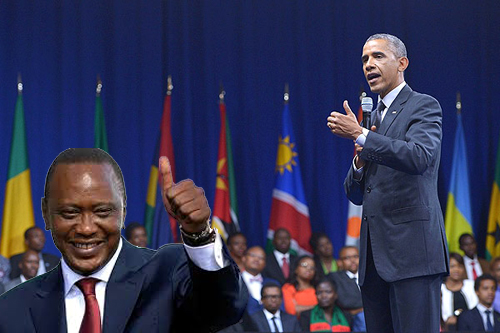
obamasummitThe largest ever gathering of African leaders starts today in Washington at the invitation of President Obama. A year ago this would have been unthinkable.

A year ago Obama would not have arranged this summit; his advisors would have considered it bad politics. But Obama is no longer playing to the vicious racism that has stymied him from Day One.

A year ago President Uhuru Kenyatta would not have been invited: he remains on trial for crimes against humanity at the World Court (ICC). Kenyatta arrived in Washington for the summit yesterday. His court case has faltered and Kenya has prospered.

The guest list at the White House is filled with despots and authoritarians including Equatorial Guinea’s Obiang and Uganda’s Museveni. But with a little help from the White House, their most serious critics are also being heard.

A year ago the Heads of the African Union (AU) states would have rejected a meeting that included a parallel gathering of their most intense critics. The White House encouraged this activist gathering, but also deftly declined to participate and that seems to have satisfied the African Mighty. That’s a diplomatic dosey doe of the most successful sort.

Times are changing, Obama is changing, and I think America is recalibrating. No African leader embodies these changes better than Egypt’s President el-Sisi.

The White House did not invite el-Sisi, yet in my estimation whatever immoralities or crimes he’s committed in his coup against the legitimately elected Muslim Brotherhood Mursi as president last year pale in comparison to Obiang’s or Museveni’s reigns of terror.

But the White House was following a careful script. El-Sisi had been ousted from the AU. Obiang and Museveni remain in good standing with the AU, whether they should or not.

When el-Sisi was reinstated several months ago, the White House then issued an invitation and El-Sisi immediately declined, but with diplomatic nicety sent his Prime Minister and closest confidant, Ibrahim Mehleb.

The only other heads of state not invited have all been ousted by the AU: Zimbabwe, Sudan, Eritrea and the Central African Republic.

America’s recalibration is good and bad. Obama’s administration is reembracing the old diplomat Henry Kissinger’s realpolitik: In contemporary terms you don’t cheer change at the expense of certain stability.

The Arab Spring has proved mostly a failure. In the long view of multiple decades or centuries it may have inched human rights forward, but today human rights in places like Egypt and Morocco and Kenya is more suppressed than before the Arab Spring.

What has improved is social stability and economic growth, and that is the stuff that realpolitik responds to.

America’s obsession with freedom and democracy is very good … for America. But perhaps not right now for Africa, and that’s the paradigm manifest in today’s African summit.

In the last decade, American investment and trade with Africa which had been supreme, has fallen below that of Europe’s and China’s. “The summit agenda is heavily focused on business and trade,” the Guardian’s Washington correspondent says.

China may worry Obama more than any African despot. The Guardian continues:

“China’s trade with Africa rose to $200bn last year – largely made up of Beijing’s imports of oil and minerals, and export of electronics and textiles – more than double the US… Twenty years ago trade between China and Africa was just $6bn.”

The “U.S. Summit Seeks to Play Catch-Up in Africa,” the Washington bureau chief of IPS says.

Egypt is essentially stable, today. So is Kenya. One is governed by a military authority, the other by a man indicted by the ICC for crimes against humanity.

But both countries are essential to U.S. security. Egypt’s current moderating role in the ongoing conflicts in the Mideast, and Kenya’s occupation of Somalia, represent irreplaceable components of American security.

The real world is not always a pretty one.