Heroes To Africa

Heroes To Africa

Two Heroes to AfricaA huge sigh of relief could be heard coming from Africa when the Iran Deal was secured this week. It was hard for them to understand why Americans might not have accepted it.

It was hard for me to find any African opposition whatever to the deal, as hard as I tried surveying every news outlet and blogpost I could find in Africa. I was particularly surprised this was the case in Nigeria.

Nigeria’s potential as Africa’s financial powerhouse rests with its enormous reserves of oil, and the Nigerian government announced recently that it expects a quarter of its government revenues could be lost if the Iran deal goes through:

“US-Iran deal: Nigeria could lose N333bn by year end,” Nigeria’s major business newspaper reported.

This is because Nigeria and Iran produce the same quality of crude. Before the Iran sanctions were imposed a number of years ago the two were each other’s main competitor.

Reduced government revenues won’t just occur because Iran will be able to effectively compete again with Nigeria, African analysts warn, but also because there will be “a further drop in crude oil prices” as even more oil is made available to an already saturated market.

So despite this startling understanding, Nigerian public opinion is squarely behind the deal.

“The Republicans dominate the military industrial complex of America and they love and appreciate war more than they treasure and seek peace,” writes an important Nigerian commentator.

This is the sentiment throughout the continent, although outside Nigeria, commentary is a bit more biting:

“In a sense,” writes one of Nairobi’s most prominent columnists, “Obama’s real contest is not with Congress. It is with a small but powerful Middle-Eastern state that holds extraordinary – even abnormal – power over … Congress.

“One can write a whole book on why exactly Israel has this unique capacity to make America dance to her every tune.

“Empires begin to decline when they lose touch with reality. Diplomacy has lost meaning to the Republicans. It’s either their way, or the gun.”

“The Iran nuclear deal would curtail its nuclear programme. The only people who can hate that are the kind who just love war,” according to one of South Africa’s most read dailies.

“Republicans … seem downright furious diplomacy prevailed over the threat of more missiles.

“For Republicans, the Iran nuclear negotiations have never been about getting ‘a good deal’ for the US. They’ve simply wanted to preserve their ability to kill people … whenever they want.”

These are tough words from a normally moderate and respected newspaper, and it reflects the utter frustration that otherwise thoughtful and intelligent Africans felt when confronted with the possibility that Republicans might have scuttled the deal.

Well anyway, frustrations aside at last, the deal seems done. Perhaps its demonstrable success over the next few years will be one of the final nails in the coffin of America’s Republican Party, an old GOP movement that may truly have seen its day.

Pork Pies

Pork Pies

farmsubsidiesPreparing for the first-ever WTO leadership meeting on African soil in December, Kenyans are coming out swinging.

Against western trade deals. Against western “communism.” They have a point.

Developing countries overriding responsibility is to feed their population. Many developing countries, like those in East Africa, have large amounts of agricultural land, relatively modern farming techniques and educated farmers.

Today they are even being supported by better infrastructure for getting their product to market.

They are entirely capable of not only feeding their own population, but growing an agricultural sector through global exports. Tanzania, in fact, has had multiple years in the last two decades of doing just this.

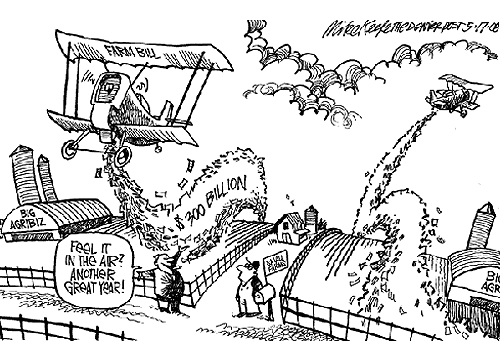
The problem is that their countries are not wealthy enough to subsidize their agricultural sectors while the world’s mega economies, including the U.S. and Europeans, do.

Advantage Big.

“The US … spends billions of dollars every year subsidizing its agricultural sector. These subsidies lead to over-production of commodities and dumping of surpluses on the global markets,” explains Pete Ondeng, director of the “Lead Africa Foundation.

The result is that it’s often cheaper for Africans to import American food than develop an agricultural industry that becomes self-sustainable.

This makes the African countries real economic vassals of the developing world. Its populations eat well when the developing world makes good decisions, but its people starve when the developed world does poorly or ignores them.

It’s also a characteristic of societies managed from the top, not by free markets. It’s a perfect example of communism, and Africans see this as the height of American hypocrisy.

Most of the U.S. disputes over its subsidies to farmers have been with non-African countries like Brazil (for cotton) and India (for meat). Last year, however, the African country of Burkina Faso blasted the U.S. for destroying its cotton industry with the billions of dollars of cotton subsidies paid U.S. farmers in the last decade.

This “buying” of the market would be a federal offense if the dynamic occurred wholly within the United States.

Kenyans believe that the World Trade Organization’s decision to hold its leadership conference in Nairobi this year is a signal that the organization will more aggressively advocate the interests of developing nations.

“The meeting presents a unique opportunity, not just for Kenya, but for all African countries to make their voices heard. Clearly, something new has to happen,” Mr. Ondeng says.

Western pandering to combat poverty in the developing world comes cleanly exposed when trade issues like this are put on the table.

But the political hold that farmers in the developed world hold on their countries’ socialist if not communist policies to artificially prop up their farming is so strong that even the most conservative developed world farmer does not see it as unfair.

I’ve always insisted that charity begins at home.

If westerners are truly interested in combating world poverty, this is where to begin: end agricultural subsidies.

And Crackerjack

And Crackerjack

ugandalittleleagueUgandan little leaguers are representing Africa better than expected in the Little League World Series.

Francis Alemo is the star pitcher, pitching faster and harder than virtually any other pitcher on the playoff roster. “Francis Alemo [is] virtually unhittable,” a sports broadcaster was quoted today on NPR.

The African little leaguers are here thanks mostly to a New Yorker engineer who has diligently worked for more than a decade to bring them up to speed, including raising the funds to educate and train young kids at a sports academy outside Kampala.

Not just boys, either. The Ugandan girls’ softball team played in the world series of softball a few weeks ago in Portland.

It’s been rough, though, getting through U.S. bureaucracy. I wrote several years ago how the U.S. embassy in Kampala refused visas to a 2011 team that qualified for the world series back then.

To a certain extent it’s understandable. Uganda’s political and social situation today is terrible, so terrible EWT will not broker trips there. Many younger Ugandans who get visas to leave the country … never return.

Not all the reporting, though, is as on target as Alemo’s pitching.

My wife and I lived for two years on the border of Uganda in an area of Kenya filled with Uganda’s second largest tribe, the same ethnic group from which Francis Alemo comes.

We lived at a boys boarding school. Among the joys I remember there more than 40 years ago was introducing softball to the school.

I managed to round up bats – most of them broken – from departing Peace Corpers. We had no duct tape back then, but lots of rubber chords, so we strapped most of them together with rubber. Even some of the balls were wrapped with twine.

According to the sports outlet Boston.com writing about the Ugandans competing this week in South Williamsport New Jersey, “Baseball was first brought to Uganda by missionaries in the early 90s.”

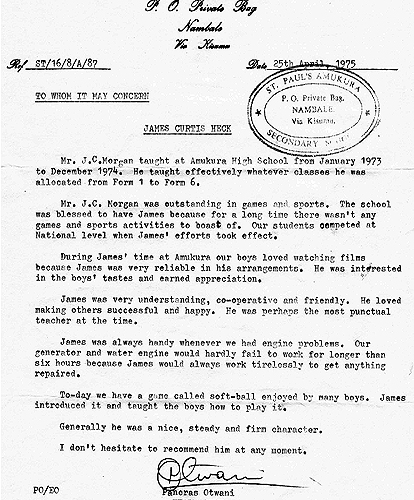
Below is my much prized letter of commendation from the Headmaster of the St. Paul’s Amukura Boys Boarding School. The most important paragraph is towards the end, commending me for introducing the boys to softball!
amukuraletter

Politics or People?

Politics or People?

Donald-TrumpYou probably have no idea what an illegal immigrant is.

You’ve heard of course of the hundreds of thousands of Middle Easterners and North Africans sailing to Greece to get to Macedonia to get to Serbia to get ultimately and mostly to Germany.

You might even know of a nearly equal number from west and North Africa seeking asylum in France, because they’re native French-speakers.

You’ve probably given a slight ear to news reports about all the political fighting going on right now in Europe and especially Greece and Italy about what to do with the (yes) millions of immigrants who’ve besieged those countries in the last decade.

But do you know anything about these people? These individuals? Whether you want to call them refugees or illegals or desperados or whatever, do you have any idea what these people are really like?

You’d be surprised.

Check this out: an aggressive German journalist is right now traveling with a group of refugees from Aleppo trying to illegally get into Germany. Follow him on Twitter and Periscope by clicking here.

This is real-time journalism and here’s what you’ll find out about these refugees:

1. They’re rich.
2. They’re educated.
3. They’re young.
4. Most are professionals.

And that’s as true for a Libyan or Zimbabwean as a Syrian. There’s an incredible similarity between these fleeing peoples whether they are starving Guatemalans trying to enter the U.S. for a meal, or professionals fleeing bombs from war-torn Libya into France.

If you remove any one of the first three of those characteristics of a typical refugee listed above, they’d never make the journey.

It’s ridiculously expensive for a refugee. Many illegal immigrants from Central America pay upwards of $20,000 to get help sneaking into Texas.

It’s true all over the world.

Only an educated person who can read and speak multiple languages, navigate signs and maps and figure out the necessary deception and convincing to get past authorities has a chance of making it.

It’s strenuous. There’s a lot of walking, bushwacking, sleep deprivation … few but young people are capable of this.

But why professionals? Because in a stressed society, they suffer the most. They’ve made the greatest investment in their lives and are enjoying no return.

Richard Dowden of the Royal African Society has been writing about African refugees for years: “This is not a new problem. It is called globalisation,” he reminds us.

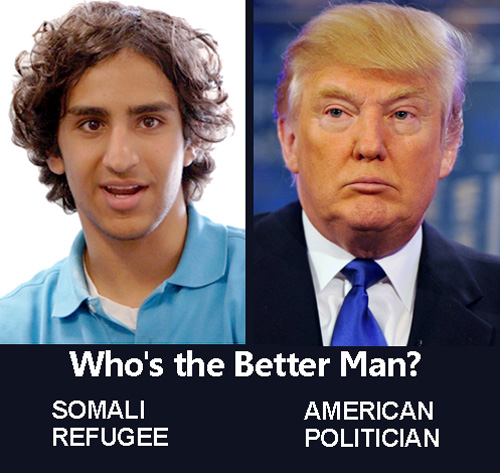
I’ve also written about refugees from northern Africa fleeing to South Africa. See that reference for my profile of Hemadet, shown in the picture above opposite Donald Trump. In fact in that blogpost several years ago I asked, “how soon will there be millions?”

Well, there are right now.

So rethink this refugee, illegal immigrant issue, please! These are not rapists, murders and criminals. A single one of them probably has greater personal character and life accomplishment than the entire bunch of politicians now quibbling over them.

And if borders were thrown wide open and all these people welcomed without question, they’d probably solve all our problems a lot quicker than we’ll ever be able to do ourselves.

Polio Plus a lot More

Polio Plus a lot More

PolioPlusPolio may have been eliminated from Africa.

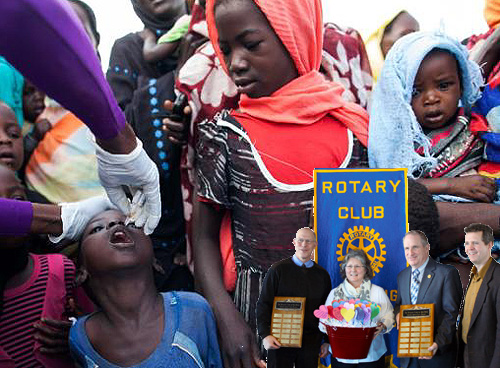
Although the context is Africa, this is an uniquely American story. It’s a hero’s tale of misplaced generosity: More than 30 years ago a generous group of American middle class business leaders decided they would eradicate polio.

Last week the Global Polio Eradication (GPE) Initiative announced that it had been one year since any new case of polio had been identified in Africa.

(Qualification: a handful of new cases caused by the vaccine itself persist in Nigeria and Madagascar, but these are not infectious.)

The GPE began in 1988 after a 1985 Rotary Club project inspired when a Rotarian visited the Philippines and was moved by efforts there to eradicate the disease.

Within three years individual Rotarians had donated almost $200 million dollars. (To date they have contributed more than $1.3 billion.)

Reluctantly United Nations organizations joined the effort. I say reluctantly because the science of public health was most developed within the United Nations community, and it was understood by them that “a few years” was not a realistic goal.

The UN and its agencies get beaten to death when they set goals they don’t achieve. But UNESCO (the United Nations Educational Scientific and Cultural Organization) agreed to partner in the effort when convinced by the less political World Health Organization (WHO), which also joined the effort in 1988 after America’s CDC came on board.

But none of these three public health organizations – attracted by the enormous amount of the Rotary contributions – wanted to be the lead organization.

It was understood that if public health organizations’ assessment of the enormous amount of time and money the project really needed were honestly conveyed to Rotarians the project might be abandoned. More puerilely, they might not get use of the funds. So the GPE was formed as an umbrella organization.

I was a Rotarian at the time, and I was extraordinarily humbled by my suburban club’s generosity towards projects I was developing in Africa. So I was roundly criticized as hypocritical and selfish when I opposed the polio campaign.

I knew the goals were unrealistic. Everyone was treating polio as if it were smallpox. The eradication of smallpox worldwide in 1978 (officially announced in 1980) still had enormous resonance in 1985 as a successful worldwide public health initiative.

WHO suggested, designed and led the effort to eradicate smallpox, a decade-long effort that began in 1958. The world – particularly America in 1958 – was considerably more socialistic than it is, today, and the successful eradication of smallpox in the U.S. and Europe inspired wonderful governmental generosity to take this know-how into the undeveloped world.

It was expensive, and it was paid for by increased taxes on westerners.

America’s psyche changed radically in the late 1970s and 1980s. Private initiative was displacing government initiatives.

Rotary is a private, capitalist club. To its lasting credit in this troubling period of change in America it was also developing thousands if not tens of thousands of small projects that were working better than the bluster of aid that was flowing for crony reasons during the Cold War.

It seemed to make sense. Private initiative. Less bureaucratic operations. Strictly altruistic.

But Rotary was not accountable to the body of science which governments and world political organizations were.

I knew that eradication of polio would take more than “a few years” and more importantly, that the quarter billion dollars raised for a few-year effort would have to become substantially more if the ultimate goal of the project was to be realized.

I knew because I had watched polio immunization in Africa fail, first-hand.

The problem is that a single immunization as was used to eradicate smallpox won’t work with polio. Polio eradication then required at least two immunizations per child and they needed to be spaced months apart.

That is a concept near impossible to convey to an illiterate peasant and particularly to skeptical ones. It’s also a regime that requires meticulous accounting and reporting. Who is immunized when is not an easy task to record when so many millions of young, undernourished and illiterate children are involved.

So it’s taken a little bit more than a “few years” and by the way, Rotary’s goal of worldwide eradication has not occurred. The infectious polio virus persists in Pakistan and Afghanistan.

It’s unclear how much has been spent to date. The New York Times reports the effort costs $1 billion/year.

Last February the Rotarian who inspired the program celebrated the 30-year effort by explaining why he felt the project could be done by Rotary:

“We didn’t need medical people, we could do it ourselves.”

Do it yourself is an American concept that is horribly immature. There is very little in the world today that can be successfully accomplished “by one’s self.”

Teams of very different kinds of people, spanning enormous disciplines and representing high science and lengthy specific experience, are required for almost everything even something as simple as counting children when the context is global.

What we need to do is tap into the incredible generosity of an individual Rotarian, which I can absolutely attest to. We need to develop that twinkling morality into a complete understanding that no Rotary – no homogenous organization – can work alone in a global context. Only massive efforts coordinated by governments can achieve global success.

And equally importantly, we must accept the facts, however daunting they may seem. Inspiration is great. Science is, too.

Crossing in the Night

Crossing in the Night

SalCapeVerdeThirty-five years ago I regularly stood abreast a Cuban or Russian in Sal, Cape Verde. We stared blankly at one another trying but unable to smile or offer a handshake.

That paradox – during South African sanctions and the height of the Cold War – defined U.S. global relations that finally today may be changing.

He (it was never a “she”) was headed southwest or northeast, to Havana or Moscow. I and my fellow passengers (with a remarkably few “she’s”) were traveling northwest or southeast to the U.S. or South Africa.

We crossed because our 1981 flights ran out of gas in Cape Verde.

We westerners were ushered down the staircase of our South African Airways 747SP, which we fondly called the “stubby” and for all the world looks like a child’s drawing of a jumbo jet. The Russians and Cubans took just a few fewer steps down their slightly lower staircase of the Aeroflot Ilyushin Il-86.

I always felt the Cape Verdeans, pawns in this international loophole, intentionally then directed us into the “transit arrivals hall” in two distinct lines, side by side, pushing us awfully close to one another as we slipped through the narrow railings entering the hall.

Normally when big planes land at an airport there’s all sorts of action: luggage carts pulling up, yellow lights flashing, cargo holds belching. When you step onto an active airport tarmac there’s an annoyingly loud distinctive din, a mixture of a buzz and ting that pervades everything.

Not in Sal.

When I stepped onto the tarmac I heard the screams of nightjars penetrating the chorus of crickets. I could actually hear my steps as I walked on the tarmac.

On any other stopover during which you can leave the aircraft, you’re told to remove all your belongings. Not in Sal. We were ordered to leave everything in our seats, even our hats and handbags.

In those days I carried bundles of cash to pay for services in Africa and it was always in my locked leather briefcase. I had to leave it in the luggage hatch.

I carried books, left on my seat. An attendant even told me to remove my precious notepad stuck in my front shirt pocket and return it to my seat. When the passengers behind me didn’t want to give way, she smiled and offered to safeguard it for me, removing it herself from my pocket.

I marched off the plane feeling naked.

The only ambient light seemed to come from the landing guides on the runway we’d left behind and the poor illumination inside the “arrivals hall” we were headed to. Nobody and nothing was getting off or on at Sal. We were all just in transit.

There is terror in the vacancy of expected action, but the smell of jet1 fuel permeating the air and old croaking dark trucks carrying tons of fuel slithering into the darkness on the opposite side of the aircraft gave us some confidence.

A couple partially bearded and seemingly curious Africans in jumpsuits displaying the South African Airways logo sat expressionlessly on the low concrete wall around the arrivals hall. I don’t know what they were supposed to do: luggage carriers? Often I tried to engage them with a smile, but it was too dark at a distance and up closer we were not allowed to slow our march.

The arrivals hall was a cubicle warehouse in which there was no shadow. I’m not sure how they did it. Either the light was just too dim and I’m not remembering well, or clever Cold War spies were surveilling the place and agreed on mutual background lighting, but it was an annoying almost amber light that filled every nook and cranny of that boxed room.

There were no chairs. The heavily shellacked wooden floor was painted with three dull red lines, as if demarcating a sports court of some sort, but it actually demarcated the lines the passengers were supposed to walk between.

The vast center of the room remained empty throughout.

The Cubans and Russians walked in the opposite direction from the westerners. Nobody told us to do this. There were no minders, no announcements, we just did it. We had 45 minutes to exercise before our interminable journeys continued.

It wasn’t long before the lines started to dissolve. Older people slowed down and were overtaken by the few fit, and sometimes even turned around. Nobody stopped them. By the end of the 45 minutes the lines had lost definition.

It was then, in those last few minutes before reboarding, that people actually milled about. Silly and bold as I’ve always been, I’d wander into a pod of easterners. Sometimes they were very young Cubans, many wearing medical outfits like blue or green orderly scrubs.

They were probably younger than I was, and I was pretty young, but virtually always they moved away from me.

The Russians were a different matter. I guess we both knew there was much less likelihood of being able to speak to one another than with the Cubans, so twinkling eyes and surprised expressions and even smiles often greeted my approach.

But then it stalled after a few embarrassed body movements of kindness.

I don’t know what went through their minds, but mine became overwhelmed with missiles and Hungary and mushroom clouds. I’ve since shaken that umbrella over my psyche, but I was young, then. We all were.

Thirty-five years is an awfully long time to wait for a door to open. But I’ll always think of Africa as the place where American and Russian and Cuban anxieties and hostilities began to diminish.

In the arrivals hall. Sal, Cape Verde. The middle of some night too long ago.

Oil & People

Oil & People

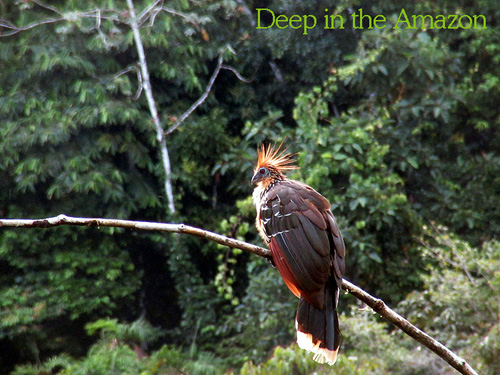
DeepInamazonAs I wait here in Arusha for my clients to arrive tomorrow, I’m haunted by my visit to the Amazon a few weeks ago.

It wasn’t just the goose bumps and occasional terror produced by the massive, towering jungle with its chaotic screaming sounds. I was profoundly moved by the local people who hosted us and who are demonstrating remarkable courage refusing the wealth of oil that sits below them.

Ecuador’s Amazon is one of the richest biomass areas in South America and includes Yasuni National Park, which the Wildlife Conservation Society says is “one of the most biologically diverse forests in the world.”

The area is also the home of several clans of Huaorani people who continue to forcibly resist development, violently opposing all efforts to contact and civilize them.

But controversy with oil companies dominates the area. The first discoveries of huge reserves in the 1960s led to a mini oil boom that was eventually stopped when several massive spills galvanized local opposition. An increasingly leftist government in Quito became incensed by the significant ecological destruction of their Amazon.

One of the tribes in the area, in fact, the Achuar Kapawi, successfully obtained a large judgement against Occidental Petroleum after a persistent six years of expensive litigation in New York (spearheaded by EarthRights International).

But even more significant reserves were discovered in the late 1990s and so the pressure on the Quito regime grew substantially. The Correa administration asked the United Nations to calculate its reasonable return over ten years if it allowed the oil to be developed. The UN came up with a figure of $7.2 billion.

President Rafael Correa then addressed the opening session of the United Nations in 2007 and asked the assembly to create a trust fund that if if subscribed by half that amount, $3.6 billion, would be used by his administration as an alternative to developing the oil in the Amazon.

Correa challenged us global conservationists to put up, or shut up.

Several years later only $110 million had been pledged and less than $13 million actually paid into the trust. So in 2011 Correa struck a deal with a consortium of multinationals for a federal royalty of $17.06/barrel and invited the companies to negotiate final deals with the various owners of the Amazon land where the reserves were located.

Nineteen of the 26 indigenous communities in the Yasuni National Park area have so far struck deals with the oil companies. The Sani-Isla community, which owns about a half million acres including a small portion actually inside the national park, has repeatedly refused deals.

Multiple times oil company representatives have requested and received an audience with Orlando, the 70-year old, democratically elected Sani-Isla leader, who is also a shaman, and who also worked for the oil companies for 20 years in the 1960s to 1980s.

Orlando’s first job with an oil company was as the most menial of laborers, the poor bloke who has to climb inside a giant oil barrel and swab it clean. By the time he left more than 20 years later he was a foreman on an oil rig.

Orlando grew increasingly horrified by the drugs, alcoholism and prostitution that always seems to beset an oiltropolis. He pleaded with management multiple times for rules and regulations to curb the errant behavior so alien to his way of life, but to no avail.

So he led his 600 Sani-Isla people to vote no to oil. Instead, they built a tourist lodge with Orlando’s savings. It’s always hazardous to critique a place you’ve been so soon after leaving it, but my initial impression is that my 7th Amazon visit, this time to Sani Lodge, was the best I’ve ever had in a jungle.

The earnings from Sani Lodge have funded a school, but it’s small and basic and has no bathrooms. They’ve also built a health clinic but it’s very rudimentary, dependent upon infrequent nurse volunteers.

On all sides of the Sani’s half million acres of Amazon, oil rigs are churning. Those communities with negotiated deals have modern schools and health clinics. Some have running water. Some even have sanitation systems. Many of their smarter children are getting scholarships to U.S. schools.

Sani Isla’s children are just as smart as any, and ironically the oil boom trusts created in the 1960s actually provided scholarships for some of the San Isla children.

Javier Gualangi is the principal guide at Sani Lodge and one of Orlando’s chief supporters. He spent three years studying biology at a college in Portland, Oregon, and he traveled across the States, visiting wilderness sites from California to Minnesota to the Everglades, in part on oil company tabs.

It was in the Everglades that his longing for the Amazon grew acute.

“That was when I knew I must come home,” he told me.

At 27-years old he has yet to start a family. He gently refused his parents’ arranged marriage, and he insists that Orlando has the correct vision for his people.

“Before we began our conservation efforts with the lodge,” he told me, “there were hardly any capuchin monkeys left.” This is the case throughout much of the Amazon, by the way. “Today they’re all over!”

We saw many. Javier’s enthusiasm for the wild is almost unbelievable, especially because he expresses it so elegantly in excellent English. What is such a remarkable person doing here? I asked myself, when the modern world is at his fingertips?

Javier showed me more stuff in the Amazon, I think, than I saw in all my combined previous six visits. He found at night the treasured paca. (See this Flickr link for pictures.) He showed us the Great Potoo, many many-banded aracari, lots of caimans, wooly and howler monkeys.

He knew the scientific names of … well, everything: plants, bugs, animals. He explained how trees walk across the ground, how mushrooms invade moths, how eels electrify our imaginations!

Two professional birders who were with us at the lodge said they came here specifically because there are more species of bird than anywhere else in Ecuador’s Amazon.

But – as I cautioned Javier – Sani Lodge as good as it is will never achieve the revenue stream of oil. Was there not a way to negotiate with the companies to protect the community’s social and cultural values?

Javier’s radiant face always seemed to smile knowingly. He said nothing at first, then pointed to a black bird deep in a bush near our canoe that was singing a most haunting Amazon tune.

“That,” he said with pride, “is the plumbeous antbird. You can’t see it anywhere else but here! It’s disappeared from the other communities.”

I listened to the hauntingde-escalating warble, a quintessential Amazon bird song echoed even louder as it sallied through the dense jungle around us. Then suddenly, the great forest fell surprisingly silent for all of a second. My tummy thundered. You could hear albeit from ten miles away the distant low rumbles of an oil rig in the next community downstream.
Obama Visit is Just Fine

Obama Visit is Just Fine

ObamasSuperLimosKenyans have never expressed such glee and excitement as for Obama’s visit Friday, but why is our President coming?

I’m in East Africa to guide my last safari of the year, starting Saturday. Thank goodness my clients aren’t arriving Friday!

Obama’s pragmatism is driving his third visit to Kenya Friday, (with a quick and very controversial stop on the return Sunday in Ethiopia). His previous two visits to Kenya, as a student then as a Senator, were not nearly as important.

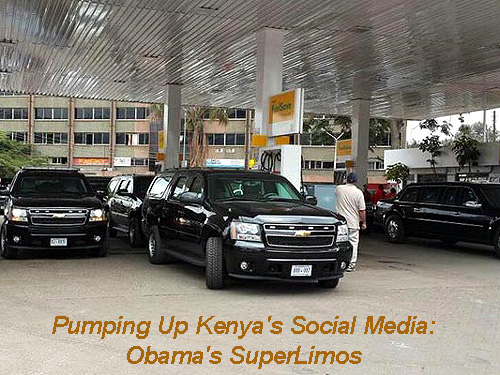
City roads – normally congested beyond belief – will be cleared for his motorcades. Social media is overflowing with pictures of his super limousines filling up with gas.

“We have filled the potholes, cleared the garbage, run the homeless street families out of town, aired the drapes, polished the crockery, beefed up security, and for the umpteenth time attempted to ‘beautify’ the landscape on the main thoroughfares into the capital city,” writes Nairobi commentator Gaitho.

The Right claims the visit is proof of Obama’s cavalier foreign policy: They wrongly consider Kenya more dangerous than Ferguson, Texas or Baltimore. And even if it were, better to thumb your nose at terrorists than cower inside Beltway fantasies.

Unshackled by the presidency Obama was outspoken when he came before, which he is not expected to be this time. It’s unlikely he will stake any controversial policy issues.

Many groups in Kenya are hoping otherwise, however, with large demonstrations planned for support of gay rights and separately, for the end to Kenya’s involvement in Somalia.

Both issues are American driven: it’s fair to say that the recent movement throughout all of East Africa to suppress gay rights is the culmination of a number of American programs and policies promulgated under the Bush administration.

It’s widely known here that Obama flip-flopped at least on the extent of his support of LGBT rights. The Kenyan gay community hopes that he will express that tolerance as rectification of a super power, not just as an individual.

Kenya would never have invaded Somalia in October, 2011, without enormous American hardware, support and training. The country has paid dearly for that, with numerous terrorist revenge attacks in 2012 and 2013.

Women Empowerment Kenya” is leading that charge, but has wide support throughout the country.

That’s the point, friends. Obama’s presidency has been so contained by a rightist Republican onslaught on his person and policies that everything he’s done in Africa has been behind the scenes. It’s not his choice to be limited to “symbolic” actions.

It drives me crazy the way respectable media call this visit “symbolic“ implying that he’s capable of more than. Much of the world – even in London – doesn’t understand how hand strapped a president can be by Congress.

The Somali war was never a legislated program in either the U.S. or Kenya, yet it is arguably the single most profound event to have befallen Kenya in modern times.

It was Obama strategy. I’ve often written that I felt it was a bad strategy and an even worse move done as secretly as it was. But the man believes in it, and he comes to Kenya owning up to it and undoubtedly to continue to support it.

The reversal of C-Street machinations in East Africa that so suppressed the gay community was also “behind the scenes.” Obama might reverse that with this visit.

Like all Third World countries, Kenya experienced a horrible crush albeit delayed a few years from the Great Recession. But that also came at a time of civil upheaval after the troubled and violent 2006/07 election, and then the Somali revenge for the invasion near crushed the spirit of the country with nearly continuous terrorist attacks.

All that seems behind Kenya, now. Somehow, this country has emerged if not renewed at least recharged. If Obama’s footsteps onto the country do nothing more than affirm this amazing resilience, it’s worth it … for both countries.

As for Ethiopia, one of the cruelest and most ruthless autocracies on the continent and with which the U.S. really has little in common, need I say more than that China has financed the world’s biggest dam here, one that could seriously stress the flow of The Nile?

At least Obama brings the U.S. to the table. To suggest the U.S. can ignore an issue of this magnitude is lunacy. Surely it’s worth the few hours stop scheduled.

So stop the complaining. I wish we could do more, but until we have more reasonable legislators in Congress, Obama’s doing the best we can.

Forming The World Order

Forming The World Order

bashiratsummitOne of the most difficult things for anyone or any thing to do is cede control … to give away your authority to someone or something else. South Africa did that, today, and the United States in an identical situation in March refused to.

In my estimation, this makes South Africa more modern, more moral and presents a future more promising than the U.S. The world is becoming increasingly interconnected and interdependent upon every part of itself.

A global society with ultimate authorities will some day be an absolute certainty. The societies which embrace this future and now work towards it will be the movers and shakers in it.

Those who refuse may decay.

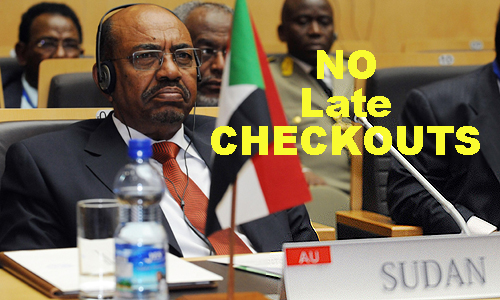
Omar al-Bashir, the dictatorial leader of The Sudan, was in South Africa earlier today attending the African Union summit in South Africa. A court ordered his arrest on an indictment from The World Court for crimes against humanity, because South Africa is a signatory to the World Court Treaty.

But minutes before the order was issued, Bashir jetted out of the country.

Bashir was in New York in March for the opening session of the United Nations. Although numerous organizations and individuals petitioned various U.S. courts to have him arrested, no court issued a warrant because the United States is not a signatory to the World Court treaty.

So he stepped onto a world stage and addressed the opening as all World leaders are allowed to do. He legitimized his ruthless rule. Obama could have cooperated with the World Court, even without a formal treaty, but he elected not to.

The situation in South Africa was not without controversy. Before The Court ordered his arrest, it ordered that he not leave the country while it deliberated the case.

The current government of South Africa headed by President Jacob Zuma was caught off guard, as it has continually been throughout Zuma’s troubled reign.

Having little choice but to play with the court that, in fact, has kept Zuma somewhat immune to the ramifications of his scandals, the South African government aruged that Bashir was technically not in South Africa, but in the nether world of the Africa Unity Summit, and therefore South African laws didn’t apply.

The Court adjourned for an hour at noon South African time after a morning of deliberation. In that hour Bashir was sped away from the summit in a black limo to a nearby South African airbase, where his plane’s engines were running.

He leaves behind him another Zuma scandal: Zuma heeded the call by the Court to deliberate the question, but essentially just ignored the earlier order to keep Bashir in the country until a decision was reached.

Bashir is under indictment by The World Court for crimes against humanity mostly in Dafar.

On Friday, the South African government urgently appealed to the court in The Hague to rescind their arrest warrant while Bashir attended the African summit.

Saturday, The World Court refused and a local South African court then ordered Bashir to remain in the country while it deliberated on numerous motions from South African citizens.

It’s not uncommon for Heads of State, including George Bush, to avoid international travel because of fear of being arrested in a foreign country.

Bush and Cheney avoided travel to Canada and Switzerland shortly after the end of the Bush presidency because of numerous lawsuits filed against them for the fraudulent war in Iraq.

Bashir has avoided almost all travel since being indicted, this because the majority of the world subscribes to the World Court. In March, however, he traveled to New York to address the opening session of the United Nations, having received assurances from the Obama administration that he would not be arrested.

The U.S. is not a signatory to the World Court convention, as virtually every African country is. Moreover, the Obama administration believes that peace in South Sudan is critical and dependent upon Bashir’s cooperation.

At the time, The World Court, which is a child of the United Nations but technically no longer linked to it, requested the UN to arrest Bashir. Ban ki-moon declined, answering that he lacked such authority.

It was a terrible travesty of human rights that Obama and Ban ki-Moon allowed the ruthless dictator to address the world assembly.

It’s arguably a greater travesty that President Zuma picks and chooses which court orders he will obey at home, but the overall situation and outcome in my estimation puts South Africa as a whole in a much more moral situation than the U.S.

Accepting authority is never easy. But without a world authority in the near future there will be no authority for anyone.

Should Obama Visit to Kenya Go On?

Should Obama Visit to Kenya Go On?

obama-kenya-2Obama’s end-of-July one-day visit to Kenya is causing as much controversy as Bruce Jenner’s to the New York Gym. Why?

People leaning left like Robert Rotberg writing in Politico have a litany of reasons topped by a presumption it’s too dangerous. To me that proves many on the left are as dangerously myopic as they claim people on the right are.

Those on the right see it as an opportunity to prove the birther theories.

Even many Kenyans are shocked by the cost and expected mayhem that will result from the single-day visit.

The White House announced the visit several months ago. The principle reason given was that Obama will attend the 6th annual Gobal Entrepreneurship Summit, which is traditionally hosted by developing nations whose economies are showing significant promise.

Like Kenya.

I think that announcing the date of his visit several months in advance is tempting fate, and I wouldn’t be surprised if his arrival an departure details changed at the last minute. But there are many diplomatic reasons that Obama needs to visit Kenya, now.

First is that he’s already visited Tanzania. Tanzania and Kenya are the Tweedle-Dee and Tweedle-Dum of East Africa, but security at least until recently has always been better in Tanzania if for no other reason than it’s a few hundred more miles from Somalia.

But visiting the poorer cousin scoffs the successful one and Kenya’s security has definitely improved.

At the time of the Tanzanian visit the president of Kenya was under indictment by the World Court for crimes against humanity. Those have now been dropped removing that very significant diplomatic barrier.

Kenya’s role in the “liberation of Somalia” and thus a necessary component of Obama’s pursuit of world terrorists was singularly important, entirely supported by the U.S. Kenya was in effect the U.S. proxy. It’s understandable Obama wants to validate this relationship.

After nearly a decade of monopolizing Kenyan investment, the Chinese have retracted somewhat. This gives the western world important entres they didn’t have just a year ago. Coupled with the GES conference, Obama’s hard-core reliance on capitalism necessitates he recognize this situation.

Finally, I’ve never felt Obama mastered his position of power as he should have. He will go down in history as a weak president. I’ve also felt his spirit was robust, it’s just that he was entrapped by the enormity of the institution. For example, he appointed Elizabeth Warren to oversee his most significant reformation of the financial system even while retaining as his closest advisors the people she is most critical of.

So, perhaps more hopefully than realistically, I see Obama visiting Kenya as a rebuff to his own administration’s ridiculously layered and duplicate travel advisories on Kenya. I know that tourists don’t have an extra $60 million to drop out for their security, but still, if the President can go, why shouldn’t you?

In some form esoteric or otherwise I think Obama wants to deliver this message.

So it makes sense, diplomatically and psychologically, and with the power of a reinvigorated CIA and chance changes in scheduling, a net plus for everyone.

So I’m certain it will happen. My ultimate source for this opinion is Mama Sarah, Obama’s step-grandmother and closest living relative in Kenya. He’s visited her before, but …

she expects him, again.

Stability at What Price?

Stability at What Price?

freedomprosperityAre freedom and prosperity at least somewhat mutually exclusive? Why is Africa so stable, today?

There is serious turmoil in Burundi, but in the major hothouses of death and destruction, Nigeria, Somalia and South Sudan, right now there is a remarkable level of peace.

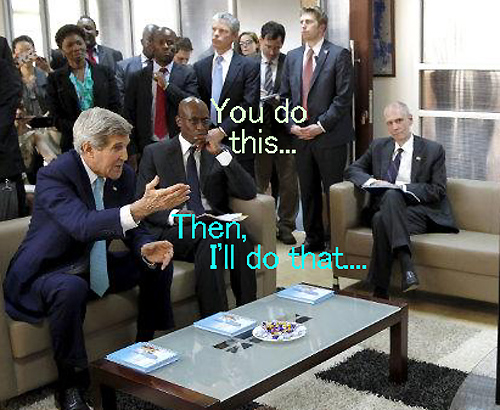
Tuesday, Secretary of State Kerry became the first high American official to visit Somalia since Blackhawk Down in 1993. Kerry justified his visit because Somalia “is turning around.”

There are many wonderful indications to suggest this is true.

There is worrisome fragility in the current Mali government, and troublesome weakness in a number of West African governments probably due to the prolonged ebola outbreak, but governments in North Africa and sub-Saharan Africa (other than Burundi) look strong and stable.
Why?

The answer is becoming clearer and clearer. Very strong military assistance mostly from the U.S. and France has propped up existing governments and laid to waste many areas of terrorism.

The starkest of the stark is Nigeria.

Literally for the last 5 years Nigeria was decimated by Boko Haram, at its worst situation (hardly a few months ago) ceding nearly 20% of its territory to terrorists.

Today Boko Haram is absolutely on the run. The explanation from one of Nigeria’s best media outlets:

“Unlike a year ago, when Nigerian troops would run away from Boko haram militants after running out of ammunition or for possessing inferior weapons, the Nigerian soldiers are now better armed, better equipped and better motivated.”

‘Better equipped’ is the understatement of the decade. The list of new equipment in the hands of Nigerian soldiers is astonishing, particularly when compared to the situation less than a half year ago.

It was not for wont of giving. The western powers were ready, as clearly demonstrated by the current situation, to arm the Nigerian military sufficiently. But a mixture of local politics and western hesitation because of the equivocal politics kept the ammunition in warehouses until now.

Legitimate concerns with protecting human rights were front-and-center in the paradigm that kept the previous Nigerian government of Goodluck Jonathan weak. These have been cast to the crows by the current president Buhari, a former general nearly imprisoned by his own society for human rights’ violations.

Ditto in South Sudan, the more “peaceful” Somali and ever more stable Kenya.

In addition to arming Africa to the teeth, Obama’s militarism these last six years has decimated terrorist cells and American drones have wiped out more than two dozen terrorist leaders.

Media freedom is a great barometer of authoritarian governments, since there has never been a government in the history of mankind that wasn’t vain.

Press freedom is under serious attack in … Nigeria, South Sudan and ever more stable Kenya.

So that’s the reason it’s safer than ever for you to travel to Africa: growingly authoritarian governments infused with western military might.

Regular readers of this blog will know that I’m troubled by this. I’m delighted that Africa is a calmer, safer, more stable place, but troubling if at the expense of freedom and the sanctity of human rights.

It seems that this age-old paradigm is near inviolable. Freedom and prosperity are at least somewhat mutually exclusive.

But wait.

Didn’t we try this, once? Weren’t there horrible South American generals and racist American governments and horribly cruel potentates that ruled the world for a long time not too long ago.

Did things get better? For whom?

Compromises Galore

Compromises Galore

KerryInKenyaBill Clinton, John Kerry, then Barack Obama, a sort of reverse greeting line that heralds the end of frosty relations with Kenya. Let’s call it compromises galore.

Politics is so damn slimy. I know how important Kenya is in Africa. I know how exceptional its youth, in particular, is and how imaginative its culture has become.

I know that in a future world, Kenya will be much more important than it is, today.

If I know it, then Bill Clinton, John Kerry and Barack Obama know it, too. The difference between them and me is that I don’t have to ignore the travesties of human rights that Kenya’s current leaders employed in their rise to power.

Uhuru Kenyatta should not be the head of anything except a mafia, and certainly his vice president, William Ruto shouldn’t be, either.

The two orchestrated horrible violence following the 2008 elections, ironically in part against one another’s followers. When the evidence for this was gathered then meticulously catalogued, and when the individuals supplying the evidence were sequestered under witness protection in Europe, not a man in the world – except them – denied it.

Then one by one the witnesses recounted or disappeared. The evidence dissolved. The two who had been arch enemies from different tribes that historically killed one another struck an alliance and were elected to lead Kenya.

The outcome, today, is that Kenya is prospering when many African countries aren’t. One could argue that the millennial enmity between the Kalenjin (William Ruto, the vice president) and Kikuyu (Uhuru Kenyatta, the President) tribes has been laid to rest.

The War Against Terror has been successful from the point of view of the United States, because the U.S. is much safer, because Kenya became the sacrificial lamb, invading Somali with American might and dollars and taking care of more than a half million refugees.

But Kenya doesn’t mind being the sacrificial lamb because the investment – much of it military – has raised it from the 13th to the 9th largest African economy in only five years.

I think Kissinger called this Realpolitik.

They’re happy. We’re happy. So why am I not happy?

I guess because in today’s world ends do justify the means. The timeline for this dynamic, though, is historically short. The longer a view you take, the less it’s true.

The machinations, manipulations, abject brutality and horror of Kenyatta’s and Ruto’s actions to achieve power have resulted in a more stable, prosperous Kenya and one that may even be tackling the most horrid affliction of emerging cultures, corruption.

Yet in accomplishing these lofty goals some very nefarious means were employed, among which is included sacrificing their own country’s peace and stability for America’s. The sale price was pretty good, though.

So as each level compromises to achieve something good by sacrificing a bit of morality, the ladder down to iniquity is built. It becomes institutionalized.

This logic is where I strike brotherhood with the Far Right… or the Far Left. It’s where compromise is bad.

Ultimately, I guess, it’s a matter of degree – how much you compromise for what ends – a very subjective exercise and who among us can judge whose subjectivity is correct? Me? Kerry? Uhuru? Bush?

Hillary? omg

Change of the Upper Hand

Change of the Upper Hand

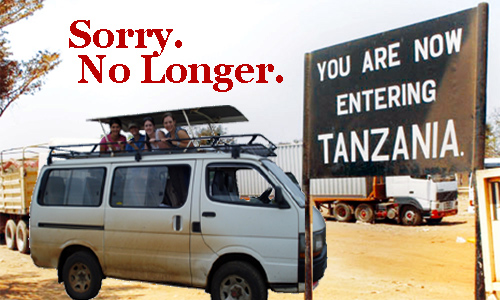
BorderClosesThe row between Kenya and Tanzania over tourism last week is a strong indication that Kenyan security has improved and tourists are returning.

This little tiff has absolutely no effect on any but the most budget-minded tourists.

Nairobi has 20-25 times more international airline service than Tanzania’s northern airport, Kilimanjaro. Deal seekers who bought a $200 better air fare into Nairobi than Kilimanjaro until Friday were able to fly into Nairobi, then arrange Tanzanian transportation from the airport into Tanzania with a net savings of about $100.

That’s over. If you want a safari in Tanzania, you now either have to fly into Tanzania or take Kenyan transport from the Kenyan airport to a bus station or other transfer point.

Travel and tourism pundits, always the poorest of pundits, exclaim that Tanzania has done itself a great disservice by stonewalling the negotiations over the last three weeks aimed at finding a compromise.

Sort of, but not really given the current governments.

Obviously any easing of travel restrictions anywhere in the world can increase tourism. This year, for example, numerous countries in southern Africa began easing the restrictions for travel between them. With this incident, East Africa is moving the other way.

Here’s the essence: Tanzanian tourism suffers any time Kenyan tourism is given an entre. This is because Kenyan tourism is bigger, better and less corrupt. I find this, by the way, remarkably ironic since my own assessment is that the Tanzanian tour product – i.e., the game parks – is better than Kenya’s.

But Tanzania has squandered its treasures more than Kenya has. This isn’t to say that Kenya is lily white, hardly. But the level of corruption in Tanzanian tourism is considerably greater. The actual laws on the books in Tanzania regarding tourism, conservation and game parks, are the most complex, messed up pile of regulations this side of Riverview Park in Chicago’s mafia days.

This discourages foreign investment and that, above all, keeps business actors in the Tanzanian tourism sector small, ripe for the picking so to speak.

If the two countries opened their borders to one another, Kenya’s much better run tourism sector could virtually subsume Tanzania’s. It’s one example of the virtues of well run capitalism. I can’t think of many, but this is one.

I don’t doubt that Tanzanians will be sorry about last Friday’s outcome. Above all it shows that Kenya feels increasingly confident about its own tourism situation. Kenya had been acting unilaterally by not enforcing the 1985 agreement, seemingly only to Tanzania’s advantage.

But in the recent dire days of terrorism in Kenya, any business they could muster was helpful. Now as things are looking, Kenya realizes it’s time to muster its advantages, recognize that the better air service and lower air fares into Nairobi are reasons travelers might choose Kenya instead of Tanzania for their game viewing safari.

So why make it any easier for them to go to Tanzania, than Tanzania allows its incoming visitors to go to Kenya?

The fact is, of course, that were Tanzania to get its house in order it would have no problem competing squarely with Kenya. At that point it would greatly benefit Tanzania to ease as many restrictions between the two countries as possible.

That day will come right after we successfully sell ski vacations to Saudia Arabia.

Muddled America

Muddled America

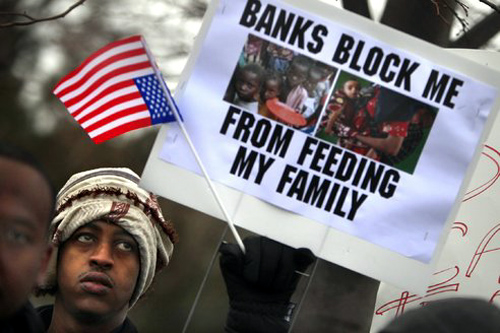
banksblockmeAnother bank stops money transfers to Somalia as American business continues to foment terrorism in The Horn of Africa.

As of this morning Merchant’s Bank of California will no longer process customer wire transfers to Somali .

This leaves fewer than a dozen mostly small banks left in the U.S. that still process wire transfers to Somalia.

I don’t know if it’s uncontrollable fear, explosive ego or just abject stupidity, but it’s so clear that this action will increase terrorism and any threats to America as a result.

According to Oxfam
, $215 million annually is sent by Somalis in the U.S. to relatives in Somalia, equaling or exceeding the total annual U.S. foreign aid to the country.

“… millions of Somalis … are dependent on this for their daily lives,” Degan Ali, the founder of a Somali support group in Kenya told Reuters today. “We’re talking about food, shelter, medical needs, education …” she explained.

I remember my own grandfather each Saturday wiring much more than my grandmother thought appropriate to his relatives in Croatia.

Large banks like Wells Fargo and Citibank stopped the service a decade ago, citing U.S. government regulation as the reason.

In a message last week to its intermediary agents, Merchants said it had received a “Consent Order” from the Department of the Treasury requiring new procedures to ensure that the wires did not end up in terrorist’s hands, and that the procedures were either impossible to comply with or to expensive to pursue.

So which is it? Is it the U.S. government incapable of managing a regulation that determines the numbers of zeros after “$5” used either to buy a month’s worth of cornmeal or a SAM missile, or is it the banks who just don’t want to be bothered by a few more checklists?

Last April two Congressman from Minneapolis where America’s largest Somali community resides, one Democrat (Keith Ellison) and one Republican (Erik Paulsen), introduced legislation in The House to clarify and simplify these regulations.

Guess what? Boehner and company dumped it as increasing government involvement in the banking industry.

In December Oxfam published a timeline of American regulatory agency involvement in this, documenting so clearly how confused and contradictory it is.

So whether it is messed up self-destructive ideology, or messed up poorly created regulation, or both, once again America is shooting itself in the foot.

There’s no question that too much money is getting into the hands of terrorists. But the significant conduits are Saudia Arabia and other of our allies! Not expatriates in Minneapolis or Los Angeles sending chip change to struggling relatives!

That presumption is the success of terrorism. There are so few American expatriate Arabs and Muslims who feel anything less than outrage against terrorism that I feel embarrassed every time I write this sentence! Americans don’t – or don’t want to – believe this.

So the system on all sides gets muddled, we make the situation worse and worse with cockamamy wars and stops on bank transfers.

We act against our own best self-interest. Isn’t that terrorism’s first objective?

Terrorists will never defeat America. America will defeat America.

Free Hate

Free Hate

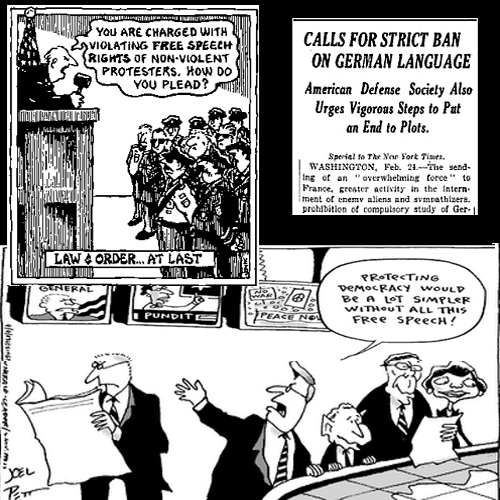
freespeechIs Charlie Hebdo hateful, and if so, should it be banned?

In the U.S. hate speech is constitutionally protected, but acts motivated by hate can be deemed illegal. It’s an extraordinarily complex if subtle distinction.

It’s not surprising that the political and religious leaders of Africa are near universally condemning this week’s European terrorism, but their societies are not expressing any such agreement at all.

Some of the most Muslim of Africa’s countries, including Morocco, Egypt, Mauritania and even Somali walked in lockstep with their condemnation of the terrorists but without, however, bringing up the subject of free speech. These and many more government statements seemed almost like they were all written by the same person.

But dig into social media and it’s a completely different situation:

“Discussions on social media are incensed,” Deutsche Welle sums up, today.

Moreover, government policy as opposed to government statements in Africa is quite different. The same governments above – as with almost all African governments – have strict laws against free speech.

In Egypt a person can be detained indefinitely whenever suspected of terrorism, and in Egypt today terrorism is defined as simple as speaking the words, “Muslim Brotherhood.”

In countries like Morocco where authoritative pro-western regimes are balancing a growing populist-Muslim movement, free speech and assembly is often banned and insults of the King result in imprisonment.

In less authoritative regimes like Kenya and South Africa, current legislatures are grappling with new laws that seriously restrict the press and other forms of free speech.

So don’t believe the government statements. I believe that Africans of almost all persuasions view the terrorism this week in France and Belgium as an understandable outcome of excessive “free speech.” The question is whether the outcome is worth it.

Free speech in Africa is a powerful weapon and those in power are unanimously wary of it.

With the less stable (Somalia), less developed (Mauritania) or more contentious governments (Morocco and Egypt), inhibiting free speech is used against Islamic militants because that same interdiction is used against any criticism of the existing regime.

With more stable and progressive governments like Kenya and South Africa, where political criticism is vibrant, the debate over Charlie Hebdo is quite unsettled. Earlier this week I wrote about this.

My own view is that we need to value the “worth” of hateful criticism. In an educated and tolerant society this value can be truly understood as an important test of free speech.

But in less educated and tolerant societies the value flips and reflects not a freedom but the oppressive power of the subjugator. Thems fighting words.

“Just like there is no such thing as unfettered capitalism, there is no such thing as unfettered free speech,” writes a New York muslim using an anonymous penname (touché!).

So when we as westerners condemn curtailments of free speech elsewhere, without criticizing our own hate speech/crime laws, are we simply claiming to have achieved the perfect standard … universally?

That’s the cardinal mistake of the West: presuming not just that they know best, but that no one else anywhere knows better.

It’s just not true. It’s not possible, and if we can excise this egoism from the argument, I think we’ll begin to empathize with the movers and shakers in the developing world who have very few riches to be taken from them, but enormous amounts of dignity.