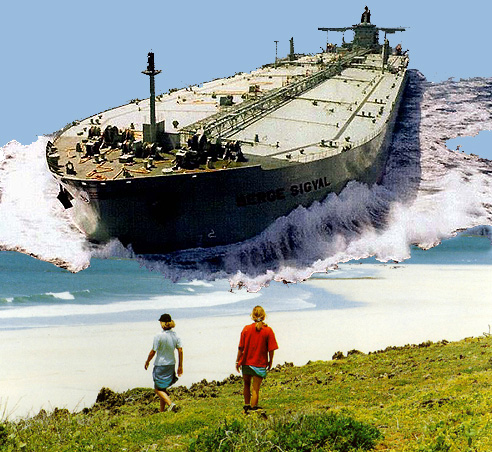
No more Lamu.Yesterday the Kenyan government invited you to replace the heavenly treasure of Lamu Island with Africa’s largest port.
Lamu, an ancient Arab kingdom and now a quaint beach retreat on the north Kenyan coast will become Africa’s second largest port in less than ten years, and shortly after that, its largest.
The half dozen paradise islands, the nearly two thousand years of quiet peace, the cars-prohibited stone streets, the sweet halva whose recipes have been passed down for generations, the white sands and azure seas will be replaced by supertankers and deep-water berths.
Oil.
Where oh where is cold fusion?
In order to get your piece of the $16 billion Chinese building fund, you have until October 15 to submit bids for:
– dredging 60 miles of coral reefs;
– plowing away several hundred miles of gorgeous sand dunes; and
– staking out the 1,000-acre port facility.
You can then submit bids for:
– surveying 800 miles of high speed rail from Manda Bay on the mainland opposite Lamu Island to Addis Ababa, Ethiopia, to Juba in the southern Sudan;
or, if you’d rather:
– help with Africa’s largest and longest steel pipeline from the oil fields of The Sudan to Lamu.
Any way you look at it, there’s probably a job in it for your nephew.
Those of us who have watched with wonder the highways being pasted down on our sleepy Africa over only the last few years have little doubt this will happen.
We also watch from afar – not far away in distance, but in memory already drowning in nostalgia.
We can’t stop this and shouldn’t. The government white paper Mr Cyrus Njiru, transport permanent secretary, presented last spring is no longer being scoffed at. There are real and live economists in the world who believe the development transforming Kenya will create Africa’s largest middle class in less than two decades.
Right now there is only one deep water port in all of the east side of this huge continent at Durban, South Africa. The three berths scheduled to come on line by 2020 in Lamu will place it second to Durban’s eight. But ten years later (2030), Lamu will grow from 3 berths to 16!
This is not just the mission statement of a not-for-profit that wants to end polio among bonobo. This is the life story of the Chinese, the society quickly becoming the biggest and richest on earth, but a society with little oil of its own.
It’s a race between Chinese consumption and laying pipe, concrete and rail through the deserts and war zones of Africa. And that’s a story in itself, because it might be the first time anyone’s done something that might really bring peace to this war ragged area.
Can you imagine ExxonMobile or preboom BP planning a project of such historic dimensions in Iraq or Afghanistan? Of course, not! In fact, they refused.
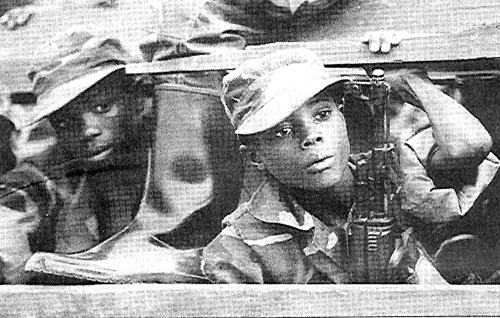
This area is probably much worse than Afghanistan or Iraq. The pipeline and edges of the highway will skirt into territory currently held by Al-Shabaab (Al Qaeda in Somalia). The pipeline will transect the oil fields that have contributed to more than a million deaths, many of them child soldiers, in The Sudan.
But the Chinese can’t say, I’m not sure this is safe enough. This is where they’ve found oil and where they control the rights.
I know this will happen. And I hope it brings peace. The Chinese – unlike the moralists in the west – can care less if women are stoned to death for burning the toast or ancient monuments are used to fill potholes. I’m not saying this offers a rosy picture of our next world society; it’s just the facts, ma’am. Chinese are the world’s ace capitalists.
They need oil. Fast.
Kenya’s figured that out and knows how to deliver.
For a price, of course. The price of prosperity. Less infant mortality for a few miles of paradisiacal coastline. Modern agricultural machinery to grow hybrid corn. Fiber optic cable to create Africa’s Bangalore.
Steel for anemones.
There will still be many wondrous places on the Kenyan coast. Just not Lamu, anymore.
American zoos could help stop the Serengeti highway.Call your zoo director now and tell him to “Support AZA’s resolution opposing the northern route for the Serengeti highway.”
Towards the end of this week, zoo directors, research coordinators and many other zoo employees will be heading to Houston for the annual zoo convention.
Concerned members are trying to get the momentum going to pass a resolution that will oppose the northern route currently staked out in the Serengeti for a highway. They are encountering great resistance among the membership.
This isn’t because there are members who support the highway, quite to the contrary. I doubt you would find a single AZA member who supports building the highway.
But it’s because the organization is so nebulous. The excuses I’ve heard range from “it’s not our responsibility” to “it will cause a backlash.” Both extremes are ridiculous if not arrogant and presume an unrealistic character of what AZA actually is.
Zoos, today, have morphed into wonderful institutions, so different from what they were when I was a kid. Many of my clients’ jaws drop when I say this, and I have to agree with them that watching a captive animal is not my cup of tea.
But putting animals on display, today, is becoming a secondary role for the best zoos. You would be very hard pressed not to find a zoo in America today, which doesn’t have something to do – some money invested – in the Serengeti.
Zoos are turning into wonderful research institutions. Their captive animal populations have become ever more precious as the world’s biodiversity crashes. They have unleashed a scientific potential that exists in their employees that is doing wonder in Africa.
So they, probably more than any other group of institutions, has a real and immediate interest in what happens in the Serengeti.
What is true is that their association isn’t a very good one. One part of their association, the SSP groups which manage marvelously the placement and movement of one captive animal with another across all zoo borders, is a work of genius. But, I’m afraid, that’s about it.
So it’s time they step up to the plate and make a concerted effort to evince their missions and their ideals. They must join a growing chorus of wildlife NGOs opposing the highway, and it will definitely help.
So please, call your zoo now. Ask to speak to the director, and you’ll likely be able to. If you can’t, get his email address after leaving a phone message.
We must stop this highway.
To read my other blogs about the highway, click below:
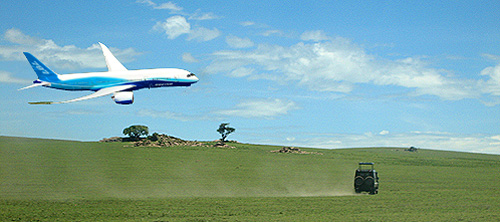
Will there be no American jets over Africa?Big Guy against Small Fry. Boeing against Kenya Airways. Heard this story before? But that’s America’s problem: looking only at the short-term.
Last week Boeing stiffed Kenya Airways. Should KQ stiff Boeing back?
Probably one of the most successful companies in Africa, Kenya Airways is ruling that continent’s skies right now, and into the far foreseeable future. It is Kenya’s – indeed, East Africa’s – largest company. Its story is awesome: in a mere decade from a no-nothing local airline to a major carrier:
Its list of awards and accolades stretches from the Economist magazine to Warren Buffet. The two that stand out in my mind are Travel News & Leisure’s designation of KQ as the “African Airline of Preference”, and the 2009 global Aviation & Allied Business Individual Achievement award to its CEO, Titus Naikiuni, a home-grown Kenyan. (That award was notable because it was the first time in its history that the African organization gave such a prestigious award to any airline company other than South African Airways.)
Currently, KQ is listed as a 4-star business class airline by Skytrax which is widely used by commercial flyers for airline comparisons. American and United airlines are currently rated as 3-star, KLM and Brussels (which compete with KQ into Kenya) are rated as 3-star, and KQ shares its 4-star business class status with British Airways, Virgin Atlantic and Emirates.
(Qatar is the only 5-star airline that flies into Nairobi.)
But KQ is small, still, albeit growing by leaps and bounds. So of the 886 orders for Boeing Dreamliner 787s, KQ had only 5 orders with 4 options.
As I’m sure you’ve heard Boeing has delayed for the third time the launch of its 787. This has disrupted the KQ business plan enormously.
So KQ wants some compensation in the form of a renegotiated sales price. This is standard. American Airlines which is ordering 42 had no trouble renegotiating. But to KQ, Boeing said: take a hike.
This is stupid. American industry is simply too big. It’s so big that it can’t see the future. It looks only at the present, and usually, only at other big things.
One day, certainly in my childrens’ life times, KQ will be bigger than American Airlines. But 50 years is just too far too look.
Boeing is cutting off its nose to spite its face. KQ is one of the very few airlines left on the African continent that uses Boeing instead of Airbus. Its partners and part owners, KLM and Delta, are almost exclusively Airbus. It makes double sense, now, for KQ to stiff Boeing and move to Airbus.
And if that happens, it won’t be KQ that suffers. It will be Boeing. Maybe not in the next decade, but with some luck, the world may last longer than that.
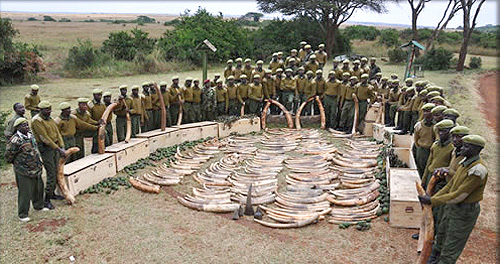
Last week's seizure of 150 tusks by the KWS.When times get bad, men get bad. But is the Kenyan government’s seizure last week of 150 elephant tusks the work of “bad men?”
Yes, for sure, if you believe that every law promulgated by man should be obeyed. The 317 pieces of raw elephant ivory (weighing 2 tonnes) and the five rhino horn were illegal cargo by both international and Kenyan law.
They were disguised in a container marked as avocados destined for Kuala Lumpur via Dubai on Emirates Airlines.
What’s interesting about this seizure made in Nairobi last week is that all the tusks and horns appear to be from animals that died naturally.
That leads to all sorts of other questions, of course. Is this an inside job, for instance?
Until now anyway, virtually all tusks and horns confiscated from dead animals were made by wildlife authorities. For one thing the park rangers generally know of the elephant and wild rhino that are ready to die, so they’re followed closely usually up to the very death.
And elephant and rhino die regularly to be sure. But the tusks from likely more than 80 elephants, and the horns from five rhino, means the cache was not collected quickly. At the very least we’re talking about a project of several years, and maybe more.
If it isn’t an inside job, then from my point of view these guys aren’t quite as bad as their counterparts who actually kill animals. And so far that’s what KWS is saying. It wasn’t an inside job.
Whoa. I’m not suggesting breaking the laws banning the ivory trade are sometimes OK. The point of the law is that any trade that occurs, whatever, generates a market that motivates more illegal trade. What I mean is let’s go a little bit lighter on the punishment.
Combing the bush for dead animals is a lot different than killing live animals.
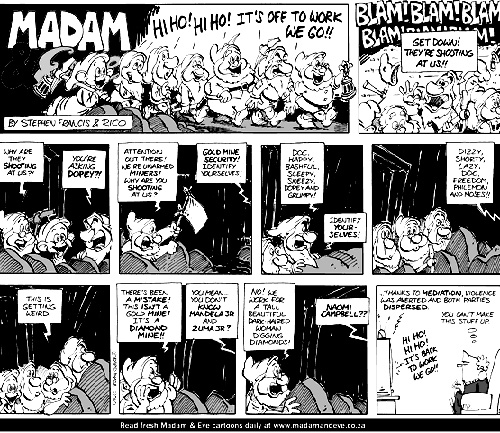
Yesterday’s popular cartoon, “Madame & Eve”, in Johannesburg’s Daily Mail: Naomi Campbell is a SA supermodel who gave blood diamonds to the head of a SA children’s charity, who hid them in his home safe for 13 years before admitting it.After a stellar performance during the World Cup, the turning fortunes of Jacob Zuma make many of us wonder if the South African presidency will be forever filled by wackos.
South Africa pulled off the World Cup like any grown up country; in fact, better. Infrastructure nightmares, mass strikes, insidious crime waves – didn’t happen.
Now it looks like it’s happening, and what we thought was Zuma’s deft handling of his country may just have been his ability to stick a very large finger into the hole in the dam.
Today is the tenth day of a national strike which threatens to bring the country to a standstill. Schools, hospitals, social agencies and even part of the President’s office are on strike. Late yesterday even the military threatened to join the walkouts!
Workers’ grievances have coalesced into a single demand: an 8.6% basic wage increase and a $130 monthly housing allowance. Zuma dug in his heals at 7% and $100.
So the difference isn’t that big; nowhere near as big as Zuma’s ego.
Zuma is best known as the president with twelve wives. That social embarrassment, though, was eclipsed recently by the revelations that Zuma’s family has profited from questionable government mining leases.
Now with twelve wives Zuma’s family extends over large parts of South Africa, but it’s a principal son who is principally involved this time.
This scandal follows Zuma’s pet legislative agenda this season: nothing to do with wages, housing or social justice. He is promulgating a draconian law that will suppress South Africa’s mighty and free press.
Zuma is the third president of the new republic. Nelson Mandela performed better than any of us could have hoped. The second president, Thabo Mbeki, fell into history as the leader who insisted that AIDS wasn’t a virus.
The interesting thing about both these guys is that under their weird personas appears to be some real talent. They both come from the ANC’s inner circle, were dedicated ideologues and have clearly formed a massive bureaucracy underneath them that is working marvelously.
Their approach to foreign policy, particularly with troubled Zimbabwe at their sleeves and massive illegal immigration, has actually received educated nods from around the world.
So what’s with this clowning around?
In Zuma’s case, his flirtations with the law are getting serious and begin to look like so many African leaders that take privilege beyond legislation. His close brush with conviction for rape (complexly linked to his polygamy) could be his ninth life, and as investigations proceed into the mining deals, he may be on the verge of the beginning of his end.
Freedom fighters are a strange lot of people. Nelson Mandela was the exception, and that’s probably why he was their leader. After a generation of fighting by rules that only a few make together, it must be hard to live in a democracy.
I expect until time sweeps away these old guys we’re going to get plenty of cartoons.
President Kikwete is digging in his heels about building the highway.Your voice against the Serengeti highway has attracted the attention of the most powerful in Tanzania. Unfortunately, he’s digging in his heels.
During an end of July live television speech to the country President Jakaya Kikwete said that “under no circumstances” will the government be deterred from building the road.
Kikwete doesn’t shy from the limelight, but most keen observers seriously doubted he would enter this fray. Whether the road cuts 40-50k through the neck of the Serengeti as planned, or is rerouted on a more lengthy route as we all would prefer, there are going to be very angry people, locally and foreign. Ethics, conservation and the Serengeti aside (be damned!), this is no good place for a politician.
So what’s his motivation?
I think I know, and I think he has a point (that he hasn’t made), and that point isn’t strong enough for him to really push this calamity through…
It’s already widely known that Kikwete is invested in the newest of the Serengeti lodges, the Kempinski Bilila.
If it weren’t for his intervention in the first place, this lodge would never have been built. It had initially failed to get the necessary permits from Tanzania conservation and wildlife authorities. Kikwete intervened.
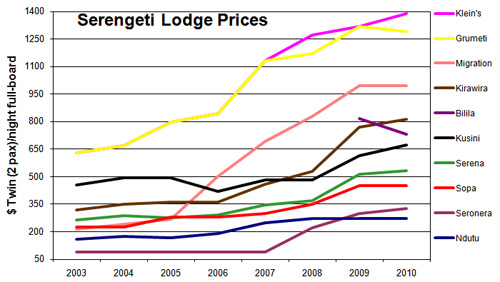
Counting Bilila, there are ten principal lodges serving the Serengeti.
Only one other property, Grumeti, joined Kikwete’s Bilila in the realistic drop in prices from 2009 to 2010. All the other 9 defied market indicators arising from the world recession.
Is Kikwete’s support for the Serengeti highway linked to a belief that the property companies monopolizing the Serengeti are out of touch with markets and need to be forced into greater competition less Tanzania tourism suffer?
Boy, is that giving the fellow the benefit of the doubt! But it’s true. All the other 9 properties have been around for many decades; several of them are approaching the half century mark.
And they all market as if we were in the 14th century. When the good times roll, they raise prices as we would expect. But when a world recession hits, they also raise prices or don’t reduce them. This half-baked theory is “be damned cash flow”, just maintain some modicum of profit.
Before reading on, take a look at the price comparison of the Serengeti Lodges shown just below, then drop down to continue reading. Based on average tour operator contract prices. For retail prices add 20-30%.
Raising prices in a declining market reduces cash flow but profits can be somewhat maintain by cutting off lots of operations.
Like jobs.
As much as a third to a half of Tanzania’s tourism employees in 2006 is currently without work.
Tanzania doesn’t have an unemployment security system. There are no legal inhibitions to just telling someone not to come to work today… or anymore. AND those poor folks collect no compensation from the state once “made redundant.” Tanzania has no safety net for the newly unemployed.
That’s the ouch of the policy, but the fact is that it’s a terribly poor business strategy, anyway. It’s a short-term fix and a long-term disaster.
All the training, operational achievements, marketing strategies suddenly hit a brick wall. And to regain them when things get better isn’t just a matter of rehiring those who were fired. That rarely happens.
Serena Hotels built and integrated a modern and very expensive worldwide reservations system in 2007. It took thousands of hours to implement. They adopted an imaginative “Active Senior” program around the same time with some target marketing.
EWT just used Serena Hotels in Kigali and Kampala. It was a nightmare. I personally was at the check-in desk in Kigali untangling a terrible mess. And they seemed to have dropped their “Active Senior” program, just at the time such a program would reap huge benefits: (If any market niche is immune to the world recession, it’s seniors.)
The much better strategy is to follow capitalist principals of supply and demand. Don’t loose your investment in people’s training or marketing strategies that remain viable, and get enough cash flow to see them through the hard times.
Lower prices.
Unfortunately, unlike pricing, we can’t get occupancy rates as they are closely guarded secrets. But there is much anecdotal evidence to suggest that while Bilila is probably the most luxurious lodge in the Serengeti, when it opened in 2008/2009, it drastically lowered its initial asking prices.
And then Bilila dropped prices from 2009 to 2010, to keep its occupancy constant. Kempinski won’t say, but the best anecdotal evidence we’ve collected suggests Bilila has achieved this strategy.
If true, Bilila is reacting to real market forces and maintaining a constant cash flow by doing nothing else than lowering prices. Whereas all the others are laying off staff, closing portions of their properties and extending off-season closures.
Bilila is new, well run, and managed to the current market. There hasn’t been any new lodge in the Serengeti for more than a decade since the out-of-the-way and hodge-podge configured Mbagaleti was built. Before that it was another ten years earlier when Elewana (luxury branch of Sopa Lodges) purchased and rebuilt Migration Camp.
Frankly, that was just fine by me and many, many others. The exclusiveness of the Serengeti is one of its principal draws.
But Kikwete has a point, even if he hasn’t expressed it. The old dogs controlling the existing lodges in the Serengeti: Serena, Sopa, &Beyond and TAHI, are rutted in savoring their monopolies. As with inflexible pricing, Kikwete may see the whole cartel is inflexible to any new notion, good or bad.
Alright, so I’ve made a point, and perhaps Kikwete has, too. But is it germane to this argument about the Serengeti road?
No.
I returned from Uganda, today, and one of the most glaringly obvious difficulties it has in rebuilding its national park system is that major thoroughfares cut right through their wildernesses.
Queen Elizabeth National Park is essentially bisected by a main road, and there are burgeoning little towns at every stop conceded not to be an actual national park proper. The stress on the area’s wildlife is huge.
The tarmac roads that crisscross the great South African reserve, Kruger, absolutely stunt its wilderness growth. Kruger has one of the lowest ratios of migrating herbivores to the rest of its animal population of any park in Africa.
Herbivores constitute the base of the mammalian food chain. It eventually feeds not just the lions but the gerbils and acacia.
Mr. President Kikwete, if I’ve struck a chord with you, let’s work this out another way. I’d be all for disinvesting the monopolies that currently control the Serengeti: Legislate the right for only a single property company in each unique reserve, for example.
But don’t kill the Serengeti. That’s the worst strategy of all.
The Dodd-Frank Act is our victory!Guess what? We won an important battle: The Wall Street reform act signed by President Obama this week regulates U.S. corporations using Coltan from the Democratic Republic of the Congo (DRC)!
There I discussed several of the great horrors of Africa : war, corruption, child soldiers and resource theft. All embodied in one main mineral, Coltan, used by electronic companies and principally to power PlayStation3.
The largest source of Coltan in the world is in the DRC, a lawless, governmentless jungle controlled by warlords who are becoming billionaires by selling Coltan to companies like Sony and Intel.
In a little noticed provision of The Dodd-Frank Act, the commission which must now be created for consumer protection is charged with drawing up rules that will prevent any U.S. corporation from buying any minerals from the DRC unless it can specifically prove that its payments are not being used for …
… war, corruption, child soldiers and resource theft.
Which… is impossible. Every dime paid for minerals that come out of the DRC goes to warlords.
We won. An important, obscure battle that few people noticed but which has such an incredible impact on Africans, particularly children, has finally been won by the power of U.S. capitalist law.
The law regulates “specific minerals obtained from sources in the Democratic Republic of Congo and bordering countries, which include “columbite-tantalite (coltan), cassiterite, gold, wolfamite, or their derivatives” and certain other minerals.”
These are the “conflict minerals” of which Coltan is the leader.
And with the “force of law” we suddenly have all these marvelous U.S. corporations acting as if they never wanted to buy Coltan in the first place:
In June when passage looked likely sneaky guru Steve Jobs announced Apple would never buy Coltan from DRC warlords. (He didn’t say they never had and there is every indication they have.)
Yesterday, Michael J. Holston, executive vice president and general counsel for Hewlett-Packard, said, “We believe this provision will help … reduce the purchase and use of conflict minerals known to fund the ongoing armed conflict in the .. (DRC), and thus help reduce some of the factors that have contributed to the civil war there.”
Right, Michael. HP has intentionally avoided vetting its microprocessor suppliers before now.
So don’t let all this gibberish take away YOUR victory. It was individuals like you, who contacted your Congressmen, organized by a huge coalition of proactive African organizations worldwide. It was a peoples’ battle that overcame the World Transformer Corporation.
We won. And there’s even more. After the U.S., it’s U.K. corporations that are the biggest offenders in the area. Boosted by the new U.S. law, a powerful world advocacy group, Global Witness, announced it would now sue the new Conservative Government to follow the U.S. law!
Now all we have to do is monitor the victory. The commission has 270 days to promulgate the law. And after that, only a U.S. Presidential degree that the conflict in the Congo is over will terminate the law.
Visions of a President Bush insisting there is no climate change or threats of off-shore drilling sets the stage, now, for the new battlefield. But the big engagement is over. We won!
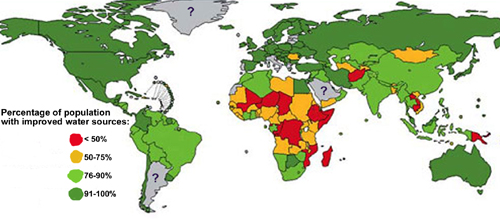
From World Heath Organization (WHO)This week as summer rains pelted the Midwest major battles for single drops of water were raging in Africa.
We take so much for granted and nothing more necessary to almost every aspect of our lives than potable water. That may be one of Africa’s top problems, if not the single-most urgent need.
All of us who’ve traveled Africa love the picturesque image of a colorfully dressed African woman balancing an equally colorful bucket of water on her head. There must be a thousand million paintings and drawings of this image.
But it is an image we ought not covet. It’s an image of egregious want.
According to Unesco one billion people lack access to improved water supply, the vast majority in Africa. Less than a quarter of the households in Africa have piped water supplies, and only about an eighth of the households in Africa are linked to a sewage system.
This week two completely separate events – one an individual judicial action in Botswana and the other a continent-wide political fight in Uganda – underscore the difficulties Africa is facing obtaining water for its citizens.
At the OAU Conference currently being held in Kampala, Egypt and The Sudan are fighting an East African coalition of countries over use of the Nile.
Egypt could not survive without its hoarding of the waters of the Nile. It is otherwise a desert. Today, there is not a single drop of water entering the Mediterranean from what was once the great Nile outflow. It is dry. Dust. Egypt needs more. More for people’s daily needs and more for growing food.
Prior to giving independence to a number of countries earlier last century, the colonial master, Britain, forced its soon-to-be-freed colonies in East Africa to agree that Egypt and The Sudan would control the Nile.
That 1959 treaty is now coming under fire at the OAU. Uganda, which controls the outflow of the White Nile mostly from Lake Victoria, and Ethiopia, which controls the outflow of the Blue Nile mostly from Lake Tana, have indicated they will abrogate the treaty.
And Kenya and Tanzania, which control large portions of Lake Victoria, have indicated they may do so as well.
East Africa needs lots of water. At the height of the recent drought, more than 5 million Nairobi area residents went on water rationing that averaged running water only every other day. According to East Africa’s Flying Doctors 70% of all the hospital visits in East Africa are caused by contaminated water.
And East Africans point out that the massive Aswan Dam (which Britain opposed being built, but long after having any influence in the region) loses nearly a fifth of all the Nile’s water to evaporation.
The solution presented at the OAU conference by Egypt and The Sudan is terrifying. Egypt is offering to build a canal around the huge Nile wetland known as the Sudd in The Sudan, which would direct Lake Victoria Waters directly into the Nile basin.
This is a temporary solution that could increase the Nile’s output by nearly 50%. But it will drain the Sudd, Africa’s largest wetland. The long-term consequences are mind blowing. We all know the incredible, devastating impact that draining wetlands has on any environment.
But the question is: potable water, now, for people; or a wetland for the future? The East African countries seem ready to accept the Egyptian proposal.
And at the other end of the continent, this week a judge in Botswana ruled that indigenous Bushmen would not be allowed to drill boreholes in their reserve to obtain potable water.
The argument is that in the reserve, as in similar places in Africa (like the Ngorongoro Conservation Area in Tanzania) the Bushmen have been given the right to pursue traditional life styles, but cannot modernize. Drilling a well is modernizing.
But modern Bushmen organizations are arguing that their life needs are paramount, and that denying water in a global climate changing world is a ruthless mandate, especially when Botswana’s meager water sources are being used by country clubs in Gaborone and diamond mines in the Kalahari, the Bushman’s traditional home.
Africa is replete with crises. But there seems none as urgent as this, yet with solutions as evanescent as an evaporating mist.
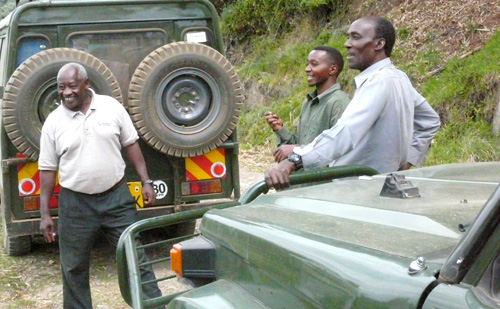
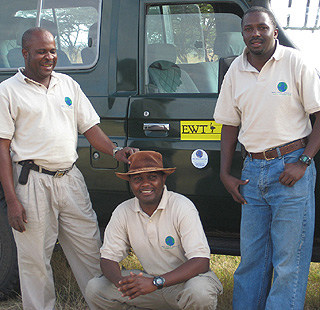
EWT Kenyan driver/guides James, Puis & Bonface.The planned strike this month by Tanzanian driver/guides has been called off. You didn’t know about it? Thank goodness!
I’m not one to oppose industrial action, almost anywhere. Workers of the World have taken a huge hit during my life time, while Managers of the World have grown fat on their sweat.
But I didn’t tell you about the planned strike of Tanzanian driver/guides – which was known since January – because I knew it wouldn’t happen. And if I had told you, it would have made things infinitely worse.
This was true of virtually everyone I knew who knew. So from the getgo, let me apologize for not telling you, but let’s just agree to put it in the category of not-wanting-to-contribute-to-an-economic-mess.
It’s a bitter/sweet story if ever there was one.
Had we all reported with gusto the planned strike, virtually every foreigner booked into Tanzania this season would have asked to book out of it (into Kenya, instead, for instance). We know the way travelers behave when an airline strike is announced.
And because of the terrible economic downturn that laid off more than half the steady, experienced driver/guide work force in 2008/2009, we all knew that if a strike were called, that there would have been no difficulty finding good replacements. Scabs are everywhere.
So… we all knew that if a strike were called, we could genuinely remark to our clients that it wouldn’t matter, or for all practical purposes, wouldn’t effect them.
While putting our good guys out of work… maybe, forever.
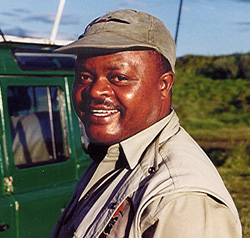
Tanzanian Driver/Guide JoyfulSo… we all knew that had we reported a strike, the dismal state that good Tanzanian driver/guides find themselves in today, would have become horribly worse.
It was – unfortunately, bitter-sweetly – a hollow threat. And.. That’s really too bad.
An unofficial “union” of safari driver/guides in Tanzania claims to – and probably really does – represent around 3000 men. This is likely around half to 60% of the steady workforce. It’s hard to know for sure, because only a handful of those thousands are permanently employed.
An East African driver/guide is usually paid by the job, or by the month providing there are a minimum number of jobs, and this has especially been the case since the economic downturn. There is a great variance in salaries, but I think a good guess of an average amount is about $200/month.
That barely reaches what’s considered minimum wage in East Africa, but the fact is that driver/guides are among the richest employees in East Africa because of their tips. A driver/guide who works 20 days can easily earn another $400-800 per month. (A recommended tip is about $10/client/day, although Americans often tip much more and Europeans much less.)
A good, steadily working driver/guide can easily pull in $6000/year. An outstanding guy can make double that and usually the worst of them make $2500. Compare that to a starting employee at the front desk of a major hotel in a city who makes around $500/month. Or a senior marketing (10 years + ) sales person in tourism who mans a foreign trade booth and makes around $1200/month.
So … it’s a good job. AND it’s an essential job for tourism.
There is a change occurring, now, in East Africa which is sidelining driver/guides. Like southern Africa there is a definite trend away from hiring a vehicle to drive you from park to park, to flying from camp to camp. I definitely don’t prefer this because I think a visitor loses a lot when they don’t experience the countryside between the sanitized, westernized game park camps.
And besides, East Africa lends itself to driving much better than southern Africa: the parks are much closer together than in southern Africa.
But the trend is there, in part because of the growing antipathy of foreign visitors with enough affluence to afford a Crater Lodge to driving over a pot-holed road next to open sewers. Nevertheless, this trend is not excessive. Driving in East Africa is here to stay as the main component of a safari for the foreseeable future.
Tanzanian Driver/Guide WinstonAnd the guys know it. They know that they are the reason a given trip is successful or not. There is a huge variance in how much these guys know : some are Ph.Ds, some are experts in plants others animals, some seem to know everything, almost all of them can fix a blown engine with a toothpick.
But their common denominator is an incredible affability that in a meaningful way introduces the foreigner to Africa. They become a traveling companion, not just a casual guide.
But this dynamic, strangely, has never included allowing the driver/guide into the same accommodation culture of their foreign guests.
The guest spends the whole day with the driver/guide, but after returned to the lodge for meals and overnight, they part ways. Driver/guides eat and sleep separately.
And only very recently have lodges and camps even agreed to be paid for driver/guides at the same rate as clients so that they can be with them in lodges and camps!
Yes! Isn’t that amazing? And this was true more often of the better lodges and camps than the more mainline ones. When we tried to enroll an East African driver/guide as a paid guest, we would simply be ignored. The invoice would be reduced, and only western names would be confirmed into the property’s tourist facilities.
That’s changing, but very, very slowly. This is racism at the core, both ideologically and geographically!
And to complicate matters, many driver/guides don’t want to sleep and eat with their clients. There’s two reasons for this:
First, it’s a relief to be extracted from a 24/7 job and given some down time with your buddies. But more importantly, they know the huge difference in costs. At &Beyond’s Crater Lodge in Tanzania, a retail guest pays $1065 per night while his driver/guide pays around $20.
And at Crater Lodge driver/guides get decent, clean accommodation and excellent meals for that $20. Understandably, if the cost of the safari increases by $1045 for that one night so that the driver/guide can have linen instead of paper napkins and two pillows instead of one, they would much rather get a bigger tip or be paid more. They need money for school fees for their kids, not chocolate mints on their turned-down pillows.
So, in fact, when I’ve tried to bring some of our own best driver/guides into the lodge experience, I’ve encountered huge resistance from them…. understandably. “Pay me more,” instead is the message.
So in a bitter-sweet way the separation of your most important safari component from you is now institutionalized in East Africa. So be it?
Well, not necessarily. Not when the accommodations are as horrible as some have become recently. There is a definite list in my head of the property companies who either never did provide decent accommodation, or that provided no maintenance to what existed before the economic downturn.
Some of the most egregious negligence is with mosquito netting. Those of us who live in East Africa don’t take malaria prophylaxis; over long periods it’s toxic. We rely on physical protection, like mosquito netting and bug spray.
Mosquito netting is about as durable as butter left out on a summer’s day. It easily gets holes, loses its tensile strength and opens up huge gaps. We travel with scotch tape and bug spray, usually, but sometimes the spray is very expensive and the holes too big.
Over the last few years, a number of property companies have been consolidating the bathrooms and showers available in the driver/guide dorm rooms. It isn’t that the existing 4 men/shower average changed – the buildings weren’t rebuilt – it’s just that when a shower or toilet broke, it wasn’t fixed.
As properties tried to manage the downturn, their food stores were one of the disposables that could be reduced. Driver/guides now seem to get the leftovers, rather than the meals planned specifically for them.
So it was no surprise in January that the “union” announced it would strike. And it was no surprise last week when the “union” announced it wouldn’t strike.
Has anything changed?
No. EWT Tanzanian Driver/Guides Adam, Dixon and Tumaini.
Clockwise from bottom left: Zita Kamwendo, Ranaf Makhani, Jimmy Masaua and Unnamed Herdsboy.It’s high school graduation time! A time for celebration, parties and boasting! Here’s a selection of graduates from Tanzania. I’d like to know which you’d like to meet.
These four kids have been born and raised in northern Tanzania, but their stories are replicated continent-wide.
Headed to the University of Cape Town’s engineering school is Jimmy Masaua. He won the top Cambridge exam award in geography. (The Cambridge exams are used more in Africa than SATs for college-bound students.)
Jimmy is destined for a busy career. Tanzania’s infrastructure is set for an enormously rapid development with the new discoveries of oil, gas and gold.
And Zita Kamwendo won the top Cambridge exam award in business studies. She’s headed to either Rhodes or Wits universities in South Africa and wants to become a lawyer. Zita is currently working at a hotel in Arusha, a city which has been growing rapidly and unlike so many cities, in a beautiful way.
Ranaf Makhani, in his own words, wants to be “The savior of Tanzania’s economy (possibly).” He was the top performer in the Cambridge exam’s economics division. He’s headed to the London School of Economics. Ranaf’s humor of “possibly” saving Tanzania’s economy is filled with truth. Many people believe Third World needs an economic revolution to stabilize.
And then, there’s the unnamed herdsboy.
There are probably ten unnamed herdsboy for every Jimmy, Zita or Ranaf. He’s nondescript. His name changes with his dreams. He doesn’t want to be an unnamed herdsboy, but he’s poor. He went to school for as long as his family could support him doing so, which wasn’t for long. There’s nothing glamorous about his life. He’s often sick and usually hungry.
But tourists want to meet him. Tourists want to meet him much more than they want to meet the truly promising kids: Jimmy, Zita or Ranaf. I’ve never understood this.
Africa’s young and well educated kids tower above their western world counterparts. No matter how privileged they may have been, how lucky to have been born into a family with some modicum of wealth, the efforts they put into their studies and upbringing are goliath compared to a typical American kid.
But who cares? Not American tourists. American tourists prefer to meet the unnamed herdsboy. They especially want to see him in his filthy village. After all if you can afford a safari, you probably have your own Jimmy, Zita or Ranaf.
The herdsboy agrees to meet tourists, because they sometimes give him food. Otherwise, he mostly covets their wealth, and then despises himself for doing so, and then becomes very angry.
Jimmy, Zita and Ranaf are destined for glorious futures well deserved and earned with an obsession that a typical American youngster might bring to PlayStation3.
Unlike Jimmy, Zita or Ranaf, the unnamed herdsboy is destined for a miserable, short life. Except for one possible career usually open to him. As a tourist, you wouldn’t want to meet him once he embarks on his job, so make sure you visit his village early.
Nairobi's famous cartoonist, Gado.I have little doubt that the Gulf Oil Spill may become the most catastrophic environmental disaster of my life. I hope it will focus your attitudes towards the Third World.
Caution: I don’t expect to get oil on my hands, or for my livelihood or retirement to be profoundly changed. Nevertheless, I know it will impact me in more serious ways than any other environmental disaster in my life time.
I expect this is true of most Americans. Those who live in the Gulf region will obviously be much more greatly impacted than I will, or those who farm sheep in Montana. But no other disaster – the Oakland earthquake, the Valdez spill, Mt. St.-Helens, Katrina, the Easter Sunday twisters, the Yosemite fires – will have as serious or lasting an impact.
It will likely have an impact on how I vote. It may even have an impact on how I shave or use lights at night.
This is major. Then, why, is there so little – if any interest at all, by East Africans?
The news has been duly reported. But there’s been no local comment, and not a single blog in a blogsphere that is hypercharged and overly active.
But there has been one, very important, cartoon. See above.
I think East Africans see America’s horror at the gulf oil spill as globally hypocritical and markedly irrelevant to their way of life.
Both these views are essential for us to understand. In no way am I suggesting that we should not be horrified by the spill; or that we shouldn’t change our ways because of if. But just for a moment, let’s see what this personal horror reveals of us to the Third World.
GLOBALLY HYPOCRITICAL
There are so many estimates flowing around right now as to the economic impact of the spill that it’s too early to turn the disaster into numbers. And I know the numbers will be huge. But you don’t have to be a statistician to make valuable comparisons with numbers in East African which are already known.
The gulf oil spill disaster will be hard pressed to reach the impact on Americans that the 1991 civil war in Somalia and subsequent rape and destruction of its Red Sea coast has had on Somalians.
Remember that the 1991 civil war in Somalia was a direct result of the end of the Cold War and the abandoning of East African states as proxies by the U.S. and the Soviet Union. We as Americans are responsible for that.
(Most of the details which follow were first published by Andrew Mwangura last week in Pambazuka.)
More than 200,000 fishermen have lost their livelihoods on the Somali coast, and the biomass of the world’s fifth most diverse fishery is being destroyed by illegal fishing by First World corporations and by illegal nuclear and toxic waste dumping in Somali waters.
The 200,000 fishermen were the bulwark of more than a thousand Somali coastal villages, which have been either eliminated or transformed into pirate villages increasing allied with al-Qaeda.
UN documents quoted by Mwangura report the first evidence of people dying from toxic waste dumping was in the village of Eel-Dheer in central Somalia when dark blue long barrels of a toxic material washed ashore in April, 1992, leaking an oily liquid. That was less than a year after the U.S. abandoned Somali following Blackhawk Down. Within a few years Eel-Dheer no longer existed. Everyone was dead or had left.
The UN analysis of the “oily liquid” confirmed that it was nuclear waste. Several other incidents have happened since, the latest in 2005.
In mid 1998 a 45km long and 5-7km wide oblong of dead fish washed ashore just south of Mogadishu to Warsheekh. Less spectacular but regular dead fish “oblongs” appear across the Somali, Eritrea and northern Kenyan coasts.
Further out to sea, but still well within the 12-mile international limit that theoretically still belongs to Somalia, ECOTERRA describes how First World countries are raping with impunity the rich biodiversity of the Somali Red Sea. Constrained by their own countries’ environmental laws, and even more often breaking international laws in an area unlikely to be well monitored, these vessels are decimating the Red Sea of tuna, mackerel, swordfish, grouper, emperor, snapper, shark, shrimp, rock-lobster, dolphins, sea turtles and sea-cucumbers. They have diminished the extraordinary population of dugong to near extinction.
According to ECOTERRA, the fishing vessels which have been systematically raping the Somali waters since 1991 (in order of greatest number) are from Italy, France, Spain, Greece, Russia, Britain, Ukraine, Japan, South Korea, Taiwan, and India.
Except for India, these are all first world nations.
According to the High Seas Task Force (HSTF), there were over 800 such fishing vessels in Somali waters at a single time in 2005. That year, High Seas estimated that more than US$450 million in fish value was taken from Somalia.
Surveys commissioned by the UN prior to 1991 in a larger report trying to document a peaceful Somali economy estimated there were 200,000 tons of sustainable fish per year that could be harvested from Somali waters. High Seas estimates that 300,000 tons is now being harvested annually.
(Hugh Seas, ECOTERRA and Mwangura make compelling arguments that current Somali piracy is essentially the former Somali fishing industry forced into attempts to control its rightful grounds.)
MARKEDLY IRRELEVANT
This is a lot easier to explain but harder to fully comprehend. Simply refer back to Gado’s cartoon above. Unlike us well off Americans, a person’s security in East Africa hardly exists day-to-day. Third World people are beset by so many problems that another natural disaster is simply not unusual.
They make do after earthquakes, revolutions and droughts, often in unseemly if creative ways. Kenya and Uganda have recently announced very promising oil and gas discoveries that the Chinese are developing at a speed unimaginable.
Japan has announced a $1.2 billion dollar project to build an oil pipeline from the southern Sudan to the yet-to-be built port (by the Chinese) on Kenya’s island of Lamu. (Or in place of the island, probably.) The risk for an accident or environmental catastrophe is much greater than for the more than 4000 oil rigs currently sitting in the Gulf of Mexico.
But it doesn’t matter. The cost-benefit ratio isn’t great enough to stop Third World peoples from doing anything they can to make tomorrow better than today. Cost-benefit is calculated in hours and days, not years or decades. It reflects an individual’s life, not the life of our planet.
Until the vast majority of the world, its poor peoples, see a future worth saving, the planet is doomed. And right now, their future doesn’t look very promising.
Watching the brown pelicans dying on a CNN short, I found myself viscerally effected by this spill in a way I hadn’t expected. I know that it will effect my life. So now take that feeling and try to imagine an East African who carries that feeling with him every moment of every day.
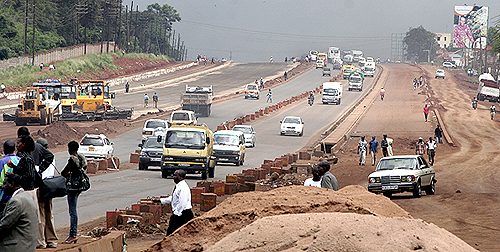
All (12-lane) roads lead to Nairobi.Three years ago China started building roads all over Kenya, including an 8-line highway between Thika and Nairobi. It’s now 30 miles of 12 lanes!
(Stop! Yes, the Kenyan wilderness away from Nairobi is still beautiful and healthy. You still will find lions in the Kenyan wilderness. Not to worry, there.)
In the few short years since the Chinese road building boom started throughout Kenya, the growth of the satellite suburbs has exploded. People saw roads finally being built (rather than the money for cement bloating the pockets of politicians) and began to realize they really could live cheaply outside the city and still work there.
It’s the same dynamic China has been grappling with for nearly two decades of incredible growth. I, for one, can’t understand how on earth it’s going to work, but I’ve heard that China is doing pretty well.
Once all these cars get to the city, what will they do?
Kenya’s main newspaper, The Daily Nation, reports 1000 new cars are being purchased to be used in the city EVERY MONTH.
I’ve written elsewhere how you have to avoid arriving Nairobi’s international airport on any weekday morning, because the traffic is so congested that it takes up to two hours to move a mere 11 miles from the airport to the city center.
That’s not going to change. The great roads that China is building simply feed into the city. There are plans for a ring road to circle away those cars not intending to come into the city, but most of them are trying to get into the city, not around it.
The city center isn’t big enough!
This seems like a massive failure of urban planning. I’ve questioned the Chinese motives, because they are combing Kenya for oil and other business opportunities. But then, again, did anyone see Shanghai recently?
Kenya’s President Mwai Kibaki returned from China’s expo with a commitment from the Chinese to build a new Kenyan port on the island of Lamu.
He called China “an important strategic partner.”
Hmm. That’s how Secretary of State just referred to Kenya: a “strategic partner.” Quite a phrase, that.
Kenya is on the threshold of a great decision. In two months the nation will vote YES or NO on a new constitution. Even getting to this point, of getting the Kenyan politicians to create a new constitution that in my opinion works well for the average wananchi was a Herculean task.
If it weren’t for the U.S., the U.K. and the EU, it would never have happened. This frontline of democracy and human rights bribed, cajoled and threatened Kenyan leaders until they finally… at the last minute … created a draft the population can vote on.
In fact when it seemed all was lost, good ole Kofi Annan jetted back into town to push the wayward leaders back on track.
So far, it has cost the consortium of good guys about $11 billion. And this is separate from ongoing initiatives like AIDS and malaria prevention, and separate from the several billion that poured into the country to stabilize it right after the political turbulence that followed the last election.
The west doesn’t want Kenya to fail. Why?
We say we don’t want Kenya to fail, because “Kenya is a strategic partner.” Untangle the myriad of meanings from that and you get to a fundamental core that “Kenya shares our values” which ultimately, of course, means that Kenya is OK with us dominating the world.
I’m not sure we would feel that way if al-Qaeda weren’t sitting next door in Somalia. We don’t seem to be quite as passionate about Senegal.
China, on the other hand, doesn’t give a hoot who is running Kenya or how they’re doing it.
“We don’t need lectures on how to govern ourselves. Lecturing us on issues that deal with governance and transparency is in bad taste,” Raila Odinga, Kenya’s current Prime Minister told Hillary Clinton last year. China never says a word about how Kenya should be governed, and certainly doesn’t care how transparent anything is.
The University of Nairobi’s Joseph Onjala warned Kenya’s leaders in 2007 that their presumption that China’s aid comes without strings attached was naive.
Chinese money is much less than the west’s : about a tenth, although growing substantially year by year. And Chinese aid is nearly all for infrastructure. The west’s aid for such important things like publishing and disseminating the draft constitution, propping up Kenyan development agencies, and unloading tons of consumables like food, is all very important nourishment for a developing society, but it doesn’t last… like a road.
China’s building roads all over the place, now. See my earlier blogs. It’s mind blowing. It’s building a Kenyan railway. They just signed a deal to help build a new port. Build-Baby-Build. Just now it’s transforming a bit: it’s becoming Drill-Baby-Drill.
The west’s aid comes with enormous accountability, a huge reversal from the free-wheeling AID giving of the Cold War era. No accountability whatever to China. Now from an efficiency standpoint, the Chinese would prefer to send their own workers to build the road, which they do, and it gets built. But a lot more cash comes into Kenya to “build the road” than it takes to build the road. And China doesn’t care where it goes.
Yesterday, President Kibaki granted China 6 of the 11 potential oil spots new technology believes might exist in the Kenyan desert. Yesterday, China announced that the world’s deepest oil well (5800 meters: about 18000′ or more than three miles deep!) has been completed in Kenya’s desert. It didn’t say if there was something found way down there.
The west sees Kenya as a strategic partner for its values.
China sees Kenya as a strategic partner for oil.
Do these two “strategic partners” have anything in common? Actually, yes.
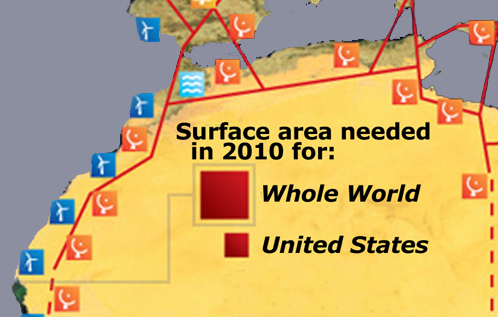
One thirtieth of the Sahara Desert can power the whole world.In 35 years Africa will be the principal source of power for the world, right?
Yes, according to a consortium of African and European governments with considerable capital funding from world companies like Siemens and classified technologies from the German Aerospace Center.
And several days ago, this “pipe dream” notion rocketed to credibility when an important German politician/businessman agreed to become its CEO. Max Schön is Germany’s Warren Buffet, entrepreneur and former President of the German Chapter of the Club of Rome. Tuesday, he agreed to take charge of the not-for-profit DESERTEC.
The secret is not photovoltaic cells, wind turbines, wave captures or nuclear energy, and of course not any new found deposits of fossil fuel.
The secret source of the world’s next generation of energy is CSP: Concentrating Thermal Power plants. Giant mirrors are placed in the deserts of Africa and capture heat to turn salt-water steam turbines. Not only does the world get energy, but Africa gets desalinated water.
European countries are considering an investment of one billion euros.
If for some reason a sand storm or freak cloud interrupts sunshine, the turbines switch over to using either or as a last resort fossil fuels to assure a constant, uninterrupted supply of power.
According to DESERTEC, while the costs are high compared to current power sources, they are much less than solar panels. So backers see this as the logical next step; not solar panels.
Siemens is deeply involved because this company builds the high voltage transmission lines needed to transport the energy from Africa to Europe. Siemens is right now building these special lines in China.
CSP plants aren’t a new idea. They’ve been used at Kramer Junction in California since 1985.
I’ve often remarked that Africa’s time will come when a new source of energy is found. Is this it?
All countries with a colonial history struggle with the psychological and economic impact of colonialism.
In many African countries, colonial masters empowered one people group over another and left a legacy of racial or tribal inequality that persists to this day.
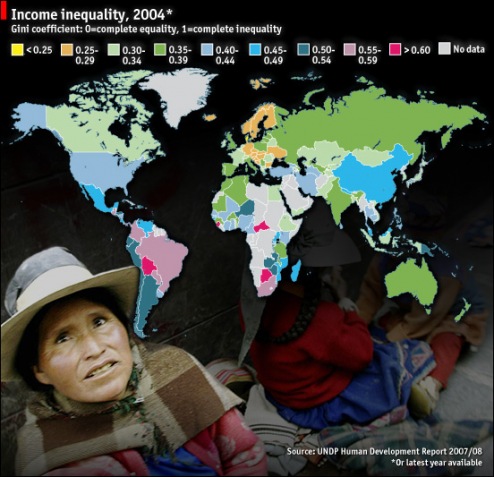
This legacy is particularly potent in South Africa, where the gap between haves and have-nots remains among the worst in the world.
Inequality Map 2004
Dealing with inequality is a complicated and emotional issue. As I see it, African governments can frame policies aimed at addressing inequality in two ways– righting old wrongs, or growing the economy.
This is clearly of the ‘righting old wrongs’ variety, much like the government’s efforts at land reform over the last decade.
In 2000, the government participated in the seizure of 110,000 Sq Kilometers of farmland for redistribution.
Many of these farmers were neither re-settled nor reimbursed.
These ill-fated land reforms further eviscerated the production capacity of the former “bread Basket of South Africa”, and their memory casts a long shadow over the present indigenous empowerment legislation.
The current manifestation of the Indigenization and Empowerment Act would require foreign owned businesses valued over US$500,000 to sell or cede 51% of their business to indigenous Zimbabweans.
It would also require all companies to “procure 50 % of all [their] goods and services… from a business in which a controlling interest is held by indigenous Zimbabweans.” (Text of Indigenization and Empowerment Act)
Businesses and investors are fleeing for the hills.
The head of a large German investment group, Andreas Wenzel, was quoted as saying that, “Prompted by the recently introduced regulations… the German-Southern African Chamber of Industry and Commerce in Johannesburg are putting on hold their plans to bring German investors to Zimbabwe”.
Contrast this with South Africa’s Broad Based Black Economic Empowerment initiative (BBBEE).
The Department of Trade and Industry claims that Black empowerment and growth go hand in hand in South Africa—”This will only be possible if our economy builds on the full potential of all persons and communities across the length and breadth of this country.”
While the ANC has been guilty of populist pandering in the past, I do not believe that this policy deserves that criticism.
The BBBEE in South Africa rates companies on a BBBEE scorecard, awarding points for the percentage of Black senior managers, owners, and employees, as well as awarding companies points for doing business with other high scoring companies.
If you want to do business with the government (a huge purchaser of goods and services in the South African economy), then you must score well.
In this way, the South African government uses their buying power to encourage companies to find qualified black personnel and business partners.
Even though claims of reverse discrimination abound, the South African government rightly understands that developing the human capital of the entire rainbow nation is crucial to the country’s growth and success.
Righting old wrongs by throwing untrained and under financed indigenous people on previously profitable land, or forcing shotgun weddings between foreign firms and potentially unprepared indigenous partners, will only make everyone poorer.