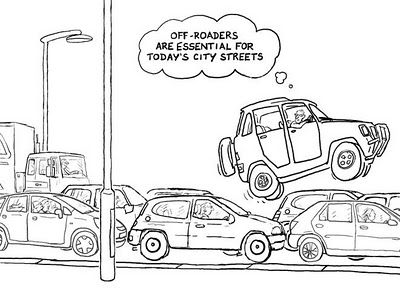
The Berlin Conference Continues to Plague Africa 125 Years After the Fact

The Berlin Conference Continues to Plague Africa 125 Years After the Fact

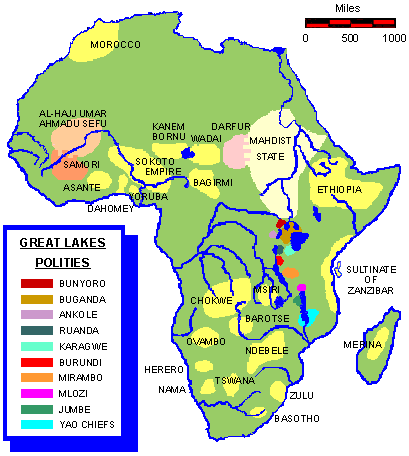
African Ethno-Political Divisions Before the Berlin Conference
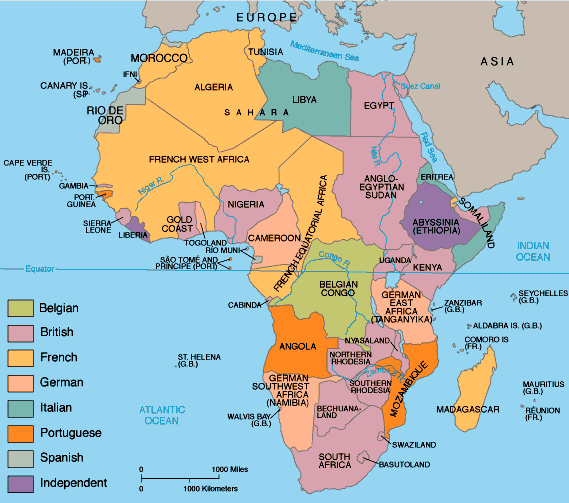
African Political Division After the Berlin Conference 1885

By Conor Godfrey

In 1884-85, European governments essentially drew a map of Africa on the back of a cocktail napkin in Berlin. This map carved Africa into a series of illogical states and spheres of influence that took little stock of realities on the ground and laid the framework for more than a century of civil strife.

Last week, the artificiality of the African political map was thrown into sharp relief by a series of tragedies.

Following the violence in central Nigeria, Muammar Gaddafi, well known for his misguided remarks and absurd costumes, suggested that Nigeria split into two states– one for the mainly Muslim North and one for the Christian and animist South.

On the other side of the continent, violence erupted in Sudan ahead of the planned referendum on an independent South Sudan.

Absurd borders are the rule not the exception in Africa. Europeans carved some of the great pre-colonial empires into unruly hodgepodges of people-groups who often lacked a shared history and had competing interests.

Look at the Gambia!

As the Europeans entrenched their rule, they imbued these imaginary lines with more and more meaning until state borders became faits accomplis. So what now?

The borders have created facts on the ground and there is no going back.

Mr. Gaddafi suggests Balkanizing the state(s) in question and equitably sharing resource wealth.

He uses the separation of India to substantiate his argument, but conveniently omits the ensuing civil strife and eventual civil war that took the lives of hundreds of thousands of people in that region.

He also appears to forget the previous attempt by the Igbo people to form their own state in South Eastern Nigeria. This event led eventually to the brutal Biafra-Nigerian war.

If Mr. Gaddafi wanted to partition every state in Africa that contains people groups deeply divided by tribe, ethnicity, or faith, he would quickly run out of fingers and toes.

This strategy would make more sense if religion and culture were truly at the core of these conflicts– but they are not.

Grazing rights, water rights, and land rights.

Access to political power, access to education, and access to jobs.

These are the flash points that drive conflicts in Africa.

Religion and culture will only fuel conflict when trampled on.

Even denying people a place to worship or undercutting some other important aspect of cultural identity rarely boils over into large-scale violent conflict unless people fear for the economic rights I listed above.

As conflicts persist, people tend to re-characterize resource based conflicts along ethnic or cultural lines, but I think that solving the resource and power-equity issues at the core of a dispute will eventually succeed in neutralizing the ethnic component.

The most effective way to deal with the fallout of the Berlin conference would be to strengthen regional bodies. ECOWAS, SADC, COMESA, even the Arab League, and especially the African Union.

This will build regional and continent-wide capacity to enforce treaties, mediate between parties, commit peace-keepers to patrol sensitive territory, and knock heads together when necessary.

Currently the various regional groupings in Africa play an important but limited role. I think this might be changing…

While ECOWAS’ response to the recent slew of coups in West Africa drew criticism from some quarters for its inconsistency, its mediation eventually proved crucial to diffusing tensions.

SADC’s attempt to mediate in Zimbabwe (spearheaded by South Africa) has not had the desired result thus far, but even the lack of progress demonstrates the need for a regional body in Southern African with more clout.

Regional stakeholders in ECOWAS urgently need to enter the scene more forcefully in Nigeria. Perhaps Burkina Faso’s Blaise Compaore could build on his successful mediation in Guinea and the Ivory Coast by wading into Nigerian politics.

The upcoming elections in Sudan will also offer the African Union a chance to prove its worth.
Is Guinea Ready to Exploit “A World Class Monster” Iron Ore Deposit?

Is Guinea Ready to Exploit “A World Class Monster” Iron Ore Deposit?

simandouSimandou_environment_25_rdax_100x150

By Conor Godfrey

The feasibility studies are complete.

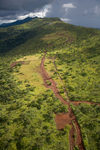
The ore deposit in Simandou, Southern Guinea, is 66% iron (high quality), and is likely the largest undeveloped iron ore deposit in the world (110 km).

One stockbroker interested in the project was quoted as saying– “It’s a world-class monster.”

Over the next several years, mining giant Rio Tinto, in conjunction with state backed Chinese mining conglomerate Chinalco, will spend an initial 6 billion dollars developing the necessary infrastructure to extract Simandou’s ore.

According to Rio Tinto executives, this infrastructure will include a trans-Guinean rail line from Simandou to the coast, a new deep water port South of the Capital Conakry, and of course, the infrastructure surrounding the mines themselves.

As Guinean officials were cleaning the drool off their desks, Rio Tinto announced that the Guinean government stood to reap 200 million dollars in tax revenue from the first few years of operation with a proportionally higher rake as mine output increases.

This is more money than all the other concessions in Guinea generate combined.

I hope and fear in equal measure.

A trans-Guinean railway would increase Guinean commercial capacity by leaps and bounds.

The announcement also refocuses attention on the transition authorities promise to hold democratic elections this June.

How serendipitous would it be for the newly elected government to have 200 million extra USD to jump start social programs and convince the population that a civilian government will indeed make their welfare a priority?

(See “The Coup d’Etat is Back” for the other possibilities.)

Watch this Rio-Tinto video for a grandfatherly manager’s take on the benefits of Rio Tinto’s giant mine.

While I acknowledge the vast potential for social improvement this deposit offers, my sense of déjà vu is disconcerting.

The presence of mining giants in Guinea dates back to the mid-1980s (1996 for Rio Tinto). How much has Guinea’s overall social welfare improved since then?

Negligible, if at all.

Ideally, the Guinean government would be a relatively clean, efficient organization capable of speaking with one voice, striking hard bargains with the mining companies, and implementing effective monitoring and legal safeguards to ensure that the money flows into government rather than personal coffers.

I expect the Ghanaian government to perform in this fashion when they start producing oil at the end of this year.

Alas Guinea is not Ghana. Instead, Guinea occupies the 168th slot out of 180 on Transparency International’s Corruption Perceptions Index, the government is riddled with internal divisions, and mining revenue historically has financed homes in France rather than roads and electric grids in Guinea.

Do not mistake my apprehension as opposition to private sector development or resource exploitation.

I believe in the private sectors’ power to transform developing economies. I also believe that mineral resources, in consultation with local authorities and relevant environmental groups, should be exploited in a mutually beneficial way.

Yet, the current dynamics inside Guinea make this almost impossible. Rio Tinto’s mission is to satisfy shareholders—not to transform the culture of corruption in Guinea.

Currently, Rio Tinto’s PR and social responsibility departments are making all the right noises.

I have no doubt they will build a few schools and health clinics, offer several thousand local jobs, and hopefully make good on their promised trans-Guinean rail line.

Yet, I fear that generations from now when Guinea gets up off her knees and stands ready to use her natural bounty for the benefit of all Guineans, the wells will be dry, the mines stripped, and the foreigners gone in search of more low hanging fruit.

To avoid this, civil society, NGO’s, commercial partners, and donor countries should begin a full court press on Conakry to make government finances more transparent and ministers more accountable before the revenue from Simandou begins pouring in.

I will even make the naïve suggestion that civil society should force the government to draw up transparent development priorities, and then in conjunction with Rio Tinto, hire a credible outside auditor to report on how mining revenue is being collected and spent.

This would make far more difference to Guinea than a handful of schools or rural health centers.

Related Reading:

Rio Tinto’s Website devoted to the Project.

What To Do With All These Ex-Combatants?

What To Do With All These Ex-Combatants?

What Next?
What Next?

By Conor Godfrey

A friend of mine currently serving in Liberia recently related the following story about his friend Abdoulaye.

Abdoulaye’s store was robbed for several hundred US dollars.

After hearing the night watchman’s account and looking into the evidence, Abdoulaye concluded that the burglar had military training and was more than likely an ex-rebel from Liberia’s long and brutal civil war.

If anyone could recognize this, he could—being himself an ex-commander under Charles Taylor.

This story was related to me on the same day that I read about ex-combatants in the Congo who had been integrated into the Congolese military and were now extracting more from Congolese mines as soldiers than they ever were as rebels.

This is a real problem.

28 African States have been involved in at least one major conflict since 1980 and the continent is awash with former combatants.

Their resumes include weapons training, brutality, and a large network of similarly credentialed co-workers, but usually lack the skills to transition into civilian life.

Despite these challenges, so-called success stories abound.

USAID and other websites tout programs emphasizing job training, basic literacy and numeracy, psychological counseling, and a bevy of other seemingly logical steps to re-integrating militia members.

Even in Liberia, polling data suggests that the majority of ex-combatants feel accepted in their families and communities.

I believe that many of these programs do indeed help break the cycle of violence, but they are not a panacea.

Ex-Soldiers from Liberia and Sierra Leone were at the core of the group that massacred and raped demonstrators in Guinea last September.

Former combatants from other conflict countries now run criminal syndicates and extortion rings like those in the Congolese mines.

Policies surrounding re-integration send mixed signals.

The ICC spends millions of dollars attempting to convict officers at the same time that various truth and reconciliation committees try to make communities forgive and move forward.

These proceedings are further complicated by how national governments, local communities, and the international community view the combatants in question.

How politicized were the combatants?

How legitimate were their grievances?

Were they a legitimate resistance force like Umkhonto we Sizwe in South Africa?

Were they convicted of widespread atrocities like the Lord’s Resistance army?

Were they mild Islamists like the FLN in Algeria, or extremist members of Al-Qaeda?

Or maybe they were more like criminal gangs than armed forces.

Creative solutions exist.

In Saudi Arabia, Islamic radicals and their families are forced to attend classes taught by moderate Imams.

Next, they are given a dowry so that they might marry and become a stakeholder in a more moderate society.

In Liberia, the national commission in charge of disarmament and reintegration provided educational and vocational training to those willing to take it.

In Mozambique, combatants were paid a small stipend each month for 18 months so that they would not be a drain on their families or need to resort to crime.

In Sierra Leone, some former rebels were given motorcycles and licensed as moto-taxis.

Most countries employ a mix of vocational training and community based education programs designed to pave the way for former soldiers to come back home.

As conflicts in Sudan, the DRC, Nigeria, and elsewhere end (inshallah), regional and local actors need to have a plan in place to turn these traumatized young people into a productive force

General Macarthur said that “old soldiers never die they just fade away”–

There are worse things.

Guns, Germs, Steel, and Internet Access

Guns, Germs, Steel, and Internet Access

internet3
By Conor Godfrey

If you believe Jared diamond, geography gave certain parts of the world a first mover advantage that has exerted tremendous influence on world affairs from the dawn of agricultural societies to the present.

Around 8500 BC, the Fertile Crescent had 32 large seed grasses that lent themselves to rudimentary cultivation; Sub-Saharan Africa had 4.

Around the same time, Eurasia boasted all five of the important domesticateable animals while Africa had none.

In 2009, 74.2 % of people in North America could access the internet while 6.8 % of Africans could.

Guns, germs, steel, and internet access.

The internet’s growth in Africa will make this millennia old advantage as insurmountable as the guns that held the continent hostage in the 19th century, or it will be the great equalizer.

This process has already begun.

What do you do in Kenya if ants start eating your potato crop?

Well, you get on the Internet and learn that sprinkling wood ash on the plants will drive the ants away.

A “wired Imam” in Mali uses the Internet to promote tourism at Mali’s famous mud mosque in Djenne.

Some East African seamstresses receive orders via email.

My favorite thing about internet access is that it puts the onus on the user to take advantage of available resources as opposed to waiting for someone else to actualize their potential.

If you let your mind dwell for a moment on the social, political, and economic consequences of widespread internet use in Africa you will become dizzy.

What if protesters in African states could use web-based social networks like the Iranians?

Or if pictures of vote rigging in Benin made the rounds on youtube as fast as those of Burmese monks being beaten by security forces?

Access to micro-credit services like Kiva would skyrocket.

Banks and business records could be digitized.

The diaspora could lend their experience back home.

People could access legal information and use the law to their advantage.

Early warning systems for natural or manmade disasters could be improved.

People could learn languages, apply to international universities, and access an infinite variety of training materials online.

Officials would be scrutinized by a media with more access and resources.

I have to stop. I have gone and made myself dizzy.

All this is happening already but the pace of change will accelerate exponentially as more people get online.

So where are we now?

For the 60-100 million internet users in Africa (hard to figure when internet cafes account for much of the use), connecting remains slow and expensive—but this is changing fast.

From 2000 to 2009, internet access in Africa grew by well over 1000%.

Recently, a rash of privatizations in South Africa and elsewhere combined with infrastructural improvements to put more than 10% of South Africans online!

Surprised?
Surprised?
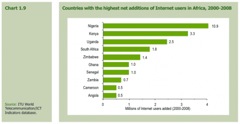
The chart on the left breaks the growth in internet usage down by country.

Projects like One Laptop Per Child and their competitors are striking deals with governments in Nigeria and Libya.

In rural Kenya, Google currently finances engineers from the University of Michigan to install small solar powered satellite dishes to connect villages to the web.

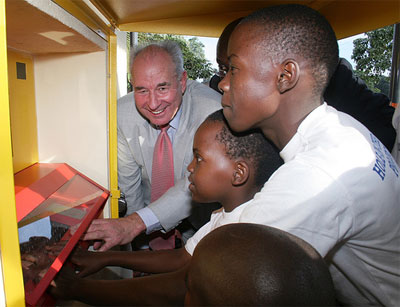
I am particularly impressed by the “hole-in-the-wall” learning centers inspired by Dr. Mitra’s success in India. He proved that children can teach themselves how to use the computer/internet without any supervision or guidance. Hole-in-the-Wall projects are now underway in Uganda.

The Next Generation of African Internet Users is On Their Way

Within a few generations these projects and their progeny will connect almost a billion African consumers/producers with the rest of the world

Geographic determinism be damned. The information age might just level a playing field that has not been level since 8500 BC.

Related Reading:

Mobile phones might be the best route for African internet users.

OnSafari: Carbon Congestion

OnSafari: Carbon Congestion

Dar's Carbon WheelPrint

Kenya’s President Kibaki has advised the developed world’s working group out of the Copenhagen climate summit that the Third World wants carbon credits for protecting its forests.

OK. And carbon debits, then, for their fuel inefficient commutes.

My first four days on safari were spent on business in the capitals of Nairobi and Dar-es-Salaam. I have meetings, go over the upcoming safari itineraries, meet friends and shake jetlag. And as I’ve written before in this blog, I never arrive except at night, because of the horrendous traffic.

I arrived Nairobi Thursday morning at 7 a.m.

This was not my fault, but American Airlines’, who had twice canceled my flights out of Chicago, first to Paris, and then to London. I arrived a day late, had to squeeze everything into a shorter time and had no choice.

And once again, it took us two hours to get from the airport to the Norfolk Hotel in downtown Nairobi, a drive that would take me 20 minutes when returning to the airport very early Saturday morning to fly to Dar.

But I have to admit I had no idea of how bad the traffic had become in Dar. It was Saturday morning! The commute from the Dar airport to The Retreat in the embassy “slip” area took two hours. And it’s a much shorter distance than from the Nairobi airport to the Norfolk. At times my cabbie simply turned off the engine and we would sit, encased by 18-wheelers, for 15 or 20 minutes!

Not my cabbie, or the 17-wheeler (one of the left rear wheels had disappeared) or even the put-putting dark smokey motorcycle was fuel efficient. In fact, these are the most fuel inefficient cars on earth.

Can you imagine the waste? I would look into the faces of the poor folks on buses and remember my conversation with the porter at the Norfolk who explained he had to get out of bed each morning at 3 a.m. to get to work by 8 a.m. He then left at 5 p.m. and would not get home until 8 p.m.

What an incredible waste, not only of carbon, but of human resources. I often hear Africans defending their agonizing struggle into development with the history of the developed world itself. “But think of your own Wild West,” the argument goes, “there was a lot of waste and graft back then.”

Yes, that part’s true. But it didn’t take Wyatt 2 hours to get to his sheriff’s office in a Corolla running on two cylinders.

The Coup d’Etat is Back

The Coup d’Etat is Back

Clattering Coups
By Conor Godfrey

Anyone who followed African news in the 1960s, 70s, or 80s, would be forgiven for thinking that a coup d’état once every five to ten years was written into West African constitutions. Yet, like small cars and women’s boots, shooting your way into the presidential palace is back in style.

Last Thursday in Niger the Supreme Council for the Restoration of Democracy followed in the footsteps of neighboring Guinea and Mauritania by seizing democratically elected President Mamadou Tandja at gunpoint.

So why are West African governments falling like dominoes? Oil and drugs.

I do not mean to ignore the host of possible global and local factors that may also bear some responsibility (global downturn, commodity prices, localized disputes), but I think we are seeing the first bubbles of instability rising from a torrent of illicit cash derived from the drug trade and the prospect of mind-blowing oil profits.

Drugs first: For some time predominantly South American drug cartels have been using weak West African states as transit points for Europe-bound product. Guinea-Bissau has the honor of being labeled Africa’s first “Narco-State,” but its southern neighbor, Guinea-Conakry, is in contention for that dubious distinction.

In 2009 the Guinean government exposed “drug labs” in Guinea used to facilitate this narcotics trade. That same year a smuggling ring involving former President Conte’s son was shut down in the southern city of Boke.

According to the Center for Strategic and International Studies, drug cargoes make the trip from coastal countries by convoy through Mauritania to Niger and beyond.

Notice that every country along that route has experienced a coup in the last two years. The revenue streaming in from cartels to corrupt officials dramatically alters the calculus of those in power and those who would see them ousted.

Let me put the problem in its appropriate financial context: when I worked in Guinea as a teacher I made $220 per month. This dwarfed the official salary of my Guinean principal and roughly equaled the official salary of his boss the superintendent. Imagine what a South American drug cartel could do with several thousand dollars, or several tens of thousands? It would be a tag sale of epic and disastrous proportions.

Oil: Experts predict that the Gulf of Guinea will soon account for 7% of the world’s total oil reserves. Exploration is underway in all but two West African countries (Burkina Faso and Cape Verde), and Ghana will become an oil producer as early as the last quarter of this year. Oil money, much like drug money, lends itself to secrecy and corruption.

Could the prospect of such easy-to-pocket money underlie the recent decisions by several West African leaders to stage ‘constitutional coups’ by amending their countries’ constitutions in order to serve additional terms? Nobody wants to leave office the year before money literally starts exploding out of the ground.

There is blood in the water, and the sharks will not be denied. The coup d’etat is back in vogue, and investors and policy makers should expect this fad to last through the season.

Related Reading
This instability map of Africa also shows the location of significant mineral extraction points. The correlation between mineral wealth and instability jumps out immediately. Imagine what might happen when oil-producing icons start to pop up all over West Africa? If you are more of a concrete thinker, just look at Nigeria.

Would you like a zebra or a petunia?

Would you like a zebra or a petunia?

zeb flowersOr both? Animals are being frantically transported out of the Kenyan cut flower farms back into Amboseli National Park.. pretty much under the radar.

Wednesday, the Kenyan Wildlife Service (KWS) began a massive relocation of nearly 7,000 animals into Amboseli National Park. KWS has issued no press reports on the move and there are growing suspicions that it may be haphazard and poorly managed.

According to Simon N’Donga of Nairobi’s FM Capital Radio, the animals are being trucked from the Great Lakes area back to Amboseli. Thousands of herbivores had fled Amboseli during the last dry spell, and this would have been a decent place for them to have fled.

It’s where Kenya’s cut flowers are grown for export.

Last August I watched dozens of zebra, wildebeest and giraffe lining up on the edge of the dangerous Nairobi/Mombasa highway, frantically trying to leave the areas south of Nairobi where the drought was serious. Similar reports came from the Nairobi/Arusha highway.

All headed to the petunias.

The rains have returned big time and most of the country’s wilderness areas are very healthy, if too soaked. Likely the animals would return on their own, eventually.

But there are growing complaints in Kenyan society of the costs of wild animals in your corn patch and elephants in your church. There are also concerns that tourists will abandon the country for Tanzania if the country’s national parks don’t put on their Sunday Best for the upcoming season.

Capital FM Radio (I believe one of Kenya’s best investigative news sources) quoted a KWS senior scientist, Charles Musyoki, justifying the lightning fast operation “to make sure that Amboseli as an eco-system does not collapse.”

Seven thousand kicking zebra and blarting wildebeest is a huge number of animals to move. We’re talking about thousands of trucks. And probably not well insulated or padded. Certainly not your everyday wild animal-moving truck.

Capital FM said that a single helicopter was being used to herd the animals into 18-wheelers. The journey to Amboseli from Naivasha can take about 12 hours by truck. (Note that the Maasai Mara is only about 3 hours away from this area.)

When asked where the funds were coming from, Musyoki suggested it was directly from the Ministry of Finance, Kenya’s Treasury Department.

“We are actually doing this in the interests of Kenyans because Amboseli is one of the key protected areas in this country that generates a lot of income for the public,” Musyoki said.

The last reliable figures out of Kenya were in 2006 before the political turbulence of the 2007 election. Tourism was then Kenya’s largest foreign exchange earner, generating about $803 million, followed closely by cut flowers (then tea and coffee).

One out of every three flowers purchased in France, the Netherlands and Belgium comes from Kenya.

Almost all Kenya’s cut flowers come from the great lakes region, the area from which the zebra and wildebeest are now being taken.

If you hate deer in your rose garden….

KWS said the project will cost about $12-13 million. That’s not very much for 7000 animals. Earlier this year, KWS was relocating elephants from the coast into Tsavo at a cost of about $14,000 per elephant.

Forgive my natural cynicism which may have impeded my careful analysis of this, but it’s happening so quickly!

Kenya needs the cut flower industry. Kenya and all of us wishing to save the planet need Amboseli. So get those beasties out of my flower patch quick?!

Amboseli is Kenya’s third-most visited park (after the Mara and Nakuru), but one of its most fragile. It is a very unusual giant soda lake sitting under mighty Mt. Kilimanjaro, pumped to life by underground rivers off Kili that create a series of swamps and wetlands.

The herbivore population of zebra and wildebeest eat good old crab grass, not lotus flowers or swamp grass. They have always moved in and out of the park with erratic rains, and they have never constituted as important a part of the ecosystem as they do in the Mara, for example, a great grassland park.

That doesn’t mean they aren’t important; I just wonder how advisable it is to begin to control natural animal migrations with 18-wheelers that normally haul iron pipes and helicopters that have a shaky safety record in Kenya.

Just doesn’t seem like a sustainable long-term, carefully constructed plan.

Sinister Tail Clippers

Sinister Tail Clippers

Poaching increases during tough economic times but is usually limited to elephants and rhino. Looks like giraffe are now being taken, too.

Wildlife officials at Arusha National Park (which is locally fondly called “giraffic park”) reported this weekend that a growing number of giraffe are being seen without tails!

Years ago when I first worked in Africa elephant hair bracelets were all the rage. I even bought them myself in the early 1970s, before elephant poaching had achieved such an insidious level. Later when we began to realize elephant were really threatened, the market turned briefly in the 1980s to giraffe hair bracelets.

I remember thinking at the time that the elephant hair was a poor man’s byproduct of the elephant hunt, but I also remember wondering if giraffe were really hunted, too. Farside cartoon material, of course: “Twili’s Twiga Barbershop”.

At the time there was only one market for giraffe hair bracelets: tourists. And there will always be a small market of tourists insensitive to the horror involved in bringing that hair to market.

Giraffe are fairly tame creatures in national parks, and especially so in Arusha. Around the Momela Gate – where the tailless giraffe are said to live – tourists have reported actually touching young giraffe. The young, especially, would be easy prey for getting their tails snipped off.

But would it really be worth it to the errant poacher? A giraffe kick – even from a youngster – is lethal.

A number of wildlife and health department officials working in the West Kilimanjaro region – the corridor between Kenya’s Amboseli national park and Tanzania’s Arusha national park – have reported whole giraffes being poached… to cure AIDS.

Apparently clever hair-tonic like salesmen are traveling in the more rural areas with concoctions of giraffe bone marrow that has achieved the reputation of being able to cure AIDS.

Tough economic times bring out the worst and the most creatively worst in all of us. So it’s likely that young giraffe aren’t having their tails snipped off – they’re being killed completely.

And so tourists blithely purchasing a giraffe hair bracelet on the streets of Arusha are supporting a much more onerous syndicate than weird tail clippers.

Year-End Roundup & Predictions

Year-End Roundup & Predictions

2009 was a bad year for East Africa. 2010 will be a little bit better.

Socially, culturally and politically, I think it’s been a GOOD YEAR for Kenya and a BAD YEAR for its neighbors.

I’m positive on Kenya and critical of its neighbors even while supporting the western powers growing sanctions on Kenya for not moving quickly enough towards a new constitution.

This may seem like a contradiction, but in fact what it means is that the outside world’s attention to Kenya is working: it is absolutely encouraging all the right moves by Kenya’s still entrenched, corrupt leaders. Ultimately, of course, the people will have to oust these scoundrels, and right now that looks possible.

The Hague has begun the process of trying those who might have been responsible for the 2007 genocide. The U.S. and the U.K. in particular have banned the most corrupt individuals from traveling to their countries. A draft constitution is circulating among all factions of the society for comment, and Kenya’s invigorating journalistic transparency has grown even greater with such additions as FM Capital Radio. Kenya is still ranked worse than Uganda or Tanzania by Transparency International, but its improvement is significant. If there isn’t any major reversal in the way things are going, I think 2010 is going to be a very good year for Kenyan society.

Tanzania and Uganda, on the other hand, are turning gruesome in the shadows. Tanzania’s corruption is so much less known than Kenya’s, because its power centers keep it that way. But just through extrapolation of what we do know, I frankly believe that Tanzania must be infinitely more corrupt than Kenya.

One of Tanzania’s finest transparent media, This Day, was forced to reduce daily publication to weekly because it couldn’t obtain the interest or funding that the country’s strictly controlled media easily obtains.

Scandals in Tanzania’s electricity board, and worse, in its precious gold mining industry, threaten to reach absolutely astronomical proportions. It’s so bad that Zanzibar is without electricity more than half the time, and the Toronto based owner of one of the world’s richest gold mines in Tanzania is trying to sell it. And no one wants to buy it! They just can’t manage the corruption.

And Uganda is ready to dive off the end of the earth. Encouraged by disreputable American righties, the Parliament is set to pass a law that would give the death penalty to anyone convicted of being a practicing gay. And worse actually, lengthy imprisonment for anyone who knows someone actively gay and doesn’t tell! (Imagine what this will do to tourism!)

Uganda’s problems are mounting, and specifically as a result of the current president’s growing grasp on life-time power.

I think 2010 will be a GOOD YEAR for Kenya, but another BAD YEAR for Tanzania and Uganda.

It’s been a very BAD YEAR for tourism. Statistics are near impossible to come by and then impossible to confirm, but my best guess is that about a third of the tourism industry that existed in 2007 is now gone. It may be more. Kenya has taken the worst hit, and in certain sections of the industry the employee base is now less than 50% what it was in 2007. But equally deep hits were taken by Tanzania’s newer central country tourism (Zanzibar, the Selous) and Rwanda, which may be seeing a decline of more than 60% in tourist arrivals.

I don’t see this changing, soon. It may be a better year in 2010 than 2009, but it will still be a BAD YEAR for tourism throughout the region.

Most of 2009 was awful for the region’s weather. It was a BAD YEAR. But the arrival of normal if above average rains these last few months throughout the region broke the drought except in some isolated areas in Kenya’s north. All predictions are for normal if above average precipitation for 2010. So expect a GOOD YEAR for 2010’s weather.

It was a BAD YEAR for wilderness and wildlife, as the “drought” persisted through the third quarter. The lack of rains was the main cause, but by no means the main explanation. Poaching increased substantially as the age-old argument of whether a country’s wildlife should be viewed as an immediate resource for the local population (such as for food, or destroyed when threatening farms, or allowed for stock grazing). The drastic reduction in tourism only aggravated the situation: Reduced revenue for anti-poaching and other management needs contributed to a spiraling decline in the efficacy of the area’s wildernesses.

Virtually all species except the predators and scavengers (obviously) declined. Hippos took the biggest hit – they need the most grass which wasn’t growing. We aren’t sure about elephants yet, because they migrated, presumably to better places. But whether they’ll return and whether these better places helped them to survive remains to be seen.

Shore birds, especially flamingoes, suffered terribly. No one was killing or eating them, but human populations were desperate for their water sources.

As I reported earlier, we think the entire biomass probably declined by 5%. That’s not bad by the standards of past droughts, and it’s now stabilized. But I don’t see any extraordinary rebound in 2010 as was the case the year after past droughts. The natural biology that normally leads to population rebounds is this time offset by poorer wildlife management, increased poaching and less tourism preparation, caused by not just the past drought, but the current economic downturn.

So expect 2010 not to be worse for wilderness and wildlife, and basically that means it will GOOD.

Strictly economically, the entire region with Kenya in the lead is experiencing the same type of GDP jobless growth we are experiencing here in the U.S. Like here, this is a skewed statistic created mostly by government stimulus. The fact is that 2009 was a terribly BAD YEAR for the economies of all the region once you strip them of their government stimulus.

I’m afraid that 2010 will be worse. That’s one of the curses on developing countries. They are led into an economic abyss by the developed world, and then the developed world emerges out of the abyss first, often at the expense of the developing world.

How bad it will be will depend upon how much aid the developed world gives. But I can’t imagine any amount that will make 2010 anything but a BAD YEAR economically.


East Africa Report20092010
SOCIETY
Kenya
Tanzania, Uganda

Good
Bad

Good
Bad
WILDLIFEBadGood
WEATHERBadGood
TOURISMBadBad
ECONOMYBadBad

Slower Tourism in Rwanda

Slower Tourism in Rwanda

Travel is a leading indicator of the economy, and the evidence is mounting that the recovery will be slower than in the past. Rwanda is today’s example.

Since the end of the Rwanda turbulence in 1994, so much money has flowed into Rwanda in all its sectors, that this little country has emerged as an economic powerhouse.

Its roads are the best in east and central Africa. Its capital is the most modern. Its communications are the least flawed. Its textile and tea industries for a country 1/20th the size of Kenya is now approaching 1/5th the revenue.

Rwanda tourism has been more or less limited to its mountain gorillas, its prized treasure, and this, too, has expanded nicely. In 1993, 24 tourists daily could visit the mountain gorillas. Today, it’s 56.

This is because increased research, habituation and park development, have combined to not just increase the gorilla population, but also visitor access to it.

And the pressure for tourism development has been so heady that the country set aside another huge swath of wilderness to develop as chimp and primate reserves. The great Nyungwe National Park has always been a protected wilderness as such – mainly because the dense forest makes any normal human development very difficult – but in the last five years was earmarked for very serious and rapid tourist development.

One of the problems for a small area is that there just isn’t enough room for a lot of players. So the Rwandan government put its faith in Dubai World, a property development company which we now know is the reason that the government of Dubai is in the tank.

Nyungwe was going to be developed by Dubai World. The first and now ailing mountain gorilla lodge, Gorilla’s Nest Lodge, was bought by Dubai World for refurbishment. Kigali’s second conference complex hotel was going to be built by Dubai World.

Not now.

And while this example is an exclamation point of how the economy has tanked, the broader picture supports the leading indicator thesis that tourism overall is recovering very slowly.

Gorilla permits are not being bought up. There always seem to be some available. There were supposed to be six lodges serving the mountain gorilla park up and running, now. There are only 3 functioning continually.

The aid and directed investment to Rwanda is greater than any other country in the area compared to its overall economy. That will continue. But in this relatively small universe of tourism, we can see all too clearly that the future for tourism in Africa isn’t too bright.

The Dark Squeeze

The Dark Squeeze

Born Johnathan Shapiro in Cape Town in 1958, Zapiro is South Africa's most read political cartoonist.
Corruption gets worse in Africa, stays about the same in the U.S., and very few people really understand what it means.

Yesterday Transparency International released its corruption list for 2009. All of Africa got worse when compared to 2008. In East Africa, Kenya is at the bottom of the pack at 146 of 180 countries rated; Tanzania is 126, Uganda is 130, and Rwanda is a pleasing 89. All fell from last year.

The United States fell to 18 from 17. New Zealand is the best in the world. Somali is the worse. The tiny islands of the Seychelles considered a part of Africa makes it the best in its category at 54, but South Africa at 55 is the best on the continent.

Corruption is linked to economy in a bell-shaped relationship. There is least corruption in times that are considered normal, when economies are performing in ordinary ways. There is most corruption when economies are either doing extremely well or extremely bad.

If corruption were measured by quantity, then the U.S. would be the most corrupt place on earth, and the undefined country of Bernie Madoff would outrank every country in Africa. With Enron, Tyco and a few notable others, the U.S. in aggregate followed by about a dozen of its smaller parts like Madoff would top the list of corruption.

Bernie Madoff lost or stole (depending upon how you look at it) 4 times Kenya’s annual GDP.

So what does this mean? It means in a very dispassionate way that corruption is driven by economic trends.

In the west people like to say this trend is greed. And to be sure, that’s a fair explanation for Madoff, Enron, Tyco and the like. It’s fair to say that in times of plenty, greed is the driving force of corruption.

But in times of want it’s quite different, and most of the time, Africa is in want of a lot.

The way I see it, intelligent and usually talented individuals rise to positions of power in African governments with the most laudable motives. Time and again I’ve watched a Jomo Kenyatta or Jason Zuma or Milton Obote be applauded into office with nothing but the most transparent ideals.

Time passes and Africa just doesn’t move fast enough. Misery grows faster than happiness. This isn’t the fault of these great men, or their ideas or management, but simply the institutionalized poverty in the world order.

The rich can’t get richer unless the poor get poorer, and we all know what side Africa is on.

And these intelligent and talented African leaders come round to seeing the truth of this.

Their education into this realization is mightily helped by many of the richer companies and individuals that come to their lands to “strike deals” for oil and other minerals, tea and spices. Outside the limiting laws of their own countries, these representatives of the less corrupt nations become the most corrupt deal-makers on earth.

All driven by the mighty dollar, driven by greed.

Right now, China is throwing money at Africa in unheard of quantities, requiring no transparency whatever. As much as $40 billion (US) has been given to East African countries in the last two years as blanket grants requiring no accountability.

And it’s not just China. I recently reported how the Toronto mining company, Barrick Gold Corporation, was unable to account for $1.6 billion dollars in payments to the Tanzanian government for the development of the world’s second largest clump of gold near Lake Victoria.

There is a difference between China and Canada, of course. China doesn’t care, so long as it gets oil. Canada is ashamed: it’s going to get rid of the mine as soon it can, but it was unable to impede the corruption.

So the African leaders give up. Once they realize there’s nothing significant they can do for their country, all that’s left is their family. And boy, a few dinners and drinks with Chinese or Canadian businessmen, and their family is set for life.

Today, most of Jomo Kenyatta’s family lives in Colorado. Jomo Kenyatta was the first president of Kenya. Most of Julius Nyerere’s family lives in London. Nyerere was Tanzania’s greatest president. And without doubt, I’m sure that these progeny are all upstanding, law-abiding moral folks.

Transparency International’s ratings, I think, are valuable for the countries rated least corrupt. But for those poor countries on the bottom, let’s understand where this all comes from. The dark force squeezes down the bottom.

How does that old teaser go? The island is sinking, and there’s absolutely nothing you can do about it. There’s one little boat with you at the oars. Who do you row to safety?

Ivory Crisis Continues

Ivory Crisis Continues

Yesterday Tanzanian wildlife officials announced they would join a Zambian initiative to allow sales of elephant ivory by downgrading the elephant’s status as an endangered species.

The move is part of the important politicking that is occurring before the March meeting of CITES, the international conference on the trade in endangered species.

Kenya denounced the move and also appealed for a third time to the Obama administration to take a stand on the issue.  For some reason the Obama administration is not acting on the Kenyan request.  It’s almost unthinkable to believe that the Obama administration wouldn’t support Kenya on this.  It was Kenya and the United States which wrote the first elephant ban in 1983.

That move at the time was supported by more than 180 countries.  It stopped the rampant poaching of elephant at the time.

“We are convinced Tanzania has contravened the spirit of the (moratorium) agreement and Kenya is totally opposed to their proposal to sell ivory,” said Mr Patrick Omondi, a KWS senior assistant director.

However, Tanzania’s director of Wildlife Erasmus Tarimo disagrees.

“We’re doing what is best for our elephant population,” he said in a phone interview to Africa 2000, adding that revenues from the sale would go towards elephant conservation.

Ironically, Tarimo was in the news just last week commenting on a Dar-es-Salaam police action against suspected poaching.  Four people were arrested in possession of over 30 elephant tusks.

According to sources within the wildlife industry, the ivory weighs more than 100 kilos and is believed to have come from at least 18 poached elephants killed within the vast Selous Game Reserve.

Other sources within the police force have described the latest seizure of poached elephant tusks in Dar es Salaam as further proof that the city is now a major transit point for ivory smuggling.

This latest development comes just days after THISDAY, one of Tanzania’s more aggressive newspapers, published a detailed expose on how the world-famous Selous has been turned into a veritable killing field where hundreds of jumbos are regularly slaughtered for their ivory.

The report actually suggested the poaching is once again going corporate.  “This looks like a chain network of poachers and ivory smugglers at work,” THISDAY reported.  The paper further claimed that some disgruntled game scouts are believed to be either turning a blind eye to illegal hunting activities or themselves taking part in killing the same animals they were hired to protect.

”An average of 50 elephants are being killed in the Selous each month…and that is a conservative estimate,” an official working in the Selous told THISDAY.

As I’ve explained in earlier blogs, poaching goes on the rise when the economy tanks.  Tanzania’s Ministry of Natural Resources and Tourism used to pay game scouts a working allowance of between $250 – $300 a month in addition to the salary to cover the expenses of fuel and food for extensive patrols in The Selous.  But due to budgetary constraints that allowance has been suspended.

Sources have described finding heaps of jumbo carcases minus tusks left lying on the mud roads within the Selous.

Tarimo has denied the increased poaching.

“A recent aerial count found 41 carcases of elephants,” he admitted.  “But 41 dead elephants is minimal compared to the total Selous elephant population of around 40,000,”  he said, adding that some elephants had died of natural causes.

Misery in the Mau

Misery in the Mau

Photo by Joseph Kiheri of Nairobi's Daily Nation

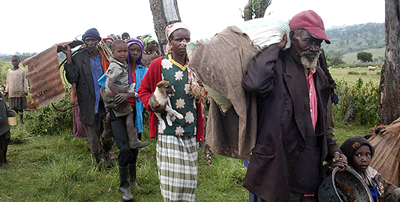
Today a stream of now homeless farmers began leaving Kenya’s Mau Forest for fear they would be killed by security forces.

The Mau Forest story is one of the most heart-wrenching in Africa.  It has parallels to development stories throughout the world, including America’s Dust Bowl of 1930-39, and it is as somber and seemingly irreconcilable as any Grapes of Wrath saga.

But as with all modern phenomenon in Africa, everything is sped up in the time warp of development.  It took a decade or more to discourage then displace the American southern plains farmer in the thirties, and moving at that speed even the American government was able to gear up to provide work through the WPA and useful advice on how to better use the land.

In the end only about a quarter of the southern plains farmers couldn’t make it through.

But in Kenya the drama is all but three years total.  In the end there won’t be one remaining of the 40,000 families who last year were farming the Mau.

And not a cent of the promised government compensation of just under a million shillings per displaced family (about $120,000) has been seen.

And if they aren’t successfully evicted, it is likely that within a decade there won’t be a drop of water for Nairobi.

The Mau Forest is considerably west of the Aberdare and other highland mountain catchments that feed Nairobi’s three reservoirs, but it’s now understood that they are all intricately linked.  The Mau directly feeds the Great Rift lake system of the central province (Naivasha and Nakuru) as well as the Mara River.

These areas provide the irrigation for huge agricultural areas as well as the country’s extremely important flower export business.  Without the Mau’s water, the Rift agriculture would start to die quickly.

And as this became apparent, the agricultural interests would begin long-distance siphoning, or would actually move further east towards the Aberdare which is the water catchment area for more than 7 million people in and around Nairobi.

There isn’t enough water to do all this.

Too many things are happening too quickly in Kenya.  Progress fighting aids and other mortal diseases like malaria have buoyed population growth.  GDP growth averaging twice that of America is creating a middle class that wants better cars and longer showers.

But the land of Kenya is one of the most stressed on earth.  Only 14% of the country is arable; the rest near desert useful only in some sections for stock farming.  It is mineral poor.  And only the few highland areas, like the Mau and Aberdare, catch water for the 40 million people.

The drought of the last three years (breaking now at last) focused into stark relief to Kenyan leaders the looming disaster.  And despite the enormous media attention given to the drought, it was mild when compared with  droughts of the past.

Global warming actually makes the equatorial regions of the world wetter than they would otherwise be.  But the lust for water for development is just too great.

In 1996 after the last more serious drought the then dictator Daniel Moi began handing out choice parcels of the Mau forest, mostly to his fellow Kalenjin tribes people.

Bigwigs were actually given deeds.  Many others were given little “resident cards” and thousands others simply followed their kinsmen from the dry lands of the kalenjin onto this fertile ground.

No one knows for sure how many people ended up first clearing the forests to sell the timber, then farm this critical ecological zone.  The government says 40,000 families, and the average size of a farming family in Kenya is between 6 and 7.  So that could be about a quarter million people.

I’ve seen the beautiful little homesteads in the Mau.  The many log houses are tidy, with little vegetable and flower gardens, and often a cow or two in a tiny fenced area.  There are small fields of corn, millet, potatoes, beans and even wheat in some places.  Any random scene in a farming village in the Mau would likely depict a near idyllic scene for a developing African country.

Schools wre built and the government supplied teachers.  Dispensaries and some of the best small hospitals in Kenya were built here.  A sheep industry developed, and many residents wore heavy sweaters and woolen coats self-made as protection against the highland climate.

A typical Mau Forest farming family looks pretty well off.

It was not a surprise this would happen.  But last year into the 2nd year of the country wide drought, Nairobi water reserves began to be rationed.  Crops failed lower down the forests, even though the Mau and other highland areas were still getting reasonable rainfall.

Sixty Minutes from America produced a television story on the great wildebeest migration, and showed the declining level of the Mara River, and wondered if this were “the end of the migration.”

Actually, it was the start.

The government decided last year the Mau had to be cleared of farmers.  A security contingent swept in, burned homes, released livestock and randomly shot farmers who resisted.

The scandal erupted into huge Parliamentary fights and became – as so much in Kenya does – tribal.  The evictions were halted, but ultimately, they had to be restarted.  More carefully, with more notice, and with a better management of the idiot politicians trying to earn kudos with the controversy, the evictions have started for real.

And they will continue until not a man is left in the Mau.  And only a fence and heavily armed security forces surround the 16,000 sq. miles.

It seems like a pretty small area for a population approaching 40 million.  But that’s Africa, today.  Every little bit counts.

Toxic Golden Goose!

Toxic Golden Goose!

Tanzania is Africa’s 3rd largest producer of gold and important producer of diamonds, but corruption is ruining the industry and the environment. PS: they’ve found uranium.

Yesterday an “inter-faith” nongovernment group near the rich gold, nickel and now uranium mines near Lake Victoria published a report claiming that the Mara River was now toxic with mine effluents.

The group which remains nameless for obvious reasons had taken the matter into its own hands after the government refused to act on a January directive by Parliament to “clean up the mines.”

This was no high school lab experiment. The study was funded and overseen by the Norwegian University of Health Sciences, which lent its name and credibility to the conclusion that the Mara River now carries high concentrations of toxic heavy metals at levels far above World Health Organization (WHO) standards.

The group laid the blame squarely on the Canadian owned North Mara Gold Mine. The Tanzanian government has demurred, so to speak, by admitting that the security at the mine is too lax to protect items like storage tanks and other hardware regularly stolen. The implicit argument is that these items are then poorly handled, allowing for ground water contamination.

(The area of toxicity is down river from the Serengeti National Park, so presumably not a threat to the national parks.)

According to members of the inter-faith committee, the study was conducted in seven villages after the unexplained deaths of 17 heifer cattle and six abortions between May and August.

Friday, notably only a few days before the release of this report, Toronto CEO of Barrick Gold Corporation, Aaron Regent, said that the Tanzania mines would be sold off.

He called the North Mara mine “troubled.”

I think it is troubled by more than toxic metals.

According to the London think-tank, Companies And Markets, Tanzania’s mines should be among the most productive on earth, but instead are falling far short of their economic value.

A 2008 report from the Business & Human Rights Resource Centre estimated that the combined loss to the country over the first seven years of the decade was more than $US400 million!

What?! Mine gold and diamonds and lose a half billion dollars?

The report claimed the loss was a result of low royalty rates, unpaid corporation taxes, and tax evasion by major gold mines.

Regent, on the other hand, insists the Canadian company has paid all taxes and royalties.

So where did one half billion dollars go?

OIL COUNTDOWN

OIL COUNTDOWN

Chinese engineers today began drilling one of the deepest exploratory oil holes ever tapped into Mother Earth, near Isiolo in Kenya.

Isiolo is the last major town north of Mt. Kenya before continuing into the Great Northern Frontier. It’s about 25 miles from Samburu National Park.

The China National Offshore Oil Corporation (CNOOC) has been all over this place for the last year. It paved a 30-mile long road through the desert in six weeks (I’ve been waiting for 20 miles of this for 20 years), two of its workers were deported for trying to smuggle ivory, and at least in Isiolo the Yuan has replaced the Dollar as the main form of bribery.

The 2½ mile deep well will probably strike oil. CNOOC’s geological studies concluded last year that there were enough measurable hydrocarbons at that depth to warrant the $20 million investment in this first deep hole. The company has spent $15 million over the last two years on roads and research.

If it’s successful, another $100 million will be required to begin harvesting the black gold.

Kenya’s Energy Minister, Kiraitu Murungi, is already bubbling.

“In a matter of days, “ he told Kenya’s East African newspaper on Thursday, “we could be celebrating. God willing, I shall be announcing a historical discovery at the end of the month.”

There’s no question it would be a boon to Kenya, greatly needed right now. The country’s extended drought and turbulent politics needs some stabilization, and oil could bring it relatively quickly.

Much of the troubles as a result of the drought have been in this area, including armed conflicts between different tribes. It would be a long time before the black gold found its residue in Kenyan banks, but certainly there would be a fairly quick job creation in the area.

Murungi must be pretty confident. He has just agreed to deliver the keynote address at the 16th Africa Annual Oil Week conference in Cape Town on November 4!