China Builds & West Saves Africa

China Builds & West Saves Africa

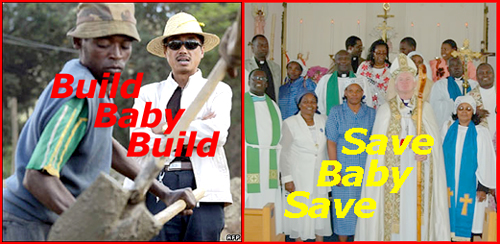
NPR’s fabulous story this morning about Kenya and China begs repeating what I’ve been saying for so long: watch China carefully and learn without embarrassment. The world may do better, then.

Frank Langfitt’s reporting on Morning Edition was superb. (And so much better than NPR’s former African correspondent, Ofeibea Quist-Arcton, who has been reduced to the new “West African Correspondent” where she continues to do a bad job, there.)

Langfitt did a yeoman’s job telling a decade’s story in less than 15 minutes. But there were a few things of importance that were neglected.

In May last year I wrote about the “Flame Tree Road“, which was then 8 lanes growing to 11 and is now, as Langfitt reports, 16 at some spots. Last September I wrote about China’s port plans in Kenya, and just a few months ago, Conor Codfrey reported the somewhat jaded views of western businesses about all of this. Two years ago I reported China was suddenly in Kenya looking for oil. Langfitt recapped it all, very well.

China is entirely and pitifully practical. And that is the crux of the difference between her and the west.

The west pontificates at best, fools at worst, and has been doing so for centuries.

The three C’s that governed Livingstone’s life and fund-raising, “Civilization, Commerce and Christianity” more or less governed until just this decade virtually everything the west ever did in Africa. China is also a “C” but like any efficient businessman, they’ve reduced the three C’s to a more productive two: “China & Commerce.”

China’s premise appears in stark relief for those of us who know Africa. Damn Kenya’s dwindling forests, we need the wood to build things. Forget about Kenya’s wetlands, they have no oil. And as for its wildlife, the only good rhino is one without a horn.

Poaching of both elephants and rhinos has increased substantially with the Chinese presence in East Africa, and there have been regular reports of Chinese apprehended in East Africa with poached ivory or rhino horn.

More worldly: Damn the millions under the Yangtze dam, discard the two centuries of Tibetan Buddhism, consider an enemy the enemies of your neighbors and do anything for a quart of oil.

Did I say we can learn from this?

Yes, absolutely. Because this policy reeks of the desperation of perfected capitalism, and that is the world’s economic system. Knowing it doesn’t mean you love it.

Ever since Livingstone’s three C’s, the west has spent enormous resources in trying to justify and work through the inherent contradiction between capitalism and goodness, trying in effect to claim there wasn’t an inherent contradiction. Realpolitik was the west’s first foray into diplomatic reality and succeeded to some extent because its American minister had a thick foreign accent. But Realpolitik has faded recently as Christianity and other ideologies like “hard work” and “marriage” have ascended.

The Chinese just love Glen Beck.

Africans are getting worried now that this pure intention of China is without a soul. Langfitt’s reporting this morning encapsulates in a few minutes volumes of recent articles and endless conversations on Kenyan radio talk shows.

After all, the west gave Kenya its religions. China is giving it its roads. There’s a very interesting future out there.
Which One-in-Three are Dying?

Which One-in-Three are Dying?

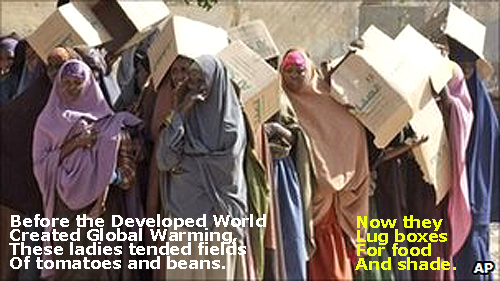
Global warming is slamming East Africa faster than expected even as One-in-Three Americans insist it doesn’t exist.

Never mind that Romney, a likely Republican presidential candidate, agrees that global warming is a man-made phenomenon. Never mind that Americans are asked to pay more and more for food aid in East Africa. Never mind that in our own communities we are feeling weather in ways it’s never been seen before.

One-in-Three Americans doesn’t believe in global warming.

One-in-HowMany believe in the rapture? One-in-HowMany believes David Vitter should remain a Senator but Anthony Weiner should resign as a Congressman? One-in-HowMany still believes Obama was born Where? One-in-HowMany believes a god created the earth in How Many Days?

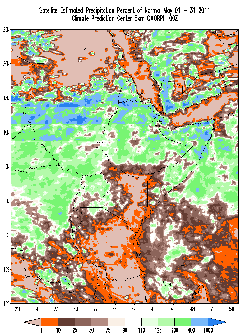
Look at this map prepared by America’s NOA’s Climate Prediction Center of East Africa. (Then go back and fiddle with the linked map of the U.S.)

Now on the one hand I have no idea why I’m using facts, since facts don’t seem to matter much, anymore. On the other hand, if we bloggers didn’t try to use facts all we would be doing is telling jokes. Problem is, One-in-Three Americans thinks facts are jokes.

The East African map is NOA’s satellite data for the percentage of normal rain that fell in East Africa this May. Although even the normal pattern of East African rain is complicated, because of its position on the equator and between a huge lake (Victoria) and a huge ocean (Indian), this map really tells it all.

May is one of the few months in the year in East Africa when a regular, generally continuous rain falls all over this map. In a normal year, this map would be all white, white being no change from normal.

Instead we see deep light brown to red areas of severely little rain to drought, bordered by areas of extreme rain and flooding conditions (green to blue).

The radical demarcations between areas of drought and flood is a symptom of global warming, and we see that in our own country as well. The Mississippi basin is flooding. Arizona is burning away.

This is new. Historically the areas between radical climates were not so close together. This is Global Warming.

The people living in Tucson and Dallas will still be able to buy tomatoes and beans, even though their land is a desiccated mess. The people in Nairobi and Dar-es-Salaam will be able to, too, for the same reason. These developed urban centers receive food distribution from wide areas around the world.

But for the still nearly 70% of Africa’s poorest countries’ populations that remain subsistence farmers, this is an epidemic far greater than AIDS could ever have become.

Countries like Kenya which are pulling out of extreme poverty find themselves conflicted now when creating social policies, because a significant portion of their population remains subsistence farmers but a rapidly larger portion is not.

This rapidly larger portion is learning how to eat and prosper even in times of drought. But they must still stand on the sidelines watching their Tucsons and Dallases starve to death, because their choice is between their own marginal threshold of prosperity or crisis policies to try to save the dying that likely could sink them all.

The Kenyan government recently dispatched a few million shillings to its northern drought areas, enough to buy food for starving people for a few weeks or so. The country’s elite was outraged at the pitiful effort, but the fact is that Kenya unlike America is not choosing between fighting a war abroad or a single payer health system. Kenya must choose between providing electricity to its new factories or feeding its starving millions.

And in countries like Niger and Mali, Eritrea and Ethiopia, where development hasn’t really got off its bump, whole societies are literally being wiped out by Global Warming.

I’m not really sure even if our own Tucsons and Dallases were starving to death that the One-in-Three Americans would care, or that they would even believe it might be true.

But just as the Rapture did not take us away, Global Warming is taking away whole junks of African peoples. And even though One-in-Three Americans might refuse to believe this, two out of three of us know the truth and it’s time to muster our majority.

Compromise with the ignorant and crazy is not compromise, it’s just giving in for nothing in return. Our responsibilities even extend to our own ignorant and crazy, not just far away Africa. It’s for the good of our own ignorant and crazy that we dare not invite them to any table of discussion.

It’s time to make a stand and force action. Don’t be bullied by the One-in-Three. We are the Two-in-Three.

America Blows the World Away

America Blows the World Away

American mostly and some European stimulus in 2009 kept the world going and Africa, in fact, soaring. It’s over, now, and screams of pain begin.

In Kenya which had roared to a near 9% GDP growth, the country’s economy is tumbling. Starvation is on the increase, again. Many diseases like AIDS and TB which had remarkably abated, are increasing … again.

In South Africa where the price of gold struggles to climb higher, fuel prices are soaring contributing to some starvation in poorer communities. And the ongoing Arab Awakening is squeezing the whole continent as tourism and oil production dwindles and America retreats.

Chinese development funds which fired up so much of Africa are dwindling.

In America when things “get bad” we stop going to the movies. In Africa, they stop eating. In America, we get sick. In Africa, they start shooting one another for whatever’s left.

All of this is because of the world economic downturn, and that was caused by American greed, by our failure to regulate ourselves fairly and wisely.

And to be sure a much worst situation was averted because of American last-minute stimulus, as American politicians gritted their teeth and did exactly what they promised never to do: grow government to save the people.

That huge stimulus let us still go to the movies. And it produced a boom economy in Africa, where car sales, for example, skyrocketed.

But it’s over, now.

Americans are going to fewer movies. Africans are beginning to shoot one another, again.

What we don’t realize in America is how seriously we effect the rest of the world. I think in part this is because so many Americans preciously hold to the idea that government is an option, and that we are reducing it.

This is the foundation of our misery, the notion that our government isn’t necessary and mustn’t necessarily be big. First of all, it is big! Even after all the shrinkage that has occurred and will occur, still, the U.S. government is massive. Even take away the wasteful and probably immoral military campaigns abroad, it is still gigantic.

The U.S. economy is 222 times as big as the Kenyan economy.

Yet we have only 8 times as many people. That gives every American, in economic terms, nearly a thirty to one advantage over a Kenyan.

And it means whatever we do has an impact probably 30 times as great as we imagine it does.

The whole world must follow whatever happens in America. We have a choice. They don’t.

The catastrophe of world depression is over, thanks to America. But it was thanks to America that it happened in the first place. And now we’re trying to clean it up.

East Africa is doing it correctly, America is not.

East Africa is increasing its debt to stave a catastrophic tumble into recession.

While America is flirting with an absurd notion not to increase its debt ceiling.

But what Kenya does won’t matter a hoot to Americans. But what America does could save or condemn the new Kenyan economy.

America is not a cowboy roping a single steer for dinner, as many Americans believe. We’re a gigantic, messy megalithic monster of an economy that needs a real tune-up, and one that keeps the brilliance and freedom of that monster moving as nicely as possible.

And a tune-up doesn’t feather the fat cats and starve the needy. Unless it’s a robot devoid of any morality whatever.

And whichever path we choose, we choose it not just for ourselves. We’re imposing the choice on the whole damn world.

Africans First Walmart Second

Africans First Walmart Second

Does Africa need lower prices? You bet! In just a few years there will be Walmarts in virtually every major African city. I think Africa can handle it. So I say, “Bring‘um On!”

Africa’s third largest retailer, Massmart, will be consumed by a $4.6 billion offer from Walmart following initial South African government approval Tuesday. Massmart currently operates in 13 of Africa’s 53 countries, and growing.

Predictably, business interests hailed the merger. Worker interests decried it. The South African government commission which approved the merger is imposing a few restrictions, including maintaining the existing labor/union mechanisms which many had feared wouldn’t survive the merger.

Everyone knows what this means. There is no dispute that Walmart will lower prices, probably boost quality in an African market known for shoddy alternates and outright fakes, as well as lowering wages and reducing other existing worker benefits.

“Can you imagine what [will] happen in Africa, with its extremely vulnerable workforce and inadequate and unenforced labor laws?” Mfonobong Nsehe writes on a Forbes blog consortium.

Everybody knows.

But two-thirds of South Africans support the merger. The reason is simple, and it’s Walmart’s signature: Lower Prices.

And the counter argument is that lower prices mean lower wages mean either depressed economies and/or an increasing gulf between rich and poor. Click here for a great interview of Patrick Craven, a South African union spokesman.

America exports Walmarts, because America is the world’s largest and most fundamental capitalist system, and Walmart is the epitome of what capitalism means. Walmart, in turn, exports human rights abuses when it sources vendors from foreign sweat shops. America champions human rights. Therein the paradox.

If we’re going to live with capitalism then we want its players to be as aggressive as possible so that the system remains dynamic. Healthy capitalism is a bloody thing. And I can’t see impeding Walmart if we’re encouraging Goldman Sachs, or for that matter, Exon/Mobile.

Walmart is not the problem. Walmart has to live under the laws of each country in which it operates, and what that means from the getgo is that advanced industrial societies must take charge of their capitalist development. REGULATION.

Minimum wages and minimum worker benefits must be increased. Affirmative action, particularly with regards to gender, must be dusted off the shelves and reembraced whole-heartedly. Legions of public agencies, from tiny villages to sovereign governments, must not extend tax benefits without ensuring that tax loss doesn’t depress its citizens’ standards of living or increase the gulf between the haves and have-nots.

The consumer and worker must always get the better shake. Business should be seen as serving, not feeding on, consumers and workers.

This is not Walmart’s responsibility. Walmart’s responsibility is to be as mean as possible. That’s how capitalism succeeds.

It’s now up to the African governments. They’re newer and not as beholding to giant capitalist entities as the American government has become, and there is a real possibility they will be able to regulate this behemoth with the same idealism they profess as overall goals of governance.

People First. Walmart Second.

Africa has a chance to get it right. But they dare not model America. We haven’t done so well.

Cows-1 Wildebeest-0

Cows-1 Wildebeest-0

The idiot at the bottom of the hill below my house who poisons squirrels isn’t very sophisticated, but unfortunately, help is on the way for him. New genetic studies are unleveling the playing field and the wilderness — in Africa at least — is set to suffer.

Not everyone longs for a vacant plain on the Serengeti over which to spread their soul. There’s a lot of people who truly believe the human mind is the only center of value, and that it’s more or less self-contained, immune to its surroundings or at least protected from them, depending upon how smart it is.

So you don’t need towering mountains or raging rivers, or awesome polar bears or freakish spring hares to help you work out the meaning of life. All you need is Proust. That’s the epitome of the self-centered human.

And then there’s the Obama Mediator Ecologist (OME), trying futilely to bring diametrically opposing sides together by organizing weekend committees to pull out mustard grass from forest preserves. This is, of course, the ultimate exercise in wasted time, but it fools participants into thinking they don’t have to choose sides.

But the sides are impermeable to one another, no matter how many fools are temporarily dissuaded. It’s not possible to intervene in the wild “a little bit.” You either put a ten-foot, electrified brick wall around the forest preserve and inventory every microbe in the ground, or you let it run wild.

Since putting a ten-foot, electrified brick wall around the forest preserve and managing every microbe therein has been until now completely impractical, the wild has persisted. But scientists on the self-centered human mind team have a new strategy terrifying to the wilderness.

Genetic engineering.

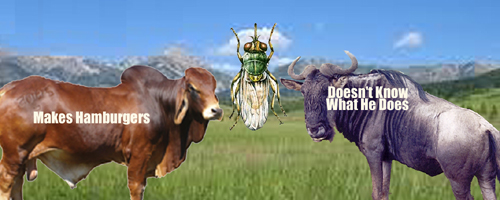
I wasn’t so upset with genetic engineering until the announcement last week in the Proceedings of the National Academy of Science (PNAS) about the discovery of the gene in domestic African cattle which if activated will give it the same protection from the tse-tse fly that wild animals have naturally.

This will be a devastating blow to a number of wildernesses, including the Mara, the Serengeti, Ngorongoro Crater and the Serengeti. Let me explain.

Virtually all of Africa’s remaining great wildernesses are surrounded by farms and many of them by cattle farms. But domestic cattle (at least until now) can be killed by the tse-tse fly which carries bovine trypanosomiasis or “sleeping sickness.” Wild animals are immune.

So while visitors to the national parks will find funny shining blue or black pieces of plastic flapping off trees near their lodging killing tse-tse helter-skelter, wildlife officials actually nurture tse-tse in other areas of the park. Why nurture this gruesomely annoying little pest? Because it’s the best way to patrol the park to keep out domestic stock.

Domestic stock eat an enormously greater amount of vegetation than their wild counterparts, and if allowed run of the wild would essentially starve the naturally wild animals out of the parks.

Tse-tse are easily eradicated, and human sleeping sickness (which is different from bovine sleeping sickness) has been mostly eradicated throughout much of Africa. Despite its awesome proboscis, the tse-tse is one of the dumbest creatures on earth. Flap some brightly colored cloth in the air and it dives into it proboscis deployed.

Spray the brightly colored cloth with pesticide and it becomes the ultimate insect kamikaze. No need for mechanical spraying strategies or search-and-destroy techniques, just advertise, “Come kill yourself! Come kill yourself!” and the tse-tse dumbly complies.

But wildlife officials have carefully not eradicated all the tse-tse. And this, in part, has kept domestic stock outside wildlife parks.

But now, the PNAS scientists have identified the gene that wild animals use to become immune to tse-tse’s package of death. And they’ve identified it currently suppressed in the greater domestic cattle community throughout Africa and are engineering ways to manifest it throughout the industry as a whole.

I’m sure the intentions of the scientists were pure. They were motivated, the report says, by a $5 billion annual loss in cattle production to bovine sleeping sickness.

And as I always remind myself, why should farmers be given any less assistance than the wild? The great wildlife fence in Botswana, which decimated the wildebeest population in the 1980s, did its trick: it protected and helped increase beef farming so important to Botswana’s economy.

So I don’t really know what SHOULD be done. I only know what IS being done, and it seems a relentless effort to assist mankind necessarily at the expense of the great wild.

A Ton on the Menu

A Ton on the Menu


As Kenyan transforms itself with a new constitution into a modern society the question of what to do with elephants has popped up. Just over there, in the garden.

But the problem is manifestly two-fold: there’s the elephant in the garden, and then there’s the ivory in the airport.

And finally Kenyan lawmakers are having trouble ignoring the problem. (Admittedly they’ve got a lot on their plates in implementing the new constitution before next year’s election.) In the last two months alone more than 330 tusks weighing more than 3 tons representing more than 150 elephants have been seized at Nairobi’s Jomo Kenyatta airport.

All the ivory was headed for Asia, mostly China or Vietnam, and often via Nigeria using diplomatic pouches. Kenya is on to it, though, and not even diplomats are getting through as easily as before.

But the increased black market for ivory belies somewhat the other manifest problem: there are too many elephants.

Believe me if you’re a citrus farmer in Voi, Kenya, you’re likely to welcome a little bit of unmanaged hunting at the outskirts of your plantation.

The very proactive Kenya Wildlife Service (KWS) wants lawmakers to change this. They want new laws that would punish the now by standing farmer, and new authority for themselves to police this.

It’s not going to be easy.

Forcing the hand of until now Kenya’s silent farmers may not be a good idea. Following a successful collaring exercise near Kenya’s elephant, Tsavo National Park, to monitor human-elephant conflict this month, farmers became enraged.

Public officials from parts of Taita-Taveta County claimed that more than 500 elephants were terrorizing them. One elected official, William Ikutu, appeared on Kenyan TV allegedly nursing serious injuries following an elephant attack while working his farm in Mwakitau.

Village Chief Crispus Mnyika said the jumbos had imposed a virtual curfew in five villages, and KWS confirmed that more than 100 acres of farmland had been destroyed.

KWS responded with a major air and ground operation to drive the elephants back to their habitat had started involving aircraft, 4 special vehicles and 50 game rangers. KWS will not say how many millions of shillings the operation cost… for obvious reasons.

So Kenyan legislators are getting it from all sides: from wildlife officials wanting stronger laws and greater authority, to Kenyan citizens who want these pesky beasts out of their lives.

All sorts of things have been tried to separate wild elephants from human populations. Personally, I think outsiders – researchers, especially – have complicated the problem by throwing pennies at the problem, spending resources on nonsense.

Nonsense about chili powdered fences is all the rage, now, and patently doesn’t work. Ridiculous attempts at flimsy electric fences supported by hundreds of thousands of dollars from well meaning but poorly scienced NGOs may be even worse.

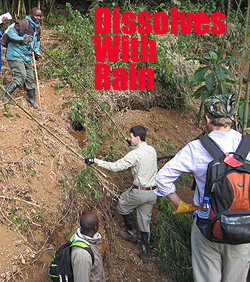
Large trenches that I’ve photographed myself in Uganda and Rwanda seem to work a little bit, but they require incredible maintenance and generally dissolve in the rainy season.

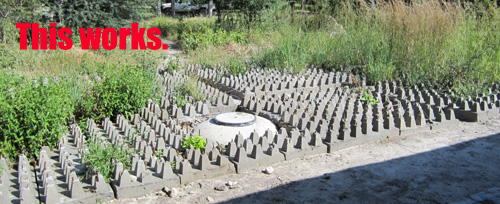
The only certain barrier I’ve ever seen is the one I recently photographed in Botswana’s Nxai Pan National Park: spiked concrete blocks that surround a public ablution unit at a public camp site. But this must be very costly. Imagine ringing a 500-acre farm with a minimum 15-foot periphery of these! (The stride of a big elephant is, yes, 15 feet!)

The daunting problem for Kenyan legislators, now, is to try to find enough resources to try to manage the crisis.

The Kenyan economy is exploding, and it’s not because of tourism. Energy development, IT including mobile phone companies, flower farming, even engineering and now new mining will likely eclipse tourism in just a few years.

The urgency for providing potable water and good sewage for its citizens, and a good business climate for its development, are issues of far greater importance to the average Kenyan and his legislator than protecting wildlife.

So all this begs the question: is there enough money left to protect elephants?

How Much is One Worth?

How Much is One Worth?

A movie deal? A bale of cotton? One Lost Generation?
No trillion dollar wars got Osama. Somebody ratted. Some chink in his anti-$25 million fortress cracked and it wasn’t from a drone and sure wasn’t from water boarding. The African Awakening is the same. It’s ideas, Joe, not guns.

Adolf Eichmann killed a lot more people than Osama bin-Laden and Israel knew he fled to Argentina, which was not exactly a stable country in the 1950s. In about the same time it took us to find Osama, Israel found Eichmann, put him on trial and hanged him.

Neo-Nazi sentiment was running high in Argentina at the time. In fact, you could argue Senator Joseph McCarthy tried to import it to the U.S. In fact, neo-Nazi sentiments in pockets around the world from Russia to South Africa was not so dissimilar to the so-called “franchises” of Al-Qaeda that created shoe bombers and Times Square crazies.

How many wars did Israel fight to find him? None.

How much money did Israel use to bring him to justice? Probably not a trillion dollars.

How much did Israel’s education, cancer research, foreign policy initiatives, high speed rail suffer to find Eichmann? (They don’t have high speed rail, sorry.)

Radio Free Europe’s Robert Tait puts it right this way:
“The timing of Osama bin Laden’s passing [coincides] with the collapse … of hated autocratic Arab regimes in the face of popular demand.” Tait sees Osama’s discovery and death, and the African Awakening as a “confluence of events.”

Let’s go one step further. It isn’t coincidental, as confluences could be. It’s causal. It’s a reasonable outcome of the world changing in a really good way.

What ISI or Pakistani military thug decided to if not rat on the monster at least ratchet down some of his protection, because Darth Vader was having trouble paying protection?

What double-agent spilled the beans last September, because he really didn’t want to become a martyr, after all.

Martyrs? What’s that? How much do they get paid an hour?

Good lord, how much American energy and lost opportunities have been lost in my lifetime pursuing military and ideological black holes? Who really cares, today, that Vietnam is communistic? Call me, I’ve got a great deal on a Mekong Cruise.

Give it up, Senator Graham. The world will be a better place, and America might just be able to reemerge.

Why the Chinese Succeed in Africa

Why the Chinese Succeed in Africa

By Conor Godfrey on April 28, 2011
If you are worried that your event on some esoteric aspect of policy will not draw a big enough crowd, just add some combination of “China,” “Threat,” “Rise,” “Beijing consensus,” “US,” and/or “Decline” to the title, and the number of RSVPs is guaranteed to skyrocket.

I have recently attended a number of meetings on Sino-African relations, and the fear is palpable among US policy makers and business people.

I just came out of one particularly good talk and thought I would share a few of the speakers’ insights mingled with some of my own.

This most recent speaker spoke very articulately about the “Angolan Model” of Chinese investment that has been replicated around the continent.

Essentially, the Angolans tell the Chinese that they want to build the following 25 roads, 10 bridges, 3 ministry buildings, refurbish a railway, build a basketball stadium, and deepen the port.

The Chinese say—“Good choices—infrastructure was key to our development as well– and while we’re talking about this, we have Chinese companies that can build every one of those projects for you, and can build them cheaper than any other international bidder.”

China continues…”So here is the deal—our companies will build all those projects before your next election cycle, we’ll do it cheaper than anyone else, and you can simply pay for it over time by shipping us oil at market prices.”

For Angola and China, it is a win-win-win-win. Angolan citizens get roads, Angolan politicians get to take credit for them, Chinese companies make money, and China gets a reliable supply of vital oil.

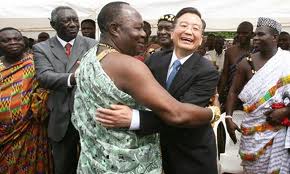
Wen-Jiabao, Premier of China, embraces a local Ghana chief
This works well if your country has an immensely desirable commodity such as oil, copper, or cobalt with which to pay down your debt, but not so much if you need to pay back $2.5 billion in loans using tea, coffee, or sesame seeds (cough cough Ethiopia).

That being said—Ethiopia doesn’t seem to mind.

This speaker pointed to a recent interview with an Ethiopian minister who raved about Chinese investment.

The minister claimed that whenever there was a problem with the work Chinese companies were doing, he would just summon the ambassador and point out the problem.

The Chinese ambassador would salute, and within a short period of time, the problem would be fixed.

When he called on a Russian, European, or U.S. politician to solicit help in regulating a commercial dispute, the problem would be tied up in court for months if not years.

All Roads lead to China
How do you compete with that?

Also, are Bechtel executives willing to stay in sub-par accommodations, away from their families for months at a time, working on a project somewhere in rural Africa?

Will other U.S. construction or engineering firms accept the 5 or 6% margin on an African project necessary to compete, as opposed to the higher margins that they are used to in North America?

The US and other donors have pumped a massive amount of money into African relief and development over the last fifty years, and some of the results (around HIV/AIDS in particular) have been astounding.

But the Chinese, and also the Indians, Brazilians, and even the South Koreans, understand the African operating environment in a way that Western decision makers simply do not get and I don’t think ever will.

It has been too long since we were a developing country.

Squeeze It Till It Collapses!

Squeeze It Till It Collapses!

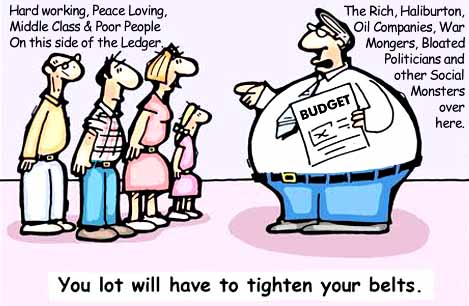
America’s belt tightening vied with the Masters this weekend as the best reality TV show in the world. But now that the entertainment is over, does anyone have the slightest idea what catastrophic nonsense has just occurred?! One tiny example from Africa.

Here’s why I’m so incensed. One: We claim this is a budget battle. The D-Day, though, was the assault on abortion. Two: We claim this is a budget battle. The last week’s negotiation was over $5.3 billion. That’s less than .2% of the $3.2 trillion budget. Three: We claim this is a budget battle. The wars we’re operating are off-limits to discussion, which is about a third of the entire budget.

4,5,6,7, ad infinitum: We claim this is a budget battle.
As my investors have screamed at me for a half century: Raise Revenue!

1001,1002,1003,1004..: We claim this is a budget battle.
Econ 101: You’ve got to spend money to make money.

So now to the promised example in Africa, supplied by a young African wizard, Conor Godfrey, who will be taking over this blog as of tomorrow as I head back on safari.

America’s belt tightening has been going on for a while, and now The U.S. Commercial Service is pulling out of Ghana. This branch of the U.S. government has essentially made money for the U.S. government since its inception, finding really attractive capitalist projects around the world that U.S. companies can exploit.

Ghana’s projected 11-12% growth rate in 2011 obviously did not make the cut.

Writes Conor:
“This bothers me—a lot. How are we pulling out of some of the fastest growing countries in the world in an effort to save money? I have made the case in this space before that Africa offers some of the highest returns on investment in the world, has the most favorable demographics in the world over the next 30 years, and will boast 7/10 of the fastest growing economies in the world over the next decade.

“The National Export Initiative trumpeted by president Obama was supposed to help U.S. companies operate in places just like Ghana!

“We’re even closing down the Commercial Service office in Senegal, our only post in Francophone W. Africa (this is a well sourced rumor).”

Emerging African markets are one of the most rapidly growing consumer niches in the world. They need to buy a lot of stuff from us: agricultural machinery, pharmaceuticals, internet and communication technologies.

Sources inside the USG also told Conor that the Commerce Dept. will not open an office in Angola as had been planned. Cross another one of the fastest growing countries in the world off the list.

This is very shortsighted. The little bit of money this might save is guaranteed to reduce U.S. commercial sales in the short-term, as competitive companies especially from Europe and Asia beat America to the punch.

“I am not some neo-colonial war monger,” Conor explains. “I don’t think the U.S. needs to be commercially colonizing Africa before the scary Chinese get there. I just think that many (not all) African countries are at a point in their development curve where they can participate meaningfully in international commerce, without being relegated to mere consumers of manufactured goods and exporters of raw materials. I want the U.S. to be a real partner for this new Africa—both the continent and the U.S. will reap substantial benefits.”

“This entire episode must be embarrassing for a president that landed in Accra with such fanfare near the beginning of his presidency, claiming to want a new relationship with Africa. Read the full speech here. I would like to think that I am not just one of the many special interest groups that believes their little corner of the budget is the one that really matters. In this case, I swear the numbers speak for themselves.

“Read this essay by the President of the Corporate Council on Africa on the shortsightedness of the government’s cuts.

“Ghana—really?! Who in the U.S. missed that memo about oil, and 12% growth?” Conor asks.

I know who missed it.

Strike it Rich, Strike it Down!

Strike it Rich, Strike it Down!

The rich are getting richer, and the poor are getting poorer, de-dum de-dum, and who the hell cares? I do, a lot. And if you don’t, you’ve been brainwashed.

This year’s Forbes List of the wealthiest people has 1,210 individuals (on a planet of nearly 7 billion) holding 77% of its total wealth ($45 trillion).

Any one of those more than thousand billionaires (most of them are fat, by the way) actually are 2000 times wealthier than all of East Africa combined.

I, and you, should care because of a thousand reasons nicely summed up in one. Like Asia a generation ago, Africa is morphing into a powerhouse. The speed and agility with which this is happening reflects the enormous potential of the caterpillar within.

So I’m not jealous. I’m not screaming I didn’t get my fair share. I still believe in an iota of the goodness of greed, in capitalism contained. But in its infant state, Giant Africa is still compassionate. We want it to stay that way and be a beacon for all society, and we want it to be nurtured and prosper.

Nurturing and Prospering is not in this week’s to-do list.

Since 2005, (and note the economic crash), the world has grown at a tepid 3%. Since 2005, the amount of wealth controlled by the Billionaire Club has quadrupled (that’s 400%).

Now that’s a rich-getting-richer thing that is hard to grasp. Fortunately for East Africa, its ingenuity and geopolitical position on the gyroscope of terrorism has basically shielded it from those five years of downward pressure.

Most of the bulging billionaire syndrome has come at the expense of the vast middle classes of developed societies. Me. You. So for the time being, anyway, Africa’s freedom to grow and save the planet has been more or less shielded from gluttonous greed. Thanks to Me. You.

And what a struggle it’s been! Not only have we had to forego getting a new car or residing our aging homes, but the Billionaire Rich have been hard at work … making war.

Joan Baxter, in this issue of Pambazuka, argues persuasively that the growth of wealth among the few is created by, and requires, world conflict.

Right. You can’t strike it rich unless you strike it down.

Baxter calls this “Disaster Capitalism” and then adds an eulogy: “At least vultures wait until after death to feed on cadavers.”

So we have this high school club controlling the world’s economy, whose very essence and continued existence, requires poverty, misery and ultimately war.

I think I read about this somewhere, before. Star Wars? Batman? Spiderman? Was it only in fantasies … until now?

But here’s the positive way of looking at this from the inside out:

Imagine how much faster the world could be improving, how many wars would end, how much misery could be morphed into genius if that grossly unnecessary billionaire wealth were spread over Africa and other promising places. (Exclude Nantucket.)

Intellects now bristle like the hairs on a porcupine. Am I daring to suggest that we simply redistribute this wealth willy nilly.

Well, in the absence of any possible Democratic/Republican new tax code, yes.

Random, wild, irresponsible redistribution of unimaginable amounts of money works. It’s been proven. The U.S. bailouts worked. We saved the billionaires from disappearing.

Enter Emperor Wadongo

Enter Emperor Wadongo

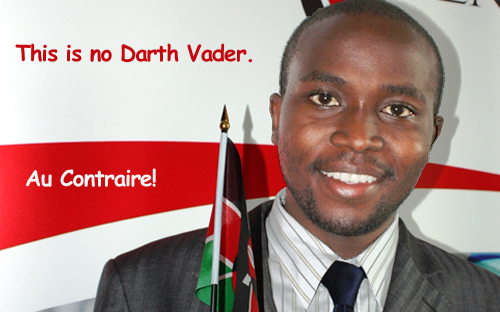
Genius Engineer, World Shaker, Kenyan Evans Wadongo
People just don’t get the social tsunami smashing the world right now. Obama’s Old News! Notwithstanding the media starred war in Libya, societies are changing at the drop of a text message. Billionaire industrialists and fat politicians aren’t the only ones running the show, anymore, in fact their days may be numbered. Meet Evans Wadongo.

Wadongo is currently sharing a world prize with Ted Turner (CNN) and Tim Berners-Lee, the man who in 1989 first made the Internet work. The three are the inaugural winners of the annual Gorbachev Award for “opening up society.”

What did 25-year old Kenyan-born, Kenyan-schooled, still Kenyan resident Wadongo do that elevated him to the table of stars?

He turned dark into light without using fossil fuels or electricity. He’s an engineer. But he didn’t invent gyroscoping drone bombing sensors, or infrared seeking document readers, or nano focused skyscraping beam protectors.

He invented a solar lamp that is cheap and efficient so that hundreds of thousands, maybe millions of poor people can see at night without endangering their health and minuscule budgets with kerosene lamps and fumes.

Do you get it?

A simple, efficient, inexpensive solar lamp is as important as the WorldWide Web and CNN.

Because when the potential of millions of suppressed people is illuminated, the world will change, and I for one, think for better. That’s exactly what’s happening, now.

Whether it’s Wadongo, or Ory Okollah, or Wael Ghonim, the movers and shakers of the world today are increasingly:

1) Kids
2) Optimistic
3) Smart
and above all, 4) Compassionate.

It’s a new world, you old fogies! Not sure how we’re going to deal with these new parameters of life, but we better get ready, because it’s going to be a much different world from the one in which we prospered.

Cote d’Ivoire in Context

Cote d’Ivoire in Context

by Conor Godfrey on March 28, 2011

So far on this blog we’ve discussed the humanitarian crisis in Cote d’Ivoire, and the merits of military intervention.

Our profile would not be complete without discussing the economic context in which all of this occurs.

This is also true in Libya of course: by Libyan nightfall yesterday, the rebels were back in control of two key oil towns and claimed to have found a gulf state buyer for the 100,000 barrels per day of production currently in rebel hands.

But back to Cote d’Ivoire.

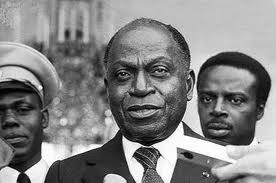
At independence, there was a famous bet between the Kwame Nkrumah and Félix Houphouët-Boigny—the two fathers of independence for Ghana and Cote d’Ivoire respectively.

Félix Houphouët-Boigny

They bet on which country would lead West Africa two decades on. Cote d’Ivoire vigorously pursued economic integration with France and allowed capitalism to thrive.

Ghana on the other hand broke most ties with the metropole, and gave the state a much stronger hand in the economy.

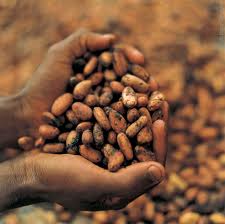
We could write an entire piece on who is ‘winning’ in 2011, but the important thing to note for this piece is that Felix Boigny’s approach allowed cocoa production to soar as French investment and agricultural know-how poured into Cote d’Ivoire.

Cote d’Ivoire exports approximately 40 percent of the world’s cocoa crop, with the West African region, including Ghana (21 percent), Nigeria (5 percent), and Cameron (5 percent), accounting for about 70 percent of international production.

As violence continues to escalate in Cote d’Ivoire, international markets have responded by driving cocoa futures to their highest price in 32 years — $3,586 per metric ton for May delivery.

EU and U.S. sanctions imposed in the aftermath of the disputed November 28th, 2010 election currently forbid companies from conducting business with entities linked to the regime of the intransigent incumbent Laurent Gbabgo.

This includes critical actors in the cocoa industry such as the cocoa regulators and the ports of San Pedro and Abidjan.

On top of these sanctions, President Outtara has attempted to starve his rival of approximately one billion dollars in tax revenue by issuing, and then extending, a ban on cocoa exports.

Taken together, the targeted sanctions and the export ban constitute a virtual embargo on Ivorian cocoa.

The recent extension of the export ban comes at a moment when cocoa shipments from Côte d’Ivoire have all but dried up.

Major cocoa purchasers such as Cargill, ADM, and Barry Callebaut, have either dramatically scaled down operations or stopped exporting completely.

This means that approximately 25 percent of the Ivorian cocoa crop, equivalent to 10 percent of the world’s cocoa crop, is piling up in humid Ivorian warehouses.

Recent estimates suggest that 300,000 tons of cocoa have been stockpiled up-country and an additional 100,000 tons, at the ports.

Ivoirian cocoa is produced in large part by small holder farmers who do not have the funds for proper warehousing, and industry stakeholders fear that the remaining crop will soon spoil if the sanctions remain in place.

Recently less than 5,000 tons of cocoa has been arriving per week at Ivorian ports from farms in the interior, and even that meager flow will likely dry up completely as Ivorian banks shut down operations.

Predictably, the export ban and subsequent banking crisis have exacerbated social tensions in Côte d’Ivoire.

Approximately seven million Ivoirians rely on the cocoa industry for their livelihood. Already thousands of Ivorian farmers have symbolically burned portions of their crop to protest the embargo.

The crisis in Côte d’Ivoire will likely reshape the cocoa industry in ways that even the 2002-2004 civil war did not.

The recent sanctions crippling the Ivorian industry have led to a dramatic upsurge in cocoa being smuggled through Ghana: since the October harvest in Côte d’Ivoire, around 100,000 tons of Ivorian cocoa have left West Africa through Ghana.

The two countries share a 668 km border that runs through the middle of the most productive cocoa regions in both countries.

The Ghanaian government, which fixes the price for cocoa beans, has amplified this trend by raising the price paid to Ghanaian farmers by about 30 percent.

The Ivorian crisis also coincided with a natural increase in Ghanaian production capacity due to better use of pesticides and fertilizers.

This turbulence in the West African cocoa market comes at a time when experts predict a steady increase in demand for cocoa due to the emergence of consumers in India and China. During 2009-10, demand outstripped supply by 82,000 metric tons, according to the International Cocoa Organization.

Volatility in this market will continue, buoyed by uncertainty over the deteriorating quality of the cocoa stockpiling in Ivorian warehouses, and the threat of a price collapse as soon as a solution to the Ivoirian political crisis appears on the horizon.

In the two weeks between October 11 and October 31, 2002, when both sides discussed a truce in the Ivorian civil war, Cocoa prices sank from $2,405 to $2,040 per ton.

The banking crisis precipitated by the political instability and cocoa embargo is the final factor in prolonging the reining instability.

The consensus among analysts is that Mr. Gbagbo needs between $100-150 million per month to pay the military and essential civil service personnel.

His signature is no longer valid at the Regional Central Bank that prints Côte d’Ivoire’s currency, and Côte D’Ivoire missed $30 million in interest payments at the end of January.

Soon Mr. Gbagbo’s financial position will become untenable.

Facebook

Facebook

by Conor Godfrey on March 25, 2011

I hate to give Facebook anymore publicity then it already gets, but a post on Online Africa was interesting enough to bring to your attention.

In 2010, Facebook gained its 3 millionth member in South Africa.

That means that Facebook use has been growing at near 25% for at least the last two years. See this post by Eshaam Rabaney for a more detailed breakdown.

Predictably, this growth has been most intense among 18-25 years olds.

However, U.S. readers should remember how quickly Facebook spread from young socialites, to their parents connecting with old friends, and even to the grandparent generation connecting with their tech savvy grandkids.

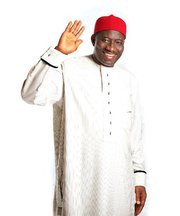
African Presidents are even adopting Facebook! Goodluck Jonathan in Nigeria is particularly active, as are a number of South African politicians.

Scroll to the bottom of this Online Africa post to connect directly to the FB pages of African leaders. I would go ahead and friend all of them with public profiles.

Presidential Facebook Shots:

Lets check out the two latest posts from President Goodluck Jonathan of Nigeria:

“In keeping with promising less and delivering more, I promised revival of our railways. If you live near tracks, you may have noticed that promise is now a reality. Trains are now gradually getting back on tracks. We met a rail service requesting attention and gave it support. It is the same way that we will bring life to every sector in Nigeria with your help. GEJ”

This post received 2498 comments, and 1798 “likes.”

“There are only two types of people in Nigeria: Good or Bad and not Northerners or Southerners.Assess people by their character which they control not by their place of origin which they cannot control. God made us and placed us in the locality where we were born. To discriminate against any human based on place of origin is to question the wisdom of God. And the wisdom of God is beyond the wisdom of man. GEJ”

This post received 3122 comments, and 3201 “likes.”

Embattled Ivorian Laurent Gbagbo has also been rallying the troops on FaceBook.

South Africa is far ahead of the rest of the continent in terms of usage (Egypt excepted), but some other countries are catching up fast—very fast. Ghana’s number of FaceBook users grew by 9.6% from February to March 2010! Morocco (7.6%) Tunisia (7.7), Nigeria (6%), Kenya (2.4%). As internet penetration increases these numbers are likely to increase dramatically. Find all the data here.

So what does this mean to Africa? Is it really important that South African teenagers are even more aware than they already were of the minute details of each other’s lives?

Yes – absolutely.

Anecdotally, the need to get Facebook is in many ways driving internet adoption among the younger generation.

These Internet and communications skills will make young Africans far more competitive in the information economy.

While the primary motivation for adopting Facebook may be social, the commercial implications of this trend are immense.

In more developed markets like the U.S or U.K. Facebook advertising is already drowning out traditional media.

The site is also more then simply a distribution channel.

Modern consumers want to feel a connection with the people behind the products they buy.

Facebook allows companies to post videos introducing potential consumers to their employees, or pictures and profiles that capture the company spirit.

Creating this type of connection with customers is no longer just a nice touch—its required.

The political implications of this type of media have already been discussed in this space, but I can’t resist one parting shot…look here for status updates from Monsieur Mubarak.

South Africa Makes BRIC

South Africa Makes BRIC

by Conor Godfrey on March 24, 2011

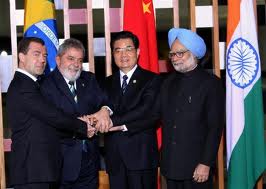
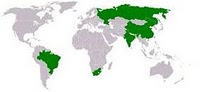
In two weeks, South Africa will be formally accepted into the BRIC grouping of Brazil, Russia, India And China at an economic summit in Beijing.

Just in case you don’t read US weekly—these are the new cool kids on the block.

Gone are the days when the EU was pinnacle of diplomatic achievement.

To be hip now is to be BRIC.

Does South Africa merit this social promotion?

That depends on the criteria.

When Goldman Sacks asset management chairman Jim O’Neil coined the term, he intended it to refer to countries of sufficient size, with favorable demographics, and with an economic environment that would facilitate high growth.

On these measures South Africa does not make the cut.

However …

Terms like these often escape easy categorization.

Do all the European Union member states share a similar cultural or geographic background? (Only if the term “similar” is stretched to the breaking point.)

Does the G20 contain the world’s top 20 economies? (No – South Africa, a G20 member, is actually the 27th largest economy in the world.)

BRIC is no longer merely an economic distinction.

The BRIC club is now a political grouping of countries based loosely on their relative economic influence among developing countries.

In this way, it has the same freedom to act, or to change membership, as any other political-economic grouping, such as the G20, EU, NATO, etc.

The BRIC leadership has shifted its membership criteria away from the founding mantra of large economies experiencing rapid growth to politically important countries whose membership would add value to the BRIC grouping.

This is a well trodden path.

Why did/does the EU extend membership to some of the Balkans?

The Balkans’ economies did not resemble the Western European founding members, nor did the mainly Slavic Balkans’ languages relate to the Germanic or Romance languages spoken in Western Europe.

The EU’s founding members offered membership to select countries in the Balkans in order to encourage the applicants’ respective governments to make the right social and economic choices, and to pacify the zone on traditional Europe’s borders.

Should Turkey be a member of NATO, the North Atlantic Treaty Organization?

Similarly blatant political maneuvering is behind Chinese Foreign Minster Yang Jiechi’s invitation to Jacob Zuma to attend the next BRIC summit.

South Africa’s 50 million people and lackluster 3% growth may lead Jim O’Neil to shoot it down in favor of countries like South Korea, Turkey, Mexico, or Indonesia; but South Africa offers the resource hungry BRIC countries something those other options do not—access.

Access to a continent teeming with ore, industrial metals, and newly minted consumers.

Pundits have been asking the wrong question: they insist on questioning whether or not South Africa merits the BRIC designation based on its size, growth rate, population, etc.

The real question is – does South Africa provide enough value to all four of the current BRIC countries?

That is the ‘merit’ that matters for this lunch table.

Urbanization: The Rising Tide That Will Lift All Boats…or Sink Them

Urbanization: The Rising Tide That Will Lift All Boats…or Sink Them

by Conor Godfrey on March 22, 2011

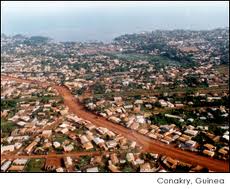
When I lived in Guinea I would make a trip to my regional capital once a month to meet with other Peace Corps volunteers, chat in English, and buy beer and toilet paper.

A lot of volunteers would note that coming into the city felt like entering “real Africa.”

This is obviously a nonsense term, but let me explain why it felt reasonable to say it: while I loved my sleepy little agricultural village, there was not a whole lot going on.

The only thing that had changed in the previous century was probably the use of cell phones. Now you could climb a mountain 5 km away for spotty service.

But things were constantly happening in the cities.

Conakary

People watched the news on T.V. and talked about current events; entrepreneurs hawked any and everything on the street; people played live music at cafes and restaurants; and young, sharp looking men and women brimmed with self confidence.

It felt like the “real Africa.”

Statistically, this will be true by 2025, when ~60% of Africa’s population will live in urban areas.

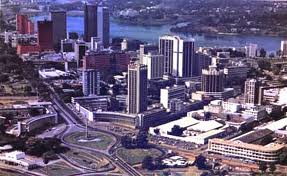
Abijan
Africa is now in the grips of one of the fastest urbanizations in history.

From the turn of the 21st century to 2030, the continent’s urban population will increase by over 150%, rising from around 300 million today to over 740 million.

Read a great Afribiz article on this transformation here.

The economist Africa blog also ran an interesting map on the growth of African. Look here to find out which cities will overtake Cairo as the continent’s largest.

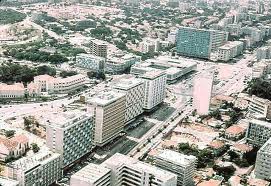
Luanda

Africa is just now reaching the levels of urbanization that fueled growth in China and India.

By 2025 some parts of Africa will actually be much more urban than their Asian counterparts. See the table on the 2nd page of this UN Habitat report for comparisons.

African cities are not ready for this influx.

Underserved slums will expand and get slummier.

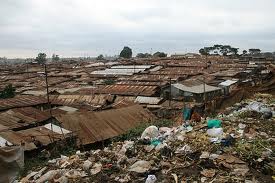
Kibera
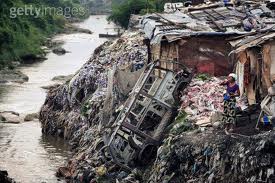
The classic examples of sprawling African slums such as Kibera in Nairobi, or this neighborhood in Kinshasa, will multiply.
Kinshasa Neighborhood

There is a chorus of experts who claim that urban design and city planning will top the list of Africa’s challenges from 2000-2050. Find another good blog entry from the Economist here.

The challenges posed by cities are obvious: how can relatively poor countries furnish new city dwellers with adequate health, sanitation, and security services?

How will all those people be fed and educated? And what will this mass of young, often unemployed men do when these services are not adequately provided?

These cities will be hotbeds of everything from HIV to insurrection. They will, however, also be hotbeds of innovation and investment.

One of the largest problems with investing in Africa is the fragmented nature of the markets.

It does not pay to bring a fiber-optic internet cable to a village of 500 people, but supplying the two dozen or so African cites that will be bigger than Rome in the next 20 years will certainly create viable revenue streams.

Dar es Salaam
Entrepreneurs will meet financiers in these new cities; financial services will expand to meet the needs of city dwellers; health insurance and other risk pooling schemes will function; technology will become more affordable; and ubiquitous, foreign companies that sell consumer products and services like purses and cell phones will set up shop (as they already are doing) and create jobs….the benefits of urbanization cannot be exaggerated.

The wave is already beginning to crash on underprepared African cities. But- If African leaders can mitigate some of the consequences of urbanization with forward thinking city planning, than I think urbanization on the continent will continue to drive a period of growth unprecedented in Africa’s history.