Bail Out The Joker!

Bail Out The Joker!

Bailout! Bailout! All Hail the Bailout! Germany for Greece! France for Ireland! EU for Iceland! U.S. for Goldman Sachs! And now! South Africa for itty bitty Swaziland! Is this really necessary?!

Swaziland is a round little hilltop surrounded by South Africa and Mozambique, smaller than New Jersey, with a GDP under $6 billion. Its main industry is absolute King Mswati III who keeps those jobs churning away by building palaces.

There are also casinos.

The King’s piggy bank doesn’t clink, anymore. The IMF refused to bail him out. He turned to South Africa, pleading … jobs.

“A lot of companies are closing down because government has not paid them,” said Hezekiel Mabuza, vice-president of the Federation of the Swaziland Business Community (FESBC).

The king buys a lot locally. He gets good credit.

FESBC has a membership of 500 small businesses, and so far over 50 have closed down because government has failed to pay them for supplied goods and services.

Swazi is one of the most undemocratic countries on earth. Dissent while not sledge hammered away is often harshly suppressed. The country has more or less stagnated as the South African umbrella blooms all around it.

The country’s deficit began exploding in 2009 and hasn’t stopped since, for all the same reasons countries all around the world are having problems: half the debt is basically due to reduced tax revenues and the other half by profligate government spending that continually expected higher tax revenues.

We did it on wars. Greece did it on fata cheese (actually I have no idea why Greece did it). Swazi did it mostly on “Mswati’s profligate lifestyle, which includes building a dozen or so palaces and frequent overseas trips and shopping excursions for his relatives, 13 wives and estimated 27 children.”

Needless to say, South Africans aren’t exactly happy with their government’s announcement.

On the face of it, it seems ridiculous. Bailout an international Play Boy? But calm down. There is method in this madness.

Because it isn’t ridiculous, or South African leaders wouldn’t be taking so much heat for standing their course. Nobody likes Mswati. But if Swazi were abandoned and the fairyland imploded, there would be a flood of refugees into South Africa at a cost that would easily exceed the bailout.

South Africa’s reasonable rationale is that if they increase this joker’s allowance sufficiently, they will stem the tide of misery that would flow from his subjects into South Africa.

It is the same rationale that applies worldwide. Bail out the people who made those bad mistakes because they’re all “too big to fail.” Without their continued nastiness, all their mess becomes yours to sort out, and that would be worse!

The point is, it’s true.

Swazi has a single university, not bad for a rural backwoodsman cousin to South Africa’s plethora of higher institutions. And rightly so, a large portion of the national budget is for the university. Only this year, it hasn’t received a penny.

So it’s closed down. Swazi can’t afford any more of a brain drain, and there are reports of faculty bailing in droves to South African institutions.

Funding for AIDS education, public health and insurance for preschool children is all gone. If you live in Swazi and have AIDS, a young child with pneumonia or a broken foot, you’ll probably make your way into South Africa, now.

So it makes imminent sense that South Africa plug the dyke.

It’s amazing that so many people just don’t understand these bailouts. Whether it was our own, or Europe, or now South Africa with Swaziland, there’s no altruism here. It isn’t a bunch of pussy footing do-gooders with reckless abandon of their own ethics.

It’s cold hard facts. If you don’t do it, it will be worse for you in the future. That simple.

And another thing. A major cause of all the bailouts, ours and Europe’s and even Swazi’s, is largely ours to blame.

Swazi had no mortgage bubble, no goony debt swaps, but its banks engaged in the same reckless lending folly that our banks engaged in.

Money was fast and loose worldwide. And guess who has the most money and the most money managers showing everyone else how to manage money?
Shedding Light

Shedding Light

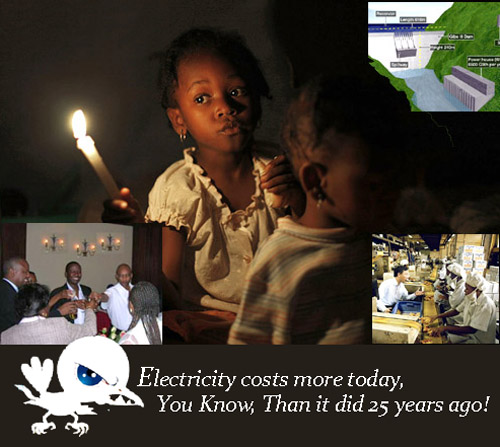
The Ethiopian dam, Gilgel Gibe III, will be 2000′ wide, 734′ high, hold a reservoir 81 sq. miles large, become Africa’s largest hydroelectric plant and some say the planet’s greatest ecological catastrophe. Save the wild, or turn on the lights?

For the mid-term at least (25 years), it will provide enough electricity for all of Ethiopia’s grand development plans with lots over to help neighbors Kenya and Uganda.

It will dam the Omo River above Kenya’s Lake Turkana. This is one of the most remote places in Africa. I floated the Omo as early as 1981, and the peoples who live along it have not changed much since. I often tell tourists that the “village” they want to see near their Mara camp is either hocus-pocos or a living museum, and that only in remote areas of Ethiopia and The Sudan can truly primitive people still be found.

The Omo disgorges into the giant desert Lake Turkana. About the size and shape of Lake Michigan, Turkana is a remnant of a prehistoric Nile river system, and no rivers flow out of it, now. It’s surrounded by harsh desert.

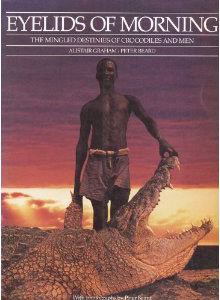
The Turkana people who live around it fish and farm seasonally, in a tight belt right around the lake itself, as rainfall is scarce. But the seasonal floods of the Omo are enough for some agriculture, and the lake is rich with fish: the world’s largest crocodiles live here. Peter Beard’s book Eyelids of the Morning shows a croc from here that is 28′ long.

Of course all of this is in jeopardy, now.

Leading the fight against the dam is the California-based International Rivers. They successfully spearheaded a drive that resulted last month in UNESCO and other UN agencies warning Ethiopia it could lose all sorts of funding if it continues with the project.

International Rivers claims that a half million traditional peoples along the Omo and into Lake Turkana will be catastrophically effected. It calls the Omo River the “umbilical chord” for Lake Turkana.

Seasonal farming based on the seasonal floods of the river (very much like the Nile), fishes, wildlife and plants are all doomed if the dam is built, IR claims. In addition to less fresh water in a desert desperately in need of it, the salinity of Lake Turkana will increase to toxic levels.

The dam itself is estimated to cost $1.55 billion. Another quarter billion will be needed for transmission lines.

Initially this was financed by the African Development Bank and the World Bank. But starting several years ago, the environmental impacts seemed so grave western agencies began bailing out of the project. The financing has been taken over by China.

The dam is about half completed, now, mostly with Ethiopian money spent and Chinese funds promised, and it cannot proceed without further cash, so it’s up to China, now. IR and several international organizations are now pressing China to end its participation.

Last month, an Ethiopian journalist who did little more than report all the above, was thrown in jail.

This is a high wire game.

If IR claims are even partially correct, it is Kenya that stands to be most impacted. Turkana’s life-giving water is one of the few reasons the area in Kenya’s far north has not succumbed to the current famine.

But Kenya just signed an agreement with Ethiopia to buy the electricity from the dam.

Africa needs electricity. And presuming for an instant that the Kenyan authorities understand the ramifications, and that there is a real possibility that their northern villagers will be critically compromised, they have still decided to support the project.

Africa needs electricity. Nairobi’s reservoirs have almost refilled with unusual rains. But power outages still occur. The city is growing like a morel. Industry is exploding. Africa needs electricity.

Do we stop the dam, save Turkana and condemn Kenya and Ethiopia to reduced development? Ethiopia’s Prime Minister Meles Zenawi, not your nicest character, nevertheless put it succinctly:

“The views of western critics are ironic as Ethiopian facilities are infinitely more environmentally and socially responsible than the projects in their countries, past and present,” he said.

Meles claims the western world is in a conspiracy “to condemn African peoples to extreme poverty.”

Africa needs electricity. Should we stop this, and then fund their nuclear power plants? Or massive solar or wind or other projects that can’t even get traction at home?

“They are concerned about butterflies’ lives, but not human diseases,” Meles says of us.

Numerous organizations have rallied around IR to defeat the dam. Even the palaeontologist Richard Leakey has pointed out that some of the world’s most treasured archaeological sites will be compromised.

Which to save? The past, or the future?

Blood for a Buck

Blood for a Buck

Almost a generation ago, John Le Carre wrote the block buster novel which became a film, Constant Gardener, about mega “pharmas” illegal testing of experimental drugs on witless Africans. Only a few years before publication, Pfizer has now admitted to having done just that in Nigeria.

Carre’s story focused on an aid agency physician driven to discover why his lover had been murdered: (She was about to become the whistle-blower against the pharma.) Carre’s story was more about deceit and corruption of British officialdom than the drug companies per se.

Pfizer announced in February that it would pay $75 million to victims and families of victims in Kano, Nigeria, who were illegally administered its never licensed drug, Trovan, for the treatment of meningitis.

Versions of the drug had been approved for use worldwide treating sexually transmitted diseases, but never for meningitis. Pfizer had been unsuccessful obtaining testing permits in the U.S. and elsewhere. So illegally and immorally, it began testing on African children.

Pfizer administered the drug to around 200 Nigerian children in 1996. Eleven died and scores others were paralyzed for life. Not long after the publication of Le Carre’s novel, suits were filed in both Nigeria and the U.S.

Pfizer fought the litigation tooth and nail, in both Nigeria and the U.S. Stateside the suits finally reached the U.S. Supreme Court, which in 2007 ruled that litigation in lower courts could continue, something Pfizer had fought for years.

The Nigerian government then announced it might pursue criminal charges.

This is exactly what Le Carre was writing about, and while illegal drug testing in Africa can’t be called exactly widespread, it is spread enough to be very, very troubling.

Two activists, Sam Burcher and Dr. Mae-Wan Ho, have spent much of their lives documenting illegal pharma testing in the Third World.

They broke the story of illegal testing of genetically modified rice serum in Peru by the California-based company Ventria Bioscience. They’ve also documented numerous illegal testing practices in India, and how drugs banned from sale in the U.S. are then sold to countries with less rigid regulation, mostly in the Third World.

Fired up by the Constant Gardener, a widely shown BBC Documentary, and concern by Pfizer employees in Nigeria that they actually would be brought to trial, the company rapidly moved in 2008 to close the issue.

Pfizer offered to pay the eleven families in Nigeria $175,000 each, a pittance by U.S. standards and a royal ransom by African standards.

Outcries continued until the final $75 million settlement in February, which also ended all U.S. litigation. Again, a pittance by American standards, an unbelievable treasure by African ones.

To date according to This Day in Nigeria, more than 3 years later, Pfizer has paid four families $175,000 each. That’s it. There is a building in the first stages in Kano which Pfizer says it’s constructing for medical research in the area, and which will cost $25 million. That’s it. Four payments to families and a shell of a new building.

According to Pfizer, the slowness of the implementing the settlement has to do with thousands more applications for compensation than is realistically possible.

That’s probably true. But that’s Pfizer’s problem, not the aggrieved families.

Pfizer concedes. And so it’s requiring DNA testing to determine those individuals and individual families who truly qualify for the money.

This, of course, is nonsense. Unless the medical records have been destroyed (an offense under Nigerian as well as U.S. law), Pfizer should have no problem determining who is who.

Understandably, victims and their relatives are reluctant to allow a pharma to do anything with their bodies, much less something as suspect as swabbing the inside of your mouth.

And so the beat goes on. Big against small. Rich against poor. Clever against the simple, the exploited, the wasted and discarded. For a healthier planet? No, for a buck.

Tourists Stranded, Tanzania Tainted

Tourists Stranded, Tanzania Tainted

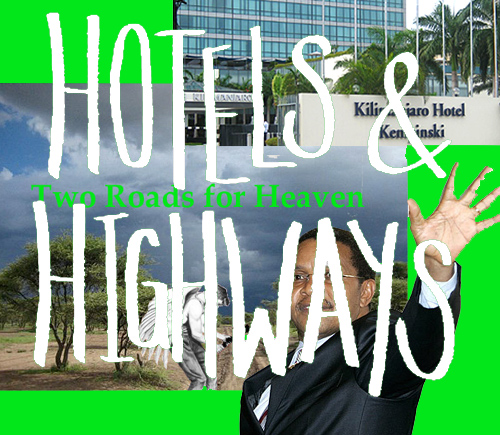
Hundreds of travelers headed to Tanzania remain in limbo this morning as a result of a high profile controversy involving one of Europe’s most prestigious hotel chains, a controversy ensnared in the Serengeti Highway debacle.

Late last month ASB Tanzania Investments, the owners of The Kilimanjaro Hotel in Dar and Bilila Lodge in the Serengeti, announced Hyatt would be taking over from Kempinski. In May they had announced Kempinski had withdrawn from managing the Zamani Resort on Zanzibar, and that hotel continued to operate with local management until this week.

But Hyatt has announced it is taking over only the Kilimanjaro hotel in Dar.

Email addresses, phones, websites have disappeared for Bilila Lodge and Zamani Resort.

What are tourists doing when they arrive these places, now? I can’t imagine Bilila abandoned; I was there only a few months ago. It’s a palace in the wasteland, a luxury convention resort. But no one answers phones or emails.

No notification was given those who were confirmed into the properties, nor to their agents or tour operators. Reserved travelers are in limbo.

Kempinski has referred questions about deposits and nonrefundable payments to Hyatt, but Hyatt insists it is managing only The Kilimanjaro.

For the moment, I’d advise travelers to quickly book something else in this High Season if they can, and then to read the story of High Intrigue that follows.

And shame on Kempinski for leaving Tanzania in such shambles.

But I think I know why.

Kempinski has only been in Tanzania for 4 years. Bilila Lodge opened on July 9, 2009. It is widely assumed that the president of Tanzania, Jakaya Kikwete, has (or had) a sizable investment in the three properties.

He was often seen at Bilila on retreat, where one of the suites was always held in ready for him. His over-the-hill inaugural speech for the lodge far exceeded the parameters a normal politician would dane to use.

Why?

It was no coincidence that this was just about the time that the Serengeti Highway project came together.

And it wasn’t just a highway project. It was a plan for an entirely new center of the park probably financed by two billionaires, Paul Tudor-Jones of the U.S. and Roman Abramovich of Russia.

Tudor-Jones already owns the Grumeti Reserves, now managed by Singita, and Abramovich is a long-time fan of Tanzania and frequent visitor to Grumeti.

Grumeti, Bilila, and the planned new center for the Serengeti, are all remarkably close to one another, and would have been a stone’s throw from various points along the Serengeti Highway.

The Serengeti Highway has been shelved. Opposition grew and grew and UNESCO dealt a final blow, just as it had done with Zamani several years ago.

With swaggering disregard for law, Kikwete had maneuvered Kempinski into paying $10,000 for a historic site within Stone Town that Zamani was to be relocated to … at hundreds of millions of dollars. UNESCO was appalled, and warned (like it did later with the Serengeti Highway) that World Heritage status would be removed.

In the economic hay days when Kikwete wrapped Kempinski into his devilish plans, he essentially ignored UNESCO. But as tourism contracted, as his own country was shaken by controversial elections, UNESCO’s warning was not so much powerful itself, as a final conclusion to what all good folk believed world wide, including in Tanzania.

The threats to the fragile history of Zanzibar and the ecosystem of the Serengeti were paramount, but it became clear in the leaned down years following the global recession that general tourism was threatened by his schemes.

Kikwete has backed away, entirely. Some of his ministers now become the fall persons for his folly.

Kempinski finally had enough. It left. Rather quickly, actually, and not at all like a European gentleman leaving a cocktail party.

I suppose what’s most important, is that this miserable attempt to profit from Tanzania’s special environments and history, is over.

What is left, though, is for Kempinski to come clean. And to apologize not just for its misguided interests in the beginning, but for the appalling way it’s left.

Of The Thousands Who Try …

Of The Thousands Who Try …

It’s hard to imagine the personal stories of the Somalis fleeing their homeland. And contrary to popular opinion, they aren’t just peasants. Many are professionals desperate for nothing more than just an ordinary life.

We all know by now of the 1500-2000 people who daily are arriving the refugee city of Dadaab, Kenya, fleeing death and destruction in next door Somalia, an unprecedented human exodus from a land wrought by drought and war.

But the media leave us with the impression that everyone running away from Somali is a destitute subsistence farmer or shepherd. I imagine most are. But there are also thousands and thousands who are accountants and lawyers, businessmen, teachers and computer techies, skilled individuals of countless professions.

The peasant farmer deserves no less help than the accountant. But the accountant is more skilled, has more savvy. Knows that there are better places to be than Dadaab.

With a bit of saved money, and usually nothing more than a cell phone with a new SIM card (that costs about 50¢) each time he enters a new country, the educated person can pursue a journey to a better place.

I know this. Because I was personally involved in helping a single professional refugee fleeing the 1994 Rwanda genocide. At the time I first thought he was remarkably unique. But in assisting him I learned there were nearly a thousand others like him hiding in Nairobi, waiting for the kind of help I was able to give to only him.

Today, as a result of the war and famine in The Horn, at least 1500 refugees per month have been entering South Africa, according to Abdul Hakim, a Somali leader living in South Africa. Some suggest it’s even more.

According to Natalia Perez of the International Organization for Migration (IOM), in the first quarter of 2011, 7200 asylum-seekers were documented entering South Africa at the Beitbridge border with Zimbabwe.

South Africa is the obvious choice for any skilled person fleeing Somalia. Its economy is 20 times larger than the rest of sub-Sahara Africa combined. Its politics are free and generous. Until recently, anyway, refugees were welcomed with open arms.

It’s nearly 2000 miles as the crow flies from Dadaab to the Beitbridge border post, and no refugee flies. In between are at least three countries, some times four depending upon the route, and these countries are hostile to refugees no matter what their skills.

Clearly the person who navigates as a fugitive through multiple layers of police and other officials, who knows how to get foreign currencies to buy bus and train tickets, who speaks multiple languages, who is able to find food and shelter for a subterranean journey that could take months… is no peasant farmer.

She or he is an educated, skilled professional. Ultimately, South Africa will be remarkably enriched by this flood of professionals into its country. But all at once, at a time of a depressed global economy, the stress may have become too profound on South African society.

The country’s open policy is changing.

Although officially denied by South African officials, we have to believe the multiple reports that at least an unstated policy change has occurred. South Africa’s borders are tightening, and this has caused a pushback into lands no skilled refugee would choose to make home.

Zimbabwe is no place of refuge, and there are as many as a thousand Zimbabweans monthly trying to get into South Africa. But Zimbabwe is the natural transit point for asylum seekers from the north wanting to enter South Africa.

Zimbabwe is not a country known for its gentle care. But in a deft political move that gives this ruthless country some cover, Zimbabwe has allowed the UN Refugee Agency (UNHCR) to set up a camp inside Zimbabwe as refugees at Beitbridge find it harder to get into South Africa.

Right now, there are 646 mostly Somalis being held there as if in a prison, picked up by Zimbabwean authorities as they are bounced back from South Africa.

Above Zimbabwe is Tanzania. UNHCR’s Mozambique head told a refugee newspaper last week that nearly a thousand refugees have been stopped at the Tanzania border with Mozambique and are now being held in a nearby prison. He said there were about 50 young children among those now being detained.

If true, Tanzania is violating a number of world treaties and customary human rights practices and could be prosecuted at the World Court.

I think of the one story I know so well of the man I helped in 1994. His story ended fabulously. He lives in the U.S. as a computer scientist, has a wonderful home and three lovely children. The only sadness in the memory is that he was but one of a thousand I had seen.

Today, there are tens, maybe hundreds of thousands.

How soon will it become millions?

Rain No Gain Only Pain

Rain No Gain Only Pain

Folks, it is drizzling near Dadaab. And it shouldn’t be. This is normally a dry season. We’ve got to understand again and again that this terrible famine is man made. It is not the work of God.

Yesterday I listened and watched to report after report, including from Kenya itself, decrying the “60-year drought.”

There is no 60-year drought in Kenya. What there is, by the way, is more important: a famine of extreme proportions. But it is not caused by drought. And all the western journalists flying into the dusty desert for the first time aren’t checking facts.

Even if we hadn’t missed a rainy season in March, even if the rains had been normal, I dare say even if the rains had been above normal, we would have had this famine.

The Dadaab refugee camp is not overflowing with starving people because there was no rain. There is no drought that caused this.

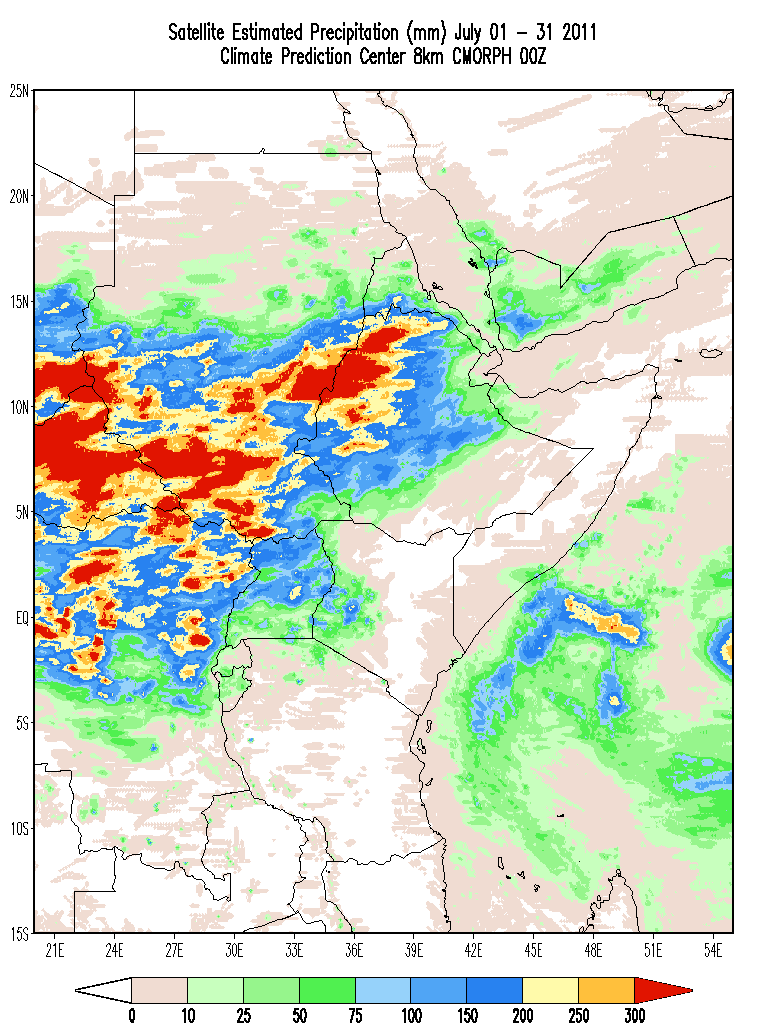
Here is NOAA’s report of rainfall in the area for the month of July just past. This is the area to which all the foreign correspondents are flying in northeast Kenya, southern Somali. In a normal year, these areas would be completely white. From about the end of May to the middle of November, for the last hundred years, not a drop of rain falls.

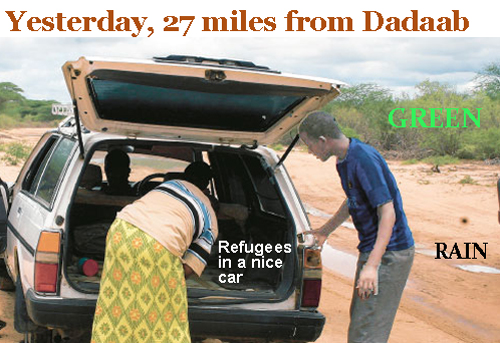
And now, it seems at least for the moment, it’s raining. Study the picture above. It was taken by Agence France Presse yesterday near the Kenyan town of Liboi, which according to GoogleEarth is about 27 miles northeast of the misery center of Dadaab.

There are pools of water. There is green grass. There is an automobile, although the AFP caption for the picture reads “Somali immigrants repair a tyre 2km inside Kenya enroute to Liboi. There are few who can afford to pay up to $150 to travel from the capital Mogadishu.”

Here is NOA’s prediction of expected rain for next week. Good news, of course. White overlaid by brown and even green shades showing pretty intense drizzle for the desert in a dry season.

What seems to be happening this year is a shift due to climate change of the rainy season that usually occurs March – May, to now. The March-May period was dry.

But understand this, please: A single missed rainy season cannot possibly cause such misery. Unless..

…there’s a vicious war just now getting worse… there’s a world recession that has so increased food prices that normal development aid is collapsed into fractions of its worth… there is political tension in the area so that bumper harvests (in Tanzania) are being prevented from shipment to the areas in need.

All the above are true. Add the real stress caused subsistence farmers who are disconnected from their normal planting routines by climate change, and you have … famine.

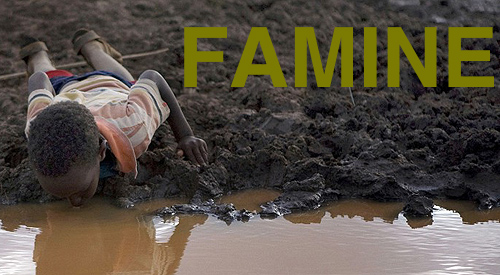
There is real, significant, terrible famine. We are approaching a half million people starving in the area of Dadaab … where it may be raining.

Uniquely as always, Jeffrey Gettleman of the New York Times, is reporting the truer story. And he is located exactly where the famine is really being caused. And that is not Dadaab. It’s in the heart of the battle for Somalia.

Gettleman makes the same mistake everyone seems to be making: calling a huge area “the worst drought in 60 years” which, sorry to have to repeat, it isn’t. But this is buried deep in his story which is otherwise right on. He explains the catastrophe as a political one, not a climate-made one.

A number of you have emailed me asking me for advice regarding how you can personally contribute best. I’m not the one to ask. Click here for better recommendations than I will give you.

My recommendation is one you probably won’t expect.

Become political and support leaders who understand a world order. Spend significant resources to defeat T-Party like mentalities that refuse to ameliorate world suffering with even a penny of the rich.

This famine is man made. I’m not for an instant suggesting that American conservatives have caused the war which caused the famine. Quite to the contrary, if anyone caused it, it was Bill Clinton.

His sheepish retreat from dealing with the mess in Somali because of the political flack he got from BlackHawk Down is the main reason for the problems, now. Almost 20 years ago, we now see the damage of short-term political gain.

This isn’t a left or right issue. It’s an issue of simple long-term compassion. Unless we get our heads screwed on right and steadfastly so, there’s going to be famine at Thanksgiving in the rain forest.

The Deadly Deal

The Deadly Deal

Africa and most of the world expects, now, that the U.S. crisis is over for the time being. Everyone everywhere presumes the two votes still required in The Senate and House will come off as predicted. Everyone, everywhere, is now assessing what this means to them.

It’s near sacrilege in America, today, to gauge your actions on how they might effect people as far away as Africa. There is still a mentality throughout the world to be sure, but especially in America, that responsibility ends at an increasingly narrowly defined notion of “home.”

Religious and political extremists mostly from the right believe that all that’s needed for a happy life is some kind of ultimate freedom from any complicated or extended responsibilities .. certainly any that extend as far from America as Africa.

We already know that’s how they feel, but we’ve been reduced to repeating it since efforts to change it have failed. We don’t even have to continue to the conclusion of what utter nonsense this is in a globally connected world. But having grown up in a tiny hamlet in northeast Arkansas, I know how small the universe can seem to many people. I know how dumb they often choose to remain.

It’s one of the great attractions of Africa to a first-time visitor: how vast it is. Confronted with such seemingly “free” and untouchable limits, a person is either absolutely awed, smacked to the floor in a feeling of complete insignificance, or … scared to death.

Those who are awed have a chance to explore new awarenesses, new understandings of how vast and different but connected are things in those global arenas, including foreign places. Those who get scared retreat into a clearer, smaller past, into everything known and nicely understood. They avoid global concepts, responsibilities.

They pack a gun and a spirit and take care of their own.

I’ve written in the last two weeks how a reduced American economy will effect Africa and the developing world, deeply. Just, of course, as it will effect us even more so at home.

Presuming “The Deal” gets passed in Congress, today, we will avoid implosion. We will retreat back into the world of AAA+. But “The Deal” cleaves America’s spending, which reduces government debt to be sure but reduces America’s output, too.

GDP will fall. Stimulus will end. Foreign aid and diaspora remittances will fall significantly. At home, social welfare programs will be cut drastically.

The poor, the developing world, those who are currently suffering will now suffer more. The rich in America will either be sustained at current levels or may prosper further.

And this horrible course will be unchangeable until the next election in November, 2012. And even if the results of that election then move in a fairer more progressive way, to ease the suffering of the poor at home and the developing world at large, it will probably be a year or more after that before new policies can begin to remedy this horrible situation.

Democracy at work.

Danse Macabre

Danse Macabre

Africa waits on pins and needles as America plays with the world. It’s not true that a default will in any way help Africa, not even gold-producing South Africa.

It’s hard to imagine what a default will be, and I don’t mean that in any apocalyptic way. America is the standard for world economy. It could be that default will be ignored, because if default of the standard is not ignored, the whole box of cards resting on it is jeopardized.

Gold is soaring, and the world’s principal gold source is South Africa, the continent’s most important economic power.

South Africa moved from the 32nd to the 28th largest economy just in a year, last year, because of the soaring price of gold. That’s an extremely respectable position relative to the rest of the world, and for certain, the leader in the continent. (Egypt is number 2 on the continent, 40th in the world.)

You would think South Africans would be ho-humming the imminent American default.

“Despite the benefits for mining, the timing could not be worse for the SA economy, “ writes Claire Bisseker last week in Johannesburg’s most important financial newspaper, the Financial Mail.

Bisseker’s brilliant synopsis of our situation and what it means for Africa is required reading for anyone interested in the economies there. What I found particularly interesting is that she extends her view well beyond the current crisis and in the long-term actually sees a benefit for African and other emerging economies.

“Whatever happens, one thing is clear… [There will be a] shift to fast-growing emerging markets as the main source of global dynamism.”

In other words, a benefit – a silver lining if you will – to emerging economies. If she’s right, it’s a terribly ironic silver lining to a world based once based gold and now thought to be based on … us, America.

But in the short-term, everyone in Africa warns the jolt will be significant.

In today’s lead editorial, the Mail’s editor, Barney Mthombothi asks, “As the world watches the danse macabre in Washington DC with utter amazement and dread, one has to ask: who runs the place? Have America’s leaders taken leave of their senses? And are we witnessing the decline of a once great power?”

Mthombothi dares to suggest one reason for the impasse is American racism.

“So why an impasse now? Some believe it has a lot to do with Obama, his colour to be exact.” Although he then suggests an equally important component is America’s “ideological divide.”

Like all African business leaders, Mthombothi must harbor a long bitterness that stretches all the way back to the days of slavery. And when giant places like Texas try to reword if not rewrite the history of slavery, it only stings them more.

In the end, like many dispatches I’ve been reading from Africa, Mthombothi concludes that the fundamental problem is not racism or ideological divide, but our constitution.

“The American constitution was an arrangement for a bygone era. It’s led to a stalemate that threatens us all.”

I tend to agree, although it may not be so much the constitution as the belief that we can neither reinterpret or change it to fit our modern times. The intransigence of the American right is the too old ebony stick that’s either going to break in the wind or come down on us all.

Famine by Man not Drought

Famine by Man not Drought

Famine is spreading across the Horn of Africa and threatens a world crisis. It’s not principally the result of drought. It’s due to political and social circumstances that if left unaddressed will begin one terrible unending famine capable of wiping out entire populations and massively stressing global resources.

News junkies crave disasters and power the news everywhere. The famine reporting I’m reading now is so driven by this that even impeccable organizations like one of my daily necessities, Reuters Africa, are failing to report correctly.

Reuters’ report, today, essentially attributes the main cause for the famine to “successive seasons of failed rains.”

Not true. There has been only one failed rainy season in The Horn so far.

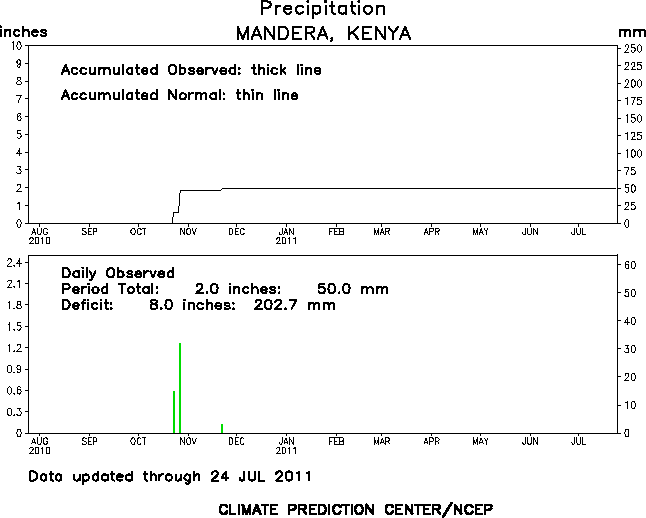
The famine is centered in Somalia, and because of the fighting there, good weather data doesn’t exist. But we do have good weather data very nearby, where nearly 400,000 refugees have fled just over the border into Kenya, at Mandera.

This is in Kenya’s far north in a climate zone nearly identical to most of Somalia. See the “Precipitation MANDERA, KENYA” chart prepared by NOA.

The chart shows that the normal Nov-Dec rainy season received just about 2″ of rain, which is about three-quarters of normal. The usually heavier Mar-May season failed completely. That one rainy season failure would not have caused famine in the past.

Then why is there now a looming crisis?

Because there’s a war. The people in Somalia have been disrupted from their normal routines. Before war ravaged The Horn a single rainy season failure was easily augmented by relying on stored food from surplus harvests, or from importing food from further south.

But now even when the rains are good, such as a year ago, the Somali’s didn’t grow much food. They weren’t planting; they were shooting.

And while there is surplus food in the world, even in the immediate area, it isn’t getting to the famine area. AID agencies can’t give away free food.

And Tanzania, which has a bumper harvest so far this year, has banned free market agricultural sales to the north, for fear it will deplete its own surpluses. This has severely effected the relief effort in Somalia, not to mention angered northern Tanzanian farmers.

So the imminent world crisis in The Horn is most certainly famine. But its principal cause is not the failure of rains, but the failure of humankind.

Moving south into Kenya and Tanzania, we have a slightly different story.

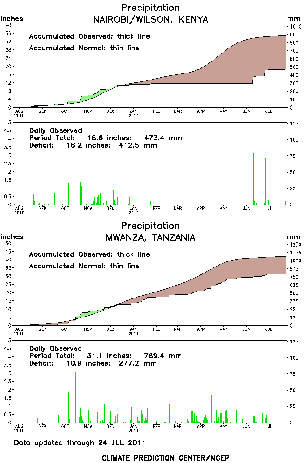
Look at NOA’s charts for NAIROBI and MWANZA.

An imaginary line from Nairobi, Kenya, to Mwanza, Tanzania, more or less transects the most densely populated areas of that region as well as the principal game viewing areas enjoyed by foreign tourists.

Over the course of the last year, Nairobi is running a 47% deficit in normal precipitation, and Mwanza is running a 26% deficit. “Running” is the key word. A careful reading of the graph shows that the problem occurred in the Feb-Jun period. That’s when the top (normal) and bottom (actual) lines diverge. That season failed completely in Nairobi and was weak in Mwanza.

But note that the track from May onwards in Mwanza is normal, and in fact shows more rain than normal in Nairobi.

We know, too, from photos coming from northern Tanzania that there have been recent rains there. It was thunderstorming in some Nairobi areas last night. This is totally abnormal. The end of July is normally a completely dry time.

Normal isn’t normal, anymore. The seasons for rains are changing or growing erratic due to climate change.

Go into a national park, and things look pretty normal. The giraffe, wildebeest, buffalo and zebra look fine. But just outside the park, Maasai cattle are dying.

More and more, the growing numbers of Maasai cattle depend upon hay-like supplements. Farmers who still plant in traditional ways, presuming the rains will come in March (when in fact, this year it appears they are coming, now), lose their crops. There is no hay. Even if there were hay, there are probably too many cattle.

The situation applies to people, too. Food prices increase because less was produced, and those rich enough have no problem, as is the case in most urban areas like Nairobi. But outside urban areas, crises occur almost overnight.

Food prices increase. Poor people have less money. Truck farmers take their food to areas where it can be bought and stop deliveries to remote areas where the poor can’t pay.

Nairobi announced this week that a series of power outages were now planned, because of the “poor rains” last season. The reservoirs are too low to produce enough power. “Enough” is a more important word in that last sentence than “low.”

In years past, enough power was cranked out even after two or three failed rainy seasons. Not now. One failed season and the power goes out.

There is no question that we have an imminent catastrophe in Somalia, a famine that has already begun. There is no question that we have a growing social crisis in much of Kenya.

But neither is due to drought, at least drought as has been historically defined. It’s due to war and the failure to deal with climate change.

It’s a failure of humankind. And any remedy for that may be as unattainable as controlling the weather.

Tick off Malawi

Tick off Malawi

Historically peaceful, extremely little, almost hidden Malawi is blowing up from the inside, rattling and perhaps destroying one of Africa’s last dictators. I’m amazed he doesn’t seem to understand.

Twevolution’s inevitable creep over Africa now covers much of the continent like a jar of syrup spilled over an old flat stone. It stopped and moved around a couple intransigent bulges like the Central African Republic and Zimbabwe, pooled in the great Egyptian depression, slipped over polished parts like Cameroon where its viscosity will determine its effect, and finally has reached little hidden away Malawi.

Wednesday and Thursday protests erupted in all the major Malawian cities, which is four: Mzuzu, Lilongwe, Blantyre and Karonga. After lots of tear gas and live ammunition were used by police, eighteen people were left dead and hundreds wounded.

The 77-year old dictator, Bingu wa Matharika, closed media outlets, continues to detain journalists, has banned funerals and is holding with indefinite charges up to 300 protest leaders.

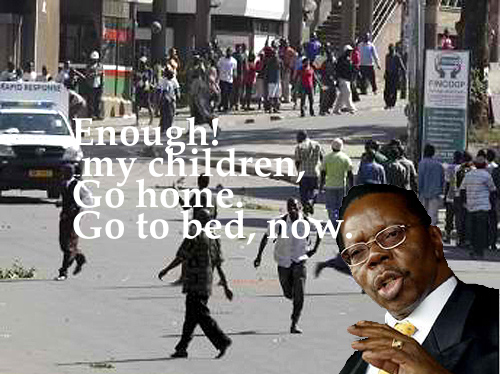
“Enough is enough,” Bloomberg news quoted him today. “I will smoke you out wherever you are because you have no right to destroy our peace,” Mutharika said. “I have been patient long enough.”

But so have the people, and that’s what I just don’t understand. And here are the distinctions between the people of Malawi, and the people of the Central African Republic (CAR), Zimbabwe and perhaps, Cameroon.

There aren’t a lot of people in the CAR, relative to other African countries. They live in Africa’s deepest jungle, have a very low level of development, and for at least two generations have lived in a state of if not constant war, constant no peace. It’s similar to Yemen or Afghanistan, where very disparate peoples are separated by awesome geography. It’s hard to get enough people for a few tables of bridge.

Zimbabwe was extremely rich relative to other African countries. When the dictator Mugabe slowly extended his control, there was a lot to pass around. There is now a very large section of the people, a minority to be sure but significant, who depend upon him, and they hold what is left of the riches and power. It is hard for a eviscerated majority to wrest control.

Cameroon is more similar to the CAR than Zimbabwe, but it is far more developed than the CAR and has more riches like huge gas fields and some mining. I think that gas is going to explode big time this fall at the election. I think with Cameroon, it’s just a matter of time, and not very long time.

But Malawi is different from them all. Malawi until twevolution was one of the most stable African countries, mainly because of its deft policies during the years of South Africa’s apartheid regime. Malawi was the bridge between South Africa and the rest of Africa, the mediator, the liaison between what ostensibly was an impossible rift.

South Africa’s economy now and before is about twenty times as great as the rest of black Africa, so it is a force no matter how ideologically unappealing it was, that must be reckoned with.

During apartheid the only way you could fly into South Africa, for instance, from Kenya was to connect through Malawi. If Uganda needed grain grown in South Africa, it bought the grain from agriculturally poor Malawi, who bought it from South Africa.

When you used those old land lines to call Johannesburg from Kigali, the last great switch was in Blantyre (Malawi). If you needed to exchange South African Rand that Switzerland wanted to pay you with for a safari in Ethiopia, it would be exchanged in Blantyre.

Malawi prospered during apartheid. South African citizens and businesses could own all sorts of things there, but so could Egyptians and Tanzanians. Malawi and the undesirable Cape Verde Islands were the only two places in this massive continent where South Africans and non South Africans could be seen vacationing together.

So South Africans developed Malawian tourism big time. Lake Malawi, one of the most beautiful deep water lakes in the world, is rimmed with South African mansions and tourist resorts. The relatively densely populated country was cleared out a bit (by South Africans) to create two modest big game reserves.

Malawi grew rich on the ideological divide between South Africa and the rest of the world. And both South Africa and the rest of the world were quite happy that the country was iron-clad stable. It was, and remains, a dictatorship.

South Africa is preparing to celebrate its 20th anniversary freed from apartheid in a few years. Malawi hasn’t done so well the last several decades, relative to the rest of Africa.

Twevolution frees initiative, severs the privileges of those who were born into rule or class from the riches and potentials of the country. Malawi should have made these changes long before twevolution arrived last year. But it didn’t.

Mutharika will not be able to squash this revolution, as Mugabe has in Zimbabwe and Bozize has in the CAR, and as Biya is trying desperately to do in the Cameroon. Mutharika does not have situations like them.

He’ll be gone, soon. Let’s just hope it’s quick and as peaceful as possible.

The Dead Elephant in the Pyre

The Dead Elephant in the Pyre

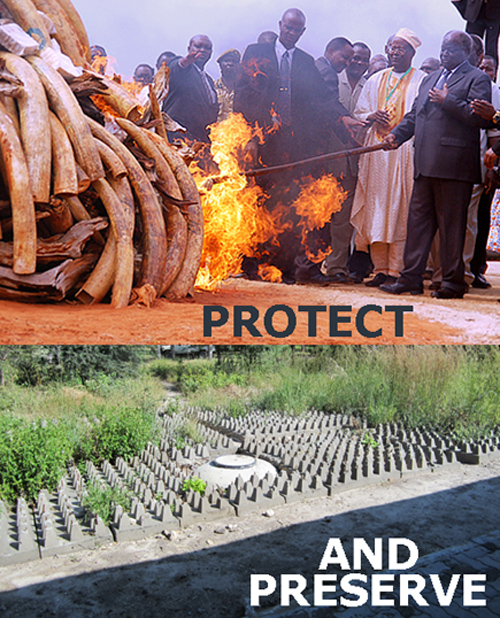
Protecting wildlife in Africa is a contentious issue, but Wednesday the Kenyan government publicly and forcibly illustrated its commitment to do so. There was no equivocation left in the pile of burned elephant tusks in Tsavo National Park.

It wasn’t just that 5 tonnes of confiscated ivory, worth close to $1 million on the black market, was being burned to ash. It was be being burned to ash by the President of Kenya, Mwai Kibaki.

And standing next to Kibaki were Kenya’s minister for Forestry and Wildlife and Minister for the Environment, as well as Uganda’s Minister for Tourism.

Kenya fought tooth and nail earlier this year at the CITES convention in DOHA to prevent elephant protection from being downlisted internationally. It fought hard against a formidable coalition of southern African countries, spearheaded this time by cousin, Tanzania. Kenya won.

The arguments Kenya had to successfully counter to defeat the initiative more or less all wrapped up into one: enormous revenue can be generated from the sale of ivory. In its most angelic form, this comes strictly from ivory sales by governments to governments of culled or naturally dead elephant, and in its slightly less acceptable form, from the sales of ivory confiscated from criminals.

But Kenya prevailed. Tanzania and its southern African countries are still grumbling.

Public support to loosen the restrictions on elephant protection, however, has numerous explanations. First and foremost is the scientific battle whether there are too many elephants right now. It’s similar to thousands of American communities that consider deer culling.

Many American communities that cull deer champion their subsequent efforts to give the meat to soup kitchens following one sniper’s moderate aim. But what do you do with 15,000 pounds of inedible meat after you;ve had to hire a military battalion to kill a single monster? And then, what do you do with the ivory, whose value is indisputably remarkable?

The next set of arguments is more compelling to the public that lives near elephant who almost universally believe one elephant is too many: Farmers lose tremendous amounts of crops annually to elephant raids, towns and villages suffer building attacks and road destruction, and federal outlays to protect elephants and their sanctuaries are becoming increasingly expensive.

But apparently not so expensive as to challenge the balance of tourist revenues. It’s the economy, stupid. We all applaud President Kibaki and his government for this dramatic show of public support, but … we all know why.

Pull the plug on tourist revenue is to pull the elephant gun trigger. Imagine if a fifth to a quarter of your local town’s property taxes came from foreign tourists paying to see deer or racoons. There’d be a whole different way of looking at planting roses.

I’m uncomfortable with this fact, just as I’m uncomfortable with current American politics driven by the almighty dollar. But … it’s the economy, stupid. Yet by pushing this moral and ethical if even scientific argument down the road, it pushes an ultimate understanding of it to the edge of the cliff.

Leakey may be exactly right that we are in the 6th great die-off, and that species decline is way behind our ability to control. But we know that species decline is fundamentally bad. And we know that no species declines all by itself, it drags much of its ecosystem and related species right down the drain with it. So governing this moral if academic argument by current economics is childish, way too short sighted.

And even more pressing is constructing the right now balance between the stresses of protecting the species and the negative human ramifications of doing so.

We need to right now figure out ways to protect farmers who live near game parks. Southern Africa does a better job of this than East Africa.

See the concrete and steel elephant grating of the “AND PRESERVE” picture above that I took earlier this year in a Botswana park. It’s so simple that it effectively keeps elephants away from the showers and toilets of a public camp site within the park.

But it’s terribly expensive, and East Africa claims not to be able to afford such measures. Instead, ruefully inadequate trenches and fences and electric wiring are still used. It’s a miserable control. It does little but further aggravate the farmers.

And if the farmers and school teachers are aggravated, today, what happens in the next decade when tourism revenues sink below agricultural production, or social services properly created by better education?

You guessed it. The elephant gun trigger gets pulled.

Stuck in the Blah Days in Tanzania

Stuck in the Blah Days in Tanzania

Northern Tanzania seems the epitome of everything that’s wrong with East Africa right now: economic recession, bad weather, a disgruntled population, and all in the context of a government that refuses to reform itself. Ho-hum.

There really is good news in East Africa, now, but at a little distance it just seems like silver linings rather than good news: to wit, the canceling of the Serengeti highway, and last week’s announcement that no new lodges will be built on the rim of Ngorongoro Crater.

Last month the Tanzanian government accepted international demands (especially from UNESCO) that the Serengeti highway not be built, while at the same time assuring Maasai just outside the park that they would get a new road at least up to the park boundary.

Brilliant move. We were ecstatic. Although I had expected by now that the donor funds to build this road and an alternative southern route would have been announced, I still think that’s what will happen.

And last week, after many more years of wrangling than the Serengeti highway issue, the government officially nixed plans by at least three companies for new lodges at Ngorongoro.

Again, brilliant move by a weak government drowning in the blahs. The point is that tourism is down, perhaps way down. Existing lodges are functioning at dangerously low capacities. It would be foolhardy to add any supply, now.

But of course the tourism minister, Ezekiel Maige, said “the area needed to remain natural and free from human pressures.” Right. And good of course, but that’s a sarcastic “right” coming from a government with little real interest in anything but oil rigs and mine shafts.

The lodge controversy at Ngorongoro began in 2005 and 2006, the hay days of safari travel. That’s when the super luxurious and ultra modern Kempinski Bilila Lodge attracted a principal investor named Jakaya Kikwete, Tanzania’s president. Reports indicate that the lodge is now putsing along at a less than 20% capacity.

When things are a bit bad, but not at crisis or catastrophic levels, news tries to push them through that threshhold to a point of gathering wider interest. What a wrong approach! We don’t want to get that point!

Unlike Kenya, Tanzania’s efforts at government reform have stalled. (btw Uganda’s are all but dead to the world.) A newly elected legislature last November, infused with new young blood and maverick politicians, was the greatest hope. They started the gears rolling for a new constitution, a necessary step.

But that’s over. Obese blahs cover the land, and nowhere within Tanzania more so than its important touristic north. It’s a do-nothing time.

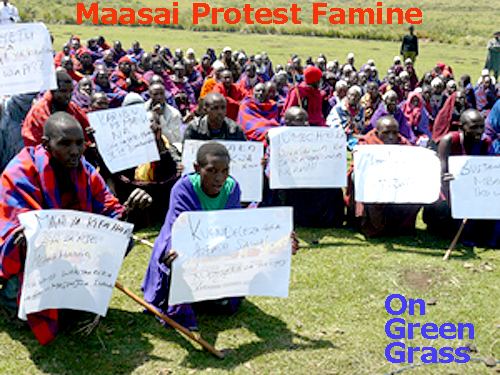
The weather is bad but not terrible (March-May rains were well below normal, but rains for the year look OK). Scandals persist as always, with the token official here and there scheduled to be sacked. Climate change gets worse and worse and Ngorongoro Maasai are demonstrating that famine and drought is destroying their lives (while sitting on freshly grown green grass).

What does this mean?

Nothing. That’s the point. We ought not presume that reforms will not take off when things improve, nor be less vigilant that a sneaky government won’t reallocate rim land to developers. Keep your eye on the weather; if it persists through another poor rainy season, then it’s time to worry for sure.

At home, we call these the Dog Days of summer, when it’s just too hot to do anything. In Northern Tanzania I call it the Blah Days, not too hot, not too cold, just not too anything.

No Drought News is Not

No Drought News is Not

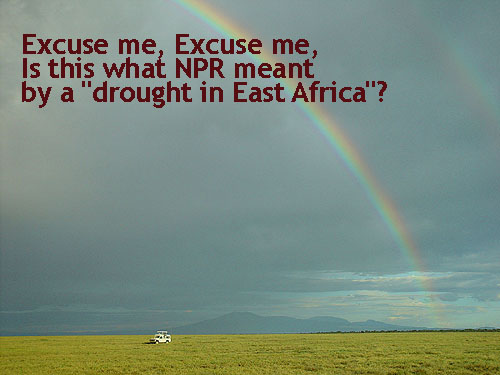
It’s raining in the Mara; it should be: That’s not news. It’s not raining in northern Kenya; it shouldn’t be: That’s news. Go figure.

In between truly cataclysmic reports of America’s political constipation last week, many news sources were reporting on the “calamitous” drought in “East Africa.” One concerned consumer emailed me:

“My husband and I are scheduled to go on safari to [East Africa] in 3 weeks and are very concerned since hearing stories of devastation and the death of wildlife due to the drought. We are insured for the trip. Do you recommend we cancel and visit another time when conditions are improved? We have spent an awful lot of money and don’t want to spend 2 weeks in a dustbowl viewing dead and dying animals.”

My office explained it was raining in the Mara. The excellent Governor’s Camp there reported 85.5 mm of rain in June (3.37 inches), a little less than normal, but nothing to write home about.

There are three important issues here.

First, “East Africa” is a big place. When you include all of Somalia, as NPR did in its weekend reporting, the area is nearly the size of half the continental U.S.

There’s a drought in America. There are devastating tornadoes in America. Floods are killing people in America. Wild fires are forcing people out of their homes in America.

Dare you visit the Blues Festival in Brattleboro, Vermont?

Columbia University’s excellent climate reporting website shows the actual precipitation over the last twelve months. (To get the “loop” actually looping, you may have to click on “Precip Loop” in the left-hand blue panel.)

When corroborated with many other similar data sources, what we know is that overall “East Africa” has a pretty normal rain pattern for this year. Somalia and northern Kenya less than “normal” and much of the prime game viewing areas of Kenya and Tanzania normal or just slightly below.

That’s the first issue’s facts. I know in today in America facts seems to matter less and less, but I can’t seem to drop the habit of referring to them.

Second. Climate change is deeply effecting all the tropical regions of the world, including East Africa, more quickly and more extremely than in much of the world including America. This is because of the highly complex way that weather works at the equator. Even when you look up from the equator at the sky, clouds rarely move at all, the confluence of multiple jet streams and mixed up “corioloses” is one of the most complicated swirling and twirling air patterns on earth.

In a nutshell the result has been to make dry drier, and wet wetter. It’s the reason we do have “drought conditions” in northern Kenya almost constantly, interrupted by a season of devastating floods.

Three. And probably most important. The human catastrophe occurring in Somalia, northern Kenya and Ethiopia is hardly new. And the fact that it’s being reported as news is a sorry indication that we don’t care as much as we should.

Do you remember “Live Aid”? That was nearly 30 years ago. Things haven’t changed much since. Admittedly, dry is drier, and there are more people to feed, so famine is more likely and will now occur more often.

Do you remember “Blackhawk Down”? That was nearly 20 years ago. That’s when Bill Clinton let Somalia implode. It’s never come back together.

The human catastrophe in a part of East Africa is human made, not weather made. True, the desert has been growing literally for millennia from north to south on the continent, and East Africa is near the dividing line moving south. But desertification in Africa is not news, happens at a relatively slow pace and can be adequately dealt with by proper human development.

And fresh, good, potable water has been a growing catastrophe in Africa for decades. This, too, has been known for 20-30 years and there are ways to deal with it.

It is the politics of fear, egocentrism, greed and lack of compassion that has been growing at too fast a pace.

It’s raining in the Mara. You can proceed nicely on your safari.

CordaWhatta in my Tutta?

CordaWhatta in my Tutta?

This dark circular tale starts with a motive of greed so pure that death doesn’t matter, and it ends in a dither of hypocrisies that if not so morbid would be laughable. Yes, we are proud that the EPA is once again doing its job to protect us … but at what cost? At the cost of killing in Kenya?

A U.S. corporation which is banned from selling deadly pesticides in the U.S. continues to profit from the production of that pesticide on license abroad, and from the ultimate sale of that product to East Africans. There in East Africa, it’s killing lions and people.

In 2008 the moment the EPA was released from the strangle-hold of the Bush administration, it began a series of critical restrictions and outright bans on a whole range of dangerous products that had been under production for more than a decade.

One of these was the pesticide Carbofuran which had been first produced in 1992 to combat the infestation of Japanese beatles and other aphids that were specially attacking soybean crops.

It was a dangerous number of years until the EPA regained enough resources under the Obama administration to ban it outright in 2008.

Numerous reports of U.S. farm worker illnesses and deaths from Carbofuran had been documented. But because the EPA and other regulatory agencies had been so emasculated by the Bush Administration, federal documentation was almost nonexistent.

But state documentation was striking. In California alone more than 77 workers were documented with serious Carbofuran illnesses.

FMC Corporation was the main producer of Carbofuran by 2002. It had either filed for most of the patents or bought them from other companies.

As more and more states independently began to restrict the chemical’s use, FMC looked abroad. Even after the EPA formally banned the product in 2008 and the Supreme Court denied FMC’s appeals in 2009, FMC could continue selling the deadly powder abroad.

It did this directly, but that was bad PR and risked further law suits simply from workers who would be packaging it in the U.S. So instead it licensed the product to a number of willing partners, including China’s Jiangsu Hopery Chemical Co., and that’s the company that continues to sell it to East Africa on license from FMC. In Kenya its main distributor is now Juanco Ltd.

In 2009 reports began to service in Kenya of the awful power of the pesticide, and more importantly, that it was available over-the-counter and was obviously not being used to kill aphids on soy beans. There is very little soy bean production in Kenya.

Children died. What was apparent was that the pesticide had been so successfully marketed in Kenya by Jiangsu, and was so relatively cheap, that small farmers were using it for everything possible, even when it was not particularly effective.

But the misuse of Carbofuran in Kenya drew world attention when Wildlife Direct reported that Maasai near the Mara were using Carbofuran to kill lions.

(Irony upon irony, eh? A kid dying doesn’t make local headlines, but Sixty Minutes finds a story when it kills a lion.)

Maasai don’t grow many crops, and certainly no soybeans. But modernizing the tradition of young morani spearing lion that harass their cattle, it’s now easier to do the job with Carbofuran.

Sixty Minutes aired its segment in July, 2009.

FMC Corporation tried to defend itself unsuccessfully. The ruse was outed. Finally, FMC agreed to buyback all the pesticide from individuals and store shelves in Kenya, while simultaneously exporting more product to neighboring Uganda and Tanzania where environmental authorities are far less aggressive than in Kenya.

It also established its licensing with Chinese companies and the Chinese companies found more Kenyan distributors, and very little Carbofuran was bought back, and lots more became available over the counter. Lots and lots more in neighboring Uganda and Tanzania, too.

Only a few weeks ago Wildlife Direct reported more lion kills in the Mara by Carbofuran and extended its claims to wildlife across the country, including many birds.

And now the tale may be twisting back onto itself.

Authorities in the U.S. are now testing Kenyan food imports into the U.S. for traces of Carbofuran, and if found, could ban Kenyan food imports. The U.S. is a huge market for Kenyan tea and coffee.

Americans like to think individual responsibility is all that matters. A video game might instigate a child to become a murderer, but it’s the parents’ responsibilities, not the government, to stop the child from viewing the poison.

But it’s OK to produce the poison in the first place. Just use it responsibly. It’s for aphids.

Victory in the Serengeti!

Victory in the Serengeti!

On November 9, 2010, I posted this graphic above my blog suggesting the Tanzanians would eventually back down from building a road through the Serengeti.
As I’ve been suggesting for a year, the “Serengeti Highway” will not be built through the park, but will be built right up to the eastern edge, and the goal of reaching the Lake Victoria port of Mwanza will be pursued as a new southern road from Arusha.

Wednesday, the Tanzanian government released a letter to UNESCO’s World Heritage Site office, which had threatened to remove World Heritage Status from the Serengeti if it were bisected by the highway, confirming that a paved west/east road through the neck of the park had been scrapped.

This is not a total victory, but a significant one. Let me explain why it’s not total.

Right now commercial traffic does move through the Serengeti, but it’s laborious. A paved road leads to the entry to the Ngorongoro Conservation Authority (NCA), and it’s then gravel for a long way, 5-6 hours to the Serengeti’s western gate.

What is planned, now, is for a new paved road to the eastern edge of the Serengeti, which will then continue as a new (short) gravel road to the existing gravel thoroughfare that runs roughly from Lobo to the western gate. When completed this “new route” will cut down the existing travel time through the Serengeti from 5-6 hours to about 3-4 hours.

The “new route” will also be significantly easier, as it will be straighter and less hilly than the winding cloud forest road through the NCA. So there will definitely be a new incentive for commercial traffic to increase once the route is completed.

But it is still likely a toss-up for commercial traffic to take this [faster] route rather than start from Arusha in a northwesterly direction on paved roads the whole way. This and the fact all roads within the park will remain unpaved are significant disincentives to commercial travel.

So in this sense it ends at least for the time being nearly two years of the most aggressive efforts by conservationists and scientists worldwide to alter a local country’s management of its sovereign wilderness.

Don’t pop the champagne.

First, this could not have been easy for the Tanzanians to have done. They have backed down. Can anyone imagine Eric Cantor backing down? Some creative spinning and long-term vengeance is in the political forecast.

Second, the real reasons for abandoning the project may not be known for some time, and I believe the main one is economic and strictly so. If I’m right, when the economic situation improves, the issue could reemerge.

Third, there is enough ambiguity in the letter that a flipflop would be easy … at any time.

Certainly there are recent indications that foreign donors – including the United States – engaged in some hard bargaining which may result in greater foreign aid to Tanzania, and likely for the construction of that southern road.

Hillary Clinton was in a specially good bargaining position last week. She was in Dar when the al-Qaeda leader, Mohammed Fazul, was killed in Somalia, and when his passport revealed that the only country which had given him safe haven was Tanzania.

What she told Tanzanian officials about Fazul’s capture is not known, and what was released instead included her reprimand about building a highway through the Serengeti.

Clinton was only the last of a long list of prominent diplomats who opposed the highway. Consortiums of scientists and wildlife organizations presented an impressive array of opposition, too. I remain seriously disappointed that our own American consortium of zoos was unable to get it together to join the impressive team.

An effort to get AZA, the American Association of Zoos and Aquariums, to join the world conservation opposition failed last year.

The first suggestions about the road came in early September, 2009, when East Africa was not yet suffering the world economic depression. What is hard for westerners to understand is that much of the developing world, and East Africa in particular, actually experienced increased growth until virtually this year.

But this year has hit East Africa very hard. Most prominently, the master road-builder China is reassessing its aid to East Africa and the world economic recession means that year after year, now, there is less to give to Africa.

Tanzanian president Kikwete is bound by a net of politics to help the Maasai in Loliondo, just to the east of the Serengeti. He linked this good, ostensible need with a bevy of corrupt components to give it a PR smile.

He can forego the corrupt goals, but the Maasai goal can’t be abandoned. This is the reason the government said, and I knew they would always have to deliver, a paved road up to the eastern edge of the park.

With less aid that will be difficult, now. But I feel that actually takes precedence over the grand scheme of linking Arusha with Mwanza, linking Tanzania’s northern heart to Lake Victoria. The priority must be the road to Loliondo.

So what happens when that is completed, but money runs out for the much more expensive southern road?

It depends. It depends upon how well tourism fairs in this down economic times. It depends upon how well Bilila Lodge (which was in the route of the old proposed highway), in which the president holds personal and substantial stock, does.

It depends upon whether the Grumeti Reserves continue to draw too much water from Lake Victoria. It depends upon whether American hedge fund traders do well enough to build the new Serengeti headquarters as they’ve promised.

It depends upon how prominent the opposition MP from Arusha, Godbless Lema, fairs in the next couple years.

All of these depends reduce to this:

If foreign donors put up the funds and build the southern road before all of the above depends play themselves out, the Serengeti is safe for another decade or two. If they don’t, it all depends.