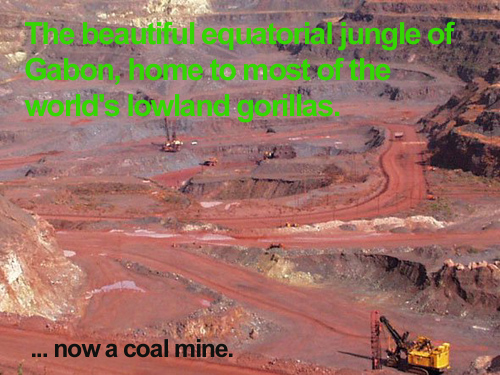
If you thought everything Canada is green and good, think again. Canadian mining is destroying Africa. And maybe destroying Canada.
The Canadian “extractive industry” as our Canadian cuzzes obliquely call it, is exploding. Literally, as GDP for Canada and as dynamite and gunfire in Africa. Numerous human rights violations across the continent have been documented against Canadian companies.
One of the worst incidents occurred in Tanzania in May. I’ve written about the North Mara gold mine before, operated by Canada’s Barrick Corporation. I think it how lovely now that the company’s own website lists some of the gravest allegations against itself.
In May Barrick admitted police aided by its private security forces shot to death 7 “intruders” and wounded others. Reports suggested as many as 1,000 people were involved. And clearly there is complicity by Tanzanian officials, which is now being investigated in parliament.
But it is the brashness of Canadian companies which stokes African ire. The CEO of one of Canada’s most aggressive African mining companies, IAMGOLD, recently told journalists in response to a strike called at one of his mines in Burkina Faso that he would crush the “illegal strike and as they will find out, will not tolerate anything that has a negative impact on our stakeholders.”
Well, that’s not particularly soothing PR for an industry blemishing the earth, and Canadians over the years were beginning to feel remorse. A year ago Parliament was about to pass Bill C-300, but the mining lobby and conservative Harper government managed to kill it. The bill would have imposed the same human rights regulations on Canadian companies operations in Africa as it imposes on those same company’s operations in Canada.
One unexpected result has been that groups as disparate as Burkina Faso mothers and Nigerian teachers are now suing Canadian companies broadside in Canada. The suits are so successful that there are plenty of lawyers to take them on.
So having lost that PR battle, and having lost all sorts of civil suits, the Canadian government has achieved a novel alternative.
The government has “developed a partnership” between many of these insidious mining companies and otherwise respectable NGOs. Here’s the three top:
A few seconds before this was announced it would have been thought an idea for the Onion or Daly Show. But it’s real. In effect the Canadian government has bought off otherwise good charities to polish up the image of its tarnished silverware. These organizations get up to a million dollars each to, in the words of WUSC CEO, “nudge along good practices.” Holy Smokes. Literally.
Each partnership is odious. Plan Canada’s mission as a principal advocate for child development has some explaining to do ever since IAMGOLD closed down operations at its Essakane mine in Burkina Faso due to strikes in part alleging illegal use of child labor.
Hm.
World Vision, one of the most aggressive religious NGOs that I’ve often claimed is one of the few excellent ones in Africa, is partnered with the gold trolls, Barrick. I just don’t think they’re going to get even an ounce for the wise men.
It’s all such a monstrous if laughable window dressing. I heard recently that not-for-profits were hurting this year. How? For money? Or mission statements?
With Africa youth unemployment as high as 50% should African governments replace funding universities teaching liberal arts with those exclusively teaching employable skills like accounting?
With the Florida State budget in a nosedive, should Florida tax payers redirect support for liberal arts universities to vocational colleges?
Voice of America reported recently that Uganda’s president, Yoweri Museveni, told an academic awards ceremony that the curriculum they were awarding was wrong. We call this letting the fox into the chicken coop. But in spite of all my other criticisms of this dictator, he moves into stark relief a question that plagues us as well.
We need truck drivers in the U.S. right now. We are still in a serious recession. Should state governments support vocational schools teaching truck driving and mechanics, or liberal arts dissecting Proust’s inner motivations?
Most of Africa is growing robustly. It needs and can often instantly employ accountants, engineers, skilled machinists and similar vocations. Should African budgets support departments of philosophy at their universities when there are as many philosophy positions opened in equatorial Africa as snow flakes on the streets?
It’s a harder question for Africa than us. We can make more policy mistakes and still come out on top. We also have infinitely more resources, and so for us, the answer should be: Support both. Despite the depth of the recession, even Mr. Tea Party knows that American innovation is born of stimulated imaginations more likely to be pricked by Proust than tossed by trucks.
Unfortunately conservatives don’t think. So the trend in the U.S. right now given the recession is to favor vocational over liberal arts. But in America I see this as a passing fancy, due to die with the Republicans very soon.
Besides, even right now if Rick Scott is successful in redirecting Florida’s educational budget towards vocational rather than liberal arts institutions, it’s unlikely he will completely gut funding the University of Florida.
Museveni, on the other hand, is implying just that: that government support – crucial to the very existence of Uganda’s Makerere University – will end unless teaching “Conflict Resolution” ends. (The university politely replied that it would study the matter.)
Uganda is the perfect contemporary society to observe the ultimate outcomes for many conservative social policies. Museveni accomplished this, for example, not so long ago by taking the issue of same-sex marriage to the point of suggesting these couples be executed.
Constrained by far fewer resources, most African societies have nevertheless developed multi-tier, varied cultures and sustained multiple approaches to both economic and social development, unlike Uganda. But they do exist in starker contrast. The rich are richer, relatively, and the poor are poorer. The divisions between the African truck driver and African philosopher are vast compared to here.
For a moment, step back from the philosophical and other fundamental (like economic) arguments that may drive these competitions for public resources. I think there’s more common sense to be applied here than intellectual strain.
I believe the principal driver of these resource competitions isn’t “the greater good” but rather a desire to divide and conquer. What we should be doing is mending the chasm between driving a truck and reading Proust, between studying conflict resolution and learning accounting.
Those like Scott and Museveni who facilely solicit public support for what they can easily argue are exigencies of stressful times are actually the devils in the details it seems so easy and even compassionate to accept. But there’s so much more to it.
The simple and so much better perspective is that we don’t want to divide then obliterate one of the options; we want to preserve both. Pointless to drive a truck to nowhere.
When something goes wrong, those with greater resources cope better. So it’s no surprise that Africans are the furious ones and the developed world’s citizens are the most complacent about climate change. Too bad rich tourists heading on safari: you’re about to experience it square on.
I think practically everyone in the world will agree on one climate change outcome: weather is more extreme. Summers are hotter, winters are colder, winds are stronger, rains are heavier, and periods of beautiful calm are often longer. Extremes.
Idiots argue that man has little to do with this, and non-idiot poorly informed believe even if man has little to do with this, there’s little he can do to abate it. Wrong. Wrong, of course. And this dog-headed refusal to accept simple science is found mostly in the developed world, where hotter summers and heavier snows are annoying, but not catastrophic. Yet.
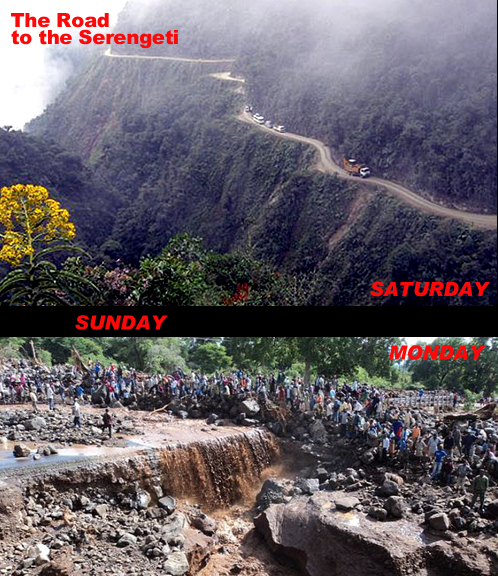
In Tanzania last weekend heavy rains fell once again in the north over the important safari circuit. Three bridges were destroyed, the beautiful Manyara escarpment lost much in a landslide, Serena Manyara Lodge was partially destroyed, a half dozen people were killed and hundreds hurt, and right now you can’t drive normally into the Serengeti from any airport in northern Tanzania.
The rains have laid waste a beautiful paved road – the only one – that links Tanzania’s Manyara, Ngorongoro and Serengeti national parks with the main metropolis of Arusha and Tanzania’s main northern airport. The road was built with Japanese aid money in 2007, completing an already improved gravel road built in 2003.
Before then overland safaris into the Serengeti were much different than they were post last weekend. Either you flew, missing so many beautiful sights along the way, or added a day or two to your itinerary to make sure you could get over the Manyara escarpment.
It’s unclear if Tanzania has the wherewithal today to repair the current mess, which is massive. The very important December holiday season is extremely heavily booked, and I doubt seriously that the roads can be repaired by then. And the greater question looms: you repair it at phenomenal cost, now, and then what about the next heavy rains?
This is happening as the Durban Conference on Climate Change goes on, and on, and on, and on. This is the conference that created the Kyoto Protocol, the nearest and now decaying world treaty to deal with climate change. For the first time in the conference’s 20-year history, no U.S. lawmakers are present.
And the all but dead Kyoto Protocol, which the world’s top polluters the U.S. and China never signed, may get its nail-in-the-coffin as reports circulate that Canada will celebrate the current conference by withdrawing from the treaty.
This particular road is important to tourists, but it’s more important to local commerce, students going to school, farmers preparing fields. It’s not just tourism, of course, that suffers from climate change. Droughts are more frequent and so famine is more frequent. Floods are more frequent, so development is drowned, diseases spread.
Africa can’t cope. And when Africa doesn’t cope big time, the developed world is pulled into the mess as rescuer of last resort at great expense. This is getting boring, it’s happening so often, and nobody seems to have a long enough vision to realize ultimately that the world as a whole – that means us – is hurt by climate change as much if not more than Wall Street banks and housing bubbles.
From far, far away, Kenya is being sacrificed to quell the war on terror. A young and dynamic, growing country with a tremendous future has been thrown to the wolves.
The war in Somalia is not going well for Kenya. The army advance is bogged down, more aid workers and civilians have been kidnaped or killed and many more injured near the front and by two grenade attacks in Nairobi city. The shilling is tanking and local prices are skyrocketing.
But it may be going well for America. Depending on your point of view, of course.
“Several of the missiles fired at jihadist fighters … on the Somali side of the border seem to have been fired from American drones or submarines,” the respected magazine, the Economist reports.
I want to stop al-Qaeda’s terrorism, who doesn’t? But fighting these endless proxy wars is inhumane. Go ahead, fire the drones, but don’t make Kenya the sacrificial lamb.
From the Kenyan border to the stated objective, the coastal city of Kismayo, the path using existing roads and tracks is about 150 miles. After 40 miles, the Kenyan military got bogged down in mud following heavy rains.
Fighting to that point was minimal. Skirmishes by al-Shabaab supporters and guerillas resulted in random and rapid firing by Kenyan troops. At the crossroads of Bilis Qoqani, 45 rebels ambushed the convoy and in the ensuing battle, the first real encounter between Kenya and al-Shabaab, the militants were routed, 9 killed and several Kenyans wounded.
At that point it was learned that an unexpectedly well organized al-Shabaab force was digging in at the city of Afmadow. This is actually north of the planned assault and now means the Kenyans have to confront the militants there or risk being attacked from their flank if they proceed directly to Kismayo.
So while today they are only about 85 miles from their objective, it looks like they must head north for the great battle at Afmadow, first.
And back at home, things couldn’t be worse for the everyday Kenyan. The city’s main newspaper calls it a “Nightmare.”
The world is surprisingly learning that a significant portion of the prewar Kenyan economy was linked to the port at Kismayo that the Kenyan military is now trying to take over.
“Supplies such as sugar, rice, cooking fat and powdered milk” and “even electronic goods and vehicles” come from Kismayo, even though it is controlled by al-Shabaab. Sugar in Kenya’s northeast today costs four times more than two weeks ago.
In the center of the country in Nairobi, the concern is not so much with sugar as shillings. A year ago the shilling traded at about 65-70 for one U.S. dollar. Today it returned to just under 100 after peaking yesterday at 106.
The median interest on a business loan shot up to 20% today, after the government’s request for a $65 million loan from the IMF was answered with only $25 million.
Tourism is being decimated. If everything ends well and Kenya is the super hero, tourism will rebound rather quickly. But that doesn’t look likely to me. I think we’re in a very long period of declining tourism.
More and more Kenyans are beginning to question the war, as I believe they should. “Let Us Rethink Our Somali Intervention” was the lead editorial in today’s Nairobi Star newspaper.
We all want al-Qaeda’s ruthlessness to stop, most of all Kenyans who have lived with it day in and day out for much of their lives. But violent eradication of an entrenched fighting force is not something Kenya can accomplish. If we as Americans have accomplished it in Iraq (which is very uncertain) look at the effort it took. Kenya cannot undertake that.
Obama knows that. Hillary knows that. But their allegiance is to their home. The sacrificial lamb comes from far, far away.
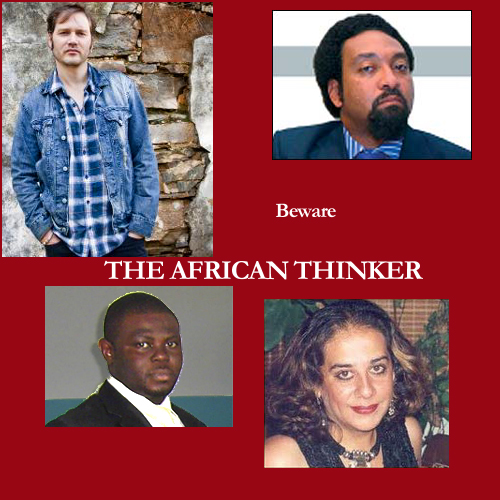
South African Richard Pithouse, Egyptian Gamal Nkrumah, Kenyan Rasna Warah, and Nigerian Rotimi FasanOccupy Wall Street is seen from Africa with a clarity we’re missing here at home. As Africa sees it, American youth’s frontal assault on unbridled capitalism is not going to end quietly.
The “unbridled” is an important distinction from the sister movement of the 1930s which gave rise to an unique version of South African communism that has continued as a political force, there, until today. Back then capitalism was going to fall lock, stock and wall safe. Not now.
South Africans, Nigerians, Egyptians and Kenyans in particular see capitalism as here to stay, but as something that needs to be hugely reigned in, and they see the OCWS as an indication it is really going to happen this time.
There have been only a few placards in Nairobi, and a greater but still smallish response in South Africa’s three main cities, but a massive amount of discussion in the media, there. I think one reason the demonstrations are smaller, is because relative unemployment has not spiked so high as it has here. The discontent relative to before is more intellectual than economic.
And African economies are much more regulated to begin with than ours.
Few Africans are in a better position to compare OCWS with the Arab Spring than Egyptian Gamal Nkrumah. The son of Africa’s first independent president (in Ghana), he married an Egyptian and has lived there permanently for a number of years. Recently Kkrumah asked about OCWS:
“Will this spontaneous outbreak of angst be hijacked and neutered or will it become, like the anger of Egyptians, the backbone of a new social contract?”
Nkrumah isn’t sure. He worries that the established financial system in America is just too hard to crack:
“The game of global finance is as dirty as hell… The international meltdown is a harsh indictment of the global financial system [but] bankers don’t seem to have a conscience and [all] the people [can do] is strike the fear of God into them.”
Nevertheless, my survey of African analysts suggests Nkrumah is in the minority. Although cautious and not suggesting our entire system is going to be revolutionized, most African analysts believe OCWS foreshadows significant change in America.
Everyone knows America with China at its heels controls the world economy. So what happens in America effects everyone, without exception. African’s interest is not simply academic. In fact what happens to the OCWS may have a more immediate effect on the everyday lives of Africans than it does on most Americans.
The very influential young thinktanker in South Africa, Richard Pithouse, has often written that the developing world has been consciously subordinated to us – the developed world – by a brute and unfair force called DEBT. Think about it. Where is most of the gold in the world? South Africa. Where is most of the oil?
But who controls the gold and the oil? Neither South Africans nor Nigerians, but Americans and Europeans.
“Debt,” Pithouse writes “became a key instrument through which the domination of the North was reasserted over the South.”
But that suffering has now come home to roost in America, according to Pithouse. The “servitude of the debtor is increasingly also the condition of [American] home-owners, students and others” who are being made to pay for the financial crisis created by their overlords, the bankers.
At last, Pithouse exclaims, OCWS in America is “a crucial realisation that for too long society has been subordinated to capital.”
“The prevailing capitalist economic system has clearly failed. It has deepened inequality between people and nations and caused much misery. Its excesses must be curbed,” writes , Kenyan analyst Rasna Warah in her article “Is the End of Global Capitalism Nigh?”
She answers her own question with a “Probably Not,” essentially what all the analysts in Africa concede. But she opines that as Africa emerges from the Arab Spring it will invent “a hybrid, more humane capitalist-cum-socialist system … where wealth will … be used to promote the greater good rather than individual and corporate interests.”
The Nigerian analyst and sometimes poet, Rotimi Fasan, compared Wall Street bankers to the worst of his own corrupt Nigerian autocrats. And like many, many writers throughout Africa he wonders if what is happening now “might be the beginning of the West’s version of … the Arab Spring.”
He refers to the west’s “crumbling economies” and cautions that “things may not take that shape immediately. But they might over time. Those who imagine that such eruptions could only happen in Africa of sit-tight leaders” do not fully understand what’s happening.
Which leads me to another dominant theme throughout all of Africa’s reflection on the protest:
Our media is minimizing the demonstrations.
“If these protests were occurring in any other part of the world, Western [media] would be describing them as an ‘American Spring’ that could topple a government,” Warah writes.
Warah and other Africans believe that the American media is part and parcel of the greater problem. “The large [American] media networks are part of the very corporate culture that the protesters are against,” Warah explains to her readers, so naturally they are minimizing the story.
Using last week’s celebrations of Martin Luther King, Pithouse claims that the famous statement that young blacks in the 1950s faced life “as a long and desolate corridor with no exit sign” applies to all American youth, today.
The South African continues: “The time when each generation could expect to live better than their parents has passed. Poverty is rushing into the suburbs. Young people live with their parents into their thirties. Most cannot afford university. Most of the rest leave it with an intolerable debt burden.”
And what does this mean about America to an educated outsider?
“The borders that surround the enclaves of global privilege are shrinking in from the nation state to surround private wealth.”
Wow. Poetic but how insightful. I think Pithouse reflects many many intellectuals from abroad, especially from developing and emerging, youthful nations. They no longer look to America for direction, but for lessons as to why things went so wrong.
“When some people are living like pigs and others have land lying fallow, it is easy enough to see what must be done,” Pithouse says. “But when some people are stuck in a desolate corridor with no exits signs and others have billions in hedge funds, derivatives and all the rest, it … is more complicated. You can’t occupy a hedge fund.”
But OCWS protestors understand that “finance capital is … the collective wealth of humanity. The money controlled by Wall Street was not generated by the unique brilliance, commitment to labour and willingness to assume risk on the part of the financial elite. It was generated by the wars in the Congo and Iraq. It comes from the mines in Johannesburg, the long labour of the men who worked those mines and the equally long labour of the women that kept the homes of the miners in the villages of the Eastern Cape. It comes from the dispossession, exploitation, work and creativity of people around the world.
“That wealth, which has been captured and made private, needs to be made public.”
Pithouse concludes and warns us directly, “When a new politics, a new willingness to resist emerges from the chrysalis of obedience, it will, blinking in the sun, confront the world with no guarantees.”
Beware the thinkers of Africa. They bear the truth of experience.
No! Because there aren't any!NPR’s Namibia stories this week distort the overall complexities of human-animal conflicts in Africa as whole. The reporting by Christopher Joyce was an admirable portrayal of one very unusual country’s struggle with wildlife, but when he generalized he was quite wrong.
I hope you listened to the two reports, one on Monday and the other on Tuesday. Read this, then listen to them, again.
Many issues regarding wildlife, hunting and social responsibilities of any country are universal. How to make use in a profitable and sustainable way of these natural resources is an ongoing struggle that I feel is being successfully addressed throughout most of Africa.
But not necessarily the ways Namibia is trying. How Namibia approaches this diminutive national resource is very much different from the rest of “Big Game” Africa. Namibia is a very, very unusual place.
The thrust of Christopher Joyce’s reporting for NPR was that the only way that wildlife can be preserved is by privatizing it. Maybe for Namibia, but dead wrong for Africa and the vast majority of the rest of the world.
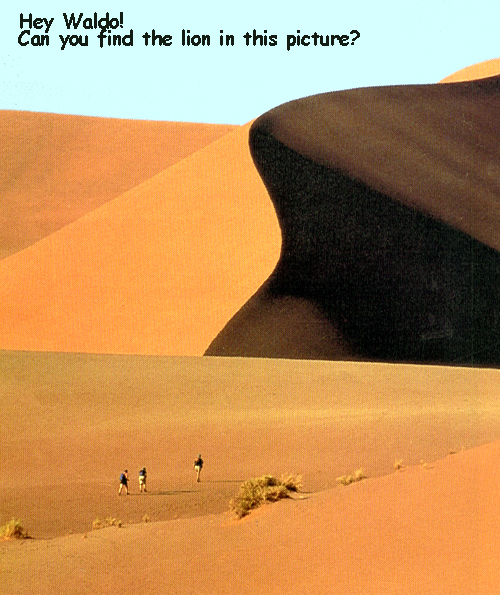
A little bit bigger than Alaska, the country is mostly uninhabitable. Nearly half (the western regions that border the Atlantic Ocean) is so dry that some fishermen grow up never seeing rain. Much of this area is the Namib Desert, which is pure sand, and some of the most spectacular dunes on earth are found here.
There is very, very, very little wildlife compared to the rest of sub-Saharan Africa. In fact, compared to practically any other random part of the world. I can’t emphasize this enough, because Namibia is where many outstanding wildlife research projects have occurred recently. Some have even led to major discoveries (about elephant verbalization, for instance). But this may be the case, indeed because the wildlife here is so scarce.
The NPR report itself confirmed there might be 125 lion in the entire country. That is about the same number of lion for this massive 325000 sq. miles as found in tiny 100 sq. mile Ngorongoro Crater in Tanzania. For a similar area in East Africa the size of Namibia there is likely upwards of 50 times as many lion.
And that metric applies pretty well for any other wildlife comparison between Namibia and the main wildlife viewing countries of Africa. The exception could be oryx and springbok, two antelope species which do exceedingly well in very dry environments. But except for these two antelope, Namibia is not a place to go to see wildlife.
The most famous wildlife park in Namibia is Etosha Pan, which is about 7% of the entire country’s land mass (22,000 sq. miles). It’s hard to find an animal census for the park, probably because it’s not very good. The Namibian government claims there are 2500 elephant (dubious) and makes the grandiose claim that, “It is well known that Etosha has the single-largest population of black rhinos in the world, but the actual count is kept secret so that this fact – and the population of rhinos it defines – is never threatened.”
Such unsubstantiated remarks need to be taken with a lot of grains of salt, of which Etosha has a vast supply. Moreover I’m absolutely sure there are many more black rhinos in places like Lewa Downs in Kenya as well as in a number of South African private reserves.
Namibia’s richest wildlife area is the eastern Caprivi Strip, the area squeezed between Botswana and Angola which is hardly 300 sq. miles large. This is where many of the private wildlife reserves Christopher Joyce discussed in his radio reports are located. Interestingly, though, it was not where Christopher Joyce of NPR spent most of his time.
The reserves Joyce reported from may have the least amount of wildlife of any of the collection of private reserves in Namibia, which does make it a compelling story as to how they are trying to exploit the little they have. But I am concerned that at no time did he explain this serious difference between Namibia and the more popular areas for wildlife viewing in Africa: i.e., there is hardly any wildlife in Namibia.
(Joyce spent most of his time on the few reserves on arid, near desert terrains where the provocative topic of hunting was raised. I thought he did a decent job with this topic although he might have considered interviewing the equally if not larger segment of the population in Namibia that opposes hunting. Nevertheless, this is a topic universal to privatization of wildlife reserves throughout the continent.)
The Caprivi is a beautiful, wooded and riverine area with a varied biomass, and what to do with it is a critical issue but keep in mind how small an area this is. It may contain up to three-quarters of all Namibia’s non-desert wildlife, but it is one one-hundredth of the country in size, only one quarter the size of Yosemite National Park.
I hope you see where I’m going with this. To call Namibia an African wildlife destination is really rather stretching it. It has some extraordinarily unusual wildlife, because of its extraordinary desert ecologies, well worth a zoologist’s interest. But to consider it a viable tourist destination for wildlife is a ruse.
Namibia’s attractions are grand, but they do not include wildlife.
And it’s probably precisely this reason that the government wants to develop the little that remains as best they can. Fair enough. And it may, indeed, be true as Joyce suggests that privatization of such a minimal resource is the only way to sustain it…in Namibia.
But this strategy is absolutely not an evidently good one for more normal environments elsewhere in Africa, where the wildlife is more naturally abundant. In fact, it’s a major and often contentious issue in areas that have naturally abundant game. Personally I’m in the camp of folks who do not believe that privatization of important national resources like wildlife is good.
And when Joyce ended his final episode by claiming the people “from all over the world and Africa” were coming to Namibia to learn from their privatization projects, I started to laugh then became rather irritated.
It’s like suggesting farmers are traveling to New York see how to grow corn. There is some corn grown on Long Island, and probably in very creative and interesting ways, but it’s sure no general model.
Private wildlife reserves are flourishing all over Africa, hundreds more than in Namibia, because they have much more wildlife to show off. Now it could be that the particular model for Namibia’s privatization is better, say, than Tanzania’s WMA (Wildlife Management Areas) or South Africa’s private wildlife zoning ordinances, with regards to fairness to the local population or to the wildlife or whatever. But Joyce didn’t explore this.
Namibia’s future is not with wildlife. Its tourism development must — and has, actually, at least until now — feature many other wonderful things before wildlife. Wildlife could be the icing on the cake of a fabulous Skeleton Coast safari, but the cake is substantively without animals.
Moreover, Namibia’s broader economic and social development is not with wildlife. It is squarely with how to divide the special wealth from its rich deposits of uranium, diamonds and a few other minerals; and with the growing conflicts with its rapidly developing indigenous populations like the Ovahimba.
That doesn’t mean we shouldn’t all be fascinated by the story Joyce told. Just put it in perspective, which he should have done but didn’t.
Years ago I guided teachers, bankers, students, lawyers and plumbers on safari. Now, I guide bankers, lawyers and brokers. What’s happened? It’s simple. Like so much in life, safaris have become too expensive for the average Joe.
Now to be fair, it was never as easy for a teacher to go on safari as a banker. And unfortunately we never saved the actual demographic data. But I can assure you I really did guide lots of teachers and as a percentage of overall clients they’ve decreased substantially.
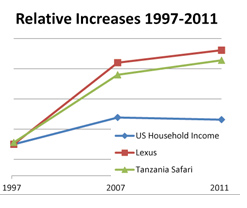
It isn’t just the current economic downturn. It’s a trend, and I decided to find what “in life” has increased as much as a safari’ cost. Answer? Lexus.
Here’s the data for the chart:
1997: US household income, $37005; Lexus: $50000; safari: $320/day
2007: US income, $50150; Lexus: $100000; safari: $600/day
2010: US income, $49550; Lexus: $112000; safari: $660/day
Costs have increased for all sorts of regular reasons like the price of fuel and food. They haven’t increased because salaries of workers have increased, and therein lies the schism. Household income hasn’t increased. There’s less for anything but just getting by.
Now as we all know, that’s not true of the richest of us. The rich are absolutely getting richer, even though as a percentage of the population they’re growing smaller. So our pool of safari travelers, just as the pool of potential Lexus buyers, is decreasing.
The latest proof of this is a white paper being circulated among Kenyan officials that would ban minibuses in national parks.
Minibuses save about 50% of the transport costs over 4-wheel drive vehicles like Landcruisers, and they have been the mainstay of the lower markets. A new minibus is actually a more comfortable ride than a Landcruiser. It lacks the power, of course, and that means it can’t travel as remotely as a Landcruiser, but in parks like Kenya’s Mara that’s not necessary.
But Kenya’s tourism minister, Najib Balala, told a Kenyan newspaper that “Using mini-buses is cheap” and that Kenya had to portray a more upmarket image.
I can’t blame Balala. For years the costs of safari have increased far faster than median income from any of the safari markets. In the last 20 years, American median income has risen hardly at all, whereas the cost of a safari has tripled.
Game Park fees have quadrupled. Lodging costs have doubled. Transport costs have tripled.
But the salaries of drivers, customer relations staff and even managers and hoteliers has hardly moved. Like median income from source markets, those graphs are flat.
So ultimately, who gets these enormous increases?
Well, the government fees for national park entrances are clearly an increased revenue source for those governments. And in places like Kenya and Tanzania, for instance, this piles up directly into the general revenue fund.
But the lodging and transport hikes derived from fuel and construction costs are going to the providers of those things, the owners and stock holders of oil companies, potash mines and manufacturing companies.
And it isn’t just safaris, of course, that I lament. In my life time I’ve watched natural and cultural attractions like national parks, city zoos and opera houses become more and more reserved for the rich and powerful. And the rich and powerful are becoming richer and more powerful even as they become a smaller segment of our society.
My own safaris cost has skyrocketed and I’ll be the first to tell you I’m not the principal one to profit. I’ve watched the cost of good, solid albeit mass tourism lodges like Sopa’s Ngorongoro property in Tanzania increase from $140 per room in 1994 to over $450 per room today. And believe me, the radiators still don’t work!
Yet I can’t consul Sopa or anyone else to do anything differently. The thresholds we have to look at today aren’t the top thresholds but the bottom ones. What?!
That’s right. Balala is exactly right. Prices that look “cheap” detract from selling. If even the product is truly cheap, its chance for selling is greater if it’s priced higher. We are appealing to the rich, no one else anymore.
I’m not blaming anyone. It was probably inevitable in our global economic system. But it’s sad.
Big business isn’t exactly winning a lot of awards today for social responsibility, but why has it taken us 20 years to figure this out? Yesterday we learned how a big oil company played war in Africa, killing tens of thousands.
It’s one thing when you choose sides in a war to fight for an idea. But my life time has been beset by wars fought not for ideas but for the power to control natural resources. The old communist adage of the “ends justifying the means” has become a truism as appropriate to rightist politics as leftists.
I’ve written how the Obama Administration through the Dodd-Frank Act has almost single-handedly ended the wars in The Congo over Coltan. With similar dispatch, we now need to stop the endless killing in the Nigerian Delta over oil.
And it appears all it might take is strapping the oil companies into a closed room and nationalizing them. What d’ya think? Sound possible?
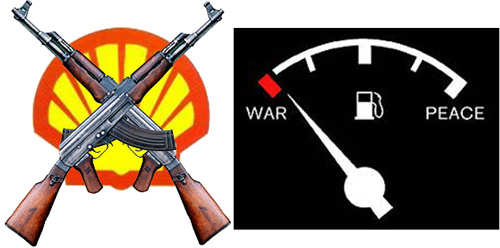
The report released yesterday in London documents Shell Oil Company waging war in the Nigerian Delta. Specifics include direct transfer of money to illegal militant organizations, changing sides depending upon who was winning mini civil wars “picking the more powerful group to help protect its oil infrastructure.”
Not good or bad, or capitalistic or socialist, just “who was winning.” To keep the oil flowing. No matter right or wrong. Ends justify the means.
The NGO responsible for the report is Platform. This is no fringe organization. The report was considered so credible it was immediately reprinted by London’s Guardian newspaper and its author immediately interviewed on Canadian Broadcasting, among literally dozens of other media platforms.
But, um, didn’t see much about it in the U.S. In fact, interestingly, the Guardian which closely follows oil company evils in Nigeria didn’t print the story in its U.S. edition.
The paper’s environmental editor, John Vidal, has published award-winning stories including castigating Americans and others for paying so much attention to the BP Oil Spill in the Gulf when the accumulated disaster of oil spills, wars and patent corruption in Nigeria has effected many, many more lives and livelihoods worldwide.
Well, that’s the reason, I guess. America isn’t ready to go to the back shed for a whipping yet, and suggesting such might … well … be counterproductive?
Media, today, is as much a function of ends justifying means as every other sinister component of modern life.
There are many Platforms in the world, daily churning out the truth. In fact, there’s so much truth about the sinister activities of oil companies in Nigeria that it’s heart-breaking it hasn’t prompted action, for instance, embodied in the Dodd-Frank Act regarding Coltan.
Write your Congressman? Buy a Prius? Maybe just add a few foreign media sources to your daily news intake?
For some clients, today, traveling for leisure is being squeezed by the economy. And as a result, they’re making some very dangerous decisions. Tight economic times are absolutely not the time to dismiss expert advice.
I can think of no better example than the horrible tragedy last Friday in Tanzania. One of the ferries that plies between Zanzibar and Dar capsized. At least 200 people are dead or missing.
The usual way for a tourist to get between mainland Tanzania and Zanzibar is to fly. From Dar, the quick 15-minute flight costs around $60. Recently, I had a client booked this way who discovered on her own that one of the 5 daily ferries between Dar and Zanzibar would cost her only $8.
Now my first task was to determine if this was really a budget issue or something else. Since her overall safari was well over $5000 it seemed silly she would be interested in saving $50 particularly when it wasn’t very comfortable and took 6-8 times as long.
But it seems so romantic, she said.
A ferry that is licensed to carry 400 people and that often carries 600 is not particularly romantic.
I have nothing else going that day, she retorted.
At this point, one begins to wonder if this is becoming one of those epic battles between the expert (me) and the client (her) over my alleged disrespect for her budgetary and travel research capabilities.
I’d like to get to know the local people, she added.
At which point I laid down the gauntlet and said the ferry schedule was totally unreliable, they only depart when they fill up, they have a terrible safety record and my straight-out advice is don’t do it.
She did.
Fortunately, she wasn’t on the ferry last Friday. Her ferry went off more or less on schedule, it was a fine sailing day, and I’m sure she’s telling everyone she meets that it was one of the best parts of her safari.
And that she really had to fight with her travel expert to do it.
This isn’t just an “I-told-you-so” anecdote. As a traveler, you can do it on your own, or you can do it with an expert. A lot of people can do it on their own quite well, and I’m the first to champion the feelings of personal accomplishment and excitement that comes with plotting your own distant explorations.
But don’t mix and match.
Personally arranged travel to exotic places carries significant risk that is a part of the whole adventure experience. I know that better than anyone. The challenge of personally overcoming intrinsic difficulties are the same as felt by the climber of McKinley or the swimmer of the English Channel.
But here’s the point. Had she arranged her own safari on her own completely, she would have learned that the ferries are unreliable and dangerous. She might then – as I have, especially in my youth – played the odds and gone, anyway. And in her case, she would be vindicated.
But she had no clue. Because she relinquished the responsibility initially to me to get her to Zanzibar from the mainland, I (a) did not believe that she wanted a daring experience and (b) knew that the 1% savings of her trip was not worth the added risk.
She was not in a position to make such a determination.
So what was her beef? Well, in all honesty, I think the squeeze of the economy is getting to people. Like so many others, this was a trip of a lifetime for her. A retired teacher, she had saved and saved, and no doubt those savings were less than she expected.
And probably she felt the villains who reduced her 401K weren’t so dissimilar to the villain (me) who was trying to extort her.
Beware, dear travelers, of projecting your angers and stress onto your advisers. Most of us aren’t going to ask you to pay for something you don’t have to do, and we certainly aren’t going to jeopardize the possibility of giving you a “trip of a lifetime” so you can save a penny with Davey Jones.
I went to bed last night with a sore throat caused by a horrible oil spill disaster near the Nairobi airport and woke to learn that hundreds had died, thousands more had burned and the still unfolding story needs to be told again and again to the west. Read on, if you can.
My luxury Norfolk Hotel is about nine kilometers as the crow flies from the disaster site. In that mere 5½ miles live up to 1 million people, and there are no high-rises. Nearly 90% of them in the slum only 1 mile from the airport where the fire occurred.
They live in the most miserable conditions imaginable. When I first wrote my novel, Chasm Gorge, I described a Nairobi slum but tried to focus on its better aspects. The way slum dwellers help each other, creative methods by which they eke out a living, and most of all their unbelievable tolerance of their suffering.
That was ten years ago. Today the slums are three or four times larger. The popular film Constant Gardener brought world attention to the slum, Kibera, that was the model for my description. Kibera is one of 8 slums around Nairobi, and if one dare compare one slum with another, probably the best one to live in.
How many people live there? I can’t find out. The Kenyan government can’t find out. At least 2 million, but perhaps 3 maybe even 4 million. The last good census of slum dwellers was more than ten years ago. It was so flawed, I think people just gave up. Ten years ago I would never have imagined the situation would have reached the tragedy of today.
YET…
…the tolerance for suffering continues.
We know in America what happened in the 1960s was at least partially the result of popular uprisings against the abhorrent conditions found in Cabrina Green in Chicago or Watts in Los Angeles. And those conditions compared to what is found in Nairobi today are simply incomparable.
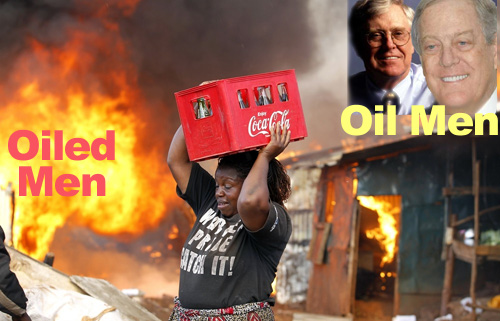
Here’s what happened yesterday. An oil pipeline bringing super gas refined in the coastal city of Mombasa and flowing at 590,000 liters/hour ruptured around 9 a.m. The pipeline runs under a slum. This was the third major Kenyan oil pipeline spill since 2009. And frankly, compared to the other two, it was small. (Probably less than a half million liters were lost before the pipeline was shut down.)
But it has been raining unusually in this dry season in Nairobi, and the oil made its way to a river that now flows through the slums. When residents realized from the smell what it was, they frantically began trying to collect it from the top of the water.
Someone’s cigarette dropped on the river. The fire exploded back up the line towards the pipeline rupture, and in its way was the slum. In seconds, tin shacks were ashes. Giant plumes of toxic smoke filled the air. Some residents on fire jumped into the river, but it was burning. Old manholes on sewers that have been stuffed and inoperable for decades blew into the air like rockets, giant fire spraying from them.
The official death toll as I write this is only 130. It will be much more. Hundreds are missing.
That’s the tragedy.
Now, can you imagine what would happen in the U.S. or Britain or Australia if something like this occurred? Well, guess who was the star guest interviewed on all the Kenyan TV channels this morning? The director of the pipeline company. But no one felt he should be blamed. Even the tweets and comments by people who live in the slums have exonerated him.
Everyone needs gas. They think he was doing the best job he could. As a result, he was totally honest about how bad the maintenance is on the pipeline, how much less the government has actually given him to operate it than he needs.
Did the Governor of California walk into Watts as it burned? Or the mayor of Chicago strol down burned out Wabash Avenue after the fires following the King assassination? Of course not.
But here the Prime Minister of the country and virtually every major political officer was in the slums this morning talking with residents, promising better conditions, pleading for the calm which already exists.
In Kenya and all the developing world on this planet, suffering is a way of life. When people ask me how possibly we can help, my answer has been steadfastly the same for decades and decades:
First, put your own house in order. If we cannot muster the human compassion to take care of our own uninsured, unemployed and immigrant populations, how can we possibly help others?
Second, forget about little charities, church bake-outs and tiny missions building little huts in the desert. This is all wasted energy. It makes us feel good, but it doesn’t do a damn thing for the developing country. This is because the solutions – whatever they are – must be massive.
I really believe, though, this is possible. I believe we can sweep away the TParty and similar thinking people into the dustbin of history. Human compassion is greater than human ignorance, as great as that ignorance currently seems to be.
So, Americans, start at home. Not with a greater tithe to your church, but with a renewed commitment to your society and government, and a willingness to sacrifice for the good of those less fortunate. And when elements in your society appear intransigent in face of this simple dictum, punish them. Force them to respond with higher taxes on them, stiffer regulations.
Make them share the happiness they achieve through other’s sorrow.
I know there is a knee jerk reaction to find a website to contribute to the “Nairobi fire.” But what about the Pakistani floods? What about your own floods?
The suffering in the world which is a result of poverty is structural. It can be changed. Start at home with the kingpins refusing to change, because we are at the top, we can make the most difference worldwide by simply doing our job at home.
Nine Eleven was a day of reflection, but in Kenya where I am it exploded. A British tourist was murdered and his wife kidnaped in the far north as southern Somalia imploded further, and Kenya desperately appealed to U.S. Republicans not to undermine its development by making it the victim of the U.S. budget crisis.
It’s all inextricably linked. It might be complicated, and that may be its nemesis with the simple minds of the Tea Party, and there’s too much here for a single blog. Tomorrow I’ll be less ideological and more news specific, but today I want to counter the empathy of yesterday with the horrible reality of the last decade as seen outside the U.S.
Sitting here in a luxury hotel in Nairobi with CNN on during all my waking hours, it’s hard to argue that a clearer perspective is achieved further from home. But it is. The travel through multiple countries and airports, the fellow passengers from all distant parts of the world in stimulating conversation, the foreign newspaper headlines and the incessant chat of the local taxi driver. It takes you far away from the repetitive and often circular news surrounding us in the U.S.
And besides, even CNN isn’t the same. CNN has been fine tuned to its customers worldwide for decades. It’s not the same in China as Dubuque, London or Nairobi. Worldwide, one of its most respected anchors is Jim Clancy, and click here for his own reflections, quite similar to my own. You won’t see this in the U.S.
Let me be so bold as to summarize the rest of the world’s views about Nine Eleven this way: If the U.S. didn’t exercise its power and express its grief militarily, the world – and the U.S. – would be much better off.
To the rest of the world yesterday marked not so much a stabbing memory of abject loss as a tedious decade of wrongdoing.
The number of people who have been killed in military violence this past decade far far exceeds those killed in the initial airplane hijack attacks. Perhaps a third of a million in Pakistan and Afghanistan alone, and hundreds of thousands in Iraq. And these aren’t principally soldiers, but civilians caught in the cross fires of ideology.
Any American who watches the film “United 93” immediately wonders why is this a British and not an American film. It’s the only concise documentary of the bungling of U.S. defense on that day, how probably three of the 4 plane crashes could have been minimized, if only someone in authority could have been found.
This is a British film, not an American one, because Americans seem incapable of admitting this mistake. No American would dare produce it. Watch it.
And this ineptitude was followed by the moral degeneration of a giant reacting to a flea bite by sledge hammering the ground around him, blindly and randomly.
There is no doubt that al-Qaeda targeted us. There is no doubt it was an inept attempt, because al-Qaeda is inept. But al-Qaeda is crazy and dangerous albeit inept, and we knew this years before they acted. We refused to deal with them as deranged, the same way we avoid dealing with our own mentally challenged individuals.
And when they finally ‘lucked out’ we were defenseless.
Thank goodness it wasn’t the Joker or an alien invasion or trained mercenaries from the Comoros, or we might currently be under a foreign military dictatorship. No President or Vice President or other chief political officer could be found to give cogent orders, or perhaps they weren’t found because there weren’t cogent orders to give. Planes that were scrambled flew off in the wrong directions, unarmed.
Our “Homeland Defense” up until September 11, 2001, was to believe we were invincible simply by maintaining nuclear arsenals and giant battleships.
The rest of the world, Europe in particular following the Balkan wars, realized that peace is created by development not destruction.
But we have never nurtured goodwill with the same enthusiasm we nurture military superiority. I think we reacted like the giant squashing the flea not so much to being attacked, as to our own inability to defend against those attacks in any other way. And like a humiliated bully with no social skills, we started scorching the Mideast.
(If oil as the unspoken booty didn’t exist, possibly we couldn’t have mustered the rationalizing to pursue it. But there is oil, there. And oil is needed for the bomber planes.)
And now to today. Sunday talk shows seemed horrified that the Super Committee will be deadlocked and the military required to take a 10% hit. What’s going on? In Africa we have committed 9 billion over ten years to help their medical development. And just before our Nine Eleven celebrations, they were advised this promise might not be kept.
Why might we renege? Because we need that 9 billion for a couple months of war in Afghanistan.
Instead of a decade of improving the health of a billion Africans who are actually on the frontline against terrorism and who are rapidly becoming an economic powerhouse, customers for our iPhones.
I see no starker comment on how wrong we continue to be.
Texas droughts, Vermont floods, Manhattan hurricanes. Dadaab famine, Ewaso floods, Zanzibar typhoons. In America I expect we’ll muddle through and with luck and no feckless economy, we’ll figure it out. I’m not so certain about Africa.
The effects of global warming on East Africa have been severe for the last 5-10 years. The weird way the wildebeest migration is behaving this year in the Serengeti/Mara ecosystem is today’s news (more below) but the intensity of droughts in ridiculously localized areas, often surrounded by floods, has now become so common it hardly makes news, anymore.
And there’s a big difference between the Africans’ outlook on disasters and ours.
Africans don’t get quite as excited as we do. Although malevolent “Acts of God” are increasing it seems to me at an even pace worldwide, they’ve been much more a part of African history than American history. We in the west tended to denigrate the African psyche as fatalistic for shrugging off one famine after another.
But you know, you can grieve for that covered wooden bridge for only so long. So … who to help?
Animals are helping themselves. The huge wildebeest herd moved out of the grassland plains this year right on schedule at the end of May. This was because the weather in the area was right on schedule. The rains which begin with the new year had finally begun to subside.
The pattern over the last century has been like a wet spot on your cement floor drying up: in this case the center of the wet spot is Lake Victoria, and the rains and humidity recede into the lake as the dry season progresses. The wildebeest migration follows this drying spot.
But subside became abrupt in the western part of the ecosystem, in the area known as the western corridor. Before June was out, residents there were calling it another drought.
I’ve noticed in the last decade that the increase in human development which has stressed available resources like potable water exacerbates negative events. Perhaps it was a drought; perhaps it was just there wasn’t enough water to go around, or that domestic stock had nibbled into the park reserve, or that previous logging and erosion had lost a final defense.
A large portion of the original grassland plains herds normally moves into the western corridor in June, and as they did there were wide reports that they were surprised there was no grass, became confused, and began to scatter.
That’s a normal reaction to an abnormal obstacle on their trip.
As the herd sort of regrouped and moved north quicker than it would, many of them were crossing into the Mara by the beginning of July. Then, it started to pour rain, but mostly south of the border, south of the Sand River.
So, the wildebeest turned around and went back into Tanzania. The rains were good for about ten days. By mid-July there were appearances of it being a rainy season in the dry season.
This would never have happened in the normal days of the past so many decades. There would not be this extreme difference between areas which are so close to one another. If the western corridor was in a drought, the northern Serengeti shouldn’t flood. Yet that was almost what happened.
Today the wilde are mostly back in the Mara, and in fact many have moved into the private reserves north of the Mara proper. This is normal. Or at least, what used to be normal. The animals helped themselves; nobody gave them a handout or sign telling them where to travel. Perhaps a tenth of the herd was lost, but that’s life, and mothers don’t even linger over their dead babies.
If somebody’s home was floated away by Irene, do we just take pictures and leave? If millions are dying in Somali, do we just sell tickets to another pop concert?
Earlier this month the Kenyan Wildlife Service (KWS) announced it was starting a number of initiatives to combat climate change. Last week was the first of many scheduled workshops. There’s a lot of sincere interest in doing something, but it’s nearly impossible to imagine if anything at all can be done.
Human populations are increasing and stock grazing comes with that. Oil and other natural resource potentials are drawing Chinese and others with little regards for the environment. There are fewer traditional farmers and herders. I see more Maasai wearing Docker Polo shirts than shukas. Life is changing, and even more noticeable is the veld itself. It’s crusting.
The actual Mara reserves and the great Serengeti grasslands further south seem to be OK for right now. The last several years in particular have been kind to the Serengeti.
But things are changing. Climate change is pounding the earth. Some will be able to move to the new drumbeat. Some won’t.
This house in a Nairobi suburb costs 3-4 times what it would cost in Houston.Get this: it’s now cheaper to buy a three-bedroom house in Houston than a comparable three-bedroom house in one of Nairobi’s better suburbs. Rich Kenyans know this, and they are now entering the U.S. market as significant players.
Joseph Wang’endo of Nairobi’s Realty Capital Agency says more and more of his time is spent brokering homes in the U.S. to Kenyan investors.
According to Wang’endo, a typical $150,000 bid at auction for foreclosed property in Houston will render a home similar to those now being sold in Nairobi’s Lavington suburb for $400-450,000.
He says that most buyers are not usually individuals who want to live in the U.S., but rather Kenyan investors or limited liability companies who then become the landlords for a rental property that he says can generate nearly $3,000/month in income.
Kenya did not have a housing bubble. Its growth slipped at the worst part of the world recession, but it never went into a recession. Today, growth in Kenya is zooming up higher than ever.
This is not unlike most of the emerging nations of the world.
How come?
I won’t pretend to be an economist, and I’ll let you reference that body of work (in the same way you try to find a quote in Shakespeare), but here’s my basic understanding.
1) The emerging economies are much more plastic (possibly, dynamic) than the larger economies. They can change quickly. The tea industry might be the biggest supplier to the GDP one year, and then cell phone manufacturing the next. It takes less time to create infrastructure for any given industry, and the work force supplies new industries faster and better.
2) Governments like Kenya are more socialist. They worry more about growth and citizen well being than national debt. Total Kenyan national debt is around three-quarters or higher of the GDP. Public debt is routinely at 50% or higher and the additional external debt is another quarter or more of GDP. [In the U.S. we make no distinction between locally held “public debt” and foreign-held “external debt” as done in the developing world. This is because developing world currencies are not convertible into developed world currencies like the dollar or Yen or Euro.]
3) America goes into its highest debt during a recession, to stave things from getting worse. Emerging nations like Kenya reach their highest debt usually during boom times, when the government is trying to send the rocket economy even higher.
This story is not news to the Americans who need to know.
Today’s major newspaper in Nairobi, the Daily Nation, published this story about Kenyans buying into the American real estate market this morning (Kenyan time, 6 hours ahead of New York).
Twevolution is like the recovery. It comes with a blast, planes off, has its ups and downs, and societies with major unresolved issues caught in the middle turn messy for a very long time. It might be time to scratch Uganda off your tour list for the next generation.
Political parallels to economic conditions are easy to make, hard to explain. Think of it this way: Down there in the nadir of the global recession anybody still standing had hope. High hope. They looked to the sky and found jobs and freedom.
As the Egyptians pummeled Tahrir Square with rocks, TARP and stimulus seemed to have righted the sinking ship. This was the time! Ireland was saved, so could Libya! Nothing could get worse and everything would get better. This adrenalin powers a lot of people to do a lot of things.
But now, something bad is happening. It’s not going according to plan. We listen to leaders blame tsunamis and other leaders, but we know the sickness is deep. The revolutionary wonders, does he really want power in a future that looks so grim?
So true or not that things are bad and the future is bleak, this is what protesters in Uganda feel, now. At the risk of over generalizing for an important point, I remain continually amazed at how fatigued African’s psyche becomes with convoluted politics compared to an American’s.
And I don’t mean to suggest that Americans’ attitudes are healthier. Not at all: It would probably have been much better for us and the world if we had left Iraq a long time ago. We might be the stubborn bullies, and Africans the practical realists.
Uganda is in the doldrums of despair. It’s a lousy place to live in, and not a good place to visit. A little while ago it was darn right dangerous to travel to Uganda, and who knows, it might become so, again. But right now, the horizon isn’t so fiery as very, very grey.
Uganda’s dictator is growing crazy with his apparent successes; he wouldn’t have acted this way only a year ago. A group of presumed businessmen supporters visited him yesterday, and he shouted at them like a disturbed headmaster. Supporters. He lashed out at supporters.
Last week, Uganda’s Minister for Security Muruli Mukasa told the media that protesters were terrorists and that the Ugandan opposition is using “Twitter, Facebook and YouTube to wage a campaign against the security forces and to psychologically prepare the people, especially young people, for armed insurrection”.
Well as a matter of fact, that’s right. But the fact the minister is now turning what used to be a successful tool against him into a tool he can use to beat them up means the tide has changed. The Ugandan government is gaining control.
Protests continue, don’t get me wrong. Major protests are scheduled for next week against electricity rationing and a specter of a massive protest against the dictator for turning a water cachment forest into a sugar cane field is imminent.
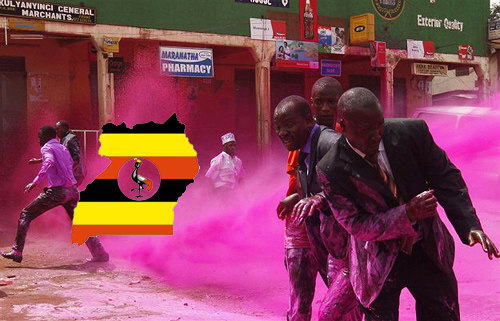
This is not a place tourists should visit. Just several days ago a couple hundred ardent, well-dressed demonstrators including a number of high profile opposition politicians, began a peaceful protest that prompted live ammunition fire from police, then a suburb drowned in tear gas.
But then as if to turn the war into a birthday party, Ugandan police sprayed the retreating demonstrators with pink paint.
It’s not the first time pink paint has been used in Uganda. In fact, its purpose was to quell the demonstrations against the draconian ‘Kill the Gays’ bill that remains pending in the legislature but for the moment is going nowhere. The symbolism is obvious.
Perhaps they just had a lot of pink paint left over. Maybe the increasingly brutal regime is equating gays with all activists. Whatever, it’s a sign that things are ugly but not getting uglier. The protests are smaller and failing. The government believes that either dissent is waning, or that they can handle it just fine.
The point is reached, as it was in Zimbabwe decades ago, when crazy dictators become so firmly in control that not even a world economic recovery can pry them from power.
Society begins to depend for its simple day-to-day existence on the growing tentacles of dependency, from the dictator to his minions. As he becomes less and less accountable, he begins dishing out favors and money that replaces hard work and profit. Remove him at your peril.
I hope this is a premature analysis for Uganda. We should know, soon. Meanwhile, stay clear.
 If you thought everything Canada is green and good, think again. Canadian mining is destroying Africa. And maybe destroying Canada.