How Rich? This Rich

How Rich? This Rich

By Conor Godfrey
Yesterday Tullow Oil struck black gold off the Kenyan Shore; Canadian and Australian miners seem to announce new gold gold discoveries in Africa all the time.

In fact, it seems like once a month I hear of another “world class” mineral or hydro-carbon discovery in Africa.

I thought it might be fun to dig into just how mineral rich Africa is. Before I get started, let me say a huge thank you to Dr. ABBAS. M. SHARAKY at Cairo University, his research on African geology was immeasurably helpful in terms of understanding why Africa is so mineral rich.

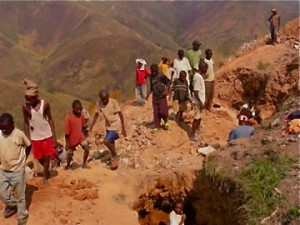
Fun fact– modern day Swaziland hosts the oldest known mining site in the world – scientists believe this mine was operational about 45,000 years ago!

See the picture of Lion’s Cave on the left. Mineral resources have also shaped African history and culture, especially the rise and fall of the great empires in modern day Mali, Ghana, and Egypt. Gold, iron, and other metals have had cultural, commercial, and even cosmetic uses for much of human history on the continent.
Today the African sub-soil is unbelievably, but not inexplicably, rich.

Before writing this, I have sifted through more geological research then I really have the vocabulary to understand, and pulled out some gems that helped me imagine the scope of both known and unknown mineral resources in Africa.

Africa is still undergoing what the field calls “Primary Exploration.”

E.g. preliminary surveys and shallow drilling.

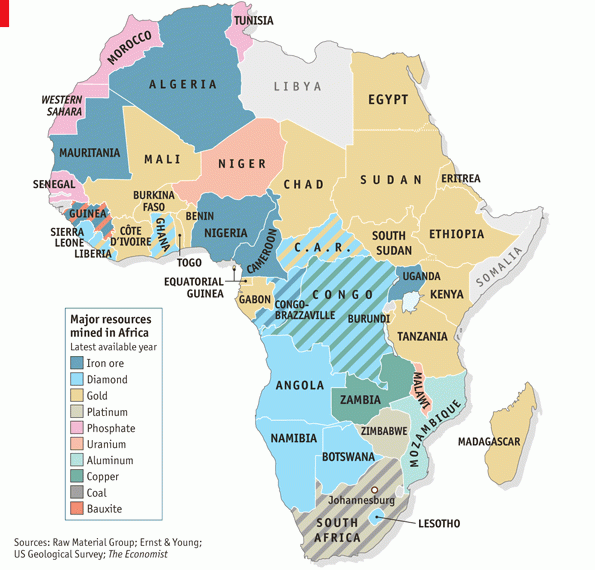
With the very limited knowledge we have of Africa’s subsoil, the continent already holds 30% of the world’s known mineral reserves.

This includes 80% of all platinum, chromium, and tantalum, and almost 50% of the world’s gold, diamond, cobalt, manganese and phosphates, and the plurality of many others, including bauxite and uranium.

Geologists estimate that Africa likely holds more than 50% of the world mineral reserves.
Wow. 20.4% of the world’s land (actual land, not water), with upwards of 50% of the world’s mineral resources.

I guess what I’m trying to say is that catalytic converters, computer chips, cell phones, engagement rings, fertilizer, tin foil, and nuclear submarines would all be a heck of a lot more expensive without African resources.

Why? (spoiler alert, pure creationists will not be happy with this section.) Well, according to Dr. Abbas, Africa has some of the oldest rocks in the world—otherwise known as Precambrian rocks.

These rocks come from the period that covers the formation of the Earth through bacterial life….a mere 4.5 billion years.

Precambrian rocks account for 80% of the world’s industrial metals.

The Kalahari craton geologic formation covers much of Southern Africa, and contains a number of the world’s oldest (therefore Precambrian) rocks.

This formation is what makes South Africa the most mineral rich country in the world; with an estimated 2.5 trillion USD worth of resources under its soil.

To put this in perspective, remember that while Saudi Arabia has just shy of 20% of the world’s proven oil reserves, South Africa has approximately 85% of the world’s platinum, 80% of its manganese, 75% of its chrome, and over 50% of a half dozen more key resources.

Other parts of Africa have mind boggling concentrations of strategic minerals; the best examples are diamonds in Botswana, copper and cobalt in Zambia and the DRC, tantalum in the DRC, uranium in Namibia and Niger, bauxite in Guinea, and phosphates in Morocco.

Tantalum Mine DRC

Africa is loaded with hydrocarbons.

Nineteen African countries produce significant quantities of oil, and ‘proven’ reserves have been skyrocketing as exploration really gets underway.

Chew on the following statistic: throughout the 80’s and early 90’s, the mining community spent about 10% of their budgets on exploration, but only 1% in Africa.

While this has improved drastically in the 90s and post 2000, African exploration is still grossly underfunded; it currently accounts for 13% of the mining community’s exploration budget but accounts for 30% of the world’s proven reserves.

Currently, Africa has proven reserves of about 210,000 billion barrels – this number is being revised upward on a quarterly basis.

These reserves constitute about 13% of global reserves- the proportion will obviously rise as commercially viable oil continues to be discovered from Mozambique to Ghana to Uganda to Liberia, and relative peace and calm allows the major producers to double down on investment and R&D.
(Source)

Botswana Diamond Mind
Get ready for some 20,000 ft. assumptions.

The developing world’s standard of living is rising- sometimes in fits and starts, and sometimes in long 30-year runs (China).

To be rather blunt, these people, and their governments, want the tin foil, nuclear submarines, green tech, phones, and other IT products that we spoke about earlier.

New discoveries will slow in the rest of the world while they accelerate in Africa over the next 50 years; I for one am very curious to see how this ramifies through world politics.

Land Grabs Really a
Proxy for Water Grabs

Land Grabs Really a
Proxy for Water Grabs

By Conor Godfrey

Paolo Bacigalupi is a master science fiction writer, and winner of the Hugo, Nebula, and any other Sci-fi award you can think of.

His blockbuster hit was entitled “The Windup Girl.”

The story imagined a world in the near-mid future where food-crop biodiversity had plunged due to constant genetic tampering in an effort to feed a growing planet with less available water.

Land, original seeds, and calories became the only currencies that mattered.

We are far from that, but sometimes I will read an article on “land grabs” in Africa and think that Mr. Bacigalupi was more of a slight exaggerator than an all-out lunatic.

Everyone wants a piece of the mother continent these days. Not- as you might have heard- just the Chinese.

Even South Africa recently bought tens of thousands of hectares in Guinea!

Other investors are Asian, European and American, as well as private pension funds and a number of Scandinavian and gulf state sovereign wealth funds.

Please read Professor Deborah Brautigam’s piece on some of the gross falsifications surrounding Chinese land grabs.

Anyway, who wouldn’t want in on African land?

First – there is a lot of it.

Africa’s approximately 200 million uncultivated hectares of arable land represent about 60% of the world’s total.

Second- its dirt cheap (pun somewhat intended).

In Europe, land costs about $22,000 per hectare (Germany) annually.

In the land rich United States, it costs about $7,000.

In most of Sub-Saharan Africa, land goes for about $800-1000 per hectare.

I could even afford some!

It also nicely diversifies a more traditional investment portfolio and promises to produce profitably as larger and larger players compete for fewer and fewer available commodities from here on out.

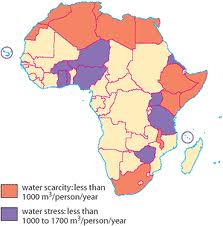
In many ways, the problem is not land; it’s water.

Map by Oakland Institute

Let me quote from a recent study by the Oakland Institute: “If all the 40 million hectares of land that were acquired on the [African] continent in 2009 come under cultivation, a staggering volume of water would be required for irrigation (…) approximately twice the volume of water that was used for agriculture in all of Africa in 2005.”

Yikes.

Some African countries have water to spare in the short term.

Others never had any.

Many pastoral and nomadic communities have negotiated (or fought over) water rights for centuries.

If their governments’ lease their land to commercial producers, they may find access to critical water sources blocked by barbwire plantation fences.

People do not suffer this lightly.

Foreign investors recently gained title to 544,567 hectares of land in Mali along the Niger river.

These new concessions will suck up about two times the entirety of Mali’s water consumption in 2000. As of today the level of the Niger river is already 30% less than in 1980. (source)

The Omo and Nile river systems are similarly fragile.

Modern capitalism still has trouble pricing in environmental externalities and some forms of risk.

Water table depletion poses obvious risks to the environment, but on the flip side, there are reputational and monetary risks for investment projects.

Draining water reserves leads more or less directly to acute political risk, and if the problem is widespread enough, sovereign risk.

Do these investors doubt for a second that a new administration facing acute domestic pressure to stop land grabs would not alter the terms of an existing contract?

Or, do foreign investors really want pictures of displaced villagers circulating among shareholders?

For example – in 2008 three people died in Uganda in riots protesting a land concession. Read this article on unrest in Guinea over an earlier land grab.

I wonder if investors are accurately assessing this types of socio-environmental risk when they sign 100 year leases.

Ironically, when the leases are for a full century, investor incentives align behind environmental and social stewardship, while the local politicians have a much shorter time horizon and might be willing to make fast cash at the expense of a small subset of their citizens.

The more I think about it the more I think our story teller Paolo Bacigalupi should apply for the empty seat at the World Bank.

USAID’s Annual Letter to Share – I mean – Stake – Holders

USAID’s Annual Letter to Share – I mean – Stake – Holders

By Conor Godfrey

This week the highest USAID cadre, Rajiv Shaw, released his annual (2nd) letter. If this second ‘annual’ letter was intended to mimic a private sector letter to shareholders, than I liked Warren Buffet’s letter to Berkshire Hathaway better, but I do appreciate the attempt.

In his very first paragraph, Rajiv and I essentially break up.

He lauds president Obama’s push to make development assistance a core part of U.S. international strategy, right alongside defense and diplomacy.

“…But the President and Secretary both believe that the development work our staff does is just as vital to our country’s interests and national security as the work of our soldiers and diplomats.“

I confess I do not believe this is true.

In fact, when viewed in this light, it is no wonder that we drown Pakistan and Afghanistan (critical U.S. priorities) in development assistance.

It is possible that this cash actually harms people, and at best, I think it is probably a wash.

Read this NYTimes article about development assistance in Afghanistan and cry.

AID workers in these countries struggle to spend the money that has been allotted to them, and set themselves up for horrendous overbilling and corruption.

There are also two other problems with AID money in places like Afghanistan and Pakistan – one, the local economy can be trashed by the influx of foreign currency, and two, the best and brightest in those communities try and get high paying jobs with AID agencies instead of working in local government or starting businesses.

These thoughts are not new; actually, it is very much in vogue to bash development assistance.

I challenge you to go out and find someone that works in development right now, get them out of the work environment, give them two beers, and ask them what they think of either their specific project of development assistance in general.

They will start with a resume-speech that uses words like capacity building and stakeholders, but it will degenerate into a story of waste and frustration.

There are people out there who work on great projects…but I bet you go through four or five of the scenarios I just mentioned before you get to them.

To avoid being charged with too much complaining and not enough suggesting, here is what I see as the future of development assistance.

1) A clearer distinction between humanitarian relief (floods, fires, droughts, conflicts) and development assistance.

The former (staffed by former soldiers and other logisticians), should be given wide latitude to act preemptively, and should make sure the U.S. is the first on the scene and the most generous when they get there.

The U.S. already does a pretty darn good job here.

The latter, development assistance, needs to be reconceived as a social impact investment fund with a high tolerance for risk.

2) They should take on investment worthy projects that are not attractive to traditional investors because the recipients do not have collateral or other assets. (Like our current Export-Import Bank, but with a much higher appetite for risk, and a bent toward micro projects.)

Better yet, they should invest in LOCAL impact investment funds that have a better handle on vetting projects.

Most importantly, this agency should RETURN MONEY TO THE TREASURY!

Now, that might be too strict when lending to entrepreneurs and businesses at this level, so perhaps the rules should be as follows….

The agency will loan out XXX Million USD per year, but only 15% of the loans could be non-performing at any given time.

If we wanted to get really crazy, the agency could take equity positions in these companies and entrepreneurs.

(Moral Hazard alert here, the business might just expect the agency to do everything.)

Yes- this would immediately take some of the least developed countries off the USAID map.

(You could adjust the rules for least developed countries if necessary.) I think that is ok, because I do not believe what these various groups say they are achieving in those countries anyway.

If you added up the stats that various AID agencies and NGOs give you for some countries, and compound those over all the years this assistance has been given out….the problem(s) would theoretically be solved already.

It is a little like the phenomenon whereby all the purported shards of wood from the Biblical cross add up to seven or eight crosses worth of wood.

Ok I am probably getting carried away.

The biggest weakness in my argument is in health. Many health problems are not ‘investment opportunities.’

(Many are though! Check out my favorite company in this space.)

There are other problems too, but I think they pale in comparison to the waste in the current system.

The Chinese Presence in Africa Probably Does Not Look like You Think it Does

The Chinese Presence in Africa Probably Does Not Look like You Think it Does

By Conor Godfrey

For quite a long time, I misunderstood the nature of the Chinese tidal wave in Africa.

I thought that giant SOEs like SINOPEC and SINOHYDRO, laced with agents from the public security bureau – and the People’s Liberation Army of course, were essentially buying the African subsoil on the cheap where their cash went the farthest – resource rich and infrastructure poor countries with brutal, corrupt, or otherwise unsavory leadership.

Some of this has certainly happened.

However, as the foremost experts have pointed out, repaying loans with commodities is neither new nor confined to China in Africa.

More than forty years ago, China secured a $10 billion dollar loan from Japan by leveraging its domestic resources.

Somehow, oil/commodity secured loans have taken on a nefarious connotation – why?

In most cases, this ensures that something is actually delivered to the host population.

If China uses its leverage to unfairly price-fix the commodity, or overvalues the infrastructure to be provided (as in Angola), then sure, the government and civil society should jump all over it.

While they are at it, however, they should also jump all over the development assistance programs from other partners that skim local talent and spend millions of dollars while leaving precious little behind.

The biggest misconception regarding the Chinese presence in Africa is the make-up of the Chinese diaspora on the continent.

There are probably about 750,000 – 1,000,000 Chinese in Africa – no one has a great estimate.

Many are former day-laborers, farmers, bankrupt shop owners, convicts, and other mother’s sons who took “going global” seriously.

They are not secret agents, nor do they receive concessional financing or other goodies from state owned banks.

They are free-wheeling entrepreneurs with huge appetites for risk and the desire to escape cut throat competition back home in China.

A recent documentary – When China Met Africa does a great job exploring the edges of the African-SINO civilizational collision. Here is a trailer, and here is a review by the always insightful Damien Ma.

While big State owned enterprises certainly cause some friction, much of the antipathy toward China and Chinese in Africa comes from the success of small-time Chinese traders in local markets. (I’m taking about the private buccaneer types, not big company reps.)

Entrepreneurship is hard, especially in Africa.

Formal capital markets for small to medium sized business barley exist, and the cost of electricity and transport makes manufacturing prohibitively expensive.

(This is changing…look for wave of African manufacturing in 2015.)

However, Chinese entrepreneurs in Africa (the private, buccaneering types) are beating out local suppliers in local markets.

Why? Connections, or Guang Xi, as the Chinese would say.

What do you do if you need a generator fixed in East Africa?

You call a Fundi (loosely, “a guy who knows stuff”).

In the Peace Corps I had a guy for pretty much everything – a money exchange guy, a taxi guy (this guy was a real wildcard), a goat guy, a make-me-a-sweet-Boubou guy, and most importantly, a bad-Muslim who-sells-beer-guy.

The Chinese have fundies too – only theirs own factories in China, trans-ocean transportation firms, and are flush with cash from thirty years of double digit economic growth.

When a Chinese business-person sees an opportunity in Africa, he/she (almost always a he) can usually access the credit, manufacturing capacity, and skills necessary to act on it.

Local entrepreneurs often cannot.

I am not fatalistic about this though – African entrepreneurs have all sorts of linguistic, cultural, and geographic advantages when competing in their own backyard.

Look at how Ethiopia’s footwear industry survived the cheap Chinese shoe onslaught and improved their products because of it.

The African firms that survive the waves of cheap Chinese goods will be stronger and ready to compete globally – bring it on.

Anyway, it helps to remember that China and Africa are not two massive, sentient entities crashing against each other, but rather, millions of individuals and tens of thousands of firms each having their own personal interactions.

These Guys Are Worse Than Pirates

These Guys Are Worse Than Pirates

By Conor Godfrey
Last week, Greenpeace shadowed an unlicensed 120-foot Russian Trawler off the Senegalese coast.

Ships like these often pull in 250 tons of fish a day by dragging 700 meter nets behind them. Some of them use incredibly damaging bottom trawling and other techniques that increase hauls while destroying marine habitats.

To put the effect of these super trawlers in perspective, allow me to quote a few statistics from the Greenpeace report on illegal fishing published last week:

1. “It would take 56 traditional Mauritanian pirogue boats one year to catch the volume of fish a [super trawler] can capture and process in a single day.”

2. “The amount of fish discarded at sea, dead or dying, during one [super] trawler’s fishing trip at full capacity is the same as the average annual fish consumption of 34,000 people in Mauritania.”

Green Peace struggles to unmask illegal fishing ship off West African Coast
These ships rotate the same license among a number of ships, or more crudely, simply cover up the name of the vessel to prevent anyone from documenting their breach.

In short, bloated European fishing fleets have already overfished their own territorial waters, and are now taking advantage of poor African countries inability to enforce their maritime borders. (Japanese, Korean, Chinese, and Taiwanese companies are all guilty as well.)

The vast majority of these illegally caught fish are ‘fenced’ through Los Palmas in the Canary Islands, owned by Spain, and through a few other ports of convenience where illegally caught fish can enter lucrative European markets.

(The European commission estimates that at least 10% of seafood sold in the E.U. could be illegally caught; other groups put the estimate considerably higher.)

This gets me riled up.

My home away from home in West Africa – Guinea — has the most overfished territorial waters in the world.

The U.K.’s development agency estimated that in 2009 about 110 million USD worth of stock was illegally fished off the Guinean coast.

That might not sound like much to a country such as Portugal or Japan (culprits in the overfishing), but that is serious money to a country that cannot even provide reliable power to its capital city.

The 110 million USD estimate does not even take into account the near permanent damage done to the habitat and reproductive stocks.

So why can’t the next foreign super trawler without a license in Guinean territorial waters be given a warning, then boarded, then confiscated and the crew thrown in Guinean jail until their host country groveled for their release?

Of course – there is the rub.

Guinea (and most of its neighbors) does not even have patrol boats and crews capable of executing that type of interdiction.

(Also, the last thing you want to do is give unruly Guinean soldiers the authority to start shaking down fisherman arbitrarily.)

Of course, some harbor masters, judges, and other gatekeepers in the maritime industry are probably on the take or could be easily paid off at a number of points (giving out licenses, enforcing fines, etc.)

This can also happen legally.

Even though almost all West African fisheries are now in critical condition, many licenses are sold legally for hard-to-turn-down sums.

Some ideas:

1. The U.S., France, and other bi-lateral donors should kill a few of their grossly ineffective aid programs, and spend the money on professionalizing and equipping a local coast guard interdiction team. (Just one small ship would do it.)

If the E.U. is as concerned as they say, then this should be right up their alley.

Most West African countries (excluding Mali and Mauritania and Niger perhaps) could not care less about anti-terrorism, while illegal fishing on the other hand is a hot button domestic political issue.

The local authorities will be ready, willing, and receptive to assist in kicking the bums out of their territorial waters.

*Interesting model: Australia was concerned that other Pacific countries’ lax fisheries enforcement was hurting Australian interests. So the Australian government created a training program along these lines for a number of neighboring countries that has been very successful in curbing illegal maritime activity.

EJFoundation Photograph
2. Lock down Los Palmas in the Canaries.

This is the Sodom and Gomorrah of illegal fishing, and as long as it continues to offer a back door to E.U. markets, I refuse to believe that Spain is at all concerned with the plight of West African fisheries.

3. West African countries might enlist the help of international companies that are also concerned with maritime criminality.

The obvious partner would be the oil companies operating in their territorial waters.

The oil companies might allow host country customs officers to ride on their ships, or use their surveillance helicopters, etc.

This idea needs to be fleshed out, but it seems like a natural partnership.

I get tired of the numerous conspiracy theories that accuse Europe or the U.S. or China of commercially pillaging Africa; most of the less nuanced theories are simply critiques of capitalism.

This fishing business, however, is as clear as day: more developed countries (including some more developed African countries) are plundering poor countries’ fisheries simply because they can.

And they are doing it as fast as possible because someone else will if they don’t, and because they need to do it before these countries get their act together and start enforcing their own laws.

No Coffee Blacks

No Coffee Blacks

My several days in Stellenbosch gave me new insights into the extraordinary difficulties South Africa is trying to confront. My optimism for the future of South Africa has diminished slightly.

Nowhere in the world are the effects of ethnic segregation as easy to see and historically easy to study as in South Africa. And unlike what most Americans think, this isn’t a single generation’s problem: apartheid might be a recent word, but it has been entrenched in South Africa since its prehistory.

Stellenbosch vies with Pretoria as the most conservative major metropolis in South Africa. Just under 100,000 people (a quarter of which are students) it was the first major settlement after the Cape in the late 1600s, the birthplace of Afrikaans and nationalist ideas, and the very center if epitome of Dutch Reformed church theology.

Today it is a producer of some of South Africa’s best wines, a seat of higher learning, and a major tourist destination. I’m here at the end of its summer, its principal tourist season, and there are tourists everywhere from every part of the world.

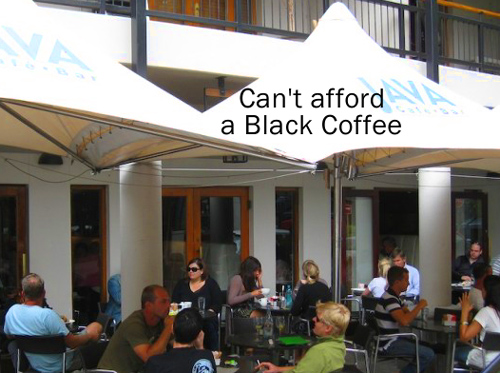
Yesterday midday I waited as all tourists do, hovering over one of the café tables at Java, an excellent restaurant and coffee house on Ryneveld Street, pouncing the moment someone left. Once seated, no concerns that it will take a server some time to finally get around to you!

Every beautiful café in the 4×6 block city center was the same, but it was also clear there were as many South Africans as foreigners. Many were South African tourists, as the South African who can afford to travel does so far and wide. But there were also many locals, enjoying a beautiful Sunday only about an hour after the great central church had disgorged its supplicants.

During my two days and two nights and four meals and coffee breaks during my weekend stay here, allocating a lot of time to maneuvering for a place to sit… I saw only three nonwhites.

When I went to the local “mall” and only main supermarket, it was all reversed. The mall is only a two-block walk from all the beautiful cafes and restaurants, across from the gargantuan city hall. There it was completely reversed. Hordes of weekend shoppers, only scattered whites.

“You see,” my affable waiter at one excellent dinner restaurant with only whites eating said, “this is not a white place.”

That’s hardly an explanation, so I probed.

Essentially, it’s not that he believed nonwhites felt ostracized anymore; indeed, they control not only the government but a growing proportion of South Africa’s huge economy. “It’s too expensive.”

The racial divisions that have plagued South Africa since inception, institutionalized by Britain in the independence act of 1911 and refined and strengthened until apartheid was torn down by Nelson Mandela, stratified economy by race.

And that’s a hard nut to crack.

The October 2011 census statistics are still being processed, but the 2001 numbers are expected to be better. That’s because in the last decade as many as 4-5 million African refugees have either legally or illegally come into the country.

But as of 2001, 1 in 11 South Africans is white, just a slightly higher percentage than “coloureds” — a uniquely South African racial division representing mixed race with a high percentage of whiteness. That means that roughly 4 out of every 5 South Africans is something else, mostly black.

At independence in 1911, 22% of the population was white. By 1980 that had decreased to 18%. The dramatic emigration of the subsequent several decades, which bled the country not only of skills and talent but also capital, was the result of the writing on the wall of history. South Africa was going to change, and so it did in the early 1990s.

But though its constitution is a model for any truly moral society, and though its top industries are becoming more and more under non-white control, and though its government is wholly controlled by nonwhites, whites still reign.

Because, as my nonwhite waiter explained, “it’s too expensive for us.”

Income inequality plagues the world. The United States ranks among the highest of developed world income inequalities with a “Gini Score” of 41. (“0″ is no inequality; “100″ is total inequality.) Most developed countries are in the 20-30 range. But South Africa? 64

This is almost, but not quite, a which came first conundrum, the chicken or the egg. If you got it, you’re not going to let it go easily, and you’re going to do everything possible to keep it for your kids, your cousins and your community. It’s almost … natural.

But what economists recognize today is that in a rapidly growing and interacting global platform, inequalities are unsustainable. Yesterday in Joburg’s Sunday Times business leader Michael Spicer pleaded with his colleagues to do something about this, calling the current situation in the country a “disaster.”

It isn’t that good South Africans of all colors aren’t trying. The University of Stellenbosch, founded by Afrikaners who wanted to restrict virtually all economic gain only to those of Dutch heritage, excluding even the English, today has one of the most progressive enrollment policy of any major South African university.

Together with nearby University of Cape Town admission policies make our own affirmative action policies seem tepid at best. These major institutions are trying to achieve a 40% non-white enrollment by 2016, and they’re well on their way to doing so.

And not without serious controversy. Admission standards for nonwhites have had to be reduced nearly in half to achieve this measured growth. And you know where that leads academics intent on performance.

So it seems that everyone, everywhere in South Africa is trying to reverse what nearly 400 years of unjust history has created. And how they are trying to do it must be a shining example for every part of the world where income inequality breeds disarray.

The question is simply, will it be fast enough.

A Nicer Gentler Walmart?

A Nicer Gentler Walmart?

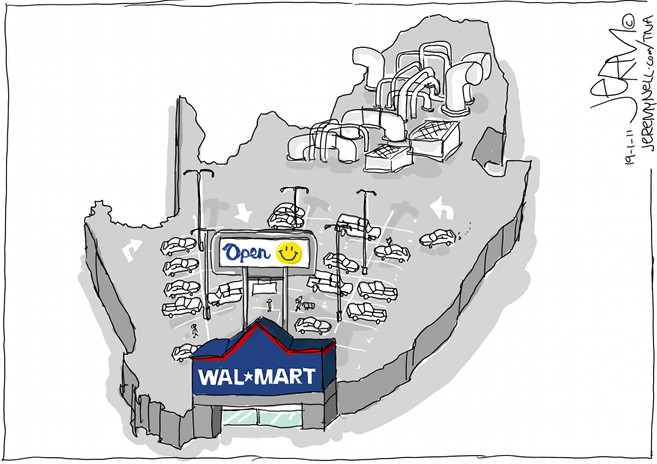
Will South Africa make Walmart nicer? Stay tuned to how all of us should be treating this behemoth of capitalism.

This week the local firm that will be acquired by Walmart when the South African government finally approves the takeover as expected, announced more or less, to hell with procedure, they were going to continue acting like they were already taken over.

Nobody blinked.

It’s not illegal. Massmart Holdings can transform itself however it wants, but the transformation can’t implement Walmart procedure until the deal is finally approved. The net result of this limbo is that it’s costing Massmart some of its expected profitability.

And if the deal is ultimately not approved, Massmart stands to be in rather deep trouble.

Legally today, Walmart owns 51% of Massmart, but other than placing the majority of its board members, it cannot completely function as the Walmart we all know and hate (oh, sorry, or love). South African law distinguishes from majority ownership and corporate control so that even minority South African equity usually governs corporate practice of foreign-held firms.

Massmart can, for example, reorganize its supply chain towards China. But until the Walmart deal is completely approved, it will not be able to place those cheaper China goods on its shelves for customers. It can start the planning and even construction of new stores, but until the tax breaks Walmart negotiated are in place, brick and mortar could make it bankrupt.

When Walmart made the move to acquire Massmart there was significant resistance in South Africa. Opposition was strikingly traditional: Labor organizations were worried that it will reduce jobs and job pay and benefits, and small retailers were worried they’ll be drowned out.

But the acquisition, $2.4 billion, doubled South Africa’s foreign investment in a single fiscal year. That’s kind of hard to ignore. So the process of approval went rather quickly, less than a year, and last summer the final hurdles were overcome and the deal got the South African stamp of approval.

Pending appeal. That’s where we’re at right, now, the appeal.

But the size of the investment is just too big to refuse. Last week the U.S. Chamber of Conference pointedly said to South Africa that if Walmart is refused, it will have a catastrophic effect on foreign investments in South African for years to come.

And there is really one awfully interesting probably good reason that no one thinks the deal won’t go through. It does not mean, as it means in America, that Walmart stores will not be unionized. Walmart has caved on this, and it’s an incredibly important exception.

In fact, it’s remarkable. Low wages and poor benefits is a hallmark of Walmart in the USA. In South Africa that may now not be the case, although the agreement struck with South Africa’s powerful labor unions is not totally ideal.

Massmart employees will likely lose some wages and benefits: most importantly, a type of tenure that tended to guarantee a job with longevity of service.

But it’s still remarkable. First for the obvious reason that it protects the worker. But almost equally because it reveals the hypocrisy of Walmart’s claim here at home that union involvement wrecks their business model.

So if it works in South Africa, any reason it can’t work, here?

Highways or Hyrax

Highways or Hyrax

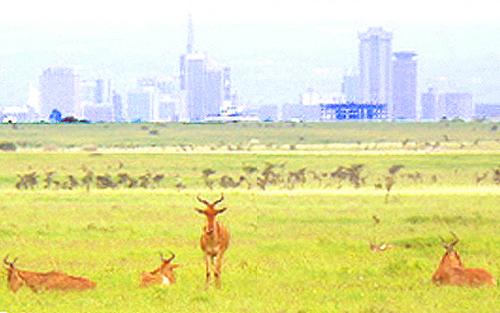
Nairobi National Park: 50 sq. miles adjacent city of 7 million
One of the greatest icons of big game parks is about to fall: Nairobi National Park. To a highway.

I’m not protesting; I’m not asking you to sign the petitions that successfully stopped the highway through the Serengeti, I’m just sick with nostalgia. This remarkable wilderness has survived with its ups and downs next to one of the most rapidly growing urban areas in Africa.

But with cloverleafs blooming all over Nairobi city, clovers have to go.

The very first wild animal I ever saw was in Nairobi National Park. My wife, Kathleen Morgan and I, flew into Nairobi directly over the park (still do) and I saw giraffe below the wing. We had hardly been in the city for a day in the early 1970s when I rented a car and drove to Nairobi National Park.

We paid our fees and drove onto the (then) dirt roads of Nairobi National Park and less than a minute later I had driven the Toyota onto a rock and we were totally stopped … about two feet from a rhino.

Rhinos were poached out of virtually all of wild East Africa in the next ten years (they’re coming back) and the city of Nairobi grew in leaps and bounds. The park did not grow. It remained as originally hardly 50 sq. miles, but also as always only three sides are fenced. The southeast side is open to the semi-wild country of the Athi Flats.

That used to be wild Maasai land all the way to Amboseli National Park. But soon a huge manufacturing area near Athi River town developed, along with some ground mining further south, and large ranches further west.

But small corridors remain open to the Amboseli/Tsavo/Kilimanjaro wilderness, although animals have to cross a major highway to get there. And even today you can find giraffe, zebra and wildebeest, and thanks to the special care of the Kenyan Wildlife Service, even a rhino and from time to time, lion.

It’s absolutely striking to see these wild animals beneath a skyline that is quickly rivaling the looks of an Asian city in explosive mode.

Couldn’t last.

Nairobi is in desperate need of highways to relieve the unbelievable congestion of traffic. And while the plan presented presumes that the land lost will be made up in a sort of triangular acquisition of adjacent farmland, this will absolutely break up the existing long-distance corridors.

And local Kenyan opponents are particularly concerned about the lost of trees. The park has been a nursery of sorts for tree farms often created in compensation for other parts of the city’s forested areas lost to housing and development.

The loss is stinging, but it isn’t in reality the catastrophe that the possible Serengeti highway would have caused, for example, and truly, it’s hardly a surprise. And if we’re to believe the wincing KWS officials, there may still be enough manageable land to sustain some grazers, and the park as always will remain a tremendous place to rehabilitate rescued wild life.

It’s all about clover or cloverleafs.

What Price is Too High?

What Price is Too High?

More than a million and a half viewers have watched the mountain gorilla YouTube. Is this the reason Rwanda has raised the permit price to $750?

I’m absolutely infuriated by this hike. The added revenue is not going to gorilla research, and the bulk of it is not going back into any kind of conservation whatever: it’s going to a very corrupted, dictatorial and inhumane Rwandan government.

There’s no way Rwanda will open its books so that we can see exactly where that $750 goes. The country has become one of the world’s worst human rights violators, thumbing its nose at virtually all organizations demanding public accountability. I’d speculate that $750 is divided something like this:

$125 for gorilla and other conservation
$125 for country-wide development
$150 for security and incarceration of political dissidents
$150 for unnecessary pet projects of political bigwigs
$300 into the pockets and Swiss bank accounts of high officials

Second, this absurd cost to spend an hour with a wild animal continues the transformation of the planet’s wildernesses into a playground exclusively for the rich.

And thirdly, it coopts wilderness conservation from a scientific orientation into a commercial one insensitive to the needs of the Rwandan people, and in fact one which tacitly supports their oppression.

EWT sent some of the very first tourists up Karisoke during the first mountain gorilla visits in 1979. The permit cost was $25. There was one organization involved in the project and Rwanda was anything but a stable, modern country.

Today Rwanda is probably the most modern country in East Africa. Fiber cable has been laid or is being laid to carry the most advanced technologies to virtually every corner of this tiny country. The Rwandan economy – benefitting from a hugely disproportionate amount of foreign aid as a result of the ‘94 genocide – is booming.

And gorilla permits now cost 30 times what they originally did and there are more than a dozen foreign wildlife organizations working in the area. And, very importantly, the population of mountain gorillas has more than doubled to just under 800.

That population is probably near its maximum, because the habitat isn’t large enough for more. I’m sure that many scientists will disagree, but I’ll cynically suggest they are circumscribed by their own over-field population encouraged by Rwandan officials.

I’m sure throughout Africa there is more habitat suitable for mountain gorillas than there currently are mountain gorillas, but in Rwanda specially and alone, I think we’ve reached the maximum. The gorilla density in the Rwandan Virungas has exceeded its natural carrying capacity specifically to encourage tourism dollars.

The evidence of this is the growing size (numbers of individual per family) and the acceleration of family amalgamation and the growing examples of multiple silverbacks in the same family.

Humans in Rwanda are also overpopulated. But the state of the Rwandan people is far from being 30 times better than in 1979. There have been notable improvements in the eradication of some poverty and general overall economic development, but personal liberty and freedom of expression have been squashed like a gorilla stepping on a mushroom.

I’ve watched that YouTube video multiple times. I’ve listened to the person narrating the experience drift with his personal excitement into a world of inaccuracies that he either considered inconsequential or artistically fanciful, as proof we as tourists are being fashioned as the weapons against the local population, and as paymasters of the world’s worst dictators.

The excitement of the tourist in that video is still to me critically important. I’ve now trekked to see the gorillas more than 50 times and I will bring others, still again. Whatever else it may be, it is a haven of natural balance and beauty and every time some tourist bonds with it, we can hope her priorities have been realigned to saving the earth.

But just as we walk the Great Wall or paddle down the Tambopata, we must more than ever be cognizant of exactly what we’re doing, and I don’t mean shooting a video.

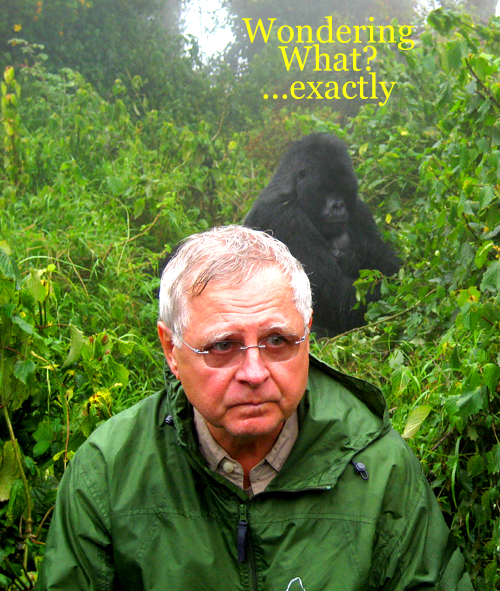
I mean wondering where the money we paid ends up. I mean wondering why people who aren’t as rich as we are can’t as easily experience the most natural and pristine parts of our earth. I mean wondering why our clawed Victorian bathtub holds gallons of steaming water while the family of the man who cleans it for us is searching for a teaspoon of clean water to drink.

To me, developing the awareness of this awful conundrum in the so-called “wild” is the most important experience of all. It’s a very personal decision. For me as a guide, the absurdity of the cost provides an easier platform for me to help my clients achieve this special awareness. So not yet is the price too high. But what is too high, then? I don’t know. That’s my own, the guide’s conundrum.

Keep Hiding, Matilda!

Keep Hiding, Matilda!

A great scientific discovery in Tanzania made two years ago, announced yesterday, remains cloaked in secrecy because Americans are likely to kill it!

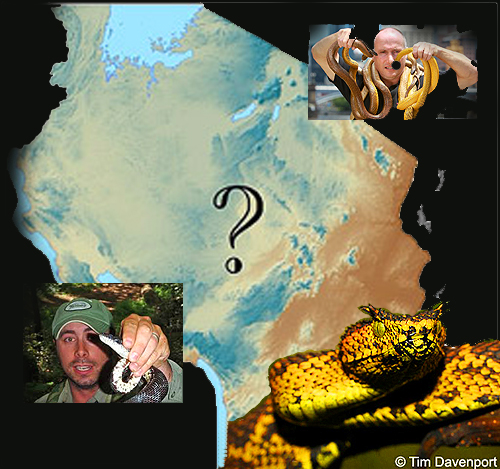
The Wildlife Conservation Society’s super field guy, Tim Davenport, has discovered an extremely beautiful, unusual and genetically important venomous bush viper, which he found somewhere in southern Tanzania and he won’t tell where.

Davenport, who was also the discover of the rare kupinji in 2005, has named the snake, the Matilda Horned Viper. (Note that there have been fewer new snakes discovered in the world in the last half century than primates.)

The discovery sheds important light on the evolution of snakes, and separately, on Tanzania’s own history of endemic forests and may ultimately contribute to the debate about why forests declined in Africa, and/or why early man contributed to this decline.

Wow. Lots of good stuff here. But Davenport says there are probably less than “dozens” of these snakes still alive, and so he won’t say where they live.

“It is often the case that the first few specimens of a newly discovered bush viper can be worth a high price and … a sudden rush to collect as many specimens as possible could actually extirpate the species in the wild,” WCS explains.

The genetic study WCS has carried out is sufficient evidence for the snake being considered an endangered species, and if finally ruled so, trade would become illegal. But getting the snake listed will take time, and in the meantime reptile collectors – mostly from America – would likely wipe it out of existence!

This is the really sad.

What exactly would happen?

Well, it starts with the scientific publication of where some new reptile has been found, and that’s why WCS “have agreed with the editor of the scientific journal … where the species description is published to keep the locality as vague as possible.”

Nevertheless, there are lots of clues, and unscrupulous reptile businessmen collectors will probably figure it out. WCS is worried. “Collection from the wild … has reached a level whereby it represents perhaps the biggest threat to Tanzania’s amphibians and reptiles.”

So Davenport is doing something extraordinary. He’s been breeding them, and that’s one of the reasons there’s been such a delay in the announcement. If he breeds enough, WCS may even put some into the commercial market to lower the price and the unscrupulous demand.

The problem is acute in America, because unlike other countries, there are few federal laws regulating owning exotic animals. These laws are largely left to the States, so some have good laws (like New York) and some have no laws whatever (like Oklahoma).

So it’s from Oklahoma that you can buy almost any snake in existence from companies like General Exotics which often goes out of business, then into business and back out of business, avoiding various state law agencies with jurisdiction over citizens who bought from them.

And the owners of General Exotics and dozens of other such unscrupulous companies hold wildly popular “fairs” constantly across the country. And of course when they come to Chicago they can’t bring exotics that are illegal under Illinois law, but they can still take your order!

These are not zoo people or even what I would call animal people. They are cutthroats who don’t care very much about what they’re selling.

But the problem, of course, isn’t them. It’s with the buyer.

The motivation for owning an exotic animal strikes me as wholly strange, but numerous analyses have suggested it falls in that macho category of indescribable subintellectual orgasms akin to anything which tempts fate like fast driving or polishing a gun.

I don’t know. I love to see them in the wild. And what they tell us about our prehistory, and how they contribute to our future lives is an immeasurable joy that you needn’t be a scientist to feel.

So keeping hiding, Matilda!

Pets, For the Love of Money!

Pets, For the Love of Money!

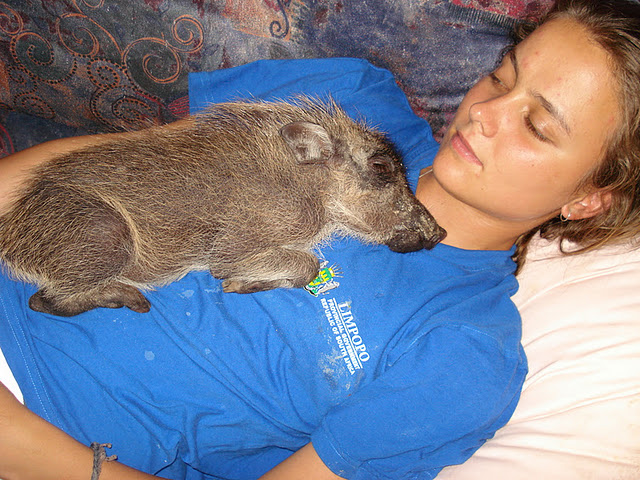
Jess DuPloy with her new pet warthog on New Years Day in South Africa.
I can’t think of a single animal in Africa, not one, that someone didn’t make a pet out of. And some were extremely dangerous, and many ended up killing “master.” So why are we so obsessed with taming the wild?

I think there are two completely different reasons.

The first I’m sure comes to mind to everyone: a pet that bonds with you trusts you. In today’s world, especially, where there is so little trust between people and institutions, trust is cherished possibly to an extreme.

Many animal lovers will expand this into a variety of more universal themes. John Balzar, Senior Vice President of the Humane Society of the US says that pets “teach us about humility and empathy and loyalty. Their eyes hold the spark of life, the same as ours.”

That’s actually a lot less romantic than some get. But however you cut it, this notion of pure love and loyalty is really one of trust. And we need trust, and if we can’t get it from Mitt or Herb, then we definitely need to get a Lassie. That sounds sarcastic, but it’s filled with truth.

The other reason is less prosaic. It’s become a major part of the developed world’s economy, and PetSmart and PetCo and a thousand other pet cemeteries and pet pharmacies and pet devices have exploited our need for trust. They have mined our innate need to consume.

I walk my Lab, Morgan, in the dark in the morning, long before America is awake. It’s now quite dark. So I went first to PetSmart to buy some kind of light that would hang from his collar and was given a mind boggling choice, and I finally chose a red light, because I didn’t think a white light would be as noticeable. But I didn’t realize until I got in the car that it was in the shape of a heart.

Not that there’s anything wrong with that, but I then went to PetCo and they had a great simple rectangular light that snapped onto the collar. Yes it was white, but by now I had been commercially maneuvered.

When the first dark day came I started with the PetCo white snap-on. Only, it snapped-off, as my Lab loves to dig to China whenever he senses a vole in the area. He’s never gotten a vole, but I’ve seen it run away from him when his head is completely buried in the hole he’s dug. Snap-on bites the dust.

So on went the heart-shaped red light. Well, this one doesn’t just shine, it sparkles. I didn’t feel warm and snugly, I felt like a migraine was coming on. Heartless, now, we walked in the dark.

And $20 had been thrust to the wind.

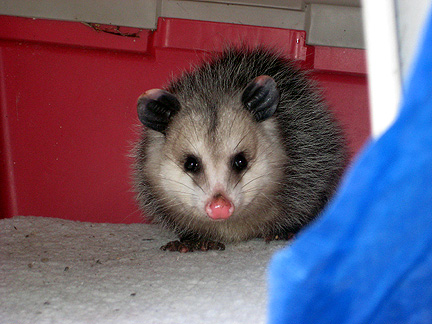
It reminds me of several years ago when our first feral cat began to approach me, and I spent long summer hours enticing her with food, until now she sits endlessly on my lap purring constantly. But this took a long time, and part of the process was to fashion her a place outside when she was in a winter’s transition.

I took our animal traveling cage and outfitted it with a heating pad and waited anxiously to see if the cat would domesticate herself.

Getting up early one morning, I noticed movement in the cage, got my camera and below is what I so joyfully discovered.

Accept, or Die. Nigeria, today.

Accept, or Die. Nigeria, today.

Nigeria is blowing up. There’s martial law in four of its 36 states, bombings and other violence is escalating, and religious war threatens to inflame shaky Chad, Niger and even Mali.

Economic instability always, always produces political instability, and Nigeria as one of the leading world oil producers has economic graphs with low and high points that are remarkable for their spread, showing extreme potential and extreme fragility.

During the relatively prosperous years of most of the last several decades, the country has developed significantly. In fact its economic development sped right past its social and cultural development, and this led in its own way to serious corruption that only recently was considered its greatest challenge.

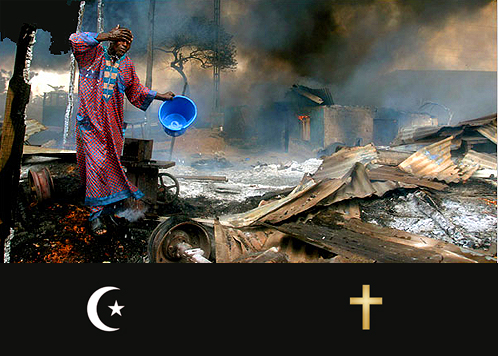
No more. Nigeria’s challenge right now is to avoid self-annihilation. And tiresome as it seems, it is the classic battle between Christians and Muslims. One which permits no compromise. Accept, or die.

I’ve spent my whole life in Africa watching religion tear apart Africa and mostly as a battle between the world’s two greatest religions, Christianity and Islam, and now I even have to enduring watching it creep into the daily life of America.

One wonders what would happen if youth’s greater perception of the impoverished theologies of the world took hold. How fast can we hope this will develop? Yet if suddenly, miraculously, religion were removed from the bombs of the world, would something else take its place, like ethnicity or poverty?

That’s a question way too complicated to think about right now. In Nigeria, Boko Haram, the underground, illegal but increasingly organized terrorist group proudly affiliated with al-Qaeda, takes responsibility for much of the violence, today. Sharia oriented, today they demanded all Christians leave the Muslim north.

And Nigeria is far more developed than neighboring countries like Niger and Chad which also suffer from Christian/Islam battles. Many Nigerian Muslim clerics are screaming for peace, recognizing that all Nigeria has gained economically is at stake. But the economic gains, the level of prosperity, may not have been enough fast enough to help these clerics get their messages accepted.

The fuel inflaming this always simmering religious battle is the economy. The President of Nigeria has begun to eliminate fuel subsidies, and the scale of the reaction is unprecedented, even in this turbulent country. Many think these will now be rolled back, but it may be too late.

Religious conflict, pricked by economic decline, is happening round the world. In the more developed west fortunately the tone of the religious conflict is moderated into a less violent social/cultural one. Instead of Jesus fighting Mohammed it’s abortionists fighting evangelicals, but in the end it’s all the same.

It’s intolerance, a battle empirically governed by those who have the money and power and are fearful of losing it. When will we ever learn…

Maybe a Wolf, but no Railway

Maybe a Wolf, but no Railway

There is no evidence that a Chinese railway will be built through the Serengeti, despite the alarms sounded by Serengeti Watch (SW) retweeted and reblogged by conservationists.

SW’s end-of-year alarm is not just premature, it’s dangerous. It makes it difficult to sustain a lasting fight against those in the Tanzanian government interested in subsuming conservation to more rapid commercial development.

Several days after SW’s issued an alert to its 40,000+ friends on Facebook that the Tanzanian, Ugandan and Chinese governments had plans to build a railway through the Serengeti, the Tanzanian government said unequivocally that any railway being planned “will not run through the park.”

I’m the last to enshrine African government announcements as trafficking in truth, but this one is pretty clear and simple, and while of course anything can be lied about, this time I seriously doubt it. Here’s why:

SW’s principal evidence was a December 23 announcement of an Uganda/Tanzania/Chinese agreement released by the Uganda Transport Minister reported by one of Uganda’s better news services, IPP media, on December 24.

The agreement for a $450 million feasibility study for several infrastructure projects all linked to China’s extraction of African natural resources included a railway from Tanzania’s northern and wholly undeveloped Indian Ocean seaside city of Tanga to its Lake Victoria port of Mwanza. A straight line from one to the other goes through the Serengeti.

There is nothing in the announcement to suggest the railway will be straight.

In the next few days following SW’s alert dozens of bloggers took up arms, and while not exactly going viral it was widespread. Several days later one of Uganda’s typically near-tabloid newspapers took the rumors and staged a full-on, evidence-lacking scandal claiming in its lead paragraph that the agreement would “build a railway line passing through the Serengeti National Park.”

That was promptly followed by the Tanzanian government denial noted above.

A whole basket of threats jeopardizes the Serengeti, not just from this yet fluid and unclear agreement, but from numerous other development projects including the moribund roads project which has not yet been removed from Tanzania’s transport docket of active projects, despite clear indications it has been shelved.

But ambiguity is supreme in African politics and policy, and it takes a bit of care in mastering your position. Threats must be fought differently than wars. The Serengeti road project is definitely on the shelf and being monitored by a whole range of pantry watchers including UN agencies and Hillary herself. It was a war that SW helped to win. That battle’s over; the threat continues.

And the railway is not yet clear enough to send in the troops.

The way to oppose these threats successfully is to be grateful to the various glorious ministers for their stated positions and to constantly remind them and the public of these. The stated position by the Tanzanian government is that there will be no big road through the Serengeti and no railway through the Serengeti. Thank you, Mr. Minister.

If the day arrives when this stated policy changes, the reversal – unlike Newt’s, Mitt’s and our farcical righties – will carry significant political leverage in Tanzania where a growing movement similar to Kenya’s is requiring more and more accountability and constancy from local politicians.

This is a tough one, and it is so because of China’s intractable need for natural resources, one that with each day is clearly insensitive to anything but its own consumption. Huge battles loom all over resource-rich Africa.

In Tanzania alone we need battle strategies right now to stop ongoing projects around Zanzibar and Tanga’s coral reefs, uranium in The Selous, hydroelectric plants on the Rufiji and the ongoing travesties with gold mining near Mwanza. Any one of these, all ongoing at this very instant, has negative environmental impacts as great as the imagined threat of severing the wildebeest migration.

The way to master the railway threat on the Serengeti is not SW’s. We need effective diplomacy not not-for-profit hysteria. The best way to lose a battle is for the little guy to shoot first.

In Africa dreams often become reality. But the last thing we need right now is to provoke these threats in the Serengeti. China has a lot of money and doesn’t exactly like clean air.

SW’s call to arms is premature and incendiary.

Top Ten 2011 Africa Stories

Top Ten 2011 Africa Stories

Twevolution, the Arab Spring [by Twitter] is universally considered the most important story of the year, much less just in Africa. But I believe the Kenyan invasion of Somalia will have as lasting an effect on Africa, so I’ve considered them both Number One.

1A: KENYA INVADES SOMALIA
On October 18 Kenya invaded Somalia, where 4-5,000 of its troops remain today. Provoked by several kidnapings and other fighting in and around the rapidly growing refugee camp of Dadaab, the impression given at the time was that Kenyans had “just had enough” of al-Shabaab, the al-Qaeda affiliated terrorism group in The Horn which at the time controlled approximately the southern third of Somalia. Later on, however, it became apparent that the invasion had been in the works for some time.

At the beginning of the invasion the Kenyan command announced its objective was the port city of Kismayo. To date that hasn’t happened. Aided by American drones and intelligence, and by French intelligence and naval warships, an assessment was made early on that the battle for Kismayo would be much harder than the Kenyans first assumed, and the strategy was reduced to laying siege.

That continues and remarkably, might be working. Call it what you will, but the Kenyan restraint managed to gain the support of a number of other African nations, and Kenya is now theoretically but a part of the larger African Union peacekeeping force which has been in Somali for 8 years. Moreover, the capital of Mogadishu has been pretty much secured, a task the previous peace keepers had been unable to do for 8 years.

The invasion costs Kenya dearly. The Kenyan shilling has lost about a third of its value, there are food shortages nationwide, about a half dozen terrorist attacks in retribution have occurred killing and wounding scores of people (2 in Nairobi city) and tourism – its principal source of foreign reserves – lingers around a third of what it would otherwise be had there be no invasion.

At first I considered this was just another failed “war against terrorism” albeit in this case the avowed terrorists controlled the country right next door. Moreover, I saw it as basically a proxy war by France and the U.S., which it may indeed be. But the Kenyan military restraint and the near unanimous support for the war at home, as well as the accumulation of individually marginal battle successes and outside support now coming to Kenya in assistance, all makes me wonder if once again Africans have shown us how to do it right.

That’s what makes this such an important story. The possibility that conventional military reaction to guerilla terrorism has learned a way to succeed, essentially displacing the great powers – the U.S. primarily – as the world’s best military strategists. There is as much hope in this statement as evidence, but both exist, and that alone raises this story to the top.

You may also wish to review Top al-Shabaab Leader Killed and Somali Professionals Flee as Refugees.

1B: TWEVOLUTION CHANGES EGYPT
The Egyptian uprising, unlike its Tunisian predecessor, ensured that no African government was immune to revolution, perhaps no government in the world. I called it Twevolution because especially in Egypt the moment-by-moment activities of the mass was definitely managed by Twitter.

And the particular connection to Kenya was fabulous, because the software that powered the Twitter, Facebook and other similar revolution managing tools came originally from Kenya.

Similar of course to Tunisia was the platform for any “software instructions” – the power of the people! And this in the face of the most unimaginable odds if you’re rating the brute physical force of the regime in power.

Egypt fell rather quickly and the aftermath was remarkably peaceful. Compared to the original demonstrations, later civil disobedience whether it was against the Coptics or the military, was actually quite small. So I found it particularly fascinating how world travelers reacted. Whereas tourist murders, kidnapings and muggings were common for the many years that Egypt experienced millions of visitors annually, tourists balked at coming now that such political acts against tourists no longer occurred, because the instigators were now a part of the political process! This despite incredible deals.

We wait with baited breath for the outcome in Syria, but less visible countries like Botswana and Malawi also experienced their own Twevolution. And I listed 11 dictators that I expected would ultimately fall because of the Egyptian revolution.

Like any major revolution, the path has been bumpy, the future not easily predicted. But I’m certain, for example, that the hard and often brutal tactics of the military who currently assumes the reins of state will ultimately be vindicated. And certainly this tumultuous African revolution if not the outright cause was an important factor in our own protests, like Occupy Wall Street.

3: NEW COUNTRY OF SOUTH SUDAN
The free election and emergence of South Sudan as Africa’s 54th country would have been the year’s top story if all that revolution hadn’t started further north! In the making for more than ten years, a remarkably successful diplomatic coup for the United States, this new western ally rich with natural resources was gingerly excised from of the west’s most notorious foes, The Sudan.

Even as Sudan’s president was being indicted for war crimes in Darfur, he ostensibly participated in the creation of this new entity. But because of the drama up north, the final act of the ultimate referendum in the South which set up the new republic produced no more news noise than a snap of the fingers.

Regrettably, with so much of the world’s attention focused elsewhere, the new country was hassled violently by its former parent to the north. We can only hope that this new country will forge a more humane path than its parent, and my greatest concern for Africa right now is that global attention to reigning in the brutal regime of the north will be directed elsewhere.

4: UGANDA FALTERS
Twevolution essentially effected every country in Africa in some way. Uganda’s strongman, Yoweri Museveni, looked in the early part of the last decade like he was in for life. Much was made about his attachment to American politicians on the right, and this right after he was Bill Clinton’s Africa doll child.

But even before Twevolution – or perhaps because of the same dynamics that first erupted in Tunisia and Egypt – Museveni’s opponents grew bold and his vicious suppression of their attempts to legitimately oust him from power ended with the most flawed election seen in East Africa since Independence.

But unlike in neighboring Kenya where a similar 2007 election caused nationwide turmoil and an ultimate power sharing agreement, Museveni simply jailed anyone who opposed him. At first this seemed to work but several months later the opposition resurfaced and it became apparent that the country was at a crossroads. Submit to the strongman or fight him.

Meanwhile, tourism sunk into near oblivion. And by mid-May I was predicting that Museveni was the new Mugabe and had successfully oppressed his country to his regime. But as it turned out it was a hiatus not a surrender and a month later demonstrations began, twice as strong as before. And it was sad, because they went on and on and on, and hundreds if not thousands of people were injured and jailed.

Finally towards the end of August a major demonstration seemed to alter the balance. And if it did so it was because Museveni simply wouldn’t believe what was happening.

I wish I could tell you the story continued to a happy ending, but it hasn’t, at least not yet. There is an uneasy calm in Ugandan society, one buoyed to some extent by a new voice in legislators that dares to criticize Museveni, that has begun a number of inquiries and with media that has even dared to suggest Museveni will be impeached. The U.S. deployment of 100 green berets in the country enroute the Central African Republic in October essentially seems to have actually raised Museveni’s popularity. So Uganda falters, and how it falls – either way – will dramatically alter the East African landscape for decades.

5: GLOBAL WARMING
This is a global phenomena, of course, but it is the developing world like so much of Africa which suffers the most and is least capable of dealing with it. The year began with incessant reporting by western media of droughts, then floods, in a confused misunderstanding of what global warming means.

It means both, just as in temperate climates it means colder and hotter. With statistics that questions the very name “Developed World,” America is reported to still have a third of its citizens disputing that global warming is even happening, and an even greater percentage who accept it is happening but believe man is not responsible either for it occurring or trying to change it. Even as clear and obvious events happen all around them.

Global warming is pretty simple to understand, so doubters’ only recourse is to make it much more confusing than it really is. And the most important reason that we must get everyone to understand and accept global warming, is we then must accept global responsibilities for doing something about it. I was incensed, for example, about how so much of the media described the droughts in Africa as fate when in fact they are a direct result of the developed world’s high carbon emissions.

And the news continued in a depressing way with the very bad (proponents call it “compromised”) outcome of the Durban climate talks. My take was that even the countries most effected, the developed world, were basically bought off from making a bigger stink.

Environmentalists will argue, understandably, that this is really the biggest story and will remain so until we all fry. The problem is that our lives are measured in the nano seconds of video games, and until we can embrace a long view of humanity and that our most fundamental role is to keep the world alive for those who come after us, it won’t even make the top ten for too much longer.

6: COLTAN WARS IMPEDED
This is a remarkable story that so little attention has been given. An obscure part of the Dodd-Frank Wall Street Reform Act essentially halved if not ultimately will end the wars in the eastern Congo which have been going on for decades.

These wars are very much like the fractional wars in Somalia before al-Shabaab began to consolidate its power, there. Numerous militias, certain ones predominant, but a series of fiefdoms up and down the eastern Congo. You can’t survive in this deepest jungle of interior Africa without money, and that money came from the sale of this area’s rich rare earth metals.

Tantalum, coltran more commonly said, is needed by virtually every cell phone, computer and communication device used today. And there are mines in the U.S. and Australia and elsewhere, but the deal came from the warlords in the eastern Congo. And Playbox masters, Sony, and computer wizards, Intel, bought illegally from these warlords because the price was right.

And that price funded guns, rape, pillaging and the destruction of the jungle. The Consumer Protection Agency, set up by the Dodd-Frank Act, now forbids these giants of technology from doing business in the U.S. unless they can prove they aren’t buying Coltran from the warlords. Done. War if not right now, soon over.

7: ELEPHANTS AND CITES
The semi-decade meeting of CITES occurred this March in Doha, Qatar, and the big fight of interest to me was over elephants. The two basic opposing positions on whether to downlist elephants from an endangered species hasn’t changed: those opposed to taking elephants off the list so that their body parts (ivory) could be traded believed that poaching was at bay, and that at least it was at bay in their country. South Africa has led this flank for years and has a compelling argument, since poaching of elephants is controlled in the south and the stockpiling of ivory, incapable of being sold, lessens the funds that might otherwise be available for wider conservation.

The east and most western countries like the U.S. and U.K. argue that while this may be true in the south, it isn’t at all true elsewhere on the continent, and that once a market is legal no matter from where, poaching will increase geometrically especially in the east where it is more difficult to control. I concur with this argument, although it is weakened by the fact that elephants are overpopulated in the east, now, and that there are no good strategic plans to do something about the increasing human/elephant conflicts, there.

But while the arguments didn’t change, the proponents themselves did. In a dramatic retreat from its East African colleagues, Tanzania sided with the south, and that put enormous strain on the negotiations. When evidence emerged that Tanzania was about the worst country in all of Africa to manage its poaching and that officials there were likely involved, the tide returned to normal and the convention voted to continue keeping elephants listed as an endangered species.

8: RHINO POACHING REACHES EXTREME LEVELS
For the first time in history, an animal product (ground rhino horn) became more expensive on illicit markets than gold.

Rhino, unlike elephant, is not doing well in the wild. It’s doing wonderfully in captivity and right next to the wild in many private reserves, but in the wild it’s too easy a take. This year’s elevation of the value of rhino horn resulted in unexpectedly high poaching, and some of it very high profile.

9: SERENGETI HIGHWAY STOPPED
This story isn’t all good, but mostly, because the Serengeti Highway project was shelved and that’s the important part. And to be sure, the success of stopping this untenable project was aided by a group called Serengeti Watch.

But after some extremely good and aggressive work, Serengeti Watch started to behave like Congress, more interested in keeping itself in place than doing the work it was intended to do. The first indication of this came when a Tanzanian government report in February, which on careful reading suggested the government was having second thoughts about the project, was identified but for some reason not carefully analyzed by Watch.

So while the highway is at least for the time being dead, Serengeti Watch which based on its original genesis should be as well, isn’t.

10: KENYAN TRANSFORMATION AND WORLD COURT
The ongoing and now seemingly endless transformation of Kenyan society and politics provoked by the widespread election violence of 2007, and which has led to a marvelous new constitution, is an ongoing top ten story for this year for sure. But more specifically, the acceptance of this new Kenyan society of the validity of the World Court has elevated the power of that controversial institution well beyond anyone’s expectations here in the west.

Following last year’s publication by the court of the principal accused of the crimes against humanity that fired the 2007 violence, it was widely expected that Kenya would simply ignore it. Not so. Politicians and current government officials of the highest profile, including the son of the founder of Kenya, dutifully traveled to The Hague to voluntarily participate in the global judicial process that ultimately has the power to incarcerate them.

The outcome, of course, remains to be seen and no telling what they’ll do if actually convicted. It’s very hard to imagine them all getting on an airplane in Nairobi to walk into a cell in Rotterdam.

But in a real switcheroo this travel to The Hague has even been spun by those accused as something positive and in fact might have boosted their political standing at home. And however it effects the specific accused, or Kenya society’s orientation to them, the main story is how it has validated a global institution’s political authority.
Save Trees Make Bricks!

Save Trees Make Bricks!

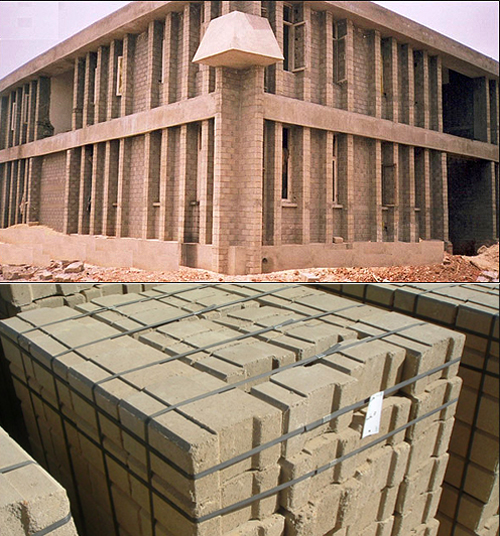
Rapid deforestation threatening African development has a notable South African remedy gaining wider recognition and use, compressed soil bricks.

The process which has been known since the late 80s is only now gaining traction and some economic viability. Fairly expensive but remarkably mobile machines that operate on diesel or electricity compress soil and other ingredients like ash and cement into interlocking bricks that are assembled with no mortar or further fixatives.

Most of the machines can produce one brick every 14-15 seconds, thousands of times faster than traditional kilns.

The final structures are remarkably durable and sustainable, and greatly reduce the need for inorganic materials while totally replacing the fired kiln, thereby protecting forests.

The newest machine started production in Karatu, Tanzania, last week. The area has soil perfect for making bricks, although until now these were all fired in a kiln, threatening the forests around Ngorongoro Crater.

Introduced by a local NGO, Hifadhi Mazingira (HIMAKA), the bricks are sold at a quarter of the price of traditional fired bricks provided the consumer first plants a certain number of trees based on the size of his purchase of bricks.

“We imported the Hydra-form brick making machine from South Africa to produce bricks that can be sold at very low costs of 250/- per piece compared to the usual brick prices of 1000/- or more per brick,” the NGO’s founder told a local Arusha newspaper.

According to the South African manufacturer, 2500 bricks requires 10 liters of diesel. Carbon emissions compare favorably with the wood that would otherwise be required to fire the kiln for the same number of bricks, and the cost is much less.

According to an official of the Ngorongoro Conservation Area Authority most existing tourist lodges in the area used a minimum of 20 acres of trees to fire the kilns that created their bricks. As a result, new tourism initiatives are being directed to the interlocking hydraform bricks.

The product has found wide acceptance in India where the soil is appropriately “red” or heavily laced with copper, as in the case of Karatu, Tanzania.

Initiatives like these come to the fore when economies move them there. The price of wood in Tanzania has skyrocketed recently, because of rapid depletion. But whether hydraform bricks are really a better idea and more environmentally friendly than something else, like simple pressed wood or artificial fibers, it’s clearly a step seeking a right direction.