In-Depth Tourism

In-Depth Tourism

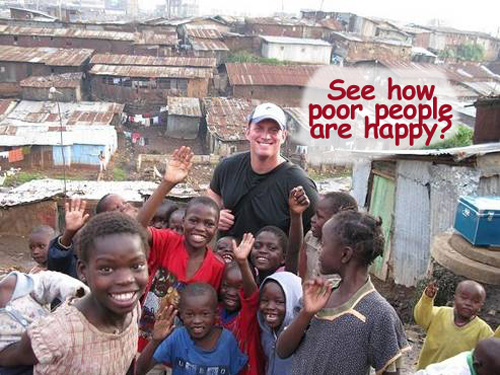
Death, destruction, despair and poverty … all for an attractive price! For less than $30 per person you can be guided into Kenya’s most famous slum! Kibera Tours dot com. “Experience a part of Kenya unseen by most tourists: KIBERA The friendliest slum in the world!”

The half-day sightseeing trip in Nairobi promises to visit an orphanage and school, a bead factor and a typical Kibera house before the piece de resistance: the biogas center: “a fantastic view over Kibera and picture-point. You can see that also human waste is not wasted here.”

This is disgusting. Tourism at its worst and most exploitive, revealing the basest inclinations of ourselves and reenforcing ridiculous notions that poverty doesn’t exist at home.

Kibera is the largest of Nairobi’s 7 or 8 slums, which slip around the city in endless tin and fumes. Not even the Kenyan government census can estimate the size, but the best guesses I’ve seen put the slums at several million people compared to the residents in the city at around 3½ million. The slums are a dissimulating fraction of greater Nairobi and would be an incessant inferno in the developed world.

But in Africa they maintain an unusual tranquility. To be sure crime is endemic (see the film, Nairobi Half Life) and ethnic feuds that plague Kenya from top to bottom can produce particularly vicious moments here, but unlike slums in the developed world there is no boiling cauldron of the poor ready to murder the rich.

Nairobi slums are often stepping stones from poverty, completely unlike the imprisonment of slums in the developed world. Emigrants from impoverished rural areas without proper education or training live for a few years in the slums and develop the minimal skills needed to work in the modern world.

Then they move up and out. Not yet has Kibera fashioned a whole class of people forever imprisoned like the old Harlem or Cabrini Green in the U.S., or the Cape Verde barreos of Lisbon. Kibera will indeed become another Cabrini Green if something isn’t done this generation. But for the moment, the slums are relatively too young to have become a blighted institution.

Nevertheless, they look the same. And the nuance I argue above is not something that can be seen on a short visit. But slum tourists don’t come looking for hope.

What do they come looking for? Why does a tourist pay to come here?

I’ve asked myself the same question time and again. It’s identical with the wish to “see a village.” That quoted remark, of course, is an euphemism for seeing dirty bomas with mud huts and animal excrement. Fortunately, by the way, such villages are rare to find, anymore, at least along East Africa’s normal tourist circuit. What has replaced them are sedentary replications intended to make money from tourists.

Why do tourists pay to see them, even though they are clearly not authentic?

Even though outstanding African economic growth and potential is in fact a topic often found on the pages of the Wall Street Journal, I still hear from parents, “I want my children to see the way the other side lives.” Or “I think it’s important we see how fortunate we are.”

You don’t have to come to Africa to “see how the other side lives.” In some places like southwest Wisconsin near where I live, or the Ozarks or Appalachia, or the residual slums of our urban cities, real poverty and its resultant despair and destruction is no less than Kibera’s.

America’s “Kiberas” are not as widespread or large as Kenya’s, that’s true. But this is not a fortune of chance. It’s the result of a human civilization that wants to give everyone a modicum of happiness, that cherishes human rights.

That’s what America was mostly about, and it’s now what the world is mostly about. Kibera’s existence is our failing, just as Cabrini Green was and Appalachia still is.

Poverty is so complicated that it easily befuddles, and I think that’s part of the tourists’ desire to see Kibera or “a village.” They want to simplify the complicated. They don’t want to see poverty as something relative, but clearly defined and for sure, Kibera is.

But there is the same, absolutely identical misery, disease and angst in the unemployed, castaway homeless veteran on the streets of New York as any child walking the mud paths of Kibera.

Kibera, or the imagined dirty African village, or the homeless veteran need not exist. In a world where you and I assumed our basic human responsibility to our neighbor, there would be no Kibera.

So I believe the single-most important reason tourists want to “experience poverty” in Africa is to believe the same identical thing doesn’t exist at home. Or isn’t as bad. Or isn’t as extensive.

If one child is poor; if one veteran is homeless, it’s wrong.

And finally — possibly even worse — the delusional tourist wants to find a smiling child who is dying, so that they can believe that poor is OK, that homeless can also be happy, that death smiles.

It’s OK to live in a multi-million dollar mansion and it’s OK to dab yourself with Chanel. But it’s not OK to live a world that allows Kiberas to exist. Kibera’s existence is our fault; the collective fault of an unjust world order. The children of Kibera can just as easily be the children of Trenton.

It’s not OK to go through life with the fantasy that Africa is besmirched and cursed and that Kiberas exist only in Nairobi and Shaker Heights exist only in Cleveland.

And it’s not OK to think that poor is OK, anywhere. There is no happiness in being poor or homeless, whether in Kibera or 49th Street.

Don’t come to Africa to validate your own fantasies.

Maul Special

Maul Special

Pretty story but not very effective: recruit Maasai morani – the legendary warriors that are expert lion killers – to protect lions. Sort of like hiring the ultimate teenage hacker to protect HSBC.

Lion numbers are dropping alarmingly, and better than any other great African savannah animal lion are a true indicator of the health of the African wild.

Unlike elephant or rhino – which are being poached at alarming rates even as their wild population increases – lion are the top of a complex pyramid of life and while masters of their position are beholding to the foundations.

Many important studies have suggested unusual reasons for the decline over the last several decades, but it now seems clear that the reason is quite simple: the wild is contracting.

Of the big cats, only the solitary leopard seems capable of adapting to a world increasingly dominated by man. The others – and especially the lion – seem unable to establish any relationship with a world increasingly dominated by homo sapiens except to war with him.

And the greatest battles are those legendary pitched posses of Maasai warriors in Old Testament regalia: Maasai don’t kill any animals for fun or food. They kill in retaliation, as if a lesson can be learned.

When a lion threatens their goats or cattle Maasai go on a war path, and some of the most spectacular stories out of Maasailand are of the greatest and most noble of the lion hunts. In the old days headmen were often determined by those who successfully killed a lion.

And remember, this isn’t with a gun. It’s with a spear and a knife.

Maasai and lion have coexisted for centuries because they use the same habitat. The grazing necessary for Maasai stock is the same that all sorts of antelope on the plains need. When there was enough for all, everyone was fat and sassy. There were enough antelope for the lion that much preferred them to a smaller goat or a larger and lanky cow.

Maasai cattle were bred not for meat but for milk. The cost/benefit ratio of a lion bringing down a Maasai cow compared to a wildebeest was no contest. The wildebeest could be killed more quickly (cats kill by strangulation, and this takes enormous time with a cow) and the dinner table had lots more meat for the effort.

But times changed. And note, too, that traditional Maasai are declining just as rapidly if not more so than the wild animals in their homelands. And maybe for the same reasons:

Shopping malls, highways, schools and hospitals, modern farms.

It takes no kopjes scientist to know where this is going.

So arise the Lion Guardians! This high profile NGO in East Africa was formed by dedicated conservationists “to promote and sustain coexistence between people & wildlife through ecological monitoring and local capacity building.”

IE: Pay Maasai morani to protect rather than kill lions.

It’s noble, yes. And anything that can give paid work to young traditional Maasai who are themselves increasingly threatened, is good. Especially in the West Kilimanjaro area adjacent Amboseli National Park.

This area is a microcosm of lion difficulties everywhere. Amboseli is one of the most important and well-known big game parks in the world famous especially for its elephant. Elephant are being threatened today by increased poaching, but their numbers are still increasing in places like Amboseli, because … well, elephant get their way.

But Amboseli is surrounded by an increasingly developed agriculture, particularly just to its south in Tanzania. The highlands of Kilimanjaro are perfect for wheat and other cash crop farming.

The towns of Arusha to the west and Moshi to the east are expanding rapidly. The roads are being paved.

All of this – not just farming – needs water. This is draining the existing aquifers and Amboseli is becoming drier and drier. This is a death sentence for much game like buffalo and wildebeest. The increased elephant population results in deforestation, and combined with the loss of aquifer power the reduction of forests is terrible for impala, duiker and a chorus of tiny things like voles and mice that animals like hyaena and jackal need to survive.

So you see … or don’t, so to speak, as time passes. No traditional food, Mr. Lion heads south to where Maasai live with their goats and cattle.

Lion Guardians believes in conserving the wild and in promoting tourism. It’s a two-pronged argument that often sticks it to itself. Tourism is one thing. Conservation is another.

There’s no doubt that tourism suffers as there are fewer lions to see in the wild. But tourism is already suffering drastically, mainly from the political situation in Kenya linked directly to the violently unsettled situation in Somalia. We hope this is temporary.

Whether temporary or not, conservation is another matter.

I grow quite sad thinking the day may come when there won’t be lions in the wild as I’ve seen all my life. But it’s hard to argue to save the lion with the same powerful scientific arguments for saving the Amazon rain forest. We know almost everything possible about lions and the African savannah. There are of course mysteries yet to be revealed … but not many.

The forest provides my oxygen. The veld powers my imagination – no small thing – but not exactly biological.

And what we know mostly is that Maasai recruited to protect lions are getting mauled, and in the end, not saving any more lions and not convincing their young teen Maasai not to go to the city and become certified public accountants.

That’s life.

Statistics are Just Cosmetic

Statistics are Just Cosmetic

The American demographic is changing, the earth is heating up, and lipstick is the only way to understand how well Africa is doing and how far behind America is falling.

A U.S. presidential election provides an incredible snapshot of America, because so much data and polling and social introspection goes on. Much of it confirms my long-stated beliefs that America is yet impeded by racism and sorely crippled by under education.

And that means much of America just doesn’t accept reality. Like global warming. Or like how Africa is becoming so modern, innovative and holds the potential to outdistance America on a number of fronts.

I’ve written about energy, for instance, and the aggressive use of solar and biofuels; I’ve written about the many inventions like the competitors to iPhones; I’ve written about software development and imaginative financing.

And now I’m writing about a topic I know so much about: cosmetics.

A new Kenyan beauty products company is achieving some unique success and might well enter the American market. We often criticize foreign-made products (particularly from China) because they often have a great price advantage. An advantage sometimes associated with inhumane labor practices or outright government subsidizing.

Not the case with SuzieBeauty. Her products might cost less than Lancome but it’s not because of slave labor. It’s because the division of wealth on earth is so skewed that the “richest” in places like Kenya are still less rich than in America. But that not by as much as you probably think!

SuzieBeauty is a perfect example of how American accomplishments are being exploited and enhanced faster by non-Americans than they are by Americans.

Suzie Wokabi is the founder of SuzieBeauty, and she’s Kenyan, of course. But she spent some time in the U.S. where she graduated from college and then joined the fashion industry. She became certified for media make-up and then worked for five years in New York before returning to Africa in 2007.

There and then in Africa, educated and experienced by everything wondrous in America, she really blossomed.

SuzieBeauty’s main standard-size bright colored lipstick costs about $10. A similar lipstick from MAC in the U.S. costs $15. This 50% difference is true through almost all of the beauty products offered by each company. One Kenyan and one American.

There are several interesting things about this.

The U.S. government says that the average wage of a working person in American in 2011 is $42,979.61. According to the Kenyan government the average wage of a working person there in 2011 was under $1000. (According to the CIA it was $1700.)

The big difference between the Kenyan government’s own determination and the CIA’s has to do with many factors, most notably the exchange rate which organizations like the CIA weight over longer periods of time. But regardless, either figure when compared to the American one suggests a society in Kenya of abject paupers. And it’s these numbers that teachers often use in high school much less college.

Africa and most of the third world have been growing so rapidly over the last several decades (as high as 10% per year, compared to developed countries 3-4%) that their societies have become radically divided economically.

The difference between Kenya’s richest and Kenya’s poorest is nowhere near as great as between America’s richest and poorest, but that’s because America’s richest are off the charts. But the difference say, between the top fifth-or-sixth of Kenyans and the bottom fifth-or-sixth is a chasm compared to that metric in America.

And that stat applies to most developing countries. And to be sure that’s an enormous problem. In Africa that metric is most pronounced in South Africa, where the country is fairly rich but huge portions of its population are abjectly poor. The labor unrest and social disturbances plaguing the country right now reflect this division.

Redistribution of wealth is a hot topic in the U.S., and one that few politicians are ready to embrace. But it is taken for granted in the developing world, because it’s understood without it their societies will explode.

But the point of this blog is not to lobby for redistribution. It’s to demonstrate that America’s top 10% and Kenya’s top fifth-or-sixth are not chasms apart. They’re about 50% apart, the difference of the cost of Suzie’s lipstick and Mac’s.

And that’s a remarkable fact, because only ten years ago it was probably 100%, and twenty years ago it was probably 1000%.

The developing world benefits from the youth of its societies which are unbridled by hundreds of years of law to be sure, but which are also unfettered by custom. But most of all the developing world is willing to experiment and explore new if radical social constructs which old places like America are so afraid to do.

You’ll never hear Kenyans talk of “founding fathers” or restricting their social responsibilities to what men in wigs 200 years ago thought was right.

SuzieBeauty’s mission goes well beyond value for stock holders. It includes “…innovative research …training and education, social responsibility and environmental awareness.”

Not your normal lipstick manufacturer. I can hear Kenya smacking its lips right now!

Redistributed Marriage

Redistributed Marriage

We should be incensed by the privileged often American tourist to rural Africa who characterizes want and poverty as some kind of pristine Garden of Eden that should just be left alone.

After her “first visit to Kenya,” a recent American tourist asked in her blog: “The Maasai culture and traditions are pure, so why would you want to change them?”

The question makes me scream: because the Maasai want iPhones, and sleeper posturepedic mattresses, and Brita filters, and slim notebooks and a hope for a better life. Anything wrong with that?

Today, the UN and hundreds of other organizations worldwide, celebrate the Day of the Girl Child which specifically condemns child marriages and which pointedly teases out much of American conservative ambiguities about freedom and individual rights.

Most forced wedlock for girl children occurs in Asia, but a close second is sub-Saharan Africa and specifically in East Africa’s still deeply rural areas.

“Some people sell their daughters at a tender age so they can get food. It’s common but people are silent about it,” a rural Kenyan told Reuters TrustLaw.

The Reuters TrustLaw story interview also described Somali traditions intended to preserve virginity prior to wedlock by arranging very young child marriages.

Now to some that may seem all so noble, right?

Such practices as female circumcision, child marriage and prostitution, and even child slavery are time and again reported in equivocal ways.

“Here’s a troubling fact: 60 million girls world wide are forced into marriage before the age of 18…,” that American tourist wrote in her blog, “But when it comes to cultures that practice child marriages, not everyone agrees that change is a good thing.”

Exactly who is everyone? A few locals you photographed on your $10,000 safari while being completely incapable of speaking to them them in their own language? Might their smiles had something to do with the 200 shillings you gave them for the shot?

I concede there are issues specifically relating to children that teeter on that sharp fence separating individual from human rights and perhaps this contributes to why some Americans believe that poverty and deprivation is fated to “just be left alone.”

Few argue that each child is different, capable of assuming independence at earlier or later ages. The UN and many organizations, though, set 18 years as the first age societies should presume a child is fully able to assume whole responsibility for herself.

Only a few generations ago, that was absurd. My grandmother married at 13 years old, a lost immigrant from Croatia. If she had not married she would likely have died in the mayhem that followed the flow of thousands of immigrants out of Ellis Island.

But that’s the point. That was more than 100 years ago. Although communities in Bangladesh or Mogadishu may not seem much different today than Ellis Island was at the turn of the 20th century, the global awareness of poverty and deprivation has increased enormously.

Fortunately, we all now care more about one another than ever before, if for no other reason than we’ve the tools to see further and deeper, everywhere.

The resilient human spirit, which burns greater in my opinion among the poor and deprived, will find moments in even the most awful situations for satisfaction and happiness. The beautiful nostalgia of my own boyhood may indeed not be so different from that of a successful African businesswoman of her own childhood in a rural hut.

But the effrontery of we privileged to wonder if earlier she might have chosen to remain deprived and under privileged is astounding. I believe it’s evil. It’s racist and the result of greed, a fear that to make things better for others means they will be made worse for ourselves.

Redistribution. Shudder at that word.

And the point there is that redistribution is only the beginning. With more of the world raised from deprivation, the productive capacity will be so remarkably increased that there will be more for all.

So get a grip. Redistribute some of that wealth that got you to Kenya to the poor little Maasai girl who would very much like to visit you in Columbus.

Greyed Out Bird

Greyed Out Bird

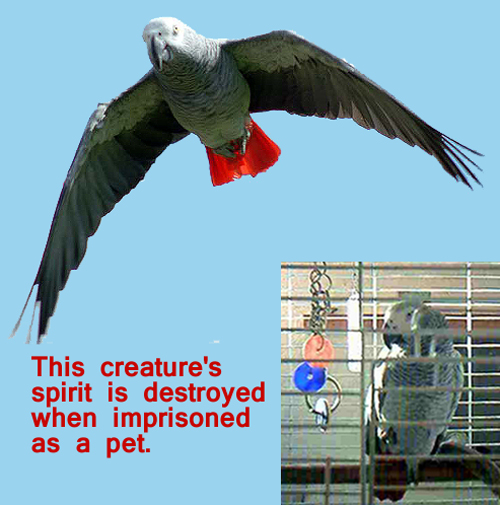
I am a loving pet owner. But I would never imprison a wild animal and then call it a pet. African Grey Parrots belong in the wild, not in a cage.

The majority of African Greys kept in the United States may have actually been born in captivity. In a sense they were manufactured to be pets; they’ve never soared over Africa’s great forests.

But be that as it may, are you sure that your bird was captive bred? And even if it truly was, do you realize that your keeping the bird in a cage is contributing to its extinction in the wild, where it much more truly belongs?

There are many as 30,000 loving owners of the Grey Parrot (Psittacus erithacus) in the United States, which for the first time this year was listed as “vulnerable” by the scientific organization (IUCN) used to determine which animals are in danger of extinction.

If the decline in the African Grey Parrot continues, and if the IUCN ultimately classifies it as “endangered” and if the CITES convention then adopts its recommendation, international trade in the bird would stop.

But the politics involved in this would be extraordinary. So there is real concern that at the point the bird is classified as threatened, it will be too late.

The IUCN explains the rapid decline in Africa’s most famous parrot because “It is one of the most popular avian pets in Europe, the United States, and the Middle East due to its longevity and unparalleled ability to mimic human speech.”

IUCN says that over the last 30 years “a million birds” may have been removed from the wild in Africa. Most of these are removed illegally, although a good portion have been captured on licenses given by corrupt African governments.

The market in the U.S. has existed for decades, but a new and vibrant market in China has also emerged as a result of China’s increased wealth. And unlike the U.S. and Europe, there are no laws in China that restrict the importation of wild birds.

Today, an African Grey Parrot in the U.S. sells for an average of $1,000. Good statistics are not available, but successful breeding of captive African Greys is a very lucrative business. Reputable companies like PetSmart routinely sell them, and eBay and Amazon both offer them.

But since there is no exact certification of what is truly a captive-bred bird, it’s likely today that many are illegal imports.

Many of these birds are smuggled out of Africa through poorly monitored ports like Windhoek, Namibia. Last week the Namibian Avicultural Association adopted new rules to try to stem the flow of illegal birds through the country.

The association claims that bird dealers in the country “do not seem to know that buying a parrot without [proper certification] may represent a bird that has been illegally caught in the wild.”

Like outright poaching, I can sympathize with Africans desperate to make a day’s wage, and capturing birds isn’t as difficult as it seems. On the Windhoek black market as throughout Africa, National Geographic estimates the poacher receives about $30 a bird.

The African middleman who pays the poachers smuggles the birds out of the country in horrible conditions. The majority die in crowded and dirty little containers that may have squashed hundreds of birds. The African middleman likely earns around $50 per bird.

The birds that survive the smuggling are taken by wholesalers in the U.S., Europe and China that launder their origin and sell them to companies like PetSmart. The wholesaler probably makes $300-500 per bird.

So while I can empathize with the poacher, it’s not possible to condone the knowingly illegal work of the middleman.

Ultimately, this horrendous trade will stop only when the market stops. Without a listing by CITES as endangered that’s impossible in places like China.

But at here at home and in Europe, let common sense prevail. Get a dog.

Zuma is not Jefferson

Zuma is not Jefferson

Tolerant, patient South Africans have basically given their leaders wide berth publicly and privately since Mandala stepped down 15 yeas ago … until now. The current president’s buffoonery and corruption threatens the nation.

Working every day under the threat of massive censorship, South Africa’s still vibrant press has systematically reported both the corruption of its government and bumbling of its leaders. But until now it hasn’t seemed to matter much.

Last week the country went ballistic. Even ardent supporters of the government grew critical and those who defended it either lied or blushed.

News leaked that $22 million dollars (203 million Rand) had been spent to build a new home for the current president, Jacob Zuma. This was not the official residence, but a complex built in Zuma’s rural homeland that is not intended for official use.

Zuma is in trouble for a lot of things, and the ruling ANC party will meet in December to decide whether he should continue as president. The recent mining strikes which became quite violent set on edge many ANC members and lessened Zuma’s ability to stay in command.

The rapid building of a new resort home strikes everyone as what it probably is, a wounded politician trying to collect as much as he can before he’s booted out.

The public works minister lied exactly as Romney lied — no holes barred — claiming that the project was in perfect compliance with the “Ministerial Handbook” or rules of governing in South Africa.

It isn’t. The lie isn’t as boldfaced as Romney saying he won’t enact a $5 trillion tax cut despite his own website to the contrary, but it’s almost as clear:

“Although members can designate a privately-owned residence for use as an official residence at the seat of office, the handbook states that the public works department will only be responsible for making available general cleaning services in private residences used for official purposes,” Faranaaz Parker, a reporter at South Africa’s Mail & Guardian explained.

This is the leader, remember, who proudly displays multiple wives and claims that his extramarital sex with underage girls is both legal, and safe from HIV, because he showers afterwards.

South Africans have tolerated this buffoonery for too long. The patent misuse of public funds to create Zuma’s golden parachute into a resort paradise is a tipping point, and brings into sharp focus the ongoing corruption of the ANC.

That corruption manifests itself principally by the awarding of uncontested government contracts. Several days ago the BBC interviewed a whistle blower who had been fired from the administration of education in Limpopo for revealing that millions of dollars allocated for the purchase of text books had gone missing.

The report caused such a stir including threats against the BBC that yesterday the BBC published an even greater in-depth story further documenting more than $2 billion dollars gone missing in South Africa’s school system.

The textbook scandal might be the one that penetrates the ennui of so many South Africans to their incompetent government. Protests are growing.

But the textbook scandal is only one of many such examples of illegally awarded government contracts.

Perhaps most disturbing is that South Africa’s much revered independent court system is being emasculated:

In one of dozens of similar cases, the Gauteng Provence High Court nullified a $1.1 billion dollar ( 10 billion Rand) government grant in August to middlemen dispensing social security payments. It was a bold move when the judge declared the award “illegal and invalid” but a lot less bold when he refused to “set it aside.” In South African jargon, that means it’s wrong but nothing will change and implementers will not be held accountable.

It is typical of the massive transformation of South Africa’s previously powerful courts into platforms of ANC control.

I don’t know if this latest scandal really is the tipping point of ANC power, and the ANC is being extremely clever by floating the idea they will get rid of Zuma before the control boils over.

But I do know it’s a tipping point for something.

While We Moo

While We Moo

Nine countries in Africa have more cell phones per capita than the U.S. and their youthful programmers are creating more creative apps than here at home.

South Africa, Libya, Botswana, the Seychelles, Gabon, Tunisia, Algeria, Morocco and the Congo have a higher per capita cell phone rate than the U.S. In part this is because land lines were never very good in many African countries, but it’s also because the technology of cell towers developed as fast in Africa as in the U.S.

Most European countries also have a higher cell phone per capita than the U.S., but what it means for Africa is that apps that are African specific are appearing in the dozens – sometimes hundreds – every day.

The most widely used cash transfer app in the world, M-Pesa, was first created and launched in Kenya in 2007. Today the app supports 23,000 jobs and has 17 million registered users in just Kenya alone.

But that isn’t even half the story. It was hardly two years that operational control for M-Pesa was ceded by its creators to IBM, which subsequently hired all of that development company’s employees. It was a clever – perhaps necessary way for IBM to avoid difficult worldwide patent contracts, since it is now free to develop the app worldwide.

M-Pesa is simple and complete, and that’s probably why it hit a brick wall in the U.S. Interstate commerce laws, local taxing authorities and most of all, the “cost for the media” (i.e., the price that the app owner wants to command for each use) has bogged down use here and in the rest of the developed world.

GoogleWallet is the closest to M-Pesa, and it’s still cumbersome compared to the beauty of the Kenyan app.

There are many apps as creative and simply beautiful as M-Pesa that Africans have developed, but one very unique app that caught my attention is iCow, and it’s not because I farm.

And that’s the point. Although iCow is most useful to the full-time dairy farmer, there are many Kenyans who are not farmers nevertheless own cows. In the fast paced changing Kenyan culture, professionals working normal 9-to-5 jobs often still own land in rural areas with aspects of farming still undertaken by much of their family.

iCow is a “cow calendar,” remarkable resource for locating vet services and medicines, and a news app that regularly updates the user on the newest science in dairy farming. Most importantly, it tells you when to milk your own unique cow, depending upon its age, feed intake and breed.

A professional in Nairobi recently told the city newspaper that she manages her small dairy farm 150 miles away “through regular [iCow] SMS updates.”

iCow was so successful that it spawned a whole range of other farm apps created and used in Kenya.

Nearly a generation ago we were warned that the “Information Revolution” and “Information Age” would be a pivotal moment in human history.

It’s happening, now.

Black Gold

Black Gold

As the U.S. and Europe teeter with their economies their investors are turning to Africa where energy companies are growing rich overnight.

Fed up with the failures of austerity in Europe and the even greater failures of politics in the U.S., giant multinationals are directing investment out of their home turfs to Africa. Facilitated especially by new Chinese technologies for deep drilling, huge new reserves of oil and especially natural gas are being discovered almost daily in Africa.

Literally overnight western companies like Tulow, Royal Dutch Shell, Cove Energy, ENI, Galp Energia, the BG Group and Eskom have seen share prices skyrocket with their new African discoveries.

Global analysts think this presages a major shift in geopolitics in the not-so-distant future. Steve Levine of the trendy new quartz.com online business journal thinks that by 2020:

“.. oil prices could average $80 a barrel, Gulf monarchs … could face unrest, Mozambique—yes, Mozambique—could become one of the most important petro-states on the planet, China could more congenially assume a top rung among global powers. And the US could untether itself from some tyrants.”

What I think Levine and others fail to underscore is that we already have a Third World African energy giant, and we have had it for more than a generation, and it’s not doing so well.

Nigeria is a mess, and the $64 trillion dollar question is will that also be the outcome for Tanzania, Kenya, Mozambique, Uganda, Angola and the others.

Nigeria’s oil, gas and other natural reserves rival many states in the Mideast. Civil war, rampant corruption, now Islamic extremism and a failure to develop basic infrastructure have stymied any meaningful development over the last 30 years.

Nigeria’s manifold problems have not just inhibited Nigerian development, but scared off many global energy companies grossly reducing investment and extraction.

Uganda’s new oil finds are suspended while the county battles multinationals in the courts over royalties.

And Tanzania’s new-found energy wealth is tied up in a series of new energy laws that simply can’t get through Parliament. And Kenya – struggling beautifully but ardently to implement a new constitution, hardly has time for such trivialities as trillion dollar oil reserves.

But that, actually, is a reason things might go OK for East Africa. Unlike the now drunken uncle Nigeria, these countries aren’t just waving in outsiders with no requirement except that they lace the doorman’s hand.

The reason for the stall in Tanzania’s multinational contracts is because of the immense new pressure being exerted on its Parliament by … we-the-people. Centered on new energy finds, the power of young legislators and activists around the country to create a fair energy law is unprecedented in this sheepish country whose population until now has jerked its knees whenever its leaders whistled.

And Kenya has become one of the most sophisticated democracies in Africa. Its only delay, truly, is because such heavy lifting as implementing a new and brilliant constitution must come first.

Each country is different, of course, but my take is that African democracies are maturing so fast that they are now fully capable of creating welcoming capitalist environments for these giant multinationals that will ultimately benefit them mightily. Thirty years ago, Nigeria just wasn’t mature enough.

To be sure this is a serious generalization that needs careful parsing. And don’t give it to the multinationals to do; don’t presume that they always know what’s best. Ask BP Shell and the other multinationals that struggle in Nigeria. Many wish they’d never started.

But once invested giant multinational energy companies get caught up in their own ideological web that won’t let the little spider move on even as the web gets torn to shreds. While a few multinationals have left Nigeria and Belarus, most wouldn’t walk away from their huge capital investment, even when the returns weren’t worth it.

This led to all sorts of horrible things. Horrible returns to investors, yes, but corruption and graft on huge scales that to this day continues to stymy Nigeria.

I don’t think that will happen, again. Thanks not to the greed of the multinationals, but to the sophistication of Africa’s young emerging democracies, today.

And I for one think that Kenya and Mozambique will be the leaders and shakers. Tanzania could turn out well, too. Right there are reserves of oil and natural gas that are almost a fifth of the existing reserves in the Mideast.

And if Angola and Uganda throw off their despicable governments – which could indeed happen – then the oil well overflowith.

The Science of Ivory

The Science of Ivory

Science rarely trumps politics, but for elephants and other big game it may, soon. And surprisingly, that’s not necessarily good.

Rapid advancements in forensic genetics now empower even Third World countries to determine the origin of virtually any big game animal from a whisker of its hair. The Kenya Wildlife Service recently announced the opening of its modern genetics and forensics laboratory which will be able to do just that.

KWS was answering the clarion call to “bring those poachers to justice!” By swabbing a poached animal site, evidence is acquired that can be matched from suspect’s clothing and tools, at airport check posts and cargo containers.

And the science stretches beyond enforcing poaching laws. Tracking species survival will now be much easier, and recognizing sudden weaknesses as well as strengths in species will allow for better wildlife management.

That’s fascinating, right? Yes, but is it all good news?

Well, ultimately, of course. But the rapidly improving science is a powerful new tool against strengthening the worldwide CITES treaty. (Did I say against?)

The southern Africans for years have been arguing that CITES – which is a worldwide treaty that bans international trade of certain animals (dead or alive) – is too punitive against those countries (like themselves) that have internal mechanisms to prevent illegal poaching. The treaty was born in the mid 1980s as a device to halt the apocalyptic decline of elephants, and it worked beautifully.

Since then it has become a massive powerhouse for global species preservation. Everything from polar bears to certain butterflies and whales have been preserved by the world coming together and agreeing not to allow those animals to be traded in any way.

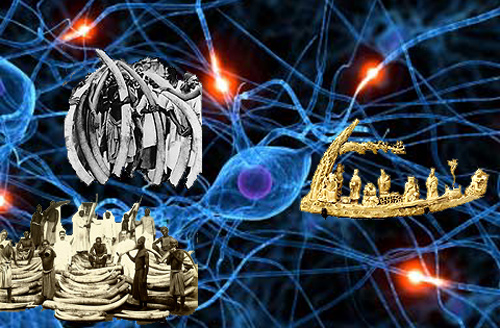
But for years in southern Africa, elephant ivory was a cash cow (or bull, depending). Extremely well run and patrolled parks in southern Africa collected heaps of tusks from elephant that died normally or were intentionally culled. This cache of animal goods, in fact, was for many years the principal source of revenue for the Zimbabwe National Parks.

CITES stopped that. Adjacent to many southern African parks can now be found warehouses of stored elephant tusks and rhino horn. They store it, because some day, they want to sell it. Right now, CITES prevents them from doing so.

CITES came on line powerfully by the end of the 1980s, and shortly thereafter, South Africans began focusing on the promise of forensic science to determine exactly where the ivory came from. South Africans developed some very creative non-genetic, isotopic or chemical methods to determine the origin of confiscated, illegal ivory.

As genetic forensics improved, CITES also did, because both proved so successful. By 2004 South Africans were desperately trying to get the world to use forensic genetics to limit CITES’ reach:

“Being able to track the origin of illicit African elephant ivory could [allow] several southern African countries … to relax the ivory ban because they have stores of ivory and lots of elephants.“

From the getgo few have questioned the southern African claim that they manage poaching well enough. It was known from the early 1980s that the danger to elephants and other big game came mostly from the northern half of the continent.

Why, then, should they be penalized from selling their legitimately harvested ivory and horn?

Because science can’t trump politics. The “free market” however it may be regulated in China is free enough on the global arena.

In 1997, 2000 and again three years ago, CITES caved under the pressure of southern African countries and “carefully” organized the sale of stockpiled ivory in a few highly regulated auctions. Each time the results were stunning:

Poaching increased measurably and substantially.

In other words, once new ivory started trading in Asia legally, black market ivory followed suit.

Although southern African countries aggressively argued that the black market was not related to the auctions, it was a hollow fight. Now, as science progresses, their argument is changing and acquiring greater force:

Genetic science can pinpoint where the ivory comes from. In southern Africans view, there is “legal” ivory and “illegal” ivory, and whether it is at cargo warehouses or jewelers stores, genetic testing devices can separate the legal from illegal trade.

The argument is very similar to the recent argument that appropriate testing can distinguish between legally mined diamonds and blood diamonds. In fact determining the origin of ivory is much easier now with genetic forensics than determining the origin of diamonds.

There’s a very provincial nearly insidious thrust to the southern African argument. I believe in their heart of hearts they know that a market widened by allowing genetic testing to scrutinize increased sales of ivory will ultimately decimate elephant in the north of the continent.

And I believe in their heart of hearts they figure, well that’s OK, we’ll protect them down here. And indeed, they could. So the extinction of the wild elephant might be unlikely… in the south. And to hell with the north. ‘If they can’t get their act together as we have, too bad.’

To be sure it’s a serious sacrifice asking the south to forego legitimate conservation revenue just because the north isn’t as developed as they are. And with the advancements announced of the sort KWS did this month, the south will be ever the more eager to promote its cause.

But it’s the difference between seeing yourself in your narrow little part of the world, and recognizing your role as a global actor.

There’s just no reason that elephant anywhere should be sacrificed to intricate ivory sculptures placed in a glass case. That tradeoff – a living work of art for a dead one – isn’t moral in my view.

There’s little sacrifice to taking the moral road.

Education Needed on This

Education Needed on This

Teacher strikes in Africa and around the world mark a critical point in the global recession.

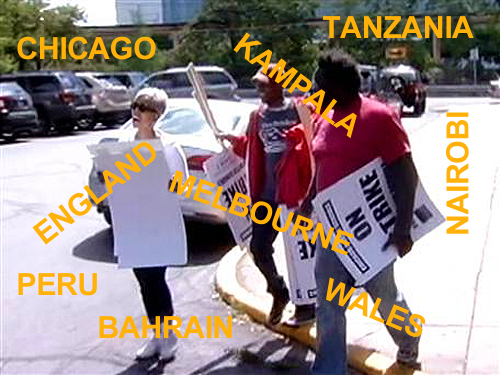
In Kenya the country’s entire educator workforce is on strike, from primary school through university. Last month’s teacher strike in Tanzania has been suspended only temporarily, and in Uganda teachers are poised to walk off the job in the next few weeks.

But there are also actions or looming actions in England and Wales, Australia and of course in my home city of Chicago. Teachers are also threatening work action in Peru and South Africa. Teacher leaders have been jailed in Bahrain which could once again destabilize that city-state.

What’s going on? There’s just too many educator work actions in too many widely different places to suggest anything like coincidence.

The Chicago strike is not about pay; the Kenya strike is about pay; and from the Mideast to Asia the range of issues is as wide as the geography. But in the end it is all about the bottom line. It’s all about the cost of education and the widely presumed notion that it isn’t working well.

I have no idea if education is working well in London or Sydney or Bahrain, and I’m pretty convinced it’s not working as well as it should in Chicago or Nairobi. But actually when you stand back from the globe and look at the turmoil, not even that seems to be the point!

Education is among the last of public services to be hurt by a global recession. When an industrial plant closes, usually a sizeable chunk of the workforce is let go all at once. Not so with education. You can’t close schools wholesale. Instead you inch up the class size, reduce the scope of services and month after month squeeze the teachers for a little bit more.

If the squeeze goes on for long enough it pops. And that’s what’s happening, now.

Conservatives around the world see this as an opportunity to trim excess and improve delivery. Progressives see just the opposite, an attempt to balance a wider social imbalance on an already stressed system.

But that’s not the point of this blog.

When such diverse societies in so many places in the world begin battles with their educators over such a range of issues, it means that globally society is really being stressed to new and maybe dangerous points.

There is a way out of this. And put aside for a minute the enormously different issues from one school system to another across the world. Education distress worldwide is an indicator that in sum the global recession isn’t easing; it’s getting worse.

There are models to turn this around: In France, China, Australia and the U.S., stimulus is being exercised. It’s important to note how different is the extremely conservative politics and society of Australia compared to the socialist politics and society of France; and how different the U.S. and China are in so many ways.

Yet these four countries have all used or are using now stimulus, and they are all much better off than countries like Britain and Peru which have opted for austerity.

The laws of economics trump all other laws.

Many African countries are on the cusp of having to make the decision about stimulus or austerity, because when the developed world tanked into recession, they actually benefited for a few years. Their decisions about stimulus vs. austerity are only now being legislated.

They should take heed carefully. The U.S. did it correctly; Britain did not. If we can get enough of the world to realize this and follow suit, then the education wars won’t be followed by wars in health care, civil and national defense.

Death Becomes Them

Death Becomes Them

There are many different kinds of poaching and some I actually sympathize with. But a particular type of child poaching in Kenya is uniquely tragic.

Poaching is hardly confined to Africa. The legendary boar poachers in my childhood home of Arkansas, or deer poachers in my neighboring state of Wisconsin have fed grand literature as much as poor folks. And it’s hard to jail a man who is trying to do nothing more than feed his family.

And much of African poaching fits into that category. Yes, it’s against the law. And without a corrupt-free justice system fledgling societies will themselves become poached by the rich and powerful.

And sometimes worse, it involves fragile species and ecosystems like mountain gorillas in Rwanda or a rapidly declining lion population in Kenya’s Mara.

But when the poaching is essentially the way a man feeds his family, it’s very hard to pursue the grander mission. A gorilla poacher on Sabyinyo is not going to eat the gorilla, and the single elephant poacher in The Selous is not going to barbecue elephant. But a market of the rich and powerful is eager to convert their loot into potatoes and mash.

Western Kenya is a diverse environment characterized mostly by dwindling wetlands and forests a part of the greater Lake Victoria ecosystem. It is a densely populated and still rural part of East Africa where some of Kenya’s greatest working poor live.

Historically farmed, there are now too many people competing for too little water and nutrient land.

Numerous aid organizations have been trying to lift rural western Kenya out of its abject poverty. A Netherlands NGO, ISCOM, has been working for a number of years to develop rice farming in the area and it’s working. The area’s rice production is increasing and its population is definitely benefitting.

But not quickly enough.

The area’s rich biomass is concentrated mostly in birds. Kenya’s nearby Kakamega Forest is only 17 square miles and has more than 300 species of birds and 400 species of butterflies. This is roughly twice as many species as found where I live in northern Illinois, which is 1500 times larger.

Many of the birds are endangered but more to the point, child poaching of birds is now near epidemic because of the use of easily acquired pesticides used for the area’s agriculture.

Children lay traps for the larger birds like the openbill and other large storks as well as raptors, by lacing the bird’s traditional food source with poison.

It’s like hunting turkey out of season by lacing berries with D-Con.

The new problem, of course, is that these very strong pesticides don’t only kill the bird, but can very easily kill the person who feasts on them, much less directly infect the hasty child that handles them.

The real culprit here is Furadan. I’ve written about Carbofuran, the proper chemical name, before. It’s a deadly and unnecessary American produced and marketed pesticide now banned in the U.S. but laying waste the developing world.

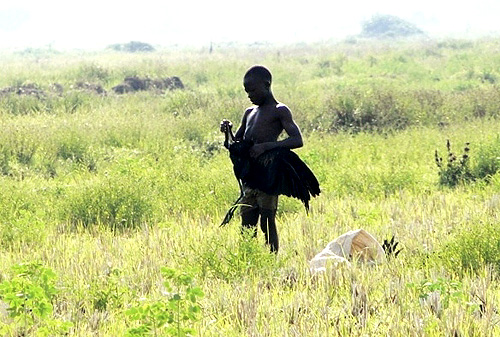
The latest tragedy was reported yesterday by a Kenyan researcher in the Bunyala rice area. It was nonconfrontational. The kid didn’t realize he was doing anything wrong. He carried a large sack with the poached bird and from the picture appears proud to readily display his catch.

The cheap pesticide marketed by American and European companies to Kenya because they can no longer sell it at home is used by the kids to lace rice that lures the birds. But with the openbill stork shown in the photo above, the bird doesn’t usually eat rice. It eats snails.

A 12-year old is not likely to carefully dust only the rice with Furadan. A 12-year old is not likely to make sure the rice doesn’t get wet or fall into the wetlands. Many types of birds are being poisoned in Bunyala by this Darth Vader chemical.

The researcher believes the kids are intentionally sent out by adults as a way for the adults to evade prosecution.

Perhaps. But it may also be a way the adults feed the kids.

Pop Goes the Weasel

Pop Goes the Weasel

The horrible killing of South African miners yesterday is less news than analysis of not just South Africa’s political legacy, but the whole wide world’s.

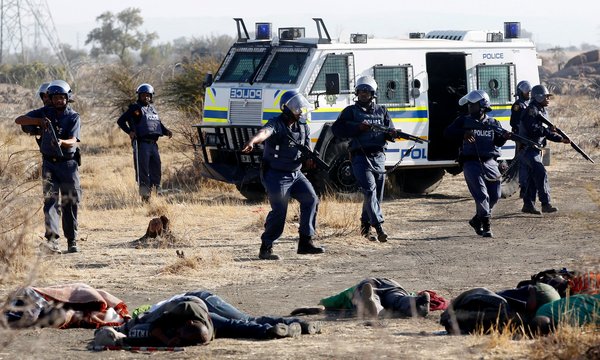
Police conceded that at least 34 admittedly aggressive strikers at a platinum mine in the north of the country were killed when things got out of control. The number is probably higher.

While the protest was ostensibly over wages, the weeks leading to the outburst were more of a battle between two labor organizations, the official union for the mine and a renegade self-styled militant union that is passionately communist.

I use that term with caution but deliberately. Communism in a truer and less autocratic way than adopted by the Soviet Union, for example, has been a significant part of South African politics for more than a century. Its leaders would be considered moderate by the style of historic European communism, more like American communists in the 1920s.

But lately South Africa – and the world – have taken significant right turns, becoming more conservative socially and fiscally. And in many places in the world, such as the U.S. under Bush and a number of European nations under current conservative leadership, it’s been downright dictatorial.

It never seems that way at the time. When America invaded Iraq, my own liberal heroes were behind the invasion. But with time history is revealing what a small number of men, motivated not by facts but ideology, actually made the decision.

It was affirmed by a greater segment of society, but the die had been cast. Society as a whole had neither the guts or power to oppose it. Even our “progressive leaders,” or in the case of South Africa, union leaders appear to capitulate to the rightist dogma.

In South Africa, the mining weasel popped. And it wasn’t pretty Thursday.

Earlier this year South Africa almost nationalized the mines. That, too, is a perennial topic it seems in South Africa, but this time they got closer than ever to doing it, and in fact the renegades have expressly said they hope this violence will make the country revisit the issue.

Nationalization would be a thunderclap in the world. Even as a diehard liberal I think it would be far too serious a jolt. This is because South Africa’s reservoir of gold and other precious minerals is too large. In one fell swoop it would alter the way energy is consumed in the world. Moreover, in South Africa it would empower a currently corrupt political leadership that could be spun out of control with their dizzying new responsibilities.

But nationalization was a real topic because blue collar workers are being shafted, just as they are in the United States, and as they are most of all in places like China. It’s a very hard argument to make, because workers are better off, today, in South Africa and China than they were two decades ago.

At the expense, I might add, of American workers.

But without the long analysis needed (read Chris Hayes’ Twilight of the Elites) the point is not so much that workers are being shafted, but that the capitalistic balloon is busting.

The right side of the balloon is the rich owners radically pulling their salaries and dividends even more to the right. But it can’t be pulled that way without pulling the left side an equal distance “shafting” the poor.

We guys in the middle just tread water and wait for the pop.

South African mine workers aren’t, really, too off-center compared to where they were a decade ago, or compared to many other workers in South Africa, today. But from their central location they see their families over there in the poor left being vastly distanced by the owners and stakeholders getting fabulously rich by the platinum they are pulling out with their hands.

New York Times reporter, Lydia Polgreen, nailed it: “The shooting left a field strewed with bodies and a deepening fault line between the governing African National Congress and a nation that, 18 years after the end of apartheid, is increasingly impatient with deep poverty, rampant unemployment and yawning inequality.”

This is ripe stuff for an explosion. Particularly in a society where workers – especially miners – have a history of activism. It isn’t just that they want higher wages, they’ve actually seen their own country’s politics radically moved by their activism.

The violent confrontation, of course, does not make South Africa’s poor richer. But it did make the rich more poor.

So this isn’t the end of it, folks. Where unions still have some power, like South Africa, there’s going to be more and more labor unrest. Relatively rich countries like South Africa will either ultimately nationalize giant industries like mining, or the global capitalistic gyroscope will reset somehow, reversing the trend of the last half century. The richer will become poorer and the poor will become richer.

I vote for the latter. It will be much less violent.

The Real Terror Within

The Real Terror Within

Terror in travel is a wonderful way for us guides to get our clients into the car on time, and in Africa, snakes seems to be the trick!

In East Africa where I guide there are 42 venomous snakes and every single one is a killer! But now a wonderful assistant professor of biology at Whitman College threatens to diminish my terror trick, but who knows, maybe make snakes a tourist attraction?

Kate Jackson has built the only online database of the snakes of Western and Central Africa. Together with the book completed with venom expert Jean-Philippe Chippaux, it is one of the best field guide toolkits I’ve seen for Africa.

While snakes command the attention of most of us by playing on our abject fear of a miserable death, Jackson’s motivations are considerably more noble. To begin with she is a living example that even the so-called “deadliest” snakes are less so than thought. She herself, has survived cobra and other snake bites.

Snake venom, like honey bee or yellow jacket stings, have a huge variant effect in humans. Generally much more powerful than an insect bite, and always after an agonizing hospitalization, venomous snake bites immediately treated correctly generally don’t kill the victim.

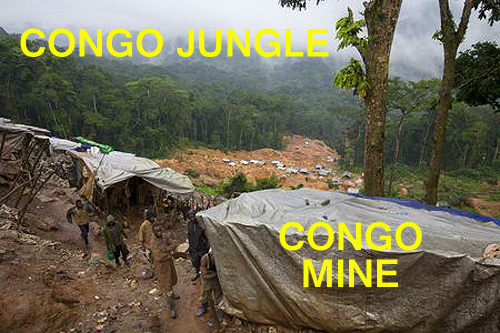
But Jackson’s motivation for exploring the Congo goes way beyond the terror of a snake: “I went to the Congo to try and protect the amphibians and reptiles from the mining.” And in so doing, of course, she will protect humans and their virgin wilderness from mining as well.

The lust for Africa’s natural resources is becoming desperate. (See my blog, yesterday, about Zambian mine workers murdering their Chinese manager.)

In the “green issue” recently published by Whitman’s college online magazine Edward Weinman reported that the Wildlife Conservation Society (WCS) invited Jackson to The Congo to explore a huge area of the west near the Gabon border scheduled for massive mining.

This is something so hard for me to imagine. I was there nearly 20 years ago, looking for lowland gorillas. It was one of the hardest, most extensive expeditions I’ve ever undertaken, and the beauty and intensity of the forest was forever memorable. The notion that this area has so transformed, or will be so transformed, that it will be raped of this pristine character is mind-boggling.

Two mining consortiums, mostly British Zanaga, and Swiss Xtrata have formed a monopoly to mine this area. Both have directors closely linked to the world’s biggest mining company, Rio Tinto. This is clearly considered one of Africa’s most potential areas for mining, and the list of ore goes well beyond coal to diamonds and rare earths.

If left unchecked this mining consortium will wipe away some of the most virgin and pristine areas left in Africa.

Jackson’s work for the WCS is clever and very political. Many mining projects in Africa get their start from the World Bank. They don’t need to, because the mining consortium like the one described above can command capital larger than the Bank can for a given project.

But the Bank overseas so much more than just mineral extraction in developing countries like The Congo. It works closely with the IMF and other UN agencies for local development projects that specific industry companies have no interest in … like hospitals and schools and dams and sustainable agricultural and water projects.

The WCS has a long and successful history of delicately going into a given area designated for mining, doing what we would call here at home an EPA study, and then convincing the World Bank and IMF that wholescale development would be an environmental catastrophe.

The pressure that the Bank can then effect on the country, and its partnership with many other agencies necessary in that country’s development, can force the mining consortiums to compromise in vital ways.

In this particular case, Jackson explains, “We documented the myriad species thriving in this virgin wilderness, not as a means to stop all development, but to instead bargain for a land swap.”

It sounds like Jackson’s work, and those of other scientists, may be successful in protecting a huge area of the Congo from any future development whatever by designating it a national park, in return for a smaller piece given to the mining consortium.

The conflicts in Africa are often much more than just the wars you hear about, or the increasing effects of global warming. They are these more complex issues as well: the Congo will benefit enormously from the mining extraction. It’s hard to argue against this.

But with help from people like Jackson, we might simultaneously be able to preserve just a little bit more of natural Africa from the real terror confronting us: losing the wilderness.

Development for What

Development for What

Rising conflicts between Chinese and Africans in Zambia and Malawi demonstrate that the Chinese do-anything desperation for Africa’s natural resources may be backfiring.

In 2009 China surpassed all other nations to become Africa’s leading trading partner. It is likely the continent’s biggest aid donor as well, although western institutions rating aid argue that the quid-pro-quo of Chinese aid moves it from the category of aid to investment.

I sat recently with three young Chinese men, probably still in their teens or early twenties, as we all waited for a delayed flight from Nairobi to Kampala. Our inability to communicate well was mitigated by the long delay. One of the fascinating things I learned from them was that they were not just excited about their upcoming work gig in Uganda, they were emigrating there!

They held one-way airline tickets from a Chinese construction company, jobs to build a highway in western Uganda, undoubtedly enough sudden cash that together they had just purchased a laptop in duty free, and … no intention to ever return home.

The rest was left to my speculation, but it seemed pretty clear to me that after their contract with the construction company ended, they would set down roots in Uganda and spend the rest of their lives there.

This is hardly new. It is exactly what the British did when they built the East African colony’s infrastructure in the mid 19th Century, except that they imported Indians rather than Scots. At the end of various construction projects, the Indians set down roots and today are as much Kenyan or Tanzanian as a Kikuyu.

The initial motives were identical as well. The British East African Trading Company was proudly a profit-making business which intended to extract as much as it could out of East Africa for the benefit of England. Chinese today are desperate for the natural resources necessary to power its society, lacking in China and flush in Africa.

Later Livingstone’s moral imperatives got entangled in British colonial development, but until that historical point the two capitalistic paths are identical.

What’s different, today, is that social authority derived of a growing embrace of self-determination, and the importance of human rights, are much different than two centuries ago. The British model of buying out local chiefs with bags of beads is quite similar to what the Economist calls “oil for infrastructure.” But the willingness of the local people to enter the deal is much more restrained.

Last week this restraint blew a threshold in Zambia and Malawi.

Mine workers staged a violent protest against their Chinese manager/owners. The Chinese have yet to mature beyond the desperation of need, and many are ruthless paymasters particularly when it comes to mining.

Last year Human Rights Watch documented increasing labor abuse by Chinese managing Zambia’s copper mines. Last week it came to a head when workers struck one mine and then battled security personnel and police, killing one of the principal Chinese managers.

In neighboring Malawi, what appears to be nothing less than a xenophobic vendetta against small Chinese business owners began last week. The government policy will essentially close down hundreds of small, local Chinese businesses in Malawi, developed I presume like the three guys I met waiting for the flight to Kampala want to eventually do in Uganda.

And in a stark 180-degree difference between the British colonial era, the Chinese ambassador to Malawi more or less endorsed the Malawian government’s move. There is little connection left between the homeland and the Chinaman who moved away.

In Dakar last week, Hillary Clinton remarked on these growing tensions and argued rather well that Chinese policy won’t work. “The days of having outsiders come and extract the wealth of Africa for themselves, leaving nothing or very little behind, should be over in the 21st century,” she said.

“Throughout my trip across Africa this week, I will be talking about what that means – about a model of sustainable partnership that adds value, rather than extracts it,” she added.

I’m not sure. I’m sure that Hillary’s admonition is correct, and that the right and moral way for a developed society to act toward a developing one is not the Chinese model. On the other hand, I’m not sure the American model is all that much better. Our “aid” to Africa is fickle, up with Democrats and way down with Republicans. All that Africa is left with is confusion and a certainty that American constancy doesn’t exist.

Africa needs infrastructure desperately. China needs oil desperately. There’s great constancy in that.

Delectably Invasive

Delectably Invasive

Banned from the U.S. after a recently very expensive eradication program in Florida the Giant African Land Snail is on the return. From the bucolic gardens of Budapest to the Westwood dinnerware of the Upper East Side.

The Giant African Land Snail (Archatina mariginata) is one of the most successful creatures in the animal kingdom. There are more than 50 species and they’re all huge. The largest recorded weighs just under a pound and when stretched out underneath its relatively light shell can extend to nearly a foot.

The great irony about land snails in general is that the vast majority of them are considered pests and many of them are classified as invasive by state agricultural authorities. Yet in an upscale San Francisco restaurant you will probably pay $2 per each of a Helix aspersa in garlic butter.

(In Paris, they’re flesh. I mean fresh.)

Although connoisseurs differ on which snail tastes best, most chefs agree that one fresh snail tastes just about the same as another fresh snail. True, little round ones in shiny black bubble cups are more appetizing than the great giant African land snail stewing in its canister, but they are all fat-free and chocked full of useful vitamins like A and D.

In fact it is the eastern European world which has currently gone snails over ape. Slimy rare animal dealers seem to be headquartered in Budapest, but much of the former Soviet Union has few prohibitions about raising or marketing animals.

Much of the social networking community is linked with slime. There seems to be something very special that really sticks these folks together.

In Africa they aren’t cultivated as pets, yet. They are basically just consumed. And responsible NGOs are using snail’s fast breeding, longevity and adaptability to develop snail farms not just to commercialize a practice that has been traditional for generations in the forest peripheries of Africa, but to provide places like California with their banned substance to eat.

So it’s really not a joke. At an average of over $75/pound when served properly dead, can’t you imagine Whole Foods offering a snail loin special?