Nice Nairobi

Nice Nairobi

There is no more simple example of the battle between development and wilderness than a highway. Friday the wilderness won in Nairobi.

Following the successful world-wide opposition to the Serengeti Highway project several years ago, last week’s remarkable effort by local conservationists in Kenya to stop the proposed highway through Nairobi National Park seems particularly exceptional.

This because it was almost entirely local. A combined effort from a number of local wildlife organizations and a few prominent conservation crusaders like Dr. Paula Kahumbu successfully battled several Kenyan agencies that had approved the start of the highway.

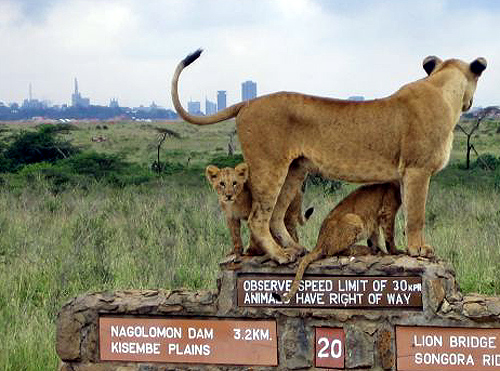
Nairobi National Park is an incredibly tiny wilderness that borders one of Africa’s largest and most sprawling cities. The battle to save it over the years has been one of those you think of as lost causes.

Birders never deserted the 40-square miles of grasslands bordered by the Athi River but many big animal enthusiasts did, particularly during droughts.

It just seemed ridiculously pointless to try to preserve a wilderness literally bordering a city that was growing so fast you can hardly move inside it, anymore. A few weeks ago I blogged about the lions that were disrupting traffic!

But I guess that should have been our glimpse into how things were going. Lions? At the edge of a city? Blocking traffic?

Before we get too ecstatic and believe that the natural order of things will always prevail, it’s important to note the judges’ decision to void the Kenyan Highway Authorities plan was also heavily based on the fact it appeared the highway was going to built too close to Nairobi’s second airport, Wilson, violating other agency regulations.

Nevertheless, the wording of the judgment and the invitation by the tribunal that the numerous wildlife authorities bringing the complaint can petition for legal cost reimbursement, suggests it might have been stopped even without this infringement on Wilson airport.

Another remarkable facet to this story is that the judge tribunal was not one in the main judicial arena, but from “NET,” the National Environmental Tribunal. Think of this as Kenya’s EPA, but it has wider judicial powers. While its ruling could be appealed to a higher court, it can’t be sued like the EPA can.

The problem is that Nairobi’s become too big. No one dare suggest a population count, despite a recent census, because the seven slums that surround the city (parts of one which actually abut the national park) make such counts so inaccurate. But many city planners are using something around 5 million.

That makes it seem tiny when compared to Shanghai or Mexico City, but given the fact it has doubled its size in less than a decade gives city planners serious concern.

And no more obvious concern than driving to work. Or for that matter, a tourist driving from the airport. Please note: Do Not Arrive Nairobi on a weekday morning, unless you don’t mind a two-hour commute over about eight miles.

One wonders what type of people can tolerate such nerve-wracking oppression? But that’s been the wonder about Africa for centuries. Once slavery. Now traffic congestion.

But above all this tale should remind us that the most powerful advocates for preserving Africa … are Africans.

Too Much To Whom?

Too Much To Whom?

Less than three short years from the Arab Spring, ethnic domination and conflict is growing throughout Africa. Capitalism may be the culprit.

I once felt that education alone could ameliorate racism, but as demonstrated especially in places like Syria, Egypt and Rwanda, that’s not proving true. At least not when that education has occurred over fewer than several generations.

Few countries in Africa have been beset by ethnic turbulence to the extent of Rwanda, and fewer still have enjoyed such rapid prosperity in my life time. The guilt that America and France felt for having allowed the 1994 genocide was followed by such enormous amounts of aid that almost all the country, today, looks very similar to a successful western society.

Unlike the rural areas where my mother lives in Wisconsin, similar rural areas in Rwanda have fiber optic cable and access to high speed internet. The system of roads now rivals both in extent and quality that of places in rural Europe.

While the number of actual doctors is relatively low in Rwanda, the level of health service is high for an African country, as heady social services planners recognize that most of the diseases prevalent in Africa are best handled by nurses and health clinics rather than hospitals.

So as Rwanda’s ostensible peace and prosperity grows, many of its African neighbors find it increasingly difficult to plan policy based on Rwanda’s past of ethnic turbulence. South Africa announced recently, for example, that Rwandans who were given exile in the 1990s must now return.

Even the richest of African countries like South Africa feels a conflict when its national resources are used by foreign nationals. But the Rwandan exiles in South Africa are terrified of the prospect of returning home.

I am the child of second generation immigrants who spent their lives inside their own ethnic communities, and while my parents’ generation intermarried, usually one or the other parent infused us children with a certain ethnic identity. I think this is true for much of America.

And now, as a fourth generation of melded cultures, my childrens’ generation seems truly ethnic free. So it is reasonable to wonder if that’s the magic number: four generations of ethnic melding to emerge from racism.

Yet Rwanda stands as the example this is not true. The Hutus and Tutsis have intermarried for so many generations over hundreds of years, that their language has become the same. But there is arguably no ethnicity in the world that remains as hateful and separating.

The Alewites and Christians of Syria have been the persecuted for centuries, until somehow the Alewites imposed control on a region where albeit they remain a minority, they are free of their persecution. Conflict as open battle was reduced in Syria, but at the cost of many freedoms like speech and political opposition.

Compared to Rwanda, the South African ethnic problems remain in infancy, even though they were forged more than two centuries ago and reenforced throughout the modern era. Then, presto in 1993, a political system emerged that based upon its constitution remains one of the most just and fair on earth.

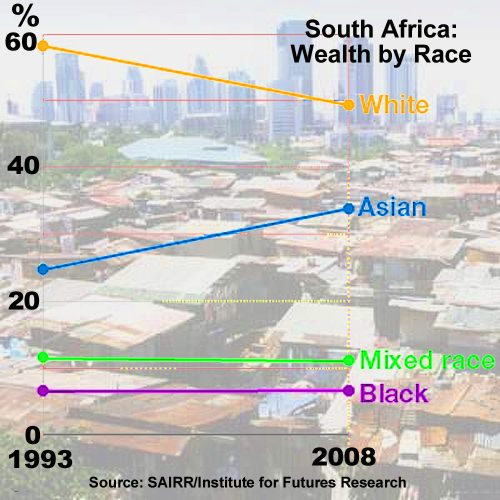
But a generation has nearly passed since then, and basic economic inequity has not improved for the majority. There has been interesting change: the two groups of South Africans that have always held most of the financial worth, the whites and the Asians, seem to be trading places.

But the vast majority of South Africans remain stalled out at the bottom. Now it’s important to add that the overall level of all sublevels has improved. There is more wealth all around, but the relationship of the ethnic groups at the bottom hasn’t changed to those at the top, even though it is the bottom group which holds political power.

It seems to me that there is something world-wide that ensures a status quo of racism defined by ethnic domination of politics and/or economies. And South Africa is the place to study this mystery, because this is precisely where the lowest economic classes hold the most political power.

And lo and behold, similarly in America, the middle class holds political power, yet it is mired in stagnation. In America, today, economic classes are acting as if they are ethnic groups.

And in both South Africa and America, political power has not ensured economic progress.

Africa is growing rapidly in economic terms… as its ethnic travails increase. America’s ethnic travails are diminishing, but it’s economic stratification grows stronger and more inequitable.

Is this, then, the universal relation? Capitalism is racism?

little screen America, Big Screen Africa

little screen America, Big Screen Africa

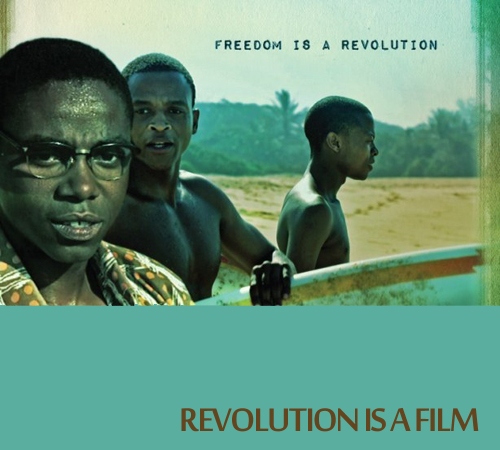
African films are exploding onto the Cannes Film Festival, opening Wednesday, as youthful African societies continue to develop this important art which is being so grossly neglected in America.

The decline in the American film industry is today’s hot topic, but I think everyone’s got it wrong. The emphasis has been on America’s growing and exciting new hand-held technologies and all the products that support them like YouTube.

Undoubtedly that has much to do with it, but I think more so it has to do with the American film industry transforming itself into making money in malls from teenagers.

There’s nothing wrong about making money. And there’s nothing wrong with malls. There’s only a little wrong with teenagers.

Film-making provides the modern world with the best way to transform imagination into reality: it’s the conduit, not the transformer. It’s the best catalyst. Nothing better.

So when that focus is placed on vampire love stories the powerful conduit is twisted towards another universe, not ours. It’s no longer relevant to our reality, and in that instance, it loses almost entirely its preeminence as an art form. Its value becomes dollars and sense, little else.

Africa is stepping into this remarkable void left by the American film industry.

This week in Cannes there is a massive representation of South African films, an excellent collection of Nigerian films and especially Nigerian writers, and from my point of view, the best dose of creativity the world’s seen for some time from Kenya.

Real stories playing into real rapidly changing worlds are American films like Hugo, Midnight in Paris, Lincoln, and Avatar – among my favorite recent American movies.

But they are so few and far between.

Nairobi Half Life and The First Grader are recent Kenyan films produced on a pittance of the budget of a single episode of American Rival, create through the Grecian act of acting and the majesty of writing stories a real and lasting impact on the world.

Madagascar 3 doesn’t do that. Nor do the Terminators or apocalypses or thousands of cars flying into the Grand Canyon. And certainly not vampires.

Good films, and by that I mean films with value to society, films that contribute to art and not just livelihoods, convey moral messages in realistic characters, characters that if we can’t identify with ourselves we can through someone we know well.

And here are several important reasons Africa is displacing America in the film industry:

Of the 150 South African filmmakers attending Cannes this year with some sort of accepted entry into the festival, twelve of them were penniless before sponsorship by the South African government.

That’s right, government involvement. Government is a reflection of society; it’s usually in the forefront – good or bad – of society’s extravagances. Without government involvement many of the best films from Canada and France would never have been made.

Two: African films fuel controversy: they take a point of view and proudly so and at the peril of failure. They dare to retell history, like Lincoln did in America recently. But Lincoln is the exception. Otello Burning is the mainstay of South Africa’s brilliant film industry.

Third and most importantly, film at its best is art. Film in America is business. Shortly before he died, Roger Ebert said this better than anyone.

Africa is developing film as art. It learned how from America. But today business eats art in America. Let’s hope the other side of the world documents this carnage rather than chooses to partake.

Outside Threats

Outside Threats

Yesterday’s deadly grenade attack in Arusha isn’t simply an indication of escalating religious tensions in Tanzania, but of the same escalating individual malevolence evident in the Boston massacre.

In neither incident do I believe there is any kind of organized group involvement, despite FOX News, Representative Stephen King or the other crazies on Meet the Press yesterday. Both cases seem to me to be engineered and implemented by wayward souls.

Wayward souls that have access in Boston to deadly technologies from Google searches. Wayward souls in Arusha who can trade a bushel of tomatoes for a grenade at practically any market in Africa.

It’s all the same. Neither is worse or more terrifying than the other. The higher tech move by the Boston duo was more deadly, just because American society is more sophisticated than Tanzanian.

Escalating religious and ideological tensions in America and Tanzania have been evident for years, and I agree with Arusha’s MP Godbless Lema that governments need to proactively address the schisms growing in their societies:

“”Religious fundamentalism is a reality in this country, but the government does nothing,” Lema said angrily outside the church, as police cordoned off the area.

Lema is one of the few honest, aggressive stars of Tanzanian politics. Like the minority of American politicians who want to address the Boston massacre with better schools and counseling and more jobs, rather than creating more fictitious global enemies, Lema knows the media speculation of the cause is absurd.

The ideologically bankrupt in a society will always point to the outside to explain a cancer within.

Since colonial times Tanzania has been one of the most Catholic countries of Africa, a product of King Leopold’s mid 19th Century conference that divided the colonial African world up by religion, so that missionaries didn’t duplicate their work.

One of the greatest historical ironies of Africa was that during the socialist policies of early independent Tanzanian in the 1970s to be a member of the Tanzanian communist party you also had to be a Catholic.

The amalgamation of Zanzibar with mainland Tanganyika in 1964 was like mixing holy water with myrrh. Since time immemorial Zanzibar was ruled by the radical Islamists of Oman, and even though it’s been given considerable autonomy, tensions have never fully eased with the mostly Christian mainland.

In October a respected Sheik in Arusha was hospitalized after an explosive device was set in his home. That was followed by church bombings in Zanzibar.

And so the cycle goes on and on, individual anger and want having found a convenient battle.

The Tanzanian government today arrested five Saudis, conveniently of a Muslim sect that is mostly disliked in Zanzibar, and charged them with terrorism.

Absurd, of course. This was the same Tanzanian government who employs the Arusha police commissioner who took 2½ hours to get to the church that was bombed Sunday morning, a half hour after the Vatican’s emissary attending the ceremony had been whisked out of the country.

The Honorable Lema is right. Governments do little today, in either America or Tanzania, to mend social schisms. Let’s just blame outsiders.

Unusual Risks in Africa

Unusual Risks in Africa

Investors in new shopping malls for Kenya and Nigeria are expecting a first-year return of 12% and a long-term return of 25%, led by savy South African banks.

Business plans for Africa have always astounded Americans. I’m mostly familiar with the tourism sector, and ROIs (return-on-investments) of less than a third are not considered worth the risk. And the risk is substantial.

And the risk hasn’t for a long time been either political or health, which is what most noninvestors think. Those types of risks have diminished regularly over the years, because of two radically different trends.

The first is simple: Africa is developing. It was never banished to the dustbin of underdevelopment, forever. Roads, schools, factories, hospitals, cinemas, community infrastructure – they have all developed at a faster clip over the last generation than was ever the case when the developing world was getting built.

The second is intriguing: businessmen like tourists have become increasingly immune and enured to politics, even violent politics. With the notable exception of global bad guys like al-Qaeda, turbulent societies somehow manage to court – not scare away – businessmen and tourists.

Egypt is the best example. That society is currently in literal upheaval, yet there were more than 8 million tourists there last year, and “tourist incidents” in Egypt have been fewer since the revolution than prior to the revolution.

It seems that both sides in a local fight have increasingly recognized the importance of foreign tourists and investment.

So what is the main risk, then?

That you’ll come up with something successful. Yes exactly: that your investment begins to pay off.

This totally counter-intuitive notion is what lays bare most poorly prepared investors in Africa. The African playing field is so small by comparison with the home turf from which most investors come, that the amount of investment is usually quite modest.

And that means if you hit on something great, there are lots of bigger guys watching from behind, and they’ll swoop down the moment those high returns actually come in.

And this is inevitably what’s happened over the last generation. A relatively small investor builds a lovely little lodge aside a national park, and the moment there’s positive cash flow, a South African tourism chain eats it up.

Now there’s nothing particularly wrong with this if the investor’s game is to make a little bit of money. And it works specially well for small investments, especially as I described above with small tourism ventures.

But the problem is that while the indicator for a tourism investment is positive cash flow, that doesn’t immediately translate into high return. The originator needs to have the fortitude if foresight to wait for that high return, but the temptation offered by the big guys is often considered just too much to pass up.

African investors’ greatest risk is that they don’t wait for that high return. And it’s often not “won’t wait” but more realistically “can’t wait.” Rarely does a single investor create something wholly unique.

There are lots of tourists lodges being built. Lots of shopping malls. Lots of gas stations. Lots of plumbing fixtures.

If you don’t take the offer the big guy gives you, he’ll buy up your competitors and smother you.

There’s nothing novel in this dilemma. What’s different in Africa is that the quantitative size difference between the Joe who took the first step and his buy-outer is massive. All the leverage is with the big guys.

It’s a simple equation derived of the modern truism that the rich have become richer as the poor have become poorer.

In 2009 Chinese investment in Africa exceeded the U.S.’ By the end of this year, Chinese investment in Africa will exceed the combined investment of Europe and the U.S.

And we’re more afraid of a terrorist attack?

Man vs Beast … Again

Man vs Beast … Again

Invisible fences for pet dogs are common in the U.S., but they’re used with opposite purpose in Africa: to keep the unwanted out.

Africa’s big game parks are mostly huge tracts of uninhabited wilderness but increasingly sophisticated agriculture and ranching impinges on many of the borders. There is the obvious social/political human/animal paradigm to work out, and it is becoming contentious.

But to the extent the wild game parks are to be preserved, there’s always been an easy, inexpensive way to demarcate Africa’s national reserves and make them nearly impenetrable by outsiders.

These “invisible fences” are not manufactured like an American dog collar, although they’re often easily manipulated, and they have kept nicely divided wild animals from domestic stock and farmers for generations.

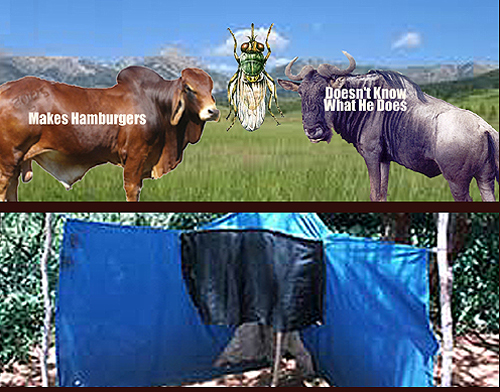
The best known of these is the tsetse fly. Tsetse no longer transmit human sleeping sickness but they continue to carry bovine sleeping sickness. Wild animals are immune to it; cows, sheep, goats and horses aren’t.

(Recent genetic research identified the specific gene that makes domestic stock susceptible to tsetse, but Africa is a long way from creating a practical therapy for domestic stock based on this.)

Tsetse must carry a kamikaze gene, because they’re easily fooled into killing themselves. Simple fabric traps of alternating blue and black, and sometimes white added, layered with pesticide is a certain end to tsetse wherever the trap is laid.

Strategically placing these traps produces an invisible fence. Lodges, camps and ranger stations in wild areas mark their perimeter this way, becoming tsetse free.

In fact tsetse could easily be eradicated completely this way, but park authorities don’t want to do this. That would also eradicate the invisible fence.

Hoof-and-mouth disease, as well as anthrax, are incomplete natural fences. Wild animals do succumb to them, but not as readily as domestic stock.

That was why Botswana authorities in the 1980s began erecting elaborate electric fences and moats to separate the wild from domestic lands. The project is considered successful since it safeguards Botswana very important cattle industry. But it does so at the expense of about a third of its wild animal population.

But until now there was one other disease that was a certain invisible fence between many of Africa’s great herbivores like wildebeest and domestic stock: a virus known as the “Malignant Catarrhal Fever Virus” (MCF).

This herpes-type MCF is a world-wide virus of significant concern to ranchers, and it’s been long studied. The developed world learned that sheep carry the disease very much like wildebeest without easily succumbing to it, but that sheep readily transmit the disease to cows, which then fall quickly.

So strategies for dividing sheep from cows employed aggressively in the 1950s led throughout the developed world to a managed situation where MCF wasn’t eradicated but didn’t cause a lot of trouble.

But it’s different, today, in Africa. The wildebeest population is rife with MCF. In fact nearly every female wildebeest tested carries it. There are many ways the disease can spread, including a slight risk through airborne transmission, but the principal way seems to be when the female wildebeest calves.

The birthing fluid lost in calving is saturated with the virus. When the herd moves on, the ground retains the virus for a very long time. There is even a suggestion that new grass which subsequently grows in the area contains the virus.

In the old days, when there was less developed agriculture in Tanzania, ranchers “would migrate with their livestock elsewhere because there was still ample land, but now there is nowhere to go,” Dr. Moses ole Nasselle told the Tanzania Daily News this week.

Ole Nasselle leads a team of professionals in the Serengeti ecosystem that announced Monday they had produced a vaccine against MCF.

The competition for land is intense in Africa. One of those playing fields is the continent’s great national parkland.

This week, advantage ranchers.

DisMobius Engagement

DisMobius Engagement

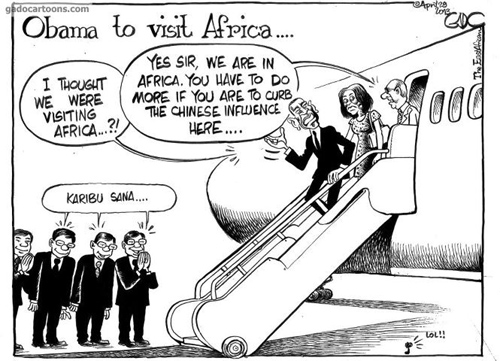
Last night a prominent African businessman chastised Obama for “disengaging” from Africa, even as American military involvement grows ominously large.

Obama as reflecting the “United States” is a curious shadow box of a troubled society. Are we (is Obama?) pulling inwards, constrained (perhaps by Congress?) to few good acts except our own security?

Yes to the first question, and the answer to the second question doesn’t matter.

“We are witnessing a gradual and continuous U.S. retreat from Africa,” Dr. Mo Ibrahim said last night in an acceptance speech for an award from an organization heavily funded by Obama’s Nobel Peace Prize winnings.

“I take the expansion of [AFRICOM] and the growing U.S. military presence sort of creeping down into sub-Saharan Africa as a further continuation” of American militarism, claimed Andrew Bacevich at the Carnegie Council last week.

Dr. Ibrahim is one of Africa’s richest men, commonly known as the “Father of Africa’s Mobile Phones.” Bacevich is a highly respected analyst, author of “The New American Militarism.”

“There is no question that Africa is moving forward,” Ibrahim continued, pointing out the extraordinary GDP growth of the continent, even through the global recession.

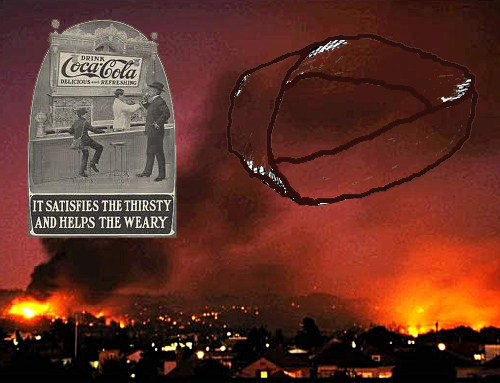
“ Everywhere in Africa you see Indian, Chinese, Brazilian businesses,” he said. But no American business except Coca Cola. Africans as a result are beginning to feel a bit uneasy about the United States.”

Read: “suspicious”

Note that Ibrahim didn’t include Europe in the panoply of foreign businesses racing into Africa, and Europe like America is in the forefront of the current global financial earthquake. I think it fair to include Europe in this analysis; it’s not just Obama, not just America, but the traditional developed world.

Which is turning inwards and becoming militaristic obsessed only with its own security.

That’s a very dangerous path to cut. It doesn’t work. It makes things worse: Look at Chris Hayes’ MSNBC show last night: click here.

In his book and his speech, Bacevich recognizes 9/11 as when America (“developed world” including Europe) pivoted from grand economic and social engagements with the rest of the world to become militaristic.

“The George W. Bush administration tacitly acknowledged as much in describing its global campaign against terror as ‘a conflict likely to last decades’ by promulgating the doctrine of preventive war,” Bacevich explains.

The doctrine of preventive war, as much a social upheaval and resource greedy policy as The Monroe Doctrine was nearly two centuries years ago, has consumed America. And it has consumed America just after American bankers and immoral financial trainers consumed society with the 2008 depression. We’re sort of on a mobius strip of unstoppable self-destruction.

Several weeks ago France conceded that its short several week involvement in Mali will likely extend to years. Remind you of something? Mission accomplished?

“… the violent pursuit of violent Islamists continues with no end in sight,” Bacevich laments.

I don’t think this policy of ‘the violent pursuit of violent Islamists’ would be quite as controversial if we didn’t have domestic flight delays, sinking education, wholly stalled government, and a basic social ennui that clearly now even extends to our private sector.

We define ourselves principally in “private sector”-speak. Capitalism cannot survive in today’s global economy, unless it’s global.

The world is moving on, and a lot of that movement is in Africa. There’s nothing very surprising about this. It was the fertile, untilled economic continent, and it’s now being tilled. By Brazil. By India. By China.

By the new economic bullies on the block.

But America sits idle. American businesses won’t invest, at home or abroad. America is consumed by its own terrorized concern that it is marked for doom.

It is. By itself.

Killing Two Birds with A Bird

Killing Two Birds with A Bird

The great rice fields of western Kenya are ready for harvest. But the battle that will determine who eats the rice is only now playing out. It’s man versus bird, and the rules of engagement are not pretty.

This is such a perfect example of the folly of man trying to tinker with nature. I’ve seen it play out time and again in America mostly by campaigns against “invasive species” which have essentially proved laughably unsuccessful.

But a time comes when human society gets itself properly organized and funded, to do such things as eradicating malaria, and then the consequences are considerable:

The eradication of malaria, typhus and other mosquito vector human diseases was successfully accomplished in America by the end of World War II through the use of DDT. The ramifications of that continue.

We all know about the near extinction of the bald eagle, and how DDT so weakened the outer shells of bird eggs that many species were threatened. But the effect on the environment was much greater than just an effect on avifauna. Scientists continue to argue, today, that DDT is a carcinogen that effects a wide range of species, and will do so for centuries.

But it did succeed in accomplishing its mission. Although there’s some concern malaria could reappear in America, today, because of global warming, certainly we can conclude that America has been essentially malaria-free since the 1950s.

So it is a cost-benefit argument. Today, most African governments argue that DDT should be allowed greater use than current world treaties allow. Today the use of DDT in Africa “within confined buildings” is allowed, but the widespread spraying that effectively ended malaria in the U.S. outdoors is prohibited.

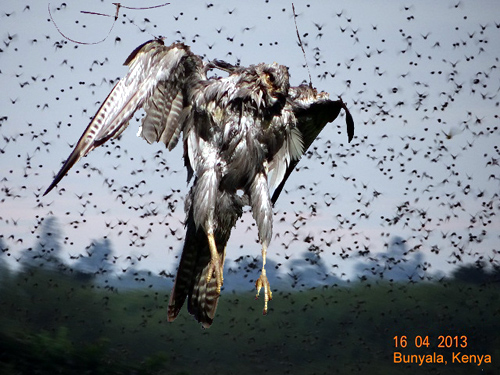
This weekend a conservation organization working in western Kenya reported that the raptors it works to protect were being poached then preserved as scarecrows in order to protect rice fields from a pestilent bird, the quelea.

An important UN agency calls quelea “Africa’s most hated bird.”

The small, sparrow-like creature lives in enormous flocks. On my last safari about a month ago we encountered them just as they began to nest in Tarangire National Park. It’s as thrilling a sight as spotting a leopard in a tree.

The “mumuration“ of quelea is not unique. Many birds do this, though most simply as a precursor to mass migration. The quelea does it … to eat.

The dark clouds of quelea descend on farmer’s fields more powerfully than locusts, and a 10-acre rice field can be laid bare in an hour.

Consistent with nature’s laws, as more and more farms in Africa concentrate grain production like rice and wheat, and as the equatorial regions of Africa get wetter with global warming and these fields grow larger…

…so do the flocks of quelea.

Farmers in western Kenya have found a deterrent they like. Poach a raptor that eats quelea, and hang it in the field preserved.

A live raptor makes a kill and is satisfied for a whole day. Its effect on mumuration is short. A scarecrow raptor – at least so far – produces a longer effect.

Of course there’s no reason not to believe the quelea will pretty quickly learn how they’ve been tricked. But for the time being, it seems to work.

And so … raptors are now threatened. And the easiest way to kill a raptor today in western Kenya is with the easily obtained, relatively inexpensive and terrifying pesticide, Furadan. I’ve written about this scourge in western Kenya, before.

It’s particularly aggravating because the drug is American made and marketed, but banned here in the U.S. That’s a global disconnect I feel verges on racism.

Because we’re using Kenya as an experiment, again. Just as we do for human medical drugs. As if this is a dispensable part of god’s kingdom.

My greater point, though, is that it won’t work. Nature can’t be bullied. We can’t tinker with nature, whether it’s trying to remove garlic mustard from prairies or kudzu from highways or curing bees of a virus or massacring deer to end CWD.

It doesn’t work. It never has.

We must learn in this world to accommodate nature not try to control it. I don’t for a minute suggest we shouldn’t battle locusts over millet fields in Senegal or quelea over rice fields in Bunyala.

But the battle must be with nature’s own. An organic battle, if you will. Or at the very least a much more highly regulated pesticide industry: Pesticide use today is out of control and dangerous to humankind. Furadan is devil’s brew.

And Bunyala is no less important than Iowa.

Techtonic in Nature

Techtonic in Nature

Separate but Equal: A chilling phrase used throughout history to justify such barbaric ideas as apartheid and reenforce the power of the status quo has now been applied to African wilderness in an attempt to save lions. It’s more naive than offensive.

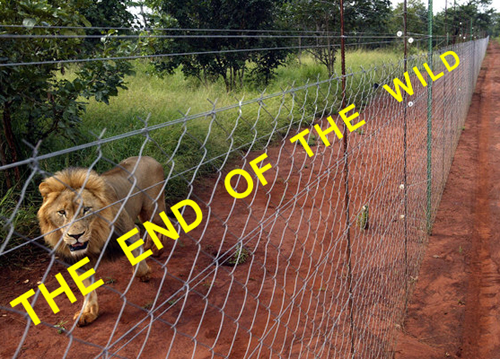
Sorry to be such a drag on your week, but when the world’s greatest carnivore scientists conclude that the only way to maintain healthy populations of wild lions is to fence them, somebody’s got to remind them that then they’re no longer wild.

One of the greatest field researchers ever, Dr. Craig Packer of the University of Minnesota, led a team of 46 researchers that published this succinct and piercing recommendation earlier this month.

Lion populations have been declining for some time, and the study confirmed many earlier studies and reports that the decline is directly linked to lion/human population conflicts.

(There are, by the way, too many big cats in zoos.)

The March publication in Ecology Letters Online will become the definitive treatise on lion declines. Its cram-packed data is perfectly if masterfully compiled leading to a vastly understated conclusion that is tectonic in nature:

Fences.

The study acknowledges “fencing has so far only been widely employed in a few African countries because of aesthetic objections, financial costs and the impracticality of enclosing large-scale migratory ungulate populations.”

Presuming the local African has serious “aesthetic objections” to fencing strikes me if not racist patently patronizing, so let’s move on:

Packer et al conclude that it would cost $2000 per square km to preserve lion at about half their potential densities in the wild unfenced, as compared to about $500 per square km to sustain populations at 80% of their “wild” potential fenced.

This means it would cost about $30 million to fence Tanzania’s largest reserve, The Selous, and then an additional $22 million annually to manage that fencing.

In a cash strapped and aid-dependent economy, these numbers are mind boggling. I don’t doubt their veracity but when compared with the needs of human villages in the same areas in which lions now thrive, there is no chance this will be embraced locally.

That defaults the solution to foreign donors.

How do lions rank in the following list of priorities?

Water, Food, Electricity, Sanitation, Health, Education not to mention anti-poverty.

Finally, it isn’t just wildebeest or elephant migrations that are essential to the wild as we know it. It’s less dramatic and more subtle elephant and buffalo migrations, which need massive corridors to maintain healthy populations.

You might, indeed, fence lions and wildebeest and zebra. In fact Botswana did so, and it crashed their wilderness in the mid 1980s, leaving today a nice place to visit but hardly the wild that existed back then, with possibly a third of the animal populations deciminated.

But you can’t fence elephants, and buffalo are problematic. So are we talking about a “wild ecosystem” for lions that excludes anything over, say, two tons? Is this not as dramatic an alteration in what the “wild is” as one without lion?

An equally powerful if nuanced conclusion from this study is that social policies by governments like Tanzania and Mozambique which have struggled to allow indigenous populations to coexist with the wild, is a bad idea … (at least for the animals):

“Negative conservation impacts of human land use can often be [read: “should be”] minimized by restricting conflicting activities to separate areas rather than by encouraging their co-existence.”

A third of the Serengeti/Mara/Ngorongoro ecosystem is the Ngorongoro Conservation Area, which allows traditional Maasai to continue living and using the land. Similar policies exist in Mozambique and Uganda on wide tracts of wilderness.

These are not recent policies generated in any way as a response to human/wildlife conflicts. Rather, they were policies forced by the reality that humans with a right to ownership of the “wilderness” have been living there for eons.

Adopting Packer et al’s policy in this regards heralds back to the Trail of Tears, the justification at the time for which was much more noble than protecting a wild beast.

As Packer said with not but a bit of irritation to the New York Times:

“Let’s get real, here.” (Although in quite a different connotation.)

Packer is an outstanding scientist. But he’s a rather poor humanist, and with this study, either nihilistic or simply frustrated. By the way, he’s likely right, too.

What this means simply is that the wild is ending. Zoos are as capable of guarding a species’ survival as the wild can. Biodiversity on typical macro levels is in grave danger, and that may indeed bode ill for the world.

But the wild is ending. And ending the wild cannot be stopped if mankind doesn’t rev up into high gear, first, its own human development.

And that, Johnny, is the real story. There is no separate but equal. There is only togetherness.

The only possible solution to fixing lions’ lives is to fix people’s lives, if not first at least at the same time.

Walkabout

Walkabout

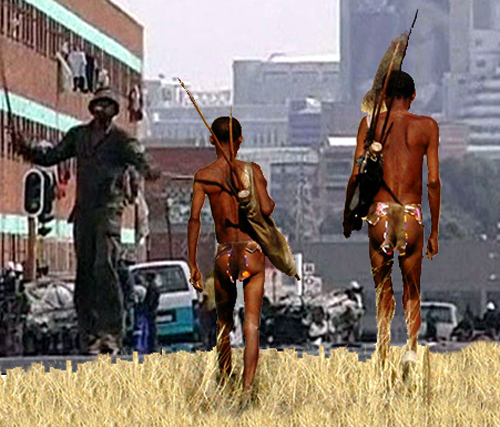
The Botswana bushmen have finally been excluded from their homeland, having lost the final skirmishes in more than a century of battling to retain their right to a traditional life in the Central Kalahari Reserve.

As of today, Botswana’s ancestral San people may only enter the reserve on month-long permits, one third the stay allowed foreigners entering the reserve for tourism. The news was reported today by a respected African publication in London.

The Botswana government claims the exclusion policy is for environmental protection and Bushman community development, but tourism has become increasingly popular in the area, and … diamonds have been found, there.

The forced removal of peoples from their ancestral homelands is hardly new. The removal of Maasai from ancestral homelands in the Moru Kopjes in 1972 led to an immediate expansion of the Serengeti National Park that substantially and almost immediately increased animal populations, making the area more attractive for tourism.

Perhaps the most egregious of forced native removals were native Americans in the late 19th and early 20th centuries, horribly summarized in what is commonly known as the Trail of Tears.

The difference with today’s situation with Bushmen in Botswana, and the next most recent similar situation with Maasai in Tanzania, is that the Bushmen seemed to have prevailed with a 2011 High Court decision that aggregated a number of earlier decisions securing use of their homelands.

But the Botswana government simply ignored its own high court orders and has continuously refused aboriginal people entry into the reserved and harassed those who snuck in.

The government’s defiant policy has succeeded in part because the numbers of Bushmen in the area seeking traditional rights in the Kalahari has plummeted in the last decade. There were likely 5,000 Bushmen in the Kalahari 50 years ago; today there are probably fewer than 1,000.

Numbers are down because — as the government is eager to show — many Bushmen have taken advantage of government education and training programs that result in their abandoning the traditional life style.

In the last few years I’ve encountered San people working in the Kalahari in tourist camps and have admired their wit as well as their intellect. Clearly at least for those few individuals, they had no desire to return to the bush.

Last June South Africa gave a state funeral to a famous Bushman who had worked his entire life for the betterment of his people. But as with himself and his children, that was principally to educate them in modern schools and find them modern, urban jobs.

Contemporary, modern opportunities for Botswana people are considerably better than for most other Africans from other countries on the continent. Botswana’s economic situation while challenged during the global recession is far superior to most of the rest of Africa, because of its rich endowment of diamonds and other minerals.

So the question devolves simply into whether the government – the wider community – knows better what’s good for certain individuals than they themselves claim. And whether the trade-off, ancestral land for a good-paying job and healthy lifestyle, is worth it.

The age-old argument applies to peoples round the world, from such diverse theories of eminent domain to gun control. Exclusion from ancestral lands is certainly at the extreme end of this spectrum, but fundamentally is no different from any individual liberty restriction.

How far can a government go restricting individual liberties and still be moral?

The removals of the Shoshone, Yavapai and Navajo in the United States were certainly no less egregious than the Bushman from the Kalahari.

Is it just that we pine for the old days? Or are we afraid of our own power, even if it will better a peoples? Or as with native Americans, that we really don’t care what happens to them?

Borders and Blood

Borders and Blood

by Conor Godfrey
I’ve been accused of being a relentless Africa booster… this is almost certainly true.

To fight back, however, I am going to offer a scarier version of the continent’s next thirty years that has taken up serious mind share recently.

This idea will hopefully pass muster as a research topic, so I would certainly appreciate your feedback as I am just getting the full proposal together now.

From the late 90s to the present, we have seen tremendous agitation around African intra and inter-state borders.

I would argue that this started with the Ethiopia Eritrea war (1998-2000) and would include the escalation of civilizational conflict inside Nigeria and Mali, the 2006 Ethiopian and the 2012 Kenyan invasions of Somalia, and, of course, the separation of Sudan and South Sudan.

Dozens of conflicts—including many in the DRC—do not make this list because they did or do not fundamentally challenge the status-quo colonial borders.

You can quibble with or add to my list – that is not the point.

Before this decade the Colonial borders exhibited nigh unprecedented durability. Here is a list of African border changes post WW1… 90% of them were trades between colonial powers.

My point (or wild hypothesis if you will) is this… from independence to 2000, most African states did not possess the material capabilities to mount a sustained challenge to the territorial status quo; doing so requires states to centralize political control, neutralize domestic opponents that pose a threat to the state, and have the material resources necessary to take, hold, and administer territory.

As the U.S. knows well, this requires lots and lots of money (not to mention a professional military and a tolerant domestic audience).

For this entire period, states concentrated on papering over the inconsistencies built into their illogical creations, and, if hostile foreign action were required, they relied on cheap and effective proxy militias and other irregular activity rather than large-scale mobilization.

The Council on Foreign relations writes —not totally persuasively in my opinion—that keeping colonial borders gave African leaders “reciprocal insurance” against invasion, and that leaders were more concerned with arguing over who controlled state resources than fighting over borders.

So why are things coming apart at the seams (pun very much intended)?

This could, after all, just be a blip, a decade long aberration on an otherwise century long consolidation along the lines drawn on a cocktail napkin in Europe.

Here is what I think:

1) Differential Growth: The continent is booming, but not everywhere feels the love.

As some countries outpace their neighbors they will be tempted to acquire the military capabilities to favorably alter the territorial status quo.

Colonialism left hundreds of potential territorial flash points, and for the first time since independence, some African states can likely do something about them.

Differential growth also exacerbates tensions within countries.

As globally connected and well endowed regions grow faster than other provinces inside the same country, resentments build and fuel long simmering separatist ambitions.

This narrative plays itself out most visibly today in Mali, Nigeria, and Cote d’Ivoire, and to a lesser extent in Kenya and Uganda.

2) Resources: As mentioned in this post, Africa is massively under prospected and companies are racing to catch up.

A powerful country may have let unfavorable borders lie when no rents could be extracted from the disputed territory, but what happens when billions of dollars of oil and gas hang on a few lousy kilometers, and investing in a miniscule navy would be sufficient to enforce a fait accompli on the border?

There are a number of possible mitigating factors—colonial withdrawal, regional integration, economic integration, etc… — but I will save those for some future post.

This is worth getting right. I would hate to see a decade of phenomenal growth and progress undone in an orgy of territorial revisionism, and reasonable precautions could help stop spirals of security competition before they begin.

Apocalypse Masks Extinctions

Apocalypse Masks Extinctions

The media hysteria about the increase in elephant poaching will not help solve the situation, not until facts are presented straight and the public realigns its reaction.

Newsweek’s article published tomorrow, disseminated this weekend by the Daily Beast, is the perfect example.

Margot Kaiser’s lengthy article might be considered detailed if it were not rife with so many inaccuracies.

To begin with she cleaves open the story suggesting few but her have ever seen the insides of the Tanzanian ivory warehouse. Local bloggers have been obtaining pictures of the ivory room for years.

That was the giveaway. Kaiser’s handling of the facts was treacherous, starting with her claims that elephant numbers were now “roughly half of what it was in the late 1970s.” The truth is that it’s impossible to say, because we can’t get good data, but a very good guess is that the numbers are closer to double today what they were during the nadir of elephant poaching in the late 1970s and early 1980s.

Not half, double.

This is a very hard post to write, because elephant poaching is definitely out of hand and has become a global economic problem that is screaming for management. We mostly look to CITES, the excellent world trade treaty that legislates global laws against the sale of ivory. The problem today is enforcement of those global laws.

And that enforcement is not being helped by near hysterical stories like Margot Kaiser’s.

The problem with elephant and rhino poaching today is much different than when elephant really were threatened with extinction in the 1970s and 1980s.

And that’s the first problem. Even if we did absolutely nothing more to enforce laws against the sale of illegal ivory, elephant numbers would increase.

Tanzania has the worst elephant poaching problem in East Africa, today. I have yet to see a reputable NGO with an official number, but the media is passing around 10,000 elephant poached annually in Tanzania.

I doubt that. Charles Foley, the principal elephant researcher in East Africa, recently released his 2012 annual research report in which he states “many thousands of elephants” not tens of thousands are being poached. Moreover, Foley has documented the highest reproductive rate of elephants ever known in Tanzania to date, with upwards of 7% population increases being recorded in the north of the country year-to-year.

Foley’s assessment suggests that elephant numbers are increasing — at least in certain prime elephant habitats — faster than the increase in poaching.

Unlike the 1970s and 1980s, poaching today is mostly individualized, not corporate. It is worth it today to a small band of individuals to risk life and limb for the value they can get for a couple tusks sold on the black market.

Because the Asian market has exploded in demand as the area develops a middle class in old cultures that have revered ivory for millenia.

And at the same time elephant populations are being better conserved, so particularly in well protected areas their numbers are growing … maybe too fast.

Increased market demand combined with a larger supply …. well, you don’t have to be a rocket economist to figure that one out.

Yet the media’s hysteria is unbelievable. I just don’t get it. We need to look at this fascinating and organically destructive dynamic now happening in the world regarding ivory, but not scream at it.

The answer today, unlike in the 1970s and 1980s, is to deal with the market demand, and there are promising developments, particularly in China, as its population becomes educated to the realities of African conservation.

Taobao, China’s Sears, has banned the sale of ivory products, which previously had been a maintstay of their household decorator market.

Americans like everything to be all or nothing, and that’s why calming down this conversation feels so perilous. I don’t want not to investigate and work towards a better balance with regards to elephant in Africa.

I just don’t want you to believe it’s apocalyptic, cataclysmic to the point we have to “act immediately” or lose everything. Today’s elephant problem is going to take a long time to solve because altering the free market takes time.

And that’s one of many points. We have the time, this time. We didn’t in the 1970s.

Konza of Kajiado

Konza of Kajiado

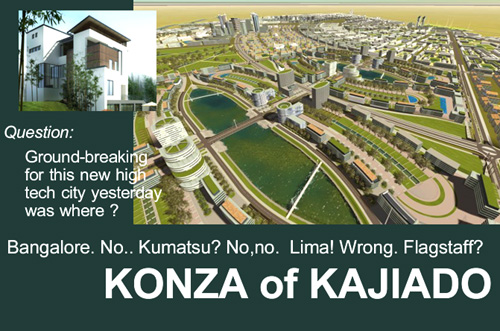
Ground breaking my eye, what happened 35 miles from Nairobi yesterday was nothing less than the Big Bang.

“Kenya’s Silicon Valley” they call it: 37,000 luxury homes and apartments, 70 acres of high-tech complexes, highways and public tennis and golf courts, several universities, high speed rail to Nairobi, 4-lane superhighways, buried electricity and fibre optics.

I know I sound like a very old man, but I can’t believe it. “Konza City” was born yesterday, and if it stays on track, by 2020 it will rival the most advanced tech cities in India and create more than 200,000 new high-skilled tech jobs.

Not only will it have call centers that we all know and hate so well serving us as likely as Proschnik in St. Petersburg, but it will have dynamic research facilities building on Kenya’s promising lead in expensive cell phone technologies, as well as medical and agricultural research facilities.

Its developers champion “green technology” and so there will be considerable solar polar.

The Kenyan’s call it a technopolis. The World Bank has funded the $330 million high speed railway that will connect the area to Nairobi, and planning is already well underway. The first rails will be laid in 2014.

But private investors are contributing up to $1 billion to a variety of areas, from private home construction to tech factories to malls. Already smaller Nairobi investors are vying for placement for car shops and grocery stores. $1 billion dollars in Kenya is easily equivalent to $100 billion in America.

More than 250 global companies have already pledged involvement, including Huawei, Samsung, RIM, and Danish Technologie.

The estimated private plus public investment that will have been spent by 2020 is expected to exceed $10 billion, which is an equivalent $1 trillion in the U.S.

I am astounded, and I admit somewhat skeptical. But I was equally skeptical only ten years ago regarding what Kenyan planned to do by today. Today its highways are reducing country-wide congestion, its education system has leaped forward, and a variety of new technologies are performing very well.

But Kenya has to get its political act together to truly manifest this dream. It has to at least achieve the level of transparency and accountability that exists today in India, or in a completely different fashion, the stability and control of a China.

Right now neither of those directions are certain. I’m encouraged that multinationals like Samsung are willing to invest heavily, but this dream will take multiple Samsungs.

The troubles confronting Kenya this minute are formidable, starting with the yet completed pacification of its neighbor, Somalia, to the still top-heavy and corrupt political leadership.

But it is getting better, and the election on March 4 will tell us a lot about whether dreams like Konza are real dreams or pipe dreams.

#3 & #4: So Well but The South

#3 & #4: So Well but The South

2012 demonstrated more than any other year that African countries are doing better economically and advancing faster socially than their counterparts in The West, their former colonial masters. Except, I’m afraid to say, the giant in the hut, South Africa.

My #3 Top Story of 2012 is the explosive narrative of African progress, and the #4 story is the significant exception, South Africa. To see a list of all The Top Ten, click here.

“Africa isn’t just a place for safaris or humanitarian aid. It’s also a place to make money,” says New York Times columnist Nicholas Kristoff. The well respected author then went on to site dozens of statistics showing Africa out pacing the world economically.

Clearly the average African is neither as comfortable or well off as the average American. But that’s not the point. The average African is mountains higher in comfort and well-being than his parents, and there is every indication that his children will share that euphoric experience.

This is, of course, a generalization but I feel a fair one. Including Somaliland, there are 56 countries in Africa. Perpetual doom and gloom persists in Zimbabwe and the Central African Republic. Increasingly bad news in 2012 plagued Angola, Uganda, Rwanda, Chad and Mali. So my generalization applies to the rest.

This positive view stands in marked contrast to America, where the generation to generation comparison is dismal. The graph projected out another generation or two actually has parts of Africa catching up with American median income.

The World Bank explains this succinctly as a wealth of new natural resource discoveries. Like oil and gold.

But that’s hardly the end of the story. The new-found wealth in the ground is a necessary foundation, just as rich soil was to early Americans and oil was to the 1960s Arab in the Emirates.

But on that foundation is blossoming some exciting non-natural discoveries, in high tech and alternative energy, in natural products manufacture and a score of other industries.

It was poorly reported but extraordinary this year that South Africa bailed out Europe. That’s right. South Africa paid $2 billion into a world monetary fund to help with the Greek and other European bailouts. Economically, the First World took charity from the Third World.

And Africa has no qualms about embracing the best of capitalism, thank you. Walmart was welcomed into South Africa with a warmer embrace than most mid-sized towns in the United States provide the retailer.

But after the hugs and kisses were over, Walmart submitted to a labor agreement that Americans working for Walmart would die for. Why are they able to do this in Africa, and not in America?

And “thing development” is progressing no less fast than social and “thought development.”

Consider the media, (I am). A respected global media watchdog claims that Tanzania has a freer and better media than the U.S. This is because of the worst of American media, which pulls down the overall ranking.

But the worst of American media, Fox News, Rush Limbaugh and sorts, have made mincemeat of the truth, have thrown civility to the wolves and turned making money into a first principal that cares little about the effects of its nearly sadistic approach to the public need.

In defense some of us Americans would point to many exceptional online services like Wired and Mother Jones and The Nation (and dozens more), and as you examine those “good” media you’ll find out the reason is the same as for Tanzania’s position: youth.

America is aging less than gracefully and its right-winger lying mentality is very much linked to old guys. So perhaps Africa has an intrinsic advantage, since such a large portion of its population is young relative to America’s.

Yesterday was historic for the American Congress: 78 women in The House and 20 women in the Senate. This reverses a trend begun about a decade ago where women in elected office began to decline.

But in Kenya that would be mandated at 145 in The House and 33 in the Senate! Mandated?! Yes, Kenya’s new constitution requires that a third of all elected officials be women, almost doubling in one fell swoop what it’s taken America more than 200 years to accomplish.

The new Kenyan constitution, modeled but improved on South Africa’s new constitution, is quickly becoming a model worldwide. Simple and common sense things like religion banned from schools and institutionalized affirmative action that adjusts to ethnicity and gender as society continually changes puts Kenya on a markedly higher moral plane than America.

I think above all other things socially, though, is the new African attitude towards justice. America is petrified with the concept of sharia Law, for instance if applied in the new Egypt. But Americans understand little of this and can’t even see how any set of laws can be molded to virtually any social model.

Our own Supreme Court has bent and twisted, upheld and struck down, and essentially remolded and unmolded society again and again. American laws on such things as drug possession (marijuana), abortion, gambling and even incest and slavery have gone all over the chart!

There was no direction from the “Founding Fathers” on those issues part and parcel to modern day life. And the irony is that so many Americans think otherwise, that there is some Founding Father out there guiding our every move.

The new Kenya justice will be an amalgam of Islamic sharia and British common law. Some feat, eh? But beautiful and adjusted to the realities of its new society.

But Kenya recognizes – like so much of the world, America excepted – that there is a global morality, today. That there is a worldwide foundation for such things as basic human rights.

Four of Kenya’s most prominent citizens have submitted to charges filed against them at the World Court in The Hague. Voluntarily they will go to The Netherlands for their trial. Now it needs to be said, of course, that these criminals (as I think they are rightly charged) would likely not do so if the Kenyan public hadn’t forced them to. And that is the majesty and beauty of the situation.

An important aside: recently convicted in the World Court, former Liberian leader Charles Taylor in pleading for leniency in his sentencing for war crimes pointed out that he was convicted of crimes no different from those of George Bush in Iraq.

The justices gave no reply.

This was not the case for our own great Justice Ginsberg who dared to speak the truth in Cairo, when she told the Egyptians that maybe the U.S. constitution wasn’t right for them.

The onslaught of criticism that followed, the incredible vitriol from the right, wasn’t just humiliating to us Americans, it was … well, barbaric. It was truly like German Goths grumbling over Roman progressives. Ginsberg is of course right, and fortunately she rather than Senator Kruz is what Egyptians will and are considering for their own new, progressive societies.

But alas, it’s not all good news for Africa. Africa’s behemoth is South Africa. Its economy is multiples of the rest of the entire continent combined. Its history is as complex and fascinating as our own. And hardly 20 years ago it reformed itself into one of the most progressive, moral societies on earth.

But now, things don’t look so good.

Residual racism and neo-apartheidism are sprouting across its non-black societies. I don’t think this is because it was always destined to be so, that there was some kind of intransigent ethic among whites that would eventually surface again, like an old whale on its last sound.

Rather, it’s because the current president has made it so. Jacob Zuma is a joke.

He’s vain, and easily set off by criticism. He’s so wrapped up in himself, he’s let the country wander leaderless. He’s patently ignored the courts, acted like a banana republic dictator and all the while the country spiraled downwards.

Many local experts, white and black and left and right, are beginning to see him not so much a central actor separate from the times, but rather the embodiment of something greater:

The implosion of the ANC, the freedom fighter party that won the battle against apartheid and whose marshal was Nelson Mandela.

I think this is true, and that’s why this is my fourth most important story of 2012. Yet it’s with hope that I also see Zuma coming to an end sooner than the constitution would mandate, and of the ANC moving restlessly to get its act together. It may, however, be too late.

So the year ends on an incredibly positive note for the continent as a whole, but a seriously cautionary one for its grand marshal.
Diamonds Are Forever

Diamonds Are Forever

Botswana has had a remarkably long streak of luck; and lions don’t have enough lives. With less than a generation left of certain revenue, there is concern the stately country could fall into the dustbin of failed states.

Right now Botswana is the richest country in Africa. With a GDP per capita around $15,000, it ranks 65 in the World Bank’s country list of 180.

Eighty percent of this is from diamonds.

When diamonds were first mined in earnest in the mid 1960s, Botswana was among the poorest countries in the world, not just Africa. Being also one of the most sparsely populated countries in the world this tends to exaggerate both the good times and the bad, but it’s fair to say before the 1960s Botswana was nearly nothing.

In colonial times the country wasn’t wanted by anyone. It was of early renown because Livingstone’s earliest journeys went through what is today Botswana, and it became the normal 19th century route to Victoria Falls from South Africa.

But virtually the entire northern half of the country, which is roughly the size of France, is good for nothing but wild animals. This is the Kalahari Desert in various forms, including the magnificent Okavango Delta (which is the Kalahari in flood).

This isn’t a sand desert like the neighboring, great Namib, but it is related. And it means that under a veneer of pleasant-looking bush can be 3-4 meters of sand in the form nearly of dust.

An apple tree would fall down. A house would blow away. A railway would have to be a very deep subway.

The south half of the country loses some of the dust earth and becomes more of a Mojave-like desert. Around World War II significant coal deposits discovered in neighboring Rhodesia spilled over a tiny bit into eastern south Botswana.

And between the great wars, Boer farmers developed wide tracts of land in southern and western Botswana for cattle farming.

But even today, when other mining and agriculture is being developed with all the desperation of a country that sees its horizon, those other-than-diamond industries pale in comparison to diamond mining.

And the diamonds are running out.

I’m always cautious about predictions of some natural resource running out. You remember the OPEC oil crisis, right? We weren’t running out of oil as then predicted, we just weren’t looking in the right places deep enough.

But diamonds are more predictable. Their formation precedes oil. In fact the better, larger diamonds, are likely the older – more than 3 billion years old. There just haven’t been multiple 3-billion year-old cycles for diamond formation, as with oil’s palsy hundreds of millions of years, or coal’s tens of millions of years.

So there is a greater likelihood that predictions that Botswana’s diamonds will run out in 20 years is correct.

What will it do?

Tourism obviously comes to mind, and Botswana’s tourism is outstanding. But defined as it is by the ever-changing, nonsolid Kalahari, these aren’t the great plains of the Serengeti, where tarmac roads follow limestone river banks and great lodges are built on granite.

Roads are hard to build anywhere in Botswana. Lodges are mostly “camps” that are often considered quite temporary.

There aren’t aquifers or lakes or wetlands outside the Okavango itself. And the Okavango’s magic is specifically in its ever-changing character. An island one year is a watercourse the next.

This is universally true, and there are notable exceptions like Chief’s Island and the edges of the Linyanti wetlands, and the great pans of the central east. But add up all these areas and they amount to about a hundredth of the available bed nights in wilderness areas in South Africa.

Which is right next door.

Botswana cannot rely on tourism to take it through this century. Yet there seems little else that’s left.