Round ‘n Round the Mulberry Bush

Round ‘n Round the Mulberry Bush

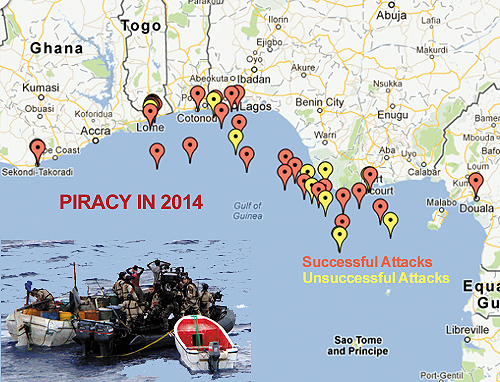
piracyHow many times around Africa, or the world, can you chase a terrorist? Piracy has now moved from the Gulf of Aden to the Gulf of Guinea.

Fans of the superb movie Captain Phillips will understand better than most (except readers of the New York Times or London’s Guardian) how high seas piracy is instrumental as seed money for “new” terrorists.

Then, once they get established, funds come from all over the world, starting with disgruntled or religiously extreme Saudis and spanning a wide range of bad people all the way to Hong Kong gangsters.

Then, they get their hands on big weapons and, game on.

But that seed money is fundamental. It comes from piracy or kidnapings or both.

We can’t ransom James Sotloff, but god forbid that we lose any oil or Camry’s. Yesterday, the Hai Son 6 secured its release from Nigerian pirates. The press release said the pirates got away with “some cargo” but I doubt that was the end of the story.

Almost every big ship that’s pirated is ransomed, and not with a handful of millions of dollars, but with dozens of millions of dollars.

Obama and Hollande successfully chased well-funded terrorists out of Somalia over the last several years, and our proxy army of Kenya occupied their main port, Kismayo.

Now, they’re on the other side of the continent.

Almost two years ago, when the fight against al-Shabaab in Somalia began in earnest, Europeans immediately began seeing piracy not seen before in the Gulf of Guinea.

The European Union immediately set up a committee and fund with about $6 million to help Gulf of Guinea states combat piracy. No takers. Until now.

Yesterday in Cameroon the French ambassador (giving the money), all the big wigs from the Cameroon government (taking the money) and the Brazilian ambassador … Brazil? Yes, almost all the container traffic between Africa and South America occurs between Brazil and the Gulf of Guinea states.

What prompted these weak States to take more direction from Europe is the radical increase in piracy. Last year there were 32 pirate attacks of giant ships and 24 were “successful.”

“Successful” means the pirate’s got a ransom.

A month ago, authorities noted a “game changer” attack of piracy on a container ship in the high seas, much further off-shore than before.

“The attempted boarding of a vessel underway, especially at night and this far out in open seas, is a tactic … associated with highly motivated Somali pirates,” said Ian Millen, Chief Operating Officer of Dryad Maritime.

It was reminiscent of Captain Phillips: three speedboats overtook then boarded the vessel.

The reason it was a tactic “associated with highly motivated Somali pirates” is because it was undoubtedly carried out by highly motivated Somali pirates.

Because they were chased out of Somalia.

Game changer? They’re just playing on a different side of the board.

So now begins a lengthy time of European and Gulf of Guinea States chasing them away. And they will earn millions and millions of dollars, and be richer than they are now, which is richer than they were in Somalia.

And they will be chased from the Gulf of Guinea to Gulf of Tonkin to the Davao Gulf, etc., etc.

Until “rich” is stopped, this will continue ad infinitum. This means you don’t ransom ships, you arm merchant ships to defend themselves (currently highly restricted) and you stop the money chain.

Swiss banks can no longer be so anonymous. The Caymans can no longer be so indiscreet. China must allow regulation outside itself of Hong Kong banking.

Ultimately, you’ve got to deal too with the reasons terrorism exists in the first place. Try these on for size:

Poverty, Depravation, Oppression
Kill Mom, Sell the Baby

Kill Mom, Sell the Baby

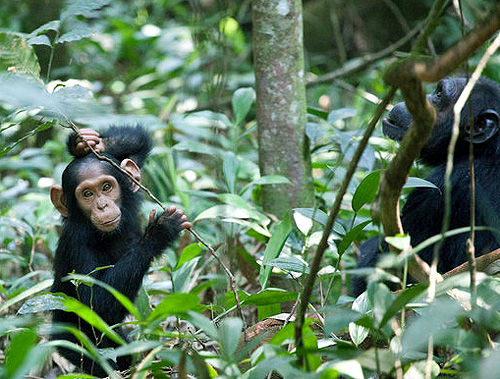
chimpChimps are not as endangered as gorillas, but they are increasingly controversial in developing Africa because they are so human-like.

Most westerners think of chimpanzees as sort of smart dogs. Well, only if the dog is as big as you! That’s right, a full grown chimp averages 5½’ tall and weighs 150 pounds.

This is no monkey.

Chimps are still widespread throughout much of Africa’s great central jungles. But for millennia the jungle peoples, mostly pygmies and settlements at the forest edge, hunted chimps for food. Traditionally chimp meat was an important source of necessary protein.

Babies were never eaten. An adult would be killed and the baby set free, usually to die for being abandoned. As villages and settlements developed, a secondary trade in selling these babies to westerners developed.

Forty years ago in far western Kenya, Kathleen and I had been working for hardly a few weeks when we were offered a baby baboon. I bought and raised it and tried to reintroduce Hamisi into the wild. The baboon’s mother wasn’t killed for food, but because she was raiding a neighbor’s maize garden.

Killing baby anythings seems offensive to most everyone. It was my justification for buying our little baby baboon Hamisi in the first place. But what I didn’t realize then was that a massive trade would develop, a blackmarket in animals like Hamisi, driven by nefarious western and Asian animal traders.

Today there are numerous NGOs across Africa whose mission is to thwart the blackmarket trade in wild African animals. This usually means intercepting the baby taken from the killed mother. And that necessarily means rehabilitating the baby.

One of the more successful organization in the southern edge of chimp habitat is J.A.C.K.. See their video below.

Killing grownup chimps is universally offensive to the developed mind of anyone who has enough food: It approaches cannibalism. Chimps are extremely smart, one of the few animals to actually show emotion, and often mock, taunt, stalk or spy on their human neighbors, the same way people might observe wild animals.

Unlike baboons and gorillas, they don’t raid gardens or kitchens. They’re quite good at finding and in a way nurturing their own food, and they fear humans. I think that their fear is intellectualized very much like human fear is, and very much unlike gorillas and lesser animals that are more reactive.

So I’d venture to suggest that a chimp when coincidentally passing a trader walking through the forest with bananas, that it stops to muse on the consequences of stealing them. A baboon which is much smaller wouldn’t normally challenge a man, but the moment an opportunity arises – the farmer sets down his bag to wipe his brow – the baboon may strike.

The chimp won’t.

Whether this is fanciful or not, the fact remains that chimps don’t raid and pose no threat to humans, other than a reduction of a traditional food source as hunting of them is prohibited.

As Africa develops even rural folks grow more intellectual.

But the need for food is ever present. And the pernicious blackmarket in wild chimps is actually growing. The demand from the west and Asia is strong, as westerners and Asians grow exponentially richer than Africans.

That, today, is one of the major challenges in Africa with regards to chimp conservation. More and more authorities are prohibiting hunting and trading in chimps. Locally authorities justify their action beyond simple conservation – which can be very controversial — although this alternative justification applies more to the lesser primates like monkeys:

Ebola and a number of other viruses, probably like West Nile and flu varieties and possibly even HIV, originated with forest primates, mutated and were transported into the human population through bush meat.

The human/animal conflict is increasingly important throughout Africa as the continent develops so fast. Chimps are at the top of that controversy.

Immoral Exaggeration

Immoral Exaggeration

ebolavampireAmericans do not understand the ebola epidemic: They are reacting in the same unthoughtful way they do to unvetted political ads and sound bite media.

The ebola outbreak in West Africa is serious, like a lot of other things, like poverty. In fact, diarrhea, flu and TB kill millions more Africans (and Americans!) annually.

Americans must think think they are protected from those other diseases but vulnerable to ebola.

They’re dead wrong.

A traveler today to Monrovia, Liberia, where the current outbreak is centered is more likely to get diarrhea, salmonella, TB or malaria than ebola. The several hundred patients in ebola clinics in Monrovia have all come from rural areas where even basic medical prevention not to mention simple hygiene and community sewage treatment, doesn’t exist.

The problem is squarely and simply that there aren’t enough treatment centers – which would easily contain the outbreak – to service the growing numbers contracting the disease in the remote bush.

The widely reported half dozen medical workers from developed countries who contracted the disease were all working in these remote areas. In the course of their normal stint in such an area, they expect – as my wife and I did – to contract a number of local diseases.

It has less to do with the disease than the environment in which the disease exists.

Ebola is not spreading in Monrovia, a modern city. That is not to say that Liberia doesn’t need a lot more help than the western world is giving it, because Monrovia is where the Liberian epidemic will end. But it won’t end without the help it needs!

The problem goes well beyond ebola, now. Medical worker assistants like orderlies and kitchen staff and maintenance staff in Monrovia, many of whom are not paid any more relative to medical practitioners than in the U.S., are abandoning their jobs in droves.

That has led to a reduction in overall medical care, including birthing centers and simple malaria and diarrhea recovery clinics. As the entire country gets worse medically overall, every disease – including ebola – grows in potential.

And that is a terrible – horrible – indictment of the developed world. Compare the western world’s response to the Haiti earthquake or Philippines tsunami to Liberia’s current dire need. It has been pitiful, embarrassing and I think immoral.

When ebola came to Atlanta in a chartered aircraft and the patients who contracted the disease in rural Africa were then quarantined, it did not spread. The efforts in the hospital in Atlanta to contain spreading of the virus were little different than for a variety of even more contagious diseases like numerous varieties of staphylococcus.

Antibiotic-resistant TB, which is on a dangerous increase throughout the U.S., is spread through the air – respiration: coughing, sneezing, breathing – one of several more worrisome diseases than ebola in a modern medical setting. Ebola, like HIV, is spread only through body fluids.

The unwarranted American fear to ebola is identical to Americans knee-jerk reactions to 30-second political ads or 2-minute headliner news.

And when that reaction builds, the perpetrators of that media rev it up.

Ebola outranks Ukraine on CNN, because that’s what people want to view. When Democratic Senator Mark Pryor in a political fight of his life wants attention, he talks about ebola!

CNN asked a few days ago, “Are Myths Making the Ebola Outbreak Worse?”

CNN is, unfortunately, concentrating on the growing fear in West African residents. What about the fear that CNN instills in its viewers that translates ultimately into less help from the western world?

What about people in Syria, Iraq, Ukraine much less Ferguson, Missouri, who are getting less attention because ratings demand talking about ebola?

Alright. But what if you’re planning a safari to Africa?

Right now your chances of contracting ebola during a Kenya, Tanzania or southern African safari are probably less than if you holiday in London and infinitely less than if you holiday in Morocco and a lot less than if you holiday in Greece, southern Spain or most of the Mideast.

That’s because the frequency of air travel right now between west and east or southern Africa is so much less than to those other areas I mentioned. London is about 500 miles closer to Monrovia than either Johannesburg or Nairobi. There’s a hugely greater exchange of people between London and Liberia right now than to east or southern Africa.

Moreover, it’s also true because the level of medical facilities in Nairobi is better than Monrovia, so if ebola did break out in Nairobi it would likely be easily contained. And as for South Africa? Remember about a generation ago, the first heart transplant was conducted in South Africa.

The last thing I want to do is minimize the seriousness of this epidemic. But frankly I get rather angry when I realize Americans fear this far, far away epidemic exponentially more than their own TB epidemic in poorer neighborhoods across their own country.

I just can’t figure it out. Is every American a teenage girl obsessed with Twilight?

Wheel From Wheel

Wheel From Wheel

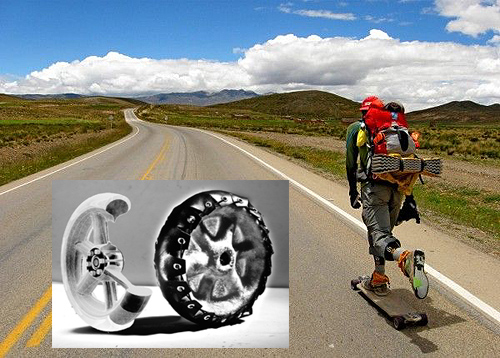
EthiopiaSkateAfrica is fraught with innovation and in Ethiopia kids have reinvented the wheel!

Development is happening so fast, today, in Africa that the end points and beginning points are stretching further and further apart.

The dynamic is as true of wealth and poverty as it is of physical things … like cars and bikes.

Ethiopia and its capital, Addis Ababa in particular, are hyper examples. More millionaires were produced in Ethiopia in 2013 than any other African country.

And as you would expect, that meant many more modern consumer goods were sold like refrigerators, TVs, cell phones and computers. But most of all, cars. And the government is facilitating the transport boom by rapidly completing many new, modern roads and highways.

But unlike the developed west, a car is not something even the most wealthy Ethiopian kid is likely to get.

Bicycles have been around for generations, but even those are being whisked up by adults who need certain transport to work. What’s left?

Skate boards. But believe it or not, imported skate boards are more expensive than bicycles, even though there’s plenty of most of the basic materials available in Ethiopia to build them. Except tires. There’s no rubber in Ethiopia.

So as reported this month in Afrigadget.com, an Ethiopian student has designed a durable skate board wheel made from discarded old wheel rubber that is stitched around a base that can be manufactured locally from metal, fiberglass and foam.

The “gadget” is part of the creative production of IceAddis, one of several NGO offshoots of a collaboration of western companies led mostly by Scandanavian countries.

So skateboarding has come to Ethiopia! Thanks to local innovation and, by the way, the universal desire of kids to have fun while sailing through the air!

Something To Hide?

Something To Hide?

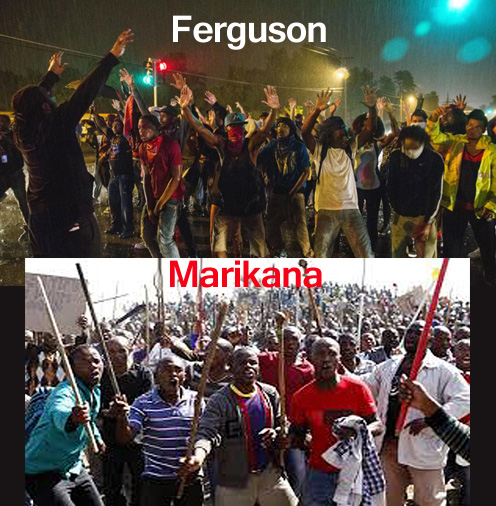
fergusonmarikanaLike few other American news stories the Ferguson unrest is widely reported in the African media. Analysts and reporters alike are essentially claiming that America is “like the pot calling the kettle black.”

It’s hard to dispute. But the killing of Michael Brown will ultimately be judged excessive use of police force, and in my opinion, the policeman will go to jail.

That’s where much of the African perspective fails. Jumping on this event before it plays out allows African analysts to presume we won’t reach the justice in this catastrophe that I think we will.

As is much more often the case in Africa than America.

Nevertheless, the Africans have a valid pinger right now.

The loudest criticism comes from the dictators:

“The changes of story are a maddening example of police obfuscation, racial bias in policing and how television news in particular often undercuts the stories with images that exacerbate racial stereotypes,” writes an American resident Zimbabwean for its mouth-piece newspaper, The Herald.

The day the incident occurred in Ferguson, The Herald and many other newspapers in Africa quickly reported the UN’s interdiction of the police force there:

“The US Government that hypocritically accuses Zimbabwe of alleged human rights abuses has come under fire from the United Nations over the wanton shooting of an 18-year old black man in Missouri that prompted widespread demonstrations.”

This, of course, is hypocrisy on hypocrisy as Zimbabwe is right now about the cruelest society with regards to free speech that exists. But that’s the incredible destruction of hypocrisy: it can be used so easily to support both its ends.

The other great suppressor of democracy, Egypt, was almost as vocal.

Cairo’s newspaper, Aswat Masriya, said that the Ferguson police response has “led to questioning whether the incident reflects a larger trend of local police excesses” in America.

Egypt’s crackdown on dissidents since the end of the Arab Spring has been incredibly tough. “Police excesses” hardly begin to truly report the brutality.

(By the way, the U.S. State Department in its unending attempt to befriend Egypt again, immediately said it “respected” Egypt’s criticism. That, too, was reported in Egypt.)

But dispense with all this hyperbole, however momentarily nonhyperbolic it may be, and there are some very thoughtful and I think valid criticisms coming out of Africa.

“When the overwhelmingly white police department in Ferguson … some of whom are Israeli trained, responded … they brought in equipment first used in the Iraq war,” writes one of my heroes of analysis in Africa, Richard Pithouse, a professor at Rhodes University in South Africa.

Pithouse is echoing many of us Americans who believe local police departments have been militarized, an almost inevitable aftermath of winding down imperial wars abroad.

Pithouse quickly picked up on valid analogies between Ferguson and Gaza, for example:

“Unsurprisingly people in Gaza started sending advice to people in Ferguson via twitter about how to deal with stun grenades, tear gas and all the rest.”

“Just as the same water cannons are used in Gaza, Port-au-Prince and Ferguson, as well as the shack lands of Brazil and South Africa, so too are the same ideological operations repeated,” Pithouse concludes.

His astute analysis repeats what many contemporary historians believe, that immoral colonialism when abandoned abroad will circle around and eventually be applied at home. In other words, the ideology once adopted is impossible to discard.

So when the colony is set free, the colonial power will sic on itself.

I agree with Pithouse, and I think Ferguson is an excellent example. But I’m more optimistic than him. I believe we can learn from, rather than be imprisoned by these historical paradigms.

South Africa recently released an official report on police brutality at the Marikana mine two years ago that was considerably more horrific than Ferguson, today.

Pithouse acknowledges this and bemoans the response of his own government to its own admissions. I think America in this case might do better.

That, of course, remains to be seen.

How Much for 100 Million Years?

How Much for 100 Million Years?

millipedeIt chirps. And it doesn’t bite and it’s not toxic. It rolls up into a ball before chirping and it’s found only in about 250 acres of forest and nowhere else on earth.

Would you set aside a small swath of natural forest to protect this millipede? Or would you allow some important mining to proceed which could greatly enrich your local community?

How about seven? Let’s say you just discovered seven new species of life, cute little ping-pong sized millipedes that chirp, which existed on earth before the dinosaurs died out when Madagascar was a part of India.

And let’s say they all live in an area where the incredibly rich resource of titanium was just discovered, too. You know! That Star Wars metal that is stronger than steel but with only a fraction of the weight and doesn’t begin to melt until 1600 F.

Let’s say the bugs aren’t going to help any person except scientists trying to unweave the incredible biological history of Madagascar, and that the titanium will create enough wealth to send hundreds maybe thousands or maybe hundreds of thousands of kids through college.

We don’t have “to say” it, it’s true. It’s another of Madagascar’s unending stories as scientists take greater and greater advantage of the country’s growing periods of peace and stability.

The first of this genera of weird literally prehistoric insects was discovered in 2009, but recently more thorough excavations of the area have found seven new and entirely separate species.

The separate species live in unique areas, from tiny swaths of forests to single humid caves surrounded by near desert. Fossils found near them are beginning to paint a picture of prehistoric Madagascar that is richer and more complicated than ever conceived before.

One of Madagascar’s most compelling mysteries is whether its current rich biodiversity which is so incredibly endemic evolved from before it split with India, or whether it evolved faster afterwards from vagrants that more or less washed ashore.

These millipedes are going a long way towards answering that question.

Rio Tinto, the mega mining multinational whose Madagascar division QIT Minerals has been given the license to mine the area, claims that exhaustive environmental studies will protect ten percent of the area so that once reclaimed by nature these species can repopulate.

But titanium mining is extremely severe. Basically giant shovels bigger than you can possibly ever imagine dig up wholesale parts of the earth and throw it on super conveyers that crush into into near dust then filter out the titanium, leaving a scorched earth with giant piles of lifeless dirt.

The value of the project is “in the billions” … of dollars.

“If you conserve the ‘wrong’ 10 percent, the endemic millipedes will be extinct. Irreplaceably. A forest can be replanted (hopefully), but the unique fauna which needed millions of years to evolve will be gone,” Thomas Wesener of the Alexander Koenig Zoological Research Museum in Bonn, Germany, told American Scholar.

Billions of dollars or millions of years?

All Hail The Buck

All Hail The Buck

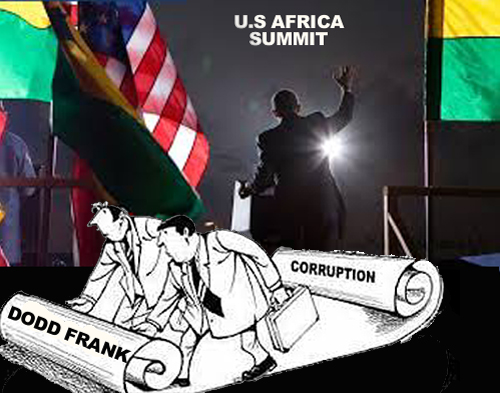
summitdoddfrankThe glitz and fanfare closing the historic U.S./Africa summit today glazed over very serious issues like corruption with lavish promises of aid and economic cooperation.

The political and strategic gains for both the United States and African Heads of State were starkly and almost exclusively economic, and clearly human rights’ activists in particular are leaving the conference terribly disappointed.

The amount of cash pledged by the U.S. and the World Bank was more than double what was expected: over $33 billion. Massive projects for electrification and natural resource development went well beyond the Heads’ expectations.

Of course $33 billion is a drop in the bucket for the U.S. and its western agencies, but it’s a large sum of money in Africa, representing about half Kenya’s annual GDP. It would be like a rich alien power promising Earth $33 trillion in aid.

So the jives are good among the rich and powerful, and the buzz in Washington is all about how Obama successfully challenged China head-on, considered at least until now to have been the dominant new force in Africa.

But there are also a host of not-for-profits and NGOs welcomed by the White House to the summit, often specifically invited, that received little attention. Their concerns are manifold, from the environment to good governance, but unless their topic was trade or foreign investment, they’re leaving empty-handed.

One concern that seemed to pop up again and again in a many different meetings and discussions was Obama’s failure to fully enact Dodd-Frank.

The Dodd–Frank Wall Street Reform and Consumer Protection Act was a signature piece of Obama legislation signed on July 21, 2010. Four years later hardly half of the law has been implemented.

Africans are specifically interested in section 1504, which has not been implemented. This portion of the law requires all mining companies listed on U.S. stock exchanges to publish all their payments to U.S. and foreign governments in the countries where they operate.

Sounds simple enough, right? Well, the very fact that it might be implemented is probably one of the main reasons that the generational war in The Congo is almost over. It would end the decades-long practice of many international companies that obtained their rare earth minerals from Congolese warlords.

The law is clear, whether it really did stop the Congo war or not: Nike, Apple, Motorola (now Google), Intel and dozens of other companies that had been buying minerals like tantalum from war zone black markets could no longer do so.

Moreover, eight of the world’s 10 largest mining companies and 29 of the 32 largest active international oil companies would be covered by the Act as well, were it implemented.

But it hasn’t been, because the Security and Exchange Commission which is entrusted with writing the rules to implement the law has been stymied and sued and from the point of view of many Africans, complicit, with multi-national industry lobbying.

“Anti-corruption activists are losing patience with what they see as pressure by the extractive industries to prevent the emergence of tough new disclosure requirements,” writes Africa policy expert Jim Lobe.

At one of dozens of activist forums at the summit, one of Africa’s most successful businessmen, Mo Ibrahim, challenged “The United States, which has been a leading light on corruption [for] now dragging its feet. Do you have a backbone, or what?”

I know that realistically economic issues govern the world, and economic prosperity often heralds peace and happiness. But let’s move this beyond game of monopoly between China and the U.S. and realize as well that there’s wealth in morality.

The Elephant isn’t in The Room

The Elephant isn’t in The Room

elenotintheroomElephant poaching is less important than jobs, energy, poverty and a host of other domestic African issues and until westerners embrace this, poaching will continue to increase.

At yesterday’s “historic“ African summit in Washington so many meetings and public forums occurred that Washington police had to close some of the city’s main roads, with limo lines moving back and forth causing their own congestion.

Most of the dozens of official gatherings were about trade, ending poverty, honoring former champions of American/African relationships, etc.

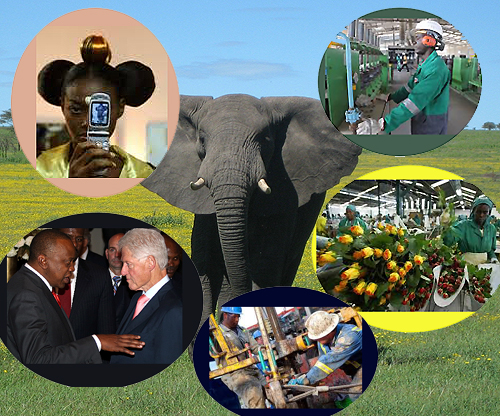
Bill Clinton spent twenty minutes speaking to Kenya’s president Uhuru Kenyatta at an event honoring Andrew Young.

Trade and investment trumped all other topics, as they should. The continent is growing by 5.7%. Middle class consumers in Africa will soon approach a half billion in number. China is edging all other players out of opportunities. There’s a lot to talk about.

One of these many formal and countless informal meetings was about elephant poaching. It attracted four African Heads of State, four of the least important movers and shakers on the continent.

NPR, of course, covered it. This is because it’s an issue which resonates with the liberal leaning Americans who need good morning news fixes.

Americans tend to look at the world through myopic lenses that focus their own passions at the exclusion of greater but to them peripheral issues. It’s as true of the liberal as conservative.

And I’ve always pointed out that the liberal/conservationist attitude towards elephant poaching has not just distorted it but distracted our important attention from other issues.

Let me state again: elephant poaching is on the rise and is a serious concern for African conservation, today. But it’s on the rise for reasons other than just that there are bad guys and evil Chinese antique dealers.

Yesterday, for example, the Kenyan Wildlife Service (KWS) did an audit of the 12 elephants that died in the last year in or near Amboseli National Park, Kenya’s most important elephant park.

Four died of natural causes: 33%.

Of the remaining eight, three were due to what officials called “human-wildlife” conflict, which I’ve often discussed: 25%.

I actually think this is the most serious problem, because it’s turning local sentiment against conservation. As Africa develops so rapidly, the conflict with the wilderness increases exponentially as that wilderness is better and better protected.

It’s one thing to have monkeys pinching the cookies you left out for your kids when they come home from school. It’s quite another when the elephant walks through their school or, god forbid, steps on the kids.

The remaining 5 of the 12 elephants were determined to have been “poached.” In other words, intentionally killed for illicit gain: 42%.

The media is rife with explaining and arguing whether the market for ivory or the price given at the source for ivory or corruption among wildlife officials or other bad things is responsible for this poaching.

“Julius Cheptei, the Assistant Director for the Southern Conservation Area, argues that there is a strong link between the swelling cases of poaching and the possibility that people are looking for traditional medication,” according to reporters covering the KWS Amboseli announcement. The reporter continues:

“Given the growing populations and spreading popularity of traditional medicines globally, experts say the demand for these natural remedies is increasing.”

The official continued to explain that often poachers are not interested in the ivory but in the elephant’s “private parts.”

As always, I’m not saying elephant poaching today is not a serious issue, and one report as above does not an issue settle.

I’m just saying, again and again, get a perspective.

Real World Blues

Real World Blues

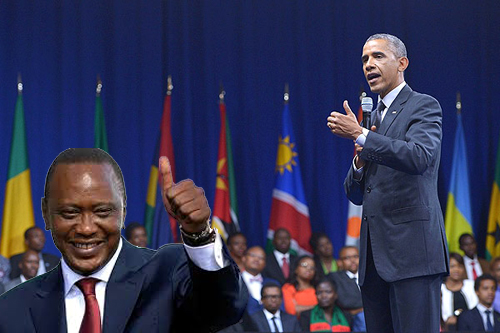
obamasummitThe largest ever gathering of African leaders starts today in Washington at the invitation of President Obama. A year ago this would have been unthinkable.

A year ago Obama would not have arranged this summit; his advisors would have considered it bad politics. But Obama is no longer playing to the vicious racism that has stymied him from Day One.

A year ago President Uhuru Kenyatta would not have been invited: he remains on trial for crimes against humanity at the World Court (ICC). Kenyatta arrived in Washington for the summit yesterday. His court case has faltered and Kenya has prospered.

The guest list at the White House is filled with despots and authoritarians including Equatorial Guinea’s Obiang and Uganda’s Museveni. But with a little help from the White House, their most serious critics are also being heard.

A year ago the Heads of the African Union (AU) states would have rejected a meeting that included a parallel gathering of their most intense critics. The White House encouraged this activist gathering, but also deftly declined to participate and that seems to have satisfied the African Mighty. That’s a diplomatic dosey doe of the most successful sort.

Times are changing, Obama is changing, and I think America is recalibrating. No African leader embodies these changes better than Egypt’s President el-Sisi.

The White House did not invite el-Sisi, yet in my estimation whatever immoralities or crimes he’s committed in his coup against the legitimately elected Muslim Brotherhood Mursi as president last year pale in comparison to Obiang’s or Museveni’s reigns of terror.

But the White House was following a careful script. El-Sisi had been ousted from the AU. Obiang and Museveni remain in good standing with the AU, whether they should or not.

When el-Sisi was reinstated several months ago, the White House then issued an invitation and El-Sisi immediately declined, but with diplomatic nicety sent his Prime Minister and closest confidant, Ibrahim Mehleb.

The only other heads of state not invited have all been ousted by the AU: Zimbabwe, Sudan, Eritrea and the Central African Republic.

America’s recalibration is good and bad. Obama’s administration is reembracing the old diplomat Henry Kissinger’s realpolitik: In contemporary terms you don’t cheer change at the expense of certain stability.

The Arab Spring has proved mostly a failure. In the long view of multiple decades or centuries it may have inched human rights forward, but today human rights in places like Egypt and Morocco and Kenya is more suppressed than before the Arab Spring.

What has improved is social stability and economic growth, and that is the stuff that realpolitik responds to.

America’s obsession with freedom and democracy is very good … for America. But perhaps not right now for Africa, and that’s the paradigm manifest in today’s African summit.

In the last decade, American investment and trade with Africa which had been supreme, has fallen below that of Europe’s and China’s. “The summit agenda is heavily focused on business and trade,” the Guardian’s Washington correspondent says.

China may worry Obama more than any African despot. The Guardian continues:

“China’s trade with Africa rose to $200bn last year – largely made up of Beijing’s imports of oil and minerals, and export of electronics and textiles – more than double the US… Twenty years ago trade between China and Africa was just $6bn.”

The “U.S. Summit Seeks to Play Catch-Up in Africa,” the Washington bureau chief of IPS says.

Egypt is essentially stable, today. So is Kenya. One is governed by a military authority, the other by a man indicted by the ICC for crimes against humanity.

But both countries are essential to U.S. security. Egypt’s current moderating role in the ongoing conflicts in the Mideast, and Kenya’s occupation of Somalia, represent irreplaceable components of American security.

The real world is not always a pretty one.

Alaska Like Tanzania?

Alaska Like Tanzania?

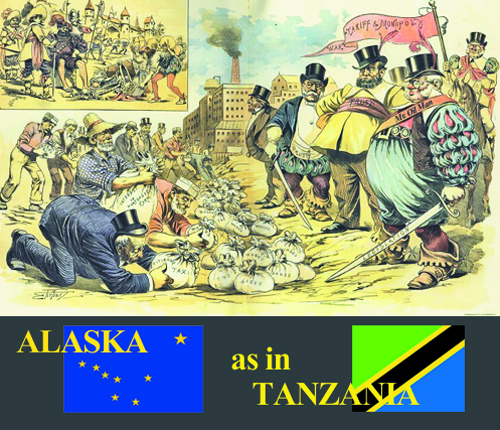
oilforSB21Last week I chastised Tanzania as a singular polity that squanders its natural resource wealth. I was wrong. So is Alaska.

I’m preparing for my once annual Alaskan trip and as always I’m in Fairbanks a few days before my clients arrive. I had no idea how similar it is to Tanzania.

Election mania is everywhere. Billboards, signs, TV ads – I couldn’t understand why compared to my own very political state of Illinois, Alaska seemed so hyped up.

Turns out it isn’t the November election of candidates that’s garnered so much interest. It’s the four referendums forced onto the ballot by grass roots signature campaigns.

Three will be on the general November ballot: legalizing marijuana, raising the minimum wage and banning further mining in certain salmon spawning grounds.

The Big One, though, comes up August 19 and is what made me realize Tanzania doth not stand alone. Ballot Initiative One repeals Senate Bill 21 which has halved the state’s oil tax revenues.

If Tanzania lived up to its IMF optimization, more than three-quarters of its revenue would be from natural resources. Today, 92% of Alaska’s revenue comes from natural resources.

In 2012 the Republican governor Sean Parnell called his predecessor, also Republican Sarah Palin, wrong for reenacting a state tax plan for oil that had been in place for decades. So Parnell, the banks and oil companies, then pushed through a bill in 2013 that reduced the maximum tax (linked to the wholesale oil price) from 75% to 35%.

Now from what we’ve been able to learn mostly from leaks of Tanzania’s strictly secret mining agreements, Tanzania is happy with 3 or 4% and opposition activists in Tanzania are screaming for 15%. So in fairness, the pie graphs aren’t very similar. But here’s the thing:

Alaska has a much, much smaller population and is dependent almost exclusively on mining for state income. And even more important than this, the previous tax plan has worked since the 1970s. Alaskan government, Alaskans who earned on average $1700/month in dividends, and even the big oil companies have been pleased as puddin’ pie.

But as seems to happen everywhere today, Republicans who are so out of touch with their electorate and in the pockets of big money (like oil companies), will do anything to stay in power. They seem to know getting elected on policy isn’t going to work.

Alaska, which has been a poster state for balanced budgets, went $2 billion in the red for the first time, this year. It didn’t even go in the red during the Great Recession!

It went in the red because the Republicans gave half their revenue back to the oil companies!

Here’s the public Republican argument: oil revenues are declining because competition is growing from places like the Dakotas which have virtually no or very little tax on the oil companies.

Here’s the truth: oil revenues have been declining since 1988 as the major oil fields that were first developed in the 1970s mature and dry up. New oil fields are being developed just as fast if not faster in Alaska as in the Dakotas.

Alaska remains the most inexpensive place in the world to develop oil fields.

There is a difference with Tanzania: Tanzania’s revenue due its people is likely being pocketed by politicians. Alaska’s revenue due its people is being given back to the oil companies!

In both cases, I call this stealing. That makes the two polities much more similar than different.

Alaska’s beginning to act like … Tanzania!

The Court Rules

The Court Rules

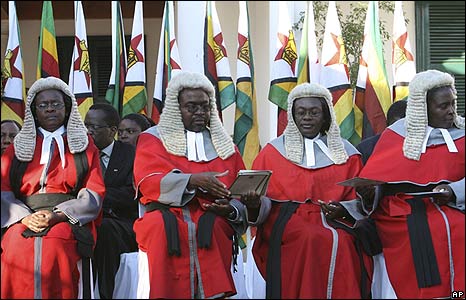
AFricanJudgesDemocracies are hardly well-oiled machines, but African courts – as in the U.S. – are pulling rank and calling all the important shots.

There are a score of new, fresh democracies in Africa in the last generation.

In South Africa, Kenya … but also in Zambia, Malawi, and most of the west African countries, democratic constitutions mostly replaced completely far less democratic ones that were distinguished by very long-serving dictators.

Out of this slow transformation of the continent’s form of governance is emerging a singular outcome: the courts rule.

As to be expected with new constitutions, precedent must be set in the interpretation of complex wording, and that has led to a lot of court rulings regarding personal and press freedom, entitlements and budgetary processes. This is to be expected.

But my interest in this question goes far beyond the obvious.

In Kenya, the courts decided the outcome of the presidential election and continue to decide dozens of elections at lower levels.

While the presidential election was a question over the counting of a very close contest, most of the elections being adjudicated by the Kenyan courts at lower levels are less technical, like whether the victor is fit to serve.

The Kenyan courts are ruling not just who won, but who should win.

In Zambia, the court is about to decide if the powerful President Zata should remain in power because of his health.

South Africa is the most jurisprudence minded on the entire continent. It was here, after all, that the chief and many of the jurists of the supreme court which upheld the immoral laws of apartheid remained the same justices which then systematically dismantled it.

Contrasting the attention and minuscule jurisprudence attending the current South African trial of Oscar Pistorius, South Africa’s Daily Maverick recently claimed that for the vast majority of South Africans the country’s new justice system was “broken beyond imagination.”

Important hearings for bail, sentencing for things like tax arrears and petty crimes, are being summarily dispensed with “not much heed … to the principles of a fair trial.”

While fresher democracies like Kenya are being ruled by the courts from the top down, the Daily Maverick claimed that South Africans are being ruled by the court from the bottom up.

It’s true here, too, at home in the good ole USA.

There’s got to be a correlation here. I think what’s happening is that the courts are filling a power gap.

In a tricameral government where an executive, legislature and the courts are separate but coequal, functioning power is possible when either one is dictatorial or two others at least are working together.

I don’t think even the U.S. Supreme Court can be called dictatorial. There’s no question in my mind that the current high court is the most activist we’ve had in my lifetime, but there’s been enough ambivalence (Obamacare) to suggest it isn’t completely dictatorial.

But because our president has not been forceful, and because our Congress is mired to a halt, the opportunity arises for the court to be proactive.

In fact, this is exactly what’s happening in Africa.

It’s a contentious time, for some further more complicated reason, throughout the world in terms of people coming together to govern.

Perhaps it’s residue from the Great Recession. Perhaps climate change is putting us to sleep.

Whatever the fundamental cause, the activists courts in the U.S. and in Africa, which seem so obstreperous lately might be considered in a slightly better light: at least they’re doing something.

Money Money Everywhere

Money Money Everywhere

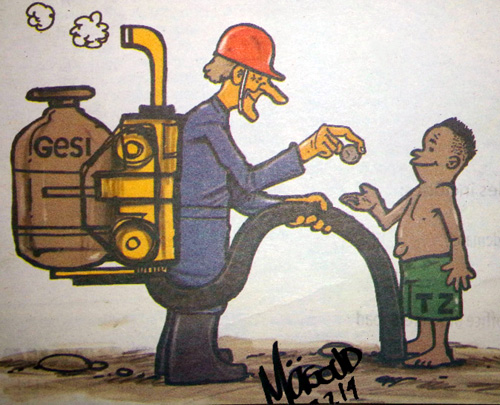
gascartoonHave you ever known anyone who’s sitting on a gold pot that they just can’t figure out how to open? Meet Tanzania.

Africa’s poverty has a real chance of being erased by major recent discoveries of natural resources, and no country has more new discoveries than Tanzania.

I know first-hand how fast Tanzania is developing. We operated a safari in just the last few weeks for a dozen Chinese managers of a new uranium plant in Dar.

Titanium and coltan have also been discovered recently, and Tanzania continues to sit on an unexploited massive vein of gold that is reckoned to be the second largest in the world after South Africa.

And most recently was the discovery of natural gas.

Just a few months ago, the IMF published findings that Tanzania could be earning $5-6 billion annually by the end of the next decade from an estimated 51 trillion cubic feet.

That’s where the good news ends.

Tanzania has botched exploitation of almost all of its natural resources, gold being the best example. Since its discovery near Lake Victoria nearly two decades ago, multiple companies have traded ownership and management, and reasonable production has yet to be attained.

Uranium is the next best example. The Chinese are successfully mining it, but the squandered tax revenue from it, and the corruption involved in the land that was swapped and sold for the mines is unbelievable.

And now there’s natural gas.

Lo and behold some observers think that the successful bidder to start developing the resource, the Norwegian company, Statoil, has ripped the country off royally.

The Production Sharing Agreement that Tanzania signed with Statoil “could [cost the government] hundreds of millions of dollars a year” according to a principal of the East African watchdog organization, Taweza.

It’s truly a mystery why Tanzania, which could be one of the richest countries in Africa, continues to be one of the poorest.

Some suggest corruption, and to be sure there’s a lot of that in Tanzania. Particularly with mineral rights transparency is easy to avoid. There is no legislative committee – as there should be – which oversees mineral right negotiation. It’s the Minister and his cronies.

That would be easily remedied by a better legislature, and it is coming round but terribly slowly.

In a confusing tweet last week Tanzanian opposition politician, Zitto Kabwe said, “not a single developing country that derives the bulk of its export earnings from oil and gas is a democracy.”

Is Kabwe suggesting he must trade his ideology, his outspoken democratic opposition to the current Tanzanian regime, to eliminate poverty? In other words: the current Tanzanian regime portraying itself as a democracy facilities wanton corruption?

Is there a Marxian dialectic here?

I’m not sure but it’s the handful of people like Kabwe who might be able to force Tanzania into some kind of meaningful grappling of its very rich resources.

But don’t pop the champaign just yet.

Arusha, Chicago & Kenya

Arusha, Chicago & Kenya

March And Vigil Remember Chicago Student Beaten To Death Near Community CtrCoastal Kenya, Chicago and Arusha suffered terrible acts of violence these past several days, and it leaves us wondering if it’s safe to walk out of the house.

The violence along Kenya’s coast just seems to get worse and worse. Although 28 of the 29 deaths this past weekend occurred outside established tourist areas, one fatality was a Russian tourist in Mombasa town who resisted an attempt to rob him of his wallet.

In Arusha, the hub for Tanzania’s famous tourist industry, a third violent attack this year happened Monday night when an IED was thrown into a popular Indian restaurant in the center of town.

No one was killed but eight people were hurt. The Verma Indian restaurant is attached to a popular city gym and is frequented by Arusha’s more affluent residents, including many foreigners.

In Chicago 16 people were killed and 80 others seriously wounded in gun battles that raged through the city’s south side for most of the weekend.

What are we to make of all this?

The Kenya violence is a continuation of the Muslim/Christian world war, a specific retribution by al-Shabaab for Kenyan occupation of Somalia.

Kenya has suffered three such attacks monthly for more than the last year alone. The Kenyan invasion, encouraged and outfitted by the Obama administration, has done much to pacify Somalia and reduce the terrorism threat to the United States, but at Kenya’s peril.

In Chicago the violence strikes me as a result of increasingly lax gun ownership restrictions. Chicago’s top cop said this to CNN. Of course why there is such anger and frustration that utilizes the available guns is the more profound question, and unlike Africa, it isn’t a Muslim/Christian war.

It’s more akin to a poor/rich war, which in fact could be the explanation for the Arusha bombing last night.

Tanzania has not participated in the war in Somalia, and so unlike Kenya and Uganda which have, Muslim groups have not claimed any responsibility for attacks seen on the Tanzanian mainland.

But the three attacks in Arusha over the past year have been political or religious. A prominent and popular Arusha politician and his wife were hurt at a political rally, and a Catholic church was bombed in a second attack.

Monday’s attack in Arusha targeted what’s considered an expensive restaurant, owned by Indians, in one of the city’s most affluent neighborhoods. Throughout the last several centuries Indians in Africa have often been the brunt of attacks against political systems that favor business and the rich.

This suggests three completely different motivations for the violence in Arusha over the last year.

In the end, the simplest explanation for all the attacks is that weapons are too easily available. The next level of explanation is that identifiable groups of people feel marginalized:

Muslims in Africa. Poor in Africa. Poor in Chicago.

Some believe this in insoluble: that there will always be poor feeling marginalized, that there will always be one or another religions that feel oppressed by other religions.

I disagree. There are not enough poor in Sweden or Denmark or many, many European countries for there to be a problem of rich vs. poor in those countries.

Recent progress in Ireland proves that enmity between religions isn’t eternal. And even when some friction continues, as in Quebec, it rarely if ever becomes violent.

But taking a vacation is different from social activism. I’ve said for some time, now, that I feel the danger to vacationers in Kenya has broken at least the threshold of perception of visitors’ safety, so I can’t recommend traveling there for most people.

But to Chicago or Arusha it’s simply a matter of knowing where and where not to go. Don’t visit Chicago’s south side. Don’t eat in a downtown Arusha restaurant. Those are fairly simple tools for staying as safe as one has ever been.

The point is that this violence so far has not been random: The perpetrators are motivated by ideology, and their footprints are clearly tracked.

Visitors are not the intended targets. Only in Kenya is the violence so widespread that visitors have in fact been victims and this specifically because the focus of much of Kenya’s tourism is the coast where the religious conflict is centered.

There is still good news and bad news, and this is the bad news, today.

Breathtaking Fall

Breathtaking Fall

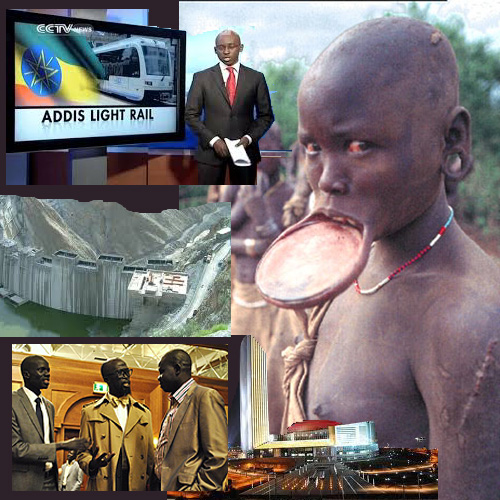
oldafricafallingfastHow fast and hard is ancient Africa falling? Take a look at Ethiopia.

Ethiopia is the only country in the entire continent of Africa that was never colonized. It was occupied for almost three years by Mussolini during World War II, but save that short episode it has had an indigenous rule since prehistoric times.

In fact, there may be few other societies in the world except parts of China and Japan where this is the case.

Geography is the main reason. The country is bordered by seas, deserts and mountains, effectively walling it from the outer world. This safety and isolation has led to a fascinating indigenous language, musical scale, methods of counting and cultural foundation unlike anything else in the world.

Only Christianity was able to penetrate the closed Ethiopian society, and because it was done so early, Judaism as well worked itself into ancient practices.

The isolation kept Ethiopia ancient throughout most of my life time. But that’s changing, and now changing fast.

And when any society changes as fast as Ethiopia is, there’s turbulence, and given where it’s headed to where it’s been, it’s mind blowing.

The violence of the overthrow of Haile Selassie was unbelievable. The Reign of Terror which followed was one of the most brutal regimes in contemporary history, and the wars with Eritrea and minuscule moves towards democracy have been agonizing.

Today Ethiopia plays with democracy but is one of the most autocratic regimes in Africa. It is also one of the most stable and most productive.

There is only one opposition member of Parliament. There are more local journalists in prison than publish each day in Addis. The current prime minister, Hailemariam Desalegn, succeeded Meles Zenawi who was in power since 1995 until his death in 2012, and between the two of them they have constructed the most powerful totalitarianism in modern times.

The centerpiece of the country’s modernization policy is the ironically named “villagization” of the country, which Human Rights Watch calls “Waiting for Death.” Through massive relocation of its peoples, Ethiopian planners expect to create a more workable, productive society.

“Modern Ethiopia is a paradox,” writes David Smith in London’s Guardian newspaper this weekend. Smith is amazed that only a generation after the famine that killed more than a million people, Ethiopia is now hailed “as an African lion because of stellar economic growth and a burgeoning middle class.”

More millionaires are being created in Ethiopia annually than anywhere else in Africa. Addis Ababa, once a quaint and isolated capital known mostly for its antique silver jewelry, has today skylines with Chinese office skyscrapers and modern highways.

Advancements in agriculture developed here may actually be winning the war against desertification and prompted the IMF and World Bank to underwrite what will become Africa’s largest dam.

The scale of this dam and other feeder dams is destined to produce more electrical power in Ethiopia than exists today in all of sub-Saharan Africa down to South Africa.

And all of this rapid modernization forged by an incredibly repressive government threatens to ignore to the point of not preserving many of the beautiful and unique practices of the ancient world.

I recall traveling to a remote region of Ethiopia in the late 1970s to visit the Mursi people, and I continue to refer to that trip as one of the last I ever made where I felt I truly saw Africa in prehistoric times.

“They know that they are practically finished”, William Davidson of Think Africa Press says regarding the Mursi today.

“Their way of life, their livelihood, their culture, their identity, their values, their religious beliefs – all this is being rubbished by a government which sees them as ‘backwards’ and uncivilised.”

There’s nothing wrong with modernizing Africa. But boosting the speed of development at the expense of human rights is wrong. And doing it so fast that valuable connections with the past are lost forever isn’t particularly enticing either.

What’s the point in farming better turkeys if done at the expense of celebrating Thanksgiving?

Watch Ethiopia. Watch the “brave, new world.”

EWT’s Kathleen Morgan leads a comprehensive trip to Ethiopia late this summer. For information call Kathleen at 800-672-3274 x204.

An Ugly Goose

An Ugly Goose

814 goldTanzania has some of the largest deposits of gold, uranium and other precious metals in the world, and Tanzania is one of the poorest countries in the world. Go figure.

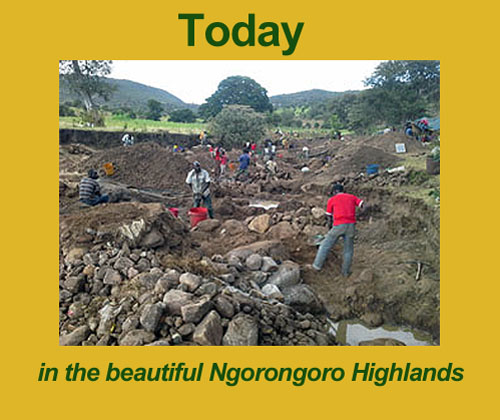
And now, they’ve found gold in Ngorongoro. The rush has begun.

For the last month rumors have grown out of one of the most besmirched areas of the country, the far northeastern area of the Ngorongoro Conservation Area, that there was gold in them thar hills.

At first it was put aside as just another “Wackie Waso.” Waso is one of the larger towns in the area where several years ago “Babu,” the Lutheran pastor turned herbalist, began dispensing a brew that reportedly cured everything from diabetes to AIDs.

Lots of people raced to Babu, literally in the thousands from as far away as the Emirates. And lots of people died.

The area is just south of Loliondo adjacent the Serengeti and due north of Olduvai Gorge. It’s been in all sorts of controversies in the last several years, including a main stop on the proposed Serengeti Highway.

This is a rich agricultural area with a rapidly growing population. The place has all the makings of a real “Wild West” community.

So when gold was reported in a seasonal stream about a month ago there were two distinct reactions: run to the place or laugh. The government tried to stem the tide, but to no avail. The rush is on.

Reports today have more than a thousand individuals panning a stream hardly a kilometer long that at its best is 2 meters wide.

Yet this week government agents confirmed it is gold. Not surprisingly, authorities announced that they would not allow any major commercial exploitation, but let the local people “enjoy the windfall.”

That may strike outsiders as strange, given how valuable a real streak of gold could be to a poor country. But Tanzania already has the world’s second largest seam of gold and has been trying to benefit from it for the last 15 years.

The Lake Victoria gold mines have been a mess for years. Mismanagement, corruption and lack of security have meant that Tanzania has been unable to benefit from what is clearly Tanzania’s greatest single “pot of gold.”

According to this week’s Arusha Times, government experts “verified that the mineral being scooped in Samunge is actually gold, but that should just be windfall for the residents of the surrounding village as well as other artisan miners because the government won’t allow large conglomerates to start excavating the newly found treasure.”

Woe is luck. Without good commercial exploitation, the Wild West Samunge Gold Rush will make a couple folks rich but most of them just miserable, especially children.

The continuing inability of Tanzania to get it together and benefit from the luck of being one of the richest natural resource countries on earth is enough to start a revolution.

But the days just go on and on. A few politicians and disreputable businessmen get rich from time to time, and the masses race for seasonal rivers in them thar hills.