Corrupted Index

Corrupted Index

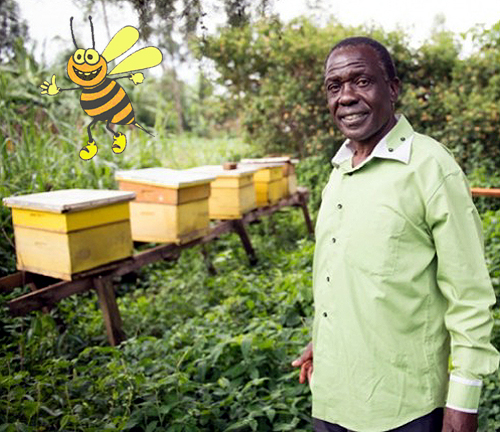
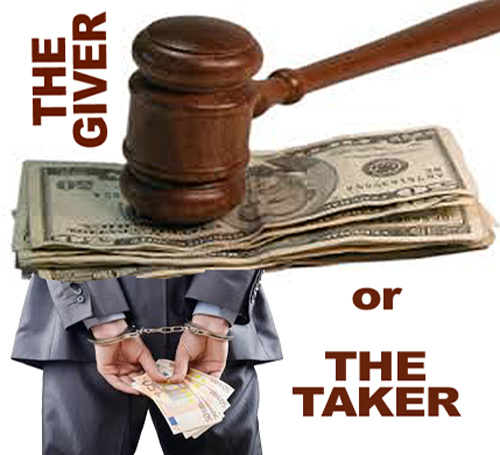
giverortakerTransparency International’s corruption index for East Africa is depressing, not wholly accurate and therefore more depressing, and becoming increasingly irrelevant.


The index
was released this week and the analysis of sub-Saharan Africa differs little from last year in the aggregate: Africa is still the most corrupt place in the world, and East Africa is among the worst in Africa.

Notable is that Kenya has dropped even further to the bottom (now below Nigeria) and that Tanzania ranks much higher than I think it should. Also notable and unchanged is the positive rating given Rwanda.

The index is a summary of up to 8 other organization’s assessment of a country’s corruption. Several of these are massive and well known institutions like the World Bank and African Development Fund.

Others, like the Bertelsmann Foundation and Political Risk Services International Country Risk Guide are less well known and I think lack some serious credibility. They are often regionally specialized or carry certain political and ideological biases (mostly towards capitalism and oligarchical democracy).

Nevertheless, I think the index as a general tool works. This year, however, it doesn’t work so well for East Africa.

Before I sound like an apologist for evil, there is no question that Kenya is still seriously corrupt. The most recent, egregious scandal to go public emerged last month when a British court revealed huge bribes paid to Kenyan officials for printing documents like … ballots.

This specific story points perfectly to my criticism of TI’s index.

Britain, listed by the index as lily white at 14th of the 176 countries analyzed, is essentially the facilitator of Kenya’s corruption, listed by the index as the dismally 145th.

In other words, if British printing companies didn’t pay corrupt Kenyan officials, then at least in this case there would be no corruption.

Add to this that in many countries, including Britain and in certain cases in the U.S., paying bribes isn’t illegal.

In still another misleading way, Rwanda is shown as the outstanding 5th best of Africa’s 50 analyzed countries, and that may indeed reflect less bribery for ballots. But Rwanda’s insidious support of militias in The Congo is doing far more to destabilize Africa and the world than Kenya.

The irritation I feel leads ultimately to the definition of corruption. It took an Act of the U.S. Congress (the Dodd-Frank Act), numerous judicial appeals and even global litigation to stop Apple from funding Congo warlords through black market schemes perpetuated by Rwanda.

It took a simple UK court to reveal the three Kenyan idiots who took bribes for a single act of corrupt printing. And then, it stopped.

Which is the more egregious? Well, the first sustained a generation of war and millions of deaths and millions more starved and tortured. The second?

I’m not condoning the second, I’m suggesting that TI’s index can lack relevancy.

I am also mystified at how Tanzania improved so much this year, even though the European governments for the first time ever suspended their aid because of growing evidence of corruption, there.

It would take time, but I think a good Ph.D thesis in economics would reveal that TI’s index is linked to economic performance, which does not reflect clean governance.

So overall I accept TI’s assessment that not much has changed in Africa vis-a-vis the world as a whole as regards corruption and good governance.

But enter the details and we might be discovering a very corrupted analysis.
Bad Ebola Cancellation Policy

Bad Ebola Cancellation Policy

badvacationThings are calmly down, slides in travel are reversing, and African tour companies are once again shooting themselves in the foot.

In the last ten days a wave of African travel companies have issued new cancellation policies addressing a perceived fear by potential travelers of ebola, which does absolutely nothing except increase fears.

As far as I can tell it began with one of southern Africa’s most reputable and larger companies, Wilderness Safaris.

Wilderness is a holdover from archaic marketing days and still doesn’t sell directly to the consumer, so it sent a rather petulant email to agents worldwide that began by deriding the notion that ebola in West Africa could effect holidays as far away as East and southern Africa.

But then sighing through the internet, the company issued a new policy that said it would cover any difference in lost cancellation fees from nonrefundable payments not refunded by the travelers own insurance company.

Sounds pretty good, doesn’t it? It didn’t take long for a whole bunch of companies throughout the continent to follow suit.

It’s meaningless – at least for Americans – and in my opinion is totally counterproductive.

First, why it’s meaningless:

Read the revised policy’s fine print. (1) WHO must declare an “outbreak” in the country in which the safari is scheduled. (2) The traveler must then apply first to his own travel insurance company for refunds of monies on deposit. (3) Whatever the insurance company doesn’t cover, this widely adopted policy will not refund cash but rather a credit for future travel, which is limited by time and other conditions depending upon the specific company.

(1) There is currently much more ebola in the United States then in any sub-Saharan country. WHO has not declared an “outbreak” of ebola in the United States. That is a strategic-specific term that precedes an actual “epidemic” and it requires multiple cases in multiple locations. So to begin with, a single case say in a game park in South Africa will not trigger this policy.

(2) I’m not completely knowledgeable about the travel insurance available to other than Americans, but in the United States there is not a single travel insurance company that covers a travelers’ decision to abort their trip because of ebola or any other public health emergency. In the U.S. normal travel insurance provides benefits strictly for accidents and other health conditions befalling the traveler him/herself.

(A few very expensive policies cover terrorism, and consumers can spend an enormous amount of money for “cancel for any reason” but for most travelers these rare policies are prohibitively expensive.)

In other words, normal travel insurance bought in the U.S. will not provide benefits for a public health emergency in the country scheduled to be visited.

Refunds of part of your deposited trip, and not others, essentially mute out the first refund: Few Americans traveling to Africa will deposit on a trip there without also buying their air fare. There is no indication whatever that any airline will issue any refund for a travelers’ decision to cancel because of a public health emergency.

(3) As most established travel agents and operators worldwide know, most local African companies are quite liberal in extending nonrefundable date-specific services for almost any reason. In other words, most travelers are able to reschedule their previously deposited trip to a later date with no penalty for any reason, much less ebola.

For Americans, then, there is absolutely no benefit whatever from the newly expressed policies.

Most American consumers are a bit more savvy than Africans believe their geography quotient may be. I think most consumers will see this for what it is: a marketing gimmick. Gimmicks don’t help sales.

Consumers who consider the policy more substantial than a gimmick will actually be further deterred: Creating policies that on their surface seem beneficial to the potential traveler only if an outbreak actually occurs suggests that company is conceding that an outbreak is possible.

When the risk is nil. Consider that several of the last ebola outbreaks occurred in Uganda, a popular East African safari country. It never turned into an epidemic, and Uganda’s health-care system countrywide is below average compared to most other sub-Saharan countries.

Consumers – especially in America where two of its largest cities now have had locally developed ebola (Dallas and New York) – are recognizing however slowly that sub-Saharan Africa is actually less risky to visit than the Cowboys’ new stadium or the Statue of Liberty.

African travel companies have always been a little bit behind the times. This stupid policy does nothing but reignite irrational fears.

Ebola’s Surprising Effect

Ebola’s Surprising Effect

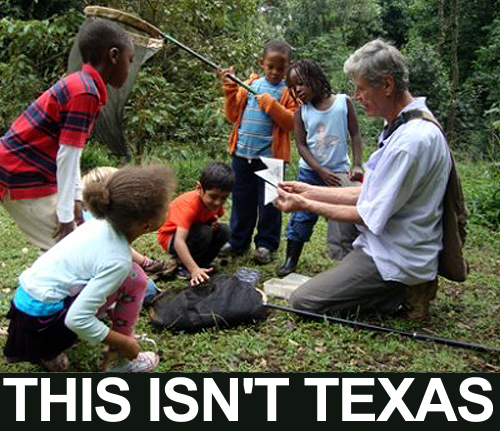
thisisnttexasThis ebola epidemic has a surprising effect: Americans are wondering if Africans have it better.

Most Americans’ live styles are much better than their counterparts in Africa, but what about the change from year to year? Americans believe they aren’t getting better. Africans by a wide margin believe they are. Both are right.

It’s only a matter of time before Africans feel they are better off than Americans.

Nigeria and South Africa both had ebola patients come to them from the infected areas. One Nigerian ebola patient infected one of the hospital care givers in Nigeria. Both the patient and the care giver were cured. In South Africa no transmission to health care workers occurred. Both South African and Nigeria are today “ebola-free.”

Texas isn’t.

So why is the American future pessimistic compared to the African future, and why is ebola being better contained – outside the three-country infected area – in Africa than America?

I’ve got one answer: school field trips.

School field trips in Kenya are on a massive increase; trips in the U.S. way down.

According to Education Next, “Museums across the country report a steep drop in school tours… A survey by the American Association of School Administrators found that more than half of schools eliminated planned field trips in 2010–11.”

For example, the Field Museum in Chicago has lost a third of its annual school visitors, as has the Cincinnati arts organizations.

I’ve got another answer: declining infrastructure.

The title of the Council on Foreign Relation’s new report on American infrastructure, “Road to Nowhere,” says it all.

Infrastructure is booming throughout Africa. I can’t believe my eyes when I’m absent from Nairobi for more than a couple months: another highway, another factory, another rail line…

Here’s another answer: American protection of human rights is on the decline. While human rights is still on the whole better in America than in Africa, America is getting worse while some parts of developed Africa like South Africa are getting better.

The Human Rights Risk Atlas for 2014 lists America at 139 of 197 countries, or a “medium risk” of human rights abuse.

It’s possible to go on and on down the list of what governments are supposed to do: build roads, educate children, protect human rights. By so many metrics, even the simple metric of stopping the spread of ebola in a hospital, America isn’t doing so well.

While much of Africa is getting better.

But this should come as no surprise. Social investment in education, infrastructure, even the money we spend on courts and judges, is shrinking.

I once thought it impossible that in my life time any African country could achieve some kind of significant metric that bettered America.

I’m not so sure, anymore.

When Night is Day

When Night is Day

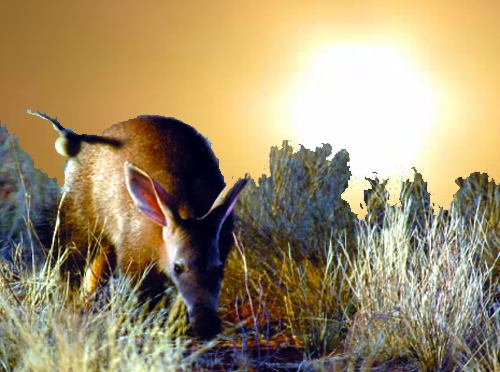
aardvarkinsunAnecdotal evidence that global warming has caused a decline in African animals is slowly but surely being confirmed by field science.

No one argues that Africa abate its growth, and it comes as no surprise that this growth is directly linked to global warming. Industry is mostly fired by fossil fuels: CO2 heats the atmosphere while more wealth builds Africa.

The immediate benefits to Africans are indisputable. But the ecology of the continent is suffering greatly and more quickly than we ever imagined.

The World Wildlife Fund’s “Living Planet Report” contends that nearly half of the world’s animal species have been lost since 1970.

This is beyond astounding. My children’s children will have a planet with only an eighth of the animal species around when I was born.

One irony for African wilderness is that some of its better known areas, like East Africa with its great national parks like the Serengeti, show visibly improved biosystems. This, too, is directly linked to global warming.

The great East African wilderness lies on the equator. One of the effects of global warming has been increased rain as the melting of the poles increases ocean levels and precipitation worldwide. One result in part coupled with an early management approach to the Serengeti has been to nearly triple many of the larger animal species like wildebeest and zebra.

But move hardly 200 miles north or south of these equatorial wildernesses and the story dramatically changes.

Increased global precipitation is not falling equally across Africa or anywhere else but as torrents as extreme weather events even while global warming burns deserts into many other areas.

Global weather has become a nightmare, as the American Meteorological Society recently documented. The band along the equator seems to be handling this pretty fortuitously, but nowhere else.

Travel south and wildlife populations in places like Kruger National Park, the Okavango Delta and many private reserves are falling precipitously.

While elephant populations in East Africa are probably too large, in southern Africa they’re dangerously small. Buffalo and other large herding animals like eland are declining, and rarer antelope like nyala, sable and roan are also in decline.

Exact science on large animal decline is difficult, because much of it is human caused through poaching. But go down a notch to slightly smaller animals, and the science is becoming compelling.

An excellent indicator species is the anteater, or aardvark. A study recently concluded by scientists from Johannesburg’s prestigious Witwatersrand University claims that only animals whose behavior can accelerate adaptation will survive.

“Many species will not be able to evolve fast enough to adapt to the rapid rate of current climate change… most large mammals simply don’t reproduce quickly enough to allow for adaptive traits to be selected,” the report explains.

Aardvark are the focus of the study not just because of demonstrable changes in their own behavior, but because so many other endangered animals depend upon them.

The report found that aardvark are trying to adapt their behaviors to an increasingly hot and dry environment caused by global warming.

In one astounding finding, the scientists show that aardvark are now foraging in daylight hours as well as through the night as usual. It had previously been presumed that their eye physiology would not allow this, but as their food sources dwindle they’re forcing it.

The unstated implication is that this won’t work in the long term, and that eye physiology will stop any long term behavioral change.

Aardvark holes are used by scores of other animals and birds, and as the number of dens decline so will populations of anteater chats, porcupine, warthog, pole cat, meerkats and others.

The WWF report focuses heavily on human/animal conflict as probably the single greatest factor effecting the planet’s decreasing biodiversity. This is certainly, for example, the reason lions are declining so quickly continent wide.

But studies as those from The Wit on aardvark complement this understanding with recognition that as adaptive as world creatures are, behavioral adaptation will simply not be quick enough.

The WWF along with many other organizations believe there is a path out of this through management of global warming with the technologies like solar energy that we already possess.

I don’t see it. Frankly, I can imagine a future world adequately under control for human development. But I just can’t see a path that will retain our current magical biodiversity.

Delta Destruction

Delta Destruction

DeltaDestructionThe battle between fossil fuel mining and the environment has moved into Botswana’s main tourist attraction, the Okavango Delta.

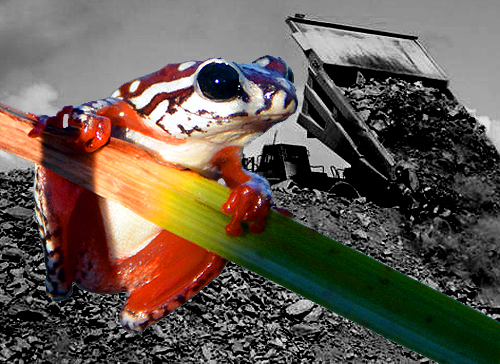
The photo above of a painted frog was taken by EWT client, Melissa Michel, this year. The background of a mining waste dump is compliments of Rio Tinto.

Tourism in the Okavango Delta is the second largest source of Botswana’s GDP, after mining (which dwarfs it, by the way: 40% vs 12%).

Exact figures are hard to confirm, because the government has not defined how government and ancillary industries like educational training and direct contributions contribute to or diminish the tourism and mining sectors. But clearly mining is 3 to 5 times as important as tourism.

Historically most of this was with diamonds. Botswana is the world’s largest diamond producer, but several years ago the government recognized that “diamonds aren’t forever.”

This led to increased fossil fuel exploration and bingo, there’s a lot of it. Relative to diamonds, coals lasts forever.

The largest Botswana owned company, Tsodilo, listed on the Toronto stock exchange, recently announced plans to mine more than 440 million tons of iron ore, and with less fanfare, a rather sizeable amount of coal.

Botswana’s chief mining official said that Rio Tinto, the world’s largest mining company, would be the principal in coal extraction.

“The future of Botswana mining is going to be the coal and iron ore resources…,” he said before adding as an afterthought, “and of course diamonds.”

Botswana is already the 65th richest country in the world. This will likely push it up further.

Unfortunately, much of the iron ore discovered is underneath or close to the Okavango Delta.

Although Botswana has a variety of big game habitats, it is the Delta which is the draw. Unique on earth, it’s where a desert seasonally floods. This produces extremely unusual habitat as well as major deterrents to human settlement.

Over the eons vast numbers of endemic species have arisen in The Delta, many which remain to this area alone. These are mostly plants, amphibians and fish, but the area is also outstanding for more notable, rare and larger animals like sitatunga and wild dog. Many water fowl absolutely depend upon the Delta and many are extremely rare, like the Wattled Crane.

The world’s growing appetite for fossil fuels is as undisputed as the fact that most of them will come from Africa.

Why should Botswana be denied compromising its ecosystem for greater wealth, as Alaska and California did big time last century?

The answer is usually that the world’s just come too far. Time is not on their side, as it was with the Rockefellers and early gold diggers: The global warming apocalypse takes precedence.

That’s such a subjective argument it falls on deaf ears in Africa. South African environmentalists, however, are trying more clever answers.

Winner of the Goldman Environmental Prize, Desmond D’Sa recently explained that the argument that mining will “create wealth for the people” was fallacious. “We’ve seen the mining industry in South Africa, hundreds of years, has created impoverishment and poverty… The majority, the 99 percent of us in the country, are poor, are living in abject, poor conditions.”

And that’s true and compelling … for the instant. But what happens if – as many of us hope – this changes and there is a real redistribution of wealth? Like in China?

Reversing the world’s poverty is going to take a lot of industry. Protecting the unique ecosystems under which that industry is fired will be no small task.

Tired World Invites Strongmen

Tired World Invites Strongmen

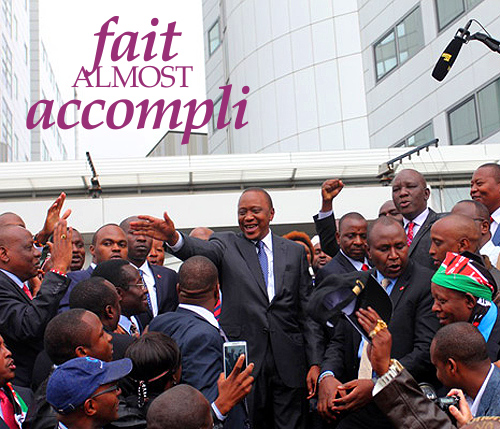
faitacompliKenya’s battle with the World Court is the perfect example of how global institutions are losing relevancy in an increasingly conservative world.

Around the world and especially in Africa societies are becoming conservative and authoritarian. Oligarchies are consolidating power. Minorities are growing submissive. Particularly in Africa this means the Strongman reemerges.

Uhuru Kenyatta is such. Very much like his father, Jomo Kenyatta, the country’s first president for 15 years until his death, Uhuru has masterfully consolidated his power to the point that he is almost invincible.

Kenyatta isn’t quite yet the benevolent dictator like his father, but I imagine after the next election he will be. Afterwards, subsequent elections will be fairly meaningless or simple window dressing.

The reason this is happening is for the same reason it started this way at Independence. Turmoil is considered more expensive and damaging than the increased opportunity that might be unleashed by movements like the Arab Spring.

Kenya under the current Kenyatta has prospered by the geopolitical metrics of economy that seem to govern the world. The World Bank projects 4.7% growth this year, and increasing growth in the years ahead.

While this is down from a few years ago, it’s impressive when you consider the challenge of the Somali War. As that successfully fought war continues positively the literally hundreds of thousands of successful Somali businesspeople in Kenya return to Somali causing a drain on growth… for good reasons.

Kenya’s education and health care policies are among the most progressive in Africa. Womens rights are more progressive in Kenya than almost anywhere elsewhere in Africa except South Africa, and were it not for the highest people in the current administration (e.g., Uhuru Kenyatta) the LGBT community would likely be facing as horrific oppression as it does in neighboring countries like Uganda and Rwanda.

But Human Rights Watch, like me, equivocates Kenya’s appearance of progressiveness with its patent immoralities and lack of democratization.

The Kenyan government under Kenyatta has systematically undermined the World Court’s prosecution of Kenyatta and his Vice-President. The evidence that existed two years ago, collected by the World Court, was damning: Kenyatta was guilty of crimes against humanity. It was eventually how he came to power.

But since he’s been in power the dozen or so witnesses, many of them in witness protection programs in Europe, recanted or disappeared. Pressure on their families back home seems to have been the reason.

So now, there is no evidence. Without evidence, there’s no case.

Yesterday, Kenyatta returned jubilant from The Hague. It’s likely the last time he will go there.

While ICC prosecutors are arguing for various censures of the Kenyan government for its lack of cooperation, other Heads of State in Africa are rallying behind Kenyatta. If the ICC fails to relent, Africa as a whole might leave the ICC.

The many global institutions like the ICC which appeared last century to guarantee the human rights of all global citizens now seem almost irrelevant.

Within Kenya police power has exploded exponentially. Summary arrests and neglect of existing laws protecting the innocent like habeas corpus are routinely ignored. More and more there seems to be only a single authority: Uhuru Kenyatta.

And yet that seems to be what if we dare generalize the “Kenyan public” wants, even those who are theoretically in the opposition.

Stability, however unequal, rules the day.

I think it’s public fatigue. War fatigue, election fatigue, countless fatigues that were so promising only a few years ago but proved futile by today. The world, for whatever underlying reasons, is moving away from freedom in order to avoid conflict.

Of course it’s true here at home, too, as well as Kenya. By the way, yesterday China became the world’s largest economy.

The Curse of Apathy

The Curse of Apathy

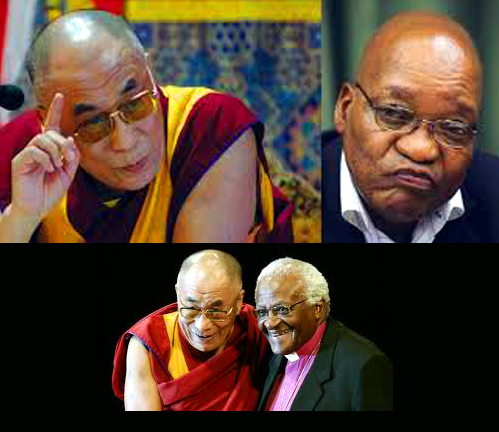
dalai&saIn an incredibly sycophantic move, South Africa’s president Jacob Zuma has denied the Dalai Lama a visa to attend a convention of living Nobel peace prize laureates in Cape Town.

The convention was supposed to begin a week from today, but Late last week the laureates announced they were suspending the October 13 get-together and relocating to a yet unnamed country.

Cape Town Mayor Patricia de Lille said her government “has embarrassed the country.”

The laureates decision not to go to Cape Town followed the South African government’s refusal to elaborate on why the Dalai Lama was not given a visa. Fourteen of the 21 laureates sent a letter to President Jacob Zuma asking him to reverse his decision.

The initial decision to hold the convention in Cape Town, which would have been the first time in Africa, was a coup for the wildly popular Desmond Tutu, himself a Nobel laureate, who was instrumental in ending apartheid.

The ending of apartheid was the reason that Nelson Mandela, and at that time the president of South Africa, Willem de Klerk, shared the 1995 prize.

“I am ashamed to call this lickspittle bunch my government,” Tutu said in a statement.

This is actually the third time that the Dalai Lama has been denied a visa. The last time was for Tutu’s 80th birthday celebration.

China and South Africa have a very close relationship, and interestingly, it is less because of aid and investment than trade. South Africa is China’s leading trade partner in Africa.

China has publicly promised to lobby for more power in the UN Security Council for Africa. Given the political turmoil in Africa’s other powerhouse countries, Egypt and Nigeria, any such aggrandizement would likely benefit South Africa.

China has often snubbed the world prize, as a number of prominent and usually dissident Chinese have been made laureates.

Most Chinese believe it is a political tool, and as such, South Africa’s president’s refusal to embrace it should be seen as strictly political, say the Chinese.

One might also bring up sour grapes. Jacob Zuma is one of the most corrupt and least loved of South Africa’s big man politicians. Many in the country wonder how he has managed to stay in power.

He’s received none of the multitude of accolades and awards that many of his comrades-in-arms against apartheid, like Mandela and Tutu, have.

What perplexes me is how younger South Africans don’t seem to care to the extent I thought they would. Their lives are getting better, however incrementally, but key economic indicators like the spread between the rich and the poor is growing.

I suppose like at home, war fatigue has spilled over into political fatigue. Your average Joe has become exhausted by being fed up.

And so long as things on a day-by-day basis don’t seem to get worse, major if immoral power policies leading to oligarchical control just don’t raise enough ire.

It’s called the curse of apathy.

When Wrong is Right

When Wrong is Right

whenwrongisrightImagine Ray Rice walking into court followed by Eli and Peyton, Adrian Peterson, a few veterans like Mike Ditka and then a couple hundred high rolling NFL fans.

He’d be saying, “Some people think I did something wrong. Maybe I did. But I had to,” or maybe not ‘I had to’, rather “They understand why I did.”

And that understanding spans the gamut from being cuckoo to especially stressed. And in any case, it’s acceptable because, gdi, we need that guy playing the game!

And … he wouldn’t have done it, if he didn’t have to.

And since that “have to” spans the same gamut from being cuckoo to especially stressed, we get in a loop that we can’t get out of.

This is exactly what’s happening with the President of Kenya.

Next week President Uhuru Kenyatta will leave the Nairobi airport surrounded by probably hundreds if not thousands of cheering supporters for The Netherlands, where he’s on trial for crimes against humanity.

Whether World Court officials will allow his entourage to enter the vaulted halls of the ICC with him, he will be accompanied to the portals by at least four other Heads of State, maybe more, and by more than 100 elected Kenyan members of Parliament.

The facts in Kenyatta’s trial have come out in the press, mostly, since important witness after important witness has been so intimated that they’ve dropped out or disappeared. So now the spent prosecutors at the World Court have little facts left to present.

The facts as most of us believe them but which have not been able to justly be presented in court are pretty simple. The national election of 2007 was close. The current head of Kenya’s opposition from its second largest tribe, Raila Odinga, was neck and neck with the then president of Kenya running for reelection, Mwai Kibaki. Kibaki was a Kikuyu, the largest tribe and the tribe of Kenyatta.

Kibaki was old, Kenyatta was young. Kenyatta’s father, Jomo Kenyatta, is the “Father of Kenya” and its first president.

Widespread violence followed the election and the country was brought to its knees. Almost 1500 people were killed in horrific violence and a quarter million displaced, of which dozens of thousands remain so today.

There were absolute differences in ideology clashing, but the violence was tribal.

The settlement forced on Kenya by Britain and the United States was brilliant. Kibaki and Odinga shared power for almost five years. During that time a new and fabulous constitution was adopted.

The settlement required Kenya to determine the cause of the violence and prosecute those responsible. The settlement went further: Kenya had a certain window of time to attain this justice, and if it failed, then the World Court in The Hague would step in to do the task.

Kenya failed. Parliament tried several times to create courts and procedures for this most important attempt at national justice in its history, but at the end of the day, an invitation was sent to the World Court.

The World Court did not really want to do this. No indictment for crimes against humanity had been issued before the court was invited by Kenyans to start searching. Normally, the court issues indictments, as it did in Liberia for example, in response to individual petitioners. There were no individual petitioners with individual grievances from Kenya. The Kenyan Parliament invited The Court to take over, and it said, OK.

When it finished its several years of investigations, fully supported on the ground in Kenya by Kenyans, indictments were issued.

One was against the country’s current Vice President. The other was against Uhuru Kenyatta.

We know from leaked testimony and tapes that Uhuru Kenyatta, then a powerful political leader and Member of Parliament, organized and managed partisans in widespread murder and thuggery of the rival tribe.

This is against the law. It’s a crime against humanity.

But Kenya is doing pretty well, right now. Like all the rest of the world, the happiness and prosperity is happening mostly at the top, but the social fabric is peaceful. An unexpected war in Somalia, thrust upon it mostly by British, French and American interests, is not easy, but Kenya is handling it pretty well.

Skyscrapers are popping up all over. Roads are being built faster and better than in the U.S. Business was booming and is now humming along pretty well.

Even President Obama sat with Uhuru in the White House.

Like Rice, maybe he did do it. But take Rice or Uhuru out of the spotlight, out of their circles of power, and what happens? The team loses, and we just can’t afford that.

How Can I Help You?

How Can I Help You?

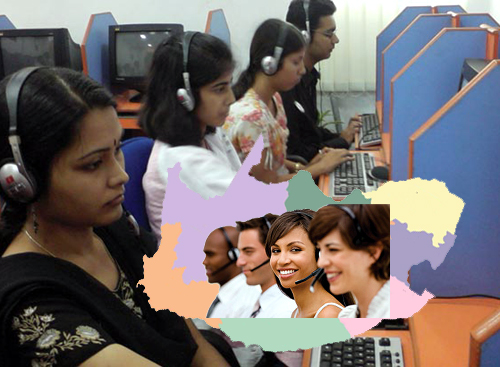
indiavssacallcenterReady for someone at the Help Desk to really help you, maybe even in English? It may happen, and you’ll have South Africa to thank!

Huge grants from Microsoft and the Rockefeller Foundation among others are working their way through the South African system to help its worldwide call centers grow quickly enough to meet demand.

South African call centers are the Dyson vacuum cleaner in the consumer help desk market. Their quality is unrivaled, but their expense is high and as a result for years their growth has been anemic compared to major rivals like India.

The reason is pretty simple: The South African per capita income is nearly three times that of India ($11,500 compared to $4,000 according to the World Factbook.)

The metric is useful because it translates almost exactly into what a call center in one country costs versus on in a different country, including the largest single component of cost, salaries.

But in the last few years, American companies in particular have begun to react to bad reviews of their call centers.

“Consumers are fundamentally unhappy with the state of customer service,” a widely cited April survey of call centers concluded.

You knew that! Purdue University discovered this more than a decade ago: Poor call centers more than halve an otherwise expected product repurchase rate by a consumer (78% vs 32%).

Nevertheless, the cost savings of a distant land’s call center for the last decade were actually considered more important. And since virtually all of your competitors were doing the same, the sting was spread around and diluted.

That was the case … until a few years ago. The consumer public simply started to get fed up. Competitors emerged from the Great Recession with cash reserves, and better call centers seemed a promising sales point.

In walked South Africa.

South Africa has had a vibrant call center industry for more than twenty years. But it’s never been large, because it’s been expensive. Roughly 30,000 individuals have been employed rather steadily in these centers.

Suddenly, demand exploded.

“We have [lately] had to focus more on skills development than on marketing,” a leading spokesman for the industry recently told South Africa’s Financial Mail.

In other words, not enough employees available to work.

The pace at which global companies are now requiring better service from their call centers surprised the South African industry. Demand for South African centers now requires nearly 60,000 employees, or twice as many who are currently trained.

As a result, the industry is now poaching employees from the hospitality industry. Pay as a consumer visible employee in areas like hotels has never been high in South Africa, so the fit seems good.

And helping out are the American companies who prefer the South African worker to the Indian worker. Microsoft’s huge grant may be self-serving, but the Rockefeller grant is more general.

The half million dollar grant from the RockefellerFoundation is specified strictly for the training of disadvantaged youth.

And call centers are actually coming back to the U.S. In a perfect example of a capitalistic world that for once seems to be working, a major Indian call center company recently announced opening up a call center in Dallas that will employ 1,000 people.

Of course while the U.S. per capita is more than three times South Africa’s (which as stated is more than three times India’s), the per capita income of Texas’ working poor isn’t impressive. Another way of looking at it is that Texas is as “profoundly” rich as India. That’s why India is coming to Dallas and not to San Francisco.

So for the time being, the entre is open to South Africa. And frankly, with the highest child poverty rate in America in Dallas, I think I’d rather opt for a South African kid from Port Elizabeth telling me how to reboot my system than a roper from Ft. Worth.

African is Better? Really?

African is Better? Really?

robobeastHere are some wild South Africa inventions, useful and artistic, which in many senses reflect a creativity we often lack in the U.S.

It’s been a long time since foreigners thought of South Africa as a Tarzan abode. The country was prominent and controversial in both world wars, stubborn then creative in subduing its nuclear technology to world treaties and rocketed to fame when the first heart transplant was performed.

Today’s South Africa creativeness is still high tech but there’s a wonderful peasant component that’s emerging as millions of Africans begin to emerge from abject poverty.
wonderbag
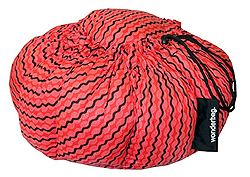
The purely South African invented “WonderBag” has proved so popular worldwide it is now available from Amazon – US.

This is a slow cooker for everywhere! Its unique design and astro-fabric produces a heat retention that hasn’t been cheaply available before. Essentially this is a tea cozy for your stew pot, and it works!

The cooking process starts normally in the pot. But rather than continuing the process on the stove or in a slow cooker once the stew or beans or potatoes have reached a boil, the pot is firmly sealed then tugged into the WonderBag and slow cooking begins.

With typical sour grapes, some American product reviewers have claimed the WonderBag is dangerous. It isn’t.

Claims that the bag’s temperature retention is poor are totally unsubstantiated and anecdotal and ignore the fact that you’ve got to boil your stew for a few minutes before promptly sealing it in the pot before bagging. If done to instruction, bacteria are doomed and slow cooking sweetness guaranteed.

encoreSo successful it’s now been enhanced and globally marketed by a British company, the very South African Encore Player was originally designed just as a portable radio but has become a recorder and phone charger in its global iteration.

But the genius of the device lies in charging itself by an extendable solar panel! The panel is brilliant enough to charge the device so that it can then charge your phone!

I left the best for last: what may be the world’s most useful 3D Printer.

Precise to 100 microns, the RoboBeast is an entirely South African creation that brings 3D printing to affordable levels with enormous precision.

The 3dprint.com review site calls RoboBeast “Toughest Printer By Far.” It’s also among the very cheapest, available for around $2500.

indexThese and bunch of other great recent inventions can be found at the South African blogsite, sa-venues.com.

Thanks, South Africa, for putting a smile on life’s curiosities fulfilled!

Hands Off is Hands Dirty

Hands Off is Hands Dirty

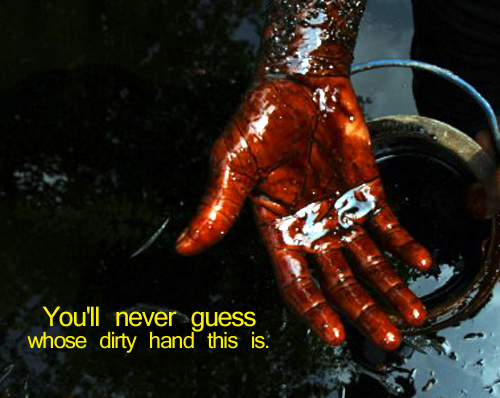
gettinghandsdirtyYou’d never guess which respectful country in the developed world contributes to ISIS’ ability to fund itself through oil revenues.

It’s been an interesting week in the War on Terror and of all the bad news playing out another Groundhog Day movie history came one new glimmer of hope: the global conversation turned a bit towards financially starving the adversary rather than bombing it to smithereens.

From 2011 to 2013 African oil producing countries earned $250 billion from their oil sales, a staggering 56% of their entire national revenues, 2.3 billion barrels of oil.

But nobody is quite sure where all that oil went, or who exactly got paid for it.

That total lack of transparency in the global oil market is exactly why ISIS can sell oil, and probably salt and peanuts, to fund its nefarious world.

“The sale of crude oil by governments and their national oil companies is one of the least scrutinized aspects of oil sector governance,” wrote AfricaFocus in a special report published several weeks ago.

The report documented as far as it could 1500 major oil transactions from African countries in the 2-year period starting in 2011.

The initial findings that record keeping was intentionally poor in order to blur bribes, and that the worst part of record keeping was that the destination of the oil sales was rarely known were not surprising given the level of corruption in the developing world.

What was surprising is what country facilitated this lack of transparency more than any other.

Switzerland.

“Of the 1,500 individual sales we identified, Switzerland-based companies purchased a quarter of the volumes sold by African NOCs, buying over 500 million barrels worth around $55 billion.”

These are not well known companies: Arcadia, Glencore, Trafigura and Vitol are among the most often mentioned. Reuters called these company’s transactions “shadowy.”

They are not companies with super tankers or refineries or thousands of employees. The largest, Arcadia, doesn’t even have a website. They are usually single billionaires trading in commodities and using Switzerland’s lack of regulation and transparency laws to buy with bribes and sell in darkness.

We often think of Switzerland as a placid meadow where everyone respects everyone else and minds their own business and so doesn’t need much governance.

Wrong.

In this case the shy Swiss are extraordinarily evil. And I’m not saying the individual billionaires running the unseen commodity trades are the evil ones. They’re just the players.

The evil is in the system, a system that says, ‘Hey, do what you want! Just don’t break any laws!’ particularly when there are no laws to break.

The funding of ISIS is wrong, but so is the fact that a handful of Swiss fund a huge percentage of Africa without any strings attached. This foments corruption, and in fact, it actually invites corruption.

It’s says I don’t care how you got your money to pay, just pay.

And Ronald Reagan should have applied his trickling down theories here, because trickling down is the corruption, deceit, and ultimately the heinous and cold-handed transactions that fund wars while causing starvation.

It may look like a placid meadow in the Alps. But it’s where The Joker hangs out.

Risky Business

Risky Business

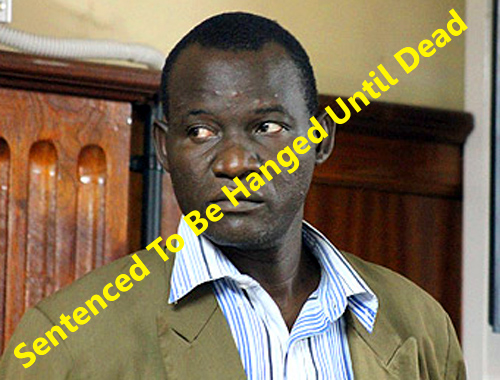
hangedKenya’s first execution in 27 years was ordered yesterday of a 41-year old male nurse for a failed abortion that led to a young woman’s death.

The judge said he had taken into consideration the fact that two lives were lost:

“He has killed two people; a foetus and a mother. The only sentence available in law is the death penalty,” Judge Ombija ruled.

Outsiders don’t realize how incredibly pro-Life the vast majority of law in the developing world is. What is even more ironic, though, is that while developing world law is crystal clear on the issue, these laws are rarely enforced.

Islamic ruled countries generally leave the consequences of a revealed abortion to the family. Those consequences are often crueler if the cultural edict is carried out. The widely interpreted Koranic punishment for adultery is being stoned to death, and generally any woman who seeks an abortion in the Muslim world is considered adulterous.

But it remains unknown and likely vastly underestimated the number of abortions in the Muslim world that are simply swept under the carpet.

In the non-sectarian ruled countries like Kenya abortion is just as illegal, but there are countless numbers of abortions, anyway. Authorities normally don’t enforce the law. Yesterday’s sentence, after all, is the first ever given.

“Our analysis indicates that an estimated 464,690 induced abortions occurred in Kenya in 2012,” Kenya’s own Ministry of Health reported last year. Each one of those if adjudicated would result in a death sentence.

The Kenyan Ministry report also concludes that the mortality rate of these attempted abortions is so high that it is a significant factor in Kenya’s escalating health care costs.

Many other reports circulating in Kenya indicate one of the reasons there are so many abortion attempts is because contraception is either too expensive or frowned upon by cultural and religious leaders.

Kenya law is clear: abortions are illegal. Legislative attempts to change this, including by women activists who lobbied hard to make abortion legal in Kenya’s revised Constitution of 2007, were all soundly defeated by Parliament.

It was, however, a “perfect storm” for 41-year old nurse, Jackson Namunya Tali, who will now become known as either the first or the only abortion provider to have been sentenced to death.

Tali operated one of probably dozens if not hundreds of abortion clinics in shady areas of Nairobi where police rarely appear. He is a fully trained nurse whose pay under the national health system is likely 1/100th of what he earned at his clinic.

He was much more compassionate than most abortion providers who dump their patients out the front door as fast as they can once the procedure is over.

The particular patient in question had complications, and Tali tried to deal with them for more than a week before he personally tried to race the her to the hospital in his own car. She died enroute, and instead of then abandoning her, he himself called the police.

Clearly the man was empathetic, hardly the criminal type that the vast majority of less well trained and less sensitive abortion providers in Kenya are. He seemed generally distressed that his efforts with this woman failed.

His empathy led to his sentence.

This was not big news in Kenya. In fact the major media outlets didn’t even carry it. And the few comments that appeared in the digital world were mostly in support of the judge.

Landslides Are Irrevocable

Landslides Are Irrevocable

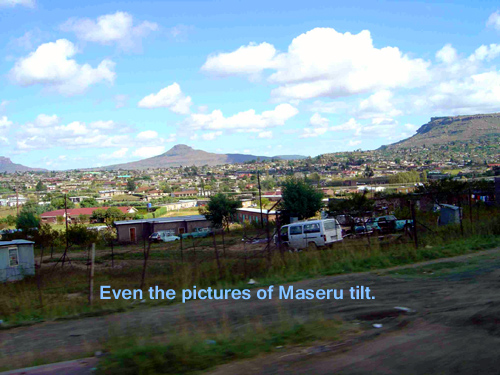
tiltingmaseruLesotho is a spot of a country surrounded by South Africa. Is it time to wipe the spot out?

There are spot countries all over the world: European potentates (Vatican City, Monaco, San Marino & Liechtenstein); scattered South Seas countries (Marshall Islands, Nauru, Tuvalu, Palau); other scattered sea countries (Seychelles & Maldives); Caribbean beaches (Saint Kitts & Nevis, Andorra, Granada, Barbados, Antiqua & Barbuda), regal airline hubs and tax havens like Luxembourg.

In fact, there are 110 of the 252 countries listed by the U.S. WorldFact book smaller than Lesotho.

South Africa’s other spot, Swaziland, is only half Lesotho’s size. So why am I asking if it’s time to wipe out Lesotho?

Most of the spot countries of the world are either too anemic or too essential to mess with: the Seychelles and Singapore, for instance. Few will protest when most of the Seychelles tiny 90 granite islands sink as the world’s ocean’s rise.

But a lot of Asian billionaires and world banks will tremble if Singapore cracks.

Swaziland tilts ever so slightly into the Singapore camp of countries. Its western border is with South Africa, and its eastern border is with Mozambique. There aren’t any refugees anymore from Mozambique, but if there were, this is the conduit.

Some creative accounting is possible for trucking companies depending upon what particularly taxed goods they’re carrying.

In the old days during the very strict moral laws of apartheid in South Africa, Swaziland was the playground of the debauched with lots of casinos and gentlemen’s clubs. Today’s South African laws are less restrictive, but still more restrictive than the g-string thresholds in Swaziland.

These aren’t all necessarily good reasons for Swaziland to exist, but they are reasons. That’s Lesotho’s problem. It doesn’t have any reasons to exist.

The reason Lesotho is Lesotho, and Swaziland is Swaziland, and neither is a part of South Africa starts with their geography. But Lesotho is surrounded by South Africa. Unlike Swaziland’s geographical situational raison d’etre, Lesotho was left alone because it was too high to get to.

Lesotho is almost entirely above the clouds. It has the highest lowest point of any country in the world, 4,593 feet. The rest of it scraggles upwards to a peak of 11,424 feet high. It’s mostly gravel, limestone and granite mountaintops, with a very few meadows that some unusual sheep live in, and one tiny city, the capital of Maseru, that if lifted down to a reasonable altitude would look something like a sprawling mobile home community near Flagstaff.

There are less than two million people widely scattered among its nooks and crags with a third of the resident population unemployed and the rest, two-thirds, all working for the government.

There are no natural resources, and the country only produces 20% of its food. In fact, Lesotho imports 90% of everything it uses.

Essentially all of its wealth comes from its citizens working in South Africa and sending the money home.

This was all honky dory for the two entities, Lesotho and South Africa, for years. Rather than undertake this extremely undeveloped region that needs so much expensive infrastructure, South Africa preferred to let Lesothoans work in South Africa and avoid many of South African taxes, so that the money could flow up to the mountain tops and keep everybody peaceful and quiet.

They aren’t peaceful and quiet, anymore.

People grow up. They get educated. They learn when they’ve got a raw deal, and technically South Africa has maintained Lesotho as a kingdom to save money.

Several years ago revolution erupted. Basically that meant that the 57-member military/police force took over the palace then the legislature.

South Africa mediated a solution that gave more power to the people. But then only a few weeks ago, baton wielding coupest turned into gun firing takeoverists.

What Lesothoans want is to become absorbed by South Africa. Most outsiders don’t realize this. Like Thomas Friedman, they think that all Lesotho needs are few new restaurants.

This has been going on too long, now. In a country with only 2 million people, 30,000 signed a petition then staged a march in Maseru four years ago demanding annexation by South Africa.

When nobody listened, the men with batons hit the street, and now, men with guns are taking over. What had been a peaceful if placated democracy is now another African dictatorship.

Last week South Africa’s trade unions, far more powerful than trade unions in the U.S., decided it was time to annex Lesotho. (A very high percentage of South Africa’s mine workers come from Lesotho.)

“In reality, Lesotho is in the Free State and so it can be an extension of the Free State, or the 10th province,” one of South Africa’s principal union leaders, Frans Baleni, said last week.

He’s absolutely right. It’s time to wipe out the spot.

BodaBoda Brigade

BodaBoda Brigade

bodabodaBodaBoda means Harley in Swahili and may represent the next East African revolution.

So let me start by saying some of my best friends own Harleys… or did. One of them turned his in for a Kawasaki. And then there’s my niece living in Milwaukee who has managed to grow her business by selling leather items to Harley owners. And good grief, EWT has even operated safaris for Harley packs traveling from Cape to Cairo!
cow-on-a-boda
Kidding aside, the opprobriums attributed Harley owners have more or less died down in my generation. But there was certainly a time when Harley gangs slipped out of James Dean’ book clubs into brigand suburban warfare.

And that’s what’s happening in much of East Africa, today.

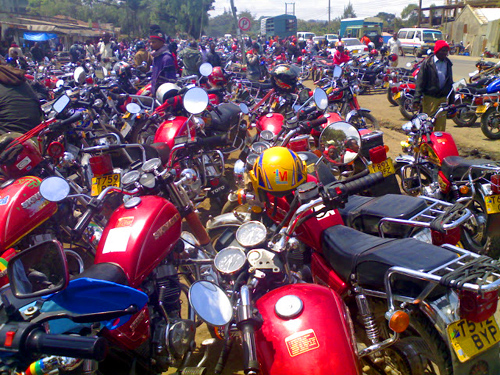
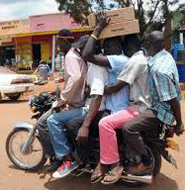
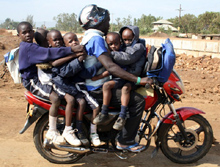
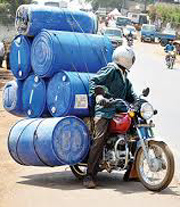
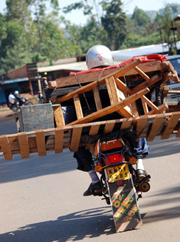
Motorcycle use has exploded in East Africa’s cities in just the last few years and the backlash from the ruling classes — all of whom own Mercedes — is astounding.

The menace is called BodaBoda, a Swahili nickname derived from ages ago when small motorcycles were used to ferry travelers between BORDER posts.
sixguys
Often buses taking travelers from a city in one country to a city in another country were unable to cross the border. So these entrepreneurial motorcycle owners would ferry passengers from a bus on one side of the border to a bus on the other side.

Today their role is more indispensable. The car congestion in East Africa’s expanding cities is unbelievable. Rapid highway development just can’t keep up.
SixToSchool
In the safari business we’re now constrained by rush hour. Entire itineraries are designed to allow transit through a city on a Sunday, about the only day that road rage can be avoided.

But local citizens have to deal with this every day, and the fix for the last several years has been to dump your car and get a BodaBoda, instead.

BodaBodas believe they are subject to no laws. So despite the rapid installations of traffic signals in places like Arusha, Tanzania, it matters little to them what color is showing above.
balesboda
They slip through the narrow spaces between miles of stopped traffic.

They make roads wherever they want to. Smaller BodaBodas roar right down the aisles of grocery stores.

As this culture of initial efficiency prevailed a darker side emerged. Police still use cars. Robberies, homicides and all manners of crime are now principally conducted from BodaBodas.

“Boda boda which have brought relief to commuters in poorly accessed suburbs of Arusha have of late been blamed as being behind a series of violent crimes,” writes Arusha’s main newspaper last week.

A third of all road fatalities in Tanzania are now BodaBoda drivers.

In an area increasingly homophobic, courageous women buck their culture by operating BodaBoda taxis.

The Kenyan Upper Class is being rattled. Recently the government announced a number of dramatic “remedies” to the BodaBoda menace:

(1) All women will have to sit side straddle, as proper English did in Victorian times. A woman Kenyan legislator, Caroline Owen, explained that the standard BodaBoda straddle of a bike “was uncultured and deprived women of respect because they expose their bodies to men.”
carryingladder
(2) No BodaBodas will be allowed in Kenyan city centers. Moreover, elsewhere they can’t operate between 11 p.m. and 5 a.m.

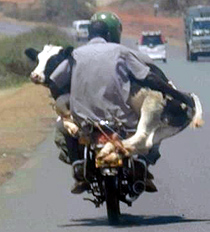
(3) Only one passenger besides the driver can be on the BodaBoda at any one time.

Fat Chance. If Kenyan authorities think there’s a security threat from neighboring Somali terrorists, just wait for the BodaBoda to Rise Up. And if road construction isn’t sped up quickly enough, they’ll be plenty of BodaBoda traveling on a single wheel, anyway.

How Sweet It Is!

How Sweet It Is!

beekeeperYou might be afraid of the mythical African Killer Bee, but there’s a sweet buzz about them in East Africa!

With American and even Chinese honey production at low levels, the demand for honey worldwide has grown so substantially that honey is increasing in price 6% every year.

The 150 million pounds of honey Americans will produce is just not enough for the demand.

Honey production is down because of a terrible virus that while winding down still effects large swaths of wildflower America. This has a further disincentive for honey production as successful beekeepers shift from producing honey to selling their tools elsewhere.

What? A beekeeper in Harrisburg, PA, will triple his annual income if he packs up his hives and travels with them to southern California to pollinate almonds for three weeks.

East Africans are taking advantage of the demand in the market.

Honey Care is a for-profit East African corporation whose main mission nonetheless is to support distressed communities. (Did you register that BP? : a for-profit company with a mission greater and more noble than making profits.)

The company can’t produce enough honey, either, so it’s now begun actively recruiting new beekeepers.

It does this by offering a startup package for $50 of two hives. And most of the time the newly endowed beekeeper doesn’t have to pay the $50 as Honey Care also comes with a loan from a microlending NGO.

Almost all startups are successful. The $50 investment the first year yields $175 annually by the second year.

The program has been so successful that it’s spawned a secondary industry of “professional hive tenders” who travel from small beekeeper to the next tending the hives, if the farmer herself doesn’t want to.

Honey Care then buys, packages and markets the honey. It’s also among the first companies worldwide to use the Swarm Phone App so that East Africans considering a purchase from a grocery store can scan the barcode to find out what kind of flowers produced that particular bottle’s honey.

Since Honey Care is expanding throughout East Africa, it’s become something of a grocery store game to scan this bottle then that one, discovering the first is from wild ginger and the next from purple clover and so forth.

A couple years ago the honey bee got a very bad rap which was mostly fraudulent first incorrectly reported by poor if racist Texas journalism.

That was followed almost as if predestined by a virus in the western hemisphere which has wiped out so much of the organism that the honey producers are now referring to the “new normal” in production at about half pre-virus levels.

That raised prices, and that gives the small land holder in Africa a truly golden opportunity!