Matatu Kindness!

Matatu Kindness!

matatumadnessWonderful news out of Africa to end your week: #matatukindness.

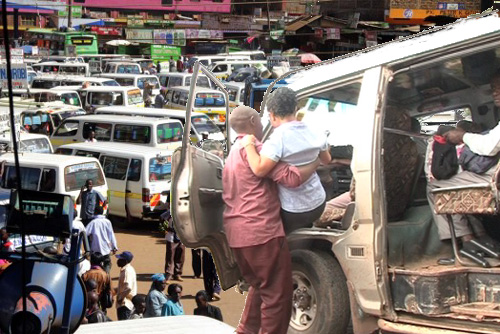
Matatus are private taxi/limos in East Africa’s big cities. They are so much cheaper than a regular taxi and so much more dependable than public transport that by one account they handle more than 90% of Nairobi city’s passenger transport.

Some like me have argued that it is free enterprise gone wild, because there are never enough matatus, so the demand is extreme.

But this is African capitalism, not Adam Smith’s. High demand doesn’t necessarily mean high prices. Even the most desperate clerk trying to get to work or the most dedicated teacher trying to get to school will refuse to pay more than she feels justified.

This stressful and never-ending battle between “tout” (the guy in the matatu calling out its route to potential travelers, deciding if someone is too big to fill the remaining tiny space available, and negotiating, collecting and providing change for payment) and the passenger is one of the most dynamic and pervasive African-capitalist transactions in East Africa, today.

I actually think it effects the price of airline tickets and Mercedes C class.

Imagine a car park with 600 too many vehicles somehow nearly stacked on one another and filled to the brim with human life, and the “tout” arguing with the last passenger for the last available space (with 60 other passengers screaming behind her) over whether it should be 100 shillings or 95 to Limuru.

She usually wins.

That’s life in the big city. But this absolutely essential commodity, transport, creates a working class of people that are pretty adamant in what they should pay for things.

Little sympathy goes to the poor matatu owner, driver and tout. That’s understandable when the media uncovers huge matatu mafia magnates. In Swahili transliteration it became Mungiki, which lingers even today in certain parts of the Rift Province as real organized crime.

The current president of Kenya, Uhuru Kenyatta, had been charged in the World Court with a variety of crimes linked to his involvement with Mungiki.

But in the last several years the Kenyan government has managed to separate a lot of Mungiki from Matatu, and to be sure, there are many small, independent matatu owners.

One of them, Josphat Mwangi and his tout, James Njau, have caused a marvelous stir in the mayhem of matatus. For nearly two years, now, they leave the market high prices of rush hour for a short time so that they can transport for free disabled persons.

One of Kenya’s struggling but persistent local organizations is the National Council for Persons with Disabilities.

Hardly two or three generations ago, most Africans born with a disability were killed. Even today a stigma is attached disabled persons that makes survival except in the more developed cities problematic.

“We at the council have persons with disability forming half of our staff [who] were resigning … because of transport challenges,” said the council chairman, Dr. David Sankok.

So enter Mwangi and Njau. No special devices or special cars. Just leave the market at its highest bid, carry the deserving person into a seat in your matatu, pack their wheelchair or other implements then transport them for free.

Neither Mwangi or Njau have spoken publicly. They don’t have time. There’s another fare waiting for Kinoo!
Junked Java

Junked Java

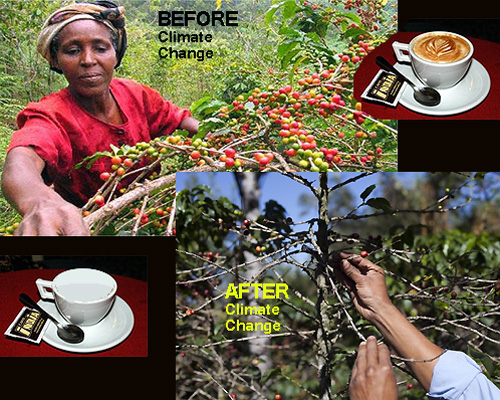
climatechangecoffeePerhaps this will help Senator Inhofe wake up: coffee.

Coffee prices are escalating in part because coffee production worldwide is taking a nose dive.

Some of the finest coffee in the world comes from the Kilimanjaro highlands. Or did. According to Reuters, “hundreds of farmers in the region are abandoning … coffee and cotton.”

The Reuters report is less provocative as to why than the Union of Concerned Scientists: “Climate change is threatening coffee crops in virtually every major coffee producing region of the world.”

UCS explains that coffee in particular is very sensitive to a slight increase in temperatures. Coffee also requires more stable climates with regular amounts of precipitation.

All that’s changing, and particularly in the Kilimanjaro highlands. The Tanzanian government announced a 29% decline this year in coffee production.

Farmers didn’t need the study released recently by a prestigious university in South Africa correlating the decline in coffee production to an increase in the highlands’ night time temperatures.

“Coffee beans are no longer profitable as my harvests keep on falling,” a villager in the Kilimanjaro highlands told Reuters: “I need fast-growing crops I can sell for a quick income.”

Coffee is a long-term agricultural investment. It takes at least three years, and usually five, for a new coffee tree to produce beans. After that it can continue producing for up to 50 years, but the orchard requires lots of water and constant tending.

The South African study documented an increase of a little more than 2 degrees F over a decade, enough to reduce the harvest by a third.

Large numbers of farmers throughout the East African highlands are therefore abandoning coffee for quick growing and quick selling vegetables … and flowers. The “cut flower” industry is growing in leaps and bounds in East Africa as the demand for them grows in Europe. Major European airlines now make their scheduling decisions more on the cargo of cut flowers than on passengers.

Many other farmers are turning to crops like sunflowers and casava which are less sensitive to climate change.

For the time being the crop changes will not likely effect the Tanzanian economy. The cut flower market like coffee requires high initial investment but pays off much more quickly.

Demand for food throughout Africa grows by the minute, and Tanzania remains a net exporter. The agricultural sector of its economy is growing the fastest.

So perhaps the major effect of this current news will be on Senator Inhofe, reported to love his coffee … even during droughts and floods and tornadoes.

Gosh, it’s Google!

Gosh, it’s Google!

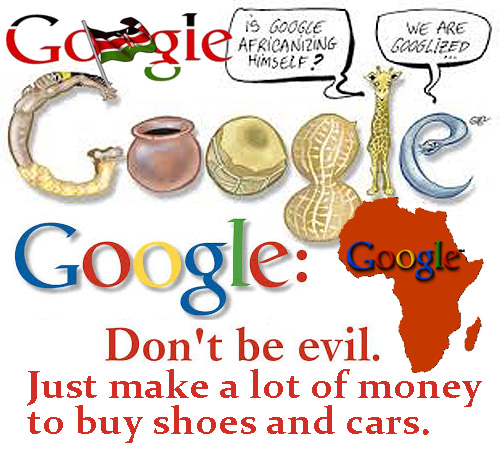
googlemontageA recent interview with the head of Google Kenya highlights Africans’ growing concern about the giant.

Google rules Africa … at least according to a number of studies in South Africa. 94% of South African searches are on Google, and likely more in other countries like Kenya.

In fact, when studies were published several months ago in Kenya that 90% of all Kenyan internet searches were from mobile devices like phones, Google immediately announced it would alter its search algorithms to prioritize websites that were mobile friendly.

Just good business, eh?

Yes, and no sarcasm intended. Google is responding in Africa with the quickness of the times and the speed of its heart and soul, its search.

But the domination of a couple internet companies in the world, like Google and Facebook, begs the “too big to” whatever mantra.

More and more Africans are growing weary not of post-colonial or geopolitical policies that seem to fence them in, but of world giants like Google that dominate their economies, or at least “rule” them.

I’m not talking of the specious criticism and endless suits against Google for being the vehicle of bad information, although in both Europe and Kenya those suits are gaining some traction.

Nor am I talking about the equally endless internecine suits between the world’s internet giants.

Nor even of the fact that Europe now charges Google with being illegally too big!

“Not knowing something is fine, but thinking that you do know when you don’t is foolish,” writes Morten Jerven in African Arguments. Jorten is Associate Professor at the Simon Fraser University.

Jerven argues in a more polite way than I’m now going to summarize, that newly intellectualized African societies are taking Google searches too much for granted. The nuances that blossom real truth are being completely ignored.

Google seems to know this, but its intention is to capitalize on it, not moderate it.

“Life is 80 per cent luck and 20 per cent you taking advantage of this,” the head of Google Kenya told its main newspaper, today.

Thirty-eight year-old Charles Murito took over the reigns of Google Kenya from a predecessor who was fired for “scraping” data from a competing (and client) internet company, that was then allegedly driven into bankruptcy by Google’s actions. No legal determination was ever made.

Murito epitomizes Google’s supremacy, and its unabashed mission that “everything you do is a business. You have to think about it in dollars and cents.”

He’s proud that “I have more pairs [of shoes] than my wife. My shoes, mostly sneakers, always have to match the colour of the T-shirt I am wearing.”

When pressed for his choice of a car, which in Kenya today defines the top businessmen from the strugglers, he replied, “No. I don’t want to talk about material possessions. But I do love cars.”

Google is all business, and it’s a good one.

Perhaps, too good.

From Baltimore to Joburg

From Baltimore to Joburg

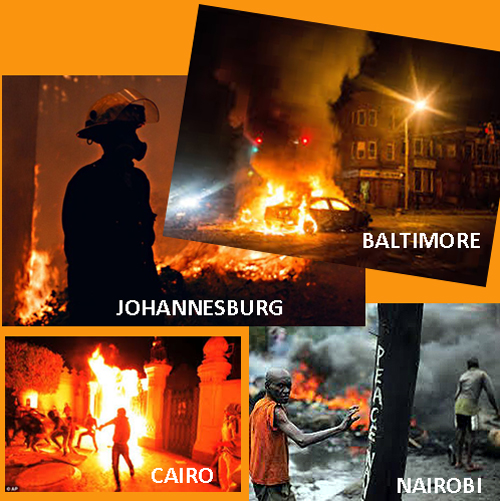
balt2joburgCivil violence in Baltimore, Beijing, Nairobi, Cairo and Johannesburg reflects societies coming apart.

One thing is certain: “We will bring order. We will bring calm. We will bring peace,” the (black) Baltimore mayor vowed last night as national guard troops entered her city.

Then, one of two things happens afterwards: a more democratic Tunisia, South Africa and Kenya; or a more autocratic China and Egypt.

Civil violence is quite distinct from war. It happens from within. Brothers are pitted against brothers. In the beginning new ideas link across disparate social communities. That’s the case today when we find Baltimore mayor, Stephanie Rawlings-Blake, saying things that her opponents consider collaborative with the protestors.

It’s the reason that the World Court indicted the current President of Kenya for fomenting crimes against humanity. It’s the reason Hosni Mubarak lingers in a jail guarded by the men he brought to power.

Civil violence reveals fissures and inconsistencies in social systems that are difficult to reconcile .. even by its leaders. It’s about human rights violations, not border disputes. Groups like ISIS will use civil violence to then start geopolitical warfare, but in the beginning it’s an internal conflict not an external one.

It often devolves into whether “the end justifies the means.” But it’s rarely so clear, much murkier: Is it fair that Uhuru Kenyatta paid youth under-the-table to fight a rival tribe in order to preserve his beneficence that now seems to be very positive in Kenya?

Peace at all costs?

Yes, so far anyway, eventually that’s human history. For the champions of human rights who fight in the streets, it’s a battle against the clock. They have limited time to bend society to their ideas until they’re crushed.

Civil violence is growing around the world, just as it did many times previously in human history. The hours on the clock are growing longer.

We’re entering a period of enlightened conflict, perhaps because of videos transmitted in nanoseconds by watches.

“Thank God for cell phone videos because the truth will come out,” the lawyer for the Freddie Gray family said last night.

Unlike in the past, more of us see and hear the same thing. The media can’t distort it as easily as in the past.

In this new and more volatile world, those of us in privileged situations should take stock:

“The infidels have so much to lose, they can be afraid of even losing their happiness! We,” he said, lifting his eyes to the sky as his mind’s eyes pulsated with a black sun, “We have nothing, so we fear no loss.”

That short excerpt is from my book, Chasm Gorge. It’s the world’s greatest terrorist explaining why he fights to the death.

The difference between those who have less and those who have more will not last in the new world. How much must be given away by us privileged is being determined by the battles being fought right now, from Baltimore to Johannesburg.

There’s no question a redistribution will occur. The question is how will it occur? Democratically or ruthlessly?

OnSafari: South Africa’s Cars

OnSafari: South Africa’s Cars

Hoot BayI transferred to my hotel in Sandton last night in a brand new Mercedes Benz, but the driver/owner kept turning the engine off at stoplights to save gas.

That’s South Africa in a nutshell: a veneer of luxury … but a base still struggling to become middle class.

In incredible contrast to the rest of the entire continent, including relative power houses like Nigeria and Egypt and Morocco, there is nothing in South Africa you as a visitor can’t get. Everything from organic kosher milk to a heart transplant, from the newest model Mercedes to the highest tech call center in the world.

Diamonds are a luxury that no one needs, and gold too was nothing but a luxury when first discovered. South Africa has been the world’s primary provider for more than a century. I believe this dependency on the world’s lust for luxury has bored itself into the local South African’s psyche.

If there was ever a top-down economic model, the intractable belief that prosperity trickles down, it’s here.

We’re rapidly coming to the conclusion in the U.S. that trickle-down economics doesn’t work. We – America – the bastion of capitalism is admitting our economic success was not from the flash-in-the-pan headlining Rockefellers, but from the mom-and-pop entrepreneurs who never really make it big, except in the aggregate numbers of them.

Cars reflects that. Long before a little business needs a Madison Avenue PR consultant or Washington lobbyist, it needs a car.

The old adage in the States that as goes GM so goes the economy might be lately displaced by “so goes Apple,” but that’s stepping a bit too far into the future when discussing economies like South Africa that are still trying to develop a sustainable middle class.

That isn’t to deny that every peasant needs a mobile phone. But even Ubuntu – which will long outsell Apple in Africa – is too expensive for many South Africans, today. The sheer number of mobile phone sales in South Africa is an undeniably important and hopeful part of its economy.

But ‘cars’ is driving it this minute.
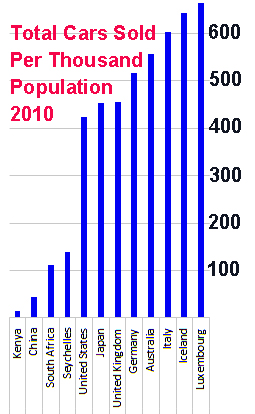
CharterCarssold2010
The automotive industry contributes nearly 6% of South Africa’s GDP and is the third largest sector in the South African economy after mining and banking, accounting for 29% of the country’s manufacturing output.

Mining and banking are not driven by South Africa’s minions, but by global forces associated to the lust for luxury.

Cars are driven by the South Africa’s minions and it’s substantial.

All the major car manufacturers have plants or shared plants in South Africa. Between a half million and three-quarters million cars are sold annually here. (Ford is the top manufacturer and seller in the country.)

Of the roughly 190 countries reporting in 2010, South Africa was 68th in the world for the number of vehicles sold per thousand persons.

The U.S. was 32nd. Seychelles was actually the African country with the most sales, but the Seychelles has so few people and is such an anomalously rich place for Africa, I don’t think it really counts.

South Africa is the king in Africa, and actually among most countries just below the level of development reflected in the United States.

(Brazil did not report in 2010. Based on a range of years around that, though, Brazil would be the leader in South America and would rival South Africa’s world ranking.)

South Africa stands out as well for an exporter of cars. Toyota’s Hilux truck or pickup, Mercedes Benz’ C220, and Volkswagon’s Polo are the top exporters, respectively. They represent a huge range of car types, from super luxury, to work vehicles to economic vehicles.

So what does this all mean? South Africa is a major consumer and producer of cars globally, from all styles and needs. But many of the owners, like the guy who transferred me to the hotel last night, really pinch their pennies.

Luxury drives visitors to South Africa, and it’s a reasonable presumption that they will appreciate being transferred in a luxury vehicle to the nearest diamond seller.

But the man driving them still lives hand-to-mouth. Though South Africans might cherish thinking otherwise, it’s not going to trickle down.

Ain’t So Edelweiss

Ain’t So Edelweiss

senatormuthambaEast Africans figure prominently among the leaked billionaires holding accounts with the Swiss HSBC bank, but there’s a lot more to the story.

The International Consortium of Investigative Journalists’ report of the hidden, possible illegal depositors of HSBC’s Swiss bank was released last week. As thousands of journalists mine the information it was reported yesterday that a prominent Kenyan Senator is among them.

There’s nothing in the ICIJ report to link any individual to illicit activities, although the report does explain how bank officials routinely advised investors ways to avoid paying taxes, among other methods of hiding wealth.

The report leaked information from 742 clients, but almost all of these are unnamed accounts as is the custom with high rollers banking in Switzerland. The “numbered” account is usually all that is known.

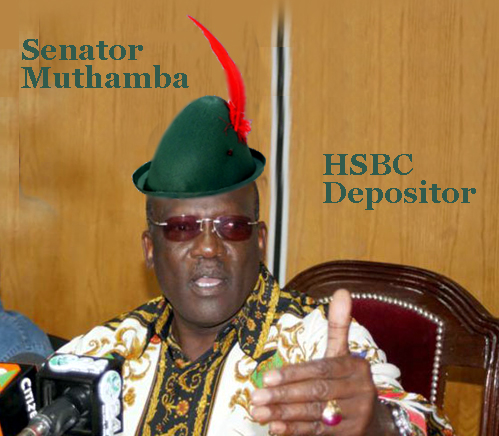
But true to form, Senator Johnston Muthama of Machakos opened at least one account in his name and eight others with other family member names. His total deposits of around $35 million seem unbalanced to his business interests in his area, but that’s impossible to prove.

His explanation to a newspaper in Kenya today was that the accounts were opened as business ventures with international capitalists and were related to his legitimate business interests in mining.

The remainder of the Kenyan accounts were unnamed and equaled $559.8 million. There were 286 Tanzanian accounts in excess of $100 million.

In today’s world there are a lot of rich people and I suppose not all of them got that way illegally. In any case. it’s not possible from the ICIJ report to prove any illegality by anyone, although the inferences are strong.

HSBC has agreed for some time to repatriate foreign funds to governments that can prove the deposits are illegal. This is a clever move by a big bank recognizing that “foreign governments” are usually controlled by the people who are its depositors!

The East African component of HSBC depositors is fractional when compared to those from the developed world, and Senator Muthama’s $35 million bank account shouldn’t give any of us pause. In the big pond of the wealthy, he’s a very small fish.

What is significant is that countries like Kenya and Tanzania are incapable of emerging from poverty in today’s world without mastering capitalism, whether they should have to or not.

Muthama’s stash is only one of hundreds — maybe thousands — from East Africa, which means that precious capital needed by East Africa is leaving it.

Several years ago professors at the University of Nairobi documented this horrible capital flight out of East Africa.

“Residents of the East Africa Community have more money stashed away in Swiss banks than those from any other region in Africa,” the report found.

The report said that more than $1.3 billion of capital generated by East Africa was at the time residing in Swiss banks.

A major reason East Africans as compared, for example, to the much bigger and more prosperous southern Africans may have more Swiss deposits is because southerners can grow their money at home often as well as abroad. In far less developed East Africa that’s more difficult: there’s less for very wealthy people to invest in.

As with this week’s expose, there was nothing in that 2012 report to prove illegality, and the 2012 report was not even trying to suggest it. Rather, it was pointing out that development requires capital and capital generated in East Africa ought to stay and be used in East Africa, not flee to Switzerland.

The ICIJ report is a national embarrassment to Kenya and possible political epitaph to Johnston Muthamba but it’s important to repeatedly acknowledge illegality is only inferred.

(Sort of the same way we wonder how a new Congressman can decorate his office like Downton Abbey.)

Secret capital in Swiss banks, on the other end, is clearly evil.

Uber Alles

Uber Alles

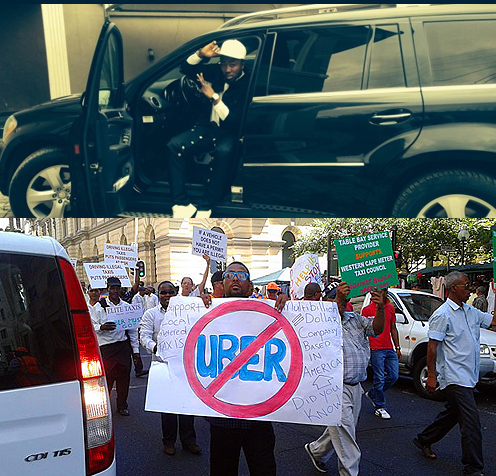
uberafricaUber is rolling over Africa despite growing protests in Cape Town and Nairobi.

Last month Uber launched in Nairobi, its third African market after South Africa and Nigeria.

In my opinion Uber’s genius is principally its app. I think if yellow cab or Marvin’s Machines in Keokee had had the foresight to move with the times, it would be Uber Over.

Uber, however, claims otherwise. It claims its genius lies in contracting with independent drivers who get their own licenses independently of any company, but the fact is there’s nothing new about this.

Limo drivers do essentially the same thing. Shuttle services, too. No, Uber’s genius is in its app.

Cab service throughout the world is one of the most uniform, corrupt and nepotistic services in the world. So essential and never sufficient, travelers stand in lines for ridiculously long times, get drenched waving their appendages into the rain and oncoming 18-wheelers and argue endlessly to keep their cab going on the shortest route.

The cabals that provide workers to the cab cartels across the world are a multi-layered no-contract service licensed by metropolitan cities whose nature of doing business is rarely transparent and never fair.

The only place in the world that I enjoy riding cabs is in London. Of course a cab ride from Heathrow to a hotel in Piccadilly costs almost as much as the flight to London. You get what you pay for.

Other than London? It’s one of the most stressful parts of a trip.

Enter uber. Nigerians love it. The response “has been overwhelming,” according to an Uber executive in Lagos.

Uber plowed over Nigeria. It launched with one of the country’s most famous hip-hop stars, Ice Prince, and then it devoured an earlier similar startup, EasyTaxi, by offering up to $12 to every person for the first ride. It moved from Lagos to Abuja faster than Boko Haram.

EasyTaxi just can’t compete. It doesn’t have the snazzy app or the tech behind it. That’s the wizardry of Uber.

Negotiations continue in Cape Town where over the weekend Uber claimed to have a licensing deal that was then denied today by a city official.

Uber Kenya launched recently in association with the very popular Restaurant Week in Nairobi, offering to give free or reduced rides to certain restaurants.

Resistance is severe in Kenya where living and working successfully means mastering a network of dependency.

The universal argument against Uber is that there is no systematic driver training or qualification. The widely cited Indian rape case is forever mentioned.

One wonders, though, how many rapes and other incidents of abuse routinely occur in regular cabs around the world.

Last month as a hostage situation developed in downtown Sydney, Uber jacked up its fares by 400% as terrified customers tried to leave the city center. (It has since offered refunds.)

Uber’s market-driven pricing rather than set pricing determined by expensive citizen commissions is one of the novelties attracting Africa’s new entrepreneurs. And they need cabs.

In Nigeria Uber usually costs more than EasyTaxi and many conventional cabs, but provides snazzy cars and well-dressed drivers that appeal to a huge segment of this trendy populace.

In South Africa and Kenya, as through much of the rest of the world, Uber costs the same or less.

Who’s making that decision? Uber will say “the market” but then, who’s got their statistical fingers on the market pulse?

Uber Up There.

A Greener Melancholy

A Greener Melancholy

kengreenentrepreneur

Even the poorest places in Africa are trying to reduce carbon emissions. Will shame change our behavior?

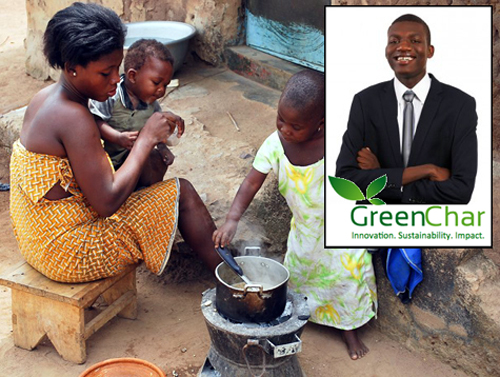
I was incredibly touched with a heavy dose of admiration and melancholy when I read recently about 19-year old Tom Osborn of Kenya, the founder of a “green” charcoal briquette company in Kenya.

As a high school top performer Osborn mastered the internet and found international and local foundations concerned with Africa’s struggles, and particularly how it might develop in a “greener” fashion.

The vast majority of Africans today cook using charcoal. The unit devastation to our planet for making a meal using charcoal is significantly greater than using more refined fossil fuels like propane, but that’s simply beyond the economics of the poor.

“I randomly came across a report saying smoke from … charcoal killed more people than AIDS, Malaria and TB combined,” Osborn told an African magazine.

“That really shocked me and made me start thinking of my mom, and that maybe she was slowly dying from all the times she had cooked for us. So I wanted to try to help her.”

Osborn linked with MIT students who had published studies of turning agricultural waste into charcoal briquettes. They confirmed that briquettes from discarded sugar cane stalks, for example, produce 90% less smoke and 60% more heat than an equal amount of charcoal.

Networking was the key and one link led to another. Osborn was named as one of the “30 under 30 Forbes entrepreneurs” which gave him enormous credibility that this creative kid turned into lots of startup money.

He received $80,000 from Echoing Green and another $10,000 from the Anzisha Foundation which gave him enough getup and go to partner with Envirofit that makes energy efficient charcoal stoves.

His company now bundles the energy efficient stove with his sugar cane briquettes and has so far sold to several thousand customers.

Osborn’s GreenChar benefits from great IT assistance and has a fabulous, modern website. Osborn has mastered networking with all the right people.

Osborn is a brilliant kid.

It is completely unlikely that this company will succeed: Admiration and melancholy.

Envirofit’s stove is fabulous, but very expensive by African standards. Osborn has admitted that he has achieved his first market niche by selling below or near costs, funded by his grants.

The world is cleaner. A young man is learning the ropes. And the western world is applauding him for trying so hard, but the crashing hammer of capitalism means the effort continues only as charity or dies.

I’m elated that one day when Osborn is 30 years old he might be sitting in the CEO chair for Kenya Airways or IBM – South Africa. It’s fantastic that this kid in rural Kenya has tunneled out of poverty using in the beginning nothing more than the internet.

But hold your applause.

The day will come when unfettered cooking in Africa is achieved either by violent revolution or the radical global redistribution of wealth that prevents it. None may be in a better position to help make that choice than Tom Osborn.

Admiration and melancholy. Maybe, too, a little bit of hope.

Firing The Light

Firing The Light

FiringTheLightA California company is building plants and producing huge amounts of solar power for South Africa. Why not here?

In collaboration with a Saudi financing company (and Google!), SolarReserve will produce almost 350mW of electricity from four solar plants in South Africa’s sunny Karoo (from Kimberly west into the northern Cape).

In fact SolarReserve does have a single operation in Nevada, but the new operation just announced in South Africa will be its fourth just in that country.

Both our countries use fossil fuels at about the same percentages: 70% of American electricity is fossil fuel generated, 67% for South Africa.

Traditional fossil fuel plants produce more electricity once operating than comparable solar operations. American nuclear power plants, for example, proudly insist that they generate around 500 mW and a typical coal-fired electric plant generates around 550mW. This is up to three times what a typical solar plant creates.

More importantly, coal-fired and nuclear plants sustain their rated output far better than alternative energy plants like solar, which of course don’t produce at night.

Is South Africa simply “greener” than America?

No, unfortunately. The flip side of output is the cost of building a plant. Solar plants are much less expensive than traditional fossil fuel plants and can be up and running in 16 months, half as long as a coal-fired plant. Nuke facilities can take a decade to build.

That’s the key for South Africa, and it’s the reason such a fertile market exists there right now for solar energy providers. Last year the country experienced its first rolling outages and more are expected this year.

Africa’s rapid growth demands alternative energy sources in a way America does not. It costs less to build and can be operating in a fraction of the time. Politicians, I’m afraid, and not environmentalists are driving the process in South Africa.

Inevitably, though, Americans will benefit. As expected when South Africa’s first solar plants came on line they produced far less than projected. Any new technology is going to experience such growing pains.

Working through these engineering issues gave rise – at least in SolarReserve’s case – to a whole new alternative to PV (photovoltaic) solar electricity production.

PV is what we all understand: a cell hit by the sun produces electricity. It’s what’s on the top of your home and it’s what we use to create a bit of power in our camps in the African bush.

SolarReserve is now a leader of a new almost scifi technology referred to as CSP (concentrated solar thermal power): Ten thousand tracking mirrors, rather than cells, circled onto a 1,500 acre field direct laser-like sun onto the top of a 550′ tower at the center, melting salt at temperatures as high as 1,000F.

The salt is then used to heat steam to power generators. The reason the Saudi company has joined these ventures is because an easy by-product of this process is fresh from salt water.

By the way, the Australians just announced a breakthrough in the old PV technology. Traditional PV cells are rated as low as 18% efficiency. The new Australian methodology increases efficiency to 33-40%.

The answer to the question I poised at the top is urgency and capital. There is more of the first and less of the latter in South Africa than the U.S.

Those of us who look long-term, though, see the present urgency and poverty in South Africa vis-a-vis the U.S. as an opportunity to help us all.

Does this mean “green” is “poorer” and more “reactive” than non-green?

For the time being. That’s the point: only for the time being. As crass it is, we non-greeners are using green South Africa to work through the glitches before we handily adopt the new technology.

It’s the way of the (capitalist) world.

It’s Just a Joke, Right?

It’s Just a Joke, Right?

xenophobiaXenophobia triggered by the slaughter at Charlie Hebdo has devolved in Africa from Christian/Muslim into primitive and very dangerous tribal racism.

The demonstrations, lawlessness and violence we saw last week in places like Algiers and Niger was a direct response by Muslims to French secular dogma featuring Charlie Hebdo’s mocking Muslim cartoons.

That grew in Europe to vigilantes against any foreigners. Particularly in Dresden and Birmingham xenophobia was ignited.

Back in Africa ethnic tensions are rising dramatically throughout sub-Saharan Africa. Today’s presidential election in Zambia, for instance, has been inflamed by ethnic tensions that had long since been curtailed.

And yesterday in Soweto, youth gangs looted foreign-owned stores, killing two and injuring more, mostly Somali and Pakistanis.

I suspect this is happening all around the world. We know it’s happening here in America.

In Algiers, Niger, Soweto, Birmingham, Dresden or Texas, xenophobia today in particular is the manifestation of people feeling they’re getting shafted, unfairly denied what their televisions are telling them is a “recovery.”

Economic statistics are improving and truly fewer people are on the skids. It’s as true in Soweto as it is Dallas.

But the “improvement” is horribly lopsided towards those who were better off to begin with. It’s also likely lopsided to those who have a greater experience with adversary, like immigrants.

In Soweto the shops that were looted were owned mostly by Somali and those killed were Somali. Few people in the world have had to endure the life of a Somali. Even fewer still have found the wherewithal to migrate an entire continent to try to etch out a more productive life for themselves.

Those are the kinds of people who will likely bounce back first, since they’ve already achieved the skills of survival in adverse situations.

And those below them who linger, like the supposed out-of-work truck driver in Texas, thrash out at a Muslim in a suit-and-tie because it’s a difference that’s clear enough for him to understand, a sort of Limbaugh economics.

There will always be xenophobia and ethnic racism, because there will always be differences that seem unfair to those who have less.

But today that unfairness is particularly sharp. The rich are unfairly rich, whether that be in South Africa or the United States. But unlike in the past, the rich are also in seeming total control.

Whether it is the Koch and Murdoch in the U.S. or the Zuma-ists in South Africa, the rich and powerful control much of the media with skills which include deceiving the poor and less informed that the problem is with “foreigners.”

The beauty of America is foreigners, the “melting pot” of the free world. Clearly this is where most of our creativity and ingenuity has come from. To a great extent, it’s a dynamic happening in South Africa, too.

Charlie Hebdo had no idea. Humor is sometimes so provocative it actually accomplishes something.

Oiling The Works

Oiling The Works

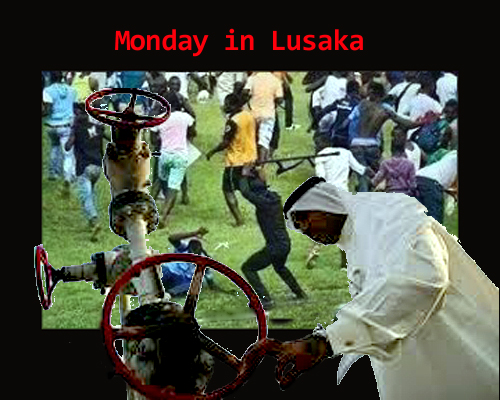
MondayinLusakaZambia, copper giant and Zambezi River namesake, is fraying at the seams, torn by a global recession manipulated by Sandia Arabia and an educated society intoxicated by democracy.

What’s happening in Zambia today is a preview of the trouble hanging over much of developing Africa, and Zambia is in the focus just unluckily because of the unexpected death of its leader.

At 77, popular Michael Sata was right around the age of many African leaders and his health was OK. His death in October came as a surprise.

If Sata had died a year earlier before copper prices had tumbled and oil began to decline and the Eurozone started to fray, again, I doubt anything unusual would have happened. The country was doing well.

But Sata didn’t die a year earlier, he died in the early preview to a new global recession caused by the forced decline in oil prices, which has triggered a decline in commodity prices of all sorts including copper, Zambia’s one and only and very important resource.

I wrote earlier about the peculiar transition of power to a transitional government Sata’s death abroad caused: A white man, Guy Scott, became acting president but was barred from becoming president even as he oversaw the process for new elections.

Immediately fissures began in all political alliances, and yesterday violence peaked with car bombings and sporadic gun fire in the capital. Read the comments to the brief article to see how high tensions are.

This would not have happened a year ago. Yesterday alone copper prices tumbled and are now almost 10% below a year ago. The Canadian stock market sank miserably, because of copper.

“Copper [has] an uncanny ability to predict turning points in the global economy,” a Dubai asset manager wrote recently.

It isn’t that the people exploding cars or throwing rocks or issuing threats in Zambia understand the economics of global commodities, just as the new disaffection with Nairobi university students doesn’t mean every single one of them understands the mechanisms that provoked Chinese companies to stop drilling for oil in Kenya.

But everything is so intricately linked, that disaffection spreads like a virus. In Africa’s small if previously vibrant economies, a wrinkle in future outlook is a tsunami of potential misery.

President Zata died unexpectedly as the storm clouds that were gathering began to rumble. The event alone was socially disruptive to be sure, but in normal times it would not have led to the violence in the streets of Lusaka currently seen.

Zambia is one of sub-Saharan Africa’s better educated countries, and though it’s struggled with an above average amount of corruption, it should have been able to make the current power transition pretty easily.

But Sandia Arabia opened the spigots. We’re told the reason is to force America out of the top spot in world oil production. The ramifications are startling and severe.

Combined with an untimely power transition in developing Africa, it creates a maelstrom of discontent and unease.

The Zambian election process begins in earnest in a week. As copper is a barometer of the global economy, what happens in Zambia next week will foreshadow much of Africa for next year.

# 3 : Bust Not Boom

# 3 : Bust Not Boom

10000shteacherThe terrifying decline in energy prices will set the Third World back a half century, and this is the #3 Story of 2014 in Africa.

This one is hard for Americans to understand and it came quite late in the year. [For the summary of all Top Ten Stories in 2014 click here.]

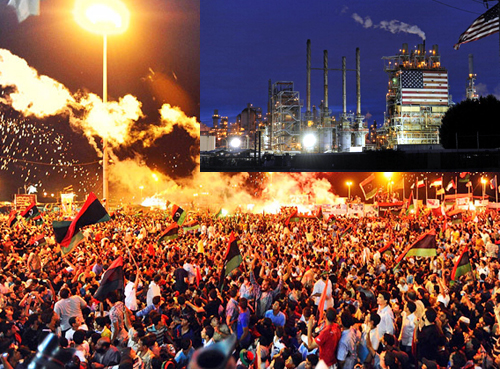
The decline in energy prices is caused in large part by America’s boom in energy production both at the resource level (oil) and production level (wind and solar). Good thing, right?

What we didn’t realize was how quickly we were outpacing the rest of the world, and global impediments to trade and wealth distribution coral virtually all the benefits in North America.

Look simply to Europe to see how the decline in energy costs seriously threatens a new European recession and at the very least a partial breakup of the Eurozone.

The decline does have some negative effects here, mostly the stock market, but benefits like growth and consumer spending render a net positive.

It’s seriously different in Europe, India and China; and in the Third World it’s nothing less than terrifying.

During the Great Recession, countries like Kenya were proudly expounding that their growth rate year-to-year – which was much higher than the U.S. year-to-year – actually presented a horizon when the countries would achieve economic parity.

Before the Great recession in 2005, Kenya’s overall economy was about .14% of the U.S. That’s right, the U.S. economy was 700 times bigger than Kenya’s.

By last year Kenya had more than doubled its growth vis-a-vis America. America was only 300 times bigger. At this rate it would be only about a half century before Kenya caught up with America.

Many of us didn’t think this was a pipe dream. It seemed like the logical extension of a globalized economy based on capitalism. I’m no economist, but economists made the same mistake I made: we presumed this trend was fixed.

This year proved anything but, and next year will be stultifying. It’s likely that Kenya’s 300 times smaller than the U.S. economy this year will become 400 next year and perhaps return to 2005 by 2016.

Kenya is a perfect example for the entire Third World.

What does this mean?

I might not like capitalism, but I know that political progress, human freedoms and basically overall social happiness are in today’s world linked to an increasing economy. Whether it should be or not, doesn’t matter for this discussion. It just … is.

The Arab Spring can be explained with these metrics. The breakup of the Soviet Union, the expansion of Europe, the growing peace in Asia … all can be explained with these economic metrics. Even today’s possible reversal of the situation in the Ukraine, or the management of Iran’s nuclear threat can be postulated with these metrics.

So, the reverse?

Doesn’t take a rocket scientist to answer: increasing social instability, more war and civil disturbances, more refugees and massive global instability.

From America’s point of view an actuarial could attempt to predict the tipping point: when will America’s profound growth begin to eat itself because the rest of the world’s suffering becomes so profound it somehow effects us?

What a horrible assignment. Yet that’s the question, today, for Americans. And if you’re a Kenyan rather than an American it’s not an assignment worth waiting for.

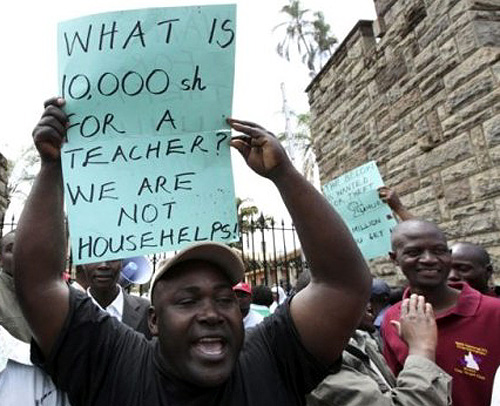
Today Kenyan teachers are on strike. That in itself is nothing new. Public sector employees often strike in Kenya, especially teachers.

But note the issue, today: a starting salary of Ksh 10,000/month. That’s $111. A decade ago it was twice that, not because the shilling value was different but because the exchange rate – the value vis-a-vis America – was twice as good.

What does a government do when it has no money to pay teachers? The expected oil and gas revenues in Kenya declined by 50% this year while the price of energy doubled.

“The arrest, prosecution, and jailing of [social media bloggers criticizing the current Kenyan regime on] foolish Facebook posts acts as proof of the intolerant and dictatorial regime we are drifting into,” writes Kenyan activist, Gaitho, today.

Hunger. Then, Dictatorship. Then, finally a return to Ignorance. One follows the other as certain as I and my children begin to buy SUVs again because they’re now so affordable.

Boom or Bust?

Boom or Bust?

oilboomportendsrevoliutionAn extremely dangerous economic situation portends tremendous global unrest, especially in Africa.

Obama’s energy policy has put American front and center, and while Americans are reaping enormous relief from falling energy prices the developing world is poised to suffer considerably.

That may seem counter intuitive, because energy is needed by everyone. It isn’t only Americans that are benefitting from lower energy prices, is it?

Yes.

Europe, India and China have unique problems restricting them from benefiting from increased global oil and gas production.

Developing countries in Africa have an even more unique situation making it even worse for them:

African governments have long subsidized their citizens’ energy prices, especially gas and oil, because without natural resources and without refineries, a gallon of gas would just be out of the reach of even the most successful truck driver/owner.

So a gallon of petrol in developing Africa has cost $5 to $6/gallon for the last 20 years, regardless of the actual cost to the governments holding that price for their consumers.

But, you may ask, the governments win or lose depending upon the price, right?

Of course, but over the last decade an unexpected factor entered the equation. New technologies allowed a boom in oil and gas exploration in Africa. Reserves previously too difficult to get were unleashed.

Previously considered resource poor, countries like Kenya, Uganda and Tanzania now consider themselves resource rich.

Oil is being pumped from the deserts of Kenya like never before. The government has benefitted much more from the taxes on these natural resource extractions than it has expended to keep the consumer price of oil and gas at stable levels. A net positive increase.

America is unwittingly changing that.

Kenya was ecstatic when 600 million barrels of oil reserves were established in its northern deserts, and this year it celebrated a remarkable 3 million barrels of extraction.

But …

… Texas is right now extracting 3 million barrels of oil every day. This year Texas produced the entire estimated Kenyan reserves in 9 months.

America’s energy boom has crushed world oil prices. Kenya’s tax revenues are plummeting. That’s not even the worst part of the story.

Kenya’s main oil exploration company, Tullow Oil Plc of Britain, announced this week that it was massively reducing its exploration in Kenya. This was a polite way of saying, Goodbye Folks.

The net result of the loss of new revenue over the last ten years against the benefit of reduced energy prices worldwide is a net loss for Kenya and virtually every developing African nation that had recently discovered new oil and gas reserves.

This is a perfect illustration of the gap we talk about so often between the rich and poor. If the rich and poor are equated, and by that I mean subject to identical economic laws and their results, then they benefit or suffer by the same percentages.

If a big society like America grows by 6% annually and a small country like Kenya grows by 6% annually, the difference between them gets bigger and bigger.

When that dynamic is accelerated because the bigger society, America, benefits from a global price reduction in energy (because the net result of cheaper asset value is offset by even greater increases in production), while the smaller society, Kenya, suffers enormously … the gulf widens even more.

No one had predicted the size of the energy boom in America. It’s absolutely unbelievable, and it has widened the gap between America and the rest of the world in near exponential ways.

This is a terrible conundrum that seems out of control. The answer can’t possibly be to restrict production? Isn’t there something inherently correct to presume that if things cost less we’ll all be better off?

If by “we” you mean Americans, absolutely! If the “we” includes Africans, absolutely not. Africans will get poorer more quickly than they ever expected, and I think that will set off another and much greater Arab Spring.

There is a solution to this. It’s a nasty term called redistribution of wealth. It’s even more nasty than Republicans in Congress believe, because I’m not just talking about recalibrating America’s tax code.

This one is about the whole wide world.

Ivory Ends

Ivory Ends

Only ivory can be so minutely and intricately carved yet remain so tough and durable.
There may still be too many elephants in East Africa, but Tanzania is acting so irresponsibly with regards to increased poaching that the scales may soon tip.

This week a group of environmental organizations led by the EIA petitioned the U.S. government to withhold aid from Tanzania until elephant poaching abates.

It’s unlikely that the appeal directed to Secretary of State John Kerry will be seriously considered. Tanzania is on the front-line of the Obama administration’s war on terror, and the “elephant problem” is considered incapable of trumping “homeland security.”

The flaw in this reasoning is simplistic and ultimately fails because our homeland security policy with regards to terrorism is failing.

The explanations for Tanzania’s “elephant problem” also reveal why the country is so incredibly corrupt, why it has grossly mismanaged its treasure of natural resources including oil and gold, and why its powerful oligarchy can with abandon relocate thousands of Maasai to appease a few Dubai hunters.

Recently Dick Cheney agreed that enhanced interrogation techniques were a means to an end and were justified.

Facilitating if not outright supporting Tanzania’s corruption is also a means to an end that the Obama administration apparently feels is distant enough from public understanding to be acceptable.

I’ve often written that the elephant poaching problem is serious but exaggerated. Increasingly this year, though, the situation has grown more troubling. I hesitate to cite specific numbers, because they’re all over the place.

The EIA report looks sound to me, but I’m subsequently infuriated that they introduce it on their website with an ITN video that grossly misstates acceptable numbers. I just wish for once that these good environmental organizations working to save elephants would be more scientific and less evangelical.

London’s Guardian newspaper is probably the best resource in the world for accurate news on current elephant poaching. The Guardian contends that “Chinese demand for ivory is devastating Tanzania’s elephant.”

I agree, but what is missing from the hysteria is the fact that the growing development of Africa has enormously constrained elephant habitat in just the last ten years: not just national parks, but more importantly the vast areas peripheral to the national parks as well as the quasi protected corridors that connect distantly separately massive wildernesses to allow for elephant migrations.

These “corridors” and “donut edges” are often private land or land in trust, and demands for their development have grown exponentially. Farming, mining as well as simple village growth now impinge on what was only a short time ago elephant bush.

The tension between the needs of a growing and developing human population with the enormous amounts of land required for wild elephants is at the highest ever.

Until that tension is squarely addressed, corrupt officials will play god. Local communities engaged in ivory poaching will be given a pass, since the government is inept or incapable of giving them work, instead.

This is the real problem. Distant foreigners’ hearts may break when pictures of poached elephants appear on their TV screen. The world should continue to encourage China’s incremental movements to change a thousand-year culture that covets ivory as no other collectable.

And as the Guardian brilliantly pointed out, the disconnect between westerners’ campaign to stop endangered animal poaching and their allowance that these same animals may be legally hunted and harvested, has to be closed.

So the problem is not as simple as hysteria presents, but the problem is getting worse. It may not be the extinction of elephants that looms any more likely than the end of enough larger wild areas to support families of such a large wild animal in East Africa.

For the first time in my opinion, that is a plausible claim. Whatever the remedies, they certainly do not include ends-justify-means tests of what’s right to do.

Fat Children Starving

Fat Children Starving

Comedy conveys reality to Americans today better than straight facts, and last Friday’s ‘The Daily Show’ masterfully presented the real Africa.

Jon Stewart introduced his new correspondent from South Africa, Trevor Noah, who conveyed to Americans a lot more successfully than I and dozens of other bloggers have:

(1) Eric Garner and Michael Brown demonstrate more police brutality in America than in South Africa.

Moreover and more importantly, police brutality in South Africa was once much worse and is now much better, and this is not the case in America.

Noah pointed out that police brutality in South Africa was a construct of apartheid, and that when apartheid ended this brutality began to reverse.

In America, where there’s never been apartheid as such, brutality has remained high if not increased.

(2) There is more ebola in America than South Africa.

True and undeniable, but no matter how many times we say this it’s forgotten until carried in a comedy routine!

Noah said his friends warned him against going to America for fear of contracting ebola, and he replied “just because they had a few cases of ebola there [America] doesn’t mean we should cut off travel, there.”

(3) Americans believe they can “save Africa” by small charity donations. Noah remarked, “for just five cents a day.”

This sarcasm is powerful stuff. It reveals the ignominy of American charities and the naivete of American donors in the much fuller arguments that I and many others have made for years about the mistake of so much American charity.

(4) Americans think almost exclusively that Africa is a vacation destination for big game safaris. While Africans absolutely don’t, of course.

Noah then presented a game, “Spot the Africa” which was phenomenal.

A series of two paneled photographs came up multiple times contrasting Africa with America, and as you can imagine, the horrible ones were America.

This wasn’t just nitpicking. It was real.

Stewart then asked Noah, “You aren’t saying that things in America are worse than in Africa?”

And Noah replies, “No, I’m not saying that, you guys are saying that.”

I’m one of those guys.

And Noah ended with a brilliant observation that knits the reality of sarcasm to the troubled conundrum of American life:

“You know what African mothers warn their children, about, Jon? Be grateful for what you’ve got, because there are fat children starving in Mississippi.”