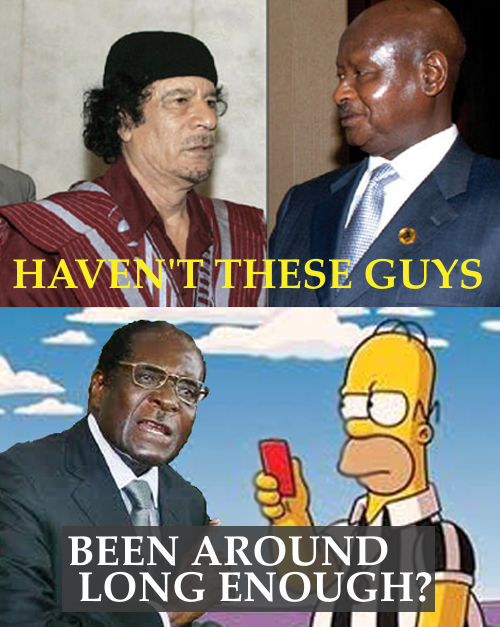
The reason twevolution won’t come to Uganda is because Ugandans are tired of conflict. But apathy is a heavy curse: beware another Zimbabwe.
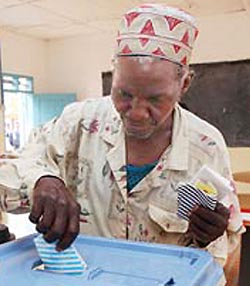
Sunday Uganda’s official electoral commission declared Yoweri Museveni the presidential victor with more than 66% of the votes. Museveni starts his 6th 5-year term and while it’s clear there was enormous vote rigging, even a clean election would have brought him to power.
Billie Miller, spokesman for the Commonwealth countries monitoring the election had to resort to criticism of the runup to the election rather than the actual vote casting itself.
In an interim statement, Miller said that “the main concern regarding the campaign and indeed the overall character of the election was the lack of a level playing field.”
She was referring to the huge amount of money spent by Museveni – much of it from the American right, combined with what the observers felt were unfair practices by media and government officials inhibiting the opposition’s message.
All that may be. But the margin was too big for there to be any question as to the legitimacy of the election, if like we Americans you believe you can spend whatever you want however you get and say whatever you want no matter how untrue.
And to tell you the truth, I think it goes further than that. Most Ugandans were not born during the terrible years of Idi Amin, but his legacy lingers as a dark blotch on the country’s reputation. But most Ugandans did experience many years of war with the Lords Resistance Army, and along their border during the Sudan conflict.
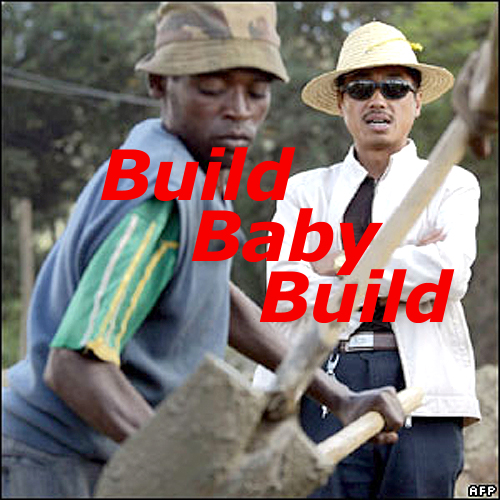
They are tired of conflict. Museveni is seen as having brought peace and stability. And more recently, oil. Oil has been discovered and will be extracted by Chinese which are building Uganda’s infrastructure faster than an ant colony builds tunnels.
What worries me in the long term is this is exactly the prescription for disaster that turned beautiful Zimbabwe into the dark side. The long civil war, and then the war for so long just across the border in Mozambique, brought battle fatigue to the librarian in the city. When a seemingly nice guy with strong ideas came along, he was embraced.
With time, he relied more and more on the military. Which is exactly what Museveni is doing now. The military was exemplary if not brilliant in their ending the wars with the LRA, but now … they have nothing to do but beat protestors.
And with the American right’s finances behind him, Museveni is set for life.
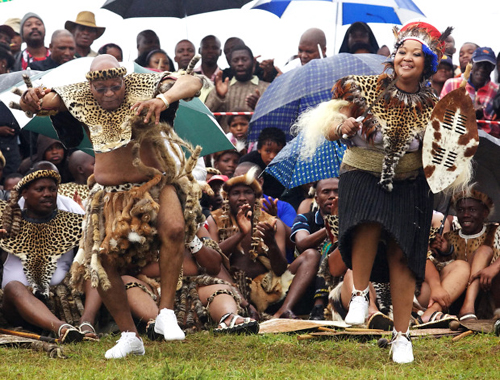
South African President Jacob Zuma dancing with his wife, Ms. .... oh, sorry can't remember which one.Twevolution is sweeping Africa’s dictators away. But could it go further? Is there a chance that pretty boy South Africa is next in line?
South Africa? you wonder out loud. Didn’t I say that South Africa started all this almost twenty years ago? [Yes] Haven’t I often hailed the new country’s constitution as nearly perfect? [Yes] Didn’t I write that its domestic policy was nicely redistributing wealth [Yes] and that its foreign policy particularly towards its neighbors was deftly professional?
Yes-Yes-Yes…but.
It could be that South Africa is trying to be such an exemplary modern society that the last vestige of nondemocratic states will be swept away by the Twevolution. And this last vestige is the authoritarian if not autocratic power held by the majority party in the government, the ANC (African National Congress).
And this nearly impenetrable wall of power (the ANC has continually held two-thirds or more of Parliament since Nelson Mandela first became president) might just be cracking by some of the most juvenile political pandering ever imagined.
It’s hard to fault Mandela for anything, much less astronomical majorities in the government he brought to power. But Mandela was not without his own political nasties. The relationship (or not) that he held (or not) with his wife, who at the time was almost equally powerful, we now recognize as tools to constrain the masses.
By most accounts Winnie Mandela would have been right up there with the Mubarak thugs that stormed Tahrir Square on camels. Winnie was convicted of murder and kidnaping but never served a day in jail.
And Mandela’s favor placing went unchecked for a long time. His close revolutionary associate, Cyril Ramaphosa, was set up in new South African businesses with a patent disregard for either skills or capital once it was clear he would never become president.
Mandela was followed by another ANC miracle worker, Thabo Mbeki. Thabo was less star-strutted than Mandela so less scrutinized, but whatever good he did will forever be eclipsed in history by his paramount achievement: discovering that AIDS was not a virus.
Mbeki told his fellow countrymen to shower well after sex to avoid AIDS. Some claimed this was so he could more easily adjudicate claims against international insurance companies but I think it was to please the masses, develop their support. Whatever it was, it was criminal.
But today we have the biggest oaf of all: Jacob Zuma. Number Three President is famous for having ten wives, but the fact is it may be eleven or twelve. Protocol officials around the world never know what the state dinner place cards should read.
Zuma hails his ancient culture, but I’d put it otherwise: he hails vote getting.
And now Zuma has topped the charts . Last week while Egypt was readjusting world power, Zuma was creating his own eternal life.
“When you vote for the ANC,” he told a rally near Cape Town last week, “you are choosing to go to heaven. When you don’t vote for the ANC, you should know that you are choosing that man who carries a fork… who cooks people.”
Pardoning (or not) a powerful wife, setting your cronies up to be billionaires, denying the science of the disease AIDS that’s killing your people, flaunting culture and preaching eternal life only to those who follow you … none of these juvenile if neurotic acts has managed to derail South Africa’s basically good trajectory into the modern world.
But Twevolution is youth driven, and youth in Africa are incredibly intelligent. You can take just so much nonsense before realizing how distracting it can be from dealing with the pressing issues at hand.
Twevolution may not topple the South African system, but there are growing sounds that it just may topple the idiots at the top
Wonder what the hotel manager got for this one?Wikileaks’ cable publication confirmed last week what we already know: that the Obama Administration has reversed the Bush Administration’s questionable bribing policies and that Tanzania has not changed at all: business by bribes still prevails.
Corruption is hardly an African exclusive and hardly less a Tanzanian exclusive, but as countries throughout Africa increasingly move away from it, Tanzania seems to be moving closer towards it.
Tanzania’s mounds of corruption leak themselves, so they’re so enormous and so stunning. They include bribes to high public officials for buying an anti-defense missile system for Dar that was obviously not needed and never installed, and a pile of corrupt deals with its energy ministry which last week erupted again in Texas courts.
Corruption in Tanzania is like a fermented jar of unused jam that finally bursts its seal. Even so the details come slowly, from good local reporting that is usually suppressed by the government.
So it’s refreshing when something straight-forward like a Wikileaks’ cable simply tells the raw story.
Times’ readers may have been more interested in the top of the story about Arab kings’ interior decoration preoccupations of giant aircraft. And although the revelation about Air Tanzania was found pretty far down, it was big news in East Africa.
Not because it was news, but because local news sources could at last report it without fear of government reprisal. And what’s striking is that since the publication on January 3, not one word has been uttered by either Air Tanzania or the government that owns it, about the leak.
In a nutshell Boeing was trying to sell an aircraft or two to the constantly beleaguered, totally mismanaged Air Tanzania. Why not? No one flies Air Tanzania unless there’s absolutely no choice, and even when passengers want to fly Air Tanzania it usually doesn’t.
But the government of Tanzania said it was in the market for new aircraft, simultaneously with a limp wrist effort to find an international investor to turn the miserable company around.
There is a modicum of business truth to this. No investor in their right mind could turn around a company with the state of (or non state of) aircraft currently owned by Air Tanzania.
So Boeing aggressively started the sale.
The compilation by the Times of numerous, separate Wikileaks’ cables shows how aggressively the new Obama administration helps American companies, to the point that a side story to this is that Europeans are claiming some trade agreements might be jeopardized.
But when the Tanzania government showed interest and then told Boeing it better find an agent, and that the agent Boeing better find was a hotel executive in Tanzania, the U.S. embassy in Dar fired off cables more or less warning Boeing about going too far.
That was a major change from the Bush Administration, and Boeing then rightly towed the line:
A Boeing spokesman told the Times, “It is not just a matter of abiding by U.S. law and laws internationally but a general sense of business ethics.”
Air Tanzania bought an Airbus.
It really doesn’t matter if Air Tanzania buys an Airbus or a Space Shuttle, the company will never be solvent, and it’s truly sad that the business oligarchy in Tanzania profits from this.
The last several weeks in Tanzania suggest things might be turning around. That Tanzanians are getting fed up with a closed government notable most for its corruption.
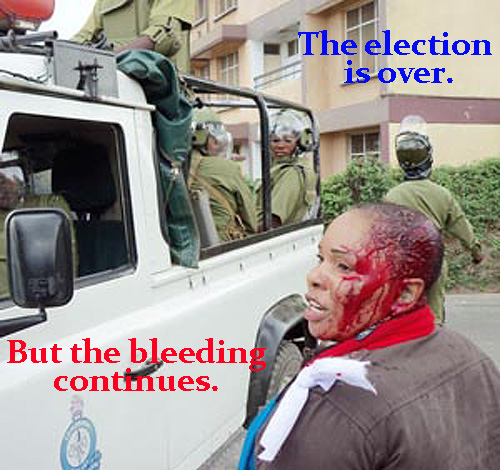
Fiance of opposition candidate, Wilbrod Slaa, challenges police in Arusha.It happened all too quickly. Tanzania’s second largest city erupted in violence Wednesday, three people killed and scores injured. The push for democracy and transparency in Tanzania has exploded faster than even I expected.
Right now Arusha is calm. EWT, in fact, had clients who were in the town today. But the situation remains tense, and the government of Tanzania is acting only in ways that will make it worse.
The Tanzanian government is trying to suppress all news about the affair. Click here for a manual link to YouTube about the demonstration. The reporter, who I can’t identify and doesn’t want to be identified, has requested that YouTube remove all embedding code that would allow it to be dispersed more easily through blogs like these.
The video captures much of the chaos over most of Wednesday afternoon. It has a clip of the fiance of defeated opposition presidential candidate Wilbrod Slaa, her face bloodied.
The violence began when federal police used tear gas on a rally called to criticize the current government.
The initial battle with tear gas occurred at a large open field where Chadema’s rally (the opposition party) was just starting.
A large anti-riot police vehicle equipped with its tear-gas throwers disturbed the crowd, who had assembled with a police permit. The police claimed the vehicle was there to prevent marchers who were arriving from the central city to join the rally, because while police had granted a permit for the rally, they had denied a permit for the march to the rally.
“Police keep away, this is an official meeting and we have permission to gather here,” shouted Wilbrod Slaa, the defeated Chadema candidate for president of Tanzania who was at the time addressing the rally.
As marchers appeared, the tear gas went off and chaos errupted. Police arrested a number of the leaders in the front of the march, including Godbless Lema, the wildly popular and newly elected MP from Arusha, and (opposition party) Chadema chairman Freeman Mbowe.
As the two high profile politicians were being driven away with 47 others arrested, the crowd exploded: scores of people raced towards the police vehicle throwing rocks. The police responded with more tear gas.
Crowds then formed throughout the city trying to converge on the police station, where it was presumed the leaders were being held. Police used live ammunition against the crowd, there, and the afternoon became one of continuous pitched battles throughout the city between police and demonstrators.
Police confirmed 2 dead and 9 injured but area hospitals suggested 3 dead and injured closer to 100.
Arusha opposition MP Lema is a rebel rouser, and this is not his first brush with the law. He has been in jail twice before during his campaign for Parliament, which he won in the national election the end of November.
The specific issue that ignited yesterday’s violence was a federal government move over the weekend that stacked the Arusha city council with government supporters allowed to vote for mayor, but who did not actually reside in the city.
The real city councilors had boycotted the meeting and claim, therefore, that there was not a quorum sufficient to elect a mayor. But the government ordered the election to continue, and the result is that at least officially, Arusha now has a mayor allied to the government ruling party, a mayor overlording a city that is hugely in the opposition’s camp.
This does not happy days make.
But there were other issues to be discussed at the rally which was never completed: that the presidential election last November was unfair, that the government is corrupt, and a host of lingering accusations that during the November national election campaign the government suppressed all opposition.
I’m not sure how far this is going to go. The opposition in Arusha is incredibly strong and has support from several other larger communities in northern Tanzania like Karatu. But other important areas in northern Tanzania like Moshi, Monduli and Mto-wa-Mbu are firmly on the government’s side.
The blogosphere is cautious, I fear worried that the government is looking over their shoulders. There are numerous references to what has happened in Arusha is like Tiananmen Square, protests in Berlin before the wall went down, and demonstrations in Kenya that led to more transparent government.
Without doubt the police acted wrongly. It remains to be seen if they acted on their own, or are following in lock-step the darkening oligarchy in Dar.
When you’re sick inside, the outside looks terrible: 2010 was a year of striking differences between surging Kenya and its backward neighbors. 2011 will be the same.
Socially, culturally and politically, it was a GREAT YEAR for Kenya but a BAD YEAR for its neighbors.
Kenya grew fast, started to implement a radical new constitution, improved tourism even while increasing tourist rates, and deftly participated in major global controversies like the CITES attempt to allow selling ivory and the run-up to the South Sudan election.
But the other countries in East Africa? Terrible. Socially and politically Rwanda, Tanzania and Uganda all took huge steps backwards. Contested or ramrodded elections, scandals of unbelievable corruption, and horrendous attempts to extinguish moves to improve human rights gave this part of East Africa a 20th century dictatorial look.
And the actual bombings in Kampala that killed more than 70 people almost suggest that when your internal body isn’t doing so well, you’re going to be nicked by the viruses from the outside.
For many years Tanzania’s tourism was inching up on Kenya’s, outpacing both growth and development. Last year that was reversed, and one can only suppose that tourism is sinking with the overall quicksand felt throughout the country.
It was a BAD YEAR for wilderness and wildlife. The “mini-drought” is now two years behind us, and so almost anything looks good in comparison, but there were two horrendous trends appearing throughout East Africa last year:
Poaching and Politics.
There’s always been poaching, but nothing like the corporate poaching that successfully kills and transports out of private, fenced and patrolled reserves a black rhino. That happened in both Kenya and South Africa. And in Tanzania, the Serengeti lost 20% of its wild rhinos (1 of 5, that until now were patrolled like a child in a perambulator with the Nanny’s grip fastened.)
And Tanzania in its drive to become Africa’s newest pariah first spearheaded a campaign to reverse CITES sanctions on selling ivory, and then announced it was going to kill the wildebeest migration with a road.
In Uganda, Father Museveni gave the nod to start hunting, again, and let South Africans develop the hunting of the rare sitantunga, even as its wildlife count declines.
And there’s nearly as bad a flipside to this wildlife story: where poaching and politics aren’t screwing things up, elephants are. The population explosion is eroding the population’s confidence everywhere that governments can keep the jumbo out of the farm.
It just doesn’t look good for wildlife in this turbulent and developing era in East Africa.
It’s hard to imagine 2011 can be as bad. And at the risk of jinxing the whole kebab but being true to end-of-year stock taking, I’m going to predict the Serengeti highway won’t happen, at least not completely as planned. And if we can get at least that victory, I guess the battle continues with some hope.
And with that my marker for WILDLIFE below moves from bad to good.
Strictly economically, Kenya is in the stratosphere, leaving its neighbors way behind. Now a lot of this is foreign donors nudging the county towards implementing the new constitution, so you would normally expect that to end next year. But next year is one year before the next election, and it was the last election when everything fell apart, so I feel this outside stimulus is going to continue. And then, there’s China, flooding Kenya with infrastructure money as if it’s taken a page out of Obama 2.0.
Elsewhere in East Africa, including Tanzania and despite recent fossil fuel discoveries, things don’t look so rosy. Tanzania’s debt is massive, Rwanda’s long flirtation with foreign aid is about over, and Uganda is so mired in bad bookkeeping we can only presume the worst.
I’m afraid that 2011 will be worse for Kenya’s neighbors and probably the same for near inebriated Kenya.
Here’s my summary for what it was and what it will be:
East Africa Report
2009
2010
2011
SOCIETY Kenya The Rest
Good Bad
Good Bad
Good Bad
WILDLIFE
Bad
Bad
Good
WEATHER
Bad
Good
Good
TOURISM Kenya The Rest
Bad Bad
Good Bad
Good Bad
ECONOMY Kenya The Rest
Bad Bad
Good Bad
Good Bad
Predictions are just that, based on the here and now. If Tanzania can move swiftly to its own new constitution, if Father Museveni steps down, if Karume disappears and is replaced by a coalition-building young person, then societies throughout East Africa will improve.
And with the society, so will the economy.
East Africa is booming, so many of the stories of 2010 were terrifically good news. But there were the tragedies as well like the Kampala bombings. Below I try to put the year in perspective with my top ten stories for East Africa for 2010.
1. Populace democracy grows.
2. Terrorism grows, as does the battle against it.
3. Huge stop in the mercenary purchases of Coltan.
4. Momentum for peace in the runup to establishing a new South Sudan.
5. Tourism clashes with development, especially with the proposed Serengeti Highway.
6. New discoveries of fossil fuels produces new wealth and a new relationship with China.
7. Gay Rights grow public but loses ground.
8. Rhino poaching becomes corporate.
9. Hot air ballooning’s safety newly questioned in game parks.
10. Newest early man discoveries reconfirm sub-Saharan Africa as the birthplace of man.
#1: POPULACE DEMOCRACY GROWS
Theoretically, all the East African countries have operated as “democracies” except for the torrential years of Idi Amin in Uganda. But the quality of this democracy was never very good.
Tanzania was a one-party state for its first 20 years, and that same party continues to rule although more democratically today. Kenya, Uganda, Rwanda and Burundi experienced one dictator after another, even while democratic elections at regional levels challenged the executive.
But the end of the Cold War destroyed the alliances these developing countries had with super powers. Purse strings were cut, and political cow-towing ended. All of them moved towards a truly more democratic culture.
And in 2010 huge leaps were made in all the countries towards more truly representative government. The most important example by far was the overwhelming passing of the new constitution in Kenya in a national referendum where more than 75% of registered voters participated.
And like the U.S. election which followed shortly thereafter, and like support for national health care in the U.S. and so many other issues (like no tax cuts for the rich), Kenyan politicians dragged their feet right up to the critical moment. They tried and tried, and ultimately failed, to dissuade Kenyans from their fundamental desire to eliminate tribalism in government and more fairly distribute the huge wealth being newly created.
I see this as People vs. Politicians, and in this wonderful case, the People won!
And there was some progress as well in Tanzania’s December election, with the opposition growing and its influence today moving that country towards a more democratic constitution.
(It was not so good in Rwanda or Uganda, where stiff-arm techniques and government manipulation of the electoral process undermined any attempt at real democracy.) But the huge leap forward in Kenya, and the little hop in Tanzania, made this the absolute top story of the year.
#2: TERRORISM GROWS
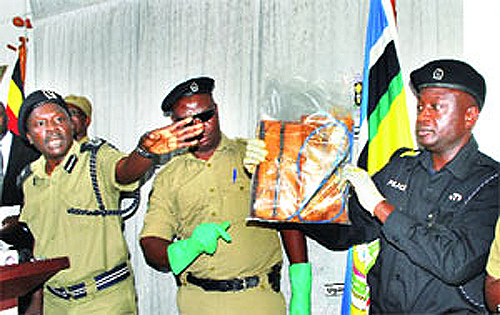
Four smaller bombings in Nairobi’s central business district over the year were eclipsed by two horrible simultaneous bombings in Kampala bars on July 11 while patrons were watching the world cup. Police display an unexploded suicide vest.
Al-Shabaab, Al-Qaeda in Somali, claimed responsibility. And throughout the year Shabaab grew increasingly visible along the Kenyan border as its power in Somali increased.
I’ve written for a long time about how the west has had its collective head in the sand as regards terrorism and Al-Qaeda in particular. Long ago I pointed out that the locus of Al-Qaeda terrorism had moved to the horn from Afghanistan, and this year proved it in spades.
The country with the most to lose and most to gain in this war on terror is Kenya, because of its long shared border with Somalia. And the year also marked a striking increase in the Kenyan government’s war on terror, and with considerable success.
With much more deftness and delicacy than us Kenya has stepped up the battle against Al-Shabaab while pursuing policies aimed at pacifying any overt threats to its security, by such brilliant moves as allowing Omar Bashir into the country and not arresting him (on an international U.N. warrant). As I said in a blog, Kenya Gets It, and the story is therefore a hopeful one.
The Dodd-Frank Act is our victory!The Congo Wars continue but are abating, and in large part because of a little known provision in the Dodd-Frank Wall Street Reform Act which now makes it almost impossible for major corporations in the U.S. to buy the precious metal Coltan on the black market.
A black market which has funded perhaps Africa’s most horrible war for more than a generation. Hundreds of thousands – perhaps millions – have been killed and raped, and more than 20,000 children conscripted into brutal wars, funded by purchases of Coltan and other precious metals by Intel, Sony and Apple.
It certainly wasn’t just this little legislative move. The U.N. peace-keeping force, fabulous diplomatic initiatives by Uganda and a real diplomatic vigilance by the U.S. all were instrumental. But the year ended with the least violence in the region in more than two decades.
#4: SOUTH SUDAN
I may be jumping the gun on this one, because the referendum to create a new country, the South Sudan, is not scheduled to occur before next month. But the runup to the referendum, including the registration process, while labored looks like it’s working.
Allied loosely with the Congo Wars, the civil war between the North and South Sudan had gone on for generations until a brokered peace deal five years ago included the ultimate end to the story: succession of the South into a new country.
The concept is rife with problems, most notably that the division line straddles important oil-producing areas. But in spite of all of this, and many other ups and downs along the way, it looks to me like there will be a South Sudan, and soon. And this year’s new U.N. presence in Juba, donor-construction of roads and airports, all points to the main global players in the controversy also thinking the same.
The creation of a new state out of a near failed one is not the be-all or end-all of the many problems of this massive and powerfully oil-rich area. But it is a giant leap forward.
#5: THE SERENGETI HIGHWAY & TOURISM
Last night NBC news aired a segment on the Serengeti Highway controversy, elevating an East African story into American prime time. Good.
But like so many reports of this controversy, the simplification ran amok. NBC’s reporter Engels claimed the motivation for the road was to facilitate rare earth metals like Coltan (see above) getting into Chinese hands more quickly.
While there may be something to this, it’s definitely not the main reason, which is much more general and harder therefore to fight. As I’ve often written, the highway as planned will be a real boon to the Maasai currently living to the east of the Serengeti, as much if not more than to the Chinese.
And as far as I know, Maasai don’t use Coltan.
Roads bring commerce and may be the single quickest way to develop a region. This region is sorely in need of development and recent Tanzania politics has aligned to the need for this regional development.
The highway is just one of many such issues which came to the fore throughout 2010 in Kenya and Tanzania. Concern that the west is just interested in East Africa as a vacation destination with no regards for the struggle for development, has governed quite a few local elections this year.
The whole concept of tourism may be changing as the debate progresses. I believe very deeply that the Serengeti highway as proposed would hinder rather than help development. But as I’ve pointed out, alternatives are in the works.
And the real story of which the highway story is only a part, is how dramatically different East Africans have begun to view tourists in 2010.
#6: NEW RESOURCE DISCOVERIES ALTER GEOPOLITICS
For years I and other African experts have referred to East Africa as “resource-poor.” Kenya, in particular, had nothing but potash. Boy, did that change this year!
Although only one proven reserve has been announced in Kenya, several have begun production in Uganda and we know many more are to come.
China has announced plans for a pipeline and oil port in northern Kenya at a cost of nearly $16 billion dollars, that’s more than twice the entire annual budget for the Kenya government! Deep earth techniques have matured, and China knows how to use them.
More gold has been found in Tanzania, new coal deposits in Uganda, more precious metals in Rwanda… East Africa is turning into the world’s rare earth commodities market.
A lot of these new discoveries are a result of technology improving: going deeper into the earth. But 2010 freed East Africa from the shackle of being “resource-poor” and that’s a very big deal.
#7: GAY RIGHTS ON THE HOOK
African societies have never embraced gay rights but as they rapidly develop, until now there was none of the gay bashing of the sort the rightest backlash produces in the U.S. U.S. Righties manipulating East Africa.
That changed this year, and in large part because of the meddling of U.S. rightest groups.
In what appears to now have been a concerted many year effort, support from U.S. righties is leading to a vote in Uganda’s parliament that would make homosexuality a capital offense, and would jail for long terms those who failed to out known gays.
This extreme is not African, it is American. Mostly an insidious attempt by those unable to evince such insanity in their own society to go to some more manipulative place. The story isn’t over as the vote has yet to occur, but it emerged and reached a crescendo this year.
#8: RHINO POACHING EXPLODES
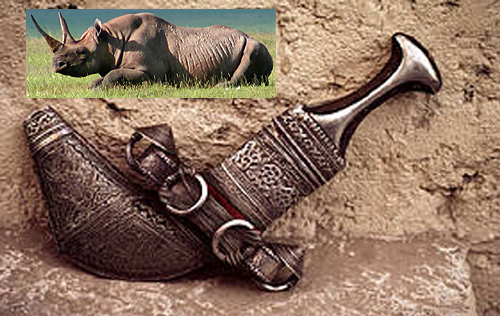
Poaching is a constant problem in wildlife reserves worldwide and Africa in particular. Rhino are particularly vulnerable, and efforts to ensure safe, wild habitats have been decades in the making. Dagger from rhino horn.
This year, they seemed to come apart. It’s not clear if the economic downturn has something to do with this, but the poaching seems to have morphed this year from individual crimes to corporate business plans.
This leap in criminal sophistication must be explained by wealth opportunities that haven’t existed previously. And whether that was the depressing of financial goals caused by the economic downturn, increased wealth in the Horn of Africa where so much of the rhino horn is destined, or reduced law enforcement, we don’t yet know. But 2010 was the sad year that this poaching exploded.
#9: IS HOT AIR BALLOONING SAFE?
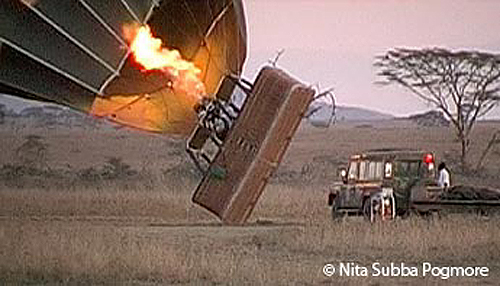
Hot air ballooning in Africa’s two great wildernesses of the Maasai Mara (Kenya) and the Serengeti (Tanzania) has been a staple of exciting options to visiting tourists for nearly 30 years. That might be changing. Is it Safe?
A terrible accident in the Serengeti in early October that killed two passengers and injured others opened a hornet’s nest of new questions.
After working on this story for some time I’ve personally concluded 2010 was the year I learned I should not step into a hot air balloon in East Africa, at least for the time being!
#10: EARLY MAN WONDERS
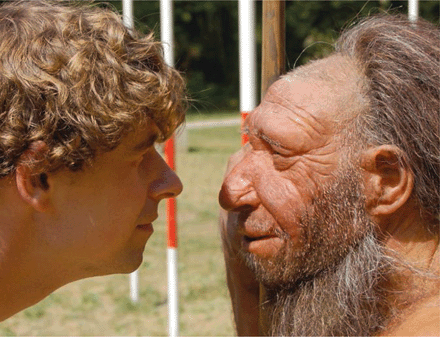
There were not quite as many spectacular discoveries or announcements about early man this year as in years previously, but one really did stand out as outstanding and you might wonder what it has to do with East Africa! Representation by Tomislan Maricic.
DNA testing of Neanderthal proved that early man from Africa didn’t wipe them out after all, but absorbed them into the ever-evolving homin species.
And that absorption, and not massacre, happened outside Africa to be sure. But it finally helps smooth out the story that began in Africa: It’s likely that Neanderthal were earlier migrants from Africa, and absorption was therefore easier, physiologically and biologically.
It’s a wonderful story, and fresh and exciting, unlike the only other major African early man announcement about Ardi which was really a much older story, anyway.
****************
HAPPY NEW YEAR to all my loyal readers, with a giant thank you from me for your attention but especially your wonderful comments throughout the year. See you next year!
Dagger sold in Sana'a for $15000. The handle is made from rhino horn. The poacher gets $200-1000. Middlemen transporting it to the Horn take about $5000. Skilled carvers take around $2000. Profit in the market more than $7000.Rhino poaching is exceeding even my own direst predictions this year, and I’m trying to understand why.
The Serengeti is one of the world’s largest protected wildernesses, nearly 5000 sq. miles when combined with the adjacent Ngorongoro Conservation Area. There are now only 4 wild rhinos left in this area, after one was found dead this holiday season – it’s horn removed.
This is the most recent of an extraordinary run of killings, most of which were in South Africa where the poaching is more mafia-like, corporate. In East Africa it’s usually individuals working alone.
I wrote about rhino poaching only a few weeks ago but I’m particularly incensed about this loss in the Serengeti. I’ve personally seen poached rhinos several times in northern Tanzania during my career, and try as I have to understand the poor bloke (poacher) just trying to make a buck, the harder it becomes.
Why should I – a foreigner from a distant land – be angry with an impoverished Tanzanian who has tried everything right in his life to get a job and support a family, and just can’t? Who has the daring to kill a dangerous animal? Who has the wherewithal to find the onerous black market?
It’s one thing when you know – as I did in 1998 on the crater floor – that it was a well-paid ranger working in cahoots with the Conservator of the park. But it seems different when it’s a single individual who just can’t get a job and has tried.
So this current surge in poaching I originally linked to the economic downturn. But Africa pulled out of the economic downturn long before we did and has been essentially surging for the last year.
And that’s the key.
Like here at home, the rich are now comfortable with spending their money, again. And it’s the rich to whom the rhino horns go. Mostly to Yemen, but throughout the lower Mideast where rhino horns are prized as much or greater than ivory in Asia.
Like ivory, they carve beautifully and buff even better. Traditionally they were used as dagger handles in male rite de passage ceremonies where Dad gives Butch a special present. Now a days they tend to be made into commercial sculptures and sold like stolen Picassos.
These are the culprits, much more so than the desperate father encouraged to make the actual kill. There’s a real analogy here with the illicit drug market in the U.S. For sure the Mexican mafia are bad guys. But it’s the users of cocaine, not the growers of poppy, who are the real satans.
Important Note: black rhino will not go extinct. They are thriving in private reserves, zoos and small, contained wildernesses like Lake Nakuru. They thrive as they have since appearing on earth because they are big and eat almost anything. They have no predators, except man.
But in the wild, the true open wilderness, their days are numbered. Perhaps it’s time to just come to accept this fact of the modern world. At least until the rich and greedy can be controlled. And that I don’t see happening soon.
Choose your culprit: Right or Left.Yesterday The House censured Rep. Charles Rangel for among other things, bribes. And today Nigerian officials confirmed a warrant has been issued for the arrest of Dick Cheney… for bribes.
While the magnitude of the bribes is significantly greater in the Cheney than Rangel case, both involve oil, and both involve men at the highest pinnacles of U.S. power.
On the surface the two men couldn’t be more different: conservative and progressive, white and black, aristocrat and slum-boy. Yes, but the difference even stretched into their souls.
The one I’ve always liked is like your bumbling old uncle who nonetheless brings you the best Christmas presents. Rangel was a progressive, Harlem’s Godfather, articulate and loaded for bear in the public arena fighting for what he thought was right.
Cheney is the Joker incarnate. He appears public only when the vicious veils of his den of inequity are ruffled, and even then rarely says anything. He’s insensitive to public suffering, loved by no one.
But at the bottom of their souls all differences disappear. They’re both corrupt.
I’ve spent a good amount of my adult life explaining to critics of Africa that the popular notion that Africa is corrupt is upside down. Africa is a poor place, or at least has been for most of my life. Corruption usually takes the form of money. That has to come from rich places.
Like Haliburton and the U.S. Congress.
Rangel maneuvered into a tax bill a loophole worth hundreds of millions of dollars to an oil-drilling company that pledged $1 million to build a New York city college named in his honor.
In my book Cheney was the bad guy and Rangel the good guy. Cheney was the elite if effete aristocrat masterfully deploying evil. Rangel was the underdog, wounded vet, loyal progressive slipping into the aristocratic comfort zone with little skill.
Cheney did things to get rich. I suppose Rangel did, too, but mostly to get honor. Cheney seems unmotivated by anything moral. Rangel was dangerously playful with The “Ends-Justify-The-Means” to enrich his down treaded community and obtain personal accolades.
Frankly, I actually think Rangel was also just tired of detail, arrogantly careless, ultimately criminally incompetent or incompetently criminal. That certainly does not describe Cheney. Cheney’s Nigerian crimes are ruthlessly calculated, focused from the get-go.
But they both broke hundreds of laws. The big stash was oil.
(Nothing has been proved in court. In both cases only unlitigated allegations exist, and likely will never move further. But let the truth prevail. Justice is often not revealing, just reflective: as opaque as the power that opposes it.)
Cover them both in oil, and you can’t tell them apart.
There couldn’t be two different characters. Mired in infamy by a fossil fuel.
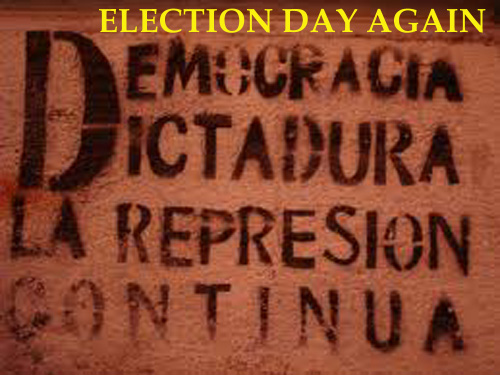
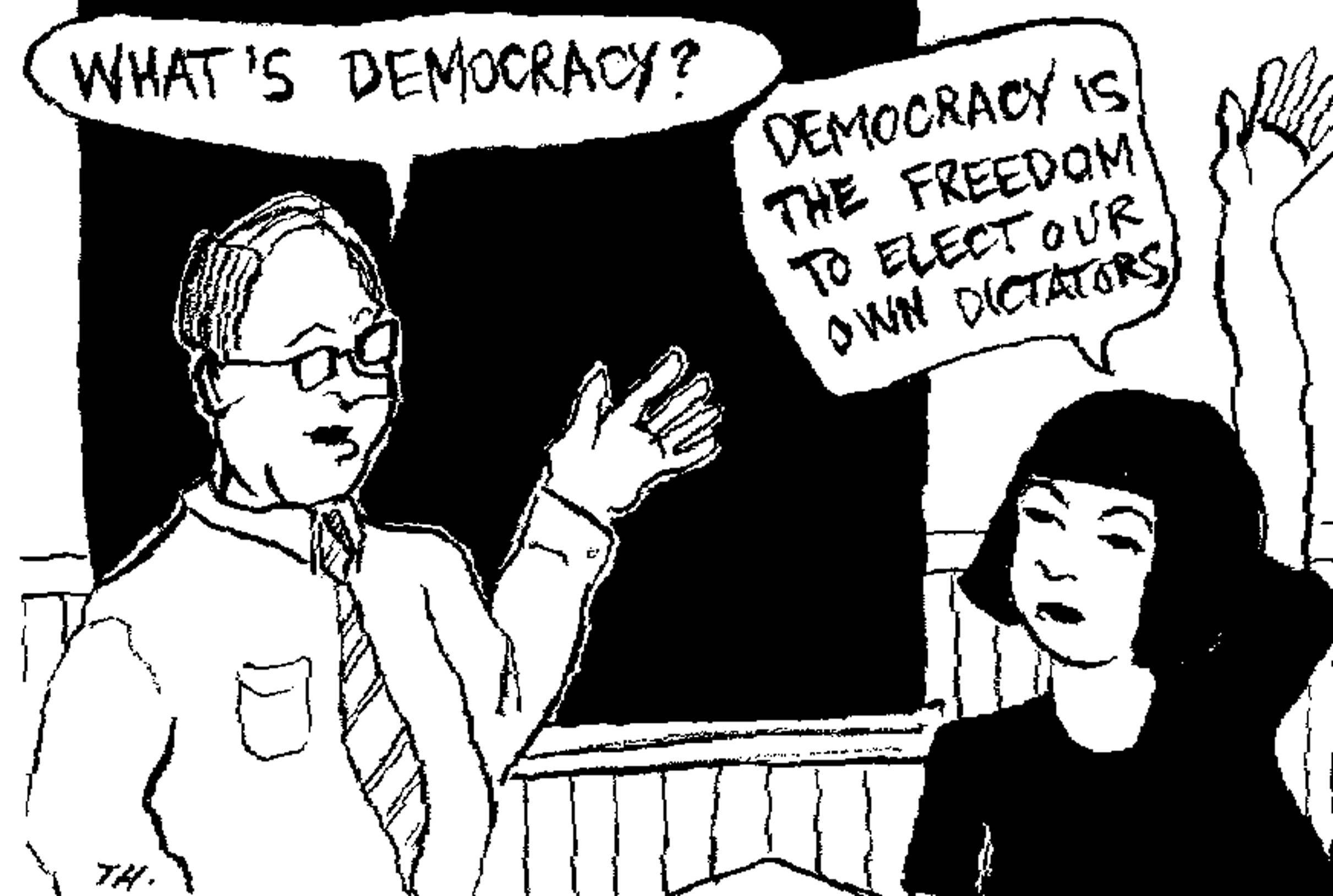
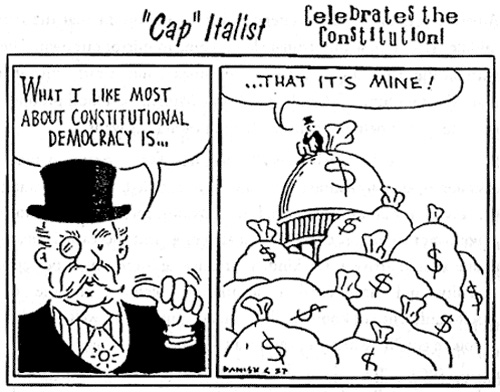
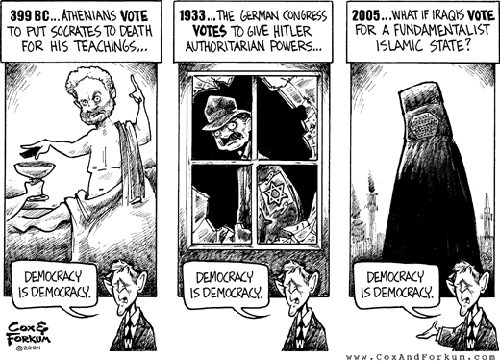
Democracy may not be cracked up to be what we think. Neither here or … in Tanzania.
As I look at what has happened in East African elections over the last several years – all considered democratic – and place that in the background of our own elections, today, I wonder if implementing the “will of the people” (WoP) can ever occur.
In Tanzania there is every indication that the ruling elite will continue to rule, as they have for … well, forever. Ditto for Rwanda earlier this year, and what we also expect in Uganda. Only in Kenya, where the electorate is more educated and empowered, have elections been close enough to cause real trouble.
The Tanzanian election was Sunday, and the political party whose heritage comes from the one-party state that took Tanzania from independence in 1962 to its first multi-party election in 1992 is expected to win handily. Results are seeping out and should be known in full by the end of the week.
That first “democratic” election in 1992 was forced on Tanzanian society, mainly by an unrelenting Reagan policy that stopped any kind of donor aid from virtually any US or world aid organization if the country didn’t go “democratic.”
Reagan created the diplomat known as the “Democracy Officer” and put one in virtually every embassy and consulate in the world. Sort of like a politburo official, this puny little usually poorly trained non career diplomat had effectively more power in some embassies – particularly in East Africa – than the ambassador him/herself.
Tanzania – like many developing countries around the world – was clever. They created a veneer of multi-party democracy that even to today is hardly more. Political parties are denied registration. Opposition candidates get no press. And like many of our own T-party candidates this year at home, central party candidates refused to debate or talk to the press.
Is this “democratic”?
In Rwanda presidential opponents are dead or in jail. Uganda holds an election, soon. The opponents have quietly withdrawn or are in what is locally called the “process of disappearing.”
Yet our State Department, the EU and other lordly world bodies, have called these all “democratic elections.”
I suppose they are. And perhaps, that’s the point. To the extent that people can vote, if that’s all democracy means, they are voting with their daily lives of complacency as much as at the ballot box, that they will do as they are being told to do.
Is that “democracy”?
And here at home, it could be that a majority of Americans today vote against their own best interests. Because they’ve been fed simple lies they believe. Like Obama is a Muslim. Or that death panels will decide their death moment.
Or that the Health Care Law is so many bad things it isn’t and none of the good things it is. Or that Obama is responsible for the debt. Or that the wars …
The wars? Anyone talking about the wars? Are there wars? Anybody hear a bomb recently? Are Afghans and Iraqis and American kids being blown to smithereens?
Anyone care? Maybe it’s just in xBox.
What we’re learning here and in Africa is that democracy does not reflect WoP. It reflects a physical act of choosing between candidates, but the little brain that directs those hands marking a ballot and effecting a choice is … well, brainwashed.
Democracy seems to be doing what you can be convinced to do. Even if it’s not true, or not what you really want to do.
That’s not what democracy should mean.
To me democracy means affecting a choice whose outcome you understand pretty clearly and correctly. There really is a reality out there, Joe. If the pipes are clogged, there really is a place – probably in the U-tube – where sludge is building. And we probably can really plunge it out.
But if you’re told over and over that it’s OK your sink overflows, that the pipes are still working, then Joe the Plumber & Great Deceiver controls your life, not you.
Only in Kenya has democracy approached some realistic manifestation of WoP. And that provoked the worst election violence we’ve seen in Africa in my life time. Is that good? Certainly not for the 1300 murdered and 150,000 displaced.
So, WoP, are you everything you’re cracked up to be?
We will know the official outcome of our elections Tuesday, before we know the official outcome of Tanzania’s Sunday elections.
Despite the rapid development in places like Tanzania, there are still many very remote polling stations, and uniformity in how returns are reported publicly rules Tanzanian law. So of course they know right now who won in the urban areas like Dar, but it won’t be reported until little remote villages like Endulen report in as well.
The expected results are much more expected in Tanzania than here at home.
Jakaya Kikwete, the current president, will likely be reelected for his second and final term, although by a much narrower margin than the 80% of his first election.
Kikwete has lost some of his pizzaz. A few weeks after his first election, he dressed up like a commoner and walked into various government agencies, like social security, and experienced the distress of trying to get something done.
He’d walk out and the next day fire most of the staff.
He was hailed for such bravado. But those days are far gone. His main rival, Willibrod Slaa, is riding a wave of anti-corruption sentiment. Foreign donors have halved their donations since Kikwete’s first election, ostensibly because of growing corruption.
This half billion dollars lost annually, in a national budget which is only just over $6 billion, is a sizeable hit. Kikwete has tried some fancy footwork to close the gaps, including increasing the tax on foreign mining companies and issuing bonds, but it still falls massively short.
So the country has moved into deficit spending big time, even while the economy is doing nicely and would not normally mandate such red ink if the donors were being normally kind.
Like here at home, it’s the economy stupid, and in a developing country even when the economy is doing pretty well, for many it seems exactly otherwise. It will be a generation before the developing world can provide to the extent the developed world now does.
And as communication increases and democracy spreads, discontent rules.
Change, whether you can believe in it or not, motivates everyone’s vote.
Will President Kikwete (far left) not be reelected Sunday?Before Angle vs. Reid on Tuesday, we’re going to have Kikwete vs. Slaa on Sunday. And a remarkable surprise may be in the making.
Several opinion polls are now predicting that the sitting president of Tanzania, Jakaya Kikwete, may not be reelected.
This is really incredible. I have to admit my own surprise by admitting how I never would have considered it possible.
In my blog of October 12, I said most analysts were predicting a landslide for the sitting president, Jakaya Kikwete. Well, no more. Most are predicting a victory, but not by much, and there are even some daring to suggest he will lose to his most formidable rival, Willbrod Slaa.
Tanzanian voters have only had a choice of presidential candidates since 1992; before that, a single-party state controlled the presidency. This will be the 5th election since then, and it would be the first that a sitting president was ousted.
Today the main issue in the campaign is corruption and government competence. This has appeared suddenly and surprisingly. Corruption and government competence has always been questioned by Tanzania’s elite and educated, but the message has apparently gained traction with the masses.
Much of the broad political fight has been focused onto Kikwete’s support for his former prime minister, Edward Lowassa, who is attempting to return to Parliament after resigning several years ago as a result of a scandal that implicated him in millions of kickbacked dollars.
Although Lowassa is popular in his home region, he is vastly unpopular elsewhere. He’s a de facto admitted crook. But the president is supporting him, and the president’s opponents are calling him out for doing so.
And focusing the entire charge of corruption on this one very visible event.
We’ll see. All eyes on Tanzania Sunday. I’m still predicting Kikwete will win,.
Unable to do it at home, U.S. Righties do it in Africa.The gay bashing which became gay beating two weeks ago in Uganda was widely reported worldwide. But not enough has been said about the U.S. Christian right which fomented the violence in the first place.
In September I wrote that the “C Street Players” – a list of prominent leaders and politicians on the U.S. far right – were implicated in rigging the re-election of the Ugandan MP who introduced draconian legislation to punish gays and people who knew people were gay.
Fortunately that bill was tabled by Uganda’s president after substantial pressure from the west.
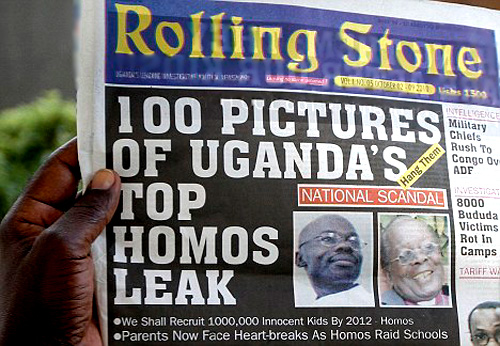
But the evil continues. A rogue newspaper, not registered (and were it anything but a gay basher tabloid would have been viciously suppressed by the Ugandan regime), incited incredible violence earlier this month by naming the country’s “Top 100 Homos.”
It’s really impossible to know if American money is behind this new tabloid, and in a sense, it doesn’t really matter. Hate on the level C Street brought to Uganda in the first place, which promulgated legislation that couldn’t possibly get even rightest attention in the U.S. (execution for certain gays), was intense enough to start these brush fires.
Fewer than 2000 copies of the Ugandan Rolling Stone issue were circulated, but that seemed enough to cause something of a cultural rampage in the capitol. Shortly thereafter, the real violence began. Four gays were seriously beaten, others injured, scores intimated.
This is a terrible story, but I actually believe the more terrible story is how effective the American Christian right is now in East Africa.
Much of this current violence can likely be traced to Lou Engel, an American evangelical, who received permission to hold a kill-gays rally on the campus of Uganda’s most prestigious university, Makerere. More than 1300 people attended that rally in May.
As reported then in the Huffington Post Engel was a picture perfect conservative rabble rouser. To the American press he disavowed any animus towards gays and even any knowledge of the bill before the Ugandan legislature.
But once at the rally his tuned changed significantly and he was dispensing hate with incredible efficiency. He seemed to know that the five-year long fight for an anti-gay bill in Uganda so beautiful maneuvered and heavily funded by the U.S. Christian right was in trouble.
So his response was to say incredibly vicious things. “…he whipped up bizarre fears of evil gays lurking in schools in Uganda” according to Wayne Hudson in that Huffington article, along with screaming that Uganda was “ground zero” in the fight against gays.
This is what the American right does: lie, then use that lie to engage the deep-set anger of those foolish enough to consider it. Once engaged, the anger is finally corrupted to any use they wish.
Senators De Mint and Coburn will never succeed in punishing people in the U.S. for being gay, and not even Lou Engel could preach such nonsense here. So…
…they go to Africa, where the angers are greater and deeper, and they shift their lunacy for power there.
Mark Jordhal, a blogger friend in Kampala wrote me recently:
“The proposed bill found fertile ground here and, frankly, if you asked out on the streets at least 90% of Ugandans are fully in favor of the bill. The only thing that kept it from coming to be was the fierce international response and the fact that a third of Uganda’s national budget comes from foreign donors. Five years from now when that money is replaced by oil revenues, the story might be much different.”
Here at home there’s a glimmer of light that the ton of negative lying campaign ads are actually having a backlash effect.
I hope in the end Ugandans themselves will realize how they’re being manipulated, and manipulated not by some foreign power preaching an ideology, but by demons preaching hate, who have little concern for Ugandans themselves.
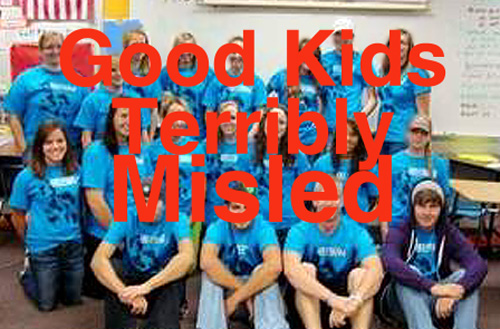
The International Club of Windsor High School, Colorado.
Here’s a perfect picture of what’s wrong with part of America: Kids, yes kids, duped by charity.
No one doubts the generosity of Americans. But charity must be researched first. And that’s what so many Americans just don’t do.
It would bother me less if it weren’t adults misleading kids. And I wouldn’t be quite so enraged if a series of subsequent adults didn’t affirm the original lie.
According to the Windsor, Colorado newspaper, The Beacon, Windsor High School students in northern Colorado are holding a big fund-raiser November 3 to help children fleeing a war zone in Africa.
The problem is, there is no war zone.
I don’t know if the lead teacher, Jackie Doman-Peoples, believes this. I tried to find out by calling her school and sending her an email, but she didn’t respond. So I don’t know if she just went onto the website of Invisible Children and didn’t dig deeply enough into their pages for the “current history” of Uganda and just got spell-bound by the movie about Invisible Children which no longer applies.
I don’t know if she then just decided, wow, that looks good, just like thousands of American idiots read a Sharron Angle’s poster and decide, wow, that looks good.
Doman-Peoples could have set me and lots of people in Uganda straight, but she didn’t. And I worry that she is leading her students to believe that their hard earned donations would be used to build a school to welcome recent escapees who had been kidnapped and turned into child soldiers by the notorious Lord’s Resistance Army (LRA).
The LRA hasn’t been active in Uganda for at least two years, maybe longer.
So there aren’t any children fleeing an army that no longer exists in a war zone that isn’t.
The Beacon fed into the online version of a major Ft. Collins newspaper, the Coloradoan, where it reappeared.
So, we know the Beacon didn’t fact-check, and we know the Coloradoan didn’t fact-check the Beacon, and we know that Doman-Peoples didn’t take the opportunity to tell me that she didn’t believe what was reported about her.
Now to be sure, the LRA is still a force to be reckoned with, but not in northern Uganda. This weekend the leaders of a number of African nations met in Bangui, Central African Republic (CAR), to plan a strategy to finally wipe them out.
This is because the LRA was defeated in northern Uganda, southern Sudan more than two years ago by a proactive Ugandan military mixed with adroit international diplomacy.
The African leaders met in Bangui to discuss the LRA, because that’s the country in which the LRA is now most active. The renegade leader, Joseph Kony, fled northern Uganda when his dwindling forces were being routed and is probably in a hold-up in Darfur, much closer to the CAR than Uganda.
LRA is now active in a place that’s as far from northern Uganda as Windsor is from Las Vegas or St. Louis. The displaced kids from this new war zone can’t be helped in northern Uganda. And unfortunately, these new war zone areas are far too unstable for schools of any kind at the moment.
My irritation is certainly not with the generous souls of those kids in the high school, or even with the good intentions of someone like Donam-Peoples. There are plenty of children still in northern Uganda who still need assistance from the war which ended two years or more ago. They will likely need assistance the rest of their lives.
But I’m mad as hell that the implication is that the war continues, there! It doesn’t! Or that innocent kids are still being displaced, there. They aren’t!
This is also a story of what happens to NGOs when they become unnecessary. They won’t admit it. According to Mark Jordhal, whose wonderful Ugandan blog first broke this story, Invisible Children doesn’t deny that fund-raisers are still using their materials, particularly the film, which claims that the war in Uganda continues.
Their website, under the page “History of the War”, has recently updated the facts. But their promotional materials remain steeped in the past, and it is that pitch, that kids are being kidnapped and escaping into Invisible Children’s welcoming arms in northern Uganda, which is a serious outright lie.
So if Donam-Peoples checked with Invisible Children, a charity which has accomplished a lot of good work in northern Uganda, she could have been misled from the getgo, because that’s what their site does. And good gracious me, why on earth would we question a good American charity?!
It’s so important to the peoples in northern Uganda/southern Sudan – and particularly their children – that we recognize their victory. Claiming that a war still exists trashes their victory and discounts their noble hopes for the future.
There is no excuse for this.
Even though Invisible Children is still showing their film literally to this day to raise money. A film which claims the war continues.
The film was shown Tuesday on the Main Campus of Temple University. Perhaps at the end of the showing the presenter explained it was no longer happening in Uganda, I don’t know. But this once good charity, having run out of its main justification for income, can’t seem to move on. There’s a lot of good charity work left in northern Uganda. This aspect to this story is a story in itself.
But I can’t get over the fact that children are being misled. You don’t muster the power of kids without knowing the Truth, the Whole Truth and Nothing but the Truth. It’s called:
Fact-Checking!
Katherine Popowski who wrote for the Beacon didn’t. And then David Persons, the editor of the Beacon didn’t. And by the time that the senior editor of the Coloradoan, Robert Moore, didn’t, it almost seems… true. And Doman-Peoples didn’t let me know if she did or not.
I held the publication of this post for two days to give all the above a chance to comment. I made phone calls to the school, sent emails to the teacher, the newspapers, the on-line reporter. Not one response. Not one email in reply.
They aren’t alone.
This may be the biggest problem in America, today. Not Knowing the Truth, The Whole Truth, and Nothing But The Truth. But more importantly, not caring. Standing by your lie.
Thanks to Mark Jordahl in Kampala for bringing this to my attention. Take a look at his excellent blog, Conserve Uganda.
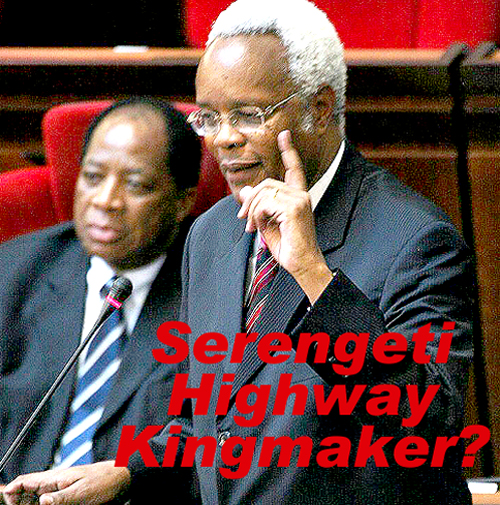
Will this man if elected determine the highway route?The imminent election of a formerly disgraced Tanzanian politician may determine the route of the controversial Serengeti Highway.
Tanzania’s disgraced former Prime Minister launched his political comeback yesterday by vowing to push through the Serengeti highway despite environmental objections.
But in typical Tanzania PoliSpeak, Lowassa left open which route he supports. I think the man is on track to become the final power broker for how the highway is built and that he’s essentially going to put the route up for international auction.
As with everything in Tanzanian politics, a lot of reading between the lines is necessary. There is a possibility that Edward Lowassa is just a loose canon trying to avenge his disgrace, being carefully rehabilitated by power elites, or just blowing populist hot air.
Lowassa’s flamboyant political rally in Mto-wa-Mbu, specifically where the highway is scheduled to begin, came only one month before the national election on October 31. He is running on a small, opposition party ticket (Chama cha Demokrasia na Maendeleo, “Chadema”) which currently has only 6 of the 295-seats in Parliament and no national officials.
(Chadema may be the biggest threat to the ruling autocracy in Tanzania, although it’s hard to see enough victories in Parliament to impact the balance of power.)
Lowassa cannot run on the ruling party ticket, because he was thrown out in 2008. At the time he was the second most powerful man in Tanzania, its prime minister, but he got mired in one too many scandals.
He resigned as Prime Minister on February 7, 2008, after being implicated in a corrupt deal with the Houston energy firm, Richmond Development, where it was widely speculated he received enormous kickbacks for electrical services that were never delivered.
His resignation and that of other implicated ministers which immediately followed saved him from any formal investigation into the extent of criminality.
Making the Serengeti Highway a primary campaign position allies him with his former friend and now President, Jakaya Kikwete, who is also the man who forced his resignation in 2008.
But unlike Kikwete, he hasn’t specified which route — north through the Serengeti or south outside animal reserves — he favors. And listening to him yesterday at his rally, you’d think the issue wasn’t whether to lay the tarmac north or south, but whether to build a highway for the common man or preserve lions for tourists to see.
“Environmental activism should change. [Activists] should not be more concerned by the welfare of the animals than that of our people who need development,” Lowassa shouted to the cheering crowd.
Lowassa began his career as the area’s police boss, and he remains very popular locally so is likely to win. His opponent is an evangelical minister whose main campaign issue is that the election, scheduled for October 31, should not be held on the Sabbath.
Lowassa is playing both ends of the field. He can win the election and still embrace either the northern or southern route.
And then, he will become the most prominent politician whose constituency is closest to the actual highway area. He will become crucial in any negotiations down the line.
I think this is what Lowassa is doing, sneaking his way into an issue that not even the ruling elite can control, one that is certain to ensure his political rehabilitation on the national level.
He’ll give Kikwete an acceptable path towards changing his own position, which is that the northern route is the best one, while ingratiating himself into the political elite once again.
Lowassa will be up for the highest bid. That’s the nature of the guy. So NGOs, start the fund-raising, because Lowassa’s victory will be a sure sign that the highway’s route is up for auction.
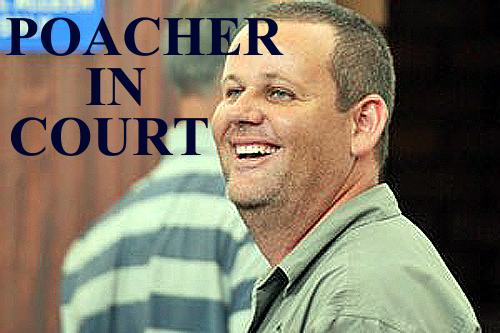
Manie du Plessis, mastermind of grand poaching syndicate.Eleven professional WHITE people have been arrested and charged with rhino poaching in South Africa. The outcry from their colleagues is deafening and revealing. The story is fascinating.
I’ve written continuously that during hard economic times, poaching increases. Poaching is a relatively easy occupation, a job, a gig, when none others are available. The market is always there: in Yemen, especially, but also in Asia.
The mind set of those who buy poached ivory or poached rhino horn or poached bear feet is pretty simple: these are animals, which like trees to make our houses, are to be used by man. The final consumer feels no remorse and as evidenced by the many street window apothecaries in Kuala Lumpur, does not consider it a crime.
Quite to the contrary, the seller of poached animal products sincerely believes in their medicinal or symbolic value, and often claims that the legal restrictions strongest in the areas where the animal is actually killed are affronts by arrogant cultures.
And the archetypal culprit who kills the animal is usually an individual African down on his luck.
Well, guess what. There’s more to it. What wildlife conservationists have been telling us for years was underscored last week when 11 professional South Africans including veterinarians, professionally licensed hunters and respected local community officials were indicted for a huge poaching ring that South African police spokesman Vishnu Naidoo said was linked to “hundreds of rhino poaching incidents.”
The eleven respected wildlife professionals arrested in a multi-agency sting in South Africa last week included game farmer, Dawie Groenewald; his wife, Sariette; licensed veterinarian, Karel Toed and his wife, Maria Toed; licensed veterinarian, Maine du Plessis; and professional hunters, Tollman Room Erasmus, Dallied Gouws, Nordus Rossouw, Leon van der Merwe and Jacobus Marthinus Pronk; and a game farm employee, Paul Matoromela.
Naidoo told the press Thursday that the suspects are believed to be the “masterminds” behind South Africa’s poaching scourge, which has claimed the lives of 210 rhinos already this year.
White rhinos are flourishing in South Africa. There are many scientists, in fact, who claim there are too many and that culling should be considered in some places. (This in contrast to black rhino which remain seriously endangered. The horns, however, are not differentiated on the black market.)
CITES is the international treaty designed to stop such poaching, and it does a pretty good job. Its mandate, too, is quite simple. Have enough countries in the world sign a treaty that forbids the trade of certain animals across its borders.
That suffocates the market and means that the animal killer becomes much less important than the syndicate of criminals that distributes the animal product as contraband.
That’s why CITES is so important. The many parts of the distribution chain become criminalized, and ultimately when all parts particularly in the Far East are aggressively pursued by legal authorities, then the market dries up, and killing the animal becomes pointless.
Because killing the animal is the easiest thing to do.
A lot has been written about South Africa’s tourist boom this year, linked to the successful World Cup. But the truth is that when football enthusiasts are removed from the numbers, we’re still at revenue levels around 2004, 20% below where they were in 2007.
Game farms in South Africa, from where this particular atrocity was apparently managed, are kind of down on their luck at the moment. Farming a protected animal and butchering it for the black market was an opportunity these “professionals” felt they couldn’t pass up.
We don’t know if these 11 Afrikaners had lost their insurance, or couldn’t pay their kids’ college tuition, or had farms being foreclosed. I don’t know if any situation of this sort would garner them sympathy from you, any more than the poor African in Tanzania who poaches a wildebeest for food might.
That is the other side of the market, the darker one. The side that drives people to the crime. The side that is much harder to remedy.
The other fascinating part of this story is the local reaction. I am privy to an exchange of private emails among professionals in South Africa that I consider somewhat appalling. And there is plenty in the public blogosphere you can google.
Other … whites .. are reacting with ridiculous fury, as if whites would never do such a thing. As if poaching like this is something only the uncivilized black would do. Here is a piece from just such an email I received this weekend:
“Hello —– ,
I am APPALLED, SHOCKED, DEVASTATED, DISAPPOINTED, BLOODY ANGRY!!!!!!! How DARE these people, in positions of trust and responsibility, and WORST OF ALL, our own people, from whom we would LEAST EXPECT this uttterly disgusting and traitorous behaviour.”
The presumption that the criminals involved in poaching are not usually “our own people” unsheathes a terrible racism. It isn’t the animal killer who is most responsible. It is the transporter, contraband arranger and most guilty, the purchaser. These criminals have much more culture in common with Manie du Plessis than the unnamed black man in Tanzania.
And they are much more responsible for poaching in the first place.
Kudus to the South African police and wildlife agencies that managed this sting. Spread the world that poaching is on the rise and that aggressive police action worldwide is required. And most importantly:
Forget that these guys were white. And if you can’t, we’ve got a lot more blogs to write but it isn’t about poaching.