Let Africa Kill the Gays

Let Africa Kill the Gays

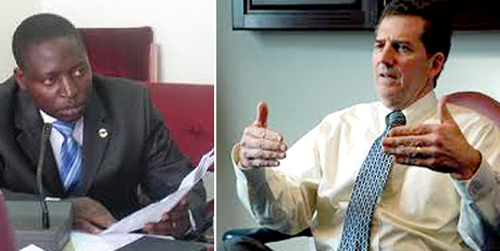
The puppet, David Bahati, and the puppeteer, Sen. Jim DeMint.
Can we not stop this insanity?
Polarization, craziness, lies near insanity does not a physical mark make. Until vigilantes bash heads in Cleveland and my safari clients are tortured in Ugandan prisons.

It hasn’t yet happened, but I have reason to worry. Yesterday, I blogged that we should take note of the violence occurring by Kenyan vigilantes as a trend developing here at home, and today we hear that the Ugandan MP promoting a bill to execute gays and imprison any who know of gays (including tourists) rigged his recent re-election.

David Bahati is the crazy, and the confident of President Yoweri Museveni of Uganda, and “Christian brother” of Sen. Jim DeMint (R-SC). Like so much vicious anger in the world, today, he’s the puppet of the American Christian Right.

His story, and his puppetry, is not news. Click here for a video condensing all the news in which he’s been involved for the last several years.

Basically, since our legion of crazy rightists has conceded they probably won’t be able to execute gays at home, they’ve decided to pour resources into Africa so it can be done, there.

If Bahati’s bill becomes law, and I have safari clients trekking gorillas in Bwindi National Forest (like I did last week), and those clients innocently remark about something gay-related, they could be arrested! And god (is there one?) forbid, if one of them mentions that he/she is gay, he/she could be arrested and executed!

And all of this, the polarization, craziness, lies near insanity, AND Cleveland vigilantes AND Ugandan homophobes all comes from the United States’ Christian Right, and pointedly, the “Family” who resides in “C Street” in D.C.

Bahati’s reelection was challenged by someone who was sane, Charles Musekura, who had strong support for a number of reasons not least of which is that most sane Ugandans don’t think you should execute gays!

But Bahati had the money. We can guess from where. And he had the tricks, too:

Michael Mubangizi, a respected reporter for the Ugandan Observer, reports that the recently concluded reelection campaigns including Bahati’s were rigged. They were rigged in quite simple ways. People were selling ballots that were then counted with names that didn’t exist. Up to 5,000 ballots illegitimate ballots may have helped to reelected Bahati.

Led by Sen. DeMint (R-SC), this “movement” that claims the moral high ground is one of the most evil social phenomenon ever seen in the world. I just can’t understand for the life of me why they are so prominent and hold so much power.

Just as I cannot understand why there are vigilantes in Cleveland.

But these machinations of hate are something that we must all try very hard to understand, whether in Cleveland or Uganda. They aren’t just wrong, they’re crazy. Their perpetrators aren’t going to be convinced by logical argument.

And as evidenced by Bahati in his recent reelection, nothing legal or sane alone is going to stop them.

Here is a list of the most prominent C Street players. Unless we stop them, this insanity will continue:

Chuck Colson, Watergate felon
Rep. Bart Stupak (D-MI)
Rep. Chuck Pickering (formerly R-MS)
Rep. Frank Wolf (R-VA)
Rep. Heath Shuler (D-NC)
Rep. Joe Pitts (R-PA)
Rep. Mike Doyle (D-PA)
Rep. Mike McIntyre (D-NC)
Rep. Zach Wamp (R-TN)
Sen. Bill Nelson (D-FL)
Sen. Chuck Grassley (R-IA)
Sen. Jim Inhofe (R-OK)
Sen. Jim DeMint (R-SC)
Sen. John Ensign (R-NV)
Sen. Mark Pryor (D-AK)
Sen. Mike Enzi (R-WY)
Sen. Sam Brownback (R-KS)
Sen. Tom Coburn (R-OK)

Democracy or Bust!

Democracy or Bust!

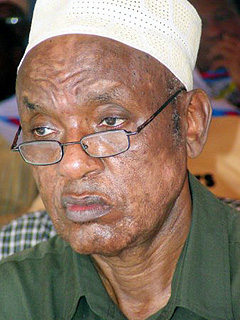
Yusuf Makamba: No Democracy in Tanzania.
The Tanzanian election is less than two months away and is really heating up. Yesterday, debates were banned!

Opposition candidates are furious, of course, and blogs and articles in the U.S. especially are denouncing Tanzania’s authoritarianism as wrong and archaic. I agree, but I also wonder if the squeaky clean critics understand how they’ve contributed to the mess.

Yesterday’s announcement by the CCM secretary general, Mr Yusuf Makamba, that forbid all party candidates from debates (on television, but there weren’t any scheduled anywhere else) is certainly because the election is unexpectedly moving away from the party central command.

But another reason is more philosophical: the power of opposition in a modern world, the power to … lie.

There is no better example than here in the US of A. Death Panels. A President Born in Kenya. No Global Warming. Weapons of Mass Destruction. And to wit: The Millennium Trade between Burning the Quran and Moving The Mosque.

Lies foul up democracy. Everyone agrees lies are bad, but it’s the bad guys who profit from them. And in this viral internet age, lies can be assumed truths for critically long times. Sometimes, forever.. as those who embrace them lager themselves against being called out.

Democractic Lies gain special traction in bad times when people are so angry. Like now.

Maybe, just maybe America can weather this extreme moment of national lying. But a young and uneducated country like Tanzania maybe can’t.

It’s been a long while since Tanzania has had a real opposition; in fact, almost never. Following the surprise resignation of the country’s first president, Julius Nyerere, after more than twenty years in office in 1985 there was a spark of opposition. It faded quickly.

Today Yusuf’s CCM controls 206 of the 232 seats in Tanzania’s parliament. That’s almost 90%, and the renegades in opposition rarely make it through a single term.

But this time it’s different. Mostly because of what was left of an angered media the government partially shut down, a number of scandals have become public.

Every Tanzanian newspaper is read mostly online, so these scandals went viral:

There were lingering issues with the former attorney general’s million dollar kick back for arranging a missile defense system around Dar.
The Tourism Minister’s side business selling illegal ivory. The World Bank withdrew development funds and the specified reasons of corruption – usually kept under wraps – were leaked.

And local issues, including the proposed Serengeti highway in the north, became contentious issues between the party and opposition candidates.

It was only just before the last election that the Tanzanian government allowed opposition parties. Its legacy is a single-party state.

Yusuf holds as much power as any elected leader. A small cadre of mostly past elected leaders constitutes what we used to call the “central committee.” Yusuf and this group call virtually all the shots in Tanzania.

But democracy is pushing through this old style politics. I feel the internet age makes it inevitable.

It would just be helpful to emerging societies like Tanzania if the veterans of this age-old ideal of democracy had citizens who acted on The Truth, not The Lie.

Call your zoo NOW!

Call your zoo NOW!

American zoos could help stop the Serengeti highway.
Call your zoo director now and tell him to “Support AZA’s resolution opposing the northern route for the Serengeti highway.”

Towards the end of this week, zoo directors, research coordinators and many other zoo employees will be heading to Houston for the annual zoo convention.

Concerned members are trying to get the momentum going to pass a resolution that will oppose the northern route currently staked out in the Serengeti for a highway. They are encountering great resistance among the membership.

This isn’t because there are members who support the highway, quite to the contrary. I doubt you would find a single AZA member who supports building the highway.

But it’s because the organization is so nebulous. The excuses I’ve heard range from “it’s not our responsibility” to “it will cause a backlash.” Both extremes are ridiculous if not arrogant and presume an unrealistic character of what AZA actually is.

Zoos, today, have morphed into wonderful institutions, so different from what they were when I was a kid. Many of my clients’ jaws drop when I say this, and I have to agree with them that watching a captive animal is not my cup of tea.

But putting animals on display, today, is becoming a secondary role for the best zoos. You would be very hard pressed not to find a zoo in America today, which doesn’t have something to do – some money invested – in the Serengeti.

Zoos are turning into wonderful research institutions. Their captive animal populations have become ever more precious as the world’s biodiversity crashes. They have unleashed a scientific potential that exists in their employees that is doing wonder in Africa.

So they, probably more than any other group of institutions, has a real and immediate interest in what happens in the Serengeti.

What is true is that their association isn’t a very good one. One part of their association, the SSP groups which manage marvelously the placement and movement of one captive animal with another across all zoo borders, is a work of genius. But, I’m afraid, that’s about it.

So it’s time they step up to the plate and make a concerted effort to evince their missions and their ideals. They must join a growing chorus of wildlife NGOs opposing the highway, and it will definitely help.

So please, call your zoo now. Ask to speak to the director, and you’ll likely be able to. If you can’t, get his email address after leaving a phone message.

We must stop this highway.

To read my other blogs about the highway, click below:

Tanzanian President reaffirms doing the project.

Tanzanian Minister of Tourism has questionable links to highway.

World Bank withdraws funding for Tanzanian road building.

Serengeti Highway Alert and summary.

Ivory Highways in Tanzania

Ivory Highways in Tanzania

Shamsa's Plan
A courageous legislator in Tanzania’s Parliament has charged Tanzania’s Minister of Tourism with corruption. The pieces to the puzzle seem to fit.

Last week Tanzanian MP, Magdalena Sakaya, publically accused Tanzania’s Minister for Tourism, Shamsa Mwangunga, of deceit with regards to her attempt to sell ivory stockpiles.

This is no small matter. Sakaya is one of a handful of outspoken backbenchers who the government of Tanzania is increasingly suppressing. Just last week, for instance, the Court of Appeals refused to allow any independent candidates in this year’s national election.

Shamsa is one of the most corrupt members of the Tanzanian government. She led the failed effort to obtain permission from the Convention on International Trade in Endangered Species of Wild Fauna and Flora (CITES) in Doha last March to sell a stockpile of elephant tusks.

Sakaya noted that 11 of the 27 tonnes of illegal ivory confiscated worldwide in 2007 came from Tanzania. And in 2009 that number was 12 of 24. (Elephant Trade Information System)

Yet, Sakaya explained, official records by the Ministry of Tourism or any other government department show no such large numbers of confiscated ivory.

Why not?

“Conspiracy to legalize trade of elephant tusks and their products surrounds the request,” Sakaya said in Parliament. “The Opposition camp believes the request is a ploy intended to deceive Tanzanians.”

Sakaya charged “high ranking government officials” with running a syndicate of poaching and suggested that it would be these same individuals who would have benefited from the ivory sale had CITES approved it.

Many of us are wondering, now, if Shamsa’s new push for a Serengeti road is in typical personal retribution for her failed effort to sell ivory at CITES.

In an interview with The Citizen last week, the minister denied that the 40-kilometer stretch of east-west road through the northern Serengeti would disrupt the wildebeest migration.

What?!! What planet does this person come from?

Depending upon the weather as many as a million wildebeest and half again as many zebra and other gazelle funnel north through this relatively small area into Kenya’s Maasai Mara every year.

To the east is heavily populated Kenya; to the west is heavily populated Tanzania. It’s their only route to the fresh and lasting grasses that the Mara provides during the dry season.

If the road is as heavily used as anticipated, this will result in massive disruption of the migration. Consider the extraordinary efforts that were employed by the Alaskan pipeline, including high bridges and deep tunnels, to lessen the effect on the caribou migration in a part of the planet where not another soul lives or needs to drive on a road!

Consider the massive destruction of the wildebeest migration in Botswana when the veterinary fence was built there in the 1980s.

The evidence is the stuff that a 3rd grader can use for a science report.

“Those criticizing the road construction know nothing about what we’ve planned,” Shamsa claimed.

That’s for sure. Kickbacks, new clothes from Zurich, foreign trips….

Click here to join the growing forces opposing the road.

SerHighway Reveals More Corruption

SerHighway Reveals More Corruption

Mrema blown out?
Public pressure may be working to forestall the Serengeti highway. The terrible corruption of the Tanzanian government is coming to light.

Tanzania has a far less dynamic and transparent media than either Kenya or Uganda, but the “little engines that could” are blowing their whistles as hard as they can!

A tiny on-line publication, This Day, reported today that the World Bank has withdrawn a US$8.4 million offer to finance new government buildings in Dar-es-Salaam, specifically because of the growing controversy of corruption in the Tanzanian roads’ agency.

(The bank’s on-line directory still showed the project was current, today. But This Day has a remarkable record of accuracy.)

If true, it is not clear whether this is in response to the growing outcry against the Serengeti Highway, or simply a response to a lot of dirty laundry the proposed project has aired.

Several publications and blogs – most of them on-line and not widely available to the public in Tanzania – today came down brutally on the CEO of the Tanzania National Roads Agency, Ephraim Mrema, for widespread corruption.

Recently Mrema canceled the specific site for which the World Bank had made its loan to build the TANROADS headquarters, after more than $1 million had already been spent on designers and architects.

“World Bank officials in Dar es Salaam were angered after they discovered that they were misled by the TANROADS management about key aspects of the project and have since withdrawn their funding,” said an anonymous TANROADS official quoted today by This Day.

Mrema was appointed in 2007 by Andrew Chenge, then Attorney-General but since fired, for an appointment of three years ending on June 3, 2010. But Mrema remains in office, today.

Following Chenge’s resignation and later indictments on charges of corruption, a government inquiry began into Mrema’s own dealings. The inquiry has charged him so far with overstepping his authority, clinging to a position since expired, and fomenting a “reign of terror” within the agency.

The Vice-Chairman of TANROADS, theoretically Mrema’s second-in-command, Dr Samuel Nyantahe, has officially called the situation a “serious crisis.”

“…the situation at the agency is very grave as there is a reign of terror … urgent government intervention is needed to forestall further deterioration and decadence,” Nyantahe said in an April 12, 2010, letter addressed to the Prime Minister of Tanzania, made public today by This Day.

“How can a public service official (Mrema) exhibit blatant insubordination behaviour and get away with it?” the letter continues.

Mrema’s answer is that he has been officially sanctioned by Tanzanian President Jakaya Kikwete. The president’s office was silent, today, on the growing controversy.

On May 3 last year, the ministry in charge of roads censured Mrema. Omar Chambo, the Permanent Secretary, formally reprimanded Mrema for a number of contractual and ethical violations. “Implementing [unapproved actions] contrary to my instructions amounts to insubordination,” says part of Chambo’s letter to Mrema.

It must be serious. In December, 2008, Mrema paid Chambo an “honorarium” of $7000 from the TANROADS coffers for seemingly no reason.

In Tanzania you don’t bite the hand that feeds you unless that hand’s ready to be chopped off.

Ducky Judges Quack

Ducky Judges Quack

Not unconstitutional; rather inconsequential.
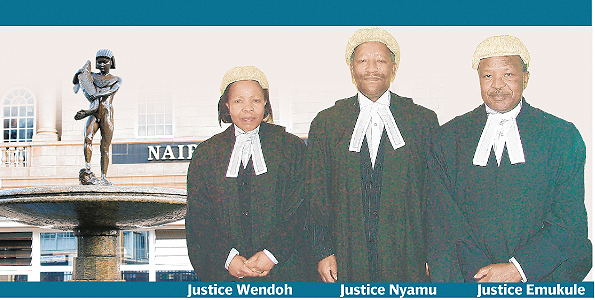
Here’s one for the books. Yesterday, a panel of 3 Kenyan judges said the proposed judicial system in the proposed new constitution is unconstitutional!

Wait, wait, don’t tell me. There isn’t a constitution , yet, because it’s being voted on August 4, so how can something that isn’t, not be?

This is incredibly embarrassing to Kenya, and it’s a patent retrogression to the old days of corruption and nepotism. If the new constitution passes, all judges lose their jobs and must be reappointed to the newly reconstructed judiciary.

These lameducks are trying to … what… how should I put it, be… eternalized?

The ruling is ridiculous but disturbing. The new proposed Kenyan constitution, which I consider brilliant, sets up an admittedly controversial judiciary that includes a second tier of civil courts for Muslims – restricted strictly to personal matters like marriage and only if all parties agree.

The judges called these “kadhi” courts unconstitutional.

Incredible. There is no constitution yet, so nothing yet can be unconstitutional.

Kenyan political leaders have called it for what it is, “inconsequential.”

EVAPORIZE Goma!

EVAPORIZE Goma!

After the kiss, she throws a grenade to the bridesmaids.
A large midweek wedding celebration dominated the eastern Congo town of Goma, this week, for the first time in decades. Is the war over, or just getting ready to start, again?

We’ll have to go to our PlayStation3 to find out.

I have a mixture of distant nostalgia and abject fear when I remember my own adventures in Goma. Before Mobutu was gone the Congo (then Zaire) was a secretive and scary place, but once inside the forests were filled with beauty and magic. And that was the problem, you had to be a wizard to get out.

But the end of Mobutu – as horrible as he was – heralded an unprecedented era of barbarism. Mineral-rich Kivu province, the eastern slice of the Congo that lies astride Uganda, Rwanda and Burundi, became a lawless bastion of mercenaries and thugs.

Supported by the west’s desperate need for such absolutely essential things as weapons of mass destruction, Kivu went on the auction block, and the bidders were Sony, Intel, the U.S. Defense Department and a bevy of other moral-less capitalists. They all need Coltan.

According to the U.S. Geological Survey, 80% of the world’s Coltan reserves are in Kivu.

Coltan is a wizard’s brew. When refined it becomes tantalum, and shortly thereafter it becomes camera lenses, cell phones, detailed instruments for surgical implants, wires and filaments in light bulbs that last 100 times longer than tungsten and its alloys are used for jet engines, missiles and all sorts of secret, wizardry things.

But where is most of it used?

Right now, that would be PlayStation3.

I find it so heartening that PlayStation3 now uses more Coltan than the Defense Department.

According to the monitoring group, Towards Freedom, there are 1300 people that die every day in Kivu from bullets or perverse rape. The massacre is a part of the Coltan War. Whoever controls Coltan gets very, very rich.

Those who mine Coltan are abused, mostly children. Those who finally collect for the sales of Coltan often shun dollars for weapon – did you hear that? “Shun Dollars”? What do they want instead?

Guns.

It’s so remarkably convenient. The most sophisticated guns use Coltan. Is this what they call sustainable development?

Eleven years ago the world got antsy with this unusual war for PlayStations, and the UN Security Council sent in 20,000 troops to Kivu to regulate the slaughter and rape. Forget about child labor in the mines, that was beyond their mission.

It has worked a little bit. Enough that there are now weddings in Goma. Enough that the very distant President of the Congo, Joseph Kabila, has asked the UN soldiers to leave. Kabila rules from Kinshasa, more than a thousand miles away over impenetrable jungles and in a world as distant from Kivu as .. Well, as from Leaf Valley, Agar or the other supposedly mythical republics of the PlayStation worlds.

If they go, the modicum of stability in Goma will, well I think the term used in the “Modern Warfare 2 Stimulus Package” for PlayStation is , evaporize.

We better all get ready. Click here.

Build Baby Build!

Build Baby Build!

Kenya’s President Mwai Kibaki returned from China’s expo with a commitment from the Chinese to build a new Kenyan port on the island of Lamu.

He called China “an important strategic partner.”

Hmm. That’s how Secretary of State just referred to Kenya: a “strategic partner.” Quite a phrase, that.

Kenya is on the threshold of a great decision. In two months the nation will vote YES or NO on a new constitution. Even getting to this point, of getting the Kenyan politicians to create a new constitution that in my opinion works well for the average wananchi was a Herculean task.

If it weren’t for the U.S., the U.K. and the EU, it would never have happened. This frontline of democracy and human rights bribed, cajoled and threatened Kenyan leaders until they finally… at the last minute … created a draft the population can vote on.

In fact when it seemed all was lost, good ole Kofi Annan jetted back into town to push the wayward leaders back on track.

So far, it has cost the consortium of good guys about $11 billion. And this is separate from ongoing initiatives like AIDS and malaria prevention, and separate from the several billion that poured into the country to stabilize it right after the political turbulence that followed the last election.

The west doesn’t want Kenya to fail. Why?

We say we don’t want Kenya to fail, because “Kenya is a strategic partner.” Untangle the myriad of meanings from that and you get to a fundamental core that “Kenya shares our values” which ultimately, of course, means that Kenya is OK with us dominating the world.

I’m not sure we would feel that way if al-Qaeda weren’t sitting next door in Somalia. We don’t seem to be quite as passionate about Senegal.

China, on the other hand, doesn’t give a hoot who is running Kenya or how they’re doing it.

“We don’t need lectures on how to govern ourselves. Lecturing us on issues that deal with governance and transparency is in bad taste,” Raila Odinga, Kenya’s current Prime Minister told Hillary Clinton last year. China never says a word about how Kenya should be governed, and certainly doesn’t care how transparent anything is.

The University of Nairobi’s Joseph Onjala warned Kenya’s leaders in 2007 that their presumption that China’s aid comes without strings attached was naive.

…the aid appears to be very closely linked to strategic and political objectives, perhaps even more so than the aid offered by some European countries and the US. Chinese aid is …linked to the extraction and export of minerals and oil to China. These facts indicate that the aid might hurt Kenya in the long-run.”

Chinese money is much less than the west’s : about a tenth, although growing substantially year by year. And Chinese aid is nearly all for infrastructure. The west’s aid for such important things like publishing and disseminating the draft constitution, propping up Kenyan development agencies, and unloading tons of consumables like food, is all very important nourishment for a developing society, but it doesn’t last… like a road.

China’s building roads all over the place, now. See my earlier blogs. It’s mind blowing. It’s building a Kenyan railway. They just signed a deal to help build a new port. Build-Baby-Build. Just now it’s transforming a bit: it’s becoming Drill-Baby-Drill.

The west’s aid comes with enormous accountability, a huge reversal from the free-wheeling AID giving of the Cold War era. No accountability whatever to China. Now from an efficiency standpoint, the Chinese would prefer to send their own workers to build the road, which they do, and it gets built. But a lot more cash comes into Kenya to “build the road” than it takes to build the road. And China doesn’t care where it goes.

Yesterday, President Kibaki granted China 6 of the 11 potential oil spots new technology believes might exist in the Kenyan desert. Yesterday, China announced that the world’s deepest oil well (5800 meters: about 18000′ or more than three miles deep!) has been completed in Kenya’s desert. It didn’t say if there was something found way down there.

The west sees Kenya as a strategic partner for its values.

China sees Kenya as a strategic partner for oil.

Do these two “strategic partners” have anything in common? Actually, yes.

It Takes 2, or 3, to Tango.

It Takes 2, or 3, to Tango.

This man, Dick Olver, is corrupt.
This man, Dick Olver, is corrupt. His clients, the US & UK, are corrupt.
The deal struck last week between a major world’s arms manufacturer and the UK and US governments explains why African leaders are corrupt.

Corruption doesn’t start with an evil black man’s hand out. It starts with a white man.

BAE Systems is the world’s second largest weapons manufacturer. It’s so big that it doesn’t just manufacture the weapons, it even manufactures the defenses against those weapons!

Unshackled from the Bush and Blair administrations, the U.S. and U.K. governments moved to meaningful indictments against white men. In those public indictments we learned that BAE had bribed with hundreds of millions of dollars government officials – many of them popularly elected – in a host of countries including Saudia Arabia, the Czech Republic, Hungary…

And South Africa and Tanzania.

In South Africa, it includes the current president, Jacob Zuma.

In Tanzania, it was the once Attorney General, Andrew Chenge.

BAE paid Chenge a million dollars into a hidden bank account in Britain, and bingo, Tanzania bought…

A RADAR DEFENSE SYSTEM FOR DAR!

The system is a modern, high-tech if cold warish circle of radar around the capital of Dar-es-Salaam to protect this armpit of Africa, from … incoming missiles? Who the hell would send missiles at Dar?!

But, anyway, it can’t work! There isn’t enough electricity in all of Tanzania! The government would have to choose between electricity for televisions and light bulbs or defense against… missiles?!

Young, aggressive Tanzanian politicians skinned Chenge’s hide and in fact, forced his resignation as well as the resignation of the existing Prime Minister. But since the case is now settled, Chenge might not be prosecuted, because there will be no witnesses and no allowable evidence …

Where the law is more respected, South African Jacob Zuma’s spokesmen simply said there will be no comment.

It takes two to tango. And the referee of these ballroom 1-2-3, 1-2-3’s is that all-important third beat, the world’s Super Power. The U.S. settled probably because it was bribed, too. Bribed that a public trial would reveal too much secrecy about … weapons of mass destruction.

BAE is not too big to fail, it’s too big to accuse.

Is there too much too big around at the moment?

In a statement, BAE Systems Chairman Dick Olver said his company “has systematically enhanced its compliance policies and processes” in the past several years and “very much regrets and accepts full responsibility for these past shortcomings.”

Right. His stock than rose 1.6%.

The penalty paid was less than the stock rose, less than was paid out in bribes, and a fraction of the profits earned from the corruptible sales.

Your “shortcomings,” Mr. Olver, include corrupting some of the most talented and skilled individuals in Africa, ruining ten-year economic plans, casting shadows over entire cadres of political parties and good ideas.

Your shortcomings have doomed Africa to more poverty and castigation. How horribly corrupt are African leaders! I’m sure you, Mr. Olver, would never take a bribe. You only give them.

“We have been shafted by the decision to reach a plea bargain agreement and not to prosecute BAE,” South African opposition Democratic Alliance spokesman David Maynier said yesterday. “The details of the various investigations will remain hidden as a result of the plea bargain agreement and nobody – whether they bribed or whether they took bribes – will be held to account.” (Washington Post, February 5, 2010)

South African politician, Patricia de Lille, said the U.S. and the U.K. are “No better than any of the rogue leaders in Africa who have used funds from bribes in arms deal to stay in power.”

Right. On.

Ivory Jubilee!

Ivory Jubilee!

Officials from CITES were in Dar last week to inventory the ivory stockpile that Tanzania wants to sell. It looks more and more likely that Tanzania will prevail in Doha next month.

The only hope that the momentum for the sale will be derailed is with Tanzania’s tourism minister, Ms. Sharmsa Mwangung.

It’s not that Ms. Mwangung is against the sale, quite to the contrary. But her recent remarks to local journalists might just reveal Tanzania’s true reason for wanting the sale, and it isn’t a nice one.

In one of the most remarkably ridiculous arguments any conservation official could make for selling confiscated ivory Ms. Mwangung, told the East African, that Kenya’s argument that a one-off sale of Tanzania’s stockpile of ivory would increase poaching “does not hold water, because the number of elephants in the country has increased.”

That mind twister defies gravity.. There it goes!

Now being generous and retrieving that argument from the stratosphere before it finds a black hole, it could be that what she means is that poaching is OK for Tanzania, because they’ve got more elephants than they need. So that it doesn’t really matter if poaching increases, because the elephant population is growing fast enough to sustain the illegal culling.

Well… let’s try to tackle that one.

First, she’s right about the numbers. The elephant population has increased considerably in East Africa over the last decade. It’s still below what it was before the rampant poaching of the 1970s, but most would agree it’s pretty healthy. That doesn’t mean it’s too many, though.

But second, she’s wrong about the conclusion. Doing anything to encourage poaching – of anything, not just elephants – is madness. You’re basically telling criminals to get on with it! Support your country! Get us more ivory, there’s plenty of elephants!

Third, she’s ignoring the region as a whole for the selfish interests of Tanzania. That’s bad but understandable, (since it’s what South Africa does practically every day, anyway). Kenya is seriously going to suffer major increased poaching if Tanzania encourages the market.

This is mainly because Kenya shares a 500-mile long porous border with Somali and Ethiopia, easy conduits for the market of illegal ivory.

If Tanzania truly felt it had too many elephants, then like South Africa, Tanzania would officially cull elephants and argue for the sale of that specifically culled stockpiled ivory, not the sale of criminals’ successes!

But unfortunately perhaps, I doubt Ms. Mwangung is really that mercenary. It’s really probably much simpler.

Tanzania’s tourism minister has absolutely no idea what does or doesn’t cause poaching, and similarly, she probably has only one idea of why they should sell ivory: to get money.

And we can take it pretty easily from there. To get money for what? Whether it is gold in Mwanza or unnecessary radar equipment for the capital or unused trash trucks in Dar, large blocks of money tend to never show up in Tanzania where they’re supposed to.

So if we can just have Ms. Mwangung giving a few more press conferences, there’s hope!

Year-End Roundup & Predictions

Year-End Roundup & Predictions

2009 was a bad year for East Africa. 2010 will be a little bit better.

Socially, culturally and politically, I think it’s been a GOOD YEAR for Kenya and a BAD YEAR for its neighbors.

I’m positive on Kenya and critical of its neighbors even while supporting the western powers growing sanctions on Kenya for not moving quickly enough towards a new constitution.

This may seem like a contradiction, but in fact what it means is that the outside world’s attention to Kenya is working: it is absolutely encouraging all the right moves by Kenya’s still entrenched, corrupt leaders. Ultimately, of course, the people will have to oust these scoundrels, and right now that looks possible.

The Hague has begun the process of trying those who might have been responsible for the 2007 genocide. The U.S. and the U.K. in particular have banned the most corrupt individuals from traveling to their countries. A draft constitution is circulating among all factions of the society for comment, and Kenya’s invigorating journalistic transparency has grown even greater with such additions as FM Capital Radio. Kenya is still ranked worse than Uganda or Tanzania by Transparency International, but its improvement is significant. If there isn’t any major reversal in the way things are going, I think 2010 is going to be a very good year for Kenyan society.

Tanzania and Uganda, on the other hand, are turning gruesome in the shadows. Tanzania’s corruption is so much less known than Kenya’s, because its power centers keep it that way. But just through extrapolation of what we do know, I frankly believe that Tanzania must be infinitely more corrupt than Kenya.

One of Tanzania’s finest transparent media, This Day, was forced to reduce daily publication to weekly because it couldn’t obtain the interest or funding that the country’s strictly controlled media easily obtains.

Scandals in Tanzania’s electricity board, and worse, in its precious gold mining industry, threaten to reach absolutely astronomical proportions. It’s so bad that Zanzibar is without electricity more than half the time, and the Toronto based owner of one of the world’s richest gold mines in Tanzania is trying to sell it. And no one wants to buy it! They just can’t manage the corruption.

And Uganda is ready to dive off the end of the earth. Encouraged by disreputable American righties, the Parliament is set to pass a law that would give the death penalty to anyone convicted of being a practicing gay. And worse actually, lengthy imprisonment for anyone who knows someone actively gay and doesn’t tell! (Imagine what this will do to tourism!)

Uganda’s problems are mounting, and specifically as a result of the current president’s growing grasp on life-time power.

I think 2010 will be a GOOD YEAR for Kenya, but another BAD YEAR for Tanzania and Uganda.

It’s been a very BAD YEAR for tourism. Statistics are near impossible to come by and then impossible to confirm, but my best guess is that about a third of the tourism industry that existed in 2007 is now gone. It may be more. Kenya has taken the worst hit, and in certain sections of the industry the employee base is now less than 50% what it was in 2007. But equally deep hits were taken by Tanzania’s newer central country tourism (Zanzibar, the Selous) and Rwanda, which may be seeing a decline of more than 60% in tourist arrivals.

I don’t see this changing, soon. It may be a better year in 2010 than 2009, but it will still be a BAD YEAR for tourism throughout the region.

Most of 2009 was awful for the region’s weather. It was a BAD YEAR. But the arrival of normal if above average rains these last few months throughout the region broke the drought except in some isolated areas in Kenya’s north. All predictions are for normal if above average precipitation for 2010. So expect a GOOD YEAR for 2010’s weather.

It was a BAD YEAR for wilderness and wildlife, as the “drought” persisted through the third quarter. The lack of rains was the main cause, but by no means the main explanation. Poaching increased substantially as the age-old argument of whether a country’s wildlife should be viewed as an immediate resource for the local population (such as for food, or destroyed when threatening farms, or allowed for stock grazing). The drastic reduction in tourism only aggravated the situation: Reduced revenue for anti-poaching and other management needs contributed to a spiraling decline in the efficacy of the area’s wildernesses.

Virtually all species except the predators and scavengers (obviously) declined. Hippos took the biggest hit – they need the most grass which wasn’t growing. We aren’t sure about elephants yet, because they migrated, presumably to better places. But whether they’ll return and whether these better places helped them to survive remains to be seen.

Shore birds, especially flamingoes, suffered terribly. No one was killing or eating them, but human populations were desperate for their water sources.

As I reported earlier, we think the entire biomass probably declined by 5%. That’s not bad by the standards of past droughts, and it’s now stabilized. But I don’t see any extraordinary rebound in 2010 as was the case the year after past droughts. The natural biology that normally leads to population rebounds is this time offset by poorer wildlife management, increased poaching and less tourism preparation, caused by not just the past drought, but the current economic downturn.

So expect 2010 not to be worse for wilderness and wildlife, and basically that means it will GOOD.

Strictly economically, the entire region with Kenya in the lead is experiencing the same type of GDP jobless growth we are experiencing here in the U.S. Like here, this is a skewed statistic created mostly by government stimulus. The fact is that 2009 was a terribly BAD YEAR for the economies of all the region once you strip them of their government stimulus.

I’m afraid that 2010 will be worse. That’s one of the curses on developing countries. They are led into an economic abyss by the developed world, and then the developed world emerges out of the abyss first, often at the expense of the developing world.

How bad it will be will depend upon how much aid the developed world gives. But I can’t imagine any amount that will make 2010 anything but a BAD YEAR economically.


East Africa Report20092010
SOCIETY
Kenya
Tanzania, Uganda

Good
Bad

Good
Bad
WILDLIFEBadGood
WEATHERBadGood
TOURISMBadBad
ECONOMYBadBad

Law of the Jungle!

Law of the Jungle!

Tourist fees in the Serengeti and NCA (Ngorongoro Conservation Area) have doubled, and in some instances, tripled, and it’s not clear whether this is law or graft.

The law is printed on the official TANAPA fee schedule. Click here to download that schedule. The fees are basically $50 and in bold red letters at the bottom of the brochure it states, “NB: Fees valid for 24 hours only.”

There is nothing that says it is for a single entry. But many tourists are now being charged $100, and some, $150, based on the notion that the gate is a toll-booth, not a park gate, and that every time you pass you have to pay!

The vast southern grassland plains of the Serengeti are technically composed of two separate parks management authorities: the Serengeti National Park (north) and the Ngorongoro Conservation Area [NCA] (south).

Ngorongoro Crater, Olduvai Gorge, Lake Natron, Olmoti and other old volcanoes and most of the lakes region of Ndutu is technically in the NCA. Naabi, Seronera, Moru, Gol, the western and northern corridors are technically in the Serengeti National Park.

The multiple charging occurs to tourists who are lodging in one area but traveling during the day into the adjacent area. The first example I can document of this in August… to me!

(I paid $50 for the day of August 31 at Ndutu Lodge in the NCA. Then unexpectedly I had to drive into the Serengeti to pick up guests who had been delayed. The rangers charged me $50 for simply driving to the airstrip to collect the guests. But then as we returned into the NCA, the rangers charged me a third $50 for “reentering” the NCA.)

At the time I chalked this as just one more incident of African graft. There’s nothing on the permit which could otherwise explain it, and I didn’t want to duke it out with the rangers while welcoming my newly arrived guests into the Serengeti.

Increasingly, though, it is happening to many of our safaris.

The northern border of the NCA abuts the southern border of the Serengeti and traditionally game drives have moved back and forth over this vast area, more commonly known as the southern grassland plains of the Serengeti.

Often the great herds are partially in one area and partially in the other, and moving back and forth between the two areas is the only reasonable way to undertake a game drive in the area. Now, it seems, every time the invisible line is crossed, tourists will be charged $50!

Every country has the right to charge whatever they deem fit for foreigners to use and visit their natural resources. But what if this is not what the Tanzanian government believes is being charged? Who, really, is pocketing this money?

And if it is legal, then the permit and literature like the fees schedule should say so.

Mara Muddle

Mara Muddle

If the Mara conservancies don’t get their act together, visitors might be paying $400 in daily fees!

One of the world’s most fabulous wild reserve is really a very small area that’s being cut apart into even smaller pieces that are squabbling with one another.

In a worst case scenario that I just can’t imagine happening anywhere in the universe except in Kenya, a guest at the Mara’s eastern-most lodge, Keekorok, who wanted to spend the day exploring the whole reserve with a picnic lunch traveling as far as Serena Lodge in the west, would incur reserve fees of $400 per person!

Until last week the three main sections of the Mara reserve (Sekanini, the furthest east third; Musiara, the main central part; and the Mara Triangle, the area west of the Mara River), all respected each other’s fee receipts as adequate to entering their own area. This core area of the Mara is only about 590 sq. miles. It really is possible on a single long day’s game drive to go through the entire area, easily going in and out of all three parts.

The visitor never knew they were technically moving from one reserve into another or back, again. And surrounding the Mara are a number of private reserves acting similarly.

But last week the Mara Triangle indicated it may stop accepting Musiara and Sekanini fee receipts. That would mean if you crossed the Mara River, you’d have to pay, again. And oh by the way, the three Mara conservancies now charge the highest of any reserve in Africa: $80 per person per day.

The remaining two portions are now threatening to do the same in retaliation. If this happens and you were a traveler staying at Mara Serena Lodge (in the Triangle), traveling on the new road from Nairobi via Narok, you would have to pay $240 just to get to the lodge! To get to the lodge you have to drive through the other two parts of the sanctuary.

This is getting ridiculous. It was, in fact, ridiculous before now. The very idea that a small wilderness reserve would be cut into separately managed sections is absurd.

Each section charges and accounts for its own fees, of course, but also trains and deploys its own set of rangers, and tries to enforce its own sets of rules and regulations. It’s patently absurd, and the reason it’s this way is because the Maasai politicians always refused to allow the federal Kenyan government to manage the area.

So such important things as wildlife management, wildlife research, visitor management and the like are often different every ten miles as your drive through the reserve. There’s no coherent marketing or planning of any sort. Mara.com, Maasaimara.com and even Masaimara.org are all privately owned websites exploited by local Kenyan business interests!

When Richard Leakey was head of the wonderfully managed Kenyan Wildlife Service (KWS) he tried to force the Maasai to relinquish control of the reserves to KWS, as numerous other ethnic groups had done to produce such wonderfully managed reserves as Samburu and Tsavo. In response, someone bombed his plane while he was flying and he lost his legs.

So for years and years, the Amboseli and Mara (Maasai reserves) have been administered by their own (incredibly corrupt) county councils. And now, they are fighting among themselves!

Balloon safaris will have a particularly difficult time as the three parts bureaucratically separate. The balloons (of which there are now 16 rising daily in the Mara) pay a “launching and landing fee.” If they bump down in an area other than from which they launched, they’ll be double taxed.

Not to mention the intrepid traveler who is trying to follow the wildebeest migration. Imagine being stopped dead at some signpost and being told to go over there to where the million wildebeest are will cost you another $80!

It gets worse. As the steam of anger boils over, the three fiefdoms are considering a rule that is used to my great consternation in neighboring Tanzania. The “one-time entry rule” means that if you leave one reserve for another, you have to pay again to re-enter the first reserve.

That means wherever you’re lodging and paying the daily $80 per person fee, that if you go out, then come back, you have to pay twice that same day!

THAT MEANS if you transected the Mara on a good long day’s drive, you could theoretically have to pay $400 PER PERSON!

Why oh why is all of this happening?

Money.

Tourism is way down. The government and community institutions controlling these marvelous parcels of wilderness got used to a certain revenue stream that they don’t have, now. And frankly, I don’t think they’ll ever have, again.

But if there’s anything that will totally destroy the little that’s left, it’s this current nonsense going on in the Mara. Please, folks, let’s not discharge our responsibilities with the same acumen as a warthog!

The Dark Squeeze

The Dark Squeeze

Born Johnathan Shapiro in Cape Town in 1958, Zapiro is South Africa's most read political cartoonist.
Corruption gets worse in Africa, stays about the same in the U.S., and very few people really understand what it means.

Yesterday Transparency International released its corruption list for 2009. All of Africa got worse when compared to 2008. In East Africa, Kenya is at the bottom of the pack at 146 of 180 countries rated; Tanzania is 126, Uganda is 130, and Rwanda is a pleasing 89. All fell from last year.

The United States fell to 18 from 17. New Zealand is the best in the world. Somali is the worse. The tiny islands of the Seychelles considered a part of Africa makes it the best in its category at 54, but South Africa at 55 is the best on the continent.

Corruption is linked to economy in a bell-shaped relationship. There is least corruption in times that are considered normal, when economies are performing in ordinary ways. There is most corruption when economies are either doing extremely well or extremely bad.

If corruption were measured by quantity, then the U.S. would be the most corrupt place on earth, and the undefined country of Bernie Madoff would outrank every country in Africa. With Enron, Tyco and a few notable others, the U.S. in aggregate followed by about a dozen of its smaller parts like Madoff would top the list of corruption.

Bernie Madoff lost or stole (depending upon how you look at it) 4 times Kenya’s annual GDP.

So what does this mean? It means in a very dispassionate way that corruption is driven by economic trends.

In the west people like to say this trend is greed. And to be sure, that’s a fair explanation for Madoff, Enron, Tyco and the like. It’s fair to say that in times of plenty, greed is the driving force of corruption.

But in times of want it’s quite different, and most of the time, Africa is in want of a lot.

The way I see it, intelligent and usually talented individuals rise to positions of power in African governments with the most laudable motives. Time and again I’ve watched a Jomo Kenyatta or Jason Zuma or Milton Obote be applauded into office with nothing but the most transparent ideals.

Time passes and Africa just doesn’t move fast enough. Misery grows faster than happiness. This isn’t the fault of these great men, or their ideas or management, but simply the institutionalized poverty in the world order.

The rich can’t get richer unless the poor get poorer, and we all know what side Africa is on.

And these intelligent and talented African leaders come round to seeing the truth of this.

Their education into this realization is mightily helped by many of the richer companies and individuals that come to their lands to “strike deals” for oil and other minerals, tea and spices. Outside the limiting laws of their own countries, these representatives of the less corrupt nations become the most corrupt deal-makers on earth.

All driven by the mighty dollar, driven by greed.

Right now, China is throwing money at Africa in unheard of quantities, requiring no transparency whatever. As much as $40 billion (US) has been given to East African countries in the last two years as blanket grants requiring no accountability.

And it’s not just China. I recently reported how the Toronto mining company, Barrick Gold Corporation, was unable to account for $1.6 billion dollars in payments to the Tanzanian government for the development of the world’s second largest clump of gold near Lake Victoria.

There is a difference between China and Canada, of course. China doesn’t care, so long as it gets oil. Canada is ashamed: it’s going to get rid of the mine as soon it can, but it was unable to impede the corruption.

So the African leaders give up. Once they realize there’s nothing significant they can do for their country, all that’s left is their family. And boy, a few dinners and drinks with Chinese or Canadian businessmen, and their family is set for life.

Today, most of Jomo Kenyatta’s family lives in Colorado. Jomo Kenyatta was the first president of Kenya. Most of Julius Nyerere’s family lives in London. Nyerere was Tanzania’s greatest president. And without doubt, I’m sure that these progeny are all upstanding, law-abiding moral folks.

Transparency International’s ratings, I think, are valuable for the countries rated least corrupt. But for those poor countries on the bottom, let’s understand where this all comes from. The dark force squeezes down the bottom.

How does that old teaser go? The island is sinking, and there’s absolutely nothing you can do about it. There’s one little boat with you at the oars. Who do you row to safety?

Toxic Golden Goose!

Toxic Golden Goose!

Tanzania is Africa’s 3rd largest producer of gold and important producer of diamonds, but corruption is ruining the industry and the environment. PS: they’ve found uranium.

Yesterday an “inter-faith” nongovernment group near the rich gold, nickel and now uranium mines near Lake Victoria published a report claiming that the Mara River was now toxic with mine effluents.

The group which remains nameless for obvious reasons had taken the matter into its own hands after the government refused to act on a January directive by Parliament to “clean up the mines.”

This was no high school lab experiment. The study was funded and overseen by the Norwegian University of Health Sciences, which lent its name and credibility to the conclusion that the Mara River now carries high concentrations of toxic heavy metals at levels far above World Health Organization (WHO) standards.

The group laid the blame squarely on the Canadian owned North Mara Gold Mine. The Tanzanian government has demurred, so to speak, by admitting that the security at the mine is too lax to protect items like storage tanks and other hardware regularly stolen. The implicit argument is that these items are then poorly handled, allowing for ground water contamination.

(The area of toxicity is down river from the Serengeti National Park, so presumably not a threat to the national parks.)

According to members of the inter-faith committee, the study was conducted in seven villages after the unexplained deaths of 17 heifer cattle and six abortions between May and August.

Friday, notably only a few days before the release of this report, Toronto CEO of Barrick Gold Corporation, Aaron Regent, said that the Tanzania mines would be sold off.

He called the North Mara mine “troubled.”

I think it is troubled by more than toxic metals.

According to the London think-tank, Companies And Markets, Tanzania’s mines should be among the most productive on earth, but instead are falling far short of their economic value.

A 2008 report from the Business & Human Rights Resource Centre estimated that the combined loss to the country over the first seven years of the decade was more than $US400 million!

What?! Mine gold and diamonds and lose a half billion dollars?

The report claimed the loss was a result of low royalty rates, unpaid corporation taxes, and tax evasion by major gold mines.

Regent, on the other hand, insists the Canadian company has paid all taxes and royalties.

So where did one half billion dollars go?