Maple Leaf is Oxidizing

Maple Leaf is Oxidizing

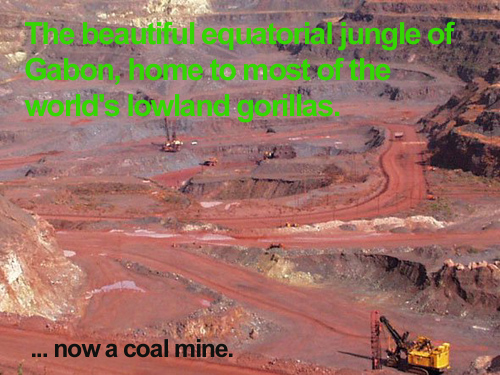
If you thought everything Canada is green and good, think again. Canadian mining is destroying Africa. And maybe destroying Canada.

The Canadian “extractive industry” as our Canadian cuzzes obliquely call it, is exploding. Literally, as GDP for Canada and as dynamite and gunfire in Africa. Numerous human rights violations across the continent have been documented against Canadian companies.

One of the worst incidents occurred in Tanzania in May. I’ve written about the North Mara gold mine before, operated by Canada’s Barrick Corporation. I think it how lovely now that the company’s own website lists some of the gravest allegations against itself.

In May Barrick admitted police aided by its private security forces shot to death 7 “intruders” and wounded others. Reports suggested as many as 1,000 people were involved. And clearly there is complicity by Tanzanian officials, which is now being investigated in parliament.

But it is the brashness of Canadian companies which stokes African ire. The CEO of one of Canada’s most aggressive African mining companies, IAMGOLD, recently told journalists in response to a strike called at one of his mines in Burkina Faso that he would crush the “illegal strike and as they will find out, will not tolerate anything that has a negative impact on our stakeholders.”

Well, that’s not particularly soothing PR for an industry blemishing the earth, and Canadians over the years were beginning to feel remorse. A year ago Parliament was about to pass Bill C-300, but the mining lobby and conservative Harper government managed to kill it. The bill would have imposed the same human rights regulations on Canadian companies operations in Africa as it imposes on those same company’s operations in Canada.

One unexpected result has been that groups as disparate as Burkina Faso mothers and Nigerian teachers are now suing Canadian companies broadside in Canada. The suits are so successful that there are plenty of lawyers to take them on.

So having lost that PR battle, and having lost all sorts of civil suits, the Canadian government has achieved a novel alternative.

The government has “developed a partnership” between many of these insidious mining companies and otherwise respectable NGOs. Here’s the three top:

World University Service of Canada (WUSC) has partnered Rio Tinto Alcan. Plan Canada has teamed up with IAMGOLD. And World Vision Canada has joined forces with Barrick Gold, the Tanzania devil.

A few seconds before this was announced it would have been thought an idea for the Onion or Daly Show. But it’s real. In effect the Canadian government has bought off otherwise good charities to polish up the image of its tarnished silverware. These organizations get up to a million dollars each to, in the words of WUSC CEO, “nudge along good practices.” Holy Smokes. Literally.

Each partnership is odious. Plan Canada’s mission as a principal advocate for child development has some explaining to do ever since IAMGOLD closed down operations at its Essakane mine in Burkina Faso due to strikes in part alleging illegal use of child labor.

Hm.

World Vision, one of the most aggressive religious NGOs that I’ve often claimed is one of the few excellent ones in Africa, is partnered with the gold trolls, Barrick. I just don’t think they’re going to get even an ounce for the wise men.

It’s all such a monstrous if laughable window dressing. I heard recently that not-for-profits were hurting this year. How? For money? Or mission statements?
Kenya or America Most Corrupt?

Kenya or America Most Corrupt?

Tables turned: America winning the bribes game while Kenya streaks ahead in the anti-corruption game. It’s all a matter of bribes.

Some bribes are paid with dollar bills. Some bribes are paid with false promises. Many bribes are paid with lies. What all these versions of bribes have in common — what makes a bribe a bribe — is that the receiver takes it knowing it’s wrong.

Here are two tales separated by oceans and continents of two different bribes. You decide which is more egregious.

Today in America:
Yesterday CBS News discovered a new campaign ad for Gingrich produced by Winning Our Future (WOF) which claims Newt (1) cut taxes; (2) created millions of jobs; and (3) reduced welfare by 60%, as well as how he stood with Reagan and battled Clinton.

These claims are spurious if not outright lies. Spurious are those about cutting taxes and creating millions of jobs, because no one person does that, and while he was Speaker of the House taxes were actually raised, not lowered. As for reducing welfare by 60%… outright lie.

The ad is paid for by a SuperPac which the Supreme Court this year released from any campaign contribution restraints in the famous case where our erudite highest court decided that corporations are people. WOF’s president is Becky Burkett, a close Gingrich ally and former employee.

Today in southern Kenya:
“I knew there was a traffic check along the way, so I was strictly driving at 80kph. On approaching the traffic check, one officer waved me down and I noticed that he wrote down my registration number on a piece of paper. He told me that I was speeding at 120kph. I laughed out loud and asked him if he was sure and to show the radar. He showed me my reg no on his paper and told me that he was given this info by his colleague a km further down. Told him that I saw him write down the number as I came closer! He handed back the DL and told me to go.”

The above report comes from a new popular internet site in Kenya called I Paid A Bribe operated by Transparency International Kenya.

I can, of course, pick and choose from literally thousands of examples in both the U.S. and Kenya, and so admittedly this is rather biased. But the point is that your average person in virtually any society on earth doesn’t condone lying and works against corruption. That’s your average Joe and you cynical idiots who might think otherwise need to read more.

That statement that the average Joe worldwide is not corrupt bristles American conservatives who thrive on the rapacious notion that other places are corrupt and they’re lily white. For years I’ve been battling this notion with constant reminders of hundreds of cases of corruption in America from Enron to Bernie Maddow, about literally hundreds of corrupt politicians like …

… well, do you remember one who was thrown out of his own party and resigned as Speaker of the House?

Two internet sites you must bookmark: FactCheck and Democracy21. Finding the truth isn’t so hard. Even when so many forces are set against you to obscure it, organizations like these will help.

Corruption is endemic anywhere that there’s enough extra money to pay someone off. And whether that be a handoff of dollar bills or a golden parachute, it’s the same. Getting something that wasn’t earned by working well, hard, ethically and …

Sorry. I can no longer add the adverb “legally” since our Supreme Court has even corrupted that.

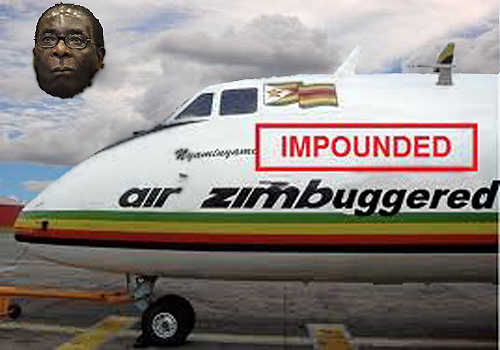
AirZim AirGone

AirZim AirGone

How I wish the end of Air Zimbabwe would be Mugabe’s nail in the coffin. But this vampire gives no impression of leaving before he’s melted by sunlight.

Yesterday Zimbabwe’s diaspora media broke the story: Air Zimbabwe’s one and only 767 had been impounded by the maintenance company owed $1.2 million dollars.

Then, with typical zany Zimbabwean zest, Zim moneybags apparently raised the ransom to pay off the debtor, but the plane still isn’t leaving and we’re not sure why. Well, for the facts, read the Zimbabwe government newspaper, The Herald, and then presume just the opposite:

(1) They didn’t raise the money.
(2) The staff including pilots of the airplane are too scared to return home. After all, someone will have to be punished for such an unwarranted delay.

Either way, a relatively unused although older 767 sits today on the tarmac at Gatwick airport. And you might say that about almost everything of the modern age in Zimbabwe, including the opposition leader and powerless prime minister, Morgan Tsvangira, who once led bloody protest marches but now spends his time explaining why he won’t let a woman into his house who claims to have had his child.

Everything in Zimbabwe has been coopted and drained to the core by its self-appointed evil master, Robert Mugabe. It is one of the most tragic tails in Africa: how this once prosperous, richly resourced, highly educated country can achieve nothing now but misery and comic notoriety.

The 767 is the perfect mascot. This plane often didn’t fly; usually because it had no passengers, but more often because of unpaid bills here and there. That is Robert Mugabe’s standard operating procedure: do. So when he did, but had no money to pay for it, he just waited until someone else paid for him. Usually that was South Africa, and in the case of the 767, China.

The 767’s weekly routine begins Friday night with a scheduled departure from Harare to Peking via Kuala Lumpur. There are several reasons for this bold route. First, Mugabe probably knows that one day he’s going to have to run. And to China might be the only alternative.

Mugabe is reported in some quarters to be 120 years old. In any case, he’s suffered innumerable diseases, including throat cancer, most of which have been treated in a Malaysian hospital which only takes cash. He’s managed to take Rand from South Africa and Yuan from China to pay doctors in Kuala Lumpur.

And the 767 plane is often filled with lots of cronies who have lots of other diseases, so this southern African medivac is welcomed by KL’s underpaid doctors.

Two. China never turns away a foreigner in need. So they buy our treasury bills, and they refuel the 767 and they force lower diplomats to use the airline on their way to Africa. This way China will eventually rule the world.

Three. No one notices when the plane doesn’t fly two out of three weeks or so.

The plane turns around in China and comes back to Harare arriving Sunday morning at 615a, and then Sunday morning at 8 a.m. it’s scheduled to fly to Gatwick arriving Sunday night, but that ridiculous schedule never happens.

All day Monday it’s supposed to get maintained in Gatwick – you know, oil changes and such. Then Monday night it returns to Harare arriving Tuesday morning. Then, until Friday, it’s now at the disposal of the President.

Now there’s a business plan for you! (It until recently flew midweek to Kinshasa, but that was suspended.)

Zimbabwe is an unreal, a scatological nation held together by outside forces: China as a part of its world strategy to dominate the earth; South Africa in order to keep out refugees who would overwhelm it should any real revolution begin.

So now, Mugabe’s escape is reduced to the range of a 737. AirZim might have one of those left working.

This Mojo Got Real Spirit!

This Mojo Got Real Spirit!

A paid staffer for Michelle Bachmann was imprisoned in Uganda for terrorism and illicit arms deals with Congo rebels linked to the current serious turmoil in Uganda. Did you know about this?!

Last week Peter Waldron convened evangelical Iowa ministers in Des Moines to discuss political strategy to help Bachmann.

Five years ago, according to The Atlantic which broke the story on August 17, he was sent to Uganda’s Luriza Prison convicted of terrorism and illicit arms dealing. My Google pretags and all the media I read about Africa didn’t bring it to my attention.

I do read The Atlantic from time to time, but it took a casual look at a Ugandan’s blog, yesterday, for me to finally learn about it. Obviously I have serious interest in this, but shouldn’t the whole world have serious interest in this!?

There’s a lot more to this story. Fast forward to today: Waldron has tried to turn this normally terminating revelation to his profit. He’s making a movie about himself, and will portray his time in Ugandan prisons as a hero’s suffering for righteous causes.

Holy Smothering Smokes! This is absolutely incredible! I know it’s what the right does all the time, twists bad into good. But this is unbelievable:

Bachmann’s press secretary, Alice Stewart, replied in an email to The Atlantic: ‘We are fortunate to have him [Waldron] on our team and look forward to having him expanding his efforts in several states.’

He’s a mercenary! He’s an arms dealer! He’s a crook and about as bad a guy as you can get!

More. Here’s what the respected Ugandan blogger, Mark Jordahl, said about Waldron two days after the story appeared:

“I happen to know some people who … went to his apartment one evening. The table was covered with pornography, and there were a number of attractive young ladies hanging around. I’m sure he was just talking to them about the evils of pornography.”

And, oh by the way, he’s the Michele Bachmann campaign’s faith advisor. Paid. Still. Today.

Oh-oh, and by the way, after The Atlantic published the story, the website for his movie was shut down. Fortunately, The Atlantic had transcribed the trailer that was on YouTube (which was also taken down):

“Lebanon. Iraq. Syria. Afghanistan. Pakistan. Uganda. India. For over thirty years, his family never knew where he went — never knew what he did. Based on a true story, Dr. Peter Waldron was on a mission. Was he a businessman, a preacher, a spy? Tortured and facing a firing squad, he never broke his oath of silence. What secret was worth the ultimate price?”

A month after being imprisoned for up to life, Waldron was deported from Uganda. According to Waldron, he was freed “thanks to the Bush Administration.”

Now there’s an awful lot to this story we don’t know, and I think it would make a fascinating investigation for some serious journalist. Who were those others arrested, charged and imprisoned with him? All we know so far is that they were Africans involved in the civil war in The Congo. When Waldron was deported, so were they.

Why was he in Uganda in the first place?

One of Waldron’s friends, Dave Racer, told the Uganda Monitor that Waldron “was a friend” of Uganda President Yoweri Museveni.

A friend of the rising dictator, Yoweri Museveni, is just the kind of person who would be whisked out of the country before the opposition got their hands on him and revelations would pour to earth.

But what revelations?

The Atlantic reported local allegations that he was working with Congolese rebel militia members to capture a warlord, Joseph Kony, in order to claim a $1.7 million bounty offered by the International Criminal Court in The Hague.

Here’s my fundamental lesson from all of this. There is a fact or two no one can dispute. Peter Waldron was imprisoned in Uganda for alleged terrorism. Police confiscated lots of money and serious weapons from his home. He was arrested with a group of known foreign (Congolese) rebels. Then, suddenly and in violation of Ugandan law, he was deported.

He tried to champion this and other episodes of his life in a movie the forward publicity of which was then removed from public view when this story broke.

He works for the Michele Bachmann campaign as a faith advisor.

The rest is here say, although I put a lot of personal credibility in my friend and blogger, Mark Jordahl, who reports through another level of here say that Waldron didn’t appear to evening visitors at his home to be that upstanding a guy.

Forget about the here say. Let him tie up all the loose ends of his mysterious tale, or let the woman who professes such high and mighty morality dump him from her campaign.

And presuming neither will happen, the lesson ultimately we learn is that at least in Republican politics nothing matters anymore but pure fantasy.

Good. Lesson learned. But why did this take such effort? Why did The Atlantic story not gain traction in the greater media? Why is Waldron still a Bachmann staffer?

Because Uganda doesn’t mean diddly squat to Americans? Because arms dealing and bounty hunting is good experience for “faith advisers”?

Whoa, that mojo got spirit!

LET IT BE

LET IT BE

Gibson guitars and an African dictator, a major conservation group, U.S. Fish & Wildlife, and yes you guessed it, the T-Party, are banging out country and western lyrics headed for the Grammys. Dissonance par excellence.

I own (I think, my son took it about 10 years ago) a beautiful Gibson guitar which I played badly for years. Like most pseudo-musicians, my signature sound was volume. And despite repeated attempts to destroy the guitar, it remains in tact. Why? Because of its extraordinary craftsmanship and precious rainforest wood.

True musicians can hear the difference between a guitar they play using rosewood or ebony, and less rare versions of wood like binga.

According to Louisiana guitar maker, Mike Armand, “Different woods allow different tones.”

He says it’s all a matter of the way the wood handles humidity. Obviously wood from high humidity places like … well, say, Madagascar rainforests … handles humidity a lot better than wood grown in Canada.

Turn on your speakers and click here for the sound of a rosewood guitar. Billy D & The Hoodoos, a Portland group, are among many who claim they are worried now about traveling with their instruments over international boundaries.

As they should be. We can’t have it both ways, folks. (Although, read further down, it seems like everyone is trying to on this one.) If you believe that elephant ivory should be confiscated and traders across borders prosecuted, then the same should be true for Madagascar rosewood.

Rosewood (Leguminosae Fabaceae) and elephant (Loxodonta africana) are both found on Appendix I in the CITES treaty. Which means you cannot take those products across international borders.

CITES is that near perfectly functioning, marvelous world treaty that protects endangered species.

The reason is so simple it defies criminality. Wherever those things exist (elephants in Africa; rosewood in Madagascar) they are dying out, or will die out if not protected from commercial harvesting. So … leave it be.

The reason I want you to watch this video is because it was made in 2007 by a respectable conservation organization regarding their project to protect 10 million acres of Madagascar rainforest by 2010.

They failed. In fact, they failed miserably. About the same amount was logged, instead. They failed, because the Madagascar government was taken over by a hipster strongman who prior to siccing military on demonstrators was a young, popular Tana DJ who scratched vinyl with little regards for the tonality of sound. He has approached his current job in the same way.

Madagascar is, ergo, a mess. Mostly a decimated mess of scorched earth.

But it takes two to tango. Somebody’s got to buy the wood. Gibson knowingly violated the law. Why? For two reasons: (1) because rosewood makes such a pretty sound, and (2) they figured they could get away with it. So far they’re right on both counts.

Whether you believe in the whole morality of the CITES convention (as I do), certainly the issue of law is universally compelling. Right now, it’s against the law (worldwide) to buy Madagascar rosewood. And so, let it be. Or, change the law. Or, opt out of the treaty.

So although I have enough music still lingering somewhere deep inside and can definitely tell the difference between Pavarotti and Domingo, and probably even appreciate Billy D’s rosewood grace, if I’m a law abiding citizen, I’ll lobby Billy D not to take his rosewood guitar when he performs in Vancouver.

Gibson broke the law.

But… guess what. Gibson is not being prosecuted. U.S. Fish & Wildlife, which is responsible for preparing the prosecution for any violation of CITES, hasn’t acted on a judge’s instruction in the case, effectively putting the whole case on hold. It’s Fish & Wildlife’s move, and they don’t seem very anxious to do so.

And desperately in search of a political win, the T-Party has now “rallied” to Gibson’s side. I didn’t know Nashville extremists went further than murdering mothers-in-law.

Gibson is not being prosecuted.

Music is a dangerous stage on which to fight politics. But when CITES was adopted by the U.S. under the Reagan administration, Fish & Wildlife actually steamed off ivory keys from priceless pianos sent in or out of the country. Pianists have come to accept this.

Gibson has pursued raw materials with the same abandon as many of its pea-brained singers. Not just Madagascar rosewood, but also Fiji ebony. Both places are run by dictators intent on little more than making a buck for their families, who care not diddly squat about their fragile island ecologies which are ready to disappear.

Both appreciate Gibson’s business. It would make a very good country and western lyric.

After Fish & Wildlife revealed the investigation was taking place of Gibson’s interests in Madagascar, Gibson terminated its relationship with the Fiji devils. But it intends to fight the ban on Madagascar rosewood.

How? On what basis?

Well one successful strategy has been to buy out an otherwise established conservation organization. Yeah, that seems to be working. The Rainforest Alliance has certified Gibson as producing “sustainable products.” This is nonsense. CITES knows better than the Rainforest Alliance, but guess what? Guess who recently gave tens of thousands of dollars to the Rainforest Alliance? Not Hank Williams.

And then another strategy that seems to be working: Get T-Party-ers to scream veiled obscenities at Obama and be covered by FOX. And that fight seems to be working, too. Obama, as the old country and western tune opines, might just be that sheep in wolf’s clothing.

Dictators Weekend Out

Dictators Weekend Out

Joburg’s main newspaper is spot on: the downfall of Libya will “put a new spring” into twevolution. And old hags dealing with aging revolutionaries no longer passes muster: Uganda, Eritrea and Al-Shabaab are in a vaudeville skit as the age of pictures begins!

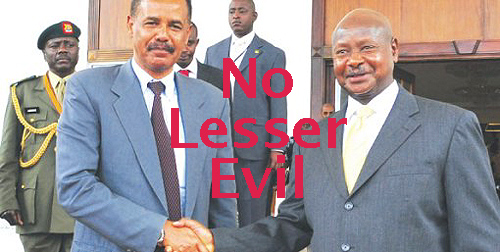
Two of Africa’s dwindling dictators spent a nice weekend together in Kampala. Yoweri Museveni, Uganda’s dictator, and Eritrean President Isaias Afeworki, are two of the most disliked people in Africa.

Museveni is cracking down on his people like never before. Afeworki is already under UN sanctions, and a resolution currently before the Security Council could effectively strangle him (although China is not yet on board).

Museveni’s crimes are methods of keeping himself in power. Afeworki’s crimes are too, but have drawn more world attention because of his funding of al-Shabaab, al-Qaeda in the Horn of Africa, which until recently controlled nearly two-thirds of Somalia.

Museveni and Afeworki are old school guys: “The enemy of my enemy is my friend”-school. Ethiopia, from whom Eritrea wrenched independence in 1993 and who remains its most bitter enemy, is an ardent supporter of the transitional government in Somalia battling al-Shabaab for control.

But wait, wait! Uganda is on the same side as Ethiopia, isn’t it? Here’s the truly unbelievable irony: Although the African Union has armed troops supporting the transitional government in Somalia, only Ugandan and Burundi soldiers remain from the original force which was much larger and included Kenya.

Uganda is by far the dominant force. So Uganda is supporting the enemy of al-Shabaab ostensibly more than any other African government.

And Uganda paid dearly for it last November, when al-Shabaab blew up two sports bars in Kampala packed with people watching the world cup. Nearly 80 people were killed.

So what’s going on, here? Where’s this enemy-is-my-enemy thing? Why is the president of a country ripped to shreds by a suicide bomber from a movement supported by Eritrea, welcoming the president of Eritrea?

The headlines say they are mending fences.

I don’t think so. Museveni has probably killed as many or more of his citizens than the November bar bomb did. And Afeworki has only a few more civil disturbances to go before he’s indicted by the World Court.

These are two aging dictators who nobody else likes. They don’t have any other friends, and as Libya crumbles, the prospect of their own tenure needs some mutual self-esteem reenforcement. These are not nice guys “working out differences.”

They are bad leaders lagering against twevolution.

Pink is for Power

Pink is for Power

Twevolution is like the recovery. It comes with a blast, planes off, has its ups and downs, and societies with major unresolved issues caught in the middle turn messy for a very long time. It might be time to scratch Uganda off your tour list for the next generation.

Political parallels to economic conditions are easy to make, hard to explain. Think of it this way: Down there in the nadir of the global recession anybody still standing had hope. High hope. They looked to the sky and found jobs and freedom.

As the Egyptians pummeled Tahrir Square with rocks, TARP and stimulus seemed to have righted the sinking ship. This was the time! Ireland was saved, so could Libya! Nothing could get worse and everything would get better. This adrenalin powers a lot of people to do a lot of things.

But now, something bad is happening. It’s not going according to plan. We listen to leaders blame tsunamis and other leaders, but we know the sickness is deep. The revolutionary wonders, does he really want power in a future that looks so grim?

So true or not that things are bad and the future is bleak, this is what protesters in Uganda feel, now. At the risk of over generalizing for an important point, I remain continually amazed at how fatigued African’s psyche becomes with convoluted politics compared to an American’s.

And I don’t mean to suggest that Americans’ attitudes are healthier. Not at all: It would probably have been much better for us and the world if we had left Iraq a long time ago. We might be the stubborn bullies, and Africans the practical realists.

Uganda is in the doldrums of despair. It’s a lousy place to live in, and not a good place to visit. A little while ago it was darn right dangerous to travel to Uganda, and who knows, it might become so, again. But right now, the horizon isn’t so fiery as very, very grey.

Uganda’s dictator is growing crazy with his apparent successes; he wouldn’t have acted this way only a year ago. A group of presumed businessmen supporters visited him yesterday, and he shouted at them like a disturbed headmaster. Supporters. He lashed out at supporters.

Last week, Uganda’s Minister for Security Muruli Mukasa told the media that protesters were terrorists and that the Ugandan opposition is using “Twitter, Facebook and YouTube to wage a campaign against the security forces and to psychologically prepare the people, especially young people, for armed insurrection”.

Well as a matter of fact, that’s right. But the fact the minister is now turning what used to be a successful tool against him into a tool he can use to beat them up means the tide has changed. The Ugandan government is gaining control.

Protests continue, don’t get me wrong. Major protests are scheduled for next week against electricity rationing and a specter of a massive protest against the dictator for turning a water cachment forest into a sugar cane field is imminent.

This is not a place tourists should visit. Just several days ago a couple hundred ardent, well-dressed demonstrators including a number of high profile opposition politicians, began a peaceful protest that prompted live ammunition fire from police, then a suburb drowned in tear gas.

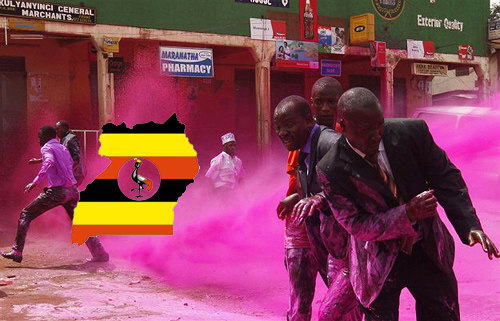
But then as if to turn the war into a birthday party, Ugandan police sprayed the retreating demonstrators with pink paint.

It’s not the first time pink paint has been used in Uganda. In fact, its purpose was to quell the demonstrations against the draconian ‘Kill the Gays’ bill that remains pending in the legislature but for the moment is going nowhere. The symbolism is obvious.

Perhaps they just had a lot of pink paint left over. Maybe the increasingly brutal regime is equating gays with all activists. Whatever, it’s a sign that things are ugly but not getting uglier. The protests are smaller and failing. The government believes that either dissent is waning, or that they can handle it just fine.

The point is reached, as it was in Zimbabwe decades ago, when crazy dictators become so firmly in control that not even a world economic recovery can pry them from power.

Society begins to depend for its simple day-to-day existence on the growing tentacles of dependency, from the dictator to his minions. As he becomes less and less accountable, he begins dishing out favors and money that replaces hard work and profit. Remove him at your peril.

I hope this is a premature analysis for Uganda. We should know, soon. Meanwhile, stay clear.

Blood for a Buck

Blood for a Buck

Almost a generation ago, John Le Carre wrote the block buster novel which became a film, Constant Gardener, about mega “pharmas” illegal testing of experimental drugs on witless Africans. Only a few years before publication, Pfizer has now admitted to having done just that in Nigeria.

Carre’s story focused on an aid agency physician driven to discover why his lover had been murdered: (She was about to become the whistle-blower against the pharma.) Carre’s story was more about deceit and corruption of British officialdom than the drug companies per se.

Pfizer announced in February that it would pay $75 million to victims and families of victims in Kano, Nigeria, who were illegally administered its never licensed drug, Trovan, for the treatment of meningitis.

Versions of the drug had been approved for use worldwide treating sexually transmitted diseases, but never for meningitis. Pfizer had been unsuccessful obtaining testing permits in the U.S. and elsewhere. So illegally and immorally, it began testing on African children.

Pfizer administered the drug to around 200 Nigerian children in 1996. Eleven died and scores others were paralyzed for life. Not long after the publication of Le Carre’s novel, suits were filed in both Nigeria and the U.S.

Pfizer fought the litigation tooth and nail, in both Nigeria and the U.S. Stateside the suits finally reached the U.S. Supreme Court, which in 2007 ruled that litigation in lower courts could continue, something Pfizer had fought for years.

The Nigerian government then announced it might pursue criminal charges.

This is exactly what Le Carre was writing about, and while illegal drug testing in Africa can’t be called exactly widespread, it is spread enough to be very, very troubling.

Two activists, Sam Burcher and Dr. Mae-Wan Ho, have spent much of their lives documenting illegal pharma testing in the Third World.

They broke the story of illegal testing of genetically modified rice serum in Peru by the California-based company Ventria Bioscience. They’ve also documented numerous illegal testing practices in India, and how drugs banned from sale in the U.S. are then sold to countries with less rigid regulation, mostly in the Third World.

Fired up by the Constant Gardener, a widely shown BBC Documentary, and concern by Pfizer employees in Nigeria that they actually would be brought to trial, the company rapidly moved in 2008 to close the issue.

Pfizer offered to pay the eleven families in Nigeria $175,000 each, a pittance by U.S. standards and a royal ransom by African standards.

Outcries continued until the final $75 million settlement in February, which also ended all U.S. litigation. Again, a pittance by American standards, an unbelievable treasure by African ones.

To date according to This Day in Nigeria, more than 3 years later, Pfizer has paid four families $175,000 each. That’s it. There is a building in the first stages in Kano which Pfizer says it’s constructing for medical research in the area, and which will cost $25 million. That’s it. Four payments to families and a shell of a new building.

According to Pfizer, the slowness of the implementing the settlement has to do with thousands more applications for compensation than is realistically possible.

That’s probably true. But that’s Pfizer’s problem, not the aggrieved families.

Pfizer concedes. And so it’s requiring DNA testing to determine those individuals and individual families who truly qualify for the money.

This, of course, is nonsense. Unless the medical records have been destroyed (an offense under Nigerian as well as U.S. law), Pfizer should have no problem determining who is who.

Understandably, victims and their relatives are reluctant to allow a pharma to do anything with their bodies, much less something as suspect as swabbing the inside of your mouth.

And so the beat goes on. Big against small. Rich against poor. Clever against the simple, the exploited, the wasted and discarded. For a healthier planet? No, for a buck.

Tourists Stranded, Tanzania Tainted

Tourists Stranded, Tanzania Tainted

Hundreds of travelers headed to Tanzania remain in limbo this morning as a result of a high profile controversy involving one of Europe’s most prestigious hotel chains, a controversy ensnared in the Serengeti Highway debacle.

Late last month ASB Tanzania Investments, the owners of The Kilimanjaro Hotel in Dar and Bilila Lodge in the Serengeti, announced Hyatt would be taking over from Kempinski. In May they had announced Kempinski had withdrawn from managing the Zamani Resort on Zanzibar, and that hotel continued to operate with local management until this week.

But Hyatt has announced it is taking over only the Kilimanjaro hotel in Dar.

Email addresses, phones, websites have disappeared for Bilila Lodge and Zamani Resort.

What are tourists doing when they arrive these places, now? I can’t imagine Bilila abandoned; I was there only a few months ago. It’s a palace in the wasteland, a luxury convention resort. But no one answers phones or emails.

No notification was given those who were confirmed into the properties, nor to their agents or tour operators. Reserved travelers are in limbo.

Kempinski has referred questions about deposits and nonrefundable payments to Hyatt, but Hyatt insists it is managing only The Kilimanjaro.

For the moment, I’d advise travelers to quickly book something else in this High Season if they can, and then to read the story of High Intrigue that follows.

And shame on Kempinski for leaving Tanzania in such shambles.

But I think I know why.

Kempinski has only been in Tanzania for 4 years. Bilila Lodge opened on July 9, 2009. It is widely assumed that the president of Tanzania, Jakaya Kikwete, has (or had) a sizable investment in the three properties.

He was often seen at Bilila on retreat, where one of the suites was always held in ready for him. His over-the-hill inaugural speech for the lodge far exceeded the parameters a normal politician would dane to use.

Why?

It was no coincidence that this was just about the time that the Serengeti Highway project came together.

And it wasn’t just a highway project. It was a plan for an entirely new center of the park probably financed by two billionaires, Paul Tudor-Jones of the U.S. and Roman Abramovich of Russia.

Tudor-Jones already owns the Grumeti Reserves, now managed by Singita, and Abramovich is a long-time fan of Tanzania and frequent visitor to Grumeti.

Grumeti, Bilila, and the planned new center for the Serengeti, are all remarkably close to one another, and would have been a stone’s throw from various points along the Serengeti Highway.

The Serengeti Highway has been shelved. Opposition grew and grew and UNESCO dealt a final blow, just as it had done with Zamani several years ago.

With swaggering disregard for law, Kikwete had maneuvered Kempinski into paying $10,000 for a historic site within Stone Town that Zamani was to be relocated to … at hundreds of millions of dollars. UNESCO was appalled, and warned (like it did later with the Serengeti Highway) that World Heritage status would be removed.

In the economic hay days when Kikwete wrapped Kempinski into his devilish plans, he essentially ignored UNESCO. But as tourism contracted, as his own country was shaken by controversial elections, UNESCO’s warning was not so much powerful itself, as a final conclusion to what all good folk believed world wide, including in Tanzania.

The threats to the fragile history of Zanzibar and the ecosystem of the Serengeti were paramount, but it became clear in the leaned down years following the global recession that general tourism was threatened by his schemes.

Kikwete has backed away, entirely. Some of his ministers now become the fall persons for his folly.

Kempinski finally had enough. It left. Rather quickly, actually, and not at all like a European gentleman leaving a cocktail party.

I suppose what’s most important, is that this miserable attempt to profit from Tanzania’s special environments and history, is over.

What is left, though, is for Kempinski to come clean. And to apologize not just for its misguided interests in the beginning, but for the appalling way it’s left.

USA to Follow KEN?

USA to Follow KEN?

Politicians the world over are a lot smarter than we give them credit for. Take Kenya, for instance. Wednesday a new political party was announced, a reaction to the public’s intense dislike of current politicians. Should we follow Kenya’s lead?

The new party in Kenya is the United Democratic Front (UDF). Wow, that blew me away. At last, a truly representative group of savvy (all) men who are united in their respect for voter’s wishes. Now that’s a change. And they’re going to be in the front, too!

Sensitivity to the complexity of issues doesn’t mean you don’t need good marketing. I think these three-letter wraps are perfect. In the airline industry we’ve used three-letter codes for years to designate airports.

ORD is Chicago. LOL is Derby, Nevada. ACK is Nantucket. This helps us remember where we’re going to, if of course, we were sure we were going and that there would be an FAA (Fair trAffic Actors) to assist us.

Although the announcement yesterday was greeted by throngs of people nearly overflowing the covered bus stop at Uhuru and Kenyatta avenues, it was hard to figure out exactly what the new party stood for. Fortunately, Google helped with a simple UDF search.

The UDF clearly stated “it’s commitments to the people of Kerala to rise to their aspirations for Growth and overall development along with a peaceful living for the entire section of society.”

Now there’s a mission statement.

An obvious error in today’s main newspaper in Nairobi reported, “The UDF… is linked to some politicians associated with the G7 grouping.“. I and most of Kenya are unable to explain this, but we are waiting for them to add another digit or letter.

Perhaps, though, with my long experience following politics in Kenya, I can make an inference as to really why this new party was formed.

The two principle leaders of the UDF, crossing their waving hands in the photo above, are (left to right, or vice versa depending upon which photoshop or political analyst you use) is Prime Minister Uhuru Kenyatta and suspended Higher Education minister William Ruto.

I for one would be concerned that their travel schedules might disrupt their local policy planning. They are traveling back and forth to The Hague quite a lot, since they are both indicted by the World Court for crimes against humanity, and the vast majority of the Kenyan people refused to allow them to wiggle out of that one.

And then there’s the possibility that Ruto will go to jail (in Kenya). The question with Ruto is whether he will go to jail in Kenya first, or the Netherlands first. That’s why the PRE (“president”) suspended him from his cabinet position.

Both men have crossed existing party lines and old ethnic barriers to form this new party. This carries on the tradition they began during the turbulence following the 2007 election when (allegedly) they both recruited thugs often not in their own tribe to shoot police, club clergy to death and set fire to buildings.

Now the question comes home. Should we follow Kenya’s lead? Perhaps Senator David Vitter could start a new WTF party. He might go to jail, soon, too.

And then there’s that other senator, Joe Lieberman self suspended from the DEM but unwilling to join the GOP for GOK (God Only Knows).

That’s a team, now! Vitter and Lieberman, or Lieberman and Vitter, just like Ruto and Kenyatta (or Kenyatta and Ruto).

Amazing, isn’t it?

Calling the South Sudan Corrupt

Calling the South Sudan Corrupt

I am sick of westerners criticizing corruption in Africa, and recent reports from Africa’s 54th country, the new South Sudan, reveal how hypocritical, racist and just plain unfair corruption charges against Africa often are.

The new South Sudan is suddenly rich by most African standards, because of its ownership – yet to be fully defined – of Sudan’s rich oil fields. And temporarily, at least, it’s enjoying huge amounts of western aid to get itself going. So there’s a lot of cash, and there’s been a lot of cash for several years.

There are two main reasons that criticizing Africa for corruption is so wrong. First, the donor encourages corruption. Second, the donor is corrupt.

Giving money without strict accountability is lunacy, yet that is what most of the donor group in the South Sudan is doing, including the U.S. It has led to some nearly laughable acts of corruption. When a dirt poor economy is suddenly flooded with nonspecific money, expect the slime to start skimming.

Only Canada, among all the donor nations, has retained the foresight to insist on its aid going directly to the projects for which it was allocated. All other western countries, including the U.S., send cash – however specified – through the new government.

So Canada alone can obtain relatively good accountability of its aid.

The tradition of foreign aid being allocated for specific projects – like water treatment, for instance – but then being given to the recipient country rather than its water works directly, has a long history. Part of it is simplicity.

The U.S. gives South Sudan about $300 million every year, and the largest portion of this is composed of specific development projects. Last year, for example, there were dozens of specific projects mentioned in the aid grant.

To send this as smaller pieces to each of the projects is tedious. It also requires much more oversight, as Canada now does, as it more carefully evaluates each and every project. This is ideally the way to go, but that would take a greater staff in USAid than the U.S. Congress is willing to fund.

So while conservatives in Congress decry foreign aid for being corrupt, they are exactly the ones who make it so.

It would be much better to reduce the aid – as Canada has done – but insist on the separate project funding and accountability by using what was reduced to fund additional Canadian staff to oversee the funding.

Brilliant, but in America ideologically impossible. Can you imagine any reason – even if it saves money – that Congress would accept to increase the federal workforce?

Even worse, can you imagine the battles in Congress over whether to fund this water treatment plant in Juba, because corruption was discovered there, or oil field catering services further north, because Haliburton is involved?

For both the structural and ideological reasons that restrain America’s way of giving aid, most all of the donor countries behave similarly.

“O Canada, we stand on guard for thee!”

Second.

Corruption is a learned behavior. It happens to be remarkably anathema to virtually all subsistence economies and traditional societies. It is a modern, capitalistic phenomenon.

You’ve heard of Macmillan Publishers, haven’t you? Massive publishing company. Revenues mostly from school text books.

Monday, Macmillan agreed in a UK court that it had bribed (massively) South Sudan officials to get the country’s school text book market.

It would have been a lucrative deal. Donor nations had given the World Bank nearly $50 million to develop educational materials for the new nation, and Macmillan was bidding on the contract. Macmillan is now barred from working with donor agencies for … three years.

Three years?!! So, you mean, after three years they can bribe some more?

This stalwart of America academia is also under investigation, now, for its similar contracts in Rwanda, Uganda and Zambia, not your cleanest of countries.

Example Two.

East Africa’s aggressive blogger, Mark Jordahl, recently reported several corrupt land grabs occurring in the South Sudan, all instigated by donor nation companies.

In the brilliant blog,“South Sudan – a Subsidiary of Texas“, Jordahl reports how an American company bought a hunk of The Sudan equal in size to the state of Delaware for a questionable payment to a possibly fictitious cooperative of ….

…$25,000. About a penny an acre.

The company, well, it isn’t even a company. It’s a hedge fund without a website. And it now owns a 49-year lease on land in the South Sudan equal in size to the state in which it is legally incorporated.

Not a lot of corruption money, you say? No, it isn’t. And it all went to a fictitious cooperative of bribed Southern Sudanese who agreed to a revenue split of 60/40 on anything developed there.

Like oil.

These are just two examples, one outright corruption, the other mostly clever theft, begun by the westerners who decry the corruption of Africa.

It’s called calling the kettle black. And, by the way, it’s infectious.

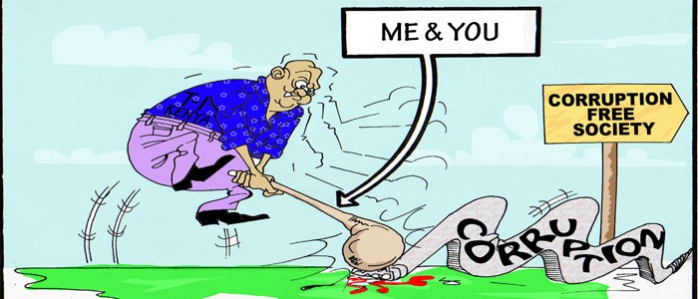
There are legions more South Sudanese who want a corrupt-free society than the criminals who live there. But the west is rewarding criminals while neglecting the honest entrepreneur. Who’s really to blame?

Three Men Out

Three Men Out


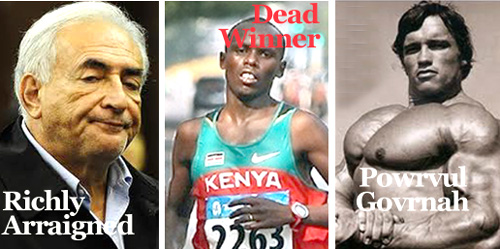
Say what you believe and believe what you say. Without that credo society breaks down. The cants include Schwarzenegger, Strauss-Kahn, and Wanjiru. These three headliners are respectfully American, French and Kenyan.

They are stars: political and commercial, and sports heroes. Wanjiru at the prime age of 24 was the world’s greatest marathon runner, and he killed himself yesterday when his wife found out about his affair.

Nairobi’s Capital FM radio station put it poetically: “[His] existence was intertwined by the sad pointer [of a] tortured genius, choosing to express himself through an excellent natural gift and reckless abandon in equal measure. Enigmas who no one, even himself knew.”

Gimme a break.

Nothing quite as poetic with the Terminator or Emperor Pretender. In fact once you leave dynamic African society, scandals don’t seem to be scandals, anymore.

My greatest personal disappointment was with John Edwards.

I’m a numbers guy. It’s very hard to get a handle on how many committed couples have affairs. It’s just too all-over-the-place. So-called “respected journals” like The Journal of Couple and Relational Therapy say 50%.

But that’s a European group, and I think their main interest is selling their books and therapy.

Although it’s been a decade since any American university studies, that’s what I’d believe: Judith Treas, a sociologist at the University of California-Irvine, concluded 11 % and pronounced, “There isn’t any evidence of an infidelity epidemic.” The numbers were more or less the same as a University of Chicago study in 1994. Michael Kinsey concurred.

And so that leaves me and my cohorts in grey society all quite ordinary, in a grand majority of all the less influential and colorful bodies on earth. Oh, but wait! Zuma! Jacob Zuma!

The President of South Africa makes no bones about his affairs. He doesn’t have to. He just marries them, and right now, they number 12. It poses great difficulties when he travels on State visits. The Maitre D’ doesn’t know who to put on the place card.

I’m not the only person who’s made fun of the President’s polygamy. In South Africa it’s a serious issue. And the fact he doesn’t have to cheat, he just marries again, doesn’t mean the man “Says what he believes and believes what he says.” Zuma’s in a ton of trouble in that regards.

So is sexual infidelity, which breaks the credo, public infidelity? If you lie to your partner, do you lie to your constituency? to your clients? to your business partners? to your children? to your supporters?

Is this just a goofy topic… or a real issue?

National Enquirer readers want to know.

King Mswati III

King Mswati III

By Conor Godfrey on April 27, 2011
The worst ruler on earth gets a classy invite.

Up until yesterday, I had successfully avoided learning anything about the royal wedding in Great Britain.

(Full disclosure—I once argued at a family dinner with several small children present that we needed to overthrow the princess culture that dominated the minds of our young women at an early age—I may be an outlier.)

I failed because the royal wedding sneaked in the back door—through Africa.

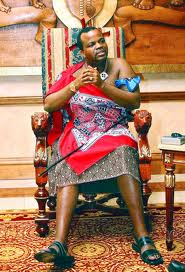
King Mswati III of Swaziland

It turns out that King Mswati III of Swaziland has received an invitation, and will be attending the show with 50 of his closest friends.

It’s a little bit like a reward for being the worst ruler on the planet.

King Mswati III has an impressive record…other would-be governing catastrophes would do well to study his techniques.

Let’s have a look at King Mswati’s resume:
1. Swaziland has the highest AIDS rate in the world
2. 50% of adults in their 20’s have HIV
3. Life expectancy is 32 years
4. 60% of people live on $1.25 or less a day

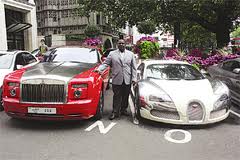
Money is not so much a problem though—all 51 members of the royal entourage will be sleeping at the Dorchester Hotel for about 500 pounds per night during the wedding festivities.

King Mswati III in England

King Mswati’s personal fortune (estimated at more than 70 million Euros) is also put to good use beating and jailing protestors.

Labor unions, teachers, and the country’s president have all been targets during the recent unrest.

This makes me angry enough to go through the futile effort of finding someone to blame (besides Mswati III himself of course).

First—South Africa and the other members of the Southern African Development Community.

If governments continue to hide behind pan-African solidarity to avoid cleaning house, then a few bad apples like King Mswati III are going to make pan-African-ness synonymous with rotten.

South Africans are great with political cartoons—here is one that describes how I feel about Zuma’s mediation efforts.

The next culprit is unfortunately colonialism.

As you know, the colonial powers did not have near enough people to rule the colonies directly.

They were forced to empower local power brokers and co-opt traditional checks and balances on tribal authority.

This created a class of rapacious local elites who became the oppressors, conscriptors, and tax collectors on behalf of their colonial masters.

Swaziland was in the British colonial orbit for almost all of the colonial period, excluding a brief period when South Africa administered Swazi affairs.

Eventually, the British claimed Swaziland as a autonomous protectorate, and thus empowered the local autocrats to maintain the status quo.

As in most now independent African countries, once the pressure mounted, Britain fled Swaziland in disarray and left radical parties to take control.

In the 1970s, after a sweeping “electoral” victory, King Sobhuza disbanded the democracy that had haphazardly come into being in 1968.

The ‘electoral’ interlude emasculated traditional checks and balances, and the restored monarchy had more power than their royal ancestors would have dreamed of!

None of this really matters though, and I do not pretend to have a perfect understanding of the nuances of Swaziland’s colonial experience.

At present, the problem is that King Mswati III is quite possibly the worst national ruler on the planet, and I think that the country seems too small and insignificant for anyone to do anything about it.

Mr. Jega

Mr. Jega

by Conor Godfrey on April 19, 2011

Attahiru Jega

I had been waiting to write a blog about Attahiru Jega for quite some time, and over the last few days the international acclaim over Nigeria’s relatively free and relatively fair elections made it seem like I would have the chance!

As I write this, however, violence is escalating in the North where aggrieved Muslim supporters of losing candidate Muhammadu Buhari have taken to the streets alleging electoral fraud.

You know what—I am going to go out on a limb and say this unrest is transitory—this election was a success in the Nigerian context, and I want to celebrate one of the people that made it happen.

So back to the original story….

57 percent of Nigerians have asked for Goodluck Jonathan of the Peoples Democratic Party (PDP) to stay for another four years!

This looks to be sufficient to avoid a runoff with General Muhammadu Buhari, but that will depend on the Electoral Commission’s investigations into vote rigging.

How can we trust the Electoral commission you ask?

Wasn’t the electoral commission a problem in that other North-South divided African country, Cote d’Ivoire was it?

Ah-ha: Enter the Miracle Maker.

Attahiru Jega

On June 8th Goodluck Jonathan asked Mr. Jega to leave his comfy academic life and make this Nigerian election different by heading up the head of the Nigerian National Election Commission.

At the time, the international community and Nigerian pundits were exerting tremendous pressure on the newly minted president to deliver credible elections, and appointing someone with Mr. Jega’s anti-corruption zeal was the only way to deliver on that promise.

Read Mr. Jega’s address to the nation when he accepted the office—good rhetoric at a minimum.

As soon as he took office, Me. Jega scrapped the ridiculous Nigerian voter registry and created a new one. He then instituted a voting system where voters check in locally to register on election day, and then stay there to observe the entire process right up until the results are posted.

That means a long hot day in the sun, but it is harder to stuff ballot boxes, and then publicly announce false results, when all the voters are milling outside the building.

So for the last two weeks, Nigerians have confidently and peacefully voted in peaceful, fair, parliamentary and presidential elections.

Let me say that one more time. During the last two weeks, Nigerians have voted in two sets of free and fair elections.

This is a big deal! If a country of 160 million people with intense, divisive social fractures can pull this off, then how can other African leaders claim that they do not need to be accountable to their people?

The system is still a bit ridiculous of course.

The ruling People’s Democratic Party is a platform-less ‘giant smoky back room’ where Nigerian elites gather to split up the pie.

But they actually lost ground in the parliamentary elections…how novel is that?

Over the last decade, Nigerian elections have been conducted by bringing duffel bags of cash into party caucuses for distribution to PDP power brokers.

I would encourage anyone to read the Nigeria chapter in Richard Dowden’s creatively titled book, Africa.

His anecdotes will make you realize what a success this election was.

Or, you can read this informative Q&A with Nigeria expert Peter Lewis.

I just checked the headlines again before publishing this piece…the violence is still getting worse in the North.

Still, I say it mostly blows itself out over the next week. I will write a blog eating my words next week if I’m wrong.
.

How Chewing on Fingernails Puts Rhinos on the Path to Extinction

How Chewing on Fingernails Puts Rhinos on the Path to Extinction

By Conor Godfrey on April 15, 2011

Rhino poaching makes me nauseous.

And it has already happened more than 80 times this year in South Africa alone.

It is also back in the news as the price per oz surpasses that of gold, and the infamous “Groenewald Gang “ comes back up for trial.

When people talk about the Guinean forest disappearing to make room for Cocoa farms—I’m upset, but I understand the calculus of the farmers doing the cutting.

When East African Farmers shoot elephants near their Watermelon farms, or Western U.S. ranchers shoot wolves near their cattle—I get it.

I am frustrated with the seeming inevitability of conflict between human development and species/habitat preservation, but I find it hard to really dislike the people killing animals they view as economically harmful pests.

Rhino poaching is an entirely different affair—this is organized crime.

Night-vision goggles, tranquilizers, helicopters, the whole nine yards.

The actual poachers are often unemployed South Africans and Mozambicans, but they are merely the tip of a multi-million dollar industry.

2010 was a brutal year.

333 Rhinos were killed in South Africa alone, including a number of critically endangered Black Rhinos.

In the first several months of 2011, 81 Rhinos and 9 poachers have already lost their lives.

In response to this dramatic uptick in poaching and violence, the South African government has brought in the heavies—as of April 1st South African military personnel have begun to take over security in South Africa’s famed Kruger National Park.

I tend to think protecting the supply will do little when a kilo of powered Rhino Horn goes for $35,850 on the black market.

More effort should be focused on curbing demand.

As recently as ten years ago the end-market for most illegal Rhino horn was Yemen, where artisans carved intricate jambiya dagger handles.

Studies suggest that Yemeni buyers can no longer compete with Chinese and Vietnamese traditional medicine markets where the vast majority of end users now purchase Rhino Horn and its derivatives.

However, we should all be more understanding; after all, Rhino Horn is the active ingredient in a number of highly effective treatments for cancer, high blood pressure, and impotency.

Wait—no it isn’t.

In fact, the purported medicinal properties of Rhino Horn have been tested over and over and the results are definitive—zip, zero, zilch.

Crushed up fingernails for what ails you
Rhino Horn is made of “agglutinated hair”—in other words—it is identical to finger nails. Here are links to a few studies for your perusal in case you find yourself reaching for the Rhino Horn powder before bed: Zoological Society of London, pharmacological study, Dr. Raj Amin.

The Chinese government does little to stop the misperceptions.

They even declared traditional Chinese Medicine as a strategic industry, and subsidized the industry to the tune of $130million.

Nauseating, I know.