Beach Bums

Beach Bums

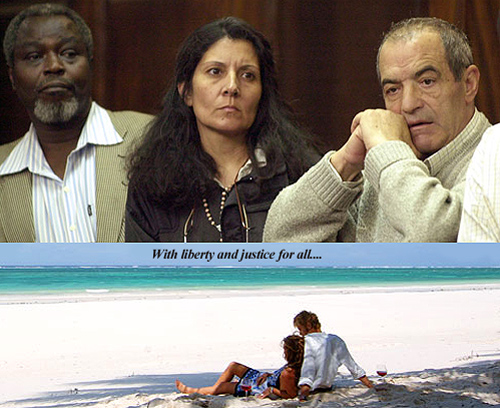
Angelo Ricci, a member of Kenya's Italian community, listens as a Kenyan judge acquits him of any crime for having 2,500 pounds of cocaine in his beach resort cabin. (AP)
Don’t feel sorry for the harassed billionaires of the world; they’ve found a place to hide from those nasty journalists linking them to blood money, laundering and drugs: the incomparably beautiful beaches of Malindi, Kenya.

This summer Brian Dabbs writing for The Atlantic unmasked the Italian cartel in Malindi, Kenya, that uses “Eden” as a likely place to headquarter a global mafia increasingly on the run from Europe.

Ten days ago Silvio Berlusconi joined billionaire friend and equally maligned Flavio Briatore in Malindi, Kenya, where they remain today cloaked in a secret “billionaires retreat” with much younger women, and many believe this is a don convention to divvy up the Joker’s World.

They are “holidaying” at the Lion in the Sun Resort, owned by Briatore, and which TripAdvisor ranks as #6 of 17 resorts in Malindi. E-Travel calls it a HotSpot hotel. (No mention in either TripAdvisor or E-Travel about money laundering or the drug trade.)

Berlusconi is the deposed and disgraced former Italian prime minister and now convicted felon. Briatore has a longer list of accomplishments including conviction for fixing Formula 1 racing.

When Italian billionaires convene like this in Malindi (this is hardly the first time), the Kenyan Post newspaper puts out this clarion call: “Nairobi ladies, there is a cash cow in Malindi, better hurry up!”

Two things really bother me about this.

Most troubling is that while Italian mafia, drugs and global crime is not news for Malindi, it is growing worse just as Kenya is about to turn a new page next March with its first election under a new and fabulous constitution.

While I see an increasing transparency and honesty with Kenyan politicians as a whole, the crew in Malindi has been totally corrupted by the Italian criminals.

Dabbs interviewed several Kenyans, including the local police boss, who essentially confirmed that they turn a blind eye to all the criminal goings-on among the Italian billionaires. Even local judges have acquitted the cartel of cocaine trafficking that excellent Kenyan investigators had all but proved.

Add to this the growing political instability of the coast, where a new political force called the “MRC” (Mombasa Republican Counsel” is increasingly linked to terrorism and many warriors fleeing Somalia, and you have all the ingredients for mob reign.

And secondly, travel tools used by so many people are doing nothing but white washing this horrible situation. It’s an incredible travesty, from my point of view a crime of its own:

Online travel portals like TripAdvisor, E-Travel, Luxist and get this, Conde Nast’s OnLine Tatler awarded it the Best Life Changing Spa – Tatler Spa Award Winner 2010. You can say that, again. And you won’t find that link leading you to Conde Nast or Tatler, because they’ve since discharged their noble duty of killing that award without explaining why.

But I guess the occasional legitimate guest Lion in the Sun gets irritates Briatore, anyway. He’s building a new exclusive “billionaire’s condominium” in Malindi, claims that half the units are already sold and that “For this project, I will choose who will come here.”

I guess that won’t be any clients I have.

The Democratic Challenge

The Democratic Challenge

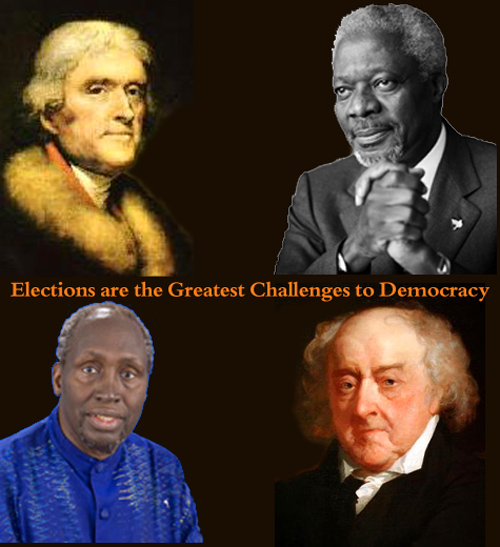
Two of Africa’s wisest old men have echoed the same cautions that America’s founders gave a young democracy about its elections. Beware: Bad elections are the greatest threats to democracy.

Yesterday Kofi Annan and Ngugi wa’Thiongo focused on the upcoming Kenyan elections as a marker for world democracy and reflected on America’s distortion of elections as something to be avoided by younger countries.

Annan is a well-known world figure, one of the most prominent Secretary Generals the United Nations has ever had. Like Jimmy Carter who remained remarkably active after leaving office, Annan’s role in global negotiations has never ceased. In fact, it was Annan who led the Kenyans out of the mire of the violence following their last election in 2007.

Ngugi has adopted America as his home after a career as a professor at Yale and New York universities. He is currently the Distinguished Professor of English and Comparative Literature at the Univ. of California in Irvine. Until 2004 he lived intermittently between Kenya and the U.S., and in Kenya is heralded as a famous revolutionary and writer.

What Americans obsessed with their own election need to know is that huge new parts of the world, especially in Africa, are adopting democracy and America’s form of democracy to govern their young societies.

This is a major change from hardly a generation ago when just as many new countries were adopting forms of Chinese communism or heavily top-down managed socialism. It’s a testament of course to the end of the Cold War, but also of the preeminence of capitalism in the global economy.

Old countries like China might be able to fiddle with capitalism and not disrupt their mechanisms for governing, but new countries can’t. The power of the economy is so critical with emerging countries that it often trumps other moral and social issues.

A case in point was Ngugi’s violent condemnation yesterday of Kenya’s decision to use English as the predominant language for governance. Ngugi is Kikuyu, the main tribe in Kenya and was imprisoned as a freedom fighter under the British. He is himself a master of the English language but he has written scholarly novels in Kikuyu, and he believes preserving multiple languages is critical to an advanced society.

It is something of the inverse argument in America as to whether Latinos should be validated by a greater use of Spanish in government.

Arguing that the current Kenyan leaders are “child abusers” for denying “mother tongues” Ngugi says, “To have a mother tongue … and add other languages … is empowerment. But to know all the other languages and not one’s own is enslavement.

“The post-colonial government and the entire [Kenyan] elite have chosen enslavement over empowerment,” he concludes.

The problem, of course, is that the violence that followed the 2007 elections turned ethnic. It is completely understandable that current politicians wishing to avoid anything much beyond a dull election want to steer clear of languages that are specifically ethnic.

In America as in Kenya when one person speaks a language that another person doesn’t understand, enormous suspicions arise, conjecture becomes almost as credible as fact-checking, and literally all hell can break lose. Unlike in Canada or Belgium where multilingual democracy flourishes, in most of the world multiple languages breed distrust.

(N.B. What puzzles many in the Kenyan situation, though, is why English was chosen rather than Swahili. Swahili belongs to no specific tribe and so is clearly universal among East Africans. The problem is that Swahili is a lingua franca and suffers thereby from a sore lack of precision. Tanzania tried to use Swahili as the formal language for many years, slowly giving way to English. It’s near impossible in Swahili to say succinctly, “Federal zoning regulations with regards to clean and safe landfills will preempt county council laws with regards to individual ownership.”)

(N.B. continued: Swahili in my view, by the way, is one of man’s most wondrous cultural achievements of the last several centuries, creating poetry of nearly every statement while maintaining a universal morality far superior to many popular western notions about right and wrong. But that’s another blog, and in this case I think Ngugi is wrong.)

Annan didn’t mention language, but in virtually everything else the two scholars said yesterday there was agreement.

Annan who is Ghanian was in Kenya yesterday. He referred to his fears that money is buying power in Kenya, as in the world over. “The infusion of money in politics … threatens to hollow out democracy,” Annan told CNN in September.

Annan understands the importance of capitalism in the world, today, but he also sees it as a threat to democracy. Many of us wait expectantly for his treatise on how the twain should ever meet, but for the time being I suppose we should presume he simply wants aggressive regulation.

In Kenya today he sees a brazen challenge to its young democracy by its rich leaders. Four of Kenya’s richest men and political leaders, including the son of the first president Jomo Kenyatta, are on trial in The Hague for inciting the violence of 2007.

Yet two of them, Uhuru Kenyatta and William Ruto, are running for president. (Not yet officially, but in Kenya “officially” comes quite close to the actual election.)

Annan sees this occurring not because the Kenyan people want it to, but because these individuals are so powerful, and because they are so rich.

Ngugi concurs: “Unregulated money in politics undermines …confidence in democracy… The explosive growth in campaign expenditures … strengthens fears that wealth buys political influence.”

American politicans’ penchant for personal stories about their early impoverishment is mostly malarkey or at best irrelevant to their current control of wealth. The vast majority of successful American politicians are rich. The cost of entering politics defies many startups. Over $1 billion will be spent by candidates and their surrogates in the current U.S. election.

Both men see the poor, the less privileged, the disabled and geographically disenfranchised as likely a majority of African voters that can be deftly ignored in a modern election:

Ngugi: “Too often, women, young people, minorities and other marginalized groups are not given a full opportunity to exercise their democratic rights.”

Democracy is today widely popular throughout new African countries and embraced as the best way to protect and govern themselves. But the messages that Ngugi and Annan delivered yesterday to a promising young African country resonant here at home just as much.

Democracy is never achieved; it’s simply strived for. America has used democracy for nearly two and a half centuries, yet the corrupting power of money, the difficulties of implementing democracy to a multi-lingual population, and the ease with which the underprivileged can be disenfranchised are threats as great today as they were in the 18th century.

Nor any greater a threat in Kenya than here.
Zuma is not Jefferson

Zuma is not Jefferson

Tolerant, patient South Africans have basically given their leaders wide berth publicly and privately since Mandala stepped down 15 yeas ago … until now. The current president’s buffoonery and corruption threatens the nation.

Working every day under the threat of massive censorship, South Africa’s still vibrant press has systematically reported both the corruption of its government and bumbling of its leaders. But until now it hasn’t seemed to matter much.

Last week the country went ballistic. Even ardent supporters of the government grew critical and those who defended it either lied or blushed.

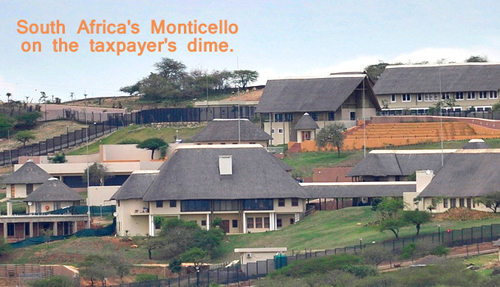
News leaked that $22 million dollars (203 million Rand) had been spent to build a new home for the current president, Jacob Zuma. This was not the official residence, but a complex built in Zuma’s rural homeland that is not intended for official use.

Zuma is in trouble for a lot of things, and the ruling ANC party will meet in December to decide whether he should continue as president. The recent mining strikes which became quite violent set on edge many ANC members and lessened Zuma’s ability to stay in command.

The rapid building of a new resort home strikes everyone as what it probably is, a wounded politician trying to collect as much as he can before he’s booted out.

The public works minister lied exactly as Romney lied — no holes barred — claiming that the project was in perfect compliance with the “Ministerial Handbook” or rules of governing in South Africa.

It isn’t. The lie isn’t as boldfaced as Romney saying he won’t enact a $5 trillion tax cut despite his own website to the contrary, but it’s almost as clear:

“Although members can designate a privately-owned residence for use as an official residence at the seat of office, the handbook states that the public works department will only be responsible for making available general cleaning services in private residences used for official purposes,” Faranaaz Parker, a reporter at South Africa’s Mail & Guardian explained.

This is the leader, remember, who proudly displays multiple wives and claims that his extramarital sex with underage girls is both legal, and safe from HIV, because he showers afterwards.

South Africans have tolerated this buffoonery for too long. The patent misuse of public funds to create Zuma’s golden parachute into a resort paradise is a tipping point, and brings into sharp focus the ongoing corruption of the ANC.

That corruption manifests itself principally by the awarding of uncontested government contracts. Several days ago the BBC interviewed a whistle blower who had been fired from the administration of education in Limpopo for revealing that millions of dollars allocated for the purchase of text books had gone missing.

The report caused such a stir including threats against the BBC that yesterday the BBC published an even greater in-depth story further documenting more than $2 billion dollars gone missing in South Africa’s school system.

The textbook scandal might be the one that penetrates the ennui of so many South Africans to their incompetent government. Protests are growing.

But the textbook scandal is only one of many such examples of illegally awarded government contracts.

Perhaps most disturbing is that South Africa’s much revered independent court system is being emasculated:

In one of dozens of similar cases, the Gauteng Provence High Court nullified a $1.1 billion dollar ( 10 billion Rand) government grant in August to middlemen dispensing social security payments. It was a bold move when the judge declared the award “illegal and invalid” but a lot less bold when he refused to “set it aside.” In South African jargon, that means it’s wrong but nothing will change and implementers will not be held accountable.

It is typical of the massive transformation of South Africa’s previously powerful courts into platforms of ANC control.

I don’t know if this latest scandal really is the tipping point of ANC power, and the ANC is being extremely clever by floating the idea they will get rid of Zuma before the control boils over.

But I do know it’s a tipping point for something.

Renewing [or not] The Strongman

Renewing [or not] The Strongman

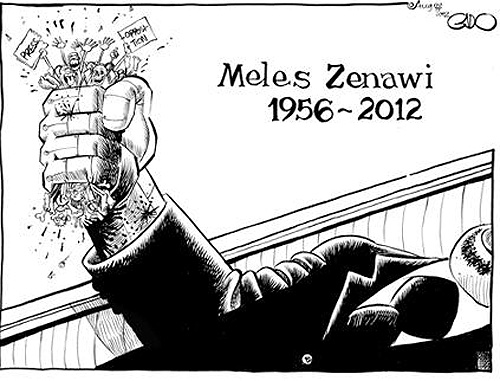
Last week’s death (unusually of natural causes) of Ethiopia’s strongman Meles Zenawi is an unique opportunity for America to reflect on its impact in East Africa, if not the whole of the developing world.

Meles was one of the most ruthless dictators in the world. He was also heavily supported (argue, “propped up”) by the Obama administration. This contradiction was justified because Meles was also instrumental in the War on Terror.

America’s Wars on Communism and Terror and Drugs have governed our policies in Africa for more than a century. The question, now, is whether we are mature enough of a society to throw off these archaic shackles usually described as “self-interest.”

    Cycle One: The War on Communism

In 1960-1962 during the presidency of John Kennedy democratic movements throughout the Congo were quashed and its leaders assassinated paving the way for the continent’s most famous and longest serving tyrant, Mobutu Sese Seko.

    Cycle Two: End of The Cold War

In 1993-95 during the presidency of Bill Clinton democratic movements in the Congo and Rwanda were abandoned to chaos paving the way for seemingly interminable war and ethnic conflict.

At the time the rationale for abandoning Africa to dictators and mayhem was that there was nothing consequential to America in Africa at the time worth fighting for. The Cold War was over

    Cycle Three: The War on Terror

Today, 2010-2012, under the presidency of Barak Obama strongman regimes in Rwanda, Uganda and Ethiopia have received huge amounts of military and development aid paving the way for ruthless dictatorial regimes violating all sorts of human rights.

Today’s rationale is that the War on Terror is going pretty well, and especially well in The Horn of Africa.

Lesser acknowledged but well known is the American Right’s involvement in all three of these cycles. Until the current cycle it was principally from church missions and was admittedly less significant. But during this latest cycle, the involvement of DC’s Church Street and other evangelical groups most prominently in Uganda has been well reported.

The contradictions are explosive:

The most incredible one is that while President Obama has inched his own country away from homophobia quite successfully, his administration piles enormous support on the Ugandan regime which is still trying to pass legislation that will execute gays for being gay and imprison nongays for not revealing that someone is gay.

And there are many more: no military involvement in Libya or Syria, but already a brigade of green berets in Uganda and the CAR; and tax to death or forbid U.S. corporations from extracting coltan and other precious metals from the troubled DRC, but laden Rwanda with extra development aid to build local industries that do just that.

This is not a Right or Left affair, although it seems to always be initiated by Democrats and then massively supported by Republicans that follow. And it is not a Left versus Right affair, either. The fact that Democrats in power are essentially promoting the same thing as evangelic Christians funding movements in African backrooms is clear this is not a Left verus Right affair. It’s a power thing.

It’s ends justify the means. It’s Kissinger’s self-interest dogma. It’s we do what works best for us, irrespective of morals, ethics or human rights. It’s been the way of the world for centuries.

And so we endure Cycle Three: Museveni in Uganda, Kagame in Rwanda and whoever will be Meles’ successor in Ethiopia are all ruthless dictators. Together with American drones, the War on Terror proceeds just hunky-dory.

All hail the African Strongman.

Anything for A Buck!

Anything for A Buck!

Tanzania’s scandals and sheer wastefulness of its bountiful natural resources are legendary. But last month’s incident took the prize.

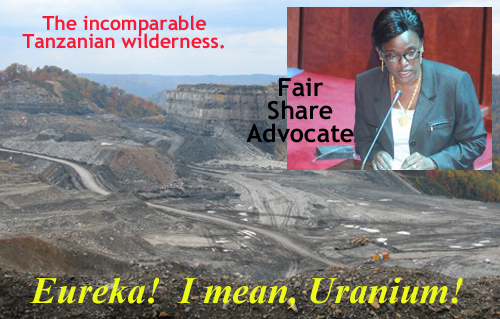
In addition to the world’s second largest single vein of gold, countless copper and recent rumors of off-shore oil, large deposits of uranium were discovered hardly 100 miles from the port of Dar-es-Salaam last year.

The fact that most of the streaks were in the massive Selous Game Reserve really was incidental. According to the government less than 1% of the reserve would be effected.

Not the Tanzanian government is to be believed about the time the sun rises, but the way the natural resources ministry mismanaged the gold mining near Lake Victoria, which has essentially stalled normal mining, I think gave hope to many environmentalists who simply expected this new discovery will also be bungled.

But uranium has a “security” component to it gold does not. The interest of world powers is acute. No fewer than 26 multinationals (and one Tanzanian) company are now involved.

In approval faster than a speeding bullet, UNESCO who fought tooth and nail to protect a single road from bisecting the Serengeti, approved yet to be revealed mining methodology of the world’s largest protected wilderness, The Selous.

By 2014, optimistic businessmen claim, Tanzania will become the world’s eighth largest producer of uranium.

All to be expected, and despite my sarcasm I have never opposed proper natural resource extraction from Africa and I’ve always countenanced arguments for extracting it from protected wildernesses.

The fact is that the world is energy desperate and Africa is sitting on the golden goose. It’s about time that Africa get its fair share.

And that’s the problem, now. There are so few fair shares of Tanzania’s gold getting back to the local population that it’s a joke.

Now, one of the few rational, educated, articulate Tanzanian politicians, the shadow minister of natural resources, Ms. Halima Mdee, has revealed that one of Tanzania’s equally unscrupulous hunting companies, Game Frontiers, has actually sold off the block of Selous given it for hunting to a mining company!

And no one seems to care!

The fact that this violates a tome of Tanzanian law isn’t the point, since most of Tanzanian law is violated one way or the other. It’s just the sheer crassness of this move that’s so infuriating.

What’s more, Ms. Mdee seems to understand that any legal argument is pointless, so she is scolding the government on larger ethical and moral grounds.

“Other than the illegality of the contracts,” Tanzania’s Guardian newspaper reported, “she described what she called ‘unfair’ distribution of disbursed compensations on the part of the hunting company embezzling the villagers share.”

Did you get that?

The way to appeal to either popular consensus or somehow otherwise gain political advantage is to drop altogether the body of law in Tanzania and the rest of the world that disallows a hunting company to farm out a country’s resources, and claim that the local people in and around the hunting block aren’t getting their fair share of the loot from the illicit deal!

Whoa Tanzania. Yes, thank you Ms. Mdee, and by the way how are you doing with the laundry of al-Qaeda’s Somali weapons?

The Undemocratic Election

The Undemocratic Election

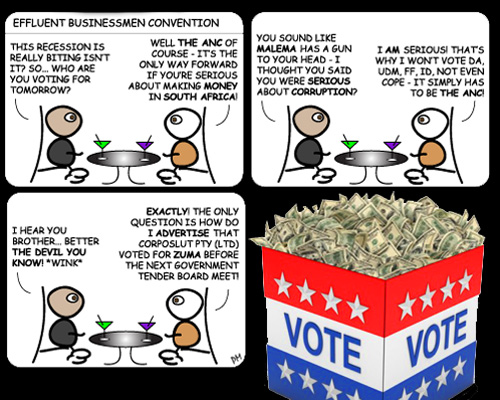
South Africa like the U.S. allows unlimited campaign financing but Kenya has moved to severely regulate it. Which democracy is likely to last?

These two democratic powerhouses both have progressive constitutions but differ radically on candidate funding. Kenya has yet to hold an election under its new constitution but South Africa is well along, yet I think it’s already clear that Kenya’s much greater regulations will lead to fairer outcomes.

South Africa and the U.S. have essentially unregulated candidate financing. Don’t be fooled by those who argue otherwise, because “essentially” is the formative adverb. There are filings and partial disclosures, but “essentially” a candidate can solicit and distribute unlimited amounts of cash to promote the campaign.

Kenya, on the other hand, is severely restricting such financing. In fact the regulations are so tight that there is public concern that the commissioners regulating the campaign could themselves become instruments of unfairness.

And that’s the current debate in Kenya. There is no debate about whether there should be stiff regulation. Everyone supports in principal rules for limiting campaign spending based on the population and individual earnings level of the electoral area.

Kenya also prohibits corporate financing of individual campaigns as well as severely limits how much a candidate himself can contribute to his own campaign.

It takes no rocket scientist to know why. Money buys votes.

I remember my grandfather in Chicago talking about the rigged elections for mayor. Once we even visited a bar where the alderman was buying drinks for potential voters and … passing out cash.

Later I remember living in Kenya where exactly the same thing happened: Local politicians in a bar buying drinks and votes.

Getting a free beer or pocketing some cash doesn’t in itself guarantee that voter will even go into the ballot box and then if he does tick off your name. So a bit of cleverness was required in those days long past, and it basically came as follows:

“What’s the other guy giving you?”

The answer was rarely “nothing” and more often was always “not enough.”

And that’s the hook in today’s world, too, whether it be South Africa, Kenya or the U.S. Of course there is never enough so long as more is possible. And as evidence that I can provide you with more, here’s a beer.

Or a promised tax cut. Or a promise of “deregulation” intended to mean more cash in your pocket. Ultimately a promise to make you richer, like those who are already rich buying you off.

South Africa after twenty years of new independence is feeling the effects of such unregulated financing. The country is far richer than Kenya and in that regards much like the U.S.

But one party has dominated South African government since Mandela became its first president, the ANC, and the cogent argument today is that money has made it that way.

U.S. election lawyer, Michael Lowry, describes precisely how unregulated financing in South Africa has led to the dominance of the ANC. And like the U.S. it’s more onerous than just the election of a single candidate:

Once unrestricted campaigns elect rich politicians, the dynamic quickly moves to the actual levers of power. In other words, only the rich begin to earn cabinet posts and even military positions.

Soon a single class – or party – is not just controlling the outcome of elections, they are controlling the society.

And democracy no longer exists.

Tusks For Terrorists

Tusks For Terrorists

Until recently Republican obstructionism in Congress hurt few but us Americans. Now, it’s seriously hurting Kenya and harming Somali peace while supporting al-Shabaab!

This is a no brainer. Kenya Wildlife Service (KWS) director, Julius Kipng’etich, told the Senate foreign relations committee last week that Senate Bill 1483 (if it became law) would drastically reduce elephant poaching in Kenya and dramatically escalate Somali peace.

Senate Bill 1483 has no chance of passing. Only 3% of the Senate bills this Congress have passed, and despite widespread bipartisan support, and a bit of chance it would pass in the Senate… no chance in the House.

So even before we discuss what the bill means, who presented it, who supports it, what it does … even before anything substantive about the bill, we know it won’t pass because the House won’t pass anything.

And even before I tell you what it means, I’m going to tell you that the Wall Street Journal, not exactly a bastion of progressive ideas, coyly supports it.

But here’s what it would do, if it could:

The bill is an amendment to the Homeland Security Act that would require all U.S. corporations to reveal their “beneficial owners.” Right now business entities are created under state laws, and those laws do not require the individuals who control the corporation be named. They only require the officers of the corporation or the agents of the corporation to be named.

In money laundering scams, “shell corporations” are created with officers and agents who are beholding to the true overlords who remain unidentified. For example, Somali al-Shabaab opens a bank account in the Canary Islands. Canary Island bank law is so lax that there is nothing in Canary Island records to show this. Instead, for example, John Doe is shown as the CEO.

Like a Swiss bank account, the manipulation of that account is done by number keys.

Next, a “shell corporation” is opened in Delaware, with Jim Heck as CEO, you as treasurer, and so on. This “shell corporation” sells consulting services to Sheik al-Doe in Somalia. Sheik al-Doe, an al-Shabaab leader has just slaughtered an elephant and sold it to Asians for cash. He wires the cash to the “shell corporation” and the corporation moves the money into the Canary Islands account controlled by the al-Shabaab leader.

The terrorist now has easy and legal access to his safeguarded funds, and because the deposits into the account come from an American corporation, the illicit money trail is disguised.

1483 would put an end to this. It would require the “shell corporation” to name its beneficial owners, which are the individuals who control the Canary Islands account, i.e., the terrorist.

Kipng’etich explained that al-Shabaab is poaching elephant and rhino from Kenya’s Arwale and Meru national reserves, selling them on the Asian black market for enormous sums, remitting it illicitly into American bank accounts that transfer it to foreign off-shore accounts, thus safeguarding the funds in the global banking system.

It’s quite interesting that Senator John Kerry, the committee chairman, brought Kipng’etich to Washington do this. There were plenty of other experts on hand to say the same thing.

Of the many who testified, Tom Cardamone of Global Financial Integrity was the most comprehensive, presenting sheaves of evidence about money laundering in the U.S., a good portion of which is through the sale of drugs and ivory.

So Sen. Kerry is digging to the very source, and notably, not a single Republican Senator challenged Kipng’etich’s testimony. But …

… the bill won’t pass. Needless to say it would do us all a lot more good if it did, and it would provide a specially powerful tool for Kenyan anti-poaching.

But it doesn’t matter. Nothing seems to matter. The answer these days is always NO.

Rhino RipOffs

Rhino RipOffs

Despite my better reasoning I can sympathize with poachers just trying to survive. But when rangers and other paid officials participate in the crimes, my blood boils.

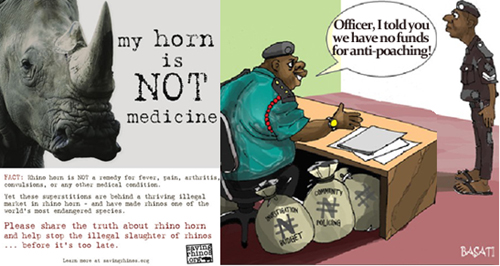
Several weeks ago Serengeti officials admitted that two of the Moru area’s 31 black rhinos had been killed by poachers… in April! We probably wouldn’t even have learned of this if the Member of Parliament for the area hadn’t announced the killings at an irate press conference the end of last month.

There’s only one reason park authorities kept the lid on the story: they’re a part of it.

When the Minister of Natural Resources & Tourism read about the MP’s press conference, he immediately fired 4 park officials and suspended another 28.

And I won’t be the least surprised if all the posturing, firings and elaborate news conferences are simply part of a smokescreen to hide the culpable.

The demand for rhino horn is skyrocketing as Asian economies emerge from the recession. The main markets for rhino horn are Vietnam and China, where apothecaries use them in combination animal powders primarily as fever reducers. Ever heard of aspirin?

The great irony is that the rhinos which were killed were progeny of black rhinos removed from the Serengeti more than 20 years ago and nurtured in South Africa as a strategy to protect the species when poaching was simply out of control.

I remember in the early 1980s when I was with one of my photographers in Lake Manyara on a routine photo shoot. He was an ex-Marine and hunter and as we were inconsequentially continuing down the lake side road we saw a mid-size rhino dead in the grass.

Ken, my photographer, got out of the vehicle and examined the very recent kill. The horn had been sliced off, but he believed he could tell the type of gun which had successfully made the heart shot.

We raced back towards park headquarters and passed some rangers walking along the road. I stopped the vehicle to explain to them that a rhino had been poached several miles back, but they insisted they knew about it and that it was a natural death.

Meanwhile, Ken was whispering in my ear that they carried the guns that killed the animal.

The temptation of insiders to stage an in-house crime increases as the loot does, and right now the loot is high as regards rhino horn. It was back then, too, when ranger salaries were so pitifully low. By our standards they’re still low, but nowhere near where they were, and now many would argue quite reasonable.

But what isn’t reasonable is what Asian consumers will pay for pulverized carotene of priceless, endangered animals, to use as medicines that don’t work. Much less the governments complicit in their crimes.

There are many more people wrapped into this evil doing than the simple poor two rhino that were killed.

Similiar Social Circles

Similiar Social Circles

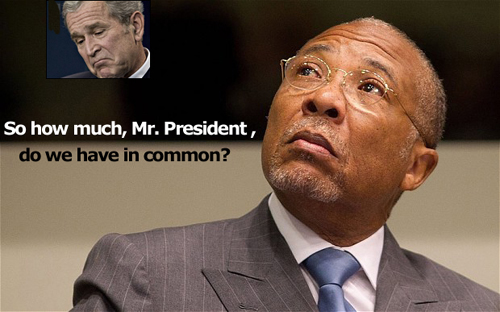
Charles Taylor’s demand that the World Court try George Bush is neither hair-brained or facetious and demonstrates the growing globalization of justice.

Shortly after Liberia’s former strong-man was sentenced by the World Court yesterday to 80 years for “crimes against humanity” he remarked to the press:

“President Bush… ordered torture and admitted to doing so. Torture is a crime against humanity. The United States has refused to prosecute him. Is he above the law?”

Well, the answer of course is, yes.

The World Court is playing increasingly pivotal roles in African justice, and thereby, African politics. Taylor was the strong-man now found responsible for the long blood diamond and blood resource war that devastated much of West Africa in the 1990s. His apprehension and prosecution in The Hague was fundamental to West Africa’s current fragile peace and stability.

Right now the Court is negotiating conducting a similar prosecution against Seif al-Islam Gadhafi, the son of Moammar. Seif is being held by a remote militia group in the south of the desert country, and they refuse to surrender him to current Libyan authorities. But they might just surrender him to The Hague.

Also right now, the Court is trying four prominent Kenyans – two of whom may become presidential candidates. Remarkably, the four are willingly traveling back and forth to The Hague for their trial, although there is wide speculation that as soon as proceedings become threatening to them, their schedules might just become too tied up for further international travel.

So it is really not just banana republic hyperbole regarding Bush. (Important to note, of course, that America is one of the minority of countries in the world that doesn’t recognize the World Court.)

Both Bush and Cheney have canceled multiple trips abroad in the last few years for fear of global prosecution. So even if we don’t recognize this new global justice, it does impact us.

Bush first found his travel restricted on what seemed like an innocuous trip to Canada in October, 2009. While speaking in Calgary, Canada, a warrant for his arrest was issued, but higher courts vacated the warrant allowing him to leave.

Bush then laid low for a couple years before trying, again, in October, 2011. He returned to Vancouver in the company of Bill Clinton. Once again the warrant was issued, and this time he snuck out of Canada by the skin of his teeth. An unusual “higher intervention” stayed the British Columbia’s court action hours before he left.

Bush has made no trips since.

But it was in neutral-grounded, ideologically-bereft Switzerland where both Bush and Cheney faced the most serious possibility of actual arrest. Both canceled previously announced visits when it became apparent authorities would actually apprehend them.

Cheney’s last cancellation was only two months ago, once again testing the presumed friendship if obsequiousness of our nearest neighbor and dearest ally, Canada. The mounting evidence of Cheney’s involvement in torture may have breached the threshold of “higher authorities” power in Canada to prevent his apprehension.

The growing evidence against Bush and Cheney specifically with regards to Guantanamo torture, as well as torture abroad during the Iraq war may not rise to the level of slaughter that Charles Taylor conducted in Sierra Leone.

But this isn’t a body counting analysis. Some actions like torture are no less wrong once than a thousand times. Taylor’s ordered massacres of tens of thousands may indeed be more horrible than Bush and Cheney’s torturing a hundred terrorists. And within that perspective the World Court has sentenced Taylor to 80 years, one of the greatest sentences ever levied by the Court.

So perhaps George Bush should be sentenced to 10 and Cheney to 20. Or something like that.

The point is that the world is developing a sense of global justice around a few top human rights’ issues like torture and innocent massacre about which there is little debate. Africa is taking the lead using the World Court, thereby contributing in a fundamental way to defining exactly what justice means in our increasingly compacted world community.

Whereas we, in America, risk global conflict by berating China for its poor stewardship of human rights, while our former leaders tiptoe across the world careful not to breach the lines of decency. It would be terribly embarrassing were Bush or Cheney arrested for torture, wouldn’t it?

Great Power. Greater Hypocrisy.

The Children Are NOT Invisible

The Children Are NOT Invisible

Invisible Children has produced a viral YouTube video that is dangerous. Like other U.S. organizations embracing an African cause they exploit part truths to make a buck.

My young hero, Conor Godfrey, wrote an incredibly balanced and unemotional blog about this that you must reread to understand the facts of the case. That way I can just continue screaming in good conscience.

I’ve written disparagingly about Invisible Children before. Among their most outlandish accomplishments was accepting money from naive high schools in America’s heartland for a cause that no longer existed. IC did this by teasing emotions and grossly ignoring details.

IC’s raison d’etre is to tell the stories of child soldiers who played such unspeakable rolls in mostly Uganda and The Congo in the 1990s, while under the control of a still wanted fugitive, Joseph Kony. That’s true.

But when the Windsor Colorado high school (and presumably others, too) raised money for the effort at the behest of IC, the cause was already over. There have been no child soldiers or Joseph Konys or Joseph Kony wanabees in Uganda since 2006.

IC’s response was to change its website slightly and go on accepting money from lots of naive high schoolers, much less pensioned widows and disabled truck drivers. The teachers, administrators and even local newspaper reporters in Windsor refused to comment on my blog or even talk to me about it.

I am so incensed by this exploitation, and watching the video that’s gone viral on YouTube makes my blood boil. IC is continuing its false cause campaign by generalizing to the point that details be damned!

Of course we all care about children! Can’t criticize the palsy filmmaker Jason Russell for spending two minutes at the beginning of the video showing baby pictures of his son, followed by a minute segment showing the birth of a very white child. Warm us up, so to speak.

The entire video is so tweaked with these generalized but irrelevant emotive gimmicks that I feel I’m watching a drug company commercial on the evening news. Russell’s honey coated commentary belies a very disturbed psyche, someone whose deepest soul is daring pushback against a blind evangelical drive to tell a story … that really isn’t.

The true story, as Conor reviews above, actually has parts with happy endings, not particularly conducive to a charity campaign.

Joseph Kony is a fugitive, probably in the Central African Republic (CAR), not Uganda. He hasn’t been there since he was roundly defeated by the Ugandan military in 2006.

We should presume Kony continues his sadistic ways of conscripting, drugging and brainwashing young children to be killers – the heart and soul of IC’s craven drive for wealth and fame. But we have little hard evidence of a scale anywhere near his robust days in Uganda.

Voice of America reported in March of his redeveloping presence in The Congo near the CAR. But as one of my all-time favorite journalists, New York Times reporter Jeffrey Gettleman explains in his March essay in the New York Review of Books, Kony is involved in only one of “dozens of small-scale, dirty wars” that while absolutely terrible doesn’t begin to achieve the magnitude of murder and destruction Kony leveled on Uganda in the 1990s.

But if IC owns up to the facts it might kill the golden goose.

The warehouse of emotion that IC has harvested from an unwitting American population, much less its cash charity, corrodes to the core the intention of every good person donating to it.

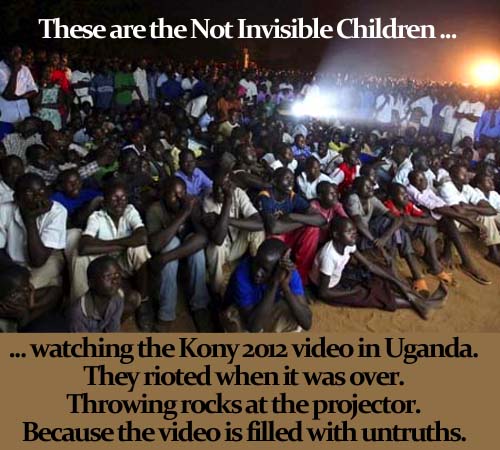
IC is especially being denounced in Uganda, where it all began. Ugandans are proud that they’ve routed Kony, so when the video was shown there last month it nearly caused a riot.

The excellent blog, Upworthy, tells a more sinister fiscal tale about IC in the recent post, “Share This Instead of the New Kony Video”:

IC recently accepted $750,000 from the National Christian Foundation (NCF). The NCF designed then funded the campaign in Uganda to pass a “Kill the Gays Bill” about which I and so many others have written. NCF gives other big sums of money to “The Call” which sends youthful missionaries into “dominions of darkness” like San Francisco to retrieve gays from their purgatory.

Also on NCF’s big recipient list with IC is the Family Research Council and The Fellowship. These mega right-wing organizations are well known and so dangerous, not just to Uganda but America. Just spend a few minutes on Google to build your Darth Vader tome.

This is the recipient pool that IC shares. And its message, methods and racist causes are also the same.

Weep when you watch the video. But let the tears dry before besmirching a check. You’ll realize that your clenched fist is packaged for IC not Kony.

Lord of War Behind Bars

Lord of War Behind Bars

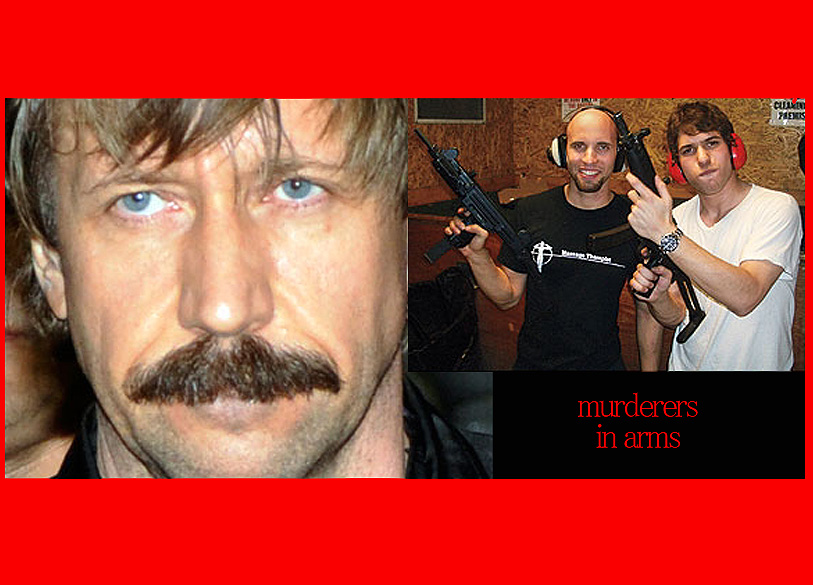
One of Africa’s most heinous arms dealers is now in a New York jail for at least 15-20 years. It’s about time. American administrations all the way back to Nixon have avoided prosecuting these terrible men, often because they used them.

Viktor Bout‘s sentence doesn’t begin to bring justice to the millions killed in Liberia, Angola or Sierra Leone, or to ward off future wars of the sort he tried and failed to start in Tanzania. But it’s a start, and it’s long, long overdue.

You can’t make war without weapons. The buildup of weapons during the Cold War was insane, and it wasn’t just limited to the nuclear arsenal that could destroy earth a hundred times. The inventory of tanks, surface-to-air-missiles, grenade launchers and simple guns that were manufactured in the 1960s and 1970s, is mind boggling.

Even the Federation of American Scientists considers illicit arms dealing one of the planet’s greatest threats.

When the Cold War ended and self-destruction grew less likely, the discarded hardware provided business opportunities for the most callous of men, and much of this wheeling and dealing occurred in or through Africa.

(Indeed, major arms dealing occurred in Africa even before the Cold War ended. Unbeknownst to this then young tour guide, I paid $60 x 14 to get my Lincoln Park Zoo safari members onto a DC3 that appeared like magic landing beside our mud encased vehicles near Zaire’s Ituri Forest in 1985.

We scrambled into the aircraft, grabbed individual ropes hanging above the small port windows and sat in jump seats facing the center of the aircraft which was consumed by a well equipped Armored Personnel Carrier (APC) headed for who knows where well south of where we got off when the plane refueled in Goma.)

But it was the huge inventories of weapons opened to the “free market” after the collapse of the Soviet Union that fueled so much death and destruction in Africa in the 1990s and 2000s.

Click here for a quick list of books documenting the incredible mayhem. Viktor Bout was the model for Nicolas Cage in Lord of War.

Bout’s conviction is a bit dicey in itself as evidenced by the judge’s reluctance to levy anything but the minimum sentence. But it shows the determination of the Obama administration to reverse years of immoral American complicity with arms dealing.

As the judge explained when issuing the minimum sentence, Bout was nabbed in a sting operation, a fictitious setup by US agents pretending to represent Columbian rebels.

He may, in fact, never have dealt in South America before. Africa was his kingdom. So while I can’t fault the judge for levying the minimum sentence, I can certainly applaud the Obama administration for doing whatever necessary to get this man off the street.

America’s complicity with illicit arms dealing is legend. Last year Rolling Stone magazine published an incredible story about two kids in Miami Beach procuring cargo planes of weapons for the Bush administration in Afghanistan from illicit sources in Kyrgyzstan.

What?!

The story of illicit weapons is unbelievable. And it isn’t, as Rolling Stone showed, just a product of funny Russians taking advantage of the implosion of their society. It’s equally American kids pretending to be video soldiers who suddenly emerge from their flat sceens to become actual war mongers.

And more often than not, it’s Africa that suffers most.

You can’t make war without weapons. Apparently, you can’t get weapons without Viktor Bouts and Miami Beach 25-year olds. They should all be in jail.

These Guys Are Worse Than Pirates

These Guys Are Worse Than Pirates

By Conor Godfrey
Last week, Greenpeace shadowed an unlicensed 120-foot Russian Trawler off the Senegalese coast.

Ships like these often pull in 250 tons of fish a day by dragging 700 meter nets behind them. Some of them use incredibly damaging bottom trawling and other techniques that increase hauls while destroying marine habitats.

To put the effect of these super trawlers in perspective, allow me to quote a few statistics from the Greenpeace report on illegal fishing published last week:

1. “It would take 56 traditional Mauritanian pirogue boats one year to catch the volume of fish a [super trawler] can capture and process in a single day.”

2. “The amount of fish discarded at sea, dead or dying, during one [super] trawler’s fishing trip at full capacity is the same as the average annual fish consumption of 34,000 people in Mauritania.”

Green Peace struggles to unmask illegal fishing ship off West African Coast
These ships rotate the same license among a number of ships, or more crudely, simply cover up the name of the vessel to prevent anyone from documenting their breach.

In short, bloated European fishing fleets have already overfished their own territorial waters, and are now taking advantage of poor African countries inability to enforce their maritime borders. (Japanese, Korean, Chinese, and Taiwanese companies are all guilty as well.)

The vast majority of these illegally caught fish are ‘fenced’ through Los Palmas in the Canary Islands, owned by Spain, and through a few other ports of convenience where illegally caught fish can enter lucrative European markets.

(The European commission estimates that at least 10% of seafood sold in the E.U. could be illegally caught; other groups put the estimate considerably higher.)

This gets me riled up.

My home away from home in West Africa – Guinea — has the most overfished territorial waters in the world.

The U.K.’s development agency estimated that in 2009 about 110 million USD worth of stock was illegally fished off the Guinean coast.

That might not sound like much to a country such as Portugal or Japan (culprits in the overfishing), but that is serious money to a country that cannot even provide reliable power to its capital city.

The 110 million USD estimate does not even take into account the near permanent damage done to the habitat and reproductive stocks.

So why can’t the next foreign super trawler without a license in Guinean territorial waters be given a warning, then boarded, then confiscated and the crew thrown in Guinean jail until their host country groveled for their release?

Of course – there is the rub.

Guinea (and most of its neighbors) does not even have patrol boats and crews capable of executing that type of interdiction.

(Also, the last thing you want to do is give unruly Guinean soldiers the authority to start shaking down fisherman arbitrarily.)

Of course, some harbor masters, judges, and other gatekeepers in the maritime industry are probably on the take or could be easily paid off at a number of points (giving out licenses, enforcing fines, etc.)

This can also happen legally.

Even though almost all West African fisheries are now in critical condition, many licenses are sold legally for hard-to-turn-down sums.

Some ideas:

1. The U.S., France, and other bi-lateral donors should kill a few of their grossly ineffective aid programs, and spend the money on professionalizing and equipping a local coast guard interdiction team. (Just one small ship would do it.)

If the E.U. is as concerned as they say, then this should be right up their alley.

Most West African countries (excluding Mali and Mauritania and Niger perhaps) could not care less about anti-terrorism, while illegal fishing on the other hand is a hot button domestic political issue.

The local authorities will be ready, willing, and receptive to assist in kicking the bums out of their territorial waters.

*Interesting model: Australia was concerned that other Pacific countries’ lax fisheries enforcement was hurting Australian interests. So the Australian government created a training program along these lines for a number of neighboring countries that has been very successful in curbing illegal maritime activity.

EJFoundation Photograph
2. Lock down Los Palmas in the Canaries.

This is the Sodom and Gomorrah of illegal fishing, and as long as it continues to offer a back door to E.U. markets, I refuse to believe that Spain is at all concerned with the plight of West African fisheries.

3. West African countries might enlist the help of international companies that are also concerned with maritime criminality.

The obvious partner would be the oil companies operating in their territorial waters.

The oil companies might allow host country customs officers to ride on their ships, or use their surveillance helicopters, etc.

This idea needs to be fleshed out, but it seems like a natural partnership.

I get tired of the numerous conspiracy theories that accuse Europe or the U.S. or China of commercially pillaging Africa; most of the less nuanced theories are simply critiques of capitalism.

This fishing business, however, is as clear as day: more developed countries (including some more developed African countries) are plundering poor countries’ fisheries simply because they can.

And they are doing it as fast as possible because someone else will if they don’t, and because they need to do it before these countries get their act together and start enforcing their own laws.

Democracy Without Votes

Democracy Without Votes

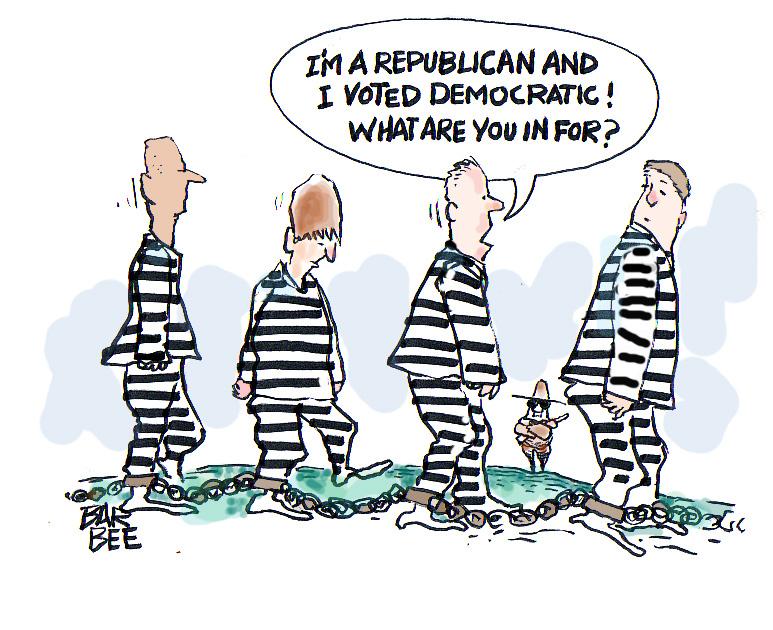
Carton by artists Barbee Fish.
So who’s more primitive? Yesterday Kenya announced modern, near-instant voter registration processes even while 14 American States are implementing new laws making voter registration now the hardest in the world.

With a nearly $10 million infusion by world bodies like World Bank, Kenya’s election monitoring board proudly adopted such instant high-tech registration techniques as retina scans, because according to its chairman, Mr Isaack Hassan, “it was prudent we aren’t left behind.”

Behind who? The U.S.? Hardly. Not a single U.S. state uses biometric devices to register voters.

Hassan said “most African countries, for example, Ghana, Sierra Leone, Tanzania, Burkina Faso and Nigeria, had embrace [biometric registration] and as such it is prudent for Kenya not to be left behind.”

So I guess Mississippi, Tennessee and even glorious Wisconsin and 11 other U.S. states are behind Ghana, Sierra Leone, Tanzania, Burkina Faso and Nigeria in running democracies!

“This is a national disgrace,” writes Cokie & Steven Roberts in a blogpost yesterday. Their fabulous blog cites a report released recently by the Brennan Center for Justice at New York University that argues as many as 5 million mostly Democratic voters in the U.S. have been disenfranchised from the next election by Republican state governments.

Kenya and all the other African countries cited above except Ghana have experienced recent and violent elections. And all of them are taking radical measures to fix this, and the first and most important fix is to facilitate an easy, quick way for everyone to vote.

The mantra of voter fraud is one of the most primitive, fraudulent claims ever assumed by existing American legislators, and it reflects not some concern about freedom, but concern about losing power.

Fortunately, the Obama administration is forcefully challenging many of these laws in court. But god help us if they fail.

What the hell are we doing? Why are we digging ourselves back into a prehistoric political hole? If you believe in democracy, and I do and most of Africa does, resultant laws will craft it differently and fashion a kaleidoscope of power as different as the Iowa caucuses counts are from New Hampshire electronic tallies.

But don’t tread on me. Let me vote! Facilitate my involvement, don’t impede it.

My grandfather was proud of being one of the few true Republicans in Chicago in the 1930s and 1940s, and he loved telling us his grandchildren why he stopped voting before the war. The last time he tried the election judge looked him right in the eye and said, “Mr. Andersen, sir, you’re dead.”

That was eighty years ago. I thought things had changed.

They have, in Africa.

The #1 … Place To Get Hurt

The #1 … Place To Get Hurt

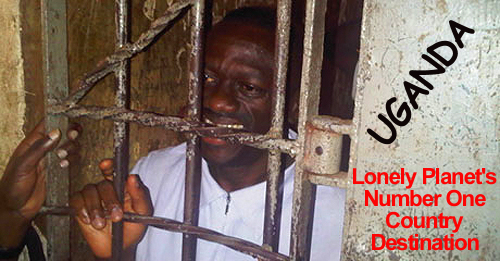
Opposition Leader, Kizza Besigye, after another brutal police action yesterday.
We all know print media is on the decline, but no better example than the once stellar Lonely Planet naming one of the worst countries in the world #1 in its Top Ten Destination List.

Lonely Planet named Uganda #1 explaining, “It’s taken nasty dictatorships and a brutal civil war to keep Uganda off the tourist radar, but stability is returning and it won’t be long before visitors come flocking back.”

That was in November. Stability has not returned; it’s getting manifestly worse. And tourism has sunk to levels not seen since Idi Amin, and rightly so.

Yesterday Uganda’s main opposition leader, and in fact all opposition politicians in Parliament, were arrested without charge, following another (how many now, 24?) brutal battle on the streets of a Kampala suburb. (Most politicians, including the leader Kizza Besigye, were released late today.)

This is not a place you want to visit. Demonstrations have continued since the current dictator’s rigged last election more than a year ago. Tourism has plummeted. The road from the international airport at Entebbe to the capital of Kampala – the only road from the airport – and thence to the rest of the country is lined with police and military.

And even as some of the country’s other lower corrupt politicians try to join the twevolution of Besigye, Yoweri Museveni’s grip is tightening. This week he simply ignored Parliament’s initial moves to impeach him, and there is every indication he will jail anyone associated with moving such legislation forward.

He has jailed, fired and reappointed cronies to Uganda’s judiciary. Patent corruption of the highest kind, giant under-the-table payments from oil companies and huge swindles of private land, are widely known. But today Uganda’s newly reconstituted courts threw out all attempts to allow Parliament to investigate further.

The pattern is identical to the early days of Zimbabwe, and I must admit having traveled in Zimbabwe during the same period, there. Travel right now – if you miss a demonstration and take extra time for military check posts – can actually be an incredible value, since tourist costs have dropped so much.

From a safety point of view, if you miss the demonstrations tourists are more or less being left to their own devices.

But like Zimbabwe, the demonstrations will increase before the country settles into a state of awkward misery, where fuel and sometimes even food becomes scarce. Where officials like park rangers go on the take just to stay alive. It’s hard to predict exactly when such a time occurs.

Lonely Planet’s list was eclectic at the least. Myanmar and Switzerland also made the Top Ten.

About the only truth to Lonely Planet’s naming Uganda is that Uganda is even more lonely than before.

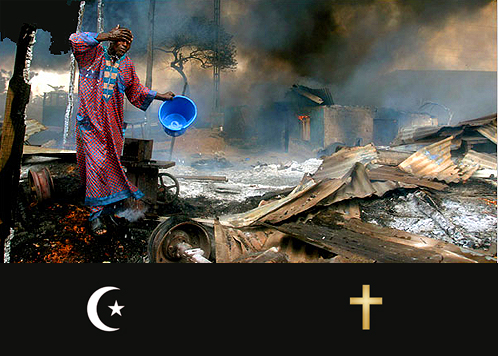
Accept, or Die. Nigeria, today.

Accept, or Die. Nigeria, today.

Nigeria is blowing up. There’s martial law in four of its 36 states, bombings and other violence is escalating, and religious war threatens to inflame shaky Chad, Niger and even Mali.

Economic instability always, always produces political instability, and Nigeria as one of the leading world oil producers has economic graphs with low and high points that are remarkable for their spread, showing extreme potential and extreme fragility.

During the relatively prosperous years of most of the last several decades, the country has developed significantly. In fact its economic development sped right past its social and cultural development, and this led in its own way to serious corruption that only recently was considered its greatest challenge.

No more. Nigeria’s challenge right now is to avoid self-annihilation. And tiresome as it seems, it is the classic battle between Christians and Muslims. One which permits no compromise. Accept, or die.

I’ve spent my whole life in Africa watching religion tear apart Africa and mostly as a battle between the world’s two greatest religions, Christianity and Islam, and now I even have to enduring watching it creep into the daily life of America.

One wonders what would happen if youth’s greater perception of the impoverished theologies of the world took hold. How fast can we hope this will develop? Yet if suddenly, miraculously, religion were removed from the bombs of the world, would something else take its place, like ethnicity or poverty?

That’s a question way too complicated to think about right now. In Nigeria, Boko Haram, the underground, illegal but increasingly organized terrorist group proudly affiliated with al-Qaeda, takes responsibility for much of the violence, today. Sharia oriented, today they demanded all Christians leave the Muslim north.

And Nigeria is far more developed than neighboring countries like Niger and Chad which also suffer from Christian/Islam battles. Many Nigerian Muslim clerics are screaming for peace, recognizing that all Nigeria has gained economically is at stake. But the economic gains, the level of prosperity, may not have been enough fast enough to help these clerics get their messages accepted.

The fuel inflaming this always simmering religious battle is the economy. The President of Nigeria has begun to eliminate fuel subsidies, and the scale of the reaction is unprecedented, even in this turbulent country. Many think these will now be rolled back, but it may be too late.

Religious conflict, pricked by economic decline, is happening round the world. In the more developed west fortunately the tone of the religious conflict is moderated into a less violent social/cultural one. Instead of Jesus fighting Mohammed it’s abortionists fighting evangelicals, but in the end it’s all the same.

It’s intolerance, a battle empirically governed by those who have the money and power and are fearful of losing it. When will we ever learn…