Don’t Forget Your Popcorn

Don’t Forget Your Popcorn

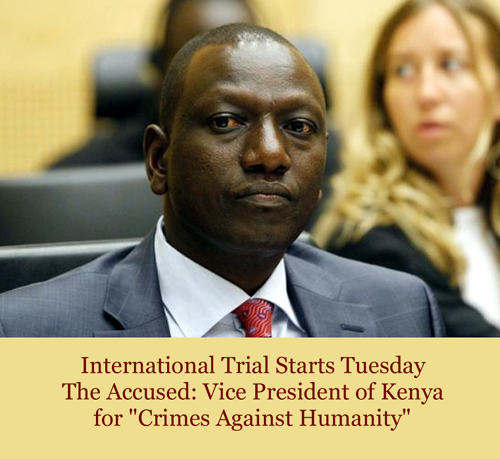
RUTOtrialBeginsTuesday the Vice President of Kenya personally stands on trial in The Hague for crimes against humanity. Two months later, the President will begin his trial, there.

William Ruto, the Deputy President of Kenya, will be accompanied by about 100 recently elected Members of Parliament who obviously support him.

It is, indeed, one of the most curious performances of achieving justice the world has ever seen. A Nairobi commentator put it this way this morning:

“Most international criminal tribunals have been set up as courts of victors to punish the losers,“ explains Luis Franceschi, Dean of Nairobi’s Strathmore Law School, citing the great trials that followed great wars and historic massacres.

This time in Kenya, though, “The accused [are] not past rulers or sitting presidents, but newly elected leaders. We are witnessing one of those uncommon ironies where democracy seems to clash with justice.”

Add to this complexity yesterday’s action by the Kenyan Parliament to withdraw from the International Court that is holding the trials, and you have the kind of governmental and political mess that has stymied Kenya for so long.

There’s more! The International Criminal Court (ICC) is an independent, global judiciary created and supported by 122 sovereign nations. Kenya is one of those. Proposed as a part of the remedial actions taken after World War II to try war criminals, it became a serious global justice tool after opposition to it by Soviet block allies ended with the end of the Cold War in 1989.

The U.S. is one of the few nations to have specifically rejected the Treaty of Rome which formed the ICC. The other two – you guessed it – are Russia and China.

Yesterday in Kenya’s Parliamentary debate, America was invoked time and again as a reason for Kenya to withdraw.

In a finely worded statement the U.S. issued after the Parliamentary debate, undoubtedly hoping no one would read it because of the Syria Crisis and G20 meeting, America urged Kenya “to fulfill its commitments to seek justice for the victims of the 2007-2008 post-election violence.”

This is a major step back from much more severe statements America made earlier, including “severe consequences” to Kenya if action like this were taken.

Kind of hard to tell Kenya to go to trial in The Hague when you intend to ignore your staunchest ally and the rest of the world that are telling you not to bomb Syria.

This is a mess.

It would have been a mess even if the U.S. hadn’t muddled its diplomacy in Kenya or its image abroad, but believe me, that isn’t helping.

There is every indication at the moment that Kenya’s duly elected and pretty popular top two leaders will stand trial in an international court. Last week technicians from Kenya were allowed into the court chambers to hi-tech wire it up, so that people in Kenya could have real time coverage and communications.

The charges against them and three others are that they were the principals in organizing and funding if not actually managing the terrible violence that followed the disputed 2007/08 elections.

More than 1300 people were killed, many horribly, but perhaps more significantly more than a quarter million displaced. The issue of “IDPs” (internally displaced persons) remains a contentious and difficult one in Kenya even today.

The Hague is conducting The Trial because it was asked to by the Kenyan Parliament.

Not the current Parliament. The current Parliament is entirely new, the first one under a wonderful new constitution adopted last year. But the old Parliament that was viced together by Kofi Annan and others who finally brought peace to the country by March, 2008, first accepted that it must hold trials, then wavered, then asked the ICC to take over.

The ICC did so reluctantly and laboriously. But once things got going, they became unstoppable.

Neither the accused current president or vice president held significant power in the coalition government that brought Kenya out of the cauldron of violence into the new light of a really good constitution.

Both were charged by the ICC as being among the main culprits before they even announced they were running for the leaders of the country created by the new constitution.

The old Parliament debated furiously whether as accused they should even be allowed to stand as candidates, and finally decided they could.

Meanwhile, the ICC was rounding up tons of evidence. It takes the ICC years to achieve enough evidence to bring someone to trial, and in this case they did so very quickly. Trial dates were set initially before Kenya’s presidential election.

But it became clear at that time that the two accused were also very popular in Kenya. Negotiations that kept the old Parliament on board with the ICC successfully pushed the trial dates until after the elections.

Then, the accused won by such a slim margin that Kenya’s newly constituted Supreme Court finally had to affirm the razor thin outcome.

As Uhuru Kenyatta, the current president, and William Ruto, the current vice president, solidified their power and control over the country, witnesses that the ICC had assembled for the trial began to withdraw.

Of an original 30 witnesses, there are today less than half that willing to testify. You can imagine why.

And to make this entire blog meaningless, the process of Kenya withdrawing from the Treaty of Rome that it signed fifteen years ago could not possibly conclude before these trials are over.

Sane minds in Kenya implored Parliament not to become “hysterical” and do what they did yesterday, accomplishing essentially nothing but making Kenya look odd at best, juvenile at worse.

I am absolutely fascinated at this whole process. Clearly, Kenyatta and Ruto if convicted are not going to jail. They’d go home, first, and then stay there.

So why go through the antics in the first place?

They believe they can prove innocence. I suppose we should remain open-minded about this. You know, innocent until proven guilty, and all that. And to be sure a guilty verdict in The Hague requires a lot more evidence and certainty than in a normal court.

It is, indeed possible, that despite all the evidence so far assembled against these two men, they could be found not guilty.

Even so, they’re bad guys. We don’t need an international court to sift through the volumes of news reports that have already convicted Kenyatta and Ruto in the international court of public opinion and I believe that judgment has been a fair one. Although the U.S.’ stand is losing credibility, there’s not a single European power willing to engage either of these leaders.

But in the duplicitous world of global power politics, a not guilty verdict from The Hague might make an appointment in Westminster easier to arrange.

Stay tuned.
Stop Elections

Stop Elections

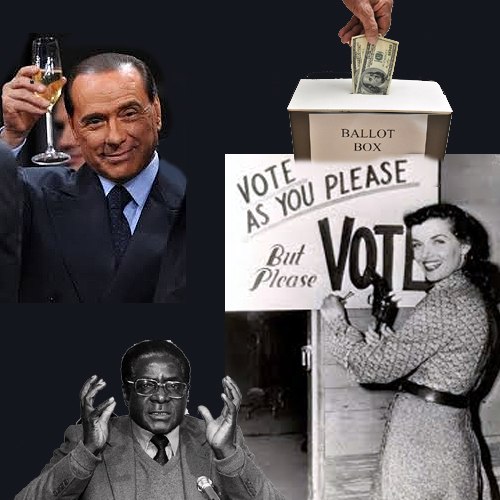
stopelectionsSome may call it growing pains, but Kenyans are having second and third and fourth thoughts about their new constitution.

Invoking “Dream Week,” one of Kenya’s most read analysts wrote this week, “…many will also be thinking of a broken promise. The great new society we were to build has become mired in the same old, tired, dirty, backward politics driven by moneyed ethnic warlords with the support of stupid cheering and jeering masses.”

Amen, brother Macharia Gaitho.

We progressives are just incapable of understanding why everyone isn’t nice. So we build institutions and construct constitutions to promulgate niceness. We support regulations to prevent badness.

Our work is stellar, as is absolutely the case of the Kenyan constitution, and to be sure, the relatively new South African constitution.

Affirmative action is carved in stone until utopia can at least be imagined. Taxing is fabulously progressive. Housing is a guaranteed human right. (And need I mention health care?)

So what is everyone griping about?

“At present what we have is Senate not worth the name, one that would not be missed if it was abolished.”

Amen, Harry Reid.

“Arbitrarily plucking figures out of thin air will not properly address the issue of revenue sharing.”

Wasn’t it Rep. Bachman who claimed that 70% of food stamps funds goes to “salaries and pensions for the bureaucrats” when it is actually less than 5%?

And then her claim was rebroadcast by several Fox news commentators?

But despite the black and white nature of so many issues, today, “A quick and thoroughly unscientific survey tells me that the public right now is not that hungry for a political showdown,” Gaitho concludes.

As do I.

Especially when a new mideast war is right around the corner.

So “we are inured to betrayal, in fact we welcome it and revel in it going by the type of leaders we subject ourselves to.”

It’s a worldwide disease: voting against our self-interest then complaining with the result, either because we’ve been duped or we’re just too exhausted to figure it all out.

The comments to Gaitho’s analysis were charged. Many deduced from what he wrote that the problem was the ethnicity of Kenyan voters. (I’d make a parallel with the “ideology” of American voters.) In KenyaSpeak, today, it’s call the “tyranny of numbers.”

Kazora commented that the “Tyranny of numbers only works against poorly prepared candidates relying on court poets and jesters to bring in the numbers.”

Mkenyamoja13 summarized them all:
“Tyranny of numbers is another name for democracy. If you do not want tyranny of numbers, stop electing leaders.”

That’s the answer. Stop electing.

Black Holes Widening

Black Holes Widening

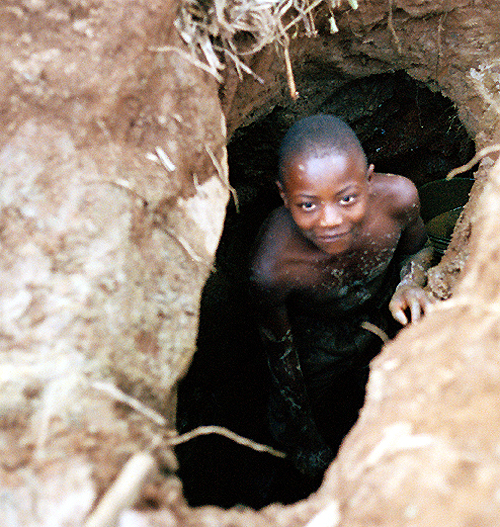
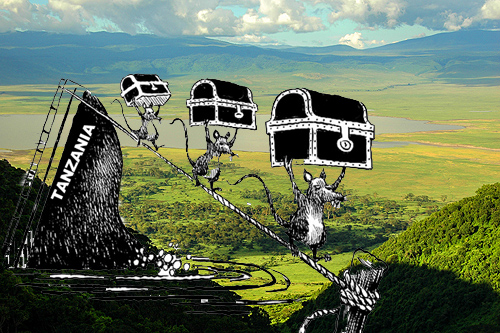
blackHoleEight-year olds – lots of them – are dying agonizing deaths in Tanzania as the government and world turn a blind eye to child gold-mining.

This morning Human Rights Watch issued its long anticipated report on child mining in Tanzania.

Not that we didn’t know there were “thousands” of children involved, that the Tanzanian government has consistently denied a problem, or that unacceptable levels of toxic wastes equal to biochemical weaponry cause the most grief.

I wrote myself about this less than two weeks ago.

I guess we just needed this respectable report to figure out what to do. So what do we do, now, we who are not Tanzanians but love Tanzania no less than children anywhere … what can we do?

Start a petition? Contact your tone-deaf congressmen? Divest yourself of multinationals in Tanzanian mining (see below)? Increase your black-hole tithing? Support NGOs working for better alternatives?

Or own up to the reality that nothing will stop this defamation of humanity except serious redistribution of wealth.

My reading of the 96-page report is a horrifying recognition that the increasing gap between rich and poor is the real cause of this calamity.

How the hell can you stop a child who is almost always sick with a cold and diarrhea who knows that a pill she can buy for a quarter will make her feel better, from sticking her hands into a plate of liquid mercury, when she knows that there’s a chance of 1 in 6 of pulling out $10?

She knows the mercury is bad. She knows that doing this enough times will make her unendingly sick. But she’s sick, now! She wants to get better!

What on earth will you tell a kid who has no father, whose mother is a prostitute for wealthier miners, who at best eats one meal of porridge a day?

Most of the child laborers interviewed by Human Rights Watch said they used their earnings “for basic necessities such as food, rent, clothes, and school supplies such as exercise books, pens, and uniforms.”

The incredible horror stories in the report of children getting sick from chemicals and hard labor were compounded by many documented cases of sexual abuse, blackmailing and outright physical abuse including murder.

Tanzania has laws on the books against all of this. But … few Tanzanian laws of any kind are regularly enforced: Tanzania is a lawless land where social order is sewn together by bribes and sometimes the goodness of local officials.

Tanzania is now the 4th largest gold producer in the world. The $2.1 billion dollars earned annually contributes 3-5% to the entire GDP of the country.

Ninety percent of this is from large-scale, big-machine, high-tech commercial mining. Roughly three-quarters of the commercial mining in Tanzania is controlled by African Barrick Gold (ABG), a UK held multinational; and AngloGold Ashanti, a South African company. The remaining quarter to a third is held by smaller multinationals, the largest of which are the Australian mining company, Resolute Mining Limited, and the German Currie Rose Resources Inc.

Ten percent, though, comes from this off-the-books, theoretically illegal artisanal mining involving the children.

The artisanal mining is usually pursued on the periphery of the commercial mining in areas the big machines just haven’t gotten to yet, or in areas that the multinationals have determined isn’t rich enough for their interest.

Most of it is surface or near-surface mining, and that’s what lends itself to individual prospectors.

Like mining throughout the ages, there is little guarantee of striking it rich by anybody, but the allure is what keeps the miners going. But in Tanzania, “striking it rich” is phenomenally greater than it is for an Alaskan miner, today; or even those involved in the great western gold rush a century ago.

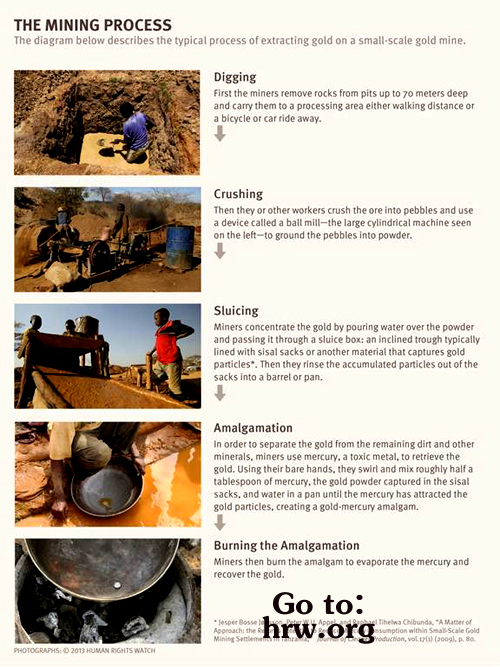
In Tanzania, a child who finds a gram of gold will be able to sell it, once processed through the toxic mercury process in his pan, for more than $40. In many of the regions in Tanzania where this now occurs, that’s enough to keep a family of five alive, well fed for a month, with some left over for used clothing.

When a child strikes out in the mines, there’s other horrific work. HRW documented children as young as ten earning up to $3 for crushing a pile of rocks, $1.23 for mixing the mercury and gold for another prospector, all of which compounded could earn a kid more than $12/day.

That is roughly what a well groomed doorman, janitor or telephone operator in a safari lodge in Tanzania makes.

The story created here is of a society struggling to be simply clean, healthy and not hungry, putting their lives on the line starting as children, day after day, to reach a goal – a level of existence – in economic terms that is around one one-hundred-thousandth (.001%) of the average earnings ($90,000 annually) of workers for African Barrick Gold living the U.K.

Or one-ten-thousandth (.01%) of the average cost of a gold bracelot. Or should I go down a bit? Do you have any gold earrings? OK. Maybe one-tenth percent of the average cost of your gold earrings? So a thousand chilren work-days in Tanzania equals your gold earrings?

That gap is the problem. Tanzania should be getting a much larger proportion of its gold wealth, and the citizens and children of Tanzanian should be getting a much, much larger proportion of the money its own government earns.

But we know that gap is not getting smaller; it’s getting bigger and bigger as the years drip by. And the children get less and less and sicker and sicker.

Was slavery better?

miningprocess

The Demons of Democracy

The Demons of Democracy

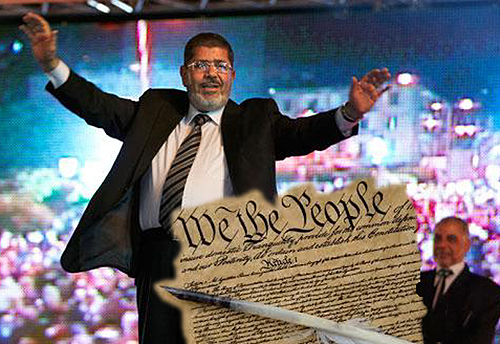
democracyfailesmorsiwinsTwo African elections this week clearly show how democracy fails in societies with powerful chief executives.

Like the U.S. But more about that after discussing Africa.

This week’s elections in Zimbabwe and Mali have failed both their societies, for different reasons, and the result is arguably worse than had there not been elections at all.

In Zimbabwe the rigged election process reaffirmed the country’s despot, Robert Mugabe, and ensures the country will continue to slide into poverty and greater dependency upon its neighbors desperate that it doesn’t totally fail.

It’s interesting that Mugabe and thugs mastered the democratic process so well that despite this week’s travesty of popular expression, observers from as divergent organizations as the African Union and reporters for Reuters gave the process a pass.

It absolutely wasn’t fair. Imagine an election – officially stated – with 99.97% of the rural population voting, and only 68.2% of the urban population voting.

Get it?

What Robert Mugabe has become is an evil despot. This is pretty easily defined as an individual who concentrates power around himself and his thugs, and distributes whatever wealth can be extracted from the country into this small core of individuals.

At the expense of everyone else in the population, even those who supposedly voted for him.

He absolutely does have solid support from Zimbabwe’s poor and rural populations, who are thrown pieces of bread (the land of white farms) just like Marie Antoinette did to stave the French revolution.

And essentially uneducated and untrained, a piece of land is a gold mine, but what it means for the tens of thousands of rural Zimbabweans who have benefitted from this policy, is that they will never have tractors, will never have schools, will never have hospitals or roads or a better life beyond their tiny plot of land.

Yet their ecstacy at this gift from Daddy is profound. And their xenophobia and racism is ripe for plucking. And even so, even with 99.97% of them “voting,” they wouldn’t have been the majority if the more educated urban populations were given their voice.

And, of course, 99.97% of them didn’t vote. Many of them can’t read and there weren’t enough polling stations in the country to handle that number of actual voters. The irregularities in this “election” were profound.

Yet it was “democratic.” Zimbabwe’s urban population rolls were restricted by techniques strikingly similar to dozens of new American voter registration laws. If it’s democracy in Texas, it’s democracy in Zimbabwe.

In Mali – often championed as a model for democracy by westerners – another near perfect election process has resulted in an effective tie. This is something democracy can’t handle. It screwed it up in Bush v. Gore, and it screwed it up in Kenya’s recent election, and now Mali’s future becomes terribly problematic.

Ibrahim Boubacar Keita (IBK), a former prime minister in better times, seems to have received 50.+% of the vote, which would effectively make him the chief executive without a second run-off election.

This, by the way, is the identical situation that occurred in Kenya in March, where the victors were ultimately declared the winners with 50.07% of the vote.

In Mali, the election process was truly fair in my opinion. If there was any fault to the process, it was that the serious opposition from the desert peoples and those involved in the recent insurgency was not voiced. In part, because the insurgency continues and the insurgents didn’t want to participate.

But of the society held together by the French Foreign Legion, a sort of muscular gerrymandering, the elections were remarkably free and transparent.

But now what? Within the margin of error of any scientific study, no one really won, but democracy mandates that someone win. If this were in Europe or Israel, it wouldn’t matter so much, because the chief executive for whom the election was held is not so powerful.

But in executive democracies, where the chief executive like President Obama holds so much power, one of the sides wins and one of the sides loses. Definitively.

And down the road that leads to polarization, friction and radicalization of power blocks that might otherwise be able to compromise.

Had America had a parliamentary democracy rather than an executive presidency, I believe that we would never have gone to war in Iraq and Afghanistan. The challenge of modern democracy is to create workable amalgams of power in societies with large and nearly equally opposing views. That’s not possible in societies with a powerful chief executive.

This is the case as well in Kenya, where ethnicity and corruption is now on the rise after decades of decline, and where Mali is likely now doomed to become a war zone for generations.

Neither Kenya or Mali will be able to traumatize the world as much as America did after Bush v. Gore. But all three examples show how ineffective, perhaps counterproductive, democracy is when the society has a powerful chief executive.

The analysis seems much simpler with Mugabe. When evil masters the process, in this case democracy, the ends justify the means and essentially emasculates the idealists who proclaim the process. Yet on closer reflection it’s clear had Zimbabwe not had a powerful chief executive style government, Mugabe may not have lasted.

The lesson seems starkly obvious to me. Democracy is a bad idea for societies with a powerful chief executive. Parliamentary democracies may be good; presidential democracies are not.

Just Justice

Just Justice

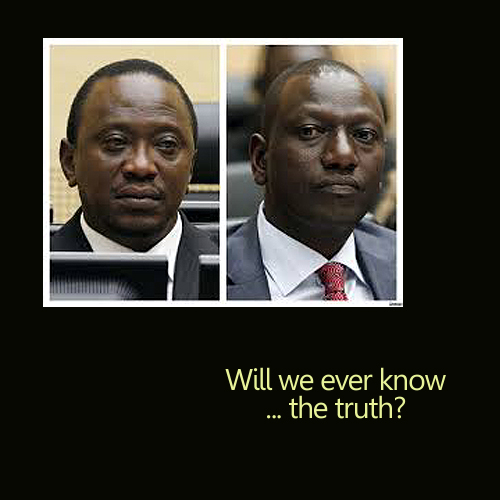
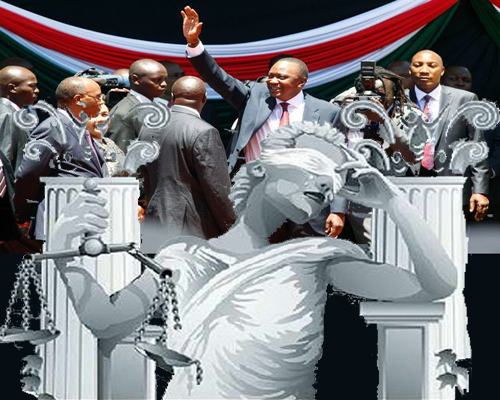
willweeverknowthetruthThe bizarre story of the world trials of Kenya’s leaders grew ever the more bizarre yesterday and when bundled with incidents like Trayvon Martin shows just how fluid, uncertain and perhaps even meaningless justice is.

Whatever else you concluded about the George Zimmerman trial, you must agree that its outcome was based as much on technicalities as “justice.” And by that I mean that Zimmerman shouldn’t have shot Martin, but somehow, he got away with doing just that.

Kenya’s president and vice-president are widely presumed world-wide, by diplomats and journalists and scholars alike, if not directly causing the terrible violence of 2008, certainly encouraging it. They’re widely presumed responsible in some significant measure for the deaths of more than a thousand people and the displacement of a quarter million.

The distinction between “causing” or “encouraging” is the point of the trials. Causing is criminal. Encouraging may not be criminal. And that’s the task assigned to the World Court in The Hague … finally, by the Kenyan Parliament.

But even were a successful trial in The Hague to find both President Uhuru Kenyatta and Vice President William Ruto innocent of “causing” the violence, real democratic societies would not allow them to continue as leaders.

Real democracies do not tolerate leaders whose citizens those leaders allowed to be massacred. Historically they could be seen as having tried to begin a civil war, but if so they lost that war. Kenya is still Kenya, whole if scathed. Jefferson Davis did not become the President after Lincoln. Kenyatta and Ruto shouldn’t be Kenya’s leaders. They are. And they might be for a long time.

Two of innumerable cases worldwide where justice has been lost.

The George Zimmerman trial is over. The just concept of double jeopardy makes it impossible that he be tried for murder or manslaughter, again. But the trials of the Kenyan leaders haven’t even yet begun.

The President’s trial has been rescheduled to begin November 12. The Vice President’s trial has been rescheduled to begin September 10.

The legal manuvering in the World Court has been considerable. The most significant of many unexpected twists and turns are the reduction of the witness list and the adjudication of whether these national leaders need necessarily attend their trials in person.

The former is much more salient to achieving some level of justice than the latter, and besides, who in their right mind believes if found guilty either of the men will resign, take the first plane to Amsterdam and let themselves be incarcerated?

It’s a foregone conclusion that regardless of the outcome of the trials, Uhuru Kenyatta and William Ruto will never be behind bars in The Netherlands.

But many of us would like to know if they really are culpable. We could be wrong, couldn’t we?

Africa is rife with Shakespearean mysteries. Perhaps the defendants’ claims that each and every one of the witnesses against them is either lying or being extorted is true. It seems unlikely, but “beyond a reasonable doubt” is something that only a good court can ascertain.

And that part is becoming less and less likely. Witnesses have been dropping out like flies. The reason given by The Court is that they fear for their security.

There’s every reason to presume this true. Kenya’s most historic murder trial was of the politician Robert Ouko, likely killed in the then Kenyan dictators’ residence. Witness after witness either dropped out of the trial .. or was murdered.

But this time there’s hope we will know. Kenya’s own parliament declined holding trials or other judicial investigations to determine those responsible for the 2008 violence, and so conceded that right legislatively to the World Court in The Hague.

So we want to know. Kenya’s Parliament wants to know. We know whatever the outcome, Kenya’s current leaders will not go to jail, they will avoid that justice to be sure. But that doesn’t mean we don’t want our own theories validated, or shown to be incorrect.

We want justice, at least the first step of discerning the truth. And I can’t imagine why every single Kenya wouldn’t want the same.

Hail To The Victor Valiant!

Hail To The Victor Valiant!

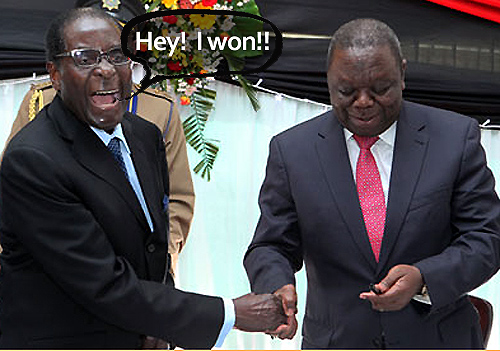
Robert Mugabe and Morgan TsvangiraiAfrica’s longest-serving dictator and one of the most evil men in the world, Robert Mugabe, will be validated by democracy as Zimbabwe’s leader again on July 31.

It will be his third “democratic” election and without doubt, his third victory. It will be the third time that his single opponent is the dumbly masochist, Morgan Tsvangirai, who has endured torture, humiliation and the murder of his wife, to spot Mugabe over the last 15 years as the opponent who gives Mugabe credibility.

Through democracy.

I am intrigued by the time and resources that Mugabe has committed to this facade of being a democratically elected and warmly loved leader. Tsvangirai holds the questionable title of “Prime Minister,” and may indeed, hold it again after Mugabe is elected, again.

So he gets a nice house and a stipend for good clothing, but alas, he’s rarely allowed to leave the country and his meetings and rallies are monitored by Mugabe’s thugs who then routinely beat up anyone in the public who seemed engaged.

Most of the time Tsvangirai speaks to himself, and pity to the few earnest supporters putting their lives on the line for such dastardly acts as waving a poster.

Mugabe has expended notable effort this time to get outside observers. Of course, the most respected outside observers of elections – the organization that actually founded the idea – the Carter Center, has been banned.

So instead he will have observers from Russia and Serbia. (There are others, including the more respectable African Union, but that organization does hate to upset its dictators.)

And despite truly heroic efforts by many good Zimbabweans to do such things as register voters, it’s essentially impossible to register unless you prove your loyalty to Mugabe, first.

The private and somewhat secret website in Zimbabwe to help fledgling democrats register is called “MyZimVote.” Illustrative of its primary function is a giant map with red circles counting the number of gross violations around the country where persons attempting to register were denied … or beaten up.

This and a bunch of other laws and regulations that actually does manage to out-shame Texas means Mugabe’s victory is assured.

All in the name of democracy. And while it would be hard for the most poorly trained political scientist to call this “good” democracy, it does go through the motions. It does a little better than Stalin’s 99% wins. And above all it proves that most everyone – even the grossest of leaders – ascribes to the theory that the people should decide who rules them.

And that leads to the marvelous question of whether these pretenders, from Mugabe to Bush, really believe they have been elected by the people, or if they realize it’s a sham from the getgo.

Bush believed. Mugabe knows it’s a sham. I guess that’s the difference between poorly educated and a thug.

Power to the People

Power to the People

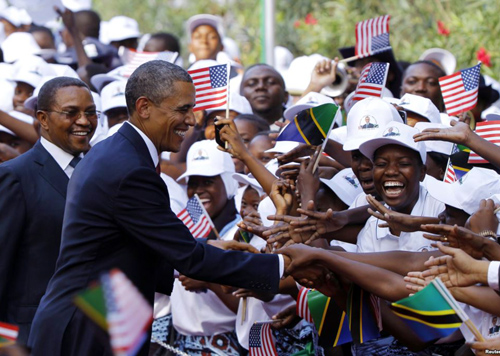
obamatanzaniaAmerican presidents one-upping each other is hardly news at home, but this time round it really is news for Africa. George Bush is personally credited with $15 billion for Africa, now Obama with $16 billion.

This year the Obama Administration requested a total of $7.5 billion for USAid to Africa. Twenty percent of that is for Egypt, with the remaining 43 beneficiary countries receiving $5 billion.

Nigeria is in second place, no surprise. If the country can ever solve its ethnic problems its massive oil reserves will make it literally one of the most important countries in the world.
2013USAidtoAfrica
But what is surprising is third place, Tanzania.

Obama just completed an Africa trip where the signature speeches, most dramatic announcements and largest contingent of Americans traveling with him (800) were in Tanzania. Why Tanzania?

Tanzania’s human rights ranking is terrible. Just before Obama arrived, an opposition rally in Arusha was brutally crushed by police. A month before Obama arrived the Tanzanian government announced wholesale movements of Maasai from their native lands to increase a hunting reserve for Arab princes.

And there’s been scandal after scandal, many centering on the country’s 15-year inability to make money from the discovery of the world’s second largest gold reserve.

Compared to neighboring Kenya, Tanzania is a banana republic with no clear optimistic future.

Why Tanzania?

There are two reasons. The first is because Obama’s predecessor, George Bush, doled out a huge amount of his $15 billion AIDs initiative in Africa to Tanzania. Why Tanzania? Because Kenya wouldn’t have him and South Africa didn’t really want him, either. In fact, because most of Africa did not want to be associated with George Bush.

The Bush Administration alienated most of the world with its invasion of Iraq, Africa included. Its foreign policy was hurtful to emerging countries in virtually all areas, from conservation to economics.

And its missteps were many and severe in Africa. Perhaps the most notable for this discussion was when George Bush became the only leader in the world to congratulate Mwai Kibaki on becoming elected president in 2007. Which he hadn’t been, which was why no other world leader offered the congratulations.

But those congratulations Kibaki immediately published on Kenyan media to consolidate his illegitimate claim to power, and that led to the terrible violence of 2007/2008.

So by process of default, Bush went to Tanzania. Obama has to one-up him. Bush’s $15 billion was for AIDS aid. Obama’s $16 billion is for electrification.

There’s a second reason.

Drones have assassinated no fewer than a dozen terrorists while they were living in Kenya and Tanzania. Kenya doth protest. Tanzania doesn’t.

Aid is a tricky game. I have a sense that Obama has mastered it far better than Bush did, but he’s shackled by his militarism and obsession with killing terrorists, and influenced by not letting his predecessor shine more brightly.

Aid is a tricky game. Morality isn’t. I don’t know how long it will take for America to sync itself into a truly moral stance after our generations of warring, but it doesn’t look like it will be soon.

Game Viewing in Zimbabwe

Game Viewing in Zimbabwe

After a relatively long period during which Zimbabwe’s national parks seemed to be recovering in spite of Robert Mugabe, tourists reported gunfire in the country’s main national park this week.

And — unfortunately — it was not the gun fire of a revolution. The shots came from hunting rifles.

Hwange National Park is Zimbabwe’s most precious big game wilderness. Located in the northwest of the country, it was one of Africa’s primary game reserves throughout the last century.

You need to be cautious when researching it, though, as is true of everything today in Zimbabwe. The link above to Wikipedia is quite dated, with Hwange’s biomass considerably smaller than the library reference suggests, and its ecology far more fragile.

“…the number of animals being snared for food by local people living on the boundary of the Park has increased dramatically,” reports one of Hwange’s most dedicated tourism operators. This because of severe food shortages throughout the country.

That’s only one of three major problems facing Hwange, today.

The second serious problem with Hwange is its very design. Wildlife filmmaker, Aaron Gekoski, documented this recently in his March production, “Grey Matters“.

When Hwange was created in 1928 it was understood there was not enough water for a real wildlife park. So the government built boreholes, water wells, throughout the park and has been pumping water for the wildlife ever since.

This isn’t unique. The same is done in Namibia’s main national park, Etosha, and in a variety of national and private reserves throughout southern Africa.

It works if maintained. But the last Zimbabwe resource that the current dictator cares about is its wildlife, and the boreholes have not been maintained. Fewer than half of the original ones are operating, and as a result, the animals are dying.

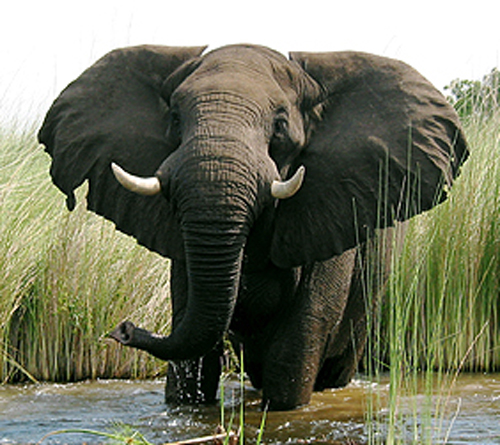
But Hwange’s greatest problem, reflected this week as tourists trying to find an elephant in Hwange instead heard it being shot, is the wholesale looting of its biomass, and not just by corrupt government officials, but by private hunting companies.

Soldiers regularly harvest ruminates indiscriminately, sometimes assisting villagers for their bushmeat. While subsistence hunting elicits some understanding from me, Zimbabwe soldiers are well paid.

And without any study or regards to biology or ecology, the government of Zimbabwe is trading animals for political favors.

Last year foreign wildlife investigators confirmed that the government of Zimbabwe had exported at least four small elephants to China. The act was little more than stupid cruelty by the seller and receiver. Four young elephant removed from their families have little chance of surviving, anywhere, much less in a Chinese zoo.

There was such worldwide outrage at this act last year, that the global treaty which governs the trade in international species of which China is a signatory, CITES, banned any further such transactions between Zimbabwe and China.

China is legendary at publicly accepting such restrictions while finding ways to work around them, or to simple illegally ignore them in practice. But the attention this focused on Zim’s dwindling elephant population provoked a real local vigilance that seems ready to expose any subsequent violation.

But while internationally Zimbabwe may be restrained, internally it’s gone bonkers.

One of Zimbabwe’s most important wildlife reserves is the Save Conservancy (pronounced Sav-hey), in the far southeast of the country that was once scheduled to become a part of a trans-national wilderness withn Mozambique and South Africa wildernesses.

Land grabbing has grown from sport to routine in Zimbabwe, and Save is being eaten away as the Mugabe regime parcels it out to its cronies.

And add to this devil’s den of looters professional hunting.

In the old, good days, Zimbabwe was a preferred destination of hunters, and its wilderness was one of the best managed in the world, with hunters and non-hunters in grand alliances that did much to preserve Africa’s game.

That’s changed. This week tourists in Hwange reported hearing gunfire, and not the kind which would excite us all that the regime was under assault. These were the shots from hunting rifles.

We don’t know if the elephants shot were by hunters from the regime, or hunters from abroad.

But the Zimbabwe Conservation Task Force (ZATF), a proactive and somewhat subterranean wildlife NGO, insists that Zimbabwe professional hunters are now regularly harvesting animals technically illegally from national parks and private reserves, with the tacit approval of the Mugabe government:

Arnold Payne, Ken & Tikki Drummond, all of Impala African Safaris, have been named as the principal thieves.

Worse, ZATF says, “It is suspected that some of the hunters … are US citizens.”

The old adage, three strikes and you’re out, is dangerously close to being true in Zimbabwe’s big game wildernesses: subsistence hunting forced by food shortages, an ecological design of national parks that can’t withstand neglect, and now wholesale looting of the biomass.

Hwange and its other sister wildernesses in Zimbabwe which for so many years were the treasures of Africa now teeter on the brink of annihilation.

Justice Becalmed, Justice Bedeviled

Justice Becalmed, Justice Bedeviled

Today’s final detailed explanation by Kenya’s Supreme Court of its decision to affirm the March presidential election makes me doubly angry with Bush vs. Gore.

The clear consensus by much more scholarly analysts who have rushed out their initial impressions is pretty negative, that the detailed decision is “disappointing.”

But quite to the contrary, it helps me understand how insidiously deceptive a political system is where the final say presumably rests with a collection of appointed sage elders with so little obligation to anyone or anything that they can neutrally discern the facts and subsequently convey justice.

Or in other words: Finalismo.

By the way, there was nothing very revealing in the 113 pages, and a little bit for everyone including the critics of democratic methodology and the critics of corruption. I’m no legal scholar, but let me paraphrase the decision this way: don’t rock the boat.

The “rule of law” sounds good, but over America’s much longer history than Kenya we can often find definitive failed justice from the top. And that’s not wholly unexpected since it’s usually the most contentious and/or complicated issues that rise to the top, and it’s just statistically unlikely that the right decision will always be made.

And an incorrect Dred Scott decision foments war. The incorrect decision of our own Supreme Court in Bush vs. Gore arguably paved the way for two prolonged, unbelievably expensive and totally unjust wars.

America has a long enough history that it just seems statistically inevitable that some pretty horrible top court decisions would be made. But this, in effect, was Kenya’s first major decision.

And like America in Bush vs. Gore, the justices’ action put the man who likely lost the election in the winner’s seat: In Kenya by not altering the decision by the election authority (despite massive illegalities) and in America by stopping a recount of votes.

In Kenya it was passive justice; in America it was active justice; but in both it put the wrong man in power, invalidating democracy.

As in Bush vs. Gore, there were plenty of tidbits the justices couldn’t ignore: like the wanton corruption acquiring voting technology and the inability of the corroborating registration system to affirm exactly who had voted.

They even encouraged the Kenyan prosecutors to indict the “tender team” that designed and acquired the voting technologies that massively failed.

Just as the justices in Bush vs. Gore acknowledge that hanging chads if reconciled could alter the outcome.

So I don’t think we can rack this one up to the “statistical” likelihood that all profound decisions will not always be correct. There’s more to it.

In Kenya it means one of two things:

1. The justices were biased towards the flawed outcome, however wrong it was; or

2. The justices felt their meaning for existence was not sufficient enough to alter the status quo.

In America it was clearly Number 1, because they did alter the status quo by stopping the recount. In Kenya it’s hard to say.

But both situations demonstrate how weak the “rule of law” is in Kenya and America towards assuring a just outcome. Because the “rule of law” in both cases wasn’t. Law didn’t rule. Something else did.

And don’t be fooled by rationalists who argue that green is black, that intonation is meaning, that interpretation rather than implementation governed the situations. Legal opinions coming out of the whazoo drown in semantics. Get yourself into that clear air of what’s right and what’s wrong.

I believe that the “rule of law” achieves justice.

There was not “rule of law” in either Kenya or America. In both cases the justice system failed. And not just “statistically” so; intentionally so. Something else prevailed over justice. It’s called…

Power. And unlike the very essence of justice, it has no limits.

The Impoverished Kenyans

The Impoverished Kenyans

Left: President Uhuru Kenyatta, scheduled to go on trial for crimes against humanity in July. Next in line: Vice-President William Ruto, scheduled to go on trial in May.
Poor Kenya. The world waits to see if the new president and vice-president will travel next month to The Hague to stand trial for crimes against humanity. Kenyans elected these men free and fairly. They chose alleged murders to lead them.

As a businessman in tourism I wait for more signs. As a devoted student of Kenya, I’m depressed and frightened. Like everyone in the world who knows Kenya, we wait with baited breath for the start of the scheduled May and July trials of the Vice-President and President.

Kenyans are polite and on edge. They are proud that they didn’t devolve into violence as during the last election, proud of the new judicial system that validated the election, but on pins and needles waiting like everyone in the world for the next chapter in this country’s history.

That comes next month when Vice-President William Ruto is scheduled to begin his trial for having arranged and financed killer squads following the 2007 elecetion. President Kenyatta’s trial is set to begin in July.

“If the International Criminal Court is right,” writes Daily Nation columnist Makau Mutua, “the two funded death squads to kill, maim, and loot each other’s folks. Mr Ruto only subordinated himself to Mr Kenyatta because he couldn’t win [the national election] on his own.”

Mutua goes on – as many others have – that this unlikely team of arch enemies is together for only one reason: they are both alleged organizers of mass murder.

There’s nothing particularly sensational in this thriller, the Joker elected mayor. It struck me as a storyline that would likely be rejected by Hollywood for being sorely uncreative. The difference, of course, is that this is real.

And the sad part is not the fates of these two men. The sad part is that Kenyans elected them, freely and fairly.

Incredibly, Kenyans couldn’t come up with anyone else. And although it’s true I supported Kenyatta’s principal rival, Raila Odinga, nearly anyone of the other 6 challengers who contested the election would have been infinitely better.

Anyone who watched even a snippet of either of the two election debates would see what great people Kenya has as potential leaders. But none but Uhuru and Raila had the financing (and ethnic support) to be viable candidates.

That was the main reason I (and many, many others) supported Raila: none of the other challengers had a chance, and the outcome proved it. The remaining six challengers got less than 8% of the vote.

Kenya is peaceful. In fact as Somalia improves, Kenya becomes more and more peaceful. Raila has met with Kenyatta. They are photographed laughing together, working to “keep Kenya peaceful.”

I received an email from an owner of a lodge near Mt. Kenya, Sunday, which implores me to write good things about Kenya, to beef up its tourism:

“Would it not be a good idea to now send out a positive email concerning Kenya? It seems to me that people prefer to spread bad news all the time.

“Kenya is an amazing country with lovely people and I am sure if you compared the crime rate with the UK and considered the poverty people combat every day here in Kenya, the UK would not come out looking too rosy itself!”

UK leaders are not accused of crimes against humanity. The Kenyan president and vice-president are.

By All Means Peace

By All Means Peace

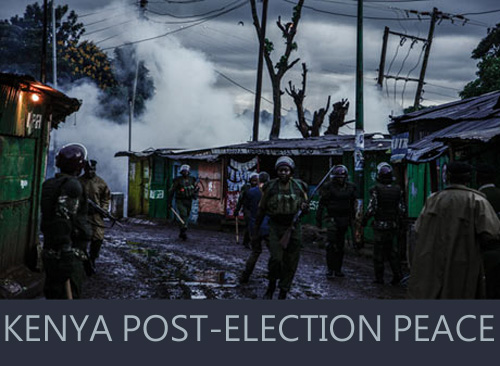
Only a couple violent incidents following Saturday’s court decision upholding Kenya’s election. Peace is predicted, specifically because the architects and instigators of the deadly violence following the 2007/2008 elections are now the country’s president and vice-president.

Uhuru Kenyatta is the country’s new president. William Ruto is vice president. The two are indicted for crimes against humanity. Whether it be the poor judgment of Kenyan voters or its manipulation by evil leaders, doesn’t really matter anymore. It’s done.

Five years ago when 1300 people were killed and nearly a half million displaced (a quarter of which remain so) Kenyatta and Ruto according to the World Court indictment used their vast fortunes and complex communication network to organize thugs and criminals to kill and terrorize.

They no longer command thugs and criminals. Today, they command the Kenyan army.

A generation or more of Kenya’s social progress has been lost.

It’s the ultimate prerogative of democracy to install in power those who should not be: To make liars, cheaters, crooks and even murderers Heads of State. And in this case in Kenya, I honestly believe as did its exemplary Supreme Court, that if not the majority at least the plurality of Kenyan voters truly wanted this outcome.

And the insult to righteousness is that not even a tiny minority of Kenyans ought to have voted for Uhuru Kenyatta. Kenyatta is the richest man in East Africa, now the 4th president of Kenya and son of the first, and one of six unique Kenya individuals indicted by the World Court for crimes against humanity.

On April 9 he becomes the second sitting African Head of State (after Omar al-Bashir of The Sudan) to be on trial for the gravest sins against his fellow men.

How could Kenyans have elected him?

There are two widely accepted reasons. The first is Kenya’s horrid tribalism, which perhaps I wrongly thought its youth had all but discarded. Kikuyu Kenyatta’s chief rival in this election was Raila Odinga, a Luo from western Kenya.

The Kikuyu and Luo are the arch enemies that define Kenya tribalism. It was Raila’s father, Oginga Odinga, and Kenyatta’s father, Jomo Kenyatta, who fought one another in the bush then in Parliament to be the first to rule an independent Kenya. Jomo prevailed then jailed Oginga.

That was a half century ago. Most of us simply could not believe that the last half century of human development in Kenya, which outperformed all historical standards, would not produce a new generation of Kenyans who would emerge from these hateful trapping of tribalism.

Now nothing seems to have changed. Each tribe so fears the other that they will do anything to achieve power over the other. There are more than 40 tribes in Kenya, and Uhuru’s deft manipulation of democracy in this exercise was to choose his vice president from a third tribe that ensured a solid plurality against the Luo.

It mattered little that his choice was one of the most evil and corrupt men in Kenya, William Ruto, a fellow indicted by The Hague as well. The Kikuyu Kenyatta/Kalenjin Ruto team, bedeviled as historical enemies nevertheless controlled the numbers, and the numbers make democracy.

The second reason seems less likely to me, but Kenyan analysts seem sure of it:

There may have been a popular backlash against the World Court’s indictments and of western nations’ not so subtle messages to Kenya that they better not elect a criminal.

The U.S. was particularly blunt: Obama said he hoped Kenyatta wouldn’t win. The U.K. – Kenya’s national mother and principal benefactor – said it would not allow Kenyatta or Ruto to visit Britain. (Both have now congratulated the new leaders.)

So Kenyatta crafted an election strategy, replete with his billions of carefully placed media shillings, charging “foreign interference,” a phrase guaranteed to garner votes.

I may be just as naive about this as I was about the presumption that tribalism was water over the dam, but frankly the Kenyans I know are heartsick with the outcome. These are Kenyans that are young, well educated and truly a rainbow of tribes.

But like the courageous kids who started the revolution in Egypt, or the intellectuals who thought they crafted the New South Africa, or any of the bloodied stakeholders dedicated to good change in places like Tunisia much less Russia or Broward County, democracy has a wicked way of exploiting change by crushing it.

Revolution is no certain remedy. And democracy is often little more than a facilitator for the evil that provokes revolution in the first place.

Peace, maybe.

Kenya’s new constitution, its youthful society and progressive economy, is 100% 21st century. This election is the failure of that new generation to manifest itself, take control. It is a government of a society of the 1960s.

Kenyatta’s government will be in power for at least the five years given it by the new constitution. But some think it’s in for the generations that were just lost.

Ripped Off Paradise

Ripped Off Paradise

Paradise is being abandoned. Tanzania’s Ngorongoro Crater, its greatest single tourist attraction and one of the most pristine areas on earth, is in the midst of a political crisis that threatens normal tourism there.

Officialdom in Tanzania is rarely much more than organized crime, but even that can be better than the mayhem currently being reported in and around the crater.

Tuesday one of the “good” committees in Tanzania’s mostly corrupt parliament called on the government for “urgent action” to resolve a crisis that jeopardizes tourism and the environment in ways we’ve seen before, and in ways that are getting tiring and tedious.

There are no principal government officials left at Ngorongoro Crater National Park. The Director, Conservator of the National Park, the Chief of Security and many important chairman of various committees have all … left. This was prompted last month when the Tourism Minister basically told them to scram:

In a diatribe reminiscent of Mitt Romney’s disavowal of Massachusetts Heath Care, tourism minister Khamis Kagasheki warned last month that Ngorongoro officials would all be sacked.

So instead of waiting to get the boot, they left with the entire wardrobe.

Two immediate problems are likely. The first is that collection of fees is turning dirty. Many driver/guides will have more trouble getting in and out of the crater without excessive bribing. The second is that the local Maasai – stressed by a couple years of near drought – will flood the crater floor with cattle and the rangers – absent of a master – will do little about this illegal action.

If the trend isn’t stopped, then it will ultimately develop into a third more serious affront to this beautiful place: Poaching. Whenever the crater loses its shawl of organization, poaching skyrockets and often organized by the rangers.

This all started several years ago when Tanzania’s president organized several NGOs to look into helping the Maasai at the crater organize their cattle farming in a better way.

Suggesting something similar to a giant co-op, the President’s plan was grand on mission and scant on details. The mission was OK: vets and stockades and abattoirs and everything else that modern cattle farming needs.

And a ton of money was thrown at the project. And it has all evaporated.

This is nothing new in Tanzania, of course, and last month’s diatribe by Minister Kagasheki suggests there’s a still in his pocket. But it’s quite unusual that such an important tourist destination would be left completely rudderless, and this is Tanzania’s main tourist destination!

It’s another woeful sign that while many of Tanzania’s African neighbors are moving steadfastly towards more modern, transparent governments, that Tanzania is still stuck in the mud of a crater rainy season.

“Paradise Lost” is not something the casual tourists visiting Ngorongoro, today, will notice. Tanzania has been so corrupt for so long that somehow it moves on in spite of it, and tourist professionals know better than any how to manage the system.

But the need for careful ecological management of the crater is real and right now is MIA. This means over time the biomass will suffer.

It’s one thing when we conservationists in Africa deal with the daunting problems of human/wildlife and wilderness/development conflicts. These are tough, real issues. It’s quite another to have to deal with the Keystone Cops in control of Ft. Knox.

#5 : Ivory Towers

#5 : Ivory Towers

Big game poaching is not new, never abated to the point of becoming incidental, but 2012 was a year in which poaching got dramatically worse. Why? And what to do?

My #5 Top Story of 2012 is the complex and very sad chronicle of Africa’s big game under enormously new onslaught. To see a list of all The Top Ten, click here.

First, a little perspective. Elephant being the biggest and least manageable of Africa’s big wild animals are understandably the barometer of poaching in general, even though virtually all types of African animals are poached. But as goes GM, so goes the economy; the metrics of elephant poaching more or less represent poaching in general.

And lacking good statistics it remains fair to say that the poaching today is nowhere near as massive as it was in the horrible 1970s and 1980s when elephant were almost extirpated. There are still lots more elephant, today, than at the end of the 1980s.

I’m very disturbed, though, by how the media has exaggerated the situation. There’s no need for exaggeration. The truth is bad enough. But it results in the media totally ignoring some fabulous successes with anti-poaching, especially with quelling the market for ivory.

And I have previously brought up the very uncomfortable idea that poaching in East Africa is the same as culling in South Africa. This complex notion can, indeed, be argued that there’s no better possible situation than the status quo. That doesn’t make it right, by the way.

So while the quantitative problem of poaching today pales in comparison to the 1970s and 1980s, and the public has been unnaturally jigged up by sensational media in particular, the qualitative aspect of poaching today is, indeed, much worse than before.

There are two main differences with the decimation of elephant in the 1980s and today: today a lot of poaching is by individuals, or small bands of unorganized friends, in very ad hoc ways as opposed to the large corporate poaching of the past. Secondly, there’s every indication that poaching is being used as a politically global football fully open to bargaining.

The involvement often at the global level of very powerful institutions … like banks is new and horrifying. In America in particular the “lay-off more bank regulation” which has followed the cavity they caused in the global economic order is allowing the important and rich middlemen that transit the animal part from its home country to its market country to flourish.

And on the more patent political level, “national security” is becoming a determinate in establishing a de facto level of poaching rather than the moral argument which prevailed in the past, so that the previous presumption that elephant poaching was immoral is being usurped by the argument that it contributes to terrorism.

It’s unfortunate we don’t have good summary numbers. Asia, especially Thailand and India, and South Africa compile good numbers on elephant populations and poaching. But no one else does.

We can scrape up numbers for individual ecosystems, like the Serengeti, but even simply combining the Serengeti with its Kenyan neighbor, the Mara, grows difficult to impossible.

The main reason for this is that most African countries do not want researchers to know the real numbers.

But there are enough “scraped up” numbers, anecdotal reports, public scandals and especially confiscated attempts at ivory shipments to give us a reasonable view of what’s happening.

In the last few years Tanzania has hired and fired more wildlife officials and Ministers with wildlife portfolios than Liz Taylor did with husbands: Researchers as well as local Tanzanians are growing increasingly fed up with corruption and obfuscation.

Because while most of Africa’s elephant population is happening in Tanzania, so is it the pinnacle of East African safari tourism. There is less empathy locally in non-South Africa Africa for wild animals than from us, outside. But when considered in the context of tourism, there is widespread consensus that poaching is bad.

So why, then, is it getting worse?

My opinion is that the global economic recession is principally to blame, but not for the evident reasons you might think.

Africa did fairly well overall during the recession. As did Asia. But the five years since the market collapse have nonetheless massively impacted African and Asian economies, most notably by increasing the gap between rich and poor.

Huge numbers of Tanzanians, like huge numbers of Chineese, have become extraordinarily rich over the last five years. Even as Dar’s slums have exploded in size and China’s rural populations have suffered a decline in standard of living.

Asia and China in particular is the principal market for poached game, especially ivory. And East Africa and Tanzanian in particular is the principal source. It’s a marriage made in hell.

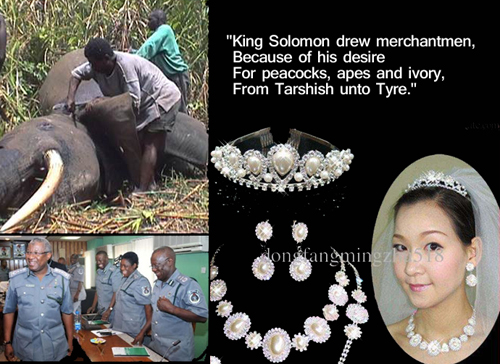
According to the African Wildlife Trust, “The vast majority of the illegal ivory …is flowing to China… China’s economic boom has … push[ed] the price of ivory to a stratospheric $1,000 per pound on the streets of Beijing.”

We don’t know for sure how this devolves to the individual poacher trying to sell his illegal cut on the streets of Morogoro, but the best estimates is that a typical 20-kilo tusk nets the poacher 2-3 years annual wage. And most elephants have two tusks.

In an economic environment where the untrained, unskilled adult is struggling with farming in climate change and squeezed by increasing dry goods prices, the allure of poaching is real. Combine this with a growing sentiment among urbanized people worldwide that there are too many wild animals, a market in China controled by individuals with no empathy whatever for big game preservation, corrupt local officials on the take, and you have all the ingredients for tacit acceptance of this otherwise illegal trade.

So that’s my take: bad economic times with rich Asians richer wanting to buy ivory, and rich Tanzanians richer wanting to broker it. And a rapidly growing Africa that simply has too many elephant.

What to do?

Groan if you will, but there are no simple answers. We’ve entered an extraordinarily complex era in African development, particularly in East Africa. Increased poaching is a part of this, but understanding that as a complicated, nettled component of contemporary African society much less global capitalism is necessary before anything at all can be done.

Line Up Punctures the Big Top

Line Up Punctures the Big Top

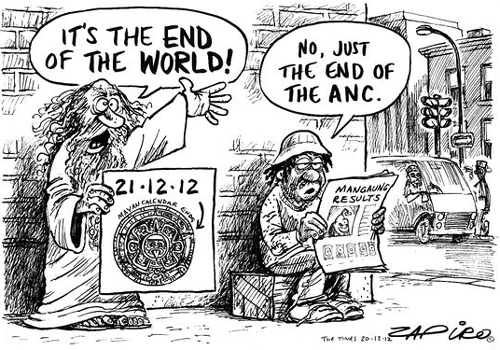
Much like China’s communist party convention, South Africa’s ANC convention that ends tomorrow was supposed to determine who runs the country for as long as the next decade.

South Africa’s African National Congress has run South Africa since the end of apartheid with its standard bearer and first president, Nelson Mandela. The ANC’s history goes back much further than Mandela, though, well back into South Africa’s racist history. And quite often the ANC vied with the much more radical communist party of South Africa for political control.

And it usually won. Nevertheless, over its century of existence the ANC was decidedly leftist and especially recently just before the end of apartheid. Its structural models are larger Chinese, its leaders having been trained in Tanzania by Chinese functionaries.

I think it’s a good model for a developing society, and it’s a model that societies thrust into democracy mode too early often collapse back into; ergo, Egypt. Democracy can’t work unless a good portion of the electorate vote their conscience and a good portion of that have a rational understanding of their own self-interest.

If you don’t know why there’s a drought, and you don’t know how much a pump costs or have any idea how it’s made, and have no clue as to what an aquifer or reservoir is, as a farmer you have no ways to guarantee your own security.

And easier than understanding global warming, or market economy or hydrology, is to find someone who looks nice and claims to know all these things, your neighborhood dictator, who can assume a softer image by pretending to be a cleric or other type of grandfatherly godhead. Stalin was affectionately referred to as Grandpa.

The ANC was traditionally a collection of South Africa’s most prestigious black intellectuals and its central committee, like communist parties everywhere, was the helm of the ship.

And when the ship became the state, so did the ANC. Although an election for president of South Africa happens regularly just like here at home, the choice of the ANC candidates is made at their convention, and since Mandela and the mid-90s, whoever the convention nominates wins nationally.

And that convention is anything but democratic. It has all the bells and whistles of democracy, including women’s groups and youth group’s and worker’s groups, but all these groups are carefully fashioned by the central committee and it’s basically just a reenforcing loop of a small group of powerful men.

All this works more or less tidily provided …

… the guy at the top is sane.

South Africa’s current president is a wacko. In a mature democracy, we tolerate wackos at the top with moderate difficulty, like George Bush, II. It gets harder to do so when their understudy, Dick Cheney, is even more a wacko, but democracy is not as top-heavy as more socialist forms of government, and you don’t have to drill down too far to get to people like Colin Powell and and the legions of good civil servants.

The problem in a top-heavy system like South Africa’s is that it there is no working grass roots. There is no Colin Powell under whom serve a lot of hard-working, dedicated citizens. What you see at the top is what you get at the bottom. And so these last few years in South Africa have been a mess.

While the rest of Africa was growing gangbusters, South Africa was muttering along. Social goals like housing for millions of displaced poor fell decades behind schedule. Labor strife, particularly in its crucial mining sector, continues to be near catastrophically violent.

And the personality of the current president is…. well, wacko. He has multiple wives, believes he can protect himself against AIDS by showering well after sex, unapologetically has pilfered public funds and then publically ranted against cartoonists who portrayed him as unsaintly for doing so.

He’s escaped numerous prosecutions for malfeasance and criminal misuse of federal funds only to flaunt his accusers by building personal mansions with public funds. And the with this top-heavy system, it means that corruption and clowning now occur on a daily basis in the smallest municipality.

And this week the ANC nominated Jacob Zuma to be president, again.

What a joke. But here’s the rub.

A good portion of the South African electorate is democracy savvy. And already local governments in Cape Town and a few other cities have thrown off their ANC shackles.

Maybe, South Africa is ready for democracy.

Out of This World

Out of This World

Evangelical preachers have long been on the list of greatest scam artists but five Nigerians with active churches in the U.S. take the cake!

“God is good,” says Forbes magazine, “especially if you’re a Nigerian pastor.”

Two with special attachments to Texas and other blind congregations that vote against their medicare benefits, hate blacks and throw the last bits of money they have at these jokers, are David Oyedepo and Chris Oyakhilome.

They’ve most recently been ensnared in a loud African debate over why so many pastors own private jets.

Forbes estimates Oyedepo’s worth at $150 million and Oyakhilome’s at $30-50 million. Oyakhilome actually has a greater presence in the U.S. than Oyedepo and it totally befuddles me that people will write him checks.

Oyakhilome runs Christ Embassy. There are a number of affiliate churches in the U.S., many in Texas and almost all of them in the south, and many directed to American youth on college campuses.

“Oyakhilome’s diversified interests include newspapers, magazines, a local television station, a record label, satellite TV, hotels and extensive real estate. His Loveworld TV Network is the first Christian network to broadcast from Africa to the rest of the world on a 24 hour basis,“ Forbes revealed.

His regular “rivals” throughout America’s south garner millions and millions.

He recently plead no-contest to a $35 million money laundering scheme that siphoned cash from his network of churches into foreign bank accounts. The individual stories are beyond laughable. It’s absolutely incredulous that people believe him.

Take the most recent $5000 “disappearance” of church cash which he tries to pin on another jet-setting millionaire Nigerian pastor, Chris Okotie. (Forbes says Okotie’s estimated worth approaches $10 million. Guess that’s not enough.)

One American Christ Embassy church member “lamented” that these factitious warring evangelical pastors are “soiling our image.”

Why do so many people, in Africa and in the U.S., supports these crooks?

The question is really not so different from why do these same people vote against their own self-interest, deny that Obama was born in the U.S., disbelieve global warming and think evolution is a plot by bad men to deny the existence of god.

So it’s a fun exercise in exasperation, but there’s little to do about it. It isn’t as if these guys aren’t exposed. They’re exposed in all sorts of publications, and not just headliners in Forbes. The good Nigerian press is constantly on them.

But the attempt to unmask them is the very stuff they use to build their support. There is such distrust in the world of our given institutions, like government and the media, that clever artisans can twist allegations into alleged lies and be believed.

So I suppose in the end we are responsible. We’re responsible for allowing our established institutions to degrade to this point, and to having neglected social education to the point that good people are unable to see the obvious fraud for themselves.

I think Africans are awakening compared to Texans, though, and it may be why so many of them are redirecting their efforts here, out of Africa.

Why are Africans awakening and the citizens of Houston aren’t?

Send me your answers. Make them brief.