Dominoes in Reverse

Dominoes in Reverse

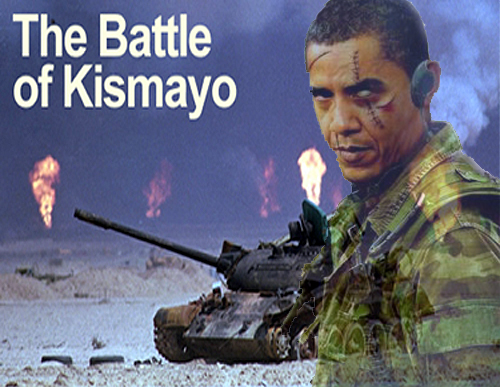
kismayoforisisCome on, America! You’re not all dimwits! Obama’s announced policy against ISIS is comparable to what he did in Somali, and it worked. And it was wrong.

We’ve apparently been successful knocking down a bunch of dominoes around the world. I guess Obama thinks it’s time to pull a few of them back up for future consideration.

Now so far I’ve probably assisted raising new funds for the Society of Dimwits. But you’ve got to understand as we race pell-mell into war, again.
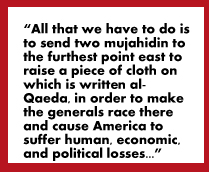
OBLstatementTake a look at the statement to the right and guess who said it. Read this blog through to the end to find out, but try to guess, first.

I was watching my favorites on MSNBC parse the Obama speech for analogies with past African policy in Yemen and Somalia, and they got the facts terribly incomplete. It’s astounding that three years after the Kenyan invasion of Somalia, nobody knows about it.

Before the Kenyan invasion on October 18, 2011, U.S. special forces and even regular forces had been spotted on the ground in Mombasa and Lamu, two of Kenya’s coastal cities near Somalia.

French naval forces had penetrated the unofficial stay-away limit from the Somali shore.

A week after the invasion, 90 U.S. soldiers were cheered by Ugandan crowds as they entered Kampala on their search for the terrorist, Josef Kony.

Drones – relatively new and untested back then – were flying all over the African heavens.

We knew something was up, and it was. Later we’d learn about all the equipment and training that the British and Obama had given until-then a useless Kenyan army.

Obama had chased the meanest of the Afghan and Iraqi warlords and terrorists into Yemen and Somalia. They found greater purchase in Somalia than Yemen, where no real government had been in place for more than a decade.

So while the war in Yemen has never ended, it’s much less international than in Somalia. The war and the terrorists in Yemen are almost all Yemeni. Not so in Somalia. They came from Afghanistan and Iraq, mostly.

Someone made a decision in late September, early October, 2011, to deploy everything possible short of the perceived “boots on the ground” against the fugitive terrorists from Iraq and Afghanistan.

It’s now three years later. What’s the score?

The Kenyan Army took less than a year to get rid of the terrorists who were, in fact, controlling most of Somalia. As I wrote on October 12, 2012, ‘Mission Accomplished: Now What?’.

From afar the score today is pretty much in America’s favor. More than two dozen terrorist leaders have been “eliminated.” Somalia while not yet fully pacified has its first functioning government in 21 years. (There’s even a dry cleaning store now open in Mogadishu.) Piracy in the Gulf is almost nonexistent.

And …

Kenya continues to occupy Somalia. It has suffered the most horrific three years of terrorist attacks on its own soil imaginable. Its economy, prior to October 2011 and in fact right through the Great Recession, which was robust, is now weak and possibly crumbling.

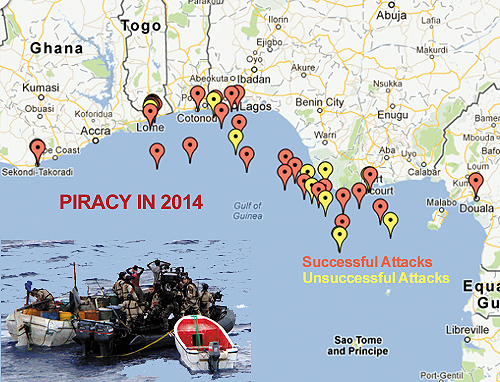
Somalia has a government, but its Parliament building is rather regularly destroyed by suicide bombers. There’s less piracy in the gulf off Somalia, but now a phenomenal increase in piracy in the gulf of west Africa.

The short-term strategy to make America safer, however slightly since our fear isn’t invasion but surprise suicide bombings, worked. And I expect it will work against ISIS despite all the naysaying.

Our policy, Obama’s policy in Iraq and Syria, will make America slightly safer at the immoral expense of making Iraq and Syria much, much less safe … and all for the short-term.

Exactly like the Horn of Africa, where our safety – incrementally better in my view – came at the horrible expense of the safety of our so-called “partners on the ground.”

And so once we complete the mission in Iraq and Syria, with the wars there incompletely finished, then we’ll have an even better score, and we’ll be able to start another war just like it in, oh say, Nigeria.

And after Nigeria, maybe Mynamar? How about Tibet at last? Why, my goodness, we could be remarkably SAFE with the rest of the entire world burning up!

Click Here for the answer to the question about who was quoted in the red box above.

So get it right, Rachel and Chrisses. The policy did work. And it’s wrong.
Round ‘n Round the Mulberry Bush

Round ‘n Round the Mulberry Bush

piracyHow many times around Africa, or the world, can you chase a terrorist? Piracy has now moved from the Gulf of Aden to the Gulf of Guinea.

Fans of the superb movie Captain Phillips will understand better than most (except readers of the New York Times or London’s Guardian) how high seas piracy is instrumental as seed money for “new” terrorists.

Then, once they get established, funds come from all over the world, starting with disgruntled or religiously extreme Saudis and spanning a wide range of bad people all the way to Hong Kong gangsters.

Then, they get their hands on big weapons and, game on.

But that seed money is fundamental. It comes from piracy or kidnapings or both.

We can’t ransom James Sotloff, but god forbid that we lose any oil or Camry’s. Yesterday, the Hai Son 6 secured its release from Nigerian pirates. The press release said the pirates got away with “some cargo” but I doubt that was the end of the story.

Almost every big ship that’s pirated is ransomed, and not with a handful of millions of dollars, but with dozens of millions of dollars.

Obama and Hollande successfully chased well-funded terrorists out of Somalia over the last several years, and our proxy army of Kenya occupied their main port, Kismayo.

Now, they’re on the other side of the continent.

Almost two years ago, when the fight against al-Shabaab in Somalia began in earnest, Europeans immediately began seeing piracy not seen before in the Gulf of Guinea.

The European Union immediately set up a committee and fund with about $6 million to help Gulf of Guinea states combat piracy. No takers. Until now.

Yesterday in Cameroon the French ambassador (giving the money), all the big wigs from the Cameroon government (taking the money) and the Brazilian ambassador … Brazil? Yes, almost all the container traffic between Africa and South America occurs between Brazil and the Gulf of Guinea states.

What prompted these weak States to take more direction from Europe is the radical increase in piracy. Last year there were 32 pirate attacks of giant ships and 24 were “successful.”

“Successful” means the pirate’s got a ransom.

A month ago, authorities noted a “game changer” attack of piracy on a container ship in the high seas, much further off-shore than before.

“The attempted boarding of a vessel underway, especially at night and this far out in open seas, is a tactic … associated with highly motivated Somali pirates,” said Ian Millen, Chief Operating Officer of Dryad Maritime.

It was reminiscent of Captain Phillips: three speedboats overtook then boarded the vessel.

The reason it was a tactic “associated with highly motivated Somali pirates” is because it was undoubtedly carried out by highly motivated Somali pirates.

Because they were chased out of Somalia.

Game changer? They’re just playing on a different side of the board.

So now begins a lengthy time of European and Gulf of Guinea States chasing them away. And they will earn millions and millions of dollars, and be richer than they are now, which is richer than they were in Somalia.

And they will be chased from the Gulf of Guinea to Gulf of Tonkin to the Davao Gulf, etc., etc.

Until “rich” is stopped, this will continue ad infinitum. This means you don’t ransom ships, you arm merchant ships to defend themselves (currently highly restricted) and you stop the money chain.

Swiss banks can no longer be so anonymous. The Caymans can no longer be so indiscreet. China must allow regulation outside itself of Hong Kong banking.

Ultimately, you’ve got to deal too with the reasons terrorism exists in the first place. Try these on for size:

Poverty, Depravation, Oppression

What’s the Point?

What’s the Point?

adangodaneAmerica has likely killed Ahmed Godane. Do you care?

Ahmed Godane, if dead, was the leader of al-Shabaab for four years. Al-Shabaab is al-Qaeda of sorts in Somalia, although like so many terrorist groups the affiliation is tentative at best.

But al-Shabaab is among the larger and more successful terrorist groups in the world, because it is what’s left of the council of warlords that had run Somalia for a decade or more before American and Kenyan military sent them running in October, 2011.

Godane replaced Adan Hashi Ayrow who was similarly killed in an American drone attack in 2008.

Whether true or not, Godane claimed responsibility for staging the two mass killings in Uganda and Kenya in 2010 and 2013 (Kampala bar of people watching the World Cup; and the Westgate Mall).

The missile attack certainly obliterated an awful lot, and if Godane was anywhere near this herculean attack, he’s certainly gone. Reuters called the attack “a hail of missiles.”

Locally Godane is presumed killed. The local Somali media picked up a tweet that seems legit: Shabaab announcing the “demise” of their leader.

The reasons Americans aren’t confirming the death is because there’s nothing left to check. The “hail of missiles” was so intense that there’s no evidence left.

Much of the good Somali media, the ones not affiliated to the warlords or terrorist groups, are hailing the American strike and predicting a “game changer.

But not necessarily for the better. These same Somali media are warning that Godane’s death will foment “potentially more dangerous splinter movements.”

This makes me dizzy. This is what we now propose to do to the leaders of ISIS. Taking out leaders doesn’t do anything. There are dozens in the next village waiting to assume control.

When our president is assassinated, as seems to happen at least once a generation or two, America doesn’t stop.

And it’s particularly true of the decentralized nature of terrorist groups, today. Unlike America, they are often composed of many smaller groups, each with equally competent and trained leaders.

So what’s the point?

Vengeance. That’s no strategy.

Provocative Rachel

Provocative Rachel

dontbeprovokedRachel Maddow’s misleading account of East Africa’s recent terrorist attacks contributes to America’s rearming against the War on Terror, despite her better intentions.

On her show Tuesday night, Rachel sort of concluded as I hope many others do that we should not overreact to the recent beheadings of two American journalists.

Her analysis that terror succeeds when it provokes is spot on. And the relatively simple act of murdering two people, however gruesome it was albeit they were journalists and Americans, is about as provocative as you can get.

But in elaborating on the “gruesome” and “provocative” Rachel fell down that slippery slope so American of defining a situation worse than it really is, of exaggeration. Fear does this. It moves you to overreact.

In describing the abject brutality of al-Shabaab, she recounted incompletely the bar bombing in Kampala in July, 2010, and followed that with a similarly misleading recounting of the Westgate Mall attack in September, 2013.

(Al-Shabaab claimed responsibility for both attacks, although to this day it’s not completely clear the militant group held complete authority regarding Westgate. That tight knit group of terrorists who carried out the attack were mostly foreign and may have included the “White Widow”, no underling to Somali warlords who might aspire to be her boss.)

Rachel implied that both were indiscriminate if not random killings. This couldn’t be further from the truth. It doesn’t in any way justify them, but it does help to explain why they happened.

The first motivation for both is that the Ugandan and Kenyan armies viciously fought al-Shabaab. The Ugandans were the lead army in the UN so-called peace-keeping force that had been battling al-Shabaab for years in Somalia.

The Kenyan Army staged a much, much greater assault in October, 2011, a virtual invasion supplied, organized and probably managed from start to finish by America. The Kenya Army remains a significant occupier of Somalia.

The second specific motivation for the Kampala bombing was that it was in a bar of people watching the World Cup: recreation and alcohol. A bombing of that magnitude would have been far more devastating had it occurred in the central bus station or airport.

More to the point, however, it would have been far easier at the bus station or a dozen other places than in a security patrolled, modern sports bar.

The second specific motivation for the Westgate bombing was the decadence of a mall which on the Muslim holy day had something like a mini rock concert, and as with all the malls in Kenya, sold everything from liquor to ladies panties. Why Westgate in particular? Because it is the only mall of Kenya’s giant three owned by a Jew.

So it is not completely random, and as I said, that hardly makes it better or more justified. Rather I’m saying there’s method in this madness.

Rachel then described the failed Navy Seals operation two weeks after the Westgate Mall attack which attempted to take out one of the leaders of al-Shabaab. We got him with a later drone attack, and Rachel then pointed out how easily he was replaced.

I’ve written a lot about Westgate and terrorism. It’s hard to exaggerate the brutality of ISIS, yet we do. We do by failing to compare it with all the other homicides and murders and unnatural deaths and lack of simple human rights right in our own backyard.

We all exaggerate, as Rachel did, by considering the most horrible of acts random. They are, in fact, rarely random. If subtle, the world’s terrorists are very methodical. Their horrific acts, including suicide bombings, are cleverly and carefully designed to entrap us.

Exaggeration is knee-jerk. It leads us into wars. We take the bait of provocation.

Unfortunately, we’ve learned to if not forget, to file distantly away in an instant afterwards the senseless murder of a kid in Ferguson or the senseless murder of an employee in a gun range in Nevada.

Perhaps we nurture such forgetfulness so that we can retrieve the events later on, in calmer moments, when we are fitter to analyze them better, to determine less emotionally if new actions are called for.

So we should now do with the senseless murders of two journalists.

Bloody Red Cross

Bloody Red Cross

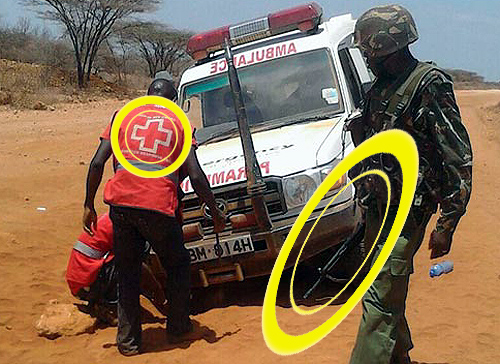
redcrosscallsformilitaryWhen the Kenyan Red Cross demands military action, you know the world has changed.

It’s been a rough week for the purveyor of humanitarian relief. First there was the kerfuffle in The Ukraine where Vladimir told the white crosses to move it or lose it. Then yesterday a Red Cross ambulance in northern Kenya was attacked and destroyed, its occupants barely escaping with their lives.

It didn’t take Kenyan Red Cross officials long to then demand that President Kenyatta send in the army.

“It is now time to act,” Abbas Gullet, secretary-general of the Kenya Red Cross Society (KRCS), told IRIN yesterday.

Gullet was referring to a June 25 pledge by the Kenyan president to send in the Army if the tribal groups in this part of northeastern Kenya didn’t stop fighting.

They didn’t stop fighting.

What’s happening in around this far northern city of Mandera in Kenya is exactly what’s happening in many places in the world, like Pakistan and Myanmar, when hostile ethnic groups get their hands on heavy weapons.

How do they get the weapons?

Don’t make me laugh. Watch Nicholas Cage in Lord of War. It’s cheaper and easier to buy an AK47 in Mandera, Kenya, than it is to buy a sack of potatoes.

And after you’ve killed enough merchants and collected enough coins, just hop over the Somali or Ethiopian border for the Labor Day Sale of grenade launchers.

Soon everyone is killing everyone. Kill or get killed.

Those groups most successful attract the attention of stronger military powers. They make the first compromises of their lives, to join forces however temporarily with other similar groups, and they become the new terrorist threat in the region.

From time immemorial ethnic rivalries existed worldwide and were violent. Development and education ameliorates the hatred and bloodshed subsides when productive work develops.

Global warming, which especially in this part of northeastern Kenya adjacent Somali means more and worse droughts, followed by sudden and terrible floods, makes things worse.

Slow development is often worse than no development at all. People’s hopes are raised then dashed.

This is northern Kenya in a nutshell. It is much of the rest of the world, too.

“Our mission is to work with vigor and compassion … to prevent and alleviate human suffering and save lives of the most vulnerable,” the Kenyan Red Cross charter says.

So… stand your ground boys, then fire!!

Do We Bomb Kenya?

Do We Bomb Kenya?

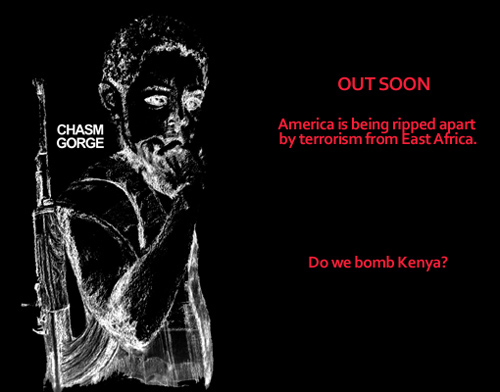
OUTSOONJim Heck’s new novel, Chasm Gorge, will soon be available for purchase in all formats through sellers like Amazon and book stores across the country.

Watch this space for free excerpts available prior to publication in September.

Ohio congressman Brad Talvich is set to become the next president of the United States. As a former popular NBA player with long experience as a fighting Republican congressman he has everything the party needs to win.

There is only one thing holding him back – the kidnapping of his son by the world’s most notorious terrorist.

Author and experienced safari guide Jim Heck invites readers to experience his debut novel, Chasm Gorge, which tells the thrilling story of a safari guide’s journey through Africa in search of the son of one of the most powerful men in the world.

Len Willy had previously rescued kidnapped teenagers roughly in the same locale that The Congressman’s son is presumed to be. But he is reluctant after an aid calls asking for his help. Unable to say no due to his conscious or his pocketbook, Willy embarks for Africa, where his first task is to find Tali, Africa’s most notorious terrorist, Cassidy’s kidnapper as well Willy’s former driver and guide.

“Terrorism is unstoppable and forever unpredictable,” Heck says. “I hope readers gain an acceptance of terrorism as part of life, today and an understanding that you can’t eradicate with force something that fires in people’s minds.”

In Chasm Gorge, Willy faces one threat after the next. His situation grows murky and more dangerous when the Congressman’s son, Cassidy, demands a ransom for himself even after escape from Tali is secured. Will Willy be able to get Cassidy home before the American government over reacts?

Jim Heck has been a safari guide since the early 1970s. While witnessing firsthand the evolution of terror in Africa, he has been kidnapped, lost in jungles, flipped out of a canoe into crocodile invested waters and been pinned in his tent by an elephant. Heck and his wife, Kathleen Morgan, were among the very few westerners to explore Uganda under Idi Amin.

Jim’s novel, which is already in great demand, presents disturbing truths about terrorism from first-hand experience.

Destined to become a best-seller, stick to this space for more information!

The War Comes Home

The War Comes Home

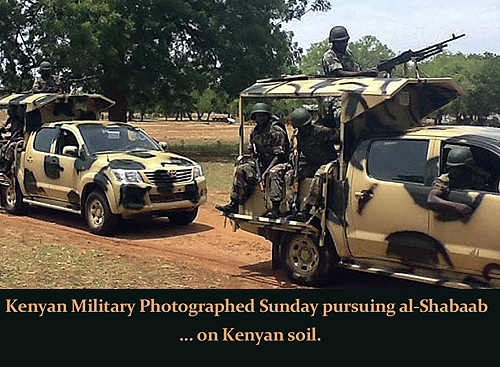
pusuealshabaabWith the Kenyan military vehemently dening it, many local residents report that Kenyan military aircraft dropped bombs in mainland forests near Lamu last Sunday. There were similar reports about a month ago.

In late June militants attacked two coastal villages on the mainland opposite Lamu, massacred almost 100 people, stole stores of corn and other food and disappeared into the thick jungly forests a few miles further inland.

The Kenyan military responded and it was presumed this one-off event had been resolved. But it appears now that the militants are entrenched, and that the war in Somalia has moved onto Kenyan soil.

When the military first responded on Kenyan soil about a month ago, the general in charge announced an operation to ferret out the remaining al-Shabaab terrorists who are presumed responsible for a number of Lamu area attacks in the last year.

I guess it didn’t work.

This strikes yet another blow to Kenya’s struggling tourist industry, and it’s a shame, because the issues are grossly misunderstood and the situation poorly reported.

The relationship between Kenya and the U.S. has suffered recently because of America’s strong travel advice to its citizens against visitnig Kenya, and because of the White House’s cold shoulder attitude towards Kenya’s president, Uhuru Kenyatta, who is on trial for crimes against humanity in The Hague.

Last week, though, at the African/U.S. Summit there were signs that the relationship is improving. The entire situation is steeped in irony, because it is precisely the Obama administration which recruited, armed and trained the Kenyan army to go into Somalia in the first place.

Although American foreign policy has often snaked around to bite itself, the irony doesn’t just end there. The Kenyan military operations have made America much safer, Kenya probably less safe.

Lamu is an island city in far north Kenya, only 60 miles from Somalia. While most of the Kenya/Somalia border is desert and wasteland with few people, Lamu is a thriving coastal city with more than 100,000 people.

It has a deep history that goes back to the 13th century, was a favorite retreat of early colonials, and is just a few miles from the mainland coast of extraordinary, pristine beaches. It’s set to become Africa’s largest deep water port within the next ten years, as it’s the perfect terminus for oil and gas pipelines coming out of the new oil fields now being developed in the deserts to the west and north.

Over the years some of Kenya’s most exclusive beach resorts and boutique hideaways have been built in this area, several of which have recently gone out of business.

Because of Lamu’s proximity to Somalia, it’s suffered a number of attacks including headliner tourist kidnapings and murders by Somali terrorists.

The thick mainland forests just off the shore are undeveloped and very jungly, providing excellent refuge for fugitives and terrorists. This is where a number of local resident said the Kenyan military was shelling and/or dropping bombs last Sunday.

The Kenyan mission in Somali is doing well. Kenyan military – armed and trained by Americans – essentially ousted al-Shabaab earlier this year. The great port city of Kismayo is now a functioning, non-terrorist city.

The trouble is that we’ve turned the clock back 20 years to before al-Shabaab, but right after Black Hawk Down, when Somalia imploded leaving only scores of warlords running the place yet fighting one another united rarely to fight outsiders.

Al-Shabaab, like the Taliban in Afghanistan, had managed a semblance of stability throughout Somali by whipping the warlords into shape, extorting them or in many cases, integrating them into the larger jihadist structure.

Now absent al-Shabaab, they are reemerging as feisty and independent as ever, and armed to the teeth.

Al-Shabaab as such is a spent force. It’s very likely that the trouble in and around Lamu is al-Shabaab, because this is the likely place they would have run to from the Kenyan military occupation in places like Kismayo.

I don’t think it’s going to last. Although it flies in the face of similar situations around the world from Afghanistan to Cambodia, I think the Kenyan military is likely to get a hold on this situation pretty quickly.

There just aren’t that many al-Shabaab left. Jihadists are racing to the Mideast, Iraq and Syria. They’ve essentially lost Somalia and Kenya.

But if not?

Then it’s a terrible escalation of a cancerous conflict. I’ll keep my eyes on this closely.

Ebola Hell

Ebola Hell

When superstition in the bush becomes religion in the city, all hell breaks loose.
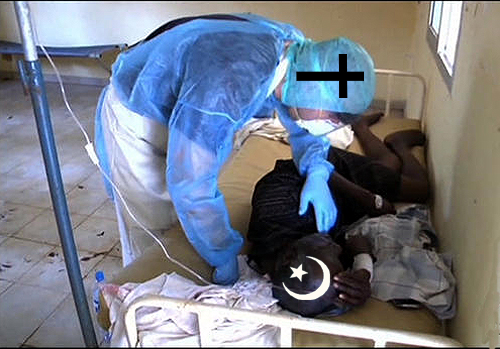
This ebola outbreak is an epidemic, the first of 28 previous outbreaks. It’s much more dangerous and we need to understand why.

There are a number of contributing factors, but I believe the most significant one is the growing enmity and polarization between Christians and non-Christians, Muslims and non-Muslims.

It’s a horrible object lesson of a global society that just isn’t working, anymore.

Of course increased communications and more global interaction from airlines and so forth contribute to the speed of the current spread. But relative to the previous outbreaks something new and very bad has entered the equation, and I think that’s religious hostility.

Until this outbreak, ebola was confined to a tiny core of central Africa composed of only 4 countries: The Congo, Gabon, Sudan and Uganda.

In all those cases the outbreak occurred in heavily forested, rural “jungle” areas with relatively few people. As soon as health workers arrived on the scene, the outbreak was finally contained. Whenever an infected person arrived in an urban area, immediate hospitalization often led to recovery and further containment.

Those outbreaks experienced a 2/3 fatality rate: more than 1500 people died from a reported 2389 cases.

As of this moment 729 people have died and another 1323 remain hospitalized. This is half of all the previous incidents since 1976, and the epidemic is spreading into developed Liberia, Sierra Leone, Guinea and Nigeria.

This is the first time that ebola once out of the jungle has not been contained.

In more urban than rural areas of Sierra Leone, infected persons are escaping from hospitals and refusing treatment.

Massive police action hasn’t been able to stop widespread street demonstrations against the west and its medicine.

Police shot 9 people in Freetown last week during a protest sparked by a former nurse who told the demonstrators that “Ebola was unreal and a gimmick aimed at carrying out cannibalistic rituals.”

In Liberia, the most developed country of the region, harsh government measures closing public institutions, confiscating bush meat and increasing public health monitoring have been met with angry demonstrations.

Following a burial yesterday grieving crowds hunted down and stoned health care workers.

All of this follows a pattern throughout the “almost developed” world that restarted earlier this year with Pakistan’s much publicized increase in polio. The disease was nearly eradicated, but this year polio has reemerged big time in Pakistan.

There’s little doubt that an insurgent campaign by the Taliban and others to prohibit polio vaccination was motivated in large part to the successful effort to find Osama bin-Laden.

Intelligence inside bin-Laden’s compound was obtained by CIA agents acting as bogus polio vaccination workers.

Additionally, Muslim clerics throughout the troubled parts of the world have started again to claim that western attempts at vaccination are really meant to sterilize Muslims.

That terrifying myth seems to have grown now to encompass the efforts to end ebola.

It’s the same horrible paradigm that provokes seniors in America to support ending medicare, or Texans to ban text book references to slavery, or coastal Floridians to vote down shoring up their communities in the advent of global warming, or Georgians to ban immigrants who are the only ones who harvest their peaches.

It’s denial of the truth with actions against one’s own self-interests.

Done with the certainty and conviction of religion, a first principal that will not be compromised.

There is little ideology or religion in Africa’s deep jungles. Survival trumps everything and superstition while intense has never seemed to work terribly against the people who adopted it.

But when superstition in the bush becomes religion in the city, then all hell breaks loose.

On Safari: America from Afear

On Safari: America from Afear

whichismoreexplosiveI and Kenyans woke this morning to the news of a bloody terrorist attack near Lamu. But what worries us even even more is that the U.S. might restart the Iraqi war.

CNN’s “State of the Union” is the most widely watched American show in Kenya. It comes on live at Sunday dinner time.

So Kenyans who woke the next morning to actual terrorism watched with even greater horror as Sen. Lindsay Graham called for a virtual reverse jihad.

The U.S. Right spent Sunday warning of a “califate” that would be a super threat to the U.S., an ISIS that would rebomb the World Trade Center.

This is utter nonsense. Don’t take the bait, America. What is going on in Iraq is a civil war, not global jihad.

Nairobi’s leading newspaper in its leading editorial this morning claimed the resurgence of war in Iraq “serves as graphic testimony that Western military adventurism in the region not only failed to extinguish the flames of extremism, but might have added fuel to the fire.”

“Stepping into the bloodbath of Iraq would be madness,” was the headline in one of London’s leading Sunday newspapers.

Why are we more afraid of terrorism than driving over a bridge ready to collapse or dying of cancer?

As I wind up my three-day visit to Nairobi I realize how horribly warped American paranoia of terrorism is and yet how impossible it seems to remedy.

Terrorism is increasing. The Rand Corporation’s most recent report shows a 58% increase in significant jihadist groups, a doubling of fighters and a tripling of attacks.

Obama’s own government report, The Country Reports on Terrorism submitted to Congress on April 30 claims terrorist attacks increased by nearly 50% from 6,700 to 9,700 from 2012 to 2013, resulting in 18,000 murders and 33,000 serious injuries.

There’s no reason to doubt these numbers. And here are some more:

The number of homicides in the U.S. averages between 13 and 15,000/year, or roughly 80% the number of worldwide terrorist killings. The number of highway fatalities in the U.S. annually is nearly twice the fatalities caused by worldwide terrorism. The numbers of U.S. homicides or highway fatalities in relation to U.S. fatalities caused by terrorism doesn’t exist, because since the Boston Marathon bomber, there haven’t been any.

What are we afraid of? Or more specifically, why do we fear terrorism more than the highway or the gunman in the classroom?

Kenya has had an unfair share of terrorism fatalities, injuries and damaged economies, because it has been targeted by terrorist groups for its proxy war against al-Shabaab in Somalia, a war that it would not have chosen to do, nor been capable of doing, without serious pressure and military assistance from the west, primarily the U.S. and France.

So as Kenya’s rate of terrorist harm has increased dramatically in just the last few years, France’s and the U.S.’ has declined.

Yet there is a palpabale fear in the U.S. that this is not the case. That fear is the success of terrorism, making its victims’ communities feel threatened out of proportion to the facts.

Imagine if the trillion plus dollars spent on the wars of retribution and against terrorism in Iraq and Afghanistan had been directed instead to America’s leading cause of death, cancer and heart disease, both which average 25 times greater than the worldwide deaths from terrorism.

With that amount of money might we have already achieved a robot car whose driver, even if drunk, would be unable to cause an accident thereby reducing American fatalities, currently 2-3 times worldwide fatalities caused by terrorism?

Clearly it’s not the deaths that bother us. So it’s not the threat of fatalities that must bother us, it’s the challenge to our power. A relatively few deaths caused by terrorism create a proportionately greater fear and insecurity.

DUIs, suicides, cancer, school shootings … we’ve learned to live with and do not seem to threaten our way of life. We must learn to live with terrorism in the same way. As an actual threat, it’s actually much, much less.

Kenyans know this. The country is booming (except for tourism). Everything from Google to IBM to Caterpillar to GM is investing heavily here. The energy of its youth, the rapidly increasing level of education and the imaginative ways difficult problems are being solved is becoming a model for the world.

But the beautiful white sand beaches, among the finest in the world, and in the incomparable wilderness and big game are being abandoned by world travelers.

There has not been a tourist assault death here in more than two years, nor an injury; nor have any foreign investors been bumped off or maimed.

Those are pretty good numbers for any business person. But as explained above, numbers mean little when it comes to scaring people. Terrorism, the wanton killing for ideological reasons, scares people more than potholes on I-80.

So as irrational as it may be that you will choose to visit New York instead of Nairobi, where any way you run the numbers your chances of being killed or hurt are much greater, you’ll feel better doing it.

And that’s why terrorism is so successful. And that’s why it’s more important than ever that we start to educate ourselves to the priorities of need we truly have.

Before terrorism wins against us all.

On Safari: Nairobi at Night

On Safari: Nairobi at Night

nairobiatnightNairobi is transforming faster than a teenage girl getting ready for the prom.

I arrived on time with Swiss from Zurich at 6 p.m. sharp. The airport is like a transformer being born, huge amounts of new terminal construction. As always airport staff was prompt, courteous and professional. The bus that took us to the temporary international arrivals hall was clean and swift.

I bought a visa, picked up my luggage in the new somewhat hiphop carousel area (with its popular music, many ads and neon red painted piping) walked out into the beautiful Nairobi air, picked up a 100,000 shillings in a snap from an ATM, ordered a cab, bumped into an old friend, and was in the car heading into town in 18 minutes and 14 seconds after we landed.

And I got to my hotel two hours later.

It’s “Members Night” — the local vernacular for Friday night party time. I was on the three-lane superhighway into town, designed for us to speed over the underpasses and under the overpasses, but the traffic in both directions was absolutely unbelievable.

First of all, it’s one giant industrial city from the airport to the city center. The new buildings are immense and many still in construction. The cars on the road all seem new, from BMWs to Hummers to the main city brand, Toyotas.

My fabulous cab driver new all the backroads, which were also clogged but at least were moving. When we did stop we had time to buy excellent CDs, all copied music and music videos pirated from major stars around Africa, for Ksh 100/ each. That’s about 90 cents. Each CD had the requisite 13 or 14 songs.

At least it gave us something to do when stopped in traffic. Because after all, you can’t trust a hawker with a pirated music CD. You’ve got to play it through!

When we finally got to the fabulously new and spectacular Villa Rosa Kempinski there was new delay, which I understand is true at every hotel. Every car is thoroughly patted down, with lights and metal detectors, before it’s let in to the normal cul-de-sac.

The security guys are friendly, excellently dressed as if coming from a ball, and spoke perfect English (to me) and German (to the clients in front of me).

Then at the entrance to the hotel several attendants took my luggage — no, I couldn’t take it myself, because it had to be carefully scanned and searched.

I had to walk through a metal detector that was more sensitive than the TSA one I walked through in O’Hare.

Then, finally, I checked in. And like so many hotels today in Nairobi, you aren’t just checking into a hotel. You’re checking into a huge walled complex of multiple restaurants, shops, fitness centers, pools and outdoor cafes.

The vibe in Nairobi is amazing. This city will one day rule the world. But for the moment, for tonight anyway, it’s almost as if a war is going on.

“It is,” the bellman explained to me immediately.

“The War on Terror.”

Good People Died Today

Good People Died Today

goodpeoplediedtodayYesterday extremists in Las Vegas and Mombasa killed good people of the establishment escalating the War on Terror.

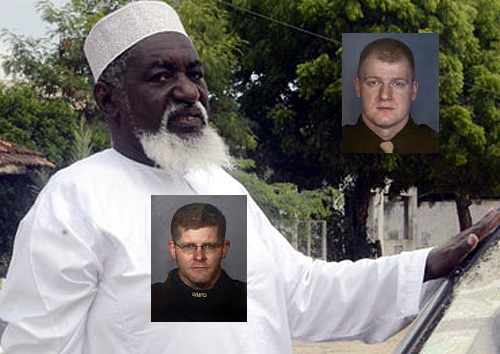
Sheikh Mohammed Idris was shot once in the stomach by a drive-by hit squad in Kenya’s main coastal city, and he died shortly thereafter.

The sheik was famous throughout this trouble region of Africa for his moderate religious stance and his vehement opposition to jihadism.

Although the gunmen are not known it’s presumed that they killed for the ideological reasons that the sheik was so well known.

Not several hours later across the world in Las Vegas another two extremists shot and killed two policemen then a civilian before killing themselves.

The views of the Las Vegas killers were well known, and like the Mombasa murderers they killed for ideological reasons: that the establishment, the government and their agents, the police, were threatening their freedom.

It doesn’t matter that one set of killers might be more “crazy” than the others, which we don’t know, anyway. Nor does it matter that people like this are driven by injustice, perceived or real.

What matters is that the intensity of their beliefs is so strong that not even death deals compromise. Like soldiers of the oldest dogma, they will kill themselves for their beliefs and “innocent civilians” who happen to get in their way are fair game, too.

There is such certainty in their beliefs that they either get what they want or die trying.

This is terrorism. It’s the ultimate act of war, a sort of non sequitur … “Live Free or Die.”

There’s always been terrorism from the earliest times but it’s come to govern our lives today in ways much different from the past.

Societies are much more pervasive and powerful than in the past, so their opponents are more celebrated. A single act of terrorism is instantly known regardless that its actual impact on society is no greater than the murder of Marcus Aurelius.

And so societies feel more publicly aggrieved and become reactionary. A war of response and explanation is ignited between the adversaries as each sets up a battle to win. Winning is what it becomes all about: Assassinating the infidel and catching the murderer.

Terrorism becomes a process rather than a method.

In Kenya the extremely respected opposition political leader immediately announced he was attending the funeral today of Sheik Idris.

Back in the U.S. Harry Reid, the senator representing Las Vegas, called for more gun restrictions. Reid had previously said the militia with which the Vegas shooters claimed affiliation were “domestic terrorists.”

Terrorism is not going to go away. It never has. But whether it’s Afghanistan or Mombasa or Las Vegas, managing it must become the priority, not the false hope of wiping it out.

“Ending the War on Terror” is absurd. A single disenfranchised soul in the society of heaven can create terrorism. There will always be terror. There always has been.

And that’s the first step in managing it better than we currently are.

We need to recognize that even if the terrorists are nothing more than crazy, they weren’t born that way. They become that way. And it’s the society that they fight that facilitated them to want to destroy it.

We need to take responsibility for this mess. It’s as much our fault as al-Shabaab or the Bundy militants that good people died, yesterday.

Bring those murderers back to their childhood. That’s likely when the mistakes were made. What could we, the society, have done back then to ensure they didn’t turn out to become the ruthless murderers they are.

Boko Tea

Boko Tea

T-PartBokoHaramBoko Haram and America’s T-Party have a lot in common, and neither will disappear until their adversaries adopt some of their moral pinnings.

Boko Haram is on the rise. For more than a decade it’s caused widespread death and destruction in Nigeria, but with its new found fame, it’s expanding into a neighboring country.

“Right now, we are being infiltrated by Boko Haram,” a colonel in the Cameroon army told an Africa-wide press service last week.

Some argue they are “on the run” from northern Nigeria, their stronghold for more than a decade. Others, including myself, believe they’ve been strengthened by their recent worldwide attention.

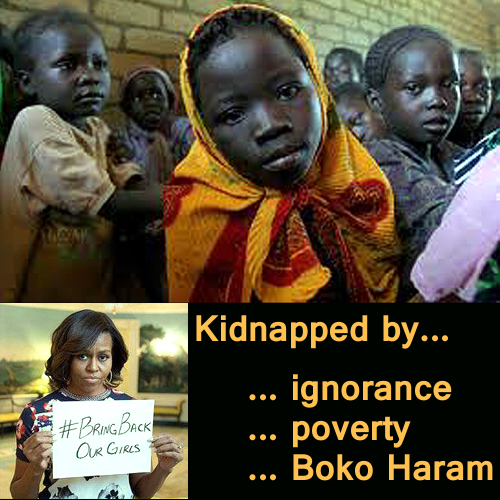
The group continues to hold nearly 300 kidnapped schoolgirls from northern Nigeria. Many of the world’s western powers are helping Nigeria try to find the girls and eradicate the organization ever since the world’s media locked onto the story.

Like all politics in the west, Boko Haram has become entertainment:

The world press went ape yesterday announcing that primitive African tribes were now “on the hunt” for Boko Haram.

An extremely articulate, gentle and soft-spoken Boko Haram killer in a scarf-wrapped face was the centerpiece of last night’s CBS evening news.

“Boko Haram’s attacks … should be understood as part of an ongoing political-military campaign …to purge, conclusively, Nigeria’s Northern Muslim society of the source of its culture of corruption, decay and mismanagement,” says a Nigerian expert from King’s College, London.

Boko Haram views kidnapping girls from a corrupt society and turning them into tendrils of antiquated Islam a noble feat. That’s because in most of Africa you have to stretch way back to antiquated Islamism to find societies that were not corrupt.

And those were the precolonial days spoken about so highly by most jihadists. Corruption began with colonialism. It’s never ended.

Corruption in all sorts of forms is the only treatise the T-Party can rationally expound. When it gets into specific issues and policies it becomes mired in intellectual bureaucracy. Purity is the key.

As it is with Boko Haram. Little is ever argued in the academic or religious world about the tenants of Islam, or for that matter, the tenants of Christianity, or for that matter, the iconic folkways of the Irish or Poles.

Rather the purity of those tenants is what is argued. And there is little argument that Africa today, Nigeria in particular, is corrupt.

As is America. Nigerian corruption might reach its apex in a High Court judge taking money from an oil company. American corruption is more likely the Koch brothers airing 10,000 TV ads lying about Obama’s citizenship.

Neither example is more corrupt than the other. It doesn’t matter that one might have a greater impact in its respective society than the other. They’re both corrupt and it isn’t effectiveness but nature that generates the violent opposition of the likes of Boko Haram or America’s T-Party.

More than a year ago the Atlantic ran an excellent piece arguing that Democrats will only achieve supremacy over the T-Party if they adopt some of the T-Party’s ways:

“It is time for Democrats finally to steal a move from the Republican’s playbook… a Tea Party for Reform,” Lawrence Lessig argued in that article.

Even before that, analogies were being made between the T-Party and Occupy Wall Street.

Purity.

It’s a hard stake to drive into American or African politics, but it’s what we all need right now.

Exactly Why Go Anywhere?

Exactly Why Go Anywhere?

tubing in the sunAs more details emerge from Friday’s deadly terrorist attack in Nairobi, Kenyans are condemning western media for suggesting a holiday in Kenya isn’t safe. Do they have a point?

Two of Kenya’s leading tourism executives blamed western media for scandalizing the situation and argued that tourists on a Kenyan holiday are no more endangered by terrorism than tourists visiting Big Ben.

Before we get into this, let’s review what happened Friday:

Ten people were killed and at least 70 injured by two simultaneous explosions in an open-air market in mid-afternoon in Nairobi.

The first IED exploded around 230p at the periphery of what is called Africa’s largest second-hand clothing market. A few minutes later, a small bus filled with passengers exploded on a street adjacent the market.

The market is located about half-way between the troubled Eastleigh community of northeast Nairobi where so many Somalis live and the Nairobi city center.

Two days previously the British and American governments issued travel warnings urging their citizens to leave the Kenyan coast. Nairobi is about 220 miles inland from the coast.

The British secret service, the SAS, may have tipped off both British and Kenyan authorities that something was going to happen.

“Terror attack chatter” was intercepted by the SAS, according to the report in London’s Sunday Star.

The stern travel warnings that ensued prompted Europe’s mega travel company, TUI, to evacuate its British citizens booked through its subsidiaries, Thomson Holidays and First Choice Holidays, and to cancel its regular charter flights from Europe to the coast through October.

A third large European company, Kuoni, while not evacuating tourists canceled all further holidays on the Kenyan coast through October.

I explained in my blog Friday how the unique aspect of British travel insurance forced TUI into the decision. (Kuoni’s decision was for other reasons.) Hundreds of other European holiday makers booked through other companies were not evacuated and remain on the coast, today.

More than half the tourists who visit East Africa never see an animal. They come for the beautiful coast, and the coast of Kenya is as popular to Europeans for a holiday as the Caribbean is to Americans.

But the coast is heavily Muslim and has been so since the earliest histories. Kenya’s occupation of Somali unleashed the retribution which averages three terrorist attacks monthly, although the vast majority of these have been on or near the Somali border.

But the minority of other attacks have been on the coast, several quite near tourist centers.

In the last year a terrorist attack about once every two months has hit the Nairobi Somali expatriate community as well.

“Terrorism is a global threat and not unique to Kenya, with similar risks evident in Britain,” Jake Grieves-Cook, former head of the Kenyan association of tourist organizations, told the press Saturday.

He went on to detail that “the latest British MI5 and MI6 assessment of the terrorist threat within mainland Britain itself is now rated as ‘substantial’,” implying that a traveler in Britain was under as great a threat as in Kenya.

“This was not an evacuation as reported in the press,” Stefano Cheli, founder and owner of one of Kenya’s most successful upmarket tour companies said today. In a broadcast email to western travel companies, Cheli criticized the western media for suggesting the tourist repatriation was a British government operation rather than a TUI business decision.

Grieves-Cook, by the way, spent a long time in his statement explaining the exceptional good, particularly with regards to the near ending of Indian Ocean piracy, that the Kenyan military occupation of Somali has achieved.

He was almost but not actually saying that tourists owed Kenya an unusual latitude of security for what Kenya had secured for the world.

* * *

Vacations fall into a great variety of different categories. Probably the largest one is “R&R,” a reward for successful hard work. As such, the holiday maker wants as hassle free down time as possible. I think most beachcombers fall into this category.

A safari is a little bit different. I don’t think anyone planning a safari thinks it’s going to be relaxing. Exciting is the predominant theme. In fact, a touch of danger is often presumed, the titillation that is often a part of the motivation for booking. Like a sports holiday, there’s a definite aspect of challenge.

But you train carefully for a specific sport, and you believe – whether it’s true or not – that if you follow the rules the lion won’t eat you.

Terrorism is so successful because it’s just that: surprised fear. Holiday-makers don’t train to evacuate. There are no rules for dodging the bomb.

What’s left, though, is Grieves-Cook argument that Britain is as dangerous as Kenya, and the facts might bear him out.

Tourists killed in Britain’s scores of terrorist incidents, or in 9/11, are likely substantially higher than all the tourists ever killed in Kenya. So why not just trust the Kenyans to keep you as safe as the British?

Aha, that’s the answer and it’s not good for Kenya. Trust.

America and Britain have certainly had their share of terrorist acts, but Americans and Britains believe strongly that their governments have protected them against many, many more.

Why should a tourist trust Kenya when Kenya is unable to protect its own Eastleigh (Nairobi) citizens from a serious attack every two months? Facts aside, westerners are much more likely to trust the British or Americans to keep them safe than Kenyans.

It might not be fair. It might not even be rational. But it is the perception which matters.

Pivot on Kenya

Pivot on Kenya

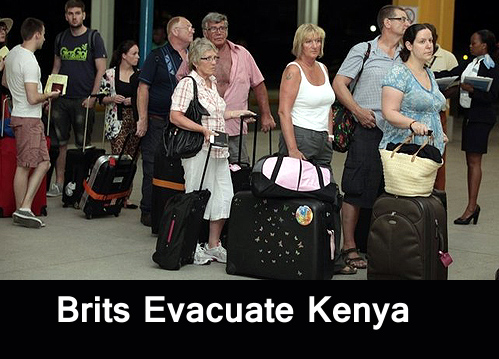
britsevacuatekenyaThe U.S. and Britain have issued specially strong travel warnings on Kenya. British tourists are being evacuated from the Kenyan coast.

Personally this is a stinging disappointment. We have multiple trips to Kenya planned; I was scheduled to be in Nairobi for three days in a couple weeks. There are unique and compelling attractions in Kenya found nowhere else in Africa.

Travel to Kenya’s game parks remains safer than it’s been for years. Simple numbers on not just kidnapping or murder, but even petty theft, are at historical lows in Kenyan game parks, probably lower in fact than in neighboring safari countries with average incidents.

But travel to its coast is now likely dangerous, and the overall perception travelers will now have means that travel to anywhere in Kenya won’t render the magical, super, exciting vacation that a good safari must be.

Vacations are composed of considerable amounts of positive anticipation, not just during the day to day events during the holiday, but even more so in the exciting preparations for it. A Kenyan holiday will now lack this essential ingredient.

The reason for Britain’s particularly harsh move was not triggered by any event. There has been no new significant terrorist incident since January 2, and that I almost didn’t classify as “significant.”

It was an improvised explosive device thrown into a crowded nightclub near the fancy resorts of Kenya’s south coast. But it was very amateurish, and the club was not a place tourists would normally go, anyway.

A half dozen other individual and pretty botched disruptive acts by who knows what kind of deranged or forsaken people has been recorded in places like the Nairobi airport this year, but really these were hardly more than fratboys freaking or disgruntled employees swinging.

The serious last “tourist” attack was on the Westgate Mall last September. As I’ve often written, it was not clear that was targeting tourists, but it could have been. Prior to that we have to go back nearly three years for any specifically tourist targeted attack.

So what prompted the Brit warning?

We don’t know, but it’s not always that the Brits and Americans follow each others’ warnings in lockstep as they did this time. Something’s in the air.

And the unique drama this time that highlighted the warnings is the ongoing evacuation of British tourists from beach resorts by the tour companies that brought them there. No other nationals are being evacuated, including Americans, and here’s why.

Travel Insurance
.

Americans or most Europeans buying travel insurance pay up to 10% of the amount they wish to be covered for, and in the case of Americans, you can’t insure yourself against terrorism despite what some travel insurance companies may claim.

In Britain, the government guarantees the underwriters of travel insurance and it’s extremely affordable. Most Brits don’t buy it for a single trip, but on an annual basis, and the cost is generally around $250 per person per year.

That does cover your trip investment, health and safety and personal belongings against terrorist acts, but only if you abide by the government’s travel advice.

When the government says “Leave Now” – which the Brits did yesterday regarding the Kenyan coast – it means if you stay you’ll be without insurance. Travel companies carrying these passengers then become liable if something happens.

They have no choice but to get their clients out.

From a non-Brit’s point-of-view, however, this is extremely severe. Britain has never issued evacuation advice before. As I said, something’s in the air and the Brits are convinced of it.

And the Americans, who followed suit within hours, believe it, too.

This is catastrophic for the Kenyan tourist industry. Indeed, all the activity now may lead to a prevention of any terrorist act, hopefully. And if so, we’ll never know the reason. We’ll never know if it’s legitimate.

But I trust the Brits and Americans with regards to their travel advice, today. I didn’t always.

Persons contemplating an East African safari should steer clear of Kenya, now.

Travelers already committed to Kenya will have some tough decisions. No one should go to the coast, now, but as I’ve said, the game parks seem very safe. Anxiety will be weighed against losing deposits.

It is a horrible fact in our world, today, that “improvised” terror striking as disparate communities as Boston and Diani Beach can determine not just the fate of holidays but the fate of entire economies.

“Terror” has become part and parcel of our daily lives.

Boko What?

Boko What?

schoolgirlBoko Haram. You need understand little else than the name to understand the situation: “Western Education is Sacrilege.”

‘Boko Haram’ is a Hausa language derivative, which lays blame for the misery in the world upon the educational systems created by the successful, developed world.

Of course there are many in the successful, developed world who agree with this:

In the United States, the number of home schooled primary and secondary school kids increased from 850,000 in 1999 to 1½ million in 2007 (1.7-2.9%).

Boko Haram believes that traditional western social values as evinced by public institutions are wrong. The schoolgirl kidnapping in Nigeria is an expression of moral indignation at gender equality.

Most western homeschoolers also believe women are inferior to men, or in a persistent homeschool jargon, “more godly” if they pursue a subservient relationship to men.

So in a real sense western homeschoolers and Boko Haram are comrades in arms.

What begins with the gender fracture continues into other aspects of society, like money and power.

Boko Haram, like the IRA, the Basques and numerous other ethnic-derived rebel movements, is fighting for a redistribution of wealth and power.

They arise from a portion of Nigerian society, the north and mostly Muslim part, which has benefited hardly at all from the development of the Christian south.

The less people have, the less they have to lose, the more likely they’ll put their life on the line.

Boko Haram, like all rebel groups, can’t survive on its own. Exploiting the undeveloped roads and vast forests of northern Nigeria, they hide not just in the neglected and undeveloped topography but among the millions of people who share a common misery.

Even the barbaric LRA (Lord’s Resistance Army) received sanctuary from communities that felt they were being neglected to the point of desperation.

In a strange but true sense, American homeschoolers have likewise been neglected. And they find themselves not only bereft of basic understandings of and skills for the real world, but generally at the bottom of the economic ladder as a result.

If these movements are successful and ascend to power quickly or suddenly (take the Muslim Brotherhood or the Iranian ayatollahs), they’re unable to evolve more rational and moral positions. Instead, they reenforce the conservative myths around which they first organized themselves.

That’s the real danger to a just society. So what to do? Suppress them with every gun you’ve got? Imprison thousands? Or from the liberal side: spend billions quickly but carelessly to remedy such failings as their education?

Something in between, I suspect. Perhaps the IRA and Basque separatist movements are models. But what they both clearly show is that these “struggles” are long ones. There’s no quick fix.

Africa poses an additional challenge. The cleavage in so many African nations between the educated and well off, and the uneducated and impoverished, is greater than anything Marx could have imagined, or that ever existed in Belfast or the mountains of northeast Spain.

Boko Haram has been around for more than a decade. According to the Council on Foreign Relations, over 10,000 people have died in Boko Haram violence.

The Nigerian school girls have captured the world’s attention, but they are only a fraction of the horror and misery throughout the whole world.