Osama Bin Laden affected almost everyone’s life in some way over the last twenty years.
Maybe you lost a family member in 9/11, or maybe the 1998 bombing in Tanzania drove your tourism company out of business, or perhaps you lost a friend when U.S. troops raided your house in the middle an Iraqi night.
The death of Osama Bin Laden is both momentous and meaningless depending on how Osama touched your life.
For the families of his victims, his death might bring some satisfaction.
If you are a mid-level Al-Qaeda operative in Yemen, his death means very little in practice, seeing as Osama Bin Laden has not been operationally involved in al-Qaeda activities for years.
What about for Africans in Mauritania, Algeria, Tunisia, Mali or Morocco, where al-Qaeda in the Islamic Maghreb (AQIM) continues to launch deadly attacks?
Well, I would guess that the death of their figurehead sheik will cause very few ripples for two reasons: one, all politics are local, and two, the Arab spring has smashed the ideological foundation for violent extremism in the Maghreb.
AQIM is a hodge-podge of local players who imported the Qaeda brand name.
I don’t doubt that some of these fighters are committed to the global jihad, but I think the grievances that radicalized them have more to do with their own government’s failings and foreign influence in their home region than the international jihadist agenda.
In this light, the fact that ordinary Arab youths can topple governments where radical fringes have repeatedly failed should also deal a death blow to the notion that blowing up cafés filled with foreigners is the best way to affect change.
In the short term, the turmoil of North African politics will open up space for radical groups to use violence.
However, Osama’s ideology in the Maghreb was mortally wounded before he took a bullet in the head.
He lost the battle for hearts and minds the moment Ben Ali flew out of Tunisia.
The die-hards will fight on: kidnapping tourists, moving drugs from Guinea-Bissau to North Africa, and detonating the odd bomb in touristy cafes.
But without the passive support of those Arab youths that have now found their voice another way, the radical moment will fizzle.
National armies will kill more and more mid-level al-Qaeda commanders, the more moderate Islamist movements will form parties and contest elections, and, one hopes, rising prosperity will help entrench these new political norms.
In Somalia, or on the Arab peninsula, the Qaeda brand still has real traction.
In the Maghreb, Osama was already on his way to irrelevance.
East Africa is booming, so many of the stories of 2010 were terrifically good news. But there were the tragedies as well like the Kampala bombings. Below I try to put the year in perspective with my top ten stories for East Africa for 2010.
1. Populace democracy grows.
2. Terrorism grows, as does the battle against it.
3. Huge stop in the mercenary purchases of Coltan.
4. Momentum for peace in the runup to establishing a new South Sudan.
5. Tourism clashes with development, especially with the proposed Serengeti Highway.
6. New discoveries of fossil fuels produces new wealth and a new relationship with China.
7. Gay Rights grow public but loses ground.
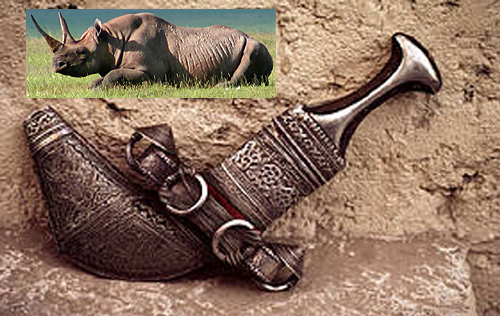
8. Rhino poaching becomes corporate.
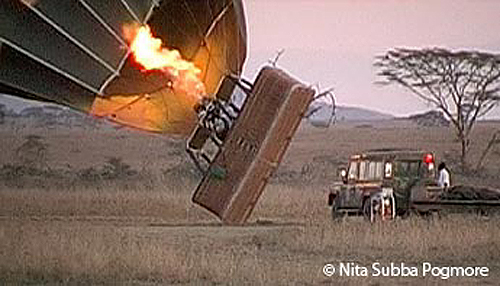
9. Hot air ballooning’s safety newly questioned in game parks.
10. Newest early man discoveries reconfirm sub-Saharan Africa as the birthplace of man.
#1: POPULACE DEMOCRACY GROWS
Theoretically, all the East African countries have operated as “democracies” except for the torrential years of Idi Amin in Uganda. But the quality of this democracy was never very good.
Tanzania was a one-party state for its first 20 years, and that same party continues to rule although more democratically today. Kenya, Uganda, Rwanda and Burundi experienced one dictator after another, even while democratic elections at regional levels challenged the executive.
But the end of the Cold War destroyed the alliances these developing countries had with super powers. Purse strings were cut, and political cow-towing ended. All of them moved towards a truly more democratic culture.
And in 2010 huge leaps were made in all the countries towards more truly representative government. The most important example by far was the overwhelming passing of the new constitution in Kenya in a national referendum where more than 75% of registered voters participated.
And like the U.S. election which followed shortly thereafter, and like support for national health care in the U.S. and so many other issues (like no tax cuts for the rich), Kenyan politicians dragged their feet right up to the critical moment. They tried and tried, and ultimately failed, to dissuade Kenyans from their fundamental desire to eliminate tribalism in government and more fairly distribute the huge wealth being newly created.
I see this as People vs. Politicians, and in this wonderful case, the People won!
And there was some progress as well in Tanzania’s December election, with the opposition growing and its influence today moving that country towards a more democratic constitution.
(It was not so good in Rwanda or Uganda, where stiff-arm techniques and government manipulation of the electoral process undermined any attempt at real democracy.) But the huge leap forward in Kenya, and the little hop in Tanzania, made this the absolute top story of the year.
#2: TERRORISM GROWS
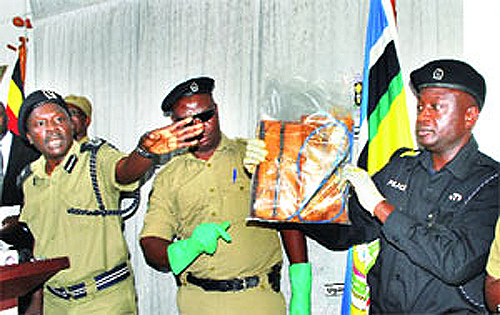
Four smaller bombings in Nairobi’s central business district over the year were eclipsed by two horrible simultaneous bombings in Kampala bars on July 11 while patrons were watching the world cup. Police display an unexploded suicide vest.
Al-Shabaab, Al-Qaeda in Somali, claimed responsibility. And throughout the year Shabaab grew increasingly visible along the Kenyan border as its power in Somali increased.
I’ve written for a long time about how the west has had its collective head in the sand as regards terrorism and Al-Qaeda in particular. Long ago I pointed out that the locus of Al-Qaeda terrorism had moved to the horn from Afghanistan, and this year proved it in spades.
The country with the most to lose and most to gain in this war on terror is Kenya, because of its long shared border with Somalia. And the year also marked a striking increase in the Kenyan government’s war on terror, and with considerable success.
With much more deftness and delicacy than us Kenya has stepped up the battle against Al-Shabaab while pursuing policies aimed at pacifying any overt threats to its security, by such brilliant moves as allowing Omar Bashir into the country and not arresting him (on an international U.N. warrant). As I said in a blog, Kenya Gets It, and the story is therefore a hopeful one.
The Dodd-Frank Act is our victory!The Congo Wars continue but are abating, and in large part because of a little known provision in the Dodd-Frank Wall Street Reform Act which now makes it almost impossible for major corporations in the U.S. to buy the precious metal Coltan on the black market.
A black market which has funded perhaps Africa’s most horrible war for more than a generation. Hundreds of thousands – perhaps millions – have been killed and raped, and more than 20,000 children conscripted into brutal wars, funded by purchases of Coltan and other precious metals by Intel, Sony and Apple.
It certainly wasn’t just this little legislative move. The U.N. peace-keeping force, fabulous diplomatic initiatives by Uganda and a real diplomatic vigilance by the U.S. all were instrumental. But the year ended with the least violence in the region in more than two decades.
#4: SOUTH SUDAN
I may be jumping the gun on this one, because the referendum to create a new country, the South Sudan, is not scheduled to occur before next month. But the runup to the referendum, including the registration process, while labored looks like it’s working.
Allied loosely with the Congo Wars, the civil war between the North and South Sudan had gone on for generations until a brokered peace deal five years ago included the ultimate end to the story: succession of the South into a new country.
The concept is rife with problems, most notably that the division line straddles important oil-producing areas. But in spite of all of this, and many other ups and downs along the way, it looks to me like there will be a South Sudan, and soon. And this year’s new U.N. presence in Juba, donor-construction of roads and airports, all points to the main global players in the controversy also thinking the same.
The creation of a new state out of a near failed one is not the be-all or end-all of the many problems of this massive and powerfully oil-rich area. But it is a giant leap forward.
#5: THE SERENGETI HIGHWAY & TOURISM
Last night NBC news aired a segment on the Serengeti Highway controversy, elevating an East African story into American prime time. Good.
But like so many reports of this controversy, the simplification ran amok. NBC’s reporter Engels claimed the motivation for the road was to facilitate rare earth metals like Coltan (see above) getting into Chinese hands more quickly.
While there may be something to this, it’s definitely not the main reason, which is much more general and harder therefore to fight. As I’ve often written, the highway as planned will be a real boon to the Maasai currently living to the east of the Serengeti, as much if not more than to the Chinese.
And as far as I know, Maasai don’t use Coltan.
Roads bring commerce and may be the single quickest way to develop a region. This region is sorely in need of development and recent Tanzania politics has aligned to the need for this regional development.
The highway is just one of many such issues which came to the fore throughout 2010 in Kenya and Tanzania. Concern that the west is just interested in East Africa as a vacation destination with no regards for the struggle for development, has governed quite a few local elections this year.
The whole concept of tourism may be changing as the debate progresses. I believe very deeply that the Serengeti highway as proposed would hinder rather than help development. But as I’ve pointed out, alternatives are in the works.
And the real story of which the highway story is only a part, is how dramatically different East Africans have begun to view tourists in 2010.
#6: NEW RESOURCE DISCOVERIES ALTER GEOPOLITICS
For years I and other African experts have referred to East Africa as “resource-poor.” Kenya, in particular, had nothing but potash. Boy, did that change this year!
Although only one proven reserve has been announced in Kenya, several have begun production in Uganda and we know many more are to come.
China has announced plans for a pipeline and oil port in northern Kenya at a cost of nearly $16 billion dollars, that’s more than twice the entire annual budget for the Kenya government! Deep earth techniques have matured, and China knows how to use them.
More gold has been found in Tanzania, new coal deposits in Uganda, more precious metals in Rwanda… East Africa is turning into the world’s rare earth commodities market.
A lot of these new discoveries are a result of technology improving: going deeper into the earth. But 2010 freed East Africa from the shackle of being “resource-poor” and that’s a very big deal.
#7: GAY RIGHTS ON THE HOOK
African societies have never embraced gay rights but as they rapidly develop, until now there was none of the gay bashing of the sort the rightest backlash produces in the U.S. U.S. Righties manipulating East Africa.
That changed this year, and in large part because of the meddling of U.S. rightest groups.
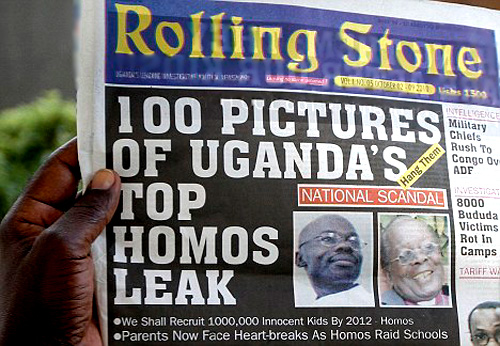
In what appears to now have been a concerted many year effort, support from U.S. righties is leading to a vote in Uganda’s parliament that would make homosexuality a capital offense, and would jail for long terms those who failed to out known gays.
This extreme is not African, it is American. Mostly an insidious attempt by those unable to evince such insanity in their own society to go to some more manipulative place. The story isn’t over as the vote has yet to occur, but it emerged and reached a crescendo this year.
#8: RHINO POACHING EXPLODES
Poaching is a constant problem in wildlife reserves worldwide and Africa in particular. Rhino are particularly vulnerable, and efforts to ensure safe, wild habitats have been decades in the making. Dagger from rhino horn.
This year, they seemed to come apart. It’s not clear if the economic downturn has something to do with this, but the poaching seems to have morphed this year from individual crimes to corporate business plans.
This leap in criminal sophistication must be explained by wealth opportunities that haven’t existed previously. And whether that was the depressing of financial goals caused by the economic downturn, increased wealth in the Horn of Africa where so much of the rhino horn is destined, or reduced law enforcement, we don’t yet know. But 2010 was the sad year that this poaching exploded.
#9: IS HOT AIR BALLOONING SAFE?
Hot air ballooning in Africa’s two great wildernesses of the Maasai Mara (Kenya) and the Serengeti (Tanzania) has been a staple of exciting options to visiting tourists for nearly 30 years. That might be changing. Is it Safe?
A terrible accident in the Serengeti in early October that killed two passengers and injured others opened a hornet’s nest of new questions.
After working on this story for some time I’ve personally concluded 2010 was the year I learned I should not step into a hot air balloon in East Africa, at least for the time being!
#10: EARLY MAN WONDERS
There were not quite as many spectacular discoveries or announcements about early man this year as in years previously, but one really did stand out as outstanding and you might wonder what it has to do with East Africa! Representation by Tomislan Maricic.
DNA testing of Neanderthal proved that early man from Africa didn’t wipe them out after all, but absorbed them into the ever-evolving homin species.
And that absorption, and not massacre, happened outside Africa to be sure. But it finally helps smooth out the story that began in Africa: It’s likely that Neanderthal were earlier migrants from Africa, and absorption was therefore easier, physiologically and biologically.
It’s a wonderful story, and fresh and exciting, unlike the only other major African early man announcement about Ardi which was really a much older story, anyway.
****************
HAPPY NEW YEAR to all my loyal readers, with a giant thank you from me for your attention but especially your wonderful comments throughout the year. See you next year!
How sad that I must discuss the bomb blast in Nairobi yesterday during the holiday season, and yet I fear this will be the norm in the years to come. Over many years terrorists have established that disruption during the Christian holiday is a signature they prefer.
As terrorist incidents go, this was not devastating as have been some. Directed so obviously to local African holiday makers, the bombing was outside an overnight bus scheduled to leave from Nairobi to Kampala at 8 p.m., Monday night.
Bus security actually saved many lives. Four were killed and 41 were injured, but the bus was packed, with more than 30 people aboard. Security was checking the luggage as is the routine outside the bus, which alarmed one of the last passengers boarding the bus which intentionally (or not, we aren’t sure) resulted in his small carry-on exploding.
That bomber was killed. In the mayhem that followed, his companion traveler left the bus and escaped.
During the day, Monday, Uganda issued a special security alert that warns travelers in the country during Christmas to be on the look-out for Al-Qaeda affiliated terrorists. In July Uganda suffered its worst terrorist bombing ever: 79 people were killed in two separate bars as they watched the World Cup.
Uganda has been an avowed special target of Al-Qaeda for some time, as there are more Ugandan soldiers in peace-keeping roles in Mogadishu, Somali, than from any other African country. Al-Shabab (Al-Qaeda in Somali) currently controls about a third of the country and is fighting hard to gain control of Mogadishu.
So it’s unclear whether the two bombers and their packages were intended to explode in Kenya, or were simply transporting weaponry into Uganda when Nairobi security personnel foiled the plot prematurely.
Nairobi’s central bus station is isolated from the city’s tourist hotels. This was clearly not an attack intended against tourists in Kenya.
It’s relentless, this media pursuit of scandal and contretemps. Ahmed Ghailani is innocent of murder and hundreds of thousands of media points in the U.S. explode with the news while I can hardly find a mention of it in East Africa where his alleged evil killed so many people.
What’s going on? Aren’t the East Africans, who watched 242 people killed and 4000 wounded in August, 1998, furious that this guy’s been exonerated?!!
(Oh, has he been exonerated? No, oh, well is he being released? Isn’t he coming for me!!!???)
And it’s not just a simple news story. Every single file is laced with “setback”, “slap-in-the-face” or in the Huffington Post’s words, “mixed result.”
News is not being reported, it’s being made by the reporters.
250 people were killed and more than 4000 wounded in Kenya and Tanzania when U.S. embassies were simultaneously bombed by Al-Qaeda in August, 1998. That’s a fact.
Ghailani was involved, he’s admitted it. There were probably 20 or 30 people involved. That’s a fact.
We know a lot about Ghailani. He was born in Zanzibar at a time that country was being run like a Maoist state, totally closed to outsiders. He was further radicalized in Pakistan, has admitted to delivering information and weapons materials to the embassy bombers, was picked up in Pakistan in 2004 by the Pakistani military and rendited to secret CIA camps before finally being interned at Guantanamo.
His single conviction of conspiracy in the murders carries a sentence of up to 20 years, but so long as the U.S. declares itself in combat with Al-Qaeda, he will be held as an enemy combatant.
So what’s all the fuss about?! This guy is not going to do anybody any harm any more.
The fuss is about making news. I’m not saying this doesn’t rank as news, it just doesn’t rank at the level it’s been and is being reported.
As a member of John Stewart’s rally I was terribly disappointed when Stewart ended a great show on the mall with a poor soliloquy about how the news from every corner is zealous and exaggerated.
Well, in this case, Stewart’s analysis is right on.
This morning I could find only one major mention of Ghailani’s story in East Africa’s media, in Tanzania’s major newspaper and even there it was buried deep inside. The big rags in Nairobi didn’t even print it; it was ladled on-line with Prince Henry’s wedding.
East Africans were the ones killed, maimed and made homeless! Aren’t they furious!?
No. It’s not important news, anymore. Sputnik’s not news. The guy’s spending the rest of his life behind bars and he was a secondary accomplice, anyway.
America has blown out of the rational world a thing of the past. What about the mining scandals in Tanzania? What about the drug lords recently named in Kenya’s government? What about the Al-Qaeda operative just last week arrested by Kenya on its border with Somali?
Why doesn’t America care about this news?
Because it doesn’t sell little purple pills.
It’s beyond me. We command so much technology that has become so competitive for selling the little purple pills that we look for any immediate rush we can find, the reactive word, anything to shock.
Move On, America. You’re being drowned in the past and fired up by little men wanting to sell purple pills. Move On!
A little more than twelve years ago I sat in my room in the Norfolk Hotel and listened to our embassy in Nairobi being blown up. Now, our ambassador at the time says we knew it was going to happen.
Prudence Bushnell, U.S. ambassador to Kenya in August, 1998, listed 8 reasons in a July interview with the Washington Post that contributed to bad intelligence sharing that prevented her from knowing at the time that the Nairobi and Dar embassies were going to be blown up. But it was only last week that she got frighteningly specific, during a radio interview on WBEZ’s WorldView program.
A man walked into the Nairobi embassy in December, 1997, identified himself as a scared Al-Qaeda recruit and said he wanted to warn the embassy that it would be blown up with a truck bomb. (That was how it was done eight months later.)
Dismissed as a “flake” by embassy staff, the man was later apprehended in Tanzania and tried for his involvement in the Dar embassy bombing. He wasn’t convicted, but deported back to Egypt where he’s disappeared.
Bushnell is obviously quite bitter. Her rants and raves against the intelligence service then and now fluctuate between on-point and churlish. But the truth seeps out.
Bushnell wasn’t very good. I remember thinking that at the time, comparing her diplomatic capability to the caliber of binoculars that carry her name. She morphed as a career civil servant into high diplomatic brass when Bill Clinton was elected president.
She was immediately thrust into two failures as Assistant Secretary of State for African Affairs. First, Blackhawk Down, and second, the Rwandan genocide. She complains often viciously of being placed in public positions of prominence, but never being let into the circle of real intelligence that knew she was going to fail. Sort of propped up to the be the fall girl.
Her ultimate excuse for not stopping the African embassy bombings was that the growing intelligence that something was going to happen was buried by the Monica Lewinsky affair.
But cut through her whining and you find some terrible news. There was enough intelligence to stop the Rwandan genocide, we’ve known that for years. But there was also plenty of intelligence to stop the Kenyan and probably Dar bombings five years later; that’s news.
Not only didn’t we learn from our mistakes, but apparently, doomed to suffer them, again.
And let her personal vindication settle out and she describes an America we know all too well: inebriated with its successes, blind to the future.
She accurately explains how the end of the Cold War fooled the government, mostly a Republican Congress, into thinking the world was now hunky dory.
“Many Congressmen didn’t think we needed embassies, anymore,” she claims. So funding was slashed for the State Department.
The 1986 truck bombing of our Lebanon embassy resulted in new regulations requiring all embassies to be off-set from main thoroughfares. Had those regulations been implemented in Nairobi, 224 people would not have been killed and more than 4000 not wounded.
But they weren’t. Because Congress denied the funds.
I think it’s important that we keep in mind this happened during the Clinton administration. I’ve always been skeptical about his popularity. Today, he’s championed as the democrats White Knight, saving Obama from himself.
But my feelings about Clinton have always been tainted by his failures in Somali, Rwanda.. and now, apparently, Kenya and Tanzania. The guy oversaw an exploding domestic economy and did implement a few home policies that seemed progressive.
But he was a failure when it came to intelligence and was unable or unwilling to correlate these failures with the growing threats to America, much less the world as a whole.
So long as he could get top billing with Jay Leno for wiping out welfare services, Clinton seemed pleased as puddin-pie as the world was being subsumed by Al-Qaeda. Bushnell claims that the Clinton Administration considered Nairobi a “backwater” not worth paying any attention to.
After wards, Clinton became a real Afrophile, apologizing profusely for his negligence in Rwanda and throwing untold millions into East Africa, almost as reparations for the bombings, implying if never saying, “If Only I’d Known.”
And in that context, Bushnell comes right out of his mold. Capable of complaining and apologizing, she nevertheless reflects blame elsewhere.
Later this swirl of evil hits the Twin Towers. We now know that Bush II also ignored important intelligence, thrust the world into wrong wars in reaction and probably never read John Le Carre.
Has this ostrich head in the sand ended? I hope so, but just for insurance I think I’ll trust Kenyan diplomacy over American diplomacy when it comes to dealing with Al-Qaeda.
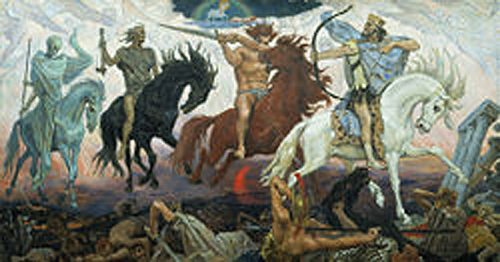
To end terror we've got to deep-six these four guys.For travelers like us terrorism is nothing new. And it’s well past the time that we should lead our fellow Americans into a fuller understanding of what it means and how to minimize it.
If you can’t stand reading through the rest of my poorly constructed nonsense, just jump to the bottom of this for MY SOLUTION.
The penultimate word in the first paragraph is the key: Minimize. Terrorism will never, ever go away. It never has. Pagan potentates enslaved tasters to eat their food, first. Famine and pestilence were certain outcomes for any misbehaving early Christian. Spies stole children from critics of the gulag. Salman Rushdie, and many of his family and friends, have remained in hiding since the 1989 fatwa ordering his murder.
And leaping into the present, Ugandan citizens are so terrified of the proposed laws against homosexuality, that as many gays may be fleeing the country today as Asians who were ordered exiled by Idi Amin in the 1980s!
By the way, know a Mexican in Phoenix?
1. TERRORISM IS NOT NEW
The first and most important point. And it should not be as powerful news as it is, today that there’s terrorism.
Every time the nightly news headlines a terrorism warning, it’s presented as something remarkably unexpected. Every single night the news is filled with mayhem, war and killing, but a terrorism “threat” elicits greater shock.
Because the mayhem, war and killing was not about you. And because the threat is simply that, something that hasn’t yet occurred and so isn’t yet fully defined, so it might involve you. Suddenly, you’re in the news.
And when it doesn’t happen, or does and doesn’t happen to you, then you recycle your psyche to be just as shocked at the next news broadcast of potential terror featuring you. Americans are all hams and gluttons for punishment.
I hate to tell you, but terrorism is just as ordinary an occurrence as hurricanes, lightning strikes and your regular ole every-year airplane crash over Rochester. It’s a part and parcel of our lives.
2. TERRORISM IS NOT MORE POWERFUL TODAY
Don’t give me that baldersash that yes, there’s always been terrorism, but not with the power of airplanes or nuclear weapons.
How many died in the halocaust? How many ships were sunk by kamikazes? How many specific terrorism deaths in the Balkans, or during the many years of conflict in Northern Ireland? How many are still being raped and decapitated in Kivu, The Congo, or Somalia? How many airplanes or nukes would it take to reach this sum?
That is not to say that the methods of terrorism haven’t changed. As the world is more interconnected, all the good and evil within it move further and more quickly. Terrorism in our generation has adopted a travel component that it didn’t use to have it, and that’s the reason we as travelers are more attuned to it.
1985: the Achille Lauro cruise ship hijacking
1985: hijacking of TWA in Cairo
1988: Pan Am disaster over Lockerbie
1996: Atlanta Olympic bombings
1998: American embassies bombed in Kenya and Tanzania
9 -11
2005: 7-7 city bombings in London subway
2008: Slaughter in Mumbai
All the above specifically and successfully targeted travelers on airplanes or tourist hotels, or used travelers to get to their target. There were scores of other unsuccessful attacks like the shoe- and underpants-bombers. That’s a generation and counting of terrorism redefined to some extent by travel.
3. MOST MUSLIM TERRORISTS ARE NOT IDEOLOGUES, JUST WELL PAID
This nonsense that Mideast suicide bombers are half wits who believe they are tending roses in heaven is more baldersash. It just drives me crazy. THEY GET REALLY WELL PAID!
They are completely unlike the long history of soldiers who went into battle for ideological and religious reasons expecting to die fighting.
The most recent ideological suicide soldier was the kamikaze. And the phenomenon did not begin until the loss of Iwa Jima, after which rational people, including well trained Japanese soldiers, knew there was no hope. Read this for a thoughtful explanation of soldier ideologues.
There have been thousands of reports like the ones above corroborating that today’s suicide bombers in the Mideast do it mostly for money, not mostly for their soul or honor, and yet leave it to Americans to twist this around. This fundamental mistake is something the rest of the world doesn’t make.
This account of suicide bombers as relates kamikazes is accurate, but totally inaccurate regarding current Muslim terrorists. It’s typical of the American Right’s, mostly religious, repositioning of facts. This casts a simple proposition, that Muslim suicide bombing can be valued in dollars, into the heavenly worlds of moral conflict making it much more difficult to deal with.
This is because the current conflicts in the Mideast are all economic ones, not ideological ones. Virtually all the major conflicts on earth have been economic and this is no different. The people with more power need oil currently lived on by people with less power.
This is a tough situation and I don’t mean to belittle it in any way. I don’t think it’s clear that we as the people with more power shouldn’t have equal or more rights to the oil than the people who live on top of it. But that’s a different problem, one with a different analysis.
By redefining an economic problem into an ideological or religious one, the arguments are driven less by facts and much more by emotion. And ultimately the only way to win an emotional argument is to be more fanatic.
Please watch this. It’s heart wrenching. Sunday’s “This Week with Christiane Amanpour” stripped our current conflict to its reframed religiosity. And it’s so clear there’s no resolution in sight. So long as religion dominates the perspective, this war will never end.
4. THE CERTAIN WAY TO LOSE THIS WAR IS TO INCREASE THE FIGHTING
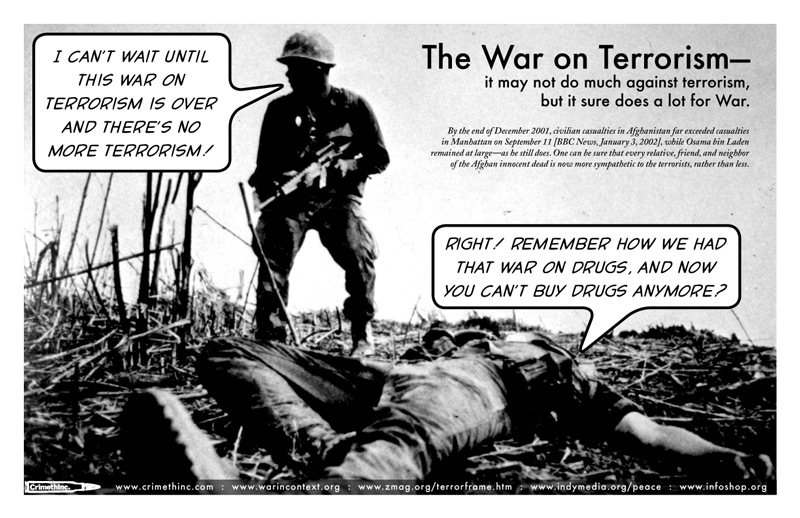
“War Against Terrorism” is as inappropriate a phrase as the “War Against Drugs” or the “War Against the Lunacy of 13-year-old Boys.” The real war today is a “War Against People Who Live Over Oil They Won’t Give Us at a Fair Market Price.”
It has been the longest war in the history of the modern world. It began when Edwin Drake extracted the first black liquid from Pennsylvania in 1859. The war really heated up when most of the world’s known oil shifted out of Texas and Oklahoma to godknowswhere deserts in the Mideast only about 50 years ago.
It was sometimes a military fight, but mostly a cultural and diplomatic one. We violated all sorts of our own values in this campaign to annex land for ourselves and our European partners so we could have its oil. We bribed, applied our laws to theirs, fixed markets, we tried everything possible until finally, we had to shoot.
And during this lengthy fifty years or two generations, the poor souls living over there noticed how fancy the cars were that were using oil. Before iPhones that was a bit more difficult, but now you can send a picture of a Dodge Ram all over the world in seconds.
We got richer. They got poorer. We got richer because of their oil.
Doesn’t compute, does it?
What would you do, a young, yet vibrant desert youth whose abs haven’t been yet emaciated for lack of proper nutrition? You watched your grandfather and your father die loathsome deaths mostly from smoking Philips cigarettes. And then with your iPhone, you saw what’s under your home made Jenny the prettiest, richest homecoming queen in the world. How come you can’t wear a carnation?
Today’s terrorism is fire. It’s the fire in the soul of two generations of Mideasterners mostly being denied their rightful development.
Terrorism’s fire is fueled by desperation, wont, poverty. What else can you call a suicide bomber? Don’t fool yourself that they all think they’re going to paradise. This is a very attractive job.
Terrorism must be watered down, not fired up. Terrorism will decline only as the desperation in the world declines, and not a second before. Until then, it will increase, and for those of us fortunate enough to not be so desperate, it will be something effecting our lives …always.
JIM’s SOLUTION TO ENDING THE CONFLICT WITH RADICAL MUSLIMS
It’s kind of hard to do this, because the numbers just won’t stay still:
Anyway, let’s give it a try. During my final edit this morning, the number was One Trillion, eight-nine billion, seven hundred and twenty-four million, one hundred and sixty-five thousand, eight hundred and thirteen dollars.
It’s been three thousand, two hundred and eighty-five days since we invaded Aghanistan on October 7, 2001.
That means, roughly give or take a few cents, we’ve been spending
$331,727,295.50 per day.
Now the area of Iraq and Afghanistan is 426,034 sq. miles. So if we divided how much we’ve been spending per day, that means we’re spending $778.64 each day on every square mile of those two countries.
Now if you don’t mind, I’m going to reduce the $778.64 by about one four-thousandths of a penny, one four-hundred-thousandths of a dollar so that my wife’s favorite local state historical site, the Apple River Fort, can be kept open, which has faced possible closure for budgetary reasons.
That leaves $778.64 available each day for every square mile, which I would bundle up in cheerfully wrapped packages using Halliburton‘s Christmas Wrapping Division, and then drop from a helicopter. Over the course of a year, that’s roughly the salaries of ten suicide bombers in each square mile, or in total, way more than whatever total has ever been paid to all the suicide bombers in the history of mankind.
The weekend terrorist alerts issued for Europe are the most extensive and serious in history. What should we do? Personally, nothing.
The best intelligence suggests a coordinated terrorist attack is currently playing itself out, right now. The media is reporting that the plans include something akin to the 2008 Mumbai slaughter where pretty good suicide gunmen fanned out across a city center shooting madly, throwing incendiary bombs.
It’s a race between implementation and prevention. But it’s not easy anywhere in Europe, any more, to pack a weapon and go into a populated area. It’s not even easy to get a weapon, or ammunition… as it is in the U.S.
Alerting travelers and residents alike, there will be more eyes and ears to report unsavory activity. It will increase the chances that nothing will happen.
But shouldn’t I advise you to “just wait a while?” Let things cool down? Sure I could, and so could the terrorists wait a while. (Or following a dreaded success, they could claim another is imminent.)
Don’t exaggerate our own government’s announcement. It’s an alert, not a warning. Were it a warning, I might argue differently.
The risk of being hurt by terrorists in Europe, now, is worth the risk of any travel you have arranged. It’s time for the frequent reminder of the threats you and your children face crossing busy city streets, driving on an interstate, or injuring yourself while playing sports.
All of these are greater than you being hurt soon by terrorists in Europe. God forbid, even if it happens, as car wrecks happen every minute. There’s not the slightest indication, for example, that the target relates to travel or airports, any more than it does to pubs or hotels or hospitals or malls. All that we might surmise is that it is planned for areas with lots of people.
The counter I often hear is that crossing the street, driving, working out, are all essential to your daily lives, but that vacation travel isn’t.
We can just stay home, the argument goes. We don’t have to travel.
For those of us fortunate to have the means to travel, we probably also have nice homes and comfortable life styles that to many may now seem a safer alternative. Five hundred cable channels and sixty types of potatoes chips with three nearby pizza delivery services. And as soon as we nuke all the deer in our city parks, we won’t have to worry about tick fever, either.
It’s precisely because Americans have so insulated themselves from the outside world that we started the wars in my life time that I believe have led to the current level of terrorism. We’ve painted ourselves into a corner, and it’s a very tiny, self-contained corner.
About a third of all American travel is to Europe. Nearly a third of that is by Americans who will never travel anywhere else except on a cruise.
Please, enjoy Europe, now. A life in a box isn’t worth living.
Is it safe to travel in Uganda, now?As we were traveling from the Entebbe (Uganda) airport late last night, the first topic we discussed was “security.” Security against a catastrophic 9-11 is better in Africa than at home.
My first clients, the Pomerantz family, (Roger and Cathy Colt and son, Daniel) remarked first that they had recently been to Egypt where it seemed like security was nonexistent. And I told them a very funny story that just happened to me in Nairobi.
I was at Gate 3 of the Jomo Kenyata? airport, the basement gate, which sends off 3 or 4 late night flights more or less at once, so in a waiting area that is always jammed. To get into this waiting area you have to pass through “security” – a metal detector.
A novice traveler to be sure, a very small (possibly Twa) Ugandan dressed in finest Sunday clothes was having great difficulty getting through the metal detector and to everyone’s irritation was holding up the line.
Each time he tried to go through, the red light beeped and security officials ordered him to return and try, again. He’d empty his pockets. Beep. He took off his belt. Beep. He removed what looked like a medicine ID tag. Beep.
Finally, the security official pointed to his highly, thin-toed black polished shoes. He took them off. Beep.
This time we knew why. He took them off, but he held them in his hands as he walked through for the upteenth time, and of course the detector beeped. The other items he had removed he had carefully placed in several of the big pockets of his Sunday dress coat. Which he didn’t remove. Beep.
The security official, finally realizing only moments after the rest of us did what was going on, laughed uncontrollably and waved the gentleman through. Beep. Last beep, though. No enforced retry.
No threat, either. Some of us get through when we don’t beep. Others – like this gentleman – when it’s just obvious he’s no threat.
Until this month, there was little to terrorize in poverty-stricken, weather forsaken, economically oppressed Africa.
A decade ago it was different. I was in Nairobi on August 10, 1998, when the American embassies in Nairobi and Dar were blown to smithereens. But every American embassy in Africa is now a fortress of unbelievable magnitude. Can’t bomb it, now.
So terrorizing sufficient numbers of westerners has become problematic. And … until recently .. there was no point in terrorizing nonwesterners.
A couple weeks ago more than 70 people were killed in the Kampala bomb blasts. That’s where I am at this moment as I write. But the bombs were meant for westerners. Al-Shabaab (Al-Qaeda in Somalia) expressly said it was targeting Ugandans.
Things have changed.
The Ugandans were targeted because they are the lead in an OAU military peace-keeping force in Somalia that Al-Shabaab is fighting.
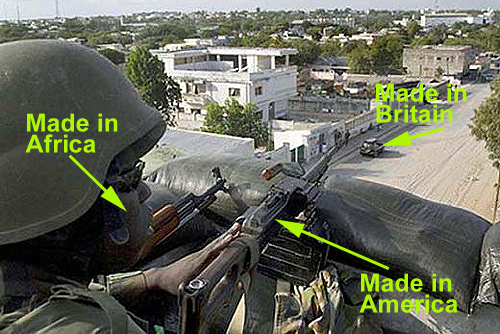
The OAU military force is being exclusively outfitted by the U.S. and the UK.
Clever Obama. Our proxy wars have begun, again.
Huge and terrible wars, with thousands and thousands of casualties and untold destruction occurred during the Reagan years in proxy wars between Ethiopia (Russia) and the Somalia (U.S.).
Russia, despite all its other misfortunes and missteps, has bowed out of these miserable controversies. Our adversary is no longer a Super Power. It’s a terrorism organization. “Cold War” is now the “War on Terror”.
Terror only works when the recipient can be terrified. The Twa walking through the metal detector creates humor. Our military-industrial complex descending on Somali – oh so cleverly – creates terror.
Guns from the UK, Guns from America, and bodies from Africa.Tuesday Congress gave President Obama additional emergency funding for the war in Afghanistan. But the real new news is that America and Britain are beginning a new war in Somalia.
This was a week where terror succeeded. It began with the Al-Shabaab (Al-Qaeda) bombings in Kampala, which like 9/11 are intended to provoke. Terrorists know they are militarily inferior, but if they can provoke the militarily superior to come to them, they can win.
Nine-Eleven did just that. It provoked the U.S. in a multi-trillion dollar response that hasn’t ended yet, and judging from Obama’s increasingly hawkish ways, won’t end at all soon.
The powers of the world just don’t get it: no matter how powerful you may be, you can’t beat the joker on his own turf.
By diverting resources away from eliminating poverty, or malaria, or child soldiers… despicable culture centers like fiendish jihadism flourish. These weirdos survive on misery. But we can’t try to end poverty, or malaria or child soldiers… because the resources that would be used are being used instead to buy guns.
So the bad guys at whom the guns are pointed and who want the poor to stay poor so that they can be elevated as the poor’s protectors, win.
It’s weirdly impractical, but if we’d just schedule regular drops of thousands of dollar bills over Helmand Province or Basra, rather than delivering guns to shoot one another, there’d be no terrorism left. And it’d probably cost a lot less.
And this enigmatic neurotic dynamic of World Powers has infected every single American administration, Republican or Democrat, since my birth.
And what I worry about, now, is Africa.
Africa has been mostly immune from this aberration of modernism, because only lately has its resources become so important. Yes Zambia had copper, and yes, South Africa had diamonds and gold, and yes Nigeria has oil, but not enough, or too deep, or too cheap, or too hard to get at.
But gold is five times the value it was ten years ago. Oil extraction technology is way superior to what it was before, and the thirst for oil especially from China and the U.S. is unbelievable. Copper is an old element. But Coltan is desperately needed by every cell phone and it’s in The Congo and Rwanda.
So enter Africa into the Modern Age: Prepare for battle.
So America called on the Organization of African Unity (OAU) to beef up its troops last week to fight Al-Shabaab in Somali. The OAU asked America for guns. We’re giving them big time.
Yesterday, Kenya’s security chief, George Saitoti, asked its mother colonizer Britain for “support” in fighting al-Shabaab.
Britain’s new conservative Minister of African Affairs, Henry Bellingham, said he was “delighted” to help.
“Al-Shabaab is a threat to all other countries including the UK (United Kingdom)”, Bellingham said, raising his China teacup to new heights.
Since I was born in 1948 just after World War II, the U.S. has spent more money on wars than any other single service for me or my fellow citizens, if you dare call “war” a service.
Korea, Bay of Pigs, Vietnam, Granada, Panama, Nicaragua, the Balkans, Gulf, Iraq and Afghanistan and that doesn’t count the “Cold War” expense of nuclear armaments or troops and bases in Europe.
America in Africa...or...China in Africa?The U.S. is finally realizing that Somali is the center of the world’s “War on Terror.” And so now we’re all ready to do exactly the wrong thing. Again.
I’ve written often — and spoken in public — about the growing power that Al-Shabaab has in Somalia. Al-Shabaab is Al-Qaeda in The Horn. Western preoccupation with Al-Qaeda in Afghanistan and Iraq has allowed them to spread and regroup into the Horn of Africa.
Al-Shabaab has been fighting along Kenya’s long northeastern border with Somalia for more than three years. Much of this has been hit-and-run, kidnapping and petty theft of food and military equipment, but more and more the gun battles with Kenyans begin to assume real engagement.
Al-Shabaab claimed responsibility for Sunday’s bombings in Kampala. That seemed to do the trick: The U.S. has finally noticed.
First we heard from General William Ward who heads the U.S. Africa Command, that the U.S. would increase its military support to the TFG in Somalia. (Transitional Federal Government).
Then, a much more elaborate policy was detailed by the U.S.’ main diplomat in the region, Johnnie Carson.
I don’t like what I’m hearing.
What I’m hearing is that the U.S. is going to step up its military aid while lecturing a weak and futile puppet Somali government that it “should do more” for its people.
Here are my excerpts from Carson’s interview with All Africa published, today:
“I think [military assistance] is the correct policy… We have provided [Uganda & Burundi soldiers in Somalia] with military equipment… We have supported the training of TFG forces…We have supported specialized training in dealing with improvised explosive devices and training for the protection of ports and airports… There is no question that the TFG has to do more than it’s done in the past….
“We have not done enough on Somalia, which, for far too long, has been the subject of benign neglect by the United States…Given the magnitude of the problems …now is the time for the international community to recognize that this problem will only get worse for all of us if we do not come together to find a solution.”
Military assistance is NOT the correct policy. Providing military equipment and training to Ugandan soldiers who are famous for raping and pillaging in The Congo is NOT the correct policy. The TFG is an useless entity. We should NOT support the TFG.
I like Johnnie Carson, and I more or less like the Obama administration’s overall foreign policy, but they seem stuck in American imperialism. It’s just so dastardly how good guys get corrupted by power. I wonder if we elected Mahatma Ghandi U.S. President if he would then start new wars that we’d lose.
My lifetime has been characterized by failed U.S. wars and failed U.S. policies that I see as contributing to if not outright causing world terrorism.
Bruton’s formula is not new. Learned men have been espousing active, nonmilitary engagement in troubled parts of the world for decades as the ONLY solution to the world’s instabilities. We just don’t seem to get it.
Military action by a foreign power cannot eradicate a local guerrilla force. Period.
Military support of puppet regimes put in power by outside foreign powers is a black hole. Period.
Puppet regimes don’t last. Period.
And the most salient point is that the cost of military action is dozens if not hundreds of times greater than nonmilitary assistance.
In today’s Africa China’s got it right and America’s got it wrong. China is spending billions on roads, resource development and city planning. The U.S. is, too, but many more billions on military.
China’s spending on African military? 0. Zip. Not a penny.
I don’t mean to frame this as a contest between China and America, I mean to point out that China’s got policy orientation right and is contributing to African development. And that America’s obsession with military will destroy African development.
We must end our roles as policeman, schoolmarm, parent and pastor for the rest of the world. We can perform a role as a benefactor, but no longer as a soldier.
Police display the unexploded suicide vest found in Kampala.Ugandan police gave indications, yesterday, that Al-Shabaab plans further bombings in Kampala next week during the OAU conference.
I imagine that several Heads of State who had planned to attend will not, now, or will greatly reduce their stay. In this regard, the Sunday bombings would have achieved their objectives, so further disruption wouldn’t be necessary. But:
Next week is not a time to visit Uganda. Wait until the conference is over July 28.
The OAU is the main body controlling the Somali peacekeeping forces in Mogadishu, and Uganda is the largest single contributor to that force. The OAU mission supports a weak Somali government being contested militarily by Al-Shabaab.
Ugandan police announced the arrest of Wasswa Nsubuga just outside the city yesterday and claim that he was carrying documents describing how to create 19 different types of bombs. He is an Ugandan who two years ago returned from Iraq where he had been working as a security guard. He currently works as a security guard in Kampala for a supermarket.
In his defense, and with credit to the police, Nsubuga explained to the press in a prepared statement that the documents he carried had been given him by his Iraq employer as a way of educating himself of the threats of terrorists.
But there were other Ugandan government actions that also suggested heightened concern as delegates to the OAU begin arriving, Saturday.
Police and military are visible everywhere from Entebbe to Kampala, brandishing large machine guns. Virtually every city hotel now has intense security, with under-body car checks made outside parking areas, and metal detectors being rushed to hotel entries.
Most of the larger shopping centers have also employed new, visible security measures.
But the most visible change has been at the airport at Entebbe. Check-in now takes about 4 hours, with multiple checks by Ugandan government officials followed by private security checks from the individual airlines.
My fingers are crossed for the Ugandans next week. On the one hand, the event now having occurred, it seems unlikely more could happen. But the clear and stated target was the African forces from the OAU now in Somalia, and their annual conference begins Saturday.
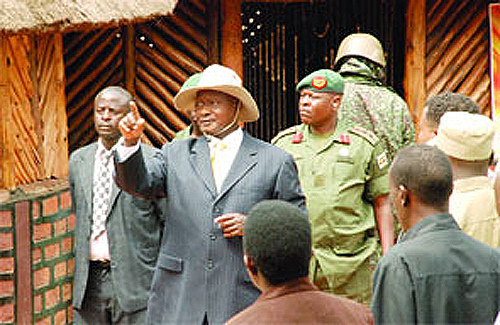
Uganda President Museveni at one of the bomb sites.The suicide bombings in Kampala Sunday night are not an escalation, but a continuation of the terror the world has always suffered.
In the midst of this recent horror, it’s critical to realize that terrorism is a part of our ordinary lives. Americans have this subconscious absurd notion that there wasn’t terror before 9-11.
Yet we remember with grief and horror:
A generation ago when in one year, 1985, the Achille Lauro cruise ship hijacking and the hijacking of TWA in Cairo. Three years later, the Pan Am disaster over Lockerbie. 1995 was the horrible Oklahoma federal bombing by Timothy McVeigh, followed a year later by the tragic Olympic bombings on July 27 during the summer Olympics in Atlanta. Two years later the twin bombings of our embassies in Nairobi and Dar-es-Salaam. All of these preceded 9/11. And, of course, it didn’t stop: then the Smiley-Face mailbox bomber on May 9, 2002.. On July 7, 2005, the infamous 7-7 city bombings in London when 52 people were killed during rush hour.
And this doesn’t even begin to list the IRA/British terrorism, the terrorism in the Balkans, Palestine, South Africa, the thousands killed in Argentina terror….
What’s the point in this list? This list of hurt and suffering?
There are wicked people out there, and always have been. But modern technology has empowered them in ways never experienced before our own life times. And this isn’t just the technology of weapons; the technology of faster communication is just as important.
Messages transmitted and then acted upon by wicked destruction. This is a late 20th and 21st century phenomenon.
Americans may think they have suffered one of the most grievous of the attacks, but that could be because we just have more of the larger things to attack. The whole world suffers from terrorism.
And right now, Americans’ response is wrong.
You cannot fight terrorism with a military. It just won’t work. Britain’s arduous and troublesome approach to Northern Ireland seems to have worked, but it takes a patience Americans don’t seem to have, and a memory of history most of us were never taught.
And the Argentinian’s solution also seemed to work: and that took a generation. And the South African’s worked: and that took forgiveness.
The solutions to terrorism are patience, forgiveness, sensitivity to why the wicked have become wicked and attempts to remedy the social negligences from which terrorists arise.
That’s a long and tortuous path. But such a hazard if we just think we can resort to the gun.