Kill ’em or Tease ’em!

Kill ’em or Tease ’em!

South African Solutions
The impenetrable bulwark of South African anti-poaching efforts has collapsed: an “epidemic” of Rhino poaching there has evoked a response rivaling any PETA position here at home. Kill them. (The poachers, that is.)

South Africans aren’t ones to mince their chew. And it isn’t just that outdoorsman independence and fierce loyalty to the wild. Before the economic downturn this goliath of African economies was surging, and tourism had surged within from 4.6% of GDP to 8.3%.

Consider this as a reference on the importance of wild and tourism and animals in South Africa, compared to our dear safari countries in East Africa. Nine times as many tourists to South Africa in 2007 as in all of East Africa contributed to South Africa’s GDP just a few billion less than the entire economies of either Kenya or Tanzania!

So it is not just that rhinos in South Africa are endangered but that a big chunk of the economy is endangered.

I wrote earlier this year about the horrific plot by farm managers in South Africa to butcher rhino for the black market. This week the International Rhino Foundation reported that 289 rhinos had been poached in South Africa so far this year, “the highest in more than 100 years.”

Within South Africa, the phrase now circulating is that a rhino is poached there every 30 hours.

Local farmers, tour managers and environmentalists have reacted with what I consider hysteria. The blogosphere is filled with calls to execute the many alleged poachers currently in custody. In typical political cow-towing to the reaction, today in South Africa’s Parliament, the Minister of Justice was charged with dropping prosecution against known poachers.

(The Government hasn’t dropped the investigations.)

False equivalences are flying. Rhino owners are citing government expenses, for travel of diplomats and other officials for example, as funds misplaced that could be used for stopping the poaching.

But the most outlandish reaction appeared last week. The owner/founder of a game reserve near Johannesburg told a local news outlet that he was considering injecting cyanide into the horns of his rhino.

Ed Hern said, “We wanted to inflict the same kind of suffering our animals had to endure on anyone involved in the vile activity of poaching.”

“We began researching the possibility of poisoning our rhinos’ horns, so any individual who knowingly handled or consumed the horn would either become seriously ill, or even face the risk of death.”

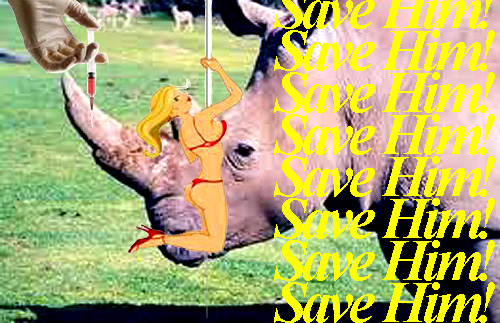
South Africa never does anything half way. Today a strip joint in Joburg pledged 50,000 Rand (about $8,000) from its take this weekend.

This is hysteria…cal.

A single rhino horn now commands up to $10,000 on the black market in South Africa, before it’s sent usually to Asia. South African officials are pretty much in control of at least understanding what’s happening.

The World Wildlife Fund with the government’s blessing has organized a special unit to deal with the upsurge in rhino poaching in South Africa.

WWF and South Africa, for instance, have identified Vietnam as the main market. They’ve identified a new belief there that powdered rhino horn cures such ailments as cancer, as modern diseases emerge in what was a non-modern society.

One hysteria leads to another.

There is also no doubt that the global economic realignment that started several years ago is devastating tourism in Africa. Even while African countries are doing extremely well relative to the rest of the world, tourism within those economies has been hit extremely hard.

No better poaching expert than men who were laid off from anti-poaching patrols.

The upsurge in rhino poaching in South Africa is terrible. And it’s real. But killing or teasing the killers won’t solve the problem.
Hot Cocoa is Pure Kaka!

Hot Cocoa is Pure Kaka!

Roibos Tea! Owned, Discovered by Nestle!
The thousands of little kids like me sent to a freezing winter bed at night with a steaming mug of hot cocoa now have to contend with the fact that their benefactor is one of the most thieving, villainous multinationals in the history of the world!

Nestle (which is now as most things in the U.S. owned by foreigners) is quietly trying to become the global owner of a plant that has grown wild and free in South Africa for as long as there have been bushmen: Roibos.

Or, as properly spelled in South Africa, Rooibos.

Rooibos as a live thing is not attractive. A field of them before they begrudgingly bloom once annually for 5 or 6 seconds looks like a microscope’s eye view peering into the netherworld of bacteria: a bunch of smallish thornless cacti covered with soiled socks.

And whatever truly living thing ever thought of consuming it obviously was climbing a wrung in human evolution. Most things won’t touch it.

I was first introduced to Rooibos when I was working in South Africa in the early nineties. After my first cup of Rooibos tea I felt that I was joining apartheid in a certain death.

But strangely, joining Marmite and Vegemite as healthy food that kids love at first taste, my suitcases coming home were filled with Rooibos tea for my son and daughter.

It took me about 20 years and a genius move by my local grocery store to add ginger to the brew, and I, too, now drink Rooibos. It’s all over America, now. Usually called “Red Bush Tea.”

(Calling Rooibos “red” is like calling the goo left on a wildebeest carcass before the vultures get it red.)

But enough personal ughing.

Rooibos is actually Good for the World. And Nestle has requested an international patent on the organic molecule that makes rooibos Rooibos and it’s found nowhere else on earth!

This is biopiracy and rape in its highest form.

South Africans of every disposition and color have been benefitting from rooibos for hundreds of years. The plant grows only in the Cedarberg Mountains of The Cape Peninsula. Scientifically known as fynbos.

South Africans believe that it can cure acne, slow ageing, inflammation and hair loss, and alter the course of your investments.

Except for the last attribute, the others are explained by rooibos’ explosive antioxidant, Aspalathin. “Most scientists believe the property is available only in the rooibos plant,” writes South African Khadija Sharife who first reported this story in the South African press.

Sharife writes in the current issue of Pambazuka that Nestle has applied for five 20-year patents claiming that it – the multinational – is the “discoverer” of how to extract Aspalathin, and several other molecules from rooibos and a close cousin, the honeybush plant.

And here’s the real affront. Nestle, a Swiss corporation, is not applying for the patent in South Africa, but in Switzerland!

And the Swiss patent office has the authority to issue patents that achieve instant worldwide global enforcement, including in the U.S.!

Sounds absurd, doesn’t it? But there is a wave right now of multinationals trying to patent biological agents, like molecules, all a seeming natural progression of the patent process of genetically altered agriculture.

Fortunately, this little end run on The Cape has been revealed. Natural Justice in South Africa, a South African based not-for-profit got on to the theft and has gotten the South African government involved.

It may not be enough. I for one can understand why no one wanted to patent Rooibos, but I guess we should listen more carefully to our kids. No one has tried to patent Rooibos before. Nestle is the first. That seems critical in the Swiss decision.

So Nestle is reported ready to fight South Africa in Swiss courts for a Cape plant.

What next? Kaka?

How Much for Censorship?

How Much for Censorship?

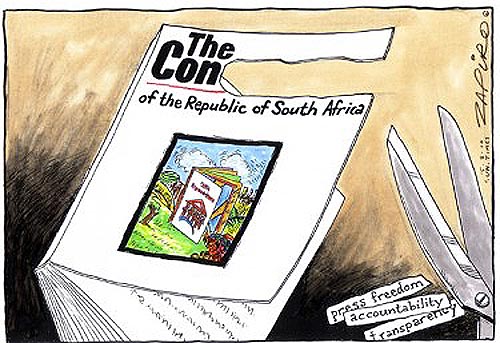
Will the proposed censorship law destroy South Africa?
Crippled and cowering, the South African government is shifting its attention onto the country’s media after essentially provoking then losing the devastating public service strikes.

South Africa’s problem at the moment is that it’s exhausted. Can hardly blame it. The current political framework is less than 16 years old, it keeps chugging along with an economy about 20 times bigger than all the rest of the countries of Africa combined, the divisions between its rich and poor get larger, and a private capitalist economy keeps fighting with socialist leaders.

Everyone on all sides had hoped that a successful performance of the World Cup would somehow have made roses bloom and smog go away. To be sure, an unsuccessful performance would have been dire, and kudus to the government for taking the dare.

But attention to the World Cup was a distraction. Apartheid was the ace capitalist tool. By sequestering rights and setting boundaries among populations, markets were more easily defined then exploited. Wealth was much more easily created, albeit by excluding the majority.

So this is to be sure an incredibly daunting situation, now that the majority is in power, even while the majority knows it can’t just divide the existing wealth without so diluting the economy that it immediately evaporates into the African thin air.

So it’s understandable that this society wants to retire to bed with a plaster.

But a much more serious distraction than the World Cup is now besetting this enervated society.

Press Freedom.

Frankly, I think press freedom is overrated, today. Even in societies with thousands of years of censorship, like China, the news gets out. You simply can’t stop every cell phone, iPad and their partner electrons from zapping around.

Don’t get me wrong. When the battle lines are drawn, I fall squarely with the blobbers. (Sorry, is that blogger or blabber?) I’m just trying to point out that… it’s a distraction.

The proposed “Protection of Information Bill” has not yet passed South Africa’s parliament. It is a bill – with similarities to Kenya’s press control bill passed last year – that in its purest form would punish lying or revealing government secrets.

Of course, that’s the problem. One person’s lie is another’s truth. One person’s secret is another person’s redemption. This is not to say a lie is a truth, or that governments don’t have rights to secrets, or vice versa, just that there are a lot of malicious and ignorant people out there who believe lies and would misuse secrets.

And protection of their right to be stupid seems inseparable from pure freedom. And so it is.

South African leaders have been so quirky and so beleaguered by scandals that it’s quite clear that the law is as much intended to stop the whistle-blowing as it is to keep a fragile society from being rocked apart by lies or taken down by being stripped buck naked.

And so the fight begins anew with this session of Parliament. The original legislation has been softened, a “tribunal” of mediation proposed to define the parameters when previously it was the government itself, but Cry Freedom has lost its resonance.

It would be a mistake to pass this bill. And it may pass because the real problems besetting this ailing country seem insoluble, whereas controlling the press seems so much easier. Passing it is neither going to end press freedom in South Africa or stop journalists from finding out who Jacob Zuma’s next wife is.

South Africa didn’t fare very well in the actual World Cup matches. But it pulled off the event just fine.

South African Cartoons

South African Cartoons

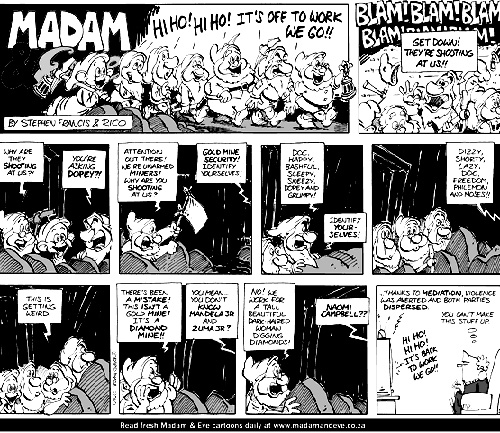
Yesterday’s popular cartoon, “Madame & Eve”, in Johannesburg’s Daily Mail: Naomi Campbell is a SA supermodel who gave blood diamonds to the head of a SA children’s charity, who hid them in his home safe for 13 years before admitting it.
After a stellar performance during the World Cup, the turning fortunes of Jacob Zuma make many of us wonder if the South African presidency will be forever filled by wackos.

South Africa pulled off the World Cup like any grown up country; in fact, better. Infrastructure nightmares, mass strikes, insidious crime waves – didn’t happen.

Now it looks like it’s happening, and what we thought was Zuma’s deft handling of his country may just have been his ability to stick a very large finger into the hole in the dam.

Today is the tenth day of a national strike which threatens to bring the country to a standstill. Schools, hospitals, social agencies and even part of the President’s office are on strike. Late yesterday even the military threatened to join the walkouts!

Workers’ grievances have coalesced into a single demand: an 8.6% basic wage increase and a $130 monthly housing allowance. Zuma dug in his heals at 7% and $100.

So the difference isn’t that big; nowhere near as big as Zuma’s ego.

Zuma is best known as the president with twelve wives. That social embarrassment, though, was eclipsed recently by the revelations that Zuma’s family has profited from questionable government mining leases.

Now with twelve wives Zuma’s family extends over large parts of South Africa, but it’s a principal son who is principally involved this time.

This scandal follows Zuma’s pet legislative agenda this season: nothing to do with wages, housing or social justice. He is promulgating a draconian law that will suppress South Africa’s mighty and free press.

Zuma is the third president of the new republic. Nelson Mandela performed better than any of us could have hoped. The second president, Thabo Mbeki, fell into history as the leader who insisted that AIDS wasn’t a virus.

The interesting thing about both these guys is that under their weird personas appears to be some real talent. They both come from the ANC’s inner circle, were dedicated ideologues and have clearly formed a massive bureaucracy underneath them that is working marvelously.

Their approach to foreign policy, particularly with troubled Zimbabwe at their sleeves and massive illegal immigration, has actually received educated nods from around the world.

So what’s with this clowning around?

In Zuma’s case, his flirtations with the law are getting serious and begin to look like so many African leaders that take privilege beyond legislation. His close brush with conviction for rape (complexly linked to his polygamy) could be his ninth life, and as investigations proceed into the mining deals, he may be on the verge of the beginning of his end.

Freedom fighters are a strange lot of people. Nelson Mandela was the exception, and that’s probably why he was their leader. After a generation of fighting by rules that only a few make together, it must be hard to live in a democracy.

I expect until time sweeps away these old guys we’re going to get plenty of cartoons.

World Cup Travails

World Cup Travails

SA strikes grow violent

In a live sequel to Invictus South Africa’s dreams and aspirations were to be featured as it hosts the greatest sporting event in the non-American world, the World Cup. It’s not going well.

The South African Municipal Workers Union (Samwu) has been striking since July, and the protests are growing and the violence is escalating.

Rubber bullets were used Wednesday following massive national street marches, Monday. In many parts of the country basic services like sweeping, garbage collection and public bus services have stopped. All is reminiscent of last year’s massive violent strikes that clogged city streets with burning trash and tires.

The decision to award the World Cup to South Africa was a long and tortured one, with opponents of the world body running the event claiming the country wouldn’t be able to refurbish or build new stadiums in time, and wouldn’t be able to provide good enough security.

That’s been compounded by poorer ticket sales than expected, poorer media contracts, and criticisms from virtually every sector of the paranoid western world that there aren’t enough hospitals or grocery stores!

London’s notorious Daily Star has even claimed that a devastating earthquake will occur during the games!

Building has been slow but now seems like it will be completed in time. Thousands of additional police and undercover security personnel have been trained by a government with a serious budget shortfall.

But no one expected the new stadium workers or trained police might just not show up for work.

“Workers want to see matters resolved speedily,” Samwu Secretary General Mthandeki Nhlapo said yesterday of the open-ended strike. “But there will be no compromise from our side.”

It’s not really a South African problem, as I see it. Imagine if the venue chosen had been Athens instead of Joburg. The problem is the world economic crisis.

Imagine if Obama had allocated a few extra billions to host the event in New Orleans.

To hire the thousands more police and build the great new stadiums, while trying to accomplish its many promises in the post-apartheid world in a depressed economy, South Africa is in the same pinch every country in the world finds itself.

The protests represent a very open, democratic society. Are we going to subscribe to every athletic event being hosted by Beijing?

Don’t change your plans to go to the World Cup. I’ll be very surprised if things don’t settle down weeks before the June 1 exhibition match in Johannesburg between Denmark and Australia.

Can Africans Afford the “African World Cup”—Does it Matter?

Can Africans Afford the “African World Cup”—Does it Matter?

South Africa - Champion Venue of World Cup 2010

By Conor Godfrey

World Cup fever is in full swing as the FIFA countdown clock hits 95 days, 22 hours, and 10 minutes. China’s olympic sized debutante ball in 2008 has made it all too easy for pundits to bill the upcoming World Cup as a continental coming out. I admit—I’ve fallen for the hype.

According to the optimists, the South African World Cup will create 129,000 jobs, make major strides in the battle against HIV/AIDS, increase the efficacy of South Africa’s security services, add 21 billion Rand to South Africa’s GDP, and cure cancer while halting global warming. (That last bit was all mine.)

And South Africans are dancing in celebration to K’naan’s “Wavin’ Flag,” the World Cup 2010 official song.

Naysayers claim that the so-called ‘African World Cup’ has priced Africans out of attending.

They are mostly right. Although the government reserved many $20 class-four tickets for South African residents, purchasing tickets elsewhere requires internet access and a credit card.

Those two qualifications alone would eliminate the majority of the continent. Furthermore, airfare and non-resident ticket prices would price out most fans from Ghana, Cote d’Ivoire, Cameroon, and Algeria who want to follow their teams to South Africa.

But this misses the point.

Yes the World Cup venues will be swarming with white football fans, and yes many African football fanatics will be forced to watch the game from a Nairobi bar, or village video club, but that’s ok! This does not detract from the fact that Africa has moved up a weight class.

Africa’s influence beyond its shores is surging across all sectors.

The continent’s impact on international culture, security, health, and politics will continue to grow in the decades ahead as its minerals reshape geo-politics, its native sons and daughters accumulate on foreign shores, and its stark inequalities foster global menaces like pandemics, piracy, and extremism.

In 95days, 22 hours, and 10 minutes South Africa will strike a blow against the image of a continent hell bent on self-destruction and replace it with one of hard earned success.

This World Cup Americans account for a larger percentage of foreign-bought tickets than ever before.

American families want to combine a chance to see the World Cup with a once-in-a-lifetime African safari. This means that thousands of Americans will come home in July with an image of Africa that rarely graces the front on the New York Times.

95 Days, 22 hours, and 10 minutes