Coastal Conundrum

Coastal Conundrum

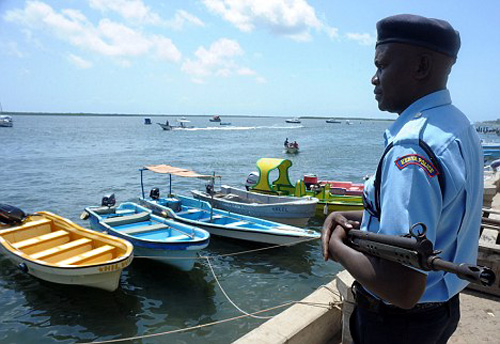
coastaltourismTourism is collapsing in East Africa. It began with terrorism but terrorism is down yet it continues to collapse.

Today you can get breakfast, dinner and a decent sea-view room in Zanzibar for $27.50 per night per person sharing.

These absolutely ridiculous prices can be found for a thousand miles from northern Mozambique to Lamu in Kenya, among some of the finest and most beautiful beach properties in the world.

“Officials on Friday warned that tourism at the Coast was on the verge of collapse with 30,000 to 40,000 staff set to lose their jobs,” Kenya’s main newspaper reported today.

Occupancy at most coastal hotels is hovering around 20% and major properties are closing down weekly.

Kenya and Tanzania’s white sand coral coast is also one of the most pristine in the world. Yes it is suffering the same coral destruction that climate change has foisted on the oceans around the world, but it’s better here, for example, than in most of East Asia.

What’s going on? Should you go?

Well, that’s the problem. Every western government in the world, plus Australia, says, ‘No, you shouldn’t go’ because of potential terrorism.

The northern border of this paradise is Somalia, and real trouble began there when the U.S. invaded Afghanistan in 2002 sending all its most vicious criminals into Somalia.

Things weren’t so bad in the beginning, because it seemed like all the bad stuff happening in Somalia was staying in Somalia.

But then there was the election debacle of 2007 in Kenya with widespread violence that took nearly a half year to settle down. When it finally did, the U.S. began drone strikes in Somalia.

Then in 2011 Kenya, acting as a proxy for Obama’s growing wars against fleeing terrorists, invaded Somalia and all bets for a stable coastal tourism industry were off.

More drones killed more Arabs from Dar to Lamu, internecine warfare among the Arab sects in the coast heated up, prominent Arab leaders were assassinated in Mombasa and Zanzibar, and if ever there had been a stirred up cauldron of discontent and chaos, it was the East African coast.

Didn’t somebody say on TV this weekend that we’ve learned an important lesson from Baltimore? Didn’t someone say that we’ve got to do something more than just add police to stem crime?

Is that why Secretary Kerry is in Kenya, today:

to “discuss ways to more effectively deal with threats posed by the militant group al-Shabab”?

To get permission to fire more drones? To give Kenya more personal armored vehicles?

There haven’t been any serious terrorist incidents for months on the coast. (The Garissa University attack was considerably inland, far from tourist areas.)

But that’s the Catch-22: bring in more tourists and that will attract more terrorists, because terrorist attacks on tourists are always more powerful than local attacks.

I wonder if there were any businessman who invested in Belfast apartments in the late 80s? If so they’re making a killing, today.
From Baltimore to Joburg

From Baltimore to Joburg

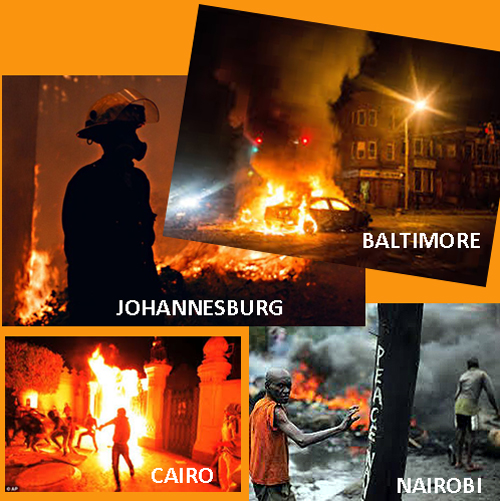
balt2joburgCivil violence in Baltimore, Beijing, Nairobi, Cairo and Johannesburg reflects societies coming apart.

One thing is certain: “We will bring order. We will bring calm. We will bring peace,” the (black) Baltimore mayor vowed last night as national guard troops entered her city.

Then, one of two things happens afterwards: a more democratic Tunisia, South Africa and Kenya; or a more autocratic China and Egypt.

Civil violence is quite distinct from war. It happens from within. Brothers are pitted against brothers. In the beginning new ideas link across disparate social communities. That’s the case today when we find Baltimore mayor, Stephanie Rawlings-Blake, saying things that her opponents consider collaborative with the protestors.

It’s the reason that the World Court indicted the current President of Kenya for fomenting crimes against humanity. It’s the reason Hosni Mubarak lingers in a jail guarded by the men he brought to power.

Civil violence reveals fissures and inconsistencies in social systems that are difficult to reconcile .. even by its leaders. It’s about human rights violations, not border disputes. Groups like ISIS will use civil violence to then start geopolitical warfare, but in the beginning it’s an internal conflict not an external one.

It often devolves into whether “the end justifies the means.” But it’s rarely so clear, much murkier: Is it fair that Uhuru Kenyatta paid youth under-the-table to fight a rival tribe in order to preserve his beneficence that now seems to be very positive in Kenya?

Peace at all costs?

Yes, so far anyway, eventually that’s human history. For the champions of human rights who fight in the streets, it’s a battle against the clock. They have limited time to bend society to their ideas until they’re crushed.

Civil violence is growing around the world, just as it did many times previously in human history. The hours on the clock are growing longer.

We’re entering a period of enlightened conflict, perhaps because of videos transmitted in nanoseconds by watches.

“Thank God for cell phone videos because the truth will come out,” the lawyer for the Freddie Gray family said last night.

Unlike in the past, more of us see and hear the same thing. The media can’t distort it as easily as in the past.

In this new and more volatile world, those of us in privileged situations should take stock:

“The infidels have so much to lose, they can be afraid of even losing their happiness! We,” he said, lifting his eyes to the sky as his mind’s eyes pulsated with a black sun, “We have nothing, so we fear no loss.”

That short excerpt is from my book, Chasm Gorge. It’s the world’s greatest terrorist explaining why he fights to the death.

The difference between those who have less and those who have more will not last in the new world. How much must be given away by us privileged is being determined by the battles being fought right now, from Baltimore to Johannesburg.

There’s no question a redistribution will occur. The question is how will it occur? Democratically or ruthlessly?

Buddying Up

Buddying Up

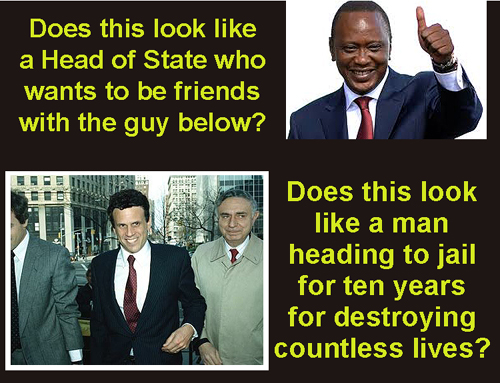
kenyatta and milkenPresident Kenyatta’s legacy like his plane last night is heading in the wrong direction.

The President of Kenya was headed last night to Los Angeles to learn the “American Way.” His teacher? The Joker with a makeover.

But his plane had to turn back because of fighting in Yemen. As of this writing it’s not known if he’ll resume the journey to the United States, and if so, what parts of it will be eliminated.

I have a suggestion.

Only two African Heads of State are scheduled to address the closed-door “Milken Institute Summit” next week in Los Angeles: Kenyatta and Rwanda’s Paul Kagame.

The Summit is an annual event avoided by most public figures because the Milken Institute is funded by Michael and Lowell Milken, “junk bond kings.”

The Milken legacy is one humongous fraud on the American people, two playboys who got filthy rich from the suffering of tens of thousands of retirees and other responsible middle class savers.

In 1990 Michael was sentenced to ten years in prison for manipulating financial markets that in part caused the collapse of the ‘Savings & Loan’ industry and likely contributed to the later world financial collapse.

Today the two brothers are billionaires and Michael is listed by Forbes as one of the richest men in the world.

Most of the world has already written off Rwanda’s Kagame as a ruthless dictator and most of the world has begrudgingly accepted him for keeping the peace of his troubled country.

But Kenyatta’s story is still being written. There’s a lot of good and a lot of bad to it.

As Kenya’s current Head of State he has a lot to be proud of: Things are going petty well in Kenya right now.

Security has improved immensely as the Somali conflict winds down albeit excruciatingly slowly. The economy is up despite the most enormous challenges in the world. The new constitution is being implemented step by step and with a few exceptions is going well.

But Kenyatta’s legacy will forever be saddled with the fact that the World Court considered him responsible, and charged him, with fomenting the horrible violence of 2007 that ultimately brought him to power.

So Kenyatta has a lot to prove in the remainder of his term as Kenya’s president, much less in the remainder of his life.

Traveling to the U.S. to address a controversial business forum that any sane politician wouldn’t touch with a hundred foot pole will hardly become a feather in his cap. It’s another tick in the bad column.

He says he’s doing it to increase investment in Kenya.

That was the line that Milken used for America in defending his junk bond trading.

I hope Kenyatta reads his fate correctly. The first leg of his journey yesterday, a flight from Nairobi to Dubai, had to turn back because of fighting in Yemen.

Apparently his advisers didn’t know about the fighting in Yemen? Do they know about Michael Milken?

As of this writing it’s not known which parts of his planned American trip will be cut short if he continues.

It looks pretty clear to me.

Terrorists Are Not Religious

Terrorists Are Not Religious

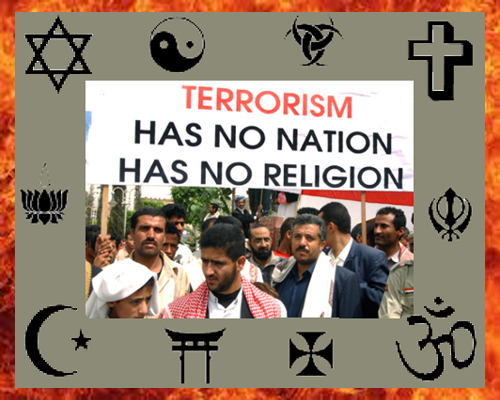
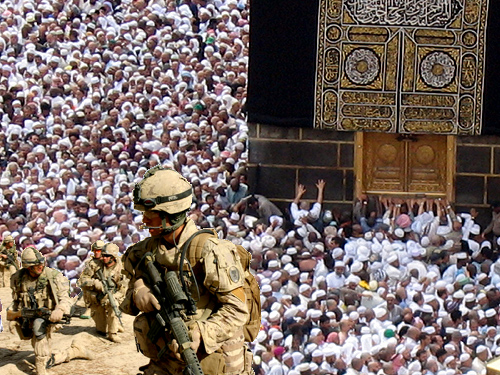
TerrorismNoReligionThe terrorist attack on a remote Kenyan university last Thursday that massacred more than 150 students is a terrible blow to what had been Kenya’s much improved security.

About a quarter of the university population was killed or injured mostly by suicide bombers who overpowered four front gate guards, then ran into the dorms and libraries where students were congregated, then pulled their bomb triggers.

Like the kamikazes of World War II, this unbelievable desperation is hardly an act of war. It reeks of the vengeance of those who expect to lose.

Kenyan security agencies had advised universities across the country a week ago that they suspected al-Shabaab would launch just such an attack on a university.

There are now a couple dozen substantial universities in the country and all of them went onto high alert. Garissa is among the newest, most remote, and nearest to Somali. It’s quite a distance from Nairobi or other populated areas of the country.

Clearly al-Shabaab – or whatever might be claiming to be al-Shabaab – was incapable of anything closer to the heart of Kenya.

As horrible as this is, it remains notable that terrorist attacks in places like Nairobi or even Mombasa have not occurred now for nearly two years. I still believe Kenyan security is better than ever.

As was Boston for the marathon. Bad stuff happens.

American media reaction was not healthy or rational: “The gunmen who attacked Garissa University College on Thursday singled out Christians for killing,” Fox News lied.

There was no attempt to determine the religion of those who were killed. After the massacre other al-Shabaab hoodlums entered the university and tried to kidnap non-Muslims, according to a report put out by al-Shabaab after the attack. News agencies have been unable to confirm the claim, although several dozen students remain unaccounted for. Those who gave interviews to the press said it was too chaotic for anyone to know if anyone else was a Muslim or not.

The bulk of the Garrisa student population, in fact, is likely secular. There are also many Sikhs, Hindus and even old fashioned animists. It was not a religious attack.

If America and others feeling besieged by terrorists continue to frame this struggle as a religious one, it will grow not diminish.

“I got an email from Anne Thompson, a journalist working with NBC News,” respected journalist and college dean, Luis Franceschi said.

“Ms Thompson’s questions reflect…most of the western world: ‘We are working on a story about today’s attack at Garissa University and are trying to understand what appears to be the religious roots of this incident… Are Christians safe in Kenya?’

“I would tell Anne Thompson a thousand times that the matter is not religious. The terrorists may say so and they are lying. If the matter were religious they would have been attacking us since independence, but they didn’t.”

The Muslim population in Kenya may be nearly a third of the avowed religious population. Muslim leaders hold prominent positions in the government and have since Independence.

Franchesci explained in an article for Nairobi’s main newspaper that the attack is linked to Kenya’s occupation of Somali, to corruption and to organized crime.

It was not a religious attack.

“I can confidently say that some of my very best friends and most impressive colleagues and students are pious and dedicated Muslims. In them I have always seen a wonderful example of virtue, humanity, sincerity and dedication, which I wish many of us Christians could imitate.”

Terrorism succeeds when it strikes irrational fears in those it challenges.

Fox News has been terrorized, and Fox News is losing. Let us hope the sane world knows better.

Jim posted this blog from Arusha, Tanzania.

Listen to Africa

Listen to Africa

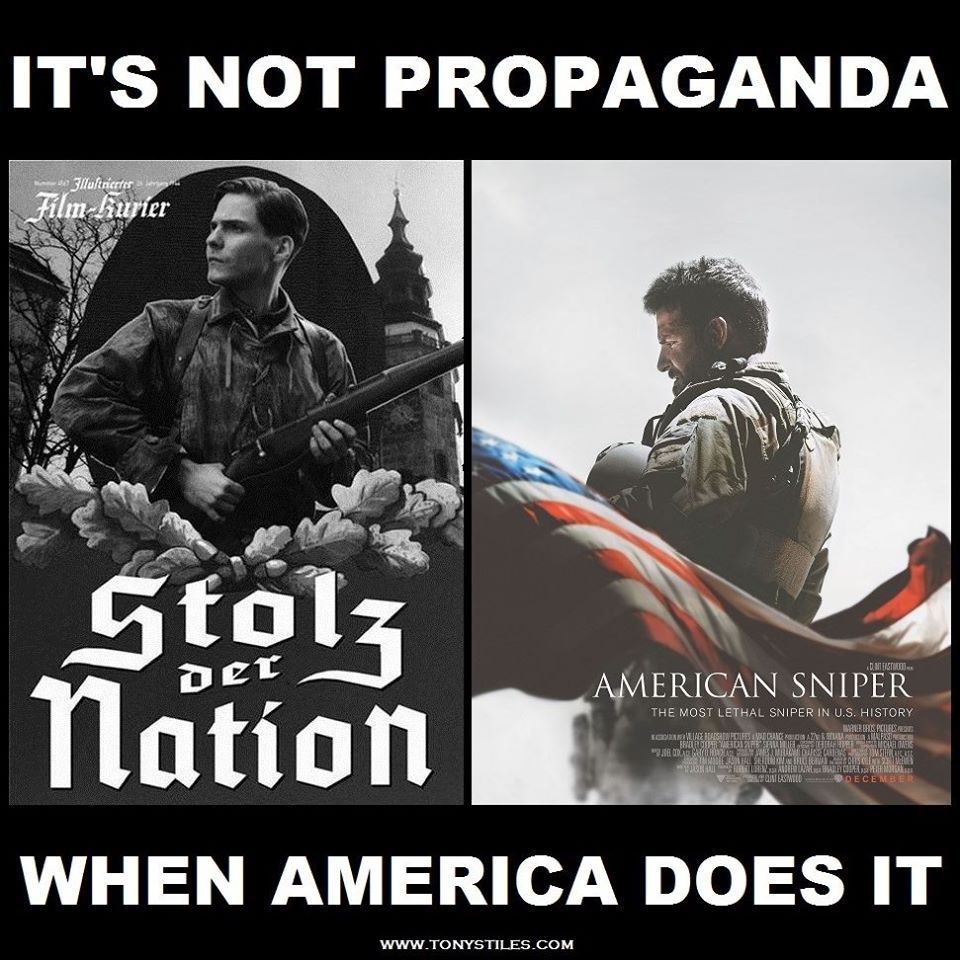
notpropagandaAfrican critics are condemning the Oscars for validating American Sniper, which they charge is little more than propaganda.

Calling it a “highly dangerous and simplistic film,” respected Kenyan author Rasna Warah claimed this morning that American Sniper will reenforce the lies that many Americans believe regarding the Iraq War.

Popular South African movie critic, tha-bang, called the movie Clint Eastwood’s “biggest propaganda film ever.”

Warning her African readers that “though it may be hard to believe,” Warah explained that many Americans still think Saddam Hussein was involved with the Twin Towers bombing and that he harbored weapons of mass destruction.

Kenyans were drawn into this controversy, because director Clint Eastwood used documentary footage of the bombing of the Kenyan Embassy (in 1998) as part of sniper Chris Kyle’s motivation to become a Navy Seal and go into combat.

There is of course no connection whatever between those who organized and blew up the Kenyan embassy and those who were later fighting in Iraq.

“The fact that the weapons of mass destruction lie is so conveniently skipped in this movie as the rationale for the invasion of Iraq instead of the Twin Towers, just shows what kind of film this is,” tha-bang concludes angrily.

“The film has not only angered Arabs but fueled anti-Muslim sentiments,” Wasna warns.

Warah knows her stuff: she’s a Kenyan expert on African terrorism. Her books include “War Crimes” and “Mogadishu Then and Now,” two essential reads for persons interested in understanding Somalia.

I think we need to heed these voices, and of course critics of American Sniper for being propaganda are not confined just to Africa. There have been many similar critiques here at home and from respected critics abroad.

The better a production a movie is, the more dangerous it becomes if its message is unreal or untruthful.

American Sniper carries a message which is a lie, “American avengers are honest souls.”

They are not. American soldiers were no less tricked than me or you into thinking what they were doing was right.

It was wrong, and the film pulls that reality back into the fictionalized grandeur of a nonexistent America.

So whether or not the acting is superb, or the cinematography is near perfect, or the music splendid and dramatic, a message … which is a lie … is carried into the watcher.

We pride ourselves in America for allowing any voice short of one untruthfully screaming “fire” to enter our collective consciousness.

But if critics here at home condemn Obama because he won’t say “Islamic terrorist” then they better endorse Warah and tha-bang, too, for condemning Eastwood for not just rehashing but promulgating the biggest lies of my lifetime.

Change of the Upper Hand

Change of the Upper Hand

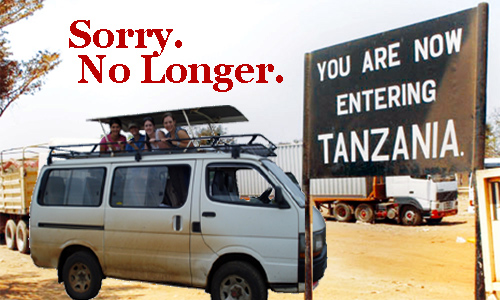
BorderClosesThe row between Kenya and Tanzania over tourism last week is a strong indication that Kenyan security has improved and tourists are returning.

This little tiff has absolutely no effect on any but the most budget-minded tourists.

Nairobi has 20-25 times more international airline service than Tanzania’s northern airport, Kilimanjaro. Deal seekers who bought a $200 better air fare into Nairobi than Kilimanjaro until Friday were able to fly into Nairobi, then arrange Tanzanian transportation from the airport into Tanzania with a net savings of about $100.

That’s over. If you want a safari in Tanzania, you now either have to fly into Tanzania or take Kenyan transport from the Kenyan airport to a bus station or other transfer point.

Travel and tourism pundits, always the poorest of pundits, exclaim that Tanzania has done itself a great disservice by stonewalling the negotiations over the last three weeks aimed at finding a compromise.

Sort of, but not really given the current governments.

Obviously any easing of travel restrictions anywhere in the world can increase tourism. This year, for example, numerous countries in southern Africa began easing the restrictions for travel between them. With this incident, East Africa is moving the other way.

Here’s the essence: Tanzanian tourism suffers any time Kenyan tourism is given an entre. This is because Kenyan tourism is bigger, better and less corrupt. I find this, by the way, remarkably ironic since my own assessment is that the Tanzanian tour product – i.e., the game parks – is better than Kenya’s.

But Tanzania has squandered its treasures more than Kenya has. This isn’t to say that Kenya is lily white, hardly. But the level of corruption in Tanzanian tourism is considerably greater. The actual laws on the books in Tanzania regarding tourism, conservation and game parks, are the most complex, messed up pile of regulations this side of Riverview Park in Chicago’s mafia days.

This discourages foreign investment and that, above all, keeps business actors in the Tanzanian tourism sector small, ripe for the picking so to speak.

If the two countries opened their borders to one another, Kenya’s much better run tourism sector could virtually subsume Tanzania’s. It’s one example of the virtues of well run capitalism. I can’t think of many, but this is one.

I don’t doubt that Tanzanians will be sorry about last Friday’s outcome. Above all it shows that Kenya feels increasingly confident about its own tourism situation. Kenya had been acting unilaterally by not enforcing the 1985 agreement, seemingly only to Tanzania’s advantage.

But in the recent dire days of terrorism in Kenya, any business they could muster was helpful. Now as things are looking, Kenya realizes it’s time to muster its advantages, recognize that the better air service and lower air fares into Nairobi are reasons travelers might choose Kenya instead of Tanzania for their game viewing safari.

So why make it any easier for them to go to Tanzania, than Tanzania allows its incoming visitors to go to Kenya?

The fact is, of course, that were Tanzania to get its house in order it would have no problem competing squarely with Kenya. At that point it would greatly benefit Tanzania to ease as many restrictions between the two countries as possible.

That day will come right after we successfully sell ski vacations to Saudia Arabia.

Uber Alles

Uber Alles

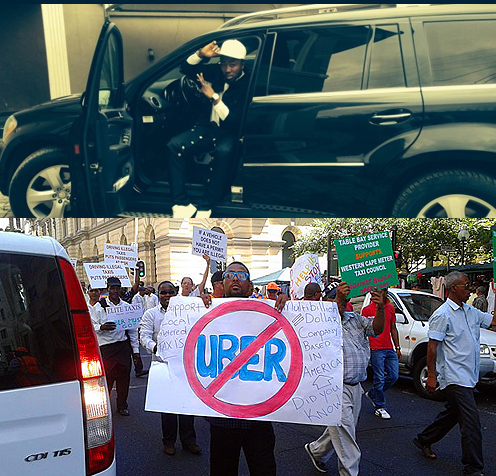
uberafricaUber is rolling over Africa despite growing protests in Cape Town and Nairobi.

Last month Uber launched in Nairobi, its third African market after South Africa and Nigeria.

In my opinion Uber’s genius is principally its app. I think if yellow cab or Marvin’s Machines in Keokee had had the foresight to move with the times, it would be Uber Over.

Uber, however, claims otherwise. It claims its genius lies in contracting with independent drivers who get their own licenses independently of any company, but the fact is there’s nothing new about this.

Limo drivers do essentially the same thing. Shuttle services, too. No, Uber’s genius is in its app.

Cab service throughout the world is one of the most uniform, corrupt and nepotistic services in the world. So essential and never sufficient, travelers stand in lines for ridiculously long times, get drenched waving their appendages into the rain and oncoming 18-wheelers and argue endlessly to keep their cab going on the shortest route.

The cabals that provide workers to the cab cartels across the world are a multi-layered no-contract service licensed by metropolitan cities whose nature of doing business is rarely transparent and never fair.

The only place in the world that I enjoy riding cabs is in London. Of course a cab ride from Heathrow to a hotel in Piccadilly costs almost as much as the flight to London. You get what you pay for.

Other than London? It’s one of the most stressful parts of a trip.

Enter uber. Nigerians love it. The response “has been overwhelming,” according to an Uber executive in Lagos.

Uber plowed over Nigeria. It launched with one of the country’s most famous hip-hop stars, Ice Prince, and then it devoured an earlier similar startup, EasyTaxi, by offering up to $12 to every person for the first ride. It moved from Lagos to Abuja faster than Boko Haram.

EasyTaxi just can’t compete. It doesn’t have the snazzy app or the tech behind it. That’s the wizardry of Uber.

Negotiations continue in Cape Town where over the weekend Uber claimed to have a licensing deal that was then denied today by a city official.

Uber Kenya launched recently in association with the very popular Restaurant Week in Nairobi, offering to give free or reduced rides to certain restaurants.

Resistance is severe in Kenya where living and working successfully means mastering a network of dependency.

The universal argument against Uber is that there is no systematic driver training or qualification. The widely cited Indian rape case is forever mentioned.

One wonders, though, how many rapes and other incidents of abuse routinely occur in regular cabs around the world.

Last month as a hostage situation developed in downtown Sydney, Uber jacked up its fares by 400% as terrified customers tried to leave the city center. (It has since offered refunds.)

Uber’s market-driven pricing rather than set pricing determined by expensive citizen commissions is one of the novelties attracting Africa’s new entrepreneurs. And they need cabs.

In Nigeria Uber usually costs more than EasyTaxi and many conventional cabs, but provides snazzy cars and well-dressed drivers that appeal to a huge segment of this trendy populace.

In South Africa and Kenya, as through much of the rest of the world, Uber costs the same or less.

Who’s making that decision? Uber will say “the market” but then, who’s got their statistical fingers on the market pulse?

Uber Up There.

A Greener Melancholy

A Greener Melancholy

kengreenentrepreneur

Even the poorest places in Africa are trying to reduce carbon emissions. Will shame change our behavior?

I was incredibly touched with a heavy dose of admiration and melancholy when I read recently about 19-year old Tom Osborn of Kenya, the founder of a “green” charcoal briquette company in Kenya.

As a high school top performer Osborn mastered the internet and found international and local foundations concerned with Africa’s struggles, and particularly how it might develop in a “greener” fashion.

The vast majority of Africans today cook using charcoal. The unit devastation to our planet for making a meal using charcoal is significantly greater than using more refined fossil fuels like propane, but that’s simply beyond the economics of the poor.

“I randomly came across a report saying smoke from … charcoal killed more people than AIDS, Malaria and TB combined,” Osborn told an African magazine.

“That really shocked me and made me start thinking of my mom, and that maybe she was slowly dying from all the times she had cooked for us. So I wanted to try to help her.”

Osborn linked with MIT students who had published studies of turning agricultural waste into charcoal briquettes. They confirmed that briquettes from discarded sugar cane stalks, for example, produce 90% less smoke and 60% more heat than an equal amount of charcoal.

Networking was the key and one link led to another. Osborn was named as one of the “30 under 30 Forbes entrepreneurs” which gave him enormous credibility that this creative kid turned into lots of startup money.

He received $80,000 from Echoing Green and another $10,000 from the Anzisha Foundation which gave him enough getup and go to partner with Envirofit that makes energy efficient charcoal stoves.

His company now bundles the energy efficient stove with his sugar cane briquettes and has so far sold to several thousand customers.

Osborn’s GreenChar benefits from great IT assistance and has a fabulous, modern website. Osborn has mastered networking with all the right people.

Osborn is a brilliant kid.

It is completely unlikely that this company will succeed: Admiration and melancholy.

Envirofit’s stove is fabulous, but very expensive by African standards. Osborn has admitted that he has achieved his first market niche by selling below or near costs, funded by his grants.

The world is cleaner. A young man is learning the ropes. And the western world is applauding him for trying so hard, but the crashing hammer of capitalism means the effort continues only as charity or dies.

I’m elated that one day when Osborn is 30 years old he might be sitting in the CEO chair for Kenya Airways or IBM – South Africa. It’s fantastic that this kid in rural Kenya has tunneled out of poverty using in the beginning nothing more than the internet.

But hold your applause.

The day will come when unfettered cooking in Africa is achieved either by violent revolution or the radical global redistribution of wealth that prevents it. None may be in a better position to help make that choice than Tom Osborn.

Admiration and melancholy. Maybe, too, a little bit of hope.

# 4 : Kenyatta Loosened

# 4 : Kenyatta Loosened

kenyattawilsonpantenaloThe President of Kenya is not quite a wholly free man, but a war criminal is no longer charged, and iniquity has trumped justice.

The dropping of charges against the President of Kenyatta is my # 4 Story for Africa in 2014. [For the summary of all Top Ten Stories in 2014 click here.]

Early last month the International Criminal Court at The Hague dropped all charges against Uhuru Kenyatta, the current President of Kenya, after a 5-year prosecution of crimes against humanity.

Kenyatta is guilty. Whether he should ever have been prosecuted is now another question, but the ICC’s flipflop is as much a statement on the feasibility of global justice as it is on Kenyatta’s culpability.

The President of Kenya, the Vice-President of Kenya and originally four other high officials plus a local journalist were all charged by the ICC for being the key masterminds in the horrible violence that wrecked Kenya following its flawed 2007/2008 national elections.

About 1200 people were slaughtered and equally awful were the near quarter million who were displaced of which more than a 100,000 remain displaced, today.

The agreement brokered by the U.S. and Britain between the warring parties established a coalition government that actually worked well and which mastered a new constitution that at least on paper is nothing short of fabulous.

Part of the agreement required Kenya to bring to justice all those responsible for the violence. A sub-agreement to that required the ICC to step in if Kenya was unable to accomplish this.

So despite all the creativity and work that Kenyans managed in creating a new society, in the end they were unable to bring themselves to charge the son of the first president, Jomo Kenyatta, who was quickly achieving national popularity especially among his ethnic group, the Kikuyu.

So the ICC stepped in as agreed and two years ago had a near irrefutable case against Uhuru Kenyatta and William Ruto, who in the meantime became freely elected as Kenya’s president and vice president.

Drip. Drip. Drip. One by one protected eye witnesses recounted or disappeared. Those who resisted were found murdered. Drip. Drip. Drip. Hard factual evidence began evaporating at The Hague.

No one believes that Kenya has either the power or wizardry to change the past, but it sure seems so. Earlier last month the prosecutor had to drop the case, because … well, there wasn’t one, anymore.

The rules of the ICC allow it to bring charges again, at any time, so technically Kenyatta has not been vindicated. Quite to the contrary, the animus of the ICC towards Kenyatta is palpable. The prosecutor has made no bones about why she dropped the case: it, literally, was stolen from her.

History has already crystalized. Kenyatta and his henchmen funded and orchestrated much of the horrible ethnic violence that followed the 2007/2008 election. In a Shakespearean twist classic to Kenyan mischievousness, most of the violence Kenyatta concocted was against the ethnic group of … Kenya’s vice president.

In a brilliant move several years ago, Kenyatta didn’t simply offer an olive leaf to his arch rival, the man who the ICC charged with being equally murderous against Kenyatta and his clans. Kenyatta offered him the second spot on the national stage.

By the way, charges have yet to be dropped against the Vice President, William Ruto, but everyone knows they will be.

Many in Kenya see this public and power alliance as retribution enough. Many in Kenya believe justice has been served and that it’s no business of a World Court thousands of miles away and culturally so dissident to judge Kenya’s recent past.

In fact, there is a growing movement in Africa to abandon the ICC altogether. The ICC is a complicated but I believe wonderful concept that has yet to win over the greatest world powers like the United States and China.

But for the great majority of the rest of the world it’s working pretty well. It’s had few convictions, but its masterful prosecutions and principle investigations have held many to account and I believe imprinted much of Africa with the need for justice.

So while even I can be convinced by the many Kenyans who believe that this horrible chapter of their history is closing, they leave one page unturned: It was they, the Kenyans, who invited the ICC in.

Kenyans themselves could have closed the book, but they couldn’t. So Kenyans themselves invited the ICC to take over. Then? Kenyans apparently connived and manipulated the witnesses and somehow stole the evidence.

That’s so behind-the-scenes, so Machiavellian, so deceptive that it in my opinion it’s immoral. No justice can come from this.

# 3 : Bust Not Boom

# 3 : Bust Not Boom

10000shteacherThe terrifying decline in energy prices will set the Third World back a half century, and this is the #3 Story of 2014 in Africa.

This one is hard for Americans to understand and it came quite late in the year. [For the summary of all Top Ten Stories in 2014 click here.]

The decline in energy prices is caused in large part by America’s boom in energy production both at the resource level (oil) and production level (wind and solar). Good thing, right?

What we didn’t realize was how quickly we were outpacing the rest of the world, and global impediments to trade and wealth distribution coral virtually all the benefits in North America.

Look simply to Europe to see how the decline in energy costs seriously threatens a new European recession and at the very least a partial breakup of the Eurozone.

The decline does have some negative effects here, mostly the stock market, but benefits like growth and consumer spending render a net positive.

It’s seriously different in Europe, India and China; and in the Third World it’s nothing less than terrifying.

During the Great Recession, countries like Kenya were proudly expounding that their growth rate year-to-year – which was much higher than the U.S. year-to-year – actually presented a horizon when the countries would achieve economic parity.

Before the Great recession in 2005, Kenya’s overall economy was about .14% of the U.S. That’s right, the U.S. economy was 700 times bigger than Kenya’s.

By last year Kenya had more than doubled its growth vis-a-vis America. America was only 300 times bigger. At this rate it would be only about a half century before Kenya caught up with America.

Many of us didn’t think this was a pipe dream. It seemed like the logical extension of a globalized economy based on capitalism. I’m no economist, but economists made the same mistake I made: we presumed this trend was fixed.

This year proved anything but, and next year will be stultifying. It’s likely that Kenya’s 300 times smaller than the U.S. economy this year will become 400 next year and perhaps return to 2005 by 2016.

Kenya is a perfect example for the entire Third World.

What does this mean?

I might not like capitalism, but I know that political progress, human freedoms and basically overall social happiness are in today’s world linked to an increasing economy. Whether it should be or not, doesn’t matter for this discussion. It just … is.

The Arab Spring can be explained with these metrics. The breakup of the Soviet Union, the expansion of Europe, the growing peace in Asia … all can be explained with these economic metrics. Even today’s possible reversal of the situation in the Ukraine, or the management of Iran’s nuclear threat can be postulated with these metrics.

So, the reverse?

Doesn’t take a rocket scientist to answer: increasing social instability, more war and civil disturbances, more refugees and massive global instability.

From America’s point of view an actuarial could attempt to predict the tipping point: when will America’s profound growth begin to eat itself because the rest of the world’s suffering becomes so profound it somehow effects us?

What a horrible assignment. Yet that’s the question, today, for Americans. And if you’re a Kenyan rather than an American it’s not an assignment worth waiting for.

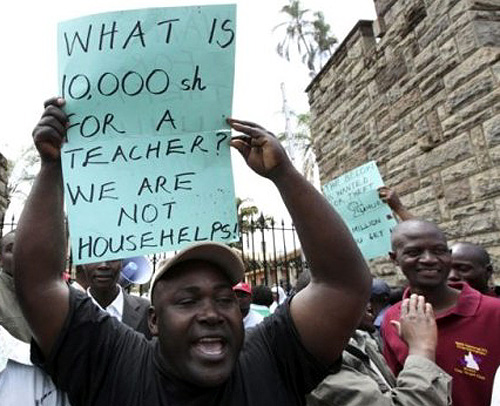
Today Kenyan teachers are on strike. That in itself is nothing new. Public sector employees often strike in Kenya, especially teachers.

But note the issue, today: a starting salary of Ksh 10,000/month. That’s $111. A decade ago it was twice that, not because the shilling value was different but because the exchange rate – the value vis-a-vis America – was twice as good.

What does a government do when it has no money to pay teachers? The expected oil and gas revenues in Kenya declined by 50% this year while the price of energy doubled.

“The arrest, prosecution, and jailing of [social media bloggers criticizing the current Kenyan regime on] foolish Facebook posts acts as proof of the intolerant and dictatorial regime we are drifting into,” writes Kenyan activist, Gaitho, today.

Hunger. Then, Dictatorship. Then, finally a return to Ignorance. One follows the other as certain as I and my children begin to buy SUVs again because they’re now so affordable.

#2 : Terrorism is Down

#2 : Terrorism is Down

-Terrorism is declining in Africa, my #2 Story of 2014.

Terrorism is an almost meaningless word. At its root is war but differentiated from classic war by tactics of brutality and special cruelty.

Yet as we’ve seen in America this year, not even torture is easily associated with American definitions of terrorism. Conflict becomes terrorism in most people’s minds when they are so frightened that they react impulsively and thereby often become unable to defend themselves properly.

Napoleon at Waterloo or Bush at 9/11:

Scared to death. It’s a tactic that the Davids of the world retain as their most valuable, since today’s Goliath’s are incapable of being defeated by weapons other than fear.

Terrorism in Africa was definitely down in 2014 over recent years. From Mali to Egypt to Uganda to Mozambique, the incidents of terrorism were fewer in number than in 2013.

Readers of this blog will be focused on Kenya, because Americans control the narrative of terrorism in the world, and because Kenya is an African country they know more about than most other African countries.

Kenya has a close association to America. Its new constitution is modeled more by America’s than any single other country in the world. More recently Kenya became America’s proxy in the war in Somalia where Kenya remains the occupier and governor of a very fragile peace.

2013 was a horrible year for terrorism in Kenya. Since the horrible Westgate Mall attack in 2012, the Kenyan government began to react like most western governments when terrorized: clamp down.

Kenya beefed up security, increased military and police forces and began passing draconian laws. Much of this was counseled and paid for by America and undertaken exactly as America did after 9/11.

From my point of view, Kenya is even doing better than America after 9/11, because its reexamination of some of its draconian security laws is happening faster than it did in America.

America’s Patriot Act was enacted in October, 2001 and Obama ended all but 3 of its 10 provisions which will die if not renewed this year. Many persons myself included believe it had limited if any impact on reducing terrorism while greatly inhibiting personal liberties.

Kenya’s version of the Patriot Act was passed last month, but Kenya’s High Court suspended most of its key provisions Friday.

I hope the Kenyan High Court perseveres and strikes the law down for good, and I think there’s a good chance it will.

The Kenyan High Court is much more progressive than America’s Supreme Court. The Kenyan constitution, in fact, is more progressive than America’s.

The reason security has improved in Kenya, and the reason security improved in the U.S. after 9/11, had little to do with draconian new laws that culpable legislators hurried to enact.

The increased security was simply because of increased vigilance that was lacking before 9/11 or the Westgate Mall. We all know now how dismissive the Bush administration was of reports of imminent terrorism. Kenya’s dismissiveness may have been similar but was likely something else: lack of resources.

America and Britain have now beefed up Kenya’s resources, so while the explanation for why Kenya and the U.S. suffered dramatic attacks differs, renewed vigilence was similar in both countries, and given the west’s support, I think Kenya will continue to improve its security.

Should Kenya also put the kibosh on its horrible new security laws it will have also learned from America’s mistakes and will retain citizen liberties in a way America did not.

I think at that point the whole world – including America – will realize that America’s knee-jerk response to 9/11 was counter-productive and that “terrorism” is an eternal threat requiring measured but constant vigilance, not draconian security laws.

It’s fair to extrapolate Kenya’s experience to more or less all of Africa, with the notable exception of Nigeria.

Nigeria has never coalesced into a single republic well. The Biafran War was not a civil war like America’s. It was a much newer conflict of issues of ethnicity, class, privilege and income.

Boko Haram is the newest iteration of this contemporary conflict. There’s no question that its tactics are brutal and extreme, although the kidnaping of the school girls or the executions of young students is not a new technique in African conflicts.

Boko Haram’s ideologies are less global than local. This past weekend powerful Boko Haram forces overran a military base in Nigeria and could have easily taken more territory in neighboring Chad but didn’t.

Boko Haram is on the ascent because the Lagos government is on the decline. Crippled by a falling oil price as much as weak governance, Nigeria’s threat from Boko Haram is a serious internal one that ought not be extrapolated to Africa as a whole.

No conflict, no terrorism, is comforting. But in my long view of Africa, I’d say that things are getting better. More optimistically, Kenya’s chance to reframe how to deal with “terrorism” might be a model for the whole world. Take note, America.

Charity Begins At Home 2014

Charity Begins At Home 2014

charitybeginsathomeCharity begins at home: In my estimation that means creating good government.

At this time of the year I get numerous requests from my generous and truly sensitive clients regarding charities I recommend in Africa. They are often surprised.

There are two reasons I discourage charity, whether to Africa or anywhere.

First, especially in Africa, charity is often a massive con game. There are many excellent not-for-profits doing heart warming work in Africa, but unfortunately there are many, many more that cause more problems than they solve.

Second, charity by its very nature coopts the responsibility that any reasonably moral society should take on its own. So by your act of charity, you are perpetuating the immoralities of your society.

The second reason is a contentious one, I concede. So for those who disagree with me on moral terms, my basic message changes to “stick close to home.” Charity is meaningless if wasted. All it does it make you feel good while possibly doing serious damage.

You must be able to do due diligence before giving, and you must be able to follow up to assess performance. Accountability is much easier the closer to home you get, and of course by “closer to home” I don’t mean simply proximity. You must be familiar with the situation, and you’re much likelier to be familiar with something near to you, geographically, socially and culturally.

Besides, we are rapidly approaching the time when poverty caused disadvantages like illiteracy are greater in parts of America than in the developed world.

I do due diligence in Africa. Good African charities are extremely few in number. They include Catholic Relief, World Vision and Médecins Sans Frontières.

Donations to many other large Africa involved organizations like National Geographic or the World Wildlife Fund are nearly useless. Their projects have become so massive they rely on their endowments to survive, diluting any individual giving to the point of meaninglessness.

Donations to smaller often locally created charities in specific countries, or to smaller church-based foundations, are usually destructive and anti-developmental. They are so mission focused that while they may indeed be helping a small group of people, more often than not they conflict with the greater social and governmental policies of the area.

One of America’s largest youth-based volunteer organizations, DoSomething.org, reports 11 facts about current America that are likely more egregious than in many parts of the developing world.

Consider this. Morning Edition reported today that in clustered communities of 10,000 children in Philadelphia there were only 33 books.

Literacy is difficult to specify, because different parts of the world define it so differently. UNICEF is the best mediator of literacy statistics worldwide, but the problem is that UNICEF does not generate literacy metrics for the United States. But clearly, literacy in that Philadelphia community is not good.

According to UNICEF, Kenya’s literary rate is just above 72%.

Why, then, would you send books to Kenya and not to distressed Philadelphia?

The conundrum of wanting to do good but being unable to do so will only be remedied when we create a society with a government that is trusted and moral.

That should be your greatest goal of the new year, not getting a tax credit.

Free Kenyan Collapse?

Free Kenyan Collapse?

Kenya democracy is on the brink of collapse, because … of democracy.

Facing imprisonment if the bill in Parliament he is criticizing is passed, popular Kenyan journalist, Kwame Owino, wrote today that Kenyan society “is bound for a democratic recession, with the possibility that its constitutional journey will come to an abrupt and painful stop.”

At immediate issue is a Security Bill that is so draconian if passed that if will effectively stop debate in the Parliament that passes it.

This afternoon Parliament grew so disruptive that fist-fights broke out, media cameras were smashed and the police ordered to surround the building.

“The changes are retrogressive and their cumulative effect could return Kenya to the police state of the 1980s and 90s and reverse gains made in protecting human rights,” Amnesty International Regional Director told local media.

Human Rights Watch said the Security Bill would “limit the rights of arrested and accused people, and restrict freedoms of expression and assembly.”

The bill’s details include holding “terrorism suspects … without charge for 360 days, compel landlords to provide information about their tenants and punish media organisations for printing material that is “likely to cause fear or alarm”.”

This is not a new development. There are already a series of horrible new laws, particularly against free speech, that this Parliament has already passed.

Bloggers around the country are being brought in by police for “impolite” or “disrespectful” remarks.

One of Kenya’s most political and followed tweeters, Robert Alai, was yesterday released on $2,000 bail and will be tried for having tweeted that Kenyan President Uhuru Kenyatta is an “adolescent president”.

Here’s the thing:

The reason that Kenyatta had the new Security Law introduced (or more correctly, many draconian amendments to the proposed law) is because of terrorism, mostly in Kenya’s far northeastern provinces which are adjacent Somalia.

Kenya with the aid and abetting probably of America invaded Somalia in October, 2011, and remains as an occupier. Somalia has achieved some peace and stability for the first time in more than a generation as a result, but Kenya has suffered terrorist retribution.

Kenyatta’s slow but methodical increase in security measures has seemed to work in stemming what had been a growing increase in terrorism.

Terror attacks in Nairobi, for example, happening last year at nearly one per month, are now rare.

But the cost of this has truly been the democratic rights protected by its fabulous young constitution.

It’s fair to surmise that every new tourist who comes to Kenya because of its new security sends an additional Robert Alai to jail… if the new laws work.

I don’t think they will. They didn’t in America. The Patriot Act did little to protect us. Under the Patriot Act a bevy of new terrorist attempts came to the surface, including the shoe-boot and underwear-pants bombers, the cargo planes and much more.

Not until we backed off draconian measures like the Patriot Act, began ending the wars of retribution in Afghanistan and Iraq, did our own security truly improve. That is if you exclude Sandy-Hook, the Black Knight bombing and maverick terrorists like the Boston Marathon bombers.

My point exactly. What is security? Three thousand people and the exponent of their families were seriously hurt by 9/11. How many in the exponential pool of marathon runners, parents of grade schoolers and movie goers have been hurt by domestic terrorism?

There is real equivalence, here, and the Patriot Act probably did more to increase this aggregate terrorism than it did to reduce it.

Once a power center like a government gets it into their noggin that they should fight terrorism, they begin to think they should fight until they win.

That is the recipe for certain defeat. Terrorism cannot be defeated. It has existed forever and it will forever exist.

European nations are the best examples of how to live with and manage terrorism.

America after 9/11 … and now Kenya, are about the worst examples out there.

Shape up, Kenya. There’s still time.

Fighting Terror with Terror

Fighting Terror with Terror

futilityofantiterrorLike father, like son: Kenya has now joined its military father, the U.S., using illegal force in failed attempts to fight terrorism.

The Senate committee report released Tuesday is a shame on America that will follow our empire to its ultimate grave, but the extra-judicial killings of 500 detainees by Kenyan security forces is simply mindless.

My novel, Chasm Gorge, explains how a terrorist in Kenya succeeds by provoking America to react with excessive force. That’s exactly what’s happening in Kenya today.

And it’s fair to conclude that because America did it, Kenya does now. America planned, financed and helped managed the Kenyan invasion of Somalia.

The Kenyans are simply doing what their teachers did: Actions speak louder than words.

Yet there are words, too:

The Kenyan operatives told London’s Guardian that “they have received training and intelligence from Britain.” So add Britain to this terrible mix.

Why is this happening? Why did America torture? The evidence is strong that torture doesn’t produce useful intelligence, and even if it did it would be immoral.

Hypothetical cases suggesting that torture could reveal and thereby prevent an ultimate apocalyptic attack are ludicrous. Nothing yet in the human arsenal is more apocalyptic than the immorality of torture.

In today’s world and any future hi-tech world I can imagine, torture does nothing but escalate a conflict. So why pursue such inane policies?

The answer is the same as to why the Kenyans murder their detainees.

Revenge. It’s that simple. Revenge is short-term relief. It’s old testament equalizing. There is, in fact, some logic to revenge if a conflict is considered irresolvable, when compromise at any point is impossible. In this case only one side wins, and revenge is a move on the chess board that allows no draws.

If we truly believe certain conflicts are irresolvable, then as righties for years have argued, pull out all the stops! Let the nukes fall!

Fortunately, we’ve retain enough sanity to avoid doing this yet, which reveals the deeper truth that we are prepared to compromise, but that flies in the logic of revenge.

That’s the devilish duality of the American psyche: whatever our education and intellect tells us battles with our machismo. Our ego is deadly.

Many Americans are beginning to realize this. Terrorism wins when the terrorized over-react in fear, essentially defeating themselves.

When the U.S. spends trillions of dollars in retaliation to 9/11, it loses the battle of 9/11. When in reply to the several thousand soldiers killed in Iraq and Afghanistan battles the U.S. kills and displaces fractions of millions of people, it loses the wars in Iraq and Afghanistan.

We, and now Kenya, are doing exactly what the terrorists want us to do.

And so, we’re both losing. For gods’ sakes, Kenya, learn from your failed teacher.

Broken or Manipulated?

Broken or Manipulated?

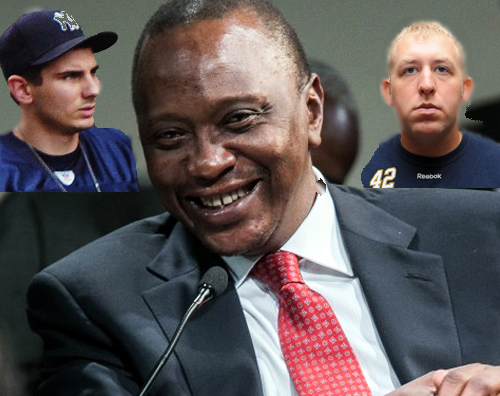
kenyattawilsonpantenaloJustice, fairness, equality – “legally” lost today around the world. Uhuru Kenyatta, Darren Wilson and Daniel Pantaleo are today uncharged, and they should not be. What’s wrong?

Uhuru Kenyatta, the President of Kenya, was indicted for crimes against humanity by the World Court more than a year ago. Today the chief prosecutor dropped all charges.

Darren Wilson and Daniel Pantaleo are white police officers who exceeded their professional protocols while apprehending unarmed black men and killed their victims, but both were released of any charges by local grand juries.

All of this is legal and lawful.

And wrong.

The debating if bickering as to why these major miscarriages of justice occurred will go on for years and ultimately it will be concluded — exactly as it’s understood at this very moment — that modern systems of justice are easily manipulated by those in power.

In Kenyatta’s case, the prosecutor issued a statement blaming the Kenyan government for gross intimidation of witnesses and refusal to cooperate in the search for evidence.

The white police officers were exonerated because of prosecutors’ unusual granular involvements in the deliberations, and law that has become badly interpreted to vindicate virtually anything that a police officer does.

All three men are most likely guilty of the crimes for which they had been considered or in the case of Kenyatta, charged. Without a completed prosecutorial investigation, this certainty will never exist, of course, so we’re forced to speculate if justice was served.

If any of them is truly not guilty, that too will never be known, now. In the public mind it grows more and more impossible that they are innocent.

So justice, whatever it really is, will never exist in these cases.

The only valuable outcome I see is the fact that the world is fast recognizing that these three men are but representatives of a much larger community of possible criminals who escape justice by the manipulation of those in power.

And that power, even in democracies, is apparently absolute.

Many, particularly in Kenya but also here at home, argue that regardless of whether justice was served or not, the outcome is correct.

This is to say that justice is not always the right outcome.

Many, many Kenyans believe that the stability that Kenyatta seems to have achieved among Kenya’s brutally opposed ethnic groups, was worth a couple hundred thousand displaced persons and a thousand deaths.

The argument is that in the absence of Kenyatta’s management of violence following the disputed 2006/7 election that Kenya would have become a failed state mired in unthinkable if barbaric horrors not unlike the situation in Nigeria’s Biafra in the 1960s.

Similarly, Americans believe that police officers can break the law in order to enforce it, provided the overall outcome is a more lawful society.

I disagree. Justice and injustice are mutually exclusive. Manifesting justice does not beget injustice.

There is nothing inherently weakened in the concept of justice if the powerful who find themselves its guardians are themselves punished for injustice. In fact, it strengthens not weakens justice.

No, the explanation is not found in arguments that verge on hyperbole. The explanation is found in the larger masses of society, who are today apathetic or placated if fooled.

There is too little moral indignation than there should be among the societies where these injustices take place, and the powerful recognize this and so take advantage of it.

Justice is not something that was delivered to us by men in wigs 300 years ago, or in the case of Kenya, a convoluted global justice system in its initial stages of infancy.

Justice is there for the taking.

But today not enough people want it.