Rise of The Ignorant

Rise of The Ignorant

FirstGrader1Government politics clashed explosively today with education in Kenya as a court struck down a teachers’ pay raise that had ended a devastating national strike.

Kenya better take a lesson from the U.S.: compromise education and you’ll empower the ignorant. Soon Donald Trump will be running for President of Kenya.

Teachers in Kenya are employees of the federal government rather than state governments as in the U.S. The 5-week long strike which ended in October was therefore nationwide.

The pain of that strike didn’t end with the misery of teachers forfeiting their livelihoods to promote their rights. Kenyan teachers earn 12 times the average national pay, so a huge buying sector of the economy was shut off just as the overall Kenyan economy began to slump.

Ultimately the government agreed to a more than 50% pay increase. The court decision, today, reverses that on the technical grounds that the agency authorizing the increase did so unconstitutionally.

(It’s actually fascinating: the lower Appeals Court effectively reversed a higher Supreme Court ruling. The teachers union is now appealing this lower court ruling back to the higher court. Can’t help but loving this tinkering with government bureaucracy.)

If the pay increase is sustained Kenyan teachers will earn more than 15 times the national average. (In the U.S. a teacher’s salary is almost identical to the national average.)

Why, then, should anyone be worried if Kenyan teachers aren’t awarded this huge increase in pay? …that will stretch even more the disparity between teachers and the common worker in Kenya?

Well, to begin with take a look at the student/teacher ratio. In Kenyan primary schools it’s around 50:1. It’s 25:1 in all of sub-Saharan Africa; the U.N. benchmark is 17:1 and in the U.S. it’s 14:1.

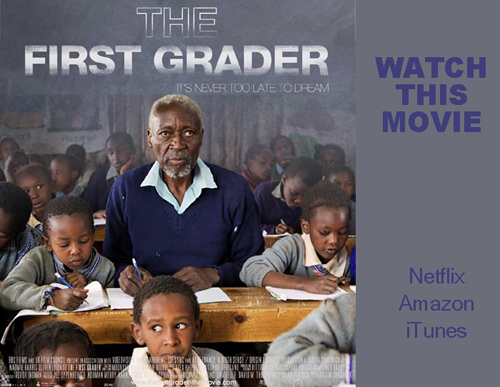
So Kenyan teachers are taking a heavy lift, and this is precisely because overnight a few years ago the country decided to offer free primary education to everybody. (Everyone should watch the amazing movie about this, “First Grader.”)

But statistics like this used cross culturally lose some validity. About the only empirical conclusion evident from this data is that Kenyan teachers are overpaid for working too hard, and U.S. teachers are underpaid for working too little.

I think there’s something important to extract from this.

U.S. institutions of higher learning may be the best in the world. But our primary and secondary schools are a mess, dragged deeper today into our social dustbin by the outrageous licensing of “home” and “community” schooling.

When public education is ignored, as it has been in the U.S. for the last half century, a massive underclass of ignorant people who still benefit from an expanding economy grow more and more powerful.

This underclass pulls down the education system even further: Teachers get paid less, are given fewer resources, perform worse, get paid less still, etc. It’s a spiral into … well, ignorance.

Ignorant people are impressionable and gullible because they aren’t taxed with thinking hard. They’re more likely to jump to conclusions and embrace emotive reactions than question the world. They shoot before looking, because they can’t analyze what they might see.

As the ignorant gain power complex social institutions and infrastructure collapse. You’ve got to be able to think hard to build a bridge or understand welfare or negotiate a nuclear arms deal. Lacking necessary cognitive and intellectual skills the ignorant don’t consider the future as a component of well-being.

The enormous pay difference between an average Kenyan teacher and an average Kenyan worker is definitely cause for concern, but every time Kenyans compromise public education they concede a bit more control of their society and future to the ignorant.

Using the U.S. as the example, that’s not a good idea:

Imagine if when I was a boy I’d heard my parents debating whether they should elect as President Ed Sullivan or Doctor Spock.
Guns & Climate

Guns & Climate

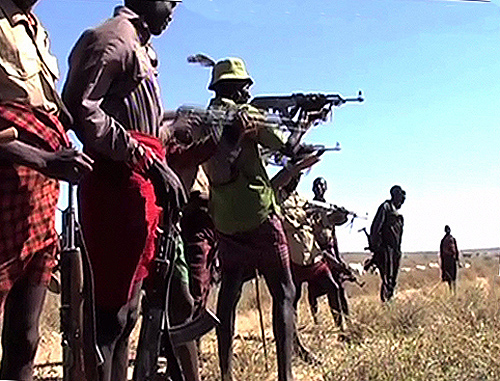
samburugunsMore guns make more war and less guns make less war and the truth is shown clearly today in Kenya’s Samburu district.

Since the incredible arming of Kenya by the Obama administration for the Somali Invasion four years ago, the number of weapons in northern Kenya has increased by a ridiculous amount. It’s particularly noticeable now that the war is winding down.

Guns don’t wind down.

So all the tens of thousands of unused machine guns and grenades have reached the black market and they’re available for a song.

The Samburu district of Kenya has always had a sort of wild west flavor, including messy cowboy entanglements. For one thing it’s where two historically antagonistic tribes, the Turkana and Samburu, meet.

Both tribes hold creation myths stating that God created cows only for them, so if the other tribe has cows, they must have stolen them. The young warrior class is charged with recovering as much of these stolen goods as possible.

So cattle rustling has existed at least for as long as anyone has written about the area, well back to the 16th and 17th centuries. It’s different, now.

To begin with, there’s more competition. There are more people, so more food and more cows are needed at the same time that climate change is exacerbating the desertification of these northern areas.

So while it used to be pretty much an ethnic conflict between two or three major tribes, today the issue of enough land for grazing is just as important.

The Kenyan government is moving perhaps too quickly to ameliorate this by generating new local revenue from deep-hole oil wells financed by the Chinese.

But the most important difference is how people fight.

Instead of using spears and clubs, the fights are now almost exclusively with very sophisticated guns.

Guess where they might come from? Amazing, isn’t it, that they cost less than fashioning a good spear?

In the most recent cases it appears the warring factions are better armed than the police.

Kenya has a strict firearm policy: it’s not easy as a private citizen to own a gun. But in the Samburu district of Kenya it’s hard to find a Samburu without a gun.

In an attempt to reduce the weaponry, Samburu authorities announced an amnesty several weeks ago for anyone who turned in an illegal firearm. That program expired Tuesday and “no firearms had been surrendered.”

It is, of course, a common argument promoted by arms manufacturers that peace prospers when more people have guns. This presumes that the vast majority of people are good and only use guns to defend themselves.

That argument is about as cogent as the idea that God created all cows for Samburu.

Dangerous Dennis

Dangerous Dennis

norwegiansuitShould a paid aid worker in a dangerous part of the world be able to sue his NGO for not protecting him well enough?

Steve Dennis sued his employer, the Norwegian Refugee Council (NRC), for gross negligence that resulted in his kidnapping in 2012. Dennis refused more than a half million dollars out-of-court settlement, and a Norwegian judge will now soon decide the matter.

Dennis and several others were kidnapped from the Dadaab Refugee Camp on the Kenyan/Somali border by Somali insurgents. They were freed four days later by a commando raid of Kenyan and Somalia government forces.

He contends that his PTSD syndrome and continuing physical ailments that resulted from the kidnapping were all preventable had NRC better security procedures in place.

I think this is nuts.

Everyone – even soldiers and aid workers – should have redress through the courts for being abnormally maligned or mistreated, but Dennis was not.

The NRC is one of the most respected NGOs in Africa. The 100+ recommendations the NRC generated from its own internal investigation into Dennis’ kidnapping have all been implemented and are being widely considered by all NGOs in the Dadaab area.

I suspect there is much more to the story than has reached the media.

Just after the actual incident, the then 37-year old Dennis told his home-town Toronto Globe and Mail:

‘[that] he remains committed to aid work despite having just gone through “a very bad long weekend. I’m still going to be engaged somehow. How, I don’t know. For now I think my job is to take a couple months off and then, if I feel good, take a couple more maybe,” he said with a laugh.’

Dadaab is one of the most dangerous refugee camps in the world, and if I know this I imagine that aid workers do, too.

There are about 22 million refugees living in camps around the world, the majority in United Nations’ organized mini-cities. There are nearly a million in Dadaab alone.

The 10,000 UNHCR employees overseeing these facilities are assisted by an estimated 50,000 other aid workers of the sort Steve Dennis was, persons who are actually working in refugee camps. (Altogether there are around a quarter million humanitarian aid workers worldwide.)

Aid workers are characteristically the most dedicated, moral and upstanding individuals you can imagine. I’ve often pondered why these incredibly intelligent and motivated individuals give up traditional lives with usually greater compensation for such hazardous work.

About a year after the July, 2012, incident Dennis began issuing more and more serious allegations and complaints: his mood had obviously changed. In court documents he chalks this up to his PSTD.

Also about a year after the incident, NRC changed CEOs. In a letter introducing himself, Jan Egeland concluded, “And finally. Be careful, take the necessary precautions and wear a seatbelt. We cannot afford to lose any of you.”

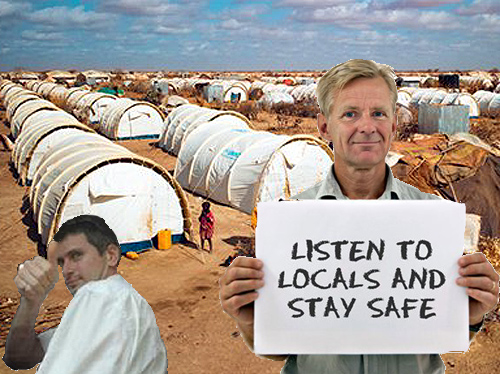
The NRC media arm that issued the letter featured a picture of a smiling, handsome and weathered Egeland holding a large hand-written sign that read, “Listen to Locals And Stay Safe.”

As Dennis’ legal wrangle starting taking shape, he asked the public for $50,000 through FundRazr. The $20,000 that the Guardian newspaper reported he finally raised was apparently sufficient enough to attract ambulance chasers now working on speculation.

I don’t doubt that Dennis suffers from PTSD or that he has other lasting infirmities from his kidnapping. I’m not even sure I approve of the half million dollar settlement NRG offered Dennis, but at the very least it strikes me as incredibly generous.

But if aid organizations are now sued by employees who work in the most dangerous conditions in the world, it would be like soldiers suing the Army for sending them into war!

Norwegians are among the most dedicated aid workers in the world, and Norway among the most committed countries on our planet to making the whole wide world better. So it’s not surprising that they will find fault with themselves.

But I hope the judge notes that Dennis used crowdfunding to attract ambulance chasers. This is not how to save the world.

Vicious Volunteerism

Vicious Volunteerism

molestationChild predators in the guise of foreign volunteers to Africa are at last facing prosecution when they return home.

I’ve often written how volunteerism in Africa by (mostly western) foreigners is usually a bad idea. Child predation is an extreme matter although it’s increasingly used in Kenya as a reason social organizations should be less welcoming of foreign volunteers.

In a detailed investigation by Nairobi’s Destination Magazine (DM), a 20-year old American Christian volunteer repeatedly molests children in a Kenyan orphanage over a period of several years until new American legislation results in him being arrested at his Oklahoma home and ultimately imprisoned.

The young American was finally convicted this summer after a lengthy defense mounted in Oklahoma courts by a star-studded legal team that included the lawyer who defended Timothy McVeigh and Sigma Alpha Epsilon (SAE).

According to DM: “In Africa …people serving with the church …are bestowed with a great deal of respect… So much so that individuals in these capacities …can carry on a double life for years without detection.”

DM published an excellent and detailed report of the story of the Oklahoman teen who traveled multiple times to Kenya from the United States, ostensibly for Christian missionary work.

He was considered by both the community he came from in Oklahoma and the religious African community that welcomed him into their orphanage as reliable. In fact after several visits to the orphanage to volunteer he requested to live with the children rather than in volunteer dorms.

“Even though his request was peculiar, it was nevertheless granted.” An African manager on a routine check of the orphanage’s dorms then caught him having sex with the orphans.

Kenyan child activist, Kevin Wasike, also asks, “How could a volunteer be left alone with children at night, without any kind of supervision whatsoever?”

Wasike’s indictment of an organization for not properly vetting its volunteers extends well beyond the heinous social crime of child molestation.

I estimate that most – more than half – of African organizations that receive charity from abroad end up regretting it.

Most volunteers come on a lark: They volunteer in part to get a better deal for the cost of traveling. They are untrained or poorly trained for whatever they ultimately try to do. They rarely make long-term commitments, which should be an essential requirement of any employee of a social organization.

So the organization ends up dedicating more resources to “taking care of the volunteers” than the volunteers give back.

Finally, most volunteers are not certified.

Since 2003 British citizens may not volunteer anywhere abroad for any child organization without first obtaining an International Child Protection Certificate (ICPC).

The certificate is a police check on the individual intending to volunteer abroad. The Certificate is currently required by 73 countries worldwide, but not yet by Kenya.

The 2006 U.S. law that was used to convict the American teen also provides for sharing of child molester databases with countries abroad, including Kenya.

But the American legal process is weighted not just to the defendant, but in this category of cases against foreign allegations.

Though there was a video made in Kenya accompanying the defendant’s 10-page confession, together with medical exams of some of the kids shortly after sex with the defendant, the legal team delayed the trial for more than a year.

The team claimed that the video was by children who were not mentally fit, that the confession was coerced, and that the team was unable to visit Kenya, alluding to Kenya’s terrorism incidents.

Americans ascribe a near divine right to volunteering. Certainly this example is extreme, but it is often in the extremities of things wrong that we come to see the light.

Messy Mashujaa

Messy Mashujaa

mashujaadayIt’s “Heroes’ Day” in Kenya, Mashujaa Day, and one of my Kenyan heros, journalist Macharia Gaitho, just displayed our time’s most painful paradigm: hypocrisy.

Like many long-lasting, courageous journalists in Kenya Gaitho is analytical and penetrating, seemingly nontribal, usually grumpy but without fail calls a spade a spade.

Today he berated his country’s national holiday in its most widely read newspaper:

“Unfortunately, we no longer celebrate our mashujaa, our heroes. We celebrate tyrants and thieves.”

Mashujaa Day was a social compromise of Kenya’s fabulous 2010 Constitution. Prior to then, “Kenyatta Day” and “Moi Day” were celebrated much as Washington’s and Lincoln’s birthdays were once celebrated separately here.

Jomo Kenyatta was the country’s first president and Daniel arap Moi was its second. Mashujaa Day combines them, as we combined our presidents’ birthdays into Presidents’ Day, but goes further than we have.

Mashujaa Day extends the celebration to the average bloke who perhaps without any notice helped to create a better Kenya through self-sacrifice. This addendum to the celebration was added because Kenyatta and Moi represent the two most powerful (although often opposing) tribes without acknowledging the remaining 40% of Kenyans.

“Mr Kenyatta … thought Kenya owed him all its riches and spent a bit too much time ensuring perpetual riches for his heirs.

“The Moi regime … [was] one [of] a rapacious orgy of slash-and-burn economics.”

Here’s what’s important in Gaitho’s roast of his national holiday: For some at first inexplicable reason, he ends today’s column (after seven asterisks) with the following:

“I really fail to understand the Obama doctrine. Syria and Iraq are in danger of falling to Isis, that monstrous Islamic supremacist movement spreading its tentacles across the region and beyond.

“But instead of backing the Syrian government against the monster, President Obama insists on a self-defeatist support for the armed rebellion against President Bashir al-Assad, that he assumes can also be used to fight Isis.

“You can’t have your cake and eat it, Cousin Barry. On this one I am with Russian President Vladimir Putin, if his military intervention is what will strengthen Assad and keep terrorists from our shores.”

Gaitho is right, history is turning out to harshly judge Jomo Kenyatta and Daniel arap Moi. They were not the heroes “Heroes’ Day” intended to praise. And I’m pretty sure Gaitho will agree that neither is Bashir al-Assad.

For the record I don’t support the Obama policy in Syria, which is widely supported here. I really believe we should cut and run, and there are few on either side of our gaping American political divide who join me.

But I can’t understand Gaitho’s criticism of his first two presidents for their failure at fair governance when the real legacy of Kenyatta and Moi was that they kept the country stable and so much so that it was protected from outside forces.

So why does Gaitho now support Assad for the same reason?

Alas, heroes crumble easily in today’s extraordinarily complex world.

Train Wreck

Train Wreck

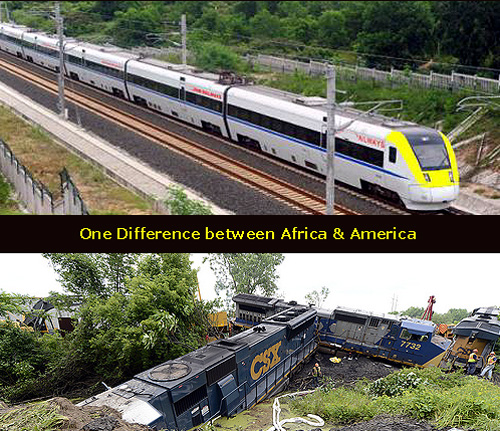
TrainDifferenceI step very gingerly on loose railway ties when we bird along the Mississippi River close to the horrible derailment last spring, wondering why Kenya can build a modern railway and we can’t.

The quick answer is that Kenya isn’t: China is, in Kenya. The second quick answer is because Republicans think they can get along just fine without government invested infrastructure.

Kenya’s 380-mile modern, fast standard gauge railway project is “running ahead of schedule.” When fully operating in 2017 it will cut the travel time between the coastal city of Mombasa and megalopolis of Nairobi down to 4 hours.

China is paying for 90% of the $3.8 billion dollar cost with the Kenyan government paying the remainder and then of course paying for the operating costs.

Railways worldwide are usually not profitable … as in the United States. That’s because they don’t have as many derailments.

Railways are understood in the sane, modern world to be a lost leader, a necessary infrastructure that builds commerce and ultimately increases tax revenues enough to justify them while providing the population with a modern service.

Like … a sidewalk.

It’s generally an idea Republicans don’t get: providing their constituencies with infrastructure. They prefer to believe the private sector will know when to build something.

“America’s sparse rail network is so far behind [the] standards in [European] countries,” the Guardian newspaper reported after our spate of spring crashes.

A private sector that prefers to clean up toxic leaking bonfires because it’s less expensive than building something that won’t crash is how America does it, today.

Kenya’s new railway replaces the decrepit “Iron Snake” that was built more than 100 years ago and is essentially useless, constantly breaking down and often taking 19 hours to travel from Mombasa to Nairobi.

The railway was one of the first undertakings of the British colonial regime, recognizing that transportation of goods and people was essential to development. The colonial power pursued similar projects in its Indian and Asian colonies.

Pity we overthrew them too early.

China has significantly withdrawn its investment in Africa since its slowdown this year, but the project was begun early last year and it appears the Chinese will see it through.

Chinese attempts to “cut corners” with a standard Chinese-designed culvert were thwarted in March by Kenyan authorities who insisted on sticking to the original British design. Work was actually stopped for several weeks until the Chinese agreed to continue with the original design.

Remarkably the railway will cut right through Nairobi National Park and parts of the Tsavo national parks, but there has been little opposition.

“We can’t say to the Nairobi resident: ‘You have to sit in a traffic jam for the rest of your life’,” the famous conservationist and anthropologist Richard Leakey told reporters.

China isn’t just playing nice guy. China had lots of cash it needed to invest a few years ago. It knows that Africa often produces as great a return on investment as in its own society. And Africa has … oil and other natural resources.

But this mercantile motivation is what capitalism is all about, right? Then how come our own government won’t invest in its own people? Because the private sector is so greedy it holds all the cards?

Yeah, that’s it.

Get More, Obviously

Get More, Obviously

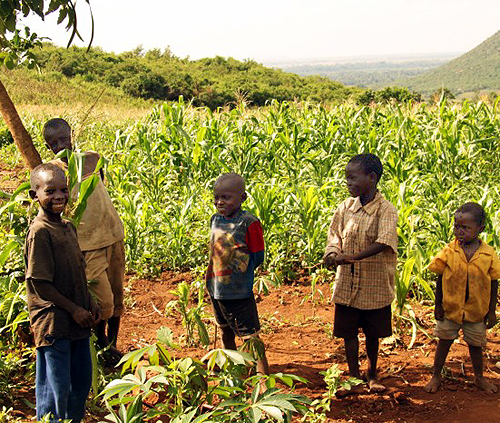
cornfieldbusiaKenya will end all restrictions on genetically modified agricultural seed, setting the stage for the largest production of GMO crops in Africa.

According to the country’s vice president, William Ruto, the end of the partial ban on a variety of GMO seed will “maximise agricultural production, improve health services, conserve the environment, and basically improve the living standards of our people.”

The back-and-forth suspensions of GMO seeds throughout sub-Saharan Africa this decade reached a turning point two years ago when Monsanto agreed to unlimited free use of its Monsanto 810 by sub-Saharan African countries, currently being distributed by the Bill Gates Foundation.

The drought resistant corn embodies the entire debate over GMO. While there is no doubt higher yields in stressed environments are produced when Mon810 is used, both bug and virus diseases seem to develop rapidly and powerfully against it.

As a result farmers using the seed also must use more pesticide.

The debate is whether this is because the GMO maize itself somehow nurtures super disease, whether it is simply more susceptible because it’s a relatively new genetic strain, or even whether it’s simply climate change.

The third possibility remains plausible because statistics gathering in Africa remains poor. While there are reasonable statistics to prove that additional pesticides are required for the use of GMO crops, there are not good numbers on what climate change is doing to traditional crops.

No matter the cause, new and tougher ways to suppress bugs and viruses is required whenever a farmer begins using Mon810.

South Africa has discovered that planting every fifth or sixth row of corn with non-GMO crops considerably reduces the need for added pesticide on the entire field.

But that’s an expensive proposition, especially for Kenya.

The net financial payoff, however, remains positive in both South Africa and Kenya. The question is what is the payoff to the overall environment and this question is a much longer term consideration than growing enough food next year for the local population.

I’m no scientist, and I remain very skeptical about altering genes for agriculture or medicine. But in the absence of any similarly efficient alternative for food production, it seems terribly crass to argue against the use of GMO in Africa.

Which to Visit? Kenya or Tanzania?

Which to Visit? Kenya or Tanzania?

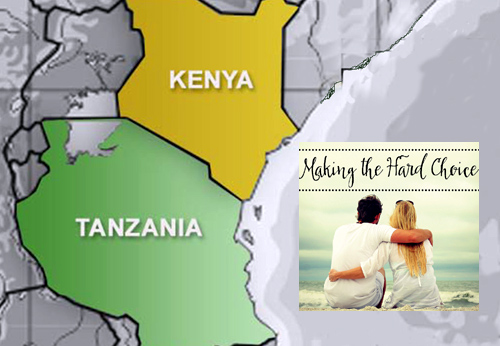
KenyaOrTanzaniaMy five months in Africa ended this week. If you’re trying to decide between visiting Tanzania or Kenya, I’ve got the answer.

My answer, if you’ve got the cash and time, is both. But if you’re watching your vacation dollars and have limited time, the answer is Kenya.

Here’s why.

First of all why does it take more time and money to visit both countries? The two countries share almost a 500 mile-long border with quite a few border posts, and much of the border actually goes right through abundant game controlled areas.

This isn’t just an issue of the additional costs of visas or shots.

The answer is because the two countries have intentionally made it difficult for tourists to visit them both on the same trip. Both countries believe if they force you into an all-or-nothing situation, they’ll be better off.

Since 1979 the border posts that fall in game controlled areas have been closed to tourist traffic. So, for example, the most important one, the border between Kenya’s Maasai Mara and Tanzania’s Serengeti, isn’t just closed, it’s now grown over with jungle.

The Sand River bridge which used to deliver tourists between the two countries is ready to collapse. I wouldn’t use if I could. (Click here for my blog that explains why this happened in 1979 and has never changed since.)

So to travel from one game park in one country to another game park in the other country, you have to go back to a border post which allows tourist crossings, and this usually means traveling backwards a lot.

The cost, for example, to travel from a camp on the southern bank of the Sand River in Tanzania, to one you can see across that same river in Kenya, is about $600 per person and at least 8 hours if you fly the whole way.

It will take at least the entire day, and that often doesn’t make sense, because if you try to do it in a day, you’ll have to leave at the break of dawn and won’t arrive in the other country until late in the afternoon/early evening, yet you’ll be paying full game viewing fees (twice!) for each country on a day that you won’t have any time to do game viewing!

So die-hards wanting to see both countries recognize that it’s better to do something else in between, breaking up the long circuitous journey, if that’s nothing more than just seeing a city like Nairobi. And that’s where the concept of needing more time starts.

And then you get into the problem of having to whittle away principal attractions in each of the countries to make enough time to see them both, or if accepting only the very prime attractions in each country, you’re looking at a safari of more than two weeks.

Add to this that “open-jawing” your international air fare (flying into one country but returning from another) is considerably more expensive than simply roundtripping one.

As a general rule, you’ll need 20-25% more time and money for the same amount of sightseeing and game viewing if you visit both countries instead of only one.

Both Kenya and Tanzania have a superb list of incredible attractions, game viewing and otherwise. If they opened their borders a tourist could approach them both as a single country, East Africa.

But they haven’t, and they won’t in my opinion. So I’m beginning to think that most travelers conscious of their travel budget and holiday time ought to choose one or the other and might do so realizing they’ll return another year to see the other one!

The same strategy that most Americans apply now to Europe’s many diverse nations ought to be applied to East Africa.

So if you’re contemplating a “first time safari” for next year – which country should it be?

Kenya.

Here’s why.

1. Kenya is growing more stable than Tanzania.
Safety, and even more importantly, the perception of safety is probably the single-most important factor when people choose an exotic destination to visit.

Last month, President Obama visited Kenya. Last month, the British government removed its travel warnings from Kenya’s most vulnerable area to Islamic terrorists, the beautiful Indian ocean coast.

2. Travel is cheaper and easier to Kenya than Tanzania.
Nairobi’s new airport is astoundingly modern and efficient. You’ll think you’re in Europe. Tanzania’s two airports, Kilimanjaro and Dar-es-Salaam, are losing not only service from Europe and beyond, but they’re losing electricity!

In my many visits in the last five months to Kilimanjaro airport, there were no less than a dozen power outages as I waited for my clients to arrive!

There is much more service to choose from flying into Kenya than Tanzania, and it looks now like Delta will be flying directly to Nairobi starting early next year.

3. Tanzania’s October election could be troublesome.
On the negative side and as I’ve written several times in the last few weeks, Tanzanian politics are heating up. It could be very good for the country, and there are many reasons to think that Tanzania will not go through the troublesome period of political change that Kenya did about ten years ago.

But there are also many reasons to think otherwise. A very contentious national election is scheduled for October 24, and I worry that the main candidates in both factions are talking less about the issues than “keeping the election peaceful.”

Even China — normally an aggressive side liner that never interferes with foreign elections – cautioned Tanzanians Wednesday about violence in the October elections.

4. Kenya is more aggressively conservationist than Tanzania.
Then there are gnawing conservation issues becoming toxic in Tanzania, beginning with the lax enforcement of ivory poaching, the relocation of Maasai just outside the northeastern Serengeti to increase a private Arab hunting reserve, and totally rebuffing conservationists’ attempts to slow down the planned dam and mine in The Selous.

None of these is serious enough for you to cancel a Tanzanian safari, but Kenya in contrast has high positive points on all of these named measures, and so if having to choose one over the other, I think it’s now a slam dunk.

Remember who’s writing this. The Serengeti remains my favorite place in the world, and that’s in Tanzania. My great migration experience these last 8 months in both countries convinces me it’s best in Tanzania.

But the time … money … and safety perception components of creating a great safari are now all tilting towards Kenya.

Obama Visit is Just Fine

Obama Visit is Just Fine

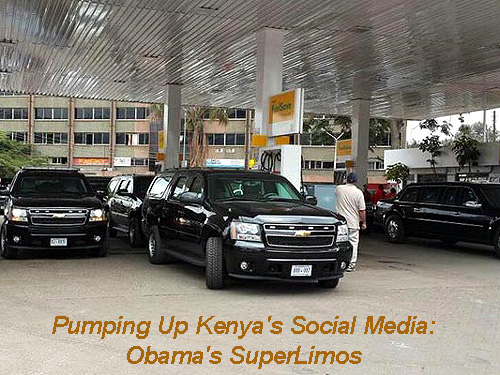
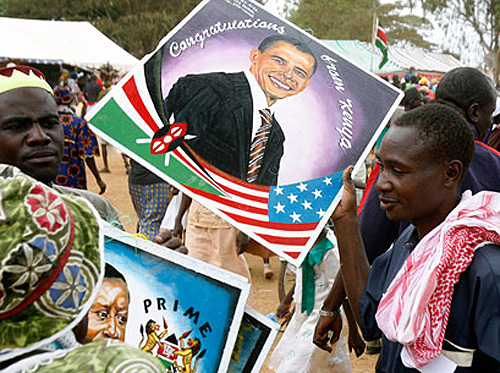
ObamasSuperLimosKenyans have never expressed such glee and excitement as for Obama’s visit Friday, but why is our President coming?

I’m in East Africa to guide my last safari of the year, starting Saturday. Thank goodness my clients aren’t arriving Friday!

Obama’s pragmatism is driving his third visit to Kenya Friday, (with a quick and very controversial stop on the return Sunday in Ethiopia). His previous two visits to Kenya, as a student then as a Senator, were not nearly as important.

City roads – normally congested beyond belief – will be cleared for his motorcades. Social media is overflowing with pictures of his super limousines filling up with gas.

“We have filled the potholes, cleared the garbage, run the homeless street families out of town, aired the drapes, polished the crockery, beefed up security, and for the umpteenth time attempted to ‘beautify’ the landscape on the main thoroughfares into the capital city,” writes Nairobi commentator Gaitho.

The Right claims the visit is proof of Obama’s cavalier foreign policy: They wrongly consider Kenya more dangerous than Ferguson, Texas or Baltimore. And even if it were, better to thumb your nose at terrorists than cower inside Beltway fantasies.

Unshackled by the presidency Obama was outspoken when he came before, which he is not expected to be this time. It’s unlikely he will stake any controversial policy issues.

Many groups in Kenya are hoping otherwise, however, with large demonstrations planned for support of gay rights and separately, for the end to Kenya’s involvement in Somalia.

Both issues are American driven: it’s fair to say that the recent movement throughout all of East Africa to suppress gay rights is the culmination of a number of American programs and policies promulgated under the Bush administration.

It’s widely known here that Obama flip-flopped at least on the extent of his support of LGBT rights. The Kenyan gay community hopes that he will express that tolerance as rectification of a super power, not just as an individual.

Kenya would never have invaded Somalia in October, 2011, without enormous American hardware, support and training. The country has paid dearly for that, with numerous terrorist revenge attacks in 2012 and 2013.

Women Empowerment Kenya” is leading that charge, but has wide support throughout the country.

That’s the point, friends. Obama’s presidency has been so contained by a rightist Republican onslaught on his person and policies that everything he’s done in Africa has been behind the scenes. It’s not his choice to be limited to “symbolic” actions.

It drives me crazy the way respectable media call this visit “symbolic“ implying that he’s capable of more than. Much of the world – even in London – doesn’t understand how hand strapped a president can be by Congress.

The Somali war was never a legislated program in either the U.S. or Kenya, yet it is arguably the single most profound event to have befallen Kenya in modern times.

It was Obama strategy. I’ve often written that I felt it was a bad strategy and an even worse move done as secretly as it was. But the man believes in it, and he comes to Kenya owning up to it and undoubtedly to continue to support it.

The reversal of C-Street machinations in East Africa that so suppressed the gay community was also “behind the scenes.” Obama might reverse that with this visit.

Like all Third World countries, Kenya experienced a horrible crush albeit delayed a few years from the Great Recession. But that also came at a time of civil upheaval after the troubled and violent 2006/07 election, and then the Somali revenge for the invasion near crushed the spirit of the country with nearly continuous terrorist attacks.

All that seems behind Kenya, now. Somehow, this country has emerged if not renewed at least recharged. If Obama’s footsteps onto the country do nothing more than affirm this amazing resilience, it’s worth it … for both countries.

As for Ethiopia, one of the cruelest and most ruthless autocracies on the continent and with which the U.S. really has little in common, need I say more than that China has financed the world’s biggest dam here, one that could seriously stress the flow of The Nile?

At least Obama brings the U.S. to the table. To suggest the U.S. can ignore an issue of this magnitude is lunacy. Surely it’s worth the few hours stop scheduled.

So stop the complaining. I wish we could do more, but until we have more reasonable legislators in Congress, Obama’s doing the best we can.

OnSafari: The Migration

OnSafari: The Migration

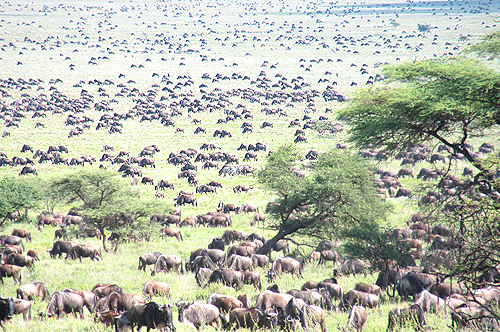
From Naabi Hill looking west.The greatest wildlife spectacle on earth has become unpredictable because of climate change, as awesome as it remains.
Today my McGrath Family Safari left the Moru Kopjes at 7 a.m. and arrived our camp near the Mara River on the Tanzanian side around 5:30p. During that time we saw two enormous groups of wildebeest, despite reports that they were all in Kenya.

From just after the Grumeti River near Seronera to Lobo, a distance of about 25 miles, we drove continuously through wildebeest. I estimated a quarter to a third of a million.

After we arrived at the Kenyan border for lunch, we headed west then north again towards the Mara River. From about the Lemala Camp position on the river to about 10 miles southeast of Kogatende, we saw another 100-150,000.

If my very rough estimations are even slightly correct, it means that we saw – today in Tanzania – from around a quarter to a third of all the wildebeest and zebra known in East Africa.

Is this the migration?

For years and years, 30 of my own career to be exact, the more or less circular migration of the great herds was a given that you get nearly set your watch by. Safaris were appropriately planned several years in advance to intersect the best of the great herds.

The beginning of the year began with the rains that attracted all the herds together on the southern grassland plains. Here they calved – all of them, around the last week of February. There was a minor hiatus in precipitation in February in the south, more in the north, but the rains were continuous until often an abrupt stop in late May or early June.

A few weeks later the herds freaked and started running north. The calves were strong enough by then to do so.

They would sometimes break into three sections, often not, with some going into the western corridor and others sticking to the eastern Serengeti. Then by the end of June, virtually all the wildebeest moved across the great Sand and Mara Rivers into Kenya, where they stayed until October.

It just doesn’t happen that way, anymore. Calving is erratic and occurs almost everywhere on the migration route. This year hardly any calving occurred on the southern plains.

Read my “OnSafari” reports for the last several years. This year we found most of the migration in March where it traditionally would have been in June, and we later found it in April where it traditionally would have been in February.

On the McGrath safari last Wednesday, we left the crater to enter the Serengeti. We visited Olduvai, where it was bone dry and few animals, but by the time we hit the Lemuta Kopjes the plains were covered with wildebeest.

From Lemuta west to the main Serengeti road, we easily saw 100,000 wildebeest. This is an area where traditionally they calve in February. Today is nearly July.

In all these unusual cases, the wildebeest were where the grass was growing, of course because it had rained. The rainy season is now all mixed up. Overall precipitation is greater than normal, but it comes in dangerous torrents followed by mini-droughts.

The wilde are adjusting.

The “migration” was never only wildebeest. It was a third zebra as well, but I’ve also noticed that the zebra are separating from the wilde in ways they didn’t before. For the last several days with the McGraths, for example, we encountered around 20,000 zebra starting at the Simba Kopjes through the top of Seronera and west into Moru.

Zebra, no wilde. (Well, maybe one or two or ten or twenty.) And today with the fractions of millions of wilde we saw, hardly any zebra.

Zebra have different eating habits and preferences than wilde. Perhaps climate change is differentiating these even more.

This is fascinating and perhaps troubling, but nowhere near as troubling as the commercial sites, like herdtracker.com, which claim to tell you where the wilde are.

Today, well, the wilde are everywhere. Large herds literally can be found in the furthest south and furthest north part of the Serengeti. Presumably, too, there are many in Kenya.

Irritated by sites like herdtracker.com motivated by commercial advertising, the Frankfurt Zoological Society is in the beta stage of a much more exact migration locator which will be launched soon as SerengetiTracker.com.

The FZS is radio collaring a number of different wilde which it believes come from different parts of the herd, and these will be tracked by satellite.

This is good, but not even this will be complete.

Meanwhile, my McGrath Family Safari couldn’t be happier. After all, they weren’t supposed to have seen the migration.

Matatu Kindness!

Matatu Kindness!

matatumadnessWonderful news out of Africa to end your week: #matatukindness.

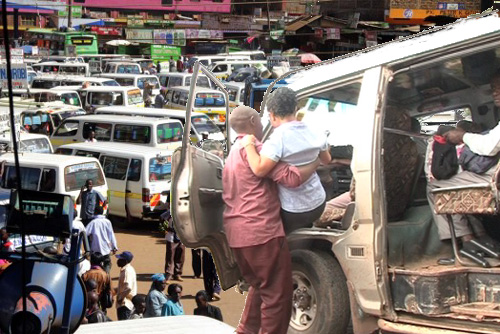
Matatus are private taxi/limos in East Africa’s big cities. They are so much cheaper than a regular taxi and so much more dependable than public transport that by one account they handle more than 90% of Nairobi city’s passenger transport.

Some like me have argued that it is free enterprise gone wild, because there are never enough matatus, so the demand is extreme.

But this is African capitalism, not Adam Smith’s. High demand doesn’t necessarily mean high prices. Even the most desperate clerk trying to get to work or the most dedicated teacher trying to get to school will refuse to pay more than she feels justified.

This stressful and never-ending battle between “tout” (the guy in the matatu calling out its route to potential travelers, deciding if someone is too big to fill the remaining tiny space available, and negotiating, collecting and providing change for payment) and the passenger is one of the most dynamic and pervasive African-capitalist transactions in East Africa, today.

I actually think it effects the price of airline tickets and Mercedes C class.

Imagine a car park with 600 too many vehicles somehow nearly stacked on one another and filled to the brim with human life, and the “tout” arguing with the last passenger for the last available space (with 60 other passengers screaming behind her) over whether it should be 100 shillings or 95 to Limuru.

She usually wins.

That’s life in the big city. But this absolutely essential commodity, transport, creates a working class of people that are pretty adamant in what they should pay for things.

Little sympathy goes to the poor matatu owner, driver and tout. That’s understandable when the media uncovers huge matatu mafia magnates. In Swahili transliteration it became Mungiki, which lingers even today in certain parts of the Rift Province as real organized crime.

The current president of Kenya, Uhuru Kenyatta, had been charged in the World Court with a variety of crimes linked to his involvement with Mungiki.

But in the last several years the Kenyan government has managed to separate a lot of Mungiki from Matatu, and to be sure, there are many small, independent matatu owners.

One of them, Josphat Mwangi and his tout, James Njau, have caused a marvelous stir in the mayhem of matatus. For nearly two years, now, they leave the market high prices of rush hour for a short time so that they can transport for free disabled persons.

One of Kenya’s struggling but persistent local organizations is the National Council for Persons with Disabilities.

Hardly two or three generations ago, most Africans born with a disability were killed. Even today a stigma is attached disabled persons that makes survival except in the more developed cities problematic.

“We at the council have persons with disability forming half of our staff [who] were resigning … because of transport challenges,” said the council chairman, Dr. David Sankok.

So enter Mwangi and Njau. No special devices or special cars. Just leave the market at its highest bid, carry the deserving person into a seat in your matatu, pack their wheelchair or other implements then transport them for free.

Neither Mwangi or Njau have spoken publicly. They don’t have time. There’s another fare waiting for Kinoo!

Should Obama Visit to Kenya Go On?

Should Obama Visit to Kenya Go On?

obama-kenya-2Obama’s end-of-July one-day visit to Kenya is causing as much controversy as Bruce Jenner’s to the New York Gym. Why?

People leaning left like Robert Rotberg writing in Politico have a litany of reasons topped by a presumption it’s too dangerous. To me that proves many on the left are as dangerously myopic as they claim people on the right are.

Those on the right see it as an opportunity to prove the birther theories.

Even many Kenyans are shocked by the cost and expected mayhem that will result from the single-day visit.

The White House announced the visit several months ago. The principle reason given was that Obama will attend the 6th annual Gobal Entrepreneurship Summit, which is traditionally hosted by developing nations whose economies are showing significant promise.

Like Kenya.

I think that announcing the date of his visit several months in advance is tempting fate, and I wouldn’t be surprised if his arrival an departure details changed at the last minute. But there are many diplomatic reasons that Obama needs to visit Kenya, now.

First is that he’s already visited Tanzania. Tanzania and Kenya are the Tweedle-Dee and Tweedle-Dum of East Africa, but security at least until recently has always been better in Tanzania if for no other reason than it’s a few hundred more miles from Somalia.

But visiting the poorer cousin scoffs the successful one and Kenya’s security has definitely improved.

At the time of the Tanzanian visit the president of Kenya was under indictment by the World Court for crimes against humanity. Those have now been dropped removing that very significant diplomatic barrier.

Kenya’s role in the “liberation of Somalia” and thus a necessary component of Obama’s pursuit of world terrorists was singularly important, entirely supported by the U.S. Kenya was in effect the U.S. proxy. It’s understandable Obama wants to validate this relationship.

After nearly a decade of monopolizing Kenyan investment, the Chinese have retracted somewhat. This gives the western world important entres they didn’t have just a year ago. Coupled with the GES conference, Obama’s hard-core reliance on capitalism necessitates he recognize this situation.

Finally, I’ve never felt Obama mastered his position of power as he should have. He will go down in history as a weak president. I’ve also felt his spirit was robust, it’s just that he was entrapped by the enormity of the institution. For example, he appointed Elizabeth Warren to oversee his most significant reformation of the financial system even while retaining as his closest advisors the people she is most critical of.

So, perhaps more hopefully than realistically, I see Obama visiting Kenya as a rebuff to his own administration’s ridiculously layered and duplicate travel advisories on Kenya. I know that tourists don’t have an extra $60 million to drop out for their security, but still, if the President can go, why shouldn’t you?

In some form esoteric or otherwise I think Obama wants to deliver this message.

So it makes sense, diplomatically and psychologically, and with the power of a reinvigorated CIA and chance changes in scheduling, a net plus for everyone.

So I’m certain it will happen. My ultimate source for this opinion is Mama Sarah, Obama’s step-grandmother and closest living relative in Kenya. He’s visited her before, but …

she expects him, again.

The Man is Back

The Man is Back

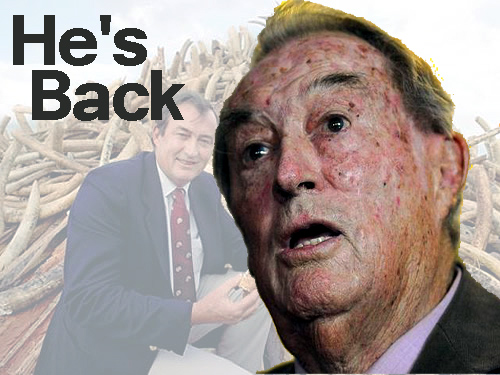
richardleakeybackRichard Leakey is back. Not as the paleontologist. Not as the politician. As head of Kenya’s Wildlife Service. Window dressing at its finest!

Leakey is a very enigmatic character. I immediately disliked him during our first meeting in the late 80s when he was flying high as the architect and czar of the movement that was successfully stopping elephant poaching.

His accomplishments were many and a few years later he would demonstrate some exceptional personal courage when he was nearly assassinated while trying to develop a progressive political party in a country that at the time was being run by an iron-fisted dictator.

But he has had a lot of missteps in a variegated career that spanned science, wildlife administration and raw politics.

That’s his critical flaw: doing too many things, so doing nothing exceptionally.

Last month Kenya’s president, Uhuru Kenyatta, appointed Leakey “Chairman” of the service that he founded almost 30 years ago, the Kenya Wildlife Service.

The position is similar to the chairman of the board of a corporation, so technically Leakey is not supposed to be involved in the actual running of the now massive organization. Local observers, however, think he might have more proactive inclinations.

Nearly fifteen years ago London’s Guardian newspaper asked if “there is any more fight” left in Richard Leakey? Leakey was certainly in the nadir of his many careers then. He was never charismatic like his father, but his public persona had just taken a whipping when he mysteriously resigned from the head of a “dream team” America helped create in Kenya to battle corruption.

His health is reported even worse than when I last met him at the Field Museum in Chicago on the anniversary of his father’s 100th birthday in 2003. Then, he seemed hardly able to talk.

I think Kenyatta appointed Leakey, so soon after a stream of American celebs including Kerry and Clinton visited Kenya, to reconnect with America and the west. Leakey, and his father Louis, are adored in western circles where they had extraordinary success fund raising.

Kenya is in a bit of a slump right now. The vicissitudes of Americans not understanding the ebola situation, the recession in Europe from which the bulk of Kenyan tourists have always come, and the lingering worries about terrorism following the country’s invasion of Somali four years ago have all combined to really challenge an otherwise dynamic economy.

Kenya Airways, which I think is one of the finest if not the finest airline in Africa, came under government scrutiny today for losing more than $100 million dollars last year at a time when most global airlines were making tons of cash.

Relying more and more on outside foreign aid, particularly because of the Somali invasion, Kenya’s internal engines are sputtering and Kenyatta recognizes that only foreign investment will reverse this.

IBM, for example, has yet to fully fund a major Kenyan investment that it announced in 2012.

In my opinion none of this heralds any real crisis but simply demonstrates how susceptible a young emerging nation is to western fears.

“Poaching” is a topic that still commands American attentions. Africans understand much better than westerners that there really isn’t an elephant poaching crisis right now. But westerner’s insatiable need for crisis has narrated a different story, and Leakey is still known as the pivotal character that stopped the real elephant poaching of the 1980s.

Savvy President Kenyatta understands he has to now stroke American psyches. Appointing Leakey is part of this strategy.

Stability at What Price?

Stability at What Price?

freedomprosperityAre freedom and prosperity at least somewhat mutually exclusive? Why is Africa so stable, today?

There is serious turmoil in Burundi, but in the major hothouses of death and destruction, Nigeria, Somalia and South Sudan, right now there is a remarkable level of peace.

Tuesday, Secretary of State Kerry became the first high American official to visit Somalia since Blackhawk Down in 1993. Kerry justified his visit because Somalia “is turning around.”

There are many wonderful indications to suggest this is true.

There is worrisome fragility in the current Mali government, and troublesome weakness in a number of West African governments probably due to the prolonged ebola outbreak, but governments in North Africa and sub-Saharan Africa (other than Burundi) look strong and stable.
Why?

The answer is becoming clearer and clearer. Very strong military assistance mostly from the U.S. and France has propped up existing governments and laid to waste many areas of terrorism.

The starkest of the stark is Nigeria.

Literally for the last 5 years Nigeria was decimated by Boko Haram, at its worst situation (hardly a few months ago) ceding nearly 20% of its territory to terrorists.

Today Boko Haram is absolutely on the run. The explanation from one of Nigeria’s best media outlets:

“Unlike a year ago, when Nigerian troops would run away from Boko haram militants after running out of ammunition or for possessing inferior weapons, the Nigerian soldiers are now better armed, better equipped and better motivated.”

‘Better equipped’ is the understatement of the decade. The list of new equipment in the hands of Nigerian soldiers is astonishing, particularly when compared to the situation less than a half year ago.

It was not for wont of giving. The western powers were ready, as clearly demonstrated by the current situation, to arm the Nigerian military sufficiently. But a mixture of local politics and western hesitation because of the equivocal politics kept the ammunition in warehouses until now.

Legitimate concerns with protecting human rights were front-and-center in the paradigm that kept the previous Nigerian government of Goodluck Jonathan weak. These have been cast to the crows by the current president Buhari, a former general nearly imprisoned by his own society for human rights’ violations.

Ditto in South Sudan, the more “peaceful” Somali and ever more stable Kenya.

In addition to arming Africa to the teeth, Obama’s militarism these last six years has decimated terrorist cells and American drones have wiped out more than two dozen terrorist leaders.

Media freedom is a great barometer of authoritarian governments, since there has never been a government in the history of mankind that wasn’t vain.

Press freedom is under serious attack in … Nigeria, South Sudan and ever more stable Kenya.

So that’s the reason it’s safer than ever for you to travel to Africa: growingly authoritarian governments infused with western military might.

Regular readers of this blog will know that I’m troubled by this. I’m delighted that Africa is a calmer, safer, more stable place, but troubling if at the expense of freedom and the sanctity of human rights.

It seems that this age-old paradigm is near inviolable. Freedom and prosperity are at least somewhat mutually exclusive.

But wait.

Didn’t we try this, once? Weren’t there horrible South American generals and racist American governments and horribly cruel potentates that ruled the world for a long time not too long ago.

Did things get better? For whom?

Compromises Galore

Compromises Galore

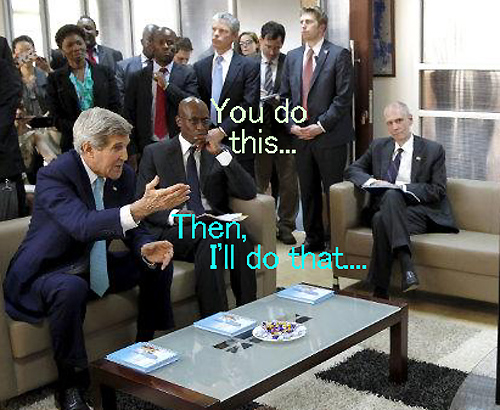
KerryInKenyaBill Clinton, John Kerry, then Barack Obama, a sort of reverse greeting line that heralds the end of frosty relations with Kenya. Let’s call it compromises galore.

Politics is so damn slimy. I know how important Kenya is in Africa. I know how exceptional its youth, in particular, is and how imaginative its culture has become.

I know that in a future world, Kenya will be much more important than it is, today.

If I know it, then Bill Clinton, John Kerry and Barack Obama know it, too. The difference between them and me is that I don’t have to ignore the travesties of human rights that Kenya’s current leaders employed in their rise to power.

Uhuru Kenyatta should not be the head of anything except a mafia, and certainly his vice president, William Ruto shouldn’t be, either.

The two orchestrated horrible violence following the 2008 elections, ironically in part against one another’s followers. When the evidence for this was gathered then meticulously catalogued, and when the individuals supplying the evidence were sequestered under witness protection in Europe, not a man in the world – except them – denied it.

Then one by one the witnesses recounted or disappeared. The evidence dissolved. The two who had been arch enemies from different tribes that historically killed one another struck an alliance and were elected to lead Kenya.

The outcome, today, is that Kenya is prospering when many African countries aren’t. One could argue that the millennial enmity between the Kalenjin (William Ruto, the vice president) and Kikuyu (Uhuru Kenyatta, the President) tribes has been laid to rest.

The War Against Terror has been successful from the point of view of the United States, because the U.S. is much safer, because Kenya became the sacrificial lamb, invading Somali with American might and dollars and taking care of more than a half million refugees.

But Kenya doesn’t mind being the sacrificial lamb because the investment – much of it military – has raised it from the 13th to the 9th largest African economy in only five years.

I think Kissinger called this Realpolitik.

They’re happy. We’re happy. So why am I not happy?

I guess because in today’s world ends do justify the means. The timeline for this dynamic, though, is historically short. The longer a view you take, the less it’s true.

The machinations, manipulations, abject brutality and horror of Kenyatta’s and Ruto’s actions to achieve power have resulted in a more stable, prosperous Kenya and one that may even be tackling the most horrid affliction of emerging cultures, corruption.

Yet in accomplishing these lofty goals some very nefarious means were employed, among which is included sacrificing their own country’s peace and stability for America’s. The sale price was pretty good, though.

So as each level compromises to achieve something good by sacrificing a bit of morality, the ladder down to iniquity is built. It becomes institutionalized.

This logic is where I strike brotherhood with the Far Right… or the Far Left. It’s where compromise is bad.

Ultimately, I guess, it’s a matter of degree – how much you compromise for what ends – a very subjective exercise and who among us can judge whose subjectivity is correct? Me? Kerry? Uhuru? Bush?

Hillary? omg