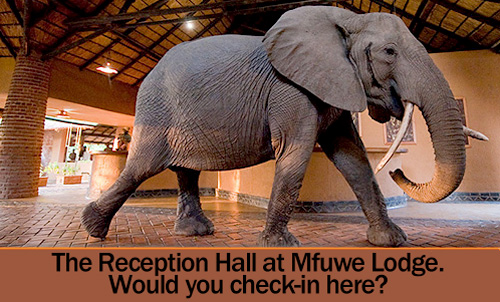
I know most of you go on safari to see animals, but how about to be stepped on by them? Right, would you like to be stepped on by an elephant during your safari? It can be arranged.
Zambia’s biggest, arguably best and certainly most famous game lodge, Mfuwe Lodge, presents a special opportunity to its residents from October – December. You can be squashed by elephant.
The lodge is a truly wonderful place, near a river in Zambia’s best game park. By today’s standards, it’s fairly if even value priced. The problem has nothing to do with the politics in the area; Zambia’s politics is a constant clutter of insignificance. It’s not because of AIDS or too many mosquitoes or anything of the sort.
That report by London’s Daily Mail was first published in October, 2008, nearly three years ago. And the lodge hasn’t figured out a way to stop it, yet.
I called the lodge Tuesday morning and spoke to Client Relations Manager, Lucy. She confirmed that the elephants came last year and are expected this year. When I asked her if it wasn’t dangerous, she replied:
“I’ve been here for 4 years and nothing’s happened. When they come through we make sure that the guests are out of the way.”
Don’t they break things in the lobby? I asked. “If the juice is out, they might come and drink a glass of juice.” How many? I asked. Well, the original family is 10, but now there’s a second family that also strolls through the hotel.
Mfuwe Lodge has been around for as long as Luangwa welcomed tourists, which is many decades, but it was rebuilt five years ago. The story goes that they didn’t realize they had built the hotel right on a “migration route” for elephants.
Well it’s not exactly a migration route. It’s just that the new hotel layout cuts off a grove of wild mango trees (loved by elephants) from the greater surrounding bush.
Ele would not normally walk through a building, no matter how attractive was the fruit stand on the other side. But Luangwa is not and is not supposed to be a normal place. This is where walking safaris were pioneered by Norman Carr years ago. And the tradition has been preserved to the present time. The animals here are much more acclimated to people than elsewhere in Africa.
I consider that a danger. It’s a danger that once advised may not be considered serious enough to change your travel plans, and to be sure, if you want to walk among wild African animals, this is probably the safest place in Africa to do so. I don’t recommend walking with animals, anywhere. Note that Luangwa is a great place for traditional vehicle safaris.
The walks in Luangwa are led by trained, armed guides. Presumably check-in at Mfuwe does not include an elephant gun rack.
But if you stay at Mfuwe Lodge when the wild mango are ripe enough for the ele (usually the first of October through the end of the year), they’ll most likely be joining you for tea.
The Mfuwe Lodge elephants are clearly habituated to people. So are zoo elephants, but I’d be hard pressed to find a single zoo director in the world that would allow patrons to get this near them.
It’s a mistake that’s been fortunate enough to have had no consequences, yet. Don’t you be there when it does.
At last! You will finally know how much the airline ticket costs, you will be justly compensated for being bumped or delayed, you can change your mind up to 24 hours after buying a ticket, and more! Am I dreaming?
No. This is what good government regulation means, something that we’ve not had since Reagan fired the air traffic controllers, deregulation buried a lot of good airlines, and big business subsumed what used to be a fun thing to do, fly.
(And imagine, it’s taken the Obama administration nearly 3 years to do this.) The rules were adopted by the Department of Transportation (DOT) in April and come into effect, today.
Well, part of the rules. The airlines objected so incessantly, their lobbyists unrelenting, that at the risk of Congress intervening the Obama administration has delayed implementation of some of the rules until January 1.
Here’s the breakdown: first the rules that go into effect TODAY:
BUMPED
At last U.S. passengers will be fairly compensated, as in Europe. If you’re bumped from a flight you can demand compensation of twice the value of your ticket, if the airline figures out another way to get you to your destination within three hours. This compensation is capped at twice the ticket value or $650, whichever is lower. If the delay is more than three hours, you can demand four times the ticket value up to $1300.
DELAYED BEFORE BOARDING
Unfortunately, a “Passenger’s Bill of Rights” similar to what exists in Europe where specific rules exist to compensate delayed passengers didn’t make it through the lobbying process this time, and I really see this as a terrible flaw in the new regulations.
Compensation for delay remains entirely up to the airline, and in many cases, to the gate clerk handling the actual flight. Flyers advocacy organizations, like FlightMole, have reported recently, however, that airlines seem to be more generous now than in the past, possibly to avoid restarting this debate that they just won. But there are no hard and fast rules. You’ll still have to duke it out at the airport.
DELAYED AFTER BOARDING
Here’s where we won. If a flight sits on the tarmac for three hours or more after the passengers are boarded, the airline will be fined $27,500 per passenger! Now this requires some rumination. That’s a huge fine, even for the airlines. What’s the point?
Not to pay down the national debt. The point is that the flight will now likely be canceled rather than sit forever on the tarmac. Their argument until now was that the flight left (the gate) on time. This rationale released them from their own policies regarding delayed compensation.
No more. It’s now cheaper for them to cancel the flight and compensate you (using their own rules) than pursuing the charade of the delayed flight pulled away from the gate.
EXTRA SERVICE FEE TRANSPARENCY
This actually gets much better in January (if weirdo Congress doesn’t intervene) but today ALL fees must appear up-front on the airline’s website. You are supposed to know precisely how much they intend to charge for that 4-day old tuna sandwich once you get on board. Baggage fees, cancellation fees, must all be clearly shown.
I checked on the American Airlines site. It took quite a while, after actually booking a flight, to get the baggage regulations and I gave up trying to find the cost of the tuna sandwich.
I expect this is going to take a while. DOT is probably doing a better job than I did this morning, and I imagine they’ll be talking a lot with the airlines this week.
But the best regulations, which were initially to start today, have been delayed until JANUARY. Here’s their breakdown, so that you can keep pressure on your Congressman not to mess with them.
JAN 1: TRUTH IN ADVERTISING
I could almost cry. I’ve been screaming about this for years and years. Airlines will no longer be able to advertise a “$99 fare to Las Vegas” when the ticket price you finally pay is over $200, because of fees and taxes. From January on, an advertised fare has to be what you end up paying, taxes and all.
American Airlines has probably been the most egregious in this regards. Almost every AA ticket has an incredible fuel surcharge on it. To Africa, for instance, the fuel surcharge can be $400 roundtrip, so they can advertise a $990 roundtrip ticket to Nairobi that ultimately becomes over $1600, once their fees and taxes are applied.
And American spread the disease masterfully. American doesn’t actually fly to Nairobi, they use their partner from London, British Airways, even though the flight is called and numbered American Airlines (code-sharing).
But British Airways does fly from many American cities through London to Nairobi. So how on earth was it going to compete in the American “capitalistic” market if it didn’t show that its fares were just as cheap as American’s?
So the fuel surcharge and other hidden fees game spread all around the world.
Now (well, in January if Congress doesn’t intervene), this kind of unfairness will be over. The ticket to Nairobi will read $1600 from the getgo.
This is major, and long, long overdue. How on earth can you function within a capitalistic system when you don’t know how much something costs?
JAN 1: PURCHASE INTEGRITY #1: Right to Cancel: Provided you buy a ticket at least a week in advance, you’ll have 24 hours to change your mind about the purchase for a full refund. This is actually something the airlines have accorded travel agents forever, but now it doesn’t matter how you buy your ticket, you can change your mind if you have second thoughts up to 24 hours after the purchase.
#2: No Increase after Purchase: What? Airlines haven’t been able to get more money out of us after we’ve purchased the ticket, have they? Yes, they have. It’s not that they call you up and politely say, “Mr. Heck, I’m sorry, but we undercharged you for that flight to Cleveland. We have to charge you $20 more.”
What happened was more subtle. That special advertised on the web for $99 roundtrip Cleveland (which became $218.70 after fees and taxes) sold out almost the moment it went on the web. Running planes to Cleveland at that amount is a sure flight path into bankruptcy. So, the airline would cancel your flight altogether.
Sometimes, all they did was change the time by a few minutes and give it a new number.
You would get a polite call with many regrets and assurances that your credit card was fully refunded to the penny. Now, Mr. Heck, would you like to go to Cleveland? We have a flight leaving a few minutes later that is available. Oh, sorry, it’s $50 more though.
No more. Done and gone (well, as of January if Congress doesn’t intervene).
JAN 1: PROMPT NOTIFICATION OF DELAYS
Delayed flights are often known hours earlier than they’re announced. Here’s an example. A snow storm in New York delays or cancels the United flight from Newark to Santa Ana, a daily weekday nonstop that then turns around and comes back to New York.
This is a 6-hour flight on a 737 and there aren’t a lot of other flights into Santa Ana to begin with, so it’s not like United could redirect another aircraft there easily. But common practice has been to get the passenger to the airport even when the delay is known long in advance, and continue to process the flight as if it were on time.
To be fair, this wasn’t just meanness. United probably hoped its genius flight controllers could figure out some way to get another aircraft in their earlier. But now, if the airline registers a delay internally and that delay is more than 30 minutes, passengers must be advised immediately.
There’s more, and it’s all good. If you’re a frequent traveler, you might want to spend a weekend with DOT’s Aviation Consumer website which has all the qualifications and rules neatly laid out.
But the bottom line is a big HURRAY to Ray Hood, the DOT and the Obama Administration for forcing our airlines to be a little bit fairer!
And be vigilant, flyers! Congress can still thwart the whole thing before January first!
As indigenous people benefit from development, the majority of ecotourism projects are revealed as shams. This is because the local people get smart enough to call a spade, a spade.
I regret I can’t show you verbatim many of the emails I received — offsite — about yesterday’s blog. And I won’t violate confidences other than to say much of the world agrees with me, and by the way, that’s not really news.
But while yesterday was mostly just an appraisal of what today’s ruthless market is doing to ecotourism, there was this incessant desire by many of you to figure out a good way to resuscitate “ecotourism.” Shouldn’t we be doing everything possible to keep it alive? Hasn’t it been good? Even if the market doesn’t like it, isn’t it worth nurturing somehow?
No. While the concept of ecotourism might be lofty, it always had a darker side.
One of the greatest banner failures of the United Nations was its 2002 Year of Ecotourism. As part of that event, the UN funded the first ever world ecotourism conference in May in Quebec City. There were 500 delegates from 84 countries.
It was a contentious and raucous convention. One of the observers at the conference, a group representing the interests of the Akha Peoples of Asia, spoke for the vast majority of indigenous delegates. AKHA reported that “Ecotourism had just opened the doors to more destruction of natural resources and ecosystems; community life in affected areas was seriously disrupted; and in some cases, Indigenous Peoples were forced out of their traditional lands.”
The conference was not what the promoters had hoped it would be. There was not a sunny picture of protagonists standing before a tree that was saved by KUONI. Instead, there was incredible rancor as the more developed of the developing peoples of the world stepped to the podium one by one to denounce “Ecotourism.”
Although gauged in diplomatic language, the outcry from the developed world was too much to ignore. The report slammed African governments in particular for failing to adequately educate and otherwise make aware the exploitation of foreign tourism companies.
“Particular mention was made of commoditisation in tourism in [Africa],” the report boldly exclaimed in opening chapters. Ecotourism had promoted the “degradation of the intrinsic value of cultural items, beliefs, goods, and practices…”
“This trivialisation of culture is demonstrated by the sale of culturally related trinkets,” the report goes on, without the benefit of the creator of the trinket getting a fair price, much less for the payment of a lodge night to stay in the wilderness.
Report after report outlined situations where local people were simply not getting their fair share: That they were “being used” for profitable enterprises whose profits were not being fairly shared with them.
This is the crux of the issue, even today. Why should any of the profits of an ecotourism lodge in Africa end up in the United States? Are there any Africans who are adding to their bank accounts by the proceeds from Canyon Ranch in Arizona?
That conference ended as quickly as the promoters could do so. Not much has followed, although a very important change was manifest. UN agencies by 2003 dropped their former use of the term, “Ecotourism” and replaced it with today’s popular, “Sustainable Tourism.”
This was a crucial admission that ecology was not as important as sustainability. And frankly, I must agree with the important caveat that the two may be miserably intertwined.
To me the final blow to any hope of making ecotourism a viable concept came at the World Parks Congress (WPC), in Durban, South Africa, in September 2003. Conservation International and UNEP introduced their jointly produced study, “Tourism and Biodiversity: Mapping Tourism’s Global Footprint” which essentially concluded that tourism, and ecotourism in all its form in particular, was an “extreme threat” to biodiversity.
We came full circle in just a few years. Unregulated capitalism provided by the developed world to preserve the developing world’s wilderness, jelly coated as “ecotourism,” was now the very thing that threatened that wilderness.
The issue is complicated and global, so I appeal to you not to take from this blog the presumption that I think every project which calls itself ecotourism is bad and counterproductive. But I do believe that the majority if not the vast majority of so-called ecotourism projects are bad and counterproductive.
And almost exclusively so because the profits are not fairly shared. And as the peoples receiving those unfairly small profits used them to educate themselves, to research their situation, they began to realize that while their wilderness might not be being exploited, they were.
Remedies have begun by a lot of good companies. Many “ecofriendly” projects have started to share profits better. But this has made them more and more expensive and less and less attractive to the market.
The market, like capitalism, is cruel. And this is yesterday’s blog. The great ax in ecotourism: it won’t sell.
When you’re sick inside, the outside looks terrible: 2010 was a year of striking differences between surging Kenya and its backward neighbors. 2011 will be the same.
Socially, culturally and politically, it was a GREAT YEAR for Kenya but a BAD YEAR for its neighbors.
Kenya grew fast, started to implement a radical new constitution, improved tourism even while increasing tourist rates, and deftly participated in major global controversies like the CITES attempt to allow selling ivory and the run-up to the South Sudan election.
But the other countries in East Africa? Terrible. Socially and politically Rwanda, Tanzania and Uganda all took huge steps backwards. Contested or ramrodded elections, scandals of unbelievable corruption, and horrendous attempts to extinguish moves to improve human rights gave this part of East Africa a 20th century dictatorial look.
And the actual bombings in Kampala that killed more than 70 people almost suggest that when your internal body isn’t doing so well, you’re going to be nicked by the viruses from the outside.
For many years Tanzania’s tourism was inching up on Kenya’s, outpacing both growth and development. Last year that was reversed, and one can only suppose that tourism is sinking with the overall quicksand felt throughout the country.
It was a BAD YEAR for wilderness and wildlife. The “mini-drought” is now two years behind us, and so almost anything looks good in comparison, but there were two horrendous trends appearing throughout East Africa last year:
Poaching and Politics.
There’s always been poaching, but nothing like the corporate poaching that successfully kills and transports out of private, fenced and patrolled reserves a black rhino. That happened in both Kenya and South Africa. And in Tanzania, the Serengeti lost 20% of its wild rhinos (1 of 5, that until now were patrolled like a child in a perambulator with the Nanny’s grip fastened.)
And Tanzania in its drive to become Africa’s newest pariah first spearheaded a campaign to reverse CITES sanctions on selling ivory, and then announced it was going to kill the wildebeest migration with a road.
In Uganda, Father Museveni gave the nod to start hunting, again, and let South Africans develop the hunting of the rare sitantunga, even as its wildlife count declines.
And there’s nearly as bad a flipside to this wildlife story: where poaching and politics aren’t screwing things up, elephants are. The population explosion is eroding the population’s confidence everywhere that governments can keep the jumbo out of the farm.
It just doesn’t look good for wildlife in this turbulent and developing era in East Africa.
It’s hard to imagine 2011 can be as bad. And at the risk of jinxing the whole kebab but being true to end-of-year stock taking, I’m going to predict the Serengeti highway won’t happen, at least not completely as planned. And if we can get at least that victory, I guess the battle continues with some hope.
And with that my marker for WILDLIFE below moves from bad to good.
Strictly economically, Kenya is in the stratosphere, leaving its neighbors way behind. Now a lot of this is foreign donors nudging the county towards implementing the new constitution, so you would normally expect that to end next year. But next year is one year before the next election, and it was the last election when everything fell apart, so I feel this outside stimulus is going to continue. And then, there’s China, flooding Kenya with infrastructure money as if it’s taken a page out of Obama 2.0.
Elsewhere in East Africa, including Tanzania and despite recent fossil fuel discoveries, things don’t look so rosy. Tanzania’s debt is massive, Rwanda’s long flirtation with foreign aid is about over, and Uganda is so mired in bad bookkeeping we can only presume the worst.
I’m afraid that 2011 will be worse for Kenya’s neighbors and probably the same for near inebriated Kenya.
Here’s my summary for what it was and what it will be:
East Africa Report
2009
2010
2011
SOCIETY Kenya The Rest
Good Bad
Good Bad
Good Bad
WILDLIFE
Bad
Bad
Good
WEATHER
Bad
Good
Good
TOURISM Kenya The Rest
Bad Bad
Good Bad
Good Bad
ECONOMY Kenya The Rest
Bad Bad
Good Bad
Good Bad
Predictions are just that, based on the here and now. If Tanzania can move swiftly to its own new constitution, if Father Museveni steps down, if Karume disappears and is replaced by a coalition-building young person, then societies throughout East Africa will improve.
And with the society, so will the economy.
East Africa is booming, so many of the stories of 2010 were terrifically good news. But there were the tragedies as well like the Kampala bombings. Below I try to put the year in perspective with my top ten stories for East Africa for 2010.
1. Populace democracy grows.
2. Terrorism grows, as does the battle against it.
3. Huge stop in the mercenary purchases of Coltan.
4. Momentum for peace in the runup to establishing a new South Sudan.
5. Tourism clashes with development, especially with the proposed Serengeti Highway.
6. New discoveries of fossil fuels produces new wealth and a new relationship with China.
7. Gay Rights grow public but loses ground.
8. Rhino poaching becomes corporate.
9. Hot air ballooning’s safety newly questioned in game parks.
10. Newest early man discoveries reconfirm sub-Saharan Africa as the birthplace of man.
#1: POPULACE DEMOCRACY GROWS
Theoretically, all the East African countries have operated as “democracies” except for the torrential years of Idi Amin in Uganda. But the quality of this democracy was never very good.
Tanzania was a one-party state for its first 20 years, and that same party continues to rule although more democratically today. Kenya, Uganda, Rwanda and Burundi experienced one dictator after another, even while democratic elections at regional levels challenged the executive.
But the end of the Cold War destroyed the alliances these developing countries had with super powers. Purse strings were cut, and political cow-towing ended. All of them moved towards a truly more democratic culture.
And in 2010 huge leaps were made in all the countries towards more truly representative government. The most important example by far was the overwhelming passing of the new constitution in Kenya in a national referendum where more than 75% of registered voters participated.
And like the U.S. election which followed shortly thereafter, and like support for national health care in the U.S. and so many other issues (like no tax cuts for the rich), Kenyan politicians dragged their feet right up to the critical moment. They tried and tried, and ultimately failed, to dissuade Kenyans from their fundamental desire to eliminate tribalism in government and more fairly distribute the huge wealth being newly created.
I see this as People vs. Politicians, and in this wonderful case, the People won!
And there was some progress as well in Tanzania’s December election, with the opposition growing and its influence today moving that country towards a more democratic constitution.
(It was not so good in Rwanda or Uganda, where stiff-arm techniques and government manipulation of the electoral process undermined any attempt at real democracy.) But the huge leap forward in Kenya, and the little hop in Tanzania, made this the absolute top story of the year.
#2: TERRORISM GROWS
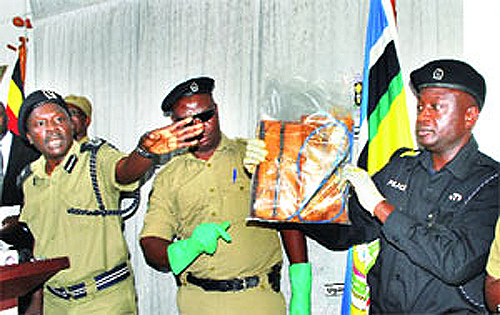
Four smaller bombings in Nairobi’s central business district over the year were eclipsed by two horrible simultaneous bombings in Kampala bars on July 11 while patrons were watching the world cup. Police display an unexploded suicide vest.
Al-Shabaab, Al-Qaeda in Somali, claimed responsibility. And throughout the year Shabaab grew increasingly visible along the Kenyan border as its power in Somali increased.
I’ve written for a long time about how the west has had its collective head in the sand as regards terrorism and Al-Qaeda in particular. Long ago I pointed out that the locus of Al-Qaeda terrorism had moved to the horn from Afghanistan, and this year proved it in spades.
The country with the most to lose and most to gain in this war on terror is Kenya, because of its long shared border with Somalia. And the year also marked a striking increase in the Kenyan government’s war on terror, and with considerable success.
With much more deftness and delicacy than us Kenya has stepped up the battle against Al-Shabaab while pursuing policies aimed at pacifying any overt threats to its security, by such brilliant moves as allowing Omar Bashir into the country and not arresting him (on an international U.N. warrant). As I said in a blog, Kenya Gets It, and the story is therefore a hopeful one.
The Dodd-Frank Act is our victory!The Congo Wars continue but are abating, and in large part because of a little known provision in the Dodd-Frank Wall Street Reform Act which now makes it almost impossible for major corporations in the U.S. to buy the precious metal Coltan on the black market.
A black market which has funded perhaps Africa’s most horrible war for more than a generation. Hundreds of thousands – perhaps millions – have been killed and raped, and more than 20,000 children conscripted into brutal wars, funded by purchases of Coltan and other precious metals by Intel, Sony and Apple.
It certainly wasn’t just this little legislative move. The U.N. peace-keeping force, fabulous diplomatic initiatives by Uganda and a real diplomatic vigilance by the U.S. all were instrumental. But the year ended with the least violence in the region in more than two decades.
#4: SOUTH SUDAN
I may be jumping the gun on this one, because the referendum to create a new country, the South Sudan, is not scheduled to occur before next month. But the runup to the referendum, including the registration process, while labored looks like it’s working.
Allied loosely with the Congo Wars, the civil war between the North and South Sudan had gone on for generations until a brokered peace deal five years ago included the ultimate end to the story: succession of the South into a new country.
The concept is rife with problems, most notably that the division line straddles important oil-producing areas. But in spite of all of this, and many other ups and downs along the way, it looks to me like there will be a South Sudan, and soon. And this year’s new U.N. presence in Juba, donor-construction of roads and airports, all points to the main global players in the controversy also thinking the same.
The creation of a new state out of a near failed one is not the be-all or end-all of the many problems of this massive and powerfully oil-rich area. But it is a giant leap forward.
#5: THE SERENGETI HIGHWAY & TOURISM
Last night NBC news aired a segment on the Serengeti Highway controversy, elevating an East African story into American prime time. Good.
But like so many reports of this controversy, the simplification ran amok. NBC’s reporter Engels claimed the motivation for the road was to facilitate rare earth metals like Coltan (see above) getting into Chinese hands more quickly.
While there may be something to this, it’s definitely not the main reason, which is much more general and harder therefore to fight. As I’ve often written, the highway as planned will be a real boon to the Maasai currently living to the east of the Serengeti, as much if not more than to the Chinese.
And as far as I know, Maasai don’t use Coltan.
Roads bring commerce and may be the single quickest way to develop a region. This region is sorely in need of development and recent Tanzania politics has aligned to the need for this regional development.
The highway is just one of many such issues which came to the fore throughout 2010 in Kenya and Tanzania. Concern that the west is just interested in East Africa as a vacation destination with no regards for the struggle for development, has governed quite a few local elections this year.
The whole concept of tourism may be changing as the debate progresses. I believe very deeply that the Serengeti highway as proposed would hinder rather than help development. But as I’ve pointed out, alternatives are in the works.
And the real story of which the highway story is only a part, is how dramatically different East Africans have begun to view tourists in 2010.
#6: NEW RESOURCE DISCOVERIES ALTER GEOPOLITICS
For years I and other African experts have referred to East Africa as “resource-poor.” Kenya, in particular, had nothing but potash. Boy, did that change this year!
Although only one proven reserve has been announced in Kenya, several have begun production in Uganda and we know many more are to come.
China has announced plans for a pipeline and oil port in northern Kenya at a cost of nearly $16 billion dollars, that’s more than twice the entire annual budget for the Kenya government! Deep earth techniques have matured, and China knows how to use them.
More gold has been found in Tanzania, new coal deposits in Uganda, more precious metals in Rwanda… East Africa is turning into the world’s rare earth commodities market.
A lot of these new discoveries are a result of technology improving: going deeper into the earth. But 2010 freed East Africa from the shackle of being “resource-poor” and that’s a very big deal.
#7: GAY RIGHTS ON THE HOOK
African societies have never embraced gay rights but as they rapidly develop, until now there was none of the gay bashing of the sort the rightest backlash produces in the U.S. U.S. Righties manipulating East Africa.
That changed this year, and in large part because of the meddling of U.S. rightest groups.
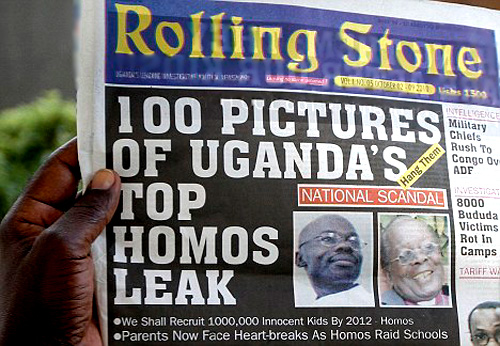
In what appears to now have been a concerted many year effort, support from U.S. righties is leading to a vote in Uganda’s parliament that would make homosexuality a capital offense, and would jail for long terms those who failed to out known gays.
This extreme is not African, it is American. Mostly an insidious attempt by those unable to evince such insanity in their own society to go to some more manipulative place. The story isn’t over as the vote has yet to occur, but it emerged and reached a crescendo this year.
#8: RHINO POACHING EXPLODES
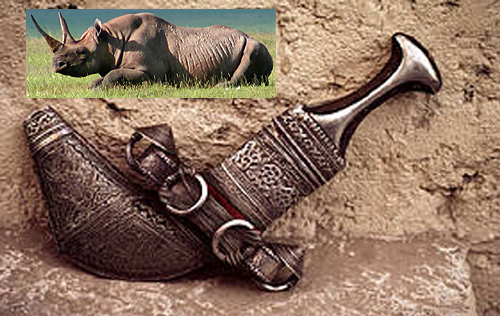
Poaching is a constant problem in wildlife reserves worldwide and Africa in particular. Rhino are particularly vulnerable, and efforts to ensure safe, wild habitats have been decades in the making. Dagger from rhino horn.
This year, they seemed to come apart. It’s not clear if the economic downturn has something to do with this, but the poaching seems to have morphed this year from individual crimes to corporate business plans.
This leap in criminal sophistication must be explained by wealth opportunities that haven’t existed previously. And whether that was the depressing of financial goals caused by the economic downturn, increased wealth in the Horn of Africa where so much of the rhino horn is destined, or reduced law enforcement, we don’t yet know. But 2010 was the sad year that this poaching exploded.
#9: IS HOT AIR BALLOONING SAFE?
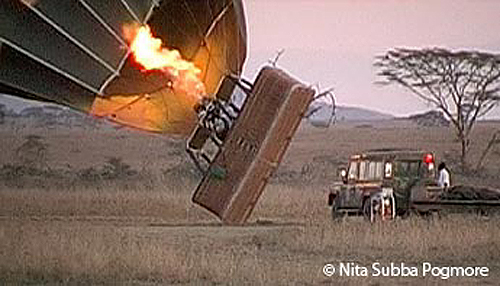
Hot air ballooning in Africa’s two great wildernesses of the Maasai Mara (Kenya) and the Serengeti (Tanzania) has been a staple of exciting options to visiting tourists for nearly 30 years. That might be changing. Is it Safe?
A terrible accident in the Serengeti in early October that killed two passengers and injured others opened a hornet’s nest of new questions.
After working on this story for some time I’ve personally concluded 2010 was the year I learned I should not step into a hot air balloon in East Africa, at least for the time being!
#10: EARLY MAN WONDERS
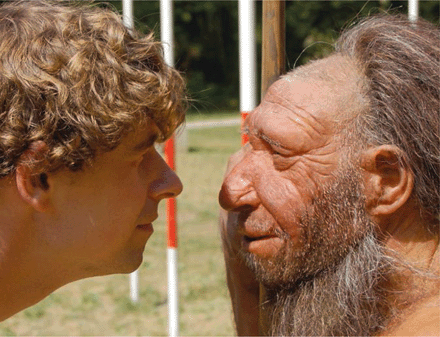
There were not quite as many spectacular discoveries or announcements about early man this year as in years previously, but one really did stand out as outstanding and you might wonder what it has to do with East Africa! Representation by Tomislan Maricic.
DNA testing of Neanderthal proved that early man from Africa didn’t wipe them out after all, but absorbed them into the ever-evolving homin species.
And that absorption, and not massacre, happened outside Africa to be sure. But it finally helps smooth out the story that began in Africa: It’s likely that Neanderthal were earlier migrants from Africa, and absorption was therefore easier, physiologically and biologically.
It’s a wonderful story, and fresh and exciting, unlike the only other major African early man announcement about Ardi which was really a much older story, anyway.
****************
HAPPY NEW YEAR to all my loyal readers, with a giant thank you from me for your attention but especially your wonderful comments throughout the year. See you next year!
Many, many people travel during the holidays. But for me, being home is the best place to be!
Our winter, snowy celebration with a large family begins today. I’ll be back blogging first thing next week!
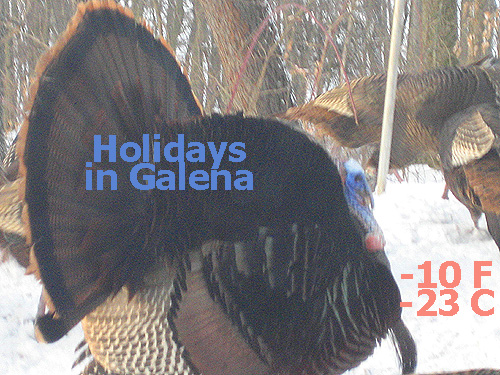
Meanwhile, and especially for my friends in Africa, I thought you’d like to see a few scenes of the wild animals outside my office in Galena, Illinois, seven miles from the great Mississippi River!
The several thousand WikiLeaks about East Africa so far tell us very little that we didn’t already know or deeply suspect. I actually find it rather refreshing.
Basically, East Africans are publicly affronted by the frankness with which Wiki frames the obvious failings of East African leaders and their positive actions as American motivated. And basically American diplomats are shown as being a bit more juvenile than adult when it comes to getting (or not) their way.
Wiki basically shows that the Big Boy got his way with the little toughs. Good. I’m glad we did. And I think most East Africans are, too. From time to time, the Big Boy ain’t so bad.
American policy in East Africa from the end of the Bush years through the present has been right on as far as I’m concerned (except for one significant item: the soon new Southern Sudan.) In the main, an A- overall.
But Wiki takes the charm out of the politics. When all the polite language is peeled from the events, when “convinced” becomes “bribed” and “suggested” becomes “threatened” there’s no question any more that American power bludgeoned its way in East Africa over the last few years:
We bribed Kenyan leaders to be democratic and we bribed them to fashion a more moral constitution. We threatened sanctions if they didn’t bring the proposed new constitution to a vote. We targeted Kenyan youth with a campaign not dissimilar to Obama’s get-out-the-2008-vote, because they were the most energized and least likely to actually vote. And so we got them to vote ..the way we wanted (which was the right way).
We raised a normally behind-the-scenes ambassador to a very public level. We did everything short of leaking ourselves the names of top Kenyan politicians we believed were principally responsible for instigating the violence following the 2007 elections, to the point that these guys became so universally known that real criminal prosecutions against them in The Hague may begin shortly.
Once outed, our ambassador was given other public tasks we hailed as “transparent.” When food that we were delivering to a famine area of Kenya was delayed at the Kenyan port of Mombasa because the bribes paid to off-load it weren’t enough, our dear ambassador took a camera team onto the gangways and started off-loading the grain himself.
We lamented that so much time had to be spent with Kenya’s growing up into a full democracy that we have let Uganda and Tanzania slide. But that doesn’t seem to matter, because they are neither as powerfully geopolitically or as economically powerful as Kenya.
OK. Take a deep breath. Wiki just ratted on the Teacher to that troublesome but promising Pupil. The rest of the class (Tanzania & Uganda) always knew Kenya was the favorite and that it was a tense relationship.
But it’s working, if you concede that current American interests are almost as vital to East Africans as Kenyan interests. I do.
So… This has all been good. Good for East Africa and good for America.
So, WikiLeaks, what was bad?
What Kenyans are currently all upset with is the derogatory name calling carried by U.S. diplomatic cables. Both the president and prime minister of Kenya are called beneficiaries of a network of old boy corruption “feathering” their fortunes “with impunity.”
Yeah. So?
That’s not news. It’s been said in public by many former officials world-wide, much less Kenyan journalists themselves. Frankly, I think this, too, is changing although it was much less evident earlier this year than now. So, anything else, Wiki?
We and Britain publically decided to embarrass Kenya in October, 2008, when a ship carrying 33 Ukrainian T-72 tanks was hijacked by Somali pirates, then freed (after ransom) off the coast of Kenya. Kenya claimed at the time that the tanks were for Kenya, despite journalists claiming otherwise that the Kenyans were creating a corridor for arming southern Sudan.
As then, I still have this intuitive feeling that we’re involved in this, but Wikileaked cables suggest we were affronted by the revelations. The cables paint Kenya as the culprit and us as the surprised school-mom and either way, this is enraging Kenyan leaders who are working so hard to making the January, 2011, elections in southern Sudan work.
I don’t like war, anywhere, but without some military hardware southern Sudan will not survive any attempt at Independence.
Wiki also underscores something I’ve been saying for a long time: China is beating America at the Africa game, the East African parlor in particular.
There’s a lot of name calling, again. One top diplomat, Johnnie Carson, referred to China in Africa as a “pernicious economic competitor with no morals.” (Agence France Presse). “China is in Africa for China,” Carson said as well to a group of Nigerians, insisting there was nothing moral or altruistic in their very large recent economic involvement in Africa.
Yeah. So?
Why is the U.S. involved in Africa? To bring righteousness and moral rectitude to the Dark Continent? Why did Stanley broker for the malicious King of Belgium? Why has any foreign government ever been involved in Africa… or anywhere else foreign for that matter?
In diplomatic niceties we say “self-interest.” When the niceties are dropped, Carson goes on and on castigating China for trying to buy UN votes and other allegiances, something that America is the ace at, especially during the Cold War.
I think this is revealing. I think this is something we as Americans should study. What these leaks reveal in the unrelenting American diatribe against China in Africa is that we’re jealous. We don’t have the cash, anymore, and China does. For years – especially during the Cold War from our government, and right until the economic downturn from our megamonolithic corporations, America spent more in bribes than anybody else.
Now, Wiki explains, China does.
We’re jealous. But the great revelation is the following:
China is spending OUR money. The money from the purchase of toys, car parts, solar panels, and kitchen utensils.
It’s ironic and terribly revealing. We’re still bribing, but not necessarily in our own interests. Rather, in China’s.
In this age of belt tightening and budget angst the impoverished State of Kentucky is going to give $37½ million dollars to a wacko anti-science group to build a creationism theme park.
Sub-Saharan Africa is the cradle of mankind. The earliest known hominid, our direct evolutionary ancestor, is at least 6 million years old. Olduvai Gorge, where so much of these marvelous discoveries were made, is top on my list of things to see on safari.
Natural selection is not immediately intuitive. It takes some study. But once you get into it, the rush is unbelievable! The majesty of living things, and man’s unique position within that, is awesome. Complexity and simplicity seem to merge in an array of life forms that is unbelievable.
No doubt what many describe as art which consumes and inspires is relational to the patterns and designs of the natural world. “Beauty” is natural engineering at its finest. To me much of the greatest beauty of the world is in Africa, where it just stands to reason, so much of it began.
Roll your cursor back and forth over the graphic below. African flower mantids have so remarkably adapted to African flowers that without a graphic like this one you’d never in a million years find them! This is beauty, complex mathematics and natural selection all rolled up into a powerful single lesson.
I’ve labored for years with people and clients who don’t believe that natural selection explains life on earth, most of whom squander in the cartoons of creationism. Only 39% of Americans believe in evolution. This is worse than embarrassing. There is no other educated population in the world with such a miserable statistic.
And the number is increasing, not decreasing. We’ve countered the limited beliefs of the critics fact-by-fact. We’ve politely and consistently tolerated the position of those arguing against evolution, giving “equal voice” to nonsense. I know, now, how wrong that was.
Creationism is wrong. It’s a lie. It’s perfectly legal to believe lies, so I’m not so insane as to suggest that people who believe lies should be somehow punished. But the time has come to firmly not reward them.
Kentucky already has a Creationism Museum that commercially is doing very well. It’s not certain and will never be known if its financial success is for the same reason that people used to pay to go to freak shows, or if there really are believers in support. But either way, institutions like it should not be subsided by public funds.
In other words, I guess we can tolerate lunacy but we sure ought not support it.
The weakness with which scientists, teachers and politicians have defended such concepts as natural selection against fringe idiots has produced a terrible legacy. Natural selection is just one of many issues like woman’s rights and child poverty and national health care that have suffered in my lifetime because their advocates have cowered to baseless critics.
Our legacy of poor defense has resulted in the U.S. dropping from Number 1 when I was in high school to 18th of 36 nations whose high school students graduate on time.
And those who do graduate are getting dumber and dumber.
As you enter the gates of the United States Grand Canyon National Park, you can purchase in their shop a “guide book” that says the Grand Canyon was formed by Noah’s flood and is only a few thousand years old.
In the last year alone, the Texas State Board of Education has ordered text books used in public schools there to question the American separation of church and state, to remove Thomas Jefferson as an influential political philosopher, to study the “unintended consequences” of Affirmative Action and Title IX, to replace “capitalism” with “free-enterprise system” and to describe the U.S. government as a “constitutional republic” rather than “democratic.”
This is the state of education in America. It has struggled to reach this nadir for more than a generation. We have allowed it to sink, because we haven’t defended with the vigor of certainty that which is science.
There is a lot of talk these days about compromise and purism. We made a mistake in my life time by tolerating as equals those who disbelieved evolution.
I don’t know if there’s time to turn it around. But if there is, there can be no compromise on the struggle. Thanks to http://dududiaries.wildlifedirect.org/.
From World Heath Organization (WHO)This week as summer rains pelted the Midwest major battles for single drops of water were raging in Africa.
We take so much for granted and nothing more necessary to almost every aspect of our lives than potable water. That may be one of Africa’s top problems, if not the single-most urgent need.
All of us who’ve traveled Africa love the picturesque image of a colorfully dressed African woman balancing an equally colorful bucket of water on her head. There must be a thousand million paintings and drawings of this image.
But it is an image we ought not covet. It’s an image of egregious want.
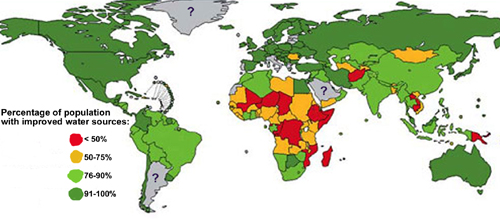
According to Unesco one billion people lack access to improved water supply, the vast majority in Africa. Less than a quarter of the households in Africa have piped water supplies, and only about an eighth of the households in Africa are linked to a sewage system.
This week two completely separate events – one an individual judicial action in Botswana and the other a continent-wide political fight in Uganda – underscore the difficulties Africa is facing obtaining water for its citizens.
At the OAU Conference currently being held in Kampala, Egypt and The Sudan are fighting an East African coalition of countries over use of the Nile.
Egypt could not survive without its hoarding of the waters of the Nile. It is otherwise a desert. Today, there is not a single drop of water entering the Mediterranean from what was once the great Nile outflow. It is dry. Dust. Egypt needs more. More for people’s daily needs and more for growing food.
Prior to giving independence to a number of countries earlier last century, the colonial master, Britain, forced its soon-to-be-freed colonies in East Africa to agree that Egypt and The Sudan would control the Nile.
That 1959 treaty is now coming under fire at the OAU. Uganda, which controls the outflow of the White Nile mostly from Lake Victoria, and Ethiopia, which controls the outflow of the Blue Nile mostly from Lake Tana, have indicated they will abrogate the treaty.
And Kenya and Tanzania, which control large portions of Lake Victoria, have indicated they may do so as well.
East Africa needs lots of water. At the height of the recent drought, more than 5 million Nairobi area residents went on water rationing that averaged running water only every other day. According to East Africa’s Flying Doctors 70% of all the hospital visits in East Africa are caused by contaminated water.
And East Africans point out that the massive Aswan Dam (which Britain opposed being built, but long after having any influence in the region) loses nearly a fifth of all the Nile’s water to evaporation.
The solution presented at the OAU conference by Egypt and The Sudan is terrifying. Egypt is offering to build a canal around the huge Nile wetland known as the Sudd in The Sudan, which would direct Lake Victoria Waters directly into the Nile basin.
This is a temporary solution that could increase the Nile’s output by nearly 50%. But it will drain the Sudd, Africa’s largest wetland. The long-term consequences are mind blowing. We all know the incredible, devastating impact that draining wetlands has on any environment.
But the question is: potable water, now, for people; or a wetland for the future? The East African countries seem ready to accept the Egyptian proposal.
And at the other end of the continent, this week a judge in Botswana ruled that indigenous Bushmen would not be allowed to drill boreholes in their reserve to obtain potable water.
The argument is that in the reserve, as in similar places in Africa (like the Ngorongoro Conservation Area in Tanzania) the Bushmen have been given the right to pursue traditional life styles, but cannot modernize. Drilling a well is modernizing.
But modern Bushmen organizations are arguing that their life needs are paramount, and that denying water in a global climate changing world is a ruthless mandate, especially when Botswana’s meager water sources are being used by country clubs in Gaborone and diamond mines in the Kalahari, the Bushman’s traditional home.
Africa is replete with crises. But there seems none as urgent as this, yet with solutions as evanescent as an evaporating mist.
The victor and still champion, Paul Kagame, flanked by the two other candidates. (Left) Kayumba Nyamwasa who is in exile. And (right) Victoire Ingabire who is in jail.Rwanda’s national election occurs in 3 weeks. That has nothing to do with who will win.
President Paul Kagame, the leader of Rwanda for the last 16 years, and prior to that, the paramount general of the Tutsi led RPF army that stopped the 1994 genocide, is the winner and champion.
Kagame has imprisoned all his viable opponents. Members of his military – which are really the political and economic controllers of the country – who have dared to criticize him have either been demoted, exiled or killed. Newspapers have shut down or shut up.
This will not be a free election.
Frankly, I don’t know if there should be a free election. If there were, the Hutu-defined factions would win. The government would be in turmoil. Businessmen would flee the country. It would cause an extraordinarily awkward situation with regards to the brutal war going on in the eastern Congo (led by Rwandan exiled Hutu extremists).
And this tiny, currently peaceful country would go to pot.
Obviously no one knows this better than Kagame. Like so many African dictators before him, he has emerged over a good period of time as a leader who has painted himself into a box of eternity.
He has been essentially benevolent and fair. Particularly in the beginning few years after the genocide, he was remarkably tolerant and forgiving. He has adroitly danced on the world stage, criticizing his donors while getting more of their money (including the U.S.). And he has overseen a ravaged and poor country grow into one of Africa’s most successful economies.
Kagame’s life goal has been to reverse the powerful currents that separate his population into two factions that despise one another. Hutus call Tutsis “cockroaches.” Tutsis – now in firm control – are less derogatory about Hutus. Instead, they ignore them, hire them for slave wages and refuse to matriculate them up the political or business ladder.
So Kagame has suffered the biggest failure of his own stated goals: he has not brought together the warring factions that led to the genocide. If anything, he has presided over an increasing gap.
And as I’ve written before, deep down it is not an ethnic divide. And this incredibly unique and confusing aspect muddies the waters even more. Hutu and Tutsi speak the same language. They have intermarried for nearly a millennia. The physical differences of their ancestry are blurred at best.
But there was enough physical difference at the start of the colonial era, that the Belgians could attempt a differentiation, and that reenergized and refined the division that lasts until today. Still, it is less an ethnic divide than a typical political class divide. The rich and powerful against the poor and disenfranchised.
Were it simply ethnic, Kagame’s task would have been easier. But he entered the modern world like any leader, anywhere. It’s not only old scores that have to be settled, it’s .. Poverty.
So yes, Rwanda is safe, and yes, Rwanda is economically prosperous by African standards. But no, it’s not free.
This is how Lamu looks NOW! Get to Kenya quick!It’s serious: lots of oil and a new scramble for (east) Africa.
We’ve known for about a month that China had found serious oil and gas reserves in northern Kenya. And we’ve known for about that same amount of time China had found new oil reserves in Uganda. And we’ve presumed for wont of anything contrary, that the expected new state of Southern Sudan will have lots of oil.
And we knew when President Kibaki came back from the Shanghai expo, that China wanted to transform the little tropical paradise of Lamu into Africa’s biggest oil port.
Well, guess who also knows: Japan.
Japanese interests, according to Nairobi’s Business Daily, are upset at the $200 million dollar no-restriction grant that President Kibaki walked home with from Shanghai, although it’s suppose to begin planning the Lamu port.
Hello modernity, good bye remote tropical paradise.
The port is now estimated to cost $16 billion, of which China has offered to put up almost 97%. It is projected to have a total of 22 berths with a quay that will lie on 1,000 acres.
But Japan is sticking itself into the oily works. President Kibaki – bless his little crafty soul – is using the Chinese grant to hire Japanese consultants to create the feasibility study!
Home run for Kenya.
“This is likely to be the most fought after project between the two countries as they seek to enhance their economic and political dominance, ” said Dr Joseph Kieyah, a senior researcher at Kenya Institute of Public Policy Research and Analysis (KIPPRA).
Japan has always been the sweeter donor to East Africa, with often unrestricted aid for truly humanitarian projects. China has never done that. So from the perspective of who would be the better friend, Japan has a leg up.
But both countries have been awarded provincial drilling rights in the southern Sudan, pending that country’s maturation into state hood after a March, 2011, referendum.
Last month, Toyota Tsusho, the car maker’s trading arm, announced plans to build a $1.5 billion oil pipeline from South Sudan to the Kenyan coast, complete with an oil export terminal.
So China builds the port and the roads in Kenya, and Japan builds the pipeline from The Sudan. I hope they’re friends.
But what this means – with the extraordinary amounts of money that are being talked about – is that both China and Japan view the southern Sudan and Kenya as its only outlet as a new Nigeria.
The estimated cost of the port and the pipeline ($17.5 billion), represents about half of all of East Africa’s 2003 GDP. More than amazing: mind blowing.
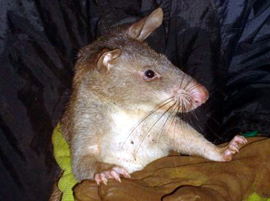
The African Giant Pouched Rat has no shadow to see.The closest African relative to the groundhog never appears.
Well, fact-check first. The truly closest relative to the groundhog is the giant forest squirrel (Protoxerus stangeri mayensis) but it may be extinct. I’ve never seen it, no one seems to care very much about it, and the only picture I could find was of a specimen collected in 1842 that is in a drawer of the Field Museum in Chicago.
But the giant pouched rat (Cricetomys gambianus Waterhouse) definitely exists, because I’ve eaten it.
I didn’t roast it, but our guide roasted it on a skewer to attract the pygmies along the Lobe River in the Cameroun that would then trade the skewered roasted giant pouched rat, to guide us to see lowland gorillas. But we, too, needed dinner.
It tasted just as good as the Guinea Pig I ate in Cuzco.
The main difference between an African groundhog-like animal (the Giant Pouched Rat) and an American groundhog-like animal (the Groundhog) is that the African groundhog-like animal does not appear on Oprah.
Nor does the African variety pretend to forecast weather. There is no movie named “Giant Pouched Rat Day” and in fact no movie made by Africans that is that incessantly trivial. African Giant Pouched Rats do not appear on 7 o’clock local television shows during the weatherman section and they do not appear to have a single day of being loved with 364 days trying to escape the landscape exterminator.
The Groundhog’s better common name is Woodchuck. The African Giant Pouched Rat’s better common name is Big Rat.
However, only the Groundhog is capable of reflecting the stir crazy mentality of someone living in the depths of an endless winter.
There have been 236 great white shark attacks on humans recorded since 1876. Oh, sorry, that’s now 237.
That statement above was a part of a lengthy June, 2008, article in the Smithsonian entitled “Forget Jaws, Now it’s . . . Brains!” which also claimed that Great White approaches to humans were mostly out of “curiosity” and that really, they’re quite friendly and intelligent.
Holy Mackerel.
Yesterday, a horrible and gruesome attack by a White Shark at one of Cape Town’s most popular summer beaches was witnessed by dozens of people. A Zimbabwean holiday maker was taken by the shark when he swam out into deeper waters, alone.
Sharks have infested the South African beaches, particularly those from Durban west to Cape Town, for as long as we’ve known about the beaches and sharks. My wife’s parents lived in Durban during World War II and like the 20,000 British pensioners that live there, today, frequented the beach during summer. They claimed whenever they went swimming, there were massive hemp ropes fastened to shore poles so that people attacked had a better chance of being pulled in for rescue.
A third of the world’s Great Whites live off California, another third off Cape Town, and roughly the last third off Melbourne. This is because these are areas of deep, mostly cold ocean waters, the most fecund habitat of the sea.
In the case of South Africa, the world’s coldest ocean, the Atlantic, meets the warmest ocean, the Indian, just east of the Cape. This mix of habitats makes it remarkably nutrient rich.
Great Whites don’t approach the beaches of Australia and America like they do in Cape Town. I know just north of San Francisco I often saw smaller sharks, myself while swimming and living there, but nowhere near as many as in South Africa. At Durban, one of the world’s greatest surfing beaches, there are all sorts of precautions taken against sharks: nets, sensors, paid spotters.
Sharks and South African beaches are a way of life. And the truth is that there are few attacks compared to the hundreds of thousands of swimmers on their beaches throughout the summer – right now.
But even so, I wouldn’t invite one over for dinner. Mackerels are much more conversational.
The current deluge in Kenya is a real human tragedy, and I sympathize with many Kenyans who are furious that their official meteorological department said the rains were going to end, not continue.
I wrote a blog about it on December 11, explaining that data available from satellites which I then published as maps, suggested otherwise: that the end of December and on would be rainy.
So this untrained meteorologist (I love my remote digital indoor/outdoor weather system), did better than the Kenyan Meteorological Department!
But in deference to my colleagues, I felt I should reprint with minimum comment the remarks of Dr. Joseph Othieno which appeared in Nairobi’s Daily Nation newspaper in response to the public outcry against the government’s weather forecasting department.
Uncertainty (sic) is an uncomfortable aspect of life, but one that pushes humanity to act. To overcome it, man has sought various interventions from soothsayers, astrologers, prophets, magicians and scientists to forecast what the future holds.
And NOAA’s special African desk for weather reporting from a stationary satellite above Africa. Try this: http://www.cpc.ncep.noaa.gov/products/african_desk/
In developed countries, extreme weather conditions are accurately predicted to the day, hour, and in magnitude.
Right.
But in developing countries, this has remained a big challenge due to a number of problems that are worsened by public ignorance….
And the weathermen are a part of the public?
Forecasting … is one of the major challenges facing meteorological services… This is worsened by ignorance, technological challenges, complex physical features and lack of appropriate data.
Like how much rain fell?
A major objective of forecasting is to unmask fate and inform the current on timely strategic interventions that will mitigate the adverse events of the predicted phenomenon, by informing policies and supporting the end user of such information to adopt accordingly.
Pursuant to meteor men proclivating outside regular business hours.
It is important for all to understand what weather forecast is all about. A forecast that doesn’t translate into light but heat is useless.
This is the reason it’s darker in winter.
An accurate forecast that induces no action is worse than an inaccurate forecast with action.
Dr. Othieno, I cannot express to you how relieved I am now regarding the future not just of Kenyan meteorological forecasting, but of the country’s destiny in toto, of its unique opportunity to shine as beacon of [hot?] light in the dreaded darkness of Third World science. Did you pass you’re a-levels? Or are you, too, planning to run for Parliament?
 I know most of you go on safari to see animals, but how about to be stepped on by them? Right, would you like to be stepped on by an elephant during your safari? It can be arranged.